Showing posts with label Ladislav Elgr. Show all posts

Thursday, 12 January 2023

Katya Kabanova, LSO/Rattle, 11 January 2023


Barbican Hall

Katěrina Kabanova – Amanda Majeski
Marfa Ignatěvna Kabanova (Kabanicha) – Katarina Dalayman
Varvara – Magdalena Kožená
Boris Grigorjevič – Simon O’Neill
Váňa Kudrjáš – Ladislav Elgr
Tichon Ivanyč Kabanov – Andrew Staples
Savël Prokofjevič Dikoj – Pavlo Hunka
Kuligin – Lukáš Zeman
Glaša, Fekluša – Claire Barnett-Jones

London Symphony Chorus (chorus master: William Spaulding)
London Symphony Orchestra
Simon Rattle (conductor)


Images: Mark Allan

Perhaps the most perfectly proportioned of Janáček’s operas, certainly one of the most emotionally and dramaturgically correct—which, in Janáček’s case, is saying quite something—Katya Kabanova has not wanted for recent performances in Britain. That is no cause for complaint, quite the contrary. That Janáček’s operas are still not at the heart of every major opera house’s repertory says nothing about the operas and, alas, a great deal about our houses and some of their audiences. Concert performances are less common: these are very much works for the stage. This current project from the London Symphony Orchestra and Simon Rattle to present a number of his operas in concert—I assume it is not all, though should be delighted if it were—is most welcome, not only for introducing new audiences to these fine operas, not only for affording the LSO (and Rattle) the chance to perform them, but also for giving us the opportunity to hear their orchestral writing in all its detail and power, such as might in part be lost when played in the pit.

Rattle certainly seemed to have conceived his reading with this in mind. It is doubtless fruitless to speculate, but I suspect some of the more extreme passages, whether with respect to dynamic contrast or tempo (at the slower end), would have been less so in the theatre. The LSO and an excellentcast responded in kind. Indeed, the glowing, dare I say Central European, tone of the opening bars promised—a promise finely delivered—a performance in which the orchestra was at least as much changed by its encounter with the score as vice versa. Doubtless, Rattle’s work with the Czech Philharmonic contributed to what we heard, but this was a Rattle rethinking at its best, nothing taken for granted, the fury of the later orchestral response again taking one by surprise, yet firmly in the spirit of composer and work. Where later I might have expected the full orchestra to sound a little cramped by the Barbican acoustic, that was not at all to be the case; in the absence of a new London concert hall, killed by Theresa May alongside so many of our hopes, conductor and orchestra have found new ways of living with it.


Climaxes were built and tended, singers included too—no one more so than Amanda Majeski in the title role. Her vocal line and all too clearly Katya’s hopes soared, preparing for a fall, when in the first act she sang to Varvara of her childhood imagination of angels flying heavenwards, continuing prophetically of the sin that threatened her. Likewise in the next act, when she resolved to see Boris and thus fully to set her tragedy in motion. A lack of stage business made such passages more conversational: perhaps neither for good nor ill, but rather just how it was. All the while, Rattle and the orchestra brought out telling detail without having it overwhelm greater line, musical and narrative. What intrigued me—I am not sure I can put my finger on why—was that this Katya seemed less saintly, more intent on pursuing her own happiness, more relatable perhaps, if less of a quasi-religious example. Given her fate, why after all should she present an example?
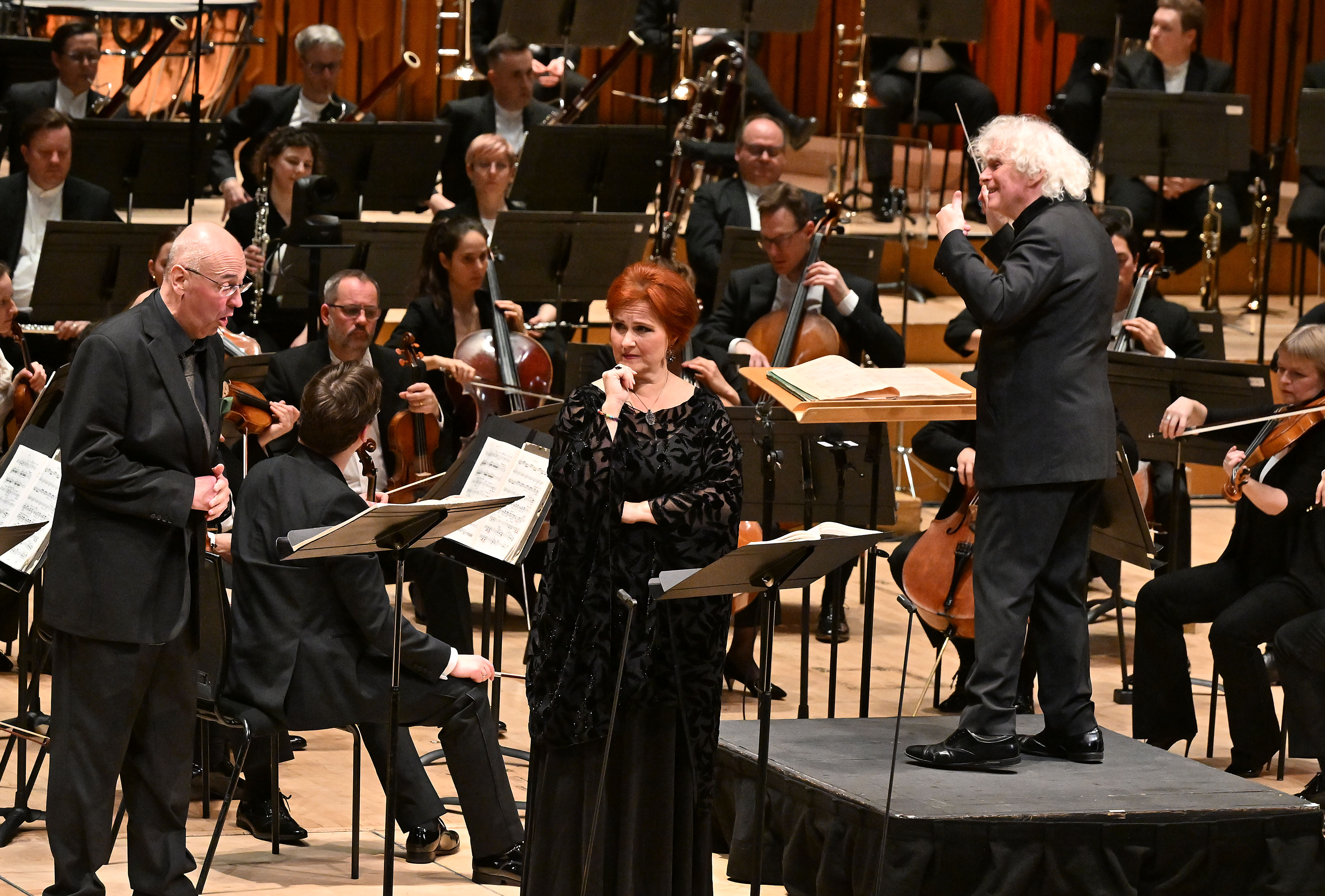


Much could be read from Majeski’s face too; as it could from that of Andrew Staples as her husband Tichon. He felt shame, as did his voice, yet still he did what his mother said. Katarina Dalayman’s Kabanicha was no mere caricature; if hardly sympathetic, perhaps she embodied a more comprehensible than usual desire for order in a community she saw threatened, rightly or wrongly, with breakdown. Her relationship with Pavlo Hunka’s sharply characterised Dikoj was likewise less caricatured than would often be the case, perhaps not merely a case of jaw-dropping hypocrisy. Simon O’Neill’s Boris was intelligently conceived, often ardent. There was likewise plenty of intelligence, and a wonderful animating spark, to Magdalena Kožená’s Varvara. She seemed veritably to brin Ladislav Elgr’s Kudrjáš to life, his second-act song delivered with verve and no little charm, Rattle splendidly highlighting the pizzicato accompaniment to help bring it to life. Claire Barnett-Jones and Lukáš Zeman both impressed in their smaller roles, making much of them in collaboration with their fellow artists. I look forward to hearing more from the latter, a new voice to me.


And yet, this was above all an orchestral drama. The poignancy of the brief, all-too-brief, Puccini-plus afterglow to the second act, eliciting a sadness quite different from anything one might hear in Puccini, offered another splendid, affecting example. Likewise, tellingly, the sheer strangeness of the early storm music of the third, especially from the LSO woodwind. If there were times, slightly to my surprise, when I found myself missing the completion of action that would have been achieved by a staged production—Janáček leaves much to that crucial pillar of operatic experience, knowing not only what to write but also what not to write—this was a compelling evening. If some listeners might have felt Rattle’s more spacious tempi went to far at times, for me they worked well in context. There seemed little doubt they had the assent of orchestra and cast alike.

Tuesday, 21 January 2020

Jenůfa, Deutsche Oper, 17 January 2020


Jenůfa (Rachel Harnisch), Grandmother Burya (Renate Behle); Images © Bettina Stöß


Grandmother Buryja – Renate Behle
Kostelnička Buryja – Evelyn Herlitzius
Jenůfa – Rachel Harnisch
Laca Klemeň – Robert Watson
Števa Buryja – Ladislav Elgr
Foreman – Philipp Jekal
Mayor – Stephan Bronk
Jano – Meechet Marrero
Barena – Karis Tucker
Mayor’s Wife – Nadine Secunde
Karolka – Jacquelyn Stucker
Shepherdess – Fionnuala McCarthy

Christof Loy (director)
Dirk Becker (set designs)
Judith Weihrauch (costumes)
Bernd Purkrabek (lighting)
Eva-Maria Abelein (Spiellleitung)
Thomas Wilhelm (choreographic assistance)
Christian Arseni (dramaturgy)

Chorus of the Deutsche Oper, Berlin (chorus master: Jeremy Bines) 
Orchestra of the Deutsche Oper, Berlin
Donald Runnicles (conductor)


If Jenůfa fails to move, something will have gone terribly wrong. That is not, however, to say that one should take for granted a performance as moving as this. It takes a good deal of musical work to present an opera with this degree of excellence. This, in short, was an evening that heard the Deutsche Oper at something close to its very best.

Grandmother Burya, Laca (Robert Watson), Jenůfa


Guiding that excellent work throughout, whether on stage or in the pit, was the hand – perhaps better, were the hands – of Donald Runnicles. I have heard some distinguished conducting of this opera, from Bernard Haitink at Covent Garden (my first Jenůfa and, indeed, my first Janáček opera) to Jiří Bělohlávek in concert and, most recently, on the fateful night of 23 June 2016, Mark Wigglesworth for ENO. Each of those conductors brought something distinctive and valuable to the opera. Runnicles and his outstanding orchestra had nothing whatsoever to fear from comparisons. If I applaud his gifts of synthesis, that is not to say that the parts coming together to make their sum were insignificant: quite the contrary. An ear for detail, be it for specificity of timbre or rhythm, combination of instrumental and vocal line, the composer’s singular method of motivic writing, and much else besides, was crucial here in capturing and holding not only the musical but also the dramatic attention. That coming together, however, was equally crucial. Not unlike Mozart – or Shakespeare, for that matter – Janáček does not judge. To be sure, we make our own judgements, yet the humanity informing the composer’s mission involves understanding of why people do wrong, why they did not act otherwise. The conductor’s task in communicating that is to balance detail and broader sweep, not unlike the composer himself does in his astonishing art. There was human wisdom here on both counts: aware, perhaps, of something beyond, something divine, yet knowing that the truths in which this drama would partake must also keep their distance. They have their roots in something specific, even folk-like, without ever being reducible to that. Once again, this seemed to be communicated instinctively, however great the preparation and skill in maintaining that fond, even dangerous illusion of the immediate.


Kostelnička Buryja (Evelyn Herlitzius), Jenůfa


In an instructive programme note, Runnicles spoke of Janáček following an aesthetic of Kargheit (which connotes both frugality and bleakness) when it comes to sonority, an aesthetic opposed by well-meaning, Straussian smoothing of the edges and rounding out by the conductor Karel Kovařovic for the first Prague performance. A comparison with Rimskified Mussorgsky is not, as Runnicles, suggests, so far from the mark (though I still think that deserves something, somewhere of a place). We no longer hear either as eccentric, let alone incompetent, and we are surely right to do so. But again, to hear the craft, the meaning, the art in such writing requires work: no music worthy of the name really plays or sings itself; nor, one might add, does it listen to itself. Orchestral musicians as much as the conductor, as much as the listener, need to respond to finely judged balances between fragment and melody, speech rhythm and musical rhythm, individual timbre and blend. They must also do so with a knife-edge appreciation of dramatic timing. That unforgettable xylophone solo there, a solo violin intervention there, the crucial difference between trombone (Janáček) and horn (Kovařovic) sonority, and so on: these were not only presented, but felt, believed in. There is no need to damn Kovařovic any more than there is Rimsky-Korsakov. They did what they did; it spoke to many. One could truly feel, however, that Janáček spoke on this occasion – and that one thereby felt the cruelty, the bleakness, and yet ultimately the humanity and redemption too that this opera requires us to feel.


Jenůfa, Kostelnička


That also requires the small matter of excellent singing and acting – and of excellent collaboration. Here again, I had no reservations. Rachel Harnisch led us surely down a tragic yet sorrowfully redemptive path with a Jenůfa whose initial youthful spirits rendered the inhumanity of her subsequent, consequent tribulations all the more harrowing. I cannot imagine any human being having failed to root for her. Robert Watson and Ladislav Elgr faced off splendidly as Laca and Števa, the former wounded and wounding, increasingly noble of spirit, the latter’s cocky allure – seemingly the whole village, not only its girls, under its spell – undermined by a weakness of spirit that is always difficult to convey through song. (In a sense, it is the Don Ottavio problem, here skilfully surmounted.) Not the whole village, of course, for that would be to reckon without the Kostelnička – and without Evelyn Herlitzius’s Kostelnička. If I say it was a typically astonishing performance, I do not mean to undermine its specificity. Herlitzius is one of those singing actors who somehow both remains quite herself and assumes, even transforms the character of the role she is playing. Initially hard, increasingly wild, always with good in her heart: one could hardly bear to look her in the face, or the aural equivalent, yet equally knew that one must. This was spellbinding artistry, in the truest sense. Yet wherever one looked and listened, there was necessary artistry, as much a crucial part of the musicodramatic synthesis: Renate Behle’s Grandmother, wiser than her carefully prepared surface let on, in knowing that principle may also lie in surviving, in not succumbing to tragedy; Nadine Secunde’s properly ghastly Mayor’s Wife; Philipp Jekal’s Foreman, wanting initially to be Števa, yet perhaps suggesting that all was not quite as it should be: these characters and more made Janáček’s community and thus drama what they were. So too, of course, did the excellent Deutsche Oper Chorus.


Jenůfa, Števa (Ladislav Elgr), Laca


I have left Christof Loy’s production until last because it seemed – and this is not always a claim I should make for that director’s work – more a framework in which the work and its performance could unfold than an interpretation. Aside from the conceit of having the imprisoned Kostelnička look back at the story that had led her to where she now found herself, there was not so much to report. Occasional dramatic pauses made their point too, having us collect our thoughts – and our emotions. I have seen more interventionist and, perhaps, more telling stagings; it is fair to say, for instance, that I learned and was challenged more from David Alden at the Coliseum. But that did not seem to be the point on this occasion. If a staging permitted, even gently led me to be moved by the drama that unfolded, then it may also be accounted successful.


Sunday, 11 March 2018

From the House of the Dead, Royal Opera, 10 March 2018


Royal Opera House

Luka Kuzmič – Štefan Margita
Nikita, Big Prisoner – Nicky Spence
Čekunov, Small Prisoner, Cook – Grant Doyle
Prison Governor – Alexander Vassiliev
Alexandr Petrovič Gorjančikov – Willard White
Guard – Andrew O’Connor
Antonič (Elderly Prisoner) – Graham Clark
Skuratov – Ladislav Elgr
Aljeja – Pascal Charbonneau
Šiškov (Pope) – Johan Reuter
Drunk Prisoner – Jeffrey Lloyd-Roberts
Šapkin – Peter Hoare
Prisoner (Don Juan, Brahmin) – Aleš Jenis
Prisoner (Kedrill) – John Graham-Hall
Young Prisoner – Florian Hoffmann
Prostitute – Allison Cook
Voice – Konu Kim
Čerevin – Alexander Kravets
 

Krzysztof Warlikowski (director)
Małgorzata Sczczęśniak (designs)
Felice Ross (lighting)
Denis Guéguin (video)
Claude Bardouil (movement)
Christian Longchamp (dramaturgy)


Royal Opera Chorus (chorus director: William Spaulding)
Orchestra of the Royal Opera House
Mark Wigglesworth (conductor)


Astonishingly, this new production of From the House of the Dead is not only the Royal Opera’s first, but also Krzysztof Warlikowski’s house debut. Better late than never, I suppose, and past omissions are hardly the fault of the current regime. Another important first is presented in a first full outing for this critical edition of the work, including Janáček’s proper libretto, including dialect, Russian, and even, apparently, a little Ukrainian, as part of his own translation from Dostoyevsky. Such things matter, of course, although how many of us in a (presumably) largely Anglophone audience can, hand on heart, claim to notice them all? Some will, and I am grateful to my friend and colleague, Geoffrey Chew, who certainly will do, for having alerted me in the first place to the use of the new edition.
 

Ultimately, though, opera lives in performance. The conductor, Mark Wigglesworth observes in a programme note, there is ‘a curious tension in today’s operatic culture between the musical priority of the performers, which typically tries to be one of complete fidelity to the composer’s instructions, and a dramatic expectation that pieces are simply springboards for a director’s limitless imagination.’ Such a tension may prove productive, as here, yet it also requires deconstruction of its own, as indeed Wigglesworth proceeds to acknowledge. It is often in those cracks that one perceives chinks of light, or to quote Janáček himself, ‘the spark of God … “A mother gave birth even to him!”,’ perhaps ultimately thus even of redemption. In this outstanding performance and production, one of the finest things I have seen at Covent Garden for a while, the interaction between freedom and determinism, such as one might readily associate more with, say, Schoenberg, in Moses und Aron, comes to influence and be influenced by work, dramatic ‘content’, performance, and the oracular mystery of ‘opera’ that arises from the dialectical relationship between them.
 

It has been worth the wait for Warlikowski. Patrice Chéreau, in his justly lauded production, originally conducted by Pierre Boulez, but which I saw in Berlin under Simon Rattle, presented the work relatively straightforwardly, perhaps even in the very best sense ‘traditionally’. Warlikowski, however, offers a post-Foucauldian queering of the work, engaging in more explicitly conceptual fashion with power, ‘justice’, and ‘punishment’ in an age of activist and intellectual intersectionality. Kimberlé Crenshaw, who coined the term, has always insisted that intersectionality was fundamentally concerned with power rather than mere identity; the line is not always absolute, of course, and identity will often prove a response to power relations, but we do well to remember that, especially when ‘centrist dad’ types – who, predictably seem to have hated the staging – as much as unrepentant reactionaries will rail against ‘identity politics’ and indeed against the very idea of intersectionality as well as the word. ‘Citizens of nowhere’, one might say, against ‘very fine people’; or is that our white privilege attempting to trump, as it were, deeper, more serious, still more violent problems and battles within society with our own? It is not either-or; that is part of the point, or should be. The coercive apparatus that sets us against one another, within and without formal incarceration returns us to Foucault, whom we see on film at the beginning, not only to have his ideas confirmed, but also to challenge them. As with Janáček and Dostoyevsky, we need them and yet have also moved on. In the agony of that alienation lies our drama too.
 

And so, alongside Foucault, we also see - and perhaps more to the point, watch - actors and singers – what, if anything is the difference? – at sport and not. Prisoners are no more the same than non-prisoners. Are we merely looking, or are we engaging in surveillance? At least indirectly we all are, and if our gaze is directed to the stage, we also know, even if we deny, that we are watching each other too. Anyone driven to distraction by the call ‘see it, say it, sorted’ on railway carriages over the past few months, will know how little it might take to have been incited by the ‘duty’ to bring to ‘justice’ so as to be facing such ‘justice’ itself, which as Foucault pointed out, was and always had been spectacularly unsuccessful in its alleged project of ‘rehabilitation’. In the contemporary American prison in which the action unfolds, the intense physicality and to us, most likely a largely white, bourgeois audience, the ‘danger’ of such, especially when as here non-white and/or non-binary faces crop up,  replicate or, perhaps better, recreate hierarchies outside of the system.
 

That places the arrival of Gorjančikov in an interesting light. To a certain extent he is ‘one of us’. We can probably imagine ourselves more as political prisoners than as some of the ‘others’, more as items on, say, Amber Rudd’s lists of foreigners than as murderers or drug dealers. We are offered a way in, but also a way to differentiate ourselves, as we do both inside and outside, to reaffirm our respectability, perhaps even to sympathise with or at least to acknowledge as ‘necessary’ the brutality we see on show from the prison officers – and hear in the chains of Janáček’s score. Are we ultimately ‘do-gooders’, or just armchair reformers, if indeed we care at all? Might we even extend that critique to the performance and to the work itself and to that redemptive claim, the ‘spark of God’, in which we so desperately wish to believe?
 

Other hierarchies recreate themselves, although not necessarily identically. In a world of often (although let us not assume too much a priori) toxic masculinity – Šiškov, after all, killed his wife, upon realising that she still loved Filka/Luka – where is the space for women? Their near-absence on stage is one of the many things that makes this work so singular in Janáček’s œuvre; the harshness of the score is not only a harshness of the tundra. Here Warlikowski doubles down, doubtless controversially, not only allotting the trouser role of Aljeja to a tenor, but revealing, or rather concealing, the Prostitute – still sung by a Woman – as a drag queen, heightening elements of the ‘show’ which, after all, lie at the heart of the play within a play here. Such, after all, may be one of the ways of dealing with prison life. Or is it, instead, a reassertion of male privilege, a banishment of women? It does not take long before our thoughts touch upon the repression of trans women, men too, not least again on account of their absence too. Is this all intentional? I have no idea, although I suspect that some at least of it is. The production, however, offers the space for such reflection; indeed, I should argue that it demands it.
 

All that would be diminished, or unachievable, were it not for a fine, committed ensemble cast – there is no room, thank God, for ‘stars’ here – working with so impressive a chorus, orchestra, and conductor. I find it difficult to believe that the opera has ever been better conducted than by Wigglesworth, who inspired the Orchestra of the Royal Opera House to the very top of its form. The sound world was just right, less golden, more steely than the Staatskapelle Berlin under Rattle. Yet it seemed to grow out of an emphasis upon specifics, upon details, upon those gnawing rhythmic and melodic cells. This was not an abstract ‘approach’ foisted upon the work, quite the contrary. Certainly one heard, or fancied one heard, the intimacy of connection between language(s) and music. That held even when the language we heard was not at its sharpest (not necessarily, I think, a matter of nationality). I am really not in any position to comment further and shall leave that to Czech speakers; I think, unsurprisingly, that I detected some variation, but would always have had to resort to the titles in any case. The richness of what even post-humanists tend to fall back on calling ‘humanity’ is on show here, yet so is its commonality, not least in resistance to oppression. Singling out particular artists seems more than usually beside the point, but Štefan Margita, Nicky Spence, Ladislav Elgr, Pascal Charbonneau, and delightfully, Graham Clark all made very strong impressions, as did Allison Cook as the Prostitute.
 

Here, though, more than ever, one remembered, saw and heard dramatised that oft-cited section of a 1927 report from the Czech newspaper, Lidové noviny. Dostoevsky’s novel had appealed to Janáček, and so it does to us, because ‘“in each of these criminals there is a spark of God”. The new opera has no main hero. Thus its novelty lies in its collectivism.’ Is that not a collectivism we need as much as ever, perhaps still more so?


Friday, 10 March 2017

Edward II, Deutsche Oper, 9 March 2017


Deutsche Oper, Berlin

Images: Monika Rittershaus
Edward II (Michael Nagy) and Piers de Gaveston (Ladislav Elgr)

Edward II – Michael Nagy
Isabella – Agneta Eichenholz
Piers de Gaveston – Ladislav Elgr
Roger Mortimer – Andrew Harris
Walter Langton, Bishop of Coventry – Burkhard Ulrich
Lightborn – James Kryshak
Angel – Jarrett Ott
Soldiers, Councillors, Guards, Tourguides, etc. – Markus Brück, Gideon Poppe
Spencer Jr – Gieorgij Puchalski
Prince Edward – Ben Kleiner

Christof Loy (director)
Annette Kurz (set designs)
Klaus Bruns (costumes)
Stefan Bolliger (lighting)
Yvonne Gebauer, Dorothea Hartmann (dramaturgy)

Chorus of the Deutsche Oper, Berlin (chorus master: Raymond Hughes)
Orchestra of the Deutsche Oper, Berlin
Thomas Søndergård (conductor)
Walter Langton, Bishop of Coventry (Burkhard Ulrich) and the crowd


Andrea Lorenzo Scartazzini’s new music theatre piece – ‘Musiktheater in zehn Szenen,’ although I am unsure in what sense it is not an opera as conventionally understood – seems to have generated quite some controversy. I have avoided reading the offending article or indeed anything else until seeing this, but I hear that one journalist has been accused of homophobia in the insults she has hurled at the work. Let us leave that on one side – I can hardly do otherwise, not having read any of the commentary – and attend to Edward II on its own terms, or what I take them to be.


Foreground: Spencer Jr (Gieorgij Puchalski), Roger Mortimer (Andrew Harris), Gaveston, Edward 
 

It turns out to be one of those difficult things to write about: perfectly serviceable as an opera, competently constructed, doing pretty much everything one would expect it to and almost nothing one would not expect. The work’s ten scenes do not overstay their welcome; the pacing seems just about right. There is a very traditional operatic and more broadly dramatic contrast between the public and private: think of Schiller, or the Petrarchan AMOR/ROMA dilemma, although here, not unreasonably, one never has any doubt that King Edward will choose love and ‘sodomite’ – a word endlessly repeated – lifestyle over matters of state. A vicious crowd, stirred up by hypocritical clergyman, bays for sodomite blood. The Queen moves – perhaps a little quickly, but such is opera – from sympathetic, lonely figure to vicious, vengeful, murderess. There is, moreover, a genuine sense of ‘this could be any family’, the young Prince Edward torn between his two self-obsessed parents. Scartazzini’s score follows the action, in what sounds on a first hearing (with all the caveats that must imply) like a generic not-quite-contemporary modernism. It screams when one would expect it to, likewise creates a hushed atmosphere when one would expect; it has structural impetus of its own within scenes.


And yet, there is little that adds up to anything more than that, or at least it did not for me. We can leave aside the playing fast and loose with history and with sources: that is what dramatists do. However, the framing devices of librettist, Thomas Jonigk, come across as forced, and indeed almost haplessly agitprop. Attempts, for instance in comments by the Angel, to present knowingly anachronistic references to other pertinent historical events and figures, are a bit embarrassing, likewise the historical tour’s visitation of Edward’s cell at the close. The comparison between wronged Jews and sodomites is not pursued in any depth, and merely seems glib. It is, moreover, only really at the close – and perhaps this is deliberate, but if so, it again needs better framing – that Edward as a character comes into focus; everyone else, despite extremely strong performances, remains something of a caricature. Derek Jarman, let alone Christopher Marlowe, did this, or something akin to this, so much better. Scartazzini never seems to lead the action, to have the orchestra partake in it, engender it, rather than predictably mirror the events on stage. His vocal lines, such as they are, hold little or no interest of their own; I could not help but wonder whether he would have been better off writing a symphonic poem or equivalent on the subject.

Edward and Gaveston
 

The sad conclusion I ended up drawing was that this opera’s creators seem to have thought it enough to write a gay opera. Perhaps it is; we are not exactly blessed with a huge number of examples, at least overtly, proudly so. (Subtexts, however close to the surface, are another matter.) Overall, though, it feels too much like box-ticking, too little like something that might have arisen from genuine artistic necessity. Imagine what might have been done in an opera that placed queer experience at its complex heart, doing something akin to what Nono did for women’s revolutionary experience in Al gran sole carico d’amore. There will, I hope, be other opportunities – and, to be fair, there is an abundance of mediocre, or worse, operas dealing with heterosexual themes.
Isabella (Agneta Eichenholz) and Prince Edward (Ben Kleiner)


That said, the Deutsche Oper deserves only praise for the commitment it has shown, both in staging the new work and, still more, doing so in performances of such quality. Its orchestra and chorus, the latterly brilliantly trained by Raymond Hughes, played under Thomas Søndergård with a confidence that suggested this might have been a repertory work. Balance, weight, incisiveness, tenderness: all those qualities and more were present in the pit; on stage, one could hardly have asked for more from the chorus, director Christof Loy’s blocking of the partly differentiated mass a joy in itself to behold. Indeed, Loy’s work in general – I speak as someone who has been far from a constant fan of his productions – deserves great credit, essentially presenting the opera as a somewhat abstracted version of classic grand opera, with slightly alienated invasions from without. The ‘family values’ crowd was an obvious ploy, replete with placards from any reactionary demonstration one might care to look at, but it made its (agitprop) point well enough.

Angel (Jarrett Ott), Edward, and Spencer Jr
 

Michael Nagy drew one in more than one had any right to expect in a visually torn, vocally secure performance of the title role. As the Angel only the King could see, Jarrett Ott offered all the strength and comfort Edward might ever have asked: a rock in a vicious world indeed. Ladislav Elgr, seen for about ninety per cent of his time on stage merely in well-fitted white vest and briefs, exhibited as the favourite, Gaveston, a near-ideal marriage of fun, born of social desperation no doubt, and magnetism. Agneta Eichenholz made the most of that abrupt transition from wronged woman to monster in a powerful assumption of the role of Isabella. The darkness of her relationship to Andrew Harris’s unreconstructedly masculine Mortimer could only really be hinted at, given the confines of the work, but hinted at it certainly was. There was a good deal of camp humour to be had from the recurring double act – from thirteenth-century soldiers guardedly admitting their sodomite tendencies to modern tour-guides – of Philip Jekal and Gideon Poppe. The Mime-like nastiness, with an undoubtedly chilling Nazi allusion of just following orders, of Edward’s murderer-with-abortionist’s-bag, Lightborn, was splendidly portrayed by James Kryshak. Ben Kleiner’s treble could hardly be faulted as the young prince; he knew how to deport himself on stage too. And last but not least, Gieorgij Puchalski’s performance in the non-speaking role as Spencer Junior, the new favourite risen from the ashes of the old, showed just what the suggestiveness and sheer physicality of a dancer in a vocal work can achieve.


If the above tends too much towards a list, that is part of my point. These were all, without exception, fine performances indeed; they did all they could with a work that could have been much worse, but ought to have been much better.