Showing posts with label Graham Clark. Show all posts

Wednesday, 13 June 2018

Capriccio, Garsington Opera, 9 June 2018


Garsington Opera House, Wormsley

Images: Johan Persson
Andrew Shore (La Roche), William Dazeeley (Count), Hanna Hipp (Clairon),
Miah Persson (Countess), Benjamin Bevan (Major-Domo)


Flamand – Sam Furness
Olivier – Gavan Ring
La Roche – Andrew Shore
Countess Madeleine – Miah Persson
Count – William Dazeley
Clairon – Hanna Hipp
Major-Domo – Benjamin Bevan
Italian Soprano – Nika Gorič
Italian Tenor – Caspar Singh
Servants – Richard Bignall, Dominic Bowe, Robert Forrest, Andrew Hamilton, Emanuel Heitz, Jack Lawrence-Jones, David Lynn, Kieran Rayner
Monsieur Taupe – Graham Clark
Young Dabicer – Lowri Shone

Tim Albery (director)
Tobias Hoheisel (designs)
Malcolm Rippeth (lighting)
Laïla Diallo (choreography)

Garsington Opera Orchestra
Douglas Boyd (conductor)

Who among the younger generation can really imagine a great city like Munich in total darkness, or theatre-goers picking their way through the blacked-out street with the aid of small torches giving off a dim blue light through a narrow slit? All this for the experience of the Capriccio première. They risked being caught in a heavy air raid, yet their yearning to hear Strauss’s music, their desire to be part of a festive occasion and to experience a world of beauty beyond the dangers of war led them to overcome all these material problems... Afterwards it was difficult to relinquish the liberating and uniting atmosphere created by the artistic quality of the new work. But outside the blackened city waited, and one’s way homewards was fraught with potential danger.

With those words, the director Rudolf Hartmann recalled the 1942 Munich premiere of Richard Strauss’s final opera, Capriccio. They are not without sugary romanticism, which tells its own contemporary as well as subsequent story, yet by the same token, would surely touch all but the stoniest of hearts. (Of the many, there are alas far too many – especially when it comes to Germany.) Since first reading them, I have found it difficult to put them and their implications – some, to borrow from Nietzsche, beyond good and evil – out of mind when listening to and thinking about Capriccio.

The Servants (Robert Forrest, Jack Lawrence-Jones, Andrew Hamilton, Richard Bignall, Dominic Bowe, David Lynn, Kieran Rayner, Emanuel Heitz)

Perhaps, then, it is merely my problem that Tim Albery’s new production seems strangely uninterested in what for me has become very much part of the work. That despite a strange claim quoted in the programme: ‘I’ve worked with Tobias Hoheisel, a London-based German designer, who has a real sensibility for Strauss’s world and language. We talked a lot about the political context of the opera and decided that we should not set it in the ruins of a collapsing Europe. We set it in the time in which it was composed, when so many people were forced into exile.’ I am far from saying that a performance of any work should always concern itself with origins, the conditions of its first performance, or indeed any one time or place. Albery’s distinction, though, makes little sense, for Capriccio was composed during the Second World War: Europe was – again – collapsing. It was not 1945, but nor was it 1935, let alone 1925. One might accuse Strauss of evasion – although, by this stage, what on earth was he supposed to do? – but there seems to me here a degree of evasion here too.

Sam Furness (Flamand), Gavan Ring (Olivier), Andrew Shore (La Roche)

What we are left with is a typical rococo palace with more modern touches: costumes and artwork. The action and conversation – are they the same thing, somewhat different, even in some respects opposed? should we not at least ask? – proceed straightforwardly. Everything is well directed on stage, but there is little edge: which only the ignorant and/or hostile could claim of the work itself.  This might seem facile, but the very setting of the work in France has – and had – resonances. To have, moreover, the Countess comparing the musical merits of Rameau vis-à-vis Couperin is more telling than many might think: Brahms might have edited Couperin, but one will struggle to find his name or his music in Third Reich performances and musicology. Indeed, many composers, let alone others, would not necessarily have been well acquainted with the music of eighteenth-century France. Strauss certainly was – and showed through his composition that he was: sometimes through direct quotation, for instance the ‘Air italien’ from Les Indes galantes, when the composer is mentioned, at other times through allusion. Likewise for Gluck – what are we to make here of a ‘German’ composer acting as a ‘French’ one? – and much else.
 
William Dazeley (Count),Miah Persson (Countess), Sam Furness (Flamand)
The apolitical, especially at times such as this, may actually be read as highly political, whatever Strauss’s – or anyone else’s – straightforward intention. Perhaps the beauty of the costumes, the Countess (Miah Persson) truly resembling a star from the Golden Age of Hollywood, the servants’ livery truly impeccable, hints at something more; perhaps it does not. That ambiguity is welcome, but might we not have had a little more? One need not have Baldur von Schirach on stage to listen to the opening sextet – although why not? – to hint at something more troubling. (The sextet had its private premiere at Schirach’s villa, the Vienna Gauleiter having helped Strauss secure his Viennese Belvedere home. In return, moreover, for the composer playing his part in furthering Viennese musical life, Schirach, the only defendant other than Albert Speer to speak against Hitler at Nuremberg, had offered protection for Strauss’s Jewish daughter-in-law, Alice, and his grandsons.) A challenging work, ever more so the more one gets to know it and think about it, deserves perhaps rather more challenge than this. Otherwise, the updating might as well not have happened; it does not seem in any way to shape, to comment, or even to frame the drama. More fundamentally, though, I missed the achievement of Christian von Götz’s Cologne staging, which I saw at the 2007 Edinburgh Festival. There, not only was one forced to confront the work’s political difficulties; one emerged, at least I did, with ever-greater admiration for it. (Indeed, it was the aftermath of that experience that set me on the road to writing a chapter on Capriccio in my book After Wagner.)

Miah Persson (Countess)

If Albery’s production comes across as something for those as unconcerned with such matters as many have erroneously claimed Strauss to be – non-, even anti-metropolitan opera – there were many musical rewards to enjoy. That was true above all for Persson. Her musical line, subtly inflected brought into greater relief than anything on stage the central question of ‘Word oder Ton?’ This was in every respect, certainly verbal, yet not only so, a superior performance to that heard in concert from Renée Fleming a few years ago. (Why are Covent Garden and still more ENO so hostile to staging Strauss, or at least so reluctant to do so?) The vocal bloom of her final scene was well prepared, prefigured perhaps more subtly still than the theme on which Douglas Boyd had proved perhaps just a too insistent in his orchestral highlighting. That said, if sometimes apparently viewing Strauss’s motivic technique a little too much as concerned with reminiscence, and not quite enough as ‘the binding together of a music drama through a dense web of motivic connections from within’ (Carl Dahlhaus on Wagner), Boyd handled and communicated the ebb and flow well: no easy task. It was doubtless no coincidence, given his background as an oboist, that the woodwind of the excellent Garsington Orchestra were afforded especial opportunity to shine. If a few more strings would at times have been appreciated, there were no real grounds for complaint here either; the section certainly came into its own at climaxes.

Hanna Hipp (Clairon)


Otherwise, there was a fine sense of vocal ensemble, Andrew Shore’s typically characterful La Roche, Hanna Hipp’s rich-toned Clairon, and Graham Clark’s properly scene-stealing Monsieur Taupe (even without Götz’s yellow star, the escape carriage having been missed) for me the pick of the bunch. If Albery’s staging perhaps serves La Roche’s caricatured aesthetics better than his broader role as impresario and indeed spokesman for broader theatrical values – Max Reinhardt his obvious (Jewish) inspiration – the opera is such that a thinking audience member cannot help but reflect upon such matters. Capriccio is a good deal less fragile, as well as a great deal more political, than it might seem and than it might have been ‘intended’ to be.


Sunday, 11 March 2018

From the House of the Dead, Royal Opera, 10 March 2018


Royal Opera House

Luka Kuzmič – Štefan Margita
Nikita, Big Prisoner – Nicky Spence
Čekunov, Small Prisoner, Cook – Grant Doyle
Prison Governor – Alexander Vassiliev
Alexandr Petrovič Gorjančikov – Willard White
Guard – Andrew O’Connor
Antonič (Elderly Prisoner) – Graham Clark
Skuratov – Ladislav Elgr
Aljeja – Pascal Charbonneau
Šiškov (Pope) – Johan Reuter
Drunk Prisoner – Jeffrey Lloyd-Roberts
Šapkin – Peter Hoare
Prisoner (Don Juan, Brahmin) – Aleš Jenis
Prisoner (Kedrill) – John Graham-Hall
Young Prisoner – Florian Hoffmann
Prostitute – Allison Cook
Voice – Konu Kim
Čerevin – Alexander Kravets
 

Krzysztof Warlikowski (director)
Małgorzata Sczczęśniak (designs)
Felice Ross (lighting)
Denis Guéguin (video)
Claude Bardouil (movement)
Christian Longchamp (dramaturgy)


Royal Opera Chorus (chorus director: William Spaulding)
Orchestra of the Royal Opera House
Mark Wigglesworth (conductor)


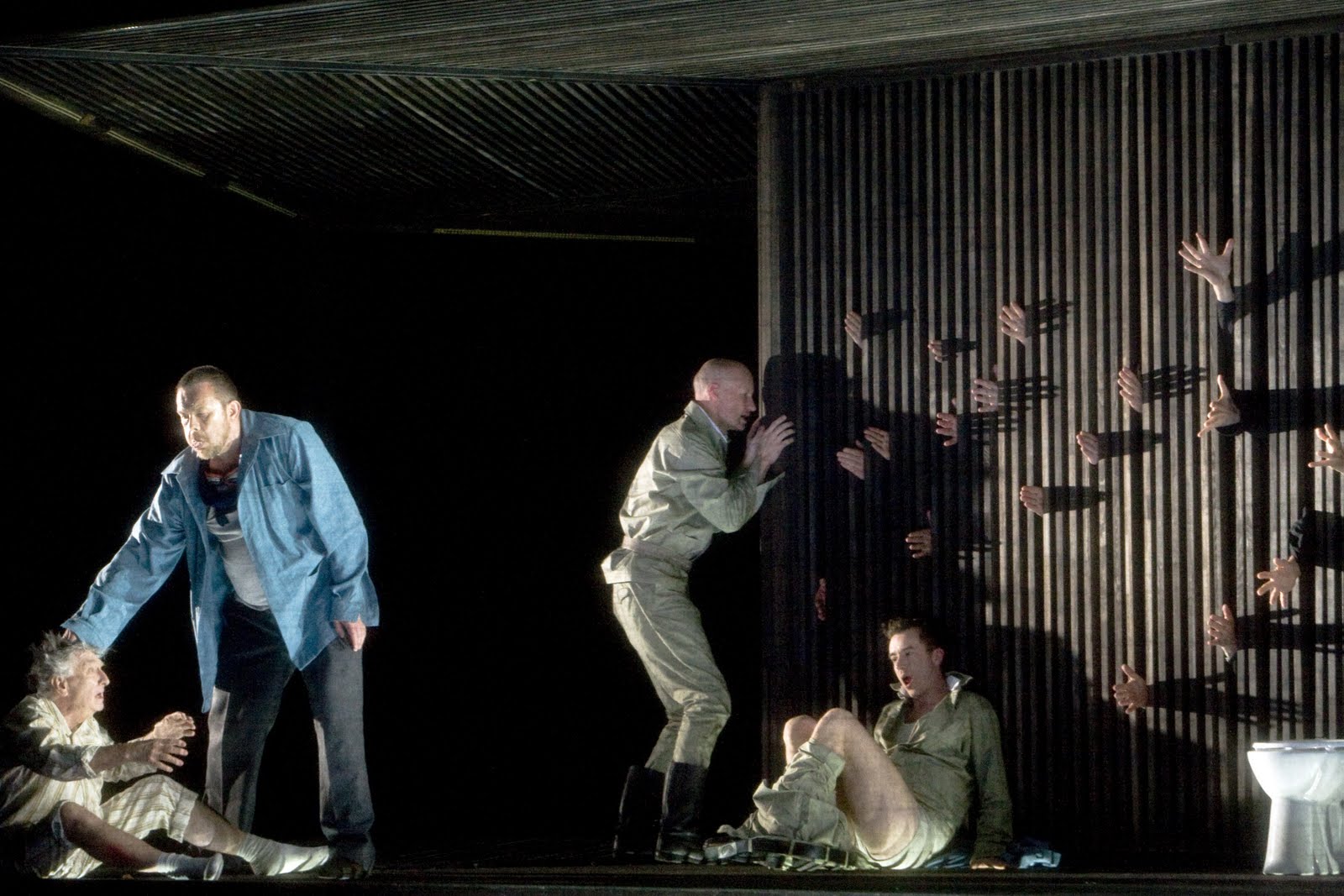
Astonishingly, this new production of From the House of the Dead is not only the Royal Opera’s first, but also Krzysztof Warlikowski’s house debut. Better late than never, I suppose, and past omissions are hardly the fault of the current regime. Another important first is presented in a first full outing for this critical edition of the work, including Janáček’s proper libretto, including dialect, Russian, and even, apparently, a little Ukrainian, as part of his own translation from Dostoyevsky. Such things matter, of course, although how many of us in a (presumably) largely Anglophone audience can, hand on heart, claim to notice them all? Some will, and I am grateful to my friend and colleague, Geoffrey Chew, who certainly will do, for having alerted me in the first place to the use of the new edition.
 

Ultimately, though, opera lives in performance. The conductor, Mark Wigglesworth observes in a programme note, there is ‘a curious tension in today’s operatic culture between the musical priority of the performers, which typically tries to be one of complete fidelity to the composer’s instructions, and a dramatic expectation that pieces are simply springboards for a director’s limitless imagination.’ Such a tension may prove productive, as here, yet it also requires deconstruction of its own, as indeed Wigglesworth proceeds to acknowledge. It is often in those cracks that one perceives chinks of light, or to quote Janáček himself, ‘the spark of God … “A mother gave birth even to him!”,’ perhaps ultimately thus even of redemption. In this outstanding performance and production, one of the finest things I have seen at Covent Garden for a while, the interaction between freedom and determinism, such as one might readily associate more with, say, Schoenberg, in Moses und Aron, comes to influence and be influenced by work, dramatic ‘content’, performance, and the oracular mystery of ‘opera’ that arises from the dialectical relationship between them.
 

It has been worth the wait for Warlikowski. Patrice Chéreau, in his justly lauded production, originally conducted by Pierre Boulez, but which I saw in Berlin under Simon Rattle, presented the work relatively straightforwardly, perhaps even in the very best sense ‘traditionally’. Warlikowski, however, offers a post-Foucauldian queering of the work, engaging in more explicitly conceptual fashion with power, ‘justice’, and ‘punishment’ in an age of activist and intellectual intersectionality. Kimberlé Crenshaw, who coined the term, has always insisted that intersectionality was fundamentally concerned with power rather than mere identity; the line is not always absolute, of course, and identity will often prove a response to power relations, but we do well to remember that, especially when ‘centrist dad’ types – who, predictably seem to have hated the staging – as much as unrepentant reactionaries will rail against ‘identity politics’ and indeed against the very idea of intersectionality as well as the word. ‘Citizens of nowhere’, one might say, against ‘very fine people’; or is that our white privilege attempting to trump, as it were, deeper, more serious, still more violent problems and battles within society with our own? It is not either-or; that is part of the point, or should be. The coercive apparatus that sets us against one another, within and without formal incarceration returns us to Foucault, whom we see on film at the beginning, not only to have his ideas confirmed, but also to challenge them. As with Janáček and Dostoyevsky, we need them and yet have also moved on. In the agony of that alienation lies our drama too.
 

And so, alongside Foucault, we also see - and perhaps more to the point, watch - actors and singers – what, if anything is the difference? – at sport and not. Prisoners are no more the same than non-prisoners. Are we merely looking, or are we engaging in surveillance? At least indirectly we all are, and if our gaze is directed to the stage, we also know, even if we deny, that we are watching each other too. Anyone driven to distraction by the call ‘see it, say it, sorted’ on railway carriages over the past few months, will know how little it might take to have been incited by the ‘duty’ to bring to ‘justice’ so as to be facing such ‘justice’ itself, which as Foucault pointed out, was and always had been spectacularly unsuccessful in its alleged project of ‘rehabilitation’. In the contemporary American prison in which the action unfolds, the intense physicality and to us, most likely a largely white, bourgeois audience, the ‘danger’ of such, especially when as here non-white and/or non-binary faces crop up,  replicate or, perhaps better, recreate hierarchies outside of the system.
 

That places the arrival of Gorjančikov in an interesting light. To a certain extent he is ‘one of us’. We can probably imagine ourselves more as political prisoners than as some of the ‘others’, more as items on, say, Amber Rudd’s lists of foreigners than as murderers or drug dealers. We are offered a way in, but also a way to differentiate ourselves, as we do both inside and outside, to reaffirm our respectability, perhaps even to sympathise with or at least to acknowledge as ‘necessary’ the brutality we see on show from the prison officers – and hear in the chains of Janáček’s score. Are we ultimately ‘do-gooders’, or just armchair reformers, if indeed we care at all? Might we even extend that critique to the performance and to the work itself and to that redemptive claim, the ‘spark of God’, in which we so desperately wish to believe?
 

Other hierarchies recreate themselves, although not necessarily identically. In a world of often (although let us not assume too much a priori) toxic masculinity – Šiškov, after all, killed his wife, upon realising that she still loved Filka/Luka – where is the space for women? Their near-absence on stage is one of the many things that makes this work so singular in Janáček’s œuvre; the harshness of the score is not only a harshness of the tundra. Here Warlikowski doubles down, doubtless controversially, not only allotting the trouser role of Aljeja to a tenor, but revealing, or rather concealing, the Prostitute – still sung by a Woman – as a drag queen, heightening elements of the ‘show’ which, after all, lie at the heart of the play within a play here. Such, after all, may be one of the ways of dealing with prison life. Or is it, instead, a reassertion of male privilege, a banishment of women? It does not take long before our thoughts touch upon the repression of trans women, men too, not least again on account of their absence too. Is this all intentional? I have no idea, although I suspect that some at least of it is. The production, however, offers the space for such reflection; indeed, I should argue that it demands it.
 

All that would be diminished, or unachievable, were it not for a fine, committed ensemble cast – there is no room, thank God, for ‘stars’ here – working with so impressive a chorus, orchestra, and conductor. I find it difficult to believe that the opera has ever been better conducted than by Wigglesworth, who inspired the Orchestra of the Royal Opera House to the very top of its form. The sound world was just right, less golden, more steely than the Staatskapelle Berlin under Rattle. Yet it seemed to grow out of an emphasis upon specifics, upon details, upon those gnawing rhythmic and melodic cells. This was not an abstract ‘approach’ foisted upon the work, quite the contrary. Certainly one heard, or fancied one heard, the intimacy of connection between language(s) and music. That held even when the language we heard was not at its sharpest (not necessarily, I think, a matter of nationality). I am really not in any position to comment further and shall leave that to Czech speakers; I think, unsurprisingly, that I detected some variation, but would always have had to resort to the titles in any case. The richness of what even post-humanists tend to fall back on calling ‘humanity’ is on show here, yet so is its commonality, not least in resistance to oppression. Singling out particular artists seems more than usually beside the point, but Štefan Margita, Nicky Spence, Ladislav Elgr, Pascal Charbonneau, and delightfully, Graham Clark all made very strong impressions, as did Allison Cook as the Prostitute.
 

Here, though, more than ever, one remembered, saw and heard dramatised that oft-cited section of a 1927 report from the Czech newspaper, Lidové noviny. Dostoevsky’s novel had appealed to Janáček, and so it does to us, because ‘“in each of these criminals there is a spark of God”. The new opera has no main hero. Thus its novelty lies in its collectivism.’ Is that not a collectivism we need as much as ever, perhaps still more so?


Saturday, 6 December 2014

Tristan und Isolde, Royal Opera, 5 December 2014

 
Royal Opera House
 
Sailor – Ed Lyon
Isolde – Nina Stemme
Brangäne – Sarah Connolly
Kurwenal – Iain Paterson
Tristan – Stephen Gould
Melot – Neal Cooper
King Marke – Sir John Tomlinson
Shepherd – Graham Clark
Steersman – Yuriy Yurchuk 
 
Christof Loy (director)
Julia Burbach (associate director)
Johannes Lieacker (designs)
Olaf Winter (lighting)
 
Royal Opera Chorus (chorus master: Renato Balsadonna)
Orchestra of the Royal Opera House
Sir Antonio Pappano (conductor)
 
Images: ROH/Clive Barda


Christof Loy has established rather a nice line in taking on works he admits he dislikes, or worse, and ignoring them whilst claiming to direct them. The ne plus ultra was surely his Salzburg Frau ohne Schatten, in which he set aside Strauss and Hofmannsthal completely in favour of his own banal story in which ‘an emerging young singer, sheltered and pampered by her well-to-do family is asked to take on the role of the Empress for a complete recording of Die Frau ohne Schatten.’ That was more or less it. His Royal Opera Tristan does not go so far as that, though his Lulu came close; nevertheless, his words speak for themselves. Loy, we read in the programme, cannot ‘really equate the couple’s position as outsiders with a Schopenhauerian denial of the world’. Wagner and many others since have managed to do so, but obviously what matters is a director’s inability or unwillingness to understand the work; that, after all, is what he is paid for. ‘Character direction which is rich in detail and specific’ is what interests Loy most as a director, which is why, he says, he had generally steered clear of Wagner, notorious, the reader will doubtless agree, for his inability to characterise. Tristan, however, seemed to Loy, who, it is once again worth reminding ourselves, the most important figure in all of this, something of an exception. It does not seem that he necessarily wished to traduce the work, then, but he has certainly misunderstood it. Of all Wagner’s works, it is perhaps least of all concerned with what he claims to interest him, and most concerned with metaphysics.
 
So much, then, for the misconception, but how does it play out in practice? Music and the arts in general are, after all, littered with examples of great works founded upon questionable æsthetics. Not too badly, to start with; indeed, I began to think that either my unfavourable memories from 2010 had played tricks upon me or that there had been radical revision. Julia Burbach was listed as an associate director and I think she probably has mitigated a few of Loy’s most irritating excesses; the supremely irrelevant canoodling between Brangäne and Kurwenal, for instance, seems toned down, although it is not, alas, eradicated. A good part of the first act is relatively abstract – pretty much always a good thing in Tristan – or at least may be seen as such with a degree of good will (towards Wagner, if not Loy). Then, when they have a little break, Tristan and Isolde are all over each other. What is the problem with that, one might ask? There seem to be two principal problems. One relates to the specificity of the setting, even if we are not quite sure of what that specificity is. In some building – a palace, perhaps? – awaiting her wedding and thereafter facing the consequences, Isolde manages somehow to escape for long enough to take off her wedding dress and be mauled by Tristan for a while. Still more oddly, she manages to do so for longer still during what may or may not be the wedding reception in the second act. Were there less specificity, this would not matter; playing fast and loose with time and location would not be an issue, and we could accept the overarching mythological claims. Here, however, we are just aware that it is at best rather trivial – Tristan for those who would prefer EastEnders, although a real soap opera viewer would doubtless expect more external action sooner – and often puzzling or downright nonsensical.  
 
The other brings us to the heart of Loy’s error, or, perhaps better, to the heart of Wagner’s – remember him? – work. Wagner’s action is resolutely metaphysical: not exclusively so, but the physical matters only insofar as it draws us towards, or in Schopenhauer’s terms, represents, the metaphysical drama. Since there are no metaphysics in Loy’s view, all we have is an extremely prolonged soap opera, tinged with the occasional aspiration towards Ibsen. Ironically – unknowingly, I suspect – Loy’s acknowledged inability to deal with Schopenhauerian denial of the world seems to have led Loy him to stage the second act as conventional ‘opera’, rather as Wagner acknowledged he could have written it, set against a backdrop of a brilliant court ball, ‘during which the illicit lovers could lose themselves … where their discovery would generate a suitably scandalous impression and the whole apparatus that goes with that.’  Wagner, of course, rejected that possibility he aired for a second act in which almost nothing but music happens. And even when external action intrudes, Wagner came to regard it as of lesser importance at best. His prose sketch had, for instance, drawn to a close, Götterdämmerung-like, with the words, ‘The bystanders are profoundly moved,’ concluding, ‘Marke blesses them’. However, when, in 1859, he summarised the work’s concerns for Mathilde Wesendonck, Wagner went so far as not only to omit the King’s  forgiveness, but also Tristan’s agonies at Kareol; they no longer mattered to him. True action, the Handlung of his own description, now lay in the noumenal world: ‘redemption: death, dying, destruction, never more to waken!’ Such, needless to say, was not what we were permitted to experience here. I should be the last person to claim that, as a general rule, production must exhibit some illusory, disingenuous Werktreue. However, in this particular case, it does seem that a staging of Tristan will not work unless it follows Wagner’s lead. Not for nothing did Nietzsche call it the opus metaphysicum. I know that I was not the only one in the audience looking back fondly to Herbert Wernicke’s comprehending, yet largely uncomprehended, production for this very house.
 
Wernicke’s production had of course been fortunate indeed to have Bernard Haitink, one of the greatest Wagner conductors of our age, in the pit. Haitink, as we know from his Bruckner and Mahler, is a master of large musical structures, and so he proved here. Antonio Pappano seems to have been thinking in similar terms to Loy, with not dissimilar results. Indeed, the scrappiness of the orchestral playing made it markedly inferior to Pappano’s previous accounts, let alone to Haitink’s. Missed entries, thinness of string tone (had I not seen the section with my own eyes, I should have sworn that it was considerably smaller), wavering intonation: none of those helped. More grievous still, however, was Pappano’s seeming inability to let a musical line, let alone a paragraph or some greater structure, unfold. The seemingly arbitrary nature of his beat was mirrored in the aimless meandering of the score. It seemed for the most part very slow; whether it was by the clock, I am not sure. The lack of direction was the problem, though, especially during the second act, which at times seemed almost to grind to a halt. Pappano gave the impression of following rather than leading the singers; that is not, to put it mildly, a recipe for success in Wagner.
 
 
Isolde (Nina Stemme)
Where, however, this Tristan did score over Wernicke and Haitink was with respect to those singers, who, as a cast, are deserving of considerable praise. Nina Stemme offered everything we have come to expect of her as Isolde. With her, words and music formed an indivisible whole; Wagner’s æsthetics emerged triumphant in a variegated reading that yet always belonged to a conception greater than the moment. She even presented us with Nilsson-like angry sarcasm in the first act. Stephen Gould proved a dependable Tristan. Despite a few passages of dubious intonation in the third act, he stayed the course and provided us with as many of the words and notes as it is reasonable to ask. (Haitink was cursed by his Tristans in particular.) Sarah Connolly, at least in the first act, did not offer as rich-toned a Brangäne as I had expected; indeed, Stemme sometimes sounded more the mezzo. Connolly’s reading seemed more focused upon words than line, but without unnecessary disruption of the latter. Iain Paterson offered an intriguingly boisterous, yet at the same time most sensitively sung, Kurwenal. The role seemed to fit him like a glove. Only John Tomlinson’s Marke disappointed. All Wagnerians owe Tomlinson gratitude for his extraordinary years of service, but, undimmed stage presence notwithstanding, the vocal flaws now render such an outing ill-advised. I was most impressed by Neal Cooper’s Melot; before consulting the programme, I had assumed this to be a German tenor. He is, we learn, covering the role of Tristan here and will sing it next year at Longborough. Impressive! Ed Lyon's Sailor was finely sung in very sense. Graham Clark made his typically characterful mark as the Shepherd; as, perhaps more surprisingly, given the brevity of his part, did Jette Parker Young Artist, Yuriy Yurchuk as the Steersman.


Saturday, 20 July 2013

Capriccio, Royal Opera, 19 July 2013


Royal Opera House

(concert performance)

Countess Madeleine – Renée Fleming
Olivier – Christian Gerhaher
Flamand – Andrew Staples
La Roche – Peter Rose
The Count – Bo Skhovus
Clairon – Tanja Ariane Baumgartner
Major-Domo – John Cunningham
Italian Singer – Mary Plazas
Italian Singer – Barry Banks
Servants – Pablo Bemsch, Michel de Souza, David Butt Philip, Jihoon Kim, Ashley Riches, Simon Gfeller, Jeremy Budd, Charbel Mattar
Monsieur Taupe – Graham Clark

Orchestra of the Royal Opera House
Sir Andrew Davis (conductor)

 
‘Wort oder Ton?’ may be the Countess’s question, but it is far from the only question asked in, let alone by, Capriccio. La Roche, for instance, introduces the rival element of the stage – and seems, by the force of his panegyric alone, to have won everyone over. (Not, of course that that brief meeting of minds and souls whole; once discussion of the opera begins, æsthetic and personal bickering resume.) The question of staging inevitably came to mind, here, of course, given the curious decision to present Capriccio in concert. Even if, as rumour has it, the decision to perform Strauss’s last opera was made late in the day, as a consequence of Renée Fleming having elected not after all to take on the role of Ariadne, it is difficult to understand why, instead of a desultory couple of concert performances, a production from elsewhere might not have been brought in. The Cologne Opera’s excellent, provocative staging, seen first at the Edinburgh Festival, would have been one candidate; so, by all accounts, would be Robert Carsen’s Paris production. (That is to leave aside the question, worthy of Capriccio itself, of why a singer wields such power at all. Gérard Mortier in Paris had the healthier attitude that if ‘stars’ were willing to perform in and to throw themselves wholeheartedly into interesting repertoire and stagings, all the better; if not, a house could and should manage perfectly well without them.)

 
Anyway, we had what we had – and I missed a full staging far less than I should ever have expected. Part of that was a matter of a generally strong musical performance, Ton winning out perhaps, but it seemed also to be a credit to the acting skills of the singers, who edged the performance towards, if not the semi-staged, at least the semi-acted. Though most did not follow Fleming’s lead – she has recently sung her role on stage – in dispensing with their scores, there was genuine interaction between them and more than a little moving around the stage in front of the orchestra. Presumably those credited with ‘stage management’ – Sarah Waling and Fran Beaumont – had some part in this far from negligible achievement too. Moreover, Fleming’s Vivienne Westwood gown, granted a lengthy description in the ‘production credits’, might as well have been intended for a staged performance.  

 
Fleming’s performance was more mixed than her fans would doubtless admit, or perhaps even notice. There was a good degree of vocal strain, especially at the top, accompanied at times by a scooping that should have no place in Strauss. It would be vain, moreover to claim that there were not too many times when one could not discern the words. That said, it seemed that there was an attempt to compensate for (relative) vocal deficiencies by paying greater attention to the words than one might have expected; there were indeed occasions when diction was excellent. She clearly felt the agonistic tensions embodied in the role, and expressed them on stage to generally good effect in a convincingly ‘acted’ performance. There were flaws in her final soliloquy, but it moved – just as the Mondscheinmusik did despite an unfortunate slip by the first horn.

 
It will come as no surprise that Christian Gerhaher excelled as Olivier. Both he and Andrew Staples offered winning, ardent assumptions of their roles as suitors for the affections of the Countess – and of opera itself. Gerhaher’s way with words, and the alchemy he affects in their marriage with music, remains an object lesson . His cleanness of tone was matched – no mean feat – by that of Staples, a more than credible rival. Peter Rose offered a properly larger than life La Roche, though vocally, especially during his paean to the theatre, it could become a little threadbare. Bo Skovhus may no longer lay claim to the vocal refulgence of his youth; he can still hold a stage, though, even in a concert performance, and offered a reading of the Count’s role that was both intelligent and dramatically compelling. Tanja Ariane Baumgartner, whom I have had a few occasions to praise in performances outside this country, made a splendid Covent Garden debut as Clairon, rich of tone and both alluring and lively of presence. Graham Clark offered a splendid cameo as Monsieur Taupe, rendering the prompter’s late arrival genuinely touching. There was, moreover, strong singing, both in solo and in ensemble, from the band of servants, many of them Jette Parke Young Artists. John Cunningham’s Major-Domo faltered somewhat, but he had a good line in the brief declamatory. The audience clearly fell for Mary Plazas and Barry Banks as the Italian Singers, though I was not entirely convinced that some of those cheering understood that they were acknowledging Strauss in parodic mode.

 
Sir Andrew Davis led an estimable performance from the orchestra, the occasional fluff notwithstanding. There were moments of stiffness, not least in the Prelude; transitions were not always as fluid as they might have been. Davis, however, marshalled his forces well, and pointed up the myriad of references to other music, whether direct quotation or something more allusive. For all the perfectly poised nature of the ‘discussion’, we always know that Strauss (and thus music) will win out, as he did here. The performance was recorded by BBC Radio 3 for future broadcast: inevitable cavils notwithstanding, it remains highly recommended.

Thursday, 21 April 2011

Wozzeck, Staatsoper Berlin, 16 April 2011

Schillertheater

Captain (Graham Clark) and Wozzeck (Roman Trekel)
Images: Bernd Uhlig

Wozzeck – Roman Trekel
Drum Major – John Daszak
Andres – Florian Hoffmann
Captain – Graham Clark
Doctor – Pavlo Hunka
Marie – Nadja Michael
Margret – Katharina Kammerloher
First Apprentice – Jürgen Linn
Second Apprentice – James Homann
Idiot – Heinz Zednik
Marie’s Child – Fabian Sturm

Andrea Breth (director)
Martin Zehetgruber (stage designs)
Silke Willrett, Marc Weeger (costumes)
Olaf Freese (lighting)
Jens Schroth (dramaturgy)


Staatskapelle Berlin
Staatsopernchor Berlin (chorus master: Eberhard Friedrich)
Children’s Choir of the Staatsoper Unter den Linden
Daniel Barenboim (conductor)


Marie (Nadja Michael) with her child
(Fabian Sturm)
Though it was the first opera I saw in the theatre – bar a reduced Don Giovanni – it had been quite a while since I had seen a staged performance of Wozzeck, most likely the greatest of all twentieth-century operas. Certainly its stature seems somehow to grow with every hearing. Keith Warner’s Covent Garden production had its detractors, but I thought it in many respects impressive. Andrea Breth, in her first production for the Berlin State Opera, presented a more ‘faithful’ reading, but fidelity should not be confused in this instance with lack of commitment. It was indeed in the cases where she presented a different interpretation from that suggested in libretto and score that the production seemed weaker. In what came across – even if it were not intended this way – as a strangely misogynistic reading, Marie’s inner conflict was minimised: she did not appear to struggle at all with her conscience in the context of the Drum-Major’s advances, and indeed submitted a few inches away from her son, in full view of him. (I did wonder, without being prudish, whether this was really something appropriate for a child to witness, though I have no reason to think that Fabian Sturm’s fear was not acted.) Moreover, not having Marie read from the Bible, but simply recall it from memory, eliminated an important point that she has struggled to attain literacy. Margret, meanwhile, seemed merely a tart, and a paralytic one at that. The other odd decision was to have Wozzeck, presumably dead, tell his son that his mother was dead; no other children were on stage, their rhyme being delivered from the pit. Presumably a point about the cyclical nature of the tragedy was being made, but the chilling nature of children’s callous insouciance was lost.


Wozzeck and the Doctor (Pavlo Hunka)

Andres (Florian Hoffmann) and Wozzeck

Otherwise, the oppressive nature of an inhuman society was portrayed starkly. There could be no doubt that the singers had been properly directed, a welcome contrast with the previous night’s Salome at the Komische Oper. Actions and scene changes were well choreographed throughout in a thoroughly professional display. Martin Zehetgruber’s dark stage designs were simple, unfussy, and always apt. Militarism was present, as it should be, but never overplayed. The form it takes is, after all, a product of capitalist society, not its cause. The same could and should be said of the Doctor’s nasty experiments and his lust for bourgeois renown. As for the miserable depravity of proletarian life, whether in the barracks or for Marie, ‘wir arme Leut’ indeed… But never were such broader themes, undoubtedly present in the work itself, trumpeted over and above it: this was Berg’s Wozzeck, not, with the exceptions outlined above, Andrea Breth’s.

In the barracks

Daniel Barenboim was on excellent form in the pit, likewise the Staatskapelle Berlin. I might have expected a more overtly ‘Wagnerian’ reading, but then Barenboim’s Wagner has always been more variegated than many seem to think, and his Berg followed suit. There were power and punch when required, which of course includes the wrenching D minor climax of the final Interlude: tonality aufgehoben in a way Schoenberg may sometimes have attempted but never quite accomplished. (Webern never tried.) Not once was there any doubt as to Barenboim’s command of line, but equally impressive were an ear for colour surely born of his experience in French music, not least Debussy, and his characterisation of the closed forms and genres of which the greater structure is composed.


Tavern scene

Roman Trekel’s was one of the best performances I have heard him give, a great improvement upon his disappointing Eugene Onegin, on a par with his fine Doktor Faust. The dryness that has sometimes affected his voice was not at all in evidence on the present occasion. His was not an overtly emotional Wozzeck, not perhaps as searching nor as terrifying as Matthias Goerne’s, but Trekel’s Lieder-singer attention to detail paid dividends nevertheless. Nadja Michael gave her all as Marie. At her best, she is a fine singing actress; here, her vocal power proved generally as impressive as her stage presence. It would have been good to have had more of the right notes, but she is far from the only singer in this role to stand guilty in that respect. The Captain is a role made for a Mime such as Graham Clark; he did not disappoint, nor did Pavlo Hunka in the dangerous, deranged role of the Doctor. John Daszak, replete with plastic muscles, made a virile thug indeed of the Drum-Major, though never at the expense of musical values. Florian Hoffmann proved fair of voice indeed as Andres, as well as convincing on stage: this is clearly a young singer to watch. And finally, it was a genuinely moving pleasure to welcome back Heinz Zednik to the stage in a typically finely observed performance as the Idiot. But the whole was so much more than the sum of the parts: a description of performance as well as work.


Final scene

Lulu will follow during next year’s Festtage, again conducted by Barenboim and directed by Breth. Barenboim said at a press conference a couple of days later that he hopes to conduct both works over a number of weekends, to allow visitors to experience a Berlin ‘Berg Weekend’, a mouth-watering prospect indeed.

Monday, 30 August 2010

The Rake's Progress, Glyndebourne Festival Opera, 29 August 2010

Glyndebourne Opera House

Trulove – Clive Bayley
Anne Trulove – Miah Persson
Tom Rakewell – Topi Lehtipuu
Nick Shadow – Matthew Rose
Mother Goose – Susan Gorton
Baba the Turk – Elena Manistina
Sellem – Graham Clark

John Cox (director)
David Hockney (designs)
Robert Bryan (lighting)

The Glyndebourne Chorus (chorus master: Jeremy Bines)
London Philharmonic Orchestra
Vladimir Jurowski (conductor)

There was much to enjoy in this final performance of Glyndebourne’s season. Perhaps first and foremost was the playing of the London Philharmonic Orchestra under Vladimir Jurowski, every bit as fine as it had been for Billy Budd in June. The opening scene did not seem quite settled – this went for the singers as well – but thereafter, Jurowski proved highly alert to the score’s changing moods and underlying consistencies. The LPO responded with disciplined yet warm playing: razor-sharp rhythmically, yet more than usually allusive to Mozart. One can play The Rake’s Progress in a number of ways, and Stravinsky’s own polemical sardonicism will surely never be eclipsed, but Jurowski is clearly his own man here, as I recall from a performance a few years ago for the English National Opera. Then it had been Stravinsky’s Russianness, even in this work, that seemed most apparent; here the distanced affection for Mozart’s most tellingly artificial opera shone through. For though Don Giovanni inevitably springs to mind in terms of the subject matter, the orchestra is of course, knowingly, unmistakeably reminiscent of that for Così fan tutte. Stravinsky’s knowingness and Auden’s too are part of what makes this so unique a work: difficult, perhaps impossible, to warm to, but equally difficult not to be intrigued by and to admire.

Quite what the audience thought was so incessantly funny about it, though, even into the graveyard scene, I cannot imagine; it simply took a new or old character to arrive on stage for some to erupt into distracting mirthful commentary. However, this was an even less discerning crowd than usual – as witnessed by applause during the epilogue, a goodly number having failed to register that the music had not stopped. An oddity, though: was Jurowski’s card-playing at the relevant point for his own amusement or ours? I do not think it would have been visible to many, though the view of the orchestra was some compensation for my partial view of the stage from the standing room of the Upper Circle.

Singing was generally impressive too. Following a degree of unsteadiness in that opening scene, Miah Persson’s Anne proved as pure and beautiful of tone as in stage presence. Topi Lehtipuu judged Tom very well: guilelessly attractive, corrupted, and then tragic, without the slightest sense of overdoing it. Matthew Rose’s Nick Shadow was well sung but lacked malevolence, if only of a mock variety. Elena Manistina’s Baba overstated the silly, ‘exotic’ voice earlier on, but excelled in her subsequent babbling. As the characterful auctioneer, Sellem, Graham Clark’s wickedly camp portrayal will take some beating. The singing of the Glyndebourne Chorus, splendidly trained by Jeremy Bines, was beyond reproach, rhythmically and verbally alert.

What, then, of John Cox’s production? Whilst it was interesting to see this venerable creature, first staged in 1975, and I can imagine that many will feel considerable affection for it, it does seem something of a museum piece now. David Hockney’s designs provide a direct link with Hogarth himself, of course, but they are the principal attraction. Whilst the sparkle has worn better than, say, the Texan transposition of Robert Lepage’s Covent Garden production (even on its first revival), I think it might not be a bad idea to call time now. The pauses for scene-changing – after every scene – become wearisome and provide a reminder of how some things at least have changed for the better. Whilst less out of place here than they would be in many works, Stravinsky’s determined non-through-composing being highlighted, the dislocation seems accidental rather than dramaturgical. Still, thirty-five years is good going by any standards.