Showing posts with label Christof Loy. Show all posts

Wednesday, 24 August 2022

Salzburg Festival (2) - Il trittico, 21 August 2022


Grosses Festspielhaus

Gianni Schicchi – Misha Kiria
Lauretta – Asmik Grigorian
Zita – Enkelejda Shkosa
Rinuccio – Alexey Neklyudov
Gherardo – Dean Power
Nella – Lavinia Bini
Gherardino – Daniel Fussek
Betto di Signa – Manel Esteve Madrid
Simone – Scott Wilde
Marco – Iurii Samoilov
La Ciesca – Caterina Piva
Maestro Spinelloccio – Matteo Peirone
Ser Amantio di Noclao – Mikołaj Trąbka
Pinellino – Aleksei Kulagin
Guccio – Liam James Karai
Buoso Donati – Leopold Böhm


Michele – Roman Burdenko
Giorgetta – Asmik Grigorian
Luigi – Joshua Guerrero
Il Tinca – Andrea Giovannini
Il Talpa – Scott Wilde
La Frugola – Enkelejda Shkosa
Song seller – Dean Power
Lovers – Dean Power, Martina Russomanno
Midinettes – Dijana Kos, Irena Krsteska, Wilma Maller, Irina Peroš, Katarína Porubanová, Anna Yasiutina
Dancers – Clara Cozzolino, Mário Jorge Moisés da Silva Branco, Joni Österlund, Anna Possarnig, Guillaume Rabain, Nicolas Franciscus, Giulia Tornarolli

Sister Angelica – Asmik Grigorian
La Zia Principessa – Karita Mattila
Abbess – Hanna Schwarz
Sister Zelatrice – Enkelejda Shkosa
Mistress of the Novices – Vaterina Piva
Sister Genovieffa – Giulia Semenzato
Sister Osmina – Martina Russo manno
Sister Dolcina – Daryl Freedman
Nursing Sister – Juliette Mars
Alms Sisters – Lavinia Bini, Alma Neuhaus
Novice – Amira Elmadfa
Lay Sisters – Svenja Kallweit, Anna Yasiutina
Son – Jonathan Ehrenreich
Choral soloists – Dijana Kos, Mari Nakayama, Irina Peroš

Christof Loy (director)
Étienne Pluss (set designs)
Barbara Drosihn (costumes)
Fabrice Kebour (lighting)
Yvonne Gebauer (dramaturgy)  

Salzburg Festival and Theatre Children’s Choir (chorus director: Wolfgang Götz)
Concert Association of the Vienna State Opera Chorus (chorus director: Jörn Hinnerk Andresen) 
Angelika-Prokopp-Summer Academy of the Vienna Philharmonic (stage music)
Vienna Philharmonic Orchestra
Franz Welser-Möst (conductor)


Images: (C) SF /Monika Rittershaus


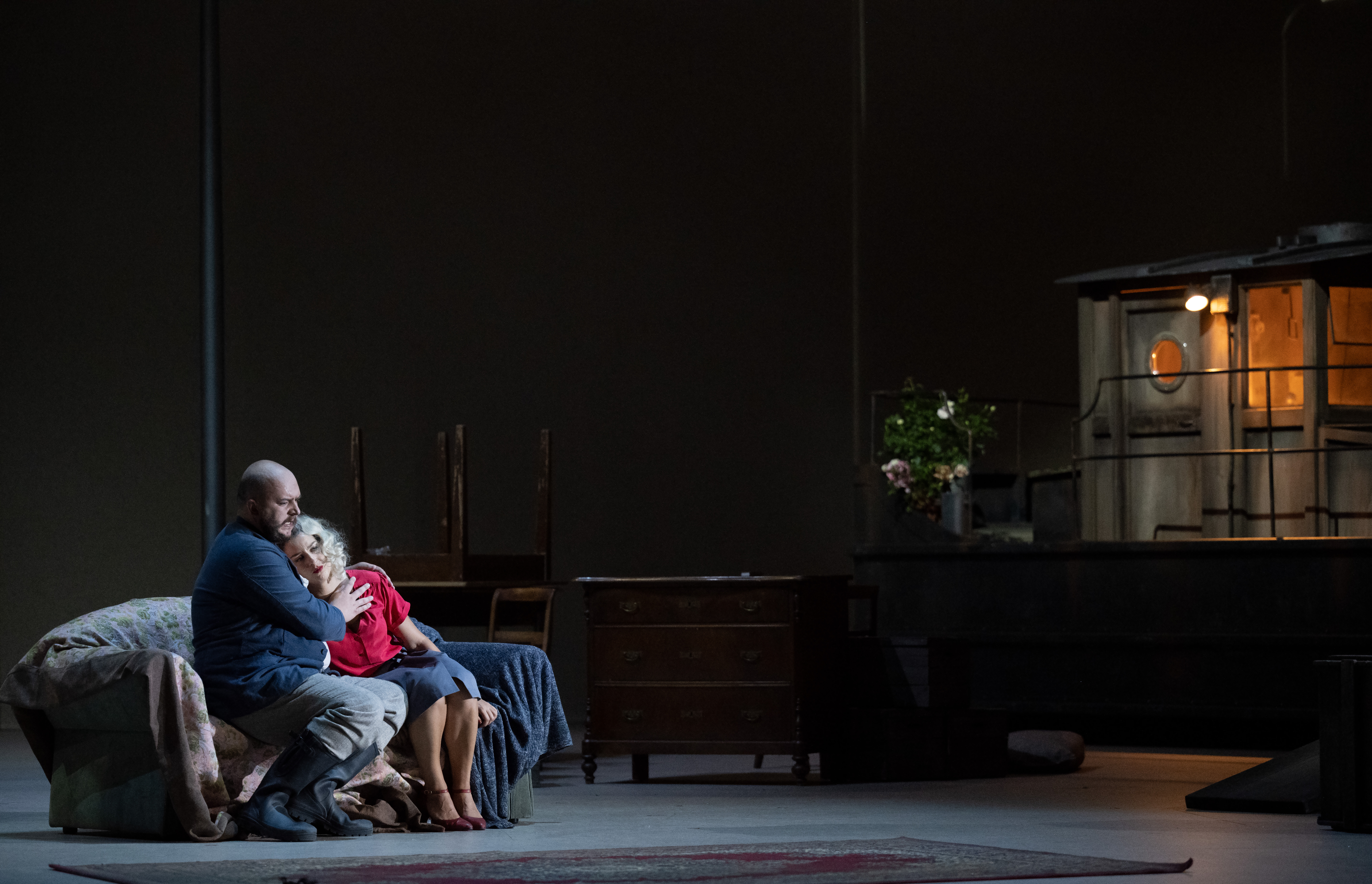
In many ways, this new production of Puccini’s triptych of one-act operas marked a triumph for the Salzburg Festival. One serious unforced error detracted, yet could only detract so far; likewise a few other cavils. Singing and orchestral playing were excellent throughout on the evening I attended, the last in the run. If Christof Loy’s production offered nothing particular in the way of insight, let alone re-evaluation, it presented the stories clearly and with élan, aided by good design work. Everything came together well, at an undeniably ‘Salzburg’ level.

Loy’s major miscalculation was to mess around with the ordering, so as to present the operas in the order Gianni Schicchi, Il tabarro, and Suor Angelica. The self-justification given in the programme made things worse, speaking of Suor Angelica having given the ‘impression’ of ‘such an extreme impact … that Gianni Schicchi came across as relatively trivial’. Not in my experience, nor in that of anyone I have spoken to. Nor has Il tabarro suffered from a lack of contemporary relevance, as Loy bizarrely suggests. (Quite why moving it to second place would help here remains unclear too.) Apparently, because this is a Festival, ‘everyone [is] in good spirits to be here,’ it makes better sense to open ‘with the seemingly life-affirming atmosphere of Gianni Schicchi’. Enough! There is good reason for placing the comedy last. Suor Angelica, meanwhile, suffers from being placed third, in that not only does it offer less a climax than a sense of tiring, even tailing away; but, perhaps worse, its own genuine musical as well as dramatic interest pales when heard after Schicchi. If you wanted to lend credence to claims of the saccharine, you could do a lot worse than adopt this reordering. Loy says that Franz Welser-Möst and he were in agreement on the matter; Welser-Möst really should have known better. None of this is fatal; after all, the operas are often (probably more often) played alone with entirely different companion pieces. But there is little gain here, and not inconsiderable loss.

Loy’s reputation in certain quarters remains something of a mystery to me. There is, as there certainly was here, a genuine craftsmanship at work. That I could admire—and did greatly. Movement and placing of objects on stage, the identity of each character (most of them, anyway), and much else had clearly been considered; one was left with little doubt that what one saw was what one was supposed to have seen. This is no more than speculation on my part, but I can imagine singers liking to work with him: certainly no bad thing. But beyond a certain generic stylishness, which is presumably in large part the work of his designers, I struggled to find any particular conceptual thinking at work, whether in each individual opera or as something to connect them. All three were vaguely modernised, I suppose, but unless one considers ‘modern dress’ to be a concept in itself, there was nothing to trouble conservative viewers. On the other hand, there was no banal intervention as in, say, Loy’s Tristan (Covent Garden) or Die Frau ohne Schatten (Salzburg, in which he essentially ignored the work altogether). So horses of no breed would have been scared away; perhaps that in itself was the idea.


The Vienna Philharmonic was on tremendous form, clearly relishing the opportunity to play all three operas in something approaching ideal conditions (certainly by way of comparison to the rehearsal schedule, or lack of it, in Vienna). Welser-Möst’s guiding spirit was heard to best effect in the first two operas, the scintillating scherzo of Gianni Schicchi razor-sharp, yet with plenty of tenderness too, the ominous ostinato of the Seine in Il tabarro duly overwhelming. (It took a few hours to get the latter out of my head, following the performance.) Light and shade were as meticulously planned and projected as any stage lighting, and there could be no doubting Welser-Möst’s knowledge and understanding of the scores. I missed a sense of something darker in Suor Angelica, but that was doubtless in considerable part a matter both of the piece itself and Loy’s decision to move it. There might nonetheless have been greater bite in its often intriguing harmonies and also a greater range of colour. A tendency to greyness such as I have often heard in Welser-Möst’s Strauss was not entirely avoided here.


Asmik Grigorian’s heroic service as heroine (of sorts) in all three proved both heartfelt and flawless. She did not tire, far from it, and gave considered, distinct performances of each of her roles. I do not think appreciation of her Sister Angelica was helped by its placing, giving the impression of everything leading up to a ‘big moment’, but I have probably said enough about that now. Her chemistry with Joshua Guerrero as Luigi and, indeed, negatively with Roman Burdenko as Michele was, to my mind, just as impressive, both of those artists turning in thoughtful as well as viscerally immediate performances. So too, unsurprisingly, did Karita Mattila as La Zia Principessa. From the moment she stepped on stage, one knew this was going to be something special, and it certainly was. Equal attention to words, music, and gesture informed a star turn that collegially collaborated with, in no sense upstaging, Grigorian. Much the same might be said, albeit (properly) with less hauteur, of Hanna Schwarz’s Abbess. Grigorian’s Rinuccio, Alexey Neklyudov, proved youthful, ardent, and similarly intelligent: a fine companion. Every portrayal in Gianni Schicchi was indeed, of similar quality, whether solo or ensemble, from Misha Kiria’s wily lawyer down (should that be the right direction). Enkelejda Shkosa’s turn as Zita here was followed by a splendidly animated La Frugola, hinting at hidden depths of sadness, in Il tabarro. This was a Trittico that almost offered the definition of casting from depth. For fine singing, complemented by excellent stage gifts, Personenregie, and orchestral playing, this will surely prove difficult to beat.


Tuesday, 21 January 2020

Jenůfa, Deutsche Oper, 17 January 2020


Jenůfa (Rachel Harnisch), Grandmother Burya (Renate Behle); Images © Bettina Stöß


Grandmother Buryja – Renate Behle
Kostelnička Buryja – Evelyn Herlitzius
Jenůfa – Rachel Harnisch
Laca Klemeň – Robert Watson
Števa Buryja – Ladislav Elgr
Foreman – Philipp Jekal
Mayor – Stephan Bronk
Jano – Meechet Marrero
Barena – Karis Tucker
Mayor’s Wife – Nadine Secunde
Karolka – Jacquelyn Stucker
Shepherdess – Fionnuala McCarthy

Christof Loy (director)
Dirk Becker (set designs)
Judith Weihrauch (costumes)
Bernd Purkrabek (lighting)
Eva-Maria Abelein (Spiellleitung)
Thomas Wilhelm (choreographic assistance)
Christian Arseni (dramaturgy)

Chorus of the Deutsche Oper, Berlin (chorus master: Jeremy Bines) 
Orchestra of the Deutsche Oper, Berlin
Donald Runnicles (conductor)


If Jenůfa fails to move, something will have gone terribly wrong. That is not, however, to say that one should take for granted a performance as moving as this. It takes a good deal of musical work to present an opera with this degree of excellence. This, in short, was an evening that heard the Deutsche Oper at something close to its very best.

Grandmother Burya, Laca (Robert Watson), Jenůfa


Guiding that excellent work throughout, whether on stage or in the pit, was the hand – perhaps better, were the hands – of Donald Runnicles. I have heard some distinguished conducting of this opera, from Bernard Haitink at Covent Garden (my first Jenůfa and, indeed, my first Janáček opera) to Jiří Bělohlávek in concert and, most recently, on the fateful night of 23 June 2016, Mark Wigglesworth for ENO. Each of those conductors brought something distinctive and valuable to the opera. Runnicles and his outstanding orchestra had nothing whatsoever to fear from comparisons. If I applaud his gifts of synthesis, that is not to say that the parts coming together to make their sum were insignificant: quite the contrary. An ear for detail, be it for specificity of timbre or rhythm, combination of instrumental and vocal line, the composer’s singular method of motivic writing, and much else besides, was crucial here in capturing and holding not only the musical but also the dramatic attention. That coming together, however, was equally crucial. Not unlike Mozart – or Shakespeare, for that matter – Janáček does not judge. To be sure, we make our own judgements, yet the humanity informing the composer’s mission involves understanding of why people do wrong, why they did not act otherwise. The conductor’s task in communicating that is to balance detail and broader sweep, not unlike the composer himself does in his astonishing art. There was human wisdom here on both counts: aware, perhaps, of something beyond, something divine, yet knowing that the truths in which this drama would partake must also keep their distance. They have their roots in something specific, even folk-like, without ever being reducible to that. Once again, this seemed to be communicated instinctively, however great the preparation and skill in maintaining that fond, even dangerous illusion of the immediate.


Kostelnička Buryja (Evelyn Herlitzius), Jenůfa


In an instructive programme note, Runnicles spoke of Janáček following an aesthetic of Kargheit (which connotes both frugality and bleakness) when it comes to sonority, an aesthetic opposed by well-meaning, Straussian smoothing of the edges and rounding out by the conductor Karel Kovařovic for the first Prague performance. A comparison with Rimskified Mussorgsky is not, as Runnicles, suggests, so far from the mark (though I still think that deserves something, somewhere of a place). We no longer hear either as eccentric, let alone incompetent, and we are surely right to do so. But again, to hear the craft, the meaning, the art in such writing requires work: no music worthy of the name really plays or sings itself; nor, one might add, does it listen to itself. Orchestral musicians as much as the conductor, as much as the listener, need to respond to finely judged balances between fragment and melody, speech rhythm and musical rhythm, individual timbre and blend. They must also do so with a knife-edge appreciation of dramatic timing. That unforgettable xylophone solo there, a solo violin intervention there, the crucial difference between trombone (Janáček) and horn (Kovařovic) sonority, and so on: these were not only presented, but felt, believed in. There is no need to damn Kovařovic any more than there is Rimsky-Korsakov. They did what they did; it spoke to many. One could truly feel, however, that Janáček spoke on this occasion – and that one thereby felt the cruelty, the bleakness, and yet ultimately the humanity and redemption too that this opera requires us to feel.


Jenůfa, Kostelnička


That also requires the small matter of excellent singing and acting – and of excellent collaboration. Here again, I had no reservations. Rachel Harnisch led us surely down a tragic yet sorrowfully redemptive path with a Jenůfa whose initial youthful spirits rendered the inhumanity of her subsequent, consequent tribulations all the more harrowing. I cannot imagine any human being having failed to root for her. Robert Watson and Ladislav Elgr faced off splendidly as Laca and Števa, the former wounded and wounding, increasingly noble of spirit, the latter’s cocky allure – seemingly the whole village, not only its girls, under its spell – undermined by a weakness of spirit that is always difficult to convey through song. (In a sense, it is the Don Ottavio problem, here skilfully surmounted.) Not the whole village, of course, for that would be to reckon without the Kostelnička – and without Evelyn Herlitzius’s Kostelnička. If I say it was a typically astonishing performance, I do not mean to undermine its specificity. Herlitzius is one of those singing actors who somehow both remains quite herself and assumes, even transforms the character of the role she is playing. Initially hard, increasingly wild, always with good in her heart: one could hardly bear to look her in the face, or the aural equivalent, yet equally knew that one must. This was spellbinding artistry, in the truest sense. Yet wherever one looked and listened, there was necessary artistry, as much a crucial part of the musicodramatic synthesis: Renate Behle’s Grandmother, wiser than her carefully prepared surface let on, in knowing that principle may also lie in surviving, in not succumbing to tragedy; Nadine Secunde’s properly ghastly Mayor’s Wife; Philipp Jekal’s Foreman, wanting initially to be Števa, yet perhaps suggesting that all was not quite as it should be: these characters and more made Janáček’s community and thus drama what they were. So too, of course, did the excellent Deutsche Oper Chorus.


Jenůfa, Števa (Ladislav Elgr), Laca


I have left Christof Loy’s production until last because it seemed – and this is not always a claim I should make for that director’s work – more a framework in which the work and its performance could unfold than an interpretation. Aside from the conceit of having the imprisoned Kostelnička look back at the story that had led her to where she now found herself, there was not so much to report. Occasional dramatic pauses made their point too, having us collect our thoughts – and our emotions. I have seen more interventionist and, perhaps, more telling stagings; it is fair to say, for instance, that I learned and was challenged more from David Alden at the Coliseum. But that did not seem to be the point on this occasion. If a staging permitted, even gently led me to be moved by the drama that unfolded, then it may also be accounted successful.


Saturday, 6 December 2014

Tristan und Isolde, Royal Opera, 5 December 2014

 
Royal Opera House
 
Sailor – Ed Lyon
Isolde – Nina Stemme
Brangäne – Sarah Connolly
Kurwenal – Iain Paterson
Tristan – Stephen Gould
Melot – Neal Cooper
King Marke – Sir John Tomlinson
Shepherd – Graham Clark
Steersman – Yuriy Yurchuk 
 
Christof Loy (director)
Julia Burbach (associate director)
Johannes Lieacker (designs)
Olaf Winter (lighting)
 
Royal Opera Chorus (chorus master: Renato Balsadonna)
Orchestra of the Royal Opera House
Sir Antonio Pappano (conductor)
 
Images: ROH/Clive Barda


Christof Loy has established rather a nice line in taking on works he admits he dislikes, or worse, and ignoring them whilst claiming to direct them. The ne plus ultra was surely his Salzburg Frau ohne Schatten, in which he set aside Strauss and Hofmannsthal completely in favour of his own banal story in which ‘an emerging young singer, sheltered and pampered by her well-to-do family is asked to take on the role of the Empress for a complete recording of Die Frau ohne Schatten.’ That was more or less it. His Royal Opera Tristan does not go so far as that, though his Lulu came close; nevertheless, his words speak for themselves. Loy, we read in the programme, cannot ‘really equate the couple’s position as outsiders with a Schopenhauerian denial of the world’. Wagner and many others since have managed to do so, but obviously what matters is a director’s inability or unwillingness to understand the work; that, after all, is what he is paid for. ‘Character direction which is rich in detail and specific’ is what interests Loy most as a director, which is why, he says, he had generally steered clear of Wagner, notorious, the reader will doubtless agree, for his inability to characterise. Tristan, however, seemed to Loy, who, it is once again worth reminding ourselves, the most important figure in all of this, something of an exception. It does not seem that he necessarily wished to traduce the work, then, but he has certainly misunderstood it. Of all Wagner’s works, it is perhaps least of all concerned with what he claims to interest him, and most concerned with metaphysics.
 
So much, then, for the misconception, but how does it play out in practice? Music and the arts in general are, after all, littered with examples of great works founded upon questionable æsthetics. Not too badly, to start with; indeed, I began to think that either my unfavourable memories from 2010 had played tricks upon me or that there had been radical revision. Julia Burbach was listed as an associate director and I think she probably has mitigated a few of Loy’s most irritating excesses; the supremely irrelevant canoodling between Brangäne and Kurwenal, for instance, seems toned down, although it is not, alas, eradicated. A good part of the first act is relatively abstract – pretty much always a good thing in Tristan – or at least may be seen as such with a degree of good will (towards Wagner, if not Loy). Then, when they have a little break, Tristan and Isolde are all over each other. What is the problem with that, one might ask? There seem to be two principal problems. One relates to the specificity of the setting, even if we are not quite sure of what that specificity is. In some building – a palace, perhaps? – awaiting her wedding and thereafter facing the consequences, Isolde manages somehow to escape for long enough to take off her wedding dress and be mauled by Tristan for a while. Still more oddly, she manages to do so for longer still during what may or may not be the wedding reception in the second act. Were there less specificity, this would not matter; playing fast and loose with time and location would not be an issue, and we could accept the overarching mythological claims. Here, however, we are just aware that it is at best rather trivial – Tristan for those who would prefer EastEnders, although a real soap opera viewer would doubtless expect more external action sooner – and often puzzling or downright nonsensical.  
 
The other brings us to the heart of Loy’s error, or, perhaps better, to the heart of Wagner’s – remember him? – work. Wagner’s action is resolutely metaphysical: not exclusively so, but the physical matters only insofar as it draws us towards, or in Schopenhauer’s terms, represents, the metaphysical drama. Since there are no metaphysics in Loy’s view, all we have is an extremely prolonged soap opera, tinged with the occasional aspiration towards Ibsen. Ironically – unknowingly, I suspect – Loy’s acknowledged inability to deal with Schopenhauerian denial of the world seems to have led Loy him to stage the second act as conventional ‘opera’, rather as Wagner acknowledged he could have written it, set against a backdrop of a brilliant court ball, ‘during which the illicit lovers could lose themselves … where their discovery would generate a suitably scandalous impression and the whole apparatus that goes with that.’  Wagner, of course, rejected that possibility he aired for a second act in which almost nothing but music happens. And even when external action intrudes, Wagner came to regard it as of lesser importance at best. His prose sketch had, for instance, drawn to a close, Götterdämmerung-like, with the words, ‘The bystanders are profoundly moved,’ concluding, ‘Marke blesses them’. However, when, in 1859, he summarised the work’s concerns for Mathilde Wesendonck, Wagner went so far as not only to omit the King’s  forgiveness, but also Tristan’s agonies at Kareol; they no longer mattered to him. True action, the Handlung of his own description, now lay in the noumenal world: ‘redemption: death, dying, destruction, never more to waken!’ Such, needless to say, was not what we were permitted to experience here. I should be the last person to claim that, as a general rule, production must exhibit some illusory, disingenuous Werktreue. However, in this particular case, it does seem that a staging of Tristan will not work unless it follows Wagner’s lead. Not for nothing did Nietzsche call it the opus metaphysicum. I know that I was not the only one in the audience looking back fondly to Herbert Wernicke’s comprehending, yet largely uncomprehended, production for this very house.
 
Wernicke’s production had of course been fortunate indeed to have Bernard Haitink, one of the greatest Wagner conductors of our age, in the pit. Haitink, as we know from his Bruckner and Mahler, is a master of large musical structures, and so he proved here. Antonio Pappano seems to have been thinking in similar terms to Loy, with not dissimilar results. Indeed, the scrappiness of the orchestral playing made it markedly inferior to Pappano’s previous accounts, let alone to Haitink’s. Missed entries, thinness of string tone (had I not seen the section with my own eyes, I should have sworn that it was considerably smaller), wavering intonation: none of those helped. More grievous still, however, was Pappano’s seeming inability to let a musical line, let alone a paragraph or some greater structure, unfold. The seemingly arbitrary nature of his beat was mirrored in the aimless meandering of the score. It seemed for the most part very slow; whether it was by the clock, I am not sure. The lack of direction was the problem, though, especially during the second act, which at times seemed almost to grind to a halt. Pappano gave the impression of following rather than leading the singers; that is not, to put it mildly, a recipe for success in Wagner.
 
 
Isolde (Nina Stemme)
Where, however, this Tristan did score over Wernicke and Haitink was with respect to those singers, who, as a cast, are deserving of considerable praise. Nina Stemme offered everything we have come to expect of her as Isolde. With her, words and music formed an indivisible whole; Wagner’s æsthetics emerged triumphant in a variegated reading that yet always belonged to a conception greater than the moment. She even presented us with Nilsson-like angry sarcasm in the first act. Stephen Gould proved a dependable Tristan. Despite a few passages of dubious intonation in the third act, he stayed the course and provided us with as many of the words and notes as it is reasonable to ask. (Haitink was cursed by his Tristans in particular.) Sarah Connolly, at least in the first act, did not offer as rich-toned a Brangäne as I had expected; indeed, Stemme sometimes sounded more the mezzo. Connolly’s reading seemed more focused upon words than line, but without unnecessary disruption of the latter. Iain Paterson offered an intriguingly boisterous, yet at the same time most sensitively sung, Kurwenal. The role seemed to fit him like a glove. Only John Tomlinson’s Marke disappointed. All Wagnerians owe Tomlinson gratitude for his extraordinary years of service, but, undimmed stage presence notwithstanding, the vocal flaws now render such an outing ill-advised. I was most impressed by Neal Cooper’s Melot; before consulting the programme, I had assumed this to be a German tenor. He is, we learn, covering the role of Tristan here and will sing it next year at Longborough. Impressive! Ed Lyon's Sailor was finely sung in very sense. Graham Clark made his typically characterful mark as the Shepherd; as, perhaps more surprisingly, given the brevity of his part, did Jette Parker Young Artist, Yuriy Yurchuk as the Steersman.


Saturday, 19 July 2014

Ariadne auf Naxos, Royal Opera, 13 July 2014


Royal Opera House

Music Master – Sir Thomas Allen
Major-Domo - Christoph Guest
Lackey – Jihoon Kim
Officer – David Butt Philip
Composer – Ruxandra Donose
Tenor, Bacchus – Roberto Saccà
Wig-Maker – Ashley Riches
Zerbinetta – Jane Archibald
Prima Donna, Ariadne – Karita Mattila
Dancing Master – Ed Lyon
Naiad – Sofia Fomina
Dryad – Karen Cargill
Echo – Kiandra Howarth
Harlequin – Markus Werba
Truffaldino – Jeremy White
Scaramuccio – Wynne Evans
Brighella – Paul Schweinester

Christof Loy (director)
Herbert Murauer (designs)
Jennifer Lipton (lighting)
Beate Vollack (choreography)

Orchestra of the Royal Opera House
Sir Antonio Pappano (conductor)
 

I hope I shall be forgiven for keeping this relatively brief. Having been distinctly under the weather this week, I have fallen a little behind, and in any case have written about Christof Loy’s production of Ariadne auf Naxos before. This time, hearteningly, I recaptured some of my earlier enthusiasm, having found the staging looking somewhat tired last time around. Perhaps it was a matter of the revival direction, or perhaps it was a matter of sitting closer to the stage (the back of the Stalls Circle, the restricted view seemingly not much of an issue). At any rate, the virtues that I had originally hymned – a very real sense of the audience and the audience member being told that this was a tale told about them, a nice balance between the present and a re-imagined and then re-imagined again eighteenth century – were married to a well-acted company performance.
 

For the most part the singing was very good too. Thomas Allen’s Music Master continues to inspire; this time, he found a fine foil in Ed Lyon’s Dancing Master, his German as impressive as the French of the repertory in which I have previously tended to hear him. Both can act too – and did. Ruxandra Donose’s Composer was beautifully sung – and a character in whom one could truly believe, whom one could take to one’s heart. I am not sure that I have heard so distinguished a trio of Naiad, Dryad, and Echo, as Sofia Fomina, Karen Cargill, and Kiandra Howarth, whether corporately or individually. Markus Werba offered a predictably excellent Harlequin, well supported by the rest of his troupe. Jane Archibald reached for the heights and attained them with her lovely Zerbinetta: an object-lesson in the role. Disappointments? Roberto Saccà’s dry-toned Bacchus, fare more so than I had heard in Salzburg in 2012. And, I am afraid that, try as I might, I could not find Karita Mattila ‘right’ for the role of Ariadne. She is a wonderfully engaging artist, and there was much to enjoy, but I missed the floating of line that seems essential to the part, likewise the neo-Mozartian grace. Others have clearly felt differently, and I have tried not to be hidebound by recollections of great historic assumptions; ultimately, however, and with considerable regret, I thought Mattila miscast.
 

The other disappointment, perhaps more predictably, was Antonio Pappano’s conducting. Quite why he insists on inflicting himself upon a German repertoire for which he clearly has little sensitivity, let alone understanding, remains a mystery. Granted, this was not nearly so bad as his Wagner, and there was considerable life to the Prologue. However, the Opera soon became listless, with little sense of harmonic or indeed any other direction. The Orchestra of the Royal Opera House played very well, but how one longed for the wisdom, refinement, wit, and humanity the late Colin Davis brought to this work in this production.


Thursday, 25 August 2011

Salzburg Festival (2) - Die Frau ohne Schatten, 21 August 2011

Grosses Festspielhaus

Image: Salzburg Festival/Monika Rittershaus

The Emperor – Stephen Gould
The Empress – Anne Schwanewilms
The Nurse – Michaela Schuster
Barak – Wolfgang Koch
Barak’s Wife – Evelyn Herlitzius
The Spirit-Messenger – Thomas Johannes Meyer
Apparition of Youth – Peter Sonn
Voice of the Falcon – Rachel Frenkel
Guardian of the Threshold of the Temple, First Servant – Christiana Landshamer
Voice from Above – Maria Radner
The One-Eyed – Markus Brück
The One-Armed – Steven Humes
The Hunchback – Andreas Conrad
Second Servant – Lenneke Ruiten
Third Servant – Martina Mikelić
Voices of the Unborn – Janna Herfurtner, Christian Landshamer, Lenneke Ruiten, Rachel Frenkel, Martina Mikelić, Maria Radner

Christof Loy (director)
Johannes Leiacker (set designs)
Ursula Renzenbrick (costumes)
Stefan Bolliger (lighting)
Thomas Jonigk (dramaturgy)
Thomas Wilhelm (choreography)

Concert Association of the Vienna State Opera Chorus (chorus master: Thomas Lang)
Salzburg Festival Children’s Choir (chorus master: Wolfgang Götz)
Vienna Philharmonic Orchestra
Christian Thielemann (conductor)


Christof Loy strikes again. After a perversely misconceived Lulu and a still more reductive assault upon Tristan und Isolde, we seem to have reached the end of the line – at least I hope we have – with this Frau ohne Schatten. I see little point into going into great detail , though Loy does in his alternative synopsis, ‘Die Frau ohne Schatten: Eine persönliche Inhaltsangabe’. It would seem that the director despises this Strauss-Hofmannsthal collaboration considerably more than even Tristan, so much so that he declines to direct it all. Instead of the complex drama we might have seen, we witness an unutterably banal alternative, in which ‘an emerging young singer, sheltered and pampered by her well-to-do family is asked to take on the role of the Empress for a complete recording of Die Frau ohne Schatten. … from now she will have to meet human beings as they are …’ All that happens, then, is that we see the singers gather for a recording session in a mock-up set of the old Sofiensäle (well designed in itself, but it is difficult to care very much). At the end, for some reason, the singers take place in a Christmas concert. The claim that this aversion of responsibility somehow echoes Brechtian alienation, Anouilh even, seems beneath contempt. I cannot be bothered to say any more, save that a concert performance would have been infinitely preferable. What a scandalous, arrogant waste! If Christof Loy does not like Die Frau ohne Schatten, that is his problem: why should it become ours?

Thank goodness, then, for the Vienna Philharmonic under Christian Thielemann. If the first act, whilst of an orchestral standard that would have put almost any house to shame, was on occasion not always quite there, the latter half of the second and pretty much all of the third were simply outstanding. Orchestral heft and the full panoply of Strauss’s phantasmagorical colouristic vision (more than once Schoenberg’s Op.16 Orchestral Pieces came to mind) were married to a sense of purpose that seemed to me even to surpass that of Karl Böhm. Moreover, Böhm’s customary cut passages were restored. The VPO’s golden string tone is always – well, nearly always – a wonder to hear, but Thielemann proved as alert to the modernistic, post¬-Elektra tendencies in Strauss’s score as the dance echoes of Der Rosenkavalier. The great climaxes did not want in impact, but there was great delicacy to be heard too. And Thielemann’s ear for orchestral balance proved second to none.

One is unlikely ever to hear a perfectly cast FroSch. Here the principals mostly suffered from drawbacks, save for Michaela Schuster’s extraordinary Nurse. Hers was certainly the portrayal to savour above all others: malevolent, confident in pitch, almost imaginable in a ‘real’ production. Stephen Gould sang well enough as the Emperor – doubling up on stage, or above stage, as a recording engineer – but his phrasing and tone production were sometimes unvariegated. Still, at least he could sing the notes, unlike many who attempt the role. Anne Schwanewilms had her moments, sweetly sung, but too often she found herself wildly out of tune and her voice cracked on more than one occasion. Wolfgang Koch was mostly dependable as Barak, though again there were cracks, whilst Evelyn Herlitzius as the Dyer’s Wife veered between staggering dramatic vocalism in the best sense and seeming inability to sing a single note in tune. There was no faulting her energy, but its application was sometimes distressingly flawed. Choral singing was outstanding, however, a tribute both to the choirs and to their training.

It was the VPO’s show, then, and Thielemann’s, with Schuster the best of a mixed vocal bunch. On Loy, I shall say no more, for the moment, other than that it is a long time since I have been so angered by a ‘production’.

Wednesday, 21 October 2009

Tristan und Isolde (II), Royal Opera, 18 October 2009

Royal Opera House, Covent Garden

Tristan – Lars Cleveman
King Marke – Matti Salminen
Isolde – Nina Stemme
Kurwenal – Michael Volle
Brangäne – Sophie Koch
Melot – Richard Berkeley Steele
Sailor – Ji-Min Park
Steersman – Dawid Kimberg
Shepherd – Ryland Davies

Christof Loy (director)
Johannes Leiacker (designs)
Olaf Winter (lighting)
Marion Tiedtke (dramaturge)

Chorus of the Royal Opera House (chorus master: Renato Balsadonna)
Orchestra of the Royal Opera House
Antonio Pappano (conductor)

This review was written for and first published on Per-Erik Skramstad's excellent site, Wagneropera.net, which I urge anyone and everyone to consult. It may be found, with images from the production, by clicking here.

I saw the first night of this Tristan und Isolde (click here for review) and have now seen the last. I hoped against hope that I might see the error of my ways and be converted to Christof Loy’s production. Sadly not. Mine, I must admit, seems to remain a minority view, at least amongst other reviewers, though perhaps not amongst the audience at large. (For a cross-section of wildly enthusiastic reviews, click here and here and here and here, etc. I draw solace from the relative coolness of that eminent Wagnerite, the opera critic of the Spectator, and a few others.) What I should take issue with is the claim that, if one does not appreciate this production, one is ‘literal-minded’. I could not care less whether one sees a ship, Tristan’s castle, and so on; indeed, I am all for abstraction, which is why I admired Covent Garden’s previous production, by Herbert Wernicke. (Many of those cheering Loy hated Wernicke’s wonderful, colour-coded, Schopenhauerian interpretation.) This is anything but abstract, though; it is domesticated and strangely specific, but specific in a sense that makes no sense. Once one starts seeing a wedding breakfast, a strange tea for two setting, an irritating curtain forever being drawn, one misses the ship, Kareol, and so forth, in a way that simply draws attention to their absence, rather than puts them to one side as inessential. Loy’s production. At the front of the stage, we see, in Johannes Leiacker’s designs that operatically ubiquitous, dreary minimalist chic which is anything but cost-cutting; the ‘world of existentialism,’ according to a programme interview with Loy. At the back is the real world of the wedding breakfast. Loy claims that ‘the two spaces’ are, during the action, ‘almost completely redefined’; once again, I was at a loss to discern anything but the most trivial difference.

If anything, I was more annoyed the second time around than the first. What I had charitably assumed to be an accident, the edging forward of a wall at the end of the second act, was not. Yet again, it appeared that something was about to be revealed; as I wrote previously, ‘perhaps it was a metaphor for the production as a whole’. Isolde’s aimless emerging from behind the curtain during the opening Prelude once again – how could it not? – completely undermined the progress of the music, what should have been its great climax coming to nothing. Is it not more than time that directors were assumed to read a score and exceptions to this were just that? (I should hardly have the nerve to direct Chekhov in Russian without understanding the language.) Perhaps Loy can read Wagner’s score, in which case he simply disregarded it. The end of the second act would have been incomprehensible to anyone who did not know the work well already. Tristan, according to what he did on stage, appeared to be addressing Melot, when he should have been addressing (a bewilderingly departed) Isolde. Words and stage direction were at odds, not with ‘interesting’ antagonism, but with straightforward confusion.

There is, of course, something more at work here. Loy freely admits that he doesn’t like heroism; nor does he care for Schopenhauer, certainly not in any sense that might inform Tristan. Loy cannot ‘really equate the couple’s position as outsiders with a Schopenhauerian denial of the world’. Some observers might think that more his problem than Wagner’s and suggest that Loy direct something with which he feels more at home. Of course, it is perfectly possible to reinterpret a work; I have no problem with that at all. My problem is that I find this production both inappropriate and incoherent, most of all far less interesting than Wagner’s opus metaphysicum. The realism of what we see is becoming almost de rigueur in modern Wagner production, but this realism seems especially at odds with what is such an overwhelmingly metaphysical work – the ‘passion of passion’ in Michael Tanner’s memorable phase. The carrying on behind the curtain between Kurwenal and Brangäne is simply demeaning: utterly unerotic and belittling characters whose love for their master and mistress is in many respects the truest love of all in the work as conceived by that minor nineteenth-century dramatist, Richard Wagner. I actually overheard someone during the second interval praising the production for the ‘masterstroke’ of having Tristan bring about his own death; the speaker, revelling in what she trumpeted as her ‘receptiveness’ to new ideas, was unaware that this was one of the few cases in which Wagner was respected. Of course Tristan should throw himself upon Melot; the only surprise was that he actually did.

Matters were not helped by Antonio Pappano’s musical direction. Pappano is an extraordinarily frustrating Wagner conductor; his performances vary enormously, sometimes getting things right, with the good work undone the next time, and vice versa. The love duet on this occasion was much better handled; its metaphysical import was ironed out, as if this were something from Italian opera, but there was structural sense of a kind. And the third act worked better than before, again hardly idiomatically – it was as if ‘plot’ were the focus of this of all works – but it built to a glorious climax in Nina Stemme’s extraordinary Liebestod. However, the first act was simply all over the place, arbitrarily pulled about, stopping and starting, with no sense of an overall line. The first act Prelude started almost unbelievably slowly. That can work, but there needs to be harmonic momentum; here, phrase followed phrase, with no connection between them. To imitate Furtwängler would be to fail, but it might be to fail better than this. The orchestra itself often sounded splendid, if rarely scaling the heights that it did under Bernard Haitink. Yet there were a few problems, which seemingly attested to a lack of security in direction. For instance, there were repeated difficulties in that unconvincing first act Prelude from woodwind upbeat entries; had this happened once, it might well have been a player’s individual mistake, but to happen repeatedly suggested otherwise. There was also an unfortunate missed entry from the trombones during the second act love duet, though they redeemed themselves with a truly sepulchral sound during Marke’s soliloquy.

However, and this is a big however, there was good news. I said on the first occasion that the ‘best reason to see this Tristan would be the singing’. On the showing of this final performance, it would be almost mandatory to endure the production on account of the singing. Everything was at least as good as before and some things were much better. Stemme rose to even greater heights, her detailed characterisation allied to astonishing radiance of tone. Schubert Lieder met Strauss opera – and I suppose Wagner is indeed somewhere in between. She also seemed to have developed a slight Nilsson-like irony, which I did not detect the first time around. Sophie Koch was a wonderful Brangäne, whilst Michael Volle was simply the best Kurwenal I have heard, charismatic and attentive to every nuance of the musico-poetic text. The supporting cast was without a weak link.

And then there were the two casting changes. Lars Cleveman was a far superior Tristan to Ben Heppner. To begin with, his tone seemed a little all-purpose heroic, refreshing though some heroism was in this production. But he sailed through – forgive the pun for an absent friend – the love duet, where Heppner had broken down and where so many others come utterly unstuck. Following the intervention of Matti Salminen’s superlative Marke, this Tristan seemed utterly changed. Whether this were increasing ease on stage or a dramatic decision, I do not know, but it certainly had a dramatic effect. Cleveman’s progress through the treacherous monologue was clearly plotted: wan and despairing at first, building up to a profoundly moving climax in tearing off his bandages. Moreover, Salminen showed that, whereas Sir John Tomlinson had moved by virtue of his great presence and understanding, a voice that was in fine fettle could take one still further.

Wednesday, 30 September 2009

Tristan und Isolde, Royal Opera, 29 September 2009

Royal Opera House, Covent Garden

Tristan – Ben Heppner
King Marke – Sir John Tomlinson
Isolde – Nina Stemme
Kurwenal – Michael Volle
Brangäne – Sophie Koch
Melot – Richard Berkeley Steele
Sailor – Ji-Min Park
Steersman – Dawid Kimberg
Shepherd – Ryland Davies

Christof Loy (director)
Johannes Leiacker (designs)
Olaf Winter (lighting)
Marion Tiedtke (dramaturge)

Chorus of the Royal Opera House (chorus master: Renato Balsadonna)
Orchestra of the Royal Opera House
Antonio Pappano (conductor)

‘I fear the opera will be banned – unless the whole thing is parodied in a bad performance –: only mediocre performances can save me! Perfectly good ones will be bound to drive people mad, – I cannot imagine it otherwise.’ Sadly, I think, Wagner’s words to Mathilde Wesendonck came nowhere near to fulfilment; or, to put it, another way, they did, but there was no chance of the work being banned. A performance of Tristan und Isolde that fails to grab one by the throat and drive one at least to the borders of insanity has failed, plain and simple. Tristan without its Rausch (intoxication) is no Tristan at all.

Most of the fault for this lies with Christof Loy’s production. There is no especial need – indeed, I suspect that it is not even desirable – for Tristan to be set ‘somewhere’, whether in Cornwall or in a multi-storey car-park. Abstraction works well, as Herbert Wernicke’s infinitely preferable Covent Garden production showed. Loy, however, contrives to have the worst of both worlds. At the front of the stage, we see in Johannes Leiacker’s designs minimalism that is drab to the point of excess; this is the world of existentialism, according to a programme interview with the director. At the back, sometimes revealed by the drawing back of a curtain, is what appears to be the real world, the specific setting of Marke and Isolde’s wedding breakfast, again according to that interview. I assume that it was significant that there are no female guests. I likewise assume that the edging forward of a wall at the end of the second act was an accident. It appeared that something was about to be revealed, but alas not; perhaps it was a metaphor for the production as a whole. At any rate, the prolonged dimming of the lights afterwards suggested a lack of intention.

Isolde emerges from the latter world during the opening Prelude. Wandering around, looking lost and slightly – but not too much – bereft, her progress, such as it is, completely undermined the progress of the music, its orgasmic climax coming to nothing. Perhaps that is the point, or perhaps not. According to Loy, ‘the two spaces’ are, during the action, ‘almost completely redefined’. Apart from the odd case of a new table, they look and act pretty much as they always had done, at least so far as I could tell. And surely a time to have bridged the gap would have been Tristan’s appearance at the helm, or whatever it transpired to be in this production; what should be an earth-moving moment once again went for nothing. Perhaps most unforgivable was the appearance of Marke, Melot, and the other men long before the moment of coitus interruptus; extraordinary though this might seem, the cadence sounded only so slightly interrupted, a fault of the musical direction too.

So we had an ‘existential world’, fair enough, which interacted awkwardly with a highly specific setting that contradicted a great deal of what we heard in the words. Without wishing to seem like a stage direction fetishist, the first act references to a ship, the second act references to the hunt, and so forth, stand in glaring and unproductive contradiction to the monotonous revelations of the backstage banquet. If all is abstract, one can simply imagine, or not; one can concentrate upon the essence of the work, which has nothing to do with the setting and everything to do with the music. Musical drama should, as Wagner writes in his Schopenhauer-infused Beethoven essay, be a case of deeds of music rendered visible. This is simply not possible here.

For it seems that Loy does not like Schopenhauer very much, not just in terms of æsthetics, but also because he cannot ‘really equate the couple’s position as outsiders with a Schopenhauerian denial of the world’. Wagner and many others managed to do so, but we shall let that pass for the moment, for there is nothing wrong with approaching a work from a different angle. But what Loy reduces Tristan too is a strange and, to my mind, incompatible mix of something between Ibsen and Strindberg on the one hand and unamusing farce on the other. Perhaps the latter was unintentional, but the glimpses behind the curtain of Kurwenal and Brangäne imitating their master and mistress were hardly daring, just a little tacky. At least with Calixto Bieito, there might have been something a little more to see. ‘Character direction which is rich in detail and specific’ is what interests Loy most as a director, which is why, he says, he had generally steered clear of Wagner. Tristan, however, seemed to him something of an exception. I cannot imagine why, for it is only superficially concerned with the characters at all; if anything, it is the most supreme example of what he professes to dislike. How small it all seemed.

And if Loy does not like Schopenhauer or even Wagner, Antonio Pappano does not seem to like myth. The abstract nature of Tristan, he says in the same programme interview cited above, ‘is overrated. These are people on stage!’ Well, sort of, but are we seriously supposed to think that what matters about Tristan is the plot in itself. Though there is relatively little stage action to speak of, Wagner omitted even some of that when called upon to explain what the work was about. But what did he know? This perhaps helps explain the musical performance’s greatest failing. Though this was certainly Pappano’s best Wagner performance at Covent Garden, and every so often revelatory in terms of instrumental, especially wind, colour, at other times the musical structure, the longer line, was once again sadly lacking. Nowhere was this more the case than during the second act love duet: shapeless, just going on for a long time. Why do I say that Pappano’s words might help to explain? Because it seemed to me that his reading – unlike Loy’s! – was very much dictated by the words. The words have their place in a musical interpretation, of course, but in this of all works, the music must take precedence. It has its own demands; it undercuts the words, sometimes with a radicalism of which a director could only dream. Tristan for the most part therefore sounded as if it were a work with some wonderful moments, not the all-enveloping whole, the representation of the Schopenhauerian Will, it simply has to be. The third act was considerably better.

The best reason to see this Tristan would be the singing: a most unusual state of affairs. Ben Heppner struggled during stretches of the second and third acts; he really does seem to have lost his former steely security. But he sang better than one has come to expect in this impossible role and his diction was impressive. Loy’s desire for ‘character direction which is rich in detail and specific’ did him no favours, though; the moments in which he became amorous were too embarrassing even to register as farce. Nina Stemme’s performance as Isolde was excellent. One does not hear the majesty of a Flagstad, nor the steely sarcasm and irony of a Nilsson; one hears an intensely musical, variegated portrayal, which again – and more appropriately – seems very much to arise from the words. Lieder-singing would seem to inform her approach, which is not to say that it lacks a greater musical line, far from it. As Kurwenal and Brangäne, Michael Volle and Sophie Koch were hamstrung by Loy’s apparent determination to present them just as best friends to Tristan and Isolde; there was little sense of hierarchy, subservience, or even devotion. But they succeeded triumphantly in musical terms, barely putting a foot wrong, and helping to distract one’s attention from the visual realisation, despite approaching their well-nigh hopeless tasks with commendable enthusiasm. Brangäne’s description of the potions was a case in point. Sir John Tomlinson’s Marke was grave and meaningful as seemingly only he knows how. In this context, however such a Lear-like portrayal served to highlight the shortcomings of the production. I was also impressed by Ryland Davies’s keenly observed Shepherd, drawing upon a wealth of operatic and musical experience, and the winning Steersman of the splendid Jette Parker Young Artist, Dawid Kimberg: certainly one to watch. If you can bear to forget the work and concentrate on some fine singing, then there are rewards to reap. There is, I suppose a bright side: you might sympathise with the vigorous first-night booing for the production team, but at least you will not, as Wagner feared, descend into madness.

Friday, 5 June 2009

Lulu, Royal Opera, 4 June 2009

Royal Opera House, Covent Garden

Lulu – Agneta Eichenholz
Countess Geschwitz – Jennifer Larmore
Dr Schön/Jack the Ripper – Michael Volle
Alwa – Klaus Florian Vogt
Schigolch – Gwynne Howell
Animal Trainer/Rodrigo – Peter Rose
Dresser/Gymnast/Groom – Heather Shipp
Prince/Manservant/Marquis – Philip Langridge
Mother – Frances McCafferty
Painter/Negro – Will Hartmann
Professor of Medicine – Jeremy White
Fifteen-year old girl – Simona Mihai
Lady Artist – Monika-Evelin Liiv
Journalist – Kostas Smoriginas
Manservant – Vuyani Mlinde

Christof Loy (director)
Herbert Murauer (designs)
Reinhard Traub (lighting)
Thomas Wilhelm (movement)

Orchestra of the Royal Opera House
Antonio Pappano (conductor)

Good news is in short supply for the Royal Opera’s new production of Lulu, but there was some. First, there actually is a new production of Lulu, the sole previous example (Götz Friedrich/Colin Davis) having been presented in 1981, revived once in 1983. (The two-act, pre-Cerha version was never staged at Covent Garden: extraordinary, until one considers what else has not been, whilst the neglected Tosca returns every season.)

Moreover, much of the singing was very good. Michael Volle scored another triumph with his role debut – remarkably, only Will Hartmann had sung his part before – as Dr Schön. Thoughtful, musical, as real a character as the production would allow him to be: this was a first-class performance. Hartmann impressed just as much and for just the same reasons, plus his honeyed tone, in his roles, especially the Painter. Klaus Florian Vogt made a welcome house debut as Alwa and exhibited the virtues we have come to know from his Walther and his Lohengrin. If perhaps too blank a canvas in the first act, this might well have been a response to direction; in any case, his desperation during the chilling final scene of the second act was moving indeed. Gwynne Howell simply was Schigolch: always a role to be relished, as here. I was put in mind of Norman Bailey. Jennifer Larmore was a more feminine Geschwitz than one often hears, beautifully sung, though not so strong, so differentiated a character as might be the case. Again, this qualification might at least partially be ascribed to the production. Peter Rose sang well, though he makes a physically unfortunate Athlete, unless, as did not seem to be the case, irony were intended. Philip Langridge offered carefully etched portrayals of his three roles, insofar as the production, etc., etc.

And then, of course, there was Agneta Eichenholz’s Lulu. Often impressive in vocal terms, though she struggled on a few occasions with the extraordinary difficulties of Berg’s writing, Eichenholz failed to exert the animal magnetism the role truly demands. Christine Schäfer, amongst others, has offered a portrayal so compelling as to leave this in the shade, and sadly, one cannot put out of one’s mind other singers in a role such as this. Even in a revisionist portrayal, it is not enough to be primarily a victim: Lulu is far more interesting than that. I suspect, however, that Eichenholz might grow into the role.

If the central role was a little underplayed, how much more so was the orchestra. In itself there was little to complain of in the orchestral playing; indeed, many woodwind and brass players truly shone. Antonio Pappano, however, showed once again that, whatever his abilities in the Italian repertoire, they are not paralleled in his conducting of German music. As so often in his Wagner, Pappano failed to weld the momentary into a greater structure, although there were perhaps fewer of the stop-start frustrations than in much of his Ring. Much of the score, especially during the first act, sounded tentative, unsure of where it was going or just diffident, as if the conductor were concerned to keep the orchestra down in favour of the singers. Some listeners apparently approve of such ‘considerate’ conducting but it underplays the labyrinthine complexity of Berg’s score, which here, extraordinarily, often sounded rather thin. Balancing Berg’s lines is here, as in his Op.6 Orchestral Pieces, a daunting task; it is not achieved by over-simplification of the textures, which in no way equates to Boulez’s famed clarity. There were, admittedly, audible reminiscences of Mahlerian dance rhythms, but they lacked bite and they lacked formal integration. Lulu makes enormous demands upon a conductor, just as it does upon a soprano. But there are several conductors who would be more suited to this task, so why not ask them? Boulez would doubtless have been impossible to persuade; likewise, I fear that we shall only be able to dream what a Lulu from Claudio Abbado or Bernard Haitink might have sounded like. Yet imagine what a storm might have been unleashed in the pit by Michael Gielen, Sir Simon Rattle, Zubin Mehta, or Christoph von Dohnányi. Sir Andrew Davis presented an excellent account at Glyndebourne. Ingo Metzmacher would have been another obvious choice. In a head-to-head contest at Covent Garden, Daniel Harding showed himself to have a far greater aptitude for Wozzeck than Pappano. I shall resist the urge to go on, but surely a Music Director should be more attuned to his strengths and weaknesses.

I invoked the production repeatedly when referring to the singers, so I ought now to explain. This was not quite a non-production but it was a non-scenic production, bar an irritating glass screen. Christof Loy calls this minimalism but I am not at all sure that it is appropriate for Lulu. True, some of the acting is well directed, and one notices it especially because there is nothing else at which to look. The æsthetic seems to remain realistic; there is no Robert Wilson-style artificiality. True, the production makes one concentrate on the score, which might have had considerable justification in a performance more strongly conducted, since again there is little else to detain one’s attention. Yet one could say that of a concert performance. The parallelism of the characters and to a certain extent that of the situations, was clear, given the lack of any particularity for any scene; again, one could say the same of a concert performance. Yet whilst the locations might not be of overriding importance, differentiation does matter. Without prior knowledge of the work, I cannot imagine a member of the audience being anything other than confused. Who were these people? Where were they and why were there? How had bourgeois society contributed to their predicament? Even a sparing depiction of some aspects of that society would have helped. Abstraction – and I realise that abstraction is not quite the same thing as such ‘minimalism’ – seems more or less the only path to follow in Tristan; it seems appropriate for a number of mythological works; it does not, however, follow that it will work in everything. I have admired a number of examples of Loy’s work before, most recently his Munich production of Henze’s The Bassarids. However, the director’s claim in the programme that ‘for me, the school of reductionism is a school of keen-eyed observation that focuses in part on the psychology of the characters and in part on their universal timelessness,’ seems to miss an important point. Works are different and not all of them will respond equally well to the demands of the same ‘school’. Time and place, not even necessarily those of the composer’s own vision, matter in Lulu.

I find myself, then, unable to offer more than a single cheer. The opportunity, at least in this country, to see Berg’s wonderful second opera is simply too rare for it not to be worth attending. However, a better choice of conductor and a more appropriate production could have made this so much more than a mixed blessing.