Showing posts with label Rihm. Show all posts

Thursday, 15 September 2022

Waiting in uncertain hope: Rihm's Vigilia and Haydn's Seven Last Words


Wolfgang Rihm (b.1952):

Vigilia for six voices and ensemble

1 Sonata I 2 ‘Tristis est anima mea’ 3 Sonata II 4 ‘Ecce vidimus cum non habentem speciem’ 5 Sonata III 6 ‘Velum templi scissum est’ 7 Sonata IV 8 ‘Tenebrae factae sunt’ 9 Sonata V 10 ‘Caligaverunt oculi mei a fletu meo’ 11 Sonata VI 12 ‘Recessit pastor noster 13 Sonata VII 14 ‘Aestimatus sum cum descendentibus in lacum’ 15 ‘Miserere’

Joseph Haydn (1732–1809):

Die sieben letzten Worte unseres Erlösers am Kreuze, in the string quartet arrangement 

1 Introduzione: Maestoso ed adagio 2 Sonata I: ‘Pater, dimitte illis, non enim sciunt, quid faciunt’: Largo 3 Sonata II: ‘Amen, dico tibi: hodium mecum eris in paradiso’: Grave e cantabile 4 Sonata III ‘Mulier, ecce filius tuus, et tu, ecce mater tua!’: Grave 5 Sonata IV: ‘Eli, eli lama sabachthani’: Largo 6 Sonata V: ‘Sitio’: Adagio 7 Sonata VI: ‘Consummatum est!’: Lento 8 Sonata VII: ‘Pater! In manus tuas commendo spiritum meum’: Largo 9 ‘Il terremoto’: Presto e con tutta la forza


Haydn, Rihm, and connecting threads
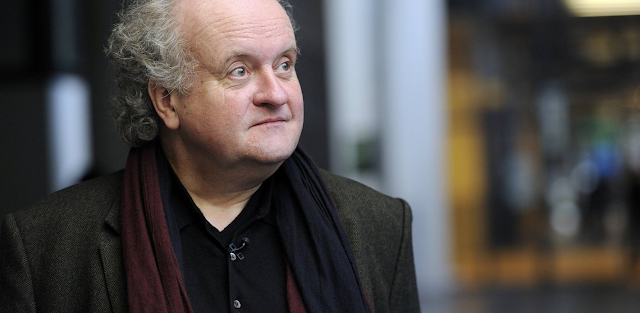


‘Concerts as we know them are organized so that one piece follows another, sometimes like alien substances,’ wrote Wolfgang Rihm in a 2005 programme note, adding ‘there is always a secret thread linking our artificial arrangements, from which questions and replies will arise.’ One can understand why he might have said that concerning a programme of Haydn’s Symphony No.95 and the world premiere of his own Two Other Movements, alongside Ravel’s Boléro, Ernest Chausson’s Poème op.25 and Saint-Saëns’ Introduction and Rondo Capriccioso.

In the present case, works by Rihm and Haydn are more obviously connected, yet that too requires a warning. One thread may be evident, but our ears should not rule out the possibility of a secret labyrinth too. Haydn is programmed more often than one might expect with Rihm, a composer fascinated by reckoning with the Classical-Romantic tradition at whose head Haydn in many respects stands. Indeed, one recent book on the piano trio is subtitled ‘from Joseph Haydn to Wolfgang Rihm’. Instrumental, chamber, orchestral and even sacred music – for some now itself a ghost at the musical feast – offer connecting threads, questions and replies both secret and revealed.


Rihm: Sonata, vigil, and plea for mercy

If six has often been thought a good number for instrumental collections (Haydn’s string quartets and even his symphonies), Jewish, Christian and other religious traditions have long considered the prime seven a ‘perfect’ number. Scripture takes us from the seven days of Creation, through seven days of Passover, to the seven last words or sayings of Christ on the Cross and, beyond, to seven seals in the Book of Revelation. Christian tradition presents seven gifts of the Holy Spirit, seven heavenly virtues, seven deadly sins, seven sacraments, and more. Rihm initially composed movements of his Seven Passion Texts between 2001 and 2006, one by one lightening the darkness of Holy Week vigils, knowingly in the venerable responsorial tradition (for six vocal parts) of Carlo Gesualdo. At the premieres of the sixth and seventh texts, he presented them as part of a larger work, Vigilia, now with preceding instrumental ‘Sonatas’, and a closing ‘Miserere’. 

Easter is coming, albeit not yet. There will be greater darkness, the greatest of all, entailing God’s death on the Cross and sojourn in Hell. Hence the vigils (the nocturnal hours of watching until Easter morning itself), their texts either straightforwardly depicting, referring to (Peter 1), or foretelling (Isaiah, Lamentations, Jeremiah, Psalms) the four Gospel accounts of the Crucifixion. A sense of uncertainty even in direction seems to hold particular appeal for Rihm, who in 2006 described himself as ‘one who does not pray, but speaks with God’. This stance we hear reflected and developed in Vigilia. 


Sonatas precede motets, but are no mere preludes. Rather they introduce the text from Scripture and respond to it with a subjectivity rarely if at all present in the motet to come. Clarinet and horn stand apart from the rest of the ensemble (perhaps an updated version of an ancient, largely tenebrous consort): two trombones, tuba, percussion, organ, viola, cello and double bass. There is musical violence here, to counterpoint, if not necessarily straightforwardly to depict, the agonies of Christ on the Cross. This is nowhere more striking than in the antiphonal organ and brass exchanges, mediated by percussion, of Sonata V; likewise from the organ and percussion at the opening of the final Sonata, where horn and clarinet respond as if from the other side of the void. Stinging dynamic contrasts and dissonance – the idea remains just about operative – contrast in turn with less ‘extreme’, more contemplative vocal liturgies, whose melody, rhythm and even harmony owe much to the mediating role of memory in reimagination of ‘early music’. Even a marking of ‘calmo’ (Sonata IV) seems to pertain more to volume and, latterly, to a Stravinskian coolness that is anything but without tension. 

The opening of the first Sonata with its leading brace of trombones has something about it of the late Renaissance, reimagined through time and paving the way for something more overtly modernist in timbre and gesture. Intervallic construction suggests Webern – and perhaps the early polyphony Webern avidly studied. (Seek and ye shall find, perhaps.) At any rate, the first of seven motets – notwithstanding its text ‘Tristis est anima mea’ – offers seraphic contrast. Likewise in Sonata III, first from brass and then from strings, agitato ghosts of Webern and Stockhausen joust in a musical drama denied the ensuing verbal setting of the temple rent in twain. Pesante octaves of two trombones and tuba in Sonata VI suggest distilled Bruckner, and woodblock intervention a modernist, even Messiaen-esque intervention, heralding the motet to follow. A lack of dynamic contrasts and markings in the motets as a whole speaks of an unmistakeably modern conception of non-subjective, even ‘expressionless’ early music. The accents of ‘Recessit pastor noster’ correct that even on its own terms, but it remains a contrast worth noting. At any rate, here is apparently timeless liturgy: a cappella other than low-key appearances of strings in this motet and percussion in ‘Tenebrae factae sunt’.

Peter Bannister’s comparison of Rihm to the Catholic-Marxist philosopher Gianni Vattimo is revealing. Bannister suggests that Rihm’s harmonic idiom in these pieces may be heard analogously ‘to Vattimo’s “weak thought”’, the thought of a ‘self-confessed “half-believer”’, in that Rihm’s ‘language suggests directionality and simultaneously subverts it at every stage, hinting at “strong structures” but scrupulously avoiding them’. In the ‘Miserere’, more than three times the length of the lengthiest motet, a productive yet provisional synthesis peters out (‘Tunc … tunc…’ – not entirely unlike the ‘ewig … ewig’ of Mahler’s Das Lied von der Erde) into alternation between voices and instruments, further suggesting the productive scepticism of Vattimo’s ‘half-believer’. Liturgy has become personally expressive after all, in a plea for forgiveness to which a response from beyond these nights of darkness remains as yet uncertain.


Haydn: Vigil in sonata, and earthquake

Rihm’s works for string quartet, dating from an unnumbered work of 1966 to the 2015 Geste zu Vedova, run throughout his career. So too do Haydn’s. If not quite the genre’s inventor, he was its first master. The Sieben letzten Worte unseres Erlösers am Kreuze (Seven Last Words of Our Saviour on the Cross) was first composed in 1786 for orchestra, with arrangements for string quartet and piano coming the next year (eventually joined by an oratorio version in 1796, with an additional piece of Harmoniemusik). The quartet version is now the best known. This is doubtless in part due to an economy of pragmatism concerning performing forces – but chamber conversation imparts intimacy and immediacy, with very much their own dramatic strength. 

The so-called seven last words (ultima septem verba) – more properly ‘sayings’ since, though brief, they are more than single words – of Christ on the Cross have been a focus of Christian Lenten devotion since the early 16th century. They come from the four canonical Gospels, though none is found in all; they have proved equally popular in Catholic, Protestant and other Christian traditions. The traditional order has been words of forgiveness, salvation, relationship, abandonment, distress, triumph (of a sort) and reunion. Musical settings and responses have ranged from Heinrich Schütz’s Die sieben Worte Jesu Christi am Kreuz, through choral works by César Franck and Charles Gounod, to more recent works by Sofia Gubaidulina (cello, bayan, string orchestra) and Tristan Murail (orchestra, chorus, electronics).

Haydn recalled his commission when dictating, 15 years later, a foreword to the score of the oratorio for Breitkopf & Härtel:


About fifteen years ago I was requested by a canon of Cádiz to compose instrumental music on The Seven Last Words of Our Saviour on the Cross. It was customary at the Cathedral of Cádiz to produce an oratorio every year during Lent ... . The walls, windows, and pillars of the church were hung with black cloth, and only one large lamp hanging from the centre of the roof broke the solemn darkness. At midday, the doors were closed and the ceremony began. After a short service the bishop ascended the pulpit, pronounced the first of the seven words (or sentences) and delivered a discourse thereon. This ended, he left the pulpit, and prostrated himself before the altar. The interval was filled by music. The bishop then in like manner pronounced the second word, then the third, and so on, the orchestra following on the conclusion of each discourse. My composition was subject to these conditions, and it was no easy task to compose seven adagios lasting ten minutes each, and to succeed one another without fatiguing the listeners; indeed, I found it quite impossible to confine myself to the appointed limits.

Haydn asked the Abbé Stadler for his thoughts. ‘I answered’, Stadler relates in his autobiography, ‘that it seemed to me advisable that over the words an appropriate melody should be fitted, which afterwards should be performed only by instruments’, though he did not know whether that had always been Haydn’s intention. Haydn requested permission from the Bishop of Cádiz to exceed the ten-minute limit for his ‘sonatas’ – the same term as Rihm – if necessary, and received it: the Bishop responded that he would limit the length of his homilies to ten minutes each, ensuring scope for musical overrun. The music, though, was intended not for the Cathedral but for the subterranean Oratorio de la Santa Cueva, whose reconditioning, completed in 1756, had been the project of the priest José Saluz de Santamaria, original source of Haydn’s commission as communicated by an intermediary, Don Francisco Micon.

A severe, double-dotted D minor ‘Introduzione’ suggests with its angular melodies and rhythms Crucifixion: late-Baroque iconography surely comprehensible to Haydn’s audience-congregation in Cádiz. Sonata I (identical nomenclature as Rihm) turns to relatively relaxed lyricism in related B flat major. (There is no overall tonic, though surely there is iconography of Affekt.) Christ seeks forgiveness for his persecutors, ‘for they know not what they do’. Haydn’s setting is unusually homophonic: if not quite a necessary than a likely consequence of a string of Adagios. His setting of the ‘words’ is straightforwardly, unanswerably melodic, followed by musical response, commentary and development. The second Sonata takes us from stern C minor command – ‘Verily I say unto thee’ – to a promise of salvation with arpeggiated, angelic accompaniment, in pure, heavenly C major: ‘Today shalt thou be with me in Paradise’. E major maternal tenderness, inflected on occasion by visions of surrounding darkness (Sonata III) leads to Christ’s celebrated cry of anguish to His Father, in darkest, deepest F minor: ‘My God, my God, why hast thou forsaken me?’ 


Through agonising thirst, Johannine predestined accomplishment (‘it is finished’), and final commendation into God’s hands in the literally muted (con sordino) consolation of E flat major (Sonata VII), Haydn concludes with a brief, terrible C minor earthquake. Its sudden eruption, more fulfilment than contrast or release, leaves us in wait, as with Rihm or with the Passions of Bach. For now, our lot is to contemplate, grief-stricken yet in hope of something redemptive from beyond. 

(This essay was first published as a programme note for the 2022 Salzburg Festival.)

Saturday, 5 September 2020

Musikfest Berlin (4) - Ensemble Modern/Benjamin - Benjamin and Rihm, 3 September 2020


Philharmonie


© Monika Karczmarczyk / Berliner Festspiele


Benjamin: At First Light (1982)
Rihm: Jagden und Formen (1995-2001, 2008 version)


Ensemble Modern
George Benjamin (conductor)


George Benjamin returned to the Musikfest Berlin to conduct, in typically excellent performances, Ensemble Modern in one of his early works, At First Light, and the 2008 version (Zustand, more literally ‘state’ or ‘status’) of Wolfgang Rihm’s Jagden und Formen. These were pieces, at least it seemed to me at first, that offered contrast more than exemplification of an idea, but there is nothing wrong with that. On reflection, however, I began to make connections after all, intended or otherwise. It was instructive to be reminded once again of Benjamin’s breadth of musical sympathies, leading here in a direction I should not necessarily have suspected, as well as to step back from his more recent, often operatic output, to a piece from his (near-)Wunderkind years.


At First Light opened in a world of ever-changing liminality, against which fanfares made an unmistakeable mark, almost as if entering from another world. La Mer in reverse? Perhaps, not least given the Turner painting, Norham Castle, Sunrise, which lay behind Benjamin’s inspiration for the work: ‘the way,’ he once wrote, ‘in which solid objects – fields, cows, and the castle itself – virtually appear to have melted under the intense sunlight.’ The impression is different at first light, of course, but the distinction between object and haze still appeared to play a role, both in work and performance. The pristine quality of sounds, both alone and in combination – for instance, minor thirds – seemed here just as important as the undeniable complexity of combinations throughout the fourteen-strong chamber orchestra. Memories of one glorious moment, when instruments and players came together as if a consort in the sky, will remain with me long.


Rihm’s Jagden und Formen likewise lived up to, and expanded our notions, of what its title implied: ‘hunts and forms’. By coincidence, I had visited earlier in the day the old Jagdschloss (hunting lodge) in the Grunewald, the oldest Hohenzollern castle remaining in Berlin. This, however, seemed to be an altogether more ferocious hunt than that implied in the Renaissance clearing by the lake. An opening battle between two fiddlers offered resonances aplenty, more strings and later other instruments entering, yet at first in a role more akin to commentary. In time, however, more hunts and forms were incited, even ignited, forms unquestionably created before our ears: perhaps an attempt to control the wildness of the hunt; or, just as likely, a way for it to extend its reach. If there was perhaps something of Henze – König Hirsch or The Bassarids, for instance – to some points of departure, they were soon left behind; that may have been more a matter of my ears seeking orientation in a new work (to me) rather than of anything more ‘objective’. A crazy duet between cor anglais and viola, other instruments providing ever-shifting background – kinship with Benjamin’s piece after all? – lingered in my recollections, but there were many such concerto-for-orchestra-like partnerships of the moment. Was there a sense of persistent frustration, perhaps of the metaphorical quarry escaping? Or was the point more the thrill of the chase? Why choose? Metamorphosis through infectious energy was the order of the day, nowhere more so than in the outstanding musicianship heard from the Frankfurt players. I sensed a strangely Mahlerian mood toward the close, disrupted by further fury, and then a sudden falling into the distance. All was over for another day, but it had been quite a ride. Time to rest, then, before another ‘first light’.

Friday, 30 August 2019

Suspended Songs of Suffering: Gesualdo, Rihm, Nono


Transalpine Tendencies


To view the relationship between Italian and German music as the fundamental driving force of modern Western musical history would be a gross oversimplification. However, in Salzburg of all places, ‘the Rome of the North’, it is a temptation that might be forgiven. It was here, after all, not long after the original 1608 premiere, that Monteverdi’s L’Orfeo received its first performances outside Italy, at more or less the same time as the foundation stone was laid for the new Cathedral (in 1614). Salzburg’s crucial importance as a staging post for the northward progress of the Italian Baroque, architectural and musical, renders it an especially apt home for this concert, Johann Bernhard Fischer von Erlach’s Kollegienkirche, built between 1694 and 1707, in turn an especially apt venue, steeped in the tradition of Francesco Borromini and Gianlorenzo Bernini. Yet, just as we should rightly cavil at speaking of the Salzburg of the 17th or 18th centuries as ‘Austrian’ – ‘German’ is closer to the mark, if still misleading – so should we be wary of straightforwardly ascribing ‘Italian’ status to the southern culture from which many of its treasures had sprung.


Kollegienkirche, this summer


Gesualdo’s Pardon


Stepping back another century, we might ask how meaningful it is to call Carlo Gesualdo an ‘Italian’ composer. It is perhaps inevitable that we should do so with hindsight. So long as we are clear that Renaissance Italy had little conception of nationhood comparable to our own, it will do no harm. Prince of Venosa and Count of Conza, Gesualdo came from the south, from the Kingdom of Naples, although he also spent time in Ferrara and Rome. By the time Gesualdo came to write his late Tenebrae Responsories, however, he was largely a recluse, confined to his estate in ‘melancholy’. It was Gesualdo’s uncle, Cardinal Carlo (St Charles) Borromeo, Archbishop of Milan, who had suggested in Gesualdo’s youth that sacred music might be written in a less conservative, more madrigalian fashion. Borromeo increasingly became an object of veneration for Gesualdo. A 1609 altarpiece commissioned from Giovanni Balducci for the Capuchin church on the Gesualdo estate, Santa Maria delle Grazie, brings together in sacra conversazione Borromeo (canonized the following year), Gesualdo, his second wife Leonora and their dead son’s purified soul. 1611 saw publication of his Tenebrae Responsories, written with private performance in mind beneath that image: Il perdono di Gesualdo.


There is something especially intimate to these 27 motets, from which we shall hear but four: intimate in their relative emotionalism, far more readily associated with single motets than with such collections. Counter-Reformation Italy heard many such settings of combined offices of Matins and Lauds for Maundy Thursday, Good Friday and Holy Saturday: the ‘triduum sacrum’, heard in the dark shadow, ‘in tenebris’, of their preceding evenings. Laden with grief, Gesualdo’s expression – anachronistically, ‘expressionism’ – is less exaggerated in these six-voice settings than in his more overtly experimental madrigals, yet perhaps more distilled, more integrated, such has often tended to be the way with music for the church. It is difficult, however, and perhaps impossible, even undesirable, to dissociate the travails of Gesualdo’s life and suffering entirely from their style and content. Suffering, betrayal, agony here seem both present and sublimated: a musical act of contrition to accompany, even to intensify, the scene in the altarpiece above.


Gesualdo Beyond the Grave


Varieties of Gesualdo’s notoriety, be it autobiographical or musical, have by now been rendered more or less indistinguishable. Aristocratic licence – Gesualdo had no need of a patron – helps provide some connection for the composer perhaps still known best for having murdered his first wife and her lover in flagrante. We should probably concede that, whether we like it or not, our Gesualdo, as man, composer, or both, is in many ways a different figure from the Gesualdo of his own time. There is nothing wrong with that; we might speak similarly of any artist of the past, from Machaut to Webern and beyond. At any rate, the Gesualdo of scandals personal and artistic has inspired many composers since his 20th-century rediscovery: among them, Peter Warlock, Igor Stravinsky, Peter Maxwell Davies, Alfred Schnittke, Salvatore Sciarrino, Georg Friedrich Haas and Hilda Parades. Rihm’s Seven Passion Texts (2001–6, later published with instrumental interludes as Vigilia) takes its place in this tradition: knowing, intentional response to Gesualdo’s responsories, likewise for six voices.


Speaking with God


Gianni Vattimo


Rihm described himself in 2006 as ‘one who does not pray, but speaks with God’, and has turned to setting sacred texts increasingly since the Millennium. He also, not uncommonly among artists, had childhood dreams of the priesthood. Composer Peter Bannister has enlighteningly compared Rihm to the Italian philosopher Gianni Vattimo, a writer with strong Marxist and Roman Catholic strands to his thinking. Bannister asks whether Rihm’s ‘harmonic idiom in these pieces’ may be heard analogously ‘to Vattimo’s “weak thought”’, the thought of a ‘self-confessed “half-believer”’, in that ‘his language suggests directionality and simultaneously subverts it at every stage, hinting at “strong structures” but scrupulously avoiding them’. There is certainly reference as well as affinity to be found in these motets to the glories of polyphony. As often with Rihm, there are tonal affinities too, sometimes more oblique than others. Even at their strongest, though, as perhaps in ‘Tristis est anima mea’, one would never mistake them for the once-fashionable ‘spirituality’ of so-called ‘holy minimalism’.


This is not the fervent belief of a Messiaen, perhaps not belief at all, but it is of a piece with Rihm’s ongoing fascination with music and practices of the past. To quote Edward Campbell, Rihm has ‘no compunction in juxtaposing music […] flagrantly modernist in aesthetic alongside passages that cut deeply into the DNA of the German Romantic tradition’. Here, another tradition too, albeit seen and heard through a Romantic-modernist prism. For Rihm, moreover, the Holocaust inevitably casts a particular, as well as universal shadow, over tales and rites of suffering. In his Deus Passus, written for the 250th anniversary of Bach’s death in 2000, his new St Luke Passion came strikingly to an unfulfilled close with Paul Celan’s poem Tenebrae. That may surely be felt here in a chromaticism unfulfilled because it cannot be.


Music of Resistance and Liberation


Rihm has freely acknowledged the importance of Luigi Nono for his music too, helping – as so often in the dialectic between German and Italian music – impart a clarity of line often welcome among the thickets of German post-expressionism. The kinship between Nono’s and Rihm’s Hölderlin fragments is clear to all, but Nono’s importance as ‘a model I cherish’ has clearly been broader, Rihm going so far as to call Nono ‘the prototypical artist, searching and failing, extremely secure and extremely insecure’, calling particular attention to the ‘ecstasy’ of Nono’s ‘sound language’.


Image: Archivio Luigi Nono


A Venetian by birth, in 1924, and death, in 1990, Nono evinced considerable interest in early ‘Italian’, often Venetian, music; his final music drama, Prometeo, often conjuring up the impression of a marriage between Marx and Palestrina and other late polyphonists, Gesualdo included, mediated by Walter Benjamin and Nono’s librettist, Massimo Cacciari. For, as Nono’s friend and colleague Claudio Abbado attested, Nono ‘never lost the deep-rooted ties to the long tradition of Venetian music […] Gigi’s sense of an espressivo or cantabile line also stems from this tradition’. Nono’s studies at the Venice Conservatory with Gian Francesco Malipiero had encompassed study of earlier traditions. Sheer delight in vocal writing and the potential of the human voice, would inform Nono’s work throughout his life, nowhere more so than in the 1955–6 cantata Il canto sospeso. Nono would recall in 1973 that Malipiero had been:

A lovingly concerned master, as I learned when he took me as a pupil during the bestial rule of fascism (from 1943 to 1945) and in his courses and seminars opened the door to study and knowledge of music which at that time lay prohibited in Italy: Schoenberg, Webern, also Dallapiccola, and naturally Monteverdi and the music of the Italian Renaissance.

This setting of texts from European resistance fighters unites all such strands, Il canto sospeso being, again to quote Abbado, ‘music born of deep dismay, painful and accusing’. Every work, for Nono, required what he called ‘a human “provocation”: an event, an experience, a test in our lives, which provokes my instinct and my consciousness, as man and musician, to bear witness’. Each of the texts we hear offers testimony from a resistance fighter shortly to be killed by the Nazis. There is here a glowing post-Romanticism: painful, even agonizing, in its beauty, nowhere more so than in the sixth movement, when, after what we may think of as a choral Dies irae without end – remembrance of Esther Srul, a victim of Operation Barbarossa – orchestral music beguiles perhaps all too readily. Words, witness, their horror nonetheless continue to resist their aestheticization. The Webern-like tenor aria-with-ensemble in which we hear from Chaim, a 14-year-old Jew from Galicia, or the ravishing melismatic writing for soprano in particular, suggest promise that cannot, should not, be fulfilled. We await, wish for reconciliation, even benediction, but know, with Nono – as, with Rihm, perhaps even with Gesualdo – that it will not, cannot happen. For the ‘wedge’ quality to Nono’s 12-note row, intervals gradually broadening out – heard in linear fashion for the first time in the fourth movement – recalls certain Bach fugues, but also, tellingly here, Dallapiccola’s beacon of (false) hope in his anti-fascist opera Il prigioniero. We must hope, even if we have few grounds for doing so.


That said, words find themselves liberated from the tyranny of expectations. Broken down into constituent parts, as well as savoured melismatically, there is music to be experienced here that goes beyond the serial parameters of pitch, duration, timbre, dynamics, and so on. Nono’s point here was not, as his fellow avant-gardist Stockhausen believed, to divest the text of meaning; it was not ‘to withdraw it from the public eye where it has no place’. In his 1960 Darmstadt lecture, Text – Musik – Gesang, as transcribed by his pupil Helmut Lachenmann, Nono explicitly took issue with that very claim, having looked at Schubert, Monteverdi, Schoenberg, Bach, Gabrieli and others, proceeding to relish one particular an instance of Gesualdo’s madrigal word-setting – the word ‘splende’ in Il sol, qual or più splende – as a presentiment of his own: sounds verbal, phonetic, and musical created a ‘pluridimensional whole’, a counterpoint of sounds in musical declamation.


‘The final unity’ for Nono nonetheless remained in words rather than syllables or parts thereof. In a sense, it is the old controversy concerning polyphony and verbal comprehension, familiar to all students of Palestrina and the Council of Trent (or of Pfitzner’s opera Palestrina). Some controversies, quite rightly, never die, not least those in the endlessly fascinating relationships – however understood or misunderstood, however constructed or deconstructed – between German, Italian and countless other musics, between the art and thought of other times and our own.


(This essay was first published in a 2019 Salzburg Festival programme for a concert from the SWR Vokalensemble, SWR SO, Marcus Creed, and Peter Rundel.)

Saturday, 9 September 2017

Musikfest Berlin (2) – Barto/DSO Berlin/Eschenbach - Mozart, Rihm, and Mendelssohn, 8 September 2017


Philharmonie

Mozart-BusoniDon Giovanni: Overture
Mozart – Concert aria: ‘Ch’io mi scordi di te? – Non temer, amato bene’, KV 505
Rihm – Piano Concerto no.2
Mendelssohn – Symphony no.4 in A major, ‘Italian’, op.90

Hanna-Elisabeth Müller (soprano)
Tzimon Barto (piano)
Deutsches Symphonie-Orchester Berlin
Christoph Eschenbach (conductor)


What a joy it was to hear the Overture to Don Giovanni with Busoni’s 1908 concert ending. Once one has done so, it is difficult to know why anyone would prefer any of the more ‘traditional’ solutions. What a joy, moreover, it was to hear Christoph Eschenbach conduct the Deutsches Symphonie-Orchester Berlin in a performance that was ‘traditional’ in the best, rather than a lazy, way: no modish – or rather, puritanically orthodox – alla breve introduction, and a full orchestral sound, albeit from really rather a small band. The important thing, of course, was that the spirit was there, both in D minor and in D major – and it was. Busoni then plunged us back into the Stone Guest scene, the music subsiding with dark ambivalence: then the scena ultima, whose banishment was ever a stain upon so many ‘Romantic’ interpretations. The first time I ever conducted an orchestra was in this overture; how I wish I had known Busoni’s version then!


Hanna-Elisabeth Müller and Tzimon Barto joined the orchestra then for the wonderful concert aria, ‘Ch’io mi scordi di te? – Non temer, amato bene’. In the recitative, Müller, Eschenbach, and the orchestra worked closely to convey a myriad of subtleties in Mozart’s writing, every note and every word mattering, yet without pedantry. I first thought of Christine Schäfer (with the Berlin Philharmonic and Claudio Abbado), only for Müller then – ‘Venga la morte…’ – to prove far more hochdramatisch. No phrase, verbal or musical, was taken for granted. Barto’s entry, heralding the aria proper, promised much in tone and touch. Alas, his contribution turned out oddly: at times, sensitive, a true partner, at other times curiously heavy-handed. Everything else, however, came close to perfection, the entwining of opera and concerto – not that they are not entwined already! – as apparent in Mozart’s passages of hushed anticipation as in his bravura coloratura.


Barto seemed on much surer ground in the Second Piano Concerto of another Wolfgang: Rihm, which he and Eschenbach premiered in Salzburg with the Gustav Mahler Youth Orchestra in 2014. Its single movement proves, as is often the case, suggestive also of a multi-movement conception, although never quite predictably. The opening material, piano and orchestral chords initially responding to each other, then fusing, has a harmonic language redolent of, yet never to be reduced to, Schoenberg and Berg. Process, however, is certainly quite different, the line seemingly concentrated in the middle register of both solo instrument and orchestra – Rihm views a concerto as ‘only’ meaning that ‘there is a soloist and a collective’ – with bass clarinet in particular offering commentary, and other lines surrounding. Barto and the DSO Berlin provided welcome clarity, without evident sacrifice to ‘atmosphere’. Climaxes and indeed the piece as a whole all seemed very well shaped, Eschenbach clearly having the piece’s measure. A couple of sweet-toned violin solos suggest an alternative path: neither taken, nor eschewed. Later, more Bartókian material evolves from what we had heard, suggestive perhaps of another, related movement, and apparently more malleable in its nature. Rihm is nothing if not eclectic, and yet never seems arbitrary here (apart, perhaps, from a strange guest appearance from temple blocks, but that may well have been my problem). A cadenza passage, underpinned by double basses, pays homage to ‘tradition’, but then so does much of the rest of the piece, without being hidebound: rather like Busoni, one might say. The quiet ending both ‘spoke’ and ‘sang’.


An exhilarating yet never merely breathless performance of Mendelssohn’s Italian Symphony was to be heard in the second half. The DSO’s sound (or Klang) sounded just right for this music – as, indeed, it had earlier too, lightness and richness two sides of the same coin, woodwind a sheer delight. There was a great deal of pleasure to be taken in the sound itself, albeit never in a Straussian, materialist sense (and rightly so). Eschenbach ensured that the music breathed without sagging. The first movement’s formal dynamism was, so it seemed, effortlessly manifest, art concealing art. Its development proved, much to its advantage, more overtly Beethovenian than often one hears, the recapitulation no mere ‘repeat’, almost a second development, so much having changed in the meantime. Antiphonal violins certainly paid off in the elucidation and drama of Mendelssohn’s counterpoint. The second movement was on the brisk side, yet retained a strong sense of the processional, Mendelssohn’s mastery of orchestration wondrously revealed therein, not least through a variety of articulation. In some ways, the minuet and trio emerged as more of a ‘slow movement’, although that is only a matter of degree. A necessary – or at least desirable – hint of slight nostalgia for a Mozartian world that has passed was beautifully conveyed, not least in the daringly relaxed trio. And what horn playing there was to savour! There was no doubting the orchestral virtuosity we heard in the finale, but it was quite without self-regard, at the service of the musical argument. It seemed over in a trice, leaving us wanting more.

Tuesday, 14 February 2017

Kopatchinskaja/BPO/Rattle - Rihm, Ligeti, and Mahler, 12 February 2017


Philharmonie, Berlin

RihmGruß-Moment 2 – in memoriam Pierre Boulez
Ligeti – Violin Concerto
Mahler – Symphony no.4 in G major


Camilla Tilling (soprano)
Patricia Kopatchinskaja (violin)
Berlin Philharmonic Orchestra
Simon Rattle (conductor)


It had been two years, almost to the day, since I had last heard the Berlin Philharmonic (in the flesh, anyway). Then it had been Mahler (with Lachenmann) in London; now it was Mahler (with Rihm and Ligeti) in Berlin. The contemporary (more or less) works fared splendidly on both occasions; Mahler, I think, fared much better on this, the interventionism that has latterly characterised Simon Rattle’s work with that composer less distracting, more convincing. The orchestra, of course, remains a great one, now as fearless in new music as its fabled earlier self was in Beethoven and Brahms.


Wolfgang Rihm’s Gruß-Moment 2 was not quite receiving its premiere: that had taken place on the first of these three performances. It is nevertheless emphatically a new work, albeit performed with a confidence that might suggest otherwise. Rihm’s piece – allegedly five minutes long, but significantly longer – is one of twelve commissioned by the Stiftung Berliner Philharmoniker from different composers, apparently given carte blanche as to how they approached their ‘album leaf’ compositions. It also follows Gruß-Moment 1, written for the Lucerne Festival, for Pierre Boulez’s ninetieth birthday in 2015; now, of course, we live in the shadow of Boulez’s death, and the piece is dedicated to his memory.
 

Rihm has written for what looks like an average-sized orchestra: neither Bach’s, nor Gurrelieder’s. There are interesting omissions, though: clarinets, bassoons (not contra-bassoon, however), and trumpets. On the other hand, there are four players apiece for flutes, horns, and percussion. It is with an English horn solo that the lament or tombeau begins, perhaps inevitably putting us in mind of Tristan und Isolde. (Whether I liked it or not, I could not help but find intervallic and rhythmic correspondences and differences with Wagner’s Shepherd Song.) Four horns follow on: as so often with Rihm, forging further links with German Romanticism, albeit more obliquely here than sometimes. Was that even a hint of Bruckner in the string unison lines to come? Oboe and trombone duetting, still more English horn and trombone duetting, put me a little in mind of Stockhausen’s Mittwoch, but that was probably just me; for one can play the game of correspondences all one likes, of course, and it is in many ways just a way of finding one’s bearing. It was only really with the sounding of the quartet of flutes and percussion together that my ears found something that might possibly remind me of Boulez, and then not overtly. Such, however, is not necessarily the point of a tribute. If this were a tombeau, it was not gloomy, some post-expressionist Angst prior to the close notwithstanding, but then why should it be? Perhaps this was more akin to an ode from Berlioz, Gluck, even Stravsinky; perhaps not. It intrigued, nevertheless, nowhere more so than in the soft, yet Fafner-like timpani of the closing bars: ‘dolce, quasi cantando’.
 

‘György Ligeti’s violin concerto is perhaps the most exciting violin concerto since Beethoven. It’s the concerto I most enjoy playing.’ Would that more violinists thought like Patricia Kopatchinskaja, whatever that might imply about some of those far from negligible concertos in between. (I shall except Schoenberg’s, since it is surely the most criminally neglected of all.) This was, it seems, the third time the Berlin Philharmonic had played the work, previous outings having come from Tamsin Little, also with Rattle, in 2003, and from Renaud Capuçon and David Robertson seven years later. There will doubtless always be a little personal eccentricity from Kopatchinskaja, but I cannot believe that her decision to play barefoot would have troubled anyone. If it did, so much the worse for him or her. (Our intrepid soloist even managed to persuade the leader, Daniel Stabrawa, to shed one of his shoes, when he joined her for a splendid encore performance of Ligeti’s very early (1950) Balad si joc.)
 

The solo opening suggested that this might be Ligeti very much in ‘process music’ mode. What especially intrigued about how both work and performance developed was that that was sort of true, but far from entirely so. That, one might say, is where music comes in. Kopatchinskaja’s solo line gradually distinguished itself more and more from the many other solo lines in this first movement Praeludium, taking on an almost ‘traditional’ virtuosic tinge, at least in the manner of Stravinsky’s Soldier’s Tale (squared). Kopatchinskaja’s duetting with tuned percussion proved one of the multiple delights here. In the second movement, I initially reflected how viola-like her tone sounded – until the viola soloist entered. A sensibility that was far from un-Romantic grew, until the moment of typical Ligetian madness when a quartet of woodwind players, Pied-Piper-like, took up their ocarinas. If the chorale section inevitably brought Berg to mind, what greater inspiration could there be?
 

The high, fantastical writing with which the Intermezzo opens had me think of Prokofiev, although, of course, it went very much its own way. Such was the intensity of the climax that it felt as though the music were over all too quickly. The slow, inevitable, riveting progress of the Passacaglia brought, as the movement came to its climax, further thoughts of Berg. This was almost incredibly committed playing from all concerned. Prokofiev sounded as if he were unwinding in the final movement, soon characterised by the reinstatement of a virtuosity it is difficult not to think of in some sense as ‘Hungarian’. Rattle left the stage, deadpan, for Kopatchinskaja to play her own cadenza: great fun, both gesturally and musically. There was a sense of trying to goad him and the orchestra to come back, eventually successful when the conductor reappeared from the percussion to bring the concerto to a close.
 

The second half was devoted to the Mahler symphony. Its first movement cannot escape from a certain sense of molding, so perhaps sets itself up better for Rattle’s approach than some of the composer’s more (apparently, deceptively) simple inspirations. It certainly did not drag – unlike, say, the well-nigh unbearable performance I heard from Vladimir Jurowski last year. Rattle ensured that the score was treated affectionately yet not too much so, and at times, with a little yet not too much brusqueness. Stabrawa’s violin solo – and not just that – sounded sweetly sardonic, or should that be sardonically sweet? Mediaeval, or rather pseudo-mediaeval, pictorialism was appealing throughout, coexisting happily with Mahler’s idiosyncratic neo-Classicism. I was not sure what it all ‘meant’, but I am not sure that I should have been sure: that is not really the point, or at least need not be.
 

I was delighted to hear some vinegar in the second movement scordatura playing. Often, that ends up sounding ‘just’ dissonant, rather than making something (though never too much) out of the different tuning. Ligeti, I thought, would have approved. Counterpoint was admirably clear: one could really hear a multitude of lines, almost as if St Anthony of Padua were preaching to a shoal of particularly wayward, individualistic fish. However illusory, there remained a sense of essential simplicity to the slow movement, which sounded very much as if it grew out of Mahler’s four-part string writing: an expanded string quartet, almost. The sound was perhaps sweeter than one often hears, but not unreasonably so, and in any case often tended towards silver too. Not that the darker side was neglected, far from it, but the movement proved commendably un-hysterical. Thematic foreshadowings of the finale were nicely brought out, and that movement grew as ‘naturally’ as I have ever heard out of its predecessor, without a break, yet not rushed. Camilla Tilling offered one of the most interpretatively interesting accounts of the text I have heard. There was a greater range of vocal colour than one often hears, very much at the service of the words. Stylistically, she drew out, or so it seemed, the music’s kinship with the world of Hänsel und Gretel, whilst Rattle’s keen ear for instrumental detail enriched rather than overwhelming. Rarely have I heard so touching a performance of the final stanza, nor a more lingering, loving farewell from the harp. Mahler’s progressive tonality had indeed opened up a new, heavenly world.


Sunday, 31 July 2016

Prom 21: Leleux/Aurora/Collon - Rihm, Strauss, and Mozart, 31 July 2016


Royal Albert Hall

Rihm – Gejagte Form
Strauss – Oboe Concerto in D major
Mozart – Symphony no.41 in C major, KV 551

François Leleux (oboe)
Aurora Orchestra
Nicholas Collon (conductor)


Tom Service presents Nicholas Collon and the Aurora Orchestra deconstructing Mozart’s Symphony No. 41 ‘Jupiter’ at the BBC Proms
Image: Chris Christodoulou/BBC Proms


The Aurora Orchestra and Nicholas Collon opened this afternoon concert with the Proms premiere of the 2002 revision of Wolfgang Rihm’s 1995-6 work, Gejagte Form (the original version having been performed by the London Sinfonietta under Markus Stenz in 1998). Rihm’s ‘hunted’ form seems to suggest – and certainly did in performance – a search for form, to suggest a state of form, as it were, ever forming. Such an idea could hardly be more indicative of the composer’s deep roots in German Romanticism. Here the Aurora players, more ensemble than orchestra, proved sure guides – or, better, discoverers. The virtuosic, well-nigh diabolical violin soloists at the beginning (Alexandra Wood and Jamie Campbell) offered us expressionistic fiddling, seemingly both in contradiction with each other but also co-dependent; such, after all, is part of the difficulty of co-dependency. Already, with the double bass entry that followed, we seemed to catch an aural glimpse of that formal quarry; it soon escaped us again, returning briefly, yet differently, with the same instrument’s pizzicato. And so, the hunt was well under way, Messiaenic, jagged woodwind chords and, eventually, brass instruments too joining the throng.  Rhythmic frenzy seemed almost, yet not quite, ever-present; its absence seemed almost always to imply prior presence. Moments of stasis were rare; they too seemed, with thrilling drama, defined by their difference. Percussion perhaps hinted at Henze’s ‘Ride of the Mænads’ from The Bassarids. Rihm’s music revealed itself as a successor perhaps to the Schoenberg of the First Chamber Symphony, even to Stockhausen’s Kontrapunkte, perhaps more surprisingly still, in its near-balletic drama, to The Rite of Spring.

 
Following a brief yet eloquent discussion between oboist, François Leleux, and Tom Service, we heard Strauss’s Concerto, surely the greatest for the instrument. The opening cello motif proved properly generative; so, in its very different way, did Leleux’s long-breathed opening solo. Orchestra (very much of the chamber variety) and soloist together suggested a post-Mozartian aria. Leleux offered a stunning variety of colour and articulation throughout, without the slightest impediment to the longer line; one sensed, rightly or wrongly, that this was very much his vision of the work. Collon proved equally flexible, an estimable accompanist. Hushed playing truly drew one in, even in a less than ideal acoustic. The transition to the slow movement was well handled: not quite imperceptible, which is just as it should be, for change as well as continuity should register. Leleux’s oboe cantilena ravished, the best efforts of an army of bronchial activists notwithstanding. There was, moreover, considerable depth to the orchestral playing, not least from the wonderful Harmoniemusik – with all the musico-historical resonance that word brings to us, and did to Strauss. The oboe sang, so it seemed, as a messenger of hope, emerging from an orchestral voice of sadness. The finale caught the right note of reflective jubilance, with more than the occasional hint of the composer’s operatic œuvre: Capriccio, Daphne, Arabella, perhaps even Ariadne. This was a lovely performance indeed.

 
For the second half, we turned to Mozart’s Jupiter Symphony. It was introduced by Service, Collon, and the players; or rather, the finale was, breaking it down ably, in a thoroughly admirable example of exploratory educational work. ‘Analysis for all,’ one might say. More unusual still was the decision to play it from memory. Clearly that cannot be done with every orchestral performance, but there was undoubted energy, excitement too, to be gained from the experience. There could, moreover, be no gainsaying the excellence of the playing, although I was less enthusiastic about Collon’s conception of the work, or at least about aspects thereof. Symphonic understanding of it as a whole, as opposed to a suite, often proved elusive, at least to my ears. I also could not help but miss larger forces in this preposterously large, ill-shaped hall, but we had (strings 8.6.4.4.2) what we had.  

 
Agogic mannerism marred Collon’s presentation of the opening (similarly when repeated, and in the recapitulation) of the first movement; Harnoncourt et al. have much to answer for. Balance was often odd, brass (rasping trumpets, although modern horns were used) too often overwhelming the strings. The second subject fared better, sounding and feeling more ‘naturally’ breathed. There was a strong sense of dialectical conflict to the development section, but much less, sadly, seemed to be at stake in both exposition and recapitulation. The slow movement was strong on rhetorical contrast, rendering it full of character, full of life: all to the good, but sometimes achieved at the expense of the longer line. It was taken pretty swiftly for an Andante, but worked well at that pace. Minor-mode sections sounded duly dark; this was for me the most impressive movement in the performance. I did not take at all to the one-to-a-bar approach, however fashionable it has become, to which the Minuet was subjected. Robbed of its grandeur, it sounded both breathless and pompous, although that extraordinary woodwind chromaticism still sounded sinuous enough. The Trio was less impulsive and all the better for it. Alas, the finale, so ably discussed beforehand, proved hard-driven indeed in performance. (Just because one can play something so fast does not mean one must!) At least as harmful was the return of such brass-heavy orchestral balance. It was the quieter passages that proved more telling, not least a suspenseful approach to the coda. Brilliant though the playing was, and undeniably impressive though it was to have played it from memory, a more smiling, less hectic view of the work from the conductor would have been welcome.


Tuesday, 11 August 2015

Salzburg Festival (2): Die Eroberung von Mexico, 10 August 2015


Cortez (Bo Skovhus) and Montezuma (Angela Denoke)
Images: Monika Rittershaus


Felsenreitschule

Montezuma – Angela Denoke
Cortez – Bo Skovhus
Soprano – Susanna Andersson
Contralto – Marie-Ange Todorovitch
First Speaker – Stephan Rehm
Second Speaker – Peter Pruchniewitz

Peter Konwitschny (director)
Johannes Leiacker (designs)
Manfred Voss (lighting)
fettFilm (video)
Peter Böhm, Florian Bogner (sound direction)
Bettina Bartz (dramaturgy)

Mixed Choir (on tape)
Movement Choir
ORF Symphony Orchestra, Vienna
Ingo Metzmacher (conductor)


This was a magnificent evening in the theatre, to which my immediate reaction was to wish to see – and to hear – it all again. Partly, that was of course a matter of a rich work, experienced for the first time, in a rich staging, experienced for the first time, in rich performances, experienced for the first and last time. I am sure that I missed a great deal. I will do so in a staging of Parsifal, which I flatter myself I know reasonably well; how much more so will that be the case in a work hitherto unfamiliar? But I hope here to give a taste of my vivid theatrical experience of Wolfgang Rihm’s Die Eroberung von Mexico (The Conquest of Mexico).


Director Peter Konwitschny is at pains, in a programme interview, to dissociate the work from the merely ‘Mexican’. ‘We saw,’ he claims, ‘the sign warning us not to turn off into the dead-end marked “Mexico”’. Before that, we read Konwitschny: ‘It’s not about Europe/America or Mexico/Spain, but Man/Woman.’ Such might be the case for Konwitschny’s staging, though not, I think entirely, but I am less sure that it is the case for the Musiktheater (an interesting, not-quite-Wagnerism) itself. It is certainly not to be reduced to any one particular polarity, as the oft-repeated, Antonin Artaud-derived, ‘Neutral, Weiblich, Männlich’ (‘Masculine, Neuter, Feminine’ – not always, notably in that order) seems to remind us. And the space available for the mediating – or original? – ‘Neutral’ is not always clear, perhaps does not even survive, or at least survive in its initial form. Is it perhaps – and this might be a Wagnerism of sorts – in the orchestra? In Rihm’s own libretto, which, taking Artaud’s Le Théâtre du Séraphin as one of its building blocks, would thus both suggest and reject some form of verbal (perhaps even colonial?) supremacy?
 

With such an enterprise, it is, of course, difficult to know where to start, and I have probably stepped ahead of myself on one strand already. I shall attempt no clear division between work and staging, since such was not my experience – and indeed would not be possible on the basis of an initial encounter. (Frustrating, yet inevitable and indeed in some sense fruitful?) There is a perhaps predictable, yet already surprising, identification of Montezuma with the feminine – and not only in voice – and Cortez with the masculine. Rape occurs early on; does it not always? But before that, and returning at long last to my initial point concerning Mexico, we have had a long, introductory, introduction, or perhaps immersion, into the landscape. The first of three parts, ‘Die Vorzeichen’/’Omens’; ‘Bekenntnis’/’Confession’; ‘Die Umwälzungen’/’Upheavals’) has drummers surrounding the audience lead us in for a few minutes before the conductor has even arrived, and indeed before the audience has received the signal to sit and to be quiet. The drum melodies, Rihm writes, are ‘the melody “of a landscape that senses the approach of a thunderstorm”’. They do not – or at least, did not to me – feel ‘Orientalist’, or better ‘Occidentalist’; yet, at the same time, it is difficult, upon reflection, not to think that in some sense they must be, and, as the action unfolds, that they have, perhaps knowingly, been presented, even constructed as such. Oppositions, then, not entirely straightforward, continue to frame, to participate, to incite.


Rihm’s score, as often with this composer, covers a broad canvas in any number of respects. Yet, doubtless partly as a matter of the excellence of staging and all performances, though not only, I think, as a matter of that, it offers the composer at his integrative as well as his discursive best. Schoenbergian Sprechstimme – can we not but think of Moses at times? – vies or collaborates with choral writing and vocal amplification that bring to mind Nono and Lachenmann. Something far more Romantic, the ghost of Mahler perhaps, or of Strauss, swells up in the orchestral strings (fewer than one perhaps realises). Lyricism – whether vocal, or solo instrumental – that would surely have brought a smile to the face any of those composers has one melt, and at the same time has one suspect, has one question, not least in light of what we see and do not see on stage.


Konwitschny makes a strong case for his conception of male-female incomprehension. Not just in the violence, whether it be of Cortez towards Montezuma, of the movement choir (which, in a brilliant coup de théâtre, stands up and reveals itself as initially having been seated in the audience) towards the golden (yes, gold again brings us back to Moses and, of course, to the idea of the New World) female, danced portrayals of Malinche, ‘who speaks with her body’. The living room in which most of the action takes place – the rest surrounding that space – has at its centre Frida Kahlo’s The Wounded Deer: both image and knowledge of Kahlo’s relationship with Diego Rivera contribute to our understanding. In perhaps the most arresting image of all, still more so than the movement choir’s gang-rape of Malinche, Montezuma gives birth, we presume to Cortez’s child: the offspring is the offspring of Apple. fettFilm’s video images plunge us into a world of projected ‘apps’ and video games: Cortez’s war is virtual – remember those television images of Baghdad, and so many other victims of Western imperialism – but the virtual appears to be real and, of course is. Both sides suffer; both sides die, kill each other, and yet appear still to be in some sense alive. What is going on? What has gone on? The information age threatens to disclose all, yet leaves us all the more alienated. Montezuma’s transformation into a statue – here, a marrying, apparently pacified doll – does nothing to resolve, everything disquietingly to disturb, as does the further violence that ensues. And yet opera, the primæval and/or modern cry, reassert themselves at the end of each part, with verse from Octavio Paz, a striking, harrowing duet for Montezuma and Cortez at the very close. Or is it? Rihm’s libretto ends: ‘Ende (?) der Oper’. Images from the (Spanish/Mexican) past have fleetingly passed before our eyes: are they a clarification, or a ‘dead end’? Log in, to find out? Or should we turn away from our screens? Perhaps to listen?


Performances, as I suggested, were uniformly excellent. Angela Denoke and Bo Skovhus offered near-superhuman efforts as Montezuma and Cortez, range as impressive in dynamic terms as in pitch, in stage presence and conviction as in musical and verbal delivery. Cortez, backed up by speakers, never elicited sympathy, but suggested a broadening of our experience and understanding. Montezuma, shadowed by spectacular high soprano and deep contralto (Susanna Andersson and Marie-Ange Todorovitch) was anything but a sentimentally conceived victim. We did not – and surely should not – know what to do with him/her, and in some sense (s)he survived. I should probably add: in another sense, sadly, not at all. The contrast with the trendy banalities of Peter Sellars’s The Indian Queen, loudly proclaiming itself post-colonial, whilst all the time forgetting the ‘post’ bit, could hardly have been greater. This approached Wagnerian music drama, not on Wagner’s terms, but not opposed to them either. And, as with Wagner, the orchestra was perhaps most crucial of all. There could certainly no be gainsaying the outstanding contribution made by the ORF Symphony Orchestra, Vienna, wisely, viscerally, reflectively directed by Ingo Metzmacher. Yes, this work needs to be seen – and heard – again.