Showing posts with label Bo Skovhus. Show all posts

Friday, 23 May 2025

Die dunkle Seite des Mondes, Hamburg State Opera, 18 May 2025

Images: Bernd Uhlig
Dr Kieron (Thomas Lehman), Creature of Light (Andrew Dickinson)


Dr Kieron – Thomas Lehman
Meister Astaroth – Bo Skovhus
Miriel – Siobhan Stagg
Creature of Light – Andrew Dickinson
Anima – Kangmin Justin Kim
The Bright Girl – Narea Son
Cornelius – Aaron Godfrey-Mayes
Dr Pulski – William Desbiens
Dr Raubenstock – Karl Huml
Dr Spinberg – Jürgen Sacher

Directors – Dead Centre (Ben Kidd and Bush Moukarzel)
Designs – Jeremy Herbert
Costumes – Janina Brinkmann
Lighting – James Farncombe
Video – Sophie Lux
Choreography – Sasha Milavic Davies
Dramaturgy – Angela Beuerle, Michael Sangkuhl
Live camera – Benjamin Hassmann  

Chorus of the Hamburg State Opera (director: Christian Günther)
Hamburg State Philharmonic Orchestra
Kent Nagano (conductor)

I really wanted to like this opera, Unsuk Chin’s second, following her widely and justly acclaimed Alice in Wonderland (2004-7). After all, I travelled from London to Hamburg expressly to attend its opening night. In some ways, I liked and admired it; or rather I liked and admired much of the music and stage performances, above all Thomas Leaman’s commanding account of the central role. It pains me to say that, nonetheless, as a dramatic and even theatrical experience what we saw and heard in Die dunkle Seite des Mondes (The Dark Side of the Moon) fell considerably short of the considerable hopes invested in it. My sense, moreover, was that mine was not, sadly, an eccentric reaction. 

A Faustian tale is no bad start; opera in particular and drama more broadly continue to flourish in development and variation of time-honoured subjects, to which something more timely will necessarily be brought. The (anti-hero), Dr Kieron, is a scientist, Dr Kieron, an unbearable, impossible colleague, who dismisses and needs the work of others, but who harbours the secret of his haunting by visions, which lead him to the realm of a ‘soul healer’, Meister Astaroth. Inspiration came originally from Chin’s interest in the relationship between the physicist Wolfgang Pauli and the psychologist Carl Friedrich Jung. 


Meister Astaroth (Bo Skovhus)

Chin’s score announces a darker soundworld, aptly enough, than that of her previous opera and indeed many other of her works, yet it is possessed, at least in its stronger sections, of many of the inventive qualities, especially rhythmic and timbral, that have justly lent her great esteem. There is exuberance and a true sense of potential in the orchestral lines, vividly brought to theatrical life, so far as I could discern, by the Hamburg State Philharmonic Orchestra under Kent Nagano, the house chorus a welcome addition in its several appearances. The beginnings of both acts, more than just the beginning in the first, offered the most compelling music and also, doubtless far from coincidentally, registered strongest in dramatic terms. Broadly, Kieron’s world convinces more than Astaroth’s, which may or may not be the point. Dramaturgically and theatrically, it seems conceived – in my case, it was certainly received – in a traditional way. A story is told on stage through words and music. There are no obvious metatheatrical questions posed; nor is there an evident desire to play with narrative, let alone a sense of the postdramatic. There is nothing wrong with that; many fine operas still take on such a form and probably always will. Traditional operatic virtues, then, probably need to register more strongly.   

The libretto, however, and more generally the plot come across as hopelessly contrived: not artificial in an arch or detached aesthetic sense, but mostly unfortunate. This, I am afraid, is also Chin’s work, written in collaboration with Kerstin Schüssler-Bach. It piles up words, fails to establish characters – most glaringly, in the case of the women, mere projections in a sense that surely extends beyond feminist critique – and often seems bizarrely unsuited to opera. I should actually go a step further and say that the problem was less its wordiness, although that certainly did not help, than that wordiness simply not having been very good. It would have come across unfortunately, had there been no music at all. Put another way, literariness needs to be good – very good – and if you are not a Hofmannsthal, remains better avoided. When something merely aspires to literariness, if indeed that is what is going on here. I honestly cannot imagine anyone caring about the characters—and it was not clear what else there was to care about. At times, an anti-war message seemed to surfacebut then it disappeared; or perhaps I had imagined it. It is surely not coincidental that the music’s invention registered most strongly when there were no words to get in the way. Then there is the length. On the face of it, it was refreshing to be presented with something that dared to be different, not to be confined to the consensus of how long an opera ‘need’ be. Like any artwork, it should probably be as long as it needs to be, but no longer. Offering something roughly the length of a Mozart-Da Ponte opera (done whole) shows ambition, if only it were realised. 

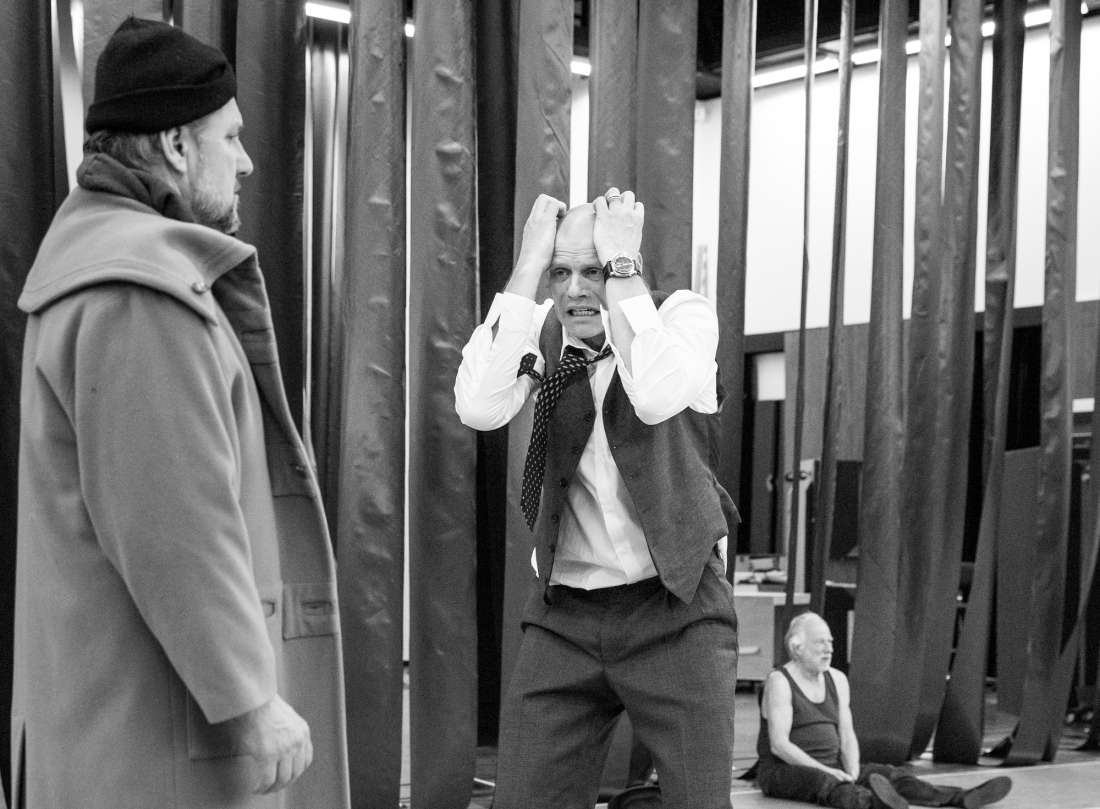
There was a good deal to suggest, however, that this had been developed as a whole, extending considerably beyond the composer’s work on her libretto. At its best, Dead Centre’s production seemed to ‘listen’ to the score and not only to the words. Without merely mirroring, movement, lighting, and much else seemed to spring from the same source, for instance in the set’s swaying to convey the drunkenness of the bar. If anything, though, it seemed too often to remain tied to the words and drama. If it would be too much to hope that a different staging might have redeemed them, something a little more interventionist might nonetheless have added something, perhaps fleshing out the characters rather than simply presenting them, such as they were. Even something that accentuated the c.1930 setting, present when one reflected yet not registering as something that mattered, might have contributed something. Live camera did, in a straightforward way, homing in on particular characters – for instance, during bar ‘crowd’ scenes – and register their facial reactions. 


Thomas Lehman’s assumption of the principal role, Dr Kieron, was thus in some ways all the more impressive: a fiercely intelligent act of apparent conviction, which created a character almost in spite of what he was presented with.  Bo Skovhus, as Meister Astaroth, similarly impressed with great stage presence throughout. Kieron’s former lover and morphine addict, Mirel, was woefully under-characterised in the work, but Siobhan Stagg did what she could, her coloratura duly sparkling—and suggestive of what might have been. Kangmin Justin Kim’s Anima was quite a star turn, splendidly feminine of tone and gesture, so much so that it was only when I checked the cast list I realised this had been a countertenor. Aaron Godfrey-Mayes made for a sympathetic Cornelius, assistant to Kieron. All seemed well sung; there was nothing evident for which to reproach the musicians, whether on stage or in the pit. 

A puzzling and, in many ways, frustrating evening, then, but one I was nonetheless pleased to have experienced. Not only because one learns from when things go wrong, though surely there is much to be learned here; but because I remain convinced there is something waiting to be released here. Where that leaves the opera, I am not sure. It is difficult to imagine the music, or rather some of it, retained and a new libretto fashioned. Perhaps there is some radical surgery that could be performed. Perhaps the best of it could be reworked into a shorter opera or another work entirely. Perhaps different performances and stagings would make a difference. Or perhaps I am entirely wrong: first night reports are notoriously littered with wrongheaded criticism. No one would be more delighted than I to find my criticisms misplaced, to owe the creators an apology, and to welcome a new work to the repertory. We shall see.


Sunday, 26 January 2025

Fin de partie, Staatsoper Unter den Linden, 24 January 2025


Hamm – Laurent Naouri
Clov – Bo Skovhus
Nell – Dalia Schaechter
Nagg – Stephan Rügamer

Director – Johannes Erath
Set designs – Kaspar Glarner
Costumes – Birgit Wentsch
Lighting – Olaf Freese
Video – Bibi Abel
Dramaturgy – Olaf A. Schmitt

Staatskapelle Berlin 
Alexander Soddy (conductor)


Images: Monika Rittershaus

Just short of his 99th birthday, György Kurtág sees Fin de partie, his sole opera to date, receive a new full staging, what I believe to be its third. The first, by Pierre Audi, was seen in several European houses. I reviewed its 2022 French premiere here; it had already been seen in Milan and Amsterdam. Last year, Ingo Kerkhof directed Fin de partie anew in Dortmund, its German premiere; Herbert Fritsch directed the Austrian premiere in Vienna; and both London and Cologne offered semi-stagings. There have also been concert performances in Budapest. There may have been others of which I am unaware. Not bad, then, for a new opera, but to call this crowning masterpiece of the last man standing from what once we called the postwar avant garde ‘not bad’ would be akin to saying that of the Beckett play in which its ‘scenes and monologues’ have their origin. At a point in which the titans of Kurtág’s generation reach their centenary – Nono last year, the unholy alliance of Boulez and Henze this year, Kurtág himself next – the twin urgency and poignancy of this work and others become ever more apparent. The wider musical world at last seems ready to recognise and acknowledge them. 


That Paris performance made a huge impression on me. Indeed, it inspired a chapter due to be published later this year by Edinburgh University Press (part of a volume edited by colleagues Christine Dysers, Peter Edwards, and Judith Lochhead, The Music of Absence: An Aesthetics of Loss in the New Millennium). Coming to my second production – if only I had known of the Dortmund staging – following a period of further and, I hope, deeper acquaintance with the work, was necessarily a different experience, as will be the case for all of us as the opera takes its place in the repertoire. (For that reason, I do not intend here to give an account of the work ‘itself’; my initial review may be read for first impressions.) I do not think it was entirely down to me that it seemed more conventionally ‘operatic’ – these things are relative – under Alexander Soddy’s musical direction than when conducted by Markus Stenz, though that may well be part of it. This was for the most part a fluent account, keenly alert, as was the Staatskapelle Berlin, to Kurtág’s colouristic invention. That a sort of Klangfarbenmelodie could and did work motivically was triumphantly affirmed in dramatic context. 

Soddy’s conception of the work and his role seemed, moreover, concerned to consider and highlight the role of the singers; indeed, a vocal conception, extending to instruments and their combination, may be a good way of considering it. Taken as a whole, the work’s course seemed more sectional, even on occasion dragging a little, although a sectional quality can work both ways: Kurtág’s description is, after all, of ‘scènes et monologues’. (That may also have been in part a consequence of Erath’s production, conceived more as a succession of scenes than Audi’s.) What I missed above all was a greater sense of the intricacy of texture—even, paradoxically or rather dialectically, when spare. There seems in Kurtág’s writing to be a Beckettian implication of loss or absence, rarely apparent here. How sympathetic one’s response to a performance that came across as locating Kurtág in surprising succession to Verdi – not unlike Antonio Pappano’s Covent Garden occasional forays into contemporary music – may ultimately be as much a matter of taste than anything else, though I think this was also, to its advantage, more conversational than that might imply. 


Erath’s staging offered further surprises, perhaps all the more so given not only the familiarity of the play but also the familiarity of what it should look like and how it should unfold, carried forward into the premiere production. I had assumed familiar issues with the Beckett estate had played a part in determining the ‘fidelity’ of Audi’s approach, and perhaps they did; perhaps they even played a part in permitting the transformation into an opera in the first place. I was therefore a little taken aback by a staging that would not necessarily have seemed radical in any other case. Designs from Kaspar Glarner and Birgit Wentsch brought a fitting (in a more meaningful sense, ‘faithful’) sense of vaudeville to proceedings, culminating in visual transformation from living room domesticity to the external, even metaphorical world of a crashed Ferris wheel. That definitely separated Hamm and Clov, only for Nell (at least in the guise of the reader of the opening Roundelay) to reappear at her mound at the close. 

There was, then, a strong suggestion something circular, similarly in the emergence of the new, differently apocalyptic scene as if through the looking glass of the dustbin lid. Like Soddy, Erath seemed keen, moreover, to emphasise the opera’s conversational qualities, very much including the crucial blind alleys, non sequiturs, and misunderstandings. Changes of perspective and scale incorporated such disruption, in some ways heightening the episodic sense discussed earlier, though perhaps also helping put things ‘back together’.

A key difference, one of relatively few, between Beckett and Kurtág is the treatment of Nell’s death. What passes unnoticed in the play, Nell unmourned, is signalled by a terrible cry of grief from Nagg and the orchestra in the opera. Soddy treated the latter in duly operatic fashion, whilst Erath hinted at the dislocation between the two genres. having a giant, video-founded Clov take out a body bag – presumably Nell – earlier. Dislocation was the name of the game, or at least of one of the games. Whether in Kurtág, as in Beckett, we can ‘know’ anything beyond the text, whether the question borders on the illegitimate, was a question not only posed but also given a provisional and unsettling answer.


Laurent Naouri’s Hamm is unlikely to have provoked any such controversy. His ready, communicative way with the French text and its musical expression seemed not only to serve Beckett and Kurtág, but also to act as an animating as well as controlling presence for the cast as a whole. Bo Skovhus’s Clov, powerfully physical, not only of gesture but of character too, contrasted with whimsical performances from Dalia Schaechter and Stephan Rügamer as Nell and Nagg, though I confess to missing the deeper and perhaps more deeply familiar tones of Hilary Summers in the former role for Stenz and Audi. That we are already in a position, though, to draw comparisons between different interpretations, even to form views on emergent performance practice, testifies not so much to the work’s stature – there are many fine pieces never heard again – as to its popular acceptance. Endgames may be more ominously apparent than ever in the world around us; this is anything but an endgame for opera.


Tuesday, 30 July 2024

Salzburg Festival (4) - VPO/Thielemann: Capriccio (concert performance), 26 July 2024


Grosses Festspielhaus

Flamand – Sebastian Kohlhepp
Olivier – Konstantin Krimmel
La Roche – Mika Kares
Countess Madeleine – Elsa Dreisig
Count – Bo Skovhus
Clairon – Ève-Maud Hubeaux
Major-Domo – Torben Jürgens
Italian Soprano – Tuuli Takala
Italian Tenor – Josh Lovell
Servants – Kieran Carrel, Jonas Jud, Fabio Dorizzi, Ian Rucker, Christian Tschelebiew, Jan Petryka, Lucas van Lierop, Philipp Schöllhorn
Monsieur Taupe – Jörg Schneider

Vienna Philharmonic Orchestra
Christian Thielemann (conductor)


Images: © SF/Marco Borrelli

There is a certain irony to the popularity of Capriccio in concert performance. The last time the Royal Opera presented Strauss’s valedictory opera – assuming we do not count Des Edels Schattens – it was also without staging. Now, for reasons unclear, it has appeared in the Salzburg Festival’s festival-within-a-festival of sacred music, ‘Ouverture Spirituelle’, treated as the first ‘full-scale’ opera of the festival, works by Georg Friedrich Haas and Luigi Dallapiccola notwithstanding, attracting the traditional complement of dignitaries for its premiere. Irony and Strauss are not so much excellent bedfellows as two sides of the same musical coin, so there is no problem there. If the world of La Roche found itself somewhat obscured on that occasion, the impresario inspired by Max Reinhardt remained present not only onstage, nodding off during the opening sextet, but also in honoured bust-form at the entrance to the Haus für Mozart next door. Strauss himself, naturally, remains on the first floor of the Grosse(s) Festspielhaus itself. And if a concert performance, perhaps especially without interval, may not have been entirely what some of those invited were expecting, they, like the rest of us, will surely have enjoyed finding themselves lightly satirised, elevated, and perhaps even inspired by what unfolded. 

Interestingly, although no ‘concert director’ or similar was credited, a degree of accomplished acting was involved, as were telling transformations in lighting (not least for the closing moonlight). Truth be told, or at least one truth among many, little seemed to be lost. When the cast engaged so animatedly with one another, onstage when necessary and offstage when not, the impression was not so very different from a ‘traditional’ production in which they would do the very same, only seated in an eighteenth-century salon. And Strauss’s question, Countess Madeleine’s too, is ultimately ‘Wort oder Ton?’ not ‘words, music, or gesture,’ however strangely that sits both with the conversations and the composer’s veneration for Wagner’s Opera and Drama (‘the book of books about music’). If we all ultimately know which will win in our hearts and minds, if not necessarily in the Countess’s, then the contest was established with commendable even-handedness by those performing, balances of all kind upheld and dramatically generative, even without a mise-en-scène or directorial Konzept. 

Moreover, if one might expect the conductor, possibly the orchestra too, to be favoured in such a scenario, such was not the case. Christian Thielemann has often proved to be at his best in Strauss. He led an extraordinary performance of Die Frau ohne Schatten in this same hall thirteen years ago, blighted yet far from obliterated by Christof Loy’s arrogant dismissal of the work as director; the composer has long proved central to his operatic work in Dresden, Vienna, and elsewhere. If his Dresden FroSch earlier this year was impressive yet, to my mind, a little on the precious side, this Capriccio unfolded with a warmth, affection, and ease that spoke of a fine balance – that word again – between preparation and familiarity. Restraint is not quite the word, but there was no grandstanding, nothing forced. One was led to listen, perhaps via music, yet to words as much as their confrere-competitors. Quotations were assumed into the orchestral fabric, never underlined. That might be the vulgar way of some, but hardly Strauss’s. There were passages of rapt orchestral magic; if the close of the string sextet has sounded more hushed, I have not heard it so. The Vienna Philharmonic clearly loves playing for Thielemann; it is just as clear that the affection is mutual. And although that sextet was certainly conducted, it never sounded like it. 


Sebastian Kohlhepp and Konstantin Krimmel made for a pair of finely cast, nicely contrasted suitors as Flamand and Olivier respectively. If Flamand ultimately stole the heart, that is really Strauss’s doing. Mika Kares lived up to La Roche’s outsize promises in a performance that relished not only his boastfulness but also his status as dramatic lynchpin, leaving implicit sadness – or am I being sentimental? – to another day. Ève-Maud Hubeaux was a splendid Clairon; before I knew who she was, I truly sensed the ‘act’ of a French tragedienne. Such is not reserved to a French singer, of course, but there was a tang of almost Voltairean authenticity here, without sacrifice to crystal-clear German. Bo Skovhus marshalled his resources wisely as the Count. Torben Jürgens’s Major-Domo made a fine impression, as did an array of individual servants, perhaps the best I have heard. They might have had a spin-off show of their own; perhaps one day they will. 

One person is missing in that, of course, and it was there that I found myself, seemingly unlike the audience, somewhat in two minds. Elsa Dreisig’s Countess was well sung, well acted, in general had much to commend it, yet somehow did not feel quite ‘right’ to me. Was that a matter of having too much a certain interpretation or mode of interpretation in my head, to which others must conform? Quite possibly, but what I heard came across in tone and character as more girlish, even Sophie-like, than a successor to the Marschallin, the true director of metatheatrical proceedings. I shall dwell on this no more; we all have our preconceptions and prejudices, and this may well have been mine. As we all know, no operatic performance is or can be perfect, let alone correct. Music, words, and theatre (visible or invisible) are too human for that.


Thursday, 2 August 2018

Munich Opera Festival (3) - From the House of the Dead, 30 July 2018


Nationaltheater

Images: Wilfried Hösl

Alexandr Petrovič Gorjančikov – Peter Mikuláš
Aljeja – Evgeniya Sotnikova
Luka Kuzmič (Filka Morozov) – Aleš Briscein
Skuratov – Charles Workman
Šiškov – Bo Skovhus
Big Prisoner, Prisoner with the Eagle – Manuel Günther
Little Prisoner, Bitter Prisoner – Tim Kuypers
Governor – Christian Rieger
Old Prisoner – Ulrich Reß
Čekunov – Johannes Kammler
Drunk Prisoner – Galeano Salas
Cook – Boris Prýgl
Smith – Alexander Milev
Pope – Peter Lobert
Prostitute – Niamh O’Sullivan
Don Juan (Brahmin) – Callum Thorpe
Kedrill, Young Prisoner – Matthew Grills
Šapkin, Happy Prisoner – Kevin Conners
Čerevin, Voice from the Kirghizian Steppes – Dean Power
Guard – Long Long


Frank Castorf (director)
Aleksandar Denić (set designs)
Adriana Braga Peretski (costumes)
Rainer Casper (lighting)
Andreas Deinert (video, live camera)
Stefanie Katja Nirschl (live camera)
Jens Crull (video, live editing)
Miron Hakenbeck (dramaturgy)
Martha Münder (revival director)


Bavarian State Opera Chorus (chorus master: Sören Eckhoff)
Bavarian State Orchestra
Simone Young (conductor)


Frank Castorf might have been born to direct From the House of the Dead. In this, his third opera project – or better, his third opera project in the opera house, for his Volksbühne Meistersinger must surely be reckoned with, even by those of us who did not see it – many of his hallmarks and those of his team are present, yet without the slightest hint of staleness, of anything other than being reborn for and in the work. And how the work suits such an approach; in many respects, the deconstruction has already been done. Probably Janáček’s greatest opera, indeed his greatest work of all, it is no accident that it is the one Pierre Boulez chose to conduct, towards the end of his life. Alas I never heard that live, although in 2014, I would see Patrice Chéreau’s production in Berlin. That was, of course, a fine piece of theatre, as indeed was Krzysztof Warlikowski’s Covent Garden staging, seen earlier this year. Castorf, however, revelling in its fragmentary nature – for it is in many respects his own – triumphantly, I should say dialectically, offers the strongest sense of a whole I have seen or could imagine. By taking it as it is, Castorf’s team and a magnificent cast, aided greatly by Bavarian State Opera forces under Simone Young in the finest performance I have heard from her, alert both to the needs of the minute and of the greater architecture, present and represent the opera as it is and might be. Quite without sentimentality, they write and rewrite, igniting and reigniting that Dostoevskian redemptive spark that is both present and absent throughout, depending when and where one looks and listens, how and with what one pieces together one’s own narrative, musical and dramatic.

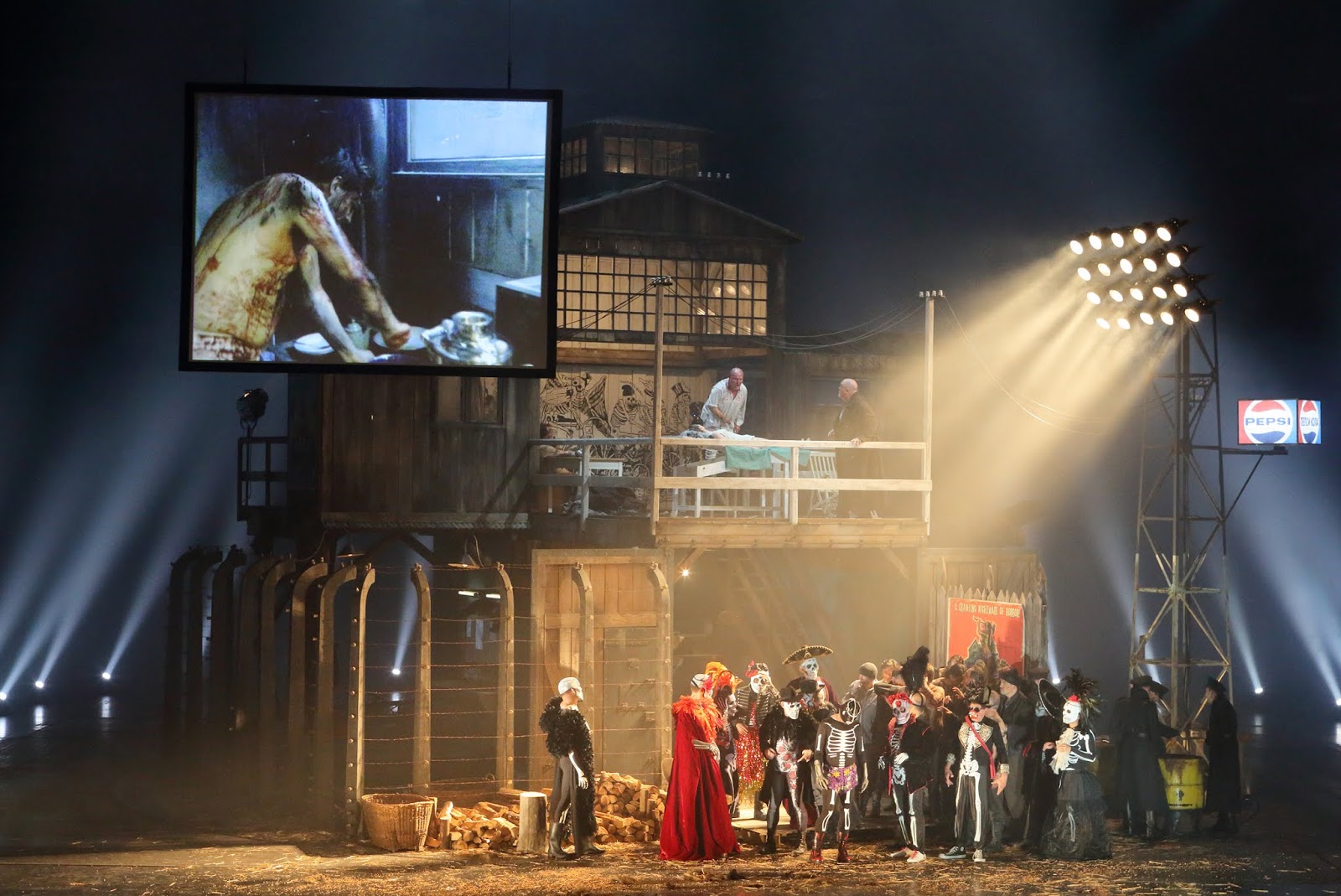
We are in Russia – no doubt of that. It is Russia at a dark time – again no doubt of that. (When, however, was that not the case, save for a few years under Lenin, and even then…?) But is it a ‘real’ Russia? And what indeed could so impossibly naïve a formulation mean? Live camerawork performs all manner of tasks, questioning our ability to comprehend, to view, to narrate, whilst making it all the more necessary that we try to do so. There is little doubt concerning the realism – until, that is, a true Carnival of the Dead comes amongst the prisoners and the prison. Magic realism? Perhaps, but if so, it is the blackest of magic to follow, perhaps even to sublate, the blackest of comedy and (non-)redemption. Whereas, in his Siegfried and Gotterdammerung, Castorf took us to an alternative historical path for the GDR, an alternative that turned out not to be so very alternative at all, (Al)Exander Platz still a commercial, post-socialist wasteland, Wall Street still failing to burn, here we seem perhaps to have joined the USSR for an alternative 1930s.


Bitter Prisoner (Tim Kuypers), Prisoner with
the Eagle (Manuel Gunther),
Aljeja (Evgeniya Sotnikova)
Or have we? Trotskyist hints abound: the rabbit hutch (many thanks to my friend Sam Goodyear for having pointed out the connection), Mexico too (‘Partido liberal’, we read on one of many historical and/or imaginary signs), a film advertisement (in Spanish), starring Alain Delon. (Hang on, if we are in 1972…?) Even a carnival bird Aljeja, splendidly sung by Evgeniya Sotnikova, seems both to suggest and to disavow that possibility. Or are we, was I, confusing him/her – here most definitely ‘her’ – with the Prisoner with the Eagle, or his eagle? What might that mean here, whether the confusion or the eagle? Russia or the USSR, however, it certainly remains, even down to the affinity – which seems to have been overstated by some – with Aleksandar Denić’s Walküre set (Azerbaijan, 1942). What does a sign for Pepsi Cola in English and Russian tell us? And what, at the end, does the English poster invitation to travel to the USSR as a holiday destination mean, not least in such appalling circumstances? Stop trying to ascribe meaning to everything: is that not what, as an imprisoned intellectual, one is compelled to do? Are we to see the future and will it to work, or perhaps indict it? Is it just a joke, as suggested by the presence of a Ring crocodile? Who knows? We shall never make the journey, just like so many of those prisoners, yet unlike, perhaps, Gorjančikov, who thinks he has something written in his head. Like Dostoevsky, like Trotsky, like Castorf, like our writer, Alexandr Petrovič Gorjančikov, we write and rewrite. So too does the action all around, on stage, on film, seen and unseen; so too, of course, does the orchestra.


Šiškov (Bo Skovhus), Statisterie and Chorus
It is complicated, yes; how can a fragmentary drama with so many ‘characters’ or at least people not be? But it is also visceral, direct. Violence we see, we feel, whether we like it or not, be it in the Guard’s sadistic flagellation (a truly nasty Long Long, almost a match for the still nastier Governor of Christian Rieger) or in the metal of the steppes’ orchestra. Opera too, even in this most inhospitable of circumstances, is reborn. If the Wanderer seemed to have been an inspiration for our noble prisoner’s initial journey to this camp, Peter Mikuláš capturing both intelligence and a certain camouflaged nobility, then it is the Wotan of the second-act Walküre monologue who comes to mind in that of Šiškov. That is partly a matter of Bo Skovhus’s searing portrayal, quite the most powerful performance I have seen and heard from him in a long time. But everyone involved has played a role in putting these pieces together, in constructing something from these musico-dramatic shards. ‘A mother gave birth even to Filka,’ after all – and we know it, because, like Šiškov, he sings, not least in this devilish incarnation from Aleš Briscein. So too, earlier, do Don Juan (an outstanding Callum Thorpe) and his pseudo-Leporello (another excellent performance, this time from Matthew Grills), in a play-within-a-play. That, thanks to Castorf’s lengthy experience with and rejuvenation of post-dramatic commentary, seems more of a play-in-itself than I can recall – until, once again, it does not.

 
Šiškov, Cerevin (Dean Power)


For, like Don Giovanni, this is redemptive within and without, or seems to be: as I said, it takes life and drama as they are. A (post-)religious consciousness is at work here. It also, perhaps, suggests what they might be, or at least what one day, when the revolution comes again, the revolution to which we cling no matter what, we might hope it to be. The noble prisoner leaves, though, so most likely not. He has used, learned from his experience; so, we imagine, have we. The carnival of (Russian) death continues. There is a chink of something uncertain. In the blackest of comedies, we might even think it light. Humanity even – though are we not all now post-human(ist) as well as post-dramatic? Who knows, who cares? This human comedy and tragedy of which we are part rolls on, just as it did for those Calderón-like figures of a reimagined Salzburg World Theatre in the celebrated post-war Furtwängler Don Giovanni. The final scene alienates – like Mozart’s. And yet, like that too, it moves (us). We have experienced something, even if we have not a hope in our living hell of learning what it may have been. We have, like this Gorjančikov, written a work of sorts in our head. No one will read it or even remember it, perhaps it would be impossible for anyone to make sense of its difficult, even nonsensical fragments; yet that spark of creativity, of art, of that which Marx just as much as Schiller considered made us human, has flickered. At least we think it did. Perhaps. Or at least we thought it did. Once. Perhaps. We return, like Gorjančikov, like Trotsky, to watch the post/non-human (non-)drama for the rabbits in their hutch, caged like us and yet (to the sentimental?) more free. Perhaps.

Aljeja and rabbits in their hutch


Wednesday, 1 June 2016

Lear, Opéra national de Paris, 29 May 2016


Palais Garnier

King Lear – Bo Skovhus
King of France – Gidon Saks
Duke of Albany – Andreas Scheibner
Duke of Cornwall – Michael Colvin
Earl of Kent – Kor-Jan Dusseljee
Earl of Gloucester – Lauri Vasar
Edgar – Andrew Watts
Edmund – Andreas Conrad
Goneril – Ricarda Merbeth
Regan – Erika Sunnegårdh
Cordelia – Annette Dasch
Fool – Ernst Alish
Servant – Nicolas Marie
Knight – Lucas Prisor

Calixto Bieito (director)
Rebecca Ringst (set designs)
Ingto Krügler (costumes)
Bettina Auer (dramaturgy)
Sarah Derendinger (video)
Franck Evin (lighting)

Chorus of the Opéra national de Paris (chorus master: Alessandro di Stefano)
Orchestra of the Opéra national de Paris
Fabio Luisi (conductor) 
 
Rehearsal photograph: © Élena Bauer / OnP


This year has seen musical Shakespeare commemorations aplenty, although I cannot help but wonder whether some miss the point. Although there are many wonderful musical settings of Shakespeare, his verse is often so musical in quality that it requires nothing additional. Successful Shakespeare operas are thus less surprisingly few than one might initially suspect. Britten’s A Midsummer Night’s Dream has its devotees, many of them fervent; I should rather stick with the play and Mendelssohn’s incidental music. Falstaff: well, it is difficult to care much one way or the other about The Merry Wives of Windsor, even if Nicolai’s version is (slightly) preferable. Lear, however, has at least one other excellent operatic version, very different in conception: Alexander Goehr’s Promised End. Aribert Reimann’s opera is more conventionally operatic, perhaps, than Goehr’s post-Brechtian response, although such a claim is highly relative and this is no work, thank God, for canary-fanciers. We are lucky to have both – and equally lucky never to have that threatened late Verdi opera. (I have never heard Aulis Sallinen’s 2000 opera.) At any rate, the Paris Opéra’s contribution, whether intended as such or no, is most welcome in principle, still more welcome in practice.


Claus H. Henneberg wrote a number of libretti, from Reimann’s 1971 Melusine to works by Peter Eötvös and Matthias Pintscher. (How I should love an opportunity to see the latter’s Thomas Chatterton!) This, first performed at the Munich Opera Festival in 1978, was written with Dietrich Fischer-Dieskau very much in mind for the title role, and that seems to have helped the initial dissemination of the work, both in the theatre and on its first recording. For a number of stagings followed, including San Francisco, Paris (making Calixto Bieito’s staging the Opéra national de Paris’s second), East Berlin (the Komische Oper), Vienna, Amsterdam, and eventually in 1989, London (ENO). Opera of this period has not generally been well served well by our opera houses, although many continental houses – and not just German ones, as this Paris production and its predecessor attest – tend to do better than their English counterparts; nor has it been in much Anglophone writing. In the meantime, however, you are recommended to seek out a performance and/or a recording where you can.
 

This Paris production and performance will do nicely in that respect. Reimann’s post-expressionist score – not unlike what you might expect from so fine a pianist in Lieder of the Second Viennese School – and Henneberg’s libretto do nothing especially ‘to’ the play, although it is of course not remotely set in its entirety. Given the musical language, violence comes much to the fore, without forsaking claims upon our human sympathies. Indeed, as one would expect, the latter become progressively engaged as the second of the two acts progresses. Dramatic parallelisms and distinctions, for instance between Lear (baritone) and Gloucester (bass-baritone), Cordelia and Edgar, are surely, if sometimes rather obviously, handled in words and music. The series with which the latter pair are associated come strongly into the foreground, much as they might have done with Berg, although there is far less of the ‘Romantic’ to this score. As with a good deal of serialist opera, one has a sense of the workings of the serial machinery and its implications, even if one could not quite put it into words, and would have to consult the score properly to analyse it. (When, after all, would one not? Surely the same is true of Mozart or Wagner.)


Although I felt that Fabio Luisi sometimes led the excellent Orchestra de l’Opéra national de Paris with a little too much restraint, and that something more full-blooded would have turned the dramatic screws with a more evident sense of theatre and ultimately of musico-dramatic generation, audibility of such procedures and our consequent ability to relate them, indeed to fuse them, with stage action were nevertheless most welcome. Not that screams from the orchestra – seemingly, insofar as I could tell, never having seen the score, executed with pinpoint precision – or stereo dialogue between percussionists in boxes either side of the pit had nothing of the visceral to them, far from it. The score can rarely, if ever, have been played with such clarity and, at times, both depth and brightness of string tone as by this fine orchestra, still woefully underrated by many who should know better. My mind was cast back to their magnificent Moses und Aron at the opening of this season.
 

The cast was excellent too. Bo Skovhus gave a highly distinguished, dramatically detailed performance of the title role. His initial pride and its disintegration into a complex web of emotions, inadequacies, and ultimately greater humanity were accomplished in what I presume would have been a more physical performance than that adopted by Fischer-Dieskau (or indeed, really possible to the role’s creator at the time). Skovhus was, I am sure, just as committed as his great predecessor would have been. The dryness I have sometimes observed more recently in his voice seemed as resolutely banished as Cordelia, without danger of its parallel return.
 

Lauri Vasar’s Gloucester was handsomely sung, in a portrayal of considerable emotional depth. Facial, vocal, and verbal expression seemed very much of a piece, as indeed they did in general on stage, testament surely to Bieito’s work as director as well as to individual artistry. Indeed, it is surely testament to both that it is difficult to disentangle the two, and I shall not really attempt to try. Bieito certainly does not seem out to shock, but rather to draw from characters, production, and performances the elements of musical drama. Modern dress is employed, if one cares about that sort of thing in itself, but the designs more broadly are stark, permitting one to allow oneself to imagine any manner of ‘setting’ or none: so more or less what all but the most hidebound reactionary would expect in Shakespearean tragedy. I am not sure that anyone would claim this as a ‘history play’, but perhaps someone silly will claim it as a ‘history opera’; frankly, who cares?
 

What Goneril and Regan have in common and what, increasingly, sets them apart is fascinatingly explored, Ricarda Merbeth’s Goneril the power-dressing big sister, initially less interested in the sexual, it would seem, but ultimately more successful – perhaps because her actions have not previously been so overtly erotic? – in its exploitation. The depravity of Regan’s actions, by contrast, from the initial sexual approach to her father (one almost wants to have her convicted of elder abuse) to her sleazy demise (a touch of necrophilia before expiring, perhaps, however understated?) tell their own story. Erika Sunnegårdh’s performance again melded the ‘musical’ and the ‘dramatic’ into a single, dynamic whole. If Annette Dasch’s Cordelia made less of a strong impression, that was more a function of the work; when she returned, hers was an undoubtedly sympathetic contrast, if ultimately never one that could emerge victorious. Andreas Schiebner’s Albany was intriguingly ambiguous: here, one felt, was a truly conflicted character, no doubt weak yet still a victim of circumstances. Andreas Conrad’s Edmund followed the seeming fate, even nature, of his own personal circumstances, with similarly powerful command of musico-dramatic theatre. His legitimate half-brother, Edgar, received a memorable performance, especially but not only in vocal terms, from Andrew Watts, switching as he must between tenor and countertenor. Here, again, was a desperately needed hint of sympathy, if also a reminder of hopelessness. There was no sense, however, of whether he might become king; our eyes and ears were focused upon tragedy.


Now I should like to see Bieito direct King Lear ‘itself’ or not quite ‘itself’. Shakespeare stands no more in need of Werktreue than any composer of opera, indeed if anything, less so. The Barbican has staged some of his Shakespeare; alas, I was unable to go, but hope that it will not prove the last opportunity in London. Otherwise, to Paris, to Barcelona, or to wherever else might oblige…


Tuesday, 15 March 2016

Die Meistersinger von Nürnberg, Paris Opéra, 13 March 2016


© Christian Leiber / OnP


Opéra Bastille, Paris

Hans Sachs – Gerald Finley
Veit Pogner – Günther Groissböck
Kunz Vogelgsang – Dietmar Kerschbaum
Konrad Nachtigall – Ralf Lukas
Sixtus Beckmesser – Bo Skovhus
Fritz Kothner – Michael Kraus
Balthasar Zorn – Martin Homrich
Ulrich Eißlinger – Stefan Heibach
Augustin Moser – Robert Wörle
Hermann Ortel – Miljenko Turk
Hans Schwarz – Panajotis Iconomou
Hans Foltz – Roman Astakhov
Walther von Stolzing – Brandon Jovanovich
David – Toby Spence
Eva – Julia Kleiter
Magdalena – Wiebke Lehmkuhl
Night-watchman – Andreas Bauer

Stefan Herheim (director)
Heike Scheele (set designs)
Gesine Völlm (costumes)
Olaf Freese (original lighting, realised by Phoenix (Andreas Hofer) and Stefan Herheim)
Martin Kern (video)
Alexander Meier-Dörzenbach (dramaturgy)

Choruses of the Opéra National de Paris (chorus master: José Luis Basso)
Orchestra of the Opéra National de Paris
Philippe Jordan (conductor)

Rehearsal picture, Stefan Herheim centre stage as director
© Elena Bauer / OnP


My experience in the theatre of Die Meistersinger has not always have been happy. There are, of course, the great might-have-beens: Pierre Boulez, who expressed a desire on several occasions to conduct the work, a wish never granted, and what might have happened in Paris under Gerard Mortier, who, disappointed in the chorus at his disposal, felt it impossible to do so. Whatever the justice of Mortier’s judgement, the present-day strength of choral singing at Stéphane Lissner’s Paris Opéra, as heard first of all in Moses und Aron, means that is no longer a difficulty. José Luis Basso’s work as chorus master is clearly paying off; the chorus was outstanding throughout. Then there are the disappointing – or worse than that – productions and performances; let us pass over them here in silence, without so much as a link. Stefan Herheim’s production, first seen in Salzburg in 2013, was of course anything but a disappointment then; now, extensively rethought, it is, I think, better still. It is difficult in so busy a spectacle to know, at least in some cases, what has been changed and what one simply missed. I shall largely refrain, then, from comparisons with respect to staging and simply recount what I saw on this occasion. Comparisons with respect to performance largely favour Paris; I shall come to those later.


© Christian Leiber / OnP

We begin in Hans Sachs’s nineteenth-century workshop. A key feature of Wagner’s Romantic conception of Sachs and indeed of Nuremberg relates to overcoming division of labour – or, the more cynical, perhaps Marxist, commentator might respond, never having reached it in the first place. Yet Marx and Engels too, had their poetic flight of fancy in a celebrated passage in The German Ideology: ‘in communist society, where nobody has one exclusive sphere of activity but each can become accomplished in any branch he wishes, … it [is] possible for me to do one thing today and another tomorrow, to hunt in the morning, fish in the afternoon, rear cattle in the evening, criticise after dinner, just as I have a mind, without ever becoming hunter, fisherman, shepherd, or critic.’ Wagner and Herheim portray Sachs in more post-Nazarene fashion. But he remains a polymath and, more than that, a rebuke to involuntary specialisation; he cobbles, he writes verse, he sings, he paints too, and so forth. Here, he also dreams, and with that Herheim reminds us of Schopenhauer, of Freud, of fairy tales, and of course of the centrality of dreams to the work ‘itself’. And when he dreams, objects in his workshop grow, Nutcracker-Christmas-Tree-style; or is it that he and the characters of his dreams shrink? There is certainly a strong sense in the Bastille amphitheatre, its scale perhaps more helpful visually than acoustically, of toy-town, even before the toys come out to play.


© Vincente Pontet / OnP

And so, the Prelude over, the curtain once again drawn back, the back of the writing desk – crucial, of course, to any poet, and what a gorgeous writing desk this is! – has become the church and indeed municipal organ. The green of the surface has become the arena for contest, never more so than in the remarkable agon – intensified, I think, from Salzburg, in very interesting ways – between Walther and Beckmesser. I thought there – but a personal train of thought, of course, yet the openness of Herheim’s approach permits such flights of association – of our own College Green in Westminster. Here, an undeniably charismatic Beckmesser – now that is a way to have him taken seriously, for which both Herheim and Bo Skovhus should take credit – had to fight for the backing of the Masters, initially enraptured by Walther’s song. They swayed, literally and metaphorically. Such seemed a contest as political as it was æsthetic, and we are of course very much in the realm of Walter Benjamin’s æstheticisation of politics, an idea which did not spring from nowhere but was very much rooted in ideas which, if not Wagner’s as such, were similar and historically related. We all know, sadly, where they could lead – and what role Nuremberg would come to play. It is up to us whether we dwell on that, but it would surely be wrong not even to think about it. (Memories of Herheim’s Berlin Lohengrin demand our attention; so do those of Peter Konwitschny’s darker staging of the same work.) Dancing in concentric circles around Walther, even after Beckmesser’s apparently successful intervention, the Masters and, in front of them, the Apprentices, might yet decide in either direction. They look outwards, though, not at Walther; are they looking at us? I think not, but perhaps they do. It is certainly not a benign scene, whatever its prettiness-on-steroids; the violence, just about sublimated, when Sachs comes close to striking Beckmesser is shocking.


© Vincente Pontet / OnP
 

What of the absorbing surface? My goodness, it is beautiful, at least in inverted commas, but that perhaps implies undue cynicism rather than multivalency and dialectics. The play-acting is unmistakeable. Let us remember that the nineteenth-century German monarchies as they stood were not ancient, far from it; they certainly laid no claim to Sachs’s Nuremberg. Nor, famously, does Wagner’s score, speaking of Bach: another century, another style, unless, perhaps, one counts Luther as a sublated participant too. Bavaria as it stood when Wagner wrote his work ‘for’ Munich had only been a kingdom since 1806; much of its territory was very newly acquired. Yet Maximilians and Ludwigs played alternating or rather intricately interconnected æsthetic games of modernisation and mediævalism. Franconia and Nuremberg were – here are – some of the pieces involved. The post-1815 Restoration here seems extended, perhaps as far as the time of composition; there is both clarity and obscurity in the minutely observed designs (wonderful work by Herheim collaborators, Heike Scheele and Gesine Völlm). Walther in noble regalia and heightened blondness looks the part; Ludwig II would surely have swooned. He is a peacock, and he knows – or at least wants to suggest he knows – how to wield a sword.


Books feature heavily. In the first act, Des Knaben Wunderhorn proves our Romantic inspiration. Towering above the characters, the giant volume is opened, to reveal, as such volumes often do, pressed flowers. They come to life; they are visual instantiations of David’s tones. In the second act, it is the Brothers Grimm, and it is their ‘characters’ who come to life, incite and participate in the Prügelfuge. Red Riding Hood as you have never quite seen her – or maybe you have, in your imagination, perhaps earlier in your life than you would care to admit or even to remember – is perhaps first among equals here. There is madness, delusion, illusion – let us say Wahn aplenty – in this dream of Sachs. What, however, are we to make of the part of the original workshop set, stage left, which shrinks in none of the three acts? There is a painting on the wall – not to be identified with the painting of Eva at which he has been at work in the third act, when, in the cold light of day, normal ‘size’ is resumed – and we might speculate about the nature of its young woman (or Jungfrau?) Perhaps more intriguingly, though, there is a puppet theatre. When Eva and Walther take refuge, it is there. They are playing roles; and someone, of course, is the puppet-master. The theatre is luxurious, like what we can see of Pogner’s house and its decor; one can imagine it, them, in the Louvre’s nineteenth-century galleries, or indeed in a Wittelsbach or Hohenzollern Schloss. The damask luxury has a touch of the absurd, to it, though, not unlike Wagner’s fabled – too fabled – pink silk. Wagner’s bust at this point remains out of sight, although other old German masters may be seen, in different sizes, from time to time. The puppet play of Herheim’s Lohengrin may again be instructive here.

© Christian Leiber / OnP
 

Meister Wagner comes into play properly in the third act, as does Sachs’s workshop in what seems now to be reality – although the conclusion will throw that all into disarray. Dreams, memories and interpretations of them, have a habit of doing so; the unconscious was not invented by Romanticism, but it was certainly placed centre stage, as it is by Herheim. So is Wagner, and in what is now surely an act of defiance against fashionable denigration or at least scepticism, all will bow before him in the final scene. (Again, though, I should remind you that Herheim has a final card up his sleeve, to which we shall come shortly.) There has, moreover, been no one single book in play here; rather, for the festivities, Sachs’s library, or part of it, has grown in size, so we may take our pick. Liberty or licence? There is danger in the very question, as the determinedly anti-liberal Wagner knew very well. Wagner’s work, even its stage directions, is acutely observed. The Master’s banners even have harps: resplendent, again a little too resplendent. Less trivially, although nothing in Wagner is really trivial, the moment of devastation earlier in the act, when the triangle between Sachs, Eva, and Walther is revealed has never moved, never wounded me so. Rent asunder, Sachs and Eva have never seemed so real a prospect; rarely, however, have Walther and Eva. One senses her plight as a plaything – however we try to dress it up, her father’s idea is monstrous; she is a bartered bride – but it is unclear whether Wagner or Herheim is actually indicting the situation. We must make up our own minds; there is something truly Shakespearean here about the lack of judgement being forced upon us.
 
© Vincente Pontet / OnP
 
 
© Vincente Pontet / OnP
 
 
All good, and bad, things must come to an end, however. Everything starts to unravel with Sachs’s shocking refusal to shake Beckmesser’s proffered hand. He has been humiliated, bruised in every sense, and yet seems willing to meet Sachs half way. No chance, it seems. Is Sachs actually the proto-fascist some have claimed him to be? Herheim remains a master of theatre, however, and not just in the echt-operatic spectacle to which Wagner and he have treated us. As the action freezes – I am sure you can guess when – the unravelling proper gathers pace. There is another awakening – was not the visible pain Sachs had suffered at ‘Wach auf!’ enough? – yet it is Beckmesser’s. Who has dreamed whom? It is not Sachs who, for the final time, draws the curtain. Or is it?


My review concentrates on the production not as an implicit denigration of the musical performances, but because not only was it really ‘the thing’ here, it was, almost as much as Wagner’s score, although of course springing in almost every respect from that score, the framework for the vocal performances. Concerning Philippe Jordan’s conducting, I wish that it had been more variegated, and thus more like the staging itself, but one cannot have everything all the time. It was generally light, sometimes too light, but it was more the lack of contrast that was a problem than the somewhat strange cross between Mendelssohn and Ravel we seemed to hear. There was no denying, however, Jordan’s fluency; again, I shall resist the temptation to draw contrasts with a number of other conductors. Nor was there any denying the magnificent playing of the orchestra itself. As with the Iolanta/Nutcracker double-bill two nights earlier, this spoke of one of the great opera house orchestras of the world. What we sometimes lacked was not only the last few ounces of grandeur, but also a real sense of the music growing upwards from the bass line; that, however, was clearly Jordan’s concept, which I found less than entirely convincing. Electrifying in Moses, and genuinely original in his conception, Jordan was perhaps too much the foil here; in Wagner, and in Herheim, the music enhances and is enhanced by the staging.
 

© Vincente Pontet / OnP
 

The cast was generally strong. If Daniele Gatti had convinced me more in Salzburg, the orchestra and singing were surely superior here in Paris. Gerald Finley’s Sachs was not a larger-than-life portrayal, and Michael Volle’s performance was unlikely to be bettered by anyone. Finley’s intelligence, vocally, verbally, and on stage, were in their very different way just as impressive, though; this was a Sachs who made one think. I can hardly say better than that. Brandon Jovanovich, as I have already said, looked the part as Walther; he sang it too, with the ease that the role requires yet does not always receive. Again, he had one believe in the part and think about it. So too did Skovhus’s Beckmesser, as provocative and intelligent a rethinking as I can recall. He must have been as exhausted as his character, yet it did not necessarily show. Julia Kleiter’s Eva was finely sung, often reaching the calculated radiance the production imparted to her appearance onstage. Toby Spence proved an eager David: a gift of a role, of course, but a demanding gift nevertheless, ably supported by Wiebke Lehmkul’s Magdalene. With a strong group of Masters, headed by Günther Groissböck and Michael Kraus, there could be no reasonable complaints concerning the singing. If it sometimes sounded a little distant, even small of scale, that was mostly, I think, to be attributed to the acoustic.


If any opera, or at least any nineteenth-century opera, is intended to have one reflect upon artistic creation, it is surely this one. That it did, and that it did in ways novel, remembered, and somehow both novel and remembered, even perhaps misremembered, stands in many ways testament to a successful staging and performance. I left the Bastille with a spring in my step, wishing only that I could see it all again, ‘so alt und … doch so neu’.