Showing posts with label Samuel Dale Johnson. Show all posts

Sunday, 19 June 2022

Eugene Onegin, Opera Holland Park, 15 June 2022


Tatiana – Anush Hovhannisyan
Onegin – Samuel Dale Johnson
Lensky – Jack Roberts
Olga – Emma Stannard
Mme Larina – Amanda Roocroft
Filipievna – Kathleen Wilkinson
Prince Gremin – Matthew Stiff
M. Triquet – Joseph Buckmaster
Zaretsky/Captain – Konrad Jaromin
Solo tenor – Phillip Costovski

Julia Burbach (director)
takis (designs)
Robert Price (lighting)
Jo Meredith (movement)

Opera Holland Park Chorus (chorus director: Richard Harker)
City of London Sinfonia
Lada Valešová (conductor)
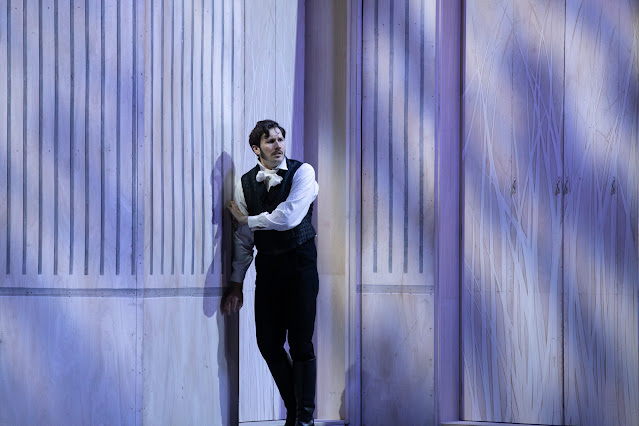
 

Eugene Onegin (Samuel Dale Johnson).
Images: Ali Wright

Sharing a single set by takis with Carmen—typically resourceful, sustainable practice for Opera Holland Park—Julia Burbach’s Eugene Onegin proved a puzzling affair. The idea, I think, was to move between monochrome and colour, perhaps playing with memory and/or dreaming, but too much remained obscure or arbitrary (at least for me). Burbach seemed unsure whether to opt for realism, something more symbolic, or even a coherent melange of the two. Presumably, the uniform light colours of the first scene were intended to evoke a sort of Chekhovian boredom, but it seemed at odds with Pushkin, let alone Tchaikovsky.  Having everyone dressed in similar finery in that opening scene also suggested a chorus of nobles rather than peasants. For these were clearly the same people we encountered in the ball scene, and I do not think the intention was to suggest some sort of Russian Petit Trianon. Quite why some were playing badminton, I have no idea; it proved distracting in the wrong way, as had ‘peasant’ dancing earlier on. A turn through colour to black largely made emotional and narrative sense, yet details continued to sit oddly with the overall ‘picture’. Nothing ever quite moved convincingly, nor settled down.

It was also unquestionably the most heteronormative Onegin I have seen: a perverse distinction, one might say. Not only is there no sign, no inkling, nor even the slightest twinkling of an eye, of homosexual subtext; the characters are conventional enough in their relationships to be plausibly heterosexual. Perhaps if one were viewing work and creator from a Putinesque standpoint, that might signal cause for celebration. To the rest of us, it may seem strange or evasive.

That said, the cast did a fine job within these confines. Jack Roberts (an OHP Young Artist) and Emma Stannard gave a fine impression of Lensky and Olga as a young couple giddily in love. Their sheer enthusiasm proved infectious, not least given the curiously static production. Roberts’s sappy tenor and Stannard’s deep-toned mezzo proved just the vocal ticket too. Samuel Dale Johnson’s offered a thoughtful, well-sung performance as Onegin, both beguiling and infuriating in his mood swings. If the visual haunting demanded by Burbach in the Letter Scene seemed somewhat contrived, Dale Johnson’s subtler vocal version thereafter, culminating tragically in buyer’s remorse, was far more convincing. Anush Hovhannisyan’s Tatina gained in confidence as the evening went on: character development of course, but also, I think, in strength of performance. By the final scene, this was a formidable portrayal indeed. There were no weak links onstage, Kathleen Wilkinson’s Filipievna and Konrad Jaromin’s appearances as Zaretsky and the Captain especially catching the ear.
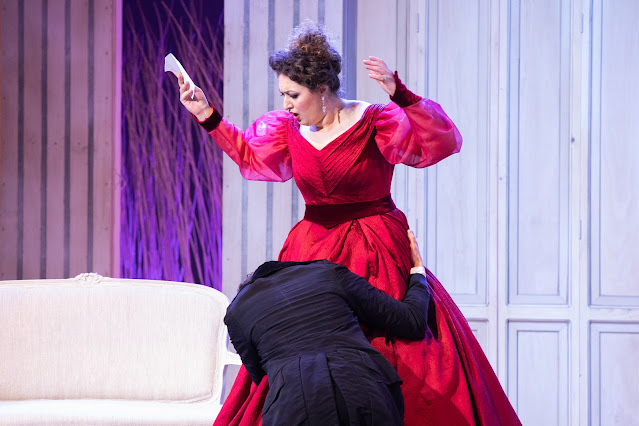

Tatiana (Anush Hovhannisyan)

Lada Valešová’s direction of the City of London Sinfonia seemed, laudably, engineered to follow these particular performances and production, rather than being imposed upon them. Was her languorous, intimate way with the first act too much of a muchness? That is probably a question of taste. It is not how I hear the work, but there was a thoughtful approach at work here. I missed a sense of abandon in the big public scenes, though Valešová’s scrupulousness offered alternative rewards.  One should also bear in mind that she was working with—and emphatically with—a chamber orchestra. A larger orchestra, as well as a different production, may well have brought forth a different musical reading.


Friday, 31 January 2020

A Midsummer Night's Dream, Deutsche Oper, 29 January 2020


Images: A MIDSUMMER NIGHT'S DREAM von Benjamin Britten, Regie: Ted Huffman, Premiere am 26.1.2020, Deutsche Oper Berlin, copyright: Bettina Stöß

Oberon – James Hall
Tytania – Siobhan Stagg
Puck – Jami Reid-Quarrell
Theseus – Padraic Rowan
Hippolyta – Davia Bouley
Lysander – Gideon Poppe
Demetrius – Samuel Dale Johnson
Hermia – Karis Tucker
Helena – Jeanine De Bique
Bottom – James Platt
Quince – Timothy Newton
Flute – Michael Kim
Snug – Patrick Guetti
Snout – Matthew Peña
Starveling – Matthew Cossack
Cobweb – Markus Kinch
Peaseblossom – Lora Violetta Haberstock
Mustardseed – Selina Isi
Moth – Chiara Annabelle Feldmann

Ted Huffman (director)
Marsha Ginsberg (set designs)
Annemarie Woods (costumes)
DM Wood (lighting)
Sam Pinkleton (choreography)
Ran Arthur Braun (Puck’s choreography)
Sebastian Hanusa (dramaturgy)
Neil Barry Moss (Spielleitung)

Children’s Choir of the Deutsche Oper, Berlin (chorus director: Christian Lindhorst)
Orchestra of the Deutsche Oper, Berlin
Donald Runnicles (conductor)


For my final review – unless, which seems unlikely, I manage to write up this evening’s concert before midnight – written as a European citizen, it is perhaps fitting to be writing of an English opera, performed by a German company, conducted by a Scotsman. Given the circumstances, I hope I shall be forgiven if it does not find me at my most inspired, should such a condition even exist. Hand on heart, Britten’s A Midsummer Night’s Dream is not an opera I can bring myself to care for greatly, although – perhaps there is a lesson, or at least an irony, here too – the Berlin audience reacted enthusiastically.


Shakespeare is a dramatist whom composers, at least opera composers, confront at their peril. However clichéd it may be to say this, there is so much music in his verse that setting it can seem superfluous. This is not a rule; there are no such rules. However, I cannot see, or rather hear, what is gained in this case, other than an undeniable creepiness to score and elements of the dramaturgy, which therefore does not seem an unreasonable place for a performance to take as its point of departure. In that, as in everything else, Donald Runnicles’s leadership of the excellent Deutsche Oper Orchestra and Children’s Choir and a fine group of soloists proved just the ticket. Rarely if ever have I heard those recurring slithering glissandi and the weird balances of instrumentation and of instrumentation-vis-à-vis-harmony sound quite so ambiguous, even callous in their indifference to the affairs of mere mortals. This was fairyland music properly unsentimentalised. Moreover, Runnicles communicated the constructivist aspects of Britten’s writing more powerfully than any conductor I can recall. Unsurprisingly, the closer it sounded to The Turn of the Screw, the more interesting the score became. There is only so much anyone can do about the general thinness of writing and a tendency, constructivism notwithstanding, towards diffuse formlessness; insofar as anyone can, Runnicles certainly did. Colour, however, came first and foremost. Those silvery slivers of orchestral moonlight cast, in a fine dramatic paradox, as much shadow as anything else.


The children’s choir had evidently been very well prepared by Christian Lindhorst. Indeed, I had to remind myself afterwards that most of its members would have been singing in a foreign language. A mixed cast included many Anglophone singers, but those who were not, at least in terms of mother tongue, could again hardly be distinguished from those who were. (Singing and musical performance more generally are, of course, international businesses in which British artists have been enabled to flourish by membership of the European Union; goodness knows what will happen next year.) It seems invidious to single out particular performances when all impressed and contributed to a whole that was unquestionably greater than the sum of its parts. I shall limit myself to noting vocal portrayals that, for whatever reason, particularly caught my ear. From James Hall came a warm yet, in the best way, piercing Oberon, channelling Alfred Deller’s memory through something more than imitation; he was well matched by Siobhan Stagg’s spirited, knowing (at least until she was not!) Tytania. Gideon Poppe and Samuel Dale Johnson offered an excellent rutting pair of impetuous youths, well matched and contrasting with their lovers, Karis Tucker and Jeanine De Bique. James Platt’s bluffly comic Bottom led a characterful troupe of rustics.


Ted Huffman’s production gave the impression of good ideas that might fruitfully have been taken further, while shining a clear path through the basic narrative. No one would have stood in any doubt as to who was who, nor as to what was taking place: more, after all, than can often be said in opera staging. I presume the mid-twentieth-century setting – 1940s? – was intended to suggest the period of writing or at least Britten’s life in some respect. It was not, however, immediately clear why we should not then have been closer to 1960. Military uniforms and a suggestion – or was that just me? – of a battlefield as all slept in the forest may have alluded to wartime; if so, without something more, I was rather at a loss as to why and with what consequences. In a programme interview, Huffman referred to Oberon and Tytania fighting over the Indian boy as being akin to the status of Britten and Peter Pears as a childless couple. Once more, if so, nothing more was made of it – and I should hardly have thought of that without reading. Lines delivered in somewhat exaggerated fashion by Jami Reid-Quarrell, Puck was likewise intended, I learned, to represent an outsider. Fair enough, although surely that comes with the territory. There was, however, no doubting Reid-Quarrell’s agility, nor the skill of Ran Arthur Braun’s choreography for him. Quite why Theseus, in a fine vocal and stage display by Padraic Rowan, was drunk, I am afraid I have no idea, but the use of giant puppets for Pyramus and Thisby was charming.


What did I miss? Christopher Alden’s superlative ENO production, far and away the best I have seen, went for the pederastic jugular. Would that more would grasp that thorny nettle with such dramatic verve – be it in this or any other Britten opera. Perhaps, though, I was missing the point. With that, I should probably sign off. See you on the other side, lost in a far darker wood than this, with blue passports, yet nothing in the way of fairyland magic and no ‘break of day’ for at least a couple of decades. If we are lucky.

Friday, 11 October 2019

Turandot, Deutsche Oper, 10 October 2019


Deutsche Oper, Berlin

Turandot – Elisabeth Teige
Altoum – Peter Maus
Calaf – Ragaà Eldin
Liú – Meechot Marrero
Timur – Byung Gil Kim
Ping – Samuel Dale Johnson
Pang – Michael Kim
Pong – Ya-Chung Huang
Mandarin – Patrick Guetti
Prince of Persia – Olli Rantaseppä (voice), Spyridon Markopoulos (stage)
Two Girls – Alexandra Hutton, Anna Buslidze

Lorenzo Fioroni (director)
Claudia Gotta (revival director)
Paul Zoller (set designs and video)
Katharina Gault (costumes) 


Children’s Chorus of the Deutsche Oper (chorus master: Christian Lindhorst)
Chorus of the Deutsche Oper (chorus master: Jeremy Bines) 
Orchestra of the Deutsche Oper
Claude Schnitzler (conductor)


© Bettina Stöß, 2008


Having seen and thought well of Lorenzo Fioroni’s Deutsche Oper production of Turandot five years ago, I was keen once more to make its acquaintance. It did not disappoint, sadly remaining the only interesting staging I have seen,  even though what I took from it this time was somewhat different this time around: whether from difference in emphasis onstage or in my reception I am not entirely sure.


The setting is a relatively modern fascist state: perhaps 1970s, on the basis of costumes and flocked wallpaper, though I am not sure it especially matters beyond not being a regime of Puccini’s own time. (That would open up interesting possibilities for dealing with orientalism and downright racism, yet must await another day.) The people, who had never reminded me so strongly before of those in Boris Godunov, are kept in check by police brutality; quite who is running the show remains unclear, though, the Emperor clearly old and frail, and not alone in that in what seems externally to be a gerontocracy in desperate need of renewal. Why one woman in the crowd refuses to turn and bow to him is again never explained: is she deranged, a dissident, or both? She is eventually beaten into submission. Lack of explanation, though, enables one to draw connections as one will: of whom, or what, is she a harbinger? Liú in heroic defiance? Calaf in foolhardiness? Turandot in a hysteria that here strongly characterises both setting and action? We see Turandot desperately trying to keep things together both before and during the riddles. And she too must obey something higher, an initial refusal to concede following defeat met with police on either side of the stage barring her way.


Marriage of terror and hysteria is the overriding impression, indeed the true marriage, of which that of Calaf and Turandot will be but a reflection. It may and should be understood both politically and psychoanalytically. We see it in the video images of children unable to sleep prior to ‘Nessun dorma’; we see it in the crowd; we see it in the deeds of individuals. We see it also in the falling scenery after the interval (between the two scenes of the second act): the cruelty of a metal frame a metaphor for society and emotions alike. Liú remains hanging from a noose, a warning sign to those who might actually attempt to tell, let alone live, the truth: for her presence, at least that fashion, is also a lie: she was not hanged, but stabbed by the knife she grabbed and turned on herself. The repellent nature of Calaf’s victory is underscored by his final deed: moving to embrace his father, who had been wandering aimlessly before sinking in depression, only to stab him and, quite without emotion, return to his bride. A theatre of cruelty indeed.


Not that the commedia dell’arte is neglected, far from it, whatever the problematical nature of Puccini’s injection of (too much?) psychological realism into the scenario. (Perhaps the problem lies more with unsatisfactory performance traditions; a baleful operatic culture that too often damns Puccini’s operas with box-office-driven productions in mind has much to answer for.) Whatever the truth of that, the pantomimes performed by Ping, Pong, and Pang fascinate, enlivening yet ultimately disconcerting in their mockery. They anticipate, imitate, repeat endless rituals of hope and death that lie at the heart of this strange yet all too familiar society. Are they tellers of potentially liberating truths, in which a Turandot in travesty may gently be mocked? Ultimately not, it seems. Not only are they prisoners too; they, Ping in particular, participate with relish in the capture and torture of Liú. Perhaps they are not to blame; how could they act otherwise? (As we know, they would rather return to the country.) They offer a way of seeing ourselves in all our contradictions, as well as the other characters onstage. Rightly, they fail to live up to our delusional expectations.


Both the chorus and orchestra of the Deutsche Oper were on fine form, clearly relishing the cruel yet often playful drama of Puccini’s score. Claude Schnitzler led his forces well. If his direction sometimes seemed a little too hard-driven to begin with, only to relax a little too much in response, that should not be exaggerated. Harmonies that might have come from Schoenberg or Debussy were just as much the thing as Stravinskian rhythm. Puccini’s Italian heart continued to beat below, however sadistic its dictates. Elisabeth Teige and Ragàa Eldin both took a little time to settle into their roles as Turandot and Calaf. The former greatly benefited from relative taming of her vibrato, proceeding to offer a performance of considerable verbal and musical acuity. Once he had found his balance with the orchestra, Eldin likewise won his laurels, though he might have sung ‘Nessun dorma’ a little less as a stand-alone aria. The tragic tenderness of Liú’s death did great credit to Meechot Marrero, sadistic knife cuts from her torturer – onstage, that is, as opposed to the composer – rendering it close to unwatchable. From the rest of the cast, Samuel Dale Johnson’s quicksilver Ping made one especially keen to see and hear more, but his companions, Michael Kim and Ya-Chung Huang impressed too, as did Byung Gil Kim’s sonorous Timur. This was a strong company evening, then, that did credit both to the repertory system and to this ultimately bizarre and repellent opera.


Saturday, 28 May 2016

Oedipe, Royal Opera, 23 May 2016


Images: ROH/Clive Barda


Royal Opera House

Theban High Priest – Nicolas Courjal
Shepherd – Alan Oke
Theban Woman – Lauren Fagan
Créon – Samuel Youn
Laïos – Hubert Francis
Jocaste – Sarah Connolly
Tirésias – John Tomlinson
Oedipe – Johan Reuter
Phorbas – In Sung Sim
Mérope – Claudia Huckle
Watchman – Stefan Kocan
Sphinx – Marie-Nicole Lemieux
Antigone – Sophie Bevan
Thésée – Samuel Dale Johnson

Àlex Ollé (La Fura dels baus) and Valentina Carrasco (directors)
Alfons Flores (set designs)
Lluc Castells (costumes)
Peter van Praet (lighting)


After the opening night of the first ever staging of George Enescu’s Oedipe in this country, I can say without the slightest hesitation that this will prove the most important event of the Royal Opera’s season. How, after all, could it not? I probably should be more cautious, given that it was my first hearing of the work, but it sounded very much as if it were the composer’s masterpiece to me. Indeed, my initial reaction was much akin to my hearing works – perhaps not entirely dissimilar, but not especially similar either – such as Szymanowski’s King Roger and Busoni’s Doktor Faust for the first time. Whilst others become enraged or, occasionally, enraptured by what Katie Mitchell might have done to a piece of drivel by Donizetti, a work surely quite undeserving of her talents as a director, the rest of us owe the Royal Opera and all concerned with this production a heartfelt vote of thanks. I should eagerly go again, if only I could make any of the dates work; I urge you, if you have not yet seen and heard the production and can, not to hesitate.

Sphinx (Marie-Nicole Lemieux) and Oedipe


First and foremost is the work itself. To my shame, I know little of Enescu’s music; he is one of those composers I have long been intending to ‘get around to’, but until now, have not really done so. He is known at least equally well as a conductor, violinist, and perhaps even as teacher, but unlike, say, Furtwängler, whose compositions are interesting yet hardly essential, Enescu was first and foremost a composer. One might actually draw another comparison with Busoni: unquestionably one of the greatest pianists of all time, yet with music (unforgivably ignored in this 150th anniversary year) that will remain a still greater testament.

 
Jocaste (Sarah Connolly) and Oedipe (Johan Reuter)

The compositional language and structure intrigue. One might, I suppose, call the latter traditional; it is certainly not experimental. This is a four-act opera with ‘conventional’ yet highly powerful, well-crafted narrative (let us not forget Edmond Fleg’s libretto here), which stands in something of a Wagnerian tradition, but is certainly not overwhelmed by it. Likewise the vocal writing, which owes something to Wagner, or perhaps better to (post-)Wagnerism, but no more than Strauss does, and probably less. As Jim Samson puts it in his excellent programme note (the ROH programme is of particularly high quality on this occasion): ‘On the surface, Enescu’s vocal writing appears similar to the kind of quasi-recitative characteristic of many post-Wagnerian operas, but on closer inspection it reveals its motivic credentials as a characteristic component of the closely unified thematic substance. The composer himself referred to a “single flow of ideas”.’ So did it unquestionably sound in this outstanding performance – yes, there was no difficulty in ascertaining that upon a single hearing – from Leo Hussain. Not only did Hussain draw out playing from the Orchestra of the Royal Opera House of a quality of which we know it capable, but which has not always been heard recently, save for under a small number of visiting conductors such as Semyon Bychkov; his pacing and palpable understanding of the way the music and the musical drama work would have had one believe he stood at the helm of a work central to the repertory. Clearly it should be, but opera houses, alas, too often know better.


In the musical language, one hears strong French elements too: Debussyan and Ravelian elements (I even thought of Vaughan Williams at times), or at least parallels, albeit within a more Germanically-structured framework. Enescu’s use of voices within the orchestra almost as if they were vocal and not just orchestral commentary is striking, as his handling of choral forces. Samson again captures the former tellingly, speaking of an idiom ‘caught somewhere between Mahler’s fragmentation and Debussy’s variegation of the late-Romantic orchestra’. Not a note seems to be wasted, moreover; in this retelling of Sophocles, which involves a good deal of material implied or spoken of in the original tragedies, yet never seen on stage, the use of music not only to serve drama but as drama inevitably has one, once more, thinking of Wagner.


So too does the staging. If characterisation of the particular flavours and styles of each act, within an overarching framework is achieved with great musical success, Hussain’s conducting is complemented by a typically imaginative production from La Fura dels baus. The initial coup de théâtre haunts one’s experience throughout the performance, and indeed thereafter, the finely detailed, hieratic stage curtain melting, during the Prelude, into the ‘real thing’. A tableau vivant is what we see and static, tableau-like music – quite unlike that of Stravinsky’s inimitable ‘opera-oratorio’, which in any case yet lay in the future – was what we heard too. Interaction and support were indeed the hallmarks of production and performance throughout. The dialogue between certain archaisms – not really musical, but perhaps hinted at by the music, oboe and harps bringing to my mind Birtwistle’s later evocations of Greek antiquity – are always convincing, yet never entirely predictable. I am not entirely sure, or indeed at all sure, why the Sphinx lived within an apparently crashed aeroplane, but that offered nevertheless senses of wonder and of surprise, as well as of revelation. After all, the story is propelled by things and people not being quite what they seem to be (as well, of course, as having been condemned by Fate to do precisely what they have been ordained to do). Oedipus, in Enescu’s conception, is more Everyman than unapproachable hero; in that, he is ‘modern’ and so do we see him here. Likewise his fickle people and the treacherous army-man, Créon. It is, however, less heavy-worn conceptual communication than a fine sense of narrative theatre which, above all, animates what we see, Jocaste’s emergence, every inch the film star, from the city of Thebes is a case in point.
 
Oedipe


Covent Garden assembled an impressive cast too, considerably more than the far from inconsiderable sum of its parts. Johan Reuter’s assumption of the title role again had one believe this was a central, heroic, repertory performance. Each part of the hero’s life, from the beginning of the second act – the first celebrates his birth and quickly follows celebration with the desperate expulsion of this son to Laïos to Jocaste – to the end of the fourth has one experience an Oedipe both different and yet familiar. A lifetime was convincingly, powerfully portrayed, with fine command both of musical style and of verbal response. Sarah Connolly certainly exhibited those qualities in her Jocaste, with acting to match; her voice, however, sounded thinner than I can recall. It did not really detract from the performance, but I should like also to hear a richer voice in the role. John Tomlinson did his usual thing, and did it, as usual, very well, in the role of Tirésias. There was no gender-bending here, but the honesty and integrity of the poor, blind prophet shone through, in a role that generally fitted well the singer’s present range. Samuel Youn made for a suitably nasty, civilised Créon: what an unsympathetic character he is, and yet how necessary to the drama! I was less convinced than many seemed to be by Marie-Nicole Lemieux’s Sphinx; I heard her words less often than was ideal, although the timbre of the voice seemed well-suited to the role. From the rest of an excellent line-up, Nicolas Courjal’s authoritative High Priest, Sophie Bevan’s beautifully sung and beautiful-of-heart Antigone, and Samuel Dale Johnson’s calmly commanding Thésée stood out to me.
 
Tirésias (John Tomlinson)
 

Choral singing was, save for those hieratic scenes, of a very high quality, for which temporary chorus master, Genevieve Ellis deserves great credit. Sadly, the visually arresting quality of the tableau did not transfer so well into vocal terms; a friend suggested to me at the interval that the chorus members could not hear each other very well. Still, the scenes on the ground, as it were, benefited greatly from artists who could act as well as sing. Collaboration with La Fura dels baus seems definitely to have inspired them. As an audience-member, it certainly inspired me. This, I should repeat, is an important achievement indeed, not to be missed.