Showing posts with label Eugene Onegin. Show all posts

Wednesday, 30 April 2025

Eugene Onegin, Tiroler Landestheater, 26 April 2025


Images: Birgit Gufler
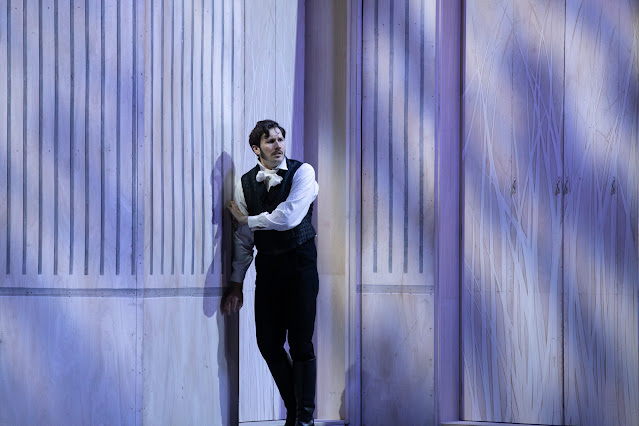
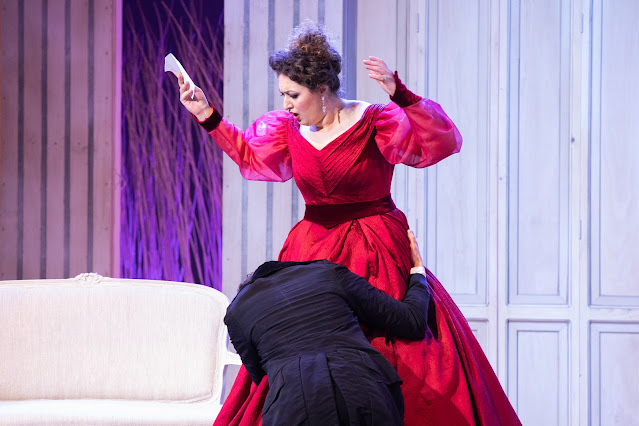
Onegin (Jacob Phillips), Sie (Eleonore Bürcher), Tatiana (Marie Smolka)


Eugene Onegin: Jacob Phillips
Tatiana: Marie Smolka
Lensky: Alexander Fedorov
Olga: Bernarda Klinar
Prince Gremin: Oliver Sailer
Mme Larina: Abongile Fumba
Filipyevna: Fotini Athanasaki
Zaretsky: Julien Horbatuk
Monsieur Triquet: Jason Lee
Captain: Stanislav Stambolov
Sie: Eleonore Bürcher
Precentor: Junghwan Lee

Director: Eva-Maria Höckmayr
Designs: Julia Rösler
Dramaturgy: Diana Merkel

Chorus and Extra Chorus of the Tiroler Landestheater (chorus director: Michael Roberger)
Tiroler Symphonieorchester Innsbruck
Matthew Toogood (conductor) 


Innsbruck is celebrated as a centre for early music and was, of course, a great centre for what was then contemporary music from the fifteenth to seventeenth centuries, as both capital of the Tyrol and Maximilian I’s Residenzstadt. (It is impossible to avoid his presence, even if for some eccentric reason one should wish to do so.) The Tiroler Landestheater is perhaps less well known to outsiders, but consistently offers adventurous programming in musical and spoken theatre as well as dance. This year’s opera programme ranges from Purcell (King Arthur) to Schoenberg (Von heute auf morgen, in a double-bill with I Pagliacci). I had initially thought I was coming to La clemenza di Tito, but confusion over dates left me with the perfectly acceptable substitute of Eugene Onegin. For devotees of a different kind of musical theatre, the musical Hair is on offer too. 

Eva-Maria Höckmayr’s new production of Onegin can be understood to offer three principal lines of approach: abstraction, feminism, and memory. The last of those is intrinsic to the work, yet is emphasised here in a staging introduced by an enigmatic woman styled simply ‘Sie’ (‘she’ or ‘her’) in possession of Tatiana’s letter or a copy thereof. I initially assumed this was Tatiana later in life, and indeed it might be, but I do not think that is ever rendered explicit in her spoken words. Perhaps it is better to think of her as an Everywoman, who could be archetypal or more specific, according to one’s particular standpoint. Often movingly portrayed by Eleonore Bürcher she observes and occasionally interacts—though the interaction is probably more on her side than that of the others. Memory is like that, though perhaps not entirely, at least in our imagination. Onegin and Tatiana look forward too, after all, accurately or otherwise. The abstraction of Julia Rösler’s set designs, combined with relative, slightly stylised historicity of her costumes likewise creates space not only for more than one standpoint but for their interaction in work and performance. Acts of dressing and undressing contribute further, similarly reminding us that this is both drama and theatre (which involves artifice, and in a postdramatic age may or may not involve drama). 


Tatiana, Onegin, Lensky (Alexander Fedorov)

The feminist or at least female angle is understandable and common to many stagings. No one should object, but I have my doubts with this specific work (whilst, I hope, retaining an open mind). The problem is not so much that this is an opera called Eugene Onegin, not Tatiana Larina. There are plenty of works whose title roles are not their central one; we do not complain that Rameau wrote Hippolyte et Aricie, for instance. Nor is there any intrinsic problem with decentring a character; it can benefit all characters, the decentred one included, as for instance we saw in Dmitri Tcherniakov’s Aix Carmen. Instead, the problem lies with Tchaikovsky having created an opera in which, unless one is careful, Tatiana (whose feelings are surely in large part a projection of his own) already overshadows the others. To my mind, a richer and more balanced dramatic treatment necessitates a little gentle help for Onegin to emerge, most likely (though not necessarily) bringing out the torment of his feelings for Lensky: important in themselves, but also because they and the situation created bring Lensky and Olga, arguably Prince Gremin, to life too. The score suggests, even straightforwardly tells us things Pushkin does not. Here, Lensky and Olga in particular seemed a little lost, abandoned even, as surplus to requirements. One can say, of course, that Tatiana deserves to be rescued from homosexual projection, to become her own character. That is a laudable aim, but I think it happens anyway in the third act, and the danger of overbalancing is greater. Still, this is a general issue I have with stagings of the work, not with this one, which pursues its approach with intelligence and a welcome openness.   

Moreover, Höckmayr and Marie Smolka present an undeniably interesting, sympathetic Tatiana, especially in the first act, where we see her so shy, perhaps even emotionally crippled, that she can hardly bear look Onegin in the face, let alone touch him, in evidenf contrast with the existing warm relationship between Lensky and Olga. Smolka’s portrayal warmed as her character did, in general finely spun vocally and dramatically. Jacob Phillips’s thoughtful Onegin offered a trajectory of its own, always working with yet far from limited to the text. If it was not favoured by the production, its quality was such that it nonetheless had space to shine. Alexander Fedorov’s Lensky was ardent, involving, again to an extent that it overcame the challenge imparted by the production. Jason Lee’s Triquet brought a welcome sense of theatricality and ambiguity. Other parts were well taken, but for me the evening’s true discovery was Abongile Fumba, whose rich-toned, compassionate Mme Larina had me keen to hear her in more extended roles. Oliver Sailer's Prince Gremin rightly drew enthusiastic applause at the close.


Orchestra and chorus showed themselves flexible throughout. If, at times, Matthew Toogood’s tempi seemed a little slow, I suspect that was from a concern, successfully achieved, to assist a cast of mostly young singers grow into its roles rather than an overall conception. That such a work can be cast from company singers and that others will be too speaks of the ongoing worth of a system British ‘major’ houses have long since abandoned, to their – and our – detriment. For now, in the words of that celebrated Renaissance song by Heinrich Issac, ‘Innsbruck, ich muss dich lassen,’ but I hope to return.


Sunday, 17 December 2023

Eugene Onegin, Komische Oper, 15 December 2023


Schillertheater

Eugene Onegin – Günter Papendell
Tatiana – Ruzan Mantashyan
Olga – Deniz Uzun
Lensky – Gerard Schneider
Mme Larina – Stefanie Schaefer
Prince Gremin – Tijl Faveyts
Filipievna – Margarita Nekrasova
M. Triquet – Christoph Späth
Zaretsky – Ferhat Baday
Captain – Jan-Frank Süße
Guillot – Alexander Kohl

Barrie Kosky (director)
Werner Sauer (revival director)
Rebecca Ringst (set designs)
Klaus Bruns (costumes)
Simon Berger (dramaturgy)
Franck Evin (lighting)

Orchestra and Chorus (chorus director: David Cavelius) of the Komische Oper
James Gaffigan (conductor)


Images: Iko Freese / drama-berlin.de

I first saw Barrie Kosky’s Eugene Onegin, premiered in 2016, in 2019, a few months before the theatres closed. Then it was at the Komische Oper’s permanent home on Behrenstraße. Now, the building having closed for several years for renovation, this latest revival may be seen across town in Charlottenburg’s Schillertheater, conducted by the company’s new music director James Gaffigan. The cast is a mix of old and new, Günter Papendell, Stefanie Schaefer, Tijl Faveyts, and Margarita Nekrasova survivors from 2019, the rest new (at least to me). 

Memory, though, is a strange thing; or rather, ‘memories’ are, since even one’s own will come into conflict with one another. Although I remembered liking what I saw, what I saw on this occasion did not always correspond to my recollections, which may indeed have been of other productions, real or imagined. Much the same might be said of what unfolds here (in many dramas, no doubt, yet it seems or seemed more than usually germane here). For there are certainly misunderstandings, missed opportunities, ‘bad timing’, and the rest in the relationships, not only Onegin and Tatiana’s, of Eugene Onegin. That of Tatiana and Prince Gremin may be an exception; yet if so, it is dependent on the failures of another. It is, in any case, hardly the central relationship; it serves as a contrast to what might have been, an antidote of reality to fantasy. Kosky’s setting the entire action in the same place, with one partial exception, brings with it some loss, not least in the inevitably lesser contrast between public and private, whose portrayal therefore becomes still more a matter for the orchestra. Yet its dramaturgical function here also brings with it considerable gain, anchoring character’s differing understandings, memories, and decisions in Rebecca Ringst’s almost pastoral, outdoor setting that yet takes in threatening woods behind. (It is not as if the libretto suddenly vanishes when all stage directions are not adhered to literally.) Although real enough – it is not abstract – it imparts something of a dream-like quality, in which not only memories but, at least as important, objects bind everything together.


Jam and jam-jars, for instance: when the opera opens, Mme Larina and the nurse Filipievna are making jam, readily eaten by Tatiana and Olga. When Tatiana sends her letter to Onegin, it is inside a jar sent as a gift. And so on, until the close, when it is there in what seems to be the same place: where it all (tragically?) began. There is something would-be bacchanalian to the ball scene, when it takes place outdoors. This, one feels, is as far away from civilisation as these characters, this society, dare travel. And, of course, it leads to the frozen, pointless misery of the duel scene. Onegin, moreover, does not face the decentring he sometimes can. There is plenty of and for Tatiana too, but we feel – and, I think, have suggested to us – more of his miserable wandering, his downward spiral than usual. Helplessly drunk when he arrives for the duel, he shows that it is already too late for him, let alone for Lensky. His early stiffness is probably a self-defence mechanism; at any rate, we feel its relationship to what is to come. All the while, subtle transformations in Franck Evin’s lighting aid the transformations, both gradual and sudden, in the drama itself. And when a room in Gremin’s palace appears, for the first St Petersburg scene, Onegin by now a sad, destroyed outsider, it is only to be dismantled onstage shortly after, in preparation for the ’return’ to a past which may or may not have ‘actually’ existed for the final scene.


Kosky’s conception remains the guiding one. The Komische Oper’s new music director, James Gaffigan, conducting his first production in the role, would appear to have been presented with certain challenges, not least among them caesuras when all stops, hearts included, all falls silent. On this, the first night of Werner Sauer’s revival, Gaffigan integrated these and other ‘givens’ to excellent effect. His reading, like Kosky’s, seemed to gain pace and depth as the evening progressed, the orchestra responding with eagerness to the vision with which it was presented. Almost chamber-like in scale to begin with, its Petersburg grandeur was undeniable, both in itself and in contrast. Choral contributions were likewise as well acted (and blocked) as sung.


Papendell’s Onegin follows and, to an extent, leads that trajectory too. It was a compelling portrayal in 2019 and is in 2023, his brokenness in the third act deeply moving. Ruzan Mantashyan travelled on a different, related journey as Tatiana, convincingly the shy, bookish girl at the outset, very much a woman at the close, albeit one struggling to keep herself in one piece. This she accomplished through musical and gestural means alike—as well as fine costuming (Klaus Bruns) and make-up. If I sometimes wished Gerard Schneider would adopt a less Verdian approach as Lensky, his was an undoubtedly committed performance, greatly superior to what I had heard from another singer four years ago. Deniz Uzun’s extravert Olga was a joy—and a telling contrast with her more complicated sister. Faveyts and Nekrasova at least matched memories of their excellent portrayals last time around: not a bad summary of the evening as a whole. The company may be on the move physically, but not aesthetically, whether that be in direction or quality.


Sunday, 19 June 2022

Eugene Onegin, Opera Holland Park, 15 June 2022


Tatiana – Anush Hovhannisyan
Onegin – Samuel Dale Johnson
Lensky – Jack Roberts
Olga – Emma Stannard
Mme Larina – Amanda Roocroft
Filipievna – Kathleen Wilkinson
Prince Gremin – Matthew Stiff
M. Triquet – Joseph Buckmaster
Zaretsky/Captain – Konrad Jaromin
Solo tenor – Phillip Costovski

Julia Burbach (director)
takis (designs)
Robert Price (lighting)
Jo Meredith (movement)

Opera Holland Park Chorus (chorus director: Richard Harker)
City of London Sinfonia
Lada Valešová (conductor)
 

Eugene Onegin (Samuel Dale Johnson).
Images: Ali Wright

Sharing a single set by takis with Carmen—typically resourceful, sustainable practice for Opera Holland Park—Julia Burbach’s Eugene Onegin proved a puzzling affair. The idea, I think, was to move between monochrome and colour, perhaps playing with memory and/or dreaming, but too much remained obscure or arbitrary (at least for me). Burbach seemed unsure whether to opt for realism, something more symbolic, or even a coherent melange of the two. Presumably, the uniform light colours of the first scene were intended to evoke a sort of Chekhovian boredom, but it seemed at odds with Pushkin, let alone Tchaikovsky.  Having everyone dressed in similar finery in that opening scene also suggested a chorus of nobles rather than peasants. For these were clearly the same people we encountered in the ball scene, and I do not think the intention was to suggest some sort of Russian Petit Trianon. Quite why some were playing badminton, I have no idea; it proved distracting in the wrong way, as had ‘peasant’ dancing earlier on. A turn through colour to black largely made emotional and narrative sense, yet details continued to sit oddly with the overall ‘picture’. Nothing ever quite moved convincingly, nor settled down.

It was also unquestionably the most heteronormative Onegin I have seen: a perverse distinction, one might say. Not only is there no sign, no inkling, nor even the slightest twinkling of an eye, of homosexual subtext; the characters are conventional enough in their relationships to be plausibly heterosexual. Perhaps if one were viewing work and creator from a Putinesque standpoint, that might signal cause for celebration. To the rest of us, it may seem strange or evasive.

That said, the cast did a fine job within these confines. Jack Roberts (an OHP Young Artist) and Emma Stannard gave a fine impression of Lensky and Olga as a young couple giddily in love. Their sheer enthusiasm proved infectious, not least given the curiously static production. Roberts’s sappy tenor and Stannard’s deep-toned mezzo proved just the vocal ticket too. Samuel Dale Johnson’s offered a thoughtful, well-sung performance as Onegin, both beguiling and infuriating in his mood swings. If the visual haunting demanded by Burbach in the Letter Scene seemed somewhat contrived, Dale Johnson’s subtler vocal version thereafter, culminating tragically in buyer’s remorse, was far more convincing. Anush Hovhannisyan’s Tatina gained in confidence as the evening went on: character development of course, but also, I think, in strength of performance. By the final scene, this was a formidable portrayal indeed. There were no weak links onstage, Kathleen Wilkinson’s Filipievna and Konrad Jaromin’s appearances as Zaretsky and the Captain especially catching the ear.


Tatiana (Anush Hovhannisyan)

Lada Valešová’s direction of the City of London Sinfonia seemed, laudably, engineered to follow these particular performances and production, rather than being imposed upon them. Was her languorous, intimate way with the first act too much of a muchness? That is probably a question of taste. It is not how I hear the work, but there was a thoughtful approach at work here. I missed a sense of abandon in the big public scenes, though Valešová’s scrupulousness offered alternative rewards.  One should also bear in mind that she was working with—and emphatically with—a chamber orchestra. A larger orchestra, as well as a different production, may well have brought forth a different musical reading.


Saturday, 21 September 2019

Eugene Onegin, Komische Oper, 20 September 2019


Images copyright: Iko Freese / drama-berlin.de


Eugene Onegin – Günter Papendell
Tatiana – Natalya Pavlova
Olga – Karolina Gumos
Lensky – Aleš Briscein
Mme Larina – Stefanie Schaefer
Prince Gremin – Tijl Faveyts
Filipievna – Margarita Nekrasova
Zareski – Changdai Park
M. Triquet – Alexander Fedorov
Zaretsky – Changdai Park
Captain – Carsten Lau
Guillot – Yuhei Sato

Barrie Kosky (director)
Rebecca Ringst (set designs)
Klaus Bruns (costumes)
Simon Berger (dramaturgy)
Franck Evin (lighting)

Orchestra and Chorus (chorus director: David Cavelius) of the Komische Oper
Ainārs Rubikis (conductor)


What’s in a name? Should Tchaikovsky’s opera – which, as Barrie Kosky states in the programme booklet, should be considered alongside Pushkin, not as its musical translation – really be called Eugene Onegin at all? Or would Tatiana Larina be the more fitting title? Eugene and Tatiana, perhaps? It is a silly question, really; for one thing, no one is going to rename the work, although someone, I suppose, might write another. But names aside, there will probably always be something of a tension between the centrality ascribed by a production to the opera’s two principal characters; and also something, moreover, of a tension between Tatiana and Onegin on one hand and Lensky, if more rarely Olga, on the other. It is difficult to imagine a successful or indeed pretty much any unsuccessful production that did not involve such tensions, although Achim Freyer, in his bizarre staging for the Staatsoper Unter den Berlin, a few hundred metres away, may be said to have accomplished that in his very typical way.


Kosky’s 2016 staging for Berlin’s Komische Oper, in co-production with Zurich, offers an intriguing, convincing blend of the broadly yet never lazily conventional; the slightly symbolic; and the point of detail, even the incidental, made more than that. The latter first: as the opera opens, Mme Larina and the nurse, Filipievna are making jam. I am not sure that I even recalled that point of detail, though I am sure that I will now. The jam jar, however, returns at a crucial point – in Kosky’s staging, that is – as container for Tatiana’s letter to Onegin. Her nurse, affecting not to understand for whom it is intended, keeps dropping it, casting it aside, until she relents and sets that train of events in motion. ‘So what?’ you may ask. So nothing, perhaps; but I think not. For the jar and its contents take us back to the opening, an apparently carefree summer afternoon, save of course for beneath the surface. Things have changed – and have stayed the same; such tends to be the way with life. And the chorus of local girls, more than usually an emanation of Tatiana’s unconscious – replication and contrast in Klaus Bruns’s costumes lightly make the point – has all along been framing, voicing, goading.


So too will the chorus, male and female, later on, as part of a more general pattern of contrasts and connections between public and private, indoor and outdoor, country and town; and the criss-crossing connections between those pairs of opposites. The fundamental setting, common to all scenes, is that of the meadow on which it all began: designer Rebecca Ringst’s simple, adaptable focus for development and memory. Franck Evin’s lighting works wonders in its partial transformations, highlighting (false or alienating?) community and Romantic loneliness, whilst never having us lose sight of where we are. So too, of course, do Kosky’s blocking and, more broadly, his story-telling. It does no harm for the ball to take place with torches outside for once; its stifling, tragic qualities are not lost. Only in the first St Petersburg scene is there an additional set design, but even then, the facade of Prince Gremin’s palace can, like all facades, readily be dismantled, so that we can turn to the inversion of our central pair’s fortunes and their resolution.


Like many directors, Kosky ignores the opera’s strong, at times overwhelming, homosexual subtexts: the ‘Romantic friendship’ between Onegin and Lensky and, of course, the figure of Tatiana herself as alter ego for Tchaikovsky, his fantasy of how a woman might feel and act. That, however, is simply not the concern of this particular production. For, in the programme booklet, Kosky expresses a preference for operas with ‘very simple stories and incredibly multifaceted themes and emotions – precisely as in Greek theatre,’ and also criticises composers who, over the past fifty years, have, allegedly, ‘simply set literature to music’. I am not quite so sure that it is as simple as that, nor that the comparison with ancient Greece is objectively meaningful in this case, as it certainly would be to Wagner; however, if it is to him, all the better. There is unquestionably a directness to Kosky’s telling of the story here, far from opposed to interpretation, but rather open to it, which works very well: as, say, in his Rusalka and his Pelléas, or indeed, harking back to Attic tragedy, in his Iphigénie en Tauride, all for the Komische Oper, yet sadly lacking in his Bayreuth Meistersinger. Whose opera is this anyway? Here, it conventionally, yet never stereotypically, moves from being Tatiana’s to Onegin’s; the latter character emerges in the reflection, the memories of the latter’s acts and emotions. That trajectory is delineated with a power only rarely achieved, at least in my experience.


Instrumental – or better, vocal – to that was Günter Papendell’s Onegin, thus perhaps rebalancing the scales slightly in that direction. To begin with, I felt somewhat nonplussed at the apparent woodenness of his portrayal, until I appreciated that it was a portrayal of woodenness, of coldness, to be humanly defrosted, as it certainly was during the course of the opera. This was a fine, memorable, and sophisticated conception of the role. It would be an exaggeration, indeed a vulgarisation, to say that Natalya Pavlova’s Tatiana moved straightforwardly in the opposite direction, but tension was present in that respect: the crossing of lines and lives that ultimately turns, we think, to tragedy. Her opening fragility, her heartfelt and beautifully sung Letter Scene, and her final struggle, seemingly achieved, for self-possession proved similarly memorable and sophisticated. Aleš Briscein’s Lensky was surprisingly coarse of tone to begin with, though it was an ardent performance; I could not help but wonder whether he were unwell. A spirited Olga in Karolina Gumos, a stylish and lively M. Triquet in Alexander Fedorov, a splendidly deep-voiced Gremin in Tijl Faveyts, and above all a richly expressive, compassionate Filipievna in Margarita Nekrasova had much to offer, in a typically strong company performance that had no weak links.


The chorus sang and acted well too, its stage direction always a Kosky strength. My sole, relative disappointment lay in aspects of Ainārs Rubikis’s conducting of the orchestra. At its best, especially in the middle scenes, there was a telling striving towards symphonism. Elsewhere, however, much was oddly hard-driven. There were striking disjunctures, moreover, between orchestra and chorus in the first scene. This was not, then, an Onegin to think of in the way of Semyon Bychkov’s (probably the best conducted I have heard in the theatre) or Daniel Barenboim’s (for Freyer, as mentioned above). This was Kosky’s Onegin rather than the conductor’s, yet it belonged as much to the singers and of course to their characters. That, I think, was a good part of its point: a point served well.


Wednesday, 10 October 2018

Opolais/Gewandhaus/Nelsons - Dzenītis, Tchaikovsky, and Mahler, 9 October 2018


Royal Festival Hall

Andris Dzenītis: Māra (United Kingdom premiere)
Tchaikovsky: The Queen of Spades, op.68: ‘I am worn out with grief’
Tchaikovsky: Eugene Onegin, op.24: Polonaise and Letter Scene
Mahler: Symphony no.1 in D major

Kristine Opolais (soprano)
Leipzig Gewandhaus Orchestra
Andris Nelsons (conductor)


After the relative disappointment of the first of these two Leipzig Gewandhaus concerts, that disappointment relating to Andris Nelsons’s conducting rather than the orchestra itself, there came a second chance. I wish I could say that I had responded more warmly. There were, as before, sections of the concert to which I could – and did. However, Nelsons’s Mahler ultimately proved no more convincing than it had before, the final movement of the First Symphony as vulgar and uncomprehending a display as I have heard for a long time. An audience that once again seemed to value excellence of orchestral execution and sheer volume of sound rather than formal, interpretative coherence clearly felt otherwise. Again I thought of Beecham: ‘the English may not like music, but they absolutely love the noise it makes’. Perhaps Nelsons qualifies as an Englishman too, at least when it comes to Mahler.


His taste in new music seems odd too. Try as I might, I could not make anything much of Andris Dzenītis’s Māra – although, as ever, with a new work, that may well just have been my fault. Its first performance had been given by the same forces in Leipzig five days earlier; this performance certainly sounded committed and incisive. The title apparently refers to a notion of divine omnipotence: according to the programme note, ‘the entire physical, visible, audible and tangible world, the materialisation of all spiritual power’. Dzenītis can certainly write for an orchestra in a ‘traditional’, more or less Franco-Russian way: the quarter of an hour or so piece proved ‘colourful’, ‘ritualistic’, ‘pictorial’, ‘dramatic’, and so on, in predictable, generic fashion. Certain passages grabbed the attention: repeated pitches redolent of Morse Code, repeated figures that briefly offered something intriguingly hypnotic. What it all added up to, though, I could not say. ‘Eclectic’ would be one way of putting it, so too ‘at least twice as long as it need have been’. A solo bass clarinet solo at the close may or may not have held some programmatic meaning. According to the note, the piece allowed ‘runes to become visible in the score’. Perhaps they were audible too; I am afraid I have no idea.


Tchaikovsky made much more sense to me, Kristine Opolais on superlative form. In Liza’s third-act arioso from The Queen of Spades and the Letter Scene from Eugene Onegin, she truly brought to life her characters, without context, scenery, or titles. One knew and felt what Liza and Tatiana meant, what their plight was – and could have taken dictation, verbal or musical, from her. Hers were fully gestural performances too, very much those of a classic singing actress. The Gewandhaus Orchestra ‘spoke’ splendidly too: this, after all, is an orchestra that plays for the Leipzig Opera as well as the concert hall (and the Thomaskirche). If only Nelsons and/or Opolais had not indulged in quite so extreme gear changes towards the end of the Letter Scene, and if only he had not driven the Polonaise so hard, these would have been ideal performances. No one, however, would have been seriously disappointed.


The first movement of the Mahler symphony opened with great promise: opening string harmonics (and their later repetition) spot on, without sounding clinical, woodwind full of colour and character, offstage brass as well balanced as I can recall. There was first-rate audience bronchial interjection too, for which many thanks. Later on, an overall freshness of spirit was apt, winning, invigorating. Antiphonally placed first and second violins worked a magic that was little short of revelatory, whilst the tender tone of the Leipzig horn consort was simply to die for. Soon, however, Nelsons began to mould the music excessively, leaving one longing for the ideal of a Kubelík. (Few are the occasions when that conductor proves anything but ideal!) Climaxes grew more and more brash, in quite un-Mahlerian fashion, once again suggestive of a conductor more at home with Shostakovich. Formal coherence had soon gone quite out of the window too.


The Ländler likewise opened well: as vigorous, as earthy as I have heard, the Leipzig strings digging deep indeed. As it progressed, however, it seemed too determined by rhythm, too little by harmony: this should not be a zero-sum game. There was alienation in the Trio, if not quite enough, the material often sounding oddly close to Bruckner. Irony does not seem Nelsons’s strong suit. Nor was it so in the third movement, its weird echoes of Mendelssohn’s Midsummer Night’s Dream apparently in spite of the conductor rather than on his account. There was no gainsaying, however, the excellence of the Gewandhaus Orchestra’s soloists here. It was a pity that Nelsons pulled around the Klezmer and other contrasting material so wildly; soon it made no sense at all, a mere succession of moments. One could hardly have wanted a louder, more emphatic opening to the finale; many of us indeed might have wished for something less ear-splitting. Such, however, was to be the order of the day, with extreme contrast that had the audience ‘excited’ in its seats. I felt merely bludgeoned. Had there been something in the way of formal coherence, it would not have been quite so bad; in its absence, this glorious movement felt interminable. Bizarre tempo changes added further frustration. What a waste of a great orchestra.


Sunday, 20 December 2015

Eugene Onegin, Royal Opera, 19 December 2015


Olga (Oksana Volkova), Eugene Onegin (Dmitri Hvorostovsky), and Tatyana (Nicole Car)
Images: Bill Cooper/ROH
 
Royal Opera House

Tatyana – Nicole Car
Eugene Onegin – Dmitri Hvorostovsky
Young Tatyana – Emily Ranford
Mme Larina – Diana Montague
Filipyevna – Catherine Wyn Rogers
Olga – Oksana Volkova
Peasant Singer – Elliot Goldie
Young Onegin – Tom Shale-Coates
Lensky – Michael Fabiano
Monsieur Triquet – Jean-Paul Fouchécourt
Captain – David Shipley
Zaletsky – James Platt
Guillot – Luke Price
Prince Gremin – Ferruccio Furlanetto

Kasper Holten (director)
Mia Stensgaard (set designs)
Katrina Lindsay (costumes)
Wolfgang Göbbel (lighting)
59 Productions (video)
Signe Fabricius (choreography)

Royal Opera Chorus and Extra Chorus (chorus master: Renata Balsadonna)
Dancers
Orchestra of the Royal Opera House
Semyon Bychkov (conductor)


The first revival of Kasper Holten’s Royal Opera production of Eugene Onegin (reviewed here the first time around) brought one major advantage, undoubtedly worth the visit to Covent Garden alone, namely the conducting of Semyon Bychkov – and, of course, alongside that the playing of the Orchestra of the Royal Opera House. Vocally, it was for me far more of a mixed bag, although the audience seemed wildly enthusiastic. As for the staging itself, I was less convinced than last time. There remains a good deal to have one think – presumably that was the reason for the sadly predictable display from the house’s first-night animal-noises department – but the changes made, combined with lesser acting strength, above all in the title role, sometimes makes for a confusing evening dramatically.
 

Young Tatyana (Emily Ranford) with her
elder self


The central idea of memory is a good one; it is, after all, the work’s own. The bookish Tatyana receives her inspiration through recollection and the haunting of the present – or, at times, perhaps the future – by the central pair’s younger selves has considerable effect. It would have more, however, were there more dramatic commitment on Dmitri Hvorostovksy’s part; especially before the interval, he seemed content merely to stand and sing. Moreover, his ‘double’ lacks the charisma of Tatyana’s. The production offers confusion of its own; it is, for example, unclear – and not, I think, in a productive fashion – why the elder Tatyana sings the Letter Scene to her younger self. Would it not make more sense if singers and ‘doubles’ swapped roles as appropriate (not the actual artists, of course, but they could surely don younger and older ‘appearance’ and costumes). Memory can play tricks, but I am not sure that is the point being made here; perhaps it is, and I missed it.


More fundamentally, though, I felt more strongly than last time the loss of what is surely the underlying theme, even if involuntarily so on the composer’s part, of the opera. This is a staging whose heterosexuality would warm the heart of Vladimir Putin. Perhaps that allows greater agency on Tatyana’s part; I was especially intrigued by thinking of her writing her drama as a counterpart to the ‘masculine’ – and, rightly so, whatever the uncomprehending complaints one heard, often from people who know not their Prague from their Vienna – writing of Holten’s Don Giovanni. That is not strongly pursued, though, partly, I think, as a consequence of less dancing than first time around; the doubles are there enough to irritate, but not long enough now really to make their point fully coherent. That Tatyana is a creation of a gay man – and surely this screams from the score – there is no visual sign at all. More damagingly, though, the principal relationship in the opera, that between Onegin and Lensky, is merely that of the frightened surface. Of the homoeroticism that is less a subtext than the text of a non-ideological understanding of the work we again see nothing. So Lensky is merely jealous of Onegin’s ‘flirtation’ with Olga. That the truest and most deadly love is between the two men is entirely ignored: a retrograde step indeed. I do not think for one moment that this is intended in Russian Minister of Culture fashion, but the likes of Vladimir Medinsky would have little to argue with – which should give pause for thought.
 

Mme Larina (Diana Montague) and Lensky (Michael Fabiano)


It is, then, perhaps a little unreasonable to complain that the singers play their roles in such a way, although I am sure that there was greater psychological depth in the relationship between Simon Keenlyside’s Onegin and Pavol Breslik’s Lensky. Hvorostovsky proved a little more engaged dramatically after the interval, but wooden indeed before, although, given his recent travails, it was impossible not to feel sympathy for him. His singing was often deeply impressive vocally, but that is not necessarily enough; memories of Keenlyside were too strong for me. Mine certainly seemed to be a minority view concerning Michael Fabiano’s Lensky; he received a roar of applause both at the end and – deplorably – during the fifth scene. I could not question Fabiano’s commitment, which put that of almost everyone else to shame. However, for me, the timbre and, more important, the emoting style of his performance did not quite sound ‘right’ for the work and the character, more suited perhaps to the world of Italian verismo. It was, I have to admit, a performance very much in keeping, though, with the heteronormativity of the production; this was, as I said, a committed performance – of a lovelorn young man distraught at the loss of his girl. Nicole Car offered an attractive soprano voice as Tatyana, and acted well too; I did not, though, find a great deal of insight beyond that. Memories of Krassimira Stoyanova, as with those of her Onegin, were not effaced. Oksana Volkova was a decent enough Olga, but again without any particular individuality. The stand-out performance was for me Jean-Paul Fouchécourt’s deliciously stylish Monsieur Triquet, sung with such perfect attention to words and line that I longed to hear it again. Ferruccio Furlanetto’s Prince Gremin was a little rough around the vocal edges at times, but still interesting to hear. Diana Montague as Mme Larina and Catherine Wyn Rogers as Filipyevna shone as last time. The choral singing was excellent too, save – and here some of the soloists were at fault too – for a few too many discrepancies between stage and pit.

 
Tatyana and Prince Gremin (Ferruccio Furlanetto)

It was, however, as I started by saying, in the pit that the greatest honours lay. Bychkov had the orchestra sound – as it always does under him – as one of the greatest in the world, utterly responsive to his touch. The strings were febrile and warmly Romantic, the utter antithesis of any absurd ‘period’ affectations; the woodwind were as full of character as I have ever heard in this work. Implacable brass at full throttle might almost have been from St Petersburg. Rubato, especially the lingering at the end of phrases, was greater than one often hears, always with its own justification, always having one sit up and listen, both to savour the moment and to breathe out when the story resumed. Broader tempo variations were again well calculated, dramatically convincing. There was some breathtakingly soft playing – for instance, the ravishing sonic cushion for M. Triquet’s final lines – which could not have stood in greater, more tellingly intimate contrast with the Fatal climaxes. Bychkov understands what is and what is not ‘symphonic’ in Tchaikovsky’s score – and communicated it in what, Daniel Barenboim notwithstanding, is probably the best-conducted, certainly the most orchestrally variegated, performance of Eugene Onegin I have heard.


Thursday, 14 March 2013

Eugene Onegin, Royal Academy Opera, 11 March 2013

Sir Jack Lyons Theatre, Royal Academy of Music, London, 11.3.2013

Madame Larina – Anna Harvey
Tatiana – Tereza Gevorgyan
Olga – Fiona Mackay
Filipievna – Rozanna Madylus
Eugene Onegin – Ross Ramgobin
Lensky – Stephen Aviss
Monsieur Triquet – Stuart Jackson
Zaretsky – Samuel Pantcheff
Prince Gremin – Nicholas Crawley
Captain – Samuel Queen

Royal Academy Opera Chorus
Royal Academy Sinfonia
Jane Glover (conductor)

John Ramster (director)
Adrian Linford (designs)
Jake Wiltshire (lighting)
Victoria Newlyn (choreography)


Annd Harvey (Mme Larina) and the chorus
Images: © Royal Academy of Music
 
And still they come, not that I am complaining in the slightest! London has certainly not done badly for stagings of Eugene Onegin recently, and it did not do badly here either; indeed, it, or rather the performers, did very well indeed. Most of the operas I have seen at the Royal Academy of Music have been smaller scale; so far as I can recall, the only other nineteenth-century work was Béatriceet Bénédict, which of course is, by Berlioz’s standards, rather an intimate work. One might say the same of Eugene Onegin; after all, these ‘scenes’ from Pushkin were first performed at the Moscow Conservatory. But there is nevertheless a grander, for want of a better word ‘Romantic’, face to the work too – and there is ballet, or at least dance. However, any fears that a nineteenth-century opera might be biting off more than the RAM could chew were firmly banished.

 
Not everything was perfect, of course, but then I could say the same about any other performance I have heard. The orchestra took a while to get into its stride, noticeably more confident after the first interval. There were a good few brass fluffs early on; moreover, there were times when, with the best will in the world and even in a small theatre, the strings (6.6.4.4.2) were simply too thin in tone.  That said, what was perhaps rather more surprising was how, especially as time went on, a glowing Romantic tone was more fully achieved. Jane Glover ably shaped the musical action throughout, displaying flexibility and not inconsiderable passion, without neglecting the needs of her young singers. (In ‘normal’ circumstances, I have little patience with the idea of a conductor ‘supporting’ singers, which normally seems to mean holding back, but in a music school environment, matters are somewhat different.) I do not mean this to be faint praise, but Glover’s account of the score was infinitely preferable to the recent dismal showing by RobinTicciati at the Royal Opera House.
 

John Ramster’s production did not provoke a great deal of thought, as Kasper Holten’s excellent ROH staging certainly had. (It clearly, unsurprisingly, passed over a great number of people’s heads, though seemed perfectly clear to me.) For a ‘traditional’ staging, however, it does its job well enough, granting the cast the opportunity not only to don nineteenth-century apparel but also successfully to follow commendably detailed stage direction. I was somewhat puzzled by what looked rather like a crown of thorns above the stage prior to St Petersburg; however, I realised, upon its disappearance, that it had been nothing so conceptually provocative, merely an indication of the countryside. There is nevertheless one particular directorial intervention at the end of the second act: following the death of Lensky, we see a calculating Olga already having moved on to the Captain from Mme Larina’s party. Victoria Newlyn’s choreography is apt and well executed, a credit both to her and to the cast.
 

Tereza Gevorgyan (Tatiana) and
Ross Ramgobin (Onegin)
 
Not least of the difficulties for the singers would have been the task of singing in Russian. (Thank goodness it was not translated!) They must all have been very well coached – Glover credited Ludmilla Andrew both for coaching and transliteration – since the results ranged from good to excellent. Perhaps Tereza Gevorgyan, the Armenian Tatiana, had an inbuilt advantage, but that did not explain her well-nigh superlative assumption of the role more generally, especially later on. Hesitance was well conveyed in stage terms during the opening scene, but the greatest triumph was in her final scene with Onegin, when a rare degree of agency was forged, making it clear that an empowered woman had turned the tables on the man who had once rejected a girl from the country. The slight – and I mean slight – metallic edge to Gevorgyan’s voice worked splendidly in cutting through and soaring above the orchestra; I hope and expect to hear more from her. Rozanna Madylus’s Filipievna, though of course a far smaller role, was at least as impressive, a full assumption, visually as well as vocally convincing, such as would have graced a major house. There was also much to admire in Anna Harvey's eminently professional Mme Larina. Fiona Mackay’s Olga occasionally lacked depth of tone, but was well acted, indeed exuberantly so, and for the most part equally well sung.

 
I wondered during the first act whether the relative stiffness of Ross Ramgobin’s Onegin was deliberate or a matter of nerves. By the end of the opera, I was reasonably certain that it had been the former, for he charted an excellent dramatic course, clearly transformed by the fatal duel with Lensky. (Not for the first time, I could not help but wish that more had been made by the director of the men’s ‘romantic friendship’, a subtext so glaring that it verges upon a supertext; however, Ramster’s production was unlikely to be the place where that would happen, and so it proved.) Vocal confidence grew as the performance continued: a highly creditable performance in a difficult role. Stephen Aviss’s Lensky suffered a little by comparison. I had the impression that it was a directorial decision to stress the airs of a poet, to render them slightly ridiculous, rather than the character’s brooding Romanticism, but there might nevertheless have been greater inwardness in performance too. Stuart Jackson verily stole the show, or rather the second act, as a bumptious M Triquet. Even Zaretsky made his mark, in the excellent hands of Samuel Pantcheff, making one wish the part were more extended. Prince Gremin is a gift of a role to an established bass, but whilst sung well by Nicholas Crawley, presents a greater challenge to a younger voice, a challenge whose deepest notes were not fully surmounted. Choral singing was excellent throughout; heft, clarity, and linguistic skill were equally impressive, no mean feat in this opera.

Tuesday, 12 February 2013

Eugene Onegin, Royal Opera, 11 February 2013

Eugene Onegin (Simon Keenlyside)
Images: Bill Cooper
Royal Opera House
 
Tatyana – Krassimira Stoyanova
Eugene Onegin – Simon Keenlyside
Young Tatyana – Vigdis Hentze Olsen
Mme Larina – Diana Montague
Filipyevna – Kathleen Wilkinson
Olga – Elena Maximova
Peasant Singer – Elliot Goldie
Young Onegin – Thom Rackett
Lensky – Pavol Breslik
Monsieur Triquet – Christophe Mortagne
Captain – Michel de Souza
Zaletsky – Jihoon Kim
Guillot – Luke Price
Prince Gremin – Peter Rose

Kasper Holten (director)
Mia Stensgaard (set designs)
Katrina Lindsay (costumes)
Wolfgang Göbbel (lighting)
Leo Warner (video)
Lawrence Watson (animation)
Signe Fabricius (choreography)

Royal Opera Chorus (chorus master: Renato Balsadonna)
Orchestra of the Royal Opera House
Robin Ticciati (conductor)


Kasper Holten’s new production of Eugene Onegin, his first staging for the Royal Opera House, was in many ways excellent, an auspicious debut indeed. Unfortunately, it was truly let down by some of the most lacklustre conducting I have heard at Covent Garden. Whilst an interesting, intriguing evening was still to be pieced together from production and singing, it would be idle to pretend that Robin Ticciati’s jejune performance did not detract significantly from the experience. To start with, it seemed as though Ticciati’s reading might prove interestingly different. The balletic side to Tchaikovsky seemed on the verge of shining through, the woodwind section of the Orchestra of the Royal Opera House offering sparkling playing, and what a nice change it made for once to hear the harp! Alas, it soon emerged that those advantages had been achieved largely by default. It became impossible to ignore the thinness of the string sound, despite a sizeable number of strings in the pit. That was not on account of any ineptitude of execution by the players, who remained polished throughout, but because Ticciati seemingly wished to elicit the sound of a middle-ranking chamber orchestra from one of the best opera house bands in the world. Fair enough if you simply have to put up with a small number of strings, or even if you are playing in a small house, but such was not of course the case here. More damagingly still, the performance dragged, at times interminably so. Without any sense of life – not to be confused with alleged ‘airiness’ – and without any sense of Tchaikovsky’s tormented soul, the only signs of anything dramatic being at stake had to be gleaned elsewhere: a great pity. Let me be clear. This was not about ‘intimacy’, about approaching Tchaikovsky’s ‘scenes’ in the manner in which they were first performed at the Moscow Conservatoire – although the perversity did have something in common, albeit significantly magnified, with the attempt by Ticciati’s mentor, Sir Simon  Rattle, to present an ‘intimate’ Carmen upon the vast stage of Salzburg’s Grosses Festspielhaus. Nor was it about actual speed; I genuinely have no idea whether the performance was fast, slow, or middling, by the clock. What I do know is that it dragged, despite sometimes being unduly driven, because Ticciati proved hopelessly incapable of finding a pulse, variable or otherwise. Instead of intimacy and interesting if unusual tempi, we had mere thinness and tedium.

 
Tatyana (Krassimira Stoyanova)
Holten’s production, on the other hand, offered what was often a searching exploration of memory. Inscribed into the score, its visual manifestation was effected by a number of means. Most obvious, but far from the only example, was the use of doubles, a young Tatyana and a young Onegin, to observe, to remind, to haunt. Mirroring the structure – some might say the lopsidedness – of Tchaikovsky’s drama, the young Tatyana is often seen during the first four scenes, whereas her counterpart does not emerge until the older, wiser Onegin appears in St Petersburg. The two young figures meet only in the final scene, offering a glimpse of what might have been, but what is now cruelly denied. Or should that read, 'wisely denied'? For in a fascinating gloss, Prince Gremin appears in that scene too: no longer a mere doddery if noble old fool, he too will have to learn to live with the truth. I can imagine that some might have found the histrionic display of the young Tatyana during the Letter Scene a little much, but by the same token, it seems a valid response to one side at least of the music – and Tchaikovsky’s character. It does not last very long, moreover, and more important seems to be the slippage between the two Tatyanas: who is writing? Who is truly affected? Is this for once an attempt to construct, with all the potential for failure that might entail, a character who is more than Tchaikovsky’s self-projection?

 
Colour is used to great effect: an especially telling moment is the infection through lighting and film of the outside world – or is it again a projection, this time from Tatyana herself? – with Tatyana’s scarlet, following the Letter Scene? Has she been rash, to put it mildly? Is this foreboding? Does her uneasy relationship to the outside world doom her to an unhappy, unsociable life? Is this where it all goes wrong, the moment to which her elder self will perforce return, time and time again? The relationship between books and memory is of course not a new concept in Onegin productions, but it is a good one, and their presence at Mme Larina’s house, not least in Tatyana’s hands, makes its point well. As time went on, above all in St Petersburg, it was as if Tchaikovsky’s and Pushkin’s reminiscences were straining towards Wagnerian leitmotif. They did not and could not reach it; technique and indeed aspiration are quite different. But I could not help but wonder if Holten’s Wagnerian experience played a role here. If only there could have been some counterpart to that in the conducting, which continued signally to fail to join up the dots. Let us hope that the production will be revived with someone else in the pit. A conductor with whom the Royal Opera House has a strong relationship, such as Semyon Bychkov, who has a fine Onegin recording to his name already? That might really be something.

 
Lensky (Pavol Breslik)
The cast was for the most part excellent too. Krassimira Stoyanova’s Tatyana was beautifully sung, no mere cipher, but a strong, flawed character, uncertain of where she was heading and all the more credible for that. I was a little disconcerted by Simon Keenlyside’s Onegin during the first act; it seemed coarser than I recalled from a few years ago. But dramatic truth gained over ‘mere’ beauty, for this Onegin gained in insight as the work progressed, quite in tandem with the production. As ever, Keenlyside’s way with words, just like Stoyanova’s, was pretty much beyond reproach. Beauty there was aplenty in the honeyed tones of Pavol Breslik, every inch the Romantic poet; his verbal acuity was no less impressive. Holten had elected to downplay, even to ignore, the homoeroticism of the relationship between Onegin and Lensky: a pity, since it so permeates the score, but of course the director had other ideas to explore. Instead we witnessed two young, quite immature men as genuine rivals for the affections or at least the attentions of their women. Olga was finely and richly sung by Elena Maximova, whilst Diana Montague and Kathleen Wilkinson almost stole the show with their equally fine portrayals of Mme Larina and Filipyevna. The only disappointments were an unidiomatic Zaretsky from Jihoon Kim and an intonationally-challenged Triquet from Christophe Mortagne. Peter Rose’s Gremin did everything it should – and more. Likewise the Royal Opera Chorus was on splendid form, for which Renato Balsadonna should once again receive considerable credit.