Showing posts with label Aribert Reimann. Show all posts

Friday, 21 April 2023

Schumann Quartet/Vinnitskaya - Schumann and Reimann, 20 April 2023


Wigmore Hall

Schumann: String Quartet in A minor, op.41 no.1
Reimann: Adagio (Zum Gedenken an Robert Schumann)
Schumann: Piano Quintet in E-flat major op.44

Erik Schumann, Ken Schumann (violins)
Veit Benedikt Hertenstein (viola)
Mark Schumann (cello)
Anna Vinnitskaya (piano)

I welcomed in February an excellent concert of Schumann and Brahms from the Schumann Quartet and Pablo Barrágan. This latest instalment of The Schumann Show – there will be a third in July – had still more Schumann: two of the composer’s works, plus another derived from his material and dedicated to him. It made for a fine successor, as did pianist Anna Vinnitskaya, joining the players for the Piano Quintet. 

The first of two works from 1842 was the A minor String Quartet. The first movement introduction invited us in, showing at the same time just how well Schumann knew his Bach, refracted by a Beethovenian lens. More important, its inwardness and pregnancy with possibility were very much to the fore, the surprise of Schumann’s move to the major mode for the Allegro registering subtly as part of his general tonal and developmental scheme; there was no need to hammer it home. Fiery and intimate by turn, and sometimes together, this performance certainly had the movement’s measure. Vigour characterised the second and four movements, though neither, rightly, was without vulnerability. Whirlwinds of different character, the former counterbalanced by a charming, sinuous trio, the latter full of post-Mendelssohnian life, they framed an Adagio rich both in secrets and in their divulgence. There was something almost operatic to it: Onegin on the Rhine, perhaps, though its heart still very much beat after Beethoven (not least his example in the Ninth Symphony). 

Aribert Reimann, a composer sadly overlooked in this country and probably best known here for work as a pianist with Dietrich Fischer-Dieskau, descends from one of the doctors who treated Schumann at his Endenich asylum. In 2006, 150 years after Schumann’s death, Reimann published the medical records he had inherited and composed an Adagio in memory of Schumann based on two chorale harmonisations Schumann had made at that time: ‘Wenn mein Stündlein vorhanden ist’ and ‘Stärk uns, Mittler, dein sind wir’. The Schumanns played the first, alongside Ken Schumann’s valuable spoken introduction to the piece, followed by a fine performance of Reimann’s typically post-Expressionist response. Prolongation, incision, elaboration, and other procedures enabled him – and us – to encircle those sad yet noble last musical words, as did Reimann’s own musical assailants and/or angels. Why, after all, choose?

Vinnitskaya and the Quartet gave us a warm and equally distinguished performance of the Piano Quintet, balance between instruments always finely judged, to the extent one would never have known it might be a problem. In the second group, viola and cello, shadowed and responded to by two violins, reminded us that Schumann’s own instrument is perhaps not even first among equals here, but simply an honoured equal. It was a dynamic reading that yet always found space for the musical drama to unfold. A tumultuous first-movement development and return took nothing for granted, taking us to quite a different place from where we had begun. Ghostly urgency in the second movement, contrasted with hallucinatory episodic visits to the Schubertian major-mode, duly unsettled. So too did Veit Benedikt Hertenstein’s dark viola solo. Full-blooded, almost Brahmsian eruption made its point with power and elegance.  Vinnitskaya’s dexterity, never in doubt, was certainly on show in the scherzo: another whirlwind to succeed those two in the String Quartet. Trios of very different character were equally relished; this was almost, not quite, an embarrassment of musical riches. An enthralling performance of the finale was given in, again, different yet consequent character. That first-movement combination of urgency and space was present also here. The Furiant from Dvořák’s second Piano Quintet made for a lovely encore—and indeed had me wish to hear the whole thing. Another time, I hope.


Monday, 9 October 2017

Reimann, L'Invisible (world premiere), Deutsche Oper, 8 October 2017

Deutsche Oper, Berlin

Images: Bernd Uhlig

Ursula, Marie, Ygraine – Rachel Harnisch
Marthe, Bellangère – Annika Schlicht
Handmaiden – Ronnita Miller
Father – Seth Carico
Grandfather, Old Man, Agiovale – Stephen Bronk
Uncle, Stranger – Thomas Blondellle
Child, Tintagiles – Salvador Macedo
Queen’s Servants – Tim Severloh, Matthew Shaw, Martin Wölfel

Vasily Barkhatov (director)
Zinovy Margolin (set designs)
Olga Shaishmelasvili (costumes)
Robert Pflanz (video)
Ulrich Niepel (lighting)
Sebastian Haunsa, Jörg Königsdorf (dramaturgy)

Orchestra of the Deutsche Oper, Berlin
Donald Runnicles (conductor)


Aribert Reimann has recently seemed fated to be remembered, if not quite only, then principally for his Lear. Its fortunes certainly seem to have picked up recently: I saw it in Paris last year; Salzburg staged it this summer too. (Alas, it simply did not fit into my schedule.) I can hardly talk of the need to look beyond a single work, for it is the only of his operas I can really lay claim to knowing – until now, perhaps. It was no one else’s fault, moreover, that I missed the Berlin premiere at the Komische Oper of his Medea earlier this year on account of illness. Reimann’s work as a pianist will surely survive too, the recordings of Second Viennese School repertoire with Fischer-Dieskau (the creator of Lear) invaluable; I have found myself choosing them several times for the discography to my forthcoming Schoenberg biography. So perhaps I am over-dramatising. At any rate, there was a keen sense of anticipation at the Deutsche Oper, a sense of the some time répétiteur returning home. And what we saw and heard seemed to me not only a convincing ninth opera, but a highly accomplished piece of musical theatre from all concerned: a model of advocacy for a new work.


For those who know a little more – if only, as for yours truly, through reading, rather than through real acquaintance with the works – Reimann has been especially associated with what the Germans call Literaturoper: that is, an opera based upon an already existing literary text. Indeed, he contributed a piece, ‘Wie arbeite ich an einer Oper?’ (‘How do I work on an opera?’) to a 1982 collection on works derived from literature, Für und wider die Literaturoper, ed. Sigrid Wiesmann (Laaber). It seems especially fitting with respect to the history of the genre, then, that here Reimann should have turned to Maurice Maeterlinck, whose play Pelléas et Mélisande offered Debussy the opportunity to compose one of the defining, as well as foundational, works in the genre. (Another instance, which ought to be far better known, is Maeterlinck’s Ariane et Barbe-Bleu, set by Paul Dukas.) Here Reimann, drawing on a lifetime’s experience, has put together with commendable economy a short – under ninety minutes? – work founded on three of Maeterlinck’s relatively – surrounding Pelléas – early one-act plays, skilfully combined so as to prove considerably more, as the cliché has it, than the sum of their parts.


The three plays, L’Intruse, Intérieur, and La Mort de Tintagiles all concern themselves with death, children, and reactions to the deaths either of children or of those closely connected with them. A great strength of what we saw at the Deutsche Oper in Vasily Barkhatov’s excellent staging was that one could never quite be sure what was ‘work’ and what was ‘interpretation’. One had one’s suspicions, of course, but even when it was clear that a stance was being taken to the drama, it may have been by the librettist-composer, by the director, or even by the performers – or indeed by a combination thereof. In this Kindertotenoper, the first section presents a family anxiously awaiting the deliverance of a mother from childbirth, news of her deliverance eventually more negative than they had hoped; we then move to the tale of an old man and stranger having to tell a family the news of the death of one of its daughters; and finally, to the story of an unseen queen who strives, and succeeds, the efforts of a child’s sisters notwithstanding, to have her servants kill him. Fate looms large, of course, which may have been heightened by the practice – not followed here – of performing the second and third of the plays by marionettes.


What may have heightened the symbolism, and indeed the Symbolism, however, here is responded to by a typical directorial – or is it creator’s – edge. As time progresses through the three works, we first find ourselves in a stifling (high) bourgeois household from what would seem to be roughly the time of (Maeterlinck’s) writing. Intérieur takes a step forward in time, somewhere between a generation or two, prompting us to ask about the identities of characters, both sung (all in French) and acted (the Staatisterie on excellent form too), or at least what connections we might draw between sections of the work. L’Intruse is written for strings only – as well, of course, as voices! Intérieur, by contrast, is set in the world of orchestral woodwind. When we come closer to the present day – although with certain disturbing questioning from the three countertenors who have helped punctuate our way between sections: who are they now as servants, and why are their ‘dresses’ made of rubbish bags? – we hear the full orchestra, brass and percussion included. But there are still many sections solely for strings or for woodwind; when those orchestral choirs come together, and when they are supplemented, we are prompted to ask what that might mean, musically, dramatically, and of course musico-dramatically.


Shadows – implicit puppet-play – play an important role too, almost as if a second orchestra. They seem to offer additional standpoints on the action, to comment on it, and perhaps to offer alternatives. A dream world is never far away; and like the best – or worst – dreams, we are never quite sure what is what. Not that there is anything vague about Reimann’s writing, its precision clear, even as its clusters provoke immediate, dramatic effect. Its roots in serial processes may be felt, fatalistically, just as the hopelessness and fascination of the situations on stage works itself out, whether in a kinship, in parallel, and sometimes perhaps even in opposition. One never feels that the music is merely ‘reflecting’ the words or the characters; sensing its ever-changing dramatic role, like that of the staging, is the business of the drama – and indeed of the listener-spectator. And yet, those alternatives: were they alternatives at all? There was never any way out really, was there? Such seems to be the message of Barkhatov’s multiple visual realisations of the potential demise of Tintagiles: car crash, noose, and so on. We persuade ourselves things might be, might have been, otherwise; often we have to. Sometimes, at least, we should not. (Not entirely incidentally, words of thanks should be offered to the production team for coming on stage to receive applause, wearing T-shirts with images of the imprisoned director, Kirill Serebrennikov. We must not forget, and here at least must not be fatalistic.)

Perhaps even more so than usually, this was very much a company effort. It seems invidious to single out members of an excellent cast, changing roles as they did, no one seeking the limelight. Let us just say that Rachel Harnisch offered a fine performance as first amongst equals – indicated also by the warmth of applause she received. One often came close to losing track of who was a ‘singer’ and who was an ‘actor’; it did not matter. The Orchestra of the Deutsche Oper sounded fully prepared: not only prepared, but committed. Donald Runnicles led what sounded to me an equally prepared and committed account not only of the orchestral score but of the work as a whole. Its changing moods and colours, its ‘internal’ and ‘external’ musico-dramatic process, its moments of eery calm and explosion: all those and much more registered powerfully, if mysteriously, even on a single hearing. I hope very much to have a second chance, to explore this work further, and have little doubt that it deserves such an opportunity, from and for many of us.

Wednesday, 1 June 2016

Lear, Opéra national de Paris, 29 May 2016


Palais Garnier

King Lear – Bo Skovhus
King of France – Gidon Saks
Duke of Albany – Andreas Scheibner
Duke of Cornwall – Michael Colvin
Earl of Kent – Kor-Jan Dusseljee
Earl of Gloucester – Lauri Vasar
Edgar – Andrew Watts
Edmund – Andreas Conrad
Goneril – Ricarda Merbeth
Regan – Erika Sunnegårdh
Cordelia – Annette Dasch
Fool – Ernst Alish
Servant – Nicolas Marie
Knight – Lucas Prisor

Calixto Bieito (director)
Rebecca Ringst (set designs)
Ingto Krügler (costumes)
Bettina Auer (dramaturgy)
Sarah Derendinger (video)
Franck Evin (lighting)

Chorus of the Opéra national de Paris (chorus master: Alessandro di Stefano)
Orchestra of the Opéra national de Paris
Fabio Luisi (conductor) 
 
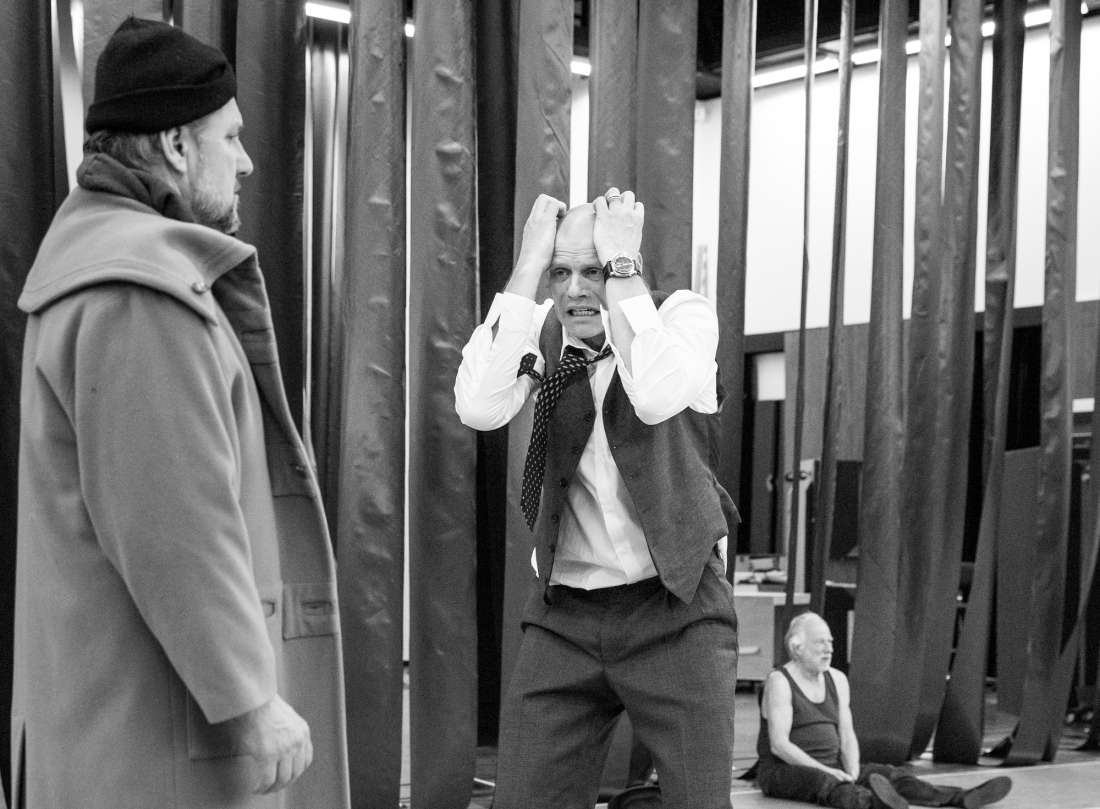
Rehearsal photograph: © Élena Bauer / OnP


This year has seen musical Shakespeare commemorations aplenty, although I cannot help but wonder whether some miss the point. Although there are many wonderful musical settings of Shakespeare, his verse is often so musical in quality that it requires nothing additional. Successful Shakespeare operas are thus less surprisingly few than one might initially suspect. Britten’s A Midsummer Night’s Dream has its devotees, many of them fervent; I should rather stick with the play and Mendelssohn’s incidental music. Falstaff: well, it is difficult to care much one way or the other about The Merry Wives of Windsor, even if Nicolai’s version is (slightly) preferable. Lear, however, has at least one other excellent operatic version, very different in conception: Alexander Goehr’s Promised End. Aribert Reimann’s opera is more conventionally operatic, perhaps, than Goehr’s post-Brechtian response, although such a claim is highly relative and this is no work, thank God, for canary-fanciers. We are lucky to have both – and equally lucky never to have that threatened late Verdi opera. (I have never heard Aulis Sallinen’s 2000 opera.) At any rate, the Paris Opéra’s contribution, whether intended as such or no, is most welcome in principle, still more welcome in practice.


Claus H. Henneberg wrote a number of libretti, from Reimann’s 1971 Melusine to works by Peter Eötvös and Matthias Pintscher. (How I should love an opportunity to see the latter’s Thomas Chatterton!) This, first performed at the Munich Opera Festival in 1978, was written with Dietrich Fischer-Dieskau very much in mind for the title role, and that seems to have helped the initial dissemination of the work, both in the theatre and on its first recording. For a number of stagings followed, including San Francisco, Paris (making Calixto Bieito’s staging the Opéra national de Paris’s second), East Berlin (the Komische Oper), Vienna, Amsterdam, and eventually in 1989, London (ENO). Opera of this period has not generally been well served well by our opera houses, although many continental houses – and not just German ones, as this Paris production and its predecessor attest – tend to do better than their English counterparts; nor has it been in much Anglophone writing. In the meantime, however, you are recommended to seek out a performance and/or a recording where you can.
 

This Paris production and performance will do nicely in that respect. Reimann’s post-expressionist score – not unlike what you might expect from so fine a pianist in Lieder of the Second Viennese School – and Henneberg’s libretto do nothing especially ‘to’ the play, although it is of course not remotely set in its entirety. Given the musical language, violence comes much to the fore, without forsaking claims upon our human sympathies. Indeed, as one would expect, the latter become progressively engaged as the second of the two acts progresses. Dramatic parallelisms and distinctions, for instance between Lear (baritone) and Gloucester (bass-baritone), Cordelia and Edgar, are surely, if sometimes rather obviously, handled in words and music. The series with which the latter pair are associated come strongly into the foreground, much as they might have done with Berg, although there is far less of the ‘Romantic’ to this score. As with a good deal of serialist opera, one has a sense of the workings of the serial machinery and its implications, even if one could not quite put it into words, and would have to consult the score properly to analyse it. (When, after all, would one not? Surely the same is true of Mozart or Wagner.)


Although I felt that Fabio Luisi sometimes led the excellent Orchestra de l’Opéra national de Paris with a little too much restraint, and that something more full-blooded would have turned the dramatic screws with a more evident sense of theatre and ultimately of musico-dramatic generation, audibility of such procedures and our consequent ability to relate them, indeed to fuse them, with stage action were nevertheless most welcome. Not that screams from the orchestra – seemingly, insofar as I could tell, never having seen the score, executed with pinpoint precision – or stereo dialogue between percussionists in boxes either side of the pit had nothing of the visceral to them, far from it. The score can rarely, if ever, have been played with such clarity and, at times, both depth and brightness of string tone as by this fine orchestra, still woefully underrated by many who should know better. My mind was cast back to their magnificent Moses und Aron at the opening of this season.
 

The cast was excellent too. Bo Skovhus gave a highly distinguished, dramatically detailed performance of the title role. His initial pride and its disintegration into a complex web of emotions, inadequacies, and ultimately greater humanity were accomplished in what I presume would have been a more physical performance than that adopted by Fischer-Dieskau (or indeed, really possible to the role’s creator at the time). Skovhus was, I am sure, just as committed as his great predecessor would have been. The dryness I have sometimes observed more recently in his voice seemed as resolutely banished as Cordelia, without danger of its parallel return.
 

Lauri Vasar’s Gloucester was handsomely sung, in a portrayal of considerable emotional depth. Facial, vocal, and verbal expression seemed very much of a piece, as indeed they did in general on stage, testament surely to Bieito’s work as director as well as to individual artistry. Indeed, it is surely testament to both that it is difficult to disentangle the two, and I shall not really attempt to try. Bieito certainly does not seem out to shock, but rather to draw from characters, production, and performances the elements of musical drama. Modern dress is employed, if one cares about that sort of thing in itself, but the designs more broadly are stark, permitting one to allow oneself to imagine any manner of ‘setting’ or none: so more or less what all but the most hidebound reactionary would expect in Shakespearean tragedy. I am not sure that anyone would claim this as a ‘history play’, but perhaps someone silly will claim it as a ‘history opera’; frankly, who cares?
 

What Goneril and Regan have in common and what, increasingly, sets them apart is fascinatingly explored, Ricarda Merbeth’s Goneril the power-dressing big sister, initially less interested in the sexual, it would seem, but ultimately more successful – perhaps because her actions have not previously been so overtly erotic? – in its exploitation. The depravity of Regan’s actions, by contrast, from the initial sexual approach to her father (one almost wants to have her convicted of elder abuse) to her sleazy demise (a touch of necrophilia before expiring, perhaps, however understated?) tell their own story. Erika Sunnegårdh’s performance again melded the ‘musical’ and the ‘dramatic’ into a single, dynamic whole. If Annette Dasch’s Cordelia made less of a strong impression, that was more a function of the work; when she returned, hers was an undoubtedly sympathetic contrast, if ultimately never one that could emerge victorious. Andreas Schiebner’s Albany was intriguingly ambiguous: here, one felt, was a truly conflicted character, no doubt weak yet still a victim of circumstances. Andreas Conrad’s Edmund followed the seeming fate, even nature, of his own personal circumstances, with similarly powerful command of musico-dramatic theatre. His legitimate half-brother, Edgar, received a memorable performance, especially but not only in vocal terms, from Andrew Watts, switching as he must between tenor and countertenor. Here, again, was a desperately needed hint of sympathy, if also a reminder of hopelessness. There was no sense, however, of whether he might become king; our eyes and ears were focused upon tragedy.


Now I should like to see Bieito direct King Lear ‘itself’ or not quite ‘itself’. Shakespeare stands no more in need of Werktreue than any composer of opera, indeed if anything, less so. The Barbican has staged some of his Shakespeare; alas, I was unable to go, but hope that it will not prove the last opportunity in London. Otherwise, to Paris, to Barcelona, or to wherever else might oblige…