Showing posts with label Tristan und Isolde. Show all posts

Sunday, 4 August 2024

Bayreuth Festival (2) - Tristan und Isolde, 3 August 2024


Festspielhaus

Tristan – Andreas Schager
King Marke – Günther Groissböck
Isolde – Camilla Nylund
Kurwenal – Olafur Sigurdarson
Melot – Birger Radde
Brangäne – Christa Mayer
Shepherd – Daniel Jenz
Steersman – Lawson Anderson
Young Sailor – Matthew Newlin

Director – Thorliefur Örn Arnarsson
Set design – Vytautas Narbutas
Costumes – Sibylle Wallum
Dramaturgy – Andri Hardmeier
Lighting – Sascha Zauner

Bayreuth Festival Chorus (chorus director: Eberhard Friedrich)
Bayreuth Festival Orchestra
Semyon Bychkov (conductor)

 
Images: Bayreuther Festspiele / Enrico Nawrath

Almost uniquely amongst operas (dramas, if we prefer), Tristan und Isolde resists conceptualisation, even much in the way of framing. Perhaps not uniquely, but to a greater extent than any other. Any attempt to make Tristan ‘about’ anything other than what it is intrinsically about seems doomed to fail. I continue to live in dread of the director who decides it is somehow ‘about’ immigration, Covid, or anything pertaining to the phenomenal world. So many, distrusting or simply uninterested in music, seem incapable of sensing what it is concerned with. 

Put frankly, if you are uninterested in music, you should leave Tristan well alone. Its action is interior; the exterior is largely back story. For Wagner at his most Schopenhauerian, in aesthetics as much as ontology, the striving of the Will is the action, to which music – not opposed to, but as drama – as its representation comes closer than any other art form or means of expression. It is the music drama in which least would be lost if words and staging were discarded. In reality, of whatever kind, that how we listen to it, even when convinced otherwise. At a certain point in the Act II love-duet, it becomes difficult, even impossible, to have the words, fascinating, complex, and telling though they may be, register in one’s consciousness. Whether we call this the world of the noumenon, of night, of Dionysus, or of Tristan, we as well as the lovers are – or should be – there and not in its phenomenal, diurnal, Apollonian, operatic equivalent. 

All very well, you may say, but we do have words, we do have singers, we do have staging. Indeed we do, and they – singers and staging, in a sense words too – must work within these realities, these artistic truths. That need not be a problem; art thrives upon constraint of one sort or another. (Ask Wagner’s antipode, Stravinsky.) Too often, though, directors do not, perhaps cannot, since they seem to have little sense of what this work is actually concerned with, still less that it seemingly cannot be wrenched to be concerned with anything else. A signal feature of Bayreuth’s new Tristan, which I saw in its second performance, is that Thorliefur Örn Arnarsson seems to grasp this, in theory and in practice, and moreover to grasp that this does not negate but rather invites his work as director. There are cases, I think, in which he might go further in this direction in paring down the extraneous – is there a better model than Wieland Wagner here? – but this makes for a very good start and, following so many misfires, whether in Bayreuth or elsewhere, comes as a great relief. 

Nietzsche wrote a good deal of arrant nonsense about Wagner, often deliberately so, yet in calling Tristan the opus metaphysicum, he was on the mark. Only a couple of stagings I have seen, by Dmitri Tcherniakov and Peter Konwitschny, have offered serious challenge to that and Konwitschny in considerably more circumscribed fashion; they are destined, I suspect, to remain exceptions. Anarsson’s production treads on safer ground, neither without reason nor without advantage Moreover, there is to Anarsson’s work and to that of his collaborators, not least the outstanding Semyon Bychkov as conductor, a sense not only of the noumenal but of the aesthetic. 

Ship enthusiasts will find themselves well catered for. Not only the first act but the entire drama has a ship as its setting. Vytautas Narbutas’s set designs evoke this powerfully, suggestively, and without clutter—save, in the second act, where the clutter is the point. Ropes mostly do the trick in the first act, whose abiding visual motif is Isolde’s billowing wedding dress, also suggestive of sails. The words displayed – and just as much, concealed – on it from Wagner’s poem tell their own story, especially as she attempts, with varying success and perhaps intent, to free herself from it. Anarsson sees no reason actually to visualise the love potion, knowing that it is simply a symbol, not a cause. I have no especially strong feelings either way on that in principle; it is merely an external manifestation. It felt slightly odd, though – I realise this may seem somewhat at odds with what I say above – as did the onset of what seemed like a realistic fight between Tristan and Melot at the end of the second act, Melot wielding a sword, only for its outcome to happen seemingly spontaneously. Those objects and acts of the day perhaps benefit, if less strongly than their counterparts in the Ring, from some sort of visualisation.


The second act moves to the inside of the ship, seemingly its core: the core, one might say, of what action there may be. Its décor is fascinating, suggesting a lumber room strewn with objects that may in some sense have led us – which is to say Wagner, the work, those performing and otherwise experiencing it – there. Caspar David Friedrich’s presence is doubtless inevitable, and will at least evoke recognition, though part of me feels it is time to give his more celebrated images, like those of Monet and Klimt a while ago, a period of rest. The broader, unaggressive deconstruction of ‘civilisation’, western and perhaps eastern too, forms a captivating backdrop for the stage and ultimately the ‘real’ action. Cleared of that baggage, moved to a different part of (presumably) the same ship, the third act unfolds in a ‘later’, barer environment. It already feels too late, which in the most obvious if not necessarily the deepest sense, it is. Lighting, or rather its lack, throughout seems intended both to accentuate but also to develop the contrast between night and day. It reminds us that these are not operatic characters; the point is not necessarily to observe them minutely. There are greater forces – ultimately, one great, overwhelming force – at work.

Following the crude lack of direction, balance, and tuning brought to us two nights earlier by Oksana Lyniv in the covered pit, Bychkov’s work sounded like aural manna from heaven. He knew how to work with the theatre and its particular characteristics; beyond that, he knew the workings and expressive possibilities of Wagner’s score and communicated them in a reading that often took its time, especially in the second act, yet never dragged. The opening of the first-act Prelude – and its echo, towards the end of the act – sounded more beautifully hushed than I can recall, yet in no sense narcissistically; this was expectant, apparently imbued with knowledge, albeit knowledge that could not yet be imparted, of where the music would head, of what dramatically, in the fullest sense of the world, was at stake in melody, dissonance, and their consequences, always, if sometimes only just, within a tonal framework. That was the story, in which intensification of string vibrato could play as important a role as overwhelming orchestral climax. Bychkov did not hold back; his is not Wagner that defers to the voice, nor to anything other than its own musicodramatic requirements. He nonetheless helped liberate the voice’s expressive potential, even when vocal realities fell short of the ideal.

I did not feel that so strongly as a couple of people I have spoken to since, and wonder how much of that might be ascribed to seating in the theatre (as well, perhaps, as to aesthetic priorities). Seated at the back of the stalls, I may have benefited from the healing balm of the Bayreuth acoustic. That said, Andreas Schager’s Tristan, for stretches of the performance possessed of many of this Heldentenor’s familiar qualities, also experienced difficulties. Balance in the second-act duet was sometimes awry with Camilla Nylund’s Isolde, who at times also seemed stretched, if more in control of her part. A degree of abandon is, of course, no bad thing; Schager’s performance, however, came into and went out of focus a little too often and became strangely disjunct in the third act, as if the effort to sing more softly, to offer a more variegated reading, made it more difficult to maintain his line at all. 


Christa Mayer’s Brangäne was, by contrast, everything it should have been: warm, sustained, intelligent, and as well as integrated as any orchestral line. Günther Groissböck’s snarling Marke seemed to be making a play to come across as more cruel, even vindictive, than one might expect; this emerged as something of a work-in-progress. If a little bluff, even gruff at times, Olafur Sigurdarson had what it took for Kurwenal. The smaller roles were all well taken, Birger Radde’s ambivalent Melot, Daniel Lenz’s sweetly sung Shepherd, and Matthew Newlin’s clear-toned Sailor all standing out, whilst taking their place in the greater ensemble. The latter was ultimately what mattered and which, shortcomings aside, made this a satisfying and often moving whole.


Thursday, 4 July 2024

Tristan und Isolde, Deutsche Oper, 3 July 2024


Tristan – Michael Weinius
King Marke – Günther Groissböck
Isolde – Ricarda Merbeth
Kurwenal – Leonardo Lee
Melot – Jörg Schörner
Brangäne – Irene Roberts
Shepherd – Clemens Bieber
Young Sailor – Kieran Carrel
Steersman – Byung Gil Kim

Director – Graham Vick
Designs – Paul Brown
Lighting – Wolfgang Göbbel  

Chorus of the Deutsche Oper (director: Thomas Richter) 
Orchestra of the Deutsche Oper
Juraj Valčuha (conductor)


Images from the 2011 premiere: © Matthias Horn

And so, the Deutsche Oper’s season, in which it has shown all ten of Wagner’s ‘Bayreuth’ works, begins to draw to a close. I have not managed to see them all; by accident rather than design, I have seen the current productions of trhe seven ‘music dramas’, but missed those of The Flying Dutchman, Tannhäuser, and Lohengrin (all of which I have a seen before). Of those I saw, all but Philipp Stölzl’s Parsifal were new to me. Stefan Herheim’s Ring I greeted enthusiastically, though not without reservations, in May; the Wieler-Viebrock-Morabito Meistersinger less so, though it had its moments. How would the late Graham Vick’s 2011 Tristan, which somehow I had missed until now, fare? 

Disappointingly, I am afraid. Maybe I was not in the right mood, though it was certainly not only that, but I do not think I have ever felt less engaged, or even interested, in a performance of what should always be a work like no other, on the edge of the possible but also of what one can bear. I doubtless quote this letter from Wagner to Mathilde Wesendonck too often, yet however drama-queenish the expression, the principle remains sound, or at least readily comprehensible: ‘I fear the opera will be banned – unless the whole thing is parodied in a bad performance –: only mediocre performances can save me! Perfectly good ones will be bound to drive people mad, – I cannot imagine it otherwise.’ Once again, sanity regrettably endured.

Let us begin with Vick’s production, at which I feel able only to throw my hands into the hair and say (polite version): goodness knows. One can admire his extraordinary work in Birmingham and indeed some or many of his stagings, without having much idea what is going on here and, more sadly, without being able to care very much. Is it perhaps all a drug-induced dream, Dallas meeting Trainspotting? One of the very few (on its own terms) theatrically convincing moments, presaged by a disturbing appearance (one of many, from a cast of irritating extras) by a shaking, wall-hugging addict, is when Tristan and Isolde inject themselves for what seems, even sounds, to be that elusive perfect hit. Who they are, though, and what they are doing in something that may be a house or may be a funeral parlour (Morold’s funeral, I thought to start with, though the coffin surely remains too long) is anyone’s guess. All manner of strange people come and go. A gang of menacing men in the first act suggests an approach founded, oddly, upon gender, when surely the whole point is the irrelevance of the phenomenal world, but it is soon gone anyway.
 

So too are the woman who walks around naked and, in the second act, outside in the garden (albeit with an indoor fireplace), a male naked gravedigger. Perhaps it is hot out there, and Tristan’s overcoat is a product of his addiction. He and Isolde sit on the sofa for most of it, as if watching the television; they seem to have little interest in each other. A torch-cum-gigantic-peppermill sometimes comes into view above, though it does not seem aligned to the night/day axis. From time to time, a woman in adjoining room does the ironing. The Steersman makes his appearance bursting out of the bathroom in mid-shave. It all ends, banally enough, with Isolde, spying some more people walking around the garden, opening the door to join them. Quite. That the action in this ‘action’ (Handlung) is entirely metaphysical seems to have eluded Vick, as it does many, but this lacks so much as a hint of coherence on its own terms. I think the point, or at least a point, may be that they have grown old in the meantime; with that, at least, one can sympathise. 


The real drama lies in the orchestra, of course, or should. There were passages of relative fluency among the rest from Juraj Valčuha, but that is about the best one can say. More often than not, we had audible gear changes, surprisingly thin strings, odd balances, faulty ensemble, and a deadly tendency throughout each act to slow down. The second act felt interminable, whilst Tristan’s third-act agonies amounted to little more than a lengthy list of non sequiturs. The Orchestra of the Deutsche Oper, normally outstanding in Wagner, sounded as if it had had enough; I cannot blame it. 

Ricarda Merbeth’s Isolde had much to commend it, especially in the first act. She made a great deal of the words, offering a masterclass in scorn, though sustaining a line seemed less of a priority. Hans von Bülow’s claim that this is Wagner’s bel canto opera is as silly as it sounds, but that does not mean there is no melodic interest in the vocal line. Still, she outshone her Tristan, Michael Weinius, who had seemingly endless vocal reserves to call on. Given how shouted and unvariegated they were, it was tempting sometimes to wish that he had not; this was neither bel nor canto, and his acting was at best gestural. Leonardo Lee’s Kurwenal bloomed into what, alongside Günther Groissböck’s beautifully sung, finely detailed Marke, was surely the finest performance of the night. Irene Roberts sang well too, though a little more mezzo-ish depth would not have gone amiss, especially so as to contrast with Isolde. Given what the singers were presented with, though, it would be churlish to complain further. 

Wagner, then, was saved again. Next  stop: Bayreuth, including a new Tristan. Fingers crossed for a little madness.


Saturday, 3 February 2024

BPO/Gatti - Schoenberg, Strauss, and Wagner, 2 February 2024


Philharmonie

Schoenberg: Verklärte Nacht, op.4 (1943 version for string orchestra)
Strauss: Tod und Verklärung, op.24
Wagner: Tristan und Isolde: Prelude to Act I and ‘Liebestod’

Berlin Philharmonic Orchestra
Daniele Gatti (conductor)


Images: Stephan Rabold

Repertoire, orchestra, and conductor: a marriage made in heaven—or, if we are to be Nietzschean about it, in the ‘voluptuousness of hell’ with which he diagnosed Wagner’s Tristan und Isolde. In this cleverly devised programme, Daniele Gatti and the Berlin Philharmonic took us through three works of explicit transfiguration, that transfiguration, transcendence, or whatever we want to call it in each case following something darker, more malign, more voluptuous and yes, both heavenly and hellish—or, as Nietzsche would have it, beyond good and evil. 

The Berliners followed their outstanding Schoenberg programme of the previous week, under Kirill Petrenko, with a Verklärte Nacht of equal distinction. I often have my doubts about the version for string orchestra – what does it actually add to the original string sextet writing? – but not here, not for a second. What it was to hear massed Berlin strings, superbly led by Vineta Sareika-Völkner, in this music: the tremolo of seven double-basses, or the unanimity of violas in pizzicato, and unisons to put the fear of God into Bruckner.  The dark allure of its opening, taken a little slower than usual and all the better for it in Gatti’s particular conception, attested to a veritable symphonic poem. Flexibility was such that one did not notice it, all part of a greater, coherent whole, heard – like all the music on this programme – as if in a single, infinitely variegated breath. Violence was unsettlingly sweet; transfiguration, when it came, never without shades of something darker. For all its tonal insistence, relatively speaking, there were spellbinding passages that took us to liminal places of near-suspension. And, for once, we heard a true outpouring of love, abundant, fulfilling, even overflowing, once the figurative tide had turned. It seemed to prefigure, perhaps even to ‘correct’, as Wagner attempted with Schopenhauer, its fons et origo in Tristan. There was rhetorical eloquence too, but never did it come into conflict with form and structure. Post-Wagnerian narrative, be it musical or extra-musical, seared its way into our consciousness, albeit with all the chamber-music motivic rigour of a composer devoted with equal ferocity to the legacy of Brahms.


Another dark opening announced Tod und Verklärung: one noticed and felt, in its heartbeat hesitations both similarity and difference vis-à-vis Verklärte Nacht. It was immediately clear that this was a more tonally stable world; there was no question here of losing aural sight of those tonal moorings, even as the soul departed for wherever it was going (or not). The excellence of the Berlin strings was now added to by woodwind and eventually others, the orchestra once more at the very top of its game. I should be listing the entire orchestra were I to name every instance, but special mention should go to the solo flute, oboe, English horn, and of course to Sareika-Völkner as leader. Clarity and purpose in musical narrative were second to none in Gatti’s reading, that there was simply no need to ask the old question about the importance (or not) of the programme. The work’s complex form – the more so the more one truly listens, just as in Beethoven – was brought to life unerringly, moving and thrilling in equal measure in a performance that had one feel one was hearing this music for the first time. The radiance of the conclusion proved every inch worth of comparison to that of Schoenberg’s piece.


As it did to that of the Tristan excerpts. Again, I often have my doubts about the wisdom of pairing the first-act Prelude to the so-called ‘Liebestod’; again, such was the conviction of this performance that such doubts never arose, and not only because Liszt’s description is better jettisoned for Wagner’s own: ‘Isoldes Verklärung’. The intensity of the Prelude had to be heard to be believed, vibrato but a single example of its expressive richness at a dramatic temperature at least equal to that of Karl Böhm, albeit in less of a hurry. Not only did the music unfolded as if in a single breath; it offered testament to Schopenhauer’s one, all-pervasive Will, of which it stands as the closest and dearest representation. The Prelude’s inability or unwillingness to close was so apparent that it seemed, for once, a natural move to expunge its pantonal presentiments through Isolde’s transfiguration. That second part flowed as if against the most inviting of tides, until enveloped by them. ‘Sind es Wellen sanfter Lüfte?’ Why choose? This was a miraculous lightness of being – and non-being – unbearable, doubtless, were it forever, yet for the moment exquisite and necessary beyond words. I have yet to hear Gatti conduct Wagner’s drama in the theatre, but on this evidence it would be a Tristan to rival those of Barenboim and Kleiber—and his own Bayreuth Parsifal.


Wednesday, 26 July 2023

Munich Opera Festival (5) - Tristan und Isolde, 21 July 2023


Nationaltheater

Tristan – Stuart Skelton
King Marke – René Pape
Isolde – Anja Kampe
Kurwenal – Wolfgang Koch
Melot – Sean Michael Plumb
Brangäne – Jamie Barton
Shepherd – Jonas Hacker
Steersman – Christian Rieger
Young Sailor – Liam Bonthrone

Krzysztof Warlikowski (director)
Malgorzata Szczęśniak (designs)
Felice Ross (lighting)
Kamil Polak (video)
Claude Bardouil (choreography)
Miron Hakenbeck, Lukas Leipfinger (dramaturgy)

Chorus of the Bavarian State Opera (chorus director: Johannes Knecht)
Bavarian State Orchestra
Lothar Koenigs (conductor)


Images: Wilfried Hösl
Tristan (Stuart Skelton) and Isolde (Anja Kampe)

Krzysztof Warlikowski’s Tristan, first seen two years ago, marking an end to Nikolaus Bachler’s intendancy, is on first sight at least, a puzzling affair. There are ideas, certainly, though quite how they connect, let alone cohere, lay largely beyond me. They seemed, moreover, to bear precious relation to this most treacherous of works, perhaps the most resistant of all operas—if one may call it an opera at all—to intervention from without. Its action is almost entirely interior, and directors forget (or fail to realise) that at their peril. The only production I have seen to take a fair shot at divesting Tristan of its metaphysics was Dmitri Tcherniakov’s for the Berlin Staatsoper in 2018, though I seem to have been largely alone in responding positively to its provocations—and had, I admit, to do a considerable amount of reading against the grain. 

Strange mannequins were seen first in the opening Prelude. Was there some sort of cyber-intent here? Perhaps, but if so, again I am at a loss as to what or why. A whole family of them, puppets added to the two original actors, joined Tristan at his table in Kareol. It was presumably a metaphor for something, or perhaps Warlikowski just liked the look of them. If we were entering the world of the posthuman, it was a tentative entry that appeared to be revoked. 


Isolde

Malgorzata Szczęśniak’s designs were not entirely dissimilar to Tchernaikov’s. A luxury ship, albeit in darker wood, served for the rest too, including what seems during much of the first act also to be some sort of treatment facility, Brangäne as nurse. These are damaged people, I suppose, as Christoph Marthaler at Bayreuth insisted on telling us (without saying anything else much), but who was who and why they were doing what they were doing to whom often eluded him. Quite why the Sailor, for instance, was being blindfolded and abused as he was for much of the act, before abruptly disappearing and never being seen again, I could not tell you. I liked the keen sense of the hunt, both in scene and costume design, in the second act; that framed very nicely what transpired on stage. An alternative action unfolded on film, though, in which Isolde made her way to a hotel room, eventually joined by Tristan. Whatever their motive, it was not a night of passion that unfolded, but rather a bit of pacing, sitting, and lying down. I do not think this was to send up the plot; Carry on Tristan did not seem either to be the intention or the result, but I am not entirely sure. 

The lovers were together at the end on film, having necessarily died separately onstage. (Whether Isolde dies at all should be an open question, but anyway...) I assume this was some sort of greater reality, or maybe it was ‘just’ a fantasy, though in that case, whose? For if the words Isolde sings are delusional, a sort of locus classicus of what George Steiner diagnosed –as, ironically, had Wagner and Nietzsche – as Christianity’s death blow to the tragic impulse, her ‘transfiguration’ (Verklärung) has wonders, to put it mildly, of its own. A couple lying chastely and smiling at each other on a hotel bed, having attempted suicide and perhaps (who knows?) about to die, has fewer if any such wonders to offer. I realise this may be a reference to Lars von Trier’s Melancholia, yet in itself, so what? The extraneous does little good in Tristan and, for the most part, simply gets in the way. Contemporary directors may view metaphysics with suspicion, yet to tackle this work they should do it the courtesy of treating its claims seriously before denying them. If loneliness were Warlikowski’s ultimate guiding concept, and I think it may have been, surely he cannot have been suggesting Tristan or what ‘happens’ in it offered some sort of cure?


Tristan and Isolde

Musically, we were on firmer, coherently moving ground. Eight years ago, Waltraud Meier sang farewell to Isolde  in this theatre, in Peter Konwitschny’s far more single-minded production. Anja Kampe proved every inch her successor. I have never heard anything but excellence from her; this Isolde, imperious, tender, and almost every shade in between, proved no exception. She had a grand manner when called for, but it was part of her portrayal, not a singer’s persona; words, music, and gesture were married in properly Wagnerian harmony. As Tristan, Stuart Skelton certainly had heft, yet he offered here, to an unusual extent for this role, an interiority founded on verbal detail and consequent colouring. Perhaps one missed a little of the soaring intensity of some Tristans, but one cannot have it all—and, with some, one has precious little at all. This was rare compensation. René Pape’s King Marke was as fine a performance as I have heard from him. There has never been any doubting the beauty of his voice, but the portrayal seemed to have gained depth, not only in his way with words but his mournful, steadfast stage presence too. Jamie Barton’s Brangäne was sincere, communicative, richly resonant. Wolfgang Koch’s Kurwenal offered a sardonic bite otherwise only really experienced in Kampe’s Isolde. From the rest of the cast, all roles well taken, Sean Michael Plumb’s Melot was vocally bright, even vivid, in a performance having one wish he had more to sing. Liam Bonthrone’s Sailor offered a clarity in song Warlikowski denied him conceptually.


Tristan and King Marke (René Pape)

The Bavarian State Orchestra played with a mastery born of years’ immersion in this score and Wagner in general that must have been apparent to all. There are doubtless several ways to be ‘right’ here; prescription is neither necessary nor desirable. But there was no doubting that this was one of them, the Munich strings dark yet glowing, fundamental in more than one sense to the mysterious surging of the Schopenhauerian Will. Lothar Koenigs’s quietly confident leadership of the performance proved impressive in cumulative effect. One did not notice a conductor’s personal ‘ideas’ about the score; one fancied one simply heard the score, whose power built until the end of each act left one reeling. How much more powerful this might have been with a stronger staging, we cannot know, but there was enough Wagner here to satisfy any listener.


Thursday, 25 August 2022

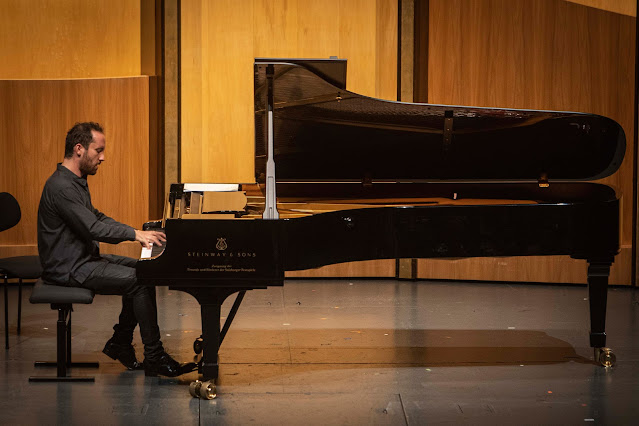
Salzburg Festival (4) - Levit: Bartók, Schumann, Wagner, and Liszt, 24 August 2022


Grosses Festspielhaus

Bartók: Out of Doors, Sz 81
Schumann: Waldszenen, op.82
Wagner, arr. Zoltán Kocsis: Tristan und Isolde: Prelude to Act I
Liszt: Piano Sonata in B minor, S.178

Igor Levit (piano)


Image: SF / Marco Borrelli

For this Salzburg Festival recital, Igor Levit offered a programme of piano music—and, in one case, orchestral music transcribed for the piano—rich in connections explicit and implicit, and beautifully balanced too. Programming is in many ways an art in itself, yet not of course quite in itself: the music needs to be performed at least as compellingly as it has been assembled. There was little problem in that respect here, given performances that never took the works in question for granted, always looked—and listened—afresh.

Bartók’s Out of Doors suite was a welcome choice to open. The drums and pipes of the opening piece gave neither pianist nor audience time to adjust. Poundingly percussive from the word go, it was always much more than that, though: melody and harmony, as ever in Bartók, at least as crucial as the initially startling melodic element. Levit understood and conveyed this, not only here but in the following pieces of very different, highly contrasted character. This suggested what a treat we might have in store from the Sonata and the Piano Concertos; let us hope they are only just around the corner. The ‘Barcarolla’ emerged as a mysterious heir to Chopin et al., those others certainly including Liszt, especially the Liszt of those lugubrious late Venetian works. I thought I heard a kinship to Prokofiev too: less expected, perhaps, but making a great deal of chronological sense. (Kinship need not mean influence in either direction.) Levit’s variety of articulation in service of the musical idea was just the thing to tease out its secrets. Delicately insistent, the ‘Musettes’ presented yet another winding, post-Romantic way, sharply contrasted by the night music of the fourth piece. Bells? Birds? Breezes? Beasts? Who knows? It was certainly Bartók, at any rate, the beating heart of the work as a whole. Independence of hands, the very foundation of Lisztian technique—well, one of the foundations, anyway—was crucial here in delineation and communication. The final piece was every inch the finale, early echoes of the opening taking us along a very different, dancing path. Fiendishly difficult and infectious, this was the piece with the most transcendental virtuosity, in Levit’s hands a veritable whirlwind.

Schumann’s Waldszenen is another set of pieces one might expect to hear more often than one does. Here, it breathed a post-Bachian air, not only in its counterpoint, but in melody, harmony, figuration, and much else. The introductory piece gently placed us in medias res: storytelling magic with an inwardness (Innigkeit) all Schumann’s own. The hunters of the second brought a degree of stormy release, ever precise, though, just as in Bach. Deceptively, captivatingly ‘einfach’ or simple, ‘Einsame Blümen’ offered as keen a note of fantasy as anything else: a note struck, in various ways, throughout the set, not least in a questing ‘Freundliche Landschaft’. In between, the dignified pathos, both directed and a little wayward, of ‘Verrufene Stelle’ hinted at a fugal mind deconstructed. A friendly wayside inn (‘Herberge’) and dignified ‘Vogel als Prophet’, the latter’s animation almost yet never quite suspended, took us into the sky before coming properly back down to earth in a rhythmically generative ‘Jagdlied’ that, in context, suggested memories of Bartók. Schumann’s epilogues are always things of wonder; here was a fond ‘Abschied’ indeed, its reluctance to close as touching as it was understandable.

Nietzsche famously declared he would not touch the score of Tristan und Isoldewithout wearing gloves. There was no doubting the dangers of its opening Prelude here, in a 1978 transcription by Zoltán Kocsis. More flexible than one would expect from an orchestra, it became a forerunner of late Liszt, ever struggling, ever becoming, endless in melody—until, that is, one realised that it was actually taking its cue from earlier Liszt, in the guise of the Sonata into which its close dissolved. We shall never finally disentangle the mutual influence and affinities of the two composers; here was a good reason perhaps not even to try, musical threads all the more dangerously intoxicating with ‘dies süsse Wortlein: und’: Wagner und Liszt.  

In that vein, the beginning of the exposition proper sounded like another chapter in the same story, beginning with Wagner, moving to those shockingly ‘new’ (even now) Liszt scales of the introduction, and new bursting forth in other, neue Bahnen, to quote Schumann on a young composer (Brahms) who certainly did not appreciate this work, allegedly falling asleep (!) when Liszt played it to him. That almost novelistic sense of pages, even chapters being turned was, I think, a particular characteristic of Levit’s performance, Liszt’s supreme Faustian bargain turned almost literally into a nineteenth-century page-turner. The composer’s formal concision can hardly be gainsaid here, but a complementary expansiveness was revealed as the other side to a coin of seemingly endless transition. There was time for grandiloquence as well as for silence; there was space for rhapsodic freedom and constructivism. (To misquote Dolly Parton, it takes a lot of organisation to sound that free.) With Liszt, especially here, several balls will often be in the air at any one time. The odd one may be dropped, but that is part and parcel of his generosity of character. With the structural outline firmly in place—there was no question as to the moment of recapitulation—there was no harm in occasionally pausing to ask a question, or even to admire the view. A divine comedy, a thoroughly Lisztian enterprise, was created before our ears. One had the sense, moreover, that it was a one-off, that a different tale would have been told on another occasion.

 With quiet dignity, the poet spoke (‘Der Dichter spricht’) for a Schumann encore. On a more modest yet not necessarily less eloquent level, Romantic rhetoric held us once again in its sway.


Sunday, 4 October 2020

Tristan und Isolde, London Opera Company, 3 October 2020


The Warehouse, Waterloo

Tristan – Brian Smith Walters
Isolde – Cara McHardy
Brangäne – Harriet Williams
Kurwenal – Louis Hurst
King Marke – Richard Wiegold
Young Sailor – Ben Thapa
Melot – Jonathan Cooke
Shepherd, Steersman – Bo Wang

Jonathan Musgrave (piano)
James Widden (violin)
Alison Holford (cello)
Michael Thrift (conductor)


Almost a year to the day (5 October 2019) since I had last seen Tristan und Isolde and considerably sooner, given the world’s catastrophic state, than I had anticipated, Wagner and Tristan returned to my life and to the lives of the performers of the London Opera Company, here giving its inaugural performance. For any company to open proceedings with Tristan is a declaration of intent, not least in London, so starved of Wagner compared to any city of its stature. Yet, this group of musicians determined not so much to keep the flame burning as, in contradistinction to its eponymous lovers, emphatically to ignite it—‘Das Licht! Das Licht!—showed a heroism as impressive and as moving in achievement as in conception. It is their hope that this will ‘inspire further chamber performances’; it should be ours too.


There were unquestionable advantages to a small performing space such as The Warehouse, near Waterloo station. No singer needing to force his or her voice. Facial expressions could readily be observed in a performance acted if not staged. We in the audience were readily drawn into the noumenal realm of Night in which Tristan's deepest action unfolds. So much Wagner is chamber music anyway; as with Liszt, that chamber music is usually part of a grander scheme rather than the essence of a work in itself. 


Michael Thrift conducted, as he had in a slightly larger-scale Parsifal given four years ago in Chiswick a flexible, clearly directed account of the score. It may from time to time have had one long to hear him communicate such understanding in front of an orchestra; equally, it seized on the virtues of a chamber performance and had one appreciate them in themselves. Jonathan Musgrave’s heroic battle to convey Wagner’s orchestral writing on the piano, ably assisted by James Widden on violin and Alison Holford on cello, made for absorbing listening. Even Liszt would have had his work cut out here. Yet it was perhaps the Lisztian delicacy accorded to more intimate moments and passages—private, not public; Night, not Day—that lingered longest in the emotional memory.


Brian Smith Walters, Parsifal in that earlier performance, showed himself here as Tristan every inch a Heldentenor. As vividly communicative in words as in music, Smith Walters paced his performance wisely, with as keen a developmental edge as any listener might wish for, culminating in shattering agonies of Kareol and sweetly longed-for release. For all the surrounding metaphysics, this was a profoundly human journey: proportionate to, yet far from constrained by, a chamber setting  that increasingly took upon itself characteristics of the nineteenth-century drawing rooms in which Wagner's own dramatic journey had taken flight. Likewise Cara McHardy’s performance as Isolde. Similarly reactive to dramatic circumstance, her path to ecstatic transfiguration excited in the uncertainty of the here-and-now, yet proved commendably clear in retrospect. Wagner's owl of Minerva once again spread its wings at dusk.


In this chamber context, the performances of McHardy and Harriet Williams as Brangäne afforded an unusual first-act opportunity to hear some of the roots of Wagner’s vocal writing in earlier, Italian or at least Italianate, opera. Shorn of rich orchestral tapestry, the score, or better one’s aural perspective upon it, yielded other secrets: words and their meaning, steeped in Novalis's verse as much as the philosophy of Schopenhauer, often overlooked amidst the musicodramatic maelstrom; a grander bel canto than we have come to expect, Wagner’s Norma, rather than Bellini’s; not to forget those treacherous, enticing paths to a Schoenbergian future for voice with ensemble. Williams’s performance, wise and compassionate, with deeply affecting vocal colour—at one point, chalumeau-like in her lower register—had this listener long for more.


Moreover, not only was there no weak link in the cast; strength of ensemble and dramatic interaction rendered it considerably more than the sum of its parts. Louis Hurst’s honest Kurwenal; finely etched accounts of the Young Sailor and Melot from Ben Thapa and Jonathan Cooke; Richard Wiegold’s sonorous King Marke, timbre and delivery redolent at times of noble Finnish predecessors such as Martti Talvela and Matti Salminen: all were valued contributors. It was, however, the keenly communicative qualities Bo Wang’s Shepherd and Steersman that made the greatest impression on me: nothing taken for granted, all presented with palpable sincerity and commitment. Above all, this was an accomplished and moving company debut.

Tuesday, 30 June 2020

Wagner and Morality


(Article on 'Morality' first published in the Cambridge Wagner Encyclopedia, ed. Nicholas Vazsonyi (Cambridge: Cambridge University Press, 2013)


Luise Reuss-Belce as Fricka

Historians often adopt a tone of prurient hypocrisy with figures of whom they disapprove. The Russian Empress Catherine the Great long endured persistent references to her “scandalous” love life: that is, she was a successful female ruler with the temerity to take lovers. It has become the practice for moral custodians, Frickas de nos jours, to berate Wagner for his easy way with other men’s money and women. Understanding both as property is instructive, betokening a narrow conception of “morality,” typical of the public opinion and commercial Press by which Wagner not unreasonably considered himself hounded. Wagner believed consistently that private property distorted every relationship between man and man, likewise man and woman. Shortly before his death, he lauded Wilhelm Heinse for having depicted in his novel, Ardinghello (1787), a society in which institution of property had never been permitted (Cosima Wagner’s Diaries, 30 Sep 1882).

 
Gustave Courbet: Pierre-Joseph Proudhon et ses enfants en 1853 (1865)

French socialism, directly and through intermediaries such as Heinrich Laube, August Röckel, and Mikhail Bakunin, was a pervading influence. As early as Das Liebesverbot, Wagner tells us, “all I cared about was to uncover the sinfulness of hypocrisy and the artificiality of the judicial attitude toward morality” (My Life, English translation, 83). Friedrich, prudishly shocked by popular licentiousness, employs state power to enforce an unnatural moral code, whilst transgressing it himself. Röckel, during their Dresden discussions provided theoretical ballast: “On the basis of the socialist theories of Proudhon and others … he constructed a whole new moral order of things to which … he little by little converted me … I began to rebuild upon it my hopes for the realization of my artistic ideals.” Wagner questioned Röckel about his desire “to do away completely with the institution of marriage as we knew it,” and was “particularly struck” by the claim that, only after eradication of coercion by money, rank, and family prejudice, would sexual morality be possible (My Life, 373-4). He returned in his final essay “Über das Weibliche” to the subject. Marriage – to Cosima, at least? – raised man and his moral faculties far above the animal world, yet he was dragged far beneath it by “conventional marriage” (Konventionsheiraten), an “abuse” (Mißbrauch) founded upon property (Sämtliche Schriften und Dichtungen, 12:343-4).


Self-justification? Perhaps, for instance when Wagner tells us that Minna “became increasingly perplexed at my seemingly incomprehensible conception of art and its relative importance,” and at his “higher delicacy in regard to moral questions,” being “unable to understand and approve my freedom of thought in such matters” (My Life, 130-1). Only up to a point, though, for the contrast between Minna’s need for financial stability and the moral purpose Wagner sought in art is real enough. That they were ultimately unsuited need not send one scurrying for blame. There is, moreover, no mistaking Wagner’s moral outrage at his perception of modern art as “industry, its moral purpose the acquisition of money, its aesthetic purpose the entertainment of the bored” (SSD, 3: 18).


Under the influence of Young German and Young Hegelian ideas, most likely including Max Stirner’s anarchistic manifesto, The Ego and its Own (1844), Wagner created in the Ring an artwork that dramatizes alternative moral possibilities. Fricka, Wagner writes, represents custom (Sitte), (Letter to Uhlig, 12 Nov. 1851). Her marriage to Wotan is fruitless; his children are sired outside wedlock. One of them, Sieglinde, experiences both brutal treatment as chattel by her husband Hunding, and passionate convention-flouting fulfillment with her twin brother, Siegmund. Fricka is outraged: “My heart trembles, my mind reels: bridal embrace between brother and sister! When was it ever heard of that siblings were lovers?” (Walküre, II/i). As the gods’ – religion’s – hold on society falters, moral prohibitions dependent upon their power are insisted upon ever more stridently. The gods would go to ruin, Fricka insists, were her moral law not to be obeyed; they already have. Wagner echoes Stirner and prefigures Nietzsche, providing a crucial link in the inversion of Hegel’s elevation of customary over individual morality: “Note how a ‘moral man’ behaves, who today often thinks he is through with God .… a customary-moral shudder will come over him at the conception of one’s being allowed to touch his sister also as a woman.… Because he believes in those moral commandments” (Stirner, 45); and “They have rid themselves of the Christian God, and thus believe that they must cling all the more firmly to Christian morality … one must, in response to the smallest emancipation from theology, reassert one’s position in awe-inspiring fashion as a moral fanatic” (Nietzsche, 80).


Mathilde Wesendonck by
Karl Ferdinand Sohn (1850)
What, then, of the pre-eminent “affair,” with Mathilde Wesendonck? One can deplore Wagner’s ingratitude towards her husband, Otto, who had offered considerable financial support, only to find himself cuckolded – at least metaphysically. Wagner opposed marriage as legal setting in stone or ring. Moreover, Wagner’s insistence that the world owed him a living – why should someone be favored because he dealt in silks instead of composing the Ring? – is borne out even in capitalist terms by the industry he created for and bequeathed that world. It has done incalculably better from him than vice versa.


One might also consider it significant that, when Wagner condensed the action of Tristan und Isolde into a few words for Mathilde Wesendonck, he did not even mention King Marke’s forgiveness. Were the sacrifices of men such as Wesendonck and Hans von Bülow as naught to such a monstrous ego? Yet Wagner sees the “custom of the time” leading to the sin of marriage for politics’ sake. The action of Tristan is not, moreover, really of this phenomenal world at all, but metaphysical. By now (1859), Wagner had partially converted to a morality founded upon Schopenhauer’s teaching. Though immediately taken by Schopenhauer’s aesthetics, “the moral principles” of The World as Will and Representation had been more difficult initially to accept, “for here the annihilation of the Will and complete self-abnegation are represented as the only true means of redemption from the constricting bonds of individuality in its dealings with the world” (My Life, 509). Either way – in practice, both – Wagner rejected the dictates of bourgeois morality.


See also:
Mark Berry, “The Positive Influence of Wagner upon Nietzsche,” The Wagner Journal, 2.2 (2008): 11-28.
Friedrich Nietzsche, Twilight of the Idols / The Anti-Christ, tr. R.J. Hollingdale, with an introduction by Michael Tanner (Harmondsworth: Penguin, 1990).
Max Stirner, The Ego and its Own, tr. Steven Byington, ed. David Leopold (Cambridge: Cambridge University Press, 1995).

Ma

Monday, 7 October 2019

Tristan und Isolde, Oper Leipzig, 5 October 2019


Leipzig Opera House


Tristan (Daniel Kirch) and Isolde (Meagan Miller)
Images: Tom Schulze

Tristan – Daniel Kirch
Isolde – Meagan Miller
King Marke – Sebastian Pilgrim
Kurwenal – Jukka Rasilainen
Melot – Matthias Stier
Brangäne – Barbara Kozelj
Shepherd – Martin Petzold
Steersman – Franz Xaver Schlecht
Young Sailor – Alvaro Zambrano

Enrico Lübbe (director)
Torsten Buß (co-director)
Étienne Pluss (set designs)
Linda Redlin (costumes)
fettFilm (video)
Olaf Freese (lighting)
Nele Winter (dramaturgy)

Leipzig Opera Chorus (chorus director: Thomas Eitler-de Lint)
Leipzig Gewandhaus Orchestra
Ulf Schirmer (conductor)


Sailors and Kurwenal (Jukka Rasilainen)

Leipzig’s relationship with its greatest son has never been easy, nor should it have been. Wagner, in all his glorious and inglorious contradictions, is too complicated, problematical, and interesting to be reduced to mere hero-worship; or, as Theodor Adorno put it, ‘progress and reaction in Wagner’s music cannot be separated as sheep from goats’. There has been – arguably, still is – enough of that in Bayreuth, anyway. Many Wagner productions of what we may broadly think of as the Regietheater era have acknowledged that: Rings from Joachim Herz to Frank Castorf and beyond, Parsifal and Meistersinger stagings too. Of the music dramas, however, Tristan has seemed more resistant to problematisation, deconstructive or otherwise. Rare examples with some degree of success have included Peter Konwitschny’s old Munich production and, more fully, Dmitri Tcherniakov’s 2018 staging for Berlin's Staatsoper Unter den Linden, the latter loudly denounced by most, yet for me fruitful in its alienation. Ultimately, Tristan’s problems seem different: more a matter of balance between drama as conventionally understood and that metaphysical drama of the Schopenhauerian Will and representation which Wagner, for one, certainly came to see as the work’s true core. Or is it, perhaps, that one needs to look and indeed to listen more closely, more subtly, for the fissures of a modernity that no one has ever seriously been able to deny this most singular of works?


Isolde and Tristan


The question remains open, I think. In the meantime – we shall likely ever remain in that meantime – Oper Leipzig has steadily been renewing its Wagner roster. This new Tristan production arises from a welcome Leipzig collaboration with the Intendant at the city’s Schauspiel, Enrico Lübbe, and his deputy, Torsten Buss. Fundamental to the staging is a ship(wreck): the location, in a relatively straightforward realistic sense, of the first act, yet also a focus for memories, dreams, psychological states and philosophical ideas brought into being. Each act has the same basic setting, yet is seen from a different standpoint, in a different state of repair, on a different scale, so as to enable the quasi-symphonic emergence of unity in diversity, ultimately cyclical, as perhaps befits a nineteenth-century work, in a final, post-Liebestod return by Tristan and Isolde to a pristine ship, never previously seen – and perhaps never having existed – in that state. In its second-act ruins, we appreciate not only our construction of connections, but crucially, our capacity for imagination.


Brangäne (Barbara Kozelj) and Isolde

So too does Tristan, who, during Isolde’s initial confrontation with him, soon regresses to the role of a child, even an unborn one, lying in foetal fashion, as if to recapture the essence of a relationship he never consciously experienced first time around, his mother having died during childbirth. Is it his imagination, then, that creates the multiplying Isolde figures during the love duet? What do they signify? There is an aimlessness, an unsatisfactory nature to them, which may hint at dashing of romantic hopes long since foretold, psychoanalytically. There is something, moreover, of the delirium we encounter more fully in the third act, to the way people, settings, thoughts, and even narratives drift in and out of consciousness. Can one, should one, begin to piece them together? Temptation is unavoidable; the production seems to encourage it. A nagging doubt nonetheless remains, like the contemporary, or at least Adornian, nagging doubt concerning Wagnerian totality. It is Tristan und Isolde, of course, not Tristan oder Isolde; the celebrated second-act discussion of ‘diese süße Wörtlein: “und”’ is often understood to offer a conceptual key to the work. And yet, Tristan will tear off his bandages, will he not? In what sense are the two ever truly united? Is the union we witness at the close of this production noumenal, phenomenal, or a sham?


Tristan and Isolde


Oppositions will always play a crucial part in Tristan, above all that between night and day; it would be strange if that did not in some sense feature in a staging. It certainly does here, for instance when the stage turns almost, yet not quite, black – part of the ship may still just be perceived – after drinking of the potion and, again, during the love duet. Night, even then, is a creation: of Tristan and Isolde; of the ship, as foundation and locus of the drama; of Wagner; of the performer; of the audience; and so forth. That we wish the dimly perceptible set to disappear entirely is symptomatic: Romantic illusion and delusion are ours, as well as the characters', as well as Wagner’s. Perhaps, then, we did need to watch and listen more subtly. One might think of this as a collaboration between different forms of light: lighting and video, as well as those entrusted with it (Olaf Freese and Torge Møller of fettFilm); Freese in the programme booklet refers to a ‘Zusammenspiel [interplay] von Licht und Video’. Film, just as much as set design, creates and disintegrates the ship - at least until the close. Likewise, we might say, there are collaboration and, more dramatically, interplay between realism and abstraction; between the individual psychological of chamber theatre – often chamber music, too – and metaphysical symbolism; and, of particular importance to this production, between sea-voyage and its fateful, fatal culmination, symbolised by the image of a ship, perhaps as shipwreck, as its own graveyard, somewhere between stagnant and dead. It should move, yet it does not; rather our gaze moves, or is moved for us by the design team, and more broadly, the production. Our souls, similarly, are moved, or should be, by Wagner’s great Greek Chorus of the orchestra.


Visual and, more specifically, design values are strongly to the fore, yet not for their own sake, as mere backdrop, but as a portal to the dramatic and conceptual. One may think this a Seelenlandschaft (‘landscape of the soul’), as Lübbe describes it, not least when the excellent English horn player, Gundel Jannemann-Fischer, wanders across the stage, a different figure from the Shepherd: a relationship that may perhaps be understood in terms of Schopenhauerian aesthetics and implicit critique or at least (typically Wagnerian) extension thereof. The alte Weise is far more than something the Shepherd plays, yet Wagner would have considered that all the more justification for concealment of the player. Granting the instrument personification, albeit in gentle, non-provocative fashion, both heightens the importance of music and also lightly nods to a twentieth-century world of music theatre, even of post-Holocaust antagonism to idealist totality. Whatever the truth of that – one soon finds one is tied in knots – it is surely the case that even such a quasi-Schopenhauerian relationship may only be accomplished by parallel or, ideally, Hegelian-dialectical communication and understanding of, if not its negation, then at least its inversion; that is, by nurturing also a sense of soul in landscape, in Nature. It was a Romantic reading, ultimately, that I gleaned, as befits an ultimately Romantic work.


Isolde and Brangäne

Much to ponder, then, which is far from always the case in a Tristan staging. Unfortunately, musical fortunes proved patchier, above all from Wagner’s aforementioned tragic Chorus, the Leipzig Gewandhaus Orchestra, and its conductor, Ulf Schirmer. The orchestra has a wealth of Wagnerian experience to call upon; this was no vintage night, however, with some strikingly careless and non-committal playing and only intermittent presence of its distinctive, ‘old German’ tone. Schirmer’s direction certainly did not help, especially in the first act, whose form had yet to be mastered. The opening Prelude seemed to go on forever: not on account of tempo as such, but of a lack of unifying ‘unendliche Melodie’, vertically and horizontally. A striking lack of chemistry between orchestra and conductor may have betokened an off-night; it was nevertheless concerning, given that Schirmer is no visiting conductor, but the opera’s General Music Director and Intendant. As is often the case, ‘traditional’ cuts did their distorting work; neither sole nor even principal responsibility, however, lay with them. Ingolf Barchmann’s bass clarinet deserves a mention for its roving, malevolent, harmonically destabilising contributions.


King Marke (Sebastian Pilgrim) and
Melot (Matthias Stier)


There was more to enjoy vocally, though here the picture was also mixed. Most singers improved as the evening went on, Daniel Kirch’s Tristan fully coming into its own in a highly impressive third act. Too much in the way of first-act barking gave way, ironically, to a more lyrical style. Given that many tenors struggle to make their way through the work in one piece, perhaps this was a matter of first-night nerves and issues of pacing; dramatic instinct and technical ability were certainly present. Meagan Miller’s lyrical, touchingly human Isolde occasionally sounded overwhelmed, yet for the most part offered – and contributed - much. Barbara Koselj’s Brangäne offered the most consistently impressive vocal performance, as unfailingly intelligent as her subtly expressive gesture. Jukka Rasilainen struggled as Kurwenal in the first act, bluff and dry of tone, but recovered markedly in the third. Sebastian Pilgrim made a fine impression as King Marke, sonorous of tone and, again, unquestionably human. Smaller parts were all well sung and acted, Alvaro Zambrano’s Young Sailor in particular catching the ear. (He also, unusually, appeared briefly on stage.) Had there been more consistent collaboration with this chamber-drama sphere from ‘metaphysical’ orchestra and conductor – the opposition is, of course, not precise – the wholeness of the evening’s experience would undoubtedly have been furthered. Yet even in that (relative) lack, one was led to think about the desirability or otherwise of totalising intoxication. Nietzsche’s opus metaphysicum, its score only to be read when wearing gloves, may not always have been fully realised; in a deeper, yes metaphysical, sense, it remained untamed as ever.