Showing posts with label Stephen Gould. Show all posts

Thursday, 15 August 2019

Bayreuth Festival (4) - Tannhäuser, 13 August 2019


Festspielhaus


Hermann, Landgrave of Thuringia – Stephen Milling
Tannhäuser – Stephen Gould
Wolfram von Eschenbach – Markus Eiche
Walther von der Vogelweide – Daniel Behle
Biterolf – Kay Stiefermann
Heinrich der Schreiber – Jorge Rodriguez-Norton
Reinmar von Zweter – Wilhelm Schwinghammer
Elisabeth – Lise Davidsen
Venus – Elena Zhidkova
Young Shepherd – Katharina Konradi
Four Pages – Cornelia Ragg, Lucila Graham, Annette Gutjahr, Elena Zhidkova
Le Gateau Chocolat – Le Gateau Chocolat
Oskar – Manni Laudenbach

Tobias Kratzer (director)
Rainer Sellmaier (designs)
Reinhard Traub (lighting)
Manuel Braun (video)
Konrad Kuhn (dramaturgy)

Bayreuth Festival Chorus (chorus master: Eberhard Friedrich)
Bayreuth Festival Orchestra
Christian Thielemann (conductor)


Eight years after I last saw Tannhäuser at Bayreuth, in Sebastian Baumgarten’s truly bizarre production, came the highlight, for me at least, of this year’s Festival: Tobias Kratzer’s new staging, conducted not by Valery Gergiev, as expected, but in a last-minuted substitution, Christian Thielemann. Not only was this unquestionably the best staging I have seen of the work in years; not only was it the best Wagner I have heard from Thielemann since the very first time I heard him (Meistersinger, 2000); it convinced me in a way no other performance and production have that there are genuine dramatic, as well as stylistic, reasons for giving Tannhäuser in its (almost) original, Dresden version.*


As the Overture plays, we see the Wartburg on film. We then see a troupe in a van – action switches between film and stage, or combines the two with outstanding skill and insight – making its way there. Or is it, perhaps, making its way from there, to the Bayreuth Festspielhaus? It could be either; after all, we are not all [cue: Anglican clerical voice] ‘in a very real sense,’ on our way between the two? Tannhäuser as clown (Stephen Gould), Venus (Elena Zhidkova), the voluptuous Le Gateau Chocolat (as herself), and the diminutive Oskar (Manni Laudenbach, surely a reference to Günter Grass’s The Tin Drum) are clearly used to a few scrapes on the road, not least when Venus splits her time between driving and entertaining her grotto guest. A pitstop at Burger King goes horribly wrong, a policeman spying Gateau Chocolat and Oskar drawing petrol from another vehicle and coming to confront the troupe after Venus has offered its update Young German motto, ‘Frei im Wollen/Frei im Thun/Frei im Geniessen/R[ichard] W[agner]’ as payment. (Or, as Don Giovanni might have put it, ‘Viva la libertà!’) In a move that clearly shocks the others, Venus puts her foot down and kills the policeman. Thus is the scene set for the nearby guest house. Oskar faces a surprise with the kitschy gnomes outside, and more seriously, Tannhäuser decides to make a break with the gang and make his own way to the Festspielhaus and, presumably, also in life.


The pilgrims, the Bayreuth audience itself, are of course on their way to a performance: his performance; at least it should be, if he deigns to turn up on time. If the fellow Minnesänger, studying their vocal scores – Tannhäuser always has his upon him – and taking the occasional sip of a local brew, are more relaxed about Tannhäuser’s return to the fold, Elisabeth, in a brief appearance, shows her true feelings, slapping his face in the wake of jeopardising the entire performance. This is the first, but far from the last, occasion on which we realise that Elisabeth is here a flesh-and-blood human being, no mere virginal saint. And then, we in the audience make a reverse progression down the hill to an interval show from Gateau Chocolat and Oskar, inflatable unicorn, fabulous new bathing costume, and all.


On returning to the house, we see a splendid Wartburg recreation set. It is the Festspielhaus after all, then, not the Wartburg ‘itself’. Elisabeth alternates between fury and arousal, as one – perhaps not Wagner – might expect. Such roleplaying, metatheatrical to a determined, in many respects deeply moving, end, divests the work of many of those problems with dramatic motivation it has often been held, not least by Carl Dahlhaus, to present. Mythology, history, performance, reception, psychological realism, and more can happily coexist, come into conflict. Is that not the very stuff of drama? And is not love, ‘whatever that means’, as the Prince of Wales once had it, always a ‘show’ too? Such is very much what Tannhäuser ‘itself’ is about, is it not?


Having narrowly missed Tannhäuser outside the Festspielhaus at the end of the first act, the troupe-as-was invades the house (on film) during the Arrival of the Guests, emblazoning the balcony with a flag declaring its Wagnerian motto. Venus deals with one of the pages so that she can take her place in the hall, whilst Gateau Chocolat and Oskar wander around the house, taking in a few images of previous conductors (Thielemann, ironically given the substitution, one of them, and much to Gateau Chocolat’s taste, and James Levine – well, the less said the better). Knowing neither her lines nor her moves, Venus must be kept in line – good luck with that – by one of the other pages. Nevertheless, she just about maintains her cover for a while, until all hell breaks loose. Shades of Ariadne auf Naxos, as two operatic worlds collide? Inevitably, but this remains its own tale. Venus sheds a layer, puts on her own show, to the shock of respectable singers and patrons. She dances, to what is supposedly Tannhäuser’s own music, to win him back, but reminds us that he never really has his own musical style; rather, he assimilates to wherever he is. Does that make him an artist, or…? You decide. He still has his score. Meanwhile, the security guard on film has alerted Katharina Wagner, who calls the police. They pause for a while before the unfurled motto, before doing what they must, and closing down the show(s).


The world-weariness, even despair, of the opening to the third act is evoked powerfully onstage – as well as in the pit – by a wasteland, in which the van has crashed and/or taken root, only Oskar remaining. (We later learn that Gateau Chocolat has gone solo, making it to the big time, her image gracing an advertisement for eponymous watches. That’s show business, we suppose.) Elisabeth still needs Tannhäuser; indeed she needs him more than ever, so much so that she has poor Wolfram dress in Tannhäuser’s clown costume. Then, and only then, can she welcome him into the van; then, and only then, and even then after a good deal of self-persuasion, can Wolfram take her. Shades of Siegfried/Gunther/Brünnhilde? Again, the suggestion is made, or at least can be, but the drama plays out on its own terms. And of course, then and only then can Elisabeth die. It is too late for Tannhäuser himself; he finally tears apart his cherished vocal score. Tannhäuser is free of Tannhäuser. And so, at the close, in a staff-sprouting miracle for our own time, Tannhäuser and Elisabeth are united at last, resurrected, as is the van, in which they drive off into the sunset. Fantasy? The after-life? An actual happy ending? That, ‘in a very real sense’, is up to us.


The cast responded with excellence and enthusiasm to Kratzer’s vision. Stephen Gould seemed much more at home with the conflicts and opportunities presented by Tannhäuser than he had in Tristan (equally well sung, yet quite without agony). Lise Davidsen’s Elisabeth was as poignantly human as I have ever seen or heard the character – and equally possessed of vocal power, wisely dispensed. Elena Zhidkova grasped the nettle of this particular Venus with everything she had, and made the role her own, ably assisted by her fabulous assistants. If I say that I found Markus Eiche’s Walther every bit as moving as Christian Gerhaher’s, many readers will appreciate the distinction of his performance, if anything perhaps slightly more attuned to verbal subtlety. All Minnesänger roles were sung with great distinction; if I mention in particular Daniel Behle, it is only because Wagner gives him more to do. Stephen Milling’s Landgrave and even Katharina Konradi’s Shepherd offered similarly impressive performances.


So too did the ever-excellent Bayreuth Festival Chorus, once more as distinguished in stage as in vocal terms; Eberhard Friedrich’s stewardship of these singers has not been the least joy of recent years in Bayreuth. So too, last but not least, did Thielemann’s conducting and the simply outstanding playing of the orchestra. Here, stepping in at what seems to have been very short notice, Thielemann showed none of the affectation that had sometimes detracted from his Tristan and Lohengrin. Structure became dynamic form in the moment; ‘beauty’ took care of itself, rather than being imposed upon it. And crucially, both he and Kratzer, who had previously directed a different version*, demonstrated their belief in the coherence and singular interest of the ‘Dresden’ Tannhäuser. Not once – well, save for the lost Bacchanale – did I miss what was ‘not there’. When I heard the musical drama turn otherwise from what is imprinted on my memory, it was unarguably right at that moment and in this context for it to do so. Thielemann, it seems to me, not unlike Simon Rattle, fares best when presented with a challenge. To this challenge, to these challenges, the assembled company rose with excellence. A happy ending, then, indeed, for an ultimately happy troupe.


* For detail on the versions – not quite what many think they are – and other thoughts on the work, please see my Royal Opera House programme note, ‘Owing the World a Tannhäuser. (Click here.)

Saturday, 10 August 2019

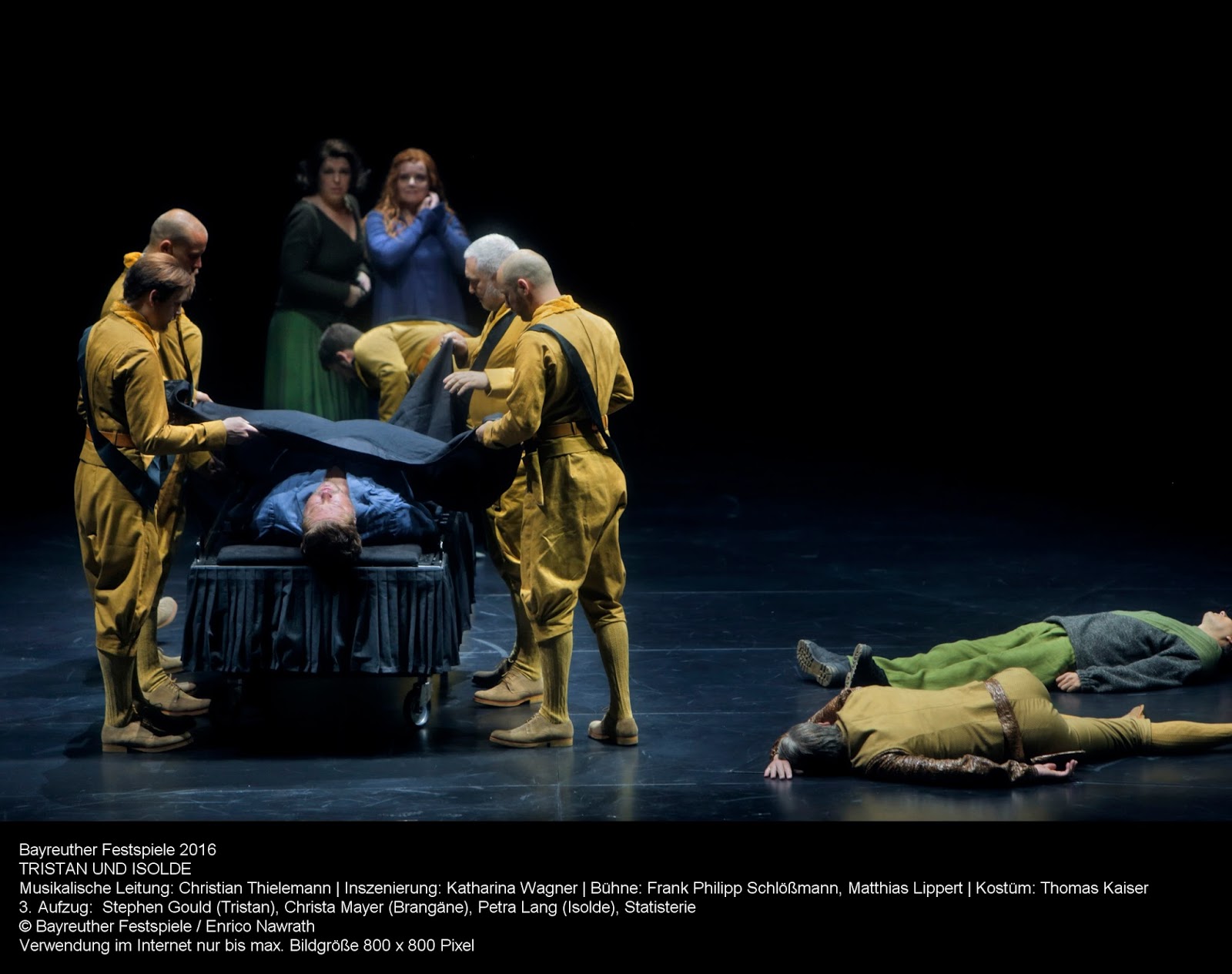
Bayreuth Festival (1) - Tristan und Isolde, 9 August 2019


Festspielhaus


Tristan – Stephen Gould
Isolde – Petra Lang
Kurwenal – Greer Grimsley
Melot – Raimund Nolte
Brangäne – Christa Mayer
Shepherd, Sailor – Tansel Akzeybek
Steersman – Kay Stiefermann

Katharina Wagner (director)
Frank Philipp Schlößmann, Matthias Lippert (set designs)
Thomas Kaiser (costumes)
Daniel Weber (dramaturgy)
Reinhard Traub (lighting)

Bayreuth Festival Chorus (chorus master: Eberhard Friedrich)
Bayreuth Festival Orchestra
Christian Thielemann (conductor)


A frustrating evening, this, as Tristan performances tend to be. Wagner, notoriously, wrote to Mathilde Wesendonck: ‘I fear the opera will be banned – unless the whole thing is parodied in a bad performance –: only mediocre performances can save me! Perfectly good ones will be bound to drive people mad, – I cannot imagine it otherwise.’ I used to sympathise with that melodramatic claim, the work having affected me so deeply, so frighteningly, even in performances that fell somewhat short, especially vocally. Now, however, following a series of disappointments, to which only one recent staging has proved (mostly) an exception, I think I might prefer to be driven mad, in this particular sense, once again.


Oddly, given my early experiences of the work and of Tristan’s role in particular, this had most to be said in its favour in vocal terms. I shall pass over those first Tristans I heard, other than to say that they had me wonder whether I should ever hear someone capable of singing the notes, let alone singing them well, someone capable of making it through the first act, let alone all three. There has never been a golden age of the Heldentenor; the beast has always been rare, even at times apparently extinct. We do not fare badly at the moment, though. Stephen Gould can certainly sing the role – and sing it he did, without audibly tiring. Tristan’s third-act agonies were underplayed in what was overall a relative sensible portrayal, but better that than the agonies of quite a different, unintentional kind to which many of us have frequently been subjected. Petra Lang’s Isolde, if often overacted – this may have been Katharina Wagner’s doing – offered impressive response throughout to music, words, and what is here their ever-mysterious union. Her voice is deeper than one generally hears, with more of the tone, at times clarinet-like, and character of a mezzo-soprano (her original Fach). That, it seems to me, is all to the good. She certainly had one listen to the performance in the here and now, not to some all-too-readily (mis)remembered ‘great recording’ of the past, from which anything actually existing would doubtless fall short. Though a mezzo, Christa Meyer sometimes sounded more soprano-like than Lang. Again, no harm was done by this, slightly disconcerting though the initial impression may have been. Her performance and Greer Grimsley’s as Kurwenal were both marked by similar virtues, and less by strange melodramatic gesture. Georg Zeppenfeld’s Marke could hardly be bettered. It is a gift of a role – to those with the necessary instrument and intelligence. Those Zeppenfeld has in spades; here he left us in no doubt of that. Tansel Akzeyebek shone both as the Young Sailor and Shepherd: sweetly pleasing of tone, his singing recalled to us, at least to me, fine performances as Froh in Frank Castorf’s Ring.


What, then, of Katharina Wagner’s production, which I previously saw three years ago, in 2016? (I shall not re-read what I wrote until after posting.) It has some ideas to it: some of them odd, even perverse, ones, but good can come of it. How they cohere into anything not considerably less than the sum of its parts remains, I am sad to say, beyond me. Incessant insistence on activity, often for nothing more than its own sake, or so it seems, detracts from them – and is surely out of place in this of all operas, whose dramatic stuff is metaphysical or it is nothing. (A partial exception would be the previously trailed production by Dmitri Tcherniakov for the Staatsoper Unter den Linden: unique, in my experience, for attempting and, in large part, succeeding in its presentation of something different.) Whatever is going on here – truth be told, I am not entirely sure – it is certainly not metaphysical. Fair enough: let us try something materialist instead. Materialism, after all, is a strong current not only in nineteenth-century history but in our own time too. But whose materialism is it anyway? Feuerbach’s? The natural sciences’? That of Friedrich Albert Lange’s once-influential History of Materialism and Critique of its Present Importance? Unclear, I am afraid. It veers all over the place, less eclectic than in need of an editor.


Madness – recall Wagner’s caution to Mathilde Wesendonck – comes to the fore in the first act and never quite leaves us. It is a construction, of course; surely we are all to that extent Foucauldians now. Set designs often make that clear: a cruel, constantly changing labyrinth in the first act, brutal, Marke-directed surveillance in the second. Perhaps Isolde’s outsize, ‘operatic’ gestures are a reaction to that. Perhaps – but frankly, they seem more a decision to do something, pretty much anything. Dramatic confusion over what the couple may be doing rather than drinking the love potion can doubtless be justified: I have come up with a few tentative explanations myself. However, none of them feels justified, anything more than a post hoc justification of a directorial decision to have people faff around for a while, be it with knives, with portentously spilling the potion, or with shredding Isolde’s veil into tiny pieces, like children playing with napkins at the dinner table.


Likewise, the emphasis on darkness and light – night and day, in Wagner’s terms – augurs well for the second act. Tristan and Isolde attempt to hide from the searchlights, to little or no avail. But why, then, does Tristan start fixing fairy lights to the makeshift tent Brangäne has offered them as a shield? It may, I suppose, be to undercut the metaphysics, or even the physics, but again it comes across as activity for its own sake. There is masochism here too: intriguingly at first. Tristan clearly derives ecstatic pleasure from cutting himself on the sharp ends of a cage of incarceration. That, in some sense at least, is and must be different from death and a death-wish. An attempt to examine the relationship between the two, though, goes sadly missed, as does any attempt to explore the implications of Melot, at Marke’s instruction, stabbing Tristan, rather than having Tristan, here blindfolded, fall on Melot’s sword (here, I think, a flick knife such as Isolde has played around with for much of the preceding drama).


Then, suddenly, in the third act, we find ourselves back to ‘normal’: to a dark, gauze-obscured staging, replete with shapes, symbols, imaginary doubles, and so on a little too close to comfort to other productions for comfort. Quite why some of Tristan’s hallucinatory Isoldes appear, beckoning to him, to have morphed into Isolde/Iseult of the White Hands I do not know. Again, I could speculate: an alternative, marital path, for instance? Once more, perhaps; once more, however, it comes across less as mysterious than arbitrary. One of them falls from her triangle as the ship arrives: it is a reaction of sorts, I suppose. After the action, Marke, like a brutal Wotan, albeit one married to his Brünnhilde-Isolde, drags her off, unpityingly. Undercutting his noble compassion in the name of an attack on patriarchy could be a fascinating idea, if prepared, pursued, and examined. In this case, it is more the final thing that happens – in a drama that is really not about things happening at all.


There is something of the materialist, perhaps more thorough-going, but also infuriatingly arbitrary in application, to Christian Thielemann’s conducting too. There is no doubting Thielemann’s command of his craft. He can have the Bayreuth Festival Orchestra do anything he wants – well, almost anything, for there were a few rough edges when it seemed he stretched things a little too far even for them. It was a fascinating display, but ultimately a display is what it felt like: a conscious display of virtuosity, even narcissism. The opening Prelude’s phrases were made to swell as if a strange mixture of ‘period’ parody and a highly talented child having delightedly learned how to operate the organ swell pedal. There were times when everything came together: the aftermath of the potion-taking (or –spilling!) Here a veritable Adornian phantasmagoria worked wonders such as can rarely have been heard before, though even that had something, as phantasmagoria would suggest, of the astounding conjurer’s trick to it rather than the workings of Schopenhauer’s Will. At other times, Katharina Wagner’s insistence on activity for its own sake seemed strangely mirrored, if rarely at the same time, by Thielemann’s play with ‘his’ orchestra. The end of the second act came close to the interminable: because he could.


Oddly, the score as a whole came across as more number-oriented, more in the line of Hans von Bülow’s quip concerning Wagner’s bel canto opera, than I have heard: at least from someone who knows what he is doing, rather than from incapable of doing otherwise. There were highly sophisticated connecting passages in between, but connecting passages was ultimately what they were: testament, it seemed, to a conception of unendliche Melodie as solely horizontal, rather than vertical too. Surely the Tristan-chord itself should give the game away in that respect. The moment of the ship’s arrival – surely one of the most exhilarating in all Western art music, on a par with the advent of the finale in Beethoven’s Fifth Symphony – went likewise for almost nothing, though all was present and correct. Of Wagner’s all-determining bass line, we heard surprisingly little: either toned down, or simply an object of beauty. Thielemann’s way could not have stood further from Furtwångler or Barenboim (Tcherniakov’s conductor); but nor did his conception of the score have anything in common with a more Schoenbergian way, such as Esa-Pekka Salonen’s. For many years, Thielemann’s Strauss has seemed to me considerably more convincing than his Wagner. (His earlier Wagner was quite different – and, to my mind, preferable.) This, however, went far beyond what he might have done with Strauss, whose forms he tends to project with extraordinary, sometimes superlative, understanding. This was more akin to a parody of Strauss by his detractors. Or, perhaps, even to the Wagner of those Nietzsche damned as ‘Wagnerians’. It might conceivably have formed the basis of a critique, just as the production might. Neither, alas, seemed willing or able to do so.


Tuesday, 23 August 2016

Bayreuth Festival (3) - Tristan und Isolde, 22 August 2016


Bayreuth Festspielhaus

Tristan – Stephen Gould
Isolde – Petra Lang
Kurwenal – Iain Paterson
King Marke - Georg Zeppenfeld
Melot – Raimund Nolte
Brangäne – Christa Mayer
Shepherd – Tansel Akzeybek
Steersman – Kay Stiefermann

Katharina Wagner (director)
Frank Philipp Schlößmann, Matthias Lippert (set designs)
Thomas Kaiser (costumes)
Daniel Weber (dramaturgy)
Reinhard Traub (lighting)

Bayreuth Festival Chorus (chorus master: Eberhard Friedrich)
Bayreuth Festival Orchestra
Christian Thielemann (conductor)


Let me summarise the case for Katharina Wagner’s defence; in this production, that is, rather than more generally. It is certainly better than her Meistersinger, although its problems are not dissimilar in quality. Nothing is downright embarrassing: remember those shoes being thrown all over the place for several minutes, because, well, because Hans Sachs is a cobbler (who nevertheless does not wear shoes himself), or a child-from-the-Stolzing-future requiring a lavatory break during the Quintet? This time, at least, it seems that the characters are doing what they are supposed (by the director) to be doing; there has clearly been progress made in terms of the director’s craft.


There are, moreover, several visually striking aspects to the mise-en-scène, for which designers Frank Philipp Schlößmann and Matthias Lippert certainly deserve credit. In some cases, although not all, they point to engagement with and a welcome critical standpoint with respect to the drama. The first act’s setting in a labyrinth, full of dead ends and other pitfalls, persistently – yet not entirely successfully – preventing the lovers from meeting presents a striking metaphor. That for the second act, in which Tristan and Isolde are constantly under King Marke’s surveillance, cruel, harsh spotlighting directed from above, initially makes its point well, taking on board Wagner’s Day/Night antithesis, and extending it, even questioning it. This is clearly a cruel world indeed; it may be understood politically, psychologically, or in both ways. The darkness of the third act is again visually attractive, and the images in which Isolde appears – I wondered to begin with whether something was being done with the white hands of legend, but then thought not – are again striking, even if their framing stands perhaps a little too close for comfort to Herbert Wernicke’s Covent Garden triangles. Tristan’s interaction with these empty ragdolls of his imagination is sensitively accomplished, although somewhat repetitive after a while. And the revisionist view of King Marke – yes, of course it is at odds with the surface of the text, but is it so very wrong to question, from time to time, its ideological basis and assumptions – is in itself welcome. His dragging Isolde off at the close, transfiguration clearly an idle, Romantic delusion, duly chills.


For the fundamental problem, however, is not so dissimilar to that of the hapless Meistersinger. Whilst there are striking images and ideas – in some instances at least, one presumes, dramaturge, Daniel Weber should at least share the credit for the latter – very little, at least until that striking conclusion, is really done with them; or, in some cases, too much of little import is done with them. I am all for an audience having to do some thinking for itself; a production that fails to accomplish that is unworthy of the name. Nevertheless, it seems to me, that there is a world of difference between, say, Frank Castorf’s Ring (at least so far, in revised fashion, as seen in 2016) and a staging (which may well, of course, undergo significant revision of its own in the future) in which the first act is made up more or less entirely of people running around, platforms being raised and lowered, and, on a couple of occasions, Tristan and Isolde are all over each other. Similarly for the stylised torture-medical (?) paraphernalia of the second act. Melot’s murder of Tristan, entirely without agency on the part of the latter, might have been suggestive; as it was, however, it came across as merely ‘different’ for the sake of it. If it were not for the striking designs – less happily striking in the hideous yellow costumes of Marke and his men – it would not be so very different from the most conventional, ‘traditional’ production. Although the screams of one audience member as I left the theatre – ‘They’ve changed the ending! You can’t change the ending! You can’t change the ending!’ – left me feeling more sympathetic with Katharina Wagner’s production than I might otherwise have done, having upset a person seemingly possessed of no critical abilities whatsoever is not in itself enough.


There is not really very much being said, then, whilst, at the same time, Wagner’s insistence – and I have yet to see it properly contradicted, on stage, in practice – that this is a metaphysical drama, majestically unconcerned with the ephemera of external representation, goes sadly unacknowledged. For, when condensing the action of Tristan und Isolde into a few words for Mathilde Wesendonck, the composer, in full Schopenhauerian flow, did not even mention Marke’s forgiveness (which is perhaps not so very important, then, to undercut). The action, he suggested, as much by omission as by commission, was not really of this phenomenal world at all; even Tristan’s agonies went unmentioned upon the way to ‘redemption: death, dying, destruction, never more to waken!’ (Erlösung: Tod, Sterben, Untergehen, Nichtmehrerwachen!) Now that need not be taken on trust, although this drama seems curiously, almost uniquely, resistant to attempts to question it on stage; the dots, however, need to be joined up a good deal more convincingly than they are here. Ultimately, what we see becomes tedious – and not in a self-critical, ‘let us consider tedium’ manner.


Fortunately, we were on much, much surer ground musically, permitting metaphysics a not insignificant re-entry to the proceedings. Hearing Christian Thielemann, in the finest Wagner I have heard from him for quite some time, made me realise that I had, in fact, been bending over backwards to excuse the shortcomings of Marek Janowski’s handling of the Ring scores (so far). De facto music director Thielemann has, of course, a huge advantage over Janowski: he has been dealing with the peculiarities of the Bayreuth acoustic – and pit! – for many years; indeed, he conducted Die Meistersinger here on my first visit, in 2000. And so, that fabled Bayreuth sound, more or less entirely absent, whether by design or otherwise, from Janowski’s performances, was once again a real presence amongst us. Perhaps I should say a variety of that fabled sound, for Thielemann tends perhaps to a slightly glossier, even more Straussian, sound than, say, that other fabled Bayreuth Straussian Tristan-master, Karl Böhm.


Beneath the surface, though – and what a glorious surface it was, all the more so for Thielemann’s not un-Barenboim-like willingness to let Debussy-tilting woodwind have their say too – there was undoubted rigour. Not only did the orchestra twist and turn, growl and gloat, speak and dissent as his fabled Oper und Drama successor to the chorus of Attic tragedy; it constituted, at least as much as merely representing, the Handlung of Wagner’s designation for the work. It was, I think, a reading of avowedly tonal understanding, such as would have pleased Wagnerian colleagues as distant ideologically from one another as JPE Harper-Scott and Roger Scruton. Schenker would have been proud. In the agonies of the third act, I might prefer something more Schoenbergian, more prepared at least to consider the air of another planet and the way it might criticise the (admittedly) iron-clad tonal structure of the work as a whole. (I think, for instance, of a performance Esa-Pekka Salonen gave with the Philharmonia in 2010.) Not every performance, not even one by Furtwängler, can present all of the potentialities of a Wagner score, though; no one would have been disappointed, or indeed anything other than thrilled, by the work of Thielemann and his orchestra, now back on superlative form.


It is unusual indeed not to find oneself making excuses for a Tristan cast, but there was no need to do so on this occasion. Bayreuth should be in the business of engaging casts to challenge, at the very least, those to be found anywhere else in the world; here it succeeded in doing so. ‘Untiring’ is often, in the Heldentenor world, a part-euphemism for ‘unpleasant, wildly out of tune, but he kept going’; not so in Stephen Gould’s case. Gould was able to put that ability to pace himself to thoroughly musical use, shaping his phrases with care, with dramatic meaning, in most cases equally careful with his words. The clarity of Petra Lang’s diction came and went, but hers was a powerfully dramatic reading, in which the somewhat unusual – for the role – colouring of her voice was relished. Her first-act sarcasm towards Brangäne, flouncingly acted as much as sung, was very different from that of, say, Birgit Nilsson, but made its point. I was less keen on the broken phrasing of the opening of her (non-)Verklärung, but it seemed to be part of a genuine effort to point to words as well as music.


Christa Mayer was as fine a Brangäne as I can recall hearing, wide of dynamic range and colour, unfailing sympathetic (perhaps especially when Isolde did not wish to hear). Iain Paterson seemed more at home with Kurwenal than the Rheingold Wotan, not that there was anything to complain about in his portrayal of the latter. This was a trustworthy, kind, unfailingly human servant and (failed) friend. Georg Zeppenfeld’s Marke proved as distinguished, at least, as his Hunding the previous night, exhibiting many similar musico-dramatic virtues. Zeppenfeld’s delivery of the second-act monologue was in no sense hampered by the director’s unsympathetic view of his character. Quite the contrary; potential difficulty was transformed into meaningful dramatic counterpoint. Tansel Akzeybek, whose Froh I had previously found uncommonly sweetly sung, offered similar pleasures in the twin roles of the Young Sailor and the Shepherd; I hope to hear more from him. Music, then, redeemed the work, or rather the production. Nietzsche’s opus metaphysicum was, more or less, reinstated as such.


Saturday, 6 December 2014

Tristan und Isolde, Royal Opera, 5 December 2014

 
Royal Opera House
 
Sailor – Ed Lyon
Isolde – Nina Stemme
Brangäne – Sarah Connolly
Kurwenal – Iain Paterson
Tristan – Stephen Gould
Melot – Neal Cooper
King Marke – Sir John Tomlinson
Shepherd – Graham Clark
Steersman – Yuriy Yurchuk 
 
Christof Loy (director)
Julia Burbach (associate director)
Johannes Lieacker (designs)
Olaf Winter (lighting)
 
Royal Opera Chorus (chorus master: Renato Balsadonna)
Orchestra of the Royal Opera House
Sir Antonio Pappano (conductor)
 
Images: ROH/Clive Barda


Christof Loy has established rather a nice line in taking on works he admits he dislikes, or worse, and ignoring them whilst claiming to direct them. The ne plus ultra was surely his Salzburg Frau ohne Schatten, in which he set aside Strauss and Hofmannsthal completely in favour of his own banal story in which ‘an emerging young singer, sheltered and pampered by her well-to-do family is asked to take on the role of the Empress for a complete recording of Die Frau ohne Schatten.’ That was more or less it. His Royal Opera Tristan does not go so far as that, though his Lulu came close; nevertheless, his words speak for themselves. Loy, we read in the programme, cannot ‘really equate the couple’s position as outsiders with a Schopenhauerian denial of the world’. Wagner and many others since have managed to do so, but obviously what matters is a director’s inability or unwillingness to understand the work; that, after all, is what he is paid for. ‘Character direction which is rich in detail and specific’ is what interests Loy most as a director, which is why, he says, he had generally steered clear of Wagner, notorious, the reader will doubtless agree, for his inability to characterise. Tristan, however, seemed to Loy, who, it is once again worth reminding ourselves, the most important figure in all of this, something of an exception. It does not seem that he necessarily wished to traduce the work, then, but he has certainly misunderstood it. Of all Wagner’s works, it is perhaps least of all concerned with what he claims to interest him, and most concerned with metaphysics.
 
So much, then, for the misconception, but how does it play out in practice? Music and the arts in general are, after all, littered with examples of great works founded upon questionable æsthetics. Not too badly, to start with; indeed, I began to think that either my unfavourable memories from 2010 had played tricks upon me or that there had been radical revision. Julia Burbach was listed as an associate director and I think she probably has mitigated a few of Loy’s most irritating excesses; the supremely irrelevant canoodling between Brangäne and Kurwenal, for instance, seems toned down, although it is not, alas, eradicated. A good part of the first act is relatively abstract – pretty much always a good thing in Tristan – or at least may be seen as such with a degree of good will (towards Wagner, if not Loy). Then, when they have a little break, Tristan and Isolde are all over each other. What is the problem with that, one might ask? There seem to be two principal problems. One relates to the specificity of the setting, even if we are not quite sure of what that specificity is. In some building – a palace, perhaps? – awaiting her wedding and thereafter facing the consequences, Isolde manages somehow to escape for long enough to take off her wedding dress and be mauled by Tristan for a while. Still more oddly, she manages to do so for longer still during what may or may not be the wedding reception in the second act. Were there less specificity, this would not matter; playing fast and loose with time and location would not be an issue, and we could accept the overarching mythological claims. Here, however, we are just aware that it is at best rather trivial – Tristan for those who would prefer EastEnders, although a real soap opera viewer would doubtless expect more external action sooner – and often puzzling or downright nonsensical.  
 
The other brings us to the heart of Loy’s error, or, perhaps better, to the heart of Wagner’s – remember him? – work. Wagner’s action is resolutely metaphysical: not exclusively so, but the physical matters only insofar as it draws us towards, or in Schopenhauer’s terms, represents, the metaphysical drama. Since there are no metaphysics in Loy’s view, all we have is an extremely prolonged soap opera, tinged with the occasional aspiration towards Ibsen. Ironically – unknowingly, I suspect – Loy’s acknowledged inability to deal with Schopenhauerian denial of the world seems to have led Loy him to stage the second act as conventional ‘opera’, rather as Wagner acknowledged he could have written it, set against a backdrop of a brilliant court ball, ‘during which the illicit lovers could lose themselves … where their discovery would generate a suitably scandalous impression and the whole apparatus that goes with that.’  Wagner, of course, rejected that possibility he aired for a second act in which almost nothing but music happens. And even when external action intrudes, Wagner came to regard it as of lesser importance at best. His prose sketch had, for instance, drawn to a close, Götterdämmerung-like, with the words, ‘The bystanders are profoundly moved,’ concluding, ‘Marke blesses them’. However, when, in 1859, he summarised the work’s concerns for Mathilde Wesendonck, Wagner went so far as not only to omit the King’s  forgiveness, but also Tristan’s agonies at Kareol; they no longer mattered to him. True action, the Handlung of his own description, now lay in the noumenal world: ‘redemption: death, dying, destruction, never more to waken!’ Such, needless to say, was not what we were permitted to experience here. I should be the last person to claim that, as a general rule, production must exhibit some illusory, disingenuous Werktreue. However, in this particular case, it does seem that a staging of Tristan will not work unless it follows Wagner’s lead. Not for nothing did Nietzsche call it the opus metaphysicum. I know that I was not the only one in the audience looking back fondly to Herbert Wernicke’s comprehending, yet largely uncomprehended, production for this very house.
 
Wernicke’s production had of course been fortunate indeed to have Bernard Haitink, one of the greatest Wagner conductors of our age, in the pit. Haitink, as we know from his Bruckner and Mahler, is a master of large musical structures, and so he proved here. Antonio Pappano seems to have been thinking in similar terms to Loy, with not dissimilar results. Indeed, the scrappiness of the orchestral playing made it markedly inferior to Pappano’s previous accounts, let alone to Haitink’s. Missed entries, thinness of string tone (had I not seen the section with my own eyes, I should have sworn that it was considerably smaller), wavering intonation: none of those helped. More grievous still, however, was Pappano’s seeming inability to let a musical line, let alone a paragraph or some greater structure, unfold. The seemingly arbitrary nature of his beat was mirrored in the aimless meandering of the score. It seemed for the most part very slow; whether it was by the clock, I am not sure. The lack of direction was the problem, though, especially during the second act, which at times seemed almost to grind to a halt. Pappano gave the impression of following rather than leading the singers; that is not, to put it mildly, a recipe for success in Wagner.
 
 
Isolde (Nina Stemme)
Where, however, this Tristan did score over Wernicke and Haitink was with respect to those singers, who, as a cast, are deserving of considerable praise. Nina Stemme offered everything we have come to expect of her as Isolde. With her, words and music formed an indivisible whole; Wagner’s æsthetics emerged triumphant in a variegated reading that yet always belonged to a conception greater than the moment. She even presented us with Nilsson-like angry sarcasm in the first act. Stephen Gould proved a dependable Tristan. Despite a few passages of dubious intonation in the third act, he stayed the course and provided us with as many of the words and notes as it is reasonable to ask. (Haitink was cursed by his Tristans in particular.) Sarah Connolly, at least in the first act, did not offer as rich-toned a Brangäne as I had expected; indeed, Stemme sometimes sounded more the mezzo. Connolly’s reading seemed more focused upon words than line, but without unnecessary disruption of the latter. Iain Paterson offered an intriguingly boisterous, yet at the same time most sensitively sung, Kurwenal. The role seemed to fit him like a glove. Only John Tomlinson’s Marke disappointed. All Wagnerians owe Tomlinson gratitude for his extraordinary years of service, but, undimmed stage presence notwithstanding, the vocal flaws now render such an outing ill-advised. I was most impressed by Neal Cooper’s Melot; before consulting the programme, I had assumed this to be a German tenor. He is, we learn, covering the role of Tristan here and will sing it next year at Longborough. Impressive! Ed Lyon's Sailor was finely sung in very sense. Graham Clark made his typically characterful mark as the Shepherd; as, perhaps more surprisingly, given the brevity of his part, did Jette Parker Young Artist, Yuriy Yurchuk as the Steersman.


Tuesday, 3 December 2013

Götterdämmerung, De Nederlandse Opera, 30 November 2013


Het Muziektheater, Amsterdam


Siegfried – Stephen Gould
Gunther – Alejandro Marco-Buhrmester
Alberich – Werner van Mechelen
Hagen – Kurt Rydl
Brünnhilde – Catherine Foster
Gutrune, Third Norn – Astrid Weber
Waltraute – Michaela Schuster
First Norn – Nicole Piccolimini
Second Norn, Wellgunde – Barbara Senator
Woglinde – Machteld Baumans
Flosshilde – Bettina Ranch


Pierre Audi (director)
George Tsypin (set designs)
Eiko Ishioka, Robby Duiveman (costumes)
Wolfgang Göbbel (lighting)
Cor van den Brink (choreography)
Maarten van der Put (video)
Klaus Bertisch (dramaturgy)


Netherlands Philharmonic Orchestra
Netherlands Opera Chorus (chorus master: Eberhard Friedrich)
Hartmut Haenchen (conductor)

 
I shall try to make this relatively short, partly on account of time pressures, but also because I still have to watch the DVD set of this Amsterdam Ring from Hartmut Haenchen and Pierre Audi, and shall therefore be able to say more once I have seen the whole ‘cycle’. (I know the word is misleading in many ways, but it is now so ingrained that its use is sometimes well-nigh inevitable.) That said, a live experience can be very different from a filmed one; indeed, for me at least, the former is nearly always preferable. There is in any case a different cast for this run. Moreover, fellow speakers at the Internationaal Wagner Congres, which took me to Amsterdam in the first place, advised that Audi’s production, in particular George Tsypin’s brilliant set designs, did not really transfer very well to video. I shall see…

 
In many respects, it is Tsypin’s ring-like space – presumably developed in concert with Audi – that dominates proceedings: not in any sense limiting, but as a good production will do, enabling. (Stephen Langridge’s Parsifal, to which I shall come shortly, did quite the opposite: a rude, yet alas not-at-all surprising awakening, upon my return to London.) The ring is, cleverly, not circular but never meets, permitting a lengthy walkway up to the theatrical heights. Not only does that facilitate comings and goings, observations and retreats; it reminds us that Wagner’s Hegelian view of history – Schopenhauer notwithstanding – does not deal in the purely ‘cyclical’. In Götterdämmerung perhaps of all works, that is crucial. The audience is drawn in; indeed people watch – like the Immolation Scene ‘watchers’ themselves – from the extremities of the set. Equally innovative and provocative is the placing of the orchestra within the ‘ring’. It is, of course, quite a different conception from that of Wagner’s invisible orchestra at Bayreuth, which, bizarrely, no one seeks to follow.  Yet, in a sense, it has equally distinguished roots in Wagnerian æsthetics. Wagner’s conception of the orchestra as his Greek chorus does not rely upon an invisibility that was never the case in Athens; indeed, the complexity of the chorus’s engagement with drama is part of the point. We are reminded, moreover, of Patrice Chéreau’s stated Bayreuth wish, explicitly echoing Wagner, that ‘that the orchestra pit be, like Delphi’s smoking pit, a crevice uttering oracles — the Funeral March and the concluding redemption motif. The redemption motif is a message delivered to the entire world, but like all pythonesses, the orchestra is unclear, and there are several ways in which one might interpret its message. … Should one not hear it with mistrust and anxiety?’

 
Audi does not propose an overarching Konzept, at least not insofar as I could discern from this viewing of a single drama. Yet in no sense does his production seem vacuous. This is not Lepage (surely the very nadir: no criticism could be too harsh), Schenk, Braunschweig, or Cassiers. There is, may Wotan be thanked, no aping of a bad nineteenth-century naturalism, as Thomas Mann would have put it and whose utterly failure Wagner himself appreciated. Yet there is a sense both of myth – at some times vaguely eastern, the veils for Gutrune and Brünnhilde reminding one of Wagner’s (proto-)Schopenhauerian flirtations – and of its interaction with history: the very stuff of the Ring. Boundaries are fluid yet the presentation is far from formless. Thus the Gibichungs can sport stylised nineteenth-century fashion at one point, for instance Gutrune’s wedding dress, and Gunther’s hunting green with top hat, both admirably fitted to the attractive figures of Astrid Weber and Alejandro Marco-Buhrmester. At the same time there is a sense of the mists of myth and pre-history descending, the imaginative presentation of Brünnhilde’s final sinking into red oblivion a case in point: superficially similar, in its use of choreography and sheets, to that in the Berlin production of Guy Cassiers, yet so much more theatrical – and meaningful. Elegance is never exchanged for Loge’s anarchistic fire. And there is real fire too – somewhat mystifyingly at the end of the second act, but more meaningfully at the end of the third.  The Tarnhelm is used intelligently at the close of the first act, so that we see both mysterious visitors and their role in Brünnhilde’s fate. Too often - for instance, in Keith Warner's London staging - directors mess this up completely; not here.

 
Hartmut Haenchen’s direction had its moments. It was certainly preferable to the truly abysmal efforts of Antonio Pappano last year at Covent Garden. (I am beginning to think that legislation might be necessary to wrest Wagner from Pappano’s near-monopoly. A good musical director would recognise his strengths and more importantly his weaknesses, and distribute repertoire accordingly.) There was little of that stopping and starting, that driving hard and that grinding to a halt; yet, by the same token, there was some scrappy orchestral playing – the brass nearly inaudible at the end of the first act, when their steel should viscerally reflect the brutality of Brünnhilde’s rape – and Wagner’s melos was sometimes obscured.

 
Stephen Gould’s Siegfried was serviceable: more than one can often say, but it was neither an especially meaningful nor mellifluous performance. Catherine Foster displayed considerable dramatic commitment and, when her tone was properly focused, a fine command of Wagnerian line; intonation, however, was sometimes a problem.  Kurt Rydl, a wonderful Hagen in his time, showed that, whilst he can still act the part with the best of them, he should alas probably have retired a while ago, his voice often threadbare and lacking focus.  Weber, though her voice could sometimes prove attractive, had a tendency towards blowsiness. Marco-Buhrmester, though, was deeply impressive, his vocal delivery of text and music alike as elegant as his stage presence. Michaela Schuster’s Waltraute was the other star performance; as with Marco-Buhrmester, every word was made to tell, yet without exaggeration. Hers was a performance that drew one in as the production suggested. I only noticed afterwards that Eberhard Friedrich had trained the chorus; that made perfect sense, since its excellence put me in mind of Bayreuth at its best. More anon when I have watched the DVDs…