Showing posts with label Lise Davidsen. Show all posts

Thursday, 2 February 2023

Tannhäuser, Royal Opera, 1 February 2023


Royal Opera House


Images: Clive Barda / ROH

 
Hermann, Landgrave of Thuringia – Mika Kares
Tannhäuser – Stefan Vinke
Wolfram von Eschenbach – Gerald Finley
Walther von der Vogelweide – Egor Zhuravskii
Biterolf – Michael Kraus
Heinrich der Schreiber – Michael Gibson
Reinmar von Zweter – Jeremy White
Elisabeth – Lise Davidsen
Venus – Ekaterina Gubanova
Young Shepherd – Sarah Dufresne
Elisabeth’s Attendants – Kathy Bathko, Deborah Peake-Jones, Louise Armit, Amanda Baldwin
Dancers – Matthew Cotton, Camilla Curiel, Donny Ferris, Evelyn Hart, Liudmila Loglisci, Risa Maki, Sean Moss, Andrea Paniagua, George Perez, Thomas Kerek, Hobie Schouppe, Juliette Tellier

Tim Albery (director)
Jasmin Vardimon (choreography, Venusberg scene)
Michael Levine (set designs)
Jon Morrell (costumes)
David Finn (lighting)
Maxine Braham (movement)

Royal Opera Chorus (chorus director: William Spaulding)
Orchestra of the Royal Opera House
Sebastian Weigle (conductor)


‘R. slept well and has decided to have a massage only once a day,’ writes Cosima Wagner in one of her last diary entries, from Venice, only twenty days before Richard’s death (when Cosima’s world and thus her diary came to an end). The day took its course, via Cosima’s characteristic desire ‘not to thwart or overburden the cherished workings of his mind,’ a ride to the Piazzetta during which Wagner extols Bach’s fugues, luncheon, visitors, R. yet again reading Gobineau, to: ‘Chat in the evening, brought to an end by R. with the “Shepherd’s Song” and “Pilgrim’s Chorus” from Tannhäuser. He says he still owes the world a Tannhäuser.’

With those celebrated words—and the tantalising prospect of hearing Wagner, even at that stage in his life, playing from his Grosse romantische Oper at the piano, perhaps singing along—the composer pointed not only to ongoing dissatisfaction with the form Tannhäuser, revisions notwithstanding, had yet reached. He also drew attention to the potential he believed his material, musical and dramatic, still had to reach a more satisfactory, perhaps more ‘finished’ state. Should one agree with Wagner—a sizable contingent has long preferred to shun changes made for Paris and Vienna, adhering to something close to what was originally given in Dresden—these twin, related issues will inevitably inform musical performance and staging alike. (Arguably, even if one returns to Dresden, less easy than some claim, one cannot forget what comes after, and that will continue to colour in one way or another the approach one takes. ‘Authenticity’ is always an illusion and usually a pernicious one.) Whether problem, opportunity, or both, it was difficult not to sense such questions hanging over what was seen and heard in the second revival of Tim Albery’s production for Covent Garden, now conducted by Sebastian Weigle.


It is certainly difficult to imagine a Tannhäuser in which the dichotomy between Venusberg and Wartburg does not loom large—some might say damagingly so, crushing the prospects for more plausible psychological motivation. (Some, equally might say this is Wagnerian myth, not Ibsen; psychological realism is hardly at issue here, at least not straightforwardly so.) Take the opening Venusberg scene, where the greatest difference between ‘Dresden’ and ‘Paris’—whatever qualifications we can and should add, still the fundamental distinction between versions—will always be seen and heard. It is rare, though not quite unheard of, in my experience not to regret the loss of the additional music written for Paris, should director and/or conductor opt for Dresden. In many ways, the Overture and Bacchanale were promising. Weigle’s way with the former, in particular, seemed to look (listen) back, a more Mendelssohnian Wagner than one often hears, with what at times sounded like—though surely were not—more chamber orchestral forces. What, surely, one then should hear is an invasion from the realm of Tristan; one—or I—never quite did. The stylistic incongruity of later material, such as it is, should be enabled to present immanent critique. Here, I am afraid, it simply seemed to go on for a bit too long: surely missing one of several points. It was, to a certain extent, made up for by the excellence of the dancers, strangely choreographed by Jasmin Vardimon, in a way that more often suggests school PE lessons than something more conventionally erotic. (Maybe that is the point, but it is probably better not to go there.) The dancing itself, though, deserves credit as first-rate; without that, it would have been a long trudge, and without the excuse of being a pilgrimage.

Albery’s production itself has its moment of greatest promise here—probably not coincidentally. The opera house, however many times we have seen this before, is fruitfully reflected onstage. Whether Tannhäuser has made it as artist and stands in need of a fresh, perhaps less sticky, challenge, or whether he was mad to leave is left to us, which is fair enough. But the conflation of Venusberg, Royal Opera House, and, in couplings with dancers, the Paris Jockey Club too has something to be said for it—if only its implications had been pursued. For, apart from when it necessarily returns close to the end, the idea of Tannhäuser as artist seems pretty much to be dropped. The proscenium arch lies as a ruin in the second act, but why we are in what seems to be a guerrilla war zone—Bosnia, we originally thought, perhaps now Ukraine—I have no idea. I cannot imagine the idea is that, without Covent Garden, love it as we may, there will be civil war, but who knows? No one I have spoken to, at any rate. Much of what unfolded seemed barely directed at all, as if the singers had been left to fend for themselves; perhaps they had.


Weigle proved more variable. The first act increasingly dragged. I do not know how long it actually lasted on the clock, but it seemed to last longer than any I could recall. Part of that, doubtless, was the production, but there was a near-fatal lack of inner, musical tension, recovered, albeit fitfully, during the second and third acts. What was ultimately lacking, though, was any real sense of the musical architecture. This can, arguably should, be understood in various ways. It need not all be Klemperer (though what I should give to hear that putative performance), nor for that matter Furtwängler (likewise). Likewise, it need not all be Wagner’s various musical inheritances, grand opéra included, just as it need not all be aspiration towards music-drama proper. But some sense of being more than number opera joined up is surely essential, or at the very least strongly desirable. The orchestra, likewise, came and went, strings sometimes sounding scrawny, at others blooming nicely. Offstage brass, however, was magnificent. There were many pleasures to be heard from vernal woodwind too.

Another, more prosaic, type of problem was presented by Stefan Vinke in the title role. Four nights previously, on the first night, he had withdrawn through illness. This time, he sang, but his voice and, with it, the drama came close to being lost altogether in the Venusberg scene. He rallied and, a similar yet less extreme example in the Rome Narration notwithstanding, showed great professionalism in doing so. It was not a great omen, though, and seemed to unsettle audience and cast alike—maybe, to be fair, it did the conductor too. Otherwise, Vinke’s straightforward way with the role had much to be said for it: no great revelations, but capable of despatching it, clear of words and musical line, and physically enthusiastic. Lise Davidsen, though, was the true star of the show, as she was when I saw her previously in this role, at Bayreuth in 2019. She strikes a wonderful balance between Nordic cool (a reprehensible yet perhaps inevitable cliché) and warm humanity, as indeed she has in everything in which I have heard her. There is no doubting her ability to sing Elisabeth; that is a given. But she does much more with it too, whilst leaving the character open to our own thoughts. Arguably, Elisabeth will always remain something of an enigma, and that is no bad thing; or, alternatively, for her to be more than that, Wagner would have to have rewritten the part, and he did not.


Anyone daring to succeed Christian Gerhaher as Wolfram as his work cut out, but Gerald Finley succeeded in making the role his own through song; not, I hasten to add, that this was not a well-acted performance too, for it was, but rather that it was musically and, indeed, verbally conceived in the first instance. Ekaterina Gubanova’s Venus held the stage through abundant personality, of stage and vocal varieties. Mika Kares’s Landgrave cut a powerful presence. Sarah Dufresne’s beautifully sung Shepherd had one wish the part might be extended. The Royal Opera Chorus was on very good form, well prepared by William Spaulding.


Nevertheless, firmer hands on the ultimate rudders, both scenic and musical, would have lifted the evening considerably. Is Wagner, as sometimes I have heard claimed, to blame, here, for still owing us his later thoughts on (and with) the work? That would be far too easy a get-out clause. Tannhäuser may not be perfect; it may not even be finished, or capable of being finished. But I am not the only one to have seen and heard other, more convincing near-solutions to its riddles. From Barenboim to Thielemann, from Götz Friedrich to Tobias Kratzer, it can be done. Oddly, though, my impression is that a number of the shortcomings on offer here, as well as the virtues, may actually have set many in the audience thinking about the nature of the work and its problematical dramaturgy. Perhaps it is time to intone, affecting an Anglican rather than Catholic or Lutheran voice, that we all, ‘in a very real sense’, still owe the world a Tannhäuser.

Wednesday, 3 August 2022

Bayreuth Festival (2): Die Walküre, 1 August 2022


Festspielhaus


Siegmund – Klaus Florian Vogt
Hunding – Georg Zeppenfeld
Wotan – Tomasz Konieczny, Michael Kupfer-Radecky
Sieglinde – Lise Davidsen
Brünnhilde – Iréne Theorin
Fricka, Schwertleite – Christa Mayer
Gerhilde – Kelly God
Ortlinde – Brit-Tone Müllertz
Waltraute – Stéphanie Müther
Helmwige – Daniela Köhler
Siegrune – Stephanie Houtzeel
Grimgerde – Marie Henriette Reinhold
Rossweiße – Katie Stevenson
Grane – Igor Schwab

Valentin Schwarz (director)
Andrea Cozzi (designs)
Andy Besuch (costumes)
Konrad Kuhn (dramaturgy)
Reinhard Traub (lighting)

Bayreuth Festival Orchestra
Cornelius Meister (conductor)

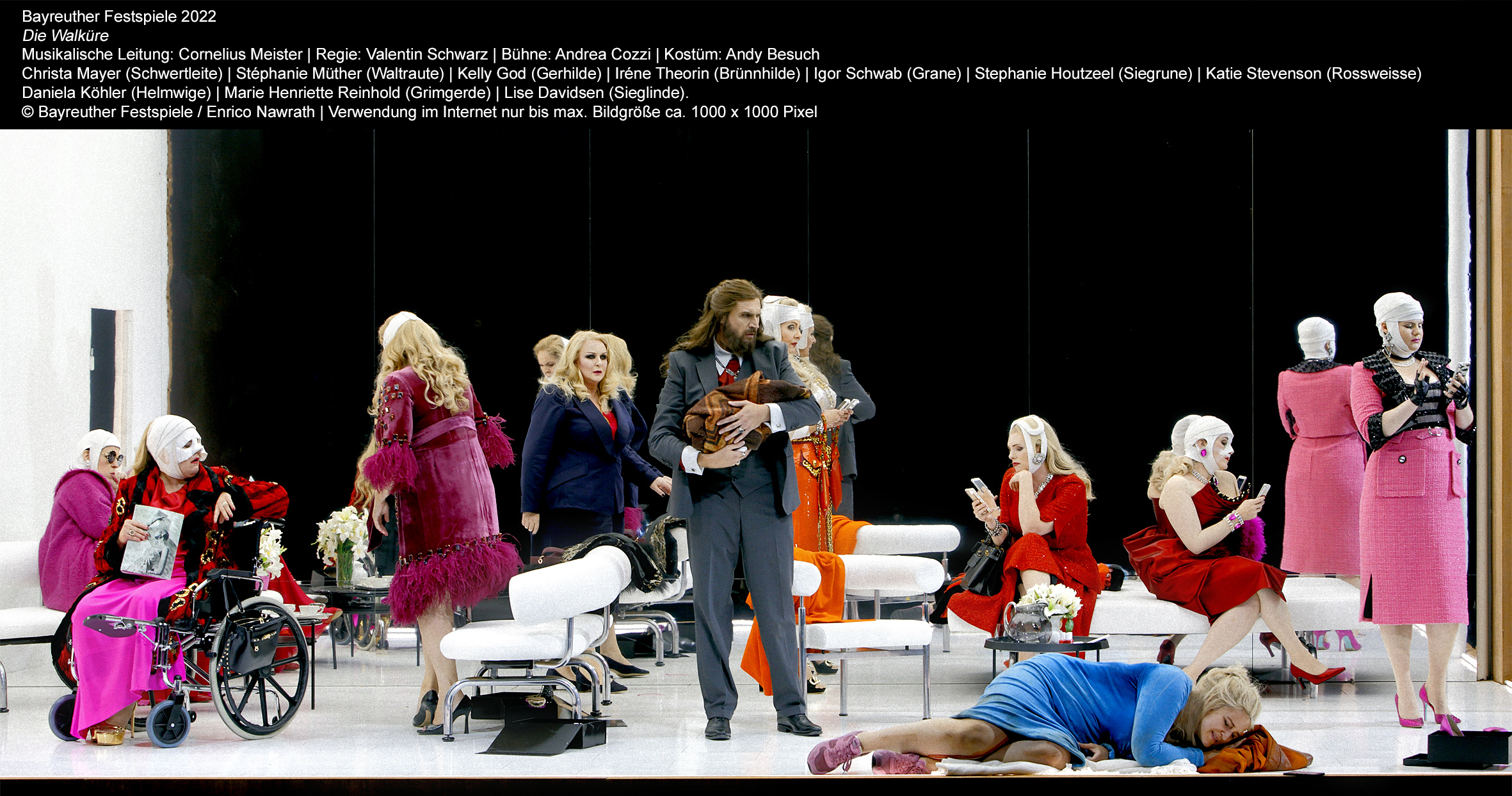
The boos are getting louder: not, I think, for the musicians, but for the production of Valentin Schwarz, who has yet to appear for a curtain-call. That need be no bad thing artistically, though the practice itself is fascistic; should a bourgeois audience feel satisfied with what it has consumed, it will be a disturbing outcome for art. Here, though, the open mind I am endeavouring to keep concerning Schwarz’s production is struggling a little. As a distinguished Wagner scholar said to me when I met him afterwards, ‘It is getting worse.’ On the basis of what I saw in Die Walküre, I had little choice but to agree.

Short of the framing of the action as a saga of twins, which here seems more assumed to continue from Das Rheingold than illustrated, there is little at all to point to other than strange departures from Wagner’s drama, which taken separately or together fail to amount to anything very much. Siegmund and Sieglinde are, I think, taken back by their self-discovery to their childhood, joined by ‘symbolic’ star-children. (Either that, or they fantasise about the children they will have, but I think it is the former.) There is nothing wrong with that; it makes sense. But for it to have taken place in Wotan’s godly quarters seems peculiar—imagine Fricka’s thoughts on that—as well as quite at odds with what they have just sung, without obvious reason.

 It is later implied that Sieglinde, heavily pregnant throughout the first two acts, is carrying Wotan’s baby. At least I think that is why he ‘comforts’ her, whilst Siegmund and Hunding seek one another, pulling down her tights and apparently attempting to deliver the child. If not, it is a straightforward case of sexual assault, although I suppose it must have been anyway earlier. My guess would be that this is intended to enhance the parallelism between Wotan and Alberich, that both will be found to have produced children, Siegfried and Hagen, through rape. But where that leaves Siegmund, goodness knows: St Joseph with a twist, it would seem. Where, though, does that leave Hunding? He must surely have noticed. It is difficult not to conclude that Wagner’s plot would have been better left as it was.

In between, Freia’s funeral, or at least her lying in rest, had taken place. There were some germs of decent, if ultimately rather incidental ideas, here. Assuming we are still to take her as goddess of love, her death would have obvious implications (although its timing is arguably strange, given that Siegmund and Sieglinde have just met). In a Mafia-film-style mise-en-scène, a few people come to pay their respects, whilst Wotan and Fricka have their decisive confrontation. (Brünnhilde spends some of that scene in what appears to be a greenhouse. I don’t know either.) Hunding petitions the gods in person, an interesting touch. That Fricka returns at the end of the third act, after Wotan has put Brünnhilde to sleep (and made, you guessed it, his incestuous urges all too clear), suggests that she is confident in her triumph. She even wheels on a drinks trolley and offers Wotan a celebratory glass. He declines, though, so in the absence of a spear—just nothing at all, throughout—Fricka clinks together the glasses to make the requisite noise.


I am afraid I have no idea at all what happens in the Ride of the Valkyries. It veered all over the place—at least the BBC light entertainment place—from Dr Who to The Benny Hill Show to Casualty, with an apparently accidental turn for Diana Dors’s gender-reversal ‘The Worm that Turned’ series for The Two Ronnies. Sometimes the Valkyries were in charge, sometimes Wotan’s guards. There was a great deal of mobile telephone use. Perhaps it is time to call for a moratorium on those devices onstage, unless the director has a clear idea what they are for. As things stand, they seem to have become the new suitcases.

Lack of objects when called for and introduction of obscure alternatives does little to help. I have already mentioned the lack of a spear or any substitute.   Just as the role of Das Rheingold’s dark-haired boy is more unclear than ambiguous, so is that of the strange pyramid-in-a-box, earlier seen and quasi-worshipped upon the gods’ entry into Valhalla as if a grail-refugee from a production of Parsifal. It now reappears as a repository for a pistol. Sometimes a pistol is a Notung equivalent, sometimes not; sometimes there are several. None of it makes any sense, really, and try as I might to try to piece together some sort of explanation, I am really on the verge of giving up.

As for Grane’s reincarnation as Brünnhilde’s male, suited personal assistant, it makes even less sense when there have been a few apparently arbitrary visual references to actual horses elsewhere. Finally, there is a strong impression that the strongest acting is brought by the singers themselves to their roles. Personenregie is intermittent at best and sometimes disappears altogether in longer exchanges between characters. I suppose some of these things, minus the lack of Personenregie, might add up to something in retrospect, but I do not feel especially hopeful.

Musically, things are better, often much better. Cornelius Meister continues to impress greatly with his command of structure and detail, conveying and expressing a Wagner melos from the pit that drives and, in many respects, is the action. The sound he drew from the Bayreuth Festival Orchestra—and, I assume, to an extent, the sound its players wished to conjure too—was in some ways distant from that we might recall from old Bayreuth recordings, closer to those of other opera orchestras. Choices seem well justified to me, though, and there is no point merely trying to imitate Karl Böhm—or anyone else, for that matter. There is considerable emotional and conceptual range as the cauldron of Wagner’s Greek Chorus bubbles: quite a difference, alas, from what we see onstage.

Not, however, from what we hear onstage. Lise Davidsen’s Sieglinde was at least the equal of any I have heard. No one seems to have a bad word to say about this extraordinary soprano, and so far there seems no reason for anyone to do so. Her final peroration here, ‘O hehrstes Wunder!...’ was as vocally magnificent, riding the orchestral wave almost like no other, as it was clearly heartfelt, the culmination of a dramatic journey that now must end. Klaus Florian Vogt’s tenor will always divide opinion. Much of that is simply down to taste. Whether one liked his performance or not—and there is no getting away from the fact that its sound is very different from the baritonal Siegmunds we have come to expect—his was certainly a committed and, I think, highly likeable performance. Georg Zeppenfeld’s Hunding offered a masterclass in the role, everything present and correct, both considered and alert to the moment.

Tomasz Konieczny and Michael Kupfer-Radecky shared the role of Wotan, the former having become unable to continue during the second interval. Both gave strong performances, deeply rooted in Wagner’s text; if the ear took a little while to adjust to new sound and delivery, that was a tiny price to pay for so crucial, short-notice a substitution. Christa Mayer’s Fricka was once again first-class, fuller-throated than often one hears, and all the better for it. Iréne Theorin impressed as head Valkyrie, youthfully impetuous and headstrong, yet clearly transformed by what she had witnessed. The rest of her team was cast from depth, including a return for Mayer as Schwertleite. Had this been a concert performance, I suspect it would have moved more than it did in the theatre. This Ring, however, will continue in Wagner’s own theatre.


Thursday, 15 August 2019

Bayreuth Festival (4) - Tannhäuser, 13 August 2019


Festspielhaus


Hermann, Landgrave of Thuringia – Stephen Milling
Tannhäuser – Stephen Gould
Wolfram von Eschenbach – Markus Eiche
Walther von der Vogelweide – Daniel Behle
Biterolf – Kay Stiefermann
Heinrich der Schreiber – Jorge Rodriguez-Norton
Reinmar von Zweter – Wilhelm Schwinghammer
Elisabeth – Lise Davidsen
Venus – Elena Zhidkova
Young Shepherd – Katharina Konradi
Four Pages – Cornelia Ragg, Lucila Graham, Annette Gutjahr, Elena Zhidkova
Le Gateau Chocolat – Le Gateau Chocolat
Oskar – Manni Laudenbach

Tobias Kratzer (director)
Rainer Sellmaier (designs)
Reinhard Traub (lighting)
Manuel Braun (video)
Konrad Kuhn (dramaturgy)

Bayreuth Festival Chorus (chorus master: Eberhard Friedrich)
Bayreuth Festival Orchestra
Christian Thielemann (conductor)


Eight years after I last saw Tannhäuser at Bayreuth, in Sebastian Baumgarten’s truly bizarre production, came the highlight, for me at least, of this year’s Festival: Tobias Kratzer’s new staging, conducted not by Valery Gergiev, as expected, but in a last-minuted substitution, Christian Thielemann. Not only was this unquestionably the best staging I have seen of the work in years; not only was it the best Wagner I have heard from Thielemann since the very first time I heard him (Meistersinger, 2000); it convinced me in a way no other performance and production have that there are genuine dramatic, as well as stylistic, reasons for giving Tannhäuser in its (almost) original, Dresden version.*


As the Overture plays, we see the Wartburg on film. We then see a troupe in a van – action switches between film and stage, or combines the two with outstanding skill and insight – making its way there. Or is it, perhaps, making its way from there, to the Bayreuth Festspielhaus? It could be either; after all, we are not all [cue: Anglican clerical voice] ‘in a very real sense,’ on our way between the two? Tannhäuser as clown (Stephen Gould), Venus (Elena Zhidkova), the voluptuous Le Gateau Chocolat (as herself), and the diminutive Oskar (Manni Laudenbach, surely a reference to Günter Grass’s The Tin Drum) are clearly used to a few scrapes on the road, not least when Venus splits her time between driving and entertaining her grotto guest. A pitstop at Burger King goes horribly wrong, a policeman spying Gateau Chocolat and Oskar drawing petrol from another vehicle and coming to confront the troupe after Venus has offered its update Young German motto, ‘Frei im Wollen/Frei im Thun/Frei im Geniessen/R[ichard] W[agner]’ as payment. (Or, as Don Giovanni might have put it, ‘Viva la libertà!’) In a move that clearly shocks the others, Venus puts her foot down and kills the policeman. Thus is the scene set for the nearby guest house. Oskar faces a surprise with the kitschy gnomes outside, and more seriously, Tannhäuser decides to make a break with the gang and make his own way to the Festspielhaus and, presumably, also in life.


The pilgrims, the Bayreuth audience itself, are of course on their way to a performance: his performance; at least it should be, if he deigns to turn up on time. If the fellow Minnesänger, studying their vocal scores – Tannhäuser always has his upon him – and taking the occasional sip of a local brew, are more relaxed about Tannhäuser’s return to the fold, Elisabeth, in a brief appearance, shows her true feelings, slapping his face in the wake of jeopardising the entire performance. This is the first, but far from the last, occasion on which we realise that Elisabeth is here a flesh-and-blood human being, no mere virginal saint. And then, we in the audience make a reverse progression down the hill to an interval show from Gateau Chocolat and Oskar, inflatable unicorn, fabulous new bathing costume, and all.


On returning to the house, we see a splendid Wartburg recreation set. It is the Festspielhaus after all, then, not the Wartburg ‘itself’. Elisabeth alternates between fury and arousal, as one – perhaps not Wagner – might expect. Such roleplaying, metatheatrical to a determined, in many respects deeply moving, end, divests the work of many of those problems with dramatic motivation it has often been held, not least by Carl Dahlhaus, to present. Mythology, history, performance, reception, psychological realism, and more can happily coexist, come into conflict. Is that not the very stuff of drama? And is not love, ‘whatever that means’, as the Prince of Wales once had it, always a ‘show’ too? Such is very much what Tannhäuser ‘itself’ is about, is it not?


Having narrowly missed Tannhäuser outside the Festspielhaus at the end of the first act, the troupe-as-was invades the house (on film) during the Arrival of the Guests, emblazoning the balcony with a flag declaring its Wagnerian motto. Venus deals with one of the pages so that she can take her place in the hall, whilst Gateau Chocolat and Oskar wander around the house, taking in a few images of previous conductors (Thielemann, ironically given the substitution, one of them, and much to Gateau Chocolat’s taste, and James Levine – well, the less said the better). Knowing neither her lines nor her moves, Venus must be kept in line – good luck with that – by one of the other pages. Nevertheless, she just about maintains her cover for a while, until all hell breaks loose. Shades of Ariadne auf Naxos, as two operatic worlds collide? Inevitably, but this remains its own tale. Venus sheds a layer, puts on her own show, to the shock of respectable singers and patrons. She dances, to what is supposedly Tannhäuser’s own music, to win him back, but reminds us that he never really has his own musical style; rather, he assimilates to wherever he is. Does that make him an artist, or…? You decide. He still has his score. Meanwhile, the security guard on film has alerted Katharina Wagner, who calls the police. They pause for a while before the unfurled motto, before doing what they must, and closing down the show(s).


The world-weariness, even despair, of the opening to the third act is evoked powerfully onstage – as well as in the pit – by a wasteland, in which the van has crashed and/or taken root, only Oskar remaining. (We later learn that Gateau Chocolat has gone solo, making it to the big time, her image gracing an advertisement for eponymous watches. That’s show business, we suppose.) Elisabeth still needs Tannhäuser; indeed she needs him more than ever, so much so that she has poor Wolfram dress in Tannhäuser’s clown costume. Then, and only then, can she welcome him into the van; then, and only then, and even then after a good deal of self-persuasion, can Wolfram take her. Shades of Siegfried/Gunther/Brünnhilde? Again, the suggestion is made, or at least can be, but the drama plays out on its own terms. And of course, then and only then can Elisabeth die. It is too late for Tannhäuser himself; he finally tears apart his cherished vocal score. Tannhäuser is free of Tannhäuser. And so, at the close, in a staff-sprouting miracle for our own time, Tannhäuser and Elisabeth are united at last, resurrected, as is the van, in which they drive off into the sunset. Fantasy? The after-life? An actual happy ending? That, ‘in a very real sense’, is up to us.


The cast responded with excellence and enthusiasm to Kratzer’s vision. Stephen Gould seemed much more at home with the conflicts and opportunities presented by Tannhäuser than he had in Tristan (equally well sung, yet quite without agony). Lise Davidsen’s Elisabeth was as poignantly human as I have ever seen or heard the character – and equally possessed of vocal power, wisely dispensed. Elena Zhidkova grasped the nettle of this particular Venus with everything she had, and made the role her own, ably assisted by her fabulous assistants. If I say that I found Markus Eiche’s Walther every bit as moving as Christian Gerhaher’s, many readers will appreciate the distinction of his performance, if anything perhaps slightly more attuned to verbal subtlety. All Minnesänger roles were sung with great distinction; if I mention in particular Daniel Behle, it is only because Wagner gives him more to do. Stephen Milling’s Landgrave and even Katharina Konradi’s Shepherd offered similarly impressive performances.


So too did the ever-excellent Bayreuth Festival Chorus, once more as distinguished in stage as in vocal terms; Eberhard Friedrich’s stewardship of these singers has not been the least joy of recent years in Bayreuth. So too, last but not least, did Thielemann’s conducting and the simply outstanding playing of the orchestra. Here, stepping in at what seems to have been very short notice, Thielemann showed none of the affectation that had sometimes detracted from his Tristan and Lohengrin. Structure became dynamic form in the moment; ‘beauty’ took care of itself, rather than being imposed upon it. And crucially, both he and Kratzer, who had previously directed a different version*, demonstrated their belief in the coherence and singular interest of the ‘Dresden’ Tannhäuser. Not once – well, save for the lost Bacchanale – did I miss what was ‘not there’. When I heard the musical drama turn otherwise from what is imprinted on my memory, it was unarguably right at that moment and in this context for it to do so. Thielemann, it seems to me, not unlike Simon Rattle, fares best when presented with a challenge. To this challenge, to these challenges, the assembled company rose with excellence. A happy ending, then, indeed, for an ultimately happy troupe.


* For detail on the versions – not quite what many think they are – and other thoughts on the work, please see my Royal Opera House programme note, ‘Owing the World a Tannhäuser. (Click here.)

Friday, 20 July 2018

Festival d’Aix-en-Provence (2), Ariadne auf Naxos, 14 July 2018


Théâtre de l’Archevêché

Images: Festival d’Aix-en-Provence 2018 © Pascal Victor / artcompress
 
Music Master – Josef Wagner
Major-Domo – Maik Solbach
Lackey – Sava Vemić
Officer – Petter Moen
Composer – Angela Brower
Tenor, Bacchus – Eric Cutler
Wig-Maker – Jean-Gabriel Saint Martin
Zerbinetta – Sabine Devieilhe
Prima Donna, Ariadne – Lise Davidsen
Dancing Master – Rupert Charlesworth
Naiad – Beate Mordal
Dryad – Andrea Hill
Echo – Elena Galistkaya
Harlequin – Huw Montague Rendall
Truffaldino – David Shipley
Scaramuccio – Emilio Pons
Brighella – Jonathan Abernethy
The Richest Man in Vienna – Paul Herwig
His Wife – Julia Wieninger
 
Katie Mitchell (director)
Chloe Lamford (set designs)
Sarah Blenkinsop (costumes)
James Farncombe (lighting)
Martin Crimp (dramaturgy, including additional dialogue, translated by Ulrike Syha)
Joseph W Alford (movement)

Orchestre de Paris
Marc Albrecht (conductor)

Ariadne auf Naxos is in many ways the ultimate opera about opera. (Or should that be Moses und Aron?) Many, perhaps most, operas would seem to be ‘about’ Orpheus and his art in some way or another. (In a shameless plug, I should add that such is the subject, or at least the starting-point, for a chapter on operatic culture I have written for the soon-to-be-published – i.e., proofs already checked – Routledge Research Companion to Musical Modernism, edited by Björn Heile and Charles Wilson.) It would be far from absurd to claim that an artwork can fail to be ‘about’ its art form, its genre, itself in one sense or another; or would it? Always we seem to be brought back to those oppositions, those dialectics, that haunt, arguably determine Western history and culture, whether we like it or not. Yet Ariadne seems to take it all in, the ‘business’ as and the ‘art’, the artists and the characters, the metanarrative and the narrative, ultimately also the transformation that may or may not transcend – Hofmannsthal and/or Strauss? – as well as the manifold absurdities and frustrations at which one can only laugh, except that is, when one can only cry.


Productions can approach such a work – in practice, with the possible exception of Elektra, almost any work! – in any number of ways. There is nothing wrong with emphasising one strand, one particular reading: single-mindedness has its place, just as much for, say, a Hans Neuenfels as for a Furtwängler or a Klemperer. (The idea of a Klemperer Ariadne in particular intrigues, not least on the basis of his Pulcinella Suite, but I digress – and I have no Music Master to restrain me or indeed to inflict cuts, justified or otherwise.) Ranking is a game for politicians and accountants – although donors perhaps have their place in this world too – but I am not sure that I have seen a production that has kept so many balls in the air at the same time, investigated their nature, and added a few of its own, as Katie Mitchell’s for the Festival d’Aix-en-Provence.


The Prologue comes across as relatively conventional: not in the sense of wanting ‘pretty’ frocks and so on, but it sets the scene, as perhaps it should, ready for the transformations to come. It is full of life, full of character; there is probably, as doubles would be the case in watching any ‘making of’ documentary, more than one can take in in a single viewing, yet by the same token there is no sense of overload. It is not ‘busy’ for the sake of it, as often seems to be a temptation – perhaps a valid one – here. One enjoys the splendidly camp yet undeniably successful and talented Dancing Master of Rupert Charlesworth: watch him rehearse his dancers and you will see that he knows his stuff as well as owning the room. One sees that room transformed into a stage and an audience – with, rightly, a flexible curtain of a barrier in between. Lights taken down and replaced suggest something afoot: a distinction being made between reception room and desert island. We are not yet sure, however.
 

Perhaps most important of all, we see and feel – this is a musical thing too, of course, but also in Mitchell’s staging – the emergence of Zerbinetta as a real person, as a human being, to an extent uncommon, perhaps even unparalleled, in my experience. The tenderness of Sabine Devieilhe’s performance is something; she can do the coloratura fireworks too, as we shall learn. So too, however, is the direction: her placing with (and not with) other characters at particular times, her reactions to them, leading up to a moment quite justified and yet also shocking: the furious slap she gives the Composer after his/her (self-)righteous words at the close. Has (s)he not listened to a word Zerbinetta has said? Most likely not; for even in a world such as Mitchell’s, in which gender is fluid, indeed performed, there is no doubting that masculinity rules the roost. Molière after all wrote Le bourgeois gentilhomme, after all, thus in a sense initiating or at least provoking this particular drama. In connection with that, it is perhaps worth noting that Marc Albrecht seemed particular attuned to the connections – and implicitly the contrasts – with Strauss’s incidental music too. His, overall, was a wise and splendid reading, never seeking attention for itself, yet fully aware of when the orchestra should soar – above all at the close. If an orchestra is unlikely ever to sound at its best outdoors, the Orchestre de Paris, a few scrappy string moments aside, offered warmth, clarity, and chamber-music responsiveness throughout. Albrecht’s gentle yet authoritative guidance nevertheless remained an absolute necessity.


Back, however, to the stage. (How difficult it is even to write about keeping all those balls in the air!) Already, in that Prologue, Mitchell and her team have slightly prised open the work (and its ‘work-concept’). The dialogue has not been quite as one remembered it, perhaps, although we all know how memories can play tricks. In ‘reality’, Martin Crimp has added some lines to fit what we see, some others have gone, and the surtitles seem to offer a further level of commentary and critique: never too much, but enough to have one wonder. Without returning to the 1912 version, with or without Molière – what a missed opportunity that was in Salzburg in 2012! – elements return or rather are rethought and transformed. The Richest Man in Vienna is there, in a dress, as his wife, who literally wears the trousers. They not only offer interjections, new yet rooted in memories of 1912, at least to begin with; they are offered opportunity to learn, to be transformed. Indeed, they interact with the ‘cast’ almost at will. It is, alas, not clear what, if anything, they have learned; audiences and patrons can be like that. Perhaps, though, it is too soon to tell, for which of us has not on occasion learned more from a performance than might initially have seemed to be the case? The final words, appropriately enough, are given to M. Jourdain’s successor: the experiment has been interesting, but it is unlikely to show the way to the future of opera. That, we may retort, and probably do, is at least as much up to us as up to you, however much you may throw your cash around.


Such is the metatheatricality. Perhaps the real truths of Mitchell’s, Hofmannsthal’s, and Strauss’s opera(s), however, lie in what is too often overlooked: what this Ariadne, partly the Composer’s, partly all manner of others’, does as an opera. Angela Brower’s Composer, beautifully, intelligently sung, has not left the stage; (s)he conducts, at times, although it is unclear whether anyone knows or cares. The Opera concerns, above all, Ariadne on Naxos. Lise Davidsen’s Ariadne proved one of the finest I have heard, possessed of an almost infinite dynamic range, subtly inflected, and endless reserves of breath for the longest of Straussian lines. I do not think I have seen – and this was surely Mitchell’s doing too – her suffer so greatly. The sheer misery of her condition shone through, long before it was revealed that she had been left with child, to be delivered and claimed by a rather nasty – should he not be just that? – Bacchus (Eric Cutler, who again can certainly sing the role). The taunts of Zerbinetta’s troupe – perhaps not intentional, yet no less hurtful for that – sting particularly in such a setting. Indeed, their erotic table-dancing, preening, and squabbling, stage realising words and music in properly post-Wagnerian fashion, seems rightly both beside the point and absolutely of it. When Bacchus offers Ariadne the choice of life or death, we have no idea what she will choose, nor for whom. Right up until the end, we fear she might use the revolver that is one of his ‘gifts’. Will she shoot herself, her child, him, someone else, the entire assembled company? In the end, she does not. A child has been born; so too has an opera. Perhaps, whatever our host may think and demand, the future or a future of opera has been too. We shall see and/or hear – or not.