Showing posts with label Albert Dohmen. Show all posts

Saturday, 6 August 2022

Bayreuth Festival (4): Götterdämmerung, 5 August 2022


Festspielhaus

Siegfried – Clay Hilley
Gunther – Michael Kupfer-Radecky
Alberich – Olafur Sigurdarson
Hagen – Albert Dohmen
Brünnhilde – Iréne Theorin
Gutrune – Elisabeth Teige
Waltraute – Christa Meyer
First Norn – Okka von der Damerau
Second Norn – Stéphanie Müther
Third Norn – Kelly God
Woglinde – Lee-an Dunbar
Wellgunde – Stephanie Houtzeel
Flosshilde – Katie Stevenson
Grane – Igor Schwab

Valentin Schwarz (director)
Andrea Cozzi (designs)
Andy Besuch (costumes)
Konrad Kuhn (dramaturgy)
Reinhard Traub (lighting)
Luis August Krawen (video)

Bayreuth Festival Chorus (chorus master: Eberhard Friedrich)
Bayreuth Festival Orchestra
Cornelius Meister (conductor)


Valentin Schwarz’s Ring ends more or less where it began, bar curtain-calls in which the long-awaited appearance of Schwarz and his team was greeted by the most intensive booing I have ever heard. I suppose a ‘cyclical’ turn will appeal to some who insist on referring to the Ring as a ‘cycle’, when it is nothing of the sort. Even those, however, who discern some kind of return at the close will have wanted a little more for their money than a hasty, borderline-cynical return of dual umbilical chord babies on video, and, prior to that, of a swimming pool for the Rhine.

Schwarz’s unwillingness or inability to formulate any kind of concept, let alone to present it successfully, has long since had hopes for drama run out of steam. Unwillingness—let us be charitable—to carry though any coherent correspondence between objects, themes, even often characters, leaves us with an incoherence that does not register as an aesthetic challenge, but simply as a careless mess. Siegfried apparently forgot to take Notung with him—or rather, the director forgot that he should. It was there, but Brünnhilde kept it, storing up various trouble for a final scene to the first act. This is not a matter of highlighting contradictions, already existing or even newly created. It is not freely associating; indeed, it is barely associating at all. It seems to speak more than anything of lack of acquaintance with Wagner’s work and—which may or may not be fair—sheer laziness. Like a child with an extremely limited attention span, Schwarz presents something, tires of it, presents a new thing without bothering to connect it to the previous thing, and continues. Occasionally, some older things return, yet neither with dramatic reason nor insight. To list them is almost the only thing one can do, given such absence of the conceptual; but it quickly becomes tedious, so I shall try to remain (relatively) selective.

The dark-haired boy we first saw in Das Rheingold shooting others with a water-pistol at the swimming pool seems in some sense to have become the gold, the ring, young Hagen, and now—oddly, having aged far faster than everyone else—‘old’ Hagen. A girl, who may or may not be the same as one also marked out at the swimming pool, who in turn may or may not be the same as the one Erda a little later seemed keen to protect, seems at times to take on the mantle of the ring, although there is also from time to time a ring too (which, given generally dim lighting, most of us can barely see). What we are supposed to make of that girl’s disappearance during the final scene, or indeed anything much in a scene that sadly had many in the audience laughing at its sheer ineptitude, I have no idea. Hagen’s return right at the end, stumbling on to shout ‘Zurück vom Ring’ (is he advising people to stay away from himself?) and then stumbling back off again, was not the least embarrassing episode in a renewed, though hardly rejuvenated, string of scenic non sequiturs.

Personal assistant Grane is still around too. It is hardly unusual for the gods to have nothing god-like to them at any stage whatsoever, though such is at best a one-sided view. Rarely if ever before, though, can they have been so recklessly divested of all character, even much in the way of motivation, and for that to have been the fate of dwarves, giants, heroes, and humans too. Turning a horse into a man in a suit does not seem much compensation, or even relevant. Anyway, Grane goes with Siegfried into the world (actually, back to part of Fafner’s house, I think) to encounter a Gunther who slightly resembles Peter Stringfellow or even Jimmy Savile, but whose inspiration a German friend tells me is a trashy television series called Die Geissens – eine schrecklich glamouröse Familie. Gunther wears a sparkly top that asks ‘Who the fuck is Grane?’ Quite, though one might ask that about anyone here, really. Grane is later beaten to something not a million miles from horsemeat. Gunther leaves the carrier bag with pieces of his body by the pool for Brünnhilde in pink dressing gown eventually to pick up Grane’s head to sing to. The unfortunate image resembles Golden Girl Rose Nylund doing a turn as Salome on her way to collect midnight cheesecake, albeit with none of the fun or interest that might entail.


But poor Brünnhilde (seriously). She too has been subjected to pretty horrific, all too casual abuse, seemingly to no end other than as something else to do (and not in a Clockwork Orange sort of way either). How much, if at all, violence towards women should be depicted on stage (or screen), especially by men, is of course very much a live topic at the moment. There may be no definitive answer, yet it is hardly a question simply to be ignored or, worse, trivialised. So many important questions, moreover, are treated similarly. Alberich’s alleged inability to father Hagen—‘it is not entirely clear’, writes dramaturge Konrad Kuhn in the programme, ‘how he could have conceived a son’—is at best problematical. ‘How,’ asks Kuhn, ‘did this “nasty”, this “hairy and hideous imp” … beget a child with the proud Queen Grimhild?’ Perhaps using the power he has amassed by foreswearing love? There is not much of a mystery, here, really, let alone inconsistency, though what form of power is of course open to speculation and interpretation. Instead, though, we end up with something that trivially disrupts the very parallelism the production seems to wish to construct between Wotan and Alberich, and arguably has more than a pinch of ableism to it. (Some might argue racism too; let us leave that for another day.)

Even Cornelius Meister’s conducting, a solid highlight of the previous three evenings, proved more mixed here. There is no shame in that; many conductors, at the best of times, are more successful in some parts of the Ring than others. That the prologue and first act in particular dragged, often seeming to lie behind whatever notional basic tempo had been set, was nonetheless unfortunate as nonsense upon nonsense unfolded onstage. That episodic quality continued into the second act, received with unusual rapture by the audience, but which to me lunged and lurched too often, making all too little musical sense. The third act, though, was much better, a sense of form as living structure once again imparted. There is no reason to think that the rest of the work will not follow in time. The Bayreuth Festival Orchestra, doubtless understandably, sounded at times tired. As an audience member, one could certainly relate. There were some splendid passages too, but this was not a vintage night for Wagner musically.
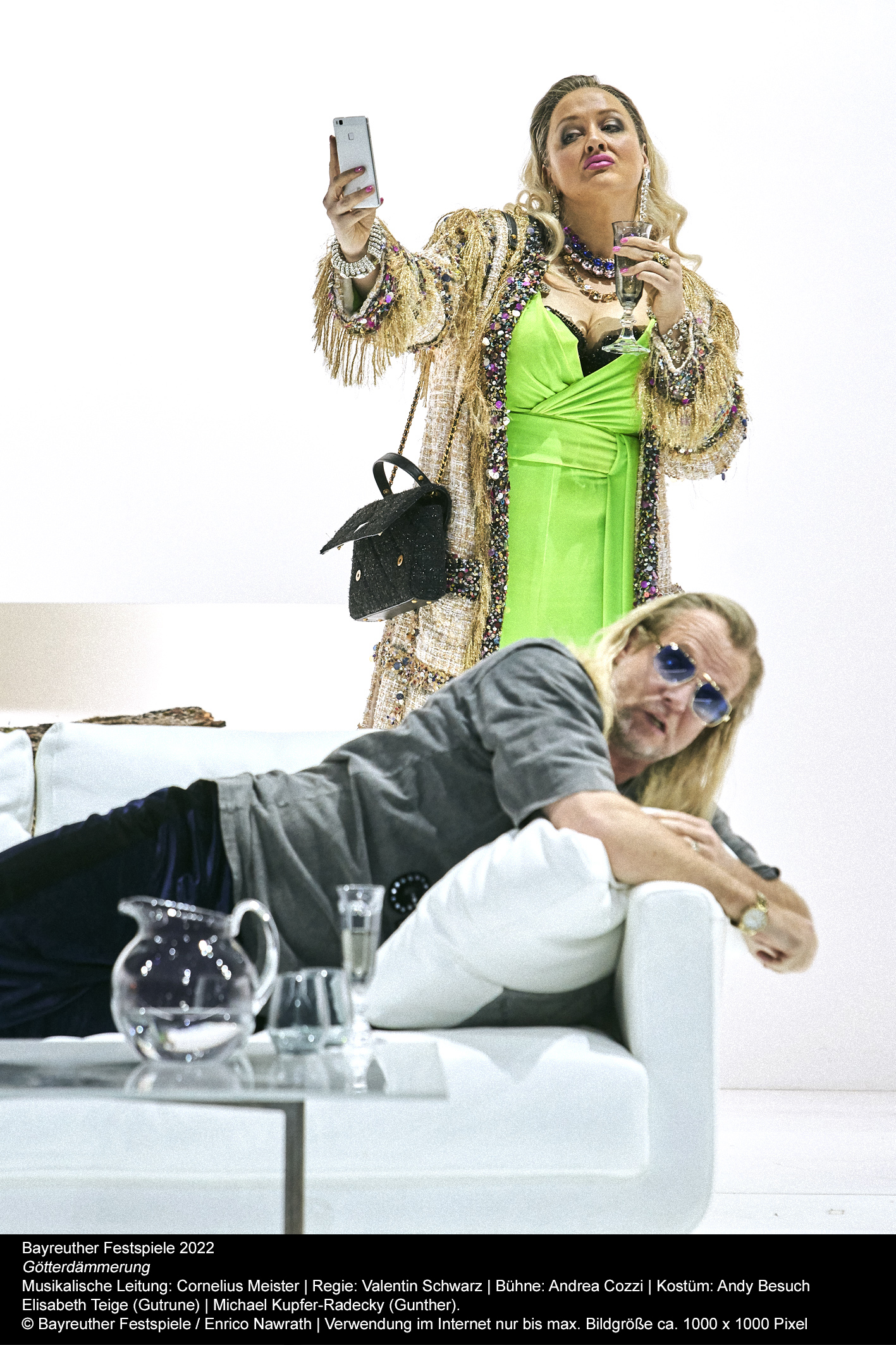


If vocal performances did not always reach the heights, nor did they ever fall below a reasonable level. Olafur Sigurdarson’s Alberich and Albert Dohmen’s were typically intelligent portrayals, founded in the poem and employing its musical marriage to considerable effect. Insofar as one could avoid Schwarz’s weird conception of Gunther—was he supposed to be high, or just very, very peculiar?—the same could be said of Michael Kupfer-Radecky in that role. If quality of diction came and went, there was much to appreciate in Iréne Theorin’s Brünnhilde, who managed to maintain a considerable degree of dignity, events around here notwithstanding. Fullness and bloom of voice were often as impressive as her sheer resolve to get on with it. Clay Hilley, a very late substitute as Siegfried, did more than could reasonably be asked of him. Not once did his voice tire; he committed himself with apparently equally enthusiasm to what was going on dramatically. Elisabeth Teige’s Gutrune was not helped by the production—who was?—but was a convincing vocal performance. Waltraute did not suit Christa Mayer quite so much as Fricka, but there was little doubting the quality of verbal response. The Rhinemaidens and Norns were all very good. If the chorus was far from overwhelming in the Vassals’ Scene, perhaps Covid restrictions were still in play; it looked as well as sounded smaller than usual.

It made for a long and dispiriting evening, though. I am only too aware of precedents, of how, say, Patrice Chéreau’s first run met with uproar and incomprehension, proceeding to become perhaps the best loved (and esteemed) Ring of all time. Not having been there, I can only speculate, but many have said it improved radically during its stint, a tribute to Bayreuth’s Werkstatt principle. Perhaps this might too, then; or perhaps I might change my mind and come to recant, as I did with Frank Castorf (parts of whose production I had, though, always admired). No one would be happier than I to admit he was wrong if so. It is far from the case that every idea advanced is unworthy of consideration; the problem more is that the production itself barely deigns to extend that consideration, already having jumped on something else. I think there would have to be a greater willingness, indeed any at all, to extend the frame of reference beyond a rich, unlikeable family. Why should we care, if that is all there is? Characterisation would help, to put it mildly, but so would a sense of the political and indeed the religious—of context whether broadly, specifically, or both (ideally). There is, it seems, no getting around that—and it is unclear why Schwarz, Kuhn, and company are so determined to try.


Friday, 1 September 2017

Bayreuth Festival (6) - Götterdämmerung, 28 August 2017


Festspielhaus


Siegfried – Stefan Vinke
Gunther – Markus Eiche
Alberich – Albert Dohmen
Hagen – Stephen Milling
Brünnhilde – Catherine Foster, Andreas Rosar
Gutrune – Allison Oakes
Waltraute – Marina Prudenskaya
First Norn, Flosshilde – Wiebke Lehmkuhl
Second Norn, Wellgunde – Stephanie Houtzeel
Third Norn – Christiane Kohl
Woglinde – Alexandra Steiner

Frank Castorf (director)
Patric Seibert (assistant director)
Aleksander Denić (set designs)
Adriana Braga Peretski (costumes)
Rainer Casper (lighting)
Andreas Deinert, Jens Crull (video)

Bayreuth Festival Chorus (chorus master: Eberhard Friedrich)
Bayreuth Festival Orchestra
Marek Janowski (conductor)


All good things must come to an end. All bad things too, I suppose, or at least hope, although looking at the world outside the Festspielhaus… But then the Festspielhaus has always looked to the world outside, nowhere more so than in the Ring. I have no idea how one would measure – yes, neoliberals still wish to do so, however many years after the Frankfurt School, after Romanticism, after anyone possessed of any intelligence and/or humanity ever… – degrees of the ‘political’ in an artwork, but if one could, it is difficult to see what, all things told, and many, many things are told here, could beat the Ring in that respect. Nothing could be less ‘faithful’ to Wagner’s intentions, let alone to our own needs, than some idiotic Disney ‘experience’ such as that purveyed by the likes of Otto Schenk. At least, I think, we have been spared a Zeffirelli Ring. (Should that sound like a contraceptive device, there may be good reason for that.)

Bayreuth in particular is and always has been a workshop, a place for experimentation, tendencies towards sacralisation (Bühnenweihfestspiel, anyone?) notwithstanding. That was what attracted Boulez to Bayreuth in the first – and second – place; that was thus what brought Patrice Chéreau there, for what must surely remain, bar the very first, the most celebrated Ring production in history. The Boulez-Chéreau films remain a miracle: as watchable – and as listenable – as when they first appeared. Moreover, and without slight, say, to Harry Kupfer’s estimable successor – let us draw a veil over Peter Hall’s contribution – Chéreau’s staging changed the work forever. Arguably, there was a good deal in it, coincidentally or otherwise, presaged by Joachim Herz in Leipzig; but at least in the West, and indeed worldwide, given its filming, it was the ‘Centenary Ring’ that informed and reminded so many what the work was, or might be, really about. Having come to the end of my viewing of Frank Castorf’s Ring for the third time, I am happy to put my neck on the line and to say that, for all its problems and imperfections – not unlike the Ring itself – this is a production which, like Chéreau’s, Herz’s, and Kupfer’s too, has changed the work forever. I recoiled from some of it the first time I saw it, and freely admit that I was, in many cases, quite wrong to have done so, although I think it also fair to say that many of the performers have grown into it during its progress and also that it has itself grown in stature following revision. For that reason, it would be hypocritical of me to condemn too harshly those who found themselves lost or bewildered.


Let us hope, though, that there will be another opportunity for them, and for others who have never seen this Ring, to experience it, on DVD. Some of Bayreuth’s recent choices in that respect have frankly been bizarre: still no Herheim Parsifal, but an instant release for Laufenberg’s miserable successor. Wagner may have died owing the world a Tannhäuser; Bayreuth would do much to stave off any such demise by giving the world a Castorf Ring. Marek Janowski’s conducting has had its ups and downs, the first two acts of Die Walküre the nadir. Yet here, if still lacking much of the epic scale and dramatic thrust, let alone the critical stance, of what we see on stage, it acts well enough as a foil. Bar a few inevitable brass fluffs – I am not sure I have ever heard a Götterdämmerung in which that did not happen – the orchestra was excellent on its own terms. Moreover, the vocal and dramatic performances on stage have surely been better this year than in any of the previous instalments.

For Götterdämmerung, the cast was identical to last year’s – except for one partial, unforgettable exception. Wagner is and remains theatre, which entails a great deal of contingency. In this case, we were treated to our first – well, certainly my first – trans Brünnhilde. Having injured her leg during the curtain calls at the end of the first act, Catherine Foster, awe-inspiring in both her artistry and her professionalism, sang the part magnificently: on crutches, from the sidelines. Meanwhile, production assistant, Andreas Rosar donned a dress, wig, and so on, and acted the role on stage. Both deserve the highest of praise, not just ‘in the circumstances’. What deserves unmerited scorn and outrage is the small contingent in the audience that booed Rosar. Seriously: what piece of subhuman scum would act in such a way to someone who, at almost no notice, quite literally saved the show? It is not as if such is an unheard of practice in the theatre, and if, for some reason the AMOP delegation did not like it, why did they not just leave? If, somehow you have managed to escape the sound and sight of resurgent fascism all around us in ‘the real world’, here it was, frighteningly and sickeningly present, railing at the mirror Wagner, Castorf, and their performers held up to that world. I should love to have it revealed that the substitution was actually all along part of Castorf’s Konzept, but I think we can assume otherwise. At any rate, the same people booed his indefatigable assistant – in many ways the greatest star of the entire four-part show – Patric Seibert. His Everyman, surely unique in direction and participation in such a piece, has clearly both been on quite a journey and taken us on several others.


Back, anyway, to Castorf ‘proper’, whatever that may mean. The cosmic tittle-tattle (Thomas Mann) of the Norns takes place in an appropriately exhausted, end-of-the-world setting. Aleksander Denić’s set designs, Adriana Braga Peretski costumes, and not lest the gloomy lighting of Rainer Casper are very much in tandem with those world-weary E-flat minor opening chords; this is not a production that always criticises or works against the musical drama, far from it. Exhaustion in a well-nigh Beckettian sense rules: Fin de partie? A weird shrine, almost Marian, yet anything but, continues to draw attention and repel. But to what is this little room into which not only the Norns but many of their successors, canonical characters and others, continue to enter and, perhaps just as important, from which they continue to attempt to leave? It suggests exhausted consumerism, replete with plastic refuse, born, of course, of the oil that has run through the entire cycle. It advertises a deadly contemporary far-right politics, which, as the poster puts it, prefers ‘Oma’ to ‘Roma’. We also see glimpses of an eternally televised non-revolution such as we endure in our own late capitalist lives: as witnessed Andreas Deinert’s and Jens Crull’s video footage, both on the particular television screen within the shrine, and elsewhere onstage. East and West both led here: state capitalism as well as the still worse neoliberal variety. There is no escape. This is a world that takes its leave from Chéreau’s Götterdämmerung, or at least may be read as having done so: a world of rituals in a post-religious society that knows no morality, indeed finds it impossible even to ‘know’. Yet still, in this nihilist hell, it must somehow continue to ‘do’ something – just as the second act will offer up desperate, pointless evocations to gods who are already dead in any meaningful sense. The Norns are all dressed up for a ball to which they know they are neither invited nor capable of attending; but what else is there to do? They can sing, of course, and all three of them do – magnificent both in solo and in blend.


The Gibichungs, heirs in many ways to the ‘minor gods’ of Das Rheingold, are a still more desperate bunch. (Ultimately, the Norns need not care that much.) Gunther’s self-love, in a commanding, yet never too commanding performance from Markus Eiche is immediately apparent, vanity and insecurity two sides of the same black leather coin. Allison Oakes’s dolly bird Gutrune is certainly the victim of misogyny, but she is happy in her little smart car and would doubtless recoil, except again through the agency of song, from any feminist accusation that she should have attended to weightier, or at least different, matters. Stephen Milling’s powerfully sung Hagen has had her number all along; indeed, in a less common suggestion of incest than the usual Gunther-Gutrune one, his agency is confirmed in gaining her attention to participate in the plot in the first place. He does not need to do very much; Hagen rarely does. But what he does reminds us that he, or perhaps the mysteriously still-with-us – or is he? – Alberich of Albert Dohmen, in perhaps his finest performance here, is pulling more of the strings than anyone else; which is not, of coruse, to say that there are not forces beyond anyone’s control at work here. Wotan may have dismissed Erda as Fate, but what does that mean? Not very much, perhaps, in a world in which chemical works and Wall Street (both featured, both crucially, undefeated, even at the last) continue to rule.

Siegfried is no better. He may even be worse. It is, after all, only at the last in Wagner’s drama that he seems a character remotely worthy of the hopes invested in him – whether by Brünnhilde to Sieglinde or by the newly-human ex-goddess to herself, or indeed by us as bystanders (‘men and women moved to the very depths of their being’) to a revolution that fails. Humping Gutrune quickly, brutally, before asking Gunther his sister’s name is horrible enough, but the reality of his rape of Brünnhilde, video projections both clarifying and intensifying the horror of what is going on, and of who, via the Tarnhelm, is who, chills as rarely before. The brutality of Wagner’s score here does much of the work, of course – so too did Foster’s frighteningly imperious impassivity before Marina Prudenskaya’s heartrendingly imploring Waltraute beforehand – yet it can so readily be partly undone by an uncomprehending staging. Siegfried is leader now, his demeanour, his costume, the projections tell us: and what good has it done us? None.


What I said about Stefan Vinke in Siegfried counts doubly here: the voice may not ingratiate, but should it? He is tireless, almost inhumanly so, and that is surely a more important thing to register. That Gunther and Siegfried make their oath of blood brotherhood in the kebab stall kitchen, none too careful with hygiene, serves to underline not only echoes of Wagnerian Palazzo Vendramin decadence but the sheer bestial depravity of the world within and without the theatre. All the while, Wall Street, carelessly concealed in cloth, awaits its deliberately underwhelming revelation. No one really bothers to hide who is running the show any longer.


The second act is thus set for another attempt at revolution that fails. Think, perhaps, of the ‘anti-capitalist’ protestors who neither know nor care what they want, but like a bit of attention. There is real crisis here, real hunger. Or is there? Do the members of the crowd putting up posters to that effect, and acting as if their lives are at stake in their pillaging, really mean what they say? Or are they just engaging in desperate rituals, whose meaning – again, like those evocations to the gods – has almost passed from memory? There is certainly no doubting the brutality of their behaviour, sons of Siegfried and Hagen, to Seibert’s character, desperately trying to cater to their demands. Or is he ‘just’ an actor too? His ‘death’ at the beginning of the third act is certainly stage-managed. The video shows him smear himself in ketchup (from his stall, perhaps?) and leave himself for dead, awaiting the Rhinemaidens – like the Norns, equally fine individually and in ensemble – to bundle him into their car, prior to their cavorting with Siegfried and his subsequent brutal attack upon them. (Shades of Alberich in Rheingold, but in semi-reverse? To return to the second-act crowd: does it have any revolutionary potential left in it, when Siegfried clearly does not? Try as we might, it is difficult to find. A good few of its members seem more preoccupied with culinary and sexual excess; still, fake radicalism is a good way to win a girl, is it not? The shots Seibert serves to many – Gutrune included – only make matters worse, but he is hardly in a position to argue.

And so, when Brünnhilde threatens to set Wall Street alight, nothing really happens. Everything is even worse than we had feared. No more has the end of this miserable world come than a revolution has saved us. Various participants go through the motions; someone even pops a Picasso out of the window for safe keeping. Or is it just to put it on more brazen display to the plebs below? The Rhinemaidens survive – or at least they do on screen. (That someone was a Rhinemaiden.) They even give Hagen a kitschy Rhine funeral, or at least see him off. Video, as it had in Das Rheingold, both comments on, elucidates, and frustrates the action; it has done so in the Funeral March too, Hagen marching back in a ‘Romantic’ landscape such as one might always have wished for until, jarringly, one saw it – and thought ‘what a load of rubbish’.


It is all, perhaps, a bit Heimat 3: which, the more one thinks about it, the more appropriate it seems. As Herbert Marcuse put it, in his self-reflexive critique of Marxist aesthetics, The Aesthetic Dimension: ‘If art were to promise that at the end good would triumph over evil, such a promise would be refuted by the historical truth. In reality it is evil which triumphs, and there are only islands of good where one can find refuge for a brief time. Authentic works of art are aware of this; they reject the promise made too easily; they reject the unburdened happy end.’ Rejecting the catharsis unburdened tragedy, or gnawing away at it out of post- or non-revolutionary ennui, twists the dialectical screw further. What a world is ours.

Thursday, 25 August 2016

Bayreuth Festival (4) - Siegfried, 23 August 2016


Bayreuth Festspielhaus
Siegfried – Stefan Vinke
Mime – Andreas Conrad
Wanderer – John Lundgren
Alberich – Albert Dohmen
Fafner – Karl-Heinz Lehner
Erda – Nadine Weissmann
Brünnhilde – Catherine Foster
Woodbird – Ana Durlovski


Frank Castorf (director)
Aleksandar Denić (set designs)
Adriana Braga Peretski (costumes)
Rainer Kasper (lighting)
Andreas Deinert, Jens Crull (video)


Bayreuth Festival Orchestra
Marek Janowski (conductor)


Mea culpa. I am by now convinced that this Ring has been far more strongly presented than it was when I saw it in 2014. (I have kept to my resolution not yet to re-read my earlier reviews, but shall do so once my visit to the festival is over.) Everything is tighter; revisions to the productions have been entirely to their benefit; the cast is much stronger, vocally and otherwise; the director seems less hostile to, although not necessarily less critical of, Wagner; and so on. And yet, the difference in my response cannot, I think, be explained away entirely in such terms; even if it can, I should rather err on the side of generosity. I am happy, then, to say that I owe Frank Castorf an apology.


Viewed overall, it was this Siegfried’s epic scope, quite in keeping not only with Wagner’s vision but with so many other dramatic works too, that struck me most of all. The word ‘journey’ has so been so debased by the lucrative language of ‘self-help’ – in some cases, in more than one literal sense – that it is perhaps too late to use it non-ironically; indeed, after Castorf, it is perhaps too late to view the Ring without some degree, at least, of irony. But the tale of the boy who learns what fear receives as probing and, in many respects, as sympathetic a treatment as I have seen for quite some time. There is no doubt of the distance both he and we have travelled by the close – and there is genuine (neo-Feuerbachian?) hope to be experienced, especially at the ends of the second and third acts. It is not hope that is unalloyed; nor should it be. (Listen to the words in the nihilistic ecstasy of Siegfried and Brünnhilde’s duet, if you doubt me; listen also to the disturbing contrapuntal virtuosity of Wagner’s music there, both attempting, so it seems, to conceal and yet to celebrate the terrifying, pyromaniacal marriage of Bakunin and Schopenhauer.) But it celebrates, as did Marek Janowski, in what proved unquestionably his strongest performance so far, the very particular character of what, for once, truly emerged as, according to the cliché, the ‘scherzo’ of the Ring: less of a cliché, if one considers, post-Beethoven, what that might actually mean, both for Wagner and for us. If the Wagnerian hero would be a Hegelian, world-historical figure, responding to contemporary necessity; so must our (anti)hero be. For, as Feuerbach pointed out, ‘God did not become man for his own sake’; nor do we produce the Ring solely for Wagner’s.


Aleksandar Denić’s sets remain a thing of wonder – and wonder is surely an epic quality in itself. The sublimity – gone right, or gone wrong? both and neither? – of the alternative Mount Rushmore backdrop reminds us that much is at stake. Irony need not be ornamental: ask Heine. As Marx, Lenin, Stalin, and Mao look down on us, as we look up to (or down on?) them, as occasionally their faces metamorphose into those of others, unreliable narration kicks in once again: do we know the newcomers, both here and on video, or not? Is this actually, then, an alternative historical path? Can we, as Wotan still wishes, at least some of the time, avert Götterdämmerung – or, perhaps worse still, a return to the non-golden-age of the Golden Motel. What is intervention? Is it desirable, or even possible? As with the shocking golden concealment of Freia – and it was, for me, impossible not to hark back to that moment – the machine-gun brutality of Siegfried’s murder of Mime truly terrifies, truly casts its shadow. As the riddles, the narrations, play themselves out, Wagner plays along; or rather leads us – and the production. Does it mean anything, then, when Wotan rejects Fate (Erda)? Or has that idea been (rightly or wrongly) jettisoned? There are no easy answers, or indeed perhaps any answers at all, just as in the Ring.


But Wotan rejects Erda not in that location, of course; he rejects her on the other side of the revolving set, the extraordinary recreation – well, knowingly unfaithful creation – of Alexanderplatz, first seen, if I remember correctly, which is not necessarily the case, as a playground for Fafner and his floozies. It is at least as much a thing of beauty as the other side of the dialectical wall (or even Wall). And, crucially, like that other side, yet also unlike it, it is, as stations and their surroundings tend to be, a place of liminality. Whether or no we may salvage the idea and the experience of a ‘journey’, we seem fated, Wanderer-like, to remain in transit. We find meaning and meaninglessness in Everyman Patric Seibert’s activities, whether as house-animal-cum-servant chez Mime, the Nibelheim van pressed back into service, or as waitor-cum-post-office-manager in the mysteriously empty – in more than one sense – proceedings in East (is there even a West?) Berlin.


I did not regret the loss of the more excessive spaghetti-founded activities in the first scene of the third act. I most certainly did appreciate Erda’s varied reprise of her Rheingold actions. Having worried, with her assistant on film, about which wig to wear during the Prelude, she disappears and changes it for her final exorcism and/or intensification of Wotan’s Rheingold possession, consensual or otherwise, of her – which, amongst other things, may well, through the creation of Brünnhilde, have enabled the rest of the action to unfold. What had previously seemed to me – rightly or wrongly, in the context of the 2014 production – arbitrary, even plain silly, now seemed charged with meaning. Returning to the scene, unquestionably ‘up for it’, Erda asks us difficult questions about what we should do, faced with a god, or a God. Just as our politicians will fellate the nearest banker without a moment’s thought, so does she get to work – and so does Wotan contemptuously slip his banknotes where one might expect. Her final finger-gesture to our hapless waiter as he returns for his payment is a splendid gesture: again rich in both potential meaning and meaninglessness. Ditto the now ‘traditional’ addition to the now five-strong crocodile community. What, two years ago, to me seemed a mere scenic backdrop – or, at least some of the time, did so – is now crucial to the drama.


Janowski’s conducting, as I mentioned above, came much more into its own. Perhaps that personal impression of mine is owed, at least in part, to a long-term strategy on the conductor’s part. Many conductors, after all, present Das Rheingold in buttoned-up, almost frigid fashion. Nevertheless, there is, I think, more to it than that. The greater sense of ebb and flow, of harmonic ‘depth’ – yes, I know it is a nineteenth-century, Germanic, ideological construction, but is no less useful for that – was palpable and, more to the point, dramatically productive. Balances were much less problematical too. If wind instruments often, although not always, came to the fore, there is nothing wrong with that. There is arguable Beethovenian warrant for it; and we want to hear, of course, as much as is possible. The Bayreuth Festival Orchestra now, for the first time, seemed very much to be the same orchestra – if not necessarily quite so consistently – as that I had heard for Thielemann’s Tristan. Pacing, whether longer- or shorter-term could not really be faulted; it may not always have been how I imagine it in my head, but that is neither here nor there.


The cast was excellent too – and here, I think, we may come to the core of why I found this Siegfried so much more convincing than I had before. Lance Ryan’s Siegfried, however adept on stage, had been excruciating vocally; Stefan Vinke gave the most convincing vocal performance I have heard from him in quite some time, clearly benefiting from not having to force his voice to fill an absurdly large theatre. He entered into the stage proceedings with equal commitment too. As with the previous night’s Tristan, ‘untiring’ should not be understood here as a euphemism; pent-up energy spilled carelessly onto the ground, as it must in the case of this rebel without a consciousness. Catherine Foster gave a splendid performance – much more at home in the production, and in the role, than I found her last time – as Brünnhilde. Her problem is not to be untiring but, so late in the evening, to be immediately fresh, dramatically immediate; the problem proved not to be such, simply an opportunity very well taken. One truly felt her transition from immortal to human, its joy as well as its fears.


John Lundgren’s Wotan/Wanderer exceeded even its Walküre promise. His performance, born very much of the detail of Wagner’s poem, equally alert to the implications of its musico-dramatic flowering, was one for the sagas – mediæval and contemporary. Albert Dohmen’s highly intelligent portrayal of Alberich was spot on: as quicksilver in momentary response as it was determined by what had gone before. His verbal acuity was shared, responded to, by Andreas Conrad’s Mime: a brother-in-arms indeed. Karl-Heinz Lehner’s Fafner was just as sinister and, intriguingly, just as darkly, dangerously attractive as what we had seen and heard his Rheingold incarnation. What we lost in rentier sloth, we gained in other respects. Nadine Weissmann retained and developed that wonderful sense of musico-dramatic ‘presence’ from the earlier drama. And Ana Durlovski’s carnivalesque Woodbird came across – rightly, in the spirit of the production – as more woman than voice of Nature. I may be nearing the moment of a mea maxima culpa.

Sunday, 21 August 2016

Bayreuth Festival (1) - Das Rheingold, 20 August 2016


Bayreuth Festspielhaus


Wotan – Iain Paterson
Donner – Markus Eiche
Froh – Tansel Akzeyebek
Loge – Roberto Saccà
Fricka – Sarah Connolly
Freia – Caroline Wenborne
Erda – Nadine Weissmann
Alberich – Albert Dohmen
Mime – Andreas Conrad
Fasolt – Günther Groissböck
Fafner – Karl-Heinz Lehner
Woglinde – Alexandra Steiner
Wellgunde – Stephanie Houtzeel
Flosshilde – Wiebke Lehmkuhl

Frank Castorf (director)
Aleksandar Denić (set designs)
Adriana Braga Peretski (costumes)
Rainer Kasper (lighting)
Andreas Deinert, Jens Crull (video)


Bayreuth Festival Orchestra
Marek Janowski (conductor)


And so, two years after my first viewing, I am returning to Frank Castorf’s Ring. I shall not re-read my first reviews until afterwards: not because I entertain some absurd fantasy about coming to the production anew, for my present experience will clearly be coloured by prior experience; yet, by the same token, I see no especial reason to have the former over-determined by the latter. One’s memory can play tricks, of course, and what I perceive as difference may or may not so; I may be misremembering, or indeed may simply not have noticed certain aspects before; I may also be viewing them in different contexts, the world – mostly to its disadvantage – having ‘moved on’ considerably since 2014. That, after all, is part of the message – at least part of the message I have taken – from the video work in this production. No one, perhaps, is so unreliable a narrator as the person convinced of the absolute truth of his or her recollections. Even if ‘correct’, that correctness is of limited use: few things are so pernicious as anti-historical elevation of the momentary to the permanent; one has only to think of the runes inscribed on Wotan’s spear, or, more generally, the bourgeois universalism of the Declaration of the Rights of Man. Any Hegelian and/or Marxist – perhaps more to the point, any historian or philosopher of history – could tell you that. However, for anyone wishing to read my previous reviews, they may be found here: Rheingold, Walküre, Siegfried, Götterdämmerung.


Back, then, to the Golden Motel: the trashy Texan (Route 66) location for the action. On first glance, like much mass culture, it might seem to be all about sex. Like the first scene of Das Rheingold, one might say, for what Wagner called Alberich’s liebesgelüste (‘erotic urge’ he was at that time disdaining traditional capital letters for nouns). In both work and production, though, things are far more complicated than they might seem. How might we characterise that liebesgelüste? It may – as I have argued elsewhere – be understood partly, at least when considered from the standpoint of the history of ideas, as an important precedent for Nieztsche’s will to power. But Wagner is not Nietzsche – even if Nietzsche is far closer to Wagner than he ever, even earlier on, wishes to admit. For the question is social too: Alberich’s proto-Nietzschean ressentiment is born of his lowly place in Wotan’s society. That is the psychological – and, in some senses, socio-political – impulse for the challenge of capital to the established political order; or at least it was in Wagner’s time. The relationship between Valhalla and Nibelheim is not entirely different in the age of neo-liberalism, but nor is it the same.


The ressentiment is also æsthetic, of course: Wagner once remarked that he had every sympathy for Alberich’s turn against the Rhinemaidens. Hedonists reject and scorn the dwarf because he is ugly. Yet the relationship between the social and the æsthetic – and this is just one relationship amongst many in this complex world – also needs to be considered. (Rhine)gold is here crucial: as itself; as the oil that powers so much of what we see, petrol pumps in the forecourt; as the shiny stuff of hegemonic trash culture (think Donald Trump, on whom, more soon); as the agent of the motel’s ‘rainbow’ rebranding in the fourth act; even, perhaps, as something hallucinogenic, narcotic, when Donner’s mysterious ‘clearing’ of the air leaves the pleasure-seekers in the bar – something now, as the rainbow flag and tight-fitting costumes for all genders and orientations – in a state of trance-like animation. But the complexity of the web of power relations, not only between characters, but between forms of power, is really the thing.


Returning – or perhaps better, again trying to return – to the beginning, then, the hedonism of swimming pool, beach ball, sun loungers, of a supposed ‘golden age’ is lain bare, again both in work and production. It is a construction; it always was; it creates more gold for some, takes away that gold from others. Wagner makes it perfectly clear that the world into which Alberich intrudes is no idyll, no ‘natural’ state of affairs; so does Castorf. The Rhinemaidens, just like the gods and goddesses who come after them – in the hierarchy, do they come before or after? Intriguingly, it is the Rhinemaidens who take occupation of the gods’ room once they have vacated it to deal with the giants. Will they relive what has gone on between those crumpled sheets, or will they – hollow laugh! – put things right? There are, of course, many more options than that. It is, rightly, unclear, or at least complicated – are already social beings. They are clad, and they behave, in ways that many would consider attractive, others would consider exploitative and/or exploited, others ‘whorish’, and so on. They have agency, yes, but only up to a point – like the rest of us. ‘Men make their own history,’ as Marx, writing at the same time as Wagner, and under many similar influences, tells us, ‘but they do not make it as they please; they do not make it under self-selected circumstances, but under circumstances existing already, given and transmitted from the past. The tradition of all dead generations weighs like a nightmare on the brains of the living.’ So too, of course, does the weight of those with greater power – and so too does the source of that power itself.


What might seem initially arbitrary, and did so (at least to me) more, although not entirely, two years ago, now speaks of complexity: when Wotan and Mime initially bring Alberich and Mime onto the scene in Nibelheim, we are asked to consider who is ensnaring whom, and, when we think we have an answer, that answer is immediately called into question. Welcome to (late) capitalism. Similarly, the Trump-like – how prescient! – depiction of Wotan, as we initially see him, a pleasure-seeking playboy who has, we might guess, inherited power, whilst claiming to have earned it, a vulgarian who yet exercises brute force, whilst allegedly (at least to Donner) renouncing it, two constructed ‘blondes’ – what a custom that is, to refer to women simply by hair-colour! – not only on his arm, but in his bed: that poses still more questions than it might ever answer.


The video work to which I referred adds another crucial dimension. Often we see in close-up what we would see on stage, were we closer. Sometimes we see what we could not otherwise see, that action taking place in a space not otherwise at the moment visible. Sometimes we suspect that what we are seeing is different; at certain points, we know that it is. And there are stills too; where did they come from? Did those events, those scenes ever happen at all? We learn a great deal – and truly acclaim the magnificent acting of the cast (and their detailed direction). We appreciate the complexity of the action. But we are also, like the characters in Hans Neuenfels’s Lohengrin, like the viewers of the ‘reality television’ that seems to be being made before our eyes, being directed. There are interests, powerful interests, at stake here. And just as Trump-Wotan does not make history as he pleases, however much he might insist otherwise, nor do we, as spectators-cum-participants. Patric Seibert’s Everyman offers us almost conventionally dramatic opportunity to empathise – but, as soon as we do, the situation is again rendered more complex. Post-dramatic theatre actually seems to encompass that which it has negated; but is the dialectic Hegelian or Adornian? Brecht, it seems, has more Aktualität, even in opera, than we might have given him credit for.


That detailed direction is really worth saying a little more about. (I am afraid there is much I shall have to miss out, for there is far too much to say.) Whether it is the Rhinemaidens taking occupation of and apparently driving the flashy car on stage, the heartrending – pretty much stage-direction-literal – covering of Freia with gold, the truly shocking, yet utterly to the point, penetration of Erda by Wotan in the shower cubicle as giants and gods settle their accounts, or, to take a very different example, the extraordinary acting by facial expression of Sarah Connolly’s Fricka (on camera): there is so much to see, to think about. It is more coherent than one might initially suspect, irrespective, I suspect, of intention; and when it is not, the incoherence now seems far more a matter of policy, of criticism, than it did last time (to me).


Few, if any, Rheingold productions have for me so convincingly, completely combined vocal and acting skills. In that, this is an utterly Wagnerian, or neo-Wagnerian essay. The Rheingold Wotan is always a tricky one, often rendered comprehensible, or more so, by what comes afterwards, yet needing nevertheless to make a strong impression of his own in the here and now. Iain Paterson would always have had a good many balls in the air; in this production, he had a good few more. They were kept in motion with great conviction; it will be very interesting to see how things turn out. Connolly’s Fricka, as previously mentioned, was a tour de force of vocal acting; her disquiet, yet her need at some point to reconcile herself with what was going on, whatever her distaste (her character’s distaste, that is) for the sub-Dallas antics around her, were powerful, provocative, partly on account of their lack of exaggeration.  Tansel Akzeyebek’s Froh was beautifully sung, equally well acted. Markus Eiche’s Donner came into his more conventional own with the storm; his portrayal of the crazed, clearly dangerous playboy earlier on, was – even if one were to dislike the directorial concept – equally impressive. Caroline Wenborne’s Freia elicited as much as sympathy as the post-Brechtian framework permitted; again, her marriage of singing and acting – on stage and on camera – was worthy of the highest praise. Roberto Saccà offered a sardonic Loge, careful with his words, yet free with them at the same time. Nadine Weissman’s deep-toned Erda – what an entrance, in that joyously vulgar white fur coat! – proved as much a vocal pleasure as her character’s greater role was a provocative dramatic development.


Albert Dohmen, as Alberich, grew in stature – quite rightly – as the performance progressed. The earth-shattering moment of his curse was strikingly well prepared: as much verbally as musically. Andreas Conrad did a great deal with the relatively few lines that Mime has: his evocation of old Nibelheim struck an excellent balance between genuine sentiment and alienated narration (reliable or otherwise). The giants’ journey, not the least striking part of the production, was marked as powerfully in vocal-dramatic terms by Karl-Heinz Lehner and Günther Groissböck as it was in their costume upgrade: local thugs to (relatively) expensive-suited Mafiosi. Both performances were sexually charged (which takes us back to that liebesgelüste starting-point), and highly differentiated, especially as time went on. One would certainly not have blamed Freia at all had she opted for Groissböck’s Fasolt, whether on grounds of physical allure or acuity of response to Wagner’s alchemic blend of words and music. Alexandra Steiner, Stephanie Houtzeel, and Wiebke Lehmkuhl offered both excellent blend and, where necessary, commendable differentiation of character as the Rhinemaidens; their acting skills were, again, outstanding.


In this, in some ways, perhaps the most radical of all Wagner’s scores, the orchestra has a very particular role, or roles. It offers exposition, commentary, wonder, dialectical development, emotional and conceptual depth: all that and much more. Marek Janowski’s conducting often seemed – at least by comparison with the multivalent drama elsewhere – to be a little too concerned to keep the score on a tight leash. It was fast-paced, which is fair enough, but there is more to be revealed when the work relaxes too. Some balances were also peculiar; the conductor appeared to have a bizarre fascination with the composer’s clarinet lines, sometimes to the exclusion of everything else. It was fascinating to hear the work almost as if from a clarinettist’s standpoint, but again a little odd, and one-sided. Perhaps it was an acoustical quirk. Against those reservations, of which I do not wish to make too much, Janowski clearly knew what he wanted and how to achieve it. His neo-Mendelssohnian persuasion has a degree of historical warrant, and there was no denying the ability of the Bayreuth Festival Orchestra’s ability in that respect. In Wagner, however, at least for me, there is never one single answer; one looks forward as well as back. Certain intimations of Schoenberg (Pierrot, and not only on account of the clarinet!) were most welcome. More standpoints, reconciled by the slippery conception of the Wagnerian melos, might have been brought to our attention in certain other performances, but this had coherence of its own.


Thursday, 27 September 2012

LPO/Jurowski - Strauss and Zemlinsky, 26 September 2012

Royal Festival Hall

Strauss – Die Frau ohne Schatten (excerpts)
Zemlinsky – Eine florentinische Tragödie, op.16 (concert performance)

Bianca – Heike Wessels
Guido Bardi – Sergei Skorokhodov
Simone – Albert Dohmen
 

This made for a disappointing opening to the LPO’s season, not the fault of the orchestra, but in many respects to be attributed to Vladimir Jurowski. The failure of the Frau ohne Schatten excerpts, despite some fine orchestral playing, may be ascribed to two principal factors: problems with Jurowski’s direction and, more gravely, the very idea of extracting parts here and there from the orchestral score, without voices, and trying to present them as some sort of coherent whole. Some people have done something similar with Wagner’s Ring, with a similar lack of success, but here Jurowski might have taken note that Strauss himself failed to make his ‘Symphonic Fantasy’ cohere. One wills it to do so, but even in the hands of Kempe, or more recently Christian Thielemann, it simply does not. At least it is shorter than this meandering hotch-potch. It opened as the operas itself does, but in Jurowski’s hands, rigid, metronomic, merely loud rather than resplendent. At times, it sounded almost like a parody of Stravinsky – and that takes some doing. Soon, moreover, the tension began to sag. Without the voices, too much of the score sounded as if we were in rehearsal rather than in concert. Moreover, a good part of it lacked a keen sense of harmonic grounding and motion, increasingly a problem from many conductors in the core Austro-German repertoire, especially when they sound superficially ‘exciting’. There was a fair bit of orchestral uncertainty too to balance against the pinpoint, almost brutal, precision of other passages, such as the opening. At least we managed to hear some impressive solo work, for instance from leader Pieter Schoeman and principal cello, Kristina Blaumane. Even the grinding dissonances just before the close failed properly to register, whilst the closing bars were merely sugary, nauseating in the wrong way. It would have been difficult to come up with a greater contrast with Bernard Haitink’s recent Vienna Philharmonic Prom performance of the Alpine Symphony. But the very premise of this performance was flawed. Perhaps Stokowski might have made something of the idea; one can imagine a time-travelling Liszt doing so on the piano. Jurowski did not.
 

He made a better job of Zemlinsky’s Florentine Tragedy, in itself a welcome visitor to a London concert hall, though sadly not to a London stage. The obvious Straussian inspiration for Zemlinsky’s version of Wilde’s A Florentine Tragedy was of course Salome, which Zemlinsky had conducted for the first time in 1910. Both operas are in one act, though Eine Florentine Tragödie, composed between 1915 and 1916, is considerably shorter. Moreover, the nauseating headiness of Strauss’s opera cast a shadow over a number of ‘late Romantic’ or ‘early modernist’ – whatever we wish to call them – operas, Schreker’s Die Gezeichneten a fine example. The links between biography and art are rarely as clear as some would like to make them, even when ironised as in a number of Strauss’s works, but the congruence of plot between opera and Mathilde Schoenberg’s affair – yes, the wife of that Schoenberg and sister of Zemlinsky – with the painter, Richard Gerstl, who then took his life when Mathilde returned to Schoenberg, is difficult to ignore. There is no love-scene as such at the opening, though there is later on, evocatively coloured by whole-tone harmonies. However, the Prelude, like that to Act I of Der Rosenkavalier, makes all clear, albeit in darker tones than Strauss had employed (though not necessarily darker in this performance). Guido, Prince of Florence, and Bianca have been indulging their passion and, upon the appearance of the merchant Simone, Bianca’s husband, hardly succeed in quieting his suspicions. It takes a dissonant duel – and Guido’s death – to have Bianca appreciate her husband, and then for his strength.
 

Though the Prelude was driven and perhaps too bright – a little more nausea would have been to the good – we heard that this was recognisably the composer of the Lyric Symphony, surely Zemlinsky’s masterpiece. If there were times, especially early on, when Jurowski proceeded too audibly bar-by-bar, at least the basic structure of the work was apparent. (Imagine, though, Thielemann taking on such repertoire!) Slower sections in particular fared better than they had in Strauss, where they had often simply dragged. Indeed, it was generally orchestral climaxes that came off best. The real problem here lay with the singers. Whilst Heike Wessels showed occasional bloom as Bianca, both Albert Dohmen as Simone and Sergei Skorokhodov as Guido struggled to make any real impression. More often than not one could barely hear the latter above the orchestra, and the same was true too often of the former. There was no charisma, no sense of who the characters might be, of why we might care about them. At best, the score emerged as a symphonic poem with voices, something of an irony given the ill-fated Strauss first half. And so, the ominous ostinato when Simone bids Bianca spin came across with more foreboding, more frighteningly even, than one might have expected. Something of the score’s claustrophobia registered too, as did the brief – ironic? – transfiguration at the end when the remaining couple hymn each other’s strength and beauty. I suspect the opera needs a staging, perhaps of the Von heute auf morgen variety. It certainly needs a superior vocal contribution.