Showing posts with label Clay Hilley. Show all posts

Tuesday, 21 May 2024

Götterdämmerung, Deutsche Oper, 20 May 2024


Images: Bernd Uhlig (from 2021 premiere, with a considerably different cast)
Hagen (Albert Pesendorfer)


Siegfried - Clay Hilley
Brünnhilde – Ricarda Merbeth
Hagen – Albert Pesendorfer
Gunther – Thomas Lehman
Gutrune, Third Norn – Felicia Moore
Alberich – Jordan Shanahan
Waltraute – Annika Schlicht
First Norn, Floßhilde – Lindsay Ammann
Second Norn, Wellgunde – Karis Tucker
Woglinde – Lee-ann Dunbar

Director – Stefan Herheim
Revival directors – Eva-Maria Abelein, Silke Sense
Set designs – Stefan Herheim, Silke Bauer
Costumes – Uta Heiseke
Video – Torge Møller
Lighting – Ulrich Niepel
Dramaturgy – Alexander Meier-Dörzenbach, Jörg Königsdorf

Chorus and Additional Chorus of the Deutsche Oper (chorus director: Jeremy Bines)
Orchestra of the Deutsche Oper
Nicholas Carter (conductor)

All things, good, bad, and indifferent, must come to an end; or must they? The idea that Wagner’s Ring is cyclical is widespread – many routinely refer to attending a ‘cycle’ – but it is at least open to criticism. More on that later, but this Deutsche Oper Ring has certainly come to an end with performances of great distinction, perhaps the most uniformly well cast I have ever seen, and with astonishing conducting from Nicholas Carter, certainly the best I have heard since Daniel Barenboim in 2013. Not, of course, to forget the superlative playing given throughout by the Orchestra of the Deutsche Oper, showing itself once again to be the match of any (Wagner) orchestra in the world, the Staatskapelle across town included. No Ring would be anything at all without Wagner’s reimagined Greek Chorus, leading, commenting, questioning, seducing, thrilling, and chilling; this one, as translucent as it was darkly malevolent, as weighty as it was agile, did all that and more. Only now, in the final instalment, it was joined by Wagner’s actual chorus, those of the Deutsche Oper as seemingly always excelling not only vocally but as dramatic participants onstage. 

A Ring in the theatre is, of course, its production too; this marked the end of Stefan Herheim’s memorable staging. No Ring is perfect: it is not, should never be, that sort of work. It is too big, too unmanageable, too much a ‘world’ for that. This has contributed much, though, not least from its insistence on Wagner’s ‘three days with preliminary evening’ as a musically driven drama that navigates between the concerns of an ongoing rite and something explicitly contemporary. In that, at its best, it has penetrated to Wagner’s own mythological practice, doing what it has shown and what it has suggested to us. If the final scene of Siegfried proved for me a rare disappointment, it also gained from what happened next—though I still think it would have benefited from heightened attention to the drama of Siegfried and Brünnhilde and less to the crowd of copulating extras around them. Here, though, at the onset of the Prologue to Götterdämmerung, the generational shift (which has already, strictly, been accomplished) is accompanied by a scenic one; or rather, the action passes between two basic settings throughout, the old one of the rehearsal room and piano, and the new one of the Deutsche Oper itself. 


We probably should not make too much of a distinction, or maybe we should, between actors and chorus. Perhaps some have gone on to be audience members, whilst some continue in their movement and ‘extra’ roles. The more important thing, I think, is that two related worlds less collide than interact. There is, after all, little point in telling a story if no one is there to listen. In any case, the actors surround blindfolded Norns (echoing the state at one point of the treble Woodbird), choreographically heightening the drama just as they did to form the Rhine in the first scene of Das Rheingold—and just as they will in the final scene of Götterdämmerung to form the fire, aided by striking red lighting. Again, some of the most powerful effects are the simplest and, as Wagner put it, the most ‘purely human’. Meyerbeer’s ‘effects without cause’ are neither his business nor ours, whatever the (exaggerated) claims that have been made for the elder composer’s influence on this drama. A degree of grand opéra, yes, but other composers in that genre, the creator of Rienzi included, loom larger, which is not to say that a blazing account of the second act trio – courtesy of the orchestra, Carter, Ricarda Merbeth, Albert Pesendorfer, and Thomas Lehman did not thrill – for it very much did. 

Back for now, though, to Herheim. (In a sense, the distinction is false, albeit necessary to say anything at all.) The theatrical ‘business’ of dressing up continues to loom large, enabling characters to become – perhaps even to leave behind – ‘themselves’, as well as actors to become characters. White sheets become improbably large wedding dresses for Brünnhilde and Gutrune, their entanglements, their allure, and their physical dangers offering visual metaphors aplenty. Rhinemaidens, in losing their external trappings, become Norn-like, hieratic, in their warnings to Siegfried, Carter’s quasi-liturgical handling of the score both reflecting and leading that. Hagen assumes Siegfried’s heroic costume, whereas Siegfried fatally loses his. Gunther is likewise transformed from initial silliness (not a criticism, but rather a commendation of Lehman’s alert performance) into something more. The white tie of an ‘artist’ is the key, or at least it seems to be, as it is for Siegfried’s transformation (as well, undoubtedly, as whatever it is Hagen slips into his drink). Their scene on Brünnhilde’s rock is very well handled, both initially equals, sharing the lines, before Gunther fails and Siegfried must take over ‘as’ Gunther—before, of course, returning to the Gibichung Hall, where the sleep into which he keeps falling (Hagen’s doing?) overcomes him. It seems also to overwhelm during his final scene, staggering about, not ‘himself’—until he can finally become himself at his death, fully in keeping with Wagner. 

Gunther (Thomas Lehman), Siegfried (Clay Hilley)

In the meantime, Hagen’s departure into the audience for his watch proves, with further Brechtian use of house lights at critical moments, a telling and striking coup de théâtre. First he finds Waltraute there, his intimidation a prod to the mission she undertakes to her sister. Then he conducts the dialogue with Alberich from there, his father on stage, Siegfried sleeping. Alberich’s presence as clown of death, spying the action, even trying to force the ring from the sleeping Siegfried’s hand, visually informs not only his son’s appearance but that of zombie guests to the abortive weddings. As we hear the Nibelung and his ring musically envelop the action, so does he colour the participants too. Not for nothing does he manically play the piano at the end of the first act and resume his performance at the beginning of the second. His longtime antagonist appears too, actors assembling to show, first during Waltraute’s narration and on occasion thereafter, Valhalla’s throng of gods and heroes, a weary Walvater finally descending to the piano to receive Brünnhilde’s ultimate judgement. 


Before (re-)turning to the close, I should add a little about the vocal performances. Merbeth combined the headstrong virtues of her Walküre Brünnhilde and the lyrical ones of her Siegfried performance into a memorable assumption of her role. Clay Hilley again proved tireless – as tireless as a Siegfried can ever really be – and committed as the doomed hero. Pesendorfer and Jordan Shanahan’s Hagen and Alberich cast spells both dark and magical through voice and stage presence alike. Lehman’s Gunther and Felicia Moore’s warmly sympathetic Gutrune captured the difficult, sometimes thankless essence of their characters, always alert to the particular demands of the staging. Annika Schlicht’s chalumeau-like Waltraute was as much of a vocal and dramatic joy as her Fricka. Norns and Rhinemaidens were uniformly excellent. This was, I am delighted to reiterate, at least the equal of any Ring I have heard in uniform excellence of casting, and perhaps more than that. There may have been starrier casts; there may have been individual performances ‘bettered’ in one way or another, for there always will be. Yet across the board, the Deutsche Oper’s strong sense of company will take some beating. 


Following departure of all from the stage and a splendidly oracular image summoning up memories of Delphi, but also of Patrice Chéreau and Pierre Boulez revelling in Wagner’s own revisiting its prophetic indeterminacy, we return to where we began: rehearsal room with lights, emergency exit, and piano, no sign of suitcases, refugees, or anyone/-thing else we have seen in between. A cleaner (with a hint of Erda to her?) comes to check all is as it should be. All has been washed away, or has it? Others will doubtless come along to stage the work again. The question remains whether they will have learned anything. For Wagner’s ‘watchers’, those ‘men and women moved to the very depths of their being’ were all along intended to imply this was not entirely a return, that consciousness had been created or raised. The Ring ends not in E-flat-major, but in D-flat, the key of Valhalla. Over, then, to those who have made it, us included. Only, given the achievements to date of ‘human consciousness’, who would bet against catastrophic repetition?


Monday, 20 May 2024

Siegfried, Deutsche Oper, 18 May 2024

Images: Bernd Uhlig (from 2021 premiere)
The Wanderer (Iain Paterson) and Alberich (Jordan Shanahan)


Siegfried – Clay Hilley
Mime – Ya-Chung Huang
The Wanderer – Iain Paterson
Alberich – Jordan Shanahan
Fafner – Tobias Kehrer
Woodbird – Nicolas Schröer
Erda – Lindsay Ammann
Brünnhilde – Ricarda Merbeth

Director – Stefan Herheim
Revival director – Philine Tiezel
Set designs – Stefan Herheim, Silke Bauer
Costumes – Uta Heiseke
Video – Torge Møller
Lighting – Ulrich Niepel
Dramaturgy – Alexander Meier-Dörzenbach, Jörg Königsdorf

Orchestra of the Deutsche Oper
Nicholas Carter (conductor)


Mime (Ya-Chung Huang)

Emblems of the refugees’ arrival but also perhaps of impending departure, suitcases once again form and delimit the set, the rehearsal piano at their centre once again omnipresent. Wagner’s life and work becomes their own, our own. It certainly has mine since I first fell under its spell, and despite occasional attempts to escape – or at least to take a break – it never works. This Deutsche Oper Ring is not helping in that vain attempt, a somewhat disappointing third act notwithstanding. 

A Ring mystery is what its ring actually does, what its powers actually are. They certainly do not tally with what the characters tell us about it. Must one in some sense believe? Is it a form of theology, as Wagner, keen student of Feuerbach, might understand it? Probably. At any rate, it notably does Alberich’s bidding at the start, its yellow light focused at the piano, opening its lid, and thus initiating the Bühnenfestspiel’s ‘second day’. He and Wotan, Schwarz-Alberich and Licht-Alberich, as Wotan-as-Wanderer will call them, watch and wander from the start. They are not always present, yet often they are. Tellingly, the Wanderer watches the whole first scene from above, and Alberich appears, to Mime’s anger, during the second. (Perhaps, again, his brother might actually have been able to help him, like Siegfried, like the Wanderer, but the clever craftsman does not want to know.)  Their final confrontation, at least onstage, in the first scene of the second act attains a tragic magnificence and import such as rarely, if ever, have I encountered. That again, is surely in part Nicholas Carter’s doing, proportions of the act as a whole seemingly reconsidered, so that, like the final act of Die Walküre, thoughts of lopsidedness – the so-called ‘Forest Murmurs’ often overstay their welcome, but not here – never materialise. It is also surely that of Stefan Herheim’s staging; the two, along with vocal-dramatic performances proceed together, more or less indivisible (although for the purposes of writing, one must start somewhere). The two figures are, of course, themselves refugees here: they have stepped forward, assumed roles; yet, like the boys in Lord of the Flies, however changed, they must also remain who they were, albeit within a different, often Brechtian framework of storytelling. 


SIegfried (Clay Hilley), Brünnhilde (here Nina Stemme)

Music continues to play its stage role. Where Alberich, in a sense, founded his enterprise on an instrument he had found, or perhaps brought with him, Mime has expanded his endeavours into a brass workshop, where instruments hang from the ceiling. It is a slightly odd assortment and that, presumably, is the point. Mime is not an ‘artist’, but a ‘craftsman’; Wagner always upheld that Romantic distinction, which directly colours his creation of Mime and Siegfried. An artist would doubtless have brought in some other instruments. Incapable of moving beyond his narrow, technical purview, Mime continues to do the same thing—as, of course, he does in attempts to reforge the sword. Not for nothing in Herheim’s cunning elision of Wagner and Mime (here, for better or worse, in striped top) is the ‘Wagner tuba’ a key exhibit. Dubious tendencies from Wagner reception –much as we might wish, we cannot always simply ignore them – resurface. Mime’s dwarf-like quality and large head surely offer a nod to strange claims made concerning Wagner’s height and (worse still) physiognomy. Nietzsche would have laughed; the Wanderer does. 

The craftsman’s resourcefulness is important, though, at least if it may be harnessed to something more. It is possible, at least for Siegfried, to have bellows created from what is available, in a splendid nod to the original steam technologies of Bayreuth. Fafner also emerges from the suitcases and instruments too, brass teeth fairly gleaming, basic sheet props and colourful lighting again working their wonders for the rest of his maw. For lighting (Ulrich Niepel) can accomplish so much, simply yet starkly, as in Mime’s silhouette of brief power, or its prospect, when he holds the Wanderer’s spear. A vision of the world, which Mime, like Alberich still would ‘win’, is unfurled, again using what has emerged from the refugees’ possessions. 


Siegfried and Mime

It is a pity, perhaps, that Siegfried’s appearance – notably, like that of his father – is so ‘historically’ bound as (to us) to seem ridiculous, but that is surely deliberate, the flaws of ‘heroism’ present from the beginning. A striking innovation, though, is the return of Siegmund and Sieglinde in a Hänsel und Gretel-like ‘Dream Pantomime’. Siegmund may have rejected the immortality of Valhalla, but there are other ways to return, to guide (such as Mime never could). That the Woodbird, an excellent boy treble (Nicolas Schröer) emanates from this world – a very junge Siegfried, if you will – makes a significant contribution to the psychoanalytical framework. So too does the dragon’s blood in which he becomes mired and the pitching of appearance somewhere between clown (picking up from Das Rheingold) and (from Die Walküre) zombie, a disconcerting contrast with fresh youthfulness of voice. 

Carter seemed to offer a presentiment in the first act, which (rather than vice versa) on one occasion seemed very much to approach Humperdinck’s score. Perhaps it was my imagination, but it struck me at the time and before I knew what was to come on stage. His direction of the once-again outstanding Orchestra of the Deutsche Oper remained deeply and consistently impressive, both tied to and leading the action onstage. So too did the cast’s performances. Iain Paterson proved a typically thoughtful Wotan, Jordan Shanahan making a welcome return as an ambiguous clown-Alberich, readable and ‘relatable’ on multiple levels, without forsaking the destructive impulse at his core. 


Siegfried and Mime

Ya-Chung Huang’s Mime was, quite simply, one of the best I have seen and heard, turning the Siegfried-Mime axis into a true battle of very different tenors, for which Clay Hilley’s tireless Siegfried should also receive due credit. Both learn to conduct, as to play the piano, to lead musically and seemingly according to the score, but do they bring it to life? That requires the return of the refugees—and discarding of the old (Walküre) score. Huang’s ability, doubtless enhanced yet only enhanced by make-up and costume, to play his role as if Mime were a puppet-clown, grotesque yet also human, captured so much of the role, its uncomfortable aspects included. Above all, it reminded us of Wagner’s great achievement in showing us, as the late, greatly lamented Michael Tanner pointed out, the sheer misery that it is to be Mime. Tobias Kehrer continued and extended his excellent work as Fafner, that extraordinary last gasp of recognition – ‘Siegfried!’ – given its proper, prophetic, yet chilling worth. I assume his return to ‘life’, or whatever it was, was as much a recognition of the underlying Brechtian ideas as it was of his acquiring zombie-status, though perhaps it was both. The Woodbird’s frustrated waving him away, getting in the way of the story, was a nice touch, but I did wonder whether it might have been better all round not to present the problem in the first place. 


The Woodbird, Siegfried

What, then, of the third act? Musically, again, there was much to admire, though even in that respect – and perhaps more on account of inextricable connection with stage action than any actual flaws – it held my attention less. There was certainly nothing to complain about in Lindsay Ammann’s return as Erda, beautifully sung and enunciated, the character, now more dishevelled, awakened from her sleep and emerging once again from the prompter’s box. Ricarda Merbeth’s surprise return, in place of the previously advertised Elisabeth Teige, as Brünnhilde will have disappointed no one either. Her radiant performance, quite an achievement given its notorious demands so late in the evening, was quite the tonic, insofar as one could avoid distraction, from the events around her. For whilst I can rationalise Herheim’s decisions here, for the first time I felt rather less than convinced. 

The first two scenes go mostly as they ‘should’. No harm in that, quite the contrary, and the third seems nicely set up by the now apparently proficient Siegfried summoning Brünnhilde’s mountain and fire from the piano. Unless, though, I was missing something – it would not be the first time – there is not much more to it then return of the refugees, their ‘identification’, first among straightforward traditional gender lines, with Siegfried and Brünnhilde, then, taught by the score (whose ubiquity becomes more than a little tedious) and, presumably, also by what the two principal characters sing, turning more fluid in orientation and staging an orgy around them. It is all very well done, to the extent of unfortunate distraction from the two singers, ‘parked and barking’. Again, I assume that to be the point, yet it ultimately seemed to me misguided. I doubt this was an attempt to hold up Wagner’s drama as insufficient, or intolerably Romantic. Frank Castorf did so in his Walküre and it proved the weakest part of his Ring. Yet Castorf arguably proved most compelling here in Siegfried, when his conception found itself guided by the weight of Wagner’s drama, even perhaps by a mediated version of its Romanticism. Is a basic Brechtian point about storytelling, ‘enhanced’ by young people in white underwear doing their thing, enough? There are plenty of places one might go in Berlin to see the real thing, if that is what one is after. 

It might be tempting to see this ‘problem’, if problem it be, as mirroring Wagner’s own in completing the Ring. After all, it was at precisely the same place, the end of the second act, that he ceased his compositional work on it for twelve years. Turning instead to Tristan and Die Meistersinger, he wrote to Liszt that he had ‘led my young Siegfried into the beautiful forest solitude; there I have left him beneath a linden tree … he is better there than anywhere else. – If I am ever to take up this work again, it must either be made easier for me, or else I myself must in the meantime make it possible to bestow this work on the world in the fullest sense of the word.’ Yet when Wagner did return to his Siegfried, to the linden tree, or rather to the scene that followed in which all is both changed and resolved, it was still more under the spell of Schopenhauer and his musical aesthetics (as well as his broader philosophy). That, really, should have been right up Herheim’s street. I shall happily eat my words if all becomes clear in Götterdämmerung; for now, however, I register my first note of dissent. 


Saturday, 20 May 2023

Wozzeck, Royal Opera, 19 May 2023


Royal Opera House

Wozzeck – Christian Gerhaher
Marie – Anja Kampe
Captain – Peter Hoare
Doctor – Brindley Sherratt
Margret – Rosie Aldridge
Drum Major – Clay Hilley
Andres – Sam Furness
First Apprentice – Barnaby Rea
Second Apprentice – Alex Otterburn
The Fool – John Findon
Soldier – Lee Hickenbottom
Tenor Solo – Andrew Macnair
Marie’s Son – Jonah Elijah McGovern

Deborah Warner (director)
Hyemi Shin (set designs)
Nicky Gillibrand (costumes)
Adam Silverman (lighting)
Kim Brandstrup (choreography)

Royal Opera Chorus (chorus master: William Spaulding)
Orchestra of the Royal Opera House
Antonio Pappano (conductor)


Images: Tristram Kenton
Andres  (Sam Furness), Wozzeck (Christian Gerhaher)


Thirty years ago, in Sheffield, a teenage schoolboy saw his first opera in the theatre. It was Wozzeck, directed by Deborah Warner for Opera North. Quite an opera with which to begin, you might say, and indeed in many ways it was, yet why would you wish to begin with something that was not ‘quite an opera’? He knew a little more, though not much, opera not having been part of his childhood or more general homelife, nor indeed of his schooling. Plus ça change… By that time, he had just begun to explore the operas of Mozart, those you might expect: Figaro, Don Giovanni, and The Magic Flute. He had also, slightly clueless, speculatively bought a reduced, ‘historic’ recording of Tristan und Isolde from WH Smith and had watched a video, kindly lent by his music teacher, of Die Meistersinger. That, however, was it. He had not yet knowingly listened to music of the Second Viennese School, though that also was suddenly about to change. It is no exaggeration to say that those hundred minutes in the Lyceum Theatre changed his life. 

From 1993 to 2023: an avid (if, born perhaps of that initial experience, selective) opera-goer travelled across another English city for the first night of a new production of Wozzeck, also directed by Deborah Warner, now for the Royal Opera. Full circle? Not really; nothing ever is. Our protagonist has, for better or worse, had numerous experiences, music, dramatic, emotional, and intellectual, since; he is certainly no longer a boy. Yet Wozzeck, which for him ever since has had at least as strong a claim as any to be the single greatest opera of the twentieth century, exerts, if anything, a still greater fascination and admiration, certainly a greater love, than it did then, born of three decades of living with it. How, then, would Warner II fare in circumstances both old and new?


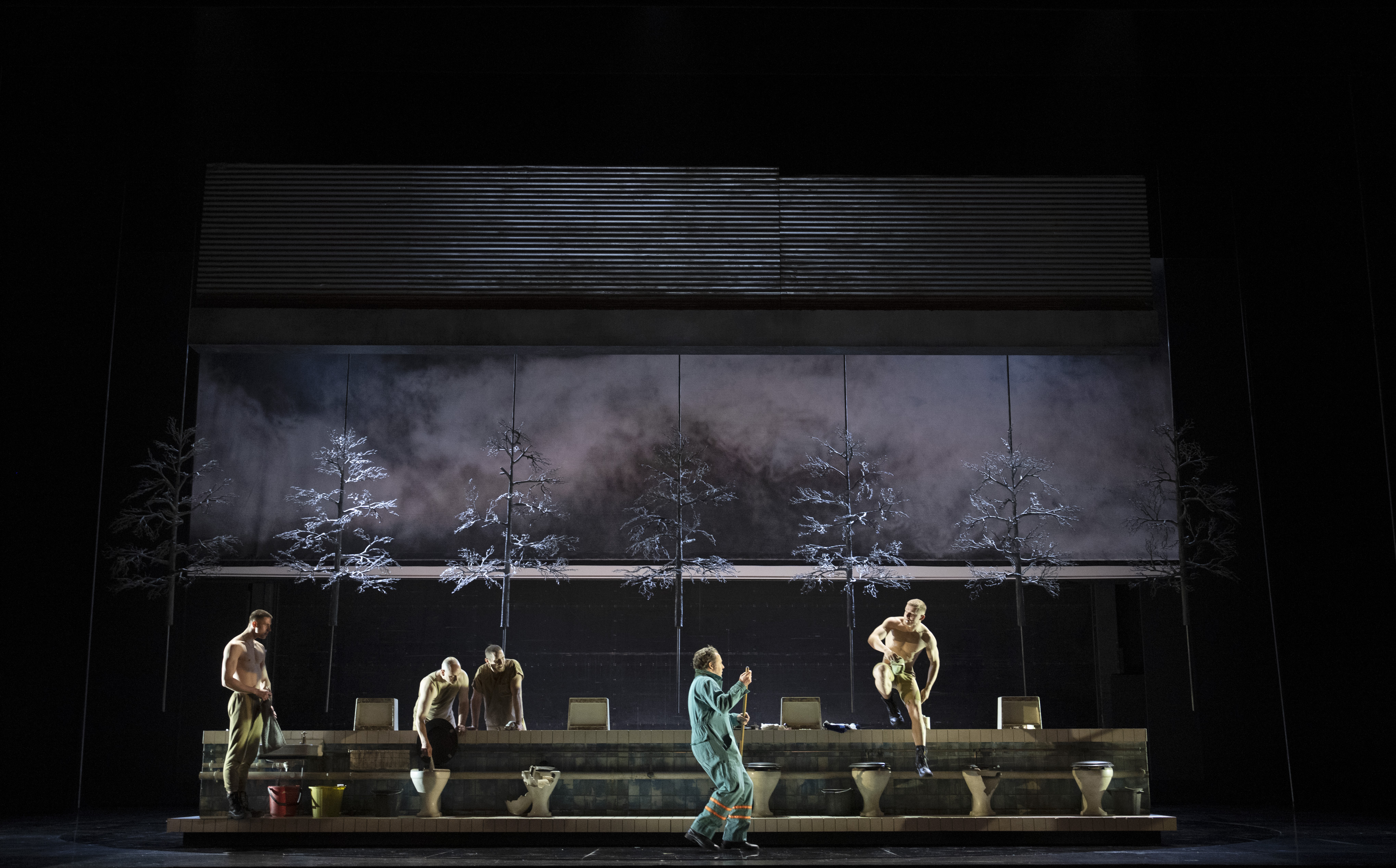
Truth be told, if you spend your time in Wozzeck thinking about a previous production or performance, something has gone wrong (either with you, what is onstage, or both). I did not. In any case, comparisons either with Warner’s first staging or with when I had previously heard Antonio Pappano conduct the work (twenty-one years ago for Keith Warner’s then-new production, in Pappano’s first season at Covent Garden) would largely be meaningless, given the vagaries of memory and my lack of a written record. Deborah Warner in 2023 does not seem to me especially to take a view or standpoint, at least not exclusively. This is not a Wozzeck that (over-)emphasises the brutality of military life and war, or expressionist experimentalism, or any one thing, though many such things are present. The action is already taking place as we take our seats, soldiers (an excellent troupe/troop of actors) relieving themselves in various ways, cleaning up, doing very much what soldiers do in barracks. That establishes an expectation of realism which is not entirely fulfilled, but rather is supplemented, so that as the action develops, as different standpoints are afforded by the work (and probably its creator), we have opportunity to take them too. Everything takes place more or less where one might expect, but there are always refreshing touches of set design, costume, lighting, or detailed Personenregie – let alone the musical performances – to enable us to take a fresh look and listen. The drama unfolds, with great immediacy, yet always it feels that this is ultimately Wozzeck rather than ‘Deborah Warner’s Wozzeck’, whether that feeling, even that possibility, be a fond illusion or otherwise. Different settings for different scenes – no fewer than fifteen of them – present themselves without fussiness or fetishisation: this is a light, enabling, generous realism that can shade almost imperceptibly into other, complementary aesthetics as required. Credit is surely due both to the design team and to the Royal Opera House’s technicians and actors, who accomplished this feat with such apparent ease. Rehearsal surely paid off.


Slightly stylised trees, Cross-like, hint at Wozzeck’s fate, albeit without redemption, but also at a natural world beyond that neither knows nor cares, yet in some sense frames tragedies that lie in stark contrast, being entirely the creation of man. There remains a Romantic desire to escape this miserable world, even if only to Berg’s family estate (Berghof) in Carinthia. Like so much else, though, it is not possible. The blood-red moon and the black, unfathomable lake dominate our vision and consciousness as natural and human boundaries. And finally, in that ultimate, heartbreaking scene of horror: the child turns to the wall in front of which the other children have just been playing, to see painted on it the news they have so cruelly, carelessly delivered. His mother is dead. He turns around and walks off, alone. The drama stops, silence cruelly denied by some idiot’s premature applause—but even that could not quite break the punch to the solar plexus. 

Much of that is, of course, a musical punch. Pappano really seems to be at his best right now. Shortly after thinking his Turandot perhaps the best I had heard from him, I found this Wozzeck at least close to equal, and in ways that surprised me. Without wishing to play that game of illusory comparisons, however tempting, I found this an infinitely more engaging experience than in 2002. Often quite extraordinary orchestral precision, for which one must of course above all credit the orchestra itself, laid bare the framework of closed forms in themselves, their multifarious musical procedures objects of an almost yet not quite Neue Sachlichkeit fascination, but also showed them to be the engines of a dramatic progression that, however Wagnerian it may often sound, is at least as much an alternative to Wagner’s method. There were wrenching, late-Romantic passages, of course, precisely where one would need and expect them, but this was also a musical drama that prefigured Hindemith, Weill, perhaps even Berg’s own teacher, Schoenberg. This was not always a Wozzeck that rose from the bass line, though sometimes it did, but it hinted more than usual at Berg’s later writing, whilst also suggesting an earlier, almost Mendelssohnian Romanticism. Like Warner’s production, it afforded different standpoints, without sounding merely sectional. 

I have been fortunate to see some extremely fine Wozzecks in those years since my first encounter (Andrew Shore on that first encounter included). Christian Gerhaher’s thoughtful, collegial approach, placing himself and his character at the dramatic hub, gaining meaning as much from interaction with colleagues as from his considered yet apparently spontaneous way with the text, has nothing to fear from any of them. His performance, worlds away, as is proper, from the beauties of his celebrated Wolfram, was yet equally well judged. Indeed, I wonder whether it heralds a new chapter in his career. For now, though, it will more than do in and of itself.


Wozzeck, Marie (Anja Kampe)

There was splendid chemistry with his Marie, Anja Kampe. I was about to say ‘we tend…’, but should really only speak for myself: I tend often somewhat to overlook the tragedy of Marie’s death, so overwhelmed am I by that of Wozzeck. Here I felt greater parity, doubtless a matter of Warner’s Personenregie but also of Kampe’s portrayal. (It is more or less impossible for an outsider to distinguish between the two.) This important corrective was brought into further relief by Anna Picard’s excellent programme note on ‘Maria and her World’, whose closing words seem very much to refer to what we saw and heard: ‘She is no Kundry. Neither is she a Judith or the hysterical Woman in Marie Pappenheim and Arnold Schoenberg’s monodrama, Erwartung. Her murder is not dressed up as a form of release for Wozzeck or a point of debate. It is simply a domestic tragedy of a very ordinary, and ever modern, kind.’ Which also brings us back to Gerhaher’s Wozzeck, for his very haplessness – what art lay in that – also contributed to that very non-release, felt (at least by me) more emphatically than I can recall.


Captain (Peter Hoare), Wozzeck

All in the cast contributed to the greater dramatic (and musical) whole, so much as to suggest unusually fruitful close collaboration between all concerned. Sam Furness’s Andres surprised me, not least because I often find myself wondering where the role went, thinking it smaller than I had expected. Not here: this was a character sympathetic to Wozzeck who yet had his own story to tell. Likewise Rosie Aldridge’s spirited Margret, whose spot in the second tavern scene almost had time stand still as the world disintegrated around her. Peter Hoare’s Captain and Brindley Sherratt’s Doctor made a sharply etched pair: guilty, yet not guilty, like all in the world we saw. Well, perhaps not quite all, for it is difficult to find any grounds to absolve the Drum Major, here given an appropriately nasty, bullying, yet finely sung performance by Clay Hilley. William Spaulding's Royal Opera Chorus was on outstanding form too. 

What, then, should a Wozzeck accomplish? There can be no definitive answer, no more than for any artwork in performance. Different productions, different performances, different audiences will all render such categorical statements in vain. If I have learned one thing over the past thirty years, it will be that. That said, if one does not emerge from a performance convinced that it is one of the greatest of all operas – ranking beyond that is a mere parlour game – it will have been in vain. My first experience was not; nor, emphatically was this: a searing and strangely refreshing Wozzeck, which I hope and intend to revisit soon.


Saturday, 6 August 2022

Bayreuth Festival (4): Götterdämmerung, 5 August 2022


Festspielhaus

Siegfried – Clay Hilley
Gunther – Michael Kupfer-Radecky
Alberich – Olafur Sigurdarson
Hagen – Albert Dohmen
Brünnhilde – Iréne Theorin
Gutrune – Elisabeth Teige
Waltraute – Christa Meyer
First Norn – Okka von der Damerau
Second Norn – Stéphanie Müther
Third Norn – Kelly God
Woglinde – Lee-an Dunbar
Wellgunde – Stephanie Houtzeel
Flosshilde – Katie Stevenson
Grane – Igor Schwab

Valentin Schwarz (director)
Andrea Cozzi (designs)
Andy Besuch (costumes)
Konrad Kuhn (dramaturgy)
Reinhard Traub (lighting)
Luis August Krawen (video)

Bayreuth Festival Chorus (chorus master: Eberhard Friedrich)
Bayreuth Festival Orchestra
Cornelius Meister (conductor)


Valentin Schwarz’s Ring ends more or less where it began, bar curtain-calls in which the long-awaited appearance of Schwarz and his team was greeted by the most intensive booing I have ever heard. I suppose a ‘cyclical’ turn will appeal to some who insist on referring to the Ring as a ‘cycle’, when it is nothing of the sort. Even those, however, who discern some kind of return at the close will have wanted a little more for their money than a hasty, borderline-cynical return of dual umbilical chord babies on video, and, prior to that, of a swimming pool for the Rhine.

Schwarz’s unwillingness or inability to formulate any kind of concept, let alone to present it successfully, has long since had hopes for drama run out of steam. Unwillingness—let us be charitable—to carry though any coherent correspondence between objects, themes, even often characters, leaves us with an incoherence that does not register as an aesthetic challenge, but simply as a careless mess. Siegfried apparently forgot to take Notung with him—or rather, the director forgot that he should. It was there, but Brünnhilde kept it, storing up various trouble for a final scene to the first act. This is not a matter of highlighting contradictions, already existing or even newly created. It is not freely associating; indeed, it is barely associating at all. It seems to speak more than anything of lack of acquaintance with Wagner’s work and—which may or may not be fair—sheer laziness. Like a child with an extremely limited attention span, Schwarz presents something, tires of it, presents a new thing without bothering to connect it to the previous thing, and continues. Occasionally, some older things return, yet neither with dramatic reason nor insight. To list them is almost the only thing one can do, given such absence of the conceptual; but it quickly becomes tedious, so I shall try to remain (relatively) selective.

The dark-haired boy we first saw in Das Rheingold shooting others with a water-pistol at the swimming pool seems in some sense to have become the gold, the ring, young Hagen, and now—oddly, having aged far faster than everyone else—‘old’ Hagen. A girl, who may or may not be the same as one also marked out at the swimming pool, who in turn may or may not be the same as the one Erda a little later seemed keen to protect, seems at times to take on the mantle of the ring, although there is also from time to time a ring too (which, given generally dim lighting, most of us can barely see). What we are supposed to make of that girl’s disappearance during the final scene, or indeed anything much in a scene that sadly had many in the audience laughing at its sheer ineptitude, I have no idea. Hagen’s return right at the end, stumbling on to shout ‘Zurück vom Ring’ (is he advising people to stay away from himself?) and then stumbling back off again, was not the least embarrassing episode in a renewed, though hardly rejuvenated, string of scenic non sequiturs.

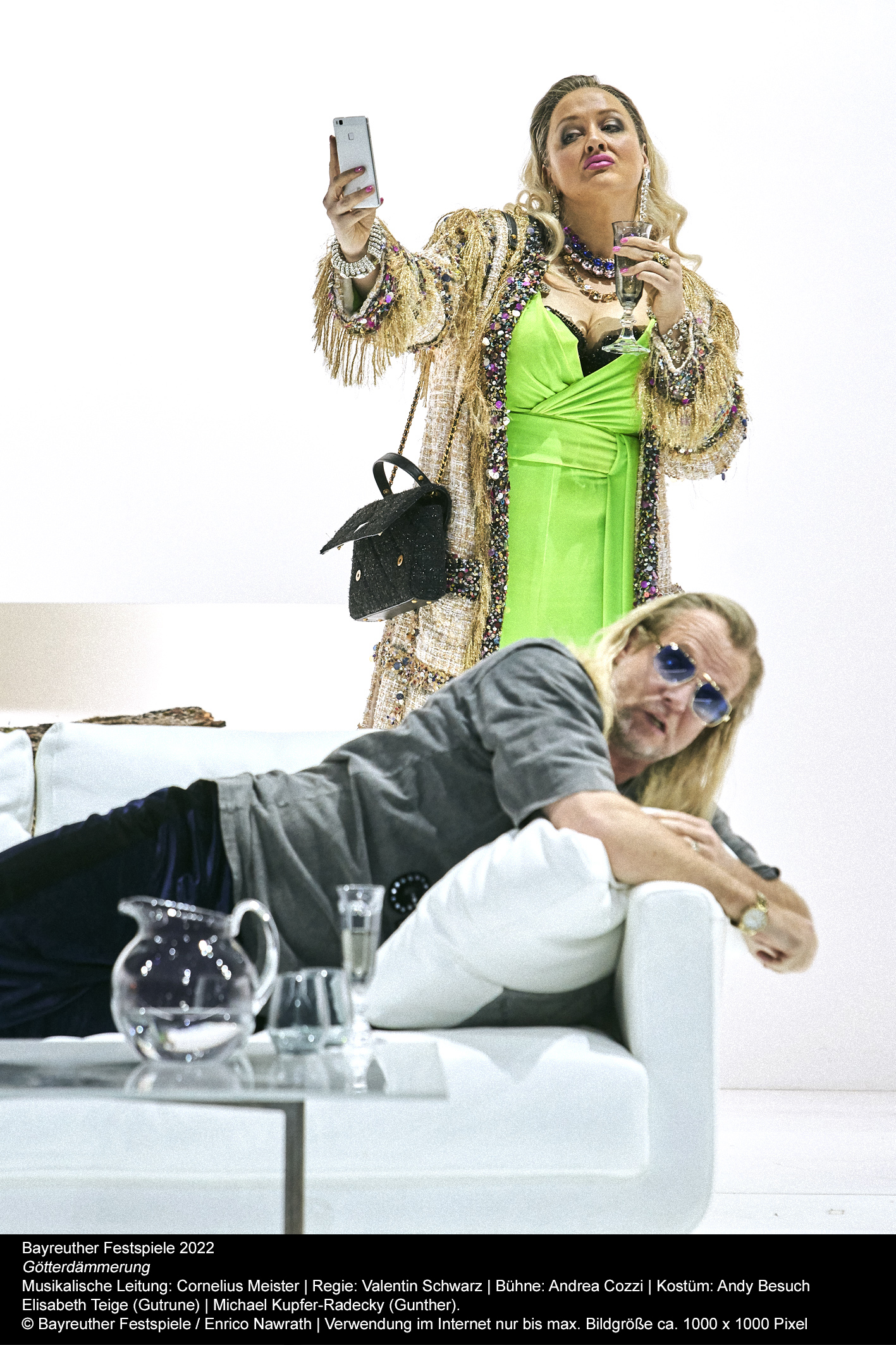
Personal assistant Grane is still around too. It is hardly unusual for the gods to have nothing god-like to them at any stage whatsoever, though such is at best a one-sided view. Rarely if ever before, though, can they have been so recklessly divested of all character, even much in the way of motivation, and for that to have been the fate of dwarves, giants, heroes, and humans too. Turning a horse into a man in a suit does not seem much compensation, or even relevant. Anyway, Grane goes with Siegfried into the world (actually, back to part of Fafner’s house, I think) to encounter a Gunther who slightly resembles Peter Stringfellow or even Jimmy Savile, but whose inspiration a German friend tells me is a trashy television series called Die Geissens – eine schrecklich glamouröse Familie. Gunther wears a sparkly top that asks ‘Who the fuck is Grane?’ Quite, though one might ask that about anyone here, really. Grane is later beaten to something not a million miles from horsemeat. Gunther leaves the carrier bag with pieces of his body by the pool for Brünnhilde in pink dressing gown eventually to pick up Grane’s head to sing to. The unfortunate image resembles Golden Girl Rose Nylund doing a turn as Salome on her way to collect midnight cheesecake, albeit with none of the fun or interest that might entail.


But poor Brünnhilde (seriously). She too has been subjected to pretty horrific, all too casual abuse, seemingly to no end other than as something else to do (and not in a Clockwork Orange sort of way either). How much, if at all, violence towards women should be depicted on stage (or screen), especially by men, is of course very much a live topic at the moment. There may be no definitive answer, yet it is hardly a question simply to be ignored or, worse, trivialised. So many important questions, moreover, are treated similarly. Alberich’s alleged inability to father Hagen—‘it is not entirely clear’, writes dramaturge Konrad Kuhn in the programme, ‘how he could have conceived a son’—is at best problematical. ‘How,’ asks Kuhn, ‘did this “nasty”, this “hairy and hideous imp” … beget a child with the proud Queen Grimhild?’ Perhaps using the power he has amassed by foreswearing love? There is not much of a mystery, here, really, let alone inconsistency, though what form of power is of course open to speculation and interpretation. Instead, though, we end up with something that trivially disrupts the very parallelism the production seems to wish to construct between Wotan and Alberich, and arguably has more than a pinch of ableism to it. (Some might argue racism too; let us leave that for another day.)

Even Cornelius Meister’s conducting, a solid highlight of the previous three evenings, proved more mixed here. There is no shame in that; many conductors, at the best of times, are more successful in some parts of the Ring than others. That the prologue and first act in particular dragged, often seeming to lie behind whatever notional basic tempo had been set, was nonetheless unfortunate as nonsense upon nonsense unfolded onstage. That episodic quality continued into the second act, received with unusual rapture by the audience, but which to me lunged and lurched too often, making all too little musical sense. The third act, though, was much better, a sense of form as living structure once again imparted. There is no reason to think that the rest of the work will not follow in time. The Bayreuth Festival Orchestra, doubtless understandably, sounded at times tired. As an audience member, one could certainly relate. There were some splendid passages too, but this was not a vintage night for Wagner musically.


If vocal performances did not always reach the heights, nor did they ever fall below a reasonable level. Olafur Sigurdarson’s Alberich and Albert Dohmen’s were typically intelligent portrayals, founded in the poem and employing its musical marriage to considerable effect. Insofar as one could avoid Schwarz’s weird conception of Gunther—was he supposed to be high, or just very, very peculiar?—the same could be said of Michael Kupfer-Radecky in that role. If quality of diction came and went, there was much to appreciate in Iréne Theorin’s Brünnhilde, who managed to maintain a considerable degree of dignity, events around here notwithstanding. Fullness and bloom of voice were often as impressive as her sheer resolve to get on with it. Clay Hilley, a very late substitute as Siegfried, did more than could reasonably be asked of him. Not once did his voice tire; he committed himself with apparently equally enthusiasm to what was going on dramatically. Elisabeth Teige’s Gutrune was not helped by the production—who was?—but was a convincing vocal performance. Waltraute did not suit Christa Mayer quite so much as Fricka, but there was little doubting the quality of verbal response. The Rhinemaidens and Norns were all very good. If the chorus was far from overwhelming in the Vassals’ Scene, perhaps Covid restrictions were still in play; it looked as well as sounded smaller than usual.

It made for a long and dispiriting evening, though. I am only too aware of precedents, of how, say, Patrice Chéreau’s first run met with uproar and incomprehension, proceeding to become perhaps the best loved (and esteemed) Ring of all time. Not having been there, I can only speculate, but many have said it improved radically during its stint, a tribute to Bayreuth’s Werkstatt principle. Perhaps this might too, then; or perhaps I might change my mind and come to recant, as I did with Frank Castorf (parts of whose production I had, though, always admired). No one would be happier than I to admit he was wrong if so. It is far from the case that every idea advanced is unworthy of consideration; the problem more is that the production itself barely deigns to extend that consideration, already having jumped on something else. I think there would have to be a greater willingness, indeed any at all, to extend the frame of reference beyond a rich, unlikeable family. Why should we care, if that is all there is? Characterisation would help, to put it mildly, but so would a sense of the political and indeed the religious—of context whether broadly, specifically, or both (ideally). There is, it seems, no getting around that—and it is unclear why Schwarz, Kuhn, and company are so determined to try.