Showing posts with label Valentin Schwarz. Show all posts

Saturday, 6 August 2022

Bayreuth Festival (4): Götterdämmerung, 5 August 2022


Festspielhaus

Siegfried – Clay Hilley
Gunther – Michael Kupfer-Radecky
Alberich – Olafur Sigurdarson
Hagen – Albert Dohmen
Brünnhilde – Iréne Theorin
Gutrune – Elisabeth Teige
Waltraute – Christa Meyer
First Norn – Okka von der Damerau
Second Norn – Stéphanie Müther
Third Norn – Kelly God
Woglinde – Lee-an Dunbar
Wellgunde – Stephanie Houtzeel
Flosshilde – Katie Stevenson
Grane – Igor Schwab

Valentin Schwarz (director)
Andrea Cozzi (designs)
Andy Besuch (costumes)
Konrad Kuhn (dramaturgy)
Reinhard Traub (lighting)
Luis August Krawen (video)

Bayreuth Festival Chorus (chorus master: Eberhard Friedrich)
Bayreuth Festival Orchestra
Cornelius Meister (conductor)


Valentin Schwarz’s Ring ends more or less where it began, bar curtain-calls in which the long-awaited appearance of Schwarz and his team was greeted by the most intensive booing I have ever heard. I suppose a ‘cyclical’ turn will appeal to some who insist on referring to the Ring as a ‘cycle’, when it is nothing of the sort. Even those, however, who discern some kind of return at the close will have wanted a little more for their money than a hasty, borderline-cynical return of dual umbilical chord babies on video, and, prior to that, of a swimming pool for the Rhine.

Schwarz’s unwillingness or inability to formulate any kind of concept, let alone to present it successfully, has long since had hopes for drama run out of steam. Unwillingness—let us be charitable—to carry though any coherent correspondence between objects, themes, even often characters, leaves us with an incoherence that does not register as an aesthetic challenge, but simply as a careless mess. Siegfried apparently forgot to take Notung with him—or rather, the director forgot that he should. It was there, but Brünnhilde kept it, storing up various trouble for a final scene to the first act. This is not a matter of highlighting contradictions, already existing or even newly created. It is not freely associating; indeed, it is barely associating at all. It seems to speak more than anything of lack of acquaintance with Wagner’s work and—which may or may not be fair—sheer laziness. Like a child with an extremely limited attention span, Schwarz presents something, tires of it, presents a new thing without bothering to connect it to the previous thing, and continues. Occasionally, some older things return, yet neither with dramatic reason nor insight. To list them is almost the only thing one can do, given such absence of the conceptual; but it quickly becomes tedious, so I shall try to remain (relatively) selective.

The dark-haired boy we first saw in Das Rheingold shooting others with a water-pistol at the swimming pool seems in some sense to have become the gold, the ring, young Hagen, and now—oddly, having aged far faster than everyone else—‘old’ Hagen. A girl, who may or may not be the same as one also marked out at the swimming pool, who in turn may or may not be the same as the one Erda a little later seemed keen to protect, seems at times to take on the mantle of the ring, although there is also from time to time a ring too (which, given generally dim lighting, most of us can barely see). What we are supposed to make of that girl’s disappearance during the final scene, or indeed anything much in a scene that sadly had many in the audience laughing at its sheer ineptitude, I have no idea. Hagen’s return right at the end, stumbling on to shout ‘Zurück vom Ring’ (is he advising people to stay away from himself?) and then stumbling back off again, was not the least embarrassing episode in a renewed, though hardly rejuvenated, string of scenic non sequiturs.

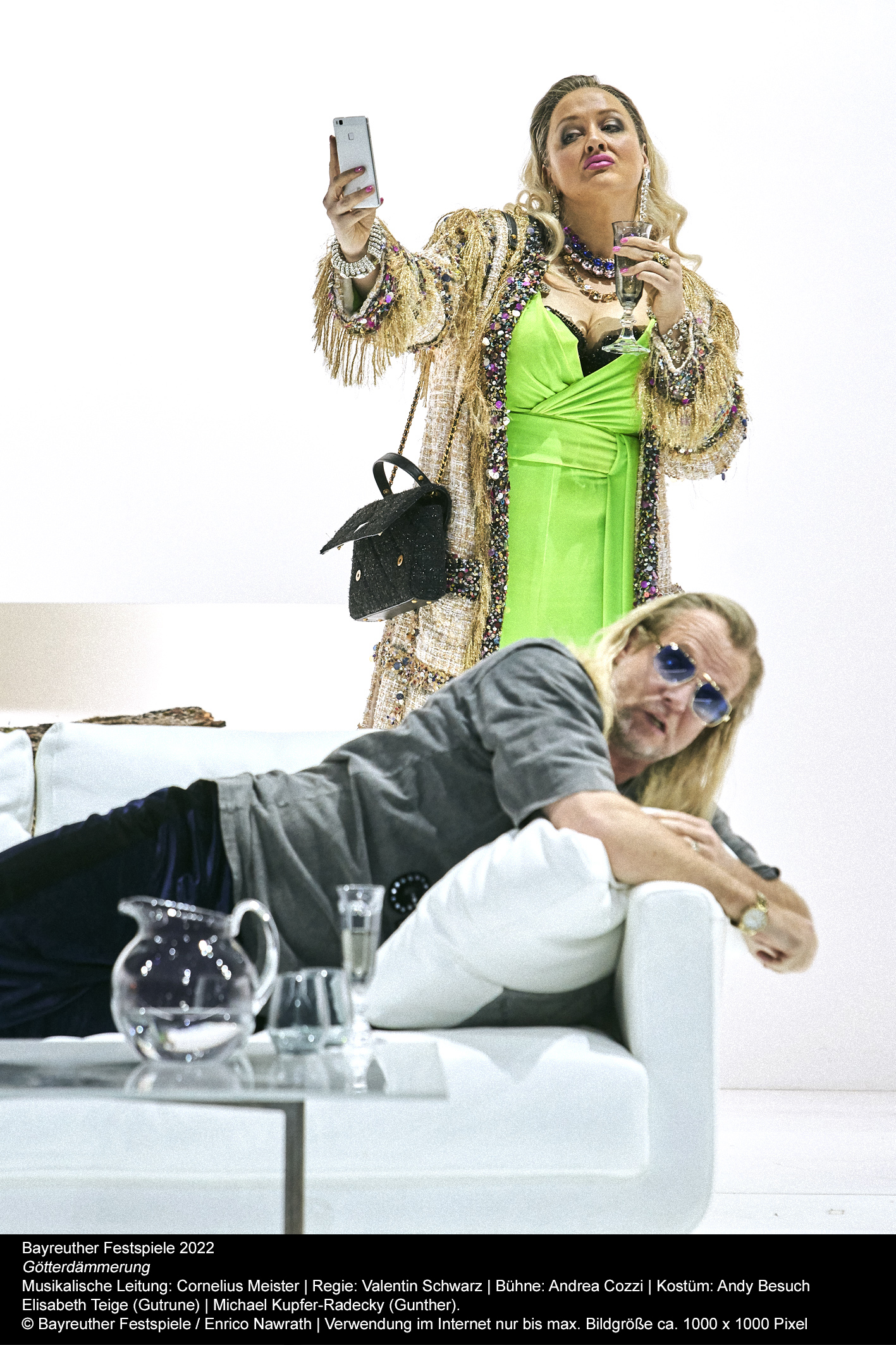
Personal assistant Grane is still around too. It is hardly unusual for the gods to have nothing god-like to them at any stage whatsoever, though such is at best a one-sided view. Rarely if ever before, though, can they have been so recklessly divested of all character, even much in the way of motivation, and for that to have been the fate of dwarves, giants, heroes, and humans too. Turning a horse into a man in a suit does not seem much compensation, or even relevant. Anyway, Grane goes with Siegfried into the world (actually, back to part of Fafner’s house, I think) to encounter a Gunther who slightly resembles Peter Stringfellow or even Jimmy Savile, but whose inspiration a German friend tells me is a trashy television series called Die Geissens – eine schrecklich glamouröse Familie. Gunther wears a sparkly top that asks ‘Who the fuck is Grane?’ Quite, though one might ask that about anyone here, really. Grane is later beaten to something not a million miles from horsemeat. Gunther leaves the carrier bag with pieces of his body by the pool for Brünnhilde in pink dressing gown eventually to pick up Grane’s head to sing to. The unfortunate image resembles Golden Girl Rose Nylund doing a turn as Salome on her way to collect midnight cheesecake, albeit with none of the fun or interest that might entail.


But poor Brünnhilde (seriously). She too has been subjected to pretty horrific, all too casual abuse, seemingly to no end other than as something else to do (and not in a Clockwork Orange sort of way either). How much, if at all, violence towards women should be depicted on stage (or screen), especially by men, is of course very much a live topic at the moment. There may be no definitive answer, yet it is hardly a question simply to be ignored or, worse, trivialised. So many important questions, moreover, are treated similarly. Alberich’s alleged inability to father Hagen—‘it is not entirely clear’, writes dramaturge Konrad Kuhn in the programme, ‘how he could have conceived a son’—is at best problematical. ‘How,’ asks Kuhn, ‘did this “nasty”, this “hairy and hideous imp” … beget a child with the proud Queen Grimhild?’ Perhaps using the power he has amassed by foreswearing love? There is not much of a mystery, here, really, let alone inconsistency, though what form of power is of course open to speculation and interpretation. Instead, though, we end up with something that trivially disrupts the very parallelism the production seems to wish to construct between Wotan and Alberich, and arguably has more than a pinch of ableism to it. (Some might argue racism too; let us leave that for another day.)

Even Cornelius Meister’s conducting, a solid highlight of the previous three evenings, proved more mixed here. There is no shame in that; many conductors, at the best of times, are more successful in some parts of the Ring than others. That the prologue and first act in particular dragged, often seeming to lie behind whatever notional basic tempo had been set, was nonetheless unfortunate as nonsense upon nonsense unfolded onstage. That episodic quality continued into the second act, received with unusual rapture by the audience, but which to me lunged and lurched too often, making all too little musical sense. The third act, though, was much better, a sense of form as living structure once again imparted. There is no reason to think that the rest of the work will not follow in time. The Bayreuth Festival Orchestra, doubtless understandably, sounded at times tired. As an audience member, one could certainly relate. There were some splendid passages too, but this was not a vintage night for Wagner musically.


If vocal performances did not always reach the heights, nor did they ever fall below a reasonable level. Olafur Sigurdarson’s Alberich and Albert Dohmen’s were typically intelligent portrayals, founded in the poem and employing its musical marriage to considerable effect. Insofar as one could avoid Schwarz’s weird conception of Gunther—was he supposed to be high, or just very, very peculiar?—the same could be said of Michael Kupfer-Radecky in that role. If quality of diction came and went, there was much to appreciate in Iréne Theorin’s Brünnhilde, who managed to maintain a considerable degree of dignity, events around here notwithstanding. Fullness and bloom of voice were often as impressive as her sheer resolve to get on with it. Clay Hilley, a very late substitute as Siegfried, did more than could reasonably be asked of him. Not once did his voice tire; he committed himself with apparently equally enthusiasm to what was going on dramatically. Elisabeth Teige’s Gutrune was not helped by the production—who was?—but was a convincing vocal performance. Waltraute did not suit Christa Mayer quite so much as Fricka, but there was little doubting the quality of verbal response. The Rhinemaidens and Norns were all very good. If the chorus was far from overwhelming in the Vassals’ Scene, perhaps Covid restrictions were still in play; it looked as well as sounded smaller than usual.

It made for a long and dispiriting evening, though. I am only too aware of precedents, of how, say, Patrice Chéreau’s first run met with uproar and incomprehension, proceeding to become perhaps the best loved (and esteemed) Ring of all time. Not having been there, I can only speculate, but many have said it improved radically during its stint, a tribute to Bayreuth’s Werkstatt principle. Perhaps this might too, then; or perhaps I might change my mind and come to recant, as I did with Frank Castorf (parts of whose production I had, though, always admired). No one would be happier than I to admit he was wrong if so. It is far from the case that every idea advanced is unworthy of consideration; the problem more is that the production itself barely deigns to extend that consideration, already having jumped on something else. I think there would have to be a greater willingness, indeed any at all, to extend the frame of reference beyond a rich, unlikeable family. Why should we care, if that is all there is? Characterisation would help, to put it mildly, but so would a sense of the political and indeed the religious—of context whether broadly, specifically, or both (ideally). There is, it seems, no getting around that—and it is unclear why Schwarz, Kuhn, and company are so determined to try.


Thursday, 4 August 2022

Bayreuth Festival (3): Siegfried, 3 August 2022


Festspielhaus


Siegfried – Andreas Schager
Mime – Arnold Bezuyen
Wanderer – Tomasz Koniezcny
Alberich – Olafur Sigurdarson
Fafner – Wilhelm Schwinghammer
Erda – Okka von der Damerau
Brünnhilde – Daniela Köhler
Woodbird – Alexandra Steiner
Young Hagen – Branko Buchberger
Grane – Igor Schwab

Valentin Schwarz (director)
Andrea Cozzi (designs)
Andy Besuch (costumes)
Konrad Kuhn (dramaturgy)
Reinhard Traub (lighting)

Bayreuth Festival Orchestra
Cornelius Meister (conductor)

This Siegfried made for pretty miserable music drama, I am afraid, the considerable qualities of the music ‘half’ notwithstanding. In a peculiar way, Wagner’s vision was vindicated. His works are not operas, nor are they intended to be. They may well impress in concert performances or in audio-only experiences at home—phenomena worthy of greater attention—but they need to impress musically and dramatically in the theatre, the whole so much more than the sum of its parts. One never knows what might be pulled out of the hat for Götterdämmerung, but it is difficult to imagine that it can truly redeem the incoherent, often tedious parade Valentin Schwarz has set before us so far. 

Incoherence may be the root problem, or at least a problem that takes us closer to the root. Some of the ideas set forth—some, rather than all—may well have merit, yet rarely do Schwarz and his team seem to have the persistence or even the attention-span necessary to pursue them. A claim might be put forward, I suppose, for an aesthetic of incoherence. Dramaturge Konrad Kuhn makes the claim in a programme note that ‘time and again, we encounter inconsistencies and contradictions in the Ring’. I am tempted to reply ‘speak for yourself’, but to an extent, it may well depend what one means. Rarely if ever are they straightforwardly ‘inconsistencies and contradictions’. The different standpoints presented, the dramatic and intellectual antagonisms put forward, the questions presented that are bigger than any possible attempt at answering them: these are part of what makes the Ring so extraordinary, so powerful, so life-changing a work. They are not signs of ineptitude, of carelessness, or some other shortcoming. This frankly slapdash attitude, however, does seem to inform what is set before us. It is not a matter of taking Wagner to task, of seeing how far a line may be pushed, but apparently of becoming bored with him and the challenges he sets us. It is a point of view, I suppose, or better an attitude or malaise; unsurprisingly, it offers little support for even a one-sided attempt to stage his most ambitious work. 

Siegfried opens in the same house in which we encountered Siegmund and Sieglinde, neither the first nor the last time when we return to the same location yet seek in vain a reason for having done so. Mime has done it up for Siegfried’s birthday party, ready to present a puppet show. If, like me, you are always intrigued by the possibilities of puppets and puppetry, you might have thought this augured well, I suspect you would soon have lost interest, when they were barely used—though perhaps not quite as quickly as the director. Having resolved to do without a sword in Die Walküre, or indeed Das Rheingold, Schwarz has Siegfried find one here concealed within Mime’s walking frame (which he does not appear to need). Since it is already there, never having been broken, the not inconsiderable time in words and music taken to reforge the sword requires something else on stage. Alas, none is forthcoming.

The second act takes place in Fafner’s expensive looking residence, irrespective of the changes in location required. Again, the starting idea does not seem unpromising. Various claimants to his wealth come to visit the giant-dragon (neither, in fact) to persuade him to leave it to them. Wotan, Alberich, Mime, Siegfried (in his way) all pay their house calls. Fafner’s carers do what needs to be done, the theme of abuse continuing to play out in his treatment of a female nurse who turns out to be the Woodbird. The other carer seems to be an adolescent version of the dark-haired boy from Das Rheingold. My speculation that he might turn out to be Hagen has been vindicated, though the symbolic identification Schwarz made between him and either the gold or the ring appears to have been dropped entirely. Siegfried has his sword but cannot be bothered to use it to kill Fafner; instead he throws him out of his chair and has Hagen strangle him to finish him off. Siegfried does use it on Mime, though. It looks at one point as if Siegfried and the Woodbird might go off together to further one part of his education, but instead he and Hagen run out together into the world, whilst the Woodbird returns to drop an item of clothing on top of her abuser as the curtain falls.


What should probably be the most decisive scene in the entire Ring, Wotan’s abandonment of Fate, quasi-identified with Erda, went for almost nothing, at least scenically. Another character, female, was present: a Valkyrie, a Norn, the girl Erda was chaperoning in Das Rheingold? Who knows? Increasingly, I was tempted also to ask: who cares? Hagen mostly sticks with Siegfried, who bullies the poor boy semi-insistently; until he does not, that is, disappearing at some point—I did not notice when—following the ascent to the mountain-top, which confusingly appears to be an adapted Valhalla. Nothing much else happens thereafter, though Grane-as-PA returns to compliment Brünnhilde on her new hat. Eventually, the work comes to a close.

Again, Cornelius Meister and the Festival Orchestra impressed. Meister’s discernment of the Ring’s architecture comes through unfailingly yet unobtrusively. If only some of this could have rubbed off on the production team. (I think as much of the dramaturge’s silly claim about inconsistency as in the inconsistencies and non sequiturs that play out visually. How well do they actually know the work?) Dynamic range was considerable, always with good reason, and never to the detriment of the singers. The theatre and covered pit help, of course, but they can only do so much. 

Andreas Schager’s Siegfried is for many of us a known quantity. On first hearing, it seems miraculous: at last someone who can sing this well-nigh impossible role and draw on seemingly infinite vocal resources to do so. None of that has changed—and we should all be thankful that we need no longer endure performances from singers who are simply not up to the job. Is it unfair to wish for something a little more, some greater verbal subtlety? Probably, yet in the absence of anything compelling from the production, I found myself doing so. Almost certainly, in fact, given the onstage chemistry shown with Arnold Bezuyen’s intelligent, wheedling Mime—who, for once, one never started wishing would emerge victorious.  Tomasz Koniezcny and Olafur Sigurdarson continued to prove themselves as the Wanderer and Alberich, the latter in particular never putting a dramatic foot wrong. This is fine singing, by any standards. 

I initially thought Wilhelm Schwinghammer’s Fafner a bit underpowered, but then realised that was not his fault; the lack of a cave and thus of any sort of projection just leaves him to himself. It is a perfectly intelligent performance on its own terms, let down by the staging. Okka von der Damerau’s Erda likewise deserved better, much better, yet could not be faulted on vocal terms. Likewise Alexandra Steiner’s Woodbird and Daniela Köhler’s Brünnhilde, whose gleaming tone and sheer relish for what promised to be new life offered both succour and inspiration. 

Wednesday, 3 August 2022

Bayreuth Festival (2): Die Walküre, 1 August 2022


Festspielhaus


Siegmund – Klaus Florian Vogt
Hunding – Georg Zeppenfeld
Wotan – Tomasz Konieczny, Michael Kupfer-Radecky
Sieglinde – Lise Davidsen
Brünnhilde – Iréne Theorin
Fricka, Schwertleite – Christa Mayer
Gerhilde – Kelly God
Ortlinde – Brit-Tone Müllertz
Waltraute – Stéphanie Müther
Helmwige – Daniela Köhler
Siegrune – Stephanie Houtzeel
Grimgerde – Marie Henriette Reinhold
Rossweiße – Katie Stevenson
Grane – Igor Schwab

Valentin Schwarz (director)
Andrea Cozzi (designs)
Andy Besuch (costumes)
Konrad Kuhn (dramaturgy)
Reinhard Traub (lighting)

Bayreuth Festival Orchestra
Cornelius Meister (conductor)

The boos are getting louder: not, I think, for the musicians, but for the production of Valentin Schwarz, who has yet to appear for a curtain-call. That need be no bad thing artistically, though the practice itself is fascistic; should a bourgeois audience feel satisfied with what it has consumed, it will be a disturbing outcome for art. Here, though, the open mind I am endeavouring to keep concerning Schwarz’s production is struggling a little. As a distinguished Wagner scholar said to me when I met him afterwards, ‘It is getting worse.’ On the basis of what I saw in Die Walküre, I had little choice but to agree.

Short of the framing of the action as a saga of twins, which here seems more assumed to continue from Das Rheingold than illustrated, there is little at all to point to other than strange departures from Wagner’s drama, which taken separately or together fail to amount to anything very much. Siegmund and Sieglinde are, I think, taken back by their self-discovery to their childhood, joined by ‘symbolic’ star-children. (Either that, or they fantasise about the children they will have, but I think it is the former.) There is nothing wrong with that; it makes sense. But for it to have taken place in Wotan’s godly quarters seems peculiar—imagine Fricka’s thoughts on that—as well as quite at odds with what they have just sung, without obvious reason.

 It is later implied that Sieglinde, heavily pregnant throughout the first two acts, is carrying Wotan’s baby. At least I think that is why he ‘comforts’ her, whilst Siegmund and Hunding seek one another, pulling down her tights and apparently attempting to deliver the child. If not, it is a straightforward case of sexual assault, although I suppose it must have been anyway earlier. My guess would be that this is intended to enhance the parallelism between Wotan and Alberich, that both will be found to have produced children, Siegfried and Hagen, through rape. But where that leaves Siegmund, goodness knows: St Joseph with a twist, it would seem. Where, though, does that leave Hunding? He must surely have noticed. It is difficult not to conclude that Wagner’s plot would have been better left as it was.

In between, Freia’s funeral, or at least her lying in rest, had taken place. There were some germs of decent, if ultimately rather incidental ideas, here. Assuming we are still to take her as goddess of love, her death would have obvious implications (although its timing is arguably strange, given that Siegmund and Sieglinde have just met). In a Mafia-film-style mise-en-scène, a few people come to pay their respects, whilst Wotan and Fricka have their decisive confrontation. (Brünnhilde spends some of that scene in what appears to be a greenhouse. I don’t know either.) Hunding petitions the gods in person, an interesting touch. That Fricka returns at the end of the third act, after Wotan has put Brünnhilde to sleep (and made, you guessed it, his incestuous urges all too clear), suggests that she is confident in her triumph. She even wheels on a drinks trolley and offers Wotan a celebratory glass. He declines, though, so in the absence of a spear—just nothing at all, throughout—Fricka clinks together the glasses to make the requisite noise.


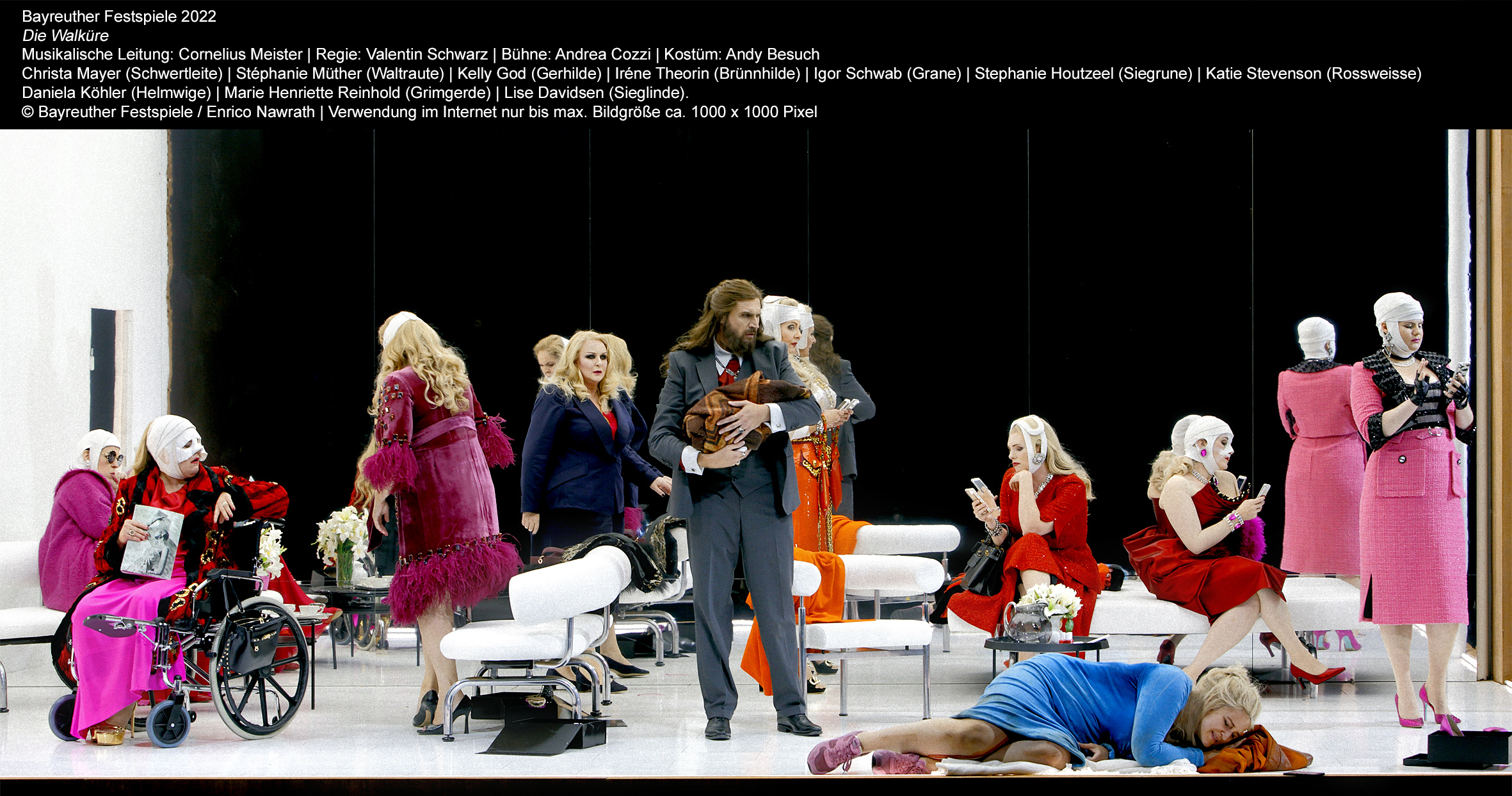
I am afraid I have no idea at all what happens in the Ride of the Valkyries. It veered all over the place—at least the BBC light entertainment place—from Dr Who to The Benny Hill Show to Casualty, with an apparently accidental turn for Diana Dors’s gender-reversal ‘The Worm that Turned’ series for The Two Ronnies. Sometimes the Valkyries were in charge, sometimes Wotan’s guards. There was a great deal of mobile telephone use. Perhaps it is time to call for a moratorium on those devices onstage, unless the director has a clear idea what they are for. As things stand, they seem to have become the new suitcases.

Lack of objects when called for and introduction of obscure alternatives does little to help. I have already mentioned the lack of a spear or any substitute.   Just as the role of Das Rheingold’s dark-haired boy is more unclear than ambiguous, so is that of the strange pyramid-in-a-box, earlier seen and quasi-worshipped upon the gods’ entry into Valhalla as if a grail-refugee from a production of Parsifal. It now reappears as a repository for a pistol. Sometimes a pistol is a Notung equivalent, sometimes not; sometimes there are several. None of it makes any sense, really, and try as I might to try to piece together some sort of explanation, I am really on the verge of giving up.

As for Grane’s reincarnation as Brünnhilde’s male, suited personal assistant, it makes even less sense when there have been a few apparently arbitrary visual references to actual horses elsewhere. Finally, there is a strong impression that the strongest acting is brought by the singers themselves to their roles. Personenregie is intermittent at best and sometimes disappears altogether in longer exchanges between characters. I suppose some of these things, minus the lack of Personenregie, might add up to something in retrospect, but I do not feel especially hopeful.

Musically, things are better, often much better. Cornelius Meister continues to impress greatly with his command of structure and detail, conveying and expressing a Wagner melos from the pit that drives and, in many respects, is the action. The sound he drew from the Bayreuth Festival Orchestra—and, I assume, to an extent, the sound its players wished to conjure too—was in some ways distant from that we might recall from old Bayreuth recordings, closer to those of other opera orchestras. Choices seem well justified to me, though, and there is no point merely trying to imitate Karl Böhm—or anyone else, for that matter. There is considerable emotional and conceptual range as the cauldron of Wagner’s Greek Chorus bubbles: quite a difference, alas, from what we see onstage.

Not, however, from what we hear onstage. Lise Davidsen’s Sieglinde was at least the equal of any I have heard. No one seems to have a bad word to say about this extraordinary soprano, and so far there seems no reason for anyone to do so. Her final peroration here, ‘O hehrstes Wunder!...’ was as vocally magnificent, riding the orchestral wave almost like no other, as it was clearly heartfelt, the culmination of a dramatic journey that now must end. Klaus Florian Vogt’s tenor will always divide opinion. Much of that is simply down to taste. Whether one liked his performance or not—and there is no getting away from the fact that its sound is very different from the baritonal Siegmunds we have come to expect—his was certainly a committed and, I think, highly likeable performance. Georg Zeppenfeld’s Hunding offered a masterclass in the role, everything present and correct, both considered and alert to the moment.

Tomasz Konieczny and Michael Kupfer-Radecky shared the role of Wotan, the former having become unable to continue during the second interval. Both gave strong performances, deeply rooted in Wagner’s text; if the ear took a little while to adjust to new sound and delivery, that was a tiny price to pay for so crucial, short-notice a substitution. Christa Mayer’s Fricka was once again first-class, fuller-throated than often one hears, and all the better for it. Iréne Theorin impressed as head Valkyrie, youthfully impetuous and headstrong, yet clearly transformed by what she had witnessed. The rest of her team was cast from depth, including a return for Mayer as Schwertleite. Had this been a concert performance, I suspect it would have moved more than it did in the theatre. This Ring, however, will continue in Wagner’s own theatre.


Monday, 1 August 2022

Bayreuth Festival (1): Das Rheingold, 31 July 2022


Festspielhaus


Wotan – Egils Silins
Donner – Raimund Nolte
Froh – Attilio Glaser
Loge – Daniel Kirch
Fricka – Christa Mayer
Freia – Elisabeth Teige
Erda – Okka von der Damerau
Alberich – Olafur Sigurdarson
Mime – Arnold Bezuyen
Fasolt – Jens-Erik Aasbø
Fafner – Wilhelm Schwinghammer
Woglinde – Lea-ann Dunbar
Wellgunde – Stephanie Houtzeel
Flosshilde – Katie Stevenson

Valentin Schwarz (director)
Andrea Cozzi (designs)
Andy Besuch (costumes)
Konrad Kuhn (dramaturgy)
Reinhard Traub (lighting)
Luis August Krawen (video)

Bayreuth Festival Orchestra
Cornelius Meister (conductor)


In der Erde Tiefe
tagen die Nibelungen:
Nibelheim ist ihr Land.
Schwarzalben sind sie;
Schwarz Alberich hütet’ als Herrscher sie einst!

So begins the Wanderer’s answer to the first of Mime’s three riddles, in which notoriously the dwarf asks his unwelcome visitor questions he hopes will catch him out—they do not—thereby wasting the opportunity to ask the chief of the gods what he, Mime, actually needs to know. Mime has asked which Geschlecht may be found in the earth’s depths. Wotan/the Wanderer tells him: the Nibelungs, that is Mime’s own kin. In response to the third riddle, when Mime asks him which Geschlecht lives in the cloud-hidden heights, the Wanderer, disguised chief of the gods, tells his interlocutor that it is those very gods, continuing, ‘Lichtalben sind sie; Licht-Alberich, Wotan, waltet der Schar.’

If I understand correctly—I should stress that I am writing this immediately after Das Rheingold, with much yet to be revealed—those points in that exchange point to something crucial in understanding Valentin Schwarz’s new Bayreuth production of Wagner’s Ring. That dialectical opposition between Wotan and Alberich, ‘white’ and ‘black’ Alberich—which is certainly the meat of the Rheingold drama, and in many ways underpins all that is to come—is taken a little more literally, rendering them twins. The Rheingold prologue is perhaps as close as we shall come to a musical presentation of the ‘spontaneous generation’ Wagner’s contemporary Karl Marx hymned in his long unpublished, Feuerbachian Paris Manuscripts: Generatio æquivoca is the only practical refutation’ of the theological ‘theory of creation,’ The ‘abstraction’ of the old way of thinking of oneself as apart from Nature overcome, ‘for you too are Nature and man’.  (Wagner would have read Arthur Schopenhauer’s description ‘spontaneity of the world of Nature’ in Parerga and Paralipomena when working on the score, but the roots of this idea unquestionably extend back to the Young Hegelian inheritance he and Marx—‘black’ and ‘white’ Marx?—found in Ludwig Feuerbach and other writers of the 1840s.)

Luis August Krawen’s opening video projection makes it very clear that we were in the waters (‘in the river Rhine’, as Anna Russell would have reminded us, ‘in it!’) so as to fit any number of creation or non-creation myths. What proceeds differently here is the vision of twin umbilical chords, leading us to twin babies—who, as the saga develops, we associate with Wotan and Alberich. At any rate, there are birth, kinship, and rivalry: a reminder that Mime’s ‘Geschlecht’, often translated as ‘race’, has here more to do with genealogy, with family, house, and lineage. Schwarz not only takes Wagner’s three lineages—dwarves, giants, and gods—as the basis of the drama to come, but takes Wagner further than himself by rendering at least two of them estranged branches of the same clan: Cain and Abel, Esau and Isaac, Wotan and Alberich…

Inheritance, therefore, is fundamental. In an underlining of the family saga element (which, at one level, surely no one could deny) Schwarz has Alberich steal and turn a child from the swimming pool over which the Rhinemaidens (glorified au pairs?) watch over a group of children. Notably, that child is black-haired, as opposed to the blond of the others. One can go down the route of trying to work out precisely what the ‘dark’ child symbolises: the gold, what it is turned into, inheritance? I am not sure that is really the way to go, though. There is a struggle between Black and White Alberich both for that boy and, intermittently, for a blonde girl, which perhaps represents—if at times, a little confusingly—the overall power struggle. Alberich is certainly an outsider and remains so, presumably at some stage cast out. Wotan’s crew is the ‘legitimate’ branch, with a ghastly family (shades of Murdoch, or even Dynasty?) in competition over the spoils and succession. I worry somewhat that the ‘racial’ element of Geschlecht may come to be seen as the point, rather than a metaphor, but perhaps the claim—it certainly has been claimed, if far from convincingly—is that race is the point here. As with much else, we shall see.


There are intriguing elements, for instance the ongoing element of the children ‘leaders’ educating and abusing other children, struggle and oppression already echoing down the ages. Wotan’s ecstasy in his own apparent victory at the close is compelling: high, it would seem, on his own ideology, or at least his own misdeeds. There are others I have yet to understand: why does Erda put in several appearances before her scheduled arrival, just to watch, and why does she walk off with the blonde girl in her care at the end? Is this in some sense a presentiment of Brünnhilde, as the boy might be of Hagen? Again, we shall see. It would be odd to understand everything, or even have much of a developed idea about at this stage. This, after all, is only the
Vorabend, the preliminary evening. Something more strongly political might not be a bad thing, but one might argue much attention, from Patrice Chéreau onwards, has been devoted to that already; perhaps it is time for a shift of emphasis. Again, we shall see.

Conducting anything at all at Bayreuth is a difficult task indeed, even when familiar with the set-up, let alone when not—likewise even when it is a single evening’s work, rather than that of four. Cornelius Meister, who was due to conduct Tristan but now substitutes for Pietari Inkinen, made a better job of Das Rheingold than I have previously heard here (Sinopoli, Petrenko, Janowski). Balance was excellent; so too was pacing. If there were a few orchestral fluffs—a couple of brass wrong entries, for instance—nothing was too grievous. The orchestra itself likewise sounded on good form. In both cases, more will surely come, but this was an impressive start.


So too was it for the cast. Olafur Sigurdarson garnered the greatest cheers from the audience as Alberich, probably rightly so. His was certainly an outstanding performance, seemingly instinctively alert to the dramatic reality and implications of Wagner’s particularly dialectical blend of verse, music, and gesture. A blond Egils Silins—that dark/light antagonism again—offered a proper battle as his principal antagonist. Christa Mayer’s Fricka was thoughtful, considered, and personal in tone and delivery. Much the same, albeit far from the same, might be said of Okka von der Damerau’s Erda. Arnold Bezuyen and Daniel Kirch made much of their tenor roles, verbally and physically, as Mime and Loge respectively. Elisabeth Teige’s Freia offered proper beauty of tone, well echoed by that forlorn violin solo of ‘love’ in the orchestra. Jens-Erik Aasbø and Wilhelm Schwinghammer contrasted actions and motivations well in the giants’ roles. It was an impressive trio of Rhinemaidens we heard too, their ensemble warning in the final scene fatally apparent. As for what is to come, we shall see (and hear).