Showing posts with label Amanda Majeski. Show all posts

Thursday, 12 January 2023

Katya Kabanova, LSO/Rattle, 11 January 2023


Barbican Hall

Katěrina Kabanova – Amanda Majeski
Marfa Ignatěvna Kabanova (Kabanicha) – Katarina Dalayman
Varvara – Magdalena Kožená
Boris Grigorjevič – Simon O’Neill
Váňa Kudrjáš – Ladislav Elgr
Tichon Ivanyč Kabanov – Andrew Staples
Savël Prokofjevič Dikoj – Pavlo Hunka
Kuligin – Lukáš Zeman
Glaša, Fekluša – Claire Barnett-Jones

London Symphony Chorus (chorus master: William Spaulding)
London Symphony Orchestra
Simon Rattle (conductor)


Images: Mark Allan

Perhaps the most perfectly proportioned of Janáček’s operas, certainly one of the most emotionally and dramaturgically correct—which, in Janáček’s case, is saying quite something—Katya Kabanova has not wanted for recent performances in Britain. That is no cause for complaint, quite the contrary. That Janáček’s operas are still not at the heart of every major opera house’s repertory says nothing about the operas and, alas, a great deal about our houses and some of their audiences. Concert performances are less common: these are very much works for the stage. This current project from the London Symphony Orchestra and Simon Rattle to present a number of his operas in concert—I assume it is not all, though should be delighted if it were—is most welcome, not only for introducing new audiences to these fine operas, not only for affording the LSO (and Rattle) the chance to perform them, but also for giving us the opportunity to hear their orchestral writing in all its detail and power, such as might in part be lost when played in the pit.

Rattle certainly seemed to have conceived his reading with this in mind. It is doubtless fruitless to speculate, but I suspect some of the more extreme passages, whether with respect to dynamic contrast or tempo (at the slower end), would have been less so in the theatre. The LSO and an excellentcast responded in kind. Indeed, the glowing, dare I say Central European, tone of the opening bars promised—a promise finely delivered—a performance in which the orchestra was at least as much changed by its encounter with the score as vice versa. Doubtless, Rattle’s work with the Czech Philharmonic contributed to what we heard, but this was a Rattle rethinking at its best, nothing taken for granted, the fury of the later orchestral response again taking one by surprise, yet firmly in the spirit of composer and work. Where later I might have expected the full orchestra to sound a little cramped by the Barbican acoustic, that was not at all to be the case; in the absence of a new London concert hall, killed by Theresa May alongside so many of our hopes, conductor and orchestra have found new ways of living with it.


Climaxes were built and tended, singers included too—no one more so than Amanda Majeski in the title role. Her vocal line and all too clearly Katya’s hopes soared, preparing for a fall, when in the first act she sang to Varvara of her childhood imagination of angels flying heavenwards, continuing prophetically of the sin that threatened her. Likewise in the next act, when she resolved to see Boris and thus fully to set her tragedy in motion. A lack of stage business made such passages more conversational: perhaps neither for good nor ill, but rather just how it was. All the while, Rattle and the orchestra brought out telling detail without having it overwhelm greater line, musical and narrative. What intrigued me—I am not sure I can put my finger on why—was that this Katya seemed less saintly, more intent on pursuing her own happiness, more relatable perhaps, if less of a quasi-religious example. Given her fate, why after all should she present an example?
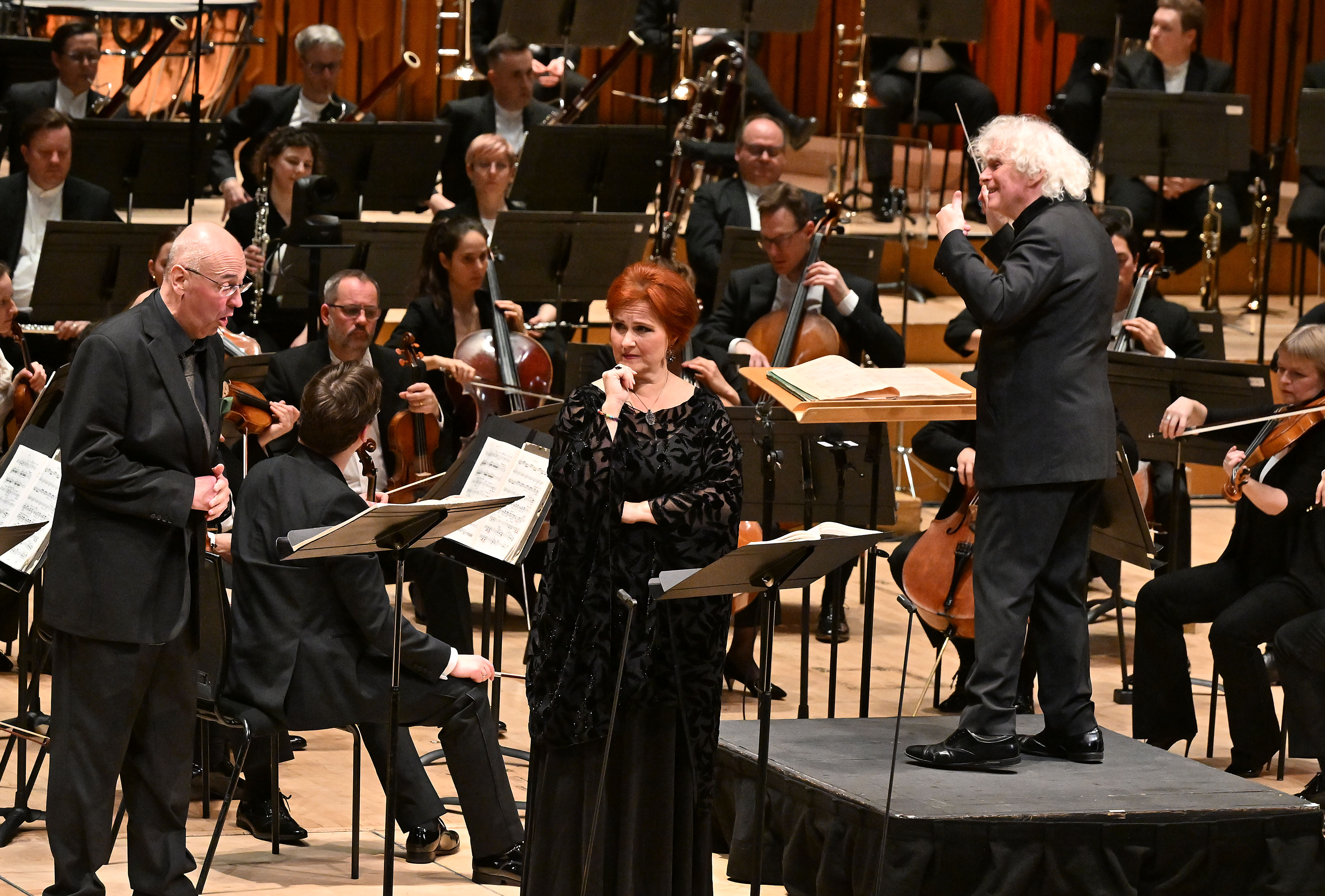


Much could be read from Majeski’s face too; as it could from that of Andrew Staples as her husband Tichon. He felt shame, as did his voice, yet still he did what his mother said. Katarina Dalayman’s Kabanicha was no mere caricature; if hardly sympathetic, perhaps she embodied a more comprehensible than usual desire for order in a community she saw threatened, rightly or wrongly, with breakdown. Her relationship with Pavlo Hunka’s sharply characterised Dikoj was likewise less caricatured than would often be the case, perhaps not merely a case of jaw-dropping hypocrisy. Simon O’Neill’s Boris was intelligently conceived, often ardent. There was likewise plenty of intelligence, and a wonderful animating spark, to Magdalena Kožená’s Varvara. She seemed veritably to brin Ladislav Elgr’s Kudrjáš to life, his second-act song delivered with verve and no little charm, Rattle splendidly highlighting the pizzicato accompaniment to help bring it to life. Claire Barnett-Jones and Lukáš Zeman both impressed in their smaller roles, making much of them in collaboration with their fellow artists. I look forward to hearing more from the latter, a new voice to me.


And yet, this was above all an orchestral drama. The poignancy of the brief, all-too-brief, Puccini-plus afterglow to the second act, eliciting a sadness quite different from anything one might hear in Puccini, offered another splendid, affecting example. Likewise, tellingly, the sheer strangeness of the early storm music of the third, especially from the LSO woodwind. If there were times, slightly to my surprise, when I found myself missing the completion of action that would have been achieved by a staged production—Janáček leaves much to that crucial pillar of operatic experience, knowing not only what to write but also what not to write—this was a compelling evening. If some listeners might have felt Rattle’s more spacious tempi went to far at times, for me they worked well in context. There seemed little doubt they had the assent of orchestra and cast alike.

Sunday, 10 February 2019

Katya Kabanova, Royal Opera, 9 February 2019


Royal Opera House
  
Tichon (Andrew Staples) and Katya (Amanda Majewski)
Images: Clive Barda/ROH


Katěrina Kabanova – Amanda Majeski
Marfa Ignatěvna Kabanicha – Susan Bickley
Varvara – Emily Edmonds
Boris Grigorjevič – Pavel Černoch
Váňa Kudrjáš – Andrew Tortise
Tichon Ivanyč Kabanov – Andrew Staples
Savël Prokofjevič Dikoj – Clive Bayley
Kuligin – Dominic Sedgwick
Glaša – Sarah Pring
Fekluša – Dervla Ramsay
Woman – Amy Catt
Passer-by – Luke Price

Richard Jones (director)
Antony McDonald (designs)
Lucy Carter (lighting)
Sarah Fahie (movement)

Royal Opera Chorus (chorus master: William Spaulding)
Orchestra of the Royal Opera House
Edward Gardner (conductor)


Janáček is surely the perfect, or at least a perfect, composer with whom to introduce someone to opera. Starting with From the House of the Dead or The Adventures of Mr Brouček might be a little odd, if hardly disastrous. However, Jenůfa, The Makropulos Case, The Cunning Little Vixen, and Katya Kabanova all boast compelling, readily comprehensible stories, strong characters (especially female ones), and textbook demonstrations of what might be accomplished by musical drama, even in something that might superficially seem close to a sung play (in itself no bad thing for a beginner). Last but not least, they are not a second too long, showing unerring mastery concerning what need be depicted, even lingered over, and what may be assumed or suggested, without the slightest chance of having anyone wonder ‘when will this be over?’ Loving them, one might wish that they were longer, but one also knows that they should not be. For devotees of late-nineteenth-century literature, Jenůfa and Katya would seem the most obvious choices. (Not that Wozzeck would do any harm: it gripped this sometime schoolboy for life…!) Setting, narrative, and character stand in well-nigh perfect relation to one another: familiar, yet fresh.

Kabanicha (Susan Bickley) and Katya

Why, then, have London houses seemed so reluctant recently to stage these operas? Xenophobic audiences, bizarrely lacking in curiosity? Most likely, alas; we live, after all, in the age of ‘Brexit’. Whatever the reason, we have all the more reason to cheer the Royal Opera’s commitment, following years of silence, to staging a number of Janácek’s works. Last year’s From the House of the Dead, in a striking, duly provocative staging by Krzysztof Warlikowski, was unquestionably a highlight of the London musical year. (If, later in the year, Munich’s offering from Frank Castorf went further, all the better for us. How fortunate we were to have both.) Richard Jones’s new Katya is not at that level: a ‘safer’ choice, no doubt; nor is it so well conducted. Nevertheless, a cast as strong dramatically as vocally brought out the best in work and production alike.

Varvara (Emily Edmonds)


Without really getting in the way, Jones’s staging is mildly puzzling: a mix of good ideas, oddly undeveloped ideas, and all-purpose Richard Jones, almost as if it were an early sketch rather than a finished production. We begin and end with a portrait of a girl, Katya presumably, and there is something intriguingly doll-like to her appearance onstage, even to some of her gestures. Three men from the community – beyond that, it is barely a community – leer through the windows at her. It is sketchy, though: neither subtle nor thought through. The 1970s Eastern bloc setting is fine, if hardly original, but not much is done with it. Nor is it clear why abstraction is occasionally the order of the day: budget limitations seem more plausible as an explanation than dramatic motivation. Auditorium strobe lighting for the storm that opens the third act is an odd touch: neither in keeping with what has preceded and what will follow it, nor productively in contrast. A degree of stylisation on stage works much better, cinematic ‘still’ moments suggestive of contrasting chaos and a moment of fateful decision. That particular aspect of the setting, too, is excellent – a wonderfully ‘real’ bus shelter, which again has much to offer in metaphorical suggestion. More along such Brechtian lines might work well; all too soon, however, it is gone.

Boris (Pavel Černoch) and Katya

Sadly, Katya’s talk – song – of sin is left to fend for itself. It still moves, of course, but would have done so far more in a production that deigned to notice it. For, despite the ‘updating’ – the slightly retro term seems apt here – socio-cultural context is barely present, at least as anything more than backdrop. It is perfectly possible, I am sure, to present a Katya Kabanova with something to replace the theology, just as it would be with Don Giovanni. Whether it is a good idea remains an open question, for here, as so often with Mozart’s deeply Catholic opera, the issue is simply ignored – or, worse, is not even noticed. Likewise, Kabanicha’s terrible words of thanks at the close could hardly fail to register; they could – should – nonetheless readily register far more strongly, set in social and theological context; or, alternatively, in its provocatively avowed absence. As Schoenberg once noted, it is only the middle road that fails to lead to Rome.


That such crucial moments did register was the cast’s achievement (as well as Janáček’s!) Amanda Majeski’s Katya was a towering performance: fearful, compassionate, human, with as impressive and moving an emotional as a dynamic range. Pavel Černoch fully lived up to the expectations I had from his Munich Makropulos Case (as Albert Gregor), his romantic ardour as genuine as his courage was but flickering, a properly compromised portrayal. Andrew Staples drew out the still more compromised, indeed downright cowardly nature of his not-even-rival, Tichon. Susan Bickley rescued her Kabanicha from mere caricature, hinting at a constraining force of social propriety that might – just might – explain or at least contextualise a little of her monstrous, constructively murderous behaviour. Clive Bayley’s Dikoj offered a quality cameo as Dikoj. If only the sado-masochism in his relationship with Bickley’s Kabanicha hinted at here had been taken further by Jones, there might have been illumination such as that gleaned from Christoph Marthaler’s production for Paris. Emily Edmonds and Andrew Tortise gave lively performances as Varvara and Váňa respectively, the latter’s second-act song winning in its diegetic naïveté.


Edward Gardner’s conducting had its moments. They tended, though, to be moments – at least until the third act, undeniably possessed of great narrative thrust. The intricate, complex relationship between continuity and discontinuity in Janáček’s score is not at all easy to bring off. Mark Wigglesworth did so magnificently at ENO nine years ago. Here, whatever its warmth, there was something soft-focused to too much of the Orchestra of the Royal Opera House’s playing. Rhythmic bite was not quite what it might have been, nor were underlying harmonic motion and tension. If the achievement of that final act could have been read back into the first two, something more taut and stark in its tragedy could well have resulted. In a way, then, it complemented Jones’s staging. Vocally, however, this was the real thing.


Wednesday, 1 June 2016

Die Meistersinger von Nürnberg, Glyndebourne, 25 May 2016


Glyndebourne Opera House

Hans Sachs (Gerald Finley)
Images: Tristram Kenton/Glyndebourne

Walther – Michael Schade
Eva – Amanda Majeski
Magdalene – Hanna Hipp
David – David Portillo
Veit Pogner – Alastair Miles
Sixtus Beckmesser – Jochen Kupfer
Hans Sachs – Gerald Finley
Kunz Vogelgesang – Colin Judson
Konrad Nachtigall – Andrew Slater
Fritz Kothner – Darren Jeffery
Hermann Ortel – Nicholas Folwell
Balthasar Zorn – Alasdair Elliott
Augustin Moser – Daniel Norman
Ulrich Eisslinger – Adrian Thompson
Hans Foltz – Henry Waddington
Hans Schwarz – Sion Goronwy
Night Watchman – Patrick Guetti

David McVicar (director)
Vicki Mortimer (designs)
Andrew George (choreography)
Paule Constable (lighting)

The Glyndebourne Chorus (chorus master: Jeremy Bines)
London Philharmonic Orchestra
Michael Güttler (conductor)


Having been privileged already to see in little over two months two great productions of Die Meistersinger, one in Paris (Stefan Herheim) and one in Munich (David Bösch), I was unable to resist the prospect of a third staging, at Glyndebourne. Alas, David McVicar’s production – for the moment, I am considering solely the staging, for there was much to admire in the musical performance – proved by far the weakest. Alas, we see here the continuation of the sad decline of a once accomplished director – his ENO Turn of the Screw remains the finest I have seen – into the Franco Zeffirelli de nos jours. McVicar’s Glyndebourne Entführung seemed like a caricature of something from an alleged ‘golden age’, which of course never was and never could have been, before the alleged invention of big, bad ‘Regietheater’. As I discuss in my recent book, After Wagner, that would take us back at least before Wagner’s own opera stagings. Indeed, it would take us back, paradoxically, to a time of opera staging prior to the origins of opera.
 

Such an approach, if one may call it that, disdaining, with more than a hint of Teutonophobia, any hint of the directorial Konzept, could hardly find a composer less suited to it than Wagner. And yet, there seems, to start with, as though there might actually be a Konzept: well, an updating, at least. For the action does not take place in sixteenth-century Nuremberg, but rather in the earlier nineteenth century, presumably at around the time Wagner was growing up. There is much to be said for such an idea, looking at the societal influences upon the young Wagner, which certainly helped shape his world-view (from a more hostile standpoint, his ideology). Moreover, the guilds and corporations came under sustained post-Enlightenment attack at this time, the Stein-Hardenberg reforms in Prussia, for instance, offering more or less the only instance in that reforming programme of a policy vehemently opposed by Hegel (as an attack on partial association, on civil society). The guild in Nuremberg, then, might be portrayed as under attack; that, after all, is partly the meaning of Walther’s intrusion, a typical Wagnerian move of introducing a charismatic leader from outside. And so we might go on. There is, unfortunately, no attempt to do anything with the updating. Indeed, as with the aforementioned Entführung, or as with McVicar’s Marriage of Figaro for the Royal Opera, one is left with the nasty suspicion that the principal point, or at least principal result, of the updating is simply to present us with a host of ‘pretty’ designs. Vicki Mortimer’s handsome designs might have done so much more – or even just a little more.
 
Beckmesser (Jochen Kupfer) attempts the Prize Song


Moreover, the typical McVicar trait of reducing drama to mere ‘entertainment’ is much in evidence here. There is nothing wrong with art being entertaining, of course; much of it would be failing if, in at least some sense, it were not. However, here the playing to the gallery – and not in some metatheatrical sense, imitating or leading the relationship between the Masters and the populace – becomes especially wearying. ‘Amusing’ interpolations, which serve little or no purpose other than to make those who have partaken of a few too many erupt into apparently helpless laughter, are too often the order of the day. (Quite what led someone to the verge of hysteria during Sachs’s Wahn monologue, I have no idea; on that occasion, the responsibility does not seem to have lain with the production.) And since every McVicar production now seems to have compulsory choreography by Andrew George, we have silly, irrelevant dances, especially painful at the opening of the second act. Beckmesser, for some reason best known to the director, becomes a preening figure of high camp.


Fortunately, the score was in better hands. The London Philharmonic Orchestra was on excellent form throughout. Clearly well rehearsed, the orchestra offered as satisfying a German tone – the strings, to my ears, more typically Brahmsian than one often hears in Wagner, but certainly, in this of all Wagner’s dramas, none the worse for that – as one is likely to hear in this country. There were, moreover, many elements of exquisite wind-playing, doubtless having their roots, at least in part, in the LPO’s long experience of performing Mozart here at Glyndebourne. Michael Güttler’s conducting never drew attention to itself; in the first and second acts, it perhaps lacked the sense of life with which the greatest Wagner conductors will bring the melos into dramatic reality, but there was sure structural understanding. In the third act, which, perhaps not coincidentally, offers a more satisfying, if defiantly conservative, experience in McVicar’s staging too, Güttler seemed relatively liberated. His was never an ‘interventionist’ account, but there was a greater willingness to play, and to let the singers, play with the ebb and flow.


What made this Meistersinger compulsory viewing (and listening) for me, however, was Gerald Finley’s Hans Sachs. Finley had also played the role in Herheim’s Paris production. Perhaps because of the lack of anything here to say from the staging, he sounded, if anything, finer still. At any rate, the distinction of his performance fell into greater relief, for I have never heard a finer rendition, more anguished and yet, ultimately, more imbued with relative hope, of the Wahn monologue than here. In ‘purely’ musical and in verbal terms, this was a Sachs whose role emerged from lengthy experience and understanding of Lieder. The size of the house probably helped too, the Bastille perhaps not the ideal venue for Finley, excellent though his Paris performance undoubtedly was.
 

Michael Schade seemed miscast, I am afraid, as Walther. If he made a better job of the role than I should have suspected, he too often sounded strained. Little of the ‘natural’ – whatever that might mean – ease with which Walther should pour forth his artistry was present. However, his Eva, Amanda Majeski, offered a beautifully sung performance, drawing, as does the character, upon greater reserves of feeling as the work progressed. There was nothing of Bösch’s radical (feminist) reappraisal here, of course, but Sajeski did a good deal with what she had. Jochen Kupfer did a sterling job with McVicar’s jarring understanding of Beckmesser; indeed, he managed almost to convince us that this was an illuminating standpoint. If he could not quite do so, that was not the fault of this fine actor, whose darkly attractive vocal portrayal proved equally impressive; I hope to see him play the role in another staging. David Portillo’s lyric tenor was just the thing for David: his was an eager, diligent, attractively sung performance very much in the traditional mode. Hanna Hipp’s Magdalene complemented him with similar qualities and great warmth of tone. Alastair Miles’s Pogner sounded somewhat elderly at times, but that is hardly inappropriate here. Last but far from least, the singing of the Glyndebourne Chorus, well-prepared indeed by Jeremy Bines, was something to savour from beginning to end. In a house of this size, it sounded just right: words and music in excellent balance, warmth and clarity anything but antithetical. If only the staging had given them something more interesting to do.iHi


Sunday, 9 June 2013

Le nozze di Figaro, Glyndebourne Festival Opera, 8 June 2013


Glyndebourne Opera House

Figaro – Adam Plachetka
Susanna – Laura Tatulescu
Bartolo – Luciano Di Pasquale
Marcellina – Anne Mason
Cherubino – Lydia Teuscher
Don Basilio – Timothy Robinson
Countess Almaviva – Amanda Majeski
Count Almaviva – Joshua Hopkins
Antonio – Nicholas Folwell
Don Curzio – Alasdair Elliott
Barbarina – Sara Lian Owen
First Bridesmaid – Charlotte Beament
Second Bridesmaid – Annie Fredericksson

Michael Grandage (director)
Ian Rutherford (revival director)
Paule Constable (lighting)
Ben Wright (movement)

Glyndebourne Chorus (chorus master: Jeremy Bines)
London Philharmonic Orchestra
Jérémie Rhorer (conductor)


What a pity! On a glorious – well, by recent English standards – summer’s day, there can be few more beautiful English countryside settings than Glyndebourne, with the added bonus, as alas much of the audience appears to understand it, of an opera house attached. Still, they had clearly made the most of their interval picnicking, about which a little more anon. To see The Marriage of Figaro, the first opera staged at Glyndebourne, and the first staged at the new house too (preserved on a wonderful DVD, with Bernard Haitink as conductor) ought to have been the icing on the cake. Of course, it ought to have been the other way round, Mozart and Da Ponte coming first, but Michael Grandage and his revival director, Ian Rutherford had no intention of permitting that to happen. (As shorthand, I shall refer to Grandage, but it may be that Rutherford modified an initial conception to a considerable degree. The curious may consult a DVD from last year now available; I do not think I can bear to see it.)

 
For no apparent reason, the action is shunted into the 1970s, the decade, which, everyone seems to agree, taste forgot, whatever its virtues may have been. It seems a peculiar substitute for the eighteenth-century. No attempt seems to have been made either coherently to re-imagine the action – the intricate comedy based upon a society of orders, let alone the droit de seigneur is, as much as possible, simply ignored – or boldly to present something new. For the former, Jean-Pierre Ponnelle remains a magical DVD bet, aided by Karl Böhm, the Vienna Philharmonic, and a cast, headed by Dietrich Fischer-Dieskau, Kiri Te Kanawa, Hermann Prey, and Mirella Freni, for which the phrase ‘to die for’ might have been made. (The aforementioned Glyndebourne production, directed by Stephen Medcalf, has a fair share of magic too.) Claus Guth’s superlative Strindbergian retelling from Salzburg heads the other camp; it should not work, but it really, really does.

 
Chez Grandage, at best what we have is a pointless updating, with nothing to say either about Figaro or about the 1970s. Much of the time, however, the situation is far worse; this most perfect of operas – give or take a Così – is treated as fodder for a variety of slapstick at which even the lowest common denominator might cavil. With a few design hints of the original Spain – it seems no more specific than that – what we see resembles a particularly un-amusing episode of the little-lamented British sitcom, Duty Free. The Overture endures the arrival of the Count and Countess in a sports car – presumably, because the budget can. Hideous outfits, sometimes with a vague ‘Spanish’ air, sometimes not, come and go. No context is suggested for the coexistence in a villa-like location of alternatingly strange and uncharacterised people. Even an ill-behaved audience thought it beneath itself to laugh – perhaps the sitcom custom of ‘canned laughter’ should have been adopted – at Susanna reacting to Cherubino’s malodorous socks.  The nadir, however, was reached when, at the end of the third act, quite deaf to Mozart’s score, some of the most embarrassing disco dancing I have ever witnessed – and even if ‘embarrassing’ were the point, that does not excuse it – was foisted upon the work. As if that were not enough, some sections of the audience started clapping along, albeit with a disturbing lack of rhythm. We seemed to have moved from Duty Free to Hi-de-Hi! (For those innocent of the ‘heyday’ of the British sitcom, Youtube may well have clips; I should recommend spending the time with Ponnelle and Böhm instead.) It was well-nigh impossible to hear the orchestra for such loutish behaviour: doubtless encouraged by the staging, but nevertheless the responsibility of the perpetrators.

 
And, just to make things even worse, the surtitles alternated between the embarrassingly demotic (Susanna again, being compelled to comment approvingly on Cherubino’s ‘moves’); the absent (far too much of the recitative); and the often wildly inaccurate (why a ‘signature’ for the army officer’s seal?) Whoever is responsible needs to address the problem, since it is not an exception; the titles for Ariadne auf Naxos made almost as much a mess of Hugo von Hofmannsthal’s exquisite text. It is a problem that can readily be corrected, and certainly ought to be.  

 
Musically, things were better, though far from what we all know Figaro can be, whether from great recorded performances or memories in the theatre. To be fair, the production did its best to overshadow the music, so there was little scope for outstanding assumptions of almost any role. Adam Plachetka seemed a little neutral as Figaro to start with, but warmed up; Laura Tatulescu, whom I admired in ENO’s Castor et Pollux, similarly as Susanna, in a lively performance. Much the same could be said of the Almavivas. Joshua Hopkins offering genuine rage without bluster in his third-act aria, and Amanda Majeski sang well enough, if not quite in style: either a little bland, or a little tremulous. Lydia Teuscher’s Cherubino was fine as far as it went, but was not helped by certain tempo choices and suffered somewhat from a lack of tonal richness; it was difficult to believe in her as a boy. I should not, however, be surprised if performances improved considerably during the run; they often do, and there was in any case nothing really to complain about here. In this context, it was perhaps unsurprising that the stock buffo characters came off best, Anne Mason’s Marcellina and Luciano Di Pasquale’s Bartolo particularly noteworthy.

 
Jérémie Rhorer’s conducting of the London Philharmonic Orchestra had its moments, but they were moments. There was little sense of Mozart’s tonal architecture, so crucial to delineating the drama; moreover there were a good few perverse choices of tempo, whether considered in themselves or in context. I do not think I have heard ‘Non più andrai’ taken either so lightly or so quickly; it is certainly not an experience I wish to repeat. Another problem, in some ways still more serious, was of general listlessness, the music swimming along somewhat aimlessly; it often seemed genuinely uncertain whether this were what Rhorer had insisted upon, or whether it were what he had fallen into. A related issue was that of far too many cases in which stage and pit fell apart. The odd instance might be ascribed to a singer, but not a persistent problem. When it was permitted to do so, the LPO played with spirit and with warmth, provided one could take the rasping of natural trumpets (though not horns). How one longed, though, for this fine orchestra, with so splendid a pedigree in Mozart, to be reunited with the likes of Haitink. One longed still more, of course, for a staging that began to do justice to the work.

 
This is a co-production with Houston and the Met. It will be interesting, to say the least, to see how it goes down across the Atlantic.