Showing posts with label Simon O'Neill. Show all posts

Wednesday, 18 February 2026

Aufstieg und Fall der Stadt Mahagonny, ENO, 16 February 2026


Coliseum


Images: Tristram Kenton


Announcer – The Company
Leokadja Begbick – Rosie Aldridge
Fatty the Bookkeeper – Mark Le Brocq
Trinity Moses – Kenneth Kellogg
Jenny Smith – Danielle de Niese
Jimmy MacIntyre – Simon O‘Neill
Jack O’Brien – Elgan Llŷr Thomas
Bank-Account Billy – Alex Otterburn
Alaska Wolf Joe – David Shipley
Jenny’s Girls – Joanna Appleby, Deborah Davison, Sophie Goldrick, Ella Kirkpatrick, Claire Mitcher, Susanna Tudor-Thomas
Jenny’s Boy, A Cloud – Damon Gould
Jenny’s Boy, A Typhoon – Adam Taylor
Toby Higgins – Zwakele Tshabalala

Director – Jamie Manton
Designs – Milla Clarke
Lighting – D.M. Wood
Choreography – Lizzi Gee, Spencer Darlaston-Jones
Sound design – Jake Moore
Intimacy and fight coordinator – Haruka Kuroda

Chorus and Additional Chorus of the English National Opera (director: Matthew Quinn) 
Orchestra of the English National Opera
André de Ridder (conductor)


In Berlin’s Dorotheenstädtischer Friedhof, one of my favourite cemeteries, Hegel lies buried—as, very close, do Bertolt Brecht and Helene Weigel, as do many others. Brecht’s Chausseestrasse house and the room in which he worked overlooked that cemetery; the Marxist Brecht expressly chose it out of increasing fascination with Marx’s single most important intellectual forerunner, GWF Hegel. One summer, I lived ten minutes’ walk away and visited regularly. Karl Marx, of course, lies in another celebrated cemetery, in another great world city: Highgate in London, further from anywhere in London I have lived, yet not so far in the greater scheme of things. This tale of ‘my’ two cities, of two cemeteries, of three dead men and more – ‘Nothing you can do will help a dead man’ – shaped my experience of this new ENO production of The Rise and Fall of the City of Mahagonny, not least since I had seen Mahagonny only two months previously, in Berlin, in Barrie Kosky’s Komische Oper staging. 

In capitalist society as in its artistic production, then as now, the grit lies in contradiction. What Hegel the divined as ontology, Marx situated in particular social and economic conditions. We are not obliged to choose; both indeed may be true or at least contain truth. In any case, following in both Hegel and Marx’s wake, Brecht and Kurt Weill’s Mahagonny offers an illuminating instantiation of some of these contradictions: not only in subject matter but in aesthetics and its implications for performance and reception. Some art fails because it simply is not very good, or at least is not well presented. The contradictions here, though, are of a different nature, not to be smoothed over, concealed, or reconciled, but to be such stuff as dreams are smashed on—as indeed is patently the case wherever we look in our present social and political predicaments. No wonder, then, that this new ENO production, the last, I believe, before the company’s move to Manchester, is replete with more general resonance than those personal, albeit connected elements with which I began. 


The contradiction between advertisement and reality is key to the Mahagonny and the Mahagonny we visit with Jamie Manton and his team, yet so is the form of production we can all see – and hear – if only we open our eyes and ears. In the ‘real’ world, ideology mystifies, obscures, yet never quite conceals; here, contradiction is perhaps more glaring, but that is the (Brechtian) point. It all goes back to a lorry, a box of theatrical tricks. (In what I think is pure coincidence, it put me a little in mind of the van in Frank Castorf’s Bayreuth Ring, though vehicular function may hold something in common.) Great claims are made for the city the unholy trio – less a trinity than in Kosky’s staging with c.1930 religious symbols – have built. Perceived desire and demand play their part, whether for whiskey or women—and, in a welcome update, men too. Sex workers rather than prostitutes, Jenny’s girls and boys are available to all, though the outcome does not change. Any declaration of love is not necessarily entirely hollow, but its truth is fleeting and contradicted by the destructive self-interest of all (save, perhaps, the founding mother and fathers). Even the whiskey is diluted by grim recycling that suggests what comes out one end will go back in the other. 

But it is not all grime and grimness: there would be no contradiction then. There is Weill, of course, on whom more soon, but there is also a lively sense of fun, of entertainment: not necessarily unmediated, but what is? There are plenty of witty moments to occasion a wry smile or more, whilst the framing – the Coliseum’s staging and technical equipment a container for, in turn, the container – reminds us this is theatre. Announcements are made by alternating members of the company, part Brechtian remnant with loudspeaker, part Handmaid’s Tale entertainment imitation. (Before the interval, that is; after, they are more clearly themselves, unmasked.) And whilst the production in general shies away from specific contemporary reference – we can hardly fail to make it – the trial as gameshow surely gives the Trumpian game away. Resourceful designs impart a sense both of using what was to hand and also of what one might see, or have seen, at the Berliner Ensemble. In the contradiction between expectation and reality, a weathervane (we have plenty of them in our world) tapdancing hurricane points the way to just destruction of the city, only suddenly to change direction in a triumph of the knowingly underwhelming that prefigures God’s forlorn, defeated attempt to visit justice on this world at the end, drawn out Weill’s Bachian chorales bleakly yet thrillingly subverting Christian passion. Likewise, a cloud dances in counterpoint to Weill’s delicious parody of overwrought, out-of-tune Romantic salon music, edging out Jimmy’s act in more ways than one. 


For the tension and indeed contradiction between Brecht and Weill will, should always lie at the heart of this work and its performance. Can, should music do what Brecht seems to imply it should? Where does that leave the songs, the tunes, the band? André de Ridder, music director designate, drew out biting and seductive playing from the ENO Orchestra. One could sympathise with Jimmy on his last night, traduced and betrayed, as for once strings soared, but not too much—and then it was over. Structurally, closed forms – how they do (and do not) add up to more – were clear and did far more than reproduce those of the libretto. It can be all too easy hearing Weill in the twenty-first century to succumb to nostalgia for a ‘Weimar’ that never was. Here, edge was maintained without entirely denying us pleasure; banjo and Hawaiian guitar could be heard amidst ominous, bass-led hemming in. If only Jeremy Sams’s translation could have decided what it wanted to be and stuck with it, much would have bitten still more savagely. Much was good, but there were too many instances that simply jarred, and the crucial Biblical element to Brecht’s writing was too often lost. 


One less productive contradiction, at least for me, lay between operatic voices and miking. The Coliseum has never offered an ideal acoustic for opera, but here balances were too often awry. The chorus suffered more than most, words sometimes more or less inaudible. Rosie Aldridge and Danielle de Niese offered nicely contrasting and complementing female leads, equally at home in more operatic moments and something closer to the street, both fine singing actors. Simon O’Neill proved a tireless Jimmy, ably supported by his friends, Alex Otterburn, Elgan Llŷr Thomas, and David Shipley. Alongside Kenneth Kellogg and Mark Le Brocq, all offered individual performances founded on the text and on a recognition that the text has contradictions of its own, not least between words and music. Ultimately, I found there was in all respects no need to choose: Berlin and London offered different experiences, in contrast, complement, and yes, contradiction. In some ways, the latter, perhaps ironically, seemed the more Brechtian in its reluctance – refusal would be too strong – to concede to opera, even in Weill’s idiosyncratic conception. It was, in any way, a properly barbed, defiant way for ENO to bid us au revoir. 


Thursday, 12 January 2023

Katya Kabanova, LSO/Rattle, 11 January 2023


Barbican Hall

Katěrina Kabanova – Amanda Majeski
Marfa Ignatěvna Kabanova (Kabanicha) – Katarina Dalayman
Varvara – Magdalena Kožená
Boris Grigorjevič – Simon O’Neill
Váňa Kudrjáš – Ladislav Elgr
Tichon Ivanyč Kabanov – Andrew Staples
Savël Prokofjevič Dikoj – Pavlo Hunka
Kuligin – Lukáš Zeman
Glaša, Fekluša – Claire Barnett-Jones

London Symphony Chorus (chorus master: William Spaulding)
London Symphony Orchestra
Simon Rattle (conductor)


Images: Mark Allan

Perhaps the most perfectly proportioned of Janáček’s operas, certainly one of the most emotionally and dramaturgically correct—which, in Janáček’s case, is saying quite something—Katya Kabanova has not wanted for recent performances in Britain. That is no cause for complaint, quite the contrary. That Janáček’s operas are still not at the heart of every major opera house’s repertory says nothing about the operas and, alas, a great deal about our houses and some of their audiences. Concert performances are less common: these are very much works for the stage. This current project from the London Symphony Orchestra and Simon Rattle to present a number of his operas in concert—I assume it is not all, though should be delighted if it were—is most welcome, not only for introducing new audiences to these fine operas, not only for affording the LSO (and Rattle) the chance to perform them, but also for giving us the opportunity to hear their orchestral writing in all its detail and power, such as might in part be lost when played in the pit.

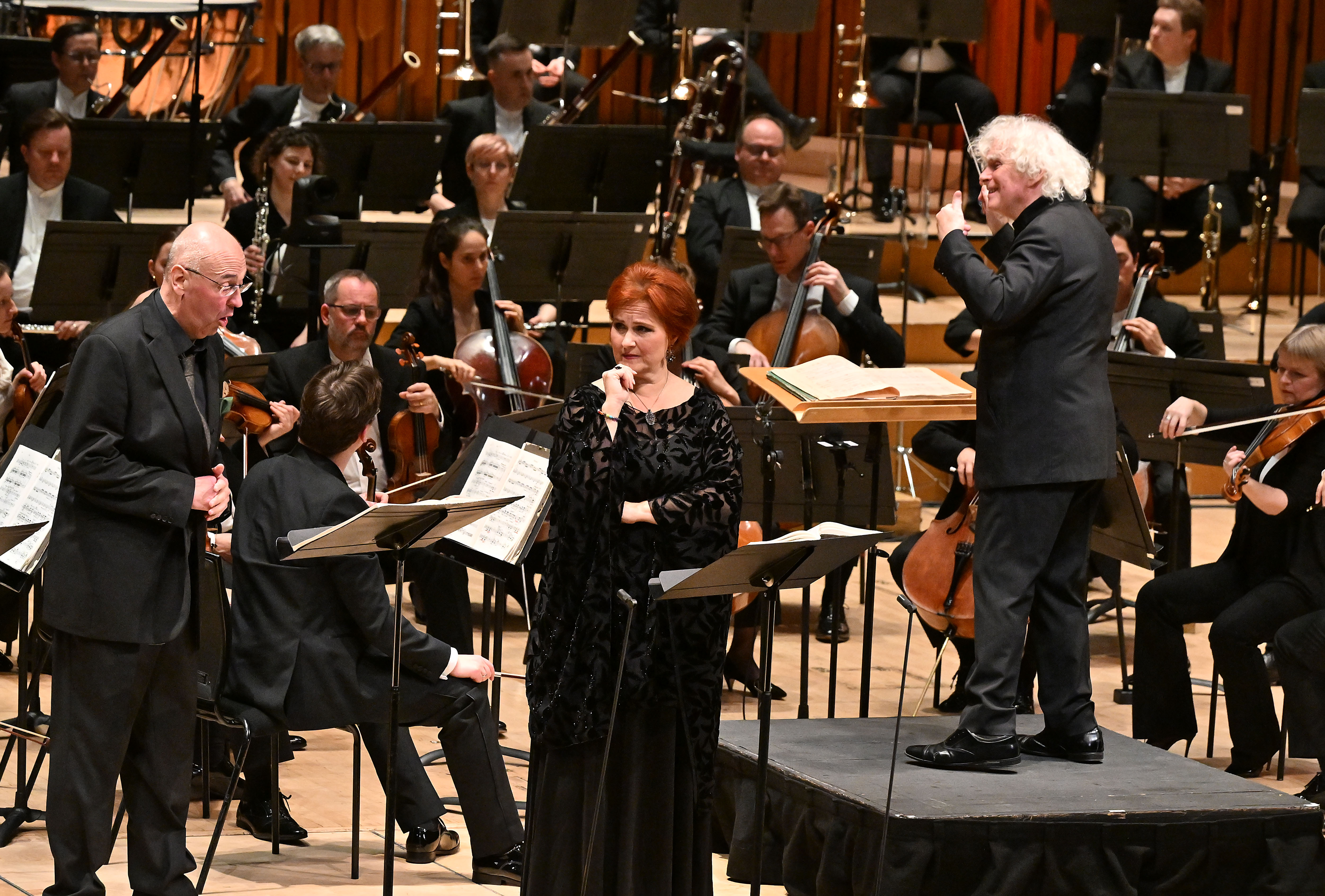
Rattle certainly seemed to have conceived his reading with this in mind. It is doubtless fruitless to speculate, but I suspect some of the more extreme passages, whether with respect to dynamic contrast or tempo (at the slower end), would have been less so in the theatre. The LSO and an excellentcast responded in kind. Indeed, the glowing, dare I say Central European, tone of the opening bars promised—a promise finely delivered—a performance in which the orchestra was at least as much changed by its encounter with the score as vice versa. Doubtless, Rattle’s work with the Czech Philharmonic contributed to what we heard, but this was a Rattle rethinking at its best, nothing taken for granted, the fury of the later orchestral response again taking one by surprise, yet firmly in the spirit of composer and work. Where later I might have expected the full orchestra to sound a little cramped by the Barbican acoustic, that was not at all to be the case; in the absence of a new London concert hall, killed by Theresa May alongside so many of our hopes, conductor and orchestra have found new ways of living with it.


Climaxes were built and tended, singers included too—no one more so than Amanda Majeski in the title role. Her vocal line and all too clearly Katya’s hopes soared, preparing for a fall, when in the first act she sang to Varvara of her childhood imagination of angels flying heavenwards, continuing prophetically of the sin that threatened her. Likewise in the next act, when she resolved to see Boris and thus fully to set her tragedy in motion. A lack of stage business made such passages more conversational: perhaps neither for good nor ill, but rather just how it was. All the while, Rattle and the orchestra brought out telling detail without having it overwhelm greater line, musical and narrative. What intrigued me—I am not sure I can put my finger on why—was that this Katya seemed less saintly, more intent on pursuing her own happiness, more relatable perhaps, if less of a quasi-religious example. Given her fate, why after all should she present an example?


Much could be read from Majeski’s face too; as it could from that of Andrew Staples as her husband Tichon. He felt shame, as did his voice, yet still he did what his mother said. Katarina Dalayman’s Kabanicha was no mere caricature; if hardly sympathetic, perhaps she embodied a more comprehensible than usual desire for order in a community she saw threatened, rightly or wrongly, with breakdown. Her relationship with Pavlo Hunka’s sharply characterised Dikoj was likewise less caricatured than would often be the case, perhaps not merely a case of jaw-dropping hypocrisy. Simon O’Neill’s Boris was intelligently conceived, often ardent. There was likewise plenty of intelligence, and a wonderful animating spark, to Magdalena Kožená’s Varvara. She seemed veritably to brin Ladislav Elgr’s Kudrjáš to life, his second-act song delivered with verve and no little charm, Rattle splendidly highlighting the pizzicato accompaniment to help bring it to life. Claire Barnett-Jones and Lukáš Zeman both impressed in their smaller roles, making much of them in collaboration with their fellow artists. I look forward to hearing more from the latter, a new voice to me.


And yet, this was above all an orchestral drama. The poignancy of the brief, all-too-brief, Puccini-plus afterglow to the second act, eliciting a sadness quite different from anything one might hear in Puccini, offered another splendid, affecting example. Likewise, tellingly, the sheer strangeness of the early storm music of the third, especially from the LSO woodwind. If there were times, slightly to my surprise, when I found myself missing the completion of action that would have been achieved by a staged production—Janáček leaves much to that crucial pillar of operatic experience, knowing not only what to write but also what not to write—this was a compelling evening. If some listeners might have felt Rattle’s more spacious tempi went to far at times, for me they worked well in context. There seemed little doubt they had the assent of orchestra and cast alike.

Wednesday, 16 October 2019

Katya Kabanova, Staatsoper Unter den Linden, 12 October 2019


Katěrina Kabanova – Eva-Maria Westbroek
Marfa Ignatěvna Kabanicha – Karita Mattila
Varvara – Anna Lapkovskaja
Boris Grigorjevič – Simon O’Neill
Váňa Kudrjáš – Florian Hoffmann
Tichon Ivanyč Kabanov – Stephan Rügamer
Savël Prokofjevič Dikoj – Pavlo Hunka
Kuligin, Passer-by – Viktor Rud
Glaša – Emma Sarkisyan
Fekluša – Adriane Queiroz
Woman – Liane Oßwald

Andrea Breth (director)
Annette Murschetz (set designs)
Silke Willrett, Marc Weeger (costumes)
Alexander Koppelmann (lighting)

Staatsopernchor Berlin (chorus director: Martin Wright)
Staatskapelle Berlin
Thomas Guggeis (conductor)


Katya Kabanova (Eva-Maria Westbroek)
Images: Bernd Uhlig, from the 2014 premiere


Given the success of Andrea Breth’s Berlin Staatsoper production of Wozzeck, it was perhaps not surprising to emerge from this Katya Kabanova feeling similarly drained. It had not previously occurred to me to consider the points of affinity between these two tragic operatic masterpieces of similar length, written at a similar time – Berg started composition considerably earlier and completed his work later – but Breth’s approach played a suggestive role. For redemption, spiritual uplift, any such glimmer, one would likely have sought in vain – certainly at its conclusion. Where Wozzeck’s expressionism was tempered or expanded by something one might characterise, with certain reservations, as realism – not that the opera ‘itself’ lacks that too – here it is perhaps the other way around, Janáček’s drama extended in its final act by something that, if not quite expressionistic, certainly went beyond the realm of realism conventionally understood. The storm and its aftermath are, in any case, clearly not intended purely in meteorological terms; here, however, Breth’s ritualistic stylisation affords opportunity, without abdication of tragic content, for a form of starkness somewhat different from that more readily encountered.


There, as at the opening, we see action, movement, that seems either to tend towards or away from a tableau: secularised, doubtless, like Janáček’s outlook itself, yet not without a sense, for better or ill, of the religious. This, it seems, is a grim, difficult world in which women especially, but many men too, are cowed by social and political rather than more strictly theological constructs. ‘Modesty’ of female dress is clearly no matter of choice; likewise, the shrouded identity, if one may call it that at all, of many of the women we see. Repression and hypocrisy are, at least in considerable part (for perpetrators, that is, not for victims). And, of course, whatever the social similarities Breth suggests with Wozzeck, heightened by a destitute Eastern Bloc setting perhaps even going beyond that chosen by Christoph Marthaler for Paris several years ago, a major distinction remains the centrality of women to Janáček’s opera.


If anything, Breth pushes that further. We see Katya treated to the point of torture by domestic incarceration in a cupboard (or is it a refrigerator?). We witness perhaps a truly formidable Kabanicha, a fur-clad Karita Mattila, rule the roost and let her guard down in private: second-act drunkenness leading to an extraordinary scene with Dikoj, in which, rather than reject his advances, she joins him on the dinner table to masturbate him, only to react with anger when his stamina proves insufficient for her needs. And we see, likewise at beginning and close, a small girl led across the stage in quasi-religious procession. Who is she? Is she one of the female characters, whose life might have turned out differently, had it not been for this vicious society and ideology? Is it a baby girl Katya might have lost? There are various possibilities open to us; if only there had been to her.


A particular strength of Thomas Guggeis’s conducting of the Staatskapelle Berlin lay in kinship with Breth’s conception. No one in his right mind would eradicate Janáček’s lyricism from the orchestra, let alone from the vocal line. (How could one, anyway?) That said, these remained brief moments of thwarted possibility amongst a notably dark account of the score, its niggling motivic, even cellular, possibilities pointing already to the Dostoevskyan world of From the House of the Dead. If there were times, especially during the first act, when I missed a little in the way of more conventional musical narrative, it seemed to me that this was very much an aesthetic choice – and one that had me ask why, the answers seeming more than justifiable in context. When the storm came, the unleashing of orchestral power – almost a tone poem with voices – said what must be said. As, of course, in her conception, did Kabanicha at the close.


Mattila’s delivery of her final line, thanking the people for their efforts, offered an unanswerable summation not only of her richly expressive vocal portrayal; not only of her imperious stage presence, unquestionably possessed of a complicated back-story concerning whose nature we could only speculate; but also of work and tight-knit production as a whole. Equally impressive was Eva-Maria Westbroek in the title role, a character whose soul as well as her vocal line would constantly take flight, as much in societal repression as in those few, rare – in every sense – moments of free expression. Katya’s, Westbroek’s, and Janáček’s humanity shone through, extreme difficulties notwithstanding, indeed in many ways very much on their account. Simon O’Neill, if a little lacking in stage credibility, sang clearly and convincingly as Boris. Florian Hoffmann and Anna Lapkovskaja made for a lively, engaging pair of ‘secondary’ lovers; at least there was some hope remaining of matters turning out better in their case. Pavlo Hunka’s Dikoj and Stephan Rügamer’s Tichon proved keenly observed throughout. All, then, contributed intelligently and movingly to the greater dramatic conception. What a conception that continues to be.


Tuesday, 3 December 2013

Parsifal, Royal Opera, 2 December 2013


Royal Opera House

Gurnemanz – René Pape
First Grail Knight – David Butt Philip
Second Grail Knight – Charbel Mattar
First Esquire – Dušica Bijelič
Second Esquire – Rachel Kelly
Third Esquire – Sipho Fubesi
Fourth Esquire – Luis Gomes
Kundry/Voice from Above – Angela Denoke
Amfortas – Gerald Finley
Parsifal – Simon O’Neill
Titurel – Robert Lloyd
Klingsor – Sir Willard White
Flowermaidens – Celine Byrne, Kiandra Howarth, Anna Patalong, Anna Devin, Ana James, Justina Gringyte

Stephen Langridge (director)
Alison Chitty (designs)
Paul Pyant (lighting)
Dan O’Neill (movement)
Thomas Bergmann, Willem Brasche (video designs)
Royal Opera Chorus and Extra Chorus (chorus master: Renato Balsadonna)
Orchestra of the Royal Opera House
Sir Antonio Pappano (conductor)

Yet again, I am afraid, the Royal Opera House seems to have come up with a Wagner production for those who are not very interested in Wagner. Thunderous applause issued forth for Sir Antonio Pappano, when the best that one could say about his conducting was that it was a bit better than the appalling mess he had latterly made of, say, Götterdämmerung and Die Meistersinger. I am told, though I have yet to look at them, that newspaper critics have praised him to the skies; I wish I could say that that surprised me. There will be some writers who have a genuine alternative view on this matter, though I admit that in this case I find it difficult to understand how, but many of our opera critics seem not to know their Knappertsbusch from their Kempe, still less their Karajan from their Boulez. Members of the audience are perfectly entitled, of course, to attend a performance with as little or as much knowledge as they please, but the whole business of criticism is on very dodgy ground indeed when one doubts whether some opera writers can even read a score – let alone bother to do so.

I can only assume that in some sense, unless the first night performance were entirely different from the second, audience members and critics had confused some fine orchestral playing with the conductor’s sense of line, or rather lack thereof. There were even early signs, I admit, when it seemed as though Pappano might at last have learned to conduct Wagner. (Surely such an apprenticeship should have been served long before deigning to try one’s hand at Covent Garden, but anyway…) The First Act Prelude sounded both beautiful, sometimes luminously so, and possessed of a decent sense of direction, even if it were far from unclear that Wagner’s transcendental meaning(s) had been grasped. Yet soon we were back in the bad old arena of stopping and starting, underlining a motif and failing to grasp how it might be part of the composer’s fabled ‘art of transition’, let alone fit into a complex, dynamic, quasi-symphonic web. Has Pappano ever so much as read, let alone understood, Wagner’s words in Über die Anwendung der Musik auf das Drama?


To be an artwork as music, the new form of dramatic music must possess the unity of the symphonic movement; this it attains by spreading itself over the whole drama, in the most intimate cohesion therewith … This unity centres upon a web of basic themes, which contrast, complete, re-shape, divorce, and intertwine with one another as in a symphonic movement; yet here, the requirements of the dramatic action dictate the laws of separation and combination.


Somehow I doubt it – and that is even before one considers the complex role played by Wagner’s poem in all of this. As I said, there were passages in which, on a basic level, continuity was maintained, and there was some very fine orchestral playing too considered in isolation, but nothing in Wagner should be considered in isolation. That is the problem – and of course the ultimate opportunity. This was Wagner conducting devoid of any understanding of what makes Wagner Wagner – and we can be pluralist in that, of course. Yet such pluralism does not, or certainly should not, extend to having Wagner reduced to a slightly Teutonic Verdi. One can only weep when thinking that the last time Parsifal was staged at Covent Garden, it was conducted with unassuming greatness by Bernard Haitink. Sadly it seems that Haitink is destined never to return; in which case, might we not have someone else, if only occasionally, to do Wagner’s works a modicum of justice? Barenboim? Thielemann? Gatti? What might pass muster in a provincial house ought not to have any place on a world stage, a house once presided over by Haitink, by Sir Colin Davis.

Let us move on, without enthusiasm, to the production. ‘Stephen Langridge’s production emphasises the timeless and universal nature of the Parsifal story,’ claimed the cast list’s ‘quick guide to Parsifal’. I am not at all sure what that is supposed to mean, the drama of Parsifal lying in an epic theological struggle between time and eternity. But even if we could somehow accept that claim – very odd or unspeakably trite; most likely, both – it was not at all clear how Langridge’s production does anything of the sort. It certainly seems  to retreat from the mythological, from the questioning, to a weird unspecific specificity, which gave incoherent answers where answers were the last thing that was required. We appear to be in a world, not unlike that of Simon McBurney’s dreadful ENO Magic Flute, over which a quasi-Scientologist cult rules; yet that potential menace is undermined by a weird obsession with hospital care. I had thought a friend who attended the first night was being facetious when he asked whether the production had been intending a comment on British sanctification of the NHS; now I am not so sure. Much of the action takes place in something resembling the strange ‘Sex Box’ of Channel 4’s recent risible television programme. (I wonder indeed whether it were the worst television programme I have ever seen: four ‘couples’ have sex in a box in front of a studio audience, though unseen by that audience, after which they briskly emerge – they are not allotted much time – to answer, or rather not really to answer, questions put to them by Mariella Frostrup and some alleged experts. Parody seemed to be absent but who knows?) The box has a bed, on which scenes from Gurnemanz’s narration – Kundry’s decidedly unerotic ‘seduction’ of Amfortas, Klingsor’s self-castration – are depicted, since we are clearly unable to listen to Gurnemanz for ourselves and imagine, still less to play with past and present, with different modes of perception and understanding, as Wagner would have us try. Amfortas’s hospital ‘care’ also takes place there.

For some reason, the Grail is replaced by a little boy, whose side is pierced, echoing Amfortas’s own wounding, and presumably as some sort of Christ-like reference. Indeed, when we reencounter this ‘Grail’ in the third act, the boy has grown into a nubile young man, still in his underpants, still ready to be pierced, though that does not happen and instead he simply retreats inside his box. The way Titurel and some of the knights touch the boy’s wound suggests paedophilia, but that does not seem to be carried through, so maybe it is just another unfortunate misjudgement. Parsifal has arrived dressed like a vagrant, with more than a touch of the Jimmy Savile about him, so again: who knows? Frankly, who cares? There is, moreover, no castle to be destroyed, no sign of the Cross, etc. Instead, presumably as an Œdipal allusion, Parsifal is blinded, though just when an interesting idea might have manifested itself, its effect is blunted by the banal restitution of Parsifal’s sight at the end. Needless to say, the NHS works its wonders, Amfortas and Kundry walking off  together

Alas, Parsifal, as sung by Simon O’Neill, sometimes even sounded a little like Jimmy Savile too. There were better moments, especially during the third act, but too much was crude, undifferentiated, and most of all vocally unpleasant, redolent, as is this singer’s wont, of a misapplied pneumatic drill. His acting was little better, though seemingly by default, since there was little difference form the first two acts, he did a passable imitation of a blind man in the third. Why can the Royal Opera not at last engage Jonas Kaufmann in German repertoire, rather than waste him on largely trivial Italianate works? Or what about Christopher Ventris, or Stuart Skelton? The rest of the cast – and here were the only real candidates for redemption – were much better. Top of the class was René Pape’s Gurnemanz: authoritative, suave,  and so securely founded in Wagner’s alchemic combination of words and music that one could forgive a great deal – just so long as he was on stage. Likewise Gerald Finley’s wonderful Amfortas, for whom dramatic commitment was of course a greater task. This was the first time I had heard Finley in Wagner; I certainly hope that it will not be the last. Angela Denoke's Kundry was again a committed assumption; many of the notes she reached, but a good few she did not. Why she appeared in the third act as she had in the second, rather than as the creature seen in the first, I cannot imagine. Unfortunately, Willard White as Klingsor and Robert Lloyd as Titurel both suggested that they would be well advised to retire from vocal performance. The male chorus improved significantly in the third act, having lacked focus in the first. Whether it were a matter of the female chorus’s placing offstage or something else, its words were entirely inaudible. I hope that having Kundry sing the part of the Voice from Above was a matter of cost-cutting rather than a ‘dramatic’ decision; in the latter respect, it made no sense at all.

Only last year, I saw Stefan Herheim’s Bayreuth Parsifal for the last time. It did not receive its finest musical performance, Daniele Gatti having been replaced by Philippe Jordan, who was little better – if at all – than Pappano. Moreover, the cast had been better in previous years too. Yet the dramatic integrity, the intellectual commitment, above all the sheer musicality of Herheim’s staging once again won out. Here I struggled and failed to find a single case of the director engaging with Wagner’s score. Haitink managed, more or less single-handedly, to salvage something from the meaningless triviality of the previous, at least equally dreadful production. But it needs someone of that stature; we seem fated endlessly to be denied such redemption.


Wednesday, 24 July 2013

Prom 15: Staatskapelle Berlin/Barenboim - Die Walküre, 23 July 2013


Royal Albert Hall

Siegmund – Simon O’Neill
Sieglinde – Anja Kampe
Hunding – Eric Halfvarson
Wotan – Bryn Terfel
Brünnhilde – Nina Stemme
Fricka – Ekaterina Gubanova
Gerhilde – Sonja Mühleck
Ortlinde – Carola Höhn
Waltraute – Ivonne Fuchs
Schwertleite – Anaïk Morel
Helmwige – Susan Foster
Siegrune – Leann Sandel-Pantaleo
Grimgerde – Anna Lapkovskaja
Rossweisse – Simone Schröder

Justin Way (director)
Staatskapelle Berlin
Daniel Barenboim (conductor)


Images: Copyright: BBC/Chris Christodoulou


The superstitious would have us believe that it is better not to build up expectations, lest they be confounded. Perhaps that makes sense in some endeavours, but in a performance of the Ring, the experience is cumulative. True, one might be disappointed after an excellent Rheingold; however, in this case, it offered the perfect preparation for an excellent first ‘day’ proper. As in Berlin, an often ‘objectivist’ Rheingold was followed by a warmly Romantic Walküre, the dramatic contrast between godly prehistory and the realm of Wagner’s ‘purely human’ palpable from the outset. If anything, Barenboim’s Wagnerian mastery – and that is certainly not too strong a term – was more impregnable than in 2011. He was doubtless assisted by a kinder acoustic – how often does anyone say that of this venue – in the Royal Albert Hall than in the Schiller Theater, where he had also elected to have the pit semi-covered. Here, however, the Staatskapelle Berlin was rightly enthroned as the brightest star in the evening’s constellation, the benefits of a semi-staged performance once again manifest. In both cases, the only serious ‘competition’ – a horrible concept, but let that pass for the moment – from my experience had been provided by Bernard Haitink with Royal Opera forces, again at the Royal Albert Hall. Barenboim and Haitink are certainly the only conductors I have heard, at least in the flesh, to have shaped the architecture of the second act satisfactorily. Once again, it is clear that Barenboim has learned his Furtwänglerian lessons, without in any sense slavishly following that greatest of all Wagner conductors.

 
The Act I Prelude set the tone in more than one sense for what was to follow, Wagner’s music audibly founded upon the bass line, very much as Furtwängler would have understood it to be; moreover, it was music, not some mere storm ‘effect’, very much as Furtwängler – and Beethoven – would have understood. Almost infinitely variegated in terms of dynamic contrast, it subsided to the tenderest of ppp, again setting out Barenboim’s stall for a performance that would prove little short of all-encompassing. Soon a classically dark ‘old German’ string sound – think of Furtwängler’s Berlin Philharmonic prior to Karajan’s internationalising tendencies – would take centre stage, both in sectional and solo (that cello) offerings. When Sieglinde brought her guest the drinking horn, the cello proved, may Wagner forgive me, as eloquent as in any Brahms chamber work. The cellos’ recitative at the end of the scene, as Sieglinde invites Siegmund to stay at the house where Unheil lives, audibly echoed Beethoven’s Ninth Symphony, straining in Wagner’s Opera and Drama terms, for the Word, and in Walküre terms, for the words to express already-burgeoning love. That takes both an orchestra and conductor steeped in central musical (that is, German) Kultur; would that either of our London houses could offer that at the moment. Similarly, the presentiment of Tristan (Act II) afforded from the strings as Wotan, in his farewell to Brünnhilde, told of the ‘üppigen Rausch’ (voluptuous intoxication) she had imbibed from love’s cup spoke of equally subtle contributions from composer, conductor, and players alike. Just as Wagner’s immersion in his harmonic world permitted him to steal from the future, so did Barenboim’s and the orchestra’s parallel immersion permit us to note that detail.


This great orchestra is far more than its string section, of course. Every section, indeed very instrument, shone – as would be acknowledged by Barenboim at the end, with the number of individual bows he allowed his musicians. Woodwind malevolence resounded to perfection, as if Tristan’s potion were being brewed before our ears, as Hunding noted the same ‘glissende Wurm’ in the siblings’ eyes. How the horns terrified, as demented – Wagner’s own direction – as Sieglinde herself during her second act hallucinations; the ancient Wild Hunt itself seemed to have dawned. The brass would soon, of course, turn gravely beautiful, their part in the Annunciation of Death evocation of the most venerable of funeral equale. Moreover, the brass-led awakenings in the first act’s final scene, as if building upon new sunlit dawns from Lohengrin, were never crude in the way one must often fear from English orchestras; they were powerful, but never brash.


Such was the case even when Barenboim whipped up the fiercest agitation, for example when Sieglinde, ‘beside herself’, named her brother Siegmund. The ongoing accelerando during her rapture once again had one thinking of Furtwängler, so dramatically right and perfectly achieved was Barenboim’s accomplishment. In a very different mood, the darkness of the curse that resounded following Fricka’s departure in the following act was all the more troubling given its grounding in both timbre and harmony. Only a conductor who knows the score inside out, and knows where musically it has come from and in what direction it is tending will accomplish that. Wagner famously described the art of transition as his subtlest art, and so once again it proved here, as that between Act II Scenes 2 and 3 took us, line unbroken, from the slough of despond to the danger and exhilaration of our love-communist outcasts. The command of architecture in this act to which I previously referred was perhaps the greatest of Barenboim’s many achievements.  Moreover, the sweetness of the Magic Fire Music allowed a final, properly phantasmagorical coming together of the orchestra as a whole: not rushed, as so often it is, but with an attentiveness on Barenboim’s part that revealed quite how disturbing this anything-but-innocent putting Brünnhilde to sleep truly is.

 
The only real fly in the ointment was Simon O’Neill’s Siegmund. Tireless and hard-working though the assumption may be, there is nothing in the way of tonal beauty, and the German continues to sound ‘learned’ rather than ‘lived’. Heroism is not evoked by simple loudness, let alone by shouting, as often endured. Even at his less abrasive, O’Neill sounded more like an ageing alderman than an alluring outlaw; one could not help but think that nine out of ten Sieglindes would have elected to stay with Hunding. The contrast at the beginning of the first act’s final scene between O’Neill’s voice and the ravishing beauty of solo horn and cello was especially painful. Likewise his ‘Wälsungen-Blut,’ the final word of the first act. Anja Kampe, from her first entry, offered a merciful contrast, in terms of vocal quality, imparting of meaning to the words, and general lack of crudity. She offered sexual and musical urgency in the moonlight, whereas O’Neill offered the charisma of a middle manager. The soft pregnancy of tone and expression when she told of what she had heard as a child had me keenly aware of my own heartbeat; in tandem with Barenboim, this Sieglinde, despite an occasionally unruly top register, offered societal rupture and sensual rapture. There were times when Halfvarson’s balance as Hunding tipped too far from the musical to the verbal, at least for my Wagnerian appreciation. (The director Keith Warner, however, has recently been contesting such claims, arguing that ‘acting’, considered broadly, should always come first.) By the same token, however, a beautifully dark, Martti Talvela-like voice was lavished on words such as ‘Die so leidig Loos dir beschied nicht liebte die Norn.’ Given the tonal quality of what we had just heard from Siegmund, it was indeed difficult not to agree that the Norn had felt little love for him. Occasionally, a little more balance to Halfvarson’s voice would have been welcome, but there were certainly pitch-black compensations to be had.


Nina Stemme offered a Brünnhilde keen in every sense, from her opening ‘Hojotoho’ onwards, never failing in tone, even if she forgot a few words in Act III. (In a display of equal acuity and generosity, Terfel acted as her prompter and normal service was resumed.) Her voice has no weaker register, or at least it did not on this occasion, thereby allowing equal expressiveness throughout. Stemme’s apparent tirelessness bodes well for Siegfried and Götterdämmerung. Ekaterina Gubanova once again proved an excellent Fricka. ‘So ist es denn aus mit den ewigen Göttern...’ was delivered with rare fury; this was a woman scorned, no ice-maiden. Likewise her ‘verlacht’, as in ‘derided’ of men, offered true bitterness, as the gods’ Feuerbach-inspired dethronement gathered pace. Moreover, the Valkyries were an excellent bunch. They and their conductor ensured that their ‘Ride’ was an infinitely more musical experience than one generally suffers; again, I had to think back to Haitink to recall something comparable. Even the laughter was musically delivered. Susan Foster’s Helmwige ‘Hojotoho!’ truly made me sit up and listen, but there were no weak links here.

 
Bryn Terfel’s Wotan had me initially fear the worst, his opening contributions somewhat coarse – and subsequent passages were not all entirely innocent of that charge. However, his musico-dramatic identification with the role won me over to acknowledge what may well be the finest performance I have heard from him. Singing ‘Nimm den Eid!’ as Fricka had her say, the ‘Eid’ (oath) that he offered was arguably over-emphasised, though opinions will differ. Other details, however, were spot on, for instance his despairingly whispered – following Wagner’s directions – ‘Als junger Liebe Lust mir verblich’ to Brünnhilde, aided by the most sepulchral of brass. Likewise in that same monologue, the shading, visibly guided by Barenboim, on the word ‘Rhein,’ when he told of his failure to return the ring to its source: the word offered both a sign of a better world than that which now prevailed, and the hopelessness of ever (re-)turning to it. ‘Das Ende – das Ende!’ presented first vehement anger, then ghostly despair, shadowed by the unerring orchestra. I have rarely been impressed by Terfel’s Wagner but this highly distinguished performance was worth the price of admission alone.  The desolation felt at the end of the second act was a tribute to him almost as much as to Barenboim, though of course it was the orchestra that sent the final shivers of terror down the spine.

 
The audience still provides too many unwelcome interventions of its own. There was far too much coughing, especially during the third act and, most unforgivably, the Annunciation of Death. And, intentional or otherwise, the opening of a fizzy drink – no one, repeat no one, should be eating or drinking during the performance in any case – was an unnecessary illustration of Siegmund sipping from his draught. Such, however, is part of the price we pay to hear the Ring at the Proms; no one in his right mind would think the bargain unholy and Wotan-like.


Sunday, 22 April 2012

Der Freischütz, LSO/Davis, 21 April 2012

Barbican Hall

Ottokar, Zamiel – Stephan Loges
Kuno – Martin Snell
Agathe – Christine Brewer
Ännchen – Sally Matthews
Kaspar – Lars Woldt
Max – Simon O’Neill
Hermit – Gidon Saks
Killian – Marcus Farnsworth
Four Bridesmaids – Lucy Hall
Narrator – Malcom Sinclair

London Symphony Chorus
London Symphony Orchestra
Sir Colin Davis (conductor)


The unfashionableness of Der Freischütz in England is a little baffling. In its day, not only was the opera celebrated across Germany, it soon conquered other European stages and indeed theatres worldwide. Premiered at the Berlin Schauspielhaus in 1821, by the end of the decade it had already received productions in Danish, Swedish, Czech, Russian, English, French, Hungarian, Polish and Dutch, and by 1850, stagings had been mounted as far afield as Cape Town, Rio de Janeiro, and Sydney. Of course, it is in many ways the quintessential German Romantic opera, though one should always remember how much influence other ‘national’ traditions wield over it, but it is saddening that we, or at least the powers that be, should apparently evince so little interest in this tradition. Oberon was programmed to appear this season at Covent Garden, a mouthwatering prospect, only to be cancelled in favour of yet another run – within the same season! – for La traviata. The only staging of Der Freischütz I have seen in London, or indeed elsewhere, was that by ENO in 1999. Meanwhile, Calixto Bieito has just presented a new production in Berlin for the Komische Oper, a must-see staging by all accounts. Perhaps ENO, with its reinvigorated interest in co-productions will bring it across the Channel at some point; we can but hope. Many thanks, in any case, are due to the LSO for this concert performance.

It is not, of course, a work without its problems, first and foremost of which is surely Johann Friedrich Kind’s libretto (even if that seems a masterpiece when compared with the ludicrous effort from James Robinson Planché for Oberon). The dialogue, especially in a concert performance, can present difficulties for a non-German cast, so it is understandable that a decision was made to ditch it in favour of an English narration by Amanda Holden. Whether the latter in any sense marked an improvement remained unclear, to say the least. Malcolm Sinclair’s delivery, whilst clear, was definitely on the ac-tor-ly side, the narration itself prosaic and yet lodged precariously between sanitised fairy-tale – fairy-tales should be anything but sanitised! – and camp. Of the work’s darkness there was little or nothing to be heard. In 1841, sickened and impoverished by the superficiality of Parisian musical culture, the homesick Wagner wrote of a performance: ‘It seems to be the poem of those Bohemian woods themselves, whose dark and solemn aspect permits us at once to grasp how the isolated man would believe himself, if not prey to a dæmonic power of Nature, then at least in eternal submission thereto.’ For a sense of that crucial quality, one had to turn to the music – and indeed, perhaps one always did.

Sir Colin Davis has a lengthy history with the work; he recorded it with the Staatskapelle Dresden – Weber’s own orchestra, of course, and Wagner’s too – twenty years ago, and these two performances have been recorded for release on LSO Live. This was not a reading of incendiary drama such as one hears on Carlos Kleiber’s legendary recording, also with the Dresden orchestra, but won over as one can hardly fail to be by that performance, it is easy to forget how unorthodox it is. Take, for instance, the waltz in the first act, preceding Max’s recitative and aria. Kleiber’s tempo is, on the face of it, bizarrely fast, though somehow it works. Furtwängler takes it far more slowly, as did Davis, though his reading sounded closer to the sound and at times implacability one might have expected from a Klemperer Freischütz. (Now there is a thought; he certainly conducted it in his youth; indeed he made his debut at the Prague Deutsches Landestheater with it, in 1907.) These were sturdier peasants; I can imagine some finding the results staid by comparison, but there was actually a subtler vigour at work.

The Overture was another case in point, its opening gravely Beethovenian. Despite the difference in tempo and almost everything else, I was somehow put in mind of Coriolan. An unfortunate split horn note was heard upon the horns entry, but thereafter, throughout the work, the LSO’s horns were on excellent form, just as required in this of all operas. There was a sense of fairy-tale: I thought of Davis’s Hänsel und Gretel for the Royal Opera. But there was also, and increasingly so, Wagnerian gravity to be heard, reminding us that, so many times in this work, Siegfried is but a stone’s throw away. Fafner’s lair takes form in the Wolf’s Glen Scene. And there was no shortage of dramatic drive to the conclusion of the Overture, but Davis and his wonderful orchestra saw no reason to resort to anything hinting at superficial display. Orchestral malevolence was to be heard in spades at the opening of Kaspar’s aria, ‘Schweig! damit dich niemand warnt,’ and a proper storm was cooked up in that celebrated finale to the second act. (Electronic sound effects proved slightly alienating, but what does one do in a concert performance?) If not exactly folksy – and does one really want that? – there was certainly a nice orchestral jauntiness to Ännchen’s ‘Kommt ein schlanker Bursch gegangen’. Whilst a list of notable orchestral solos would doubtless extend to almost every section principal, I feel I cannot fail to mention the superlative contributions of leader, Carmine Lauri, Rebecca Gilliver (cello), Gareth Davies (flute), and of course, the viola obbligato in ‘Einst träumte meiner sel’gen Base’ (it looked like Paul Silverthorne to me, although the programme said otherwise, so I should probably credit Edward Vanderspare too, just in case).

The London Symphony Chorus was on predictably fine form too. Its choral weight and attack registering unfailingly from the opening Huntsman’s Chorus onwards. Both the chorus and Davis were keenly aware of the echoes of Haydn’s Die Jahreszeiten – they recorded it relatively recently – a little later on during the first act. Would that one could hear more choral singing of such distinction in the opera house! Simon O’Neill performed a decent, professional task. He can sing the notes – and did. He can sing the words too, but there remains, as I have generally found with this artist, a lurking suspicion that he is not always entirely clear what the words mean. Moreover, the pinched quality of his voice is, despite its heft, becoming increasingly pronounced. It is perhaps easier to take here than in a work on the scale of Die Meistersinger, but one could hardly call it ingratiating. Christine Brewer again certainly has the required vocal heft for the work. Her wobble became unduly pronounced in her second act aria, but sincerity of spirit won through here, and in a lovely third-act cavatina. To start with, I found Sally Matthews’s timbre a little pallid, but was soon won over. There was certainly much to esteem in her clarity of line (not least vis-à-vis certain of her colleagues), and she handled the coloratura not only with ease but with a sure understanding of its dramatic purpose. A distinguished performance indeed! Lars Woldt was a late replacement for Falk Struckmann as Kaspar. He shone in the role, not least on account of his natural ease with his native tongue. I can imagine some might have found his vibrato a little heavy – I did not – but there was, vibrato aside, something impressively resounding to his tonal quality and delivery. The appearance of Stephan Loges as Ottokar – it is pretty much impossible to judge his electronic appearance as Zamiel – made one wish, from its elegance of delivery, that the character had more to sing. Gidon Saks wobbled a bit as the Hermit, but I am not sure that matters too much with respect to that particular role. I should also definitely mention a winning, stylish Killian from Marcus Farnsworth; again, it was difficult not to wish that the role might be expanded. Martin Snell and Lucy Hall rounded off with aplomb a cast of many virtues.

If it is difficult, then, quite to see those Bohemian Woods in the concrete jungle of the Barbican Centre, and the nature of the concert performance made for a less Romantic rendering than one would hope for in the theatre, this performance exhibited many singular qualities. It will certainly be worth hearing on CD.

Tuesday, 20 December 2011

Die Meistersinger von Nürnberg, Royal Opera, 19 December 2011

Pogner (Sir John Tomlinson)
Images: Clive Barda/Royal Opera

Royal Opera House, Covent Garden

Hans Sachs – Wolfgang Koch
Walther von Stolzing – Simon O’Neill
Eva – Emma Bell
Sixtus Beckmesser – Peter Coleman-Wright
Veit Pogner – Sir John Tomlinson
David – Toby Spence
Magdalene – Heather Shipp
Kunz Vogelsang – Colin Judson
Konrad Nachtigall – Nicholas Folwell
Fritz Kothner – Donald Maxwell
Hermann Ortel – Jihoon Kim
Balthazar Zorn – Martyn Hill
Augustin Moser – Pablo Bemsch
Ulrich Eisslinger – Andrew Rees
Hans Foltz – Jeremy White
Hans Schwarz – Richard Wiegold
Nightwatchman – Robert Lloyd


Graham Vick (director)
Elaine Kidd (revival director)
Richard Hudson (designs)
Wolfgang Göbbel (lighting)
Ron Howell (movement)

Royal Opera Chorus (chorus master: Renato Balsadonna)
Orchestra of the Royal Opera House
Antonio Pappano (conductor)

Hans Sachs would be the first to counsel us of the dangers of extolling past achievements at the expense of the present. It is an apt warning in the case of Wagner, for whom great performances, whether recorded or in the theatre, sear themselves with into the memory with perhaps unusual tenacity, acting as Mastersinger-guardians of the imagination. That said, whilst we should all beware the tendency to act as Beckmesser or worse, not every newcomer proves to be a Stolzing. At a time of year when some midsummer warmth, even magic, could hardly be more welcome, glad tidings were, sadly, thin onstage or in the pit.

Walther (Simon O'Neill), Eva (Emma Bell), congregation
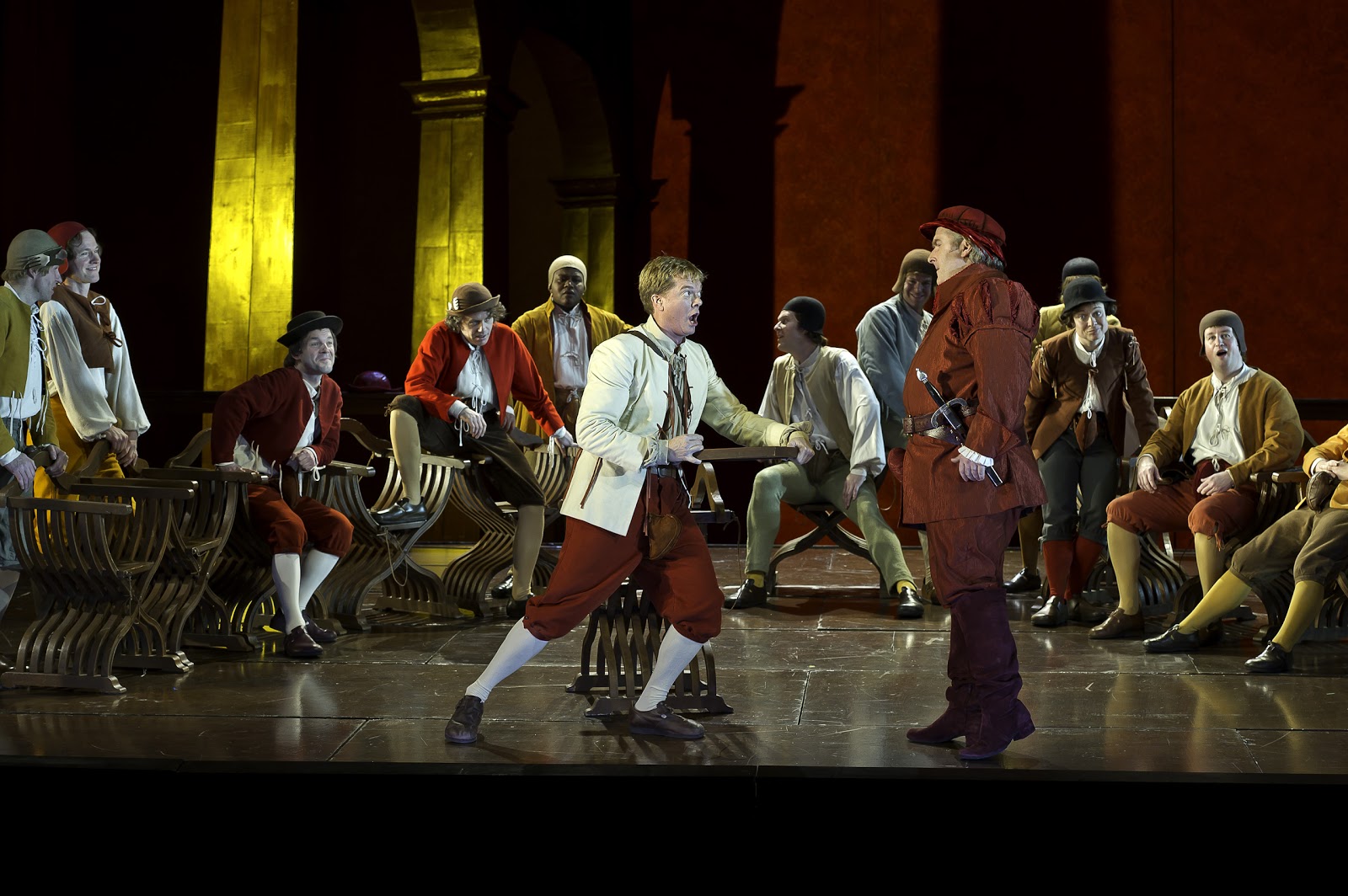
This Marker has fond memories of Graham Vick’s production. It was the first he saw in the theatre, in 2000 and again in 2002; it seemed so full of joy and good humour; above all, it provided a seemingly perfect backdrop for the unforgettable greatness of Bernard Haitink’s conducting. (Mark Wigglesworth was far from put to shame in 2002.) Now, alas, it looks tired: there are few cases of production styles failing to date; in this, as in so much else, Patrice Chéreau’s Ring offers a near-miraculous exception. The evocation of Nuremberg in Richard Hudson’s sets seems as much of its time as John Major’s ‘Back to Basics’ (not that David Cameron seems to have noticed). Where once one saw Breugel, now one registers the lack of darkness in a work every bit as Schopenhauerian as Tristan und Isolde. What once was joyous now seems evasive. The ‘amusing’ antics of the apprentices now merely irritate. Time has passed, yes, but a good part of the problem seems to be the revival direction. Perhaps matters would have been different had Vick himself returned, but there seems to be precious little to Elaine Kidd’s direction beyond having singers don their costumes and sing: it resembles a repertory production in a provincial house rather than a performance on one of the world’s great stages. Oddly, the chorus often seems better directed than the singers. As for the codpieces, it would be an act of charity for all concerned to consign them to the dustbin of history.


Beckmesser (Peter Coleman-Wright) attempting to sing the Prize Song
The contrast becomes all the more glaring, however, when one turns to the Old Master, Haitink. Though Tristan was his final production as Music Director of the Royal Opera, he chose the final scenes of Die Meistersinger as the culmination of his gala farewell to Covent Garden. Indeed, there is perhaps no opera more strongly associated with him. It was a great privilege to receive one’s theatrical baptism from him, though Christian Thielemann at Bayreuth, just a few months later in 2000, also lingers in the memory. Where, under Haitink, the Orchestra of the Royal Opera House sounded every inch a rival to Bayreuth, Vienna, or Dresden, here too much was lacklustre. The horns too often found themselves all over the place; woodwind were untidy; strings and brass lacked bloom. More seriously, Antonio Pappano’s direction failed to probe. Where every line should not only glow but take its place in vital counterpoint with every other, the work emerging almost as if an enormous Bach fugue, this reading remained very much on surface. The Prelude to the first act lacked any distinguishing feature beyond a strangely prominent tuba line: that extraordinary moment of recapitulatory arrival, heralded by adorable triangle, went for nothing. It is not a matter of speed as such, for the act managed both to sound hard-driven and well-nigh interminable. To follow and to guide the Wagnerian melos is no easy task, but when one has heard Haitink, or Thielemann for that matter, Wagner as soft-focus Verdi will not pass muster. There were better passages: the music following ‘Merkwürd’ger Fall!’ was nicely characterised, though it did not arise as it should from what had gone before, nor did it lead where it must. Even the third act, better in a good few respects, suffered from a Prelude that was merely slow: again, speed, or lack thereof, does not equal profundity. The strings now played beautifully, but it was the wrong kind of beauty, the shimmering more akin to the third act of La traviata. The closing bars were not, admittedly, helped by premature applause – surely the music is loud enough to enable one to hear when it has finished – but Pappano harried them so as to sound inconsequential; I have never heard the final chord register in so perfunctory a fashion.

Apprentices, David (Toby Spence), Walther
Save for a generally strong performance from the chorus – as usual, Renato Balsadonna had both learned and conveyed his lessons well – and from Toby Spence as David, there was little vocally to lift the spirits. Even Spence had the occasional moment of crooning, but his was otherwise an alert, carefully shaded reading, which married tone and word as his character outlines. The contrast with Simon O’Neill’s Walther was, to put it mildly, stark, nowhere more so than in the Quintet, where O’Neill stood out like a pneumatic drill. The unpleasant, metallic sound of his voice rendered the Prize Song more of a trial song – and for the first time made me think the naysayers might have it right: do we simply hear that music too often? You do not have to be Sándor Kónya, but it undeniably helps. Where Spence used, indeed relished, Wagner’s language, O’Neill seemed uncertain as to what it meant; maybe the words were not learned by rote, but that was how it sounded. Emma Bell’s intonation was variable as Eva: again, the beginning of the quintet was a glaring casualty. Too often, her delivery was blowsy; the best one could say was that she looked good in a white dress. Peter Coleman-Wright’s Beckmesser sounded and often looked over the hill: a comparison with Sir Thomas Allen for Haitink goes beyond unfortunate. Even Sir John Tomlinson, who sang Sachs in 2000, was out of sorts, loud and yet threadbare as Pogner. This was an instance too far of all-purpose raving and bluster: it was as if Bluebeard, or at a pinch, Wotan, had wandered in from another performance entirely. Wolfgang Koch was a musical, verbally attentive Sachs, but his voice sounded at least one degree too small for the theatre. Midsummer, as so often in this country, was postponed until another year.