Showing posts with label Aleš Briscein. Show all posts

Friday, 16 January 2026

The Makropulos Case, LSO/Rattle, 15 January 2026


Barbican Hall

Emilia Marty – Marlis Peterson
Krista – Doubravka Novotná
Albert Gregor – Aleš Briscein
Baron Jaroslav Prus – Svatopluk Sem
Dr Kolenatý, Strojník, Machinist – Jan Martiník
Vítek – Peter Hoare
Count Hauk-Šendorf – Alan Oke
Janek – Vit Nosek
Cleaning lady, chambermaid – Lucie Hilscherová

London Symphony Orchestra
Simon Rattle (conductor)


Images: Mark Allan


Simon Rattle’s twin traversal of the Janáček operas in concert in London and onstage in Berlin has now reached The Makropulos Case in the former, Claus Guth’s staging for the Staatsoper Unter den Linden’s having been its first ever. I suspect this may also have been the LSO’s first performance, though shall happily be corrected. At any rate, from the very outset, both Rattle and the LSO sounded entirely ‘inside’ the work, with all the security of a repertory staple, yet with all the freshness and exhilaration of discovery. It is only two months ago that the Royal Ballet and Opera staged the opera, in what was reported to have been Katie Mitchell’s feminist farewell to the genre. If so, Mitchell certainly went out with a bang in one of those rare productions that will prove not only memorable but also to have transformed our understanding of the work forever, expertly conducted by the RBO’s music director Jakub Hrůsá, and with a fine cast headed by Aušrinė Stundyte. That will have been fresh in the memories of many in the Barbican audience, but that did not prevent the hall from apparently selling out for not one but two concert performances; indeed, I suspect it aided that success.

That first-act Prelude constructed a frame for our listening thereafter, strings, timpani, and the rest, offstage brass included, ‘speaking’ in just the right way for opera: musically generative and full of dramatic content and commentary, almost more Wagnerian than Wagner, without ever sounding especially Wagnerian. Czech speech rhythms met the time-honoured craft of something approaching orchestral accompagnato in Rattle’s conducting, so that the composer’s twin poles of cellular radicalism and lyrical expansion proved not only compatible but mutually dependent and generative. At the beginning of each act, there was an unmistakeable sense of where we were, how we (dramatically) had got there, and of anticipation. For the LSO was on outstanding form. It would be invidious to single out any instrument or section, since all, from trombones to xylophone, contributed so eloquently. What struck was a sense of a myriad of lines, orchestral and vocal, combining in ever transformative fashion to a harmonic, contrapuntal, and dramatic whole.


The essence of opera in concert performance is complex: what it is, what it is not, what it might or might not be. Those of us had recently seen Mitchell’s staging will doubtless have come to the performance with different views of the work from those who had not, and so on. What is incontestably the case for everyone is that the orchestra literally takes centre stage, and we both see and hear its music very differently from when it emerges from a sunken pit. Singers must prove at least as verbally and musically communicative, since there is less room for staged expression; Rattle’s latest Janáček troupe certainly impressed in that and indeed in all other respects. It was almost like reading – or having read to one – a sung novella. In a typically livewire performance, Peter Hoare, one of two singers common to the Barbican and Covent Garden, could not but help but act. That early liberation acted as if to inspire the rest of the cast.

Marlis Petersen as Emilia Marty seemed just ‘right’ in all she did: voice, bearing, and unmistakeable sympathy. Doubravka Novotná’s rich-toned, spirited Krista proved the perfect foil—or better, one of them. From Aleš Briscein’s ardent Albert Gregor to Alan Oke’s magnificently vivid cameo (the other role shared from Covent Garden) as Count Hauk-Šendorf, this performance had a true sense of company even without staging. Jan Martiník’s three characters were sharply drawn as individuals, as was Svatopluk Sem’s Jaroslav Prus. Vit Nosek and Lucie Hilscherová likewise made the most of their roles, created through words and music, yet as human as if we had seen them onstage.  Such vivid characterisation drew back even those of us won over by Mitchell’s alternative vision towards the work ‘itself’. Those new to the opera will surely have been enthralled. A roaring reception suggested so.


For it was in the third act, as it must be, that Janáček’s drama palpably touched all as if for the first time. Here was most clearly redrawn in exultant urgency the twin clarity and abandon of E.M. to the increasing irrelevance of the men (and women) surrounding her, reminding us that ultimately, Mitchell’s staging grew out of the work’s essence rather than being imposed upon it (as uncomprehending criticism claimed). Taking a view does not necessarily mean betrayal; it is often fundamental to fidelity. Petersen and the orchestra’s transfiguration sent shivers down the spine in what came to seem, if you can imagine such a thing, almost a female, even feminist, Gerontius. Now there might lie a challenge to staging.


Friday, 9 May 2025

The Excursions of Mr Brouček, LSO/Rattle, 6 May 2025


Barbican Hall

Mr Brouček – Peter Hoare
Mazal/Blankytný – Aleš Briscein
Málinka/Etherea/Kunka – Lucy Crowe
Sacristan/Svatopluk/Lunobor/Domšík – Gyula Orendt
Würfl/Čaraskvouci/Councillor – Lukáš Zeman
Čišničeck/Child prodigy/Student – Doubravka Novotná
Kedruta – Hanna Hipp
Básník/Oblačný/Vacek- Arttu Kataja
Artist/Dohuslav/Vojta – Stephan Rügamer
Skladatel/Harfoboj/Miroslav – Linard Vrielink

Tenebrae (chorus director: Nigel Short)
London Symphony Orchestra
Simon Rattle (conductor)


Images: Mark Allan


Simon Rattle’s survey of the Janáček operas has proved a tale of two cities: Berlin (first the Philharmonic and latterly the Staatsoper) and London (the LSO). The latter has been mostly in concert, although it shared Peter Sellars’s concert staging with the Berlin Philharmonic. Now, on the back of Robert Carsen’s Berlin staging, originally seen at the Janáček Festival Brno, the LSO’s series reaches The Excursions of Mr Brouček to the Moon and to the 15th Century. 

Of those I have attended, this unquestionably marked the highpoint: one of those performances it is difficult immediately to imagine being bettered. At the heart of that was the magnificent playing of the LSO. Janáček had not previously played a large part in its repertoire, though I remember an interesting, also highly criticised Glagolitic Mass from Colin Davis. It hardly could, one might say, for a symphony rather than an opera orchestra, which incidentally reminds us of a long-term consequence of Davis and Clive Gillinson’s tenures, nurtured by their successors: regular performances of opera in concert, supplemented by occasional appearances in festival pits. Intimacy of acquaintance with Janáček’s writing, its melodic, rhythmic, harmonic, and timbral qualities, inextricably bound to the Czech language, told—as, I think, it did with Rattle, who has long championed this music and who no longer has anything to prove. Precision, heft, the way the orchestra ‘spoke’: this and so much more made for an ideal partnership, rendered all the more impressive by a uniformly impressive cast and chorus (the ever versatile Tenebrae choir, trained and sometimes conducted here by Nigel Short). 


From the opening of the first part, dance rhythms and orchestral colours, xylophone immediately recalled from Jenůfa, created a dramatic stage before our ears, so much so that it is difficult to imagine anyone truly regretting the lack of staging. Time of day, temperature (literal and metaphorical), place, and much more were palpable, indeed unavoidable. As dawn approached at the end of the first part, one felt it emotionally, overwhelmingly so, as well as temporally. For a tenderness embedded in the composer’s deep humanity was always apparent, in a reading that saw no reason to exaggerate the bizarre, zany elements, as perhaps did David Pountney in a memorable 2022 staging for Grange Park Opera. There is room for all, but this went deeper, also underscoring the extraordinary, innovative brilliance of the composer as a contemporary of Strauss, Schoenberg, and yes, Puccini. There was absurdity, yes, but in that absurdity lay deepest sincerity, and the second part, darker and more soulful from the off, proved more moving still. Soundworlds related yet distinct offered both contrast and connection between the opera’s two parts. 

Peter Hoare, who had also sung the title at Grange Park, proved if anything a still more captivating Mr Brouček, alive to his provincial, bourgeois absurdity, not without affection, yet quite without what would have been deadly sentimentality. Like his fellow cast, this was a portrayal that sprang from the page, deeply rooted in words, music, and their alchemy, without being bound by them. Lucy Crowe gave as fine a performance as I have ever heard from her, alternating various roles as Málinka, Etherea, and Kunka, bringing something special to each of them, refulgent of tone, yet acerbic where called for, and hinting without didacticism at what might unite them. Much the same might be said in principle of all those taking on multiple roles, world-class casting offered by the likes of Gyula Orendt, Linard Vrielink, and Aleš Briscein. Truth be told, there was not a weak link in the cast; more to the point, the drama lay in connection, collaboration, and of course conflict. We were fortunate, I think, to see and hear a cast that had mostly performed together onstage in Berlin. 


Dare we hope, then, for all of Janáček’s operas to feature in subsequent instalments? However tempting, we should probably retain perspective and simply enjoy them one at a time. Sometimes I worry that, in ever-straitening times, opera with full forces, be it staged or unstaged, might come to seem an ‘unaffordable’ luxury. Smaller versions, cleverly adapted, whether will slightly reduced orchestrations or full-scale reductions, can form a crucial part of our operatic ecology, but that must never be at the expense of the ‘real thing’. One can hardly hope for a better reminder of such ‘reality’ than the magical surreality of these Excursions.


Saturday, 21 September 2019

Eugene Onegin, Komische Oper, 20 September 2019


Images copyright: Iko Freese / drama-berlin.de


Eugene Onegin – Günter Papendell
Tatiana – Natalya Pavlova
Olga – Karolina Gumos
Lensky – Aleš Briscein
Mme Larina – Stefanie Schaefer
Prince Gremin – Tijl Faveyts
Filipievna – Margarita Nekrasova
Zareski – Changdai Park
M. Triquet – Alexander Fedorov
Zaretsky – Changdai Park
Captain – Carsten Lau
Guillot – Yuhei Sato

Barrie Kosky (director)
Rebecca Ringst (set designs)
Klaus Bruns (costumes)
Simon Berger (dramaturgy)
Franck Evin (lighting)

Orchestra and Chorus (chorus director: David Cavelius) of the Komische Oper
Ainārs Rubikis (conductor)


What’s in a name? Should Tchaikovsky’s opera – which, as Barrie Kosky states in the programme booklet, should be considered alongside Pushkin, not as its musical translation – really be called Eugene Onegin at all? Or would Tatiana Larina be the more fitting title? Eugene and Tatiana, perhaps? It is a silly question, really; for one thing, no one is going to rename the work, although someone, I suppose, might write another. But names aside, there will probably always be something of a tension between the centrality ascribed by a production to the opera’s two principal characters; and also something, moreover, of a tension between Tatiana and Onegin on one hand and Lensky, if more rarely Olga, on the other. It is difficult to imagine a successful or indeed pretty much any unsuccessful production that did not involve such tensions, although Achim Freyer, in his bizarre staging for the Staatsoper Unter den Berlin, a few hundred metres away, may be said to have accomplished that in his very typical way.


Kosky’s 2016 staging for Berlin’s Komische Oper, in co-production with Zurich, offers an intriguing, convincing blend of the broadly yet never lazily conventional; the slightly symbolic; and the point of detail, even the incidental, made more than that. The latter first: as the opera opens, Mme Larina and the nurse, Filipievna are making jam. I am not sure that I even recalled that point of detail, though I am sure that I will now. The jam jar, however, returns at a crucial point – in Kosky’s staging, that is – as container for Tatiana’s letter to Onegin. Her nurse, affecting not to understand for whom it is intended, keeps dropping it, casting it aside, until she relents and sets that train of events in motion. ‘So what?’ you may ask. So nothing, perhaps; but I think not. For the jar and its contents take us back to the opening, an apparently carefree summer afternoon, save of course for beneath the surface. Things have changed – and have stayed the same; such tends to be the way with life. And the chorus of local girls, more than usually an emanation of Tatiana’s unconscious – replication and contrast in Klaus Bruns’s costumes lightly make the point – has all along been framing, voicing, goading.


So too will the chorus, male and female, later on, as part of a more general pattern of contrasts and connections between public and private, indoor and outdoor, country and town; and the criss-crossing connections between those pairs of opposites. The fundamental setting, common to all scenes, is that of the meadow on which it all began: designer Rebecca Ringst’s simple, adaptable focus for development and memory. Franck Evin’s lighting works wonders in its partial transformations, highlighting (false or alienating?) community and Romantic loneliness, whilst never having us lose sight of where we are. So too, of course, do Kosky’s blocking and, more broadly, his story-telling. It does no harm for the ball to take place with torches outside for once; its stifling, tragic qualities are not lost. Only in the first St Petersburg scene is there an additional set design, but even then, the facade of Prince Gremin’s palace can, like all facades, readily be dismantled, so that we can turn to the inversion of our central pair’s fortunes and their resolution.


Like many directors, Kosky ignores the opera’s strong, at times overwhelming, homosexual subtexts: the ‘Romantic friendship’ between Onegin and Lensky and, of course, the figure of Tatiana herself as alter ego for Tchaikovsky, his fantasy of how a woman might feel and act. That, however, is simply not the concern of this particular production. For, in the programme booklet, Kosky expresses a preference for operas with ‘very simple stories and incredibly multifaceted themes and emotions – precisely as in Greek theatre,’ and also criticises composers who, over the past fifty years, have, allegedly, ‘simply set literature to music’. I am not quite so sure that it is as simple as that, nor that the comparison with ancient Greece is objectively meaningful in this case, as it certainly would be to Wagner; however, if it is to him, all the better. There is unquestionably a directness to Kosky’s telling of the story here, far from opposed to interpretation, but rather open to it, which works very well: as, say, in his Rusalka and his Pelléas, or indeed, harking back to Attic tragedy, in his Iphigénie en Tauride, all for the Komische Oper, yet sadly lacking in his Bayreuth Meistersinger. Whose opera is this anyway? Here, it conventionally, yet never stereotypically, moves from being Tatiana’s to Onegin’s; the latter character emerges in the reflection, the memories of the latter’s acts and emotions. That trajectory is delineated with a power only rarely achieved, at least in my experience.


Instrumental – or better, vocal – to that was Günter Papendell’s Onegin, thus perhaps rebalancing the scales slightly in that direction. To begin with, I felt somewhat nonplussed at the apparent woodenness of his portrayal, until I appreciated that it was a portrayal of woodenness, of coldness, to be humanly defrosted, as it certainly was during the course of the opera. This was a fine, memorable, and sophisticated conception of the role. It would be an exaggeration, indeed a vulgarisation, to say that Natalya Pavlova’s Tatiana moved straightforwardly in the opposite direction, but tension was present in that respect: the crossing of lines and lives that ultimately turns, we think, to tragedy. Her opening fragility, her heartfelt and beautifully sung Letter Scene, and her final struggle, seemingly achieved, for self-possession proved similarly memorable and sophisticated. Aleš Briscein’s Lensky was surprisingly coarse of tone to begin with, though it was an ardent performance; I could not help but wonder whether he were unwell. A spirited Olga in Karolina Gumos, a stylish and lively M. Triquet in Alexander Fedorov, a splendidly deep-voiced Gremin in Tijl Faveyts, and above all a richly expressive, compassionate Filipievna in Margarita Nekrasova had much to offer, in a typically strong company performance that had no weak links.


The chorus sang and acted well too, its stage direction always a Kosky strength. My sole, relative disappointment lay in aspects of Ainārs Rubikis’s conducting of the orchestra. At its best, especially in the middle scenes, there was a telling striving towards symphonism. Elsewhere, however, much was oddly hard-driven. There were striking disjunctures, moreover, between orchestra and chorus in the first scene. This was not, then, an Onegin to think of in the way of Semyon Bychkov’s (probably the best conducted I have heard in the theatre) or Daniel Barenboim’s (for Freyer, as mentioned above). This was Kosky’s Onegin rather than the conductor’s, yet it belonged as much to the singers and of course to their characters. That, I think, was a good part of its point: a point served well.


Thursday, 2 August 2018

Munich Opera Festival (3) - From the House of the Dead, 30 July 2018


Nationaltheater

Images: Wilfried Hösl

Alexandr Petrovič Gorjančikov – Peter Mikuláš
Aljeja – Evgeniya Sotnikova
Luka Kuzmič (Filka Morozov) – Aleš Briscein
Skuratov – Charles Workman
Šiškov – Bo Skovhus
Big Prisoner, Prisoner with the Eagle – Manuel Günther
Little Prisoner, Bitter Prisoner – Tim Kuypers
Governor – Christian Rieger
Old Prisoner – Ulrich Reß
Čekunov – Johannes Kammler
Drunk Prisoner – Galeano Salas
Cook – Boris Prýgl
Smith – Alexander Milev
Pope – Peter Lobert
Prostitute – Niamh O’Sullivan
Don Juan (Brahmin) – Callum Thorpe
Kedrill, Young Prisoner – Matthew Grills
Šapkin, Happy Prisoner – Kevin Conners
Čerevin, Voice from the Kirghizian Steppes – Dean Power
Guard – Long Long


Frank Castorf (director)
Aleksandar Denić (set designs)
Adriana Braga Peretski (costumes)
Rainer Casper (lighting)
Andreas Deinert (video, live camera)
Stefanie Katja Nirschl (live camera)
Jens Crull (video, live editing)
Miron Hakenbeck (dramaturgy)
Martha Münder (revival director)


Bavarian State Opera Chorus (chorus master: Sören Eckhoff)
Bavarian State Orchestra
Simone Young (conductor)


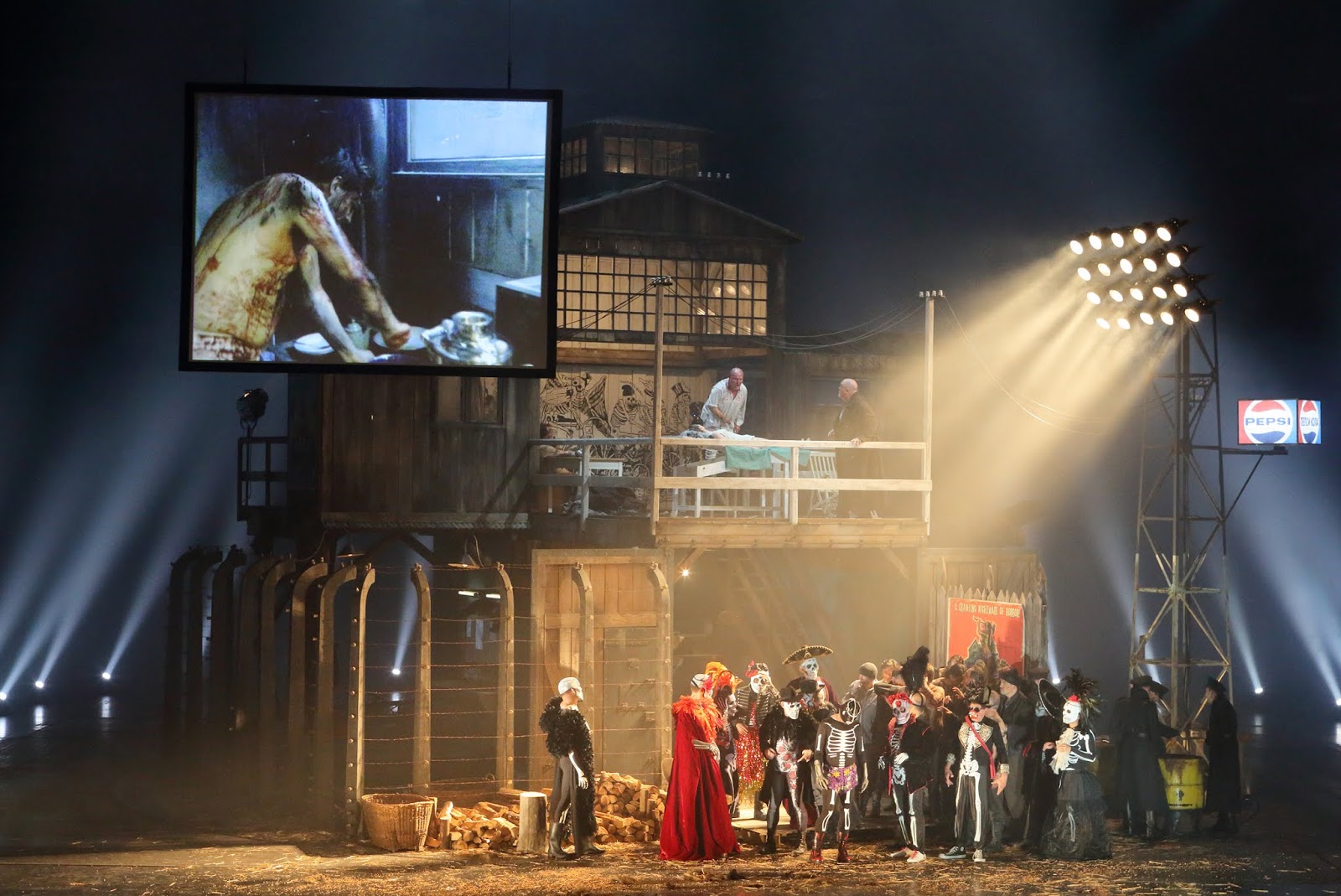
Frank Castorf might have been born to direct From the House of the Dead. In this, his third opera project – or better, his third opera project in the opera house, for his Volksbühne Meistersinger must surely be reckoned with, even by those of us who did not see it – many of his hallmarks and those of his team are present, yet without the slightest hint of staleness, of anything other than being reborn for and in the work. And how the work suits such an approach; in many respects, the deconstruction has already been done. Probably Janáček’s greatest opera, indeed his greatest work of all, it is no accident that it is the one Pierre Boulez chose to conduct, towards the end of his life. Alas I never heard that live, although in 2014, I would see Patrice Chéreau’s production in Berlin. That was, of course, a fine piece of theatre, as indeed was Krzysztof Warlikowski’s Covent Garden staging, seen earlier this year. Castorf, however, revelling in its fragmentary nature – for it is in many respects his own – triumphantly, I should say dialectically, offers the strongest sense of a whole I have seen or could imagine. By taking it as it is, Castorf’s team and a magnificent cast, aided greatly by Bavarian State Opera forces under Simone Young in the finest performance I have heard from her, alert both to the needs of the minute and of the greater architecture, present and represent the opera as it is and might be. Quite without sentimentality, they write and rewrite, igniting and reigniting that Dostoevskian redemptive spark that is both present and absent throughout, depending when and where one looks and listens, how and with what one pieces together one’s own narrative, musical and dramatic.

We are in Russia – no doubt of that. It is Russia at a dark time – again no doubt of that. (When, however, was that not the case, save for a few years under Lenin, and even then…?) But is it a ‘real’ Russia? And what indeed could so impossibly naïve a formulation mean? Live camerawork performs all manner of tasks, questioning our ability to comprehend, to view, to narrate, whilst making it all the more necessary that we try to do so. There is little doubt concerning the realism – until, that is, a true Carnival of the Dead comes amongst the prisoners and the prison. Magic realism? Perhaps, but if so, it is the blackest of magic to follow, perhaps even to sublate, the blackest of comedy and (non-)redemption. Whereas, in his Siegfried and Gotterdammerung, Castorf took us to an alternative historical path for the GDR, an alternative that turned out not to be so very alternative at all, (Al)Exander Platz still a commercial, post-socialist wasteland, Wall Street still failing to burn, here we seem perhaps to have joined the USSR for an alternative 1930s.


Bitter Prisoner (Tim Kuypers), Prisoner with
the Eagle (Manuel Gunther),
Aljeja (Evgeniya Sotnikova)
Or have we? Trotskyist hints abound: the rabbit hutch (many thanks to my friend Sam Goodyear for having pointed out the connection), Mexico too (‘Partido liberal’, we read on one of many historical and/or imaginary signs), a film advertisement (in Spanish), starring Alain Delon. (Hang on, if we are in 1972…?) Even a carnival bird Aljeja, splendidly sung by Evgeniya Sotnikova, seems both to suggest and to disavow that possibility. Or are we, was I, confusing him/her – here most definitely ‘her’ – with the Prisoner with the Eagle, or his eagle? What might that mean here, whether the confusion or the eagle? Russia or the USSR, however, it certainly remains, even down to the affinity – which seems to have been overstated by some – with Aleksandar Denić’s Walküre set (Azerbaijan, 1942). What does a sign for Pepsi Cola in English and Russian tell us? And what, at the end, does the English poster invitation to travel to the USSR as a holiday destination mean, not least in such appalling circumstances? Stop trying to ascribe meaning to everything: is that not what, as an imprisoned intellectual, one is compelled to do? Are we to see the future and will it to work, or perhaps indict it? Is it just a joke, as suggested by the presence of a Ring crocodile? Who knows? We shall never make the journey, just like so many of those prisoners, yet unlike, perhaps, Gorjančikov, who thinks he has something written in his head. Like Dostoevsky, like Trotsky, like Castorf, like our writer, Alexandr Petrovič Gorjančikov, we write and rewrite. So too does the action all around, on stage, on film, seen and unseen; so too, of course, does the orchestra.


Šiškov (Bo Skovhus), Statisterie and Chorus
It is complicated, yes; how can a fragmentary drama with so many ‘characters’ or at least people not be? But it is also visceral, direct. Violence we see, we feel, whether we like it or not, be it in the Guard’s sadistic flagellation (a truly nasty Long Long, almost a match for the still nastier Governor of Christian Rieger) or in the metal of the steppes’ orchestra. Opera too, even in this most inhospitable of circumstances, is reborn. If the Wanderer seemed to have been an inspiration for our noble prisoner’s initial journey to this camp, Peter Mikuláš capturing both intelligence and a certain camouflaged nobility, then it is the Wotan of the second-act Walküre monologue who comes to mind in that of Šiškov. That is partly a matter of Bo Skovhus’s searing portrayal, quite the most powerful performance I have seen and heard from him in a long time. But everyone involved has played a role in putting these pieces together, in constructing something from these musico-dramatic shards. ‘A mother gave birth even to Filka,’ after all – and we know it, because, like Šiškov, he sings, not least in this devilish incarnation from Aleš Briscein. So too, earlier, do Don Juan (an outstanding Callum Thorpe) and his pseudo-Leporello (another excellent performance, this time from Matthew Grills), in a play-within-a-play. That, thanks to Castorf’s lengthy experience with and rejuvenation of post-dramatic commentary, seems more of a play-in-itself than I can recall – until, once again, it does not.

 
Šiškov, Cerevin (Dean Power)


For, like Don Giovanni, this is redemptive within and without, or seems to be: as I said, it takes life and drama as they are. A (post-)religious consciousness is at work here. It also, perhaps, suggests what they might be, or at least what one day, when the revolution comes again, the revolution to which we cling no matter what, we might hope it to be. The noble prisoner leaves, though, so most likely not. He has used, learned from his experience; so, we imagine, have we. The carnival of (Russian) death continues. There is a chink of something uncertain. In the blackest of comedies, we might even think it light. Humanity even – though are we not all now post-human(ist) as well as post-dramatic? Who knows, who cares? This human comedy and tragedy of which we are part rolls on, just as it did for those Calderón-like figures of a reimagined Salzburg World Theatre in the celebrated post-war Furtwängler Don Giovanni. The final scene alienates – like Mozart’s. And yet, like that too, it moves (us). We have experienced something, even if we have not a hope in our living hell of learning what it may have been. We have, like this Gorjančikov, written a work of sorts in our head. No one will read it or even remember it, perhaps it would be impossible for anyone to make sense of its difficult, even nonsensical fragments; yet that spark of creativity, of art, of that which Marx just as much as Schiller considered made us human, has flickered. At least we think it did. Perhaps. Or at least we thought it did. Once. Perhaps. We return, like Gorjančikov, like Trotsky, to watch the post/non-human (non-)drama for the rabbits in their hutch, caged like us and yet (to the sentimental?) more free. Perhaps.

Aljeja and rabbits in their hutch


Tuesday, 24 May 2016

The Makropulos Case, Bavarian State Opera, 21 May 2016


Image: Bayerische Staatsoper, © Wilfried Hösl


Nationaltheater, Munich

Emilia Marty – Angela Denoke
Dr Kolenatý – Gustáv Beláček
Vítek – Kevin Conners
Krista – Rachael Wilson
Albert Gregor – Pavel Černoch
Jaroslav Prus – John Lundgren
Janek – Aleš Briscein
Hauk-Šendorf – Reiner Goldberg
Chambermaid – Deniz Uzun

Stage Technician – Peter Lobert
Cleaning Lady – Heike Grötzinger

Arpád Schilling (director)
Márton Ágh (designs)
Tamás Bányai (lighting)
Miron Hakenbeck (dramaturgy)

Chorus of the Bavarian State Opera (chorus master: Sören Eckhoff)
Bavarian State Orchestra
Tomáš Hanus (conductor)


Opera houses’ neglect of Janáček remains one of the most baffling of the many baffling aspects of the ‘repertoire’. At least three of the composer’s operas would be perfect introductions to the art form: Jenůfa, Katya Kabanova, or The Cunning Little Vixen would surely hook most for life. From the House of the Dead might do likewise for someone of a rather different disposition, sceptical of opera’s claims and conventions. The Makropulos Case perhaps falls somewhere in between, although surely closer to the more ‘conventional’ trio, an unusual story notwithstanding. At any rate, no Janáček opera outstays its welcome. Every one is musically and dramatically interesting, without – save, arguably, in the case of From the House of the Dead – being ‘difficult’ (a silly concept, anyway, but let us leave that on one side). There are strong, central female characters in most (again, not in his final opera, but...) And yet…
 

What, then, is the problem? Is it simply that the works are in Czech? Is there still resistance to following titles, from those of us who do not have the language? Perhaps, although how many in the audience actually have an understanding, let alone a good one, of other, more typically-used languages? Translation is, perhaps even more than usual, a bad idea, since the music depends so much on Czech speech rhythms. One can tell that, even when one does not know the language. I mention that here, since a great virtue of this particular performance was the ability to follow the words (with German titles). The sounds are important, but it is not just a matter of sound. In conjunction with the orchestra, this made sense, even for those of us having to rely upon our memories and upon the titles.
 

First and foremost to be thanked for that excellent, indeed crucial, outcome must be conductor Tomáš Hanus. His direction of the equally (at least!) excellent Bavarian State Orchestra left us in no doubt that not only did the conductor know where he was taking us, and how to do so, but that just the right balance was struck between the demands of the moment, of the intricate relationships between words and music, between vocal line and orchestra, between melodic and harmonic impulses, were being observed and, above all, dramatically communicated. The golden sound of the orchestra – again, perhaps, like the Czech Philharmonic in a recent concert performance of Jenůfa, more Bohemian than Moravian, but none the worse for that – was no mere backdrop, but a musico-dramatic cauldron from which words emerged and in whose self-transforming broth they acquired their meaning and impulse. The disjunctures were not sold short either; they held their dramatic ground, without being fetishised.
 

Angela Denoke had also played E.M. – or whatever we wish to call her – in the Salzburg Festival performance I heard in 2011. Dramatically, Denoke’s performance here in Munich was at least as fine as in Salzburg; she remains an excellent singing actress. Vocally, however, it was, if anything, superior, with few of the occasional flaws of five years ago. The virtues of the orchestral performance were also her virtues. So indeed were they of the rest of the cast. Brno-born tenor, Pavel Černoch offered an Albert Gregor of what seemed to me (again with the caveat that I am not a Czech-speaker) of vocal beauty and verbal acuity in equal measure, his stage presence just as impressive. His first-act dialogue with Emilia Marty proved one of the musical and dramatic highlights of the performance. Gustáv Beláček and Kevin Conners impressed with their difficult legal performative briefs. John Lundgren’s darkly ambitious Jaroslav Prus and Rachael Wilson’s bright-toned Krista were similarly noteworthy. Aleš Briscein’s Janek furthered the excellent impressions given in that concert Jenůfa, his crestfallen withdrawal from the Marty game a study in musico-dramatic observation and communication. And how wonderful to welcome back Reiner Goldberg to the stage as Hauk-Šendorf: so much more than a mere ‘character’ appearance. Character and artist similarly rolled back the years: a moving moment indeed, not least given the opera in question.
 

I have left Arpád Schilling’s production until last, because I do not have much to say about it, I am afraid. The principal impression is made by Márton Ágh’s stylish designs, both sets – for instance, a visually arresting pile of chairs – and costumes, Černoch’s Gregor thereby enabled to look very much as he sounded. Of a concept, let alone a Konzept, beyond that, I struggled to discern anything very much. This, then, is stage direction of the kind operatic reactionaries claim to like: non-interventionist and pretty, if a little too modern in its style for them. The work could (sort of) speak for itself, I suppose, but that is hardly the point. Christoph Marthaler delved deeper in Salzburg.


Saturday, 23 April 2016

Jenůfa, Czech PO/Bělohlávek, 18 April 2016


Royal Festival Hall

(concert performance)

Jenůfa – Adriana Kohútková
Kostelnička Buryjovka – Karita Mattila
Števa Buryja – Jaroslav Březina
Laca Klemen – Aleš Briscein
Stárek – Svatopluk Sem
Stařenka Buryjovka – Yvona Škvárová
Karolka – Lucie Silkenová
Rychtář – Jana Hrochová
Jano – Marta Reichelová
Pastruchyňa, Barena – Kateriňa Keněžiková

Czech Philharmonic Choir of Brno (chorus master: Petr Fiala)
Czech Philharmonic Orchestra
Jiří Bělohlávek (conductor)
 

Images: Petr Kadlec
Adriana Kohútková (Jenůfa)
 

Some people, it seems, are never satisfied. (Is that a tu quoque which I hear before me? Surely not.) I heard a few people during one of the two intervals during this wonderful Jenůfa lament that this was not a staged performance and therefore could not do the work justice. Well, if you felt that strongly about it, you might perhaps have considered not going… I actually very much enjoy many concert performances: not as a substitute, nor indeed as the ‘same thing’. They have their own virtues, not least the greater ability to hear the orchestra – no negligible thing, when the orchestra in question is the Czech Philharmonic. At the risk of sounding unduly reactionary, I also like on occasion not to be distracted by an inadequate production; that, of course, is an argument against inadequate productions, rather than staging as such, but let us leave that now for another day.


For me, perhaps the greatest single virtue of this particular performance was the playing of the Czech Philharmonic. I think this might actually be the first time I have had opportunity to hear this great orchestra ‘in the flesh’; it is difficult to imagine that I could readily have forgotten a previous encounter. What surprised me somewhat was that it did not sound quite so much as I had expected from (largely old) recordings. Its golden sound actually sounded to me in many respects more Viennese than Czech (or at least Moravian, for this is of course a Bohemian band). The beauty of the strings had to be heard to be believed; this was not unlike the Vienna Philharmonic on a good day (perhaps in the celebrated Janáček recordings under Charles Mackerras), or even the nearby Staatskapelle Dresden. Horns, likewise, seemingly straight out of Tannhäuser, perhaps via Bamberg. And the delectable woodwind solos would have graced any orchestra in the world, whilst retaining a sense of that most contentious of ‘national’ or ‘regional’ claims: rootedness in place.


None of that, however, was ‘mere’ beauty. What struck me about what I heard from all sections and all instruments of the orchestra, as well as the ensemble as a whole, was how, under Jiří Bělohlávek’s wise, intelligent, loving direction, what little I know (mostly from Janáček’s music!) of Czech speech rhythms truly seemed to ‘speak’ in the orchestra as well as in the vocal line. Just as much as Mussorgsky, this was instrumental recitative and arioso brought to lyrical life. Bělohlávek’s tempi were varied, with plenty of time for relaxation as well as for pressing on; above all they sounded ‘natural’.
 
Karita Mattila and Jiří Bělohlávek
 

That bringing to lyrical life to which I referred was also much to be heard from a fine cast. The sheer goodness of Jenůfa’s soul – a Czech Hardy, I often think, in this work – was to be heard in Adriana Kohútková’s performance. The compassion this Jenůfa had in abundance was ultimately to be repaid. Jaroslav Březina’s initially swaggering Steva had its subtleties too. His was an admirably balanced portrayal, in which this listener at least felt no need of a staging. Likewise Aleš Briscein’s Laca, whose initial petulance was but the start of a development of character with which we could truly sympathise. What singing, ‘purely’ as singing too! The Puccinian element of the relationship between Laca and Jenůfa was apparent, but so was the difference of Janáček: no sadism here. Karita Mattila’s Kostelnička was earth-shattering, an extraordinary move from the title-role (she was my first Jenůfa, in Bernard Haitink’s magnificent Royal Opera performances). There is no denying Mattila’s ‘star quality’: when she stands, let alone when she sings, everyone in the hall will sit up. This, however, was a deeply felt performance, too, the richness of her voice again the quintessence of compassionate humanity. Yvona Škvárová's Stařenka seemed less a portrayal than an inhabition. Indeed, all of the roles, however ‘small’ or large, were very well taken: a lesson to opera houses of the incalculable blessings of a real sense of ‘company’. To round things off, the choral singing, from the Czech Philharmonic Choir of Brno, was outstanding: here, perhaps was something a little rougher than what we had heard in the orchestra, even, dare I say it, more Moravian.


Sunday, 4 September 2011

Salzburg Festival (7) - The Makropulos Case, 25 August 2011

Grosses Festspielhaus


Images © Walter Mair/Salzburg Festival

Emilia Marty – Angela Denoke Dr Kolenatý – Jochen Schmeckenbecher
Vítek – Peter Hoare
Krista – Jurgita Adamonytė
Albert Gregor – Raymond Very
Jaroslav Prus – Johan Reuter
Janek – Aleš Briscein
Hauk-Šendorf – Ryland Davies
Chambermaid – Linda Ormiston
Conscientious Objector performing Community Service – Peter Lobert

Jin Ling – Sasha Rau
Mary Long – Silvia Fenz
Anita Stadler – Anita Stadler

Christoph Marthaler (director)
Anna Viebrock (designs)
Olaf Winter (lighting)
Joachim Rathke (associate director)
Malte Ubenauf (dramaturgy)

Vienna Philharmonic Orchestra
Concert Association of the Vienna State Opera Chorus
Esa-Pekka Salonen (conductor)


My feelings about The Makropulos Case, or perhaps more accurately, my feelings during and after a performance of the work, remain somewhat in flux. Janáček does not pull the heartstrings so consistently as in some of his other works, but of course the coldness of E.M. is part of his point – and, by all accounts, she is treated far more sympathetically than in Karel Čapek’s play. Even more so than, say, Jenůfa or Katya Kabanova, the vocal writing is conversational, the composer’s restraint admirable, even awe-inspiring: there is no more playing to the gallery here than in Pelléas – well, little more. The orchestra, then, plays its role as Wagnerian Greek Chorus. And yet, occasionally, I find that I am missing something: the question is whether that something missing is deliberately absent, whether, again, it is the dramatic point. And more so than those earlier Janáček masterpieces, rather like From the House of the Dead, I find myself reflecting afterwards, and for quite some time afterwards, on what is at stake in the drama. It is, then, an opera that makes one think, but perhaps only truly moves at the end, in the final peroration, both vocal and orchestral, when one finds that very same cyclical affirmation of life in death the composer voices in The Cunning Little Vixen, and arguably as in the earlier cited tragedies too.


Christoph Marthaler’s fine production of Katya Kabanova originated in Salzburg, before making its way to Paris, where I saw it earlier this year. I half expected to see The Makropulos Case similarly transposed to a joyless post-war East European setting, but in many respects, the setting (splendidly designed by Anna Viebrock) is rather ‘traditional’: there is certainly nothing for ‘traditionalists’ to complain about. Unless, that is, one includes the new material with which Marthaler introduces the work: a spoken reflective conversation, not without humour. Themes that will be explored during the work, most obviously the shortness of one’s allotted years, and what alternatives there might be, are adumbrated, without overstaying their welcome. (At least I thought so, though some in the audience seemed restless.) It would seem that there is some degree of reinstatement from Čapek’s play, but I shall leave delineation of that to those better informed. (I wish that I were…) There is even humour, as there is in the opera, concerning the ways of opera singers. Otherwise, one sees a court room, as one would expect, and pretty much in ‘period’, though the voguish practice of employing the same set for each act does lead to confusion: a court room is a bit of an odd place for Marty to succumb to Prus. (Doubtless we are not supposed to understand it that way, but it is a bit odd.) Other touches to either side of the principal room work better. A railway waiting room nicely suggests transience. Whilst I can imagine that some would be irritated by the depiction of a care home – replete with Zivildienstleistender (conscientious objector performing community service: no, I am not making this up) – on the other side of the stage, it aptly suggests the alternative to EM’s immortality. And therefore, as I said, really does make one think: given society’s present treatment of the elderly and infirm, it is by no means clear that one would not give elixir a try. If Christopher Alden’s ENO production probably made more of an immediate (stylish) impression on me when I saw it the first time, it began to irritate the second time around; it is probably fair to say that Marthaler’s production has made me think more, especially after the event. One would hardly expect Marthaler to play the work for laughs, and we can be grateful that he does not.


Angela Denoke performs estimably in the title role. It would be possible to castigate infelicities of tuning, for this, as one might have expected, was a performance very much in the ‘singing actress’ mould. However, such faults seemed to matter little, given the burning heat of her performance. Indeed, one could understand them, even if they were not intended this way, as contributing to the drama between aspiration to perfection and the frailty of flesh. Denoke held the vast stage of the Grosse Festspielhaus as her own, and rightly so. She was in every respect preferable to ENO’s Amanda Roocroft, though Cheryl Barker, on the first London run, was perhaps equally fine. I am rather surprised, however, to report that the other parts were more consistently cast in London (despite, of course, the gross handicap of singing in translation). Peter Hoare, for instance, was a much stronger Gregor than Salzburg’s dry-sounding Raymond Very; curiously, Hoare here movingly sang the role of Vítek. Aleš Briscein and Johan Reuter also just about stood out, though I have heard both singers to greater effect elsewhere. For there was a touch of anonymity to the general company, a surprising sense of routine, not to be exaggerated, but equally not the most memorable of Salzburg performances.

Esa-Pekka Salonen’s conducting of the Vienna Philharmonic proved somewhat disappointing. Though there were times when the orchestra sounded predictably gorgeous – and, unlike some, I really do not mind that in Janáček – one also had to reckon with a few too many loose threads, whether in terms of smudged and even missed entries, or a general lack of rhythmic bite, such as Sir Charles Mackerras and Sir Richard Armstrong both brought to the score in London. The VPO certainly can play this music; it did so memorably for Mackerras, amongst others. Here, however, it sometimes sounded as if Janáček were new and slightly unwelcome territory. Salonen seemed unwilling or unable to control the orchestra as he might have done, indeed perhaps to be still less in sympathy with Janáček’s music, the score somehow meandering aggressively, at least until the final act. Lack of tautness and indeed of formal perception went hand in hand with a tendency to play with loud indifference. Perhaps that is unduly harsh, but I expected great, or at least very good, things, and did not hear them. To my surprise, then, it proved to be Marthaler’s night rather than Salonen’s, though it was at least as much Denoke’s.