Showing posts with label Franz Welser-Möst. Show all posts

Tuesday, 9 September 2025

VPO/Welser-Möst - Berg and Bruckner, 8 September 2025


Royal Albert Hall

Berg: Lulu-Suite (extracts)
Bruckner: Symphony no.9 in D minor

Vienna Philharmonic Orchestra
Franz Welser-Möst (conductor)


Images: BBC/ Chris Christodoulou


Returning to the ‘cavernous’ (typical euphemism) acoustic of the Royal Albert Hall from the better suited venues of the Salzburg Festival takes some getting used to: for the listener and doubtless for the Vienna Philharmonic too. Still, it was heartening to be part of what approached a capacity audience despite severe transport disruption owed to Tube workers’ industrial action, and the ears – expectations, at least – adjusted as I was drawn in to fine performances of Berg and Bruckner, conducted by Franz Welser-Möst. 

It was perhaps a little odd only to hear three Lulu movements (without soloist): the Rondo, Variations, and Adagio. If the music felt slightly listless to begin with – Boulez, for instance, would have imparted a greater sense of forward impetus – Welser-Möst’s paths through the VPO’s silken-smooth Rondo-labyrinth contributed in its different way to a sense of connection throughout the work as a whole and indeed with Bruckner’s writing too. It flowed at first almost imperceptibly but with increasing inexorability. Darker undercurrents occasionally flowed over, but solo instruments in particular proved the principal voices of different threads in quasi-chamber music that highlighted points in common with, say, the Lyric Suite and indeed with Mozart and Schubert, a duly post-Mahlerian close to the movement notwithstanding. A new burst of energy heralded the Variations, well balanced and directed in a more obviously urban soundscape: both more overtly of the interwar years, of ‘Weimar culture’ broadly construed, and also more overtly Classical-Romantic in form and expression. The final movement brought greater and more tragic malevolence from the off, already offering presentiments of the darkness at the heart of Bruckner’s Ninth Symphony (and the path Europe would take following Berg’s death). Open, serial lines pointed to the musical future, but also to a close that, not unlike Wozzeck, stops rather than concludes. ‘Lulu! Mein Engel!’ could only be voiced by strings, yet was no less moving for that, as if the epilogue to the hopes and possibilities not only of a woman, but of an age grimly consonant with our own. 

Following music from Lulu, another celebrated unfinished work—although, likewise, important attempts have been made at completion (not heard here). If Berg and Webern – perhaps Friedrich Cerha, should one venture into the postwar world – sound as some of the last, epilogic gasps of the Austrian Catholic Baroque in music, Bruckner perhaps offers the final full instalment, if not so unmediated as some might have one believe. At any rate, Berg and Webern – their great Jewish-Lutheran teacher too – were present as ghosts, as immanent as those of earlier Austro-German Romanticism. Sonic combination of translucency and depth brought the Vienna Philharmonic’s character, and that of a Bruckner inclined to modernity, even modernism, to the fore. Was it in the shadows, though, and in other liminal passages, that the truest ‘meaning’ lay, here in the first movement and beyond? Poisonous offshoots from the Ring suggested Bruckner’s own response to his touchingly naïve Bayreuth question: why does Brünnhilde burn? Or was it in the unisons, in the approach to the dedicatee of the symphony, Bruckner’s ‘dear God’? In the wayward yet consequential melodic and harmonic twists and turns, or in the orchestral colours that at times seemed to pre-empt Schoenberg’s Five Orchestral Pieces? There was no definitive answer: far from a bad thing. Yes, of course even this music, Bruckner at its greatest, does not develop like Brahms or Beethoven. It takes its own path(s), though; here they sounded unerring, unlike the sometimes unfortunate attempts of his earlier symphonies. Welser-Möst may not have been so ferociously possessed as Furtwängler – who is? – but this performance had its own dramatic trajectory, at times fragile, even threatening to fragment, yet never doing so and quite clear after the event. The movement’s close was hair-raising, without the slightest over-egging. 


The Scherzo sounded as if Schubert, even Bruckner himself, were celebrating a black mass. It was not all malevolence, but, as if in anticipation of Schoenberg’s Gurrelieder confrontation with the Almighty, the standpoint was clear in a drama of belief. The Trio offered, beautifully, nervily, and not a little frighteningly keen contrast in some of the most outstanding orchestral playing London will hear this year.  And the Scherzo’s reprise was heard through that contrast in greater ambiguity and sheer terror, an Upper Austrian Devil stomping his foot to create before our ears an Oberammergau passion within a passion. When sunshine emerged from behind the clouds, one could not but ask, without ready answer, how and why. If the close slightly disappointed, that was because convincing tonal conclusion no longer seemed possible; the world of Lulu and others now seemed inevitable. 

That slightly forced conclusion was nonetheless offset by the coming of the ‘final’ Adagio in all its Wagnerian richness, eloquence, and grandeur. For whilst this was unquestionably a symphonic performance of what is unquestionably a symphony, it was informed by the deepest immersion in music drama too, above all that of Parsifal; how could it not be, given the orchestra? That was combined with a world that lay eerily ‘beyond’, historically and metaphysically, less unlike that of Mahler than we might often think, although the nature of its subjectivity remained close to diametrically opposed. Welser-Möst built the movement patiently, without evident moulding. What a welcome contrast with the flailing incomprehension of a Klaus Mäkelä in his recent Mahler Fifth. And it was striking how many presentiments of Mahler, from Das klagende Lied to his incomplete Tenth, were to be heard. The realm into which we were led disoriented and disconcerted, irrespective of how much one might ‘know’ the work. There was a sense of having attempted to reach something we could – and should – not, Wagner’s Grail meeting something more traditionally transcendental, before a necessary turn aside so as, if not to conclude, then to end.


Wednesday, 24 August 2022

Salzburg Festival (2) - Il trittico, 21 August 2022


Grosses Festspielhaus

Gianni Schicchi – Misha Kiria
Lauretta – Asmik Grigorian
Zita – Enkelejda Shkosa
Rinuccio – Alexey Neklyudov
Gherardo – Dean Power
Nella – Lavinia Bini
Gherardino – Daniel Fussek
Betto di Signa – Manel Esteve Madrid
Simone – Scott Wilde
Marco – Iurii Samoilov
La Ciesca – Caterina Piva
Maestro Spinelloccio – Matteo Peirone
Ser Amantio di Noclao – Mikołaj Trąbka
Pinellino – Aleksei Kulagin
Guccio – Liam James Karai
Buoso Donati – Leopold Böhm


Michele – Roman Burdenko
Giorgetta – Asmik Grigorian
Luigi – Joshua Guerrero
Il Tinca – Andrea Giovannini
Il Talpa – Scott Wilde
La Frugola – Enkelejda Shkosa
Song seller – Dean Power
Lovers – Dean Power, Martina Russomanno
Midinettes – Dijana Kos, Irena Krsteska, Wilma Maller, Irina Peroš, Katarína Porubanová, Anna Yasiutina
Dancers – Clara Cozzolino, Mário Jorge Moisés da Silva Branco, Joni Österlund, Anna Possarnig, Guillaume Rabain, Nicolas Franciscus, Giulia Tornarolli

Sister Angelica – Asmik Grigorian
La Zia Principessa – Karita Mattila
Abbess – Hanna Schwarz
Sister Zelatrice – Enkelejda Shkosa
Mistress of the Novices – Vaterina Piva
Sister Genovieffa – Giulia Semenzato
Sister Osmina – Martina Russo manno
Sister Dolcina – Daryl Freedman
Nursing Sister – Juliette Mars
Alms Sisters – Lavinia Bini, Alma Neuhaus
Novice – Amira Elmadfa
Lay Sisters – Svenja Kallweit, Anna Yasiutina
Son – Jonathan Ehrenreich
Choral soloists – Dijana Kos, Mari Nakayama, Irina Peroš

Christof Loy (director)
Étienne Pluss (set designs)
Barbara Drosihn (costumes)
Fabrice Kebour (lighting)
Yvonne Gebauer (dramaturgy)  

Salzburg Festival and Theatre Children’s Choir (chorus director: Wolfgang Götz)
Concert Association of the Vienna State Opera Chorus (chorus director: Jörn Hinnerk Andresen) 
Angelika-Prokopp-Summer Academy of the Vienna Philharmonic (stage music)
Vienna Philharmonic Orchestra
Franz Welser-Möst (conductor)


Images: (C) SF /Monika Rittershaus


In many ways, this new production of Puccini’s triptych of one-act operas marked a triumph for the Salzburg Festival. One serious unforced error detracted, yet could only detract so far; likewise a few other cavils. Singing and orchestral playing were excellent throughout on the evening I attended, the last in the run. If Christof Loy’s production offered nothing particular in the way of insight, let alone re-evaluation, it presented the stories clearly and with élan, aided by good design work. Everything came together well, at an undeniably ‘Salzburg’ level.

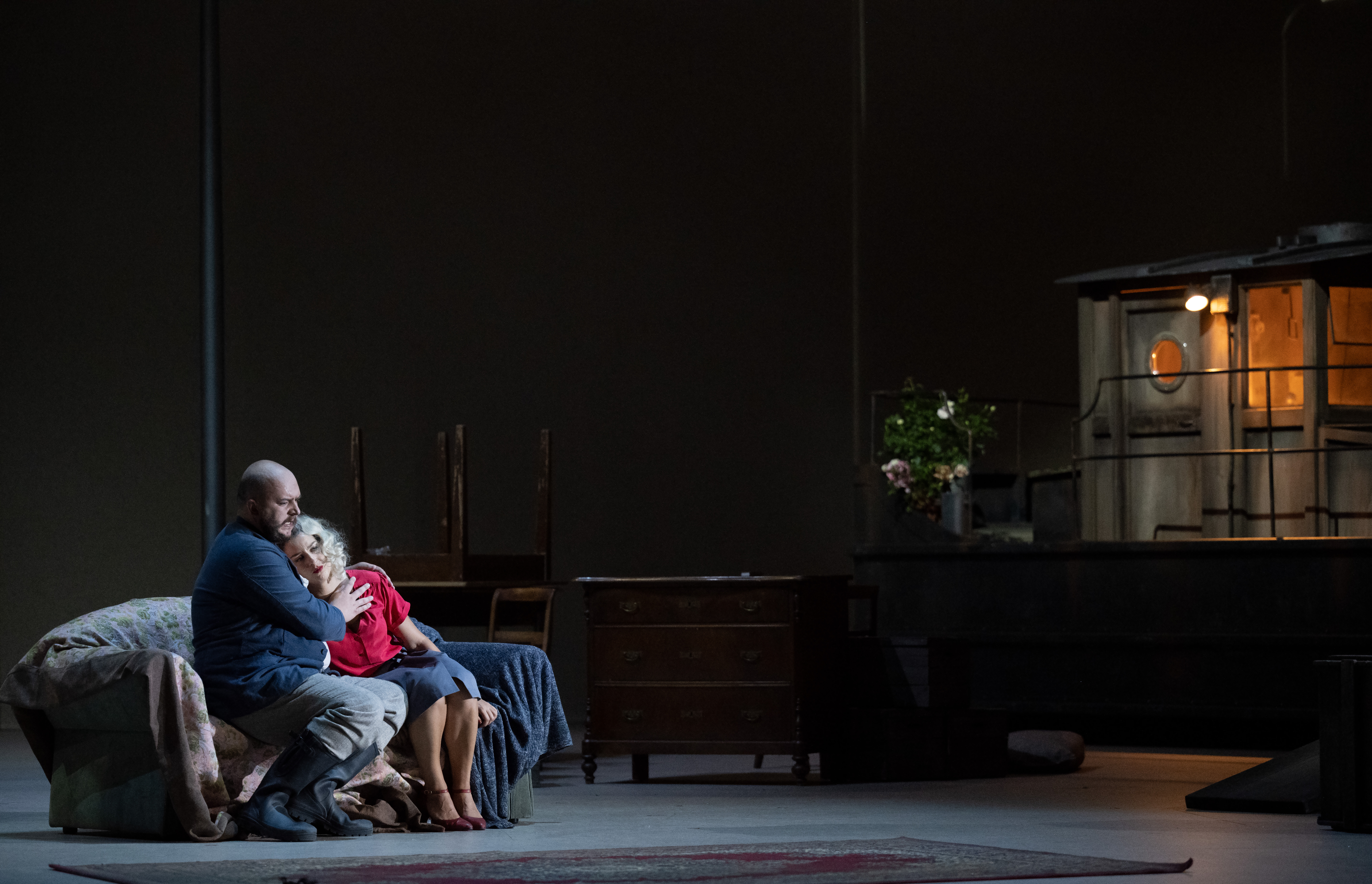
Loy’s major miscalculation was to mess around with the ordering, so as to present the operas in the order Gianni Schicchi, Il tabarro, and Suor Angelica. The self-justification given in the programme made things worse, speaking of Suor Angelica having given the ‘impression’ of ‘such an extreme impact … that Gianni Schicchi came across as relatively trivial’. Not in my experience, nor in that of anyone I have spoken to. Nor has Il tabarro suffered from a lack of contemporary relevance, as Loy bizarrely suggests. (Quite why moving it to second place would help here remains unclear too.) Apparently, because this is a Festival, ‘everyone [is] in good spirits to be here,’ it makes better sense to open ‘with the seemingly life-affirming atmosphere of Gianni Schicchi’. Enough! There is good reason for placing the comedy last. Suor Angelica, meanwhile, suffers from being placed third, in that not only does it offer less a climax than a sense of tiring, even tailing away; but, perhaps worse, its own genuine musical as well as dramatic interest pales when heard after Schicchi. If you wanted to lend credence to claims of the saccharine, you could do a lot worse than adopt this reordering. Loy says that Franz Welser-Möst and he were in agreement on the matter; Welser-Möst really should have known better. None of this is fatal; after all, the operas are often (probably more often) played alone with entirely different companion pieces. But there is little gain here, and not inconsiderable loss.

Loy’s reputation in certain quarters remains something of a mystery to me. There is, as there certainly was here, a genuine craftsmanship at work. That I could admire—and did greatly. Movement and placing of objects on stage, the identity of each character (most of them, anyway), and much else had clearly been considered; one was left with little doubt that what one saw was what one was supposed to have seen. This is no more than speculation on my part, but I can imagine singers liking to work with him: certainly no bad thing. But beyond a certain generic stylishness, which is presumably in large part the work of his designers, I struggled to find any particular conceptual thinking at work, whether in each individual opera or as something to connect them. All three were vaguely modernised, I suppose, but unless one considers ‘modern dress’ to be a concept in itself, there was nothing to trouble conservative viewers. On the other hand, there was no banal intervention as in, say, Loy’s Tristan (Covent Garden) or Die Frau ohne Schatten (Salzburg, in which he essentially ignored the work altogether). So horses of no breed would have been scared away; perhaps that in itself was the idea.


The Vienna Philharmonic was on tremendous form, clearly relishing the opportunity to play all three operas in something approaching ideal conditions (certainly by way of comparison to the rehearsal schedule, or lack of it, in Vienna). Welser-Möst’s guiding spirit was heard to best effect in the first two operas, the scintillating scherzo of Gianni Schicchi razor-sharp, yet with plenty of tenderness too, the ominous ostinato of the Seine in Il tabarro duly overwhelming. (It took a few hours to get the latter out of my head, following the performance.) Light and shade were as meticulously planned and projected as any stage lighting, and there could be no doubting Welser-Möst’s knowledge and understanding of the scores. I missed a sense of something darker in Suor Angelica, but that was doubtless in considerable part a matter both of the piece itself and Loy’s decision to move it. There might nonetheless have been greater bite in its often intriguing harmonies and also a greater range of colour. A tendency to greyness such as I have often heard in Welser-Möst’s Strauss was not entirely avoided here.


Asmik Grigorian’s heroic service as heroine (of sorts) in all three proved both heartfelt and flawless. She did not tire, far from it, and gave considered, distinct performances of each of her roles. I do not think appreciation of her Sister Angelica was helped by its placing, giving the impression of everything leading up to a ‘big moment’, but I have probably said enough about that now. Her chemistry with Joshua Guerrero as Luigi and, indeed, negatively with Roman Burdenko as Michele was, to my mind, just as impressive, both of those artists turning in thoughtful as well as viscerally immediate performances. So too, unsurprisingly, did Karita Mattila as La Zia Principessa. From the moment she stepped on stage, one knew this was going to be something special, and it certainly was. Equal attention to words, music, and gesture informed a star turn that collegially collaborated with, in no sense upstaging, Grigorian. Much the same might be said, albeit (properly) with less hauteur, of Hanna Schwarz’s Abbess. Grigorian’s Rinuccio, Alexey Neklyudov, proved youthful, ardent, and similarly intelligent: a fine companion. Every portrayal in Gianni Schicchi was indeed, of similar quality, whether solo or ensemble, from Misha Kiria’s wily lawyer down (should that be the right direction). Enkelejda Shkosa’s turn as Zita here was followed by a splendidly animated La Frugola, hinting at hidden depths of sadness, in Il tabarro. This was a Trittico that almost offered the definition of casting from depth. For fine singing, complemented by excellent stage gifts, Personenregie, and orchestral playing, this will surely prove difficult to beat.


Tuesday, 28 August 2018

Salzburg Festival (4) – Levit/VPO/Welser-Möst: Henze and Wagner, 25 August 2018


Grosses Festspielhaus

Henze: Tristan: Preludes for piano, tape, and orchestra
Wagner: Götterdämmerung: Dawn, Siegfried’s Rhine Journey, Death, and Funeral Music, Conclusion

Igor Levit (piano)
Vienna Philharmonic Orchestra
Franz Welser-Möst (conductor)

© Salzburger Festspiele / Marco Borrelli

Wagner: however much we try, we cannot escape. Do we even want to? Not really; nor have we ever. Where would Stravinsky have been without Wagner and, to a lesser extent, Beethoven to blame? Where would Henze have been ? He liked to proclaim his independence from, sometimes even revulsion towards, Wagner and Schoenberg; it was not necessarily disingenuous. The ‘ghost of old Klingsor’ (Debussy in a letter to Ernest Chausson) always won, though. In Tristan, such rebellion was not really an issue – which, in some ways, paradoxically and/or dialectically, enabled Henze to resist direct ‘influence’ and its anxiety more strongly.


Certainly hints of the Tristan Prelude were soon to be heard here from the Vienna Philharmonic’s woodwind; not, however, before Igor Levit had sounded notes from the post-Wagnerian future, that of Schoenberg. Not to be reduced to Schoenberg’s op.11, of course, yet certainly within its orbit. (There is a work we really need to hear from this pianist!) Woodwind response, cool but not cold, participated in yet also placed itself in opposition to the extraordinary long line Levit spun throughout. There was no doubting his confidence in the notes, which helped, I think, many in the audience to share in that confidence, to begin their own exploration of this work. Franz Welser-Möst’s brief spoken introduction, most welcome, had done no harm either. The invasion of an beautifully balanced, resounding A minor chord by the metaphysical penumbra of taped music (presumably that remade in 1990 by Henze and Roderick Watkins, in response to technological development) initiated quite different moods and textures, generative in possibility. Bach, Mahler, Berg, ballet as well as opera: there were many ghosts at this feast, often in (il)licit relation.


The use of Brahms’s First Symphony is the most celebrated, most obvious, of other quotations in Henze’s collage. As Brahms himself might have said, were they pointed out, ‘any ass can see that’. What follows, though? Over what do they hang? And what, if anything, might they mean? Stephen Downes, in Hans Werner Henze: Tristan (1973) (which I reviewed here for Music and Letters), rightly criticised Peter Petersen’s claim that Brahms served Henze as a merely negative, anti-erotic, anti-Wagnerian dramatic ‘character’. Welser-Möst seemed both to understand and to communicate that. These are not crude oppositions; nor did they sound so here. Both he and Levit showed that clear textures need not entail loss of dramatic power or heft; indeed, the latter’s grand manner (where required) has surely set new standards in this work, perhaps in Henze’s piano writing more generally. There was, moreover, meaning in the clusters and chords we heard. It might not be meaning we (or at least I) can put into words; that is hardly the point. Just as in Tristan und Isolde, however, it is there: vertically and horizontally. The child’s heartbeat, that inescapable moment of loss, of memory spoke both truer and yet more enigmatically than I have heard.


Wagner ‘bleeding chunks’ rarely prove a happy experience. Nor did they here, whatever the excellence of the VPO’s playing. Welser-Möst seemed aware of the problems. It was difficult to imagine that this was quite how he would have played the music in the opera house, Götterdämmerung’s ‘Dawn’ opening more slowly than it would likely have done had we just heard from the Norns, yet gathering pace relatively quickly. A boisterous, full-bodied account of ‘Siegfried’s Rhine Journey’, with just a hint or two in harmony and timbre of the Gibichung decay to come, led into his death and funeral rites: noble, not without brutality, especially from the brass. It was somewhat misleading to have the final section described as ‘Schlussszene’; what we hard began just a few bars before Brünnhilde’s ‘Fliegt heim, ihr Raben!’ No matter. Incisive string playing summoned up rather steely flames, if you can imagine such a thing. We missed the vocal line, but could readily fill it in mentally. It was impressive in its way, and the final motif (often misleadingly named ‘redemption through love’) sounded glorious from the Vienna strings. Was I moved, though? Alas not.


Wednesday, 19 August 2015

Salzburg Festival (5): Fidelio, 13 August 2015


Grosses Festspielhaus

Florestan – Jonas Kaufmann
Leonore – Adrianne Pieczonka
Don Pizarro – Tomasz Konieczny
Rocco – Hans-Peter König
Marzelline – Olga Bezsmertna
Jaquino – Norbert Ernst
Don Fernando – Sebastian Holececk
Leonore’s Shadow – Nadia Kichler
Pizarro’s Shadow – Paul Lorenger
First Prisoner – Daniel Lökös
Second Prisoner – Jens Musger

Claus Guth (director)
Christian Schmidt (designs)
Ronny Dietrich (dramaturgy)
Olaf Freese (lighting)
Torsten Ottersberg (sound design)
Andi A. Müller (video design)

Concert Association of the Vienna State Opera Chorus (chorus master: Ernst Raffelsberger)
Vienna Philharmonic Orchestra
Franz Welser-Möst (conductor) 


Florestan (Jonas Kaufmann)
Images: Monika Rittershaus/Salzburg Festival


I shall start with the good news. It will not take long. Yes, no surprises here: it was Jonas Kaufmann. Kaufmann may not have been able to save the day, but his Florestan proved almost as impressive as it had in Paris more than six years ago. Perhaps I am being unfair or unduly cautious when I say ‘almost’; it may just have been a matter of a less than exalted setting, or simply an inability on my part to relive the thrill of hearing Kaufmann’s portrayal for the first time. Whatever the truth or otherwise of that, there was nothing for which I could fault him. His baritonal tenor seems just right for the role, but what he does with it – and it seems that he can do anything he wishes – is still more breathtaking. As I wrote in 2008, ‘He exhibited a heroism to rival that of Jon Vickers, albeit without the vocal oddness.’ There can be no arguing with his acting abilities either. Called upon to portray an apparent descent into madness, quite at odds with the text, such of it that remained, let alone with Beethoven’s score, Kaufmann marshalled all of his artistic resources to powerful effect.

What else? Hans-Peter König’s Rocco, after a somewhat indistinctive start, grew in humanity. The Two Prisoners made their mark well, and the chorus proved well-trained. Otherwise, there was little to inspire. Admittedly, Adrianne Pieczonka improved as time went on; Kaufmann’s presence seemed to lift performances, at least onstage, across the board. However, her tone was often harsh and her intonation was at best variable. Olga Bezsmertna’s Marzelline was blowsy, and Tomasz Konieczny’s Pizarro undistinguished, lacking even pantomime malevolence. On its own terms, the Vienna Philharmonic played well enough, but it was impossible for me to assent to those terms.

For that, Franz Welser-Möst was squarely to blame. Beethoven surely stands as the antithesis of mediocrity, but Welser-Möst proved quite unable to raise his game. At his very best, he sounded like a poor man’s Toscanini – a rich man’s is bad enough – but this was uncomprehending stuff indeed. Proceeding phrase by phrase, sometimes even bar by bar, there was not a hint of a longer line, let alone of the indomitable spirit with which this most noble of operas is infused. The orchestra was brash, harsh, often entirely lacking in tonal variegation. Chugging replaced development. The absurdly-inserted Leonore III Overture – a great conductor can just about get away with that regrettable ‘tradition’ – was an ordeal such as Florestan himself might have had to endure. The audience, bafflingly, gave it a rousing ovation. Still more bafflingly, conductor and orchestra stood to take their bows – yes, in the middle of the second act. How frustrating, then, to know that the greatest living Beethoven conductor, Daniel Barenboim, was also in town.


Leonore (Adrianne Pieczonka) and her 'Shadow' (Nadia Kichler)


And yet, there was worse. I approached Claus Guth’s production with an open mind. On the face of it, ridding Fidelio of its dialogue seemed a bad idea – is the dialogue really so bad? Why cannot people simply leave it alone? – but perhaps it might have worked in practice. It does not. I am pretty sure that, had I not know the opera, I should have had no idea whatsoever who anyone was or what he or she was doing. Fidelio without the dialogue is at best an interesting concert; that, however, would require at the very least a conductor up to the task. Worse, still, however is the Konzept which replaces Beethoven’s. Instead of a call to humanity, we had something one might just about dignify with the term ‘existentalist’. It is all, apparently, about freeing oneself from the imprisonment of one’s own mind. Or, as Norbert Abels declares in the programme, admittedly in translation, ‘In an ever-shrinking world of universal enmeshment, of the transcontinental interconnectedness of the globe, of the unlimited procedures of saving and monitoring data, Beethoven’s opera still navigates as the utopia of man’s escape from his self-inflicted imprisonment.’ Shorn of its verbiage, that might conceivably prove a fruitful addition to what we have already; as a replacement, it simply smacks of modern self-indulgence. ‘Fidelio,’ according to Abels, ‘is usually interpreted as a salvation and liberation opera with a political background.’ It is hardly ‘interpreted’ as such; it straightforwardly is that, and this is not a work that seems especially amenable to perverse reinterpretation. Whilst Guantánamo, Gaza, all manner of other actually-existing prisons, still exist, indelible stains upon humanity, is it acceptable to suggest that the solution is simply, to ‘find ourselves’? Weird sound effects punctuate the movements: presumably the workings of the unconscious. Or something. If they are intended to terrify, they sadly fail; they are not nearly loud enough. Instead, they merely irritate. Invoking Freud is not enough; it never was.

Claus Guth justifies himself, again in the programme, by disingenuously claiming that Beethoven’s revisions leave us with an ‘indefinite, indeed open form’. For some unspecified reason, the Salzburg Festival ‘in particular, offers us a place to open a space for non-normative ideas where we are able to experiment as if in a laboratory.’ All very well, if they work, but they do not. Instead, we have especially crass references to Beethoven’s deafness thrown in, a woman, Leonore’s ‘shadow’, frantically using what appears to be sign language, Florestan covering his ears in agony, and a banal narrative of personal self-discovery (I think, in Leonore’s case) superimposed upon the opera to no good effect. I shall leave the last word to designer, Christian Schmidt: ‘On our quest for a place for the events, we tried … to avoid any clarity.’ Quite.


Wednesday, 10 September 2014

Prom 69: Cleveland/Welser-Möst - Brahms and Widmann, 8 September 2014


Royal Albert Hall

Brahms – Tragic Overture, op.81
Widmann – Teufel Amor (UK premiere)
Brahms – Symphony no.2 in D major, op.73

Cleveland Orchestra
Franz Welser-Möst (conductor)
 

Sadly, one of the most striking things about this concert was the small attendance. I should have assumed that a major American orchestra, with a renowned if not necessarily universally lauded conductor, playing a programme of mostly Brahms would have sold out, or near enough.  Prom 69 actually proved to be the most sparsely attended of any of the ‘mainstream’ – that is, at the Albert Hall, and not ‘late night’ – Proms I have been to this season. Quite why, I am not at all sure; it is not as if we are overburdened with opportunities to hear the Cleveland Orchestra. It was my first such opportunity, and I was very glad to do so, for whatever the disappointments of Franz Welser-Möst’s conducting, it remained a privilege to hear the orchestra itself.
 

The other most striking feature was the British premiere of Jörg Widmann’s Teufel Amor, his 2009 (revised in 2011) ‘symphonic poem after Schiller’ – both the work and what seemed to me a very fine performance. The composer’s description on Schott’s website offers a helpful introduction:

After the rejection of his drama Fiesco in Mannheim, Schiller offered his poem Teufel Amor to a bookseller in Frankfurt for 25 guilders. As the bookseller only offered him 18 guilders for the poem, '[Schiller] preferred to remain destitute rather than wasting his poetry on a skinflint who was unappreciative of his artistry' (Gustav Schwab) and took his poem away with him. Only a tiny scrap of this poem has survived – albeit an exceedingly poetic and also musical fragment:

Süßer Amor, verweile / Im melodischen Flug
[Sweet Amor, remain in melodic flight]

A movement as a state of being, and a state of being as movement: an apparently contradictory pair, just like the title of the poem, Teufel Amor. Love however contains more contradictions than anything else in the world, epitomising the extremes of heaven and hell, pleasure and suffering, paradise and snake-pit. Whoever has been touched by the arrow of love is at the same time a human wounded by an arrow. My imagination was fired by Schiller’s fragment; his conception of the flight of Amor as the heights and depths of a melodic progression inspired me to compose a symphonic hymnos which praises the marvels of love – even in its devilish incarnation.


What Paul Griffiths, in his programme note, described as an ‘abyssal darkness of love … [with which] the work begins,’ sounded, with its pointillistic low brass and woodwind, as if Wagner were refracted through Webern.  Gradually, we discerned a thematic cauldron, scenting a musical brew with a definite sense of the Teufel, even of Hölle. Eerie ghosts of an expressionist past – this was surely inconceivable without Schoenberg’s Five Orchestral Pieces – announced themselves, as did Strauss and Mahler in the hymn-music. Fragments strained hard toward, sometimes attained, a fragile (late Romantic?) wholeness. Long violin lines – expertly played – seemed both to aid and call that into question, even before the advent of a waltzing phantasmagoria. Mahler seemed ever more prominent, in the pathos of individual lines (Joshua Smith’s flute in particular) and indeed in the harmony. It occurred to me that this was a work that would go very well with Mahler’s Tenth Symphony. There was much, which, taken out of context, might have been thought ‘late Romantic’ or ‘early modernist’, but context, of course was crucial. Material no longer means the same thing – and this was clearly part of the pathos, even perhaps Widmann’s tragic intent.
 

Brahms, alas, fared less well, especially in the Tragic Overture, which Welser-Möst managed both to drive hard and to have sound well-nigh interminable. (It has always struck me as one of Brahms’s most succinct pieces.) The extent of that driving would surely have made George Szell blanch, but it was also quite without Szell’s sense of purpose. The Cleveland sound, however, was wonderful: dark, rich, finely articulated. At its best, the performance evinced a certain turbulence, redolent perhaps of some of the composer’s piano pieces; at its worst, it was merely harried. That is, until torpor set in. There was a sad lack of coherence, even on what appeared to be Welser-Möst’s own terms.
 

The Second Symphony opened more promisingly. Its first movement was certainly not unduly driven, but tempo fluctuations were far from entirely convincing. Again, it was well played – beautiful woodwind detail in particular – but proved interpretatively faceless, save for genuine strength in the cross-rhythms. Brahms’s ‘geniality’ nevertheless seemed all too unalloyed, untroubled by the dark shadows that make this symphony what it is. The slow movement was taken at a perfectly reasonable tempo considered in abstraction, but Welser-Möst’s over-conducting made for a pedantic impression. One heard far too many bar-lines, even beats and their sub-divisions. It soon faded into generic listlessness. The third movement was the most successful of the four. On the fast side, very much so, it was nevertheless made to work. Playing was well-pointed; detail was apparent without obscuring the greater picture. The finale, alas, succumbed again to the strange temptation to drive too hard, too inflexibly. There was, perhaps more damagingly still, little sense of what connected the four movements; it was as if Brahms had composed a suite rather than a symphony. The First Hungarian Dance was offered as an encore: again, excellently played, but Welser-Möst’s rubato proved laboured in the extreme.


Thursday, 21 August 2014

Salzburg Festival (7) - Der Rosenkavalier, 17 August 2014


Images: © Salzburger Festspiele / Monika Rittershaus

 
Grosses Festspielhaus

Die Feldmarschallin Fürstin Werdenberg – Krassimira Stoyanova
Der Baron Ochs auf Lerchenau – Günther Groissböck
Octavian – Sophie Koch
Herr von Faninal – Adrian Erőd
Sophie – Mojca Erdmann
Jungfer Marianne Leitmetzerin – Silvana Dussmann
Valzacchi – Rudolf Schasching
Annina – Wiebke Lehmkuhl
Police Officer – Tobias Kehrer
The Marschallin’s Major-domo – Franz Supper
Faninal’s Major-domo – Martin Piskorski
A Notary – Dirk Aleschus
A Landlord – Roman Sadnik
A Singer – Stefan Pop
A Milliner – Alexandra Flood
A Vendor of Pets – Franz Gürtelschmied
Leopold – Rupert Grössinger
Lackeys/Waiters – Won Cheol Song, Franz Gruber, Friedrich Springer, Jens Musger
Lerchenauischen – Florian Boberski, Kiril Chobanov, Manuel Grabner, Helmut Höllriegl, Boris Lichtenberger, Christian Schläpfer
House Servant (Mohammed) – Liviu Burz 

Harry Kupfer (director)
Hans Schavernoch (set designs)
Yan Tax (costumes)
Jürgen Hoffmann (lighting)
Thomas Reimer (video design)

Salzburg Festival and Theatre Children’s Chorus (chorus master: Wolfgang Götz)
Concert Association of the Vienna State Opera Chorus (chorus master: Ernst Raffelsberger)
Vienna Philharmonic Orchestra
Franz Welser-Möst (conductor)


Sophie (Mojca Erdmann) and Octavian (Sophie Koch)


Harry Kupfer’s production of Der Rosenkavalier is without a doubt the most thought-provoking of the stagings I saw at this year’s Salzburg Festival. It intrigued me during the first act, though I was not really sure how I felt about it; it grew on me during the second, and had won me over by the third. That seems to be a deliberate strategy, conducted in tandem with a gradual blossoming of colour from the severe near-monochrome of the early twentieth-century (time of composition) Marschallin’s palace to the more colourful inn of the third act, with certain carefully colour making its point in between. All around, photographs – untrustworthy memories – of celebrated Viennese landmarks from the Kunsthistorisches Musuem to the Prater make their point concerning recollection and reimagination. What I felt was missing was a further layering from an imaginary eighteenth century in which Hofmannsthal – if not necessarily Strauss – so painstakingly sets the action, but I learned to live with that, and again, by the time of the third act, had quite forgotten about it. Perhaps there is a lesson to be learned there too.


For pretty much all of the action one would (rightly?) expect is present and correct, except not necessarily quite as one might initially have expected it, not the least of this opera’s lessons. A particular strength of Kupfer’s production is its light insistence upon the work’s metatheatricality, less overt than, say, Ariadne auf Naxos or Capriccio, but still important to its layering. One certainly has a good sense of the Marschallin as director, and indeed as fallible narrator/director. Are the snapshots hers, as might be suggested by the arrival of her extraordinarily – deliberately so – car at the end of the third act? What are the implications for agency here? Is she still in control? And what might that mean for Octavian and Sophie, here directed – and played – as a much stronger woman than one generally experiences?
 

The Marschallin (Krassimira Stoyanova)
 

The case of Sophie is especially interesting, since I admit that, in purely vocal terms, I did not find Mojca Erdmann’s portrayal especially inviting, hearing more of an Olympia than a Sophie, a strangely mechanical rendering at times. Yet, somehow, it worked, and the strength of character came across more strongly than I can recall. For once, it was quite possible to understand why Octavian might have made the choice he did. Sophie Koch’s portrayal of the role is well-known and did not disappoint on this occasion, the opera’s play with gender as captivating as ever. Krassimira Stoyanova presented a dignified Marschallin: no vulgar playing on the heart-strings here, and probably all the more moving for it. Moreover, her careful attention to the words could usefully be aped by certain more fêted exponents of the role. Günther Groissböck worked hard to present a less caricatured Ochs than one often suffers. What remained of caricature was probably ineradicable: a pity, but there is only so much one can do with the part. Groissböck’s was an uncommonly subtle reading, though, again born of laudable attention to the text. (It is perhaps a pity, though, that Kupfer seems to want to have Sophie having made up her mind against him from the very start; a little more contest and development would not necessarily go amiss.) To start with, I thought Adrian Erőd’s Faninal a little dry in tone, but that soon ceased to trouble me; perhaps I was just imagining it. The supporting cast was not always of the highest quality, but then there is a huge amount to cast here, and much, by the same token, was impressive. Rudolf Schasching’s coarsely sung Valzacchi was a rare true disappointment; Wiebke Lehmkuhl’s Annina was much more characterful. Roman Sadnik’s Landlord – intriguingly, though probably coincidentally, dressed and even very much looking like the owner of Triangel, the restaurant outside the house – offered a particularly vivid portrayal, whilst Rupert Grössinger (and Kupfer) made considerably more of Leopold, Ochs’s son, than is generally the case.


Ochs (Günther Groissböck)

The performances were originally to have been conducted by Zubin Mehta, who had to withdraw on medical grounds. Franz Welser-Möst was a generally efficient, if not exactly inspiring, replacement, the exception to efficiency lying in an inordinately drawn out close to the first act. (I thought it was never going to end, and I am rarely opposed to slower tempi.) It was certainly not a warm reading, but that to an extent married well with the production, especially earlier on. A little more whipped cream would not necessarily have done any harm, and there were perhaps a few more discrepancies between pit and stage than one might have expected. Still, there was much to savour, and to think about, both from production and from the performances on stage.


Monday, 29 August 2011

Salzburg Festival (6) - VPO/Welser-Möst: Schubert-Mahler and Zemlinsky, 25 August 2011

Grosses Festspielhaus

Schubert-Mahler: String Quartet in D minor, D 810, ‘Death and the Maiden’
Zemlinsky – Lyric Symphony, op.18

Christine Schäfer (soprano)
Michael Volle (baritone)
Vienna Philharmonic Orchestra
Franz Welser-Möst (conductor)

Franz Welser-Möst’s Vienna Philharmonic concert opened somewhat disappointingly with Mahler’s arrangement of Schubert’s Death and the Maiden Quartet. It was naturally a joy in many ways to hear the massed Vienna strings and it would be difficult to fault their contribution in itself. However, I could not help but wonder quite what the point of Mahler’s arrangement was – especially nowadays. Having heard, just two days previously the Hagen Quartet perform the piece as Schubert wrote it, it was not clear that Mahler, orchestrator of genius though he was, added anything at all; a more overt orchestration might well have been more interesting. Instead, the simple apportioning of parts between a string orchestra, sometimes divided, sometimes not, has the tendency to neutralise Schubert’s music. There were occasional hints of the symphonies and perhaps the Rosamunde music too, but more often we seemed to be in a strange, or rather bland, no man’s land somewhere between Schubert and Bruckner. I suspect that it would have sounded better, if it had sounded less ‘conducted’, more chamber music writ large, yet Welser-Möst maintained an iron grip on proceedings, with constricted results. The second movement probably came off better in such circumstances. However, the scherzo was pushed towards Beethoven or rather towards a Toscanini-derived driven conception of Beethoven I find uncongenial, but to which some listeners – especially, it seems, across the Atlantic, still hold. It is difficult to begrudge performance of such a curiosity – and in these days of Mahler glut, it is arguably preferable to a run-of-the-mill symphonic performance – but I was left with a feeling of a box ticked rather than a truly musical experience. If only we could have heard the VPO in Verklärte Nacht instead…

Zemlinsky’s Lyric Symphony needs no apologies, and nowadays hovers on the edge of the repertoire. Not so long ago, I heard an excellent performance in London from the Philharmonia and Esa-Pekka Salonen. The VPO had nothing to fear from the comparison, drawing upon seeming fathomless depth of tone, despite one especially glaring loss of ensemble. The extraordinary beauty of the horn solo in the postlude to the third movement, ‘Du bist die Abendwolke’ would have been worth the price of admission alone: utterly ravishing. However, Salonen proved a more interesting guide than Welser-Möst. The orchestral introduction did not open promisingly. Indeed, the studied ‘conducted’ style of the Schubert-Mahler quartet seemed to persist, every beat too audible. Interestingly, if somewhat disappointingly, the orchestral postlude suffered similarly, though to a considerably lesser extent, whilst Welser-Möst relaxed a great deal when ‘accompanying’, here giving a true sense of an experienced opera conductor accustomed to dealing with singers. Zemlinsky wrote a lyric symphony, though, rather than a song cycle, and the performance, however gorgeous, did not always exhibit a symphonic sense of purpose, meandering from time to time. Christine Schäfer struggled a little to be heard in the first of her three movements, in which the poet tells of the girl whose jewel is crushed by a heedless young prince’s chariot, but there was no such problem thereafter. Moreover, I have never heard the sixth movement sound quite so close to Pierrot lunaire. Doubtless Schäfer’s experience of performing – and recording – the latter work with Boulez fed into the chilling expressionism of her account. Volle’s voice was rarely beautiful, which is not to say that it was ugly either, but the point seemed much more to be the words with him, almost as if this were Wolf. Despite the shortcomings of the conducting, this remained an estimable performance, on account of orchestra and singers.