Showing posts with label Karita Mattila. Show all posts

Wednesday, 24 August 2022

Salzburg Festival (2) - Il trittico, 21 August 2022


Grosses Festspielhaus

Gianni Schicchi – Misha Kiria
Lauretta – Asmik Grigorian
Zita – Enkelejda Shkosa
Rinuccio – Alexey Neklyudov
Gherardo – Dean Power
Nella – Lavinia Bini
Gherardino – Daniel Fussek
Betto di Signa – Manel Esteve Madrid
Simone – Scott Wilde
Marco – Iurii Samoilov
La Ciesca – Caterina Piva
Maestro Spinelloccio – Matteo Peirone
Ser Amantio di Noclao – Mikołaj Trąbka
Pinellino – Aleksei Kulagin
Guccio – Liam James Karai
Buoso Donati – Leopold Böhm


Michele – Roman Burdenko
Giorgetta – Asmik Grigorian
Luigi – Joshua Guerrero
Il Tinca – Andrea Giovannini
Il Talpa – Scott Wilde
La Frugola – Enkelejda Shkosa
Song seller – Dean Power
Lovers – Dean Power, Martina Russomanno
Midinettes – Dijana Kos, Irena Krsteska, Wilma Maller, Irina Peroš, Katarína Porubanová, Anna Yasiutina
Dancers – Clara Cozzolino, Mário Jorge Moisés da Silva Branco, Joni Österlund, Anna Possarnig, Guillaume Rabain, Nicolas Franciscus, Giulia Tornarolli

Sister Angelica – Asmik Grigorian
La Zia Principessa – Karita Mattila
Abbess – Hanna Schwarz
Sister Zelatrice – Enkelejda Shkosa
Mistress of the Novices – Vaterina Piva
Sister Genovieffa – Giulia Semenzato
Sister Osmina – Martina Russo manno
Sister Dolcina – Daryl Freedman
Nursing Sister – Juliette Mars
Alms Sisters – Lavinia Bini, Alma Neuhaus
Novice – Amira Elmadfa
Lay Sisters – Svenja Kallweit, Anna Yasiutina
Son – Jonathan Ehrenreich
Choral soloists – Dijana Kos, Mari Nakayama, Irina Peroš

Christof Loy (director)
Étienne Pluss (set designs)
Barbara Drosihn (costumes)
Fabrice Kebour (lighting)
Yvonne Gebauer (dramaturgy)  

Salzburg Festival and Theatre Children’s Choir (chorus director: Wolfgang Götz)
Concert Association of the Vienna State Opera Chorus (chorus director: Jörn Hinnerk Andresen) 
Angelika-Prokopp-Summer Academy of the Vienna Philharmonic (stage music)
Vienna Philharmonic Orchestra
Franz Welser-Möst (conductor)


Images: (C) SF /Monika Rittershaus


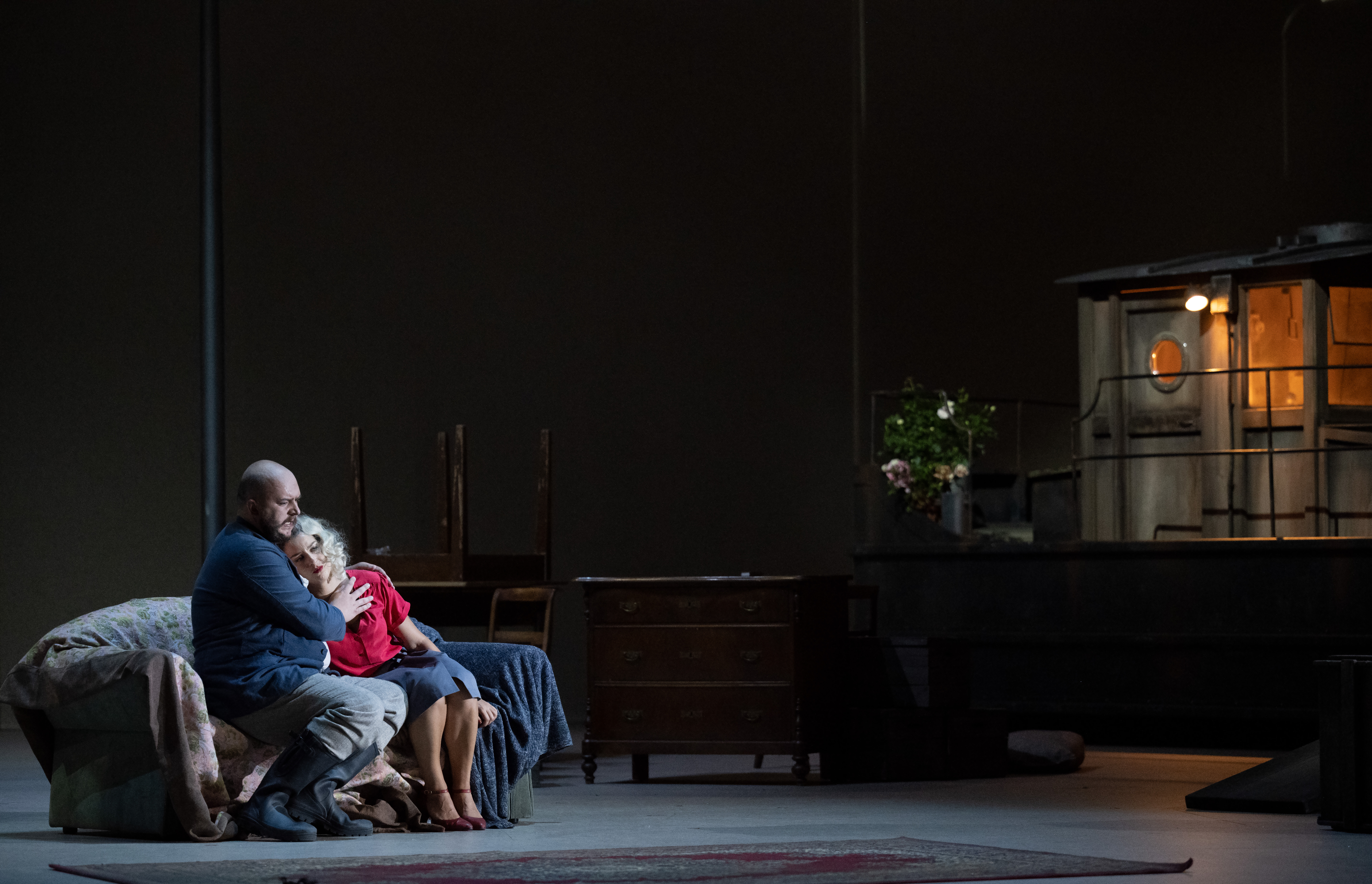
In many ways, this new production of Puccini’s triptych of one-act operas marked a triumph for the Salzburg Festival. One serious unforced error detracted, yet could only detract so far; likewise a few other cavils. Singing and orchestral playing were excellent throughout on the evening I attended, the last in the run. If Christof Loy’s production offered nothing particular in the way of insight, let alone re-evaluation, it presented the stories clearly and with élan, aided by good design work. Everything came together well, at an undeniably ‘Salzburg’ level.

Loy’s major miscalculation was to mess around with the ordering, so as to present the operas in the order Gianni Schicchi, Il tabarro, and Suor Angelica. The self-justification given in the programme made things worse, speaking of Suor Angelica having given the ‘impression’ of ‘such an extreme impact … that Gianni Schicchi came across as relatively trivial’. Not in my experience, nor in that of anyone I have spoken to. Nor has Il tabarro suffered from a lack of contemporary relevance, as Loy bizarrely suggests. (Quite why moving it to second place would help here remains unclear too.) Apparently, because this is a Festival, ‘everyone [is] in good spirits to be here,’ it makes better sense to open ‘with the seemingly life-affirming atmosphere of Gianni Schicchi’. Enough! There is good reason for placing the comedy last. Suor Angelica, meanwhile, suffers from being placed third, in that not only does it offer less a climax than a sense of tiring, even tailing away; but, perhaps worse, its own genuine musical as well as dramatic interest pales when heard after Schicchi. If you wanted to lend credence to claims of the saccharine, you could do a lot worse than adopt this reordering. Loy says that Franz Welser-Möst and he were in agreement on the matter; Welser-Möst really should have known better. None of this is fatal; after all, the operas are often (probably more often) played alone with entirely different companion pieces. But there is little gain here, and not inconsiderable loss.

Loy’s reputation in certain quarters remains something of a mystery to me. There is, as there certainly was here, a genuine craftsmanship at work. That I could admire—and did greatly. Movement and placing of objects on stage, the identity of each character (most of them, anyway), and much else had clearly been considered; one was left with little doubt that what one saw was what one was supposed to have seen. This is no more than speculation on my part, but I can imagine singers liking to work with him: certainly no bad thing. But beyond a certain generic stylishness, which is presumably in large part the work of his designers, I struggled to find any particular conceptual thinking at work, whether in each individual opera or as something to connect them. All three were vaguely modernised, I suppose, but unless one considers ‘modern dress’ to be a concept in itself, there was nothing to trouble conservative viewers. On the other hand, there was no banal intervention as in, say, Loy’s Tristan (Covent Garden) or Die Frau ohne Schatten (Salzburg, in which he essentially ignored the work altogether). So horses of no breed would have been scared away; perhaps that in itself was the idea.


The Vienna Philharmonic was on tremendous form, clearly relishing the opportunity to play all three operas in something approaching ideal conditions (certainly by way of comparison to the rehearsal schedule, or lack of it, in Vienna). Welser-Möst’s guiding spirit was heard to best effect in the first two operas, the scintillating scherzo of Gianni Schicchi razor-sharp, yet with plenty of tenderness too, the ominous ostinato of the Seine in Il tabarro duly overwhelming. (It took a few hours to get the latter out of my head, following the performance.) Light and shade were as meticulously planned and projected as any stage lighting, and there could be no doubting Welser-Möst’s knowledge and understanding of the scores. I missed a sense of something darker in Suor Angelica, but that was doubtless in considerable part a matter both of the piece itself and Loy’s decision to move it. There might nonetheless have been greater bite in its often intriguing harmonies and also a greater range of colour. A tendency to greyness such as I have often heard in Welser-Möst’s Strauss was not entirely avoided here.


Asmik Grigorian’s heroic service as heroine (of sorts) in all three proved both heartfelt and flawless. She did not tire, far from it, and gave considered, distinct performances of each of her roles. I do not think appreciation of her Sister Angelica was helped by its placing, giving the impression of everything leading up to a ‘big moment’, but I have probably said enough about that now. Her chemistry with Joshua Guerrero as Luigi and, indeed, negatively with Roman Burdenko as Michele was, to my mind, just as impressive, both of those artists turning in thoughtful as well as viscerally immediate performances. So too, unsurprisingly, did Karita Mattila as La Zia Principessa. From the moment she stepped on stage, one knew this was going to be something special, and it certainly was. Equal attention to words, music, and gesture informed a star turn that collegially collaborated with, in no sense upstaging, Grigorian. Much the same might be said, albeit (properly) with less hauteur, of Hanna Schwarz’s Abbess. Grigorian’s Rinuccio, Alexey Neklyudov, proved youthful, ardent, and similarly intelligent: a fine companion. Every portrayal in Gianni Schicchi was indeed, of similar quality, whether solo or ensemble, from Misha Kiria’s wily lawyer down (should that be the right direction). Enkelejda Shkosa’s turn as Zita here was followed by a splendidly animated La Frugola, hinting at hidden depths of sadness, in Il tabarro. This was a Trittico that almost offered the definition of casting from depth. For fine singing, complemented by excellent stage gifts, Personenregie, and orchestral playing, this will surely prove difficult to beat.


Sunday, 24 November 2019

Lohengrin, Bavarian State Opera, 21 November 2019


Nationaltheater

Ortrud (Karita Mattila)
Images: © Wilfried Hösl

King Henry the Fowler – Christof Fischesser
Lohengrin – Klaus Florian Vogt
Elsa – Anja Harteros
Friedrich von Telramund – Wolfgang Koch
Ortrud – Karita Mattila
King’s Herald – Martin Gantner
Four Brabantian Nobles – Caspar Singh, George Virban, Oğulcan Yilmaz, Markus Suihkonen
Four Pages – Soloists from the Tölz Boys’ Choir
Gottfried – Lukas Engstler


Richard Jones (director)
Ultz (designs)
Mimi Jordan Sherin (lighting)
Silke Holzach (video)
Lucy Burge (choreographical assistance)
Rainer Karlitschek (dramaturgy)


Chorus and Extra Chorus of the Bavarian State Opera (chorus director: Stellario Fagone)
Bavarian State Orchestra
Lothar Koenigs (conductor)


An exceptional Lohengrin, this. I had better explain. Yes, it was exceptional in the quality of much of the singing, especially the two principal female roles, yet also in luxury casting such as Martin Gantner as the King’s Herald. It was also—and perhaps more surprisingly to me—exceptional in that fine musical performances rescued the evening from one of the silliest and most bizarrely irrelevant productions of the work I have ever seen. (For what it is worth, staging Lohengrin is an issue to which I have given a good deal of attention; it is, for instance, the subject of a chapter in one of my books, After Wagner.) Increasingly, I have felt that opera performances working only as music—shorthand, I know—and not as theatre have little interest for me any more; I may as well stay at home and listen to a recording or read the score. This, however, was exceptional in that orchestra, singers, and conductor managed to convince me that I had experienced a dramatic performance of Lohengrin, acting included, that had little or nothing to do with what Richard Jones had served up.


Telramund (Wolfgang Koch), Lohengrin (Klaus Florian Vogt), Elsa (Anja Harteros)


Jones presented a banal tale, if one may call it that, of a middle-aged, middle-class heterosexual couple—a neglected group of whose experience we all should hear more—marrying somewhere provincial and building a new house there. That seemed to be it, save for when the house project did not work out as planned and the house was no longer present. There was occasionally promise of something else: brown-shirted uniforms suggested something obvious at the start, yet disappeared in favour of an eccentric combination—at least in any circles I know—of Tracht and tracksuits. (Maybe savings needed to be made to finance the crane that hoisted the roof onto the house.) For some reason, a difficult-to-read floral inscription in the front garden imitated that on the front of Wagner’s Wahnfried villa. Doubtless one could propose all manner of symbolic explanations concerning what various things might have meant; one would have to, really, since the production appeared not to bother. I am sure we are all, ‘in a very real sense’, as an Anglican bishop might have it, building a house, and so on and so forth, but really. King Henry the Fowler appeared to be a marriage celebrant, not unreasonably confused by proceedings around him; quite who most of the others were eluded me. Swords sat awkwardly with the narrative, to put it mildly, yet at least reminded us that Wagner’s opera has a more involving story to tell. All was blocked well: credit where credit is due to the Abendspielleitung (Georgine Balk) and, presumably, to the original production. I cannot imagine otherwise what else, if anything, ran through Jones’s head. O for a Hans Neuenfels, a Peter Konwitschny, a Stefan Herheim…


Ortrud and Elsa (Anja Harteros)


Lohengrin ‘itself’ fared much better. Anja Harteros took a while to warm up, her first act Elsa veering in and out of focus, verbally as well as musically. Once focus had been achieved however, hers was a battle royal with rival Schillerian queen—and sometime Elsa—Karita Mattila. To see and hear the two was to experience something akin to a duet between finest woodwind principals, timbres contrasting yet complementary, albeit with finely honed words and gesture too. The greatest Ortruds command attention even during the first act, the character onstage yet having little to sing. Waltraud Meier did the first time I saw her on stage; so here did Mattila, her interpretative and communicative zeal amply compensating for the vacuity of Jones’s production. Klaus Florian Vogt’s Lohengrin did not settle immediately and is famously not to all tastes. For me, it works considerably better than his other Wagner roles, a sense of unearthly ‘purity’ not at all inappropriate; like his Elsa and Ortrud, he offered a consummately professional performance throughout. So too did Wolfgang Koch as Telramund. An estimable, always likeable artist, he sometimes seemed slightly out of sorts, but there was no doubting the intelligence of his properly Wagnerian blend of word and tone; likewise Christof Fischesser’s King Henry. Gantner’s excellent Herald fully lived up to expectations, as did the Tölz trebles acting as pages and their Brabantian noble colleagues.


Lohengrin, King Henry the Fowler (Christof Fischeser), Elsa


If the orchestra was not always quite on peak form, the first act Prelude a little bumpy at times, one would have had to be wishing to find fault to be disappointed. Its strings sounded golden, more Vienna or Dresden than, say, Berlin, though there were naturally darker passages too, not least during the Prelude to the second act. Characterful woodwind and a brass section capable of sometimes breathtaking tonal variegation offered further orchestral pleasure and insight. Lothar Koenigs’s direction of the whole was sane, sensitive, and unassumingly purposeful. It certainly never drew attention to itself, which, after a certain conductor at Bayreuth this summer was more than welcome, but instead gave the impression of ‘natural’ communication of Wagner’s melos. There were a few cases of surprising disjuncture between pit and chorus, but they were rectified soon enough and did little to spoil one’s enjoyment of some fine choral singing. All in all, then, an interesting evening—if not quite in the way one might have expected.


Wednesday, 16 October 2019

Katya Kabanova, Staatsoper Unter den Linden, 12 October 2019


Katěrina Kabanova – Eva-Maria Westbroek
Marfa Ignatěvna Kabanicha – Karita Mattila
Varvara – Anna Lapkovskaja
Boris Grigorjevič – Simon O’Neill
Váňa Kudrjáš – Florian Hoffmann
Tichon Ivanyč Kabanov – Stephan Rügamer
Savël Prokofjevič Dikoj – Pavlo Hunka
Kuligin, Passer-by – Viktor Rud
Glaša – Emma Sarkisyan
Fekluša – Adriane Queiroz
Woman – Liane Oßwald

Andrea Breth (director)
Annette Murschetz (set designs)
Silke Willrett, Marc Weeger (costumes)
Alexander Koppelmann (lighting)

Staatsopernchor Berlin (chorus director: Martin Wright)
Staatskapelle Berlin
Thomas Guggeis (conductor)


Katya Kabanova (Eva-Maria Westbroek)
Images: Bernd Uhlig, from the 2014 premiere


Given the success of Andrea Breth’s Berlin Staatsoper production of Wozzeck, it was perhaps not surprising to emerge from this Katya Kabanova feeling similarly drained. It had not previously occurred to me to consider the points of affinity between these two tragic operatic masterpieces of similar length, written at a similar time – Berg started composition considerably earlier and completed his work later – but Breth’s approach played a suggestive role. For redemption, spiritual uplift, any such glimmer, one would likely have sought in vain – certainly at its conclusion. Where Wozzeck’s expressionism was tempered or expanded by something one might characterise, with certain reservations, as realism – not that the opera ‘itself’ lacks that too – here it is perhaps the other way around, Janáček’s drama extended in its final act by something that, if not quite expressionistic, certainly went beyond the realm of realism conventionally understood. The storm and its aftermath are, in any case, clearly not intended purely in meteorological terms; here, however, Breth’s ritualistic stylisation affords opportunity, without abdication of tragic content, for a form of starkness somewhat different from that more readily encountered.


There, as at the opening, we see action, movement, that seems either to tend towards or away from a tableau: secularised, doubtless, like Janáček’s outlook itself, yet not without a sense, for better or ill, of the religious. This, it seems, is a grim, difficult world in which women especially, but many men too, are cowed by social and political rather than more strictly theological constructs. ‘Modesty’ of female dress is clearly no matter of choice; likewise, the shrouded identity, if one may call it that at all, of many of the women we see. Repression and hypocrisy are, at least in considerable part (for perpetrators, that is, not for victims). And, of course, whatever the social similarities Breth suggests with Wozzeck, heightened by a destitute Eastern Bloc setting perhaps even going beyond that chosen by Christoph Marthaler for Paris several years ago, a major distinction remains the centrality of women to Janáček’s opera.


If anything, Breth pushes that further. We see Katya treated to the point of torture by domestic incarceration in a cupboard (or is it a refrigerator?). We witness perhaps a truly formidable Kabanicha, a fur-clad Karita Mattila, rule the roost and let her guard down in private: second-act drunkenness leading to an extraordinary scene with Dikoj, in which, rather than reject his advances, she joins him on the dinner table to masturbate him, only to react with anger when his stamina proves insufficient for her needs. And we see, likewise at beginning and close, a small girl led across the stage in quasi-religious procession. Who is she? Is she one of the female characters, whose life might have turned out differently, had it not been for this vicious society and ideology? Is it a baby girl Katya might have lost? There are various possibilities open to us; if only there had been to her.


A particular strength of Thomas Guggeis’s conducting of the Staatskapelle Berlin lay in kinship with Breth’s conception. No one in his right mind would eradicate Janáček’s lyricism from the orchestra, let alone from the vocal line. (How could one, anyway?) That said, these remained brief moments of thwarted possibility amongst a notably dark account of the score, its niggling motivic, even cellular, possibilities pointing already to the Dostoevskyan world of From the House of the Dead. If there were times, especially during the first act, when I missed a little in the way of more conventional musical narrative, it seemed to me that this was very much an aesthetic choice – and one that had me ask why, the answers seeming more than justifiable in context. When the storm came, the unleashing of orchestral power – almost a tone poem with voices – said what must be said. As, of course, in her conception, did Kabanicha at the close.


Mattila’s delivery of her final line, thanking the people for their efforts, offered an unanswerable summation not only of her richly expressive vocal portrayal; not only of her imperious stage presence, unquestionably possessed of a complicated back-story concerning whose nature we could only speculate; but also of work and tight-knit production as a whole. Equally impressive was Eva-Maria Westbroek in the title role, a character whose soul as well as her vocal line would constantly take flight, as much in societal repression as in those few, rare – in every sense – moments of free expression. Katya’s, Westbroek’s, and Janáček’s humanity shone through, extreme difficulties notwithstanding, indeed in many ways very much on their account. Simon O’Neill, if a little lacking in stage credibility, sang clearly and convincingly as Boris. Florian Hoffmann and Anna Lapkovskaja made for a lively, engaging pair of ‘secondary’ lovers; at least there was some hope remaining of matters turning out better in their case. Pavlo Hunka’s Dikoj and Stephan Rügamer’s Tichon proved keenly observed throughout. All, then, contributed intelligently and movingly to the greater dramatic conception. What a conception that continues to be.


Monday, 4 February 2019

Rusalka, Opéra national de Paris, 29 January 2019


Opéra Bastille


Prince (Klaus Florian Vogt), Foreign Princess (Karita Mattila), Rusalka (Camilla Nylund)
Images: Guergana Damianova /Opéra national de Paris

Prince – Klaus Florian Vogt
Foreign Princess – Karita Mattila
Rusalka – Camilla Nylund
Vodník – Thomas Johannes Mayer
Ježibaba – Michelle DeYoung
Huntsman’s Voice – Danylo Matviienko
Kitchen Boy – Jeanne Ireland
Nymphs – Andreea Soare, Emanuela Pascu, Élodie Méchain
Gamekeeper – Tomasz Kumiega

Robert Carsen (director, lighting)
Michael Levine (designs)
Peter van Praet (lighting)
Philippe Giraudeau (choreography)

Chorus of the Opéra national de Paris (chorus master: Alessandro di Stefano)
Orchestra of the Opéra national de Paris
Susanna Mälkki (conductor)


And so, the third and final opera from my long weekend in Paris: Dvořák’s Rusalka. Whilst the first two, Il primo omicidio (an oratorio, albeit staged) and Les Troyens, garnered their principal interest from their respective productions and, in the latter case, singing too, Rusalka, once over a problematical first act, offered largely musical riches and little enlightenment from the director. To be fair, Robert Carsen’s production is old, dating from 2002. Age, however, does not really seem to be the problem. It does not look tired; indeed, it looks ‘stylish’, ‘beautiful’, etc., fresh too, so that it might have been premiered today; it just does not seem to have anything particular to say.

Rusalka

It is not exactly ‘traditional’, although it is difficult to imagine ‘traditionalists’ minding it, their ideology and practice often proving not quite so consonant as they imagine. Indeed, so long as ‘pretty’ or ‘beautiful’ designs are present, they are unlikely to notice a Konzept one way or another. Credit where credit is due: Michael Levine’s designs and the lighting from Praet and Carsen himself are splendidly realised. If you like large, ultra-minimalist hotel bedrooms, furnished in exquisite silk and satin – or fabric that resembles them from afar – you may be happy. (I should happily stay in one, but that is a different matter.) There is a coup de theatre, a literally blinding flash of fire, at the moment of fateful transformation; it promises a great deal, yet alas, that is that. What instead we have is an oh-so-elegant paddling pool as the setting for the first act; in the second, the bed that has been suspended in the air find itself in that hotel room, reflected in a mirror image. Ježibaba install herself in that bed, newly suspended in mid-air for the third, with the return of water perhaps – if we are to be charitable – also suggesting a visual dissolution of themes; that scene is followed by a return to the hotel room, after which presumably the Prince and Rusalka will die – or perhaps not. Is that a directorial twist, a feminist criticism? Perhaps, although it does not seem to be presented as such. It seems more a matter of simply not listening to either words or music, without actively attempting to criticise them.  


There are likewise mild, ‘stylish’ confusions in the second act. What to make of that mirror image (until someone neglected to replicate a gesture, presumably by accident rather than on purpose)? I assume it was intended as a play on the bifurcation of human and spirit world, yet the placing of different characters, the Foreign Princess and Rusalka dressed identically, seems merely arbitrary in that respect. Is the lack of sense the point? It could be might be; again it does not seem to be. Much of this could readily contribute to something more interesting; it is a genuine pity that it does not, remaining more at the level of opera as a ‘luxury product’ that barely registers as drama. If, for instance, at ENO, you favoured Carsen’s similarly ‘beautiful’ Midsummmer Night’s Dream, with a not dissimilar bed centre-stage, to Christopher Alden’s gripping piece of theatre with the same work, this will certainly be for you. By contrast, Barrie Kosky’s brilliant production for Berlin’s Komische Oper truly penetrates to the dramatic heart, in more than one way, of the work.

Nymphs (Andreea Soare, Emanuela Pascu, Élodie Méchain), Rusalka

As a framework for fine musical and indeed stage performances, the production nevertheless worked well. Susanna Mälkki started fitfully, rendering the first act somewhat puzzling. However, in the second and third acts, she came increasingly into her own, drawing a variety of tone and phrasing, not to mention formal dynamism, seemingly unimagined by Philippe Jordan the previous night in Les Troyens. For her, the third act was undoubtedly the climax, motivic development truly working itself out horizontally and vertically in ways that Brahms and Schoenberg would surely have admired.

Foreign Princess and Prince

Mälkki’s two compatriots onstage proved outstanding throughout, Camilla Nylund offering an unfailingly differentiated performance equally attentive to the needs of words and music. Nothing was taken for granted; everything sounded – and looked – fresh. Karita Mattila announced undefinable, unmistakeable star quality as soon as she strode on stage as the Foreign Princess. One was left in little doubt whose musical wiles would win out, at least in the here and now. It was interesting to hear voices one ‘knew’ from Wagner, moreover, in this music, not at all inappropriately. Michelle DeYoung proved a formidable Ježibaba in every way. Thomas Johannes Mayer and Klaus Florian Vogt are known quantities. The former impressed once again, rather as a Wanderer on location; whether one ‘likes’ the latter is largely a matter of taste, though I shall admit to feeling that that once ethereal – if highly controversial – Lohengrin voice wears somewhat thin nowadays. All other parts were taken with great musical and dramatic skill, the three nymphs, Andreea Soare, Emanuela Pascu, Élodie Méchain, worthy of especial mention.

Saturday, 23 April 2016

Jenůfa, Czech PO/Bělohlávek, 18 April 2016


Royal Festival Hall

(concert performance)

Jenůfa – Adriana Kohútková
Kostelnička Buryjovka – Karita Mattila
Števa Buryja – Jaroslav Březina
Laca Klemen – Aleš Briscein
Stárek – Svatopluk Sem
Stařenka Buryjovka – Yvona Škvárová
Karolka – Lucie Silkenová
Rychtář – Jana Hrochová
Jano – Marta Reichelová
Pastruchyňa, Barena – Kateriňa Keněžiková

Czech Philharmonic Choir of Brno (chorus master: Petr Fiala)
Czech Philharmonic Orchestra
Jiří Bělohlávek (conductor)
 

Images: Petr Kadlec
Adriana Kohútková (Jenůfa)
 

Some people, it seems, are never satisfied. (Is that a tu quoque which I hear before me? Surely not.) I heard a few people during one of the two intervals during this wonderful Jenůfa lament that this was not a staged performance and therefore could not do the work justice. Well, if you felt that strongly about it, you might perhaps have considered not going… I actually very much enjoy many concert performances: not as a substitute, nor indeed as the ‘same thing’. They have their own virtues, not least the greater ability to hear the orchestra – no negligible thing, when the orchestra in question is the Czech Philharmonic. At the risk of sounding unduly reactionary, I also like on occasion not to be distracted by an inadequate production; that, of course, is an argument against inadequate productions, rather than staging as such, but let us leave that now for another day.


For me, perhaps the greatest single virtue of this particular performance was the playing of the Czech Philharmonic. I think this might actually be the first time I have had opportunity to hear this great orchestra ‘in the flesh’; it is difficult to imagine that I could readily have forgotten a previous encounter. What surprised me somewhat was that it did not sound quite so much as I had expected from (largely old) recordings. Its golden sound actually sounded to me in many respects more Viennese than Czech (or at least Moravian, for this is of course a Bohemian band). The beauty of the strings had to be heard to be believed; this was not unlike the Vienna Philharmonic on a good day (perhaps in the celebrated Janáček recordings under Charles Mackerras), or even the nearby Staatskapelle Dresden. Horns, likewise, seemingly straight out of Tannhäuser, perhaps via Bamberg. And the delectable woodwind solos would have graced any orchestra in the world, whilst retaining a sense of that most contentious of ‘national’ or ‘regional’ claims: rootedness in place.


None of that, however, was ‘mere’ beauty. What struck me about what I heard from all sections and all instruments of the orchestra, as well as the ensemble as a whole, was how, under Jiří Bělohlávek’s wise, intelligent, loving direction, what little I know (mostly from Janáček’s music!) of Czech speech rhythms truly seemed to ‘speak’ in the orchestra as well as in the vocal line. Just as much as Mussorgsky, this was instrumental recitative and arioso brought to lyrical life. Bělohlávek’s tempi were varied, with plenty of time for relaxation as well as for pressing on; above all they sounded ‘natural’.
 
Karita Mattila and Jiří Bělohlávek
 

That bringing to lyrical life to which I referred was also much to be heard from a fine cast. The sheer goodness of Jenůfa’s soul – a Czech Hardy, I often think, in this work – was to be heard in Adriana Kohútková’s performance. The compassion this Jenůfa had in abundance was ultimately to be repaid. Jaroslav Březina’s initially swaggering Steva had its subtleties too. His was an admirably balanced portrayal, in which this listener at least felt no need of a staging. Likewise Aleš Briscein’s Laca, whose initial petulance was but the start of a development of character with which we could truly sympathise. What singing, ‘purely’ as singing too! The Puccinian element of the relationship between Laca and Jenůfa was apparent, but so was the difference of Janáček: no sadism here. Karita Mattila’s Kostelnička was earth-shattering, an extraordinary move from the title-role (she was my first Jenůfa, in Bernard Haitink’s magnificent Royal Opera performances). There is no denying Mattila’s ‘star quality’: when she stands, let alone when she sings, everyone in the hall will sit up. This, however, was a deeply felt performance, too, the richness of her voice again the quintessence of compassionate humanity. Yvona Škvárová's Stařenka seemed less a portrayal than an inhabition. Indeed, all of the roles, however ‘small’ or large, were very well taken: a lesson to opera houses of the incalculable blessings of a real sense of ‘company’. To round things off, the choral singing, from the Czech Philharmonic Choir of Brno, was outstanding: here, perhaps was something a little rougher than what we had heard in the orchestra, even, dare I say it, more Moravian.


Saturday, 19 July 2014

Ariadne auf Naxos, Royal Opera, 13 July 2014


Royal Opera House

Music Master – Sir Thomas Allen
Major-Domo - Christoph Guest
Lackey – Jihoon Kim
Officer – David Butt Philip
Composer – Ruxandra Donose
Tenor, Bacchus – Roberto Saccà
Wig-Maker – Ashley Riches
Zerbinetta – Jane Archibald
Prima Donna, Ariadne – Karita Mattila
Dancing Master – Ed Lyon
Naiad – Sofia Fomina
Dryad – Karen Cargill
Echo – Kiandra Howarth
Harlequin – Markus Werba
Truffaldino – Jeremy White
Scaramuccio – Wynne Evans
Brighella – Paul Schweinester

Christof Loy (director)
Herbert Murauer (designs)
Jennifer Lipton (lighting)
Beate Vollack (choreography)

Orchestra of the Royal Opera House
Sir Antonio Pappano (conductor)
 

I hope I shall be forgiven for keeping this relatively brief. Having been distinctly under the weather this week, I have fallen a little behind, and in any case have written about Christof Loy’s production of Ariadne auf Naxos before. This time, hearteningly, I recaptured some of my earlier enthusiasm, having found the staging looking somewhat tired last time around. Perhaps it was a matter of the revival direction, or perhaps it was a matter of sitting closer to the stage (the back of the Stalls Circle, the restricted view seemingly not much of an issue). At any rate, the virtues that I had originally hymned – a very real sense of the audience and the audience member being told that this was a tale told about them, a nice balance between the present and a re-imagined and then re-imagined again eighteenth century – were married to a well-acted company performance.
 

For the most part the singing was very good too. Thomas Allen’s Music Master continues to inspire; this time, he found a fine foil in Ed Lyon’s Dancing Master, his German as impressive as the French of the repertory in which I have previously tended to hear him. Both can act too – and did. Ruxandra Donose’s Composer was beautifully sung – and a character in whom one could truly believe, whom one could take to one’s heart. I am not sure that I have heard so distinguished a trio of Naiad, Dryad, and Echo, as Sofia Fomina, Karen Cargill, and Kiandra Howarth, whether corporately or individually. Markus Werba offered a predictably excellent Harlequin, well supported by the rest of his troupe. Jane Archibald reached for the heights and attained them with her lovely Zerbinetta: an object-lesson in the role. Disappointments? Roberto Saccà’s dry-toned Bacchus, fare more so than I had heard in Salzburg in 2012. And, I am afraid that, try as I might, I could not find Karita Mattila ‘right’ for the role of Ariadne. She is a wonderfully engaging artist, and there was much to enjoy, but I missed the floating of line that seems essential to the part, likewise the neo-Mozartian grace. Others have clearly felt differently, and I have tried not to be hidebound by recollections of great historic assumptions; ultimately, however, and with considerable regret, I thought Mattila miscast.
 

The other disappointment, perhaps more predictably, was Antonio Pappano’s conducting. Quite why he insists on inflicting himself upon a German repertoire for which he clearly has little sensitivity, let alone understanding, remains a mystery. Granted, this was not nearly so bad as his Wagner, and there was considerable life to the Prologue. However, the Opera soon became listless, with little sense of harmonic or indeed any other direction. The Orchestra of the Royal Opera House played very well, but how one longed for the wisdom, refinement, wit, and humanity the late Colin Davis brought to this work in this production.


Sunday, 29 June 2014

Gergiev speaks


Oh dear, or dear, oh dear...! Apparently Karita Mattila 'has no idea', but there is far, far worse. At least lives in the Crimea have been 'saved immediately'...

(Don't be put off by the Finnish introduction; the interview is in English.)

Click here: http://www.hs.fi/hstv/uutiset/v1403841452883?jako=a13f9021dce43b59c9dbbc4b96387862&ref=fb-share

Friday, 1 November 2013

Wozzeck, Royal Opera, 31 October 2013


Gerhard Siegel (Captain), Wozzeck (Simon Keenlyside), Doctor (John Tomlinson)
 
Royal Opera House

Captain – Gerhard Siegel
Wozzeck – Simon Keenlyside
Andres – John Easterlin
Marie – Karita Mattila
Child – Sebastian Wright
Margret – Allison Cook
Doctor – Sir John Tomlinson
Drum Major – Endrik Wottrich
First Apprentice – Jeremy White
Second Apprentice – Grant Doyle
Idiot – Robin Tritschler

Keith Warner (director)
Stefanos Lazaridis (set designs)
Marie-Jeanne Lecca (costumes)
Rick Fisher (lighting)

Royal Opera Chorus (chorus master: Renato Balsadonna)
Orchestra of the Royal Opera House
Sir Mark Elder (conductor)

Rankings may well be stupid, pointless, pernicious, yet any performance of Wozzeck which has not reminded one that it is the greatest of all post-Wagnerian operas has failed. This most certainly did not fail; indeed, it triumphantly succeeded. Moreover, this revival of Keith Warner’s Royal Opera production offered a fascinatingly complementary experience to that of ENO’s Carrie Cracknell staging, seen earlier this year. Whereas the latter restored with a vengeance the social protest and condemnation often mystifyingly absent from stagings of Berg’s opera, Warner concentrates upon more expressionistic, existentialist, experimental matters. Part of me was tempted to wish that both had heeded the other a little more, but another voice inside me cautioned that, as Schoenberg observed, only the middle road does not lead to Rome. It is far better to have a focused, committed, if necessarily partial interpretation than one that drops the excess number of balls it would juggle.  (Not that multivalent operatic staging is impossible. We have only to look at the work of Stefan Herheim – imagine a Wozzeck from him! – to appreciate that.)

 
Perhaps the most strongly abiding memory of Warner’s production and the late Stefanos Lazaridis’s designs is that of the Doctor’s experimental laboratory. We are reminded less of social degradation – though that of course is present in the action, by no means slighted – than of Das Cabinet des Dr Cagliari. The Doctor’s weird fascination in experimentation and curiosity takes upon itself the role of that productive, sadistic, deadly perversion inherent in instrumental reason known to us since Adorno and Horkheimer as the dialectic of enlightenment. (It reaches back to Homer in their book, and now inescapably does so in any non-naïve appreciation of the Western tradition.) Wozzeck ends up in the Doctor’s tank rather than in a lake as such, yet he most likely imagines the latter, and it certainly fulfils the exclamation and/or (scientific) observation, ‘Das Wasser ist blut.’ Modern liberals shy away from, perhaps even stand in ignorance of, Nietzsche, but we do well to heed his warnings against the claims of the natural sciences, if only so as more fully to appreciate the real, as opposed to imagined, benefits they have brought us.


Child (Sebastian Wright)
 
 
The unequal division of the stage, most of it devoted to that cabinet of malevolent grotesquerie, a corner sliced off at the front for Marie’s dwelling serves a dramatic as well as practical end. Marie and her child are hemmed in, on the verge of being expelled beyond the stage: there be dragons? They are invaded too, not least by the raucous, post- and sub-Mahlerian music of the local band. What at first seems as though it makes little sense visually comes to do so, but one needs patience and one’s critical faculties to ensure that it does. There is loss: the brutality and brutalisation of war and barracks life, indeed that of late capitalism in a broader, more depraved sense, does not register as it might, as it did in Cracknell’s production. But we do not have to choose. The final scene is, or should be, controversial, Wozzeck’s child freeing himself from the bed where he has witnessed all manner of sordid misery to move towards the tank, haunted by amplified children’s voices, presumably in his head. It is perhaps a step too far away from the societal underpinning of the work, and the amplification is clumsy, whether deliberately so or otherwise. Yet even that has one think.

 
As so often, the conductor, in this case Sir Mark Elder, took a little while fully to get into his stride. The first act, though pristine, precise, pellucid, did not quite cohere as it might have done – and maybe will in subsequent performances. Yet the rest of the performance incorporated those virtues into a reading that drove the action forward as proper music-drama and yet also highlighted to an extent I cannot previously recall the true miracle of Berg’s closed forms. Whatever the composer might have claimed regarding our not needing to hear them in the theatre, to do so in conjunction with the tragic dramatic thrust, the tension between them heightening rather than detracting from, the drama only opens up possibilities, both reflecting and yet also, in Adornian fashion, criticising the dialectic of enlightenment. Occasional orchestral slips notwithstanding, this was a committed performance from the orchestra, at times as ravishingly beautiful as a fine account of Schoenberg’s op.16 Orchestral Pieces, with great, though never exaggerated, dramatic punch where it was required.

Wozzeck and his tormentors, with Karita Mattila (Marie) and Endrik
Wottrick (Drum Major) cavorting in the background
 
 
Simon Keenlyside follows in the footsteps of Matthias Goerne as a great Wozzeck. (It is interesting to note that both baritones are or have been such fine Papagenos too.) Everything is there: intelligence, albeit cruelly circumscribed and tormented, an agony that is almost Christ-like, and, perhaps most painful of all, an empty, dulled numbness at the close. Keenlyside has done many, many wonderful things, but I am not sure that any of them can have been better than this. Karita Mattila brings an undeniable Finnish accent to her German, but it helps one hear the words: no bad thing. Her performance was as committed as one might expect; it drew one in, had one sympathise almost beyond endurance in the Bible-reading scene. Endrik Wottrich’s Drum Major offered a stronger performance than any I can recall from him, his swagger, in both stage and vocal terms, finely judged indeed. The unmistakeable John Tomlinson made for a splendid Doctor; there was no doubting his understanding and communication of the text. Likewise the wonderful Gerhard Siegel as the Captain, putting his experience as Mime to good use in a performance of duly perverted power. For this was a proper team effort, all of the cast deserving of praise, all of their efforts at the service of Berg’s drama. I emerged duly moved, duly bludgeoned.

 
(BBC Radio 3 will broadcast Wozzeck on 2 December at 7.30 p.m.)

Saturday, 11 September 2010

Wigmore Hall opening concert 2010-11: 'Wigmore Memories' - Mattila/Katz, 10 September 2010

Berg – Seven Early Songs

Brahms – Vergebliches Ständchen, op.84 no.8
Der Gang zum Liebchen, op.48 no.1
Meine Liebe ist grün, op.63 no.5
Von ewiger Liebe, op.43 no.1

Sibelius – Illalle, op.17 no.6
Demanten på marssnön, op.36 no.6
Våren flyktar hastigt, op.13 no.4
Flickan kom ifrån sin älsklings mote, op.37 no.5

Strauss – Der Stern, op.69 no.1
Wiegenlied, op.41 no.1
Allerseelen, op.10 no.8
Frühlingsfeier, op.56 no.5


Karita Mattila (soprano)
Martin Katz (piano)


The Wigmore Hall opened its 110th anniversary season in style with a recital from Karita Mattila and Martin Katz. A group of Anniversary Patrons has followed up support for Haydn Bicentenary celebrations in 2008-9 and last season’s Strauss Lieder series with funding for a number of concerts featuring artists returning to the hall after some time: a most welcome initiative, both in theory and now in practice.

Mattila, we were informed, was suffering from a cold but remained determined to sing. There were a few signs of her ailment during the opening couple of songs, but it can often take a little while for a musician to settle down in any case. Katz, moreover, made up for any initial (relative) shortcomings, ensuring that mists floated as they should in Nacht, the first of Berg’s Seven Early Songs, and revelling in that song’s extraordinary Debussyan whole-tone harmony. By the time we had reached the third, Die Nachtigall, Mattila sounded firmly in her stride. A mobile telephone intervention – and this from a relatively well-behaved audience – failed to prevent her from bringing fulsome tone to her climaxes, the piano too as full-bodied as a good claret. Liebesode was for me an especial highlight, the luxurious refulgence of Mattila’s tone compensating handsomely for occasional intonational slips, and Katz’s part properly orchestral without losing the specific post-Brahmsian quality of Berg’s piano writing. The final line of Sommertage, speaking of image upon image filling the heart, proved an apt summation of what had gone before.

The two Brahms folksongs were full of life, Vergebliches Ständchen vividly and cheekily characterised by Mattila, whilst keyboard sadness, subtly enhanced by judicious rubato, marked the Bohemian Der Gang zum Liebchen. I find it difficult to enthuse about the Felix Schumann setting, Meine Liebe ist grün, but doubtless the composer’s godson would have been delighted by it; Katz certainly seemed to relish Brahms in torrential piano-writing mode. Thereafter, both musicians revelled in the echt-Romanticism of the ballad, Von ewiger Lieber, in a reading that highlighted both the debt to Schubert and the grander, late Romantic means with which Brahms repaid his predecessor.

Mattila has an obvious native advantage when it comes to a Sibelius group, but that should not necessarily be taken for granted. She ensured, however, from the outset that a different compositional voice was to be heard, Illalle notably paying homage to Grieg. Its advertised successor, Vänskapens blomma, appeared to be replaced by another song; unfortunately, I am not well-informed enough about Sibelius or Scandinavian languages to be able to say any more. Våren flyktar hastigt brought with it a definite sense of the (European) East as well as the North. Mattila’s communicative skills brought understanding even to those of us for whom the languages themselves remain remote. There were more purely musical pleasures too, not least the grand climax she reached in the closing tale of lovers’ trysting, Flickan kom ifrån sin älsklings mote. Sibelius is not a composer to whom I have ever readily responded, but I enjoyed the rare opportunity to hear some of his songs in recital.

Strauss is for me another matter entirely. Mattila and Katz were in their element here too. The Achim von Arnim setting, Der Stern, was perhaps a little too glamorous in performance for its straightforward means, but the ensuing Wiegenlied sounded just as it should: a very superior cradle song, nicely scaled down, but without limiting its horizons. Katz imparted proper dignity to the introduction to Allerseelen, continued and intensified by Mattila upon her entry. Finally, that extraordinary Dionysian Heine setting, Frühlingsfeier, whilst taxing the pianist to his limits, provided a veritable operatic scena with which to depart. Mattila’s cries of ‘Adonis! Adonis!’ at the conclusion to each of the three stanzas were truly blood-curdling, the overall conception Wagnerian in miniature. I said ‘finally’, but, despite her indisposition, Mattila returned on stage and announced that, unwise though this would be, reaching her fiftieth birthday had encouraged her to throw wisdom to the wind, so she would sing an encore after all. An evidently heartfelt Zueignung proved just the ticket.

A post-script: I am not convinced that ‘collaborator,’ Katz’s preferred alternative to ‘accompanist’, will catch on. The programme note entry, ‘One of the world’s busiest collaborators, Martin Katz…,’ and Katz’s book title, The Complete Collaborator, read somewhat unfortunately.