Showing posts with label Il trittico. Show all posts

Wednesday, 4 October 2023

Il trittico, Deutsche Oper, 30 September 2023


Michele – Misha Kiria
Giorgetta – Carmen Giannattasio
Luigi – Jonathan Tetelman
Il Tinca – Ya Chung-Huang
Il Talpa – Andrew Harris
La Frugola – Annika Schlicht
Song seller – Andrei Danilov
Two lovers – Lilit Davtyan, Andrei Danilov

Sister Angelica – Mané Galoyan
La Zia Principessa – Violeta Urmana
Abbess – Lauren Decker
Sister Zelatrice – Annika Schlicht
Mistress of the Novices – Davia Bouley
Sister Genovieffa – Lilit Davtyan
Sister Osmina – Stephanie Lloyd
Sister Dolcina – Gyumi Park
Nursing Sister – Arianna Manganello
Alms Sisters – Alyson Rosales, Kristina Griep
Novice – Maria Motolygina
Lay Sisters – Julie Wyma, Margarita Greiner

Gianni Schicchi – Misha Kiria
Lauretta – Mané Galoyan
Zita – Annika Schlicht
Rinuccio – Andrei Danilov
Gherardo – Burkhard Ulrich
Nella – Karola Pavone
Betto di Signa – Michael Bachtadze
Simone – Andrew Harris
Marco – Dean Murphy
La Ciesca – Arianna Manganello
Maestro Spinelloccio – Jörg Schörner
Ser Amantio di Noclao – Markus Brück
Pinellino – Christian Simmons
Guccio – Gerard Farreras
Buoso Donati – Derrick Amantidis

Pinar Karabulut (director)
Michela Flück (designs)
Teresa Vergho (costumes)
Carsten Rüger (lighting)
Dorothea Hartmann (dramaturgy)

Children’s Chorus (director: Christian Lindhorst) of the Deutsche Oper Berlin (director: Christian Lindhorst)
Chorus of the Deutsche Oper Berlin (director: Jeremy Bines)
Orchestra of the Deutsche Oper Berlin
John Fiore (conductor)


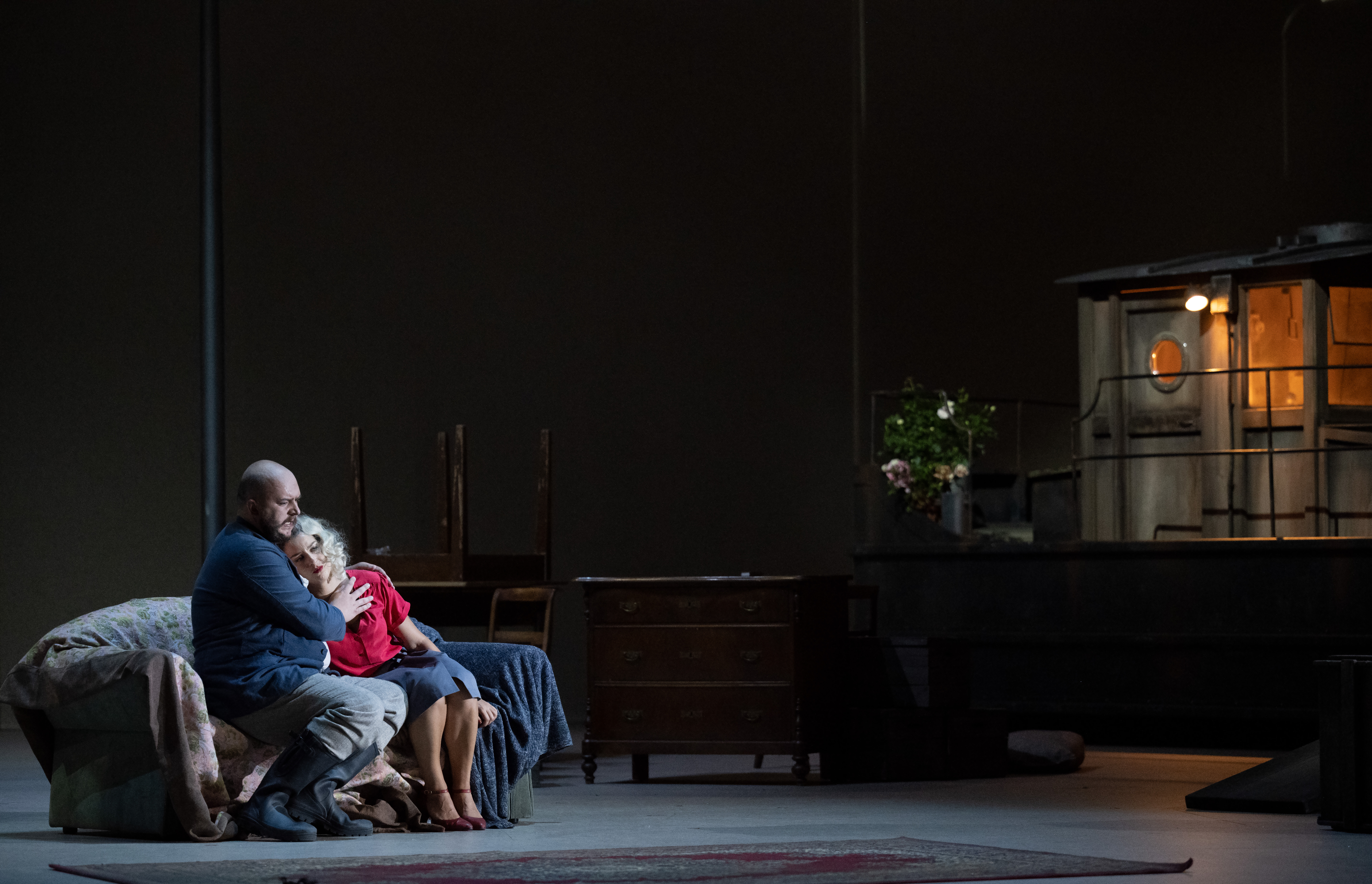
IL TRITTICO von Giacomo Puccini, Premiere am 30 September 2023, Deutsche Oper Berlin, copyright: Eike Walkenhorst (Suor Angelica)

Integral performances of Puccini’s Il trittico, first seen and heard at New York’s Metropolitan Opera in 1918, have seemed to gain in popularity of late. In recent years, I have seen two different productions in London (Covent Garden and Holland Park) as well as last year’s Salzburg Festival staging. The problem is largely one of cost, I suspect: to stage three operas, with decidedly different casting requirements, in a single evening does not come cheap, even if one does what one can to share resources, human and scenic. The balance will continue to shift between treating each opera as an individual work and some sense of a greater whole, and that is no bad thing. A signal virtue of Pinar Karabulut’s new Deutsche Oper staging, of which this was the first night, is that that balance and indeed the idea of the altar triptych remain central to her conception: not in a didactic or even overtly representational way, but nonetheless so as to suggest one knows the same artist and purpose are at work. In the middle stands the explicitly (anti-)Marian Suor Angelica, ‘flanked,’ as Karabulut explains in a programme interview, by ‘the dramatic tragedy Il tabarro and the grotesque comedy Gianni Schicchi’. 

Dante informs proceedings too. Gianni Schicchi has its origins in The Divine Comedy, of course, but Karabulut and her team offer a progression that takes us from the inferno of Il tabarro, explicitly headed with the celebrated inscription, ‘Lasciate ogne speranza voi ch’intrate’. It is far from an unreasonable location for the tragedy of Michele, Giorgetta, and Luigi to unfold; indeed, one might see it as approaching self-evident. What is often given in a naturalistic, or at least highly suggestive, Parisian setting, here becomes a more fantastic, invented world, with at least a hint of science fiction to it, visited at one point by curious visitors who might be from another planet. For this is certainly not an overtly Christian or theological approach, even as we progress through purgatory to paradise; indeed, it becomes if anything less so. Suor Angelica has, quite deliberately, nothing of the Christian convent to it, although its scenic connections with what has preceded and what will follow are cleverly suggested by framing elements retained, as if we were travelling upwards within a (secularised?) theatrical cupola. It is a futuristic society, or seems to be, albeit one with a perhaps unfortunate air of colourised early Dr Who. This, at any rate, is the world from which those visitors have earlier passed through another, as they will do also in the final piece, presented as a satyr play with a vengeance. We see suggested not only an entirely female world, but one in which patriarchy may actually have been superseded, or at least set to one side. If so, its mixings seem decidedly blessed—and perhaps that is the point.


Gianni Schicchi
 

Influence of the commedia dell’arte is seen throughout, in masks, in stylisation of action, and not least in Teresa Vergho’s costumes, connecting in scarlet what she describes as ‘three veritable figures of death: Michele, the Principessa und Gianni Schicchi’. I am not sure I agree when it comes to the third figure, though it is an interesting and far from insupportable thesis. The important thing is not whether one necessarily agrees, though, but that one is led to reflect. Commedia dell’arte functions as a distancing, even alienating (pre-, yet also post-Brecht) strategy, yet proves also in its relative artificiality to provide a way in to emotional directness that avoids the sentimentality to which Puccini stagings can still fall prey. The audience certainly seemed strongly to appreciate the release offered by the final piece’s presentation, living up to Karabulut’s billing of grotesquerie. Doubtless there is a vein of puritanism in my wishing for something a little more restrained, subtle even; such matters are more related to taste than judgement, and this high degree of physicality is more a mainstay of German than English theatre. 

John Fiore stepped in at short notice as conductor, replacing an indisposed Donald Runnicles. There was no doubting, doubly impressive in the circumstances, Fiore’s knowledge of the score and his ability to communicate his reading of it to the excellent Orchestra of the Deutsche Oper. At times, though – and again I think this is mostly a matter of taste – I found the sound a little too pre-packaged: without wishing to essentialise, this seemed a rather transatlantic understanding of Puccini, made, as it were for the Met. (Fair enough, one might say, given that is precisely where the operas were made for.) Surface sheen and extraordinary dynamic range were characteristic, yet so was stereotypical ultra-broadening for vocal climaxes—and, sadly, no attempt to evade or silence the applause within operas this helped provoke. I missed a little more Wagnerism – doubtless I would – though I greatly appreciated the unapologetic refusal to tone down the shock, in context, of Puccini’s bitonal and other explorations. Petrushka may be a little too apparent in Il tabarro, but there are many, many worse models. And if the Seine were less apparent visually – the water we saw was somehow both more elemental and more figurative, Stygian perhaps – we certainly heard it loud and clear as a character of its own in the score.


Il tabarro: Michele (Misha Karia), Luigi (Jonathan Tetelman)
 

Misha Kiria, Salzburg’s Gianni Schicchi, played the (anti?)-hero here too, as well as Michele. His versatility and sensitivity rightly garnered prolonged audience approbation. Likewise Mané Galoyan’s heartfelt, properly differentiated Suor Angelica and Lauretta. Violeta Urmana’s Zia Principessa proved a typical star turn: almost, one might say, an ‘also starring…’ moment. Carmen Giannattasio and Jonathan Tetelman, doubtless assisted by the production, brought undeniable sexual chemistry to their portrayal of Giorgetta and Luigi; it was difficult to take one’s eyes and ears off them, whether apart or together.  Andrei Danilov’s Rinuccio was similarly as ardent as one could wish for, a winning development of his (retrospective) cameo as the Song seller in Il Tabarro. Andrew Harris’s Simone and Annika Schlicht shone as Simone and Zita respectively. But there was little in the way of weak vocal links—and plenty of character to even the smallest performance. That quality was certainly shared by the Chorus and Children’s Chorus, splendidly prepared by Jeremy Bines and Christian Lindhorst. Whatever my doubts concerning a few aspects of detail, doubts that seemed from the audience reaction very much a minority response, this was an evening that spoke of the strength in depth of the Deutsche Oper as well as the enduring appeal and enigma of Puccini’s Trittico.


Wednesday, 24 August 2022

Salzburg Festival (2) - Il trittico, 21 August 2022


Grosses Festspielhaus

Gianni Schicchi – Misha Kiria
Lauretta – Asmik Grigorian
Zita – Enkelejda Shkosa
Rinuccio – Alexey Neklyudov
Gherardo – Dean Power
Nella – Lavinia Bini
Gherardino – Daniel Fussek
Betto di Signa – Manel Esteve Madrid
Simone – Scott Wilde
Marco – Iurii Samoilov
La Ciesca – Caterina Piva
Maestro Spinelloccio – Matteo Peirone
Ser Amantio di Noclao – Mikołaj Trąbka
Pinellino – Aleksei Kulagin
Guccio – Liam James Karai
Buoso Donati – Leopold Böhm


Michele – Roman Burdenko
Giorgetta – Asmik Grigorian
Luigi – Joshua Guerrero
Il Tinca – Andrea Giovannini
Il Talpa – Scott Wilde
La Frugola – Enkelejda Shkosa
Song seller – Dean Power
Lovers – Dean Power, Martina Russomanno
Midinettes – Dijana Kos, Irena Krsteska, Wilma Maller, Irina Peroš, Katarína Porubanová, Anna Yasiutina
Dancers – Clara Cozzolino, Mário Jorge Moisés da Silva Branco, Joni Österlund, Anna Possarnig, Guillaume Rabain, Nicolas Franciscus, Giulia Tornarolli

Sister Angelica – Asmik Grigorian
La Zia Principessa – Karita Mattila
Abbess – Hanna Schwarz
Sister Zelatrice – Enkelejda Shkosa
Mistress of the Novices – Vaterina Piva
Sister Genovieffa – Giulia Semenzato
Sister Osmina – Martina Russo manno
Sister Dolcina – Daryl Freedman
Nursing Sister – Juliette Mars
Alms Sisters – Lavinia Bini, Alma Neuhaus
Novice – Amira Elmadfa
Lay Sisters – Svenja Kallweit, Anna Yasiutina
Son – Jonathan Ehrenreich
Choral soloists – Dijana Kos, Mari Nakayama, Irina Peroš

Christof Loy (director)
Étienne Pluss (set designs)
Barbara Drosihn (costumes)
Fabrice Kebour (lighting)
Yvonne Gebauer (dramaturgy)  

Salzburg Festival and Theatre Children’s Choir (chorus director: Wolfgang Götz)
Concert Association of the Vienna State Opera Chorus (chorus director: Jörn Hinnerk Andresen) 
Angelika-Prokopp-Summer Academy of the Vienna Philharmonic (stage music)
Vienna Philharmonic Orchestra
Franz Welser-Möst (conductor)


Images: (C) SF /Monika Rittershaus


In many ways, this new production of Puccini’s triptych of one-act operas marked a triumph for the Salzburg Festival. One serious unforced error detracted, yet could only detract so far; likewise a few other cavils. Singing and orchestral playing were excellent throughout on the evening I attended, the last in the run. If Christof Loy’s production offered nothing particular in the way of insight, let alone re-evaluation, it presented the stories clearly and with élan, aided by good design work. Everything came together well, at an undeniably ‘Salzburg’ level.

Loy’s major miscalculation was to mess around with the ordering, so as to present the operas in the order Gianni Schicchi, Il tabarro, and Suor Angelica. The self-justification given in the programme made things worse, speaking of Suor Angelica having given the ‘impression’ of ‘such an extreme impact … that Gianni Schicchi came across as relatively trivial’. Not in my experience, nor in that of anyone I have spoken to. Nor has Il tabarro suffered from a lack of contemporary relevance, as Loy bizarrely suggests. (Quite why moving it to second place would help here remains unclear too.) Apparently, because this is a Festival, ‘everyone [is] in good spirits to be here,’ it makes better sense to open ‘with the seemingly life-affirming atmosphere of Gianni Schicchi’. Enough! There is good reason for placing the comedy last. Suor Angelica, meanwhile, suffers from being placed third, in that not only does it offer less a climax than a sense of tiring, even tailing away; but, perhaps worse, its own genuine musical as well as dramatic interest pales when heard after Schicchi. If you wanted to lend credence to claims of the saccharine, you could do a lot worse than adopt this reordering. Loy says that Franz Welser-Möst and he were in agreement on the matter; Welser-Möst really should have known better. None of this is fatal; after all, the operas are often (probably more often) played alone with entirely different companion pieces. But there is little gain here, and not inconsiderable loss.

Loy’s reputation in certain quarters remains something of a mystery to me. There is, as there certainly was here, a genuine craftsmanship at work. That I could admire—and did greatly. Movement and placing of objects on stage, the identity of each character (most of them, anyway), and much else had clearly been considered; one was left with little doubt that what one saw was what one was supposed to have seen. This is no more than speculation on my part, but I can imagine singers liking to work with him: certainly no bad thing. But beyond a certain generic stylishness, which is presumably in large part the work of his designers, I struggled to find any particular conceptual thinking at work, whether in each individual opera or as something to connect them. All three were vaguely modernised, I suppose, but unless one considers ‘modern dress’ to be a concept in itself, there was nothing to trouble conservative viewers. On the other hand, there was no banal intervention as in, say, Loy’s Tristan (Covent Garden) or Die Frau ohne Schatten (Salzburg, in which he essentially ignored the work altogether). So horses of no breed would have been scared away; perhaps that in itself was the idea.


The Vienna Philharmonic was on tremendous form, clearly relishing the opportunity to play all three operas in something approaching ideal conditions (certainly by way of comparison to the rehearsal schedule, or lack of it, in Vienna). Welser-Möst’s guiding spirit was heard to best effect in the first two operas, the scintillating scherzo of Gianni Schicchi razor-sharp, yet with plenty of tenderness too, the ominous ostinato of the Seine in Il tabarro duly overwhelming. (It took a few hours to get the latter out of my head, following the performance.) Light and shade were as meticulously planned and projected as any stage lighting, and there could be no doubting Welser-Möst’s knowledge and understanding of the scores. I missed a sense of something darker in Suor Angelica, but that was doubtless in considerable part a matter both of the piece itself and Loy’s decision to move it. There might nonetheless have been greater bite in its often intriguing harmonies and also a greater range of colour. A tendency to greyness such as I have often heard in Welser-Möst’s Strauss was not entirely avoided here.


Asmik Grigorian’s heroic service as heroine (of sorts) in all three proved both heartfelt and flawless. She did not tire, far from it, and gave considered, distinct performances of each of her roles. I do not think appreciation of her Sister Angelica was helped by its placing, giving the impression of everything leading up to a ‘big moment’, but I have probably said enough about that now. Her chemistry with Joshua Guerrero as Luigi and, indeed, negatively with Roman Burdenko as Michele was, to my mind, just as impressive, both of those artists turning in thoughtful as well as viscerally immediate performances. So too, unsurprisingly, did Karita Mattila as La Zia Principessa. From the moment she stepped on stage, one knew this was going to be something special, and it certainly was. Equal attention to words, music, and gesture informed a star turn that collegially collaborated with, in no sense upstaging, Grigorian. Much the same might be said, albeit (properly) with less hauteur, of Hanna Schwarz’s Abbess. Grigorian’s Rinuccio, Alexey Neklyudov, proved youthful, ardent, and similarly intelligent: a fine companion. Every portrayal in Gianni Schicchi was indeed, of similar quality, whether solo or ensemble, from Misha Kiria’s wily lawyer down (should that be the right direction). Enkelejda Shkosa’s turn as Zita here was followed by a splendidly animated La Frugola, hinting at hidden depths of sadness, in Il tabarro. This was a Trittico that almost offered the definition of casting from depth. For fine singing, complemented by excellent stage gifts, Personenregie, and orchestral playing, this will surely prove difficult to beat.


Thursday, 5 May 2016

Il tabarro, Melos Sinfonia/Zeffman, 1 May 2016


LSO St Luke’s

Michele – Simon Thorpe
Giorgetta – Sarah-Jane Lewis
Luigi – Charne Rochford
La Frugola – Fiona Mackay
Tinca – Robin Jeffcoat
Talpa – Arshak Kuzikyan
Song-seller – Luis Gomes

Ella Marchment (director)

Chorus (chorus master: William Cole)
Melos Sinfonia
Oliver Zeffman (conductor)
 

This was a May Day performance of Puccini’s opera to match what one might hear in the most exalted of houses, with all the advantages of observing the action at close hand. In this concert staging. there were no sets, but there was keen, telling direction (Ella Marchment). Imaginative use was made of the space too, the chorus and certain other solos being heard from above and around, reinforcing the sense of being trapped, fatally so, upon a river barge.
 

The Melos Sinfonia under Oliver Zeffman offered a duly hypnotic, post-Debussyan opening, the Seine immediately announced as a major, arguably the major, character. Zeffman’s care for orchestral balance was a richly rewarded as his dramatic pacing throughout; try as I might – and of course, I was not really trying – I could not find anything to fault. Dramatic tension and the needs of the moment were as well balanced as the orchestral lines (both with each other and with the voices). Just when one began to think that Puccini might be veering a little too close to Debussy for comfort, orchestral swells proclaimed his identity all the louder. The twists and turns in the score, for instance when Luigi offers his men a drink, were navigated with a sharp ear for rhythm and colour – and splendidly executed by the orchestra. Rhythm, perhaps in this of all Puccini’s score, proved properly generative, progenitor of as well as aqueous participant in the drama.
 

There was no doubt, moreover, of the existential tragedy when Luigi took to the stage to respond to Tinca; one could have cut the atmosphere with a knife; Paris, another existence, certainly called to the lovers in their duet. A duly symphonic conception that yet did not forget this was an opera underlined, indeed in every sense underscored, the inexorable human tragedy. The icy chill of the strings’ knife-twisting thus took its place not as a mere ‘effect’ but as a necessary outcome of what had gone before. Stravinskian ostinato – surely at least as much to the point as the organ-grinder’s colourful reminiscence of Petrushka – looked forward to Œdipus Rex.
 

I had no more reservations concerning the singing than I did the rest of the performance. Simon Thorpe’s darkly tortured – and torturing – Michele was at least as powerful a portrayal of the role as I have heard. The same could be said of the rich-toned Giorgetta of Sarah-Jane Lewis, whose plight and character could not have done more to engage our sympathy. Charne Rochford’s powerful yet subtly attentive Italianate reading of Luigi’s part was to be heard at just as impressive a level. Fiona Mackay and Arshak Kuzikyan developed their characters, La Frugola and Tinca, with excellent eyes and ears for detail: there was nothing incidental about their roles. Nor was there in the case of Robin Jeffcoat’s lugubrious yet, in more than one sense, ‘realistic’ Tinca or the finely-observed Song-seller of Luis Gomes. The small chorus, well trained by William Cole, was on equally excellent form, whether corporately or in the case of other solos. At no point did it occur to me to miss this panoply of full staging.

Sunday, 6 March 2016

Il trittico, Royal Opera, 29 February 2016


Royal Opera House

Il trittico

Michele – Lucio Gallo
Giorgetta – Patricia Racette
Luigi – Carl Tanner
Tinca – Carlo Bosi
Talpa – Jeremy White
Frugola – Irina Mishura
Song Seller – David Junghoon Kim
Lovers – Lauren Fagan, Luis Gomes

Suor Angelica

Suor Angelica – Ermonela Jaho
Suor Dolcina – Elizabeth Key
Monitress – Elena Zilio
Suor Genovieffa – Lauren Fagan
Suor Osmina – Eryl Royle
Mistress of the Novices – Elizabeth Zikora
Abbess – Irina Mishura
Princess Zia – Anna Larsson
Novice – Katy Batho
Nursing Sister – Jennifer Davis
Alms Sisters – Emily Edmonds, Renata Skarelyte
Nuns – Tamsin Coombs, Kiera Lyness, Anne Osborne, Amy Catt, Cari Searle

Gianni Schicchi

Gianni Schicchi – Lucio Gallo
Lauretta – Susanna Hurrell
Zita – Elena Zilio
Rinuccio – Paolo Fanale
Gherardo – Carlo Bosi
Nella – Rebecca Evans
Gherardino – Gabriele Montano
Betto di Signa – Jeremy White
Simone – Gwynne Howell
Marco – David Kempster
La Ciesca – Marie McLaughlin
Maestro Spinelloccio – Matteo Peirone
Ser Amantio di Nicolao – Tziano Bracci
Pinellino – Simon Wilding
Guccio – David Shipley
Buoso Donati – Peter Curtis

Richard Jones (director)
Sarah Fahie (revival director, Il tabarro and Suor Angelica)
Benjamin Davis (revival director, Gianni Schicchi)
Ultz (set designs, Il tabarro)
John Macfarlane (set designs, Gianni Schicchi)
Miriam Buether (set designs, Suor Angelica)
Nicky Gillibrand (costumes)
Mimi Jordan Sherin (lighting, revived D.M. Wood)
Sarah Fahie (movement)

Royal Opera Chorus (chorus master: Renato Balsadonna)
Orchestra of the Royal Opera House
Nicola Luisotti (conductor)
 

Until last summer, when I saw Opera Holland Park’s excellent production, I had never seen Il trittico as a whole in the theatre, something I had been intending to remedy for a while. Such was perhaps easier said than done, given that complete performances, whilst probably less rare than at one time they had become, are less frequent than one might expect. (Alexandra Wilson’s programme note was interesting on that subject.) At any rate, I wanted to wait for the right occasion, and OHP has a very good track record in Puccini. Now I have seen another, which seemed to me almost, yet perhaps not quite, as successful, but which should surely disappoint no one. That quite a few friends – I learned this only afterwards, so it did not colour my expectations – had been disappointed on the first night, especially in vocal terms, I find surprising; I have no reason to doubt them or their judgement, but can only say that, going on the second night, my experience was different; it was, after all, a different performance, and such is the magic – and indeed the frustration – of a performing art. Even the weakest of the three operas, considered purely vocally, was only comparatively so.
 

I will admit to a little disappointment that Richard Jones seems to have made little, if any, effort to unite the three operas. Three is no iron-clad rule which says one must, of course, but surely it would be interesting at least to make the attempt when the director is common to all three. It is, after all, perfectly clear how different they are on the surface; what, however, if one digs a little deeper? Yes, one can – and should – do one that oneself, but to say there is no need for a director to do so comes close to saying that there is no need for a director, at least in the strong sense, at all. Ably revived – with the caveat that I had only seen the Gianni Schicchi before, when it was paired with L’Heure espagnole – by Sarah Fahie and Benjamin Davis, there was, however to these stagings no doubt concerning the Personenregie nor the general sense of theatre. Jones treats Il tabarro as one would usually expect it to be seen, in naturalistic fashion. If I am honest, I was relieved to be spared his usual visual trademarks – no flock wallpaper, thank goodness! – and being set when and where it ‘should’ be makes a good deal of sense. (Not, I hasten to add that it must be, and if one were seeing the opera all the time, one might think differently.) It is atmospheric, though, and the designs – surely that is crucial, if one is going to be naturalistic – convince in a realistic fashion. There is perhaps more than a hint of Zola, or at least that this is recognisably of Zola’s world. The barge convinces as a barge, as do Ultz’s handsome street designs and Nicky Gillibrand’s costume designs. Paris, the very particular Paris of these workers by the Seine, emerges as perhaps the central ‘character’, and that is surely a good thing.


I am less sure about the children’s hospital ward setting of Suor Angelica; it feels a little contrived throughout, and especially at the end. Indeed, substituting for the nun’s vision a child running forward to hug her comes across, whatever the intention, as kitsch sentimentality, which is the last thing Puccini needs. Anti-clericalism is one thing, Puccini’s thing, although ultimately not a very interesting thing; this, for me, is another, something which seemed unable to take religion seriously at all and which was therefore to be found lacking. A full-on, atheistic attack – admittedly, of the post-Voltairean variety, and yes I know Voltaire himself was a deist, rather than the silly contemporary nonsense of Dawkins et al. – might be interesting; this is not it. Within these confines – and admitting, again, the excellence, on their own terms of the designs, this time by Miriam Buether – the story is told well enough, at least until the end.


Gianni Schicchi is, as one would hope, full of life, well observed, and certainly seems to respond to the music. Presumably Sarah Fahie’s movement coordination deserves credit there. It might not dig so deep as Calixto Bieito’s production for the Komische Oper,Berlin, despite their surface similarity, and of course the latter’s brilliant pairing with Bluebeard’s Castle – now there is an example of someone pursuing a compelling line through two operas – renders the comparison problematical. Having seen Bieito, I found this a little too obvious in its ‘zaniness’, a little lacking in a sense of what the work might mean. There is little, nevertheless, that should really trouble anyone, save for those ultra-reactionaries who object to the business of updating ‘on principle’. How I wish, though, that the audience could have been at least a little more quiet! Its incessant laughter was disruptive and wearying. (Is the opera really so funny that people cannot control themselves?) Applause following ‘O mio babbino caro’ suggested as strongly as audible sighs when that aria began that the perpetrators had little sense of irony, nor of the audible and visual (cinematic still) inverted commas around it. Whatever they were doing, they were certainly not applauding ironically, with a sense of the metatheatrical.


The real continuity came from Nicola Luisotti’s excellent conducting of the orchestra. To begin with, I wondered whether the orchestral sound in Il tabarro were a little too pastel of shade. However, it increasingly drew me in rhythmically, and soon I noticed and responded to the close connection with harmonic rhythm. Colour and its variation, rhythm and its variation, harmony and its variation: these and their interconnection progressed as if the score were plotting the course of the River Seine itself. That, arguably, is very much part of what it is doing. I was able to hear to an unusual degree the opera as a masterly symphonic poem with voices. That certain rhythmic figures and their development found their way into Suor Angelica was even more striking. Musical differences asserted themselves too, of course, but the sense of unity and diversity missing from the staging was undeniable in the pit. Gianni Schicchi’s scherzo-like writing thrilled as it should: with the quickfire alternation and sheer variety of character-voices above, I felt again that the truest action was in the symphonic poem so brilliantly played. Luisotti was economical with climaxes; however, my doubts as to whether he was perhaps being a little too parsimonious were readily assuaged by his long-term strategy, ably put into practice by the Covent Garden orchestra, sounding as Puccini players to the manner born.


Vocally, this felt somewhat like a ‘company’ night. The Royal Opera may not really possess a company in the old-fashioned sense; more is the pity. Nevertheless, there was considerable strength in depth and a true sense of cooperation, both between singers and between them and the production. Il tabarro, as I said, was somewhat less impressive in straightforward vocal terms, although Lucio Gallo’s relative dourness was surely part of his portrayal of Michele. Carl Tanner’s Luigi and Patricia Racette’s Giorgetta had impressive moments, although they were not so sustained as one might have wished. Irina Mishura was an arrestingly spirited Frugola. Ermonela Jaho’s Suor Angelica was properly sympathetic, indeed heart-rending; if her vocal strength is not sustained equally throughout her range, then that is the case with a good many singers. One employs what one has, and this she did very well; there was no doubting her honesty of portrayal and her commitment. Lauren Fagan’s moment as Suor Genovieffa, admitting her desire once again to hold a lamb, was touching indeed. Anna Larsson gave a remarkable performance as Princess Zia, her cold dignity scene-stealing; what a splendid contrast with the Wagner and Mahler in which I have most often heard her! Elena Zilio shone both as the Monitress and still more as Zita, the focal point – arguably more so than Gianni Schicchi himself – of activity in the final opera. Her stage and vocal presence were as one. Gallo’s more energetic – how could it not be? – performance as Schicchi clearly sprang from the words with, dare I say it, a native Italian ease. Gwynne Howell showed that he still very much has ‘it’ as Simone. Susanna Hurrell and Paolo Fanale offered youthful, fresh-tone relief as Lauretta and Rinuccio. As elsewhere, though, everyone contributed to the evening’s success. This was a properly human comedy.


Sunday, 7 June 2015

Il trittico, Opera Holland Park, 5 June 2015


Michele – Stephen Gadd
Giorgetta – Anne Sophie Duprels
Luigi – Jeff Gwaltney
Frugola – Sarah Pring
Tinca – Aled Hall
Talpa – Simon Wilding
Soprano Amante – Johane Ansell
Tenor Amante – James Edwards

Sister Angelica – Anne Sophie Duprels
Princess Zia – Rosalind Plowright
Abbess – Fiona Mackay
Monitress – Laura Woods
Mistress of the Novices – Kathryn Walker
Sister Genovieffa – Johane Ansell
Sister Osmina – Kathryn Hannah
Sister Dolcina – Rosanne Havel
Nursing Sister – Chloë Treharne
Alms Sisters – Anna Patalong, Sarah Minns
Novices – Naomi Kilby, Ellie Edmonds
Lay Sisters – Rebecca Hardwick, Chloe Hinton
Child – Matteo Elezi

Gianni Schicchi – Richard Burkhard
Zita – Sarah Spring
Lauretta – Anna Patalong
Rinuccio – James Edwards
Gherardo – Aled Hall
Nella – Elin Pritchard
Betto – Simon Wilding
Simone – William Robert Allenby
Marco – Ian Beadle
La Ciesca – Chloe Hinton
Spinelloccio – Henry Grant Kerswell
Gherardino – Barnaby Stewart
Buoso – Peter Benton

Martin Lloyd-Evans, Oliver Platt (directors)
Neil Irish (designs)
Richard Howell (lighting)

City of London Sinfonia
Stuart Stratford (conductor)


Time was when many felt compelled to ‘make allowances’ for ‘smaller’ companies. Now, more often than not, the contrary seems to be the case, instead apologising for their elder and/or larger siblings: ‘But of course, it is far more difficult for House X, given the conservatism of its moneyed audience,’ as if House X might not actually attract a different, more intellectually curious audience by programming more interesting works. At any rate, there is now no more need, if ever indeed there were, to ‘make allowances’, and it is difficult really to consider a company with such extensive programming as Opera Holland Park to be in any meaningful sense ‘smaller’. This new production – reusing its 2012 Gianni Schicchi – of Puccini’s complete Trittico may well be the best thing I have yet seen and heard at Holland Park.


Yet again, any reservations I might pre-emptively have held in abstracto concerning a small-ish orchestra (the outstanding City of London Sinfonia, strings 6:5:4:3:2) vanished within a few bars; the acoustic may sound unpromising in an unpromising performance, but in one such as this, with truly excellent conducting throughout from Stuart Stratford, there was no problem whatsoever. Dynamic contrasts and continuities could hardly have been more powerfully – and sensitively – communicated. Climaxes were shaped with unfailing conviction, matched, one felt, with as true an understanding as Puccini’s own of the dramatic ebb and flow. Indeed, the importance of rhythm, and its inextricable alliance to increasingly adventurous harmony, was projected in Il tabarro as almost a symphonic poem of the Seine itself – were that not woefully to underplay the role played by Stratford’s splendid cast. The post-verismo (if in fact we are post-) darkness of the score, lit by shards one might relate to Stravinsky, Schoenberg, or Debussy, but which one would be quite wrong to consider in any sense derivative, told of a Paris both distinct from and yet related to La bohème, Puccini’s self-quotation playful acknowledgement rather than necessity, so deeply imbued with style and meaning was the musical account.


Different colours, different sound-worlds presented  themselves in Suor Angelica and Gianni Schicchi, the tragic noose tightening inexorably in the former, all the more powerfully for its radiant feminity (from which Poulenc surely learned so much in Dialogues des Carmélites. I initially hardly felt like hearing the latter, immediately following the tragic denouement of Suor Angelica. Performance put me right, the revels now begun of a scherzo as full of zest and the comedic complexities of commedia dell’arte as the Petrushka score that more than once came to mind. Nothing was permitted to outstay its welcome, ‘O mio babbino caro’ for once a genuine moment of well-natured self-parody rather than a would-be reversion, in which members of the audience may sit back and ‘enjoy’. Indeed, Dante’s great comedy itself seemed to loom over the enterprise as a whole – just as, in very different circumstances, it had over Calixto Bieito’s brilliant Berlin double-bill of Schicchi and Bluebeard’s Castle earlier this year.

 
The casts were also as fine as I can recall from OHP, perhaps even finer still. Even given a certain amount of duplication, the number of singers involved is large, so as often put a strain upon one of those ‘larger’ houses. Here, no one disappointed, and the whole, as the well-worn cliché has it, was considerably greater than the sum of its parts; indeed, there was a real sense of company, such as one is more likely nowadays to find in relatively ‘smaller’ circumstances. Anne Sophie Duprels convinced equally in the conflicted roles of Giorgetta and Suor Angelica, her musical and dramatic focus and shaping every inch the equal of Stratford’s. Stephen Gadd and Jeff Gwaltney had one believe just as strongly in them and their plight in Il tabarro; it may not be a lengthy opera, but these felt like fully drawn characters, and the ‘smaller’ parts offered much of great interest too. So did those in the other two operas. Other singers to stand out – although it hardly seems fair to do anything but repeat the cast list – were a vehement, Rosalind Plowright as La Zia Principessa, nobler than the convent hierarchy, but possessed of similar, ruthless, yet perhaps ultimately more conflicted coldness. Family lines exert their own pressure, as we should shortly be reminded in Gianni Schicchi. Richard Burkhard’s protean Schicchi, Sarah Pring’s slightly but not too outlandish Zita, and Anna Patalong’s beautifully sung Lauretta headed a cast of true depth in that final instalment.


As night fell, the qualities of the three productions declared themselves in different ways; that change in light – and temperature – proved especially telling during the course of Suor Angelica. Neil Irish’s arched backdrop for Il tabarro, commenting yet expanding upon the ruins of Holland House, moved to the foreground for the laundry – inevitable thoughts concerning convent repression there – in Suor Angelica and the bedroom for Gianni Schicchi, laundered clothes serving dual purpose in the two latter operas. There was, however, no attempt to force the three operas closer together than that; they told their own stories, and we made connections as we would. Martin Lloyd Evans (Il tabarro and original director of Gianni Schicchi) and Oliver Platt (Suor Angelica and revival director of Schicchi) respected the works, which in turn seemed to respect them for it. Movement and designs were in keeping with the dictates of the action, scenic and musical alike, keenly observed without drawing undue attention. The tragedy and comedy of human existence were the focus, from pit and stage alike.