Showing posts with label Joshua Guerrero. Show all posts

Wednesday, 24 August 2022

Salzburg Festival (2) - Il trittico, 21 August 2022


Grosses Festspielhaus

Gianni Schicchi – Misha Kiria
Lauretta – Asmik Grigorian
Zita – Enkelejda Shkosa
Rinuccio – Alexey Neklyudov
Gherardo – Dean Power
Nella – Lavinia Bini
Gherardino – Daniel Fussek
Betto di Signa – Manel Esteve Madrid
Simone – Scott Wilde
Marco – Iurii Samoilov
La Ciesca – Caterina Piva
Maestro Spinelloccio – Matteo Peirone
Ser Amantio di Noclao – Mikołaj Trąbka
Pinellino – Aleksei Kulagin
Guccio – Liam James Karai
Buoso Donati – Leopold Böhm


Michele – Roman Burdenko
Giorgetta – Asmik Grigorian
Luigi – Joshua Guerrero
Il Tinca – Andrea Giovannini
Il Talpa – Scott Wilde
La Frugola – Enkelejda Shkosa
Song seller – Dean Power
Lovers – Dean Power, Martina Russomanno
Midinettes – Dijana Kos, Irena Krsteska, Wilma Maller, Irina Peroš, Katarína Porubanová, Anna Yasiutina
Dancers – Clara Cozzolino, Mário Jorge Moisés da Silva Branco, Joni Österlund, Anna Possarnig, Guillaume Rabain, Nicolas Franciscus, Giulia Tornarolli

Sister Angelica – Asmik Grigorian
La Zia Principessa – Karita Mattila
Abbess – Hanna Schwarz
Sister Zelatrice – Enkelejda Shkosa
Mistress of the Novices – Vaterina Piva
Sister Genovieffa – Giulia Semenzato
Sister Osmina – Martina Russo manno
Sister Dolcina – Daryl Freedman
Nursing Sister – Juliette Mars
Alms Sisters – Lavinia Bini, Alma Neuhaus
Novice – Amira Elmadfa
Lay Sisters – Svenja Kallweit, Anna Yasiutina
Son – Jonathan Ehrenreich
Choral soloists – Dijana Kos, Mari Nakayama, Irina Peroš

Christof Loy (director)
Étienne Pluss (set designs)
Barbara Drosihn (costumes)
Fabrice Kebour (lighting)
Yvonne Gebauer (dramaturgy)  

Salzburg Festival and Theatre Children’s Choir (chorus director: Wolfgang Götz)
Concert Association of the Vienna State Opera Chorus (chorus director: Jörn Hinnerk Andresen) 
Angelika-Prokopp-Summer Academy of the Vienna Philharmonic (stage music)
Vienna Philharmonic Orchestra
Franz Welser-Möst (conductor)


Images: (C) SF /Monika Rittershaus


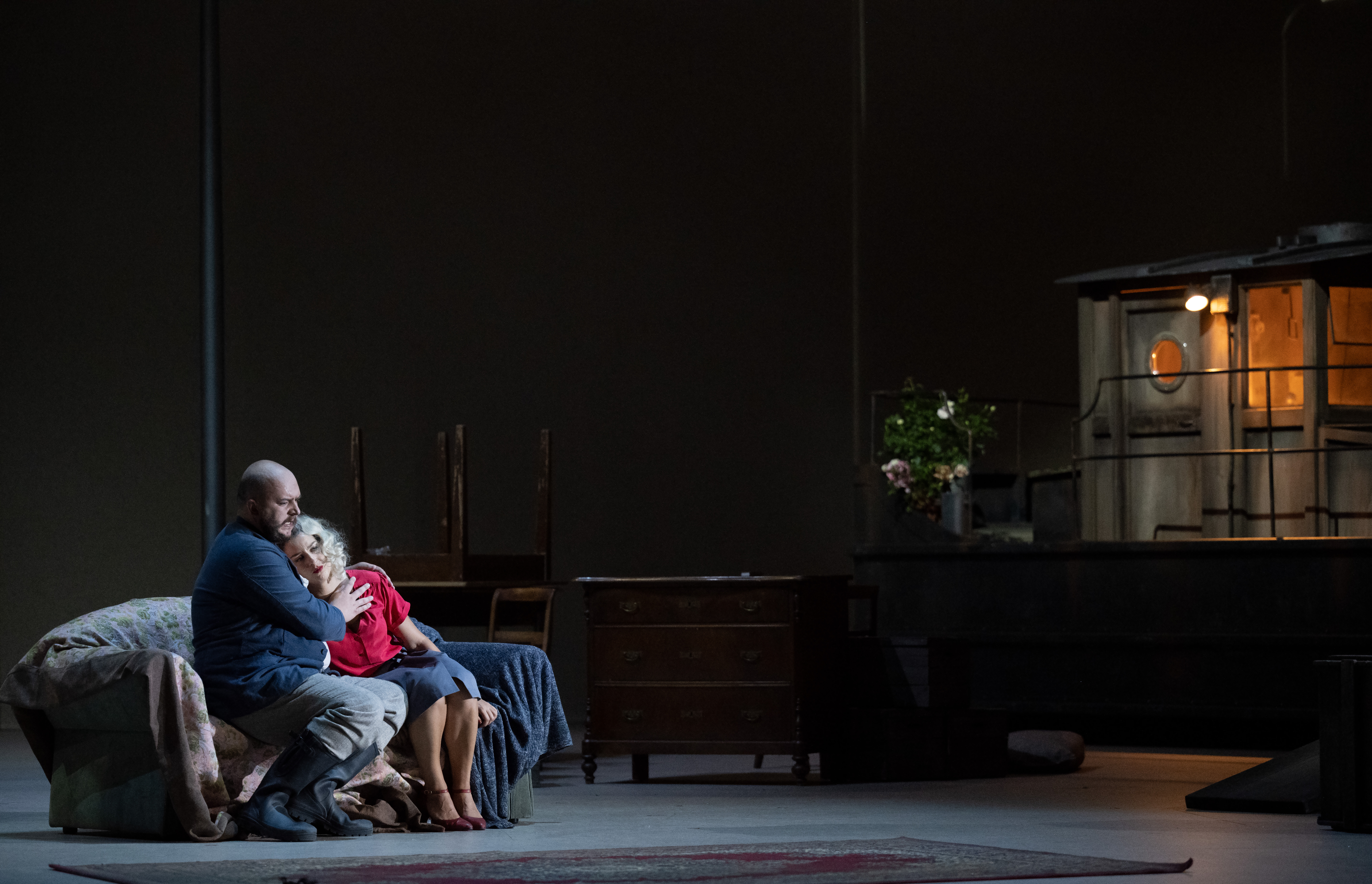
In many ways, this new production of Puccini’s triptych of one-act operas marked a triumph for the Salzburg Festival. One serious unforced error detracted, yet could only detract so far; likewise a few other cavils. Singing and orchestral playing were excellent throughout on the evening I attended, the last in the run. If Christof Loy’s production offered nothing particular in the way of insight, let alone re-evaluation, it presented the stories clearly and with élan, aided by good design work. Everything came together well, at an undeniably ‘Salzburg’ level.

Loy’s major miscalculation was to mess around with the ordering, so as to present the operas in the order Gianni Schicchi, Il tabarro, and Suor Angelica. The self-justification given in the programme made things worse, speaking of Suor Angelica having given the ‘impression’ of ‘such an extreme impact … that Gianni Schicchi came across as relatively trivial’. Not in my experience, nor in that of anyone I have spoken to. Nor has Il tabarro suffered from a lack of contemporary relevance, as Loy bizarrely suggests. (Quite why moving it to second place would help here remains unclear too.) Apparently, because this is a Festival, ‘everyone [is] in good spirits to be here,’ it makes better sense to open ‘with the seemingly life-affirming atmosphere of Gianni Schicchi’. Enough! There is good reason for placing the comedy last. Suor Angelica, meanwhile, suffers from being placed third, in that not only does it offer less a climax than a sense of tiring, even tailing away; but, perhaps worse, its own genuine musical as well as dramatic interest pales when heard after Schicchi. If you wanted to lend credence to claims of the saccharine, you could do a lot worse than adopt this reordering. Loy says that Franz Welser-Möst and he were in agreement on the matter; Welser-Möst really should have known better. None of this is fatal; after all, the operas are often (probably more often) played alone with entirely different companion pieces. But there is little gain here, and not inconsiderable loss.

Loy’s reputation in certain quarters remains something of a mystery to me. There is, as there certainly was here, a genuine craftsmanship at work. That I could admire—and did greatly. Movement and placing of objects on stage, the identity of each character (most of them, anyway), and much else had clearly been considered; one was left with little doubt that what one saw was what one was supposed to have seen. This is no more than speculation on my part, but I can imagine singers liking to work with him: certainly no bad thing. But beyond a certain generic stylishness, which is presumably in large part the work of his designers, I struggled to find any particular conceptual thinking at work, whether in each individual opera or as something to connect them. All three were vaguely modernised, I suppose, but unless one considers ‘modern dress’ to be a concept in itself, there was nothing to trouble conservative viewers. On the other hand, there was no banal intervention as in, say, Loy’s Tristan (Covent Garden) or Die Frau ohne Schatten (Salzburg, in which he essentially ignored the work altogether). So horses of no breed would have been scared away; perhaps that in itself was the idea.


The Vienna Philharmonic was on tremendous form, clearly relishing the opportunity to play all three operas in something approaching ideal conditions (certainly by way of comparison to the rehearsal schedule, or lack of it, in Vienna). Welser-Möst’s guiding spirit was heard to best effect in the first two operas, the scintillating scherzo of Gianni Schicchi razor-sharp, yet with plenty of tenderness too, the ominous ostinato of the Seine in Il tabarro duly overwhelming. (It took a few hours to get the latter out of my head, following the performance.) Light and shade were as meticulously planned and projected as any stage lighting, and there could be no doubting Welser-Möst’s knowledge and understanding of the scores. I missed a sense of something darker in Suor Angelica, but that was doubtless in considerable part a matter both of the piece itself and Loy’s decision to move it. There might nonetheless have been greater bite in its often intriguing harmonies and also a greater range of colour. A tendency to greyness such as I have often heard in Welser-Möst’s Strauss was not entirely avoided here.


Asmik Grigorian’s heroic service as heroine (of sorts) in all three proved both heartfelt and flawless. She did not tire, far from it, and gave considered, distinct performances of each of her roles. I do not think appreciation of her Sister Angelica was helped by its placing, giving the impression of everything leading up to a ‘big moment’, but I have probably said enough about that now. Her chemistry with Joshua Guerrero as Luigi and, indeed, negatively with Roman Burdenko as Michele was, to my mind, just as impressive, both of those artists turning in thoughtful as well as viscerally immediate performances. So too, unsurprisingly, did Karita Mattila as La Zia Principessa. From the moment she stepped on stage, one knew this was going to be something special, and it certainly was. Equal attention to words, music, and gesture informed a star turn that collegially collaborated with, in no sense upstaging, Grigorian. Much the same might be said, albeit (properly) with less hauteur, of Hanna Schwarz’s Abbess. Grigorian’s Rinuccio, Alexey Neklyudov, proved youthful, ardent, and similarly intelligent: a fine companion. Every portrayal in Gianni Schicchi was indeed, of similar quality, whether solo or ensemble, from Misha Kiria’s wily lawyer down (should that be the right direction). Enkelejda Shkosa’s turn as Zita here was followed by a splendidly animated La Frugola, hinting at hidden depths of sadness, in Il tabarro. This was a Trittico that almost offered the definition of casting from depth. For fine singing, complemented by excellent stage gifts, Personenregie, and orchestral playing, this will surely prove difficult to beat.


Sunday, 20 May 2018

Madama Butterfly, Glyndebourne, 19 May 2018


Glyndebourne Opera House

Pinkerton – Joshua Guerrero
Goro – Carlo Bosi
Suzuki – Elizabeth DeShong
Sharpless – Michael Sumuel
Cio-Cio-San – Olga Busuioc
Cousin – Jennifer Witton
Cio-Cio-San’s Mother – Eirlys Myfanwy Davies
Yakuside – Adam Marsden
Aunt – Shuna Scott Sendall
Imperial Commissioner – Michael Mofidian
Official Registrar – Jake Muffett
Bonze – Oleg Budurtaskiy
Prince Yamadori – Simon Mechlinski
Sorrow –Rupert Wade
Kate Pinkerto – Ida Ränzlöv

Annilese Miskimmon (director)
Nicky Shaw (set designs)
Mark Jonathan (lighting)
Kally Lloyd Jones (movement)
Ian William Galloway (video)

Glyndebourne Chorus (chorus master: Nicholas Jenkins)
London Philharmonic Orchestra
Omer Weir Wellber (conductor)


‘Picture it,’ as senior Golden Girl, Sophia Petrillo used to say. ‘England, 19 May 2018…’ An audience found itself enthralled by the marriage of an impressive woman to a privileged man, impeccable and dashing in his military uniform, from another nationality and ‘race’. They wished her well in this fairytale, investing their hopes, personal and communal, in the success of their union, even as some of their number risked spoiling the party by exploring a little of the history of this meeting of cultures. All the while, the mediating moneymakers – well, they made money. Would it last? Were some of them/us already gearing up to be thrilled by its potential difficulties, failures, even tragedy? From Windsor Castle, then, to the Sussex Downs did not seem too lengthy a journey – I saw signs at Clapham Junction for the latter, as I found my platform for the latter – especially for a festival opening for which the not-quite-so-great-and-good-as-would-have-resulted-in-an-invitation-to-the-reception were naturally out in force.


Annilese Miskimmon’s production of Madama Butterfly, Glyndebourne’s first, has been seen previously on the 2016 tour, but this was its first appearance at the Festival proper, and my first encounter with it. It would be considered reasonably straightforward for most composers, bar the ‘updating’ – must we continue to use that dated word and idea? – to the 1950s, yet for Puccini, who perhaps suffers more than any other opera composer from a surfeit of reactionary stagings, probably marks quite an important step. It is not Calixto Bieito, nor would one expect it to be. What we see, however, portrays the drama, both a clash of cultures and expectations on anything but a level playing-field and a very personal tragedy, with unfailing intelligence and emotional commitment. I liked it – and the stage performances – very much, and responded pretty much how I ‘should’, whilst being provoked to think rather more than I often have been.


What comes across very strongly from the outset is that, whatever the exalted setting – be it a royal castle or an opera stage – and the undeniable personhood of the sacrificial victim, there is something distressingly typical about the story and the social structures that give rise to it. Cio-Cio-San is placed explicitly in a line of geishas, ‘married’ off to their respective ‘husbands’, educated onsite at the marriage bureau by the slide show, ‘How to be an American wife’, a ready source of income for the grubbily venal Goro. (He returns at the close of the first act to count his money.) A neon-lit HOTEL stands next door, for ease of consummation; or rather, the bureau stands next door to it, for ease of commerce. The overweening arrogance of Pinkerton is his personally and culturally: not just the cigarettes he smokes, but his – in context – shocking act of forcing a horrified Cio-Cio-San to toss her bouquet behind her. She does not understand, nor do the girls behind her, who dart away from it. It is cultural misunderstanding, yes, but from a man and a culture – a gender too – which, holding all the cards, have neither need nor wish to understand. Perhaps he does, a little; he too, after all, is ultimately ordinary, nothing special. (Unlike his ‘bride’, he remains that way, resolutely untransfigured, untransfigurable.) There are a few little signs of such, and, in the duet with which the first act closes, he shows her a degree of kindness, or at least of toxic masculine, Yankee concern. He is, however, a colonial tourist and overlord – and will remain so. So says the score too, of course, as Puccini subjects the Star-Spangled Banner to further exploration than one might innocently expect. In Madam Butterfly, we are all robbed of whatever innocence we may fondly delude ourselves we possessed in the first place.


The second act, tellingly, shows us an American house, set in a Japanese – or, rather stylised, orientalised ‘Japanese’ – landscape. There is no doubting Butterfly’s – sorry, Mme Pinkerton’s – belief and pride in her new situation, whatever the parlous financial situation of which Suzuki informs her. She smokes American cigarettes too now, or claims to; she proudly offers one to Sharpless, and discreetly chokes on hers. Prince Yamadori was surrounded by Americans as well as ‘natives’, when he paid her a visit: he is the compromising member of a colonial elite one would expect. Much is done with light, much is done with designs, costumes included; she is dressed as an American woman too. Until the end, that is, when to die in honour, she dresses, tragically and yet not without her hallmark pride, as the Japanese woman she has, perhaps, always known herself to be. And her son, little Sorrow, plays with a model of an American gunboat, as he waits for his father – and as his mother kills herself. Throughout, the tragedy is intensely personal and intensely imperialist.


In the title role, Olga Busuioc impressed greatly, especially during the second and third acts, when she seemed more at ease in the role. (This was, after all, an opening night.) As Alexandra Wilson writes in her programme note – and this goes for so much Puccini in general: think what we actually see and hear first-hand in La bohème! – ‘one of the particular strokes of brilliance about the opera is the way in which Puccini manages to trace the development of … [her] personality so vividly and perceptively across the span of a comparatively short opera.’ That needs performative brilliance too, which one certainly received later on, the dynamic scale of her vocal contribution not the least of her dramatic tools. Elizabeth DeShong made for a kindly yet – again – proud Suzuki. If I am rehearsing colonialist stereotypes, what else is one to do in such an opera? Perhaps the best we can hope for is to do so with a degree of critical awareness, unless, that is, we are puritanically to consign this and so many other works to the dustbin of history – and then remain with what?


Joshua Guerrero portrayed Pinkerton to a tee: his easy, false charm, his arrogance, and yet, a hint of the ambiguous, albeit quotidian devil to him too. (The pantomime booing he received was, as ever, deeply regrettable. Can we not put a stop to that, right now, please?) Carlo Bosi made us loathe the shallow evil of the aforementioned Foro, whilst Michael Sumuel did an excellent job as the duly compassionate – up to a point: repeat, up to a point – Sharpless. Indeed, every member of the cast impressed, and contributed to a greater whole; I noted, especially, Michael Mofidian’s Imperial Commissioner, Oleg Budartaskiy’s Bonze, and, as much in stage beaing as in voice – for, as one always rediscovers, she has so little to sing – Ida Ränzlöv’s Kate Pinkerton.


The London Philharmonic clearly relished playing Puccini’s score. (Which orchestra would not?) String sheen and more general tonal allure were not purchased at the expense of incisive drama: quite the contrary. I could not help but wish that it had been given its head a little more often by Omer Meir Wellber, but perhaps that was his point. If he did not always communicate the quasi-symphonic form of the musical work as strongly as he might have done, with a consequent lack of dramatic impetus at times. For the most part Wellber showed himself a good accompanist, more often than not alert to the ebb and flow, often a little reticent and sometimes even sluggish. In Puccini, just as in Wagner and Strauss, the relationship between orchestra and singers is not, or should not be, a zero-sum game: attention paid to the one should heighten our attention to the other. More of that will probably come, though, as the run progresses. This remained, by any standards, an impressive opening night for the 2018 Glyndebourne Festival. For those, moreover, who cared to think, it may have had a good deal still to tell us about our own hopes and fears, about our own prejudices and our struggles, however vain, to surmount them. As Carl Dahlhaus once observed, ‘it is precisely in order to radicalise conflicts — so that “resolutions” are ruled out — that dramas are written; if not, they would be treatises.’