Showing posts with label Anna Larsson. Show all posts

Monday, 29 January 2018

Das Rheingold, LPO/Jurowski, 27 January 2018


Royal Festival Hall

Images: Simon Jay Price


Woglinde – Sofia Fomina
Wellgunde – Rowan Hellier
Flosshilde – Lucie Špičkova
Freia – Lyubov Petrova
Fricka – Michelle DeYoung
Erda – Anna Larsson
Froh – Allan Clayton
Loge – Vsevolod Grivnov
Wotan – Matthias Goerne
Donner – Stephen Gadd
Fasolt – Matthew Rose
Fafner – Brindley Sherratt
Mime – Andrew Thompson
Alberich – Robert Hayward

Malcolm Rippeth (lighting)
Katie Thackeray (deputy stage manager)
Ted Huffman (consultant)

London Philharmonic Orchestra
Vladimir Jurowski (conductor)


It is, of course, quite an achievement in itself for a symphony orchestra to perform Das Rheingold or indeed any of the Ring dramas. It does not happen very often, not nearly so often as it should; for given Wagner’s crucial musico-historical position, this is music that should stand at the very centre of their repertoires – just as Beethoven should at the centre of opera orchestras’. One can envy the practice of many German orchestras, which play for both opera house and symphony hall, but envy does not necessarily take us very far. (Actually, as Alberich will show us, it does, but perhaps not in the best direction.) In a closer-to-ideal world, admitted Vladimir Jurowski in the programme, there would have been a theatrical production, but the Ring ‘would be the end of Glyndebourne as a venue – it would simply fall apart if we tried to squeeze the orchestra into the pit!’ Why an achievement to perform it, though? Because Wagner’s dramas offer a standing rebuke to neoliberalism. It is not that there is any lack of ‘demand’; look how performances, especially in Wagner-starved Britain, will often sell out within a few minutes. But however great the demand, they will not ‘pay for themselves’. They are a communal undertaking, explicitly intended and functioning as heirs, political, social, religious, and dramatic – the distinctions make no sense – to the Attic tragedy of Aeschylus and Sophocles. (For more on that, please click here.)


Moreover, for the London Philharmonic Orchestra to give such an outstanding orchestral performance, in what must be the first time many of its players will have performed the score, is again cause for thanks and rejoicing. The LPO strings could hardly have proved more protean, the variegation of their tone a challenge to many an opera orchestra, that variegation surely born in part of Jurowski’s strenuous demands. Detail was present and vivid to what sometimes seemed a well-nigh incredible decree. For instance, the brass spluttering as Alberich floundered in the Rhine, for instance, looked forward suggestively to Strauss’s critics in Ein Heldenleben. If the anvils did not sound as they might in one’s head, when do they ever? That was no fault of the excellent nine players on three sides of the stage. The Prelude sounded – and, given the pipes behind the stage – unusually organ-like: not just the timbres, but also the insistence on the E-flat pedal, quite beyond any I can recall previously having heard. Such was the revealing side of Jurowski’s tight leash and rhythmic (harmonic rhythm included) exactitude, Bruckner coming strongly to mind.

Fasolt (Matthew Rose), Freia (Lyubov Petrova), and Fafner (Brindley Sherratt)

And yet, as so often, Jurowski himself proved too unyielding, almost Toscanini-like, if on a lower voltage. His again was quite an achievement, given that this was the first time he had conducted the score. There is no reason to think that subsequent performances will not reap rewards. By the same token, however, it would be idle to think that this compared to a Daniel Barenboim or a Bernard Haitink, although it certainly knocked spots off the incoherent incompetence Wagner generally suffers under Haitink’s successor at Covent Garden. To Londoners who hear little or nothing else, this would rightly be a cause for rejoicing. Moreover, the sometimes almost caricatured formalism of Jurowski’s approach – I wondered at times whether he had been reading Alfred Lorenz! – was not without its rewards. Was structure, however, too clarified, even simplified? For every revealing instance of opposition between different varieties of thematic material – Fricka’s disruptive, recitative-like ‘Wotan, Gemahl’, for instance, amidst Wotan’s orchestral dreaming of Valhalla – there were at least two passages that were distinctly subdued, almost as if concerned that the orchestra would threaten audibility of the singers. (It never did, by the way.) It was wonderful to hear so much harp detail as the gods crossed the rainbow bridge, and there is certainly good, Feuerbachian dramatic reason to emphasis the unreal beauty of the fortress and the path thereto. It need not, though, and surely should not come at the expense of its sacerdotal power. Novelistic, almost domesticated narrative sometimes threatened, in a dialectical turn, the integrity of musico-dramatic form. Yes, this is epic, yet it is anything but undisciplined. Das Rheingold, however, is a very difficult work to bring off: in some ways more so than the subsequent Ring dramas. Even Barenboim has sometimes erred a little too much towards Neue Sachlichkeit here. That there was a good deal to engage with critically, however, the foregoing merely illustrative, suggests that Jurowski’s Wagner is and will continue to be something to take seriously.
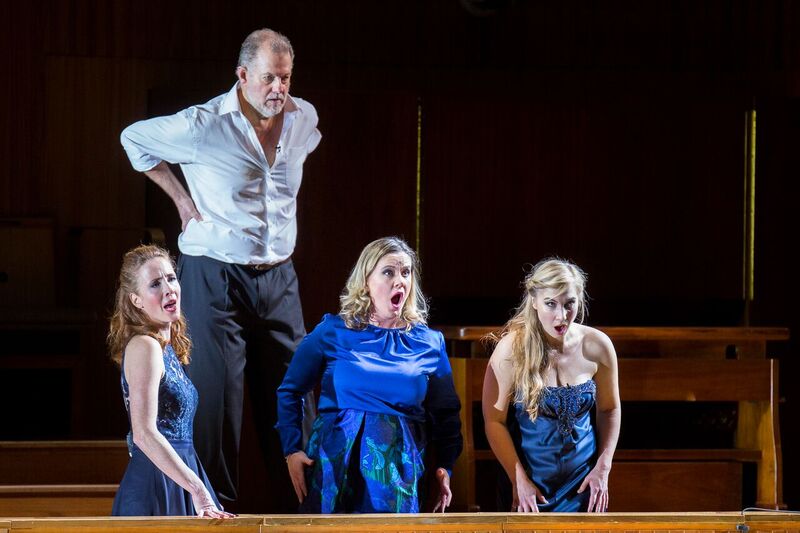
Alberich (Robert Hayward) and the Rhinemaidens (Sofia Fomina, Rowan Hellier, Lucie Špicková)


Vocally, as will almost always be the case, the bag was mixed. I could not resist the sense that, to a certain extent, at least Matthias Goerne’s Wotan was a little too much reliant on stock emotionally stunted sociopathy. Only towards the end, after the arrival of Anna Larsson’s typically excellent Erda, did he seem more truly ruminative. That is a crucial moment, of course, in his road towards Schopenhauerian conversion, but Wotan is never merely a figure of force. ‘Nicht durch Gewalt!’ is, after all, his injunction to Donner.  Robert Hayward’s Alberich went awry a few too many times; at his best, however, he proved darkly impressive. The giant pair of Matthew Rose and Brindley Sherratt also duly impressed as Fasolt and Fafner, the lovelorn brother genuinely moving, the sheer malevolence of Fafner at and after his death chilling indeed. Vsevolod Grivnov and Adrian Thompson offered detailed, dramatically alert ‘character tenor’ portrayals of Loge and Mime respectively, Allan Clayton’s light, bright-toned Froh a proper contrast. Michelle DeYoung’s Fricka, often imperious, was sometimes a little on the wobbly side, but there was little harm done in that respect, nor in the not dissimilar case of Lyubov Petrova’s cleanly sung Freia. Above all, there was a fine, almost Mozartian sense of conversation in passages of much dramatic to-and-fro. If only there had been a little more conventional drama. There nevertheless remained much to admire – and far from only because it happened at all.

Loge (Vsevolod Grivnov)

Monday, 10 April 2017

Berlin Festtage (2) - Parsifal, Staatsoper Berlin, 8 April 2017


Klingsor (Tómas Tómasson) and the Flowermaidens
Images: Ruth Walz

Schiller Theater

Amfortas – Lauri Vasar
Gurnemanz – René Pape
Parsifal – Andreas Schager
Klingsor – Tómas Tómasson
Kundry – Anna Larsson
Titurel – Matthias Hölle
Squires – Sónia Grané, Natalia Skrycka, Florian Hoffmann, Michael Porter
First Knight of the Grail – Michael Smallwood
Second Knight of the Grail – Dominic Barberi
Flowermaidens – Katerina Tretyakova, Adriane Queiroz, Anja Schlosser, Sónia Gráne, Narine Yeghiyan, Natalia Skrycka
Voice from Above – Natalia Skrycka
 
Dmitri Tcherniakov (director, set designs)
Elena Zaytseva (costumes)
Gleb Filshtinsky (lighting)
Jens Schroth (dramaturgy)

Staatsopernchor Berlin (chorus master: Martin Wright)
Staatskapelle Berlin
Daniel Barenboim (conductor)

 
With this, my third visit to Dmitri Tcherniakov’s Parsifal, I have now seen the production as many times as I did that of Stefan Herheim at Bayreuth. I shall spare you the ritual Herheim encomium on this occasion; anyone interested may seek out either my earlier reviews (here, here, and here), or the chapter I have devoted to the staging in my book, After Wagner. Suffice it to say that, developing as it has each year, again like Herheim’s staging, Tcherniakov’s production is now thoroughly established as one of the most thought-provoking, deeply troubling stagings since Herheim’s breathed its last in 2012. (Again, should anyone be interested, I shall have an article in the July issue of The Wagner Journal, looking at both stagings and their relationship to psychoanalysis.) It is just what musical drama should be, and just what clueless reactionaries loathe – because, like all great drama, it points the finger at them. If you want somehow to feel better about yourself, then Parsifal and Wagner are certainly not for you, any more than Sophocles, Shakespeare, or Mozart are. If, however, you want to begin to understand why you should not feel so good about yourself, here you are.

 
For at the heart of Tcherniakov’s staging, it seems to me, perhaps increasingly so, is the Freudian, indeed Nietzschean insight (not just theirs, by any means) that human existence is founded upon a lie. The first chapter of Beyond Good and Evil opens with the challenge: ‘The will to truth, which misdirects us toward many adventures, that fabled truthfulness, before which all philosophers hitherto have paid obeisance … why not rather untruth? … Who is Oedipus here? Who the Sphinx?’ From such perspectivism (back) to (the birth or death of) tragedy is, in a way, a splendidly anti-Nietzschean journey, especially when it involves the Wagner drama Nietzsche affected above all to hate. Here, nevertheless, it is – and it is perhaps not idle to note here the Russian –Mussorgskian (Khovanschina) and Dostoevskian – ‘look’ to Tcherniakov’s designs and direction for a Monsalvat community of what we might well call Old Believers. (But do they, fundamentally, believe? Why should we take them at their word?) Nihilism needs to be fought against, but how, and how could such battle succeed? Is the only conclusion itself nihilistic? No wonder the world of Dostoevsky seems hinted at – although it is rightly left to us to do much of that thinking; Nietzsche’s perspectivism is incorporated rather than denied (aufgehoben, if you will).


Titurel increasingly seems to me one of the most important keys to the work; he certainly is to the staging. Sung here by Matthias Hölle, there is little doubt that he is continuing to run the show. Indeed, as part of the ritual, whatever that ritual may be, he puts himself in his coffin, to emerge again once ‘it’ is over. Amfortas, whilst he can hardly be ignored in any production, seems perhaps still more central to the first and third acts than often he is. The identification with and perversion of traditional images of Christ – tradition is a dangerous, if necessary thing – comes across more strongly than ever on this occasion. He is presented as an object for us to behold, to admire, whether we like it or no; draining of blood for the ritual from his own side harrows, yet we cannot look away. There is, indeed, perhaps greater emphasis on the history of this strange community than in previous years. The slide show in which Gurnemanz educates his charges with images past – recollections, actual or false, of Wagner’s own Siena Cathedral taking pride of place – makes its point especially clearly. Whatever it is that is going on, whatever it is that is taking its inspiration and its justification from this alleged history, is losing its power to convince. Lies do that, although that does not stop us telling them, believing them.

 
The shock of the second act naturally registered most strongly of all when new in 2015. What we see when the curtain rises seems entirely new, although we come to realise that its actual framework remains from the first act; it has, however, almost literally been whitewashed. Presentation of Klingsor as an almost stereotypical tabloid image of a paedophile – one can almost see the chasing headline ‘MONSTER!’ – replete with repellent comb-over, surrounding himself with Flowermaidens as little girls in flowery dresses (some of them with dolls, performing the same role in miniature) continues to provide a discomfiting way in to the exploration of Parsifal’s sexuality that lies at the very heart of this act. Klingsor’s overt wandering of hands when he sits himself next to Kundry and her revulsion remind us there is nothing voluntary about this alliance, and, more generally, that abuse breeds abuse. So when Kundry makes Parsifal remember (or invent?) his past, the abusive lineage is extended further. (‘Who is Oedipus here? Who the Sphinx?’) The dumb show of recollection in which his mother walks in on his first tentative steps with a girl instils greater trauma than previously: upon Parsifal, visibly shaking for much of what follows (brilliantly acted by Andreas Schager), but also seemingly upon Kundry, whose production from her sinister bag of tricks of a white shirt, bloodied from a wound like that of Amfortas (perhaps it actually is from his wound?) provides a more overt connection with the business of the outer acts than we have previously seen. Parsifal was not the only one to be shaken by what he experienced; I was too. No wonder he drives the spear through Kingsor at the close of that act. The trauma of male adolescent sexuality is perhaps less often treated with in opera than one might expect. Tcherniakov makes a huge step in redressing that imbalance.

Parsifal (Andreas Schager) and the Flowermaidens
 
Memory plays tricks – as we see on stage. It is therefore perhaps unwise to attempt extended comparisons between different incarnations of staging and performance. Certainly Daniel Barenboim’s conducting and the playing of the Staatskapelle Berlin would have little to fear from such comparisons. Suffice it to say that this great orchestra’s immersion in Wagner’s music continues to reward. Here, it was the darkness of sound at the darkest of Wagner’s moments that perhaps made the greatest impression upon me, the prelude to the third act a case in point, still more so the continued development of its material throughout the act. Lower strings told one so much of what one needed to know, even if one were somehow managing to ignore, or to misunderstand, what was going on onstage. Barenboim’s ideal combination of structural command and dynamic impetus underlay everything we heard. Revealing encounters between stage action and pit action (Wagner’s fabled orchestral Greek Chorus) were many; that between the rotational cycles (see Warren Darcy’s chapter, ‘“Die Zeit ist da”: Rotational Form and Hexatonic Magic in Act 2, Scene 1, in William Kinderman and Katherine Syer (ed.), A Companion to Wagner’s ‘Parsifal’) and Klingsor’s creepy, childish self-rotation centre-stage is but one instance. The stage listens to the pit, and vice versa.

 
So too, of course, is that the case when it comes to our cast of singers and outstanding chorus (and extras too). Schager’s portrayal of the title role once again offered a near-ideal sound; he is unquestionably the Heldentenor of our age. His acting skills, as previously mentioned, are almost as crucial, especially his ability to evoke all manner of visual adolescent awkwardness. Anna Larsson’s Kundry offered something intriguingly new when we saw her too caught in the headlights of her own (well, ultimately Klingsor’s) trap in the final quarter of an hour or so of the second act. Otherwise, she sometimes seemed a little less settled, less compelling in the role than her predecessors, although her vocal tone often proved a considerable pleasure in itself. Lauri Vasar’s Amfortas was another new assumption. I found it quite spellbinding: as rich and/or as agonised of tone as need be, in perfect, often complex, relation to what we saw onstage. His way with words was equally impressive. When speaking of richness of tone, one can hardly fail to think of René Pape, whose reprisal of Gurnemanz continued to offer the excellence this production demands (and almost always receives). His almost slow-motion stabbing of Kundry gives the lie to claims that his musico-dramatic gifts are only, or even mostly, vocal. Tómas Tómasson has made this Klingsor his own – and continues to do so: of the outstanding performances to be seen and heard here, his is far from the least. Smaller parts were all well taken, often outstandingly so. This is a Parsifal that will not let go.


Sunday, 6 March 2016

Il trittico, Royal Opera, 29 February 2016


Royal Opera House

Il trittico

Michele – Lucio Gallo
Giorgetta – Patricia Racette
Luigi – Carl Tanner
Tinca – Carlo Bosi
Talpa – Jeremy White
Frugola – Irina Mishura
Song Seller – David Junghoon Kim
Lovers – Lauren Fagan, Luis Gomes

Suor Angelica

Suor Angelica – Ermonela Jaho
Suor Dolcina – Elizabeth Key
Monitress – Elena Zilio
Suor Genovieffa – Lauren Fagan
Suor Osmina – Eryl Royle
Mistress of the Novices – Elizabeth Zikora
Abbess – Irina Mishura
Princess Zia – Anna Larsson
Novice – Katy Batho
Nursing Sister – Jennifer Davis
Alms Sisters – Emily Edmonds, Renata Skarelyte
Nuns – Tamsin Coombs, Kiera Lyness, Anne Osborne, Amy Catt, Cari Searle

Gianni Schicchi

Gianni Schicchi – Lucio Gallo
Lauretta – Susanna Hurrell
Zita – Elena Zilio
Rinuccio – Paolo Fanale
Gherardo – Carlo Bosi
Nella – Rebecca Evans
Gherardino – Gabriele Montano
Betto di Signa – Jeremy White
Simone – Gwynne Howell
Marco – David Kempster
La Ciesca – Marie McLaughlin
Maestro Spinelloccio – Matteo Peirone
Ser Amantio di Nicolao – Tziano Bracci
Pinellino – Simon Wilding
Guccio – David Shipley
Buoso Donati – Peter Curtis

Richard Jones (director)
Sarah Fahie (revival director, Il tabarro and Suor Angelica)
Benjamin Davis (revival director, Gianni Schicchi)
Ultz (set designs, Il tabarro)
John Macfarlane (set designs, Gianni Schicchi)
Miriam Buether (set designs, Suor Angelica)
Nicky Gillibrand (costumes)
Mimi Jordan Sherin (lighting, revived D.M. Wood)
Sarah Fahie (movement)

Royal Opera Chorus (chorus master: Renato Balsadonna)
Orchestra of the Royal Opera House
Nicola Luisotti (conductor)
 

Until last summer, when I saw Opera Holland Park’s excellent production, I had never seen Il trittico as a whole in the theatre, something I had been intending to remedy for a while. Such was perhaps easier said than done, given that complete performances, whilst probably less rare than at one time they had become, are less frequent than one might expect. (Alexandra Wilson’s programme note was interesting on that subject.) At any rate, I wanted to wait for the right occasion, and OHP has a very good track record in Puccini. Now I have seen another, which seemed to me almost, yet perhaps not quite, as successful, but which should surely disappoint no one. That quite a few friends – I learned this only afterwards, so it did not colour my expectations – had been disappointed on the first night, especially in vocal terms, I find surprising; I have no reason to doubt them or their judgement, but can only say that, going on the second night, my experience was different; it was, after all, a different performance, and such is the magic – and indeed the frustration – of a performing art. Even the weakest of the three operas, considered purely vocally, was only comparatively so.
 

I will admit to a little disappointment that Richard Jones seems to have made little, if any, effort to unite the three operas. Three is no iron-clad rule which says one must, of course, but surely it would be interesting at least to make the attempt when the director is common to all three. It is, after all, perfectly clear how different they are on the surface; what, however, if one digs a little deeper? Yes, one can – and should – do one that oneself, but to say there is no need for a director to do so comes close to saying that there is no need for a director, at least in the strong sense, at all. Ably revived – with the caveat that I had only seen the Gianni Schicchi before, when it was paired with L’Heure espagnole – by Sarah Fahie and Benjamin Davis, there was, however to these stagings no doubt concerning the Personenregie nor the general sense of theatre. Jones treats Il tabarro as one would usually expect it to be seen, in naturalistic fashion. If I am honest, I was relieved to be spared his usual visual trademarks – no flock wallpaper, thank goodness! – and being set when and where it ‘should’ be makes a good deal of sense. (Not, I hasten to add that it must be, and if one were seeing the opera all the time, one might think differently.) It is atmospheric, though, and the designs – surely that is crucial, if one is going to be naturalistic – convince in a realistic fashion. There is perhaps more than a hint of Zola, or at least that this is recognisably of Zola’s world. The barge convinces as a barge, as do Ultz’s handsome street designs and Nicky Gillibrand’s costume designs. Paris, the very particular Paris of these workers by the Seine, emerges as perhaps the central ‘character’, and that is surely a good thing.


I am less sure about the children’s hospital ward setting of Suor Angelica; it feels a little contrived throughout, and especially at the end. Indeed, substituting for the nun’s vision a child running forward to hug her comes across, whatever the intention, as kitsch sentimentality, which is the last thing Puccini needs. Anti-clericalism is one thing, Puccini’s thing, although ultimately not a very interesting thing; this, for me, is another, something which seemed unable to take religion seriously at all and which was therefore to be found lacking. A full-on, atheistic attack – admittedly, of the post-Voltairean variety, and yes I know Voltaire himself was a deist, rather than the silly contemporary nonsense of Dawkins et al. – might be interesting; this is not it. Within these confines – and admitting, again, the excellence, on their own terms of the designs, this time by Miriam Buether – the story is told well enough, at least until the end.


Gianni Schicchi is, as one would hope, full of life, well observed, and certainly seems to respond to the music. Presumably Sarah Fahie’s movement coordination deserves credit there. It might not dig so deep as Calixto Bieito’s production for the Komische Oper,Berlin, despite their surface similarity, and of course the latter’s brilliant pairing with Bluebeard’s Castle – now there is an example of someone pursuing a compelling line through two operas – renders the comparison problematical. Having seen Bieito, I found this a little too obvious in its ‘zaniness’, a little lacking in a sense of what the work might mean. There is little, nevertheless, that should really trouble anyone, save for those ultra-reactionaries who object to the business of updating ‘on principle’. How I wish, though, that the audience could have been at least a little more quiet! Its incessant laughter was disruptive and wearying. (Is the opera really so funny that people cannot control themselves?) Applause following ‘O mio babbino caro’ suggested as strongly as audible sighs when that aria began that the perpetrators had little sense of irony, nor of the audible and visual (cinematic still) inverted commas around it. Whatever they were doing, they were certainly not applauding ironically, with a sense of the metatheatrical.


The real continuity came from Nicola Luisotti’s excellent conducting of the orchestra. To begin with, I wondered whether the orchestral sound in Il tabarro were a little too pastel of shade. However, it increasingly drew me in rhythmically, and soon I noticed and responded to the close connection with harmonic rhythm. Colour and its variation, rhythm and its variation, harmony and its variation: these and their interconnection progressed as if the score were plotting the course of the River Seine itself. That, arguably, is very much part of what it is doing. I was able to hear to an unusual degree the opera as a masterly symphonic poem with voices. That certain rhythmic figures and their development found their way into Suor Angelica was even more striking. Musical differences asserted themselves too, of course, but the sense of unity and diversity missing from the staging was undeniable in the pit. Gianni Schicchi’s scherzo-like writing thrilled as it should: with the quickfire alternation and sheer variety of character-voices above, I felt again that the truest action was in the symphonic poem so brilliantly played. Luisotti was economical with climaxes; however, my doubts as to whether he was perhaps being a little too parsimonious were readily assuaged by his long-term strategy, ably put into practice by the Covent Garden orchestra, sounding as Puccini players to the manner born.


Vocally, this felt somewhat like a ‘company’ night. The Royal Opera may not really possess a company in the old-fashioned sense; more is the pity. Nevertheless, there was considerable strength in depth and a true sense of cooperation, both between singers and between them and the production. Il tabarro, as I said, was somewhat less impressive in straightforward vocal terms, although Lucio Gallo’s relative dourness was surely part of his portrayal of Michele. Carl Tanner’s Luigi and Patricia Racette’s Giorgetta had impressive moments, although they were not so sustained as one might have wished. Irina Mishura was an arrestingly spirited Frugola. Ermonela Jaho’s Suor Angelica was properly sympathetic, indeed heart-rending; if her vocal strength is not sustained equally throughout her range, then that is the case with a good many singers. One employs what one has, and this she did very well; there was no doubting her honesty of portrayal and her commitment. Lauren Fagan’s moment as Suor Genovieffa, admitting her desire once again to hold a lamb, was touching indeed. Anna Larsson gave a remarkable performance as Princess Zia, her cold dignity scene-stealing; what a splendid contrast with the Wagner and Mahler in which I have most often heard her! Elena Zilio shone both as the Monitress and still more as Zita, the focal point – arguably more so than Gianni Schicchi himself – of activity in the final opera. Her stage and vocal presence were as one. Gallo’s more energetic – how could it not be? – performance as Schicchi clearly sprang from the words with, dare I say it, a native Italian ease. Gwynne Howell showed that he still very much has ‘it’ as Simone. Susanna Hurrell and Paolo Fanale offered youthful, fresh-tone relief as Lauretta and Rinuccio. As elsewhere, though, everyone contributed to the evening’s success. This was a properly human comedy.


Saturday, 14 November 2015

Elektra, Vienna State Opera, 13 November 2015


Images: Wiener Staatsoper/Michael Pöhn


Vienna State Opera

Elektra – Nina Stemme
Chrysothemis – Gun-Brit Barkmin
Klytämnestra – Anna Larsson
Orest – Matthias Goerne
Aegisth – Herbert Lippert
First Maid – Monika Bohinec
Second Maid – Ilsyear Khayrullova
Third Maid – Ulrike Helzel
Fourth Maid – Caroline Wenborne
Fifth Maid – Ildikó Raimondi
Overseer – Donna Ellen
Young Servant – Thomas Ebenstein
Old Servant – Hans Peter Kammerer
Orest’s tutor – Il Hong
Confidante – Simina Ivan
Trainbearer – Aura Twarowska

Uwe Eric Laufenberg (director)
Rolf Glittenberg (set designs)
Marianne Glittenberg (costumes)
Andreas Grüter (lighting)

Chorus of the Vienna State Opera
Orchestra of the Vienna State Opera
Peter Schneider (conductor)
 

It almost seems wrong to be thinking and writing about a visit to the opera in the wake of the Paris attacks last night. Yet, beyond the justified claim that we should not be deterred from going about our business – there are, I think, some exceptions, but let us leave them on one side for now – we should also remember that art speaks of the human condition. It enables us to deal with what goes on around us: not, I hope, as mere escape, but as an exploration of some of the most fundamental issues with which we grapple. Strauss’s æstheticism continues to challenge us – and so it should. It will do so in different ways at different times, and that is all to the good.


Whilst Elektra is far too important a work to be simply, or even mostly, ‘about’ one particular character or artist, Nina Stemme was clearly a principal attraction in a very strong cast. She might not be how we all ‘imagine’ Elektra, but such a situation can often present a justified challenge to our preconceptions. Stemme proved tireless, constantly musical and, just as important, constantly communicative with Hofmannsthal’s words, and a fine actress. It was interesting to note, and I do not think this was simply a matter of acclimatisation on my part, that she looked more ‘like’ the Stemme we know from other performances as the evening went on. To start with, Marianne Glittenberg’s costume cunningly doing its work here, I am not sure that I should have recognised her with my eyes alone. A Lieder-like approach to text as music and words, though, marked out her artistry. And the accuracy, volume, and tonal quality of her climaxes – there are many! – would have given Birgit Nilsson a run for her money, although the sound is of course quite different. Indeed, Stemme struck an excellent balance between strength of character and necessary – for survival – ability to adapt, wheedling herself, if only temporarily, back into the affections of her mother and detested stepfather.


With the exception of a weakly-sung Aegisth, a part often given to former Siegfrieds – surely Vienna could have done better than this! – the cast was excellent. All of the ‘smaller’ roles were very well taken, attesting to the casting in depth that a great company can offer. For me, Thomas Ebenstein’s lyric tenor, as agile as the singer on stage, and the warm humanity of Ildikó Raimondi’s Fifth Maid – what a gift of a role! – stood out, but this is definitely a case of almost all deserving prizes.


Gun-Brit Barkmin grasped what I assume to have been Uwe Eric Laufenberg’s concept – and of course, the work’s concept, at least implicitly – of Chrysothemis as a young woman repressing, somewhat kinkily, her adulthood, Marianne Glittenberg’s over-sized, little-girl costume again making the point strongly in visual terms. Barkmin grasped it and ran with it, helpless, but perhaps – we could never quite tell – knowingly so, again as a survival mechanism in impossible times, domestically and politically, whilst maintaining as impressive control over Strauss’s musical lines as she had Berg’s in Wozzeck last month. Barkmin was impressive in Semyon Bychkov’s magnificent Proms performance of Elektra in 2014; here she was more so still and, crucially, offering a different reading according to context.


Anna Larsson’s portrayal of Klyämnestra was also in its way a revelation. I have grown so accustomed to thinking of this wonderful contralto voice ‘simply’ as the earth-voice of sincerity and truth in the Ring and in Mahler, that it came as quite a jolt to hear and indeed to see her in so different a role. Again, visually I should not have recognised her. I am not sure I have heard a true contralto sing the part before; it is, of course, rare nowadays to hear a true contralto at all. Yet, not only was the musical result beautiful, although not too beautiful, Larsson’s stage presence matched her vocal artistry, again in a way that confounded narrow expectations based solely upon narrow, personal experience.


Matthias Goerne proved a chilling, psychopathic Orest. When I had heard him previously, his approach had been, for want of a better word, more ‘intellectual’. Here, again apparently grasping the needs of the moment, this undoubtedly intelligent artist sounded splendidly instinctive. (It is not that the two are polar opposites, or in any sense exclusive, but they are often treated as if they are such.) He sounded and looked – the costume initially concealed him more than Elektra’s had her – like a voice from beyond: almost a male Erda, perhaps a Charon or a Pluto. We could not but doubt that he brought death, nor that he was deeply damaged by experience. The culmination of the Recognition Scene, in which brother and sister relied as much upon their sense of touch as their sense of sight – perhaps they have seen far too much truly to be able to see any more – proved both moving and provocative in the expectation of something incestuous, only to be thwarted, not the least intelligent of Laufenberg’s double moves.


Peter Schneider seemed almost a different conductor from when I had heard him conduct the work, disappointingly, in Dresden almost a year ago. Everything was much sharper, and the Vienna orchestra was in far better shape than its Straussian rival. (Perhaps, last December, that was something to do with Christian Thielemann having had the pick of the bunch the previous evening, but such variation remains difficult to account for entirely.) Strauss’s score danced with exuberance and with sickly longing; it lingered only too long early in what seemed almost an interminable Recognition Scene, a rare lapse. The phantasmagorical array of colours, harmonic as well as instrumental, which the composer conjures up was well served by the Vienna orchestra. If it were not quite at the level of inspiration of Daniele Gatti with these players in Salzburg in 2010, it was still a very fine orchestral performance, that golden Vienna string tone unmistakeable. There were, moreover, a good few passages which seemed, tantalisingly, to reach out towards Erwartung.


Laufenberg’s production is intelligent throughout and, for the work, intriguingly different, although not for the sake of ‘difference’. I say ‘for the work’, since most Elektra sets seem to end up looking more or less the same. There is an element of the familiarly granitic and fascistic in Rolf Glittenberg’s designs, but they do not overwhelm as often they do. (Not that I am arguing such designs should not; it is not, however, the only way.) Accentuating the domesticity, as it were, seems very much in line with the Strauss-Hofmannsthal Freudian approach to the myth. And death hangs over the piece with a visual stench that would pack quite a punch, could I bring myself to mix metaphors quite so flagrantly. (If I am shamelessly having my cake and eating it in the preceding sentence, so, in many respects does the work itself.)

 
A lift connects the palace proper to the courtyard, although we do not necessarily notice it to begin with, the action very much taking charge of itself. (I am not sure that I had previously noticed quite so strong a kinship between the opening scene and its sister in Maeterlinck’s, though not Debussy’s, Pelléas.) It is in that that Klytämnestra descends (and Aegisth never manages to ascend). Behind the glass, she already seems encased: almost a taxidermist’s objet d’art. Her entrance – with that music, she simply has to make an entrance – thus proved, if one can have such a thing, a slightly understated coup de théâtre. If I mention her having a wheelchair and Elektra a suitcase, cries of ‘cliché’ will doubtless issue forth – and often, I should sympathise. But Elektra prevaricating over packing her bags is hardly an inappropriate idea here and, more importantly, the specific use of the wheelchair offers an interesting and indeed surprising commentary not only upon Klytämnestra, but also on her relationship with her daughter, which after all lies at the heart of the drama. The queen does not need it at all, or at least she sometimes realises that she does not. She is in many respects keeping up appearances, although for whom? Her retinue? Which way might they turn, if the going gets tough? Their indecision later on subtly underlines the point. Is there an ‘outside’ the palace and its environs? Is the queen’s act for them? We are not sure, and that seems to me quite an interesting reading of Strauss and Hofmannsthal on Sophocles: extending their seeming lack of interest in the political and turning it in – or should that be ‘out’? – upon itself. Her confidant and trainbearer inject her with something. Who is controlling whom? And yet, when they are out of the way, when finally she can settle herself to speak with her daughter as something approaching – at least in House of Atreus terms – her mother, Klytämnestra can walk freely: discuss, perhaps even take some agency for the self-interpretation of, her dreams. Elektra at one point takes her place in the wheelchair. Is that not in a sense right, given all she has suffered? And yet, she cannot of course remain there, or all would fail.


I have dwelled upon that particular scene, since it seemed to me unusually central to interpretation of the work and production on this evening. Its presentation is also typical of Laufenberg’s impressively text-based approach to the work. He is not necessarily a director to set off music against words – often a fruitful approach with Strauss – but not everyone can offer the layered approach, at least all the time, of a Stefan Herheim. (This is yet another work in which I should love to see what he might accomplish.) Laufenberg’s, however, is a thoughtful, faithful, yet far from subservient reading, to which I should readily return. The treatment of Elektra’s Dance is a case in point, and here there was perhaps a deeper engagement with the music too. I still think that, as I wrote when discussing that Proms performance, to speak, as Adorno did, of the discontinuity ‘between the wildness of most of Strauss’s music in Elektra and its blissfully triadic conclusion’ is wilful. However, there is an element of (false?) relapse here; the emergence of strikingly beautiful, untarnished, unreal (?) young waltzers, offering the banal hope of a utopian future amidst Mycenaean devastation, knocked sidewise by the unexpected turn of the music and carrying Elektra off with them, makes a point I thought not un-Adornian, although perhaps more fruitful. What, then, are we to make of the shell-shocked Chrysothemis, who remains?


Sunday, 28 July 2013

Prom 18: Staatskapelle Berlin/Barenboim - Siegfried, 26 July 2013


Royal Albert Hall

Siegfried – Lance Ryan
Brünnhilde – Nina Stemme
Wanderer – Terje Stensvold
Mime – Peter Bronder
Alberich – Johannes Martin Kränzle
Fafner – Eric Halfvarson
Woodbird – Rinnat Moriah
Erda – Anna Larsson

Justin Way (director)
Staatskapelle Berlin
Daniel Barenboim (conductor)

 
The brightest star in this performance proved once again to be the Staatskapelle Berlin, under Daniel Barenboim’s guidance. It is to be hoped that those Londoners who do not travel much – though it remains unclear to me why they could not listen to the odd recording or broadcast – will finally be disabused by this Proms Ring of the strange claim that the sub-standard Wagner they have all too often been served up over the past decade represents anything but a pale shadow of the ‘real thing’. That is crucial not from the standpoint of drawing up some variety of ghastly league table, but because Wagner deserves so much better, as, barring a few noisy miscreants, do audiences. A friend remarked acutely earlier in the week that so much of the chatter concerning last year’s Covent Garden Ring concerned the work as some sort of ‘ultimate challenge’ and congratulated the forces for having (just about) withstood that challenge. Art is not, however, a school sports day; to come anywhere near realising Wagner’s potential requires musicians who understand his (admittedly strenuous) demands, who are as comprehending of his world-view and its implications, historical and contemporary, as possible, and who are expert at communicating his message at as many of its multiple levels as they can. ‘Muddling through’ – or, to put it another way, a self-congratulatory celebration of English amateurism – should never be an option.

 
Barenboim once again had the measure of the score, his understanding of which has deepened considerably over the years, from the outset. The Prelude to Act I opened very slowly, but its hallmark was flexibility, not least when a mini-Furtwänglerian accelerando led us, as the most natural development in the world, into Wagner’s menacing treatment of the no-longer-dormant Nibelung motif. Lesser conductors would simply present one thing after another, perhaps with the odd ‘shock’ effect imposed upon the meaningless progression; Wagner’s drama needs to be simultaneously communicated and reinforced through a tightly woven web of motivic interconnection. As Carl Dahlhaus put it, ‘the decline in importance of the symphony as a genre represented the obverse of an inexorable expansion of the symphonic style in other genres.’ It is inconceivable that a great Wagnerian would not also be a great Beethovenian.

 
The dark orchestral phantasmagoria, inevitably bringing to mind Adorno’s Versuch über Wagner, conjured up by Barenboim and his orchestra as Mime initially struggled to forge the sword told of dark forces, dramatic and musical, at work; one was drawn into the drama in the very best way, by the score ‘itself’. And yet, there was plenty of life: Siegfried’s music quite rightly evoked the world of a Beethoven scherzo, transformed into musico-dramatic material. Barenboim showed that lightness does not preclude depth; indeed, it often relies upon it. And depth one certainly heard from the Staatskapelle’s strings, heart-rendingly when Siegfried casually knocked the food Mime had prepared out of his hands; we empathised with Mime and his misery through Wagner’s extraordinarily sympathetic portrayal. Likewise, in the third scene, Barenboim – and Wagner, of course – conjured up the sheer horror of Mime’s predicament just as truthfully as the other, unconscious, heroic side of the coin. Competition between soundworlds, distinct and yet dialectically related, was very much the stuff of this first act. The dark Staatskapelle brass, never brash in the way sections from Anglophone orchestras might often be, told during the Mime-Wanderer scene of the darkness still cast by Alberich’s Nibelheim curse – even when the Wanderer was ostensibly talking of himself. Schwarz- and Licht-Alberich continued their dialectical dance of death (even though we never discover quite what becomes of the former).  

 
Act II opened in similarly magisterial fashion. Marking by kettledrums of that crucial tritone – the giants’ motif darkened, perverted, from its initially diatonic form – was effected to musico-dramatic perfection; that interval, that sound would hang over the act for at least as long as it took Siegfried to slay Fafner. A febrile undergrowth, scenic and harmonic, would soon find itself conjured up – that phantasmagorical phrase again – by composer, conductor, and orchestra together. The orchestra, moreover, gained a real spring to its step during those extraordinary exchanges between Mime and Siegfried, when the former, despite all his efforts, betrays his true intentions, Wagner’s sardonicism conveyed with the darkest of comedy. And that Feuerbachian moment of hope – love, revolution, love in revolution might yet emerge the victor – at the end of the act was captured to perfection, only to be contrasted, at the beginning of Act III, by a very different variety of dramatic urgency, the Wanderer’s dismissal of Erda (and thus of Fate itself) upon us.

 
Barenboim’s deceleration as Erda rose from the depths told of far more than mere handling of the score; this was an attempt to hold back history itself – likewise at the end of his confrontation with Siegfried in the following scene. The Wanderer’s urgency with Erda, rhythms buoyant and generative, would emerge victorious, but at what cost, and for how long? Questions rather than answers were proffered. His silence following ‘Weisst du, was Wotan will?’ was made to tell in a fashion not entirely unlike a silence in Bruckner, and yet, with its very particular musico-dramatic import, quite unlike it. By contrast, the transformation to the final scene was perhaps the most ecstatic I have heard, the orchestra revelling in Wagner’s wizardry, Barenboim ensuring that such revelry retained dramatic motivation. There were moments when one heard, for instance, the fresh air of Johannistag – ‘Ach! Wie schön!’ as Siegfried loosened Brünnhilde’s helmet – or delectable violin femininity, as Siegfried lifted the breastplate. But they never stood out, self-regarding, for their own sake; the drama was the thing.

 
Peter Bronder’s Mime was excellent. He wheedled without falling into caricature, projected a strong command of his line throughout, and even proved a dab hand pretty with his (small) hammer. There was real anger, moreover, as well as self-pity, when he dubbed Siegfried ‘dankbares, arges Kind!’ Lance Ryan is not possessed of a beautiful voice, but he showed the necessary tirelessness not simply to ‘get through’ the role, but also to shape its progress. If vocal lines were often less than mellifluous, one could hear pretty much every word. He had a nice – or rather nasty – line in cruelty of delivery, for instance when telling of how he longed to seize Mime’s neck, though there were undoubtedly occasions when he erred on the side of crudity, not least during the forging of Notung, and  clowning around over the horn was probably overdone. Johannes Martin Kränzle once again contributed an attentive reading of Alberich’s part, words, music, stage manner welded into something considerably more than the sum of its parts. Eric Halfvarson’s Fafner (from the organ) was properly evocative of the rentier as dragon: what he lay on, he owned. One even felt a degree of sympathy at the moment of death. Terje Stensvold’s Wanderer was not as large of life as some, but his solemnity told its own tale; this was, after all, a Wotan two generations on from Das Rheingold, scarred by events, working his way towards renunciation of the Schopenhauerisn Will. Whether that were actually how Stensvold thought of it or no, one could certainly understand his portrayal that way. His Norwegian way with Wagner’s words harked back to the the old sagas: perhaps not ideal in abstract pronunciation terms, but again opening up other associations for those willing to listen. As in Berlin, Rinnat Moriah proved a bright-toned Woodbird, perfectly contrasted with the deep contralto of Anna Larsson’s wonderful Erda, her tiredness and fading powers conveyed musically rather than by default. Nina Stemme’s Brünnhilde gave an excellent impression of awakening, and handled very well this difficult transition from Valkyrie to woman. She more than whetted the appetite for what is now to come.


Tuesday, 23 July 2013

Prom 14: Staatskapelle Berlin/Barenboim - Das Rheingold, 22 July 2013


Royal Albert Hall

Wotan – Iain Paterson
Loge – Stephan Rügamer
Donner – Jan Buchwald
Froh – Marius Vlad
Fricka – Ekaterina Gubanova
Freia – Anna Samuil
Erda – Anna Larsson
Alberich – Johannes Martin Kränzle
Mime – Peter Bronder
Fasolt – Stephen Milling
Fafner – Eric Halfvarson
Woglinde – Aga Mikolaj
Wellgunde – Maria Gortsevskaja
Flosshilde – Anna Lapkovskaja

Justin Way (director)

Staatskapelle Berlin
Daniel Barenboim (conductor)

 
For me, this is almost to have come full circle – though as anyone with even the slightest acquaintance with the Ring will tell you, the so-called ‘cycle’ does not end where it began, its world having been changed forever. Though I saw Richard Jones’s Royal Opera  Götterdämmerung at the old house, the only performance I saw before its closure, my first full Ring was at the Royal Albert Hall, with Royal Opera forces under Bernard Haitink. Travelling down from Cambridge each day, this sometime impoverished student standing up in the Gallery still considers it, from the relative comfort of the RAH Stalls, a formative musical experience of his life. It has certainly never been better conducted in his experience, nor better sung; and, given the vagaries of stagings, it is sometimes difficult to avoid the reactionary position that ‘a concert performance would be preferable’. Of course it is not; but the semi-staged solution adopted at the Albert Hall both then and now does afford us the great luxury of being able to concentrate entirely upon the score (words included).  Justin Way’s direction was keen, but was limited, so far as one could tell, to placing of the singers and presumably at least some advice concerning their stage interaction. If one has any sense, one takes what one can from different performances and productions, ever aware that no one performance will ‘have it all’. What I can say, however, is that there was, with the possible exception of the production, not a single element of this Proms Rheingold that was not preferable to Antonio Pappano’s at-best-amateurish attempts at Covent Garden to act as Haitink’s successor.

 
There was actually one other aspect of the Proms experience that lessened appreciation: a heavy-breather seated behind me. Not once, despite the hardest of stares, did he relent. It might sound trivial, but, in a drama that requires of its audience total concentration, it is possible to ignore. How I wish there were some Stasi-style opportunity to report such selfish behaviour and have the miscreant banished for future performances. Moreover, the entry of audience members during the descent to Nibelheim should never have  been permitted; I assumed at first that a highly conspicuous woman with shopping bag across the hall, seemingly heading for the stage, denoted a racy realisation of Mime. Such afforded amusement; others breaking the spell did not. Moreover, a telephone’s invasion of Nibelheim took the idea of Alberich’s technological breakthroughs far too literally.

 
Logistical matters detracted, but the drama remained the thing. Whereas, across town, Pappano has never proved able to maintain a Wagnerian line, Daniel Barenboim did so almost effortlessly. From the opening E-flat to the gods’ entrance into Valhalla, the drama unfolded as if heard in a single breath. If that sounds like the Fernhören of Barenboim’s idol, Furtwängler, then inspiration doubtless derives from that source, but the differences are at least as noteworthy. As I noted with respect to Barenboim’s Rheingold with similar forces in Berlin, there is perhaps a surprising degree of ‘objectivity’ that seems, given the evidence of two separate performances, to have become part and parcel of his conception. (On the evidence of Berlin, it is a feature only of Rheingold, but we shall see – or rather, hear.) It is a perfectly justifiable response to the frigid ‘pre-historical’ world of Wagner’s Vorabend, and has something in common with the readings of Karajan and Boulez. Some, at least, of the music one hears rather as if there were an aural counterpart to the  veil that would, according to Wagner’s directions, conceal Valhalla until the end. (In Berlin, Barenboim actually adopted the Bayreuth practice of covering the pit.) There were, moreover, even within a highly flexible reading as a whole, certain passages that intriguingly hinted towards the Neue Sachlichkeit of a composer such as Hindemith; Schoenberg, another Barenboim speciality, can doubtless wait until following evenings. Barenboim’s reading, in keeping with the relatively ‘objective’ approach, was often on the swift side, yet anything but superficial; there was, though, no tendency to linger, just for the sake of it, Wagner’s  textural variegation offering its own opportunities for æsthetic absorption. The conductor showed beyond doubt – not that there should ever have been any grounds for such naïve either/or oppositions – that a fully satisfying musical reading was perfectly consonant with, indeed dependent upon, dramatic communication of Wagner’s poem: to take but one instance, Barenboim almost punched the air on the ‘wiss’ Fasolt’s ‘Du Weiser, wiss’ es von ihm’, incitement to an accent that was musico-dramatic in the fullest sense of the term.

 
None of that, of course, could be accomplished without the burnished Staatskapelle Berlin. If this Proms Ring were to have but one lasting accomplishment, to have made London audiences once again aware of how Wagner might sound with the combination of a great orchestra and conductor would be achievement enough. The Prelude received a realisation – insofar as I could disregard the sub-Alberich breathing from behind – as close to perfect as anyone might reasonably hope for: neither Barenboim nor his orchestra offered ‘interventionism’, yet Wagner’s evolving vision of what his contemporary Marx termed ‘spontaneous generation’ told its own story, even when shorn of scenic realisation. As Wagner’s Dresden comrade-in-arms, Bakunin put it in his earlier essay, God and the State,  we hear ‘the gradual development of the material world … a wholly natural movement from the simple to the complex, from the lower to the higher,’ not ‘the vile matter of the idealists … incapable of producing anything,’ but ‘matter … spontaneously and eternally mobile, active, productive.’ The words might almost have been intended as a programme note – though they come a little more than a decade before Wagner’s composition.

 
The orchestral contribution was, a very occasional obscured entry notwithstanding, truly excellent: not in a quasi-narcissistic fashion, such as one heard sometimes with the Berlin Philharmonic’s Ring under Simon Rattle, but as a proper instantiation of Wagner’s Opera and Drama ‘Greek chorus’. A splendidly sepulchral Wagner tuba offered the deftest – a word one does not always necessarily associate with the instrument – upon Woglinde’s broaching the apparently absurd idea of renouncing love for gold.  And how the brass and timpani let rip when permitted to do so – for instance, upon the arrival of Fasolt and Fafner: larger than life in more than one sense. The transformation between the first scenes, in which the ring motif is dialectically transformed into that denoting Valhalla, owed a great deal to the timbral sophistication of middle-range instruments such as that baleful English horn, violas, and of course the increasingly tender horn.  Likewise the wind ageing of the gods upon Freia’s departure was second to none I have ever heard, effected with painful, cruel beauty, a telling comment upon Wagner’s Feuerbachian unmasking of delusions to immortality. (They looked increasingly frozen of aspect too, for which the director deserves credit.) It was a pity, then, that the anvils were so underwhelming: almost a case of spoiling the ship for a ha’p’orth of tar. No matter: the horn-playing as Mime told us of old Nibelheim was so exquisitely, musically phrased that ‘wonnig Geschmeid’, nielichen Niblungentand’ came to life before our ears.

 
Barenboim’s cast was more than equal to the task , as distinguished a complement to the orchestra as anyone might reasonably hope for. The Rhinemaidens were near-idea in blend, as fine a trio as I can recall having heard, Anna Lapkovskaja’s Flosshilde perhaps especially radiant. Their final lament was as beautifully, heart-rendingly piercing as I can recall. Iain Paterson made a distinguished debut as Wotan, perhaps less authoritative than many, but the god of Das Rheingold is a less weighty figure than he will become. Attention to the text was exemplary throughout. Ekaterina Gubanova once again shone as Wotan’s consort. The portrayal of Fricka’s tenderness, an intimate portrait of a wronged, anxious wife, blossomed into splendidly divine self-assurance where necessary, but this was so much more than a mere harridan. When she approached Wotan following Erda’s intervention, Gubanova showed just how expertly she could spin out a line, not for its own sake but for dramatic effect, Barenboim her encouraging and trusting partner. Stephan Rügamer’s Loge was a vivid assumption, sardonic yet not caricatured, indeed at times beautifully sung.  The moment of shock upon Loge’s ‘Durch Raub!’ registered without being milked, testament to the artistry of both Rügamer and Barenboim. It verged upon a mini-caesura, at the very least a telling piece of punctuation, punctuation that nevertheless made sense in terms of the greater whole. (Alberich’s ‘Knecht’, as in his Act IV ‘als des Ringes Knecht’ curse, offered a telling parallel – and development, followed by the vilest orchestral fury, properly chilling.)

 
Johannes Martin Kränzle’s Alberich was lighter than one generally hears, but he made a virtue of that, drawing our attention to the intricacies of Wagner’s poem. This Alberich could shade into Sprechgesang, for instance on the ‘Lust’ of ‘doch listig erzwäng’ ich mir Lust?’ The alienating darkness had chilling dramatic effect, so long as it were not over-employed, which it was not. Especially notable was the colouring of every word in his Nibelheim threats to his band of wage-slaves – ‘Zögert ihr noch? Zaudert wohl gar?’ Every word told, yet without disruption to phrasing. Barenboim’s pointing of rhythms as Alberich poured out sarcastic scorn upon Loge – ‘Der Listigste dünkt sich Loge; andre denkt er immer sich dumm...’ – offered an excellent example of the indissoluble union of singer and conductor, words and music; this was music drama at its finest. Peter Bronder’s Mime offered a fine evocation of proto-Nietzschean ressentiment, his pitiful anger formed by his lowly position within the world – Wotan’s, be it noted, as well as Alberich’s.  Eric Halfvarson and Stephen Milling made much of their roles as giants. Milling’s Fasolt was, quite rightly, more mellifluous, more sympathetic. Fafner’s insulting ‘Geck’ towards his lovelorn brother, the word veritably spat out, said it all. Nor of course, however predictable the assessment may be, should one forget Anna Larsson’s well-nigh definitive Erda, Mahler’s Urlicht palpably on the aural horizon. Everything, then, augurs well for Die Walküre this evening – not least the mendacious orchestral blaze for the gods’ closing Totentanz. A storm awaits.