Showing posts with label Asmik Grigorian. Show all posts

Saturday, 31 August 2024

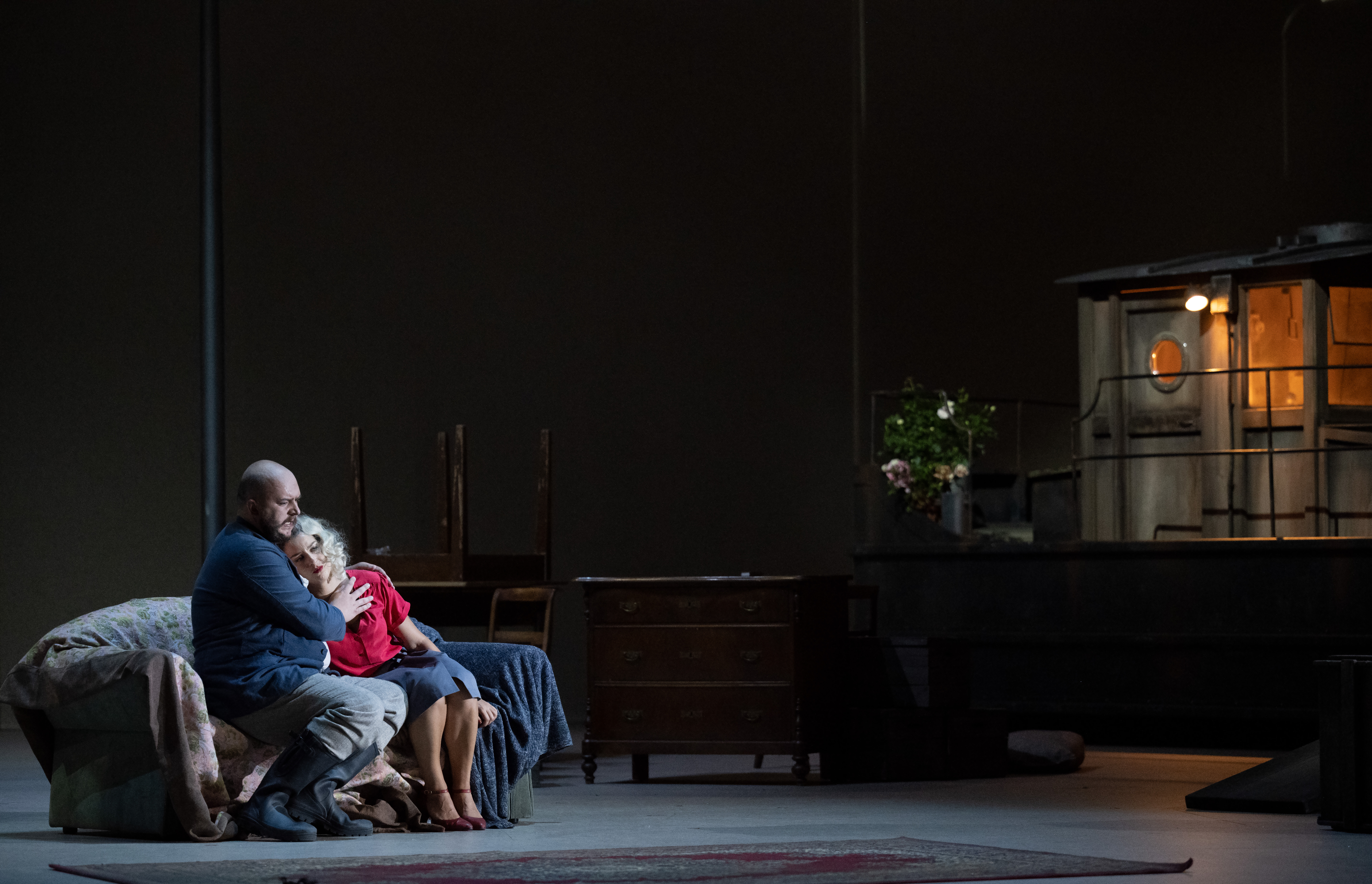
Salzburg Festival (9) - The Gambler, 25 August 2024


Felsenreitschule

General – Peixin Chen
Polina – Asmik Grigorian
Alexey Ivanovitch – Sean Panikkar
Babulenka – Violeta Urmana
Marquis – Juan Francisco Gatell
Blanche – Nicole Chirka
Mr Astley – Michael Arivony
Prince Nilski – Zhengi Bai
Baron Würmerhelm – Ilia Kazakov
Potapytch – Joseph Parrish
Casino Director – Armand Rabot
First Croupier – Samuel Stopford
Second Croupier – Michael Dimovski
Fat Englishman – Jasurbek Khaydarov
Tall Englishman – Vladyslav Buialskyi
So-So Lady – Seray Pinar
Pale Lady – Lilit Davtyan
Revered Lady – Cassandra Doyle
Doubtful Old Lady – Zole Reams
Passionate Gambler – Santiago Sánchez
Sickly Gambler – Tae Hwan Yun
Hump-backed Gambler – Aaron-Casey Gould
Unsuccessful Gambler – Navasard Hakobyan
Old Gambler – Amin Ahangaran
Six Gamblers – Slaven Abazovic, Konrad Huber, Juraj Kuchar, Jarosłav Pehal, Wataru Sano, Oleg Zalytskiy

Director – Peter Sellars
Set designs – George Tsypin
Costumes – Camille Assaf
Lighting – James F. Ingalls
Dramaturgy – Antonio Cuenca Ruiz

Concert Association of the Vienna State Opera Chorus (chorus director: Pawel Markowicz)
Vienna Philharmonic Orchestra
Timur Zangiev (conductor)


Images: SF/Ruth Walz

This new production by Peter Sellars of The Gambler had four important things in common with Mariame Clément’s Tales of Hoffmann, which I saw in Salzburg the previous evening. It imposed a fashionable concept on a work that might or might not have proved receptive to it, had it been pursued more coherently; the concept was at least on one level something to which it would be difficult for a thinking twenty-first-century person to object; it took reading of a programme note to discover fully what that concept had been; and finally, upon that discovery, I was left certain that the work’s own ideas were rather more interesting and fruitful than what had been imposed upon them. There were also, however, at least two important differences. Sellars’s production worked much better as a relatively ‘straight’ reading of the work, in which one could either ignore or remain in ignorance of the rest. And musically, whilst both productions had excellent casts, this one was well conducted. It made, then, for a far more satisfying night in the theatre. 

This was, I think, the third production of The Gambler I had seen, following stagings in Berlin (Dmitri Tcherniakov, 2008) and London (Richard Jones, 2010), and certainly the first in a while. The Felsenreitschule stage imposes certain constraints, though doubtless also offers certain opportunities to a director. One is unlikely to be able to do much in the way of scene-changes mid-act. In this case, since the opera was given without an interval, one is unlikely to be able to do much in that respect at all. Sellars and his team responded inventively, though, with a little help from the resources a Salzburg Festival production will have at its disposal. Spinning tops suspended from the ceiling, poised for action – I initially thought of a Russian opera from an earlier generation, Boris Godunov’s heir at play in the study – descended when required to form a casino of roulette tables. Green moss suggested both a park and a sense of decay and time running out. The rest could be understood pretty much on its own terms. 

At least I thought it could, notwithstanding irritating, capitalised anachronisms in the surtitles. ‘DADDY’, ‘ACTIVIST’, ‘CAPITAL’, and so on seemed little more than minor distractions. Prokofiev and indeed Dostoevsky still for the most part shone through. The presentation of Polina as an ‘activist’ was half-hearted enough that for the most part I missed it. Her clothes seemed a bit odd, her behaviour too, but neither of those things is especially unusual in such stagings. Brief portrayal of sadomasochistic activity between her and Mr Astley – I later learned he had been a ‘British venture capitalist’ – intrigued. Yet since nothing more happened in that respect, it was soon forgotten, until she eloped with him at the close. Presumably he had co-opted her, as venture capitalists do. Ultimately, then, Sellars’s concept seemed to be anticapitalist-cum-environmentalist, yet also to an extent a critique of that world of protest, Alexey hardly turning out to be a role model. It was difficult not to feel that Dostoevsky’s existentialism – Prokofiev’s too – was not more fitting, more interesting. Yet, since this mysterious world of ‘sole traders’ had barely impinged on my consciousness during the performance, it did not much matter either. I had witnessed obsession, social climbing, self-destruction, and the rest, and it had largely made sense. Sellars’s Personenregie, then, had worked well, whatever one thought (or noticed) of his concept. 


That was doubtless also testimony to the strength of the cast. I have never seen or heard a performance in which Sean Panikkar has failed to excel, and this was no exception. He truly inhabited as actor as well as singer the role of Alexey, providing the focus of the work and duly engaging our sympathies. Asmik Grigorian, here far more at home than in Strauss’s Four Last Songs the previous morning, sang gorgeously as a wilful, spirited, and ultimately enigmatic Polina. Peixin Chen’s stentorian General also offered a fascinating character study in personal weakness, not necessarily the easiest combination to bring off. Juan Francisco’s wheedling Marquis, Michael Arivony’s clever, apparently trustworthy Mr Astley, Nicole Chirka’s alluring yet shallow Blanche, and others all offered sharp characterisation. Perhaps needless to say, Violeta Urmana’s Babulenka stole the show; it is in the nature of work and role, yet hers was nonetheless a towering performance, rich-toned, impulsive, and finely characterised.    

It was doubtless no coincidence that, at the point of her arrival, the general temperature of the musical performance shot upwards. Again, that is in the nature of the work, but it seemed also to act as a spur to Timur Zangiev and the Vienna Philharmonic in the pit. A greater sharpness was to be heard, Prokofiev’s motor rhythms acquiring greater force, achieving greater impact. There was also, though, an ineffably human tenderness not only to be perceived, but to be moved by. Prokofiev’s lyricism proved the increasingly prominent obverse of the existential-dramatic coin.


Sunday, 25 August 2024

Salzburg Festival (6) – Grigorian/VPO/Dudamel: Strauss, 24 August 2024


Grosses Festspielhaus

Four Last Songs
Eine Alpensinfonie, op.64

Asmik Grigorian (soprano)
Vienna Philharmonic Orchestra
Gustavo Dudamel (conductor)


Images: SF/Marco Borrelli

The Vienna Philharmonic playing Strauss: what could go wrong? More than one might imagine; to be more generous, a good deal failed to go quite right. Neither Asmik Grigorian nor Gustavo Dudamel, whatever legions of fans might tell you, was well cast in the Four Last Songs. This is treacherous territory: so many in the audience will have favoured memories of past performances, not to mention recordings. How can anyone be expected to compete with Flagstad and Furtwängler, Janowitz and Karajan, Norman and Masur, or whoever the personal favourites might be? It is entirely unreasonable; yet even so, this was a disappointing performance. Diction is a problem for sopranos in Strauss. The proportion of audible and inaudible words was nonetheless askew. If Grigorian’s voice sounded darker than one might be used to, that was not a problem; there is no single ‘right’ way or voice here. More problematical was her excessively operatic approach. Rarely did one have a sense these were songs rather than arias. 

Dudamel, meanwhile, tended to offer decidedly foursquare ‘accompaniments’, ‘September’ an especially notable case until its close, when, to be fair, both singer and conductor, as well as the orchestra, created a magical hush. Prior to that, though, Grigorian’s inability or disinclination to float Strauss’s lines as they demand had made for a decidedly choppy autumnal ride. Spring, in the preceding song (‘Frühling’), had proved merely perfunctory; Hesse is surely offering more than a weather commentary here, as is Strauss. If a slow ‘Beim Schlafengehen’ suggested something better at its opening, Grigorian and Dudamel both struggled to sustain a tempo that also stood out awkwardly with respect to what had gone before. The VPO concertmaster’s solo made amends, as did some glorious orchestral moments, solo birds of gloaming foremost among them, in a vocally chilly ‘Im Abendrot’. Dudamel’s inability in either to set a fundamental tempo underlay a general impression of listlessness. 


That, alas, persisted in an Alpine Symphony that suggested a misunderstanding of its Nietzschean idea as the ‘anti-symphony’ rather than the Antichrist. There was little sense, alas, of any acquaintance with any underlying conception, philosophical or musical. Night’s opening at least started a little more promisingly: slow, arguably too slow, yet in its sepulchral yet velvety tone imparting at least a sense of what it might be about. Teeming life in the following transition likewise augured well, yet sunrise proved unfortunately prophetic of most of what was to follow. Strangely metallic in tone – I should never have guessed the orchestra from it – it soon grated on the ears. Pierre Monteux once damningly referred to the indifference of mezzo forte, but I should have quickly exchanged it for Dudamel’s indifference of fortissimo. Tempi bore little relation to one another; proportions matter here rather than absolutes, but both were all over the place. There were tender moments, gratefully received, and the mountain mists were spot on, but such alas proved to be exceptions. If the ascent was wayward, the descent was taken at a surprising sprint, though it had greater purpose. Dudamel’s apparent lack of interest in orchestral balance frustrated and perplexed throughout, resulting in a crude sound as foreign to what one would expect from the orchestra as to the work.


Wednesday, 1 March 2023

Rusalka, Royal Opera, 27 February 2023


Royal Opera House

Rusalka – Asmik Grigorian
Prince – David Butt Philip
Vodník – Rafał Siwek
Ježibaba – Sarah Connolly
Duchess – Emma Bell
Kuchtík – Hongni Wu
Hajný – Ross Ramgobin
Wood Spirits – Vuvu Mpofu, Gabrielė Kupšytė, Anne Marie Stanley
Lovec – Josef Jeongmeen Ahn

Ann Yee and Natalie Abrahami (directors)
Chloe Lamford (set designs)
Annemarie Woods (costumes)
Paule Constable (lighting)
Ann Yee (choreography)

Royal Opera Chorus (chorus director: William Spaulding)
Orchestra of the Royal Opera House
Semyon Bychkov (conductor)


Images: Camilla Greenwell

A strange evening: I very much enjoyed this new Rusalka, though found myself slightly haunted by the suspicion I did so more than I should have done. Musically magnificent yet theatrically inert: opera should intrinsically be more than that, yet I suppose we should be grateful that it can still partly satisfy, even when one crucial component misfires. 

The production is oddly listed as having been ‘created by Natalie Abrahami and Ann Yee’ but with ‘Ann Yee and Natalie Abrahami’ as directors. Equitable, perhaps, but does such re-listing really merit a line in the programme? (Does it really merit three lines in a review, one might also ask, I suppose.) I mention it only as a minor instance of something more irritating. Equity, sustainability, so much else: these are of course causes toward which we should all be working, a great deal faster and harder than we are now. They do not, however, in themselves make a production; they are certainly no substitute for one either. For here, whilst one could read an interesting programme note, promising much, by Jessica Duchen on ‘A Sustainable Rusalka for the Royal Opera House’, the results were actually neither sustainable – for that, ‘wed have to have started the control systems much earlier’ (Abrahami) – nor, contra what we read, saying anything much about sustainability or wider ecological issues. Instead, there was a strange boast, admittedly fulfilled, of having ‘worked with our creative team to create the illusion of water, using paint effects and lighting, and a set that can hold this without having to turn over actual water’. Fine, if hardly unprecedented. Is that not more often the case than not with water? How many productions will theatregoers already have seen that did just that?

Ultimately, the directors (or ‘creators’) feel the story is ‘not about nature’s conflict with humanity, but rather humanity’s need to connect and meld with nature’. It is a point of view: not one that makes a great deal of sense to me, either intrinsically or in the case of Rusalka, but worth a hearing or viewing. What, then, do we have? A sort of non-directed cartoon with words and music attached. Singers generally have to fend (creditably) for themselves. A mossy fairytale without irony or magic turns mildly trashy in the second act, presumably out of a desire to be ‘contemporary’. It looks as though a few items from Claire’s Accessories have been magnified on stage to frame the ‘party’. Inflatable toy animals are presumably intended to imply distance from Nature’s real animals, yet since no one seems to know what is going on, they just look silly. We return more or less to a slightly broken version of the setting for the first act. Alleged intentions go unrealised, as if our ‘creators’ have failed to appreciate that stating you will do, let alone explore, something is not the same as doing or exploring it. As a framework for the story, it works reasonably. Paule Constable’s lighting pretty much steals the visual show, saying so much more than Yee’s tedious, seemingly tone-deaf choreography.

And save, mercifully, for the musical performances: singers, orchestra, and conductor. My two other big house Rusalki over the past decade or so have been Paris in 2019, not so long before the end of the world, and Covent Garden’s first (!) staged performance in 2012. An excellent Komische Oper staging in Berlin was a slightly different animal, built as it was around a thriving company, as opposed to an ‘international’ cast; it offered by some way the most interesting, penetrating production (Barrie Kosky). Paris had Camilla Nylund, Klaus Florian Vogt, Karita Mattila, Thomas Johannes Mayer, and Michelle DeYoung, Covent Garden 2012 also had Camilla Nylund, working with Bryan Hymel, Petra Lang, Alan Held, and Agnes Zwierko. At this level, comparisons are often more a matter of taste than anything else, but I should unhesitatingly plump for David Butt Philip’s Prince from Covent Garden 2023 and consider its cast every inch the equal of its illustrious predecessors. 


One of my first thoughts was that surely we must be due a Lohengrin from Butt Philip soon; lo and behold, on later reading the programme biographies, one (Deutsche Oper Berlin) is forthcoming. Beautifully, unerringly musically phrased, his Prince conveyed a vulnerability and complexity of character considerably beyond either of the aforementioned performances. This was a considered character development, conveyed through words and music. Asmik Grigorian’s Rusalka likewise had it all: effortlessly scaling the vocal peaks, drawing in through hushed intimacy, and offering almost everything in between. Her stage presence likewise was second to none. Sarah Connolly’s Ježibaba and Emma Bell’s Duchess – I am not sure why the usual ‘Foreign Princess’ was not used here, but no matter – represented luxury casting. The former’s expressive range, controlled in technique yet with dramatic spontaneity (or the impression of such), could hardly have been bettered. The latter’s star quality shone through: both in itself and as something akin to metacommentary on the role. Rafał Siwek’s dark-toned Vodník was just the thing too, in voice and presence. Lively and warmly sympathetic performances from Hongni Wu (Kuchtík) and Ross Ramgobin (Hajný) were also highly worthy of note.

 Excellent conducting from Susanna Mälkki (Paris) and Yannick Nézet-Seguin (Covent Garden, 2012) notwithstanding, Semyon Bychkov was for me in a different league. His was world-class conducting, the Orchestra of the Royal Opera House sounding the equal of its very starriest peers. One might expect operatic symphonism from Bychkov, but the extent to which the entire work sounded as if heard in a single, variegated breath nonetheless astonished. A symphony in three movements emerged, its first two acts strongly contrasted. The first was doubtless ‘objectively’ on the slow side, but emerged as an exquisitely conceived, quasi-Wagnerian tapestry in absolute commanded of our musical attention. The second entered more Italianate waters, enlivened by a welcome dash or two of Tchaikovsky, and the third effected due synthesis, culminating in a climax that can surely have never sounded closer to the pantheistic ecstasy of Janáček. Not, of course, that this was not first and foremost Dvořák, but it was a generous, cultivated and culturally broad performance that denied national, let alone nationalistic, clichés. 

Mention should also go to the language coaches, Lada Valesova and Lucie Spickova. I do not speak or understand Czech, save for odd words and phrases I have picked up. But I could have had a stab at transcribing some of it here, such were the clarity of diction and, insofar as I could tell, evident meaning with which words in their alchemic union with music were treated. All in all, then, a splendid evening—yet despite, rather than on account of, the inconsequential production.

Wednesday, 24 August 2022

Salzburg Festival (2) - Il trittico, 21 August 2022


Grosses Festspielhaus

Gianni Schicchi – Misha Kiria
Lauretta – Asmik Grigorian
Zita – Enkelejda Shkosa
Rinuccio – Alexey Neklyudov
Gherardo – Dean Power
Nella – Lavinia Bini
Gherardino – Daniel Fussek
Betto di Signa – Manel Esteve Madrid
Simone – Scott Wilde
Marco – Iurii Samoilov
La Ciesca – Caterina Piva
Maestro Spinelloccio – Matteo Peirone
Ser Amantio di Noclao – Mikołaj Trąbka
Pinellino – Aleksei Kulagin
Guccio – Liam James Karai
Buoso Donati – Leopold Böhm


Michele – Roman Burdenko
Giorgetta – Asmik Grigorian
Luigi – Joshua Guerrero
Il Tinca – Andrea Giovannini
Il Talpa – Scott Wilde
La Frugola – Enkelejda Shkosa
Song seller – Dean Power
Lovers – Dean Power, Martina Russomanno
Midinettes – Dijana Kos, Irena Krsteska, Wilma Maller, Irina Peroš, Katarína Porubanová, Anna Yasiutina
Dancers – Clara Cozzolino, Mário Jorge Moisés da Silva Branco, Joni Österlund, Anna Possarnig, Guillaume Rabain, Nicolas Franciscus, Giulia Tornarolli

Sister Angelica – Asmik Grigorian
La Zia Principessa – Karita Mattila
Abbess – Hanna Schwarz
Sister Zelatrice – Enkelejda Shkosa
Mistress of the Novices – Vaterina Piva
Sister Genovieffa – Giulia Semenzato
Sister Osmina – Martina Russo manno
Sister Dolcina – Daryl Freedman
Nursing Sister – Juliette Mars
Alms Sisters – Lavinia Bini, Alma Neuhaus
Novice – Amira Elmadfa
Lay Sisters – Svenja Kallweit, Anna Yasiutina
Son – Jonathan Ehrenreich
Choral soloists – Dijana Kos, Mari Nakayama, Irina Peroš

Christof Loy (director)
Étienne Pluss (set designs)
Barbara Drosihn (costumes)
Fabrice Kebour (lighting)
Yvonne Gebauer (dramaturgy)  

Salzburg Festival and Theatre Children’s Choir (chorus director: Wolfgang Götz)
Concert Association of the Vienna State Opera Chorus (chorus director: Jörn Hinnerk Andresen) 
Angelika-Prokopp-Summer Academy of the Vienna Philharmonic (stage music)
Vienna Philharmonic Orchestra
Franz Welser-Möst (conductor)


Images: (C) SF /Monika Rittershaus


In many ways, this new production of Puccini’s triptych of one-act operas marked a triumph for the Salzburg Festival. One serious unforced error detracted, yet could only detract so far; likewise a few other cavils. Singing and orchestral playing were excellent throughout on the evening I attended, the last in the run. If Christof Loy’s production offered nothing particular in the way of insight, let alone re-evaluation, it presented the stories clearly and with élan, aided by good design work. Everything came together well, at an undeniably ‘Salzburg’ level.

Loy’s major miscalculation was to mess around with the ordering, so as to present the operas in the order Gianni Schicchi, Il tabarro, and Suor Angelica. The self-justification given in the programme made things worse, speaking of Suor Angelica having given the ‘impression’ of ‘such an extreme impact … that Gianni Schicchi came across as relatively trivial’. Not in my experience, nor in that of anyone I have spoken to. Nor has Il tabarro suffered from a lack of contemporary relevance, as Loy bizarrely suggests. (Quite why moving it to second place would help here remains unclear too.) Apparently, because this is a Festival, ‘everyone [is] in good spirits to be here,’ it makes better sense to open ‘with the seemingly life-affirming atmosphere of Gianni Schicchi’. Enough! There is good reason for placing the comedy last. Suor Angelica, meanwhile, suffers from being placed third, in that not only does it offer less a climax than a sense of tiring, even tailing away; but, perhaps worse, its own genuine musical as well as dramatic interest pales when heard after Schicchi. If you wanted to lend credence to claims of the saccharine, you could do a lot worse than adopt this reordering. Loy says that Franz Welser-Möst and he were in agreement on the matter; Welser-Möst really should have known better. None of this is fatal; after all, the operas are often (probably more often) played alone with entirely different companion pieces. But there is little gain here, and not inconsiderable loss.

Loy’s reputation in certain quarters remains something of a mystery to me. There is, as there certainly was here, a genuine craftsmanship at work. That I could admire—and did greatly. Movement and placing of objects on stage, the identity of each character (most of them, anyway), and much else had clearly been considered; one was left with little doubt that what one saw was what one was supposed to have seen. This is no more than speculation on my part, but I can imagine singers liking to work with him: certainly no bad thing. But beyond a certain generic stylishness, which is presumably in large part the work of his designers, I struggled to find any particular conceptual thinking at work, whether in each individual opera or as something to connect them. All three were vaguely modernised, I suppose, but unless one considers ‘modern dress’ to be a concept in itself, there was nothing to trouble conservative viewers. On the other hand, there was no banal intervention as in, say, Loy’s Tristan (Covent Garden) or Die Frau ohne Schatten (Salzburg, in which he essentially ignored the work altogether). So horses of no breed would have been scared away; perhaps that in itself was the idea.


The Vienna Philharmonic was on tremendous form, clearly relishing the opportunity to play all three operas in something approaching ideal conditions (certainly by way of comparison to the rehearsal schedule, or lack of it, in Vienna). Welser-Möst’s guiding spirit was heard to best effect in the first two operas, the scintillating scherzo of Gianni Schicchi razor-sharp, yet with plenty of tenderness too, the ominous ostinato of the Seine in Il tabarro duly overwhelming. (It took a few hours to get the latter out of my head, following the performance.) Light and shade were as meticulously planned and projected as any stage lighting, and there could be no doubting Welser-Möst’s knowledge and understanding of the scores. I missed a sense of something darker in Suor Angelica, but that was doubtless in considerable part a matter both of the piece itself and Loy’s decision to move it. There might nonetheless have been greater bite in its often intriguing harmonies and also a greater range of colour. A tendency to greyness such as I have often heard in Welser-Möst’s Strauss was not entirely avoided here.


Asmik Grigorian’s heroic service as heroine (of sorts) in all three proved both heartfelt and flawless. She did not tire, far from it, and gave considered, distinct performances of each of her roles. I do not think appreciation of her Sister Angelica was helped by its placing, giving the impression of everything leading up to a ‘big moment’, but I have probably said enough about that now. Her chemistry with Joshua Guerrero as Luigi and, indeed, negatively with Roman Burdenko as Michele was, to my mind, just as impressive, both of those artists turning in thoughtful as well as viscerally immediate performances. So too, unsurprisingly, did Karita Mattila as La Zia Principessa. From the moment she stepped on stage, one knew this was going to be something special, and it certainly was. Equal attention to words, music, and gesture informed a star turn that collegially collaborated with, in no sense upstaging, Grigorian. Much the same might be said, albeit (properly) with less hauteur, of Hanna Schwarz’s Abbess. Grigorian’s Rinuccio, Alexey Neklyudov, proved youthful, ardent, and similarly intelligent: a fine companion. Every portrayal in Gianni Schicchi was indeed, of similar quality, whether solo or ensemble, from Misha Kiria’s wily lawyer down (should that be the right direction). Enkelejda Shkosa’s turn as Zita here was followed by a splendidly animated La Frugola, hinting at hidden depths of sadness, in Il tabarro. This was a Trittico that almost offered the definition of casting from depth. For fine singing, complemented by excellent stage gifts, Personenregie, and orchestral playing, this will surely prove difficult to beat.


Sunday, 20 August 2017

Salzburg Festival (5) - Wozzeck, 14 August 2017

Haus für Mozart

Images: Salzburg Festival / Ruth Walz
Margret (Frances Pappas) and Wozzeck (Matthias Goerne)


Wozzeck – Matthias Goerne
Drum Major – John Daszak
Andres – Mauro Peter
Captain – Gerhard Siegel
Doctor – Jens Larsen
First Apprentice – Tobias Schnambel
Second Apprentice – Huw Montague Rendall
Fool – Heinz Göhrig
Marie – Asmik Grigorian
Margret – Frances Pappas
Chorus solo – Burkhard Höft
Actors – Mélissa Guex, Andrea Fabi
Mimes – Claudia Carus, Gregor Schulz

William Kentridge (director)
Luc De Wit (co-director)
Sabine Theunissen (set deigns)
Greta Goiris (costumes)
Catherine Meyburgh (video)
Urs Schönebaum (lighting)
Kim Gunning (video operator)

Salzburg Festival and Theatre Children’s Choir (chorus master: Wolfgang Götz)
Concert Association of the Vienna State Opera Chorus (chorus master: Ernst Raffelsberger)
Vienna Philharmonic Orchestra
Vladimir Jurowski (conductor)

Marie (Asmik Grigorian) and Drum-Major (John Daszak)


Salzburg is certainly doing William Kentridge proud this summer: a new production of Wozzeck and an exhibition of his work, ‘Thick Time: Installations and Stagings’, split between the Rupertinum and the museum on the Mönchsberg, which together form the Museum der Moderne. The exhibition has also been seen at the Whitechapel Gallery; I missed it there. It will also be seen – or has: I am not quite sure which – at the Louisiana Museum of Modern Art in Humlebæk and Manchester’s Whitworth Art Gallery. The exhibition is certainly well worth seeing for its own sake. In some ways, though, I found it more revealing than the opera production itself, which I could not help but think relied a little too much upon an imposed association with the First World War – a little too easy? – and indeed upon figures and ideas from his earlier work. Both claims are, I am sure, debatable, but I was left relatively unmoved by the result – which is surely a problem with Wozzeck.

Distancing can doubtless work in different ways for different people. One person’s chilling alienation will be another’s ‘I could not relate to that’. For me, however – and I can hardly speak for anyone else – the device of placing Wozzeck outside the action, having him in some sense present it, at the opening switching on the slide projector from which so much of the setting is presented, leads to a staging more observed than experienced. If we do not share Wozzeck’s agonies, his mistreatment, if it is not even entirely clear whether he actually experiences them, then that is surely something of a loss. What worked very well in Kentridge’s Lulu, which I saw at ENO, seems here to be more a matter of going through the motions; what had been a powerful impression of information overload mirroring, even intensifying the score, here reduced to a display of battlefield maps with little evident motivation other than the fact that the Battle of Ypres had taken place a hundred years ago. Charcoal drawings, long a Kentridge staple, seemed just a little dark to glean anything much from, at least at a certain distance from the stage. (I was in the First Circle.) What of looking back to such events from after the war, as Berg did when completing it? There is certainly something to be said for that in principle; yet here, it comes across as more of a device than a dramatic strategy.

Perhaps ultimately, the problem, at least for me, is Kentridge’s apparent lack of interest in psychology, as discussed in a programme interview: ‘I never start with the psychology,’ he says, ‘When a singer says to me, “what am I thinking?’ I sawy, “well, let’s listen to the music and let’s look at what we see on stage rather than giving a pre-history’. It is not clear to me why there should be an either-or. Surely part of that ‘pre-history’ lies in the music and indeed in what happens on stage; nor is ‘the music’ somehow something separate from the drama and its associations, certainly not in Berg. ‘Characters are always more than you expect and different from what you expect,’ Kentridge goes on. Of course. Here, however, especially in the case of Marie, they seem, if anything, less than one had expected. Marie comes across as somewhat peripheral to the action, or at least to the wartime setting that threatens to overwhelm the action. Most of us, I hope, are opposed to war; still more of us think the Great War was a terrible thing. But is Wozzeck really about that; or, better, should it be? The weird, powerful crowd scenes, with marauding deformed survivors give a taste of what might have been, suggesting that yes, Wozzeck could be about this, and in retrospect too; the necessary contrasting, developing character introspection, however, seems strangely absent. Substituting a puppet for a child again seems too much of a stock device. Do we really want to avoid being shattered by his fate?

Wozzeck and Marie

That said, an impressive aspect of the evening as a total artwork – Gesamtkunstwerk, if you must – was that Vladimir Jurowski’s conducting seemed to me very much in keeping with Kentridge’s approach. One heard a wealth of detail, of musical process from the players of the Vienna Philharmonic, indeed to such an extent that any listener with musical training would be well placed to identify the particular closed form of any scene immediately. That was, famously, not Berg’s point, but that does not mean that there is no value in hearing the score differently, quite the contrary. What I missed from Jurowski’s conducting was a stronger sense of how the scenes connected; again, this need not be an either-or situation, and preferably should not be. Berg remains a son, or perhaps grandson, of Wagner – or should do.

Was there also a sense that he was keeping the excellent Vienna players – what sweetness of string tone in particular! – down? I suspect it may have depended upon where one was seated in the Haus für Mozart (the old Kleines Festspielhaus). For me, there were many occasions when I longed for the orchestra to be let off the leash. It is not just during the interludes that the real, the deepest drama lies there; as with Wagner, it always does. Others, however, complained that they could not hear the singers, which certainly was not the case for me. Matthias Goerne did a good deal to supply some of the introspection seemingly missing from the staging. A Lieder-singer’s approach tends to be just the thing for Wozzeck, if not necessarily the only way; this was no exception. Asmik Grigorian sang beautifully, a fine Marie, by any standards. If only the staging had not left her somewhat marooned: just standing there, singing, seemingly having to act for herself. John Daszak navigated well the balance between character and caricature in the role of the Drum Major. Gerhard Siegel and Jens Larsen both offered keenly observed – insofar as they were permitted – performances as the Captain and the Doctor. Frances Pappas’s Marget greatly impressed, as, still more did, Mauro Peter’s beautifully sung Andres; in both cases, I was left wishing they had had more to do. Choral singing was excellent, impeccably well prepared, it seemed, by Ernst Raffelsberger. If I did not feel that I had been moved as much, nor as deeply, as I should have been, it was no fault of the cast. And I was certainly made to think.