Showing posts with label Peter Coleman-Wright. Show all posts

Friday, 1 June 2018

Così fan tutte, Opera Holland Park, 31 May 2018


Fiordiligi (Eleanor Dennis) and Guglielmo (Nicholas Lester)
Image: Ali Wright

Fiordiligi – Eleanor Dennis
Dorabella – Kitty Whately
Guglielmo – Nicholas Lester
Ferrando – Nick Pritchard
Despina – Sarah Tynan
Don Alfonso – Peter Coleman-Wright

Oliver Platt (director)
Alyson Cummins (designs)
Rory Beaton (lighting)

Opera Holland Park Chorus (chorus master: Richard Harker)
City of London Sinfonia
Dane Lam (conductor)


Absence makes the heart grow fonder; or does it? In Così fan tutte, who knows? Or rather, what could such a question even mean? Would it not be a typically sentimental coping mechanism adopted to avoid confronting the questions – artificial yet profound, indeed profound through artificiality – it asks of its characters and its audiences alike? If one does not at some level, perhaps the most important level of all, find that Così goes deeper and further than Tristan, then one most likely has not understood either. Given a tragedy without catharsis, a tragedy in the clothes, surpassingly elegant and ravishing, of comedy: sometimes one might ask who needs an opus metaphysicum at all? (We might actually need it in order to recover.)


Ferrando (Nick Pritchard), Guglielmo, Depsina (Sarah Tynan), Don Alfonso (Peter Coleman-Wright),
Fiordiligi, Dorabella (Kitty Whately)
Image and subsequent images: Robert Workman

At any rate, absence had certainly made my heart grow still fonder when it came to Opera Holland Park. Not having been able to visit last summer, I returned to what may well be the most completely successful show I have yet to see and hear there. There is certainly none I would put above it, quite a claim, given that we are dealing with Mozart, the most difficult of all composers to perform. There is nowhere to hide, on stage, in the pit, nor indeed in the audience. Nor should there be. Moreover, one had the sense, whether in production or in musical performance – the distinction is far from distinct – that this ambivalent, ambiguous, existentially devastating drama was being enabled, with the lightest of touches, to speak for itself. That does not happen by itself; there is no room for ‘non-interpretation’, for some illusory ‘original’. Yet nor did it ever seem that something was being inflicted on the work. There is room for critique, whether in words or in performance, yet sometimes, as here, the work is so rich that it both offers its own and, perhaps, renders it beside the point.

Don Alfonso

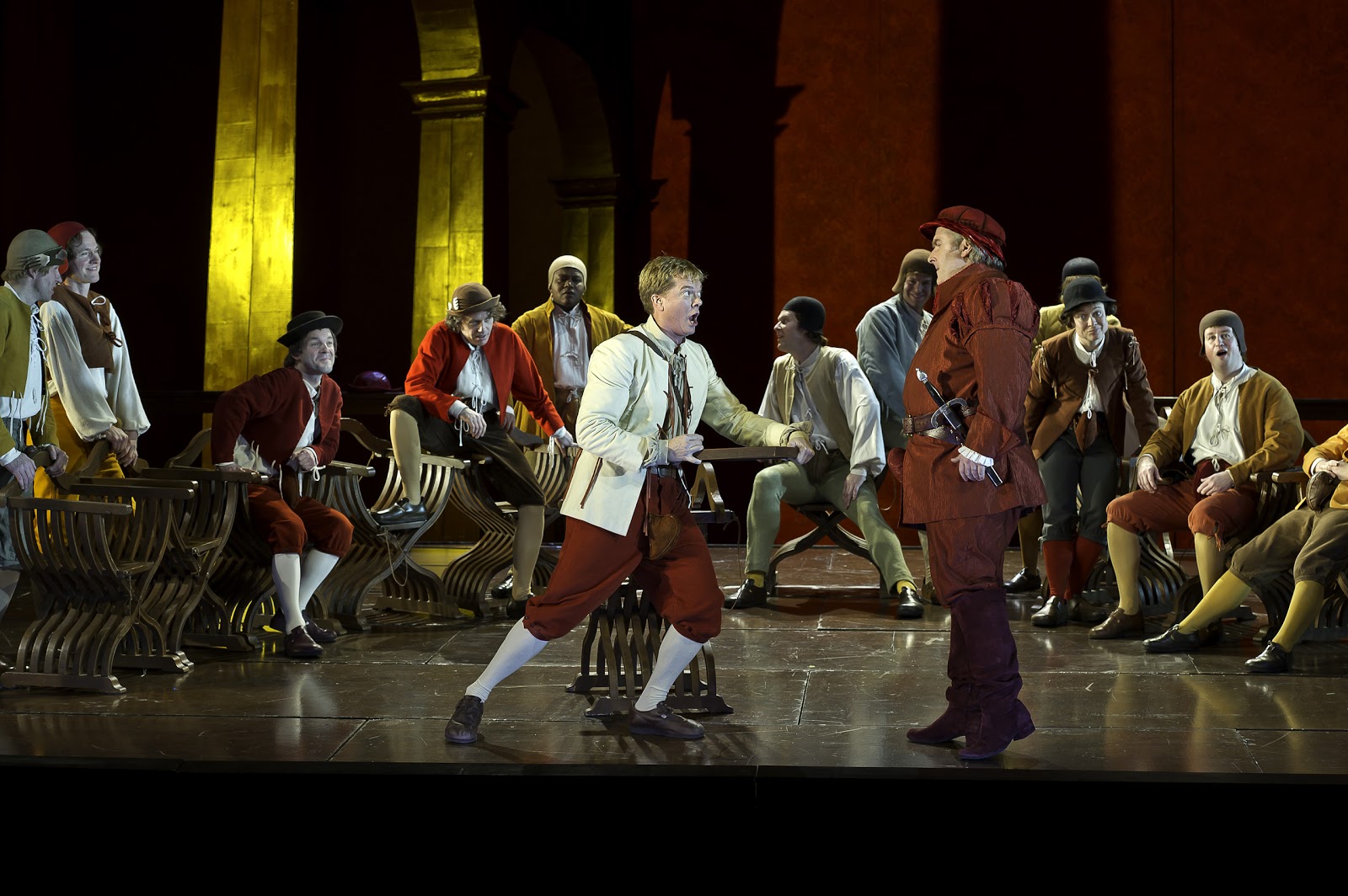
For what is Così, if it is not a musico-dramatic laboratory, a game whose results we should rather not know, and yet can never quite un-know? We see that in Oliver Platt’s production: not spelled out, ‘in a laboratory’, but actually more or less where it ‘should’ be, in an eighteenth-century setting, in which detail is everything. The more we look at what might seem a straightforward, ‘traditional’ production – and, in a sense, is – the more we see – and hear. The chorus, which like us watches proceedings and occasionally participates, is, from the start, a participant and perhaps a critic. It is not quite the Neapolitan ‘daily passeggio’ of which Leopold Mozart wrote, in a letter quoted by Helen Wallace in the programme, for that was perhaps too obviously theatrical, at any rate too bound to a particular stratum of the social hierarchy: ‘in a few hundred carriages the nobles go out driving in the afternoon until Ave Maria to the Strada Nuova and the Molo.’ These seem largely to be more ‘ordinary’ people, but what is ‘ordinary’? They are like us, perhaps, but they also remind us that we need not be ‘like’, or at least identical to, the principal characters on stage to learn from them. And so, when one looks more closely, one notices an apparently ‘male’ member of the ‘chorus’ in apparently ‘female’ dress. (S)he brings no particular other attention to himself or herself. There is no obvious plotline, no ‘distraction’, as some would have it, rightly or wrongly; there is also no obvious exit strategy for us on heteronormative or other grounds. Così fan tutti/e; or, mutato nomine, de te fabula narratur

Fiordiligi and Ferrando

All, however, is not always quite what it seems. For the commedia dell’arte painted faces of Ferrando and Guglielmo are there to start with: visitors, perhaps, from beyond, yet also in need of external transformation – in Tristan, it would be a potion – in order to reveal themselves. Interactions between characters, like those between different chemical elements, are minutely observed, rendering us experimenters of our own, again whether we like it or not. (At least, so long as we watch and listen.) One of the problems some people, not unreasonably, seem to have with this opera is not always appreciating the level of parody, verbal and musical. And so, when Fiordiligi stands on a chair to assume her pose for ‘Come scoglio’, that cruel, loving, and in every sense ravishing seria parody, she initially falters, almost falling (not, I hasten to add, vocally). The watching lovers laugh, and she resumes. All is not quite what it seems, or perhaps it is. That is largely up to us, yet within the framework constructed – or rather within the different, intersecting frameworks constructed, by Alfonso and Despina, by Mozart and Da Ponte, and by production and performers; as well, of course, as that constructed by our own experiences, thoughts, and emotions. We are led to deconstruct that terrifying final ‘moral’ ourselves, Mozart’s brusque neo-Classicism the only possible response to Da Ponte’s seemingly straight hymn to reason. If we do not think about, do not feel its numerous contradictions, we have no one to blame but ourselves – not unlike the characters themselves. Is all perhaps precisely what it seems? Yes and no.


Dorabella and Guglielmo

For it is Mozart above all who renders this opera such a necessary agony. And it is the musicians who – with the greatest respect to truly excellent work from everyone else involved, whether in the theatre, behind the scenes, or somewhere in between – who ultimately bring that into life. The City of London Sinfonia offered us gorgeous musical sado-masochism, woodwind one might almost literally have been willing to die for, strings incisive yet far from without warmth of their own. Dane Lam’s tempi began on the quick side, never unreasonably so, yet indicative of an approach one might too readily have taken to be partial. For, as the drama progressed, as the characters achieved greater delineation, so did temporal differentiation. Lam’s was a reading that knew where it was going, and thus could afford to take time on the way – in, for instance, a heartrending ‘Un aura amoroso’.


Not that that would have been heartrending without an estimable Ferrando, of course; that was not, happily, something we needed to put to the test, Nick Pritchard balancing with apparent ease the demands of line and variegation. So too did Nicholas Lester’s Guglielmo, the bitterness of his disillusion moving indeed, his ‘journey’ perhaps the greatest of all. Eleanor Dennis and Kitty Whately likewise proved almost infinitely capable both of sisterly affinity and dramatic disentanglement. So many attributes – sorrow and joy, honour and temptation, simplicity and complexity – were revealed as sides of the same experimental coin. Lines, unadorned or subtly ornamented, exuded both clarity and warmth. We knew them, and yet did not. Sarah Tynan’s Despina was very much the musical catalyst, her cynicism and her sense of fun both vividly portrayed. If Peter Coleman Wright’s pitch was sometimes a little approximate, he brought important dramatic truths to his portrayal of Don Alfonso – perhaps not unlike Francesco Bussani, first in his line. The chorus, well trained, by Richard Harker, could hardly have done more to bring their roles, individual and collective, to life.


Fiordiligi and Dorabella

There is method in the madness one feels at the close; there has to be. And yet, quite rightly, there remains mystery too. Or, in the ruminations of another operatic character, forced to confront truths of existence he might rather not – at least not too often: ‘Ein Kobold half wohl da:/Ein Glühwurm fand sein Weibchen nicht; der hat den Schaden angericht’t.’ Was Sachs just rephrasing the question? Probably. Are we? Almost certainly. That does not, however, mean that we are not confronting it, that we need not do so. Mozart leads us to Wagner, as well as Wagner to Mozart.

Saturday, 6 February 2016

Die Zauberflöte, English National Opera, 5 February 2016


Coliseum

(sung in English, as The Magic Flute)

Tamino – Allan Clayton
Three Ladies – Eleanor Dennis, Catherine Young, Rachael Lloyd
Papageno – Peter Coleman-Wright
Queen of the Night – Ambur Braid
Monostatos – John Graham-Hall
Pamina – Lucy Crowe
Three Boys – Anton May, Yohan Rodas, Oscar Simms
Speaker – Darren Jeffery
Sarastro – James Creswell
Priests, Armoured Men – Rupert Charlesworth, Frederick Long
Papagena – Soraya Mafi

Simon McBurney (director)
Josie Daxter (revival director, movement)
Michael Levine (set designs)
Nicky Gillibrand (costumes)
Jean Kalman, Mike Gunning (lighting)
Finn Ross (video)
Gareth Fry, Matthieu Maurice (sound design)
 

Whilst the Arts Council - until recently plaything to that cultural luminary, Big Brother’s Peter Bazalgette, friend and appointee of Jeremy Hunt – has been doing its best to destroy the English National Opera, ENO has fought back in the best way possible: in the theatre. I felt ambivalent about this production of The Magic Flute first time around; it was certainly an improvement upon itspredecessor, but other than that, I was somewhat lukewarm. At the time, I welcomed its emphasis upon theatricality and the workings of that theatricality, whilst wondering whether a little less might have been more. That I still feel; it is not clear to me what is contributed by the writing of ‘The Magic Flute’ on a screen during the Overture, save, alas, for permitting noisy sections of the audience to laugh uproariously. If they find that – and, it would seem, pretty much anything – so utterly hilarious and/or conducive to loud discussion, then I might suggest that they seek help; the rest of us certainly needed help at times in order to hear the performance.
 

Whether the rest had been toned down a little, I am not sure; maybe I was just feeling less curmudgeonly, in which case I owe Simon McBurney and Complicité something of an apology; I certainly enjoyed the production more than I had last time. The sound booths, in which we see and hear the making or an impression of making of sound ‘effects’ is very Complicité, of course, and I suspect that some opera-goers loved it because it was new to them. I still wish that something more were actually done with these aspects of the production, that there were more interrogation of the work and what it might mean; yet, by the same token, there is an openness to interpretation that should not necessarily be confused with non-interpretation. There was, I thought or at least felt, a stronger sense of magic this time; whether that were a product of the production’s touring in the meantime, or of greater responsivity on my part, I am genuinely not sure. Stephen Jeffreys's translation is exemplary; if one is going to perform the work in English, a witty yet serious approach such as this is unquestionably the way to go. It enables one to approach the heart of the work rather than shouting 'look at me!'
 

For me, however, the strongest reasons to enthuse were musical. Mark Wigglesworth led an excellent account of the score. No, of course it was not Colin Davis; but we do not need to hear unconvincing imitation of past glories. Wigglesworth’s tempi tended to be swifter, although not unreasonably so; crucially, there was no sense of harrying the score, of preventing it from breathing. There was no absurd rushing through ‘Ach, ich fühl’s’, nor indeed through any of the most tender moments. Moreover, the ENO Orchestra and Chorus, fighting back again where it matters most strongly, were on excellent form throughout. Orchestral light and shade was present in abundance, even if I did not especially care for the use of natural trumpets. (That seems to be the latest fashion with modern orchestras, a fashion I confess to finding incomprehensible, when modern instruments are otherwise used.) The chorus, presently under threat from management cuts, showed incontrovertibly why it deserves our fullest support, its members as convincing individually as they were corporately.
 

Allan Clayton offered a fine vocal performance as Tamino, although I think the production might have made him a little more princely. Ardent and lyrical, he was a worthy successor to Ben Johnson. Lucy Crowe’s Pamina was as touching as one could hope for, musical and dramatic qualities as one; hers was a performance that would grace any stage. James Creswell’s Sarastro was unusually light of tone; there were times when I hankered after something darker, more traditionally Germanic, but on its own terms, this was an intelligent portrayal, with considerable stage presence. Ambur Braid may not have hit every note perfectly as the Queen of the Night – who does, at least on stage? – but hers was a committed, unusually human performance; I hope that we shall see and hear more from her. Peter Coleman-Wright’s Papageno confounded expectations. Here we had a highly convincing portrayal of a bird-catcher left on the shelf, the sadness arising from society’s contempt for the ageing as much as his usual predicament. (It seems a perfectly reasonable reappraisal in a work much preoccupied with age, which really had me thinking.) John Graham-Hall’s Cockney Monostatos showed what a truly versatile artist this is; it is only a few months ago that I saw him as Schoenberg’s Aron in Paris. All of the smaller roles were taken well, showing once again how crucial a sense of company is to performance; if only ENO’s management would watch and listen.


Wednesday, 30 May 2012

Caligula, English National Opera, 25 May 2012

The Coliseum 

Caligula – Peter Coleman-Wright
Caesonia – Yvonne Howard
Helicon – Christopher Ainslie
Cherea – Pavlo Hunka
Scipio – Carolyn Dobbin
Mucius – Brian Galliford
Mereia, Lepidus – Eddie Wade
Livia – Julia Sporsén
Four Poets – Greg Winter, Philip Daggett, Gary Coward, and Geraint Hylton

Benedict Andrews (director)
Ralph Myers (set designs)
Alice Babidge (costume designs)
Jon Clark (lighting)
Dennis Sayers (choreography)

Orchestra of the English National Opera
Chorus of the English National Opera (chorus master: Francine Merry)
Ryan Wigglesworth (conductor)

Images: Johan Persson
Whatever qualifications I might go on to voice – not, I admit a promising start to a review – I am in no doubt that ENO deserves applause for its commitment to staging contemporary, or at least recent, Continental European opera. The idea that any house, even one styling itself ‘English National’, should restrict its repertoire on a basis anything other than quality, should be anathema to anyone who cares about the art form, and it is heartening to note that the present management agrees. For a German house to stage both Wolfgang Rihm’s Jakob Lenz and Detlev Glanert’s Caligula in the same season would be noteworthy; for an English company, it is cause for rejoicing. It was good, moreover, to see both present and past music directors, Edward Gardner and Sir Mark Elder, in the audience.

And yet… If only I could feel greater enthusiasm for the work itself. I suspect that Amanda Holden’s translation does not help, its flatness often evoking the language of the cereal packet as opposed to French existentialism. (The source is the play by Albert Camus.) There are a couple of amusing incidental moments, such as the line ‘crap nail varnish’ – presumably an operatic first – and, more tellingly, the line ‘We’re all in this together.’ Non-British readers may need enlightening, if that be the word, that the phrase is associated with the Chancellor of Exchequer, George Osborne, as a fig-leaf of social solidarity in the face of Government policies involving massive redistribution of wealth towards the rich, in the name of ‘austerity’.

But even putting language aside, and even if one can take an existentialist as opposed to a more seriously political take upon dictatorship - it seems fundamentally to be about bad or troubled personality, brought on by bereavement, with social and economic structures languishing unexplored – Glanert’s score is not up to much. There is a certain skill with respect to orchestration, but the harmony signals little more than threadbare neo-Romanticism, apparently without irony. If one might plot a scale running from knowingly allusive through derivative to, well, what my myriad of lawyer-friends would doubtless counsel me against writing, I doubt that one would put very much of the score on the allusive side of derivative. The most compelling music was that which sounded as if it had been lifted almost wholesale from Wozzeck. There was some catchy enough dance music after the interval, but Henze did that sort of thing far more powerfully in The Bassarids. (Now there is a work we need to see on a London stage!) Britten and Wagner – a reference seemed to be made to Tristan, though I could not for the life of me understand why – were other ‘closely related’ composers; it does not seem worth the effort to trace such relationships further. Perhaps worst, the opera goes on far too long, seemingly in need of a good editor. It sounds more like a piece presented at a first workshop session than a finished article.

Helicon (Christopher Ainslie)
All of which is a pity, given that the performers and production team approached it with evident enthusiasm and skill. Perhaps the drama might have been stronger had Caligula been awarded a more prepossessing voice than that of Peter Coleman-Wright – a Matthias Goerne, for instance – but Coleman-Wright acted well, and seemed to relish his drag turn after the interval. Christopher Ainslie was perhaps the star of the show, his counter-tenor Helicon, Caligula’s slave, making one keen to hear him in Britten and other florid roles, ancient and modern. He also, not unreasonably, seemed to enjoy the opportunity to look good in a toga. Carolyn Dobbin presented an undoubtedly sincere Scipio, who might genuinely have moved, had the work permitted. The rest of the cast all impressed, both musically and in terms of acting. So did Ryan Wigglesworth’s incisive, indeed passionate, conducting, the ENO Orchestra once again on excellent form. I wish I could have shared the performers’ belief, though I am glad for their sake that they possessed it.

I have seen better work from Benedict Andrews, not least his unforgettable Return of Ulysses for ENO last season, but there of course he was dealing with a towering masterpiece, and there is certainly much to applaud in his stadium-based staging. The socio-political dimension missing from the work itself has greater prominence here. Caligula’s madness may indeed start off partly a game of capitalism, its tawdry wares of entertainment gathering a momentum of their own. Livia’s Rebekah Brooks hair-do raised a smile on my part, though that may have been coincidence rather than intent. The emptiness of fascism, the emergency strategy of monopoly capitalism as some of us are still old-fashioned enough to believe, shone through in a more meaningful way than a merely empty score. Some members of the audience clearly relished the return of the once statutory ENO nude – I recall her running onstage like a streaker in the middle of the Wolf’s Glen Scene from Der Freischütz and running back off again – since applause for her seemed more vociferous than for many who had actually sung.

Tuesday, 20 December 2011

Die Meistersinger von Nürnberg, Royal Opera, 19 December 2011

Pogner (Sir John Tomlinson)
Images: Clive Barda/Royal Opera

Royal Opera House, Covent Garden

Hans Sachs – Wolfgang Koch
Walther von Stolzing – Simon O’Neill
Eva – Emma Bell
Sixtus Beckmesser – Peter Coleman-Wright
Veit Pogner – Sir John Tomlinson
David – Toby Spence
Magdalene – Heather Shipp
Kunz Vogelsang – Colin Judson
Konrad Nachtigall – Nicholas Folwell
Fritz Kothner – Donald Maxwell
Hermann Ortel – Jihoon Kim
Balthazar Zorn – Martyn Hill
Augustin Moser – Pablo Bemsch
Ulrich Eisslinger – Andrew Rees
Hans Foltz – Jeremy White
Hans Schwarz – Richard Wiegold
Nightwatchman – Robert Lloyd


Graham Vick (director)
Elaine Kidd (revival director)
Richard Hudson (designs)
Wolfgang Göbbel (lighting)
Ron Howell (movement)

Royal Opera Chorus (chorus master: Renato Balsadonna)
Orchestra of the Royal Opera House
Antonio Pappano (conductor)

Hans Sachs would be the first to counsel us of the dangers of extolling past achievements at the expense of the present. It is an apt warning in the case of Wagner, for whom great performances, whether recorded or in the theatre, sear themselves with into the memory with perhaps unusual tenacity, acting as Mastersinger-guardians of the imagination. That said, whilst we should all beware the tendency to act as Beckmesser or worse, not every newcomer proves to be a Stolzing. At a time of year when some midsummer warmth, even magic, could hardly be more welcome, glad tidings were, sadly, thin onstage or in the pit.

Walther (Simon O'Neill), Eva (Emma Bell), congregation
This Marker has fond memories of Graham Vick’s production. It was the first he saw in the theatre, in 2000 and again in 2002; it seemed so full of joy and good humour; above all, it provided a seemingly perfect backdrop for the unforgettable greatness of Bernard Haitink’s conducting. (Mark Wigglesworth was far from put to shame in 2002.) Now, alas, it looks tired: there are few cases of production styles failing to date; in this, as in so much else, Patrice Chéreau’s Ring offers a near-miraculous exception. The evocation of Nuremberg in Richard Hudson’s sets seems as much of its time as John Major’s ‘Back to Basics’ (not that David Cameron seems to have noticed). Where once one saw Breugel, now one registers the lack of darkness in a work every bit as Schopenhauerian as Tristan und Isolde. What once was joyous now seems evasive. The ‘amusing’ antics of the apprentices now merely irritate. Time has passed, yes, but a good part of the problem seems to be the revival direction. Perhaps matters would have been different had Vick himself returned, but there seems to be precious little to Elaine Kidd’s direction beyond having singers don their costumes and sing: it resembles a repertory production in a provincial house rather than a performance on one of the world’s great stages. Oddly, the chorus often seems better directed than the singers. As for the codpieces, it would be an act of charity for all concerned to consign them to the dustbin of history.


Beckmesser (Peter Coleman-Wright) attempting to sing the Prize Song
The contrast becomes all the more glaring, however, when one turns to the Old Master, Haitink. Though Tristan was his final production as Music Director of the Royal Opera, he chose the final scenes of Die Meistersinger as the culmination of his gala farewell to Covent Garden. Indeed, there is perhaps no opera more strongly associated with him. It was a great privilege to receive one’s theatrical baptism from him, though Christian Thielemann at Bayreuth, just a few months later in 2000, also lingers in the memory. Where, under Haitink, the Orchestra of the Royal Opera House sounded every inch a rival to Bayreuth, Vienna, or Dresden, here too much was lacklustre. The horns too often found themselves all over the place; woodwind were untidy; strings and brass lacked bloom. More seriously, Antonio Pappano’s direction failed to probe. Where every line should not only glow but take its place in vital counterpoint with every other, the work emerging almost as if an enormous Bach fugue, this reading remained very much on surface. The Prelude to the first act lacked any distinguishing feature beyond a strangely prominent tuba line: that extraordinary moment of recapitulatory arrival, heralded by adorable triangle, went for nothing. It is not a matter of speed as such, for the act managed both to sound hard-driven and well-nigh interminable. To follow and to guide the Wagnerian melos is no easy task, but when one has heard Haitink, or Thielemann for that matter, Wagner as soft-focus Verdi will not pass muster. There were better passages: the music following ‘Merkwürd’ger Fall!’ was nicely characterised, though it did not arise as it should from what had gone before, nor did it lead where it must. Even the third act, better in a good few respects, suffered from a Prelude that was merely slow: again, speed, or lack thereof, does not equal profundity. The strings now played beautifully, but it was the wrong kind of beauty, the shimmering more akin to the third act of La traviata. The closing bars were not, admittedly, helped by premature applause – surely the music is loud enough to enable one to hear when it has finished – but Pappano harried them so as to sound inconsequential; I have never heard the final chord register in so perfunctory a fashion.

Apprentices, David (Toby Spence), Walther
Save for a generally strong performance from the chorus – as usual, Renato Balsadonna had both learned and conveyed his lessons well – and from Toby Spence as David, there was little vocally to lift the spirits. Even Spence had the occasional moment of crooning, but his was otherwise an alert, carefully shaded reading, which married tone and word as his character outlines. The contrast with Simon O’Neill’s Walther was, to put it mildly, stark, nowhere more so than in the Quintet, where O’Neill stood out like a pneumatic drill. The unpleasant, metallic sound of his voice rendered the Prize Song more of a trial song – and for the first time made me think the naysayers might have it right: do we simply hear that music too often? You do not have to be Sándor Kónya, but it undeniably helps. Where Spence used, indeed relished, Wagner’s language, O’Neill seemed uncertain as to what it meant; maybe the words were not learned by rote, but that was how it sounded. Emma Bell’s intonation was variable as Eva: again, the beginning of the quintet was a glaring casualty. Too often, her delivery was blowsy; the best one could say was that she looked good in a white dress. Peter Coleman-Wright’s Beckmesser sounded and often looked over the hill: a comparison with Sir Thomas Allen for Haitink goes beyond unfortunate. Even Sir John Tomlinson, who sang Sachs in 2000, was out of sorts, loud and yet threadbare as Pogner. This was an instance too far of all-purpose raving and bluster: it was as if Bluebeard, or at a pinch, Wotan, had wandered in from another performance entirely. Wolfgang Koch was a musical, verbally attentive Sachs, but his voice sounded at least one degree too small for the theatre. Midsummer, as so often in this country, was postponed until another year.