Showing posts with label Antonio Pappano. Show all posts

Saturday, 20 May 2023

Wozzeck, Royal Opera, 19 May 2023


Royal Opera House

Wozzeck – Christian Gerhaher
Marie – Anja Kampe
Captain – Peter Hoare
Doctor – Brindley Sherratt
Margret – Rosie Aldridge
Drum Major – Clay Hilley
Andres – Sam Furness
First Apprentice – Barnaby Rea
Second Apprentice – Alex Otterburn
The Fool – John Findon
Soldier – Lee Hickenbottom
Tenor Solo – Andrew Macnair
Marie’s Son – Jonah Elijah McGovern

Deborah Warner (director)
Hyemi Shin (set designs)
Nicky Gillibrand (costumes)
Adam Silverman (lighting)
Kim Brandstrup (choreography)

Royal Opera Chorus (chorus master: William Spaulding)
Orchestra of the Royal Opera House
Antonio Pappano (conductor)


Images: Tristram Kenton
Andres  (Sam Furness), Wozzeck (Christian Gerhaher)


Thirty years ago, in Sheffield, a teenage schoolboy saw his first opera in the theatre. It was Wozzeck, directed by Deborah Warner for Opera North. Quite an opera with which to begin, you might say, and indeed in many ways it was, yet why would you wish to begin with something that was not ‘quite an opera’? He knew a little more, though not much, opera not having been part of his childhood or more general homelife, nor indeed of his schooling. Plus ça change… By that time, he had just begun to explore the operas of Mozart, those you might expect: Figaro, Don Giovanni, and The Magic Flute. He had also, slightly clueless, speculatively bought a reduced, ‘historic’ recording of Tristan und Isolde from WH Smith and had watched a video, kindly lent by his music teacher, of Die Meistersinger. That, however, was it. He had not yet knowingly listened to music of the Second Viennese School, though that also was suddenly about to change. It is no exaggeration to say that those hundred minutes in the Lyceum Theatre changed his life. 

From 1993 to 2023: an avid (if, born perhaps of that initial experience, selective) opera-goer travelled across another English city for the first night of a new production of Wozzeck, also directed by Deborah Warner, now for the Royal Opera. Full circle? Not really; nothing ever is. Our protagonist has, for better or worse, had numerous experiences, music, dramatic, emotional, and intellectual, since; he is certainly no longer a boy. Yet Wozzeck, which for him ever since has had at least as strong a claim as any to be the single greatest opera of the twentieth century, exerts, if anything, a still greater fascination and admiration, certainly a greater love, than it did then, born of three decades of living with it. How, then, would Warner II fare in circumstances both old and new?
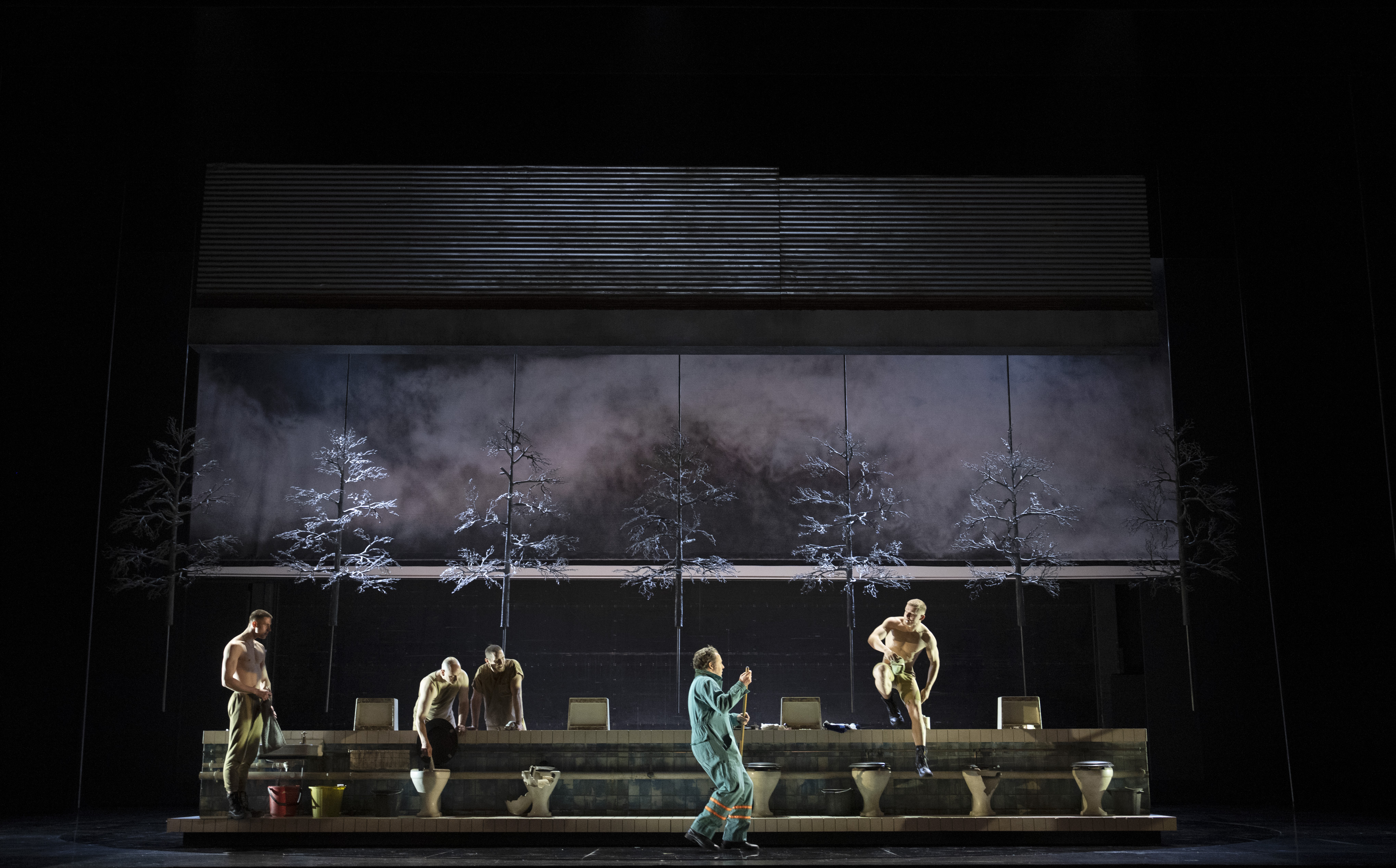


Truth be told, if you spend your time in Wozzeck thinking about a previous production or performance, something has gone wrong (either with you, what is onstage, or both). I did not. In any case, comparisons either with Warner’s first staging or with when I had previously heard Antonio Pappano conduct the work (twenty-one years ago for Keith Warner’s then-new production, in Pappano’s first season at Covent Garden) would largely be meaningless, given the vagaries of memory and my lack of a written record. Deborah Warner in 2023 does not seem to me especially to take a view or standpoint, at least not exclusively. This is not a Wozzeck that (over-)emphasises the brutality of military life and war, or expressionist experimentalism, or any one thing, though many such things are present. The action is already taking place as we take our seats, soldiers (an excellent troupe/troop of actors) relieving themselves in various ways, cleaning up, doing very much what soldiers do in barracks. That establishes an expectation of realism which is not entirely fulfilled, but rather is supplemented, so that as the action develops, as different standpoints are afforded by the work (and probably its creator), we have opportunity to take them too. Everything takes place more or less where one might expect, but there are always refreshing touches of set design, costume, lighting, or detailed Personenregie – let alone the musical performances – to enable us to take a fresh look and listen. The drama unfolds, with great immediacy, yet always it feels that this is ultimately Wozzeck rather than ‘Deborah Warner’s Wozzeck’, whether that feeling, even that possibility, be a fond illusion or otherwise. Different settings for different scenes – no fewer than fifteen of them – present themselves without fussiness or fetishisation: this is a light, enabling, generous realism that can shade almost imperceptibly into other, complementary aesthetics as required. Credit is surely due both to the design team and to the Royal Opera House’s technicians and actors, who accomplished this feat with such apparent ease. Rehearsal surely paid off.


Slightly stylised trees, Cross-like, hint at Wozzeck’s fate, albeit without redemption, but also at a natural world beyond that neither knows nor cares, yet in some sense frames tragedies that lie in stark contrast, being entirely the creation of man. There remains a Romantic desire to escape this miserable world, even if only to Berg’s family estate (Berghof) in Carinthia. Like so much else, though, it is not possible. The blood-red moon and the black, unfathomable lake dominate our vision and consciousness as natural and human boundaries. And finally, in that ultimate, heartbreaking scene of horror: the child turns to the wall in front of which the other children have just been playing, to see painted on it the news they have so cruelly, carelessly delivered. His mother is dead. He turns around and walks off, alone. The drama stops, silence cruelly denied by some idiot’s premature applause—but even that could not quite break the punch to the solar plexus. 

Much of that is, of course, a musical punch. Pappano really seems to be at his best right now. Shortly after thinking his Turandot perhaps the best I had heard from him, I found this Wozzeck at least close to equal, and in ways that surprised me. Without wishing to play that game of illusory comparisons, however tempting, I found this an infinitely more engaging experience than in 2002. Often quite extraordinary orchestral precision, for which one must of course above all credit the orchestra itself, laid bare the framework of closed forms in themselves, their multifarious musical procedures objects of an almost yet not quite Neue Sachlichkeit fascination, but also showed them to be the engines of a dramatic progression that, however Wagnerian it may often sound, is at least as much an alternative to Wagner’s method. There were wrenching, late-Romantic passages, of course, precisely where one would need and expect them, but this was also a musical drama that prefigured Hindemith, Weill, perhaps even Berg’s own teacher, Schoenberg. This was not always a Wozzeck that rose from the bass line, though sometimes it did, but it hinted more than usual at Berg’s later writing, whilst also suggesting an earlier, almost Mendelssohnian Romanticism. Like Warner’s production, it afforded different standpoints, without sounding merely sectional. 

I have been fortunate to see some extremely fine Wozzecks in those years since my first encounter (Andrew Shore on that first encounter included). Christian Gerhaher’s thoughtful, collegial approach, placing himself and his character at the dramatic hub, gaining meaning as much from interaction with colleagues as from his considered yet apparently spontaneous way with the text, has nothing to fear from any of them. His performance, worlds away, as is proper, from the beauties of his celebrated Wolfram, was yet equally well judged. Indeed, I wonder whether it heralds a new chapter in his career. For now, though, it will more than do in and of itself.


Wozzeck, Marie (Anja Kampe)

There was splendid chemistry with his Marie, Anja Kampe. I was about to say ‘we tend…’, but should really only speak for myself: I tend often somewhat to overlook the tragedy of Marie’s death, so overwhelmed am I by that of Wozzeck. Here I felt greater parity, doubtless a matter of Warner’s Personenregie but also of Kampe’s portrayal. (It is more or less impossible for an outsider to distinguish between the two.) This important corrective was brought into further relief by Anna Picard’s excellent programme note on ‘Maria and her World’, whose closing words seem very much to refer to what we saw and heard: ‘She is no Kundry. Neither is she a Judith or the hysterical Woman in Marie Pappenheim and Arnold Schoenberg’s monodrama, Erwartung. Her murder is not dressed up as a form of release for Wozzeck or a point of debate. It is simply a domestic tragedy of a very ordinary, and ever modern, kind.’ Which also brings us back to Gerhaher’s Wozzeck, for his very haplessness – what art lay in that – also contributed to that very non-release, felt (at least by me) more emphatically than I can recall.


Captain (Peter Hoare), Wozzeck

All in the cast contributed to the greater dramatic (and musical) whole, so much as to suggest unusually fruitful close collaboration between all concerned. Sam Furness’s Andres surprised me, not least because I often find myself wondering where the role went, thinking it smaller than I had expected. Not here: this was a character sympathetic to Wozzeck who yet had his own story to tell. Likewise Rosie Aldridge’s spirited Margret, whose spot in the second tavern scene almost had time stand still as the world disintegrated around her. Peter Hoare’s Captain and Brindley Sherratt’s Doctor made a sharply etched pair: guilty, yet not guilty, like all in the world we saw. Well, perhaps not quite all, for it is difficult to find any grounds to absolve the Drum Major, here given an appropriately nasty, bullying, yet finely sung performance by Clay Hilley. William Spaulding's Royal Opera Chorus was on outstanding form too. 

What, then, should a Wozzeck accomplish? There can be no definitive answer, no more than for any artwork in performance. Different productions, different performances, different audiences will all render such categorical statements in vain. If I have learned one thing over the past thirty years, it will be that. That said, if one does not emerge from a performance convinced that it is one of the greatest of all operas – ranking beyond that is a mere parlour game – it will have been in vain. My first experience was not; nor, emphatically was this: a searing and strangely refreshing Wozzeck, which I hope and intend to revisit soon.


Sunday, 12 March 2023

Turandot, Royal Opera, 10 March 2023


Royal Opera House

Turandot – Anna Pirozzi
Emperor Altoum – Alexander Kravets
Calaf – Yonghoo Lee
Liù – Masabane Cecilia Rangwanasha
Timur – Vitalij Kowalkow
Ping – Hansung Yoo
Pang – Aled Hall
Pong – Michael Gibson
Mandarin – Blaise Malaba
Two Girls – Marianne Cotterill, Tamsin Coombs

Andrei Serban (director)
Jack Furness (revival director)
Sally Jacobs (designs)
Kate Flatt (choreography)
Tatiana Novaes Coelho (choreology)
E. Mitchell Dana (lighting)

Royal Opera Chorus (chorus master: William Spaulding)
Orchestra of the Royal Opera House
Antonio Pappano (conductor)


Images: Marc Brenner

Andrei Serban’s production of Turandot has certainly offered the Royal Opera its money’s worth. First seen – somewhat oddly, not at Covent Garden, but on tour to Los Angeles – in 1984, it has had no fewer than fifteen revivals on home territory, as well as touring internationally and being adapted for performances at Wembley Arena (1991 and 1992). No wonder, as Serban’s programme biography states, that ‘he is both surprised and delighted that his production … is still revived.’ This, however, is apparently to be its final outing. Assuming that to be the case, it is receiving a good send off: not before time, yet with strong performances and revival direction from Jack Furness considerably more convincing than what I saw in earlier reincarnations (2013 and 2014). 

What we see seems understandably eager to veer towards Carlo Gozzi’s fairytale. Ping, Pang, and Pong (I know…) lose the worst of their racialised appearance, clearly taking their leave instead from commedia dell’arte. Lively performances from Hansung Yoo, Aled Hall, and Michael Gibson certainly helped in that respect, perhaps even going so far as to suggest that these, alongside Puccini, might be the real orchestrators of the action, playful as well as sadistic, intriguingly beyond morality in an almost Nieztschean sense. Where that leaves the story of Turandot, Calaf, and of course Liù remains, shall we say, problematical. The ‘arias’ embedded in the score stood out awkwardly, as if remnants – and in a way they are – of bygone technique, which the composer at the height of his musical powers was unable to banish entirely, on account of theatrical and audience expectations. 


The closer the story moves to realism, the more repellent its final sadism becomes: magnificent in a way, yet also strangely unsatisfactory. The more fantastical the framework and action, the greater the artifice, the better. This seems to be well understood and indeed communicated, not least through a parade of dances that might readily have seemed theatrical for the sake of theatre. In a way they still do, yet in this context, that offers a possibility if not quite for redemption, than for something less (im)morally outrageous. The framing of the set as a theatre of sorts, or at least a public arena suggestive of one – are not the two often coterminous and coexistent? – contributes with unusual success to that desirable distancing of standpoint. Masks serve with similar, indeed still more absolute, necessity.


In the title role, Anna Pirozzi offered a well sung, unusually human performance, warmer than many, though also posing the question as to whether that is what we should want here. Why not, really? In posing that question it is surely performing a dramatic service of its own, difficult conflict being part of the point. Yonghoon Lee’s heroic stab at Calaf should also be commended. Only on rare occasions, when something more inwardly vulnerable was required, did it sound lacking, but that is always a difficult near-circle to square. He can ride an orchestral wave, and did. He also seemed very much at one with Furness’s reimagining of the production. Even reimagined, the production arguably does Liù no favours, but that is much to ask of any staging. Masabane Cecilia Rangwanasha’s heartfelt, sincere performance was very much in the mainstream of expectations here. Timur’s strange appearance – an old man, to be sure, though it is stranger than that – likewise does the role no favours, yet when he sang, Vitalij Kowalkow was able vocally to rise far above visual limitations. 

In the pit, Antonio Pappano offered what for me turned out to be one of his best performances at Covent Garden. I have given up trying to reconcile myself to his Wagner; we clearly hear and understand that and much other music in such different ways that I am unlikely to ‘get’ it any time soon. Here, however, a Puccini darkly haunted by, even founded upon, marriage of darkly Wagnerian chromaticism to a surprisingly Wagnerian way with motivic construction – to my ears, more so than in Pappano’s Wagner – offered just the sort of musico-theatrical experience that was called for. Flexible yet goal-directed, enabling of singers yet also revelling in Puccini’s ‘symphonism’, it told us what we knew yet perhaps still wished we did not. This was a murky, malevolent tale that could not quite be wished away with a welcome does of theatrical fantasy. The oft-remarked affinities with more contemporary (to Puccini) music, not least Stravinsky and Schoenberg, were perhaps less immediately present, but viciousness both of score and broader theatrical purpose were certainly very much with us. With orchestra and chorus on excellent form, Pappano brought something both old and new to the score, greatly to his – and its – credit.


Farewell then, we think, to Serban. Even when revived with such intelligence as seen here, this is not a production directly to address the very difficult, probably insoluble, questions this extraordinary, flawed opera presents. Yet, given space such as was granted here – and was not, to the best of my memory, so apparent when I first saw the production – it can nonetheless permit them to play out. Taking a view seems more of a moral imperative here, on account of the sadism as much as the racism; there are many ways to do that, whether by transforming the work into something more directly political (or something else?) or by confronting its issues head on. We shall see what Serban’s successor does. This however, offers an often intriguing and absorbing last hurrah, as well, I suspect, as a hint to why new steps may prove necessary.


Monday, 14 January 2019

The Queen of Spades, Royal Opera, 13 January 2019


Royal Opera House

Tchaikovsky (Vladimir Stoyanov)
Images: ROH/Catherine Ashmore

Herman – Aleksandrs Antonenko
Count Tomsky, Zlatogor – John Lundgren
Prince Yeletsky, Tchaikovsky – Vladimir Stoyanov
The Countess – Felicity Palmer
Lisa – Eva-Maria Westbroek
Pauline, Milovzor – Anna Goryachova
Chekalinsky – Alexander Kravets
Surin – Tigran Martirossian
Chaplitsky – Konu Kim
Narumov – Michael Mofidian
Governess – Louise Winter
Master of Ceremonies – Harry Nicoll
Masha – Renata Skarelyte
Prilepa – Jacquelyn Stucker

Stefan Herheim (director)
Philipp Fürhofer (designs)
Bernd Purkrabek (lighting)
Alexander Meier-Dörzenbach (dramaturgy)

Members of the Tiffin Children’s Chorus and Tiffin Boys’ Choir
Royal Opera Chorus (chorus director: William Spaulding) and Extra Chorus
Orchestra of the Royal Opera House
Antonio Pappano (conductor)


London has not done badly in recent years by The Queen of Spades, both ENO and Opera Holland Park having offered productions, the latter considerably more successful than the former. (A less recent yet hardly distant visit from Opera North is also better forgotten.) In addition – fresher in and more germane to my own thoughts – Salzburg presented a fine new staging, typically misunderstood by most, from Hans Neuenfels last summer. Covent Garden, however, has not seen the opera since 2002, so it was about time. Stefan Herheim’s much lauded production, first seen in Amsterdam in 2016, may now be seen courtesy of the Dutch National Opera’s co-producer, the Royal Opera.

Countess (Felicity Palmer)


I go back a good few years with Herheim’s work. My first encounter quite bowled me over: his Entführung aus dem Serail for Salzburg in 2006, preserved on DVD in the Festival’s box of the complete Mozart operas. If I were bowled over then, growing acquaintance with his Bayreuth Parsifal over three different years of that festival (click here for my final encounter, in 2012) proved something beyond bowling over; indeed, it is no exaggeration to say that it marked a turning-point in my understanding of opera as a critical, recreative genre. Not for nothing did a picture from the production feature on the cover of my book, After Wagner, which devoted a chapter to that production and another half-chapter to discussion of Herheim’s Berlin Lohengrin. Since then, the director’s work has continued to occupy my thoughts both in my formal academic and less academic writing; Herheim’s Meistersinger is, for instance, discussed in a chapter on modernist operatic culture I wrote for a recent book, edited by Björn Heile and Charles Wilson, on modernism in music. Why mention that? Partly to situate myself – we all do that, nowadays, do we not, both when staging and watching opera? – but also to situate the doubts I began to have, not entirely dissimilar to those I initially entertained concerning Herheim’s Glyndebourne Pelléas this summer.

Herman (Aleksandrs Antonenko)


Whilst neither of these productions struck me at the time as representing Herheim at his very best, certainly not at his most groundbreaking – perhaps my problem and mine alone – I have nevertheless continued to think, to deconstruct, and perhaps more important, to piece together, but also how one needed to see and, crucially as ever with Herheim, to hear the entirety of the production, not simply to rely upon what one thought before the interval. Much came together by the close, whether onstage or in one’s mind; indeed, one was prompted to ask whether the two were, if not one and the same, at least inseparable even from the analytical standpoint. Just as with more overtly confrontational theatre work, for instance from such different directors as Peter Konwitschny and Calixto Bieito, this is not theatre for the mere spectator. Herheim’s theatricality in a more conventional sense sometimes leads others to think his theatre conventional, even crowd-pleasing. Perhaps in some senses it is, or can be. That, however, is not its point. Like Wagner, or indeed Tchaikovsky, his work continues to have much to tell those angry and unreceptive from what we might tentatively term the musicodramatic ‘left’ and ‘right’ – without collapsing into centrist quicksand. There is something synthetic, in interesting and not always expected senses, to this art – as indeed there surely is to much opera ‘itself’, whatever that might mean.


Identity is a complex thing. How do we identify with the voices or voices on stage, back stage, in the pit, even in the audience (beyond yesterday’s highly aggravating coughing, chattering, air conducting and the rest, and perhaps even including those irritant voices)? A staple, not without reason, of Tchaikovsky criticism has been discussion of the relationship, even identity, between the composer and his operatic characters. Gerald Abraham, for instance, claimed that ‘some opera composers, notably Tchaikovsky, have been able to identify themselves only with characters that are essentially or partially self-projections’. Herheim’s concept takes this as its starting-point. Titles inform us initially of the composer’s death and the story behind it, namely Tchaikovsky’s homosexuality and nineteenth-century society’s retribution for that ‘deviance’. The curtain opens and we see a desperate, pathetic Tchaikovsky seeking love from an officer he had paid only to gratify. The contempt with which he is treated sparks a flurry of writing and self-poisoning by cholera. Delirium ensues, the writing – or is it the performance? – continues, drawing upon the woman in the painting above and Tchaikovsky’s own ill-fated marriage: are the two women, indeed the three once Liza appears on stage, to be identified? It draws also upon the composer and that guardsman. The former seems to become – although are we ever entirely sure? – Prince Yeletsky, but also a host of tormenting chorus members. Who after all, torments a repressed gay man more than his interior daemons? The latter seems to become Herman, a thrill-seeker with a death wish of his own. Whose wish fulfilment is whose? And what to make of the surrealist vision immediately before the interval, when, following a (largely unsuccessful) attempt to have the audience rise to sing the Tsarist national anthem, Herman or the soldier appears in mocking travesty as Catherine herself, the ultimate, albeit surrealist queen scorning our sordid, all-too-real queen. Who, then, we might ask, is the Queen of Spades herself?


Yeletsky, who does not appear in Pushkin, is perhaps the most appropriate candidate for identity with the composer; more important, he is perhaps the most intriguing. Who is he? What is he for? Or what might we make him be, and be for? When Herman curses the prince’s luck, can we believe in this as anything more than Tchaikovsky’s fantasy? Probably, but it requires theatre – a production team and performers who communicate as well as think – to do so. Tchaikovsky-Yeletsky plays with our expectations. Who is he now? Who was he then? Frantically, he not so much writes as plays at writing, at conducting, at ‘tickling the ivories’. For the hammy gestures are those unmistakeably – at least as the drama continues – of a biopic composer. It might be Ken Russell; it might be someone else; it might be us air-conducting at home or, as yesterday, all around me in the theatre. As dramaturge Alexander Meier-Dörzenbach notes in the programme, Tchaikovsky’s autograph is ‘sketched out in a nervous, volatile, rushed script with innumerable changes and cuts. It offers compelling testimony of the feverish élan that seized Tchaikovsky in his execution of this story.’ Is this helpless, hapless caricature not precisely what one’s delirious state – who is ‘one’? – might viciously summon up in performing, in watching, in listening to Tchaikovsky’s romanticisation of the Pushkin story Dostoevsky proclaimed ‘the pinnacle of the art of the fantastic’? Ambiguous angels speak of and with such and other fantasies.

Lisa (Eva-Maria Westbroek)


Time plays tricks with us, or does it? Are we in the eighteenth or the nineteenth century, or is the setting as well as the drama – whatever this might mean – more a dream, a fantasy, than anything else? (Is there anything else?) The same set, more or less, manages through brilliant tricks of lighting (Bernd Purkrabek) to furnish both a dark, oppressive late-nineteenth-century library and a fantastical recreation of a Mozartian world that never was: like the score, like the action. And like the music box which, before a note of the score has been heard, mocks the composer at the guardsman’s behest with an endlessly repeating opening line, later to be subsumed into score and plot, of ‘Ein Mädchen oder Weibchen’. Birds achieve their freedom, their invention, the composer’s humiliation, in the pastoral divertissement. But has not the man who would so insistently conduct (direct?) proceedings, who scatters those very nineteenth-century album leaves across the stage to anyone who would read from them, created this torment, this gilded cage, this wedding in which he participates and which he haunts?


Contrast between public and private is of course key to the work. Here, if not heard with the knowing confidence with which it had been communicated by Mariss Jansons and the Vienna Philharmonic in Salzburg, we still heard enough of that from Antonio Pappano and the Orchestra of the Royal Opera House to relate score and action, libretto and staging, those and many other relationships in ways both suggested by the onstage delirium and our own. In what might well be understood as Tchaikovsky’s closest journey towards surrealism – itself a form of hyper-realism? – our critical faculties needed to be sharp, to permit themselves to be sharpened, not least since they needed to turn upon themselves, to lacerate what we might most unthinkingly or even thoughtfully treasure. Who killed whom ultimately, when the chorus continued to play at taking the fateful drink? What did it mean to play roles, and how much did we as ‘spectators’ engage? For it was those attending the theatre, the ‘entertainment’, who surely condemned Tchaikovsky, Herman, Lisa, even opera itself once again to death.


Pappano, as is his wont, tended to stop and start, to rush certain passages, if not so distractingly as in Wagner. The sound he summoned from the orchestra was, at its best, very much a ‘Tchaikovsky sound’ such as we fancy we know and love, to match the image of the ‘tormented composer’ we know and murderously love. Choral singing was excellent, often outstanding, testament to the results William Spaulding is achieving in his (relatively) new role as chorus director. Aleksandrs Antonenko and Eva-Maria Westbroek left much to be desired vocally in the first act, tuning awry beyond the limits of the merely feverish. They improved, however, the palpable honesty of the latter’s portrayal of Lisa working its own magic. Antonenko surely needs to work on his acting – especially in a production such as this: no match for the extraordinary Brandon Jovanovich in Salzburg last year. Vladimir Stoyanov, tireless in the acting role as Tchaikovsky, showed that he could sing beautifully too as Yeletsky. Felicity Palmer predictably – yet no less creditably for that – offered a spellbinding star turn as the Countess. Smaller roles tended to be very well sung, even if at times, the ensemble lacked an ideal sense of company and coherence. Perhaps that will come as the run progresses. Theatre, after all, is often about theatre; it certainly is here. Let it, let us, do with identity what we will  and vice versa.


Wednesday, 16 March 2016

Boris Godunov, Royal Opera, 14 March 2016


Royal Opera House

Boris Godunov – Bryn Terfel
Andrey Schchelkalov – Kostas Smoriginas
Nikitch – Jeremy White
Mityukha – Adrian Clarke
Prince Vasily Ivanovich Shuisky – John Graham-Hall
Pimen – Ain Anger
Grigory Otrepiev – David Butt Philip
Hostess of the Inn – Rebecca de Pont Davies
Varlaam – John Tomlinson
Missail – Harry Nicoll
Frontier Guard – James Platt
Xenia – Vlada Borovko
Xenia’s Nurse – Sarah Pring
Fyodor – Ben Knight
Boyar – Nicholas Sales
Holy Fool – Andrew Tortise

Richard Jones (director)
Miriam Buethner (set designs)
Nicky Gillibrand (costumes)
Mimi Jordan Sherin (lighting)
Ben Wright (movement)
Elaine Kidd (associate director)

Royal Opera Chorus (chorus master: Renato Balsadonna)
Orchestra of the Royal Opera House
Antonio Pappano (conductor)
 

I really only have one grumble, so I shall get it out of the way first. Why the original, 1869 version of Boris Godunov? Yes, it was a Royal Opera, although not a Royal Opera House, first? Yes, it has its particular fascinations; one might even argue it more radical or at the very least still less beholden to operatic convention than Mussorgsky’s revised version, first performed long before the original was exhumed. Yes, there is the very real advantage in the theatre of not having the action broken by an interval. But does anyone seriously think we are better off without the Polish act, without Marina? Does anyone seriously think that Mussorgsky’s sometimes drastic reworking of Pushkin is not more successful operatically (however we understand the term)? Does anyone seriously think the grander scale of the opera as a whole and the (still) greater opposition between tsar and people are not more or less unambiguously to the dramatic good? For seasoned opera-goers, one might argue that that is all less of a problem; we shall know the revision anyway. We might even know the Rimsky-Korsakov reorchestration. Indeed, we do, although I have yet, alas, to hear a performance of Rimskyfied Boris, and should like the opportunity to do so before I die. That said, I should hesitate before staging either 1869 or Rimsky in this country, at least, given that performances of any version have been bizarrely infrequent. I cannot imagine anyone would dispute the standing of the work as the greatest of all Russian operas. Perhaps it seemed less so on account of the version to the first-night audience; I cannot be sure. At any rate, I was surprised by the muted reception: quite undeserved. Maybe these were just people who thought they were in for Russian Donizetti.
 

If the 1869 version will always seem more akin to a fascinating draft to me, what a draft it is! This was a strong performance all around. Antonio Pappano sounded far more at home here than he ever has in German repertory. There were some oddities, not least the over-emphatic phrasing of the very opening bars. Even that, though, served to underline its Janáček-like vocal prophecy. More concerning, at times, was a tendency towards smoothing away some of Mussorgsky’s sparest, uncompromising writing, rather at odds with the version but, more importantly, occasionally suggesting a kinship with more conventional, even Italianate, operatic practice which, to my ears at least, should not be there. (Whatever Richard Taruskin might claim, I really do not hear a rapprochement with Verdi in the revised version.) That said, however, there was splendid playing from the orchestra, on as fine form as I have heard in some time. Pappano, moreover, should surely take some, at least, of the credit for the force with which particular musical moments stood out: not like a sore thumb, but with an underlining of a telling shift, harmonically, timbrally, or both. Pacing was sure, too: perhaps still more important in this succession of scenes, whose own formal radicalism – sorry to keep using that word, but it seems so apt in this case! – was enabled thereby truly to make its mark.
 

Bryn Terfel gave one of the finest performances I have seen from him. Truly, he embodied the role; and, in an opera so concerned with succession, it was truly unnerving to witness him grasp John Tomlinson’s mantle, as the latter gave an inimitable performance in the role of Varlaam. Not that Terfel sounded remotely like Tomlinson, of course; if one were expecting, and insisting upon, a ‘traditional’, deep, ‘Russian’, performance, one would doubtless have been disappointed. There is no more reason, though, to insist upon one correct way to perform Mussorgsky than there is with Elgar. Terfel’s care with the text – musical, as well as verbal – was striking; so was its visual incarnation. I had no doubt that this was Boris. As for Tomlinson, his larger-than-life assumption of Varlaam was spot on; the extraordinary double act, spoons and all, with Harry Nicoll’s Missail proved a joy, its grim humour well-nigh Shakespearean. Let us hope we shall one day see Tomlinson’s Lear.
 

David Butt Philip’s intelligent portrayal of the growth of a false Dmitri had one, rightly, both sympathise – why not have a go, in such a world? – with and suspect Grigory. Vocally as well as dramatically, this was a fine performance, which had one all the more regret the loss of the Polish Act. Ain Anger’s Pimen was something no one present is likely to forget, a world-weary yet canny chronicler more in control (perhaps!) than any other of these tormented – and tormenting – characters. This was, surprisingly, his Royal Opera debut; it will surely not be long before we see him at Covent Garden again. Ben Knight gave an astonishingly mature performance as Fyodor; this was the real thing, no doubt. The extraordinary versatility of John Graham-Hall took another turn with his Shuisky: wheedling, yes, but ultimately a sad figure, a more rounded assumption than one generally sees (and hears). Schchelkalov assumed greater, more chilling stature in Kostas Smoriginas’s performance than I can recall. Andrew Tortise’s Fool was, again, the Shakespearean thing; this talented singer deserves greater exposure on our opera stages. Were I to continue, and perhaps I ought to, I should simply be listing the cast and saying ‘well done!’ to each of them, for there was no weak link; there was, indeed, an abundance of fine character-singing and acting from all concerned.
 

Choral singing was excellent, as were Richard Jones’s direction of the chorus and Ben Wright’s movement direction. Here, although there are of course losses with respect to the version, there is arguably considerable gain too. The truly extraordinary prose recitative of the Coronation Scene shocked as it should. In 1869, and indeed in 2016, we stood as distant from Rimskian Technicolor and, so it seemed, not so far from a mix of Monteverdi with Schoenberg – in Russian. It is here, ironically, that one is probably better off either with the original or with Rimsky. Renato Balsadonna will be leaving a chorus in very good shape for his successor, William Spaulding. (As any operagoer knows, Spaulding’s work at the Deutsche Oper, Berlin, augurs extremely well for London.)
 

Jones’s production is honest, straightforward, direct, with some of the tell-tale designs we expect, but nothing irritating. The upper, silent level of action in which assassins meet – a disturbingly Orientalist image here, I am afraid, although I doubt it was intended that way, nor is it necessarily intrinsically so – plotters scheme, and, above all, a child meets his cruel death is the realm of memory. We see as well as hear it haunt Boris; we sympathise, as we should, although, as with his would-be usurper, we do not only sympathise. Whether what we see be ‘true’ or no, we cannot know. The more disturbing question, or rather the implicit answer to that question, is: who cares?  Such is a crucial question in the work, and it is vividly, almost ritualistically instantiated here. Otherwise, below, a story is clearly and indeed colourfully told; it is difficult to imagine even the most ‘traditionalist’ of operagoers having any quarrel with Jones’s staging or – and, sadly, this is what such operagoers exclusively seem to mean by ‘productions’ – with the designs by Miriam Buethner and Nicky Gillibrand, all well thought out and finely executed.


I cannot help but wish that the production were a little more daring in its political terms of reference. If ever an opera cried out for a little contemporary or near-contemporary signposting, it is surely Boris. Is there a Russian regime to which the work could not be updated? Gorbachev’s might be trickier than most, although even then, Boris the reformer might intriguingly come into play. By the same token, however, we are free to draw our own comparisons, and anyone with half a brain cell will do so. In some ways, it is not unwelcome to have a construction – and Jones is too clever to approach the opera unmediated, whatever first impressions might suggest – of old Muscovy placed before us; if some silly souls take that as ‘fact’ or, God forbid, as ‘beautiful’, then that ultimately is their problem. At any rate, the evening offered a convincing, powerful musico-dramatic whole.
 
The performance on 21 March will be broadcast live to cinemas worldwide.


Saturday, 2 May 2015

King Roger, Royal Opera, 1 May 2015


Images: ROH/Bill Cooper


Royal Opera House

Archbishop – Alan Ewing
Deaconess – Agnes Zwierko
King Roger – Mariusz Kwiecień
Edrisi – Kim Begley
Roxana – Georgia Jarman
Shepherd – Saimir Pirgu

Kasper Holten (director)
Steffen Aarfing (designs)
Jon Clark (lighting)
Luke Halls (video)
Cathy Marston (choreography)
John Lloyd Davies (dramaturgy)
 
Royal Opera Chorus and Extra Chorus (chorus master: Renato Balsadonna)
Orchestra of the Royal Opera House
Sir Antonio Pappano (conductor)


At last, Szymanowski’s masterpiece, King Roger, has reached Covent Garden. With one, sadly predictable, exception, it receives excellent treatment too. What a joy it is to see staged here a work, which, like Janáček’s bizarrely ignored operas, is no longer than it need be, and so handsomely repays attention in every minute of its mere ninety. (Incidentally, placing an interval after the second act was surely a mistake; this is a work considerably shorter than Salome or Elektra, and nothing was gained by having to step outside for half an hour.)

 
Kasper Holten’s production is relatively straightforward, but none the worse for that. Save for gentle costume updating to the time of composition, it is difficult to imagine self-styled ‘traditionalists’ having anything much to worry about. A gigantic King Roger’s head, in different states, inhabits the centre of the stage. Are we to understand that the conflict between Apollo and Dionysus is entirely within his head? Probably not; surely there remains some important element of the social. However, a reminder that this is, amongst other things, his conflict is no bad thing. Oppressive, patriarchal Orthodoxy surrounds the realm of the personal in the first act.


In the second, the head turns around so as to reveal, if  not strictly speaking, the inner palace courtyard of the libretto, then something pretty close: royal quarters, in which books – is that, ultimately, whence these dangerous ideas come? Nietzsche, perhaps? – are prominent. In the basement are writhing bodies, refugees from Tannhäuser’s Venusberg – which, in terms of the work, musically as well as conceptually, is very much what they should be. Cathy Marston’s choreography did little for me, I am afraid, but having recently endured again the absurdly excessive dance of Sasha Waltz’s Tannhäuser, there was relief for me to be had in lesser intrusion.


The third act, rightly, presents ruins, both social and personal. The head has been destroyed under whatever new dispensation it is the Dionysian Shepherd offers. Not for the first time, I thought of Henze’s The Bassarids in Christof Loy’s Munich production. The dangers of this brave new world are clear, for, not only have the erstwhile faithful blindly followed their new master, they blithely throw a few surviving books upon the pyre. To destroy culture is cheap, as inconoclasts from Alexandria to Rupert Murdoch to ISIS have known all too well; the cost is crippling. Mere hedonism is not the way forward; the blinding light at the end – here as simple and as striking as in Mariusz Treliński’s production, which I saw in Edinburgh in 2008 – shows that another path for Roger, and for us, will not be easy; it may not even be right. We need, however, to try. If, sadly, as in Treliński’s staging, Szymanowski’s overt homoeroticism is played down, then there are other ideas well worth pondering: not hammered home, for such tends not to be Holten’s way of operating, but more open-ended, which seems quite apt for the work and, in particular, for its unresolved, perhaps irresolvable, conclusion. After all, the final C major chord is no more convincing as affirmation than that in Elektra; the Shepherd’s strains remain.


Antonio Pappano’s conducting proved somewhat disappointing, although he certainly seemed aware of the difficulties of balance within the orchestra and for the most part steered a judicious enough path in that respect. However, if not so bedevilled by stopping and starting as his Wagner, Pappano’s account nevertheless seemed incapable for the most part of rising above the indifference of mezzo piano, to misquote Pierre Monteux. The orchestra here is defiantly post-Wagnerian, at least as much a character as anything we see on stage; here, despite some truly excellent playing, Pappano reduced it to mere accompaniment. There was too much of a tendency to meander, too: a hostage to fortune to those who would claim Szymanowski’s world amorphous. It is not, but it requires a more comprehending conductor to present to full advantage its golden tapestry in motion.

 
Choral singing, however, was excellent, from, to quote Stephen Downes’s excellent programme note, that ‘majestic, awe-inspiring chorus’ onwards. Indeed, in that’ Byzantine Sanctus sung in harmonies that evoke archaic primitivism and power,’ the basses – a sizable extra chorus had been enlisted – offered a highly convincing impression of their Eastern European confrères. Weight and sensitive diction were, throughout, shown to be anything but opposing tendencies. Renato Balsadonna and his singers deserve great credit, not least for discretely posing the question of to what extent we might consider this work a staged oratorio. It is a tendency rather than an identity, but a worthwhile tendency to raise, especially given the subject matter.


The cast was excellent too. At its heart stood Mariusz Kwiecień’s Roger. Although an ailing Kwiecień sounded – if only relatively – a little tired at the end of the second and third acts, that in no way detracted from the thoughtful heroism of his portrayal. It is a role with which, of course, he has a lengthy association; indeed, on this occasion, it seemed made for him, so close were his identification and projection of the King’s conflicting voices. This was certainly not a Roger, even when unwell, who stood in need of Pappano’s quenching the fires of Szymanowski’s orchestra. The rest of the cast seemed no more in need of that. Saimir Pirgu offered an alluring, properly dangerous, ultimately yet prematurely triumphant Shepherd, whom many would have followed. The alterity of his Lydian-inflected music, deliberately non-developmental, ‘an enclosed, complete and self-referential musical system’ (Downes), made its dramatic point strongly, even without the overwhelming orchestral contribution that might have been present. Georgia Jarman’s Roxana certainly seemed clear why she was doing so, yet not without affection for her consort; one sensed that she would like to have included him. Her second-act aria was as ravishingly sensual as anyone might decently – or indecently – have hoped. Alan Ewing, Agnes Zwierko, and Kim Begley all distinguished themselves in the smaller roles. Old Szymanowski hands and newcomers alike should hasten to the Royal Opera House.


Saturday, 6 December 2014

Tristan und Isolde, Royal Opera, 5 December 2014

 
Royal Opera House
 
Sailor – Ed Lyon
Isolde – Nina Stemme
Brangäne – Sarah Connolly
Kurwenal – Iain Paterson
Tristan – Stephen Gould
Melot – Neal Cooper
King Marke – Sir John Tomlinson
Shepherd – Graham Clark
Steersman – Yuriy Yurchuk 
 
Christof Loy (director)
Julia Burbach (associate director)
Johannes Lieacker (designs)
Olaf Winter (lighting)
 
Royal Opera Chorus (chorus master: Renato Balsadonna)
Orchestra of the Royal Opera House
Sir Antonio Pappano (conductor)
 
Images: ROH/Clive Barda


Christof Loy has established rather a nice line in taking on works he admits he dislikes, or worse, and ignoring them whilst claiming to direct them. The ne plus ultra was surely his Salzburg Frau ohne Schatten, in which he set aside Strauss and Hofmannsthal completely in favour of his own banal story in which ‘an emerging young singer, sheltered and pampered by her well-to-do family is asked to take on the role of the Empress for a complete recording of Die Frau ohne Schatten.’ That was more or less it. His Royal Opera Tristan does not go so far as that, though his Lulu came close; nevertheless, his words speak for themselves. Loy, we read in the programme, cannot ‘really equate the couple’s position as outsiders with a Schopenhauerian denial of the world’. Wagner and many others since have managed to do so, but obviously what matters is a director’s inability or unwillingness to understand the work; that, after all, is what he is paid for. ‘Character direction which is rich in detail and specific’ is what interests Loy most as a director, which is why, he says, he had generally steered clear of Wagner, notorious, the reader will doubtless agree, for his inability to characterise. Tristan, however, seemed to Loy, who, it is once again worth reminding ourselves, the most important figure in all of this, something of an exception. It does not seem that he necessarily wished to traduce the work, then, but he has certainly misunderstood it. Of all Wagner’s works, it is perhaps least of all concerned with what he claims to interest him, and most concerned with metaphysics.
 
So much, then, for the misconception, but how does it play out in practice? Music and the arts in general are, after all, littered with examples of great works founded upon questionable æsthetics. Not too badly, to start with; indeed, I began to think that either my unfavourable memories from 2010 had played tricks upon me or that there had been radical revision. Julia Burbach was listed as an associate director and I think she probably has mitigated a few of Loy’s most irritating excesses; the supremely irrelevant canoodling between Brangäne and Kurwenal, for instance, seems toned down, although it is not, alas, eradicated. A good part of the first act is relatively abstract – pretty much always a good thing in Tristan – or at least may be seen as such with a degree of good will (towards Wagner, if not Loy). Then, when they have a little break, Tristan and Isolde are all over each other. What is the problem with that, one might ask? There seem to be two principal problems. One relates to the specificity of the setting, even if we are not quite sure of what that specificity is. In some building – a palace, perhaps? – awaiting her wedding and thereafter facing the consequences, Isolde manages somehow to escape for long enough to take off her wedding dress and be mauled by Tristan for a while. Still more oddly, she manages to do so for longer still during what may or may not be the wedding reception in the second act. Were there less specificity, this would not matter; playing fast and loose with time and location would not be an issue, and we could accept the overarching mythological claims. Here, however, we are just aware that it is at best rather trivial – Tristan for those who would prefer EastEnders, although a real soap opera viewer would doubtless expect more external action sooner – and often puzzling or downright nonsensical.  
 
The other brings us to the heart of Loy’s error, or, perhaps better, to the heart of Wagner’s – remember him? – work. Wagner’s action is resolutely metaphysical: not exclusively so, but the physical matters only insofar as it draws us towards, or in Schopenhauer’s terms, represents, the metaphysical drama. Since there are no metaphysics in Loy’s view, all we have is an extremely prolonged soap opera, tinged with the occasional aspiration towards Ibsen. Ironically – unknowingly, I suspect – Loy’s acknowledged inability to deal with Schopenhauerian denial of the world seems to have led Loy him to stage the second act as conventional ‘opera’, rather as Wagner acknowledged he could have written it, set against a backdrop of a brilliant court ball, ‘during which the illicit lovers could lose themselves … where their discovery would generate a suitably scandalous impression and the whole apparatus that goes with that.’  Wagner, of course, rejected that possibility he aired for a second act in which almost nothing but music happens. And even when external action intrudes, Wagner came to regard it as of lesser importance at best. His prose sketch had, for instance, drawn to a close, Götterdämmerung-like, with the words, ‘The bystanders are profoundly moved,’ concluding, ‘Marke blesses them’. However, when, in 1859, he summarised the work’s concerns for Mathilde Wesendonck, Wagner went so far as not only to omit the King’s  forgiveness, but also Tristan’s agonies at Kareol; they no longer mattered to him. True action, the Handlung of his own description, now lay in the noumenal world: ‘redemption: death, dying, destruction, never more to waken!’ Such, needless to say, was not what we were permitted to experience here. I should be the last person to claim that, as a general rule, production must exhibit some illusory, disingenuous Werktreue. However, in this particular case, it does seem that a staging of Tristan will not work unless it follows Wagner’s lead. Not for nothing did Nietzsche call it the opus metaphysicum. I know that I was not the only one in the audience looking back fondly to Herbert Wernicke’s comprehending, yet largely uncomprehended, production for this very house.
 
Wernicke’s production had of course been fortunate indeed to have Bernard Haitink, one of the greatest Wagner conductors of our age, in the pit. Haitink, as we know from his Bruckner and Mahler, is a master of large musical structures, and so he proved here. Antonio Pappano seems to have been thinking in similar terms to Loy, with not dissimilar results. Indeed, the scrappiness of the orchestral playing made it markedly inferior to Pappano’s previous accounts, let alone to Haitink’s. Missed entries, thinness of string tone (had I not seen the section with my own eyes, I should have sworn that it was considerably smaller), wavering intonation: none of those helped. More grievous still, however, was Pappano’s seeming inability to let a musical line, let alone a paragraph or some greater structure, unfold. The seemingly arbitrary nature of his beat was mirrored in the aimless meandering of the score. It seemed for the most part very slow; whether it was by the clock, I am not sure. The lack of direction was the problem, though, especially during the second act, which at times seemed almost to grind to a halt. Pappano gave the impression of following rather than leading the singers; that is not, to put it mildly, a recipe for success in Wagner.
 
 
Isolde (Nina Stemme)
Where, however, this Tristan did score over Wernicke and Haitink was with respect to those singers, who, as a cast, are deserving of considerable praise. Nina Stemme offered everything we have come to expect of her as Isolde. With her, words and music formed an indivisible whole; Wagner’s æsthetics emerged triumphant in a variegated reading that yet always belonged to a conception greater than the moment. She even presented us with Nilsson-like angry sarcasm in the first act. Stephen Gould proved a dependable Tristan. Despite a few passages of dubious intonation in the third act, he stayed the course and provided us with as many of the words and notes as it is reasonable to ask. (Haitink was cursed by his Tristans in particular.) Sarah Connolly, at least in the first act, did not offer as rich-toned a Brangäne as I had expected; indeed, Stemme sometimes sounded more the mezzo. Connolly’s reading seemed more focused upon words than line, but without unnecessary disruption of the latter. Iain Paterson offered an intriguingly boisterous, yet at the same time most sensitively sung, Kurwenal. The role seemed to fit him like a glove. Only John Tomlinson’s Marke disappointed. All Wagnerians owe Tomlinson gratitude for his extraordinary years of service, but, undimmed stage presence notwithstanding, the vocal flaws now render such an outing ill-advised. I was most impressed by Neal Cooper’s Melot; before consulting the programme, I had assumed this to be a German tenor. He is, we learn, covering the role of Tristan here and will sing it next year at Longborough. Impressive! Ed Lyon's Sailor was finely sung in very sense. Graham Clark made his typically characterful mark as the Shepherd; as, perhaps more surprisingly, given the brevity of his part, did Jette Parker Young Artist, Yuriy Yurchuk as the Steersman.