Showing posts with label Toby Spence. Show all posts

Sunday, 26 September 2021

The Midsummer Marriage, LPO/Gardner, 25 September 2021


Royal Festival Hall


Images: Mark Allan


Mark – Robert Murray
Jenifer – Rachel Nicholls
King Fisher – Ashley Riches
Bella – Jennifer France
Jack – Toby Spence
Sosostris – Claire Barnett-Jones
She-Ancient – Susan Bickley
He-Ancient – Joshua Bloom
Dancing Man – John Findon
Half-Tipsy Man – Trevor Bowes
A Man – Robert Winslade-Anderson
A Girl – Sophie Goldrick

London Philharmonic Choir (artistic director: Neville Creed)
ENO Chorus (chorus director: Mark Biggins)
London Philharmonic Orchestra
Edward Gardner (conductor)

It would have been a work with which to make one’s mark for the opening of any Principal Conductorship. Following the LPO’s Festival Hall silence for the past year-and-a-half, it became, as Edward Gardner acknowledged in a brief spoken welcome, all the more so. Ambition imperfectly realised is in many ways more impressive than passing a lesser challenge—of the estimable qualities one associates with Michael Tippett, perfection is rarely one—but such was not a concern here. Edward Gardner’s gamble in presenting a concert performance of The Midsummer Marriage paid off handsomely, and was gratefully received by a London audience largely starved of sustained Tippett advocacy since the death of Colin Davis.


The orchestral opening was vivid, precise, variegated, as if the orchestra had never been away, likewise when the joint choral forces of the London Philharmonic Choir and ENO Chorus joined. Diction from chorus and soloists alike was excellent, which really helps in an opera whose word-setting does not always privilege verbal understanding. This first act, ‘Morning’, the dawn on Midsummer Day, felt as though it were just that; figuratively, a musical body, it seemed, greater than the sum of its parts, had awoken and was stretching, limbering up. ‘Music? What’s that?’ That and many questions and allusions had acquired new connotations during our recent travails. Tippett’s allusions to Elizabethan music appeared to speak not only of that past but of a nearer past, a ‘new Elizabethan era’ in English music his opera had helped inaugurate, and in which the hall around us, once again open, played so crucial a role (if ever so slightly predating it). Gardner’s—and Tippett’s—presentation of the score in time delineated the work’s dramatic as well as musical form, characters stepping forward as if themes in a giant sonata exposition. In a sense, that is precisely what they are. Against or rather in tandem with that, there was a strong impression, led by Gardner and the orchestra yet certainly including the cast, of revealing a protean imagination, twists and turns never awkward but rather distinctive. They were communicated with conviction, meaning, and what appeared—which cannot always have been the case—of ready familiarity.


Of many highlights, the majestic and, yes, laughing conclusion to the first act, the effervescence of the primal, sometimes dark, yet often touchingly naïve Ritual Dances and their madrigalian choral writing, and a final daybreak as moving as it was atmospheric stand out in my memory. If Tippett would doubtless have pointed to Jung, one did not buy in to that psychology to experience wonder of another sort. Likewise, if King Fisher’s consultation—if that be what it is—with Madame Soristris does not speak to us all in precisely the way intended, there was plenty of alternative in so evocative an exchange as we heard between a dark and dangerous Ashley Riches and a rich-hued Claire Barnett-Jones. For the working through of events or analysis continued to captivate musically throughout the third act, which brought a radiant reunion between Rachel Nicholls’s Jenifer and Robert Murray’s Mark. The versatility of Nicholls’s voice in particular struck me, phrasing always excellent, different colourings and moods always on dramatic point, and the extraordinary coloratura with which Tippett blesses or saddles her despatched without fear. Jennifer France and Toby Spence made for an outstanding ‘second’ couple, in reality no more secondary than their Mozartian model, at least if one imagines a greater role for Papagena than she actually receives. All impressed, but I shall give final mention to the dignity of Susan Bickley’s mysterious yet ineffably human She-Ancient.

From dim recollection of the only other performance I have heard, the 2005 Royal Opera revival under Richard Hickox, I should say this was more incisive, colourful, and generally impressive, though it may simply have been that I was more receptive this time around. My preference for Tippett’s King Priam has not been dislodged, but I think I have come to appreciate the great merits of this ambitious and engaging work as well as its more peculiar singularities. Above all, I felt that something might truly be at stake, and that part of that something was the gift of music.


Tuesday, 21 June 2016

Idomeneo, Garsington Opera, 19 June 2016


Garsington Opera House, Wormsley Park

Ilia – Louise Alder
Idamante – Caitlin Hulcup
Elettra – Rebecca von Lipinski
Arbace – Timothy Robinson
Idomeneo – Toby Spence
High Priest – Robert Murray
Neptune – Nicholas Masters

Tim Albery (director)
Hannah Clark (designs)
Malcolm Rippeth (lighting)
Tim Claydon (movement)

Garsington Opera Chorus (chorus master: Susanna Stranders)
Garsington Opera Orchestra
Tobias Ringborg (conductor)
 

Opportunities to see Idomeneo are not so frequent as they might be, certainly not so frequent as they should be. Even so fervent a Gluckian as I should happily admit that Mozart here goes beyond his great predecessor (and contemporary), perhaps not consistently, but Mozart is saddled with a vastly inferior libretto. In any case, that Gluckian musico-dramatic line is only one of the many facets of Idomeneo’s greatness. Its Salzburg luxuriance – yes, I know it was written for Munich; I refer here to the Salzburg Mozart as opposed to his Viennese successor – has its own extravagant rewards, even when the musico-dramatic focus is not quite so tightly disciplined as that of, say, Iphigénie en Tauride. Moreover, no Iphigenia is a match for Mozart’s Elettra. As for the orchestral and choral writing, it is surely a match for Don Giovanni; even its chromaticism, its masterly exploration of remote reaches of the tonal system, do not come so very far behind. And yet, even so fervent a devotee as I was only seeing the work in the theatre for the fourth time. Following the Vienna State Opera (2006), ENO (2010), and the Royal Opera (2014), here came Garsington Opera to the rescue.
 

For that, and indeed for much else, Garsington deserves a hearty vote of thanks. Musically, this was a strong performance, despite cuts that scarred the work more than I should have preferred. I can, to a certain extent, understand the temptation to make considerable cuts to the recitatives, although Mozart’s achievement here is surely not his least. To do so to the extent that the story does not quite hang together, though, is a disfigurement that seems to misunderstand the role of recitative, whether dry or accompanied, in eighteenth-century opera. One can probably fill in the gaps, but is that really the point? And unlike, say, Don Giovanni, which suffers greatly from use of the ridiculous composite of Prague and Vienna versions, this is a work for which superfluity, is part of the attraction: let us have as much of the rest as we can. I could not help but wonder whether certain arias were not present in order to facilitate a transformation of three acts into two. There will always be choices to be made, for there is no ideal ‘version’, but so far as this listener is concerned, the more one can hear, for the most part the better. The loss of the ballet music I mind more than once I did; once one realises how dramatic ballet can be, especially in the magnificent French tradition in which Idomeneo partly stands, there is no turning back. Martin Kušej’s tableau for Covent Garden is doubtless a one-off; as a visual, harrowing instantiation of regime change, it made its dramatic point to those willing to think. (Needless to say, that excluded most of the audience.) Still, we had what we had.
 

That is still more the case with a fine cast and chorus as here. The work of Susanna Stranders is training the Garsington Chorus had clearly been thorough and well directed; choral singing proved lithe and weighty, as required, very much in consonance with the kaleidoscope of colours offered by the excellent orchestra. In the title role, Toby Spence offered a typically thoughtful performance, quite different from any I have heard (and which I retain in my head), but that is no reason to criticise. Idomeneo’s torment was starkly apparent from the outset, visually and vocally, still more so as a broken man (and king) at the conclusion. I have heard no finer, no more moving Ilia than Louise Alder’s, taking its leave from words and music alike, and above all from the alchemic synthesis of the two. After a first aria shaky of intonation, Caitlin Hulcup’s Idamante proved equally impressive; indeed, so convincing was she as the prince that I initially thought I was hearing a countertenor. Rebecca von Lipinski’s Elettra was just the tour de force that one needs; if only the production (on which more anon) had helped give more context to her fury and equally to a humanity too often lost in performance, but not here. Timothy Robinson’s attentive Arbace, the perfect counsellor, had one miss more than usual his aria (not, even I should admit, Mozart at his greatest). Robert Murray’s relatively small role as the High Priest did not disappoint: a typically intelligent, intriguingly ambiguous performance. Even Neptune (who appears, rather convincingly, as a neo-Monteverdian apparition, rather than being mediated by an oracle) was convincingly brought to life by Nicholas Masters.
 

If Tobias Ringborg’s conducting had a few too many Harnoncourtisms for my taste, not least drastic, rhetorical gear changes in the Overture, then it was dramatic throughout. (I hasten to add that I have nothing whatsoever against tempo variation; but few Mozart conductors seem able to convince in that respect today, Daniel Barenboim, who has never conducted the work, an obvious exception.) Ringborg also proved somewhat of the interventionist school in his fortepiano (what is wrong with a modern piano?) continuo. Balanced against such irritants, there was no doubting the conductor’s living and breathing the music. His enthusiasm was infectious; the orchestra’s vivid response – perhaps a little vivid in the case of clattering (period?) timpani – was not the least of the evening’s special qualities.


I am afraid a ‘but’ is coming, and it relates to Tim Albery’s production. As with his Wagner productions for the Royal Opera House, Albery creates, insofar as I could discern, little beyond a string of clichés. The principal characters appear in stylised eighteenth-century dress, whilst the set designs and the chorus evoke a contemporary port. (Alas, I could not help but recall Katie Mitchell’s catastrophic ENO staging, its second act in an airport terminal – which I only later discovered had been a ferry terminal, as if that made all the difference.) There is almost always something one can do with such juxtaposition; I assumed Albery would at least do something with the large seafaring container, opened to reveal an eighteenth-century room. But no, that seems to be it: different dress, and opening and shutting of the container. It seems designed to flatter people who wanted to say they had seen something ‘modern’, without engaging with any of the possibilities of contemporary theatre, let alone presenting something as outré as a concept. The story ‘itself’ actually comes across quite strongly, despite the cuts, and that, I admit, is not an insignificant achievement. By the same token, though, it might as well have been entirely in eighteenth-century dress and in an eighteenth-century setting.


Tuesday, 15 March 2016

Die Meistersinger von Nürnberg, Paris Opéra, 13 March 2016


© Christian Leiber / OnP


Opéra Bastille, Paris

Hans Sachs – Gerald Finley
Veit Pogner – Günther Groissböck
Kunz Vogelgsang – Dietmar Kerschbaum
Konrad Nachtigall – Ralf Lukas
Sixtus Beckmesser – Bo Skovhus
Fritz Kothner – Michael Kraus
Balthasar Zorn – Martin Homrich
Ulrich Eißlinger – Stefan Heibach
Augustin Moser – Robert Wörle
Hermann Ortel – Miljenko Turk
Hans Schwarz – Panajotis Iconomou
Hans Foltz – Roman Astakhov
Walther von Stolzing – Brandon Jovanovich
David – Toby Spence
Eva – Julia Kleiter
Magdalena – Wiebke Lehmkuhl
Night-watchman – Andreas Bauer

Stefan Herheim (director)
Heike Scheele (set designs)
Gesine Völlm (costumes)
Olaf Freese (original lighting, realised by Phoenix (Andreas Hofer) and Stefan Herheim)
Martin Kern (video)
Alexander Meier-Dörzenbach (dramaturgy)

Choruses of the Opéra National de Paris (chorus master: José Luis Basso)
Orchestra of the Opéra National de Paris
Philippe Jordan (conductor)

Rehearsal picture, Stefan Herheim centre stage as director
© Elena Bauer / OnP


My experience in the theatre of Die Meistersinger has not always have been happy. There are, of course, the great might-have-beens: Pierre Boulez, who expressed a desire on several occasions to conduct the work, a wish never granted, and what might have happened in Paris under Gerard Mortier, who, disappointed in the chorus at his disposal, felt it impossible to do so. Whatever the justice of Mortier’s judgement, the present-day strength of choral singing at Stéphane Lissner’s Paris Opéra, as heard first of all in Moses und Aron, means that is no longer a difficulty. José Luis Basso’s work as chorus master is clearly paying off; the chorus was outstanding throughout. Then there are the disappointing – or worse than that – productions and performances; let us pass over them here in silence, without so much as a link. Stefan Herheim’s production, first seen in Salzburg in 2013, was of course anything but a disappointment then; now, extensively rethought, it is, I think, better still. It is difficult in so busy a spectacle to know, at least in some cases, what has been changed and what one simply missed. I shall largely refrain, then, from comparisons with respect to staging and simply recount what I saw on this occasion. Comparisons with respect to performance largely favour Paris; I shall come to those later.


© Christian Leiber / OnP

We begin in Hans Sachs’s nineteenth-century workshop. A key feature of Wagner’s Romantic conception of Sachs and indeed of Nuremberg relates to overcoming division of labour – or, the more cynical, perhaps Marxist, commentator might respond, never having reached it in the first place. Yet Marx and Engels too, had their poetic flight of fancy in a celebrated passage in The German Ideology: ‘in communist society, where nobody has one exclusive sphere of activity but each can become accomplished in any branch he wishes, … it [is] possible for me to do one thing today and another tomorrow, to hunt in the morning, fish in the afternoon, rear cattle in the evening, criticise after dinner, just as I have a mind, without ever becoming hunter, fisherman, shepherd, or critic.’ Wagner and Herheim portray Sachs in more post-Nazarene fashion. But he remains a polymath and, more than that, a rebuke to involuntary specialisation; he cobbles, he writes verse, he sings, he paints too, and so forth. Here, he also dreams, and with that Herheim reminds us of Schopenhauer, of Freud, of fairy tales, and of course of the centrality of dreams to the work ‘itself’. And when he dreams, objects in his workshop grow, Nutcracker-Christmas-Tree-style; or is it that he and the characters of his dreams shrink? There is certainly a strong sense in the Bastille amphitheatre, its scale perhaps more helpful visually than acoustically, of toy-town, even before the toys come out to play.


© Vincente Pontet / OnP

And so, the Prelude over, the curtain once again drawn back, the back of the writing desk – crucial, of course, to any poet, and what a gorgeous writing desk this is! – has become the church and indeed municipal organ. The green of the surface has become the arena for contest, never more so than in the remarkable agon – intensified, I think, from Salzburg, in very interesting ways – between Walther and Beckmesser. I thought there – but a personal train of thought, of course, yet the openness of Herheim’s approach permits such flights of association – of our own College Green in Westminster. Here, an undeniably charismatic Beckmesser – now that is a way to have him taken seriously, for which both Herheim and Bo Skovhus should take credit – had to fight for the backing of the Masters, initially enraptured by Walther’s song. They swayed, literally and metaphorically. Such seemed a contest as political as it was æsthetic, and we are of course very much in the realm of Walter Benjamin’s æstheticisation of politics, an idea which did not spring from nowhere but was very much rooted in ideas which, if not Wagner’s as such, were similar and historically related. We all know, sadly, where they could lead – and what role Nuremberg would come to play. It is up to us whether we dwell on that, but it would surely be wrong not even to think about it. (Memories of Herheim’s Berlin Lohengrin demand our attention; so do those of Peter Konwitschny’s darker staging of the same work.) Dancing in concentric circles around Walther, even after Beckmesser’s apparently successful intervention, the Masters and, in front of them, the Apprentices, might yet decide in either direction. They look outwards, though, not at Walther; are they looking at us? I think not, but perhaps they do. It is certainly not a benign scene, whatever its prettiness-on-steroids; the violence, just about sublimated, when Sachs comes close to striking Beckmesser is shocking.


© Vincente Pontet / OnP
 

What of the absorbing surface? My goodness, it is beautiful, at least in inverted commas, but that perhaps implies undue cynicism rather than multivalency and dialectics. The play-acting is unmistakeable. Let us remember that the nineteenth-century German monarchies as they stood were not ancient, far from it; they certainly laid no claim to Sachs’s Nuremberg. Nor, famously, does Wagner’s score, speaking of Bach: another century, another style, unless, perhaps, one counts Luther as a sublated participant too. Bavaria as it stood when Wagner wrote his work ‘for’ Munich had only been a kingdom since 1806; much of its territory was very newly acquired. Yet Maximilians and Ludwigs played alternating or rather intricately interconnected æsthetic games of modernisation and mediævalism. Franconia and Nuremberg were – here are – some of the pieces involved. The post-1815 Restoration here seems extended, perhaps as far as the time of composition; there is both clarity and obscurity in the minutely observed designs (wonderful work by Herheim collaborators, Heike Scheele and Gesine Völlm). Walther in noble regalia and heightened blondness looks the part; Ludwig II would surely have swooned. He is a peacock, and he knows – or at least wants to suggest he knows – how to wield a sword.


Books feature heavily. In the first act, Des Knaben Wunderhorn proves our Romantic inspiration. Towering above the characters, the giant volume is opened, to reveal, as such volumes often do, pressed flowers. They come to life; they are visual instantiations of David’s tones. In the second act, it is the Brothers Grimm, and it is their ‘characters’ who come to life, incite and participate in the Prügelfuge. Red Riding Hood as you have never quite seen her – or maybe you have, in your imagination, perhaps earlier in your life than you would care to admit or even to remember – is perhaps first among equals here. There is madness, delusion, illusion – let us say Wahn aplenty – in this dream of Sachs. What, however, are we to make of the part of the original workshop set, stage left, which shrinks in none of the three acts? There is a painting on the wall – not to be identified with the painting of Eva at which he has been at work in the third act, when, in the cold light of day, normal ‘size’ is resumed – and we might speculate about the nature of its young woman (or Jungfrau?) Perhaps more intriguingly, though, there is a puppet theatre. When Eva and Walther take refuge, it is there. They are playing roles; and someone, of course, is the puppet-master. The theatre is luxurious, like what we can see of Pogner’s house and its decor; one can imagine it, them, in the Louvre’s nineteenth-century galleries, or indeed in a Wittelsbach or Hohenzollern Schloss. The damask luxury has a touch of the absurd, to it, though, not unlike Wagner’s fabled – too fabled – pink silk. Wagner’s bust at this point remains out of sight, although other old German masters may be seen, in different sizes, from time to time. The puppet play of Herheim’s Lohengrin may again be instructive here.
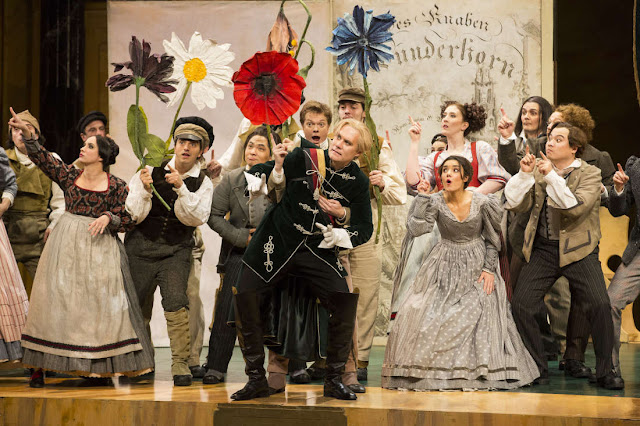
© Christian Leiber / OnP
 

Meister Wagner comes into play properly in the third act, as does Sachs’s workshop in what seems now to be reality – although the conclusion will throw that all into disarray. Dreams, memories and interpretations of them, have a habit of doing so; the unconscious was not invented by Romanticism, but it was certainly placed centre stage, as it is by Herheim. So is Wagner, and in what is now surely an act of defiance against fashionable denigration or at least scepticism, all will bow before him in the final scene. (Again, though, I should remind you that Herheim has a final card up his sleeve, to which we shall come shortly.) There has, moreover, been no one single book in play here; rather, for the festivities, Sachs’s library, or part of it, has grown in size, so we may take our pick. Liberty or licence? There is danger in the very question, as the determinedly anti-liberal Wagner knew very well. Wagner’s work, even its stage directions, is acutely observed. The Master’s banners even have harps: resplendent, again a little too resplendent. Less trivially, although nothing in Wagner is really trivial, the moment of devastation earlier in the act, when the triangle between Sachs, Eva, and Walther is revealed has never moved, never wounded me so. Rent asunder, Sachs and Eva have never seemed so real a prospect; rarely, however, have Walther and Eva. One senses her plight as a plaything – however we try to dress it up, her father’s idea is monstrous; she is a bartered bride – but it is unclear whether Wagner or Herheim is actually indicting the situation. We must make up our own minds; there is something truly Shakespearean here about the lack of judgement being forced upon us.
 
© Vincente Pontet / OnP
 
 
© Vincente Pontet / OnP
 
 
All good, and bad, things must come to an end, however. Everything starts to unravel with Sachs’s shocking refusal to shake Beckmesser’s proffered hand. He has been humiliated, bruised in every sense, and yet seems willing to meet Sachs half way. No chance, it seems. Is Sachs actually the proto-fascist some have claimed him to be? Herheim remains a master of theatre, however, and not just in the echt-operatic spectacle to which Wagner and he have treated us. As the action freezes – I am sure you can guess when – the unravelling proper gathers pace. There is another awakening – was not the visible pain Sachs had suffered at ‘Wach auf!’ enough? – yet it is Beckmesser’s. Who has dreamed whom? It is not Sachs who, for the final time, draws the curtain. Or is it?


My review concentrates on the production not as an implicit denigration of the musical performances, but because not only was it really ‘the thing’ here, it was, almost as much as Wagner’s score, although of course springing in almost every respect from that score, the framework for the vocal performances. Concerning Philippe Jordan’s conducting, I wish that it had been more variegated, and thus more like the staging itself, but one cannot have everything all the time. It was generally light, sometimes too light, but it was more the lack of contrast that was a problem than the somewhat strange cross between Mendelssohn and Ravel we seemed to hear. There was no denying, however, Jordan’s fluency; again, I shall resist the temptation to draw contrasts with a number of other conductors. Nor was there any denying the magnificent playing of the orchestra itself. As with the Iolanta/Nutcracker double-bill two nights earlier, this spoke of one of the great opera house orchestras of the world. What we sometimes lacked was not only the last few ounces of grandeur, but also a real sense of the music growing upwards from the bass line; that, however, was clearly Jordan’s concept, which I found less than entirely convincing. Electrifying in Moses, and genuinely original in his conception, Jordan was perhaps too much the foil here; in Wagner, and in Herheim, the music enhances and is enhanced by the staging.
 

© Vincente Pontet / OnP
 

The cast was generally strong. If Daniele Gatti had convinced me more in Salzburg, the orchestra and singing were surely superior here in Paris. Gerald Finley’s Sachs was not a larger-than-life portrayal, and Michael Volle’s performance was unlikely to be bettered by anyone. Finley’s intelligence, vocally, verbally, and on stage, were in their very different way just as impressive, though; this was a Sachs who made one think. I can hardly say better than that. Brandon Jovanovich, as I have already said, looked the part as Walther; he sang it too, with the ease that the role requires yet does not always receive. Again, he had one believe in the part and think about it. So too did Skovhus’s Beckmesser, as provocative and intelligent a rethinking as I can recall. He must have been as exhausted as his character, yet it did not necessarily show. Julia Kleiter’s Eva was finely sung, often reaching the calculated radiance the production imparted to her appearance onstage. Toby Spence proved an eager David: a gift of a role, of course, but a demanding gift nevertheless, ably supported by Wiebke Lehmkul’s Magdalene. With a strong group of Masters, headed by Günther Groissböck and Michael Kraus, there could be no reasonable complaints concerning the singing. If it sometimes sounded a little distant, even small of scale, that was mostly, I think, to be attributed to the acoustic.


If any opera, or at least any nineteenth-century opera, is intended to have one reflect upon artistic creation, it is surely this one. That it did, and that it did in ways novel, remembered, and somehow both novel and remembered, even perhaps misremembered, stands in many ways testament to a successful staging and performance. I left the Bastille with a spring in my step, wishing only that I could see it all again, ‘so alt und … doch so neu’.


Tuesday, 24 February 2015

Die Zauberflöte, Royal Opera, 23 February 2015


Royal Opera House

Tamino – Toby Spence
Three Ladies – Sinéad Mulhern, Nadezhda Karyazina, Claudia Huckle
Papageno – Markus Werba
Queen of the Night – Anna Siminska
Monostatos – Colin Judson
Pamina – Jania Brugger
Three Boys – Michael Clayton-Jolly, Matthew Price, Alessio D’Andrea
Speaker – Benjamin Bevan
Sarastro – Georg Zeppenfeld
Priests – Harry Nicoll, Donald Maxwell
Papagena – Rhian Lois
Two Armoured Men – Samuel Sakker, James Platt

Sir David McVicar (director)
John Macfarlane (designs)
Paule Constable (lighting)
Leah Hausman (movement)

Royal Opera Chorus (chorus master: Renato Balsadonna)
Orchestra of the Royal Opera House
Cornelius Meister (conductor)
 

When, a couple of years ago, I last saw David McVicar’s production of The Magic Flute, I was pleased to note that Leah Hausman’s revival direction had brought new life to a staging which, at its previous revival in 2011, had begun to seem tired. In terms of staging, it seems to have perked up further in 2015. Part of the reason, I suspect, must be McVicar’s having returned to direct the revival himself: something I did not pick up on until after the event, but which, in retrospect, certainly told. Not only did the cast members appear perfectly clear what they were and what they should be doing; a considerable amount of movement (typically well planned by Leah Hausman) had been rethought, reinvented. I can be very touchy – many would doubtless say too touchy, but here I stand… – when it comes to Mozart, and regret what seemed to me a shift towards the merely comic. However, if my memory serves me correctly, and this is a production I have watched regularly on DVD too, it was a shift rather than a wrench. Many, in any case, will feel differently, should the widespread enthusiasm for Nicholas Hytner’s old ENO staging, an enthusiasm I never felt in the slightest, be anything to go by. There remains delight to be had in John Macfarlane’s designs; a visual, if less an intellectual, sense of eighteenth-century Enlightenment remains happily present too. At any rate, it is pleasing to see a twelve-year-old production – I shall never forget Sir Colin Davis’s conducting during its initial run – refreshed and reinvigorated.


Cornelius Meister’s conducting had its moments; comparisons with Davis would be pointless. Meister sometimes seemed hamstrung by the (presumably self-inflicted) size of his orchestra, nowhere more so than in an often scrawny account of the Overture. When will conductors recognise the crucial matter of the size of a house in suggesting the necessary, or at least desirable, number of strings? There was sometimes a tendency to rush, too, an especially noteworthy occasion being the merely glib conclusion to the first act; here, Mozart should sound at his most Beethovenian. However, there was orchestral beauty, albeit of a Fricsay-Abbado ‘light’, almost free-floating variety, worlds away from Klemperer, Böhm, or Davis, let alone Furtwängler. Harmony, then, might have been given more of its due. Some of the Orchestra of the Royal Opera House’s woodwind playing was truly ravishing; I recall a particularly fruity bassoon line, but there were many other instances. If there were a few disjunctures between pit and stage, there was little that was grievous, and little, moreover, that seemed unlikely to be rectified in the progress of this run of performances.


Toby Spence proved an ardent Tamino, a little darker-hued than we often hear, and certainly none the worse for that. This was the first time I had heard his Pamina, Jania Brugger, but I very much hope that it will not be the last. Her performance balanced dignity and beauty of tone in properly Mozartian manner, her second-act aria an object lesson in pathos without exaggeration. ‘Bei Männern’ was an especial delight, given the participation of Markus Werba as Papageno. I do not think I have ever heard a less than excellent performance from him, and this was no exception. His Viennese way with the dialogue came as balm to the ears; but there was sadness too, as there must be beneath any clowning. Rhian Lois made the most of her role as his intended: an impressive Royal Opera debut. Anna Siminska’s Queen of the Night had the occasional slip, but this is a well-nigh impossible role; there was much nevertheless to admire. Georg Zeppenfeld’s Sarastro presented gravitas leavened by humanity, as did Benjamin Bevan’s Speaker. If the Three Ladies were not always ideally blended, the Three Boys proved delightfully aethereal, Mozart’s tricky chromaticism holding no fears for them. Colin Judson offered character that was more than mere caricature with his Monostatos. (Really, though, there should be a better solution to Sarastro’s line concerning the Moor’s blackness than stopping half-way through, pausing, and resuming later on!)


Wednesday, 23 July 2014

Munich Opera Festival (2) - La clemenza di Tito, 19 July 2014


Images: © Wilfried Hösl
Sesto (Tara Erraught) and
Vitellia (Kristine Opolais)
Nationaltheater, Munich

Tito – Toby Spence
Vitellia – Kristïne Opolais
Sesto – Tara Erraught
Servilia – Hanna-Elisabeth Müller
Annio – Anna Stéphany
Publio – Tareq Nazmi

Jan Bosse (director)
Victoria Behr (costumes)
Ingo Bracke (lighting)
Bibi Abel (video)
Miron Hakenbeck (dramaturgy)

Chorus of the Bavarian State Opera (chorus master: Sören Eckhoff)
Bavarian State Orchestra
Ádám Fischer (conductor)


It had been a while since I had seen La clemenza di Tito in the theatre, though I spend a good deal of time on it when teaching. Alas, there was little to cheer about here, save for some of the singing. Ádám Fischer’s listless conducting only had me long for Sir Colin Davis, in the pit for the sole convincing musical performance I have heard ‘live’; Jan Bosse’s stage direction had me longing for just about anything else.


Fischer, first: his role was puzzling. If anything, I’d have expected someone from at least the quasi-authenticist wing to harry the score. And that is what the Overture sounded like: grand neo-Classicism reduced to something impatiently knocking on the door of small-scale Rossini (without the gloss or the bubbles). Thereafter, however, Fischer tended to maul the score, rarely letting it settle at one tempo or another. Not that there is anything wrong with tempo variations; far from it. But Fischer seemed unable to find a general pulse for an aria, let alone for any greater structural unit. The great public scenes were scaled down: surely this calls for a reasonable-size chorus.  Perhaps worst of all was the lugubrious pacing of many of the secco recitatives: in this of all Mozart’s works, we really do not need to dwell on them, since they are many, they are not his work, and they are sometimes frankly unsatisfactory in terms of where they tonally lead us. For some reason I could never establish, they were mostly given with harpsichord, but a few with fortepiano. The Bavarian State Orchestra played well enough, considering, but as with Dan Ettinger’s dreadful Figaro two nights earlier, it was difficult to shy away from the conclusion that the orchestra would have been better off without a conductor. Certainly in this case, it would have been better off without the more interventionist aspects of Fischer’s decidedly peculiar interpretation.


Tito (Toby Spence) and chorus members
Bosse’s staging? Ultimately, as a friend wearily remarked to me during the interval, it reflects the seeming inability of a large number of opera directors to take opera seria seriously, as it were, let alone to take this extraordinary late example of the form for what it is. Caterina Mazzolà’s often drastic revision of Metastasio was acknowledged neither for what it had become, nor for what it had been, and certainly not for what Mozart transformed it into. It is difficult to discern any understanding of the classical conception of opera seria as spoken theatre with additional music having come into conflict, whether in work and reception, with later-eighteenth-century æsthetics, which had ascribed greater importance to music – unless, that is, it be nodded to by having the excellent solo clarinettist sit on the edge of the pit to be looked at by Sesto and then later by Vitellia. It is equally difficult to discern any sense of the political, of this coronation opera as, in words I have used for an article elsewhere, ‘a compulsory class in a school for ruler and ruled’.  It is just all a bit silly, with various people wandering around in ludicrously exaggerated visions of eighteenth-century dress, the size of Vitellia’s dress especially ridiculous. Wigs look as though I have been taken from an LSD-user’s vision of Amadeus. The trouser roles offer a bit of gender confusion, in that the characters’ dress seems as much female as male. And that is it: none of those ‘ideas’ is really developed, let alone related to the work. The only other feature I can recall worthy of comment is the general change from black to white between acts and the banal apparent conclusion that the characters find themselves through the burning of the Capitol. Of revolution, of counter-revolution, of Enlightened absolutism, of aristocratic revanchism: there is nothing. What on earth the dramaturge was offering for his fee I cannot imagine. And of Mozart: well, there is, if anything, still less.


Toby Spence had his good moments, more in the second act than the first, but had some strikingly unsteady moments too. He certainly was not helped by the direction, which seemed limited to having him wander around uncertainly in a sheet. I felt rather conflicted about Kristïne Opolais. There was no doubting the committed nature of her performance as Vitellia, but the nature of the application was not always necessarily appropriate. In the first act, she sometimes sounded as though she would have been happier singing Puccini, forsaking Mozart’s line for generalised ‘operatic’ sounds and gestures that have little or no place in his world. The second act was much better, though, ‘Non più di fiori’ an undoubted highlight, in which even Fischer got his act together to lead a strikingly successful transition into the finale. (It was a rare, much appreciated example of an ill-behaved audience not being permitted indiscriminately to applaud.) Tara Erraught and Anna Stéphany were more or less beyond reproach as Sesto and Annio, clean of line and clear of dramatic purpose – at least insofar as the production permitted. Both would grace the Mozart ensembles of any house. Hanna-Elisabeth Müller, the Susanna in that earlier Figaro, impressed once again as Servilia; if anything, the role – and form – seemed to suit her better still. Tareq Nazmi’s Publio, again not helped by a production which seemed to have the character down as simply a bit of a weirdo, could have been more cleanly sung. And there we have it: an opera seria performance as if from the bad old days, when the drama was seen as secondary to the singers, when the music was barely understood for what it is. Not for the first time, I longed for Gérard Mortier and the Herrmanns.


Friday, 21 June 2013

Gloriana, Royal Opera, 20 June 2013


Royal Opera House, Covent Garden

Elizabeth I – Susan Bullock
Robert Devereux, Earl of Essex – Toby Spence
Frances Devereux, Countess of Essex – Patricia Bardon
Charles Blount, Lord Mountjoy – Mark Stone
Penelope, Lady Rich – Kate Royal
Sir Robert Cecil – Jeremy Carpenter
Sir Walter Raleigh – Clive Bayley
Henry Cuffe – Benjamin Bevan
Lady-in-Waiting – Nadine Livingston
Blind Ballad Singer – Brindley Sherratt
Recorder of Norwich – Jeremy White
Housewife – Carol Rowlands
Spirit of the Masque – Andrew Tortise
Master of Ceremonies – David Butt Philip
City Crier – Michel de Souza
Concord – Giulia Pazzaglia
Time – Lake Laoutaris-Smith

Richard Jones (director)
Ultz (designs)
Mimi Jordan Sherin (lighting)
Lucy Burge (choreography)

Royal Opera Chorus (chorus master: Renato Balsadonna)
Orchestra of the Royal Opera House
Paul Daniel (conductor)

 
The Royal Opera offered a strong performance and production, for the most part as excellent as we have any right to expect, of what remains, alas, a very weak opera. Aldeburgh fundamentalists, a highly vocal sect that is yet diminishing with age, will maintain that Gloriana’s dreadful initial reception was to be attributed to a philistine audience of coronation dignitaries and the merely prejudiced. (Richard Jarman, General Director of the Britten-Pears Foundation, writes in the programme of a composer ‘whose musical conservatism was attacked by the avant garde in his lifetime but whose reputation has outlived his critics.’ Well, he would, wouldn’t he?) The way some speak of the debacle, one would think that a a masterpiece of the order of Birtwistle’s Mask of Orpheus had been slighted. It is certainly difficult to begrudge the opportunity to find out for ourselves, in what is the first time since the brief 1954 revival that the Royal Opera has staged the work, but the flip side of that opportunity proves to be realisation that many of the criticisms levelled at the work in 1953 were justified after all.    

 
Though not really a criticism of the work as such, it is extraordinary to think that anyone could have thought this an appropriate subject for dedication and tribute to a new queen: it would surely have been far better left to stand on its own feet, appearing a few years later, after the composer had had more time to work on it. La clemenza di Tito, far and away the greatest of all coronation operas, may have been written in breakneck time, even by Mozart’s standards, but, wonderful conductor of Mozart though Britten was, he certainly lacked Mozart’s combination of greatness and incredible facility. The opera is certainly not helped by William Plomer’s dreadful libretto, laden down by unconvincing archaisms and cringeworthy rhymes of which ‘duty’ and ‘beauty’ is far from the worst offender; nor is it assisted by all too formulaic scene-by-scene alternation between ‘public’ and ‘private’ realms, which encourages a dramaturgy that barely advances, if indeed it does at all, beyond Verdi. (Half-hearted applause greeted the end of each scene, whilst Richard Jones’s metatheatrical production, about which more below, did its heroic to make the scene-changes of interest.) Schiller or Boris Godunov this conflict decidedly is not. Apart from Elizabeth I herself, and perhaps the Earl of Essex, characters, such as they are, tend to be products of plot situations rather than vice versa.

 
Yet even the manifold dramatic weaknesses do not excuse the weakness of so much of the score itself. Even the mild syncopations of the opening chorus sound shop-soiled: as if drawn from a Britten manual of how to add a little ‘modernity’ without frightening away the horses. Large sections of the orchestral writing seem little more than padding. At their best, there is a kinship in vocal lines to Purcell; much of the time, however, they veer between the merely nondescript and the inappropriately Italianate (as in nineteenth-century Italianate, certainly nothing contemporary). And if Norwich might not always be accepted as a heaving metropolis, does it really deserve the tedium of the ‘masque’? (I could not help but think of those dreadful shows the present Queen and Duke of Edinburgh must sit through when on an official visit, doubtless longing to be taken as quickly as possible to Balmoral or Newmarket.) Dramaturgically, there are signs of hope there: at least Britten is doing something different. Rarely, however, does his formulaic music rise to the occasion; it is actually more interesting when it alludes most strongly to Tudor styles, though the ‘real thing’ would be more interesting still. Matters were not helped by having the first and second acts run together without an interval; it made for a very long time, scene changes included, sitting through pretty insubstantial stuff.

 
That said, there could be no gainsaying the commitment of the Royal Opera’s forces to presentation of the work. If there were times when Paul Daniel might have sped things up a bit, one did not need to know that he had conducted the score before, for Opera North, to hear that he was fully in command of it. Likewise, the Orchestra of the Royal Opera House and the Royal Opera Chorus, as ever excellently prepared by Renato Balsadonna, responded with enthusiasm and sensitivity that lay almost beyond the call of duty, regal or otherwise. Casting was of great strength, the only real problem being Susan Bullock’s vocal fallibility in the title role; without too much effort, though, one could accept that as reflecting the fallibility of an ageing monarch. Otherwise, Toby Spence proved as fine an advocate as the Earl of Essex could ever expect: ardent, sensitive, headstrong as required. Mark Stone offered a finely-sung, equally finely-acted, darker-hued foil as Lord Mountjoy. It was an especial joy to hear Patricia Bardon’s true contralto, plaintive and full of tone, as the Countess of Essex, with Kate Royal’s Penelope equally well sung, if less clear of diction. (The weird outburst in the final scene, quite unmotivated by what little character development has previously been offered, is certainly not her fault.) Smaller roles such as Sir Walter Raleigh (Clive Bayley), Sir Robert Cecil (Jeremy Carpenter), and Carol Rowlands's splendidly shrewish London Housewife offered ample opportunity for care with words and music, however undeserving. Likewise, Brindley Sherratt made the most of the tediously repetitive part for the Blind Ballad-Singer; again, comparisons with a superficially similar role in Boris Godunov are unfortunate, to say the least.

 
Richard Jones pursued his task as director with palpable relish. The production offers a metatheatrical view of staging a 1953 celebration, framed by a small procession of dignitaries. The idea might have been pushed further; as it stood, it did not really do a great deal other than remind us when the work was written. Perhaps that might have been more than the work could have taken, though Christopher Alden’s superb Midsummer Night’s Dream for ENO suggests bravery in staging may be the way forward for Britten’s slighter operas. Designs by Ultz – just ‘Ultz’, presumably like ‘Jesus’, or ‘Voltaire’, his ‘mystery’ enhanced by the lack of a programme photograph – were handsome, colourful, even witty. If we must have the 1950s on stage all the time, this was a model of how to accomplish the task. Lucy Burge’s choreography and the work of various actors and dancers were equally estimable. I could have done without the cumbersome business of each scene being introduced by a gang of children holding up letters to spell, ‘Nonesuch Palace’, ‘The City’, and so on, but apparently some members of the audience found that side-splittingly hilarious.  

 
It is meet and right that opera houses should grant the possibility to reassess works and indeed composers, lest unfair historical verdicts go uncontested. The production earlier this season of Meyerbeer’s Robert le Diable is a case in point. Yet I suspect that the uninformed vitriol poured upon a flawed yet intriguing grand opéra will be matched this time around by calls of ‘disgracefully neglected masterpiece’. We should all like to find another operatic masterpiece, but wishing does not make it so; for that, we should do better to turn our attention to the future, not least to the new work Covent Garden has commissioned from George Benjamin and Martin Crimp. Works as different as The Minotaur and Written on Skin, masterpieces both, suggest ways forward; yet it does us no harm occasionally to reflect that creation of masterpieces may not only alleviate but also be facilitated by the possibility of failure elsewhere.


Tuesday, 13 November 2012

The Tempest, Met Opera Live, 10 November 2012


Metropolitan Opera, New York, viewed at Cineworld, West India Quay

Ariel – Audrey Luna
Miranda – Isabel Leonard
Trinculo – Iestyn Davies
Ferdinand – Alek Shrader
Caliban – Alan Oke
King of Naples – William Burden
Antonio – Toby Spence
Prospero – Simon Keenlyside
Stefano – Kevin Burdette
Gonzalo – John Del Carlo
Robert Lepage (director)

Jasmine Catudal (set designs)
Kym Barrett (costumes)
Michel Beaulieu (lighting)
David Leclerc (video)

Metropolitan Opera Chorus
Metropolitan Opera Orchestra
Thomas Adès (conductor)

 
‘Oh dear, oh dear, oh dear.’ That was how I began my review of the Met broadcast of Robert Lepage’s production of Götterdammerung. I feared that it would do again for The Tempest, yet, although this was no triumph, save for some of the singers and indeed the splendid Met orchestra, nor, at least on the big screen, did it prove the excruciating embarrassment I had feared, largely due to excellent performances. I wonder how much of the rest of the salvage was due to clever filming, given that the voices of those in the theatre earlier on during the run, voices I respect, seem to have been united.

Let there be no misunderstanding: Lepage’s production was mindless in the extreme. No change there. The half-hearted attempt at meta-theatricality – are we not all tired of that now, unless it be the work of someone who really engages with the work as well – was one of the worst I have seen. All it seemed to involve was setting the opera at La Scala, for no other reason than that Prospero was once Duke of Milan, and then leaving a confused nonsense to play itself out, sometimes in front of the Scala theatre and some (eighteenth-century?!) spectators, sometimes not. Prospero, Ariel, and still more Caliban looked as if they were refugees from one of Lepage’s Cirque du Soleil shows. At one point there is an apparently non-ironic – though maybe I am just too stupid to plumb its deaths – of a filmed couple (Miranda Ferdinand) walking off into the sunset. There really is nothing more I can think of to say about the production, so I shall leave it there. 

Let there be no further misunderstanding: Adès’s stature remains inflated far beyond his talent. Still, that is not his fault; nobody forces others to stage his works, even though there may be a host of better claimants – or at least I assume no one does. The greater part of the first two acts was undistinguished in the extreme, rarely if ever rising above the level of a typical soundtrack for a middlebrow television serial. There is certainly nothing to frighten away even the most timid of horses, though I suspect that even equine or indeed bovine audience members might wonder what the point in such an enterprise might be. There is often a certain skill with orchestration, but then any decent postgraduate composition student ought to be able to manage that. Otherwise, harmonies are resolutely unchallenging – Britten sounds adventurous by comparison – and direction is unclear. O for a touch of Birtwistle! The third act picks up considerably. Whilst no masterpiece, there is greater dramatic focus, more of a sense of responding to the story, and the passacaglia towards the end, if obvious beyond the call of duty, does its business. Ariel must be one of the most irritating characters – if one can call her that – in the operatic repertoire, but at least that her insanely vertiginous coloratura adds a dash of interest. The shades of Couperin work better in context than when taken as a suite, but perhaps that is because the dullness of the score as a whole sets them in positive relief.

As for Meredith Oakes’s ghastly libretto, let there be no additional misunderstanding.  I cannot bring myself to recall, let alone to repeat, its doggerel. Not wishing to set Shakespeare ‘straight’ is perfectly understandable, but the only relief in this banal effort is the unintentionally comic. (Again, I cannot recall a particular instance, so the humour remains a relative concept.)

The Met Orchestra played splendidly for Adès, who, like Britten, except at a far lower level, consistently seems a more impressive performer than composer. (The moment we have a Turn of the Screw it will be worth a change of heart, but I am not sure we have yet heard the equivalent of the Britten Piano Concerto yet.) Incisive, full of tone, splendidly colourful: it is difficult to imagine a better performance than this. If only the orchestra’s talents had been lavished on a more worthy contemporary score. The Mask of Orpheus, perhaps? The chorus sang and acted well too. Moreover, there was a good deal of fine singing, most crucial of all Simon Keenlyside’s Prospero, whose performance at times came as close as humanly possible to moving, given the material. Audrey Luna’s Ariel was apparently effortlessly despatched, a splendid achievement. Alan Oke was creepily ‘different’ and yet unfailingly musical as Caliban, though something a little more threatening might have been in order. (Perhaps that was a matter of stage direction though.) Isabel Leonard and Alek Shrader were as beautiful and handsome of voice as of aspect, the latter especially touching in his sadness and his joy. Toby Spence and Iestyn Davies were as impressive as one would expect, Davies almost managing to convince one that his was a genuine Shakespearean – or Monteverdian – character. If only...

Maybe I set the bar too low, but this was better than Götterdämmerung. However, I beseech you not to take that claim out of context.