Showing posts with label Sophie Koch. Show all posts

Tuesday, 23 July 2024

Munich Opera Festival (3) - Pelléas et Mélisande, 22 July 2024

Prinzregententheater

Images: © Wilfried Hösl

Pelléas – Ben Bliss
Mélisande – Sabine Devieilhe
Golaud – Christian Gerhaher
Arkel – Franz-Josef Selig
Geneviève – Sophie Koch
Yniold – Felix Hofbauer
Doctor – Martin Snell
Shepherd – Pawel Horodyski

Director – Jetske Mijnssen
Set design – Ben Baur
Lighting – Bernd Purkrabek
Choreography – Dustin Klein
Dramaturgy – Ariane Bliss

Projektchor der Bayerischen Staatsoper (director: Franz Obermair)
Bayerisches Staatsorchester
Hannu Lintu (conductor)


Nine years ago, in this same theatre at this same festival, I saw Munich’s previous Pelléas et Mélisande: a staging by Christiane Pohle which I greatly admired, but  everyone else seemed to loathe. I am tempted to say ‘failed to understand’, but let us move on—to its successor, directed by Jetske Mijnssen. Perhaps it was not the best time to see this, only a fortnight after encountering Katie Mitchell’s feminist rethinking of the work in Aix, in its first revival. For me, there is nothing especially wrong with Mijnssen’s staging. It does pretty much what one would expect of a Pelléas, save perhaps for presenting a greater realism in place of its Symbolism.

In that lay my doubts. Not that there is anything wrong with that in principle; far from it. Yet without a change of perspective, or some other such idea, the point remained elusive: not in the sense that Pelléas can, must remain elusive, but rather suggesting an extended bourgeois parody of Tristan und Isolde, with which it of course has much in common. That would be a point of view, though not necessarily one I should be inclined to pursue (imagining nonetheless with a wry smile what Nietzsche, in Case of Wagner mode, would have made of Pelléas). What I think Mijnssen is getting at, suggested by her final act – in which the castle, whose rooms whether in the forest, by the stagnant pool, or elsewhere have provided the setting for all that has gone before, is stripped to its foundations – is a psychological claim that we are all ultimately like Mélisande, not least in our inability to know one another. Presumably the wooden boards relate also to the forest we never really see.

Following a realistic if sparing portrayal of early-twentieth-century costumes, furniture, and so on, Arkel’s words ‘C’est un pauvre petit être mystérieux comme tout le monde’ offer the backdrop for the entirety of this act. Having moved from a (beautifully danced) ball for the first scene, to this hospital bed for the close, often viewing Pelléas’s sick father in his bed, the tragedy encompasses all of us in a metaphysical sense far from untrue to the work. The observation – and execution – of Golaud’s chess game with his son Yniold, and Yniold’s resort to playing with his toys, perhaps as a way of trying to understanding what is happening, including a similar sweeping of the board and pieces, are suggestive and accomplished. Golaud’s striking of Yniold likewise offers a powerful moment.


Much else, especially with water – seen as rainfall as we enter the theatre, yet otherwise relegated until the close to a long, thin ‘pool’ at the front of the stage – seems to sit a little awkwardly between two stools. That the pools are more evident in the final scene, presumably closing in on the very foundations – in more than one sense – of castle and family is another good idea. But Pelléas’s reappearance – a ghost, a dream, or an actual reappearance? – to show Mélisande her child seems to come less from an alternative dimension than from an alternative production or concept. Perhaps I am missing something, given what seems in many ways an intelligent attempt to construct a whole from what is viewed, curtain falling after every scene, as a quasi-filmic succession of dramatic fragments.

An effort to construct a greater whole in theatrical time from quasi-modernist fragments, as opposed to starting with a whole and carving detail from it, seemed also to characterise Hannu Lintu’s way with Debussy’s score. At its best, Lintu’s direction conjured a wonderful translucency from the Munich orchestra; it did not want for dark malevolence when called for, either. My principal reservation related to what seemed – I am unsure whether it actually was – for scenes, perhaps acts too, to slow during their course. No one wants to rush through Pelléas, of course, quite the contrary; yet there were occasions when I felt momentum was in danger of being lost. This may, however, have been as much a matter of pauses between scenes on account of scene rearrangement, especially before the fifth and final act. By the same token, losing oneself in the forest is surely part of the musical experience, perhaps all the more so when we never really see it.


There are doubtless many ways to sing Mélisande, yet during her performance, Sabine Devieilhe had me convinced hers was, if not quite the only one, then the best. Her ease of communication, not only in the French language but in Debussy’s musical style, was effortlessly communicated for all to hear; it was simply as if she were speaking, and as clear as if that were the case too. Moreover, Devieilhe’s delivery of the text seemed indivisible from dramatic situation and imperative. French is a notoriously difficult language to sing; it would be difficult, unsurprisingly, to claim that all in the cast managed with such ease. Sophie Koch’s excellent Geneviève was of course an exception, leaving us to long for more.

That said, no one made a bad job of it either, and an age of ‘international casts’ brings advantages and disadvantages. Christian Gerhaher’s Golaud was unquestionably a fine, brutal character study. Some will doubtless have taken more to his hectoring way (at times), but it was rooted in his conception of Golaud’s sadism. Gerhaher showed the courage not to try to endear his character to anyone, without in any sense rendering him one-dimensional. To that, Ben Bliss’s boyish, mellifluous Pelléas proved an excellent foil, vocal and scenic communication offering ample justification for Mélisande’s preference. The dark ambiguity of Franz-Josef Selig’s Arkel cast due shadow over all. Last but far from least, Felix Hofbauer gave an outstanding performance as Yniold: not ‘for a boy’, but for anyone. As impressively acted as it was sung, this treble’s performance offered yet another feather in the cap for the ever-lauded Tölz Boys’ Choir. So in many respects, the fragments did add up to more.


Wednesday, 5 April 2023

Der Rosenkavalier, Semperoper Dresden, 3 April 2023


Die Feldmarschallin, Fürstin Werdenberg – Camilla Nylund
Der Baron Ochs auf Lerchenau – Peter Rose
Octavian – Sophie Koch
Herr von Faninal – Markus Eiche
Sophie – Nikola Hillebrand
Jungfer Marianne Leitmetzerin – Daniela Köhler
Valzacchi – Aaron Pegram
Annina – Christa Mayer
Police Officer – Tilmann Rönnebeck
The Marschallin’s Major-domo – Florian Hoffmann
Faninal’s Major-domo – Jürgen Müller
House Servant – Holger Steinert
A Notary – Matthias Henneberg
A Landlord – Kevin Conners
A Singer – Pavol Breslik
A Milliner – Katerina von Benningsen
A Vendor of Pets – Andreas Sauerzapf
Leopold – Yevgen Bondarenko
Lackeys – Jun Seok Bang, Norbert Klasse, Ingolf Stollberg-da Silva, Matthias Beutlich
Waiters – Markus Hansel, Max Hebeis, Andreas Heinze, Thomas Müller
Three noble orphans – Ofeliya Pogosyan, Mariya Taniguchi, Justyna Olów
Lerchenauschen – Alexander Födisch, Wooram Lim, Thomas Müller, Mirko Tuma, Werner Harke, Holger Steinert
Hairdresser – Mario Kretschmer
Mohammed – Ricardo Garcia Heine

Uwe Eric Laufenberg (director)
Christoph Schubiger (designs)
Jessica Karge (costumes)
Torsten Schäfer, Jan Seeger (lighting)
Hella Bartnig (dramaturgy)  

Children’s Choir of the Semperoper Dresden
Dresden State Opera Chorus (chorus director: André Kellinghaus)
Sächsische Staatskapelle Dresden
Cornelius Meister (conductor)

Images: © Semperoper Dresden/Klaus Gigga

One more step back towards operatic ‘normality’, at least in Germany for me: a performance of Der Rosenkavalier with its large cast, no sign of (anti-)social distancing, and as yet no sign of a Covid-themed staging. (We know they are coming: the masks, the ventilators, the Tristan love-duet via Microsoft Teams, the Downing Street ‘Abba parties’; let us enjoy their absence while we can.) My reunion with characters one fancies one knows so well they might be personal acquaintances took place in Dresden, at the Semperoper, in a production by Uwe Eric Laufenberg I saw previously in 2014. It does not seem so long, as the Marschallin would understand all too well. 

First seen in 2000, it is, like most of us after the last few years, somewhat looking its age. In 2014, I thought it had belied its years. Whether that says more about me or the production, I do not know: perhaps a bit of both. Updating a century-and-a-half or so does no harm, though it perhaps makes no particular point either other than visualising the distances and anachronisms in which Strauss and Hofmmansthal deal. There are puzzling details, for instance: why does Octavian wear a black tie with evening tails? And there are, I think, a few changes, with some overlap. The peculiar treatment of Mohammed is no more, though he remains unusually evident, only not to appear at all at the close, Ochs’s ‘children’ taking his place. None of that is of particular importance, though, and issues not only of the male gaze – complicated, of course, in a world of cross-dressing – but also of publicity remain strong. The Marschallin’s relation to the latter world is, appropriately, more old-fashioned, her levée remaining much as it ‘should’, whereas chez Faninal, with its touch of Hollywood new money, the Presentation of the Rose is a choreographed photoshoot. Paparazzi or their equivalent even scale the building to gain an ‘exclusive’ picture of Octavian and Sophie ‘in private’. The Italians straddle both worlds. 

A notable change this time was the conductor. Christian Thielemann was due to have conducted the performance once more, but withdrew, replaced with Cornelius Meister. If the performance were less razor-sharp than last time, I suspect that was more down to rehearsal time and the vagaries of standing in than anything else. The first act seemed at times to drag, but the second two were well proportioned and full of incident. Moreover, the first-act Prelude can rarely, if ever, have made its intentions, here frankly post-Tannhäuser, more immediately apparent. If you did not feel the earth move, you must not have been listening. Indeed, Meister’s somewhat Wagnerian way with much of the score, gently yet tellingly contradicting lazy assumptions of a volte face after Elektra, brought ready human warmth and motivic integrity in equal measure. The Staatskapelle Dresden, effortlessly at home in this music since its premiere, brought a multitude of colours born of, yet never bogged down in, tradition.


Camilla Nylund’s warmth as the Marschallin, especially in the first act, sounded similarly inspired, or at least in sympathy. She became steelier in the third act, often thrillingly so, in triumphant, only part-tragic, reassertion of her authority. She, after all, may and probably should be understood to direct her own opera—and certainly did so here. Sophie Koch, also Octavian in 2014, seemed a little more out of sorts. In many ways, it was a very good performance, yet it was one that left one thinking this may be a role she, like Octavian with his recent past, should now leave behind, her voice having changed considerably in the meantime. Nikola Hillebrand made for a highly impressive Sophie: not only less unsympathetic than often, but more multi-dimensional, on the cusp in so many ways. Peter Rose, another 2014 veteran, gave another highly accomplished performance as Ochs. He knows the role inside out and can play with it, the language in particular assimilated as if he were speaking it spontaneously, yet he takes nothing for granted. His boredom with the Italian singer, here in an utterly outstanding cameo by none other than Pavol Breslik, was as much a joy to watch as last time. Casting was throughout from depth, everyone contributing something. Christa Mayer’s Annina was a class act indeed, having one wish for more. Markus Eiche’s Faninal was similarly, if differently, well observed. Yes, something approaching normality was back, though not without regard to the special quality of the operatic moment.


Thursday, 28 April 2016

Tannhäuser, Royal Opera, 26 April 2016


Tannhäuser (Peter Seiffert) and dancers in the Venusberg ballet
Images: Clive Barda/ROH
 
 
Royal Opera House

Tannhäuser – Peter Seiffert
Elisabeth – Emma Bell
Venus – Sophie Koch
Wolfram von Eschenbach – Christian Gerhaher
Hermann, Landgrave of Thuringia – Stephen Milling
Biterolf – Michael Kraus
Walther von der Vogelweide – Ed Lyon
Heinrich der Schreiber – Samuel Sakker
Reimar von Zweter – Jeremy White
Shepherd Boy – Raphael Janssens
Elisabeth’s Attendants – Kiera Lyness, Deborah Peake-Jones, Louise Armit, Kate McCarney

Tim Albery (director)
Michael Levine (set designs)
Jon Morrell (costumes)
David Finn (lighting)
Jasmin Vardimon (choreography, Venusberg Scene)
Maxine Braham (movement)

Dancers
Royal Opera Chorus and Extra Chorus (chorus master: Renato Balsadonna)
Orchestra of the Royal Opera House
Hartmut Haenchen (conductor)

 
Wolfram (Christian Gerhaher)
 

London remains starved of Wagner. This season, its major companies offer but two works, Tannhäuser from the Royal Opera and Tristan from ENO. True, Opera North will bring its concert Ring to the South Bank, but that is a somewhat different matter. Comparisons with serious houses, let alone serious cities, are not encouraging, especially if one widens the comparison to nineteenth-century Italian composers. Quite why is anyone’s guess; the composer is anything but unpopular. More to the point, Wagner and Mozart should stand at the heart of any opera house’s repertory. They can hardly do so if they are so rarely performed.
 

I mention that not only because it is very important in itself, but because it has serious implications for orchestras. What used to be Bernard Haitink’s orchestra has had a rougher time of things since his departure. Whilst a great conductor – Semyon Bychkov, for instance, in the first run of this production, or more recently, in Die Frau ohne Schatten – can still summon truly great things from the Orchestra of the Royal Opera House, its day-to-day experience of core German repertory is fading. Here, under Hartmut Haenchen, there were no particular upsets, but there were only hints at what the orchestra has been capable of, and still might be. Haenchen’s conducting had its moments, but it was the heavenly lengths, and how they might fit together, that were lacking. A penny-plain opening to the Overture suggested ‘authenticist’ tendencies, as if Haenchen would rather be conducting the Dresden Tannhäuser, albeit conducting it a little like ‘period’ Mendelssohn. When it came to the music written for Paris, he seemed to linger and to rush, somewhat arbitrarily. There is stylistic ‘incongruity’, yes, if we want to call it that, but should we not be making something of that, even making it into a virtue?


I suspect that Haenchen’s tempi were, on balance, considerably quicker than Bychkov’s; that was certainly not how it felt, especially in the Venusberg, whose pleasures seemed at times interminable (in the wrong sense). Indeed, the exchanges between Tannhäuser and Venus often sounded alarmingly perfunctory, robbed not only of orchestral ‘cushioning’, but of the direction that Wagner’s orchestra-as-Greek Chorus, even at this stage in his career, offers. Of Beethoven, at least as Wagner would have understood him, there was little: perhaps there was, however, of fashionable, ‘period’ Beethoven-cut-down-to-size. Compared to the most recent other Tannhäuser I had heard, superlatively conducted by Daniel Barenboim in Berlin, this was disappointing.
 
Venus (Sophie Koch)
 

Disappointing in that very important respect, anyway. There was much more to savour vocally. Peter Seiffert gave a strange performance in the title role: it came and went, seemingly without reason, sometimes, especially in the first act, alarmingly out of tune, at other times spot on, always tireless, even when, understandably, his voice acquired something of an edge in parts of the Rome Narration (movingly despatched). Emma Bell was a wonderful Elisabeth; I do not think I have heard anything finer from her. Sincere but certainly not bland, this Elisabeth’s vocal qualities were subtle yet, where necessary (and it often is!), powerful. Sophie Koch’s Venus was ravishingly sung, words and music in excellent, dramatically productive, balance. Christian Gerhaher’s Wolfram is a known quantity to many of us, of course, but no less welcome was it for that. The startling, almost indecent, yet utterly sincere, beauty of Gerhaher’s delivery was once again something for all to remember. There was no need to force the performance; he could draw us in so as to hear a pin drop. Phrasing was just as exemplary. Ed Lyon’s sweetly-sung, dramatically-committed Walther was another pleasure; if only he had had more to sing. Thank goodness, at least, Walther’s solo, only cut from Paris because the tenor could not sing it, was restored. Stephen Milling's sonorous Landgrave was, quite rightly, especially acclaimed by the audience. Young Raphael Janssens acquitted himself well as the Shepherd Boy. So did the chorus (and extra chorus) of Renato Balsadonna, although I think there was greater precision, and perhaps greater weight, under Bychkov in 2010.
 
The ballet


Tim Albery’s production does not seem to have changed very much. The Venusberg scene is strongest, the ballet well (if more efficiently than probingly) choreographed by Jasmin Vardimon. It might have been raunchier – Wagner’s music here is, after all, the supreme musical manifestation of desperately trying and failing to achieve sexual climax – but it works well enough. Is a point being made about the unsatisfying nature of pornographic voyeurism? That was an assumption, given that our 'hero' only ever watches, but I am not entirely sure. In any case, the sense of the Royal Opera House being on stage is interesting in this opera. In a work whose central event is a song contest, who is performing, and why? Alas, nothing is really followed through, so that one cannot even really tell whether such metatheatrical possibilities are intended. We end up with little more than a mild compendium of clichés. One bizarre exception is the appearance of cowbells – there is, frankly, little to see – when Tannhäuser first returns to ‘normality’. Their lack of coordination would have been irritating in Mahler, but here, in Tannhäuser? If I had been Haenchen, or the house, I should have put a stop to it. This was not some interesting musical recomposition; it was just a bit of a mess.

The war-torn (Balkan?) setting of the second act I presume to have taken its cue from the Landgrave’s ‘Wenn unser Schwert in blutig ernstern Kämpfen stritt für des deutschen Reiches Majestät’. It would be a stretch, however, to say that post-war deprivation was what Tannhäuser might really be ‘about’, at least without some further work on the director’s part. Albery seems content to let Michael Levine’s set designs do the work for him, which of course they cannot. The third act carries on in much the same way. Very much worth hearing for most of the singing, then, but a restricted view would not penalise you unduly.


Friday, 19 December 2014

Der Rosenkavalier, Semperoper Dresden, 14 December 2014


Semperoper

Die Feldmarschallin, Fürstin Werdenberg – Anja Harteros
Der Baron Ochs auf Lerchenau – Peter Rose
Octavian – Sophie Koch
Herr von Faninal – Adrian Erőd
Sophie – Christiane Karg
Jungfer Marianne Leitmetzerin – Christiane Kohl
Valzacchi – Thomas Ebenstein
Annina – Christa Mayer
Police Officer – Peter Lobert
The Marschallin’s Major-domo – Simeon Esper
Faninal’s Major-domo – Tom Martinsen
A Notary – Matthias Henneberg
A Landlord – Dan Karlström
A Singer – Yosep Kang
A Milliner – Nadja Mchantaf
A Vendor of Pets – Mert Süngü
Leopold – Dirk Wolter
Lackeys – Ingolf Stollberg, Andreas Keinze, Jun-Seok Bang, Matthias Beutlich
Waiters – Rafael Harnisch, Torsten Schäpan Norbert Klesse, Thomas Müller
Three noble orphans – Jennifer Porto, Emily Dorn, Christel Loetzsch
Lerchenauschen – Alexander Födisch, Michael Wettin, Thomas Müller, Mirko Tuma, Werner Harke, Holger Steinert
Mohammed (‘The little Moor’) – Amala Boashie


Uwe Eric Laufenberg (director)
Christoph Schubiger (set designs)
Jessica Karge (costumes)

Chorus of the Saxon State Opera (chorus master: Wolfram Tetzner)
Members of the Children’s Chorus of the Saxon State Opera
Staatskapelle Dresden
Christian Thielemann (conductor) 
 

A superlative evening! Above all on the musical side, Christian Thielemann’s conducting having been the initial attraction for me in the first place, but with an intelligent staging too, which quite belied its years. Uwe Eric Laufenberg was announced as director of the new Bayreuth Parsifal after I had arranged to attend this performance, but since I was unfamiliar with his work, this proved a subsequent attraction. What, if anything, this 2000 staging might tell us about a 2015 Parsifal remains to be seen, but, quite in contrast to reports I had heard (‘boring’, ‘conventional’, etc.), this proved, if not the equal of Harry Kupfer’s Salzburg production this summer, then a more than acceptable alternative. When one recalls in horror Munich’s perpetual ‘revival’, if only in name, of an Otto Schenk production long past its sell-by-date, now at long last set to be pensioned off, Laufenberg offers almost the height of radicalism.


The staging of the Prelude seems to me a miscalculation, and an embarrassing one at that. Strauss makes it perfectly clear the sort of thing that is going on. We have little need to see the Marschallin and Octavian gingerly undressing each other (though not very far) and disappearing under the sheets. It certainly is not raunchy; instead, we appear stranded in a no-man’s-land – literally, I suppose – between ‘tastefulness’ and The Benny Hill Show. Things improve thereafter, however. Perhaps the most impressive developmental aspect is the way in which the sense of time, or better of times, creeps upon us, becomes more complicated – just as in the work itself. The Marschallin and Octavian might well be where they ‘should’ be, in Maria Theresa’s Vienna, or rather in Hofmannsthal’s intricate construction thereof, which is not to be confused, nor is it intended to be, with the ‘real thing’, or Ranke’s wie es eigentlich gewesen. As the first act progresses, however, it gradually becomes clearer that we are, or have progressed, some time later than we had suspected. Is it the nineteenth century, the period of those Johann Strauss waltzes Richard sublimated? It seems as though it might be, and then, through costumes and actions, we realise that we are actually a little later. The time of composition? Yes, perhaps. Ah no, in the second act, in Faninal’s strenuously ‘beautiful’, up-to-date palace, we realise that we are probably a little later still. The Marschallin, of course, lives in a more well-worn establishment, with truer, or at least more ancient, pedigree, still living, more or less, though perhaps not entirely, the life she imagines, we imagine, her eighteenth-century self having lived. At least when at home; the third act deepens historical understanding further. Octavian seems to understand his life similarly when with her, but proves more likely, aristocratic pride notwithstanding, to be influenced by his surroundings; after all, he is young and easily swayed.


The latest – that is, for the interwar years – ‘media’ techniques are employed in Faninal’s Faustian bargain: cameramen record the event, but have to be prevented, with limited success, by his Major-domo, the characterful Tom Martinsen. It is not as if the years have actually passed; this is not Stefan Herheim’s Parsifal. However, we appreciate the construction of past and present, so long as we pay attention both to the general and the specifically scenic. Moreover, we are certainly made aware, without having the point unduly hammered home, that the media attention paid to Sophie is very much an aspect of that heterosexual male gaze which excites itself with the cavorting of three women in the first place. That is not, of course, to say that others cannot find much to interest them too in those relationships, but rather to remind ourselves of the ‘norm’ on which both work and production seem predicated. The special prominence granted Mohammed, listed in the programme as ‘der kleine Mohr’ seems odd, though. He is kept as something akin to the Marschallin’s pet, and the racial overtones – especially when all the other children were so clearly of ‘Germanic’ appearance – unsettle without evident reason.


It is an impressive but far from obtrusive frame, then, in which the specific action unfolds. The success of that action is doubtless, especially at this remove from the original production, to be attributed more to the efforts of those on stage than to the production ‘itself’, but the latter does no harm. Anja Harteros proved well-nigh perfect as the Marschallin. Her grace and conviction were married to an alluring tone that yet did not preclude subtle verbal nuance. One believed in her – and felt with her. Sophie Koch’s Octavian is of course a very well-known quantity, but seemed reinvented for the occasion, keenly responsive to others on stage, eminently plausible in his/her various guises. Christiane Karg’s Sophie was a far more interesting character than one generally encounters; normally, my reaction is likely to tend towards irritation at least at her vacuity. Not so in Karg’s case; there was clearly ambition here, on the part of both singer and character. There was also clearly instant attraction – perhaps the production overdoes this? – between her and the rose-bearing count. Adrian Erőd’s Faninal was dry-toned to start with, but gained in vocal lustre thereafter, offering throughout a detailed portrayal, whether musically, verbally, or on stage. Peter Rose’s Ochs was simply wonderful: a buffo portrayal, yes, but a portrayal born of deep musico-dramatic intelligence, evidently gauging and creating the moment as it presented itself. His way with Hofmannsthal’s text lay beyond reproach. His impatience during the resumption of the Italian Singer’s aria offered a masterclass in silent stage presence. No one disappointed and most of the ‘minor’ roles strongly impressed, not least Yosep Kang’s ardent Singer and Thomas Ebenstein and Christa Mayer as the other ‘Italians’, both more obviously characters than caricatures.


Thielemann’s conducting was perhaps the finest I have ever heard in this work; so was the playing of that great Strauss ensemble, the Staatskapelle Dresden. The openings to the first two acts were perhaps surprisingly, though far from inappropriately, vigorous, Octavian’s – and Sophie’s – youthful impetuosity to the fore. But the flexibility with which Thielemann held and developed Strauss’s line was something truly to savour. Likewise the colour, depth, and allure of the orchestra, which Thielemann played with virtuosity and understanding that respected the score and yet beyond it into the truest of performative ‘interpretation’. Caesuras that might on paper sound as if they would disrupt instead increased our anticipation, the longer line somehow maintained. There was doubtless an element of theatricality, even of showmanship, but born of a deep knowledge of ‘what works’; to steal from Strauss’s operatic future, La Roche himself might have approved. Strauss’s materialistic development-cum-rejection of Wagner’s orchestral metaphysics was demonstrated, experienced far better than words could ever hope to do. This was a Greek Chorus that answered, perhaps after Goethe as much as Nietzsche, to no gods above. Our life, as the opera and its performance made clear, was here on earth, in the present – and yet it was also somewhere else and in the past that had made that present, even if that past had never actually been present. Die Zeit, die ist ein sonderbar Ding


Thursday, 21 August 2014

Salzburg Festival (7) - Der Rosenkavalier, 17 August 2014


Images: © Salzburger Festspiele / Monika Rittershaus

 
Grosses Festspielhaus

Die Feldmarschallin Fürstin Werdenberg – Krassimira Stoyanova
Der Baron Ochs auf Lerchenau – Günther Groissböck
Octavian – Sophie Koch
Herr von Faninal – Adrian Erőd
Sophie – Mojca Erdmann
Jungfer Marianne Leitmetzerin – Silvana Dussmann
Valzacchi – Rudolf Schasching
Annina – Wiebke Lehmkuhl
Police Officer – Tobias Kehrer
The Marschallin’s Major-domo – Franz Supper
Faninal’s Major-domo – Martin Piskorski
A Notary – Dirk Aleschus
A Landlord – Roman Sadnik
A Singer – Stefan Pop
A Milliner – Alexandra Flood
A Vendor of Pets – Franz Gürtelschmied
Leopold – Rupert Grössinger
Lackeys/Waiters – Won Cheol Song, Franz Gruber, Friedrich Springer, Jens Musger
Lerchenauischen – Florian Boberski, Kiril Chobanov, Manuel Grabner, Helmut Höllriegl, Boris Lichtenberger, Christian Schläpfer
House Servant (Mohammed) – Liviu Burz 

Harry Kupfer (director)
Hans Schavernoch (set designs)
Yan Tax (costumes)
Jürgen Hoffmann (lighting)
Thomas Reimer (video design)

Salzburg Festival and Theatre Children’s Chorus (chorus master: Wolfgang Götz)
Concert Association of the Vienna State Opera Chorus (chorus master: Ernst Raffelsberger)
Vienna Philharmonic Orchestra
Franz Welser-Möst (conductor)


Sophie (Mojca Erdmann) and Octavian (Sophie Koch)


Harry Kupfer’s production of Der Rosenkavalier is without a doubt the most thought-provoking of the stagings I saw at this year’s Salzburg Festival. It intrigued me during the first act, though I was not really sure how I felt about it; it grew on me during the second, and had won me over by the third. That seems to be a deliberate strategy, conducted in tandem with a gradual blossoming of colour from the severe near-monochrome of the early twentieth-century (time of composition) Marschallin’s palace to the more colourful inn of the third act, with certain carefully colour making its point in between. All around, photographs – untrustworthy memories – of celebrated Viennese landmarks from the Kunsthistorisches Musuem to the Prater make their point concerning recollection and reimagination. What I felt was missing was a further layering from an imaginary eighteenth century in which Hofmannsthal – if not necessarily Strauss – so painstakingly sets the action, but I learned to live with that, and again, by the time of the third act, had quite forgotten about it. Perhaps there is a lesson to be learned there too.


For pretty much all of the action one would (rightly?) expect is present and correct, except not necessarily quite as one might initially have expected it, not the least of this opera’s lessons. A particular strength of Kupfer’s production is its light insistence upon the work’s metatheatricality, less overt than, say, Ariadne auf Naxos or Capriccio, but still important to its layering. One certainly has a good sense of the Marschallin as director, and indeed as fallible narrator/director. Are the snapshots hers, as might be suggested by the arrival of her extraordinarily – deliberately so – car at the end of the third act? What are the implications for agency here? Is she still in control? And what might that mean for Octavian and Sophie, here directed – and played – as a much stronger woman than one generally experiences?
 

The Marschallin (Krassimira Stoyanova)
 

The case of Sophie is especially interesting, since I admit that, in purely vocal terms, I did not find Mojca Erdmann’s portrayal especially inviting, hearing more of an Olympia than a Sophie, a strangely mechanical rendering at times. Yet, somehow, it worked, and the strength of character came across more strongly than I can recall. For once, it was quite possible to understand why Octavian might have made the choice he did. Sophie Koch’s portrayal of the role is well-known and did not disappoint on this occasion, the opera’s play with gender as captivating as ever. Krassimira Stoyanova presented a dignified Marschallin: no vulgar playing on the heart-strings here, and probably all the more moving for it. Moreover, her careful attention to the words could usefully be aped by certain more fêted exponents of the role. Günther Groissböck worked hard to present a less caricatured Ochs than one often suffers. What remained of caricature was probably ineradicable: a pity, but there is only so much one can do with the part. Groissböck’s was an uncommonly subtle reading, though, again born of laudable attention to the text. (It is perhaps a pity, though, that Kupfer seems to want to have Sophie having made up her mind against him from the very start; a little more contest and development would not necessarily go amiss.) To start with, I thought Adrian Erőd’s Faninal a little dry in tone, but that soon ceased to trouble me; perhaps I was just imagining it. The supporting cast was not always of the highest quality, but then there is a huge amount to cast here, and much, by the same token, was impressive. Rudolf Schasching’s coarsely sung Valzacchi was a rare true disappointment; Wiebke Lehmkuhl’s Annina was much more characterful. Roman Sadnik’s Landlord – intriguingly, though probably coincidentally, dressed and even very much looking like the owner of Triangel, the restaurant outside the house – offered a particularly vivid portrayal, whilst Rupert Grössinger (and Kupfer) made considerably more of Leopold, Ochs’s son, than is generally the case.


Ochs (Günther Groissböck)

The performances were originally to have been conducted by Zubin Mehta, who had to withdraw on medical grounds. Franz Welser-Möst was a generally efficient, if not exactly inspiring, replacement, the exception to efficiency lying in an inordinately drawn out close to the first act. (I thought it was never going to end, and I am rarely opposed to slower tempi.) It was certainly not a warm reading, but that to an extent married well with the production, especially earlier on. A little more whipped cream would not necessarily have done any harm, and there were perhaps a few more discrepancies between pit and stage than one might have expected. Still, there was much to savour, and to think about, both from production and from the performances on stage.


Tuesday, 3 June 2014

Dialogues des Carmélites, Royal Opera, 2 June 2014


Images: Stephen Cummiskey/Royal Opera House
 
 
Royal Opera House

Chevalier de la Force – Yann Beuron
Marquis de la Force – Sir Thomas Allen
Blanche de la Force – Sally Matthews
Thierry – Neil Gillespie
Mme de Croissy – Deborah Polaski
Sister Constance – Anna Prohaska
Mother Marie – Sophie Koch
M. Javelinot – John Bernays
Mme Lidoine – Emma Bell
Carmelites – Yvonne Barclay, Katy Batho, Tamsin Coombs, Eileen Hamilton, Anne Osborne, Deborah Peake Jones, Louise Armit, Andrea Hazell, Elizabeth Key, Kate McCarney, Deborah Pearce
Sister Mathilde – Catherine Carby
Mother Jeanne – Elizabeth Sikora
Chaplain – Alan Oke
First Commissary – David Butt Philip
Second Commissary – Michel de Souza
Officer – Ashley Riches
Gaoler – Craig Smith

Robert Carsen (director)
Michael Levine (set designs)
Falk Bauer (costumes)
Jean Kalman (lighting)
Philippe Giradeau (movement)

Royal Opera Chorus (chorus master: Stephen Westrop)
Orchestra of the Royal Opera House
Sir Simon Rattle (conductor)

 
This was a performance whose intensity increased almost immeasurably as the evening went on. That seemed to be as much a matter of the production as the conducting, of the singing as the orchestral playing, although there were, of course, exceptions. At any rate, the final scene proved devastating in its combination of abstraction and directness, the amplified (electronic?) guillotine notwithstanding. Robert Carsen’s staging, and in this case especially Philippe Giradeau’s movement, exemplary throughout, frame the action simply and without hysteria, as the equally exemplary ensemble thins out one by one – until the appearance of Blanche, to whom Constance reaches out from afar, and then… Yes, the opera veers dangerously close to sentimentality, and perhaps in some places crosses that boundary, but the frisson experienced near that boundary is part, though only part, of what Poulenc is about. Musically, the scene is not quite reducible to the ghost of Œdipus Rex, haunted by an earlier ghost of Gounod; it is, indeed, its own unforgettable self. And the other influences, Puccini, Mussorgsky, and Debussy amongst them, never overpower the ‘dialogues’ of the title, with their roots in a very French understanding of plainsong and religious life. It was not only in the final scene that music, staging, and performance came together very well indeed, but it was perhaps the finest example and of course the climax.

 
Mme de Croissy (Deborah Polaski) and Blanche (Sally Matthews)

If only Carsen’s understandable interest in the revolutionary crowd did not overpower some of the other scenes, this would be a great staging indeed; as it stands, Carsen’s divided attention seems to run along the lines of much (mis-)understanding of the opera. I do not wish to carp about the role played by the volunteer Community Ensemble, whose direction and performance deeply impressed, and whose achievement, some of its participants having experienced homelessness, prison, and long-term unemployment, can hardly fail to move and to cheer. But Carsen’s presentation tends to suggest that the opera is more ‘about’ the French Revolution than it really is. This is a drama about Divine Grace, a truth at least as often forgotten, or overlooked, as the similar truth about Parsifal, a work with which Poulenc’s opera would otherwise have little or nothing in common. There are moments, nevertheless, when the ensemble works wonders, perhaps above all acting as a human – or inhuman? – dividing line between Blanche and her brother, the Chevalier, when he visits her in the convent. Still, the loss is perhaps a price worth paying for the redemptive involvement and prospects afforded to members of the ensemble, who have also been invited to take part in a careers support programme by the Royal Opera House and its partner organisations (Streetwise Opera, Synergy Theatre Project, the Department for Work and Pensions, and the Royal Central School of Speech and Drama).


Mother Marie (Sophie Koch) at the centre
Sir Simon Rattle’s role in proceedings was impressive too – as one might expect from this conductor in French music. Rattle’s leadership of the Orchestra of the Royal Opera House, generally on very good form itself, refused to sentimentalise, taking the opera faster than some may have wished, but hardly offensively so and quite without the mannerisms that so often disfigure his readings of the ‘central’ Austro-German symphonic repertoire. And the big moments had great punch, the unanimity of orchestral and vocal ensemble alike quite remarkable. Poulenc once remarked that he did not want his music to be analysed but to loved; perhaps a better way to love it, though, is to accord it the dignity of some degree of analytical, as well as dramatic, thought.


Constance (Anna Prohaska) and other Carmelites
 

Sally Matthews’s performance of the central role was one which improved almost out of recognition as the evening went on. The first scene was troubled by thick vibrato and less than convincing French. It would be vain to contend that Matthews’s French diction or style ever truly convinced, but it became possible to leave to one side one’s doubts, as her dramatic sincerity won one over. Anna Prohaska made a wonderful foil as Constance: vivacious, pure and clean of tone, yet full of fun. In short, she simply ‘lived’ the character, convincing us that this was how she must be; it would be a pity if we were not one day to hear her Blanche. Deborah Polaski’s Old Prioress impressed through sheer strength of personality, even if, again, her French was far from beyond reproach. Her Erwartung did not seem so very far away at the end of the first act. Emma Bell was sensational as her replacement, ringing as true and clear as I have ever heard; indeed, this was the finest performance I have heard from her. Equally distinguished was Sophie Koch’s Mother Marie: a tricky, yet crucial role. Her inner demons and ultimate humanity were powerfully portrayed in a reading of vocal distinction too. Yann Beuron’s Chevalier de la Force made a headstrong and imploring mark, whilst Alan Oke captured better than I had previously encountered the ambivalent role of the Chaplain. Indeed, pretty much every one of the smaller roles was well taken, and the choral singing could hardly be faulted either. This was, then, whatever quibbles one might have had concerning aspects of Carsen’s production and the French diction, an excellent company effort, and should be lauded as such.


Tuesday, 1 November 2011

Tannhäuser, Opéra national de Paris, 29 October 2011

Opéra Bastille

Hermann, Landgrave of Thuringia – Christof Fischesser
Tannhäuser – Christopher Ventris
Wolfram von Eschenbach – Stéphane Degout
Walther von der Vogelweide – Stanislas de Barbeyrac
Biterolf – Tomasz Konieczny
Heinrich der Schreiber – Eric Huchet
Reimar von Zweter – Wojtek Smilek
Elisabeth – Nina Stemme
Venus – Sophie Koch

Robert Carsen (director, lighting)
Paul Steinberg (set designs)
Constance Hoffman (costumes)
Peter van Praet (lighting)
Philippe Giraudeau (choreography)

Maîtrise des Hauts-de-Seine
Chorus and Orchestra of the Opéra national de Paris
Sir Mark Elder (conductor)


My visit to Paris took in two German operas with special association for the city and indeed for the Opéra. Lulu, the previous night, received its first full performance at the Palais Garnier. The case of Tannhäuser is, to put it mildly, less unambiguously positive, though one should recall that, whatever the disgraceful scenes at the Salle Le Peletier, it is to Paris that we owe Wagner’s revisions, which render the work a still more fascinating proposition than in its ‘Dresden version’. As is usual for performances of the ‘Paris version’, Wagner’s further modifications for Vienna were followed here, but the crucial work on the opening two scenes had already been accomplished.

Whichever version or conflation is selected, there will remain a problematical element to the work: that is part of its enduring attraction, though it has troubled some, the composer included. Cosima famously recounted on 23 January 1883, just twenty days before Wagner’s death, ‘He says he still owes the world a Tannhäuser.’ Sir Mark Elder seemed most at ease with the new music for the Venusberg, the first act certainly the strongest so far as the conducting was concerned. Perhaps it was his recent experience of conducting Götterdämmerung with the Hallé that led him perceptively to highlight the intimations of that work, Gutrune’s music in particular: both looking forward, then, but also in its harmony recalling – arguably quoting – the opéra comique of Auber, still honoured across town from the Bastille, on the façade of the Palais Garnier. An estimable performance was to be heard throughout from the Paris Opéra Orchestra, the strings golden in almost Viennese style and the woodwind quite delightful, especially during the often lugubrious third act.

If the first act, however, could be heard more or less in a single span, with a nod to its necessary disjunctures, the second and third acts offered more of a bumpy ride in terms of overall direction. There may be a case for bringing to the fore Wagner’s debt to grand opéra, not least in Paris, but the Arrival of the Guests sounded less akin to Rienzi or even to Meyerbeer than to excessively-driven early Verdi. (Is it not in any case more interesting to look to the potential of Wagner’s musical drama than to reduce it to certain murkier aspects of its origins?) There were, moreover, glaring discrepancies between pit, stage, and off-stage brass. Wherever the fault lay, the responsibility is the conductor’s – especially by the final performance of a run. The (marked) tempo change near the end of the act, shortly before we hear the pilgrims, was excessive, coming as a jolt rather than an intensification, the hurtling onward that ensued chaotic in its fraying ensemble. Line frayed too in the third act, though Elder was commendably alert to its wandering hints of Parsifal. There will always remain tensions between the various musico-dramatic components of the work, but they register more meaningfully if a greater, or at least more successful, attempt is made to engender unity – or ‘totality’, as Adorno would doubtless have accused. Such was certainly the case in the Venusberg, the ‘new’ Tristan-esque music sounding involuntarily – that, at any rate was the impression – as a restless critique of Wagner’s earlier thoughts, musical and ‘dramatic’, however false the distinction. Last year at Covent Garden, however, Semyon Bychkov proved more successful in permitting the material to enact its own self-critique, rather than harrying it in the unduly interventionist, sometimes reductionist, fashion Elder favoured here.

There was much to admire vocally. Christopher Ventris, already an accomplished Parsifal in Bayreuth, Paris, London, and elsewhere, showed no evident strain as Tannhäuser. The role is difficult for a number of reasons, not least its lack of a personal voice, Tannhäuser tending more to adapt to the situations in which he finds himself. Ventris proved successful in that respect and many others, shaping Wagner’s lines with sensitivity and projecting them with strength. Sophie Koch was quite magnificent as Venus: probably the best I have ever heard: tonally (and physically) alluring, sweetly seductive and increasingly unhinged, dramatically truthful at no cost to the vocal line, taking full advantage of the greater scope the Paris version offered her. Kundry, rightly, did not seem far away. Nina Stemme, making her Paris Opéra debut, presented a sterling, untiring Elisabeth. Hers was for the most part an ‘old-school’ reading, eschewing the possibility, explored more recently by artists such as Eva-Maria Westbroek (for Bychkov), of a more evidently tempted – and tempting – character. If Elisabeth can probably be more interesting than this, the role is unlikely to be sung with more detailed attention to the text. After a somewhat uncertain start, Stéphane Degout grew into Wolfram’s part: it is doubtless unreasonable to expect anyone to match or even to approach the astounding Lieder-reading of Christian Gerhaher (for Bychkov), though I felt the lack of something that might elevate the character into something more than a stock character and plot device. There were, though, no real weaknesses in the cast, save for an apparently uncredited Shepherd, whose music soon passed into strange bitonal realms. Mention should be accorded to the sweet-toned, intelligently-voiced Walther of Stanislas de Barbeyrac: on this evidence, we are likely to hear much more from him.

What, then, of Robert Carsen’s production, first seen in 2007, now receiving its first revival? (A quarter of a century, incidentally, had passed between the previous production and this, a haunting similarity with this perplexingly unfashionable work’s absence from the London stage.) At its heart lies the substitution, predating that of Katharina Wagner’s Meistersinger, of portraiture for song. Tannhäuser is a painter; the work that bears his name progresses from a host of attempts to paint Venus to the final hanging of his picture in a gallery of celebrated female nudes. (You name it, from Botticelli’s Birth of Venus, predictably, to Manet and Picasso, it is most likely present in reproduction.) It is strongly implied, through a final joint pose, that the final image draws upon both Venus and Elisabeth, though we never actually see Tannhäuser’s Meisterwerk, so that must remain supposition. Substitution of painting for music does no grave harm; perhaps it is intended to appeal to a city especially noted for its sympathy towards the visual arts. Nor, however, does it seem especially warranted: after all, the multitudinous references to song make more sense when actually dealing with Minnesänger. The Konzept is nevertheless carried through coherently and Personenregie is intelligently accomplished: two welcome contrasts with the Meistersinger bei Katharina.

There are moments, though, when Carsen appears to resort to ‘effect without cause’, Wagner’s celebrated accusation against Meyerbeer, which Nietzsche would then unconvincingly turn upon his antagonist. The appearance of Elisabeth in the amphitheatre at the beginning of the second act certainly startles: at a distance of five or six feet from me, I initially thought Stemme was a disruptive member of the audience. (There were certainly many of those too: in a nod to the Jockey Club’s revenge, barely a bar of the third act went uninterrupted by the bronchially assertive, the Song to the Evening Star almost obliterated.) Other characters followed suit, a practice for which there seemed no obvious justification. Occasional subsequent forays in and out of the stalls retained that sense of the arbitrary, heightening irritation. I wonder, too, whether it will some day be possible to see the guests arrive without an invasion of champagne flutes. Elisabeth’s trench coat is another slightly wearisome cliché. Carsen’s is a lively enough production, then, if not entirely innocent of veering towards the merely fashionable; yet it falls considerably short of this director at his dazzling best, for instance, the more convincing theatrical extravaganzas of his Salzburg Rosenkavalier and Munich Ariadne auf Naxos. Perhaps that was the point, a nod to the problematic nature of the drama, but, as with the score, critique proves more convincing if it emerges from within, rather than being imposed from without.

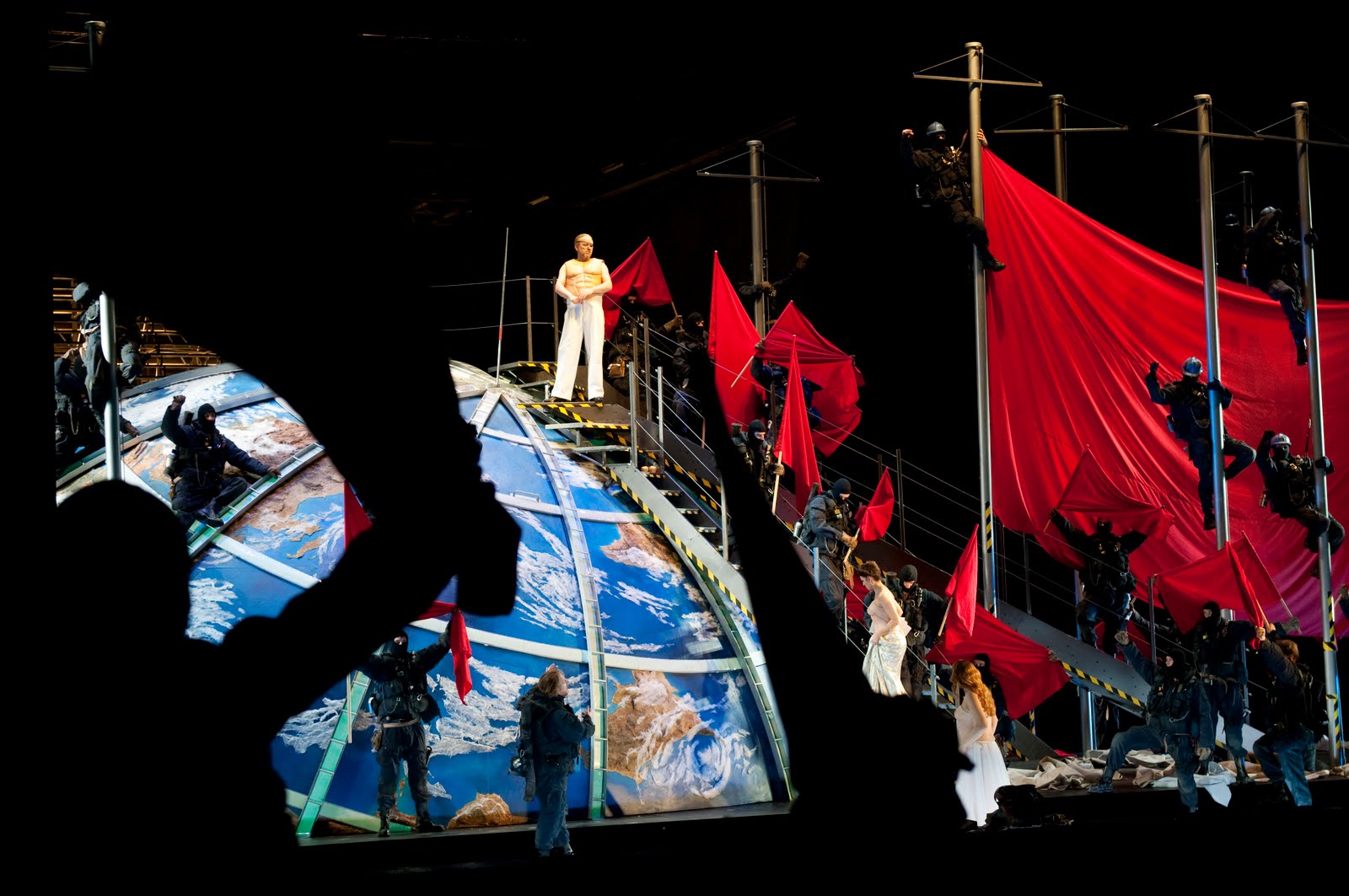
Monday, 29 March 2010

Das Rheingold, Opéra national de Paris, 25 March 2010

Images: Opéra national de Paris/Charles Duprat

Wotan – Falk Struckmann
Donner – Samuel Youn
Froh – Marcel Reijans
Loge – Kim Begley
Alberich – Peter Sidhom
Mime – Wolfgang Ablinger-Sperrhacke
Fasolt – Iain Paterson
Fafner – Günther Groissböck
Fricka – Sophie Koch
Freia - Ann Petersen
Erda – Qiu Lin Zhang
Woglinde – Caroline Stein
Wellgunde – Daniela Sindram
Flosshilde – Nicole Piccolomini

Günter Krämer (director)
Jürgen Bäckmann (designs)
Falk Bauer (costumes)
Diego Leetz (lighting)
Otto Pichler (choreography)

Orchestra of the Opéra national de Paris
Philippe Jordan (conductor)

The beginning of a new Ring will always be an event but is perhaps even more so in Paris. The Paris Opéra itself has not presented a complete cycle since 1957, reaching only as far as Die Walküre under Solti in 1976 – and even then, the company was still exclusively ensconced at the Palais Garnier, as opposed to its present day split between the old theatre and François Mitterand’s Opéra Bastille. There have been more recent performances of the tetralogy, however, at the Théâtre des Champs-Elysées and the Châtelet. The city so important to understanding Wagner, the city for which he notoriously prescribed a ‘fire cure’ and which punished him more than handsomely with the Tannhäuser debacle, has never been short of Wagnerians and has equally never been short of opponents. There is, of course, nothing more Parisian than an artistic ‘controversy’ (consider the Querelle des bouffons) or ‘case’: was Nietzsche more décadent than he knew? Perhaps surprisingly, that arch-controversialist Gérard Mortier never, during his reign at the Bastille rose to this ultimate challenge pour épater les bourgeois, but the new directorate of Nicolas Jöel and Philippe Jordan, the latter already a Wagner conductor of considerable experience, has. Das Rheingold and Die Walküre are presented this season; Siegfried and Götterdämmerung are scheduled for next.


I had felt somewhat nonplussed by earlier work I had seen from director Günter Krämer. At the 2002 Salzburg Festival, I was grateful enough for the chance to hear Strauss’s ‘cheerful mythology’, Die Liebe der Danae, still more so from the Staatskapelle Dresden and Fabio Luisi, but the production seemed to do little other than to present each act at a different stage of the work’s history: the 1944 dress rehearsal, the ‘true’ premiere of 1952, and the revival fifty years hence. Tristan, which I saw in Vienna in 2008, I found still less revealing: unobjectionable, but nothing more. By contrast, this Rheingold is really rather good: red in tooth and claw, as befits the least ambiguously socialist of all Wagner’s stage works. The staging is recognisably post-Chéreau – what could it mean to attempt to be pre-Chéreau? – and certainly shares ideas with other productions, but I see no harm in that. It generally works as a synthesis, and some of the greatest artists and thinkers have had abilities at least as much synthetic as ‘original’: for instance, Marx, who looms large here. (The programme misleads in straightforwardly describing Wagner (p.86) as ‘lecteur de Marx’. He may well have been; indeed, I should wager that he was. However, short of new documentary evidence coming to light, we cannot say for certain.) And Wagner as a thinker was certainly synthetic in tendency, if not always in achievement, nowhere more interesting than in the contradictions this might present.

Though we have seen the Rhinemaidens as ladies of the night before, the direction on stage makes this credible theatrically as well as a good idea. (I am trying not to shudder excessively at memories of the embarrassing pole-dancing experiment from Phyllida Lloyd for the English National Opera.) Alberich is a dwarf too, for those who treasure stage directions – and he certainly should be a misfit in a trivial world where one is judged solely on appearances. Krämer recognises that there is no golden age for Wagner: the composer, often even in this work a Schopenhauerian avant la lettre, presents an almost Hobbesian initial state of nature and a Fall that is anything but a felix culpa. That the post-lapsarian world is still worse than its predecessor does not detract from the latter’s amorality. Diego Leetz’s lighting works well in suggesting a Rhine of sorts. This first scene, then, seems to me a model of what Warren Darcy has called a ‘tragedy in miniature’.

I was disappointed at the abruptness of the scene shift that followed: at odds with one of the supreme examples of Wagner’s ‘most delicate and profound’ art of transition, that of Alberich’s ring into Wotan’s Valhalla. We see the site for the latter, though not of course the completed version, too early. What is being built is, with perhaps unduly heavy-handed reference to the Third Reich, GERMANIA, whose capital – in more than one sense – construction, grandiose as the drama’s conclusion, we witness as the evening progresses. Portrayal of the gods is imaginative. Their idealistic physique – muscles for the men, breasts for the women – is clearly constructed, in that they wear these, and one is intended to see that they are not ‘natural’. This certainly fits with Feuerbach’s conception, so important to Wagner, of religion alienating human qualities onto a projected godhead and thereby impoverishing life on earth. The appendages are lost when Freia and her golden apples are captured, and put back on upon her return to the fold. It is not quite clear to me, however, why Wotan does not suffer this fate. Loge, as so often, steals the show. Initially more than a little camp, the outsider, brilliantly portrayed by Kim Begley, soon throws caution to the wind as a fully-fledged drag artiste.

Nibelheim comes across well, especially its centrepiece golden globe hoard and the equally striking pendulum-like cutting mechanism that swings throughout. The wonder and tawdriness of the magic trick are presented in Alberich’s Tarnhelm transformations: we know that he is hiding behind the ball; yet we see and hear that others believe something else. Moreover, we witness the brute power wielded over the Nibelungs, since these are cowering characters on stage. Wotan’s wresting of the ring from the dwarf, one of the truly terrible moments in the cycle, most certainly is here: the violent, bloody loss of the finger realistic and prescient as Alberich’s curse itself. Then there are the giants. Initially they appear with socialist propaganda followed – this a coup de théâtre – by a threatening band of angry proletarians, who burst into the audience, dispensing red sheets, inscribed with Fasolt’s fundamental denunciation of Wotan: ‘Was du bist, bist du nur durch Verträge.’ (‘What you are, you are through contracts alone.) Not a bad agitprop slogan, and in a nice touch, Fricka peruses what seems to be a fuller prospectus of the workers’ programme. The subsequent portrayal of Fafner chills. A construction union boss, we see in the fourth scene that he is more inhuman than the gods, savagely wielding and employing his whip when duly strengthened by possession of the ring. (I could not help but think of the leaders of UNITE, drawing salaries not so very far off the executives they excoriate.) Also memorable, with attendant change of pace, is Erda’s scene, in which, clad as a Victorian matriarch, she slowly traverses the stage as she delivers her warning: simple but effective. She watches beforehand, which perhaps serves no particular purpose but, by the same token, does no especial harm.

Begley was perhaps the star performer, sardonic and with a perfect sense of timing, but the cast in general impressed. Peter Sidhom does not possess the largest of voices for Alberich, but he cleverly used what he has. Iain Paterson and Günther Groissböck clearly differentiated between Fafner and Fasolt, the vocal and scenic realisation properly increasing as the drama progressed. Qiu Lin Zhang suffered from bad intonation at her entry as Erda, but recovered with nobility. Falk Struckmann was variable as Wotan, always attentive to the words but sometimes a little underwhelming vocally, apparently pushing him to be a bit too much of an ‘actor’ on stage. Sophie Koch had something of the sphinx’s enigmatic quality to the god’s attractively sung and played consort: more interesting than something too overtly shrew-like. Marcel Reijans displayed an attractive lyric tenor as Froh. The Rhinemaidens were of somewhat uneven quality, at least in vocal terms.

Underpinning this all, however, was the first-rate orchestral contribution. The orchestra of the Opéra national de Paris sounded surprisingly – welcomely – ‘German’ in tone, doubtless in partial consequence of Philippe Jordan’s experience in German houses, not least the Berlin Staatsoper. The blend was impressive, sometimes reminiscent of Karajan’s favoured Wagner sound. This rendered the novelty – in historical terms – of Wagner’s brass writing telling, but subtly so. The only real disappointment was the feebleness of the anvils. For Jordan’s command of the work’s vast structure one could certainly forgive that. He certainly has the measure of the work’s ebb and flow, of the orchestra’s role as Greek chorus; I have heard him do nothing finer. Indeed, all told, this was the best Rheingold I have attended since Haitink’s tenure at the Royal Opera. Die Walküre is eagerly anticipated.