Showing posts with label Anja Kampe. Show all posts

Wednesday, 17 December 2025

Wozzeck, Staatsoper Unter den Linden, 14 December 2025 (centenary performance)


Production images: Stephan Rabold


Wozzeck – Simon Keenlyside
Marie – Anja Kampe
Drum-major – Andreas Schager
Andres – Florian Hoffmann
Captain – Wolfgang Ablinger-Speerhacke
Doctor – Stephen Milling
Marie’s child – Jacob Tougas Gigling
First apprentice – Friedrich Hamel
Second apprentice – Dionysios Avgerinos
Idiot – Stephan Rügamer
Soldier – Soongoo Lee

Children’s Choir of the Staatsoper Unter den Linden
Staatsopernchor Berlin (chorus director: Dani Juris)
Staatskapelle Berlin
Christian Thielemann (conductor)

One hundred years ago to the day, Alban Berg’s Wozzeck, the greatest opera of the twentieth century, received its first performance at Berlin’s Staatsoper Unter den Linden, conducted by Erich Kleiber. The composer’s proud teacher, Arnold Schoenberg, sent him a telegram the day before wishing ‘every success for the premiere’ and expressing sadness he and his wife Gertrud could not be present. Inevitable far-Right protests notwithstanding, that premiere proved a great success and the work of course went on to transform the history of twentieth-century music in general and opera in particular. That the twentieth century would overflow with great operas owed more to its example than to that of any other single work, Schoenberg’s included. Earlier that same year, one of its greatest interpreters, whose centenary we have been celebrating all year, was born: Pierre Boulez. It therefore seems doubly fitting that the Staatsoper should offer an excellent revival of Andrea Breth’s production (reviewed first here, in 2011) for the climax and culmination of 2025. 


I hope that I might, on this special occasion, be forgiven a personal excursus. (Please skip the following paragraph if not!) Many years later, this opera changed my life. It was the first I saw in the theatre, as a schoolboy who had not yet heard a note of Berg or Webern, and very little (only tonal) of Schoenberg. Travelling to Sheffield for Opera North’s visit in 1993, the experience opened up more vistas even than a Mahler symphony. Opera had not formed part of my childhood. I had only just begun to explore it, entirely from recordings, as a consequence of having fallen head over heels in love with Mozart (as yet, operatically, only Figaro, Don Giovanni, and The Magic Flute); and had still more recently begun my Wagner voyage (Tristan and possibly Meistersinger, the Ring definitely still to come). I had heard and indeed seen nothing like it, in Deborah Warner’s first production, conducted by Paul Daniel. To say that it made a great impression would be an understatement. It grabbed me by the throat and never let me go: one of the very few works one can unhesitatingly place alongside those twin lodestars of my operatic life that have never left me and indeed only shone brightrer (Mozart and Wagner). Perhaps if I had not attended that performance, invited by my music teacher, I might never have worked on opera at all; I might also never have grown to love the Second Viennese School as I do, and worked on Schoenberg (or Henze, Dallapiccola, Nono, Kurtág, and others, Boulez included). So to celebrate Wozzeck’s centenary could hardly have been an occasion fuller of meaning for me: whether music-historical or biographical. 


Captain (Wolfgang Ablinger-Speerhacke) and Wozzeck (Simon Keenlyside)

Expectations are set up to be dashed; here they were not. I shall not dwell on memories, notoriously persistent yet notoriously unreliable, of Breth’s staging, which I have written about twice before in any case. (I shall not cheat and look, at least not until after posting.) It was in any case revived here by Caroline Staunton and deserves consideration in 2025 incarnation on its own merits. What I can say Staunton and her team of skilled singing actors brought to it – at the very least I took from it, though I think it was more than that – was a stronger sense than ever of these being real people, with real, human connections between one another. It was an internal as well as an external world that sprang forth before our eyes and ears—and that connection between the two seemed, if different under a new heir to Kleiber, as strong as ever too. 


Marie (Anja Kampe), Drum-major (Andreas Schager)

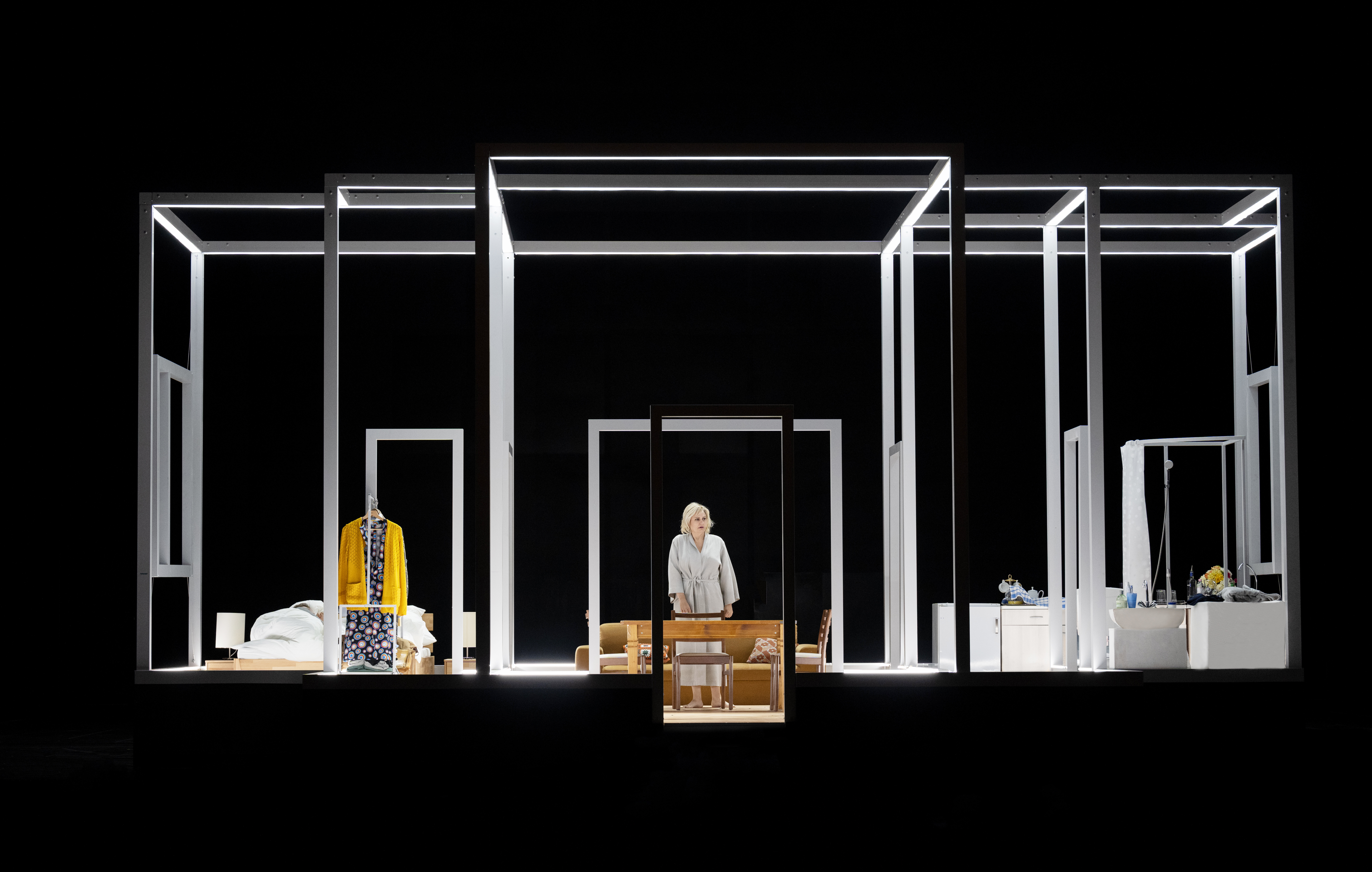
Breth’s aesthetic is realist up to a point, yet not only that—not unlike Berg and, I should argue Georg Büchner too. A sense of poverty – ‘Wir arme Leut’…’ – and wretchedness was present in enclosed sets, the room in which Wozzeck, Marie, and their child must exist as heartbreakingly abject as one could hope for: a sort of Berlin Alexanderplatz-plus (both Döblin and Fassbinder), if not in period then in something still deeper and recurring. Martin Zehetgruber’s set designs then in turn mirroring and even give the impression of helping to create Berg’s closed musical forms, which yet of course extend—both into other scenes and into the desolation of the ‘open’ lake scene (visually and perhaps also, in its D minor expansiveness, musically). These people, the poor ones anyway, are treated worse than animals and that has consequences, as we see in the joyless fornication of the tavern. And yet there is an interior life: not so banal as being mere projections of the protagonists’ torments, yet in different senses a refuge from and a creation of them. That the child in the final scene is on his own, the children’s choir singing (perhaps in his mind) from the pit does not lessen the realism but expands it with a chill still harsher than that felt by the Captain and Doctor by the lake. 

Marie, her child )Jacob Tougas Gigling), Wozzeck

Thielemann’s way with Berg’s score is strikingly different – again, with that caveat on memory – from that of Daniel Barenboim, who conducted the ever-excellent Staatskapelle Berlin on previous occasions. ‘Romantic’ is a word so stretched and overused as to verge on the meaningless, but if anything, confounding lazy expectations, it was Barenboim who proved the more so: certainly, I think, the more overtly Wagnerian. Thielemann’s approach did not neglect the longer line, but seemed more concerned with the inner characterisation and ‘life’ of those closed forms. The febrile growth and transformation of individual lines, perhaps founded ultimately more on counterpoint than harmony, could be traced in neo-Bachian fashion that was more of the time of Neue Sachlichkeit than of Berg’s youth. It is a matter of degree, of course, and neither neglected the ‘other’ side, but I recognised a tendency heard in certain lines of Thielemann’s summer Schweigsame Frau extended: intriguingly and, again a little surprisingly, closer to Boulez than Barenboim. 


Chorus, Drum-major, Wozzeck

The orchestra itself played superlatively from beginning to end, never sounding Straussian yet at the same time excelling in response to the sort of unpredictable yet ultimately coherent Strauss performances Thielemann has been giving for some time. Their stretching of time, virtuosic yet not for mere virtuosity’s sake, was unquestionably apparent here. What I believe was a swift reading overall ‘on the clock’ never felt rushed and indeed included moments of hallucinatory, post-Mahlerian near-stasis – those vistas again, both physical and metaphysical – in which shimmering colour and harmony alike brought magic to the musicodramatic moment and peered deep into the musical future. I hope we shall hear more Berg from Thielemann.


Margret (Anna Kissjudit), Wozzeck

In the title role, Simon Keenlyside brought not only a wealth of experience in this role, but something unique to this production. He sounded and even looked the Wozzeck for this moment, more broken than previously, though doubtless building on earlier performances. He seemed stunned, even stunted, by the horrors he endured, yet the flame of humanity never left him, in no small part due to his Lieder-singer’s way with the libretto—which here sounded just as intense as the score. Anja Kampe’s force-of-nature Marie perhaps lacked the last ounce of tenderness in the Bible scene, but there were unquestionable compensations elsewhere. Hers likewise was a human being brutalised yet, until the end, never defeated. Anna Kissjudit’s Margret made for a rich-toned, dramatically layered counterpart, whilst Florian Hoffmann’s Andres complemented and contrasted Wozzeck in somewhat different, yet no less important, ways. Staunton’s keen Personenregie was surely part and parcel of that, as it was in Wolfgang Ablinger-Speerhacke’s Captain, brilliantly quirky yet probably more deeply integrated into the greater company than I have previously heard. So too for Stephen Milling’s disconcerting Doctor, poised between malevolent mystery and mere quack, and Andreas Schager’s vain, frighteningly brutal Drum-major. Stephan Rügamer offered a haunting Fool. The chorus brought the rest of the world indelibly to life.

Here, then, was an opera entering its second century as harrowing, as disturbing, and as ineffably, lyrically magical, even Mozartian, as it began its first. We continue to take our leave from it, not because we have thought of nothing new since, but precisely because we have.

Thursday, 8 May 2025

Lohengrin, Vienna State Opera, 1 May 2025


Henry the Fowler – Günter Groissböck
Lohengrin – Klaus Florian Vogt
Elsa – Camilla Nylund
Telramund – Jordan Shanahan
Ortrud – Anja Kampe
Herald – Attila Mokus
Brabantian nobles – Wolfram Igor Derntl, Thomas Köber, Panajotis Pratsos, Jens Musger
Pages – Daliborka Lühn-Skibinski, María Isabel Segarra, Charlotte Jefferies, Viktoria McConnell

Directors – Jossi Wieler, Sergio Morabito
Designs – Anna Viebrock
Lighting – Sebastian Alphons
Assistant set designer – Torsten Köpf

Vienna State Opera Chorus
Extra Chorus, and Choir Academy (chorus director: Thomas Lang)
Vienna State Opera Orchestra and Stage Orchestra
Christian Thielemann (conductor)


Images: © Wiener Staatsoper / Michael Pöhn
Gottfried (member of the Wiener Opernschule), Elsa (Camilla Nylund)

Lohengrin has sometimes been described as Wagner’s ‘Italian opera’. I do not hear it that way myself, thinking rather that if such a thing were to exist, it would be with a pronounced Teutonic accent in the guise of Das Liebesverbot. For me, if one is to classify in this way at all, Lohengrin marks Wagner’s fond farewell to German Romantic opera. However, if I remember correctly, Christian Thielemann said during his time in Dresden he subscribes to the ‘Italian’ conception of the work, and for the first time, I found myself hearing it as a valid, indeed convincing reading (it not the only one). The lyricism, orchestral and vocal, of Thielemann’s reading – and there was no doubt here that this was Thielemann’s Wagner – swept along, even enveloped spectators and artists alike, not at the expense of harmony, timbre, and other musical parameters, but as arguably the guiding force in their interaction. Transitions were very much of a piece with the conception outlined in a fascinating programme note in which the conductor characterised Lohengrin as ‘Wagner’s first truly though-composed work’. 

It can be otherwise understood – arguably was by Wagner himself, in a letter to Schumann – but the point is that the conception compelled and convinced. The Vienna orchestra, which clearly adores playing with him, was not only a willing participant, but also, it would seem, an inspiration in this particular conception. I had the sense that, like a Wagner conductor of old – naming no names for now – this was his ‘Vienna’ Lohengrin, whilst his Berlin or Dresden version of the work might be quite different. Indeed, it marked quite a contrast with what I heard from him at Bayreuth in 2019, almost entirely for the better. Viennese strings glowed, woodwind spoke with a magic born in Mendelssohnian forest, yet turned somewhat phantasmagorical, and brass thrilled and threatened by turn or in tandem. This was no Bruckner orchestra-as-organ, insofar as the cap fits in that case, but there was as ever no denying the conductor’s virtuosity in leading it as an organist of sorts, less in bending it to his will as allowing wills to merge in coherent collaboration. And of course, the orchestra sounded as it never could emerging from a covered pit. 

Interestingly, it was not only Thielemann and the orchestra whom we had also seen and heard in the previous week’s Parsifal; it was the five most prominent soloists and the outstanding chorus too. Only a sharply characterised Herald from Attila Mokus had not been heard in connection with the swan-knight‘s Monsalvat father. This was quite a Wagner ensemble, by any standards, Bayreuth’s included, headed again by Klaus Florian Vogt. If Lohengrin were the role with which Vogt made his name, I felt if anything his Parsifal had proved a little stronger. This was still a tireless performance, though, with precisely the timbral quality that continues to divide opinion. Vogt can certainly act too, even when lumbered as here with a deeply unflattering wig. 


Henry the Fowler (Günther Groissböck),
Lohengrin (Klaus Florian Vogt)

Camilla Nylund’s Elsa was anything but a portrayal-by-numbers; she entered wholeheartedly into the stage concept at work here, on which more soon, initially rousing our suspicions and engaging our compassion in apparent contrition. Anja Kampe’s Ortrud was similarly complex and uniquely fiery, a portrayal very much her own, yet marking her a worthy successor indeed to the likes of Waltraud Meier (my first, at Covent Garden in 2003) and Petra Lang. Jordan Shanahan and Günther Groissböck brought both ambiguity and clarity to their roles as Telramund and King Henry. No praise could be too high for the contribution of an augmented Vienna State Opera Chorus, trained by Thomas Lang: harmonically grounded, agile on stage, and as gleaming of tone where required as the orchestra. Partners in crime, as it were—and with Thielemann too, his shading of the chorus at the close of the first act astonishingly variegated and quite unlike any performance I have heard before. 

For the somewhat odd conception, or part-conception of this new production from Jossi Wieler and Sergio Morabito was of a crime scene. Or, as designer Anna Viebrock described it in the programme: ‘We’re not telling a story of salvation, we’re making a thriller. This criminalistic perspective alone takes us way beyond the horizons of expectation.’ Since we pretty much witnessed Elsa disposing of her brother Gottfried during the Prelude to the first act, there was nothing much of a crime to be solved, and indeed everything turned out just as we might have expected. Leaving the ‘criminalistic perspective’ on one side and turning to the broader dramaturgical standpoint, there was a considerable amount to be gleaned from the ‘basic premise … [of] “Elsa did it”’. 


Ortrud (Anja Kampe)

Immediately distrusting her and Lohengrin, engaging more sympathetically perhaps with Telramund and Ortrud was an enriching experience not only dramatically but musically too, the flick of that switch having one hear not only them but at times the orchestra differently too. The broader portrayal of a time of political instability in which religion – less so, theology – appeared to take on a sinister German-Protestant hue and, needless to say, play a deeply sinister role was full of historical resonance, without being pinned down to specific reference. If the production concept seemed strongest in the first act, somewhat running out of steam by the third, the level of musical excellence was such that it was difficult to mind too much. Ultimately, here was a Lohengrin that demanded to be heard and was worth seeing too.


Sunday, 27 April 2025

Parsifal, Vienna State Opera, 23 April 2025


Images:© Wiener Staatsoper / Michael Pöhn
Parsifal (Nikolay Sidorenko and Klaus Florian Vogt)


Amfortas – Jordan Shanahan
Gurnemanz – Günther Groissböck
Parsifal – Klaus Florian Vogt
Klingsor – Jochen Schmeckenbecher
Kundry – Anja Kampe
Titurel – Ivo Stanchev
Younger Parsifal – Nikolay Sidorenko
Squires – Anita Monserrat, Juliette Mars, Andrew Turner, Nathan Bryon
First Knight of the Grail – Devin Eatmon
Second Knight of the Grail – Alex Ilvakhin
Flowermaidens – Ileana Tonca, Mariia Zherebiateva, Anna Bondarenko, Celine Mun, Jenni Hietala, Isabel Signoret

Director, designs, costumes – Kirill Serebrennikov
Lighting – Franck Evin
Assistant director – Evgeny Kulagin
Assistant designer – Olga Pavluk
Assistant costume designer – Tatina Dolmatovskaya
Video and photography – Aleksey Fokin, Yurii Karih
Fight coordinator – Ran Arthur Braun
Dramaturgy – Sergio Morabito

Vienna State Opera Chorus (chorus master: Thomas Lang)
Vienna State Opera Orchestra
Axel Kober (conductor)
 

Kirill Serebrennikov’s Vienna Parsifal, seen first in April 2021, receives a revival fully justifying the praise it garnered four years ago. Like Dmitri Tcherniakov’s Unter den Linden staging, it has a Russian quality to it, once again bringing to mind Dostoevsky (and Nietzsche’s confrontations with him and with Wagner), albeit in quite a different way. Here is not the world of the Old Believers but The House of the Dead: recalling, if only coincidentally, Frank Castorf’s move from the Ring not to Parsifal but to Janáček’s opera as a surprising, yet illuminating pendant. Well conducted by Axel Kober, in the best performance I have heard from him, with the Vienna State Opera Orchestra and Chorus, and a fine cast, this knocked spots of Bayreuth’s two recent, sorry encounters with the work written for its theatre. On a first acquaintance at least, Serebrennikov’s production marks an important contribution to Parsifal’s production history post-Stefan Herheim, whose Bayreuth staging continues, like Patrice Chéreau’s Ring, to divide others into worlds of ‘before’ and ‘after’. 

Video homes in on a remote, forest monastery, or I thought so initially. It is actually a prison. If it would be silly to say they are the same thing, the two certainly have something in common, as prison does with all manner of institutions and greater societies, all the more so when we deny that it does. As an Anglican cleric might have it, ‘we are all, in a very real sense, prisoners,’ and of course we are. Serebrennikov, notoriously, was himself when his art contravened the diktats of Putin and Russian Orthodoxy’s fascism. The way such societies constitute themselves internally and in relation to their governors is anthropologically revealing; all manner of rules, customs, comradeship, and expectations build up in complex interaction, masking, abetting, and inciting violence, increasingly so when, like all institutions, they stray from their founding purpose. Prisoners are thrown out by guards for a beating from prisoners. Gurnemanz is an intermediary, a political even, certainly at times a financier, paying a guard to look the other way. His leadership capacity involves tattooing fellow prisoners: a rite of initiation and doubtless of hierarchy too. Ritual become ritualism, as in the writing on the wall, sometimes in blood: ‘Durch Mitleid wissend, der reine Tor, harre sein’. Sometimes it takes an external intervention, a novice who does not know where he is, even who he is, to accomplish what is required—though that will be easier said than done. 


Gurnemanz (Günther Groissböck)

But that is to get slightly ahead of ourselves—not unreasonably, given the production does, presenting the first and second acts from the standpoint of an elder Parsifal, embodied in the singer (in this case, Klaus Florian Vogt), those acts’ stagework mostly – save for illuminating moments of interaction through memory – by the outstanding, highly physical acting of Nikolay Sidorenko. Violence is rife, and video enables us to home in further, observing and feeling the wounds, of which Amfortas’s is but the most egregious example, for ourselves. Like St Thomas, one might say—or like all manner of other instances, if one prefers. Kundry visits as a photographer, though one who seems also to know the rules, perhaps closer to guiding principles than others, though her photography, as becomes increasingly clear, is not only a matter of record but also of exploitation, glamourising what – and whom – should not be glamourised; such, however, is our society, and such is unquestionably the world of most of its journalism. Surveillance is part and parcel of that—and is of course an unmistakeable component of life in prison. The troubling death of another prisoner, relayed on video – though should we trust its (edited?) testimony? – equates, we think, to that of the swan. There is certainly a terrible beauty to the close-ups and a frank, border-line repellent insistence on our (homoerotic) gaze. There is ultimately no objectivity at the human level, least of all when we claim there is.

More broadly, narration may be necessary, whether via Kundry, Gurnemanz, or the elder Parsifal; yet it can, as we all know, be highly unreliable. That, as Herheim acknowledged, this has aesthetic and specifically musical implications, is clear both in Serebrennikov’s theory and practice. ‘It is Wagner's compositional and dramaturgical perspective of memory in Parsifal,’ he acknowledges, 

… from which I developed my scenic concept: An adult man of my age remembers the young man, almost still the lad he once was. For us, Wagner's music emerges from the inner movement of the protagonist and is set in the context of a scenic experimental arrangement. Parsifal is overtaken or overwhelmed by his memories, sometimes he gets lost in them. He discovers the repressed. The break in time between the first two acts and the third led me to tell the story of the mature Parsifal in a flashback, as it were, which takes us through the events of the first two acts until we arrive in the narrator's present in Act 3. In all three acts, there is what I understand to be a sacred or mystical encounter between Parsifal then and Parsifal now. It is important for me to emphasise that I have created a poetic space of memory in which - just as in our memories - there can be contradictions and in which different levels can overlap or replace each other as if in a cross-fade.

Passing of time, so fundamental to Wagner and more broadly to drama itself, is key to the unfolding of the first, most complex (here) act, as well as to its relation with the second and third. A more wholesome, more necessary ritual, that of breakfast, of breaking bread, enables its religious-theological counterpart, seemingly understood or at least capable of understanding in Wagner’s own Feuerbachian terms, to engage in that passing, to speed things up (in fruitful counterpoint, even dialectic, with the score. The latter days of Parsifal’s week of incarceration, demarcated by video, pass more quickly, then, than those at its beginning. 


Parsifal, Kundry (Anja Kampe)

At that act’s close, there is no ‘Voice from Above’; it is Kundry herself, returned to capture the moment visually, for which Parsifal has now learned to pose, flexing muscles so as to make his way in a world both old and new. Klingsor’s world, attached (even physically as well as conceptually) to that of the prison, is that of a glossy, fashion magazine: one with pretension, no doubt, that it tells a ‘story’ with its images—and indeed with the copious words seen on screen, of Kundry’s article to date. It is not finished, though, and he compels her to return to it, to continue her work with Parsifal. (And why not, one might ask; surely prison and its conditions require reporting on. Doubtless they do, but by whom, and to what end?) The Flowermaidens, part of this world and dressed accordingly, do their bit, but it is of course only Kundry who will succeed, her (Klingsor’s) exploitation of the released prisoner every bit as disconcerting, as inciting to voyeurism, as what we saw earlier on film. Stripped, ritually yet trivially, and not knowing where to turn, desperately trying to cover what is both his humiliation and his sexuality, Parsifal, now clad – captured, in more than one sense – in fresh underwear and the tightest of leather trousers, must fulfil his side of a bargain in which he does not know the stakes, indeed to which he can hardly be said to have consented in the first place. But is that not generally the case with bourgeois contracts? (Recall the runes of domination on Wotan’s spear, or the ’terms of employment’ in a hellish factory.) Parsifal, then, is reborn, in typically ‘religious fashion’, but it is sour, straightforwardly wrong. This is, after all, the ‘rose of Hell’, replete with serpent for Parsifal on film to model. The design of the black T-shirt he is eventually permitted to don doubles up as that for the headscarves of forced memories of Herzeleide. Such is the plan. In this struggle, part of which is the vain attempt of the older Parsifal to help his younger self, predestination must play its part, as always it must in narration if it is to be narration at all. 


Parsifal and Kundry

Both worlds, in any case intimately connected, come together in the third act, as they do in the work ‘itself’. In an intriguing twist, the ‘swan’ prisoner appears to come back to life, though again the question must be asked as to whether we should believe what we are told. We arguably have no choice, and that may be the problem. Rather as Christ might come down from the Cross in Gurnemanz’s narration, that is our current lot, shaped by memory and experience. In related fashion, we are reminded that performance, whatever ideological ritual-literalists may tell you, will always offer a dialectic between fidelity and infidelity. If not quite to the extent of the deeply faithful Herheim, there is also much, doubtless for many a surprising degree, that was faithful to stage direction. I cannot remember, for instance, the last time I saw an actual chalice raised on stage, yet here it i. Unless I was missing something – quite possible with so much going on, on different levels – Titurel is not seen onstage, though the recent tendency, contra Wagner, has been to render him visible.


Amfortas (Jordan Shanahan)

All this would be as naught without performers able to bring the vision to life and to contribute much of their own. Jonas Kaufmann sang the title role in 2021. It is difficult to think of an exponent – at least one who can sing it – more different vocally from Kaufmann than Vogt. Both, however, are excellent actors as well as singers, and Vogt’s compassionate retelling and participation, very much progenitor-to-Lohengrin, would surely have satisfied even his vocal detractors. Parsifal’s words – and notes – rang forth with admirable clarity and connection, their intermittent unworldliness not only a feature but a dramatically productive one. Anja Kampe’s Kundry, similarly engaged but in a very different way, was admirable too, adapting chameleon-like to changing circumstances whilst nonetheless remaining herself. Jordan Shanahan gave a rich-toned yet vulnerable, deeply human portrayal of Amfortas, ever founded in Wagner’s text. As Gurnemanz, Günther Groissböck was more active participant than often one sees and hears, but also perhaps more changed by the experience.

Kober’s musical direction likewise accentuated ‘fidelity’. It was not a reading to give rise to thoughts of ‘his’ Parsifal, as might, say, Thielemann’s or Rattle’s. There is room for both, and in reality there is a spectrum as in staging. At any rate, this gave the impression of releasing both the outstanding Vienna orchestra and Wagner’s score to do their dramatic work, alert to the latter’s melos and its demands in tandem with the staging, but also enabling them to arise. The depth of orchestral sound was a joy, though never a joy merely in itself; again, it always sounded dramatically founded. There were a few strange balances, in particular with respect to lower brass, though that may have been an oddity of the acoustic more than anything else. Choral singing was similarly outstanding throughout, a vital contributor to and participant in a drama that should – and here did – become more mysterious with every retelling.

In that, surely, Parsifal unites, whatever its heterodoxy, the human and the divine. As Janáček wrote above the score of his final drama, From the House of the Dead, ‘In every creature, a spark of God!’


Monday, 25 March 2024

Der Ring des Nibelungen, Staatsoper Unter den Linden, 18, 19, 21, and 24 March 2024

Images: Monika Rittershaus
Brünnhilde (Anja Kampe)


Wotan/Wanderer – Tomas Konieczny
Donner, Gunther – Roman Trekel
Froh – Siyabonga Maqungo
Loge – Rolando Villazón
Fricka – Claudia Mahnke
Freia – Anett Fritsch
Erda, Rossweisse – Anna Kissjudit
Alberich – Johannes Martin Kränzle
Mime – Stephan Rügamer
Fasolt – Matthew Rose
Fafner – Peter Rose
Woglinde – Evelin Novak
Wellgunde – Natalia Skrycka
Flosshilde, Siegrune – Ekaterina Chayka-Rubinstein
Siegmund – Robert Watson
Sieglinde – Vida Miknevičutė
Hunding – René Pape
Brünnhilde – Anja Kampe
Gerhilde – Clara Nadeshdin
Helmwige – Christiane Kohl
Waltraute – Michal Doron, Violeta Urmana
Schwertleite – Alexandra Ionis
Ortlinde, Third Norn – Anna Samuil
Grimgerde – Aytaj Shikhalizada
Siegfried – Andreas Schager
Woodbird – Victoria Randem
Hagen – Stephen Milling
Gutrune – Mandy Friedrich
First Norn – Marina Prudenskaya
Second Norn – Kristina Stanek

Director – Dmitri Tcherniakov
Revival directors – Lilli Fischer, Thorsten Cölle
Costumes – Elena Zaytseva
Lighting – Gleb Filshtinsky
Video – Alexey Poluboyarinov

Staatsopernchor Berlin (chorus director: Dani Juris)
Staatskapelle Berlin
Philippe Jordan (conductor)


Returning to Dmitri Tcherniakov’s Berlin Ring a year after I first saw it, it seems very much the same production: thought-provoking, amenable to almost endless further questioning, and yet, as we reach the denouement, seemingly turning aside: not, I think, or at least not straightforwardly, as George Bernard Shaw accused Wagner of having done in Götterdammerung, on account of succumbing to the ‘love panacea’, but rather from having failed to see its Konzept through. I decided this time to write a single review rather than four instalments, partly so I could make connections between the four parts more readily, not necessarily explicitly, but at least writing with the whole in min. Comparison with what went before last year, with a largely yet not entirely different cast, and a different conductor (then Thomas Guggeis, now Philippe Jordan) is both interesting and, on some level, inevitable, but I shall try to limit 2023 references, so this can be read on its own terms. (I shall re-read my reviews, here, here, here, and here, once this has been written and posted.) Whatever its flaws, this remains an important piece of theatre, and performances were of a high, often outstanding, standard throughout. If we continue to miss Daniel Barenboim, life goes on—and very well too.


Alberich (Johannes Martin Kränzle)

Set in the ESCHE research centre, with an ash appropriately enough at its centre, Das Rheingold does very well in setting up expectations for the Ring as a whole. In some though not all respects, we may safely delete ‘expectations for’. It is difficult not to think of Blake’s ‘Art is the Tree of Life … Science is the Tree of Death,’ nor indeed of the Biblical Tree of Life, as well of course as Wagner’s kindred World-Ash. For this is unquestionably the realm of science, and in the most overtly political of all Wagner’s dramas, one is led – at least I was – to consider the relationship between politics and the natural sciences: in many respects, at least since the Enlightenment onwards, a key question of political and indeed other philosophy. Hegel, notably, is the trickiest figure here, at least for those who, like Charles Taylor, find his ontology impossible to accept; but he is arguably all the more important for that. Whatever else one might say, for instance, of Marx and Engels – to name perhaps the two most important political philosophers of Wagner’s generations – they were anything but vulgar materialists. Dialectical materialism: the clue is in the name. In the following generation, Nietzsche is an equally tricky case, arguably more ambiguous (take his interest, often overlooked, in eighteenth-century materialism) than self-styled Nieztscheans. Such thinkers, and others, inform our response to this world of observation, surveillance, and experimental psychology, in which the first scene physically abuses – and watches – Alberich more thoroughly than any other I can recall. Arguably this is above all Loge’s world, the world of the instrumental reason he seems to represent: that which Adorno and Horkheimer identified as the key to modernity’s deadly dialectic of enlightenment. When Loge gestures to Wotan in the third scene of Das Rheingold that he knows all too well what is going on, but they need to continue to play the game for Alberich’s benefit, the game is truly afoot. And Wotan, quite properly after Erda’s intervention, realises something is rotten in the state of Valhalla. Following the ineffectual yet crowd-pleasing magic tricks of Froh and Donner, he remains alone, in despair, grabbing the once ‘natural’ ash tree, though it is probably too late already. No one else, though, seems to know or care. 

For perhaps the key question as the drama develops is who is in charge, who is running these experiments. It might first seem to be Wotan and the gods, yet ultimately, like serious (non-naïve, non-liberal) political philosophy in general, there seems to be something and/or someone beyond those we thought was ruling the roost. Rousseau’s problem of the Legislator returns—but so ultimately does his inability to answer the questions he set himself in The Social Contract. Questions of agency come to the fore, just as they do with respect to Wotan and his ‘great idea’, announced at the end of Das Rheingold and torn to shreds by Fricka. What are we to make, when we reach Götterdämmerung, of the institute carrying on more or less before, but with still less of an evident chain of command. Frankenstein’s monster, in politics, even metaphysics, as in philosophy? Perhaps. 

Siegmund is an escaped inmate, with a touch both of Ukrainian Zelensky and Russian Tcherniakov to him via Elena Zaytseva’s costumes, Tcherniakov’s direction, and Robert Watson’s determined yet damaged portrayal. (The Ukrainian President is, after all, nothing if he is not an actor.) This we learn via Gleb Filshtinsky’s striking video police report, which accompanies Die Walküre’s opening orchestral storm. And yet, reopening or extending questions concerning scope, authority, agency, and so forth, he is nonetheless under observation by Wotan and Fricka, a one-way mirror from Hunding’s dwelling revealing the god’s Erich Mielke-like office, from which his own brand of state security (failings pointed out unsparingly both by Fricka and, more sympathetically, by Wagner) may be dispensed. Perhaps surprisingly, given the lack of an object for the ring, there is a sword, which in this particular context imparts a sense, if not quite of playacting, then of enforced roleplay (an echo, perhaps, of Tcherniakov’s Aix Carmen).


Siegmund (Robert Watson) and Sieglinde (Vida Miknevičutė)

Forcible return of the Volsung hero to the facility proper, or to more intense observation within, is at least as shocking as, in the previous instalment, Alberich’s not dissimilar bundling off, courtesy of research centre heavies, and approaches Fafner’s horrifying gun-murder of Fasolt. Violence is omnipresent both in the Ring and Tcherniakov’s reading of it, whatever Wotan (‘Nichts durch Gewalt!’) might claim. We might also mention in that breath Wotan’s dragging a hooded – essentially imprisoned and undoubtedly traumatised – Sieglinde back to the lecture theatre, which makes the tentative steps toward childhood play and then full display of father-daughter love between him and Brünnhilde all the more moving, as did magnificent performances from both Tomasz Koniezcny and Anja Kampe.

In Siegfried, there is also much to glean and admire. The thug-orphan-hero’s smashing of childhood toys in the first act has obvious symbolism. So too has his sheer might. Intriguingly, he sees Wotan at the end of that act, through what had once seemed to be a one-way-mirror. Maybe it never was; we may just have wanted to believe that. Or perhaps it is testament to the old order and/or older generation giving way. There is room for different interpretation here. Certainly, Konieczny’s Wotan, previously the loudest – at least at his loudest – I have heard, though that is not to deny his verbal subtlety either, seemed transformed, and not only visually (though tremendous work is done there through costume, make-up, and prosthetics). This Wanderer was old, and we heard it too. So too, far from incidentally, was Johannes Martin Kränzle’s Alberich; their confrontation at the beginning of the second act was one of the deepest I can recall, as focused on Wagner’s poem as any ‘straight’ theatre performance, but with the additional intensity only music, vocal and orchestral, can bring. 

The enclosed violence of something approaching a cage-fight – a lab fight – between Fafner and Siegfried is terrible to behold, though it was a pity for Peter Rose’s Fafner, so powerful and intelligent elsewhere (a fine pair earlier with his namesake Matthew Rose, as Fasolt), to let out his final ‘Siegfried’ seemingly without any recognition of what that name might mean. The experiment on our ‘rebel without a consciousness’, as Peter Wapnewski once called Siegfried, has him gain some of that, though oddly not really fear. (Nor does he have the slightest idea who the Norns are when he passes them: perhaps a missed opportunity to depict change.) It is in the final scene that things really begin to fall apart. Much seems merely silly, the forced laughter of Brünnhilde and Siegfried grating, as if Tcherniakov can no longer bear the seriousness of Wagner’s dramas and just wishes to mock it. It prefigures similar laughter in Götterdämmerung, for instance between Gunther and Gutrune; more seriously, it prefigures the failure of that drama chez Tcherniakov.


Siegfried (Andreas Schager) and Mime (Stephan Rügamer)
 

Before, though, we turn to the denouement, let us consider the musical achievements, at least those not discussed above. Above all, there is the astonishing achievement of the Staatskapelle Berlin. I am not sure I have ever heard quite so faultless a performance, even under Barenboim. That there were a few instances of tiredness in Götterdämmerung is only to be expected; that there were so few is eminently worthy of note. Jordan’s conducting was extremely fluent, navigating the score almost as if he were Karajan. The sheer elegance of his approach will not be to all tastes, but it deserves serious consideration. Ultimately, I felt there was often, though not always, a degree or two of range lacking, and that Götterdämmerung had a tendency to drag just a little, as if tempi were slightly out of sync with the overall conception. But Jordan’s command of his forces and the sheer excellence of those forces – there was not a single vocal performance that really fell short – was testament to more than Barenboim’s extraordinary legacy, however important that may be. It was certainly the best Wagner yet I have heard from the conductor; it was also just as heartening to hear this great orchestra continue to consign any other Wagner band, Bayreuth’s included, to the shade.  

Some individual performances I have mentioned already. I cannot run through them all, but shall select some highlights. Rolando Villazón’s Loge is always likely to remain controversial, though it seemed to me to have progressed significantly from last year: less bel canto, more Rheingold dialectic. There could be no doubting his wholehearted commitment, nor his thriving on stage. That is surely more important than individual preferences for what a role ‘should’ be. Siyabnoga Maqungo made for a pleasingly lyric Froh. If I felt Claudia Mahnke’s Fricka came more into her own in Die Walküre, that is doubtless as much a matter of work and production than performance as such. She certainly lived and breathed her character’s argument and ruthlessness in its presentation, with none of the misguided recent trend to make Fricka unduly sympathetic (cheered on by commentators who clearly have little understanding of either the drama itself or Wagner’s position). Anna Kissjudit’s Erda remained essential; as with so many exponents of the role, she seems to be a singer who can do no wrong (her recent Ježibaba a case in point). That does not mean we should take for granted the deep beauty and penetrating verbal commitment of her portrayal; we should not.


Alberich
 

Kränzle’s Alberich may have been less black of tone than many, but that offered a caution against essentialism, the intelligence of his portrayal showing it is perfectly possible for an artist both to play the forger of the ring in three out of four evenings, yet also to be capable of satisfying the very different requirements of a Beckmesser. Stephan Rügamer’s Mime was every bit as distinguished, thoughtful, and similarly verbally founded a portrayal as one would expect from this fine artist: again never something we should take for granted. Vida Miknevičutė’s Sieglinde was everything one could wish for: vulnerable, yes, yet with great inner strength, blossoming and crushed according to the dramatic requirements of work and production—and René Pape’s brutal, yet beautifully sung Hunding. This is surely more his role than Wotan. 

Andreas Schager’s Siegfried continues to be a significant achievement. If Schager’s voice no longer has the freshness it once did – how could it? – his was a tireless performance, committed throughout in its attempt to show us what both Wagner and Tcherniakov asked of him. Kampe went from strength to strength as Brünnhilde, truly enlisting our sympathy, without ever playing a ‘mere’ victim’. A more distinguished set of ‘other’ Valkyries, some of whom appeared in additional roles, one would struggle to find anywhere at any time. Not only the ‘Ride’ but the crucial scene thereafter, cast from such vocal and acting strength, came to urgent, necessary life such as may only rarely be experienced. (To have such a Wotan, Brünnhilde, and Sieglinde did no harm, of course.) Stephen Milling’s Hagen was another commanding performance, and I greatly enjoyed Victoria Randem’s performance, likewise completely inhabiting the world of the Woodbird. Rhinemaidens and Norns were similarly of the highest standard.

Back, then, to Tcherniakov. It pains me to say, as a great admirer of his work in general, that the perverse achievement of his Götterdämmerung is to have made it so boring. Having seemingly run out of ideas (and/or time?) by the last scene of Siegfried, he goes through the motions here. I presume the lack of observation from elsewhere in the centre signifies something—and one can certainly speculate about what that might be. Given that it occurs before the Norns’ rope snaps, it must have happened either at the end of Siegfried or in between. I have no objection to trying to fill in the gaps; there is no reason the audience should not have to do some work too. The problem is that it becomes difficult to care. Whatever explanations one comes up with, the production seems either to repeat itself, for want of anything better to do, or introduces something arbitrarily new. No basketball so far? Why not introduce it for the hunting scene. Of course, one can argue that such sport is a reasonable masculine equivalent, but it is unprepared at best. The return of various characters, Erda (still played by Kissjudit, rather than an actor) and an elderly Wanderer included, to observe Siegfried’s funeral rites could be touching. It is certainly not an intrinsically bad idea. But amidst a host of apparently ‘new’ characters, presumably from younger generations (although the decor has not changed at all), it is all a bit confusing, even random.


Brünnhilde

I do not think I have seen a less eventful Immolation Scene, and hope never to do so. Brünnhilde really is parked, if not to bark, then to sing very well. After that, she jumps on top of Siegfried on a hospital trolley, and that is that until a final scene change to follow Hagen’s ‘Zurück vom Ring’ (from offstage). She has packed her bag – it is not quite a suitcase, I suppose, but come on… – and is heading off somewhere to be intercepted by Erda, who offers her a bird. Perhaps there was a fire after all, since the research centre seems to have vanished. For want of anything more meaningful, the words of Wagner’s so-called ‘Schopenhauer ending’ are projected for us to read. If Schopenhauer is being invoked as therapy, this must rank as the weakest, least motivated instalment of Tcherniakov’s often intriguing therapeutic turn. This, alas, seems more, not less, tired on a second viewing. One looks to do more than shrug and say ‘so what?’ at the end of a Ring, all the more so when it had started and, for the most part, continued so well. It is above all a great pity, and not in a Parsifalian-Mitleid sort of way.


Wednesday, 26 July 2023

Munich Opera Festival (5) - Tristan und Isolde, 21 July 2023


Nationaltheater

Tristan – Stuart Skelton
King Marke – René Pape
Isolde – Anja Kampe
Kurwenal – Wolfgang Koch
Melot – Sean Michael Plumb
Brangäne – Jamie Barton
Shepherd – Jonas Hacker
Steersman – Christian Rieger
Young Sailor – Liam Bonthrone

Krzysztof Warlikowski (director)
Malgorzata Szczęśniak (designs)
Felice Ross (lighting)
Kamil Polak (video)
Claude Bardouil (choreography)
Miron Hakenbeck, Lukas Leipfinger (dramaturgy)

Chorus of the Bavarian State Opera (chorus director: Johannes Knecht)
Bavarian State Orchestra
Lothar Koenigs (conductor)


Images: Wilfried Hösl
Tristan (Stuart Skelton) and Isolde (Anja Kampe)

Krzysztof Warlikowski’s Tristan, first seen two years ago, marking an end to Nikolaus Bachler’s intendancy, is on first sight at least, a puzzling affair. There are ideas, certainly, though quite how they connect, let alone cohere, lay largely beyond me. They seemed, moreover, to bear precious relation to this most treacherous of works, perhaps the most resistant of all operas—if one may call it an opera at all—to intervention from without. Its action is almost entirely interior, and directors forget (or fail to realise) that at their peril. The only production I have seen to take a fair shot at divesting Tristan of its metaphysics was Dmitri Tcherniakov’s for the Berlin Staatsoper in 2018, though I seem to have been largely alone in responding positively to its provocations—and had, I admit, to do a considerable amount of reading against the grain. 

Strange mannequins were seen first in the opening Prelude. Was there some sort of cyber-intent here? Perhaps, but if so, again I am at a loss as to what or why. A whole family of them, puppets added to the two original actors, joined Tristan at his table in Kareol. It was presumably a metaphor for something, or perhaps Warlikowski just liked the look of them. If we were entering the world of the posthuman, it was a tentative entry that appeared to be revoked. 


Isolde

Malgorzata Szczęśniak’s designs were not entirely dissimilar to Tchernaikov’s. A luxury ship, albeit in darker wood, served for the rest too, including what seems during much of the first act also to be some sort of treatment facility, Brangäne as nurse. These are damaged people, I suppose, as Christoph Marthaler at Bayreuth insisted on telling us (without saying anything else much), but who was who and why they were doing what they were doing to whom often eluded him. Quite why the Sailor, for instance, was being blindfolded and abused as he was for much of the act, before abruptly disappearing and never being seen again, I could not tell you. I liked the keen sense of the hunt, both in scene and costume design, in the second act; that framed very nicely what transpired on stage. An alternative action unfolded on film, though, in which Isolde made her way to a hotel room, eventually joined by Tristan. Whatever their motive, it was not a night of passion that unfolded, but rather a bit of pacing, sitting, and lying down. I do not think this was to send up the plot; Carry on Tristan did not seem either to be the intention or the result, but I am not entirely sure. 

The lovers were together at the end on film, having necessarily died separately onstage. (Whether Isolde dies at all should be an open question, but anyway...) I assume this was some sort of greater reality, or maybe it was ‘just’ a fantasy, though in that case, whose? For if the words Isolde sings are delusional, a sort of locus classicus of what George Steiner diagnosed –as, ironically, had Wagner and Nietzsche – as Christianity’s death blow to the tragic impulse, her ‘transfiguration’ (Verklärung) has wonders, to put it mildly, of its own. A couple lying chastely and smiling at each other on a hotel bed, having attempted suicide and perhaps (who knows?) about to die, has fewer if any such wonders to offer. I realise this may be a reference to Lars von Trier’s Melancholia, yet in itself, so what? The extraneous does little good in Tristan and, for the most part, simply gets in the way. Contemporary directors may view metaphysics with suspicion, yet to tackle this work they should do it the courtesy of treating its claims seriously before denying them. If loneliness were Warlikowski’s ultimate guiding concept, and I think it may have been, surely he cannot have been suggesting Tristan or what ‘happens’ in it offered some sort of cure?


Tristan and Isolde

Musically, we were on firmer, coherently moving ground. Eight years ago, Waltraud Meier sang farewell to Isolde  in this theatre, in Peter Konwitschny’s far more single-minded production. Anja Kampe proved every inch her successor. I have never heard anything but excellence from her; this Isolde, imperious, tender, and almost every shade in between, proved no exception. She had a grand manner when called for, but it was part of her portrayal, not a singer’s persona; words, music, and gesture were married in properly Wagnerian harmony. As Tristan, Stuart Skelton certainly had heft, yet he offered here, to an unusual extent for this role, an interiority founded on verbal detail and consequent colouring. Perhaps one missed a little of the soaring intensity of some Tristans, but one cannot have it all—and, with some, one has precious little at all. This was rare compensation. René Pape’s King Marke was as fine a performance as I have heard from him. There has never been any doubting the beauty of his voice, but the portrayal seemed to have gained depth, not only in his way with words but his mournful, steadfast stage presence too. Jamie Barton’s Brangäne was sincere, communicative, richly resonant. Wolfgang Koch’s Kurwenal offered a sardonic bite otherwise only really experienced in Kampe’s Isolde. From the rest of the cast, all roles well taken, Sean Michael Plumb’s Melot was vocally bright, even vivid, in a performance having one wish he had more to sing. Liam Bonthrone’s Sailor offered a clarity in song Warlikowski denied him conceptually.


Tristan and King Marke (René Pape)

The Bavarian State Orchestra played with a mastery born of years’ immersion in this score and Wagner in general that must have been apparent to all. There are doubtless several ways to be ‘right’ here; prescription is neither necessary nor desirable. But there was no doubting that this was one of them, the Munich strings dark yet glowing, fundamental in more than one sense to the mysterious surging of the Schopenhauerian Will. Lothar Koenigs’s quietly confident leadership of the performance proved impressive in cumulative effect. One did not notice a conductor’s personal ‘ideas’ about the score; one fancied one simply heard the score, whose power built until the end of each act left one reeling. How much more powerful this might have been with a stronger staging, we cannot know, but there was enough Wagner here to satisfy any listener.


Saturday, 20 May 2023

Wozzeck, Royal Opera, 19 May 2023


Royal Opera House

Wozzeck – Christian Gerhaher
Marie – Anja Kampe
Captain – Peter Hoare
Doctor – Brindley Sherratt
Margret – Rosie Aldridge
Drum Major – Clay Hilley
Andres – Sam Furness
First Apprentice – Barnaby Rea
Second Apprentice – Alex Otterburn
The Fool – John Findon
Soldier – Lee Hickenbottom
Tenor Solo – Andrew Macnair
Marie’s Son – Jonah Elijah McGovern

Deborah Warner (director)
Hyemi Shin (set designs)
Nicky Gillibrand (costumes)
Adam Silverman (lighting)
Kim Brandstrup (choreography)

Royal Opera Chorus (chorus master: William Spaulding)
Orchestra of the Royal Opera House
Antonio Pappano (conductor)


Images: Tristram Kenton
Andres  (Sam Furness), Wozzeck (Christian Gerhaher)


Thirty years ago, in Sheffield, a teenage schoolboy saw his first opera in the theatre. It was Wozzeck, directed by Deborah Warner for Opera North. Quite an opera with which to begin, you might say, and indeed in many ways it was, yet why would you wish to begin with something that was not ‘quite an opera’? He knew a little more, though not much, opera not having been part of his childhood or more general homelife, nor indeed of his schooling. Plus ça change… By that time, he had just begun to explore the operas of Mozart, those you might expect: Figaro, Don Giovanni, and The Magic Flute. He had also, slightly clueless, speculatively bought a reduced, ‘historic’ recording of Tristan und Isolde from WH Smith and had watched a video, kindly lent by his music teacher, of Die Meistersinger. That, however, was it. He had not yet knowingly listened to music of the Second Viennese School, though that also was suddenly about to change. It is no exaggeration to say that those hundred minutes in the Lyceum Theatre changed his life. 

From 1993 to 2023: an avid (if, born perhaps of that initial experience, selective) opera-goer travelled across another English city for the first night of a new production of Wozzeck, also directed by Deborah Warner, now for the Royal Opera. Full circle? Not really; nothing ever is. Our protagonist has, for better or worse, had numerous experiences, music, dramatic, emotional, and intellectual, since; he is certainly no longer a boy. Yet Wozzeck, which for him ever since has had at least as strong a claim as any to be the single greatest opera of the twentieth century, exerts, if anything, a still greater fascination and admiration, certainly a greater love, than it did then, born of three decades of living with it. How, then, would Warner II fare in circumstances both old and new?


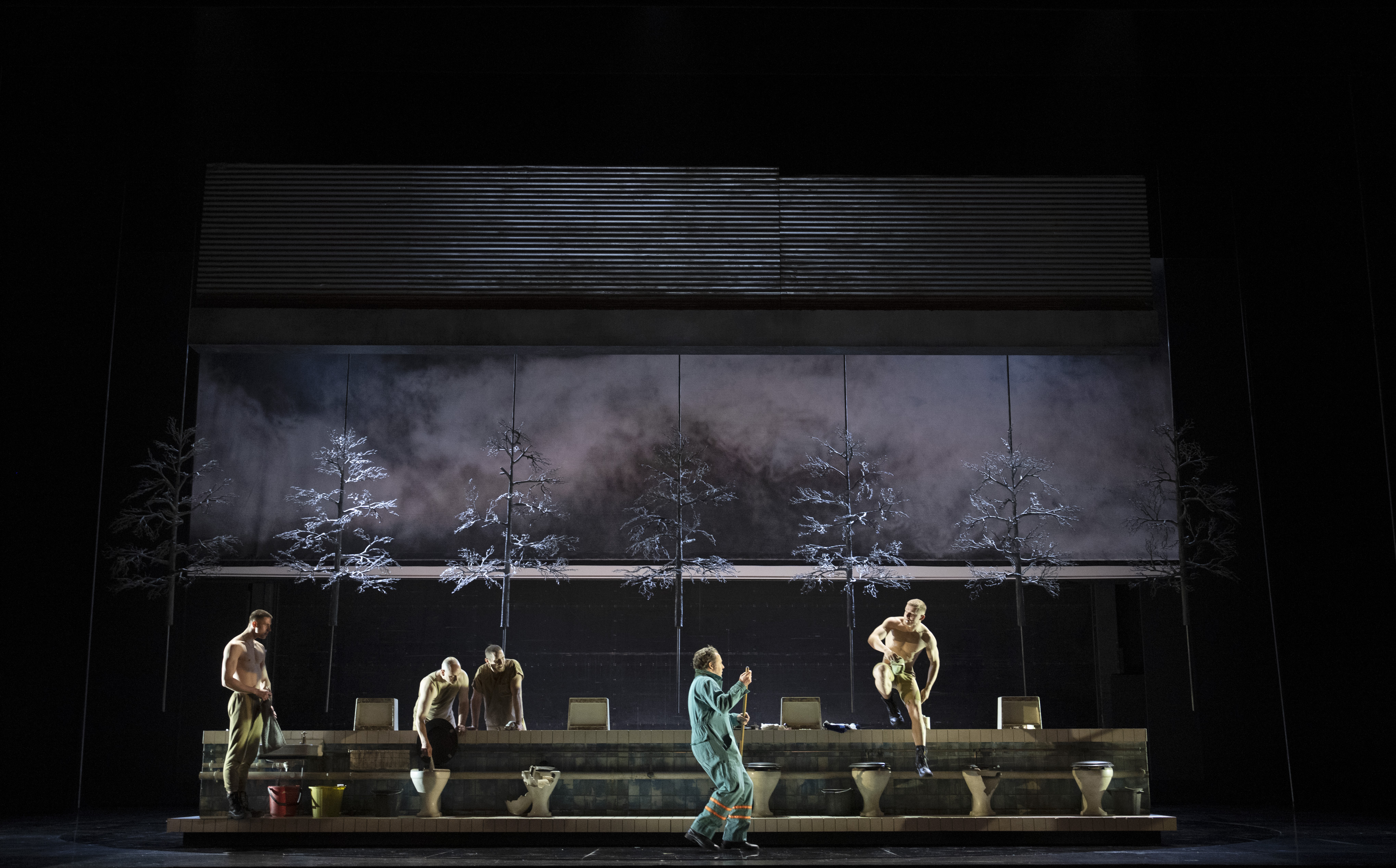
Truth be told, if you spend your time in Wozzeck thinking about a previous production or performance, something has gone wrong (either with you, what is onstage, or both). I did not. In any case, comparisons either with Warner’s first staging or with when I had previously heard Antonio Pappano conduct the work (twenty-one years ago for Keith Warner’s then-new production, in Pappano’s first season at Covent Garden) would largely be meaningless, given the vagaries of memory and my lack of a written record. Deborah Warner in 2023 does not seem to me especially to take a view or standpoint, at least not exclusively. This is not a Wozzeck that (over-)emphasises the brutality of military life and war, or expressionist experimentalism, or any one thing, though many such things are present. The action is already taking place as we take our seats, soldiers (an excellent troupe/troop of actors) relieving themselves in various ways, cleaning up, doing very much what soldiers do in barracks. That establishes an expectation of realism which is not entirely fulfilled, but rather is supplemented, so that as the action develops, as different standpoints are afforded by the work (and probably its creator), we have opportunity to take them too. Everything takes place more or less where one might expect, but there are always refreshing touches of set design, costume, lighting, or detailed Personenregie – let alone the musical performances – to enable us to take a fresh look and listen. The drama unfolds, with great immediacy, yet always it feels that this is ultimately Wozzeck rather than ‘Deborah Warner’s Wozzeck’, whether that feeling, even that possibility, be a fond illusion or otherwise. Different settings for different scenes – no fewer than fifteen of them – present themselves without fussiness or fetishisation: this is a light, enabling, generous realism that can shade almost imperceptibly into other, complementary aesthetics as required. Credit is surely due both to the design team and to the Royal Opera House’s technicians and actors, who accomplished this feat with such apparent ease. Rehearsal surely paid off.


Slightly stylised trees, Cross-like, hint at Wozzeck’s fate, albeit without redemption, but also at a natural world beyond that neither knows nor cares, yet in some sense frames tragedies that lie in stark contrast, being entirely the creation of man. There remains a Romantic desire to escape this miserable world, even if only to Berg’s family estate (Berghof) in Carinthia. Like so much else, though, it is not possible. The blood-red moon and the black, unfathomable lake dominate our vision and consciousness as natural and human boundaries. And finally, in that ultimate, heartbreaking scene of horror: the child turns to the wall in front of which the other children have just been playing, to see painted on it the news they have so cruelly, carelessly delivered. His mother is dead. He turns around and walks off, alone. The drama stops, silence cruelly denied by some idiot’s premature applause—but even that could not quite break the punch to the solar plexus. 

Much of that is, of course, a musical punch. Pappano really seems to be at his best right now. Shortly after thinking his Turandot perhaps the best I had heard from him, I found this Wozzeck at least close to equal, and in ways that surprised me. Without wishing to play that game of illusory comparisons, however tempting, I found this an infinitely more engaging experience than in 2002. Often quite extraordinary orchestral precision, for which one must of course above all credit the orchestra itself, laid bare the framework of closed forms in themselves, their multifarious musical procedures objects of an almost yet not quite Neue Sachlichkeit fascination, but also showed them to be the engines of a dramatic progression that, however Wagnerian it may often sound, is at least as much an alternative to Wagner’s method. There were wrenching, late-Romantic passages, of course, precisely where one would need and expect them, but this was also a musical drama that prefigured Hindemith, Weill, perhaps even Berg’s own teacher, Schoenberg. This was not always a Wozzeck that rose from the bass line, though sometimes it did, but it hinted more than usual at Berg’s later writing, whilst also suggesting an earlier, almost Mendelssohnian Romanticism. Like Warner’s production, it afforded different standpoints, without sounding merely sectional. 

I have been fortunate to see some extremely fine Wozzecks in those years since my first encounter (Andrew Shore on that first encounter included). Christian Gerhaher’s thoughtful, collegial approach, placing himself and his character at the dramatic hub, gaining meaning as much from interaction with colleagues as from his considered yet apparently spontaneous way with the text, has nothing to fear from any of them. His performance, worlds away, as is proper, from the beauties of his celebrated Wolfram, was yet equally well judged. Indeed, I wonder whether it heralds a new chapter in his career. For now, though, it will more than do in and of itself.


Wozzeck, Marie (Anja Kampe)

There was splendid chemistry with his Marie, Anja Kampe. I was about to say ‘we tend…’, but should really only speak for myself: I tend often somewhat to overlook the tragedy of Marie’s death, so overwhelmed am I by that of Wozzeck. Here I felt greater parity, doubtless a matter of Warner’s Personenregie but also of Kampe’s portrayal. (It is more or less impossible for an outsider to distinguish between the two.) This important corrective was brought into further relief by Anna Picard’s excellent programme note on ‘Maria and her World’, whose closing words seem very much to refer to what we saw and heard: ‘She is no Kundry. Neither is she a Judith or the hysterical Woman in Marie Pappenheim and Arnold Schoenberg’s monodrama, Erwartung. Her murder is not dressed up as a form of release for Wozzeck or a point of debate. It is simply a domestic tragedy of a very ordinary, and ever modern, kind.’ Which also brings us back to Gerhaher’s Wozzeck, for his very haplessness – what art lay in that – also contributed to that very non-release, felt (at least by me) more emphatically than I can recall.


Captain (Peter Hoare), Wozzeck

All in the cast contributed to the greater dramatic (and musical) whole, so much as to suggest unusually fruitful close collaboration between all concerned. Sam Furness’s Andres surprised me, not least because I often find myself wondering where the role went, thinking it smaller than I had expected. Not here: this was a character sympathetic to Wozzeck who yet had his own story to tell. Likewise Rosie Aldridge’s spirited Margret, whose spot in the second tavern scene almost had time stand still as the world disintegrated around her. Peter Hoare’s Captain and Brindley Sherratt’s Doctor made a sharply etched pair: guilty, yet not guilty, like all in the world we saw. Well, perhaps not quite all, for it is difficult to find any grounds to absolve the Drum Major, here given an appropriately nasty, bullying, yet finely sung performance by Clay Hilley. William Spaulding's Royal Opera Chorus was on outstanding form too. 

What, then, should a Wozzeck accomplish? There can be no definitive answer, no more than for any artwork in performance. Different productions, different performances, different audiences will all render such categorical statements in vain. If I have learned one thing over the past thirty years, it will be that. That said, if one does not emerge from a performance convinced that it is one of the greatest of all operas – ranking beyond that is a mere parlour game – it will have been in vain. My first experience was not; nor, emphatically was this: a searing and strangely refreshing Wozzeck, which I hope and intend to revisit soon.