Showing posts with label Wieland Wagner. Show all posts

Friday, 6 January 2017

Richard Wagner and Pierre Boulez's Conception of Opera


Yesterday marked the first anniversary of the death of Pierre Boulez. The 'Opera and Musical Performance' forum of the Modern Languages Association hosted a panel on the day. I was delighted to be invited to speak; here are my (all too brief) thoughts.


Musical history – indeed, artistic, and most other forms of history too – is littered with great things that did not, perhaps could not, happen. Those of us who survived 2016 need no reminder of that. Pierre Boulez was not, of course, one of those, and his death, arguably the first of that year’s great litany of deaths, one year ago to the day, seemed to many of us not just another, but one of the most significant, in the many deaths of musical modernism(s).


Three performative great non-occurrences were works he said, on more than one occasion, he wished he had had opportunity to conduct: one by Mozart at his most musically radical, Don Giovanni,  whose harmonies often reach towards Wagner, and whose metrical dislocations reach beyond, even to Stravinsky; one by Mussorgsky, his great Pushkin epic, Boris Godunov, the best of operatic realism and thus perhaps that century’s greatest challenge to the Wagnerian world of myth of which the young Boulez stood highly suspicious; and Boulez’s one missing mature Wagner ‘music drama’, Die Meistersinger (about which he nevertheless would have several interesting things to say).[1]  More important still, one of the most fabled exhibist in the museum of imaginary musical works remains an opera, or any sort of music theatre piece, written by Boulez himself. I shall leave open – like many of his Mallarmé-inspired musical forms – whether that were in itself significant. To any of us steeped in Adornian negative dialectics, it almost certainly will be; but that will not be the principal focus of what I have to say. It is an unanswerable question, yet one that never ceases its demand to be asked: not unlike whether Wagner would, as he claimed, have turned from opera to symphony after Parsifal, or whether Schoenberg’s unfinished operatic masterpiece, Moses und Aron, were by its very nature impossible to complete.


I mention those two predecessors not least since they loomed so large in Boulez’s operatic, and more broadly musical, canon. Few were the operas he conducted which in some sense did not relate to that particular, central (and central, in large part thanks to him) conception of modernism. The quintessential composer of the anti-modernist box-office, Verdi, for instance, received short shrift as ‘stupid, stupid, stupid’. Nineteenth-century Italian operatic composers repelled him for their ‘vulgarity’. Puccini, a more sophisticated composer, remained ‘so easy to understand, and that’s never very interesting, at least not to me.’ Boulez’s first opera as a conductor, Rameau’s Hippolyte et Aricie, in a 1964 Paris concert performance, remained an outlier, Boulez admitting to finding its style ‘dated’, but its tragedy, not mythology, ‘together with the choruses and great flexibility of the construction’ the ‘most interesting part’. Commenting that he loved ‘composers who construct their music,’ he met with a reply from Messiaen, also present at the interview: ‘Basically, you have very French tastes,’ a double- or perhaps triple-edged, response, if ever there were one. A still greater rarity, a 1973 abbreviated version of Haydn’s L’incontro impovviso, again in concert, in New York, would also remain an outlier. Haydn was always central to Boulez’s ‘earlier’ repertoire, yet sadly, his operas have never been central to anyone’s, with the exception of Antal Doráti, and possibly the composer himself. It was, though, with Berg (Wozzeck in 1963) and then Wagner that Boulez’s operatic career began in earnest, in the theatre. His 1966 Bayreuth collaboration with Wieland Wagner on Parsifal proved quite a turning point. Boulez’s Wagnerian theatrical career would close with Parsifal too, in 2004 and 2005, with a new staging, by Christoph Schlingensief. The small matter of the ‘Centenary Ring’ with Patrice Chéreau, what Boulez called his ‘most ear-splitting intrusion into the Museum’, would come in between. Boulez would also conduct all four of Schoenberg’s operas, in the theatre and in concert, almost staggeringly – and very much as part of his role as modernist advocate – recording Moses und Aron twice.


There was something in particular, though, about Wagner for Boulez – as indeed there has been something in particular about him to many others, from Liszt and Nietzsche, to lesser figures such as yours truly. ‘The difference between Wagner and the rest of the nineteenth century – as far as opera is concerned,’ he said, was that Wagner’s works ‘have such depth that one can return and be enriched each time.’ What, though, did that mean?


One important aspect, which requires far more study, is musical influence, or perhaps better, inspiration. The idea of the signal, crucial to many of his musical works, and which he discussed in one of his Leçons de musique, given at the Collège de France, found an important earlier predecessor – he also mentioned Bach, Berg, and Bartók – in Wagner’s use of leitmotif, specifically when a motif appeared isolated and unaccompanied. For instance, we might think of Wotan’s ‘great idea’ at the end of Das Rheingold, in which we hear the sword motif for the first time, before it has even been forged, let alone reforged. Wagner’s and Boulez’s musical languages are, of course, entirely different. Nevertheless, Boulez remarked that his work on Wagner – and Mahler – during the 1970s enabled him to write differently thereafter, for insistence on the orchestral version of his Notations – fated, or liberated, like so much of his œuvre, to remain a ‘work-in-progress’.


There is also no doubting the transformation with respect to his conducting. When I last heard him conduct Pli selon pli, in London, in 2011, I reflected:
… alongside the [definitive] revisions, it is equally interesting to note Boulez’s transformation of approach as a conductor. His reading certainly does not lack bite, as the ejaculating éclat of both opening and closing chords made clear, but the sonorities seem to have become still more ravishing. More than once I was put in mind of his recent conducting of Szymanowski, and of course his increasingly Romantic approach to the music of the Second Viennese School. For all Boulez’s talk of having devoted too much of his life to conducting, it has clearly enriched his compositional life so greatly that there really are no grounds for such regret and, once again, we heard a conducted performance that was more new composition in the light of recent experience than mere presentation of a work from the museum. (That, by no means incidentally, holds as much for his Wagner and Mahler, his Berlioz and Debussy, as for his own works.)

Composition and performance were never separate categories for him: something many critics – in the hostile as well as the more elevated sense – persistently failed to understand.


Such matters are not, however, my principal concern here. Just as his work as a conductor – a world into which he had stumbled in order to present earlier-modernist classics in performances of sufficiently high quality so as to vanquish counter-productive if well-intentioned quasi-amateurism – and his compositional work were not readily to be distinguished, nor was his broader significance not only as a polemicist, although he was certainly one of the best, but also as an educator. And in that, I think, he learned from and grew sustenance from, Wagner and his conception of opera, or rather music drama. ‘It was,’ Boulez wrote admiringly, ‘the search for a total solution that was the real passion of Wagner’s whole existence and provided the justification of even its most ambiguous and unacceptable aspects. We can watch him gradually defining his musical objectives and determining his line of conduct with growing precision, see the progressive inclusion of all his intellectual and artistic interests in a world essentially circumscribed by music.’ Wagner offered a new conception of theatre, which his own festival theatre, Bayreuth, somehow, despite its unfortunate – to put it mildly – history, had managed to rekindle under Wieland Wagner, and has, sporadically yet undeniably, continued to rekindle under successor directors. It seemed to Boulez almost a unique example of what opera, a genre, which he, like his avant-garde confreres, had held in suspicion, if not downright derision, might yet achieve, perhaps even an indication of what that never-to-be Boulez opera might have offered.
 

Like the actually existing society, perhaps especially the actually existing musical society, of the 1960s, 70s, and beyond, Wagner’s own Germany, and beyond it Europe and the world, had failed to heed his necessary message. ‘Although Bayreuth had a brilliant start,’ Boulez wrote,
... with all the aristocracy of the day in attendance, it was silenced from 1877 to 1882, and this left Wagner even more perplexed than bitter. … The society on which he wished to confer a unique identity amused itself for a while with this curiosity and then forgot it, until by a series of misunderstandings, his work was made the narrow, limited symbol of nationalism and racialism. 
Wagner’s work, however, ‘continues to exercise its fascination, for that is what it is: a work – and a theatre.’ What of that theatrical innovation?
This is a field in which Wagner has proved to have almost completely failed. His diatribes, written more than a century ago, are still completely relevant, for nothing has changed – the laziness of the repertory theatre, its failings, its precarious functioning, the blind choice of works, the fortuitous casting of singers and players, the lack of rehearsal, the sauve-qui-peut routine. Architecturally speaking, the Bayreuth model, [that is a simple Greek amphitheatre, with a covered pit] has remained a dead letter and we still have Italian-style theatres, ...
... in which so many cannot even see the stage, although they can doubtless see those in the audience they are intended to see. ‘The proportions,’ he continued,
... of these buildings have been disproportionately enlarged in order to accommodate orchestras that continue to grow in size. From the other side of this giant swimming pool – where it is possible during a performance to watch the family life of the orchestra – singers do their best to get through the wall of sound encountered by their voices: and the vanities involved in this contest give rise daily to very questionable, if not disastrous results. Both visually and acoustically, we continue to witness this permanent defeat of what is truly theatrical, Bayreuth having effected not the slightest improvement.'


With that in mind, we might turn to a notorious, earlier interview (1967), with Der Spiegel. Like so many things ‘everyone knows’, the one thing ‘everyone knows’ about this interview is wrong. Boulez did not call for the opera houses of the world to be blown up, although he might well have been following in the footsteps of Wagner, the socialist revolutionary and friend of fabled pyromanic, Mikhail Bakunin, if he had done. And so, the Swiss police who, in the aftermath of 9/11, arrested him in a dawn raid upon his Basel hotel in December 2001, for alleged terrorist intent a generation later, had perhaps not read the article properly either.[2] What Boulez, rather more playfully than Wagner, yet undoubtedly in his tradition, actually said was:
New German opera houses certainly look very modern – from the outside; on the inside, they have remained extremely old-fashioned. To a theatre in which mostly repertoire pieces are performed one can only with the greatest difficulty bring a modern opera – it is unthinkable. The most expensive solution would be to blow the opera houses into the air. But do you not think that that might also be the most elegant solution?


With a refusal to abide by the repertory system – whose uncaring, inartistic side had recently been frustrating Boulez in a Frankfurt revival of Wieland Wagner’s Wozzeck – Wagner offered the example of refusal to abide by the day-to-day rules of compromise, who may not have been taken up enthusiastically by all and sundry thereafter, but who had succeeded magnificently on his own terms, at least for a while, and who had continued to do so again. For it was Wagner who loomed largest in angry arguments concerning so-called Regietheater. It still is, in many ways, when one thinks of Frank Castorf’s recent Bayreuth Ring. What Boulez might have wanted in projected collaborations with Jean Genet (he died too soon), Heiner Müller (he also died too soon) and Edward Bond (a possibility remaining just at the stage of reading, for ‘I’m a bit superstitious about looking for a third candidate’) will always remain obscure. It might nevertheless offer us a utopian – both in a positive and negative sense – view of what future operatic endeavours might achieve. The possibilities of Japanese theatre, of masks and puppets) not for nothing did he, in 2003, turn to Manuel de Falla’s Master Peter’s Puppet Theatre (‘El retablo de Maese Pedro’) intrigued him. He also wanted something in which the musicians and indeed the conductor would be part of the theatrical action, very much, one might say, extending and acting upon Wagner’s experimentalism, albeit in ways his neo-Romanticism would never have conceived of – and, if it had, would doubtless have rejected. ‘Musically,’ Boulez said in a 1996 interview, ‘there is much of interest in the operas of Berio and Birtwistle, perhaps Zimmermann’s Die Soldaten too. But I don’t see that any of these are pushing forward the frontiers of theatre, and that’s the possibility in opera that has always interested me.' Like Wagner, Boulez wanted to use music to push, even to destroy, theatrical boundaries; like Wagner, he was, I suspect, just as aware, that such efforts would also push, even destroy, musical boundaries. Wagner’s insistence upon subordinating ‘music’ to ‘drama’ had only intensified the power and radicalism of his music; Boulez might have done, certainly would have wished to do, likewise.


Following the first performances of the Ring in 1876, Wagner told his performers, ‘Kinder, macht Neues!’ Dissatisfied with the inadequacy of his realisation, he told them that they must do it differently next time, an exhortation the composer’s would-be ‘protectors’ have always ignored. Still more dissatisfied with the inadequacy of his attempts, Boulez exhorts us to do the same. We may understand that in as banal or as strenuous a fashion as we like. Perhaps, though, we should be best off understanding it in a fashion akin to his Ring collaborator, Chéreau, when working on the Immolation Scene to Götterdämmerung. Opera, perhaps, might be like Wagner’s orchestra pit, itself:
...like Delphi’s smoking pit, a crevice uttering oracles … The redemption motif is a message delivered to the entire world, but like all pythonesses, the orchestra is unclear, and there are several ways in which one might interpret its message. … Should one not hear it with mistrust and anxiety?
That may or may not have been Wagner’s Wagner, but its modernist indeterminacy was Boulez’s Wagner – and, in an age such as ours rightly still suspicious of totality, it should probably be ours too.


[1] Plans for a Don Giovanni, a Boris, and a Ring, all with Wieland, came to nothing on account of his death in 1966.
[2] Although see NYT, Alan Rider, 7 December 2001: ‘Astride Schirmer, Mr. Boulez's spokeswoman in Paris, said that in 1995, a Swiss music critic who had written a scathing review of a concert by Mr. Boulez received a threatening telephone call that included references to bombs. “The person who called may have said he was Mr. Boulez,'' Ms. Schirmer said. ''It was evidently a joke in extremely bad taste, but the critic reported it to the police, and Mr. Boulez's name was entered into their files.''’

Saturday, 6 August 2011

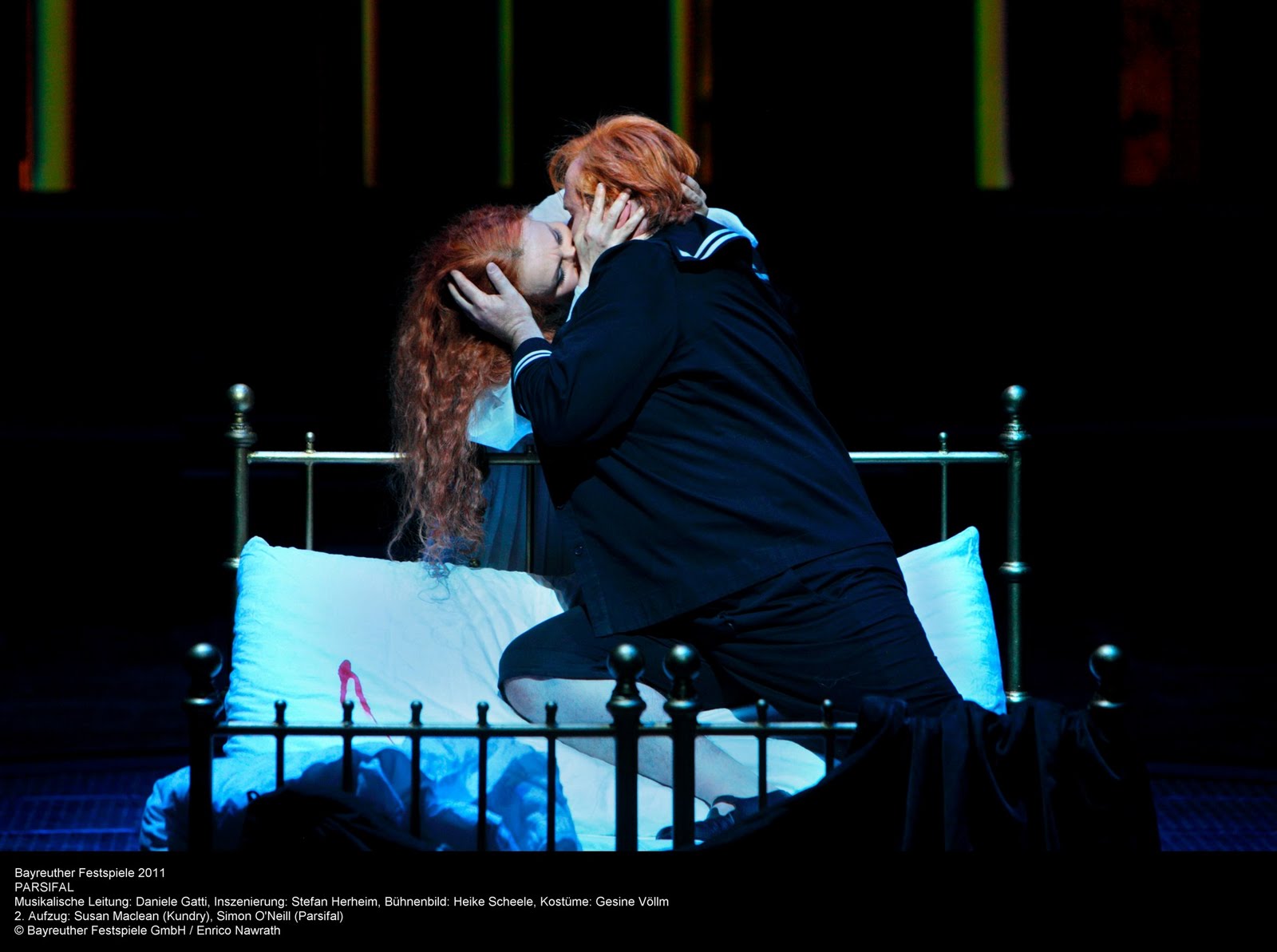
Bayreuth Festival (4) - Parsifal, 3 August 2011

Festspielhaus, Bayreuth

Amfortas – Detlef Roth
Titurel – Diógenes Randes
Gurnemanz – Kwangchul Youn
Parsifal – Simon O’Neill
Klingsor – Thomas Jesatko
Kundry – Susan Maclean
First Knight of the Grail – Arnold Bezuyen
Second Knight of the Grail – Friedemann Röhlig
First Squire – Julia Borchert
Second Squire – Ulrike Helzel
Third Squire – Clemens Bieber
Fourth Squire – Willem van der Heyden
Flowermaidens – Julia Borchert, Martina Rüping, Carola Guber, Christiane Kohl, Jutta Maria Böhnert, Ulrike Helzel
Contralto solo – Simone Schröder

Stefan Herheim (director)
Heike Scheele (set designs)
Gesine Cöllm (costumes)
Ulrich Niepel (lighting)
Alexander Meier-Dörzenbach (dramaturgy)
Momme Hinrichs, Torge Møller (video)

Bayreuth Festival Chorus (chorus master: Eberhard Friedrich)
Bayreuth Festival Orchestra
Daniele Gatti (conductor)


Should one cross the same river twice? Could Stefan Herheim’s – and Daniele Gatti’s – Parsifal possibly match up now to my first-time experience in 2008? (See also Per-Erik Skramstrad’s review from the same festival.) As with the Boulez-Chéreau ‘Centenary’ Ring, one of the few opera DVDs I find persistently engrossing, the answers are ‘yes’ – and triumphantly so. It appears almost mandatory to voice a cavil, and I have a small one, so shall get it out of the way now: there are sections of the stage direction that have been relatively simplified. In most cases, that tends to be good: a removal of clutter helped Keith Warner’s Royal Opera House Ring upon its second outing. Yet there was no clutter in Herheim’s Parsifal. Complexity, yes, but this is a complex, in many respects quite Hegelian, work, with an equally complex history; Herheim’s genius, not a word I use lightly, was and is to tell the story of both, and that includes the score, the director’s musicianship and belief in music’s redemptive power no more in doubt than his stagecraft. The first half of the third act now looks for the most part surprisingly ‘traditional’, not that it did not incorporate and develop tradition, but I slightly regret the thinning out. (Some commentators thought first time around that too much was going on, that Herheim should have concentrated on but a single line; that seemed to me to miss the whole point of his production.)

I do not intend to give a full account of the production, since that would doubtless try readers’ patience beyond endurance, and much can already be read in the two accounts I mentioned above (mine and Per-Erik’s). What I should like principally to do is to talk about some points that especially captured my intention on this particular occasion. However, it is worth briefly mentioning the broad thrust, or rather thrusts. We witness, not so much in parallel, but inextricably interlinked, as faithful a telling of Parsifal as one is ever likely to find – at least for anyone interested in Wagner’s meaning and dialectical thinking rather than fetishisation of incidental matters of costume – and a perceptive retelling of the course of German history from the time of the first performance until the present.

The metamophosis of the first-act’s Wahnfried into Siena Cathedral and back again is subtle and yet telling enough; but note that the pillars of both remain, transformed, in the field hospital of the Flowermaidens, as directed by Klingsor as Cabaret Master of Ceremonies. (Transvestite show-business is an obvious career path for the self-castrated, not unlike the castrati of old.) Herheim’s turning the mirror on the audience not a gimmick, but an invitation, indeed an incitement, to question everything we have thought. ‘Educating Parsifal’ is also ‘educating Parsifal’, and is also ‘educating us’, not in a didactic fashion but as part of a drama in which we would be fools not to participate. (Some such fools booed; another, astonishingly, asked during an overheard interval rant, ‘Why can’t it be like the Met?’) As Tristan tells King Marke, 'das kann ich dir nicht sagen; und was du frägst, das kannst du nie erfahren.' In the almost overwhelming emotional context Herheim has developed, as opposed to the abstraction of a mere act of reporting, it would be an unimaginative soul indeed who did not accept the mirror’s invitation. Identities are blurred, or better enhanced, by the play conducted not only between these two stories but also between characters: Parsifal, at various stages from baby to old man, with Amfortas – compassion or fellow-suffering (the German, Schopenhauerian Mitleid, suffering with) indeed; or Kundry and Herzeleide, whose childbirth and troubled, necessarily incestuous relationship – is any act of parenting not? – with Parsifal is worked out with Parsifal’s own education and reversion. Wagner’s anticipations of Freud have never seemed so clear as in the second-act congress with Herzeleide-Kundry. The visual motif, both on stage and on film, of Kundry as Rose of Hell – Klingsor’s ‘Urteufelin, Höllenrose!’ – guides that educative process, taking Parsifal beyond Tristan’s Nietzschean ‘voluptuousness of Hell’ and renewing in itself in the malevolence of Wagner’s Bergian chromaticism. The near-identity of Kundry and Parsifal, Christ-like, albeit Amfortas-Christ-like, at the beginning of the third act, brings us as close as we come, or indeed Wagner comes, to Christianity: helping the stricken, after the Sermon of the Mount. And those stricken in this context are the female victims of war and its aftermath, that is of one of the most violent struggles yet thrown up by the accumulation of capital and, as Adorno and Horkheimer would have it, the dialectic of Enlightenment. This is, as Per-Erik Skramstad has pointed out, a definite hommage to Götz Friedrich’s Tannhäuser : Herheim studied with Friedrich, another rare example of the musician-director.

One might have expected the electricity to wane in the second-time viewing of such coups de théâtre as the unfurling of swastikas at the destruction of Klingsor’s castle – and of Weimar – as a brown-shirted boy, perhaps Parsifal reincarnated or perhaps not, implies, incorrectly as it would turn out, that tomorrow will belong to him. Not at all: if anything, the electricity was enhanced by expectation. (We do not, after all, stop listening to Parsifal once we know what happens next in the plot.) The families gathered around beforehand for departure make their point chillingly. I could not help but think of the chasm between Herheim’s intelligence and the dreadful ‘Holocaust as entertainment’, The Producers without comedy, of Terry Gilliam’s recent Damnation of Faust. Gilliam boasted of his ignorance of Berlioz’s life and thought; Herheim, from the tying of individual movement to Wagner’s phrasing, to the broadest conceptual sweep, shows his understanding of Wagner and his reception.

Amfortas – and the Federal Republic – on trial in the Bundstag remains a potent, terrifying image following the Third Act Transformation Music. The opening of Titurel’s coffin, draped in the flag, elicits mass revulsion not only on stage but, more importantly, in the audience. (There are musical reasons for that too, to which I shall return.) The monochrome contrast, moreover, with the warmth of Ulrich Niepel’s springtime lighting for the Good Friday Music, tells its own story. Christian charity has been replaced by politics, just as the Wagner brothers’ (Wieland and Wolfgang) post-war request, that political discussion desist on the Green Hill, shown here during the Transformation Music without comment, could not have been more of a political act had they too emblazoned the stage with swastikas. The video wall built up during this scene around Wagner’s image – perhaps also an echo of Wieland’s Bayreuth wall, on whose other side lay his mother, Winifred? – is the very same wall constructed every day by those who, after Otto Schenk, wish only to see fairy-tales of knights and dragons, wilfully deaf to the words and music of Richard Wagner.

Some have complained that Daniele Gatti’s masterly pacing, slow by the clock for those who care about such things, worked against the dramatic urgency of Herheim’s staging. My experience was quite the opposite. By giving time for the drama to unfold, whilst never – I repeat never – failing to maintain the line of Wagner’s melos, Gatti presented the orchestra very much in Wagner’s Opera and Drama image of the Greek Chorus. Moreover, there was nothing unvaried about his approach. There was violence, and a nasty violence at that, in the Flowermaidens’ Music, stage images of Weimar cabaret turned sour enhanced, indeed seemingly built upon, an integrated understanding of Wagner’s harmony and colouring that foretold Schoenberg’s Golden Calf Orgy (Moses und Aron). On the other hand, the luxuriant decadence – or Nietzschean décadence? – of Kundry’s seduction spoke of Berg and Mahler. It is surely no coincidence what a fine conductor of Mahler and the Second Viennese School Gatti has proved himself to be. I mentioned above the revulsion on stage as Amfortas opened Titurel’s coffin. That was as nothing compared to the Mahlerian, indeed Schoenbergian (think of the Five Orchestral Pieces, op.16) horror Gatti screwed up in the pit. This was an exemplary collaboration between conductor and director.

What of the singers? Simon O’Neill’s Parsifal was a grave disappointment. Such is the strength of Herheim’s production – and Gatti’s conducting – that the meaning absent from O’Neill’s delivery of the text could in general be supplied elsewhere, but there was nowhere to hide when it came to the unpleasant, thin yet shouted tone production. (It was nowhere near as bad as John Treleaven’s unbearable Siegfried and Tristan, but seemed to be moving in that direction.) Christopher Ventris was superior in every respect in 2008. Susan Maclean, by contrast, was a revelatory Kundry. I have admired Maclean in the same role before, in Leipzig (twice). Here she showed the difference between a dutiful, for the most part well-sung, yet hardly seductive, portrayal (Mihoko Fujimura last time around) and one that truly engaged with the production as living musical drama. This Kundry repelled and seduced, shrieked and consoled, provoked and served. The production might have been made for her. Thomas Jesatko remained an excellent Klingsor, revelling in his kinky sleights of hand. The agonies of Detlef Roth’s Amfortas were searingly portrayed: his was a performance that made one feel not only the unsparing nature of Amfortas’s wound, but the lyrical, almost Schubertian possibilities of a future that never came. We need to believe that Amfortas’s life could have been different, and we did. Sad to say, Kwangchul Youn’s Gurnemanz proved at best variable, wideness of vibrato and occasional hoarseness never compensated for by the outsize personality artists such as Sir John Tomlinson can still bring to the role. The Flowermaidens, however, were excellent: I am sure that we shall hear more of many of them. And the choral singing was superlative, as weighty and clear as in Tannhäuser and Lohengrin: congratulations once again to the Bayreuth Festival Chorus and Eberhard Friedrich. This was not a perfect cast, then, though one could hardly have asked for more from Maclean, Jesatko, and Roth, nor from the chorus. But crucially, nothing detracted from the overwhelming force of Herheim’s and Gatti’s vision. There was no doubt, moreover, about the final redemption: it was of, for, and through Wagner’s miraculous score, ‘lit from behind’. Even if one thought Parsifal stood in no need of redemption, one realised that work and audience had been blessed.

Four requests:

1. Bayreuth: to release this production on DVD. It is a milestone not only in the staging of Parsifal but of opera tout court.

2. Stefan Herheim: to stage Die Frau ohne Schatten and Die Soldaten, works crying out for such musico-dramatic attention.

3. The Royal Opera (with apologies to readers, should this sound unduly parochial): to engage Herheim and Gatti to present a Wagner work at Covent Garden. (And no, Les Vêpres siciliennes, in which Herheim is posed to make his London debut, will not do.)

4. Bayreuth: to persuade Herheim to direct its next-but-one Ring.

Thursday, 19 August 2010

Salzburg Festival (4) - Elektra, 16 August 2010

Grosses Festspielhaus


(Images: © Hermann und Clärchen Baus. The Elektra shown is Iréne Theorin, not Janice Baird.)


Klytämnestra – Waltraud Meier
Elektra – Janice Baird
Chrysothemis – Eva-Maria Westbroek
Aegisth – Robert Gambill
Orest – René Pape
Orest’s Tutor – Oliver Zwarg
Young Servant – Benjamin Hulett
Old Servant – Josef Stangl
Overseer – Orla Boylan
First Maid – Maria Radner
Second Maid – Martina Mikelic
Third Maid – Stephanie Atanasov
Fourth Maid – Eva Leitner
Fifth Maid – Anita Watson
Confidante – Arina Holecek
Trainbearer – Barbara Reiter

Nikolaus Lehnhoff (director)
Daniel Dooner (associate director)
Raimund Bauer (set designs)
Andrea Schmidt-Futterer (costumes)
Duane Schuler (lighting)
Denni Sayers (choreography)
Martin Kern (video)

Concert Association of the Vienna State Opera Chorus (chorus master: Thomas Lang)
Vienna Philharmonic Orchestra
Daniele Gatti (conductor)


Elektra was the fourth and final of my Salzburg operas in 2010. Despite the virtues of the preceding three, Strauss’s greatest opera indubitably received the best performance and production of all. Given the cast, conductor included, I had suspected that it might, but expectations can all too often be confounded. Not so here. Whilst the Vienna Philharmonic Orchestra, a jewel in Salzburg’s crown second only to Mozart himself, proved excellent in all performances, I was simply astounded by its contribution on this occasion. Playing for a conductor it loves, such as Daniele Gatti, it remains without a shadow of doubt the finest orchestra in the world. The sweetness of string tone is one of the wonders of the world, likewise the mellowness of its horns and trombones; I could go on, and probably should… But what was especially striking here was its willingness to respond to the brazen modernism of Gatti’s reading. Greatly experienced not only in Mahler but also in Berg and Schoenberg – I recall a stunning Moses und Aron in Vienna – Gatti married the quintessential Vienna sound to savagery of attack and a revelatory orchestral phantasmagoria, which made one wonder why Strauss spoke so dismissively of Schoenberg’s Op.16 orchestral pieces. And yet, whilst I  may never have heard Strauss sound so close to Schoenberg, he never actually sounded like Schoenberg. The composer’s voice sang through, not least in the swing of his dance rhythms, in the kaleidoscopic intimations of Der Rosenkavalier, and in the soaring lyricism that even here foreshadows the composer’s fabled ‘Indian summer’. Gatti heard, and the VPO played, with a structural command that would surely have impressed Furtwängler: heard in one gigantic breath, this was Fernhören indeed.


I admit that my heart sank when it was announced that Iréne Theorin had succumbed to the filthy weather Salzburg was experiencing, confined to her bed with a sore throat. Janice Baird had responded to a telephone call the previous day, leaving her holiday in southern Spain. Carping excessively, there were occasional odd vowel sounds – her opening ‘Allein’ incorporating one of them – but otherwise, one would never have guessed that she had not been giving an acclaimed performance all the way through the run. This is, by any standards, a killer of a role, yet Baird emerged having given an intelligently conceived, dramatically urgent account, superior to many that grace the world’s foremost operatic stages. Waltraud Meier’s Klytämnestra was a subtler portrayal than one often hears; it is all too easy to turn the character into a caricature, a witch-like figure meriting little proper consideration. Here, Meier sometimes made one strain to hear, though one always could. There were splendidly dramatic gestures, but more common were passages of Lieder-like intensity. Eva-Maria Westbroek may well be the best Chrysothemis I have heard. The ‘normality’ of Elektra’s sister generally seems weirder than anything else; such is a valid reading. But Westbroek actually made some sense of her desires, her femininity, her hopes, and her determination. She sang gloriously, like the fine Sieglinde she is: radiant, but also meaningful.

René Pape’s Orest was just as fine. His voice is so extraordinarily rich and beautiful that one can sometimes find oneself mesmerised; one should resist the temptation, for he uses Hofmannsthal’s words just as intelligently as Strauss’s notes. The Recognition Scene, ever intensifying, was at least as moving as any I have heard. Why some critics claim Elektra suffers from longueurs I have never understood; if not quite so concise as Wozzeck, it is not far off. Certainly the intensity of the performance would not let one’s attention wander for a single second. Robert Gambill sounded in better voice than the typical Aegisth, yet without undue heroics that would have detracted from the character’s despicable weakness: a very tricky task to bring off, but Gambill did. All of the smaller roles were well taken; I especially liked the rounded high tenor of Benjamin Hulett’s Young Servant.


Nikolaus Lehnhoff has perhaps excelled himself here too, aided by Raimund Bauer’s striking, almost apocalyptical stage design. Indeed, one felt that this might have been a contemporary version of the Elektra Lehnhoff’s mentor, Wieland Wagner, had planned with Pierre Boulez, but which, owing to Wieland’s death, never materialised. There were no gimmicks; instead, we experienced an unremitting intensity of single-minded vision, born of myth, never fetishised, with hints of the early twentieth century, without undue specificity, convincingly welded into a dramatic whole. The starkness of the sets, of Andrea Schmidt-Futterer’s costumes, and Duane Schuler’s lighting provided the perfect setting for the musical drama to emerge. There was no attempt to overshadow, to foist an irrelevant concept upon the drama; the production emerged all the stronger for it. The final revelation of the palace, Klytämnestra hanging, thus elicited a true horror, rather than the grand guignol lesser directors might have imparted to proceedings. (A certain recent Salome springs to mind.) It seems almost unconceivable that I should have emerged elated from Elektra, still less that I should readily have seen and heard it again immediately, but such was the case.

Monday, 14 September 2009

South Bank Show: The Wagner Family, 13 September 2009

I shall probably regret this, given the risk of eliciting knee-jerk reactions from the monstrous regiment of Wagner-haters. However, I felt I could not simply remain silent after the quite disgraceful treatment of Wagner on last night's South Bank Show.

Directed by Tony Palmer, The Wagner Family was at best a confused mess, with little apparent direction - in any sense - and little ostensible point beyond muck-raking. I cannot imagine that anyone without prior knowledge would have understood what was going on, still less why this might be of any importance. The tedious yet all-too-expected reference to the dreadful clan as Germany's 'Royal Family' was made, and indeed much of it resembled the assemblage of gossip we have come to expect from anything concerning the real thing. But really? I have never met anyone, from Germany or elsewhere, who thinks of the family as deserving anything like that level of attention. One can well understand why Wieland Wagner's children and the elder children of Wolfgang Wagner would feel bitter; it seems pretty clear that they have been wronged. I hold no brief for Wolfgang. As a director, he is at best a non-entity, though his administrative skills clearly helped Bayreuth. I certainly hold no brief for his younger daughter, whose attempts at direction seem at best risible. But would it not have been proper to have someone put their side of the story? It hardly seems credible that anyone would have changed his mind on the relative merits of the brothers; indeed, it would surely have strengthened the case. And surely Katharina Wagner's declaration of intent to open the family archive should have been mentioned, if only sceptically.

That was one thing; it is difficult and doubtless not worth the effort to feel sorry for Wolfgang. But the initial treatment of his grandfather, the one who matters, was nothing short of a disgrace. As sole commentator on Parsifal, there was Robert Gutman, whose extremism on the subject would embarrass even those inclined to a racialist interpretation. His assertion, for this was no argument, that Parsifal was somehow about 'racial purity' was never questioned, let alone challenged, likewise his assertion that there was nothing Christian to the work. The latter is a complex issue, but it deserves proper consideration or otherwise leaving alone. As for the claim that Wagner somehow - at least Joachim Köhler argues his case - led to Hitler and even to the Holocaust...

In many cases, I should be tempted to shrug my shoulders, and ask, 'so what?' None of this, nor indeed Hitler's enthusiasm, has any effect upon the greatness of Wagner's works, any more than the teachings of Calvin or John Paul II detract from the message of Christ. What it does influence, however, is the general public's understanding. What people who have never encountered the dramas themselves 'know' comes from pieces such as this, which in turn has consequences for funding and, in the notorious case of the State of Israel, de facto prohibition. Wagner deserves better, even if many of his descendants do not.

We were also treated to the bizarre rantings, unquestioned throughout, of Gottfried Wagner. One can only feel sorry for him on a personal level - or at least I can - but his claim that successive mayors of Bayreuth had banned him from the city was surely more than enough to discredit rumours of even relative sanity.

Watch instead the riveting Confessions of Winifred Wagner by Hans-Jürgen Syberberg. Give someone enough rope...