Showing posts with label Thomas Jesatko. Show all posts

Sunday, 12 August 2012

Bayreuth Festival (1) - Parsifal, 11 August 2012

Bayreuth Festspielhaus

Amfortas – Detlef Roth
Titurel – Diógenes Randes
Gurnemanz – Kwangchul Youn
Parsifal – Burkhard Fritz
Klingsor – Thomas Jesatko
Kundry – Susan Maclean
First Knight of the Grail – Arnold Bezuyen
Second Knight of the Grail – Christian Tschelebiew
First Squire – Julia Borchert
Second Squire – Ulrike Helzel
Third Squire – Clemens Bieber
Fourth Squire – Willem van der Heyden
Flowermaidens – Julia Borchert, Martina Rüping, Carola Guber, Christiane Kohl, Jutta Maria Böhnert, Ulrike Helzel
Contralto solo – Simone Schröder

Stefan Herheim (director)
Heike Scheele (set designs)
Gesine Völlm (costumes)
Ulrich Niepel (lighting)
Alexander Meier-Dörzenbach (dramaturgy)
Momme Hinrichs, Torge Møller (video)

Bayreuth Festival Chorus (chorus master: Eberhard Friedrich)
Bayreuth Festival Orchestra
Philippe Jordan (conductor)


I had not seen this coming. As a veteran – if hardly by hard- or even medium-core Bayreuth standards – of two previous performances of Stefan Herheim’s production of Parsifal (2008 and 2011), I found myself nevertheless quite taken aback by how much, especially during the first act, I fancied I was seeing for the first time. Some of it I suspect I was, for not only does the Bayreuth Festival pride itself upon its Werkstatt (workshop) concept, in which productions will develop from year to year, Herheim’s questing, dialectical directorial approach especially lends itself to such reinvention – as, of course, does Wagner’s dramaturgy and compositional method, not the least of his legacies for twentieth- and twenty-first-century serialism. Convinced as I was that there had been a shift of emphasis, at least, looking back upon other early reports, I suspect that this was at least as much a matter of my approaching the staging differently, for whatever reasons, partly relative familiarity no doubt, but perhaps not just that. Herheim’s multi-layered, almost geological, method is not dissimilar to Wagner’s own, which helps explain the extraordinary ‘fit’ between the two artists. This production needs to be seen many times, and now, at last, it can be, since this very performance was being filmed for broadcast and DVD release. Yours truly might even be seen upon it, when the mirror is held up to the Festspielhaus audience; let us hope not.


The German historical-political and  Parsifal-reception levels of the production are by now celebrated. (I have written about them at some length in previous reports.) If anything, I felt them underplayed during the first act, though that may, as I said, have been more a matter of my personal reception. At any rate, what took me aback on this occasion was the depth of what I shall call the psychoanalytical level to the staging.  Indeed, such was the overwhelming experience of the latter that I started to feel in some respects a little disappointed, protective of my earlier experiences, almost a loyalist to what I imagined, rightly or wrongly, to have been Herheim I and II, rather as if I were an Old- or even New-Bayreuth loyalist, missing my Wieland Wagner, Hans Knappertsbusch, or earlier. Herheim III began to seem a meta-production, as much a re-imagining of its earlier incarnations as of Parsifal itself. Dreams and childhood come to the fore, also, just as intriguingly, religious experience and its psychopathology. (Remember Nietzsche and Thomas Mann?) The third scene in particular, with its priest, incense – Nietzsche’s accusation of Wagner bowing before the Cross re-examined – and, most shockingly, circumcision of the infant who may or may not ‘be’ a young Parsifal, offers almost as much food for thought as Wagner’s own Feuerbachian inversion of the elements. (That alone ought surely to disqualify the absurd custom, still observed in certain conservative circles, of pious refraining from applause.)

The violence of the deed of circumcision could hardly have been more topical, given the recent legal controversy over infant genital mutilation in Germany; and yet, it also pointed to something older, deep-seated, and of course very much part of the Rezeptionsgeschichte strand: the question of whether anti-Semitism is expressed in Wagner’s drama. Amfortas’s cry of pain – incidentally, or rather far from incidentally, he now seems far more central to the act, indeed to the drama as a whole, arguably more so even than Parsifal – jolted us from our complacent ‘knowledge’ of the work, and also pointed forward to Kundry’s scream of laughter. Christ, whatever Wagner may have hoped, must also have undergone the procedure. Detlef Roth’s commanding assumption of the role of Amfortas, still more impressive than in earlier years, undoubtedly assisted in this transformation of emphasis. What is the relationship between Amfortas and the young Parsifal, whom we see or think we see at various stages? Does the latter imagine the former, indeed the drama as a whole, in at least some sense? That is too easy an answer, and is complicated by the retelling of German history, but it is a questioning strand nevertheless. Notably, Gurnemanz addresses the boy Parsifal at the end of the act. Even the video despatch of young men to war (the Great War) seems as much a product of twisted familial relations – consider the inculcation of patriotism in English as well as German schools – as of great power politics.

Kundry as governess – as well, earlier and later, as Herzeleide – adds a creepy, nursery, Turn of the Screw-like aspect to the story, especially when, therafter, the grown Parsifal possesses her on the bed that is both setting for and generative of so much of the action. It is there, of course, that the child is born, literally centre stage, the delivery itself a powerful moment, as well as intricately linked to the various stages of childhood, adolescence, adulthood, dotage, and death, both personal and political, we witness enacted. The enactment on stage of Amfortas’s wounding during Gurnemanz’s narration at first seems a little too literal, but psychoanalytical implications and consequences, some mentioned above, soon manifest themselves, so that one realises that such development and consideration of such development are actually a good part of the point. The late-nineteenth-century (Mann’s ‘bad nineteenth-century?’) setting suggests, amongst other things, a family saga: Buddenbrooks spiced with Nietzsche.


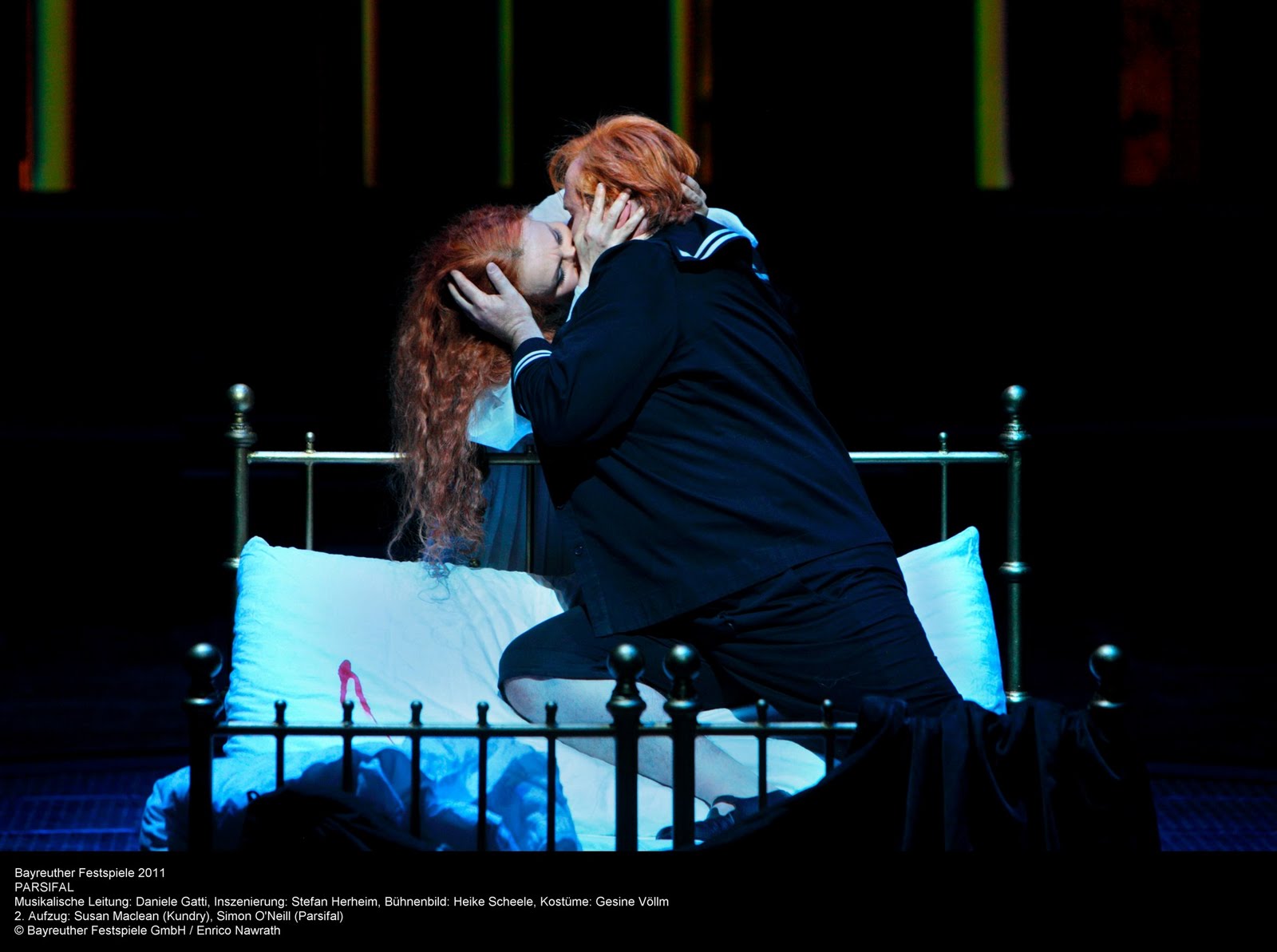
Much of that, however, was, at least for me, called into question by the second act, in which the political reasserted itself with a vengeance. The delicious representation of the Flowermaidens as orderlies and flappers – is that not just what they are? – retains its dramatic power, as well as firmly putting us in the inter-war period. (I say firmly, but of course, time passes as the act does.) And yet, a reminder that the various levels of interpretation are anything but distinct is offered by a greater keenness of manipulation when it comes to Kundry’s acts: above all, what she tells Parsifal. She is in turn being manipulated by Klingsor, of course, but perhaps so many of us are understandably now influenced by feminist readings, that we feel uncomplicatedly sympathetic. It is salutary to be reminded that this rose of Hell – the rose very much part of the staging’s imagery – has, despite her plight, agency of her own. That is surely more feminist than to consider her purely as a victim. And the similarity of costume between her and Klingsor, both in Weimar cross-dressing travesty, reinforces the need both have for each other, the Hegelian master-slave dialectic reimagined. The final scene remains electric, the unfurling of swastikas and coming of Bayreuth’s and Germany’s darkest years truly shocking. Judging by the disgruntled noises from some members of the audience – it should hardly surprise that ‘conservative’ critics of searching productions would feel discomfited by a reminder of their ideological kinship – it remains an absolute necessity too. An interval walk around the outdoor exhibition of Verstummte Stimmen (the ‘silenced voices’ of Jews ill-treated by the Festival) reinforced the point: rightist ‘Wagnerians’ are not merely deluded; they are and always have been extremely dangerous. (Ironically, the only figure treated unjustly is Wagner himself, in which the questionable claim that anti-Semitism is expressed in the dramas is trotted out uncritically.) I could not help but think of the ongoing controversy concerning Amélie Hohmann’s refusal to release correspondence between Winifred Wagner and Hitler. Whatever one might think of Katharina Wagner as director, at least she seems willing to open up the festival to necessary historical criticism.


Which leads me into the third act, with Herheim’s attack upon – or rather, display, which allows the audience to attack – the disingenuous New Bayreuth plea, signed by Wieland and Wolfgang, and displayed on stage, as Wagner himself is hidden behind Parsifal’s childhood wall, that politics be banished from the Green Hill. (It actually speaks well of Wolfgang, whatever one may think of many of his acts, that he permitted this criticism to be staged; he was always, however, a friend to directors, even if he lacked directorial ability himself.) The post-war period is initially one of devastation, and improves little, if at all, whatever the mendacious ideology of the Wirtschaftswunder. Perhaps the point of ultimate hope comes when a star briefly appears in the sky, wonderfully touching, though what does it signify? The coming of a (false) messiah? A simple, childlike pleasure? Nothing that can be put into words? It certainly rings truer than the gaudy coloured lights that seem to signal Parsifal’s descent into the realm of the (lifestyle?) guru. If anything, politics seem to stand still more starkly at the heart of the final scene. Parsifal is Lohengrin’s father, though the extent to which that is a red herring may be debated. Here, however, the problematical nature of charismatic leadership seems to follow on closely, especially from Hans Neuenfels’s production, which I shall see again soon, as well of course from the precedent of Siegfried. It is noteworthy that Parsifal is not one of the trio we see at the end, presumably hastening us to an uncertain future; instead, we find ourselves in the hands of Gurnemanz, Kundry – no, she does not expire – and a young boy. Or is he Parsifal, and has the whole drama been a dream, or in the case of its German historical setting, the ultimate nightmare? There is certainly no solace to be had from the despicable bickering politicians of the Bundestag, the Federal Republic’s flag draping Titurel’s coffin, yet Parsifal seems to have offered at best a dead-end, maybe even a touch of snake oil. (From Carole Caplin to Blair?) Amfortas, like Siegfried, seems to have gained in dignity through death. Nihilism, as Nietzsche would doubtless have had it, or Wagner’s lifelong anarchism, as I would?

Musical performances are more mixed in quality, though as I have already mentioned, Roth’s Amfortas has continued to grow in strength. Kwangchul Youn, whom I have previously found a little dull, exhibited a far stronger musico-dramatic presence, and an intriguingly ambiguous one. Who is this narrator, and is he to be trusted? Susan Maclean was perhaps a little too wild on the vocal side. It could hardly be said that her Kundry is beautiful of voice, and a little more refulgence would not at times have gone amiss, but there can be no doubting the dramatic commitment of her portrayal. Thomas Jesatko’s Klingsor is by now perhaps leaning a little too much towards camp: his first ‘furchtbarer Not’ sounded a little too caricatured to chill. Again, however, this is very much a stage assumption that one is unlikely to forget. (Perhaps it is just that I have become too accustomed to it.) Burkhard Fritz’s Parsifal marked a great improvement upon last year’s metallic Simon O’Neill. It may not be the most profound account one will hear, but his tone is secure and possessed of considerable mellifluence. One could hear pretty much all of his words too, which was certainly not the case with his Kundry. Smaller parts were cast from strength. Not only Diógenes Randes’s unearthly Titurel but even the knights and squires shone, and that was not just a matter of perceptive direction from Herheim with respect to their presentation as individuals drawn from the mass to be briefly highlighted. Choral singing, under Eberhard’s direction, was as excellent as we have come to expect, but that achievement should never be overlooked.

The only significant drawback related to Philippe Jordan’s conducting. I have heard much worse in Wagner – and alas must do so regularly in London – but this seemed a work-in-progress in a less happy sense than Herheim’s production, particularly when considered in contrast to Daniele Gatti’s work in previous years. Jordan lacked a sense of ritual, crucial to the first and third acts. That is not a matter of speed, but of steadiness, of feeling and communicating the inner pulse. Jordan seemed less an equal partner to Herheim, as Gatti certainly had done, than provider of a sound-track (ironically, given his father’s appearance on Hans-Jürgen Syberberg’s film.) There was some interesting highlighting, alla Barenboim, of woodwind lines, though brass, especially during the opening Prelude, could occasionally be a little shaky. In general, though, the orchestral playing itself was superb. The interpretation seemed, however, as though it needed time and experience to settle. For instance, intriguingly Karajan-like steely moments seemed to bear little relation to the rest of what we heard. I hope, again, that I am not becoming too wedded to a particular interpretation, in this case Gatti’s; I do not think I am, given the variety of accounts, both recorded and in the theatre, I have admired.  But it is necessary to remain on one’s guard.


This, I have little doubt, will prove one of the most necessary opera DVDs since the release on the new medium of the Boulez-Chéreau Ring. If only the casting had been a little more consistent, and if only Gatti had still been conducting. And yet, perhaps one message of this increasingly unsettling staging is that the search for perfection is not only chimerical but catastrophic.


First interval, third call, with apologies for the unsteadiness of hand...


Saturday, 6 August 2011

Bayreuth Festival (4) - Parsifal, 3 August 2011

Festspielhaus, Bayreuth

Amfortas – Detlef Roth
Titurel – Diógenes Randes
Gurnemanz – Kwangchul Youn
Parsifal – Simon O’Neill
Klingsor – Thomas Jesatko
Kundry – Susan Maclean
First Knight of the Grail – Arnold Bezuyen
Second Knight of the Grail – Friedemann Röhlig
First Squire – Julia Borchert
Second Squire – Ulrike Helzel
Third Squire – Clemens Bieber
Fourth Squire – Willem van der Heyden
Flowermaidens – Julia Borchert, Martina Rüping, Carola Guber, Christiane Kohl, Jutta Maria Böhnert, Ulrike Helzel
Contralto solo – Simone Schröder

Stefan Herheim (director)
Heike Scheele (set designs)
Gesine Cöllm (costumes)
Ulrich Niepel (lighting)
Alexander Meier-Dörzenbach (dramaturgy)
Momme Hinrichs, Torge Møller (video)

Bayreuth Festival Chorus (chorus master: Eberhard Friedrich)
Bayreuth Festival Orchestra
Daniele Gatti (conductor)


Should one cross the same river twice? Could Stefan Herheim’s – and Daniele Gatti’s – Parsifal possibly match up now to my first-time experience in 2008? (See also Per-Erik Skramstrad’s review from the same festival.) As with the Boulez-Chéreau ‘Centenary’ Ring, one of the few opera DVDs I find persistently engrossing, the answers are ‘yes’ – and triumphantly so. It appears almost mandatory to voice a cavil, and I have a small one, so shall get it out of the way now: there are sections of the stage direction that have been relatively simplified. In most cases, that tends to be good: a removal of clutter helped Keith Warner’s Royal Opera House Ring upon its second outing. Yet there was no clutter in Herheim’s Parsifal. Complexity, yes, but this is a complex, in many respects quite Hegelian, work, with an equally complex history; Herheim’s genius, not a word I use lightly, was and is to tell the story of both, and that includes the score, the director’s musicianship and belief in music’s redemptive power no more in doubt than his stagecraft. The first half of the third act now looks for the most part surprisingly ‘traditional’, not that it did not incorporate and develop tradition, but I slightly regret the thinning out. (Some commentators thought first time around that too much was going on, that Herheim should have concentrated on but a single line; that seemed to me to miss the whole point of his production.)

I do not intend to give a full account of the production, since that would doubtless try readers’ patience beyond endurance, and much can already be read in the two accounts I mentioned above (mine and Per-Erik’s). What I should like principally to do is to talk about some points that especially captured my intention on this particular occasion. However, it is worth briefly mentioning the broad thrust, or rather thrusts. We witness, not so much in parallel, but inextricably interlinked, as faithful a telling of Parsifal as one is ever likely to find – at least for anyone interested in Wagner’s meaning and dialectical thinking rather than fetishisation of incidental matters of costume – and a perceptive retelling of the course of German history from the time of the first performance until the present.

The metamophosis of the first-act’s Wahnfried into Siena Cathedral and back again is subtle and yet telling enough; but note that the pillars of both remain, transformed, in the field hospital of the Flowermaidens, as directed by Klingsor as Cabaret Master of Ceremonies. (Transvestite show-business is an obvious career path for the self-castrated, not unlike the castrati of old.) Herheim’s turning the mirror on the audience not a gimmick, but an invitation, indeed an incitement, to question everything we have thought. ‘Educating Parsifal’ is also ‘educating Parsifal’, and is also ‘educating us’, not in a didactic fashion but as part of a drama in which we would be fools not to participate. (Some such fools booed; another, astonishingly, asked during an overheard interval rant, ‘Why can’t it be like the Met?’) As Tristan tells King Marke, 'das kann ich dir nicht sagen; und was du frägst, das kannst du nie erfahren.' In the almost overwhelming emotional context Herheim has developed, as opposed to the abstraction of a mere act of reporting, it would be an unimaginative soul indeed who did not accept the mirror’s invitation. Identities are blurred, or better enhanced, by the play conducted not only between these two stories but also between characters: Parsifal, at various stages from baby to old man, with Amfortas – compassion or fellow-suffering (the German, Schopenhauerian Mitleid, suffering with) indeed; or Kundry and Herzeleide, whose childbirth and troubled, necessarily incestuous relationship – is any act of parenting not? – with Parsifal is worked out with Parsifal’s own education and reversion. Wagner’s anticipations of Freud have never seemed so clear as in the second-act congress with Herzeleide-Kundry. The visual motif, both on stage and on film, of Kundry as Rose of Hell – Klingsor’s ‘Urteufelin, Höllenrose!’ – guides that educative process, taking Parsifal beyond Tristan’s Nietzschean ‘voluptuousness of Hell’ and renewing in itself in the malevolence of Wagner’s Bergian chromaticism. The near-identity of Kundry and Parsifal, Christ-like, albeit Amfortas-Christ-like, at the beginning of the third act, brings us as close as we come, or indeed Wagner comes, to Christianity: helping the stricken, after the Sermon of the Mount. And those stricken in this context are the female victims of war and its aftermath, that is of one of the most violent struggles yet thrown up by the accumulation of capital and, as Adorno and Horkheimer would have it, the dialectic of Enlightenment. This is, as Per-Erik Skramstad has pointed out, a definite hommage to Götz Friedrich’s Tannhäuser : Herheim studied with Friedrich, another rare example of the musician-director.

One might have expected the electricity to wane in the second-time viewing of such coups de théâtre as the unfurling of swastikas at the destruction of Klingsor’s castle – and of Weimar – as a brown-shirted boy, perhaps Parsifal reincarnated or perhaps not, implies, incorrectly as it would turn out, that tomorrow will belong to him. Not at all: if anything, the electricity was enhanced by expectation. (We do not, after all, stop listening to Parsifal once we know what happens next in the plot.) The families gathered around beforehand for departure make their point chillingly. I could not help but think of the chasm between Herheim’s intelligence and the dreadful ‘Holocaust as entertainment’, The Producers without comedy, of Terry Gilliam’s recent Damnation of Faust. Gilliam boasted of his ignorance of Berlioz’s life and thought; Herheim, from the tying of individual movement to Wagner’s phrasing, to the broadest conceptual sweep, shows his understanding of Wagner and his reception.

Amfortas – and the Federal Republic – on trial in the Bundstag remains a potent, terrifying image following the Third Act Transformation Music. The opening of Titurel’s coffin, draped in the flag, elicits mass revulsion not only on stage but, more importantly, in the audience. (There are musical reasons for that too, to which I shall return.) The monochrome contrast, moreover, with the warmth of Ulrich Niepel’s springtime lighting for the Good Friday Music, tells its own story. Christian charity has been replaced by politics, just as the Wagner brothers’ (Wieland and Wolfgang) post-war request, that political discussion desist on the Green Hill, shown here during the Transformation Music without comment, could not have been more of a political act had they too emblazoned the stage with swastikas. The video wall built up during this scene around Wagner’s image – perhaps also an echo of Wieland’s Bayreuth wall, on whose other side lay his mother, Winifred? – is the very same wall constructed every day by those who, after Otto Schenk, wish only to see fairy-tales of knights and dragons, wilfully deaf to the words and music of Richard Wagner.

Some have complained that Daniele Gatti’s masterly pacing, slow by the clock for those who care about such things, worked against the dramatic urgency of Herheim’s staging. My experience was quite the opposite. By giving time for the drama to unfold, whilst never – I repeat never – failing to maintain the line of Wagner’s melos, Gatti presented the orchestra very much in Wagner’s Opera and Drama image of the Greek Chorus. Moreover, there was nothing unvaried about his approach. There was violence, and a nasty violence at that, in the Flowermaidens’ Music, stage images of Weimar cabaret turned sour enhanced, indeed seemingly built upon, an integrated understanding of Wagner’s harmony and colouring that foretold Schoenberg’s Golden Calf Orgy (Moses und Aron). On the other hand, the luxuriant decadence – or Nietzschean décadence? – of Kundry’s seduction spoke of Berg and Mahler. It is surely no coincidence what a fine conductor of Mahler and the Second Viennese School Gatti has proved himself to be. I mentioned above the revulsion on stage as Amfortas opened Titurel’s coffin. That was as nothing compared to the Mahlerian, indeed Schoenbergian (think of the Five Orchestral Pieces, op.16) horror Gatti screwed up in the pit. This was an exemplary collaboration between conductor and director.

What of the singers? Simon O’Neill’s Parsifal was a grave disappointment. Such is the strength of Herheim’s production – and Gatti’s conducting – that the meaning absent from O’Neill’s delivery of the text could in general be supplied elsewhere, but there was nowhere to hide when it came to the unpleasant, thin yet shouted tone production. (It was nowhere near as bad as John Treleaven’s unbearable Siegfried and Tristan, but seemed to be moving in that direction.) Christopher Ventris was superior in every respect in 2008. Susan Maclean, by contrast, was a revelatory Kundry. I have admired Maclean in the same role before, in Leipzig (twice). Here she showed the difference between a dutiful, for the most part well-sung, yet hardly seductive, portrayal (Mihoko Fujimura last time around) and one that truly engaged with the production as living musical drama. This Kundry repelled and seduced, shrieked and consoled, provoked and served. The production might have been made for her. Thomas Jesatko remained an excellent Klingsor, revelling in his kinky sleights of hand. The agonies of Detlef Roth’s Amfortas were searingly portrayed: his was a performance that made one feel not only the unsparing nature of Amfortas’s wound, but the lyrical, almost Schubertian possibilities of a future that never came. We need to believe that Amfortas’s life could have been different, and we did. Sad to say, Kwangchul Youn’s Gurnemanz proved at best variable, wideness of vibrato and occasional hoarseness never compensated for by the outsize personality artists such as Sir John Tomlinson can still bring to the role. The Flowermaidens, however, were excellent: I am sure that we shall hear more of many of them. And the choral singing was superlative, as weighty and clear as in Tannhäuser and Lohengrin: congratulations once again to the Bayreuth Festival Chorus and Eberhard Friedrich. This was not a perfect cast, then, though one could hardly have asked for more from Maclean, Jesatko, and Roth, nor from the chorus. But crucially, nothing detracted from the overwhelming force of Herheim’s and Gatti’s vision. There was no doubt, moreover, about the final redemption: it was of, for, and through Wagner’s miraculous score, ‘lit from behind’. Even if one thought Parsifal stood in no need of redemption, one realised that work and audience had been blessed.

Four requests:

1. Bayreuth: to release this production on DVD. It is a milestone not only in the staging of Parsifal but of opera tout court.

2. Stefan Herheim: to stage Die Frau ohne Schatten and Die Soldaten, works crying out for such musico-dramatic attention.

3. The Royal Opera (with apologies to readers, should this sound unduly parochial): to engage Herheim and Gatti to present a Wagner work at Covent Garden. (And no, Les Vêpres siciliennes, in which Herheim is posed to make his London debut, will not do.)

4. Bayreuth: to persuade Herheim to direct its next-but-one Ring.

Wednesday, 15 April 2009

Parsifal, Semperoper Dresden, 13 April 2009


Images: © Matthias Creutziger

Amfortas – Hans-Joachim Ketelsen
Titurel – Jacques-Grel Belobo
Gurnemanz – Matti Salminen
Parsifal – Stig Andersen
Klinsgor – Thomas Jesatko
Kundry – Lioba Braun
Flowemaidens – Christiane Hossfeld, Birgit Fandrey, Annette Jahns, Roxana Incontrera, Sabine Brohm, Elisabeth Wilke
Knights of the Grail – Gerald Hupach, Jürgen Commichau
Squires – Angela Liebold, Sofi Lorentzen, Tom Martinsen, Matthias Henneberg
Voice from Above – Sofi Lorentzen

Theo Adam (original director)
Heide Stock (revival director)
Rolf Langenfass (designs and costumes)

Chor der Sächsichen Staatsoper Dresden
Gentlemen’s voices from the Sinfoniechor Dresden
Kinderchor der Sächsischen Staatsoper Dresden
Matthias Brauer and Ulrich Paetzholdt (chorus masters)
Sächsische Staatskapelle Dresden
Lothar Zagrosek (conductor)

This was much better than the previous night’s Flying Dutchman. The performance made me realise that I should probably have been harsher concerning Christof Prick’s hapless conducting. Lothar Zagrosek’s direction was certainly the real thing, clearly born of a sophisticated understanding of the score and an ability to communicate that to his players. In general, this was a swift reading, which is not necessarily to say unprobing, but quite different from the broader conceptions of, say, Knappertsbusch or Goodall. To a certain extent Boulez sprang to mind, although the latter’s modernistic concerns were less to the fore than what sometimes sounded like an attempt to point to connections with Romantic symphonism. In any case, the focus was upon dramatic drive rather than the quasi-liturgical understanding that often informs the outer acts. Zagrosek’s conducting was certainly not inflexible; fluctuations in tempo were handled soundly. However, this was Wagner often sounding closer to Mendelssohn, Schumann, perhaps even Brahms, than to Bruckner, Mahler, or Schoenberg.

Greater weight was placed upon the Transformation Music and upon the choral sections, here superbly rendered by the assorted choruses, of whom the excellent children’s choir merits special mention. The work of Matthias Brauer and Ulrich Paetzholdt had clearly paid off. Likewise, the Staatskapelle Dresden was once again on splendid form. There may be no one ‘right’ sound for Wagner, but this orchestra is certainly one of the best equipped tonally for his music. The strings truly glowed, whilst the woodwind added piquant colour. At climactic moments, the brass made its presence felt without the slightest sense of Solti-like crudeness. The excellent timpanist’s role in dramatic punctuation was of the highest importance. There were a few instances of insecurity, such as a wrong entry from the woodwind immediately prior to Parsifal’s baptism of Kundry. For a worrying moment, it sounded as though the orchestra might have lost its way, but Zagrosek pulled his forces together.

1988 must have been a good year for Wagner in Dresden, since the Staatsoper premiered not only Wolfgang Wagner’s Dutchman but also Theo Adam’s Parsifal. In truth, neither production has a great deal to say to a contemporary audience, if indeed either did at the time. The prospect of an East German Parsifal was intriguing but there are no political statements here. What we have is a straightforward, uncontroversial telling of the story. Scenery and costumes are more or less as one would expect, with the partial exception of a peculiarly unattractive magic garden for Klingsor, likewise the strange, butterfly-like costumes for the Flowermaidens. As with Wolfgang Wagner’s Dutchman, we see pretty much everything we should. In this case, the Grail looks like the Grail and is elevated by Parsifal in the final scene. The spear looks like a spear and does what it should. The most fanatical adherent to Wagner’s stage directions might lament the lack of a dove at the end, but otherwise would have little with which to find fault. Parsifal does not himself make the sign of the Cross at the end of the second act but a Cross is revealed in the sky, thereby avoiding the nonsense that many productions suffer when he speaks of something that is merely disregarded. However, it was not at all clear what its presence meant, given the lack of any overt Christian or indeed anti-Christian reading of the work: probably better than disregard, but not preferable to dramatically underlined absence, as in Nikolaus Lehnhoff’s Waste Land ‘heap of broken images’ production for the English National Opera. Stefan Herheim’s Bayreuth Parsifal remains utterly in a class of its own. One thing, however, that distinguished this production from the previous night’s Dutchman was the role of Heidi Stock as acknowledged revival director. Her material might not have been the most inspiring but she ensured that the cast, including the chorus, knew what it should be doing rather than being left to fend for itself. A nice touch, whether hers or Adam’s, was to have the brothers all turn away from Amfortas upon his first act pleas for mercy.

This brings me to the singers. Parsifal is a less fiendish role than Tristan or Siegfried, for which one might read that it is not simply impossible. Nevertheless, it is hardly an easy ride. Stig Andersen did a highly creditable job, even managing to seem vaguely plausible as the foolish boy of the first act, if without the success in this respect of Stefan Vinke in Leipzig a week earlier. Lioba Braun was an excellent Kundry. She was perhaps less impressive as the seductress of the earlier part of the second act but gave a memorable portrayal of unhinged reaction to Parsifal’s rejection of her kiss. Like her character, she hurled everything into her efforts to change him. Matti Salminen was slightly disappointing earlier on, most uncharacteristically subdued; however, his tone garnered richness and authority a little way in to his third act scenes. Thomas Jesatko was thrillingly malevolent as Klingsor, perhaps more so than he had been at Bayreuth, although there the production had more than made up for it. Hans-Joachim Ketelsen was a more than acceptable Amfortas; I had probably been spoiled by the astounding portrayal offered by Tumoas Pursio for Oper Leipzig. The Flowermaidens were a mixed bunch, as it were. Sadly, those who looked unusually ‘mature’ sounded somewhat past their best too, although there were clearly some good voices amongst the group. Mention should also go to a splendid Voice from Above in the guise of Sori Lorentzen. All in all, then, this was a rather successful Parsifal, at least in musical terms.