Showing posts with label Wozzeck. Show all posts

Wednesday, 17 December 2025

Wozzeck, Staatsoper Unter den Linden, 14 December 2025 (centenary performance)


Production images: Stephan Rabold


Wozzeck – Simon Keenlyside
Marie – Anja Kampe
Drum-major – Andreas Schager
Andres – Florian Hoffmann
Captain – Wolfgang Ablinger-Speerhacke
Doctor – Stephen Milling
Marie’s child – Jacob Tougas Gigling
First apprentice – Friedrich Hamel
Second apprentice – Dionysios Avgerinos
Idiot – Stephan Rügamer
Soldier – Soongoo Lee

Children’s Choir of the Staatsoper Unter den Linden
Staatsopernchor Berlin (chorus director: Dani Juris)
Staatskapelle Berlin
Christian Thielemann (conductor)

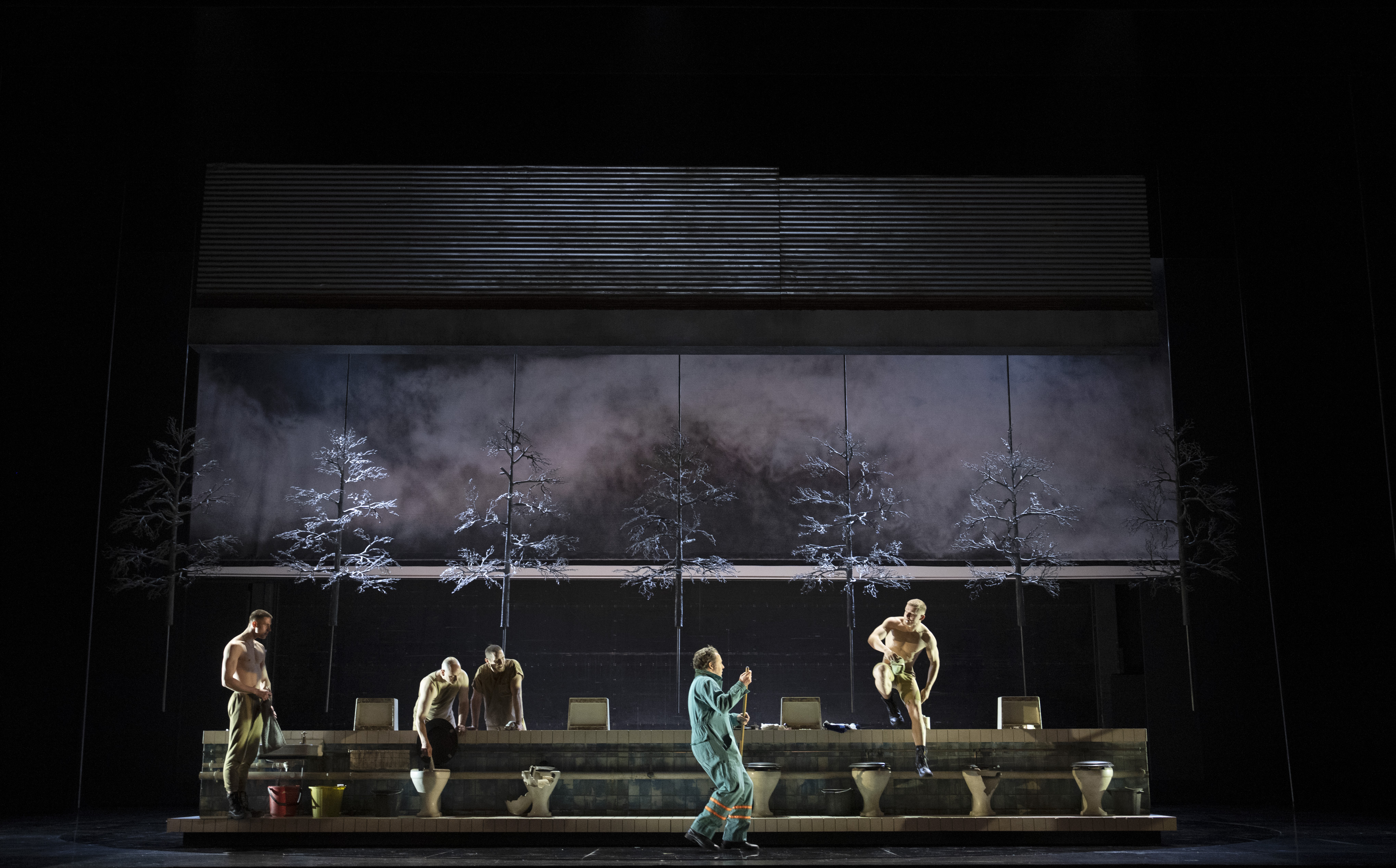
One hundred years ago to the day, Alban Berg’s Wozzeck, the greatest opera of the twentieth century, received its first performance at Berlin’s Staatsoper Unter den Linden, conducted by Erich Kleiber. The composer’s proud teacher, Arnold Schoenberg, sent him a telegram the day before wishing ‘every success for the premiere’ and expressing sadness he and his wife Gertrud could not be present. Inevitable far-Right protests notwithstanding, that premiere proved a great success and the work of course went on to transform the history of twentieth-century music in general and opera in particular. That the twentieth century would overflow with great operas owed more to its example than to that of any other single work, Schoenberg’s included. Earlier that same year, one of its greatest interpreters, whose centenary we have been celebrating all year, was born: Pierre Boulez. It therefore seems doubly fitting that the Staatsoper should offer an excellent revival of Andrea Breth’s production (reviewed first here, in 2011) for the climax and culmination of 2025. 


I hope that I might, on this special occasion, be forgiven a personal excursus. (Please skip the following paragraph if not!) Many years later, this opera changed my life. It was the first I saw in the theatre, as a schoolboy who had not yet heard a note of Berg or Webern, and very little (only tonal) of Schoenberg. Travelling to Sheffield for Opera North’s visit in 1993, the experience opened up more vistas even than a Mahler symphony. Opera had not formed part of my childhood. I had only just begun to explore it, entirely from recordings, as a consequence of having fallen head over heels in love with Mozart (as yet, operatically, only Figaro, Don Giovanni, and The Magic Flute); and had still more recently begun my Wagner voyage (Tristan and possibly Meistersinger, the Ring definitely still to come). I had heard and indeed seen nothing like it, in Deborah Warner’s first production, conducted by Paul Daniel. To say that it made a great impression would be an understatement. It grabbed me by the throat and never let me go: one of the very few works one can unhesitatingly place alongside those twin lodestars of my operatic life that have never left me and indeed only shone brightrer (Mozart and Wagner). Perhaps if I had not attended that performance, invited by my music teacher, I might never have worked on opera at all; I might also never have grown to love the Second Viennese School as I do, and worked on Schoenberg (or Henze, Dallapiccola, Nono, Kurtág, and others, Boulez included). So to celebrate Wozzeck’s centenary could hardly have been an occasion fuller of meaning for me: whether music-historical or biographical. 


Captain (Wolfgang Ablinger-Speerhacke) and Wozzeck (Simon Keenlyside)

Expectations are set up to be dashed; here they were not. I shall not dwell on memories, notoriously persistent yet notoriously unreliable, of Breth’s staging, which I have written about twice before in any case. (I shall not cheat and look, at least not until after posting.) It was in any case revived here by Caroline Staunton and deserves consideration in 2025 incarnation on its own merits. What I can say Staunton and her team of skilled singing actors brought to it – at the very least I took from it, though I think it was more than that – was a stronger sense than ever of these being real people, with real, human connections between one another. It was an internal as well as an external world that sprang forth before our eyes and ears—and that connection between the two seemed, if different under a new heir to Kleiber, as strong as ever too. 


Marie (Anja Kampe), Drum-major (Andreas Schager)

Breth’s aesthetic is realist up to a point, yet not only that—not unlike Berg and, I should argue Georg Büchner too. A sense of poverty – ‘Wir arme Leut’…’ – and wretchedness was present in enclosed sets, the room in which Wozzeck, Marie, and their child must exist as heartbreakingly abject as one could hope for: a sort of Berlin Alexanderplatz-plus (both Döblin and Fassbinder), if not in period then in something still deeper and recurring. Martin Zehetgruber’s set designs then in turn mirroring and even give the impression of helping to create Berg’s closed musical forms, which yet of course extend—both into other scenes and into the desolation of the ‘open’ lake scene (visually and perhaps also, in its D minor expansiveness, musically). These people, the poor ones anyway, are treated worse than animals and that has consequences, as we see in the joyless fornication of the tavern. And yet there is an interior life: not so banal as being mere projections of the protagonists’ torments, yet in different senses a refuge from and a creation of them. That the child in the final scene is on his own, the children’s choir singing (perhaps in his mind) from the pit does not lessen the realism but expands it with a chill still harsher than that felt by the Captain and Doctor by the lake. 

Marie, her child )Jacob Tougas Gigling), Wozzeck

Thielemann’s way with Berg’s score is strikingly different – again, with that caveat on memory – from that of Daniel Barenboim, who conducted the ever-excellent Staatskapelle Berlin on previous occasions. ‘Romantic’ is a word so stretched and overused as to verge on the meaningless, but if anything, confounding lazy expectations, it was Barenboim who proved the more so: certainly, I think, the more overtly Wagnerian. Thielemann’s approach did not neglect the longer line, but seemed more concerned with the inner characterisation and ‘life’ of those closed forms. The febrile growth and transformation of individual lines, perhaps founded ultimately more on counterpoint than harmony, could be traced in neo-Bachian fashion that was more of the time of Neue Sachlichkeit than of Berg’s youth. It is a matter of degree, of course, and neither neglected the ‘other’ side, but I recognised a tendency heard in certain lines of Thielemann’s summer Schweigsame Frau extended: intriguingly and, again a little surprisingly, closer to Boulez than Barenboim. 


Chorus, Drum-major, Wozzeck

The orchestra itself played superlatively from beginning to end, never sounding Straussian yet at the same time excelling in response to the sort of unpredictable yet ultimately coherent Strauss performances Thielemann has been giving for some time. Their stretching of time, virtuosic yet not for mere virtuosity’s sake, was unquestionably apparent here. What I believe was a swift reading overall ‘on the clock’ never felt rushed and indeed included moments of hallucinatory, post-Mahlerian near-stasis – those vistas again, both physical and metaphysical – in which shimmering colour and harmony alike brought magic to the musicodramatic moment and peered deep into the musical future. I hope we shall hear more Berg from Thielemann.


Margret (Anna Kissjudit), Wozzeck

In the title role, Simon Keenlyside brought not only a wealth of experience in this role, but something unique to this production. He sounded and even looked the Wozzeck for this moment, more broken than previously, though doubtless building on earlier performances. He seemed stunned, even stunted, by the horrors he endured, yet the flame of humanity never left him, in no small part due to his Lieder-singer’s way with the libretto—which here sounded just as intense as the score. Anja Kampe’s force-of-nature Marie perhaps lacked the last ounce of tenderness in the Bible scene, but there were unquestionable compensations elsewhere. Hers likewise was a human being brutalised yet, until the end, never defeated. Anna Kissjudit’s Margret made for a rich-toned, dramatically layered counterpart, whilst Florian Hoffmann’s Andres complemented and contrasted Wozzeck in somewhat different, yet no less important, ways. Staunton’s keen Personenregie was surely part and parcel of that, as it was in Wolfgang Ablinger-Speerhacke’s Captain, brilliantly quirky yet probably more deeply integrated into the greater company than I have previously heard. So too for Stephen Milling’s disconcerting Doctor, poised between malevolent mystery and mere quack, and Andreas Schager’s vain, frighteningly brutal Drum-major. Stephan Rügamer offered a haunting Fool. The chorus brought the rest of the world indelibly to life.

Here, then, was an opera entering its second century as harrowing, as disturbing, and as ineffably, lyrically magical, even Mozartian, as it began its first. We continue to take our leave from it, not because we have thought of nothing new since, but precisely because we have.

Saturday, 20 May 2023

Wozzeck, Royal Opera, 19 May 2023


Royal Opera House

Wozzeck – Christian Gerhaher
Marie – Anja Kampe
Captain – Peter Hoare
Doctor – Brindley Sherratt
Margret – Rosie Aldridge
Drum Major – Clay Hilley
Andres – Sam Furness
First Apprentice – Barnaby Rea
Second Apprentice – Alex Otterburn
The Fool – John Findon
Soldier – Lee Hickenbottom
Tenor Solo – Andrew Macnair
Marie’s Son – Jonah Elijah McGovern

Deborah Warner (director)
Hyemi Shin (set designs)
Nicky Gillibrand (costumes)
Adam Silverman (lighting)
Kim Brandstrup (choreography)

Royal Opera Chorus (chorus master: William Spaulding)
Orchestra of the Royal Opera House
Antonio Pappano (conductor)


Images: Tristram Kenton
Andres  (Sam Furness), Wozzeck (Christian Gerhaher)


Thirty years ago, in Sheffield, a teenage schoolboy saw his first opera in the theatre. It was Wozzeck, directed by Deborah Warner for Opera North. Quite an opera with which to begin, you might say, and indeed in many ways it was, yet why would you wish to begin with something that was not ‘quite an opera’? He knew a little more, though not much, opera not having been part of his childhood or more general homelife, nor indeed of his schooling. Plus ça change… By that time, he had just begun to explore the operas of Mozart, those you might expect: Figaro, Don Giovanni, and The Magic Flute. He had also, slightly clueless, speculatively bought a reduced, ‘historic’ recording of Tristan und Isolde from WH Smith and had watched a video, kindly lent by his music teacher, of Die Meistersinger. That, however, was it. He had not yet knowingly listened to music of the Second Viennese School, though that also was suddenly about to change. It is no exaggeration to say that those hundred minutes in the Lyceum Theatre changed his life. 

From 1993 to 2023: an avid (if, born perhaps of that initial experience, selective) opera-goer travelled across another English city for the first night of a new production of Wozzeck, also directed by Deborah Warner, now for the Royal Opera. Full circle? Not really; nothing ever is. Our protagonist has, for better or worse, had numerous experiences, music, dramatic, emotional, and intellectual, since; he is certainly no longer a boy. Yet Wozzeck, which for him ever since has had at least as strong a claim as any to be the single greatest opera of the twentieth century, exerts, if anything, a still greater fascination and admiration, certainly a greater love, than it did then, born of three decades of living with it. How, then, would Warner II fare in circumstances both old and new?


Truth be told, if you spend your time in Wozzeck thinking about a previous production or performance, something has gone wrong (either with you, what is onstage, or both). I did not. In any case, comparisons either with Warner’s first staging or with when I had previously heard Antonio Pappano conduct the work (twenty-one years ago for Keith Warner’s then-new production, in Pappano’s first season at Covent Garden) would largely be meaningless, given the vagaries of memory and my lack of a written record. Deborah Warner in 2023 does not seem to me especially to take a view or standpoint, at least not exclusively. This is not a Wozzeck that (over-)emphasises the brutality of military life and war, or expressionist experimentalism, or any one thing, though many such things are present. The action is already taking place as we take our seats, soldiers (an excellent troupe/troop of actors) relieving themselves in various ways, cleaning up, doing very much what soldiers do in barracks. That establishes an expectation of realism which is not entirely fulfilled, but rather is supplemented, so that as the action develops, as different standpoints are afforded by the work (and probably its creator), we have opportunity to take them too. Everything takes place more or less where one might expect, but there are always refreshing touches of set design, costume, lighting, or detailed Personenregie – let alone the musical performances – to enable us to take a fresh look and listen. The drama unfolds, with great immediacy, yet always it feels that this is ultimately Wozzeck rather than ‘Deborah Warner’s Wozzeck’, whether that feeling, even that possibility, be a fond illusion or otherwise. Different settings for different scenes – no fewer than fifteen of them – present themselves without fussiness or fetishisation: this is a light, enabling, generous realism that can shade almost imperceptibly into other, complementary aesthetics as required. Credit is surely due both to the design team and to the Royal Opera House’s technicians and actors, who accomplished this feat with such apparent ease. Rehearsal surely paid off.


Slightly stylised trees, Cross-like, hint at Wozzeck’s fate, albeit without redemption, but also at a natural world beyond that neither knows nor cares, yet in some sense frames tragedies that lie in stark contrast, being entirely the creation of man. There remains a Romantic desire to escape this miserable world, even if only to Berg’s family estate (Berghof) in Carinthia. Like so much else, though, it is not possible. The blood-red moon and the black, unfathomable lake dominate our vision and consciousness as natural and human boundaries. And finally, in that ultimate, heartbreaking scene of horror: the child turns to the wall in front of which the other children have just been playing, to see painted on it the news they have so cruelly, carelessly delivered. His mother is dead. He turns around and walks off, alone. The drama stops, silence cruelly denied by some idiot’s premature applause—but even that could not quite break the punch to the solar plexus. 

Much of that is, of course, a musical punch. Pappano really seems to be at his best right now. Shortly after thinking his Turandot perhaps the best I had heard from him, I found this Wozzeck at least close to equal, and in ways that surprised me. Without wishing to play that game of illusory comparisons, however tempting, I found this an infinitely more engaging experience than in 2002. Often quite extraordinary orchestral precision, for which one must of course above all credit the orchestra itself, laid bare the framework of closed forms in themselves, their multifarious musical procedures objects of an almost yet not quite Neue Sachlichkeit fascination, but also showed them to be the engines of a dramatic progression that, however Wagnerian it may often sound, is at least as much an alternative to Wagner’s method. There were wrenching, late-Romantic passages, of course, precisely where one would need and expect them, but this was also a musical drama that prefigured Hindemith, Weill, perhaps even Berg’s own teacher, Schoenberg. This was not always a Wozzeck that rose from the bass line, though sometimes it did, but it hinted more than usual at Berg’s later writing, whilst also suggesting an earlier, almost Mendelssohnian Romanticism. Like Warner’s production, it afforded different standpoints, without sounding merely sectional. 

I have been fortunate to see some extremely fine Wozzecks in those years since my first encounter (Andrew Shore on that first encounter included). Christian Gerhaher’s thoughtful, collegial approach, placing himself and his character at the dramatic hub, gaining meaning as much from interaction with colleagues as from his considered yet apparently spontaneous way with the text, has nothing to fear from any of them. His performance, worlds away, as is proper, from the beauties of his celebrated Wolfram, was yet equally well judged. Indeed, I wonder whether it heralds a new chapter in his career. For now, though, it will more than do in and of itself.


Wozzeck, Marie (Anja Kampe)

There was splendid chemistry with his Marie, Anja Kampe. I was about to say ‘we tend…’, but should really only speak for myself: I tend often somewhat to overlook the tragedy of Marie’s death, so overwhelmed am I by that of Wozzeck. Here I felt greater parity, doubtless a matter of Warner’s Personenregie but also of Kampe’s portrayal. (It is more or less impossible for an outsider to distinguish between the two.) This important corrective was brought into further relief by Anna Picard’s excellent programme note on ‘Maria and her World’, whose closing words seem very much to refer to what we saw and heard: ‘She is no Kundry. Neither is she a Judith or the hysterical Woman in Marie Pappenheim and Arnold Schoenberg’s monodrama, Erwartung. Her murder is not dressed up as a form of release for Wozzeck or a point of debate. It is simply a domestic tragedy of a very ordinary, and ever modern, kind.’ Which also brings us back to Gerhaher’s Wozzeck, for his very haplessness – what art lay in that – also contributed to that very non-release, felt (at least by me) more emphatically than I can recall.


Captain (Peter Hoare), Wozzeck

All in the cast contributed to the greater dramatic (and musical) whole, so much as to suggest unusually fruitful close collaboration between all concerned. Sam Furness’s Andres surprised me, not least because I often find myself wondering where the role went, thinking it smaller than I had expected. Not here: this was a character sympathetic to Wozzeck who yet had his own story to tell. Likewise Rosie Aldridge’s spirited Margret, whose spot in the second tavern scene almost had time stand still as the world disintegrated around her. Peter Hoare’s Captain and Brindley Sherratt’s Doctor made a sharply etched pair: guilty, yet not guilty, like all in the world we saw. Well, perhaps not quite all, for it is difficult to find any grounds to absolve the Drum Major, here given an appropriately nasty, bullying, yet finely sung performance by Clay Hilley. William Spaulding's Royal Opera Chorus was on outstanding form too. 

What, then, should a Wozzeck accomplish? There can be no definitive answer, no more than for any artwork in performance. Different productions, different performances, different audiences will all render such categorical statements in vain. If I have learned one thing over the past thirty years, it will be that. That said, if one does not emerge from a performance convinced that it is one of the greatest of all operas – ranking beyond that is a mere parlour game – it will have been in vain. My first experience was not; nor, emphatically was this: a searing and strangely refreshing Wozzeck, which I hope and intend to revisit soon.


Wednesday, 16 March 2022

Wozzeck, Paris Opéra, 13 March 2022


Opéra Bastille

Images: Agathe Poupeney / OnP


Wozzeck – Johan Reuter
Drum Major – John Daszak
Andres – Tansel Akzeybek
Captain – Gerhard Siegel
Doctor – Falk Struckmann
First Apprentice – Mikhail Timoshenko
Second Apprentice – Tobias Westman
Fool – Heinz Göhrig
Marie – Eva-Maria Westbroek
Margret – Marie-Andrée Bouchard-Lesieur
Soldier – Vincent Morell
Actors – Nathalie Baunaure, Fitzgerald Berthon, Andrea Fabi, Manon Lheureux

William Kentridge (director)
Luc De Wit (co-director)
Sabine Theunissen (set designs)
Greta Goiris (costumes)
Catherine Meyburgh (video)
Urs Schönebaum (lighting)
Kim Gunning (video operator)  

Maîtrise des-Hauts-de Seins/Children’s Chorus of the Opéra national de Paris (chorus master: Gaël Darchen),
Chorus of the Opéra national de Paris (chorus master: Ching-Lien Wu)
Orchestra of the Opéra national de Paris
Susanna Mälkki (conductor)


Four-and-a-halfyears ago, I saw William Kentridge’s then new Wozzeck at the Salzburg Festival. I found myself somewhat nonplussed by its more distanced, alienating aspects, thinking them better suited to Kentridge’s Lulu (seen the year before, at ENO). For whatever reason, I found them less of a problem and, in many respects, less apparent in this move to Paris than I had in Salzburg. Why might that have been? Such a question is necessarily speculative, since one never knows how much one is comparing like with like, but I do not think that invalidates the question. Part of the difference may simply have lain with my reception; having spent more time not only experiencing but thinking about contemporary theatre, musical and otherwise, I am probably now more receptive to more distanced approaches. I was also nearer the stage, which, given a staging that was dark in hue and involved quite intricate video projections, was a definite advantage, probably not to be ignored. But I think this was also a more intense musical and dramatic performance, offering greater emotional and psychological depth, enabling a more productive balance between distance and immediacy, to the benefit of both. 


Connected to that, more strongly than I experienced it before, was the overwhelming presence of war, in this case the Great War, though events elsewhere in Europe were doubtless on many minds too. Social brutalisation—remember Britten’s ‘the more vicious the society, the more vicious the individual’ for Peter Grimes—came strongly to the fore, not as a substitute for individual acts, but as a context and in many respects an intensification for them. This felt more strongly as if it were a drama founded in a military context, rather than having that context uneasily tacked on: tribute, I think, to some very fine dramatic performances. But the first in particular of the tavern scenes also felt more central, its madness and its malice seeping out in all directions, even retrospectively. Here, the haunted weirdness of masks (new resonances for a pandemic world) and puppets seemed to fuse more strongly with a post-Mahlerian musical sensibility: those marionettes from the ‘Rondo-Burleske’ of Mahler’s Ninth Symphony come once again to life; or perhaps better (or at least closer to the truth), to death. Here was an expressionism in which Kentridge’s artificiality participated, danced, and sang. 

Not that this was an especially Mahlerian performance. Mahler’s ghosts were present, of course. How could they not be in this opera? But listening again to that same scene from Claudio Abbado’s Vienna recording, I realise that Susanna Mälkki’s concerns were in many respects quite different. Musical processes came more strongly to the fore through Berg’s closed forms, but with a hint at least of the Neue Sachlichkeit of the Twenties (when, of course, composition was completed, and the work’s premiere given). That psychological depth was present in, to borrow once more from Britten, the turning of the musical screw. Individual lines went their different ways, brought together in harmony and in contrapuntal and/or suspended counterpoint, yet also recognising that, more often than not, there remained a distance (that word again) from Mahler’s world, that this was a world of atonality, which had already suffered the war whose catastrophic progress we saw tracked onstage. Mälkki showed a keen sense of the whole, but also of detail: absolutely crucial in this work. She was warmer, I think, than Vladimir Jurowski in Salzburg, or at least less unremittingly formalist, without taking Abbado’s (or, say, Daniel Barenboim’s) late Romanticism as her model. This seemed not only her Wozzeck, but a Wozzeck designed for this production and these singers. 


Much the same could be said of Johan Reuter’s assumption of the title role: tormented, yes, but very much within a particular context, spatial and historical as well as more conventionally expressionist. Reuter made much of the words, without making too much of them, gauging the level of speech and song unerringly, with apt fluidity and undeniable direction of purpose. Eva-Maria Westbroek’s Marie was formidable, flawed, and feisty, never a victim, in a performance that grew out of yet was never confined to the text. John Daszak’s hideously cocky Drum Major, Gerhard Siegel’s mysteriously commonplace (in a good way!) Captain, and Falk Struckmann’s similarly etched Doctor all shone in their different ways. So too did Tansel Akzeybek’s Andres, in what can sometimes seem a lesser role than it is, yet here offered an excellent counterpoint to Wozzeck: what might have been, yet tragically never really would (and would it even have been much better?) One might say the same of Marie-Andrée Bouchard-Lesieur’s Margret, vis-à-vis Marie. The whole sorry society was finely portrayed, with a fine eye and ear both to ensemble and individuality, all underpinned by typically excellent playing of heft, transparency, and a myriad of darkened colours from the Orchestra of the Opéra national de Paris.

Whether I have answered my original question, ‘why might that have been?’ I am unsure. Attempting to do so, though, has helped structure my response. In a sense, delineating and structuring responses out of chaos is what Berg and his interpreters are all involved with. 

Tuesday, 26 November 2019

Wozzeck, Bavarian State Opera, 23 November 2019


Nationaltheater


Images: © Wilfried Hösl


Wozzeck – Christian Gerhaher
Drum Major – John Daszak
Andres – Kevin Conners
Captain – Wolfgang Ablinger-Speerhacke
Doctor – Jens Larsen
First Apprentice – Peter Lobert
Second Apprentice – Boris Prýgl
Fool – Ulrich Reß
Marie – Gun-Brit Barkmin
Margret – Heike Grötzinger
Marie’s Child – Alban Mondon
Lad – Jochen Schäfer
Soldier – Markus Zeitler

Andreas Kriegenburg (director)
Harald B Thor (set designs)
Andrea Schraad (costumes)
Stefan Bolliger (lighting)
Zenta Haerter (choreography)
Miron Hakenbeck (dramaturgy)

Bavarian State Opera Chorus (chorus director: Stellario Fagone)
Bavarian State Orchestra
Hartmut Haenchen (conductor)


It would be an extraordinary, even an unimaginable Wozzeck that failed to move, to chill one to the bone. This was certainly no such Wozzeck; Marie’s reading from the Bible, Wozzeck’s demise, the final scene with their son and the other children: all brought that particular Wozzeck combination of tears and horror. At its heart, in every sense, lay Christian Gerhaher’s Wozzeck, Gun-Brit Barkmin’s Marie, and their child, touchingly sung by Alban Mondon.


I have heard some fine Wozzecks over the years; Gerhaher must surely rank alongside the finest. He has been selective in his opera roles; it would, however, be an over-simplification verging on distortion to say that he is more at home in the concert hall. Wozzeck is, of course, a very different role from his fabled Tannhäuser Wolfram and is surely the sterner dramatic test, perhaps especially for someone with so heartbreakingly beautiful a voice. Or so it might seem on first glance, but Gerhaher is an artist at least as celebrated for intelligence and humanity. His way with words, music, and gesture too simply had one believe that this was the character he was playing. Verbal nuance without pedantry, attention to musical line without a hint of self-regard, harrowing facial expression that demanded our sympathy: yes, this was a compleat Wozzeck. Barkmin’s Marie, equally well sung (and spoken), equally sympathetic, made for a fine complement indeed. Through her artistry one felt her hopes as well as her devastation, her pride as well as her capacity for love. Wolfgang Ablinger-Speerhacke’s Captain, John Daszak’s Drum Major and Jens Larsen’s Doctor skilfully trod the line between character and caricature, no mean feat in a production that often called upon them to accentuate the grotesque. Kevin Conners as Andres and Heike Grötzinger as Margret impressed too, carving out their own dramatic potentialities, even as we knew them no more likely to succeed than the opera’s central couple. Cast from depth, this was a fine Wozzeck for singing-actors.


Hartmut Haenchen’s conducting proved efficient most of the time, albeit with a few too many discrepancies between sections of the orchestra as well as between orchestra and pit. To be fair, there were also passages—often the interludes—in which all came together to offer something considerably more than that. Haenchen’s reading was not for the most part, however, one to offer any particular revelation. He clearly knew ‘how it went’, yet the post-Wagnerian orchestra as dramatic cauldron had its juices emerge only fitfully.


Andreas Kriegenburg’s production seemed conceptually a little unsure of what it was trying to achieve. Straddling the divide between Expressionist grotesquerie—some arresting images there—and social realism—with a curious twist of Brechtian image, not dramaturgy—is a perfectly reasonable strategy. Communication of how the two might intertwined proved more elusive. Updated to what seemed to be more or less the time of composition, the production left no doubt of the gross injustice and poverty pervading the world in which these events took place. I could have done without all the splashing round in the lake below. Kriegenburg often scored, however, in particular dramatic touches: above all, the acts of Wozzeck’s son, keen to learn from his ill-fated father: watching, listening. and in some cases, acting, as when this evidently wounded child broke his mother’s heart by painting the accusation ‘Huren’ (‘whore’) on her wall. All was lost, then: a moment of devastation. Already we knew what fate, or rather society, had in store not only for Wozzeck and Marie, but for their child too. ‘Wir arme leut’…

Sunday, 20 August 2017

Salzburg Festival (5) - Wozzeck, 14 August 2017

Haus für Mozart

Images: Salzburg Festival / Ruth Walz
Margret (Frances Pappas) and Wozzeck (Matthias Goerne)


Wozzeck – Matthias Goerne
Drum Major – John Daszak
Andres – Mauro Peter
Captain – Gerhard Siegel
Doctor – Jens Larsen
First Apprentice – Tobias Schnambel
Second Apprentice – Huw Montague Rendall
Fool – Heinz Göhrig
Marie – Asmik Grigorian
Margret – Frances Pappas
Chorus solo – Burkhard Höft
Actors – Mélissa Guex, Andrea Fabi
Mimes – Claudia Carus, Gregor Schulz

William Kentridge (director)
Luc De Wit (co-director)
Sabine Theunissen (set deigns)
Greta Goiris (costumes)
Catherine Meyburgh (video)
Urs Schönebaum (lighting)
Kim Gunning (video operator)

Salzburg Festival and Theatre Children’s Choir (chorus master: Wolfgang Götz)
Concert Association of the Vienna State Opera Chorus (chorus master: Ernst Raffelsberger)
Vienna Philharmonic Orchestra
Vladimir Jurowski (conductor)

Marie (Asmik Grigorian) and Drum-Major (John Daszak)


Salzburg is certainly doing William Kentridge proud this summer: a new production of Wozzeck and an exhibition of his work, ‘Thick Time: Installations and Stagings’, split between the Rupertinum and the museum on the Mönchsberg, which together form the Museum der Moderne. The exhibition has also been seen at the Whitechapel Gallery; I missed it there. It will also be seen – or has: I am not quite sure which – at the Louisiana Museum of Modern Art in Humlebæk and Manchester’s Whitworth Art Gallery. The exhibition is certainly well worth seeing for its own sake. In some ways, though, I found it more revealing than the opera production itself, which I could not help but think relied a little too much upon an imposed association with the First World War – a little too easy? – and indeed upon figures and ideas from his earlier work. Both claims are, I am sure, debatable, but I was left relatively unmoved by the result – which is surely a problem with Wozzeck.

Distancing can doubtless work in different ways for different people. One person’s chilling alienation will be another’s ‘I could not relate to that’. For me, however – and I can hardly speak for anyone else – the device of placing Wozzeck outside the action, having him in some sense present it, at the opening switching on the slide projector from which so much of the setting is presented, leads to a staging more observed than experienced. If we do not share Wozzeck’s agonies, his mistreatment, if it is not even entirely clear whether he actually experiences them, then that is surely something of a loss. What worked very well in Kentridge’s Lulu, which I saw at ENO, seems here to be more a matter of going through the motions; what had been a powerful impression of information overload mirroring, even intensifying the score, here reduced to a display of battlefield maps with little evident motivation other than the fact that the Battle of Ypres had taken place a hundred years ago. Charcoal drawings, long a Kentridge staple, seemed just a little dark to glean anything much from, at least at a certain distance from the stage. (I was in the First Circle.) What of looking back to such events from after the war, as Berg did when completing it? There is certainly something to be said for that in principle; yet here, it comes across as more of a device than a dramatic strategy.

Perhaps ultimately, the problem, at least for me, is Kentridge’s apparent lack of interest in psychology, as discussed in a programme interview: ‘I never start with the psychology,’ he says, ‘When a singer says to me, “what am I thinking?’ I sawy, “well, let’s listen to the music and let’s look at what we see on stage rather than giving a pre-history’. It is not clear to me why there should be an either-or. Surely part of that ‘pre-history’ lies in the music and indeed in what happens on stage; nor is ‘the music’ somehow something separate from the drama and its associations, certainly not in Berg. ‘Characters are always more than you expect and different from what you expect,’ Kentridge goes on. Of course. Here, however, especially in the case of Marie, they seem, if anything, less than one had expected. Marie comes across as somewhat peripheral to the action, or at least to the wartime setting that threatens to overwhelm the action. Most of us, I hope, are opposed to war; still more of us think the Great War was a terrible thing. But is Wozzeck really about that; or, better, should it be? The weird, powerful crowd scenes, with marauding deformed survivors give a taste of what might have been, suggesting that yes, Wozzeck could be about this, and in retrospect too; the necessary contrasting, developing character introspection, however, seems strangely absent. Substituting a puppet for a child again seems too much of a stock device. Do we really want to avoid being shattered by his fate?

Wozzeck and Marie

That said, an impressive aspect of the evening as a total artwork – Gesamtkunstwerk, if you must – was that Vladimir Jurowski’s conducting seemed to me very much in keeping with Kentridge’s approach. One heard a wealth of detail, of musical process from the players of the Vienna Philharmonic, indeed to such an extent that any listener with musical training would be well placed to identify the particular closed form of any scene immediately. That was, famously, not Berg’s point, but that does not mean that there is no value in hearing the score differently, quite the contrary. What I missed from Jurowski’s conducting was a stronger sense of how the scenes connected; again, this need not be an either-or situation, and preferably should not be. Berg remains a son, or perhaps grandson, of Wagner – or should do.

Was there also a sense that he was keeping the excellent Vienna players – what sweetness of string tone in particular! – down? I suspect it may have depended upon where one was seated in the Haus für Mozart (the old Kleines Festspielhaus). For me, there were many occasions when I longed for the orchestra to be let off the leash. It is not just during the interludes that the real, the deepest drama lies there; as with Wagner, it always does. Others, however, complained that they could not hear the singers, which certainly was not the case for me. Matthias Goerne did a good deal to supply some of the introspection seemingly missing from the staging. A Lieder-singer’s approach tends to be just the thing for Wozzeck, if not necessarily the only way; this was no exception. Asmik Grigorian sang beautifully, a fine Marie, by any standards. If only the staging had not left her somewhat marooned: just standing there, singing, seemingly having to act for herself. John Daszak navigated well the balance between character and caricature in the role of the Drum Major. Gerhard Siegel and Jens Larsen both offered keenly observed – insofar as they were permitted – performances as the Captain and the Doctor. Frances Pappas’s Marget greatly impressed, as, still more did, Mauro Peter’s beautifully sung Andres; in both cases, I was left wishing they had had more to do. Choral singing was excellent, impeccably well prepared, it seemed, by Ernst Raffelsberger. If I did not feel that I had been moved as much, nor as deeply, as I should have been, it was no fault of the cast. And I was certainly made to think.

Sunday, 4 October 2015

Wozzeck, Zurich Opera, 2 October 2015


Captain (Wolfgang-Ablinger Speerhacke) and Wozzeck (Leigh Melrose)
Images: Belinda Lawley
 
 
Royal Festival Hall
 
Wozzeck – Leigh Melrose
Drum Major – Brandon Jovanovich
Marie – Gun-Brit Barkmin
Andres – Mauro Peter
Captain – Wolfgang Ablinger-Sperrhacke
Doctor – Lars Woldt
Margret – Irène Friedli
Apprentices – Pavel Daniluk, Cheyne Davidson
The Fool – Martin Zysset
Soldier – Tae-Jin Park
Marie’s Son – Laura Missuray

Zurich Opera Chorus
Philharmonia Zurich
Fabio Luisi (conductor)
  

The greatest opera of the twentieth century? Without a shadow of a doubt, which is strange, given a century overflowing with operatic masterpieces. I have never been to a performance of Wozzeck that has not left me reeling, even when miserably conducted by Antonio Pappano; this visit from the Zurich Opera, giving its new production in concert, was no exception. It was, despite the indisposition of the anticipated Christian Gerhaher as Wozzeck, at least as strongly cast as any I have heard, and benefited not only from excellent playing from the Philharmonia Zurich but, of course, its presence on stage rather than in the pit.
 

One reservation, which I shall get out of the way first: the conducting of Fabio Luisi. Luisi’s career is a mystery to me. I heard him once, as a short-notice stand-in for Christoph von Dohnányi, give a truly excellent performance of Schubert’s ‘Great’ C major Symphony; such success has never in my experience been repeated. (Perhaps it was Dohnányi’s performance the orchestra was really giving?) Otherwise, it has been workmanlike performances without exception. I suppose it takes some degree of skill to have the audience in no doubt where every bar line falls, but Luisi’s bar-to-bar approach and seeming inability to go beyond a purely literalist communication of the notes on the page are really not enough for Wozzeck, not enough indeed for any score.
 

That the orchestra’s playing was of such a consistently high standard throughout, from cultivated chamber-like playing to shattering climax (d-Moll!) offered considerable compensation, not least because in such a concert setting, one appreciated Berg’s closed forms and their astonishing musical invention all the more. That Wozzeck is, amongst so many other things, as great a musical masterpiece as Pierrot lunaire has never, in my ‘live’ experience as opposed to studying the score and recordings at home, been quite so utterly apparent. Indeed, I could not help but wonder whether Stravinsky might just as readily have chosen Berg’s score as the ‘solar plexus of twentieth-century music’. Nevertheless, it remained a pity not to have a more imaginative, probing conductor, who could have turned the musico-dramatic screws, or even shown some appreciation of what and where they were.
 

The loss of Gerhaher turned out to be no loss at all. Indeed, although I was certainly curious to hear what a voice of such beauty would have made of the role, I cannot believe that the dramatic achievement of Leigh Melrose’s portrayal could possibly have been superseded. Melrose’s Wozzeck in English remains unforgettable, like much else from ENO’s brilliant Carrie Cracknell production. Here, he showed that, in the original language, his match of verbal and musical acuity with first-class acting – yes, although this was a ‘concert’ performance, much of what we saw as well as heard was in character – could, if anything, penetrate still deeper. Much nonsense has been spoken, probably more often written, about Fischer-Dieskau’s allegedly too ‘intellectual’ assumption of the role. One needs a mind to be able to understand and to communicate the darkest, most profound reaches of Berg’s – and of Wozzeck’s. This Wozzeck was as thoughtful and as sensitive as he was downtrodden and, ultimately, angered. Melrose’s appearance in Francesconi’s Quartett at the Linbury Theatre also remains lodged in the memory; quite why Covent Garden does not offer him a role on the main stage is a mystery to me.
 

Wozzeck’s final confrontation with Marie was not the least of the moments when tears involuntarily came to my eyes. (Inevitably, the final scene was the most gut-wrenching of all.) Gun-Brit Barkmin offered an equally fine portrayal of her role. Her Chrysothemis in Semyon Bychkov’s Proms Elektra last year gave British audiences an inviting taste of her artistry. This all-enveloping performance, from siren (anticipations, not least in the Louise Brooks ‘look’, of Lulu?) to terrified, guilt-wracked victim, unabashed sensuality and genuine maternal protectiveness in complex coexistence and conflict, lived both in the moment and in Berg’s astonishing depth of character development.


The cabaret-duo of Wolfgang Ablinger-Speerhacke’s Captain and Lars Woldt’s Doctor, high camp never at the expense of solid musical values, was at least as fine as any I have seen. They really should have their own ‘spin-off’ work. Brandon Jovanovich offered a Drum Major as repellent and yet as alluring in his masculinity as any I can recall too; the sheer power of his vocal delivery had all quake before him. Every member of the cast contributed to a greater whole; here, the advantages of having rehearsed and performed on stage prior to performance were abundantly clear. Last but not least, I must mention the astonishing heft and clarity of the choral performance, again doubtless benefiting from not being dispersed around the stage. Echoes of Weber, turned horribly sour, can rarely have been so disturbingly apparent.


Friday, 1 November 2013

Wozzeck, Royal Opera, 31 October 2013


Gerhard Siegel (Captain), Wozzeck (Simon Keenlyside), Doctor (John Tomlinson)
 
Royal Opera House

Captain – Gerhard Siegel
Wozzeck – Simon Keenlyside
Andres – John Easterlin
Marie – Karita Mattila
Child – Sebastian Wright
Margret – Allison Cook
Doctor – Sir John Tomlinson
Drum Major – Endrik Wottrich
First Apprentice – Jeremy White
Second Apprentice – Grant Doyle
Idiot – Robin Tritschler

Keith Warner (director)
Stefanos Lazaridis (set designs)
Marie-Jeanne Lecca (costumes)
Rick Fisher (lighting)

Royal Opera Chorus (chorus master: Renato Balsadonna)
Orchestra of the Royal Opera House
Sir Mark Elder (conductor)

Rankings may well be stupid, pointless, pernicious, yet any performance of Wozzeck which has not reminded one that it is the greatest of all post-Wagnerian operas has failed. This most certainly did not fail; indeed, it triumphantly succeeded. Moreover, this revival of Keith Warner’s Royal Opera production offered a fascinatingly complementary experience to that of ENO’s Carrie Cracknell staging, seen earlier this year. Whereas the latter restored with a vengeance the social protest and condemnation often mystifyingly absent from stagings of Berg’s opera, Warner concentrates upon more expressionistic, existentialist, experimental matters. Part of me was tempted to wish that both had heeded the other a little more, but another voice inside me cautioned that, as Schoenberg observed, only the middle road does not lead to Rome. It is far better to have a focused, committed, if necessarily partial interpretation than one that drops the excess number of balls it would juggle.  (Not that multivalent operatic staging is impossible. We have only to look at the work of Stefan Herheim – imagine a Wozzeck from him! – to appreciate that.)

 
Perhaps the most strongly abiding memory of Warner’s production and the late Stefanos Lazaridis’s designs is that of the Doctor’s experimental laboratory. We are reminded less of social degradation – though that of course is present in the action, by no means slighted – than of Das Cabinet des Dr Cagliari. The Doctor’s weird fascination in experimentation and curiosity takes upon itself the role of that productive, sadistic, deadly perversion inherent in instrumental reason known to us since Adorno and Horkheimer as the dialectic of enlightenment. (It reaches back to Homer in their book, and now inescapably does so in any non-naïve appreciation of the Western tradition.) Wozzeck ends up in the Doctor’s tank rather than in a lake as such, yet he most likely imagines the latter, and it certainly fulfils the exclamation and/or (scientific) observation, ‘Das Wasser ist blut.’ Modern liberals shy away from, perhaps even stand in ignorance of, Nietzsche, but we do well to heed his warnings against the claims of the natural sciences, if only so as more fully to appreciate the real, as opposed to imagined, benefits they have brought us.


Child (Sebastian Wright)
 
 
The unequal division of the stage, most of it devoted to that cabinet of malevolent grotesquerie, a corner sliced off at the front for Marie’s dwelling serves a dramatic as well as practical end. Marie and her child are hemmed in, on the verge of being expelled beyond the stage: there be dragons? They are invaded too, not least by the raucous, post- and sub-Mahlerian music of the local band. What at first seems as though it makes little sense visually comes to do so, but one needs patience and one’s critical faculties to ensure that it does. There is loss: the brutality and brutalisation of war and barracks life, indeed that of late capitalism in a broader, more depraved sense, does not register as it might, as it did in Cracknell’s production. But we do not have to choose. The final scene is, or should be, controversial, Wozzeck’s child freeing himself from the bed where he has witnessed all manner of sordid misery to move towards the tank, haunted by amplified children’s voices, presumably in his head. It is perhaps a step too far away from the societal underpinning of the work, and the amplification is clumsy, whether deliberately so or otherwise. Yet even that has one think.

 
As so often, the conductor, in this case Sir Mark Elder, took a little while fully to get into his stride. The first act, though pristine, precise, pellucid, did not quite cohere as it might have done – and maybe will in subsequent performances. Yet the rest of the performance incorporated those virtues into a reading that drove the action forward as proper music-drama and yet also highlighted to an extent I cannot previously recall the true miracle of Berg’s closed forms. Whatever the composer might have claimed regarding our not needing to hear them in the theatre, to do so in conjunction with the tragic dramatic thrust, the tension between them heightening rather than detracting from, the drama only opens up possibilities, both reflecting and yet also, in Adornian fashion, criticising the dialectic of enlightenment. Occasional orchestral slips notwithstanding, this was a committed performance from the orchestra, at times as ravishingly beautiful as a fine account of Schoenberg’s op.16 Orchestral Pieces, with great, though never exaggerated, dramatic punch where it was required.

Wozzeck and his tormentors, with Karita Mattila (Marie) and Endrik
Wottrick (Drum Major) cavorting in the background
 
 
Simon Keenlyside follows in the footsteps of Matthias Goerne as a great Wozzeck. (It is interesting to note that both baritones are or have been such fine Papagenos too.) Everything is there: intelligence, albeit cruelly circumscribed and tormented, an agony that is almost Christ-like, and, perhaps most painful of all, an empty, dulled numbness at the close. Keenlyside has done many, many wonderful things, but I am not sure that any of them can have been better than this. Karita Mattila brings an undeniable Finnish accent to her German, but it helps one hear the words: no bad thing. Her performance was as committed as one might expect; it drew one in, had one sympathise almost beyond endurance in the Bible-reading scene. Endrik Wottrich’s Drum Major offered a stronger performance than any I can recall from him, his swagger, in both stage and vocal terms, finely judged indeed. The unmistakeable John Tomlinson made for a splendid Doctor; there was no doubting his understanding and communication of the text. Likewise the wonderful Gerhard Siegel as the Captain, putting his experience as Mime to good use in a performance of duly perverted power. For this was a proper team effort, all of the cast deserving of praise, all of their efforts at the service of Berg’s drama. I emerged duly moved, duly bludgeoned.

 
(BBC Radio 3 will broadcast Wozzeck on 2 December at 7.30 p.m.)