Showing posts with label Rosie Aldridge. Show all posts

Wednesday, 18 February 2026

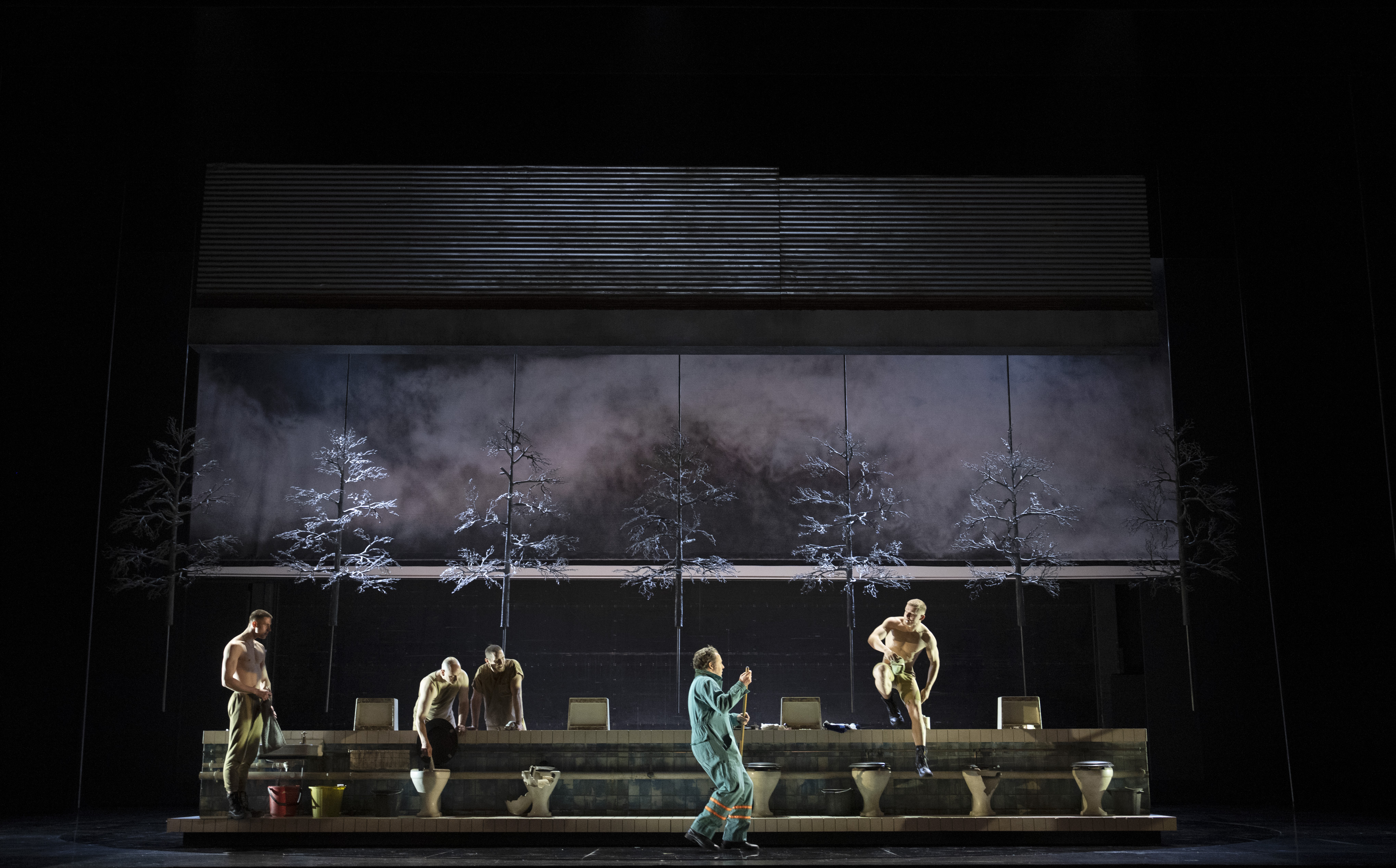
Aufstieg und Fall der Stadt Mahagonny, ENO, 16 February 2026


Coliseum


Images: Tristram Kenton


Announcer – The Company
Leokadja Begbick – Rosie Aldridge
Fatty the Bookkeeper – Mark Le Brocq
Trinity Moses – Kenneth Kellogg
Jenny Smith – Danielle de Niese
Jimmy MacIntyre – Simon O‘Neill
Jack O’Brien – Elgan Llŷr Thomas
Bank-Account Billy – Alex Otterburn
Alaska Wolf Joe – David Shipley
Jenny’s Girls – Joanna Appleby, Deborah Davison, Sophie Goldrick, Ella Kirkpatrick, Claire Mitcher, Susanna Tudor-Thomas
Jenny’s Boy, A Cloud – Damon Gould
Jenny’s Boy, A Typhoon – Adam Taylor
Toby Higgins – Zwakele Tshabalala

Director – Jamie Manton
Designs – Milla Clarke
Lighting – D.M. Wood
Choreography – Lizzi Gee, Spencer Darlaston-Jones
Sound design – Jake Moore
Intimacy and fight coordinator – Haruka Kuroda

Chorus and Additional Chorus of the English National Opera (director: Matthew Quinn) 
Orchestra of the English National Opera
André de Ridder (conductor)


In Berlin’s Dorotheenstädtischer Friedhof, one of my favourite cemeteries, Hegel lies buried—as, very close, do Bertolt Brecht and Helene Weigel, as do many others. Brecht’s Chausseestrasse house and the room in which he worked overlooked that cemetery; the Marxist Brecht expressly chose it out of increasing fascination with Marx’s single most important intellectual forerunner, GWF Hegel. One summer, I lived ten minutes’ walk away and visited regularly. Karl Marx, of course, lies in another celebrated cemetery, in another great world city: Highgate in London, further from anywhere in London I have lived, yet not so far in the greater scheme of things. This tale of ‘my’ two cities, of two cemeteries, of three dead men and more – ‘Nothing you can do will help a dead man’ – shaped my experience of this new ENO production of The Rise and Fall of the City of Mahagonny, not least since I had seen Mahagonny only two months previously, in Berlin, in Barrie Kosky’s Komische Oper staging. 

In capitalist society as in its artistic production, then as now, the grit lies in contradiction. What Hegel the divined as ontology, Marx situated in particular social and economic conditions. We are not obliged to choose; both indeed may be true or at least contain truth. In any case, following in both Hegel and Marx’s wake, Brecht and Kurt Weill’s Mahagonny offers an illuminating instantiation of some of these contradictions: not only in subject matter but in aesthetics and its implications for performance and reception. Some art fails because it simply is not very good, or at least is not well presented. The contradictions here, though, are of a different nature, not to be smoothed over, concealed, or reconciled, but to be such stuff as dreams are smashed on—as indeed is patently the case wherever we look in our present social and political predicaments. No wonder, then, that this new ENO production, the last, I believe, before the company’s move to Manchester, is replete with more general resonance than those personal, albeit connected elements with which I began. 


The contradiction between advertisement and reality is key to the Mahagonny and the Mahagonny we visit with Jamie Manton and his team, yet so is the form of production we can all see – and hear – if only we open our eyes and ears. In the ‘real’ world, ideology mystifies, obscures, yet never quite conceals; here, contradiction is perhaps more glaring, but that is the (Brechtian) point. It all goes back to a lorry, a box of theatrical tricks. (In what I think is pure coincidence, it put me a little in mind of the van in Frank Castorf’s Bayreuth Ring, though vehicular function may hold something in common.) Great claims are made for the city the unholy trio – less a trinity than in Kosky’s staging with c.1930 religious symbols – have built. Perceived desire and demand play their part, whether for whiskey or women—and, in a welcome update, men too. Sex workers rather than prostitutes, Jenny’s girls and boys are available to all, though the outcome does not change. Any declaration of love is not necessarily entirely hollow, but its truth is fleeting and contradicted by the destructive self-interest of all (save, perhaps, the founding mother and fathers). Even the whiskey is diluted by grim recycling that suggests what comes out one end will go back in the other. 

But it is not all grime and grimness: there would be no contradiction then. There is Weill, of course, on whom more soon, but there is also a lively sense of fun, of entertainment: not necessarily unmediated, but what is? There are plenty of witty moments to occasion a wry smile or more, whilst the framing – the Coliseum’s staging and technical equipment a container for, in turn, the container – reminds us this is theatre. Announcements are made by alternating members of the company, part Brechtian remnant with loudspeaker, part Handmaid’s Tale entertainment imitation. (Before the interval, that is; after, they are more clearly themselves, unmasked.) And whilst the production in general shies away from specific contemporary reference – we can hardly fail to make it – the trial as gameshow surely gives the Trumpian game away. Resourceful designs impart a sense both of using what was to hand and also of what one might see, or have seen, at the Berliner Ensemble. In the contradiction between expectation and reality, a weathervane (we have plenty of them in our world) tapdancing hurricane points the way to just destruction of the city, only suddenly to change direction in a triumph of the knowingly underwhelming that prefigures God’s forlorn, defeated attempt to visit justice on this world at the end, drawn out Weill’s Bachian chorales bleakly yet thrillingly subverting Christian passion. Likewise, a cloud dances in counterpoint to Weill’s delicious parody of overwrought, out-of-tune Romantic salon music, edging out Jimmy’s act in more ways than one. 


For the tension and indeed contradiction between Brecht and Weill will, should always lie at the heart of this work and its performance. Can, should music do what Brecht seems to imply it should? Where does that leave the songs, the tunes, the band? André de Ridder, music director designate, drew out biting and seductive playing from the ENO Orchestra. One could sympathise with Jimmy on his last night, traduced and betrayed, as for once strings soared, but not too much—and then it was over. Structurally, closed forms – how they do (and do not) add up to more – were clear and did far more than reproduce those of the libretto. It can be all too easy hearing Weill in the twenty-first century to succumb to nostalgia for a ‘Weimar’ that never was. Here, edge was maintained without entirely denying us pleasure; banjo and Hawaiian guitar could be heard amidst ominous, bass-led hemming in. If only Jeremy Sams’s translation could have decided what it wanted to be and stuck with it, much would have bitten still more savagely. Much was good, but there were too many instances that simply jarred, and the crucial Biblical element to Brecht’s writing was too often lost. 


One less productive contradiction, at least for me, lay between operatic voices and miking. The Coliseum has never offered an ideal acoustic for opera, but here balances were too often awry. The chorus suffered more than most, words sometimes more or less inaudible. Rosie Aldridge and Danielle de Niese offered nicely contrasting and complementing female leads, equally at home in more operatic moments and something closer to the street, both fine singing actors. Simon O’Neill proved a tireless Jimmy, ably supported by his friends, Alex Otterburn, Elgan Llŷr Thomas, and David Shipley. Alongside Kenneth Kellogg and Mark Le Brocq, all offered individual performances founded on the text and on a recognition that the text has contradictions of its own, not least between words and music. Ultimately, I found there was in all respects no need to choose: Berlin and London offered different experiences, in contrast, complement, and yes, contradiction. In some ways, the latter, perhaps ironically, seemed the more Brechtian in its reluctance – refusal would be too strong – to concede to opera, even in Weill’s idiosyncratic conception. It was, in any way, a properly barbed, defiant way for ENO to bid us au revoir. 


Thursday, 11 January 2024

Jenůfa, Staatsoper Unter den Linden, 7 January 2024


Grandmother Buryja – Hanna Schwarz
Kostelnička Buryja – Rosie Aldridge
Jenůfa – Vida Miknevičiūtė
Laca Klemeń – Stephan Rügamer
Števa Buryja – Pavol Breslik
Foreman – Grigory Shkarupa
Jano – Victoria Randem
Barena – Adriane Queiroz
Mayor – David Oštrek
Mayor’s Wife – Natalia Sckrycka
Karolka – Maria Kokareva
Herdswoman – Ekaterina Chayka-Rubinstein
Auntie – Rebecka Wallroth
Voices – Olga Vilenskaia, Ben Bloomfield

Director – Damiano Michieletto
Revival director – Marcin Łakomicki
Set designs – Paolo Fantin
Costumes – Carlo Teti
Lighting – Alessandro Carletti
Choreography – Thomas Wilhelm  

Staatsopernchor Berlin (chorus director: Dani Juris)
Staatskapelle Berlin
Axel Kober (conductor)


Images: Bernd Uhlig (from 2021 premiere, with different cast)

Damiano Michieletto’s 2021 production of Jenůfa, now receiving its first revival, offers a relatively straightforward retelling of the story without prettifying or sentimentalising. Paolo Fantin’s set designs are stark: semi-transparent, enabling one to see, as in a small rural community, most of what is going on, whilst still maintaining some degree of secrecy. This is a world of violence and poverty, and so it feels, whilst avoiding undue specificity: the level of abstraction is such that the message need not be restricted to any one milieu. That enables a degree of symbolism, perhaps not entirely unlike Olivier Tambosi’s 2001 Covent Garden production (my first, with Bernard Haitink and Karita Mattila no less).

Ice/water is central to Michieletto’s conception. There is something icy to the walls, but more fundamentally, not unlike Tambosi’s giant boulder, although the other way up, an iceberg descends from the ceiling or sky. It hems in the action to varying extents, according (I assume) to the emotional and broader dramatic temperature. Števa hacks a block of ice to pieces, with violence shocking both in itself and in its childishness, when he has been rejected for conscription. Jenůfa’s child is buried and preserved in the ice too, of course, that discovery provoking the final reckoning and thus enabling the advent of some limited hope and here, literally, sunlight for Jenůfa and Laca. And its melting provides a downpour to punish, symbolically at least, the Kostelnička. The community, arguably the true villain here – Števa is too weak to deserve such billing – is represented by a few actors, whose shifting shape and role say most of what needs to be said. We can fill in the gaps, bring something to the table ourselves, or simply watch things ‘straight’. Whether the chorus’s placing, largely offstage, was at least in part a response to pandemic restrictions, I do not know, but it works, perhaps paradoxically, to enhance the onstage claustrophobia.


Choral singing was good, although coordination with stage and pit sometimes went awry. Indeed, conductor Axel Kober’s coordination of his different forces often left something to be desired, the opening seriously awry, both in that respect and concerning balance of orchestral lines. By and large, Kober gave a good enough impression of the score without penetrating deeper. The Staatskapelle Berlin responded in kind, often more than that. But where the musical action should erupt, forcing itself into our consciousness as a literal matter of life or death, Kober seemed largely content to offer an accompaniment to scenic action: involving enough, but an accompaniment nonetheless. There was little sense, at least from the orchestral direction, of the composer’s speech rhythms determining line and form (surely a crucial argument for preferring Janáček in the original Czech). 

The cast did a better job in that respect and others. Vida Miknevičiūtė seems very much to be a soprano of the moment, unable to put a foot (or note) wrong. Her assumption of the title role proved no exception: no mere victim, but a somewhat headstrong young woman, who made choices of her own as well as suffering those of others. Here was to be heard a definite command of the composer’s writing and its dramatic implications, as well as stage presence and collegiality. The same could be said of her colleagues, Rosie Aldridge a compassionate yet broken Kostelnička, Hanna Schwarz still an estimable force as Grandmother Buryja. Pavol Breslik skilfully trod a tightrope as Števa, keenly alert to the character’s contemptible weakness, whilst maintaining allure and vocal security. Stephan Rügamer’s Laca grew in stature as Števa receded from our – and Jenůfa’s – consciousness. Sterling work was done in the smaller roles, Maria Kokareva’s Karolka, Natalia Sckrycka’s Mayor’s Wife, and Victoria Randem’s Jano shining examples for me. There was fine ensemble work here, in which it was rightly difficult to distinguish between singing and acting.


Saturday, 20 May 2023

Wozzeck, Royal Opera, 19 May 2023


Royal Opera House

Wozzeck – Christian Gerhaher
Marie – Anja Kampe
Captain – Peter Hoare
Doctor – Brindley Sherratt
Margret – Rosie Aldridge
Drum Major – Clay Hilley
Andres – Sam Furness
First Apprentice – Barnaby Rea
Second Apprentice – Alex Otterburn
The Fool – John Findon
Soldier – Lee Hickenbottom
Tenor Solo – Andrew Macnair
Marie’s Son – Jonah Elijah McGovern

Deborah Warner (director)
Hyemi Shin (set designs)
Nicky Gillibrand (costumes)
Adam Silverman (lighting)
Kim Brandstrup (choreography)

Royal Opera Chorus (chorus master: William Spaulding)
Orchestra of the Royal Opera House
Antonio Pappano (conductor)


Images: Tristram Kenton
Andres  (Sam Furness), Wozzeck (Christian Gerhaher)


Thirty years ago, in Sheffield, a teenage schoolboy saw his first opera in the theatre. It was Wozzeck, directed by Deborah Warner for Opera North. Quite an opera with which to begin, you might say, and indeed in many ways it was, yet why would you wish to begin with something that was not ‘quite an opera’? He knew a little more, though not much, opera not having been part of his childhood or more general homelife, nor indeed of his schooling. Plus ça change… By that time, he had just begun to explore the operas of Mozart, those you might expect: Figaro, Don Giovanni, and The Magic Flute. He had also, slightly clueless, speculatively bought a reduced, ‘historic’ recording of Tristan und Isolde from WH Smith and had watched a video, kindly lent by his music teacher, of Die Meistersinger. That, however, was it. He had not yet knowingly listened to music of the Second Viennese School, though that also was suddenly about to change. It is no exaggeration to say that those hundred minutes in the Lyceum Theatre changed his life. 

From 1993 to 2023: an avid (if, born perhaps of that initial experience, selective) opera-goer travelled across another English city for the first night of a new production of Wozzeck, also directed by Deborah Warner, now for the Royal Opera. Full circle? Not really; nothing ever is. Our protagonist has, for better or worse, had numerous experiences, music, dramatic, emotional, and intellectual, since; he is certainly no longer a boy. Yet Wozzeck, which for him ever since has had at least as strong a claim as any to be the single greatest opera of the twentieth century, exerts, if anything, a still greater fascination and admiration, certainly a greater love, than it did then, born of three decades of living with it. How, then, would Warner II fare in circumstances both old and new?


Truth be told, if you spend your time in Wozzeck thinking about a previous production or performance, something has gone wrong (either with you, what is onstage, or both). I did not. In any case, comparisons either with Warner’s first staging or with when I had previously heard Antonio Pappano conduct the work (twenty-one years ago for Keith Warner’s then-new production, in Pappano’s first season at Covent Garden) would largely be meaningless, given the vagaries of memory and my lack of a written record. Deborah Warner in 2023 does not seem to me especially to take a view or standpoint, at least not exclusively. This is not a Wozzeck that (over-)emphasises the brutality of military life and war, or expressionist experimentalism, or any one thing, though many such things are present. The action is already taking place as we take our seats, soldiers (an excellent troupe/troop of actors) relieving themselves in various ways, cleaning up, doing very much what soldiers do in barracks. That establishes an expectation of realism which is not entirely fulfilled, but rather is supplemented, so that as the action develops, as different standpoints are afforded by the work (and probably its creator), we have opportunity to take them too. Everything takes place more or less where one might expect, but there are always refreshing touches of set design, costume, lighting, or detailed Personenregie – let alone the musical performances – to enable us to take a fresh look and listen. The drama unfolds, with great immediacy, yet always it feels that this is ultimately Wozzeck rather than ‘Deborah Warner’s Wozzeck’, whether that feeling, even that possibility, be a fond illusion or otherwise. Different settings for different scenes – no fewer than fifteen of them – present themselves without fussiness or fetishisation: this is a light, enabling, generous realism that can shade almost imperceptibly into other, complementary aesthetics as required. Credit is surely due both to the design team and to the Royal Opera House’s technicians and actors, who accomplished this feat with such apparent ease. Rehearsal surely paid off.


Slightly stylised trees, Cross-like, hint at Wozzeck’s fate, albeit without redemption, but also at a natural world beyond that neither knows nor cares, yet in some sense frames tragedies that lie in stark contrast, being entirely the creation of man. There remains a Romantic desire to escape this miserable world, even if only to Berg’s family estate (Berghof) in Carinthia. Like so much else, though, it is not possible. The blood-red moon and the black, unfathomable lake dominate our vision and consciousness as natural and human boundaries. And finally, in that ultimate, heartbreaking scene of horror: the child turns to the wall in front of which the other children have just been playing, to see painted on it the news they have so cruelly, carelessly delivered. His mother is dead. He turns around and walks off, alone. The drama stops, silence cruelly denied by some idiot’s premature applause—but even that could not quite break the punch to the solar plexus. 

Much of that is, of course, a musical punch. Pappano really seems to be at his best right now. Shortly after thinking his Turandot perhaps the best I had heard from him, I found this Wozzeck at least close to equal, and in ways that surprised me. Without wishing to play that game of illusory comparisons, however tempting, I found this an infinitely more engaging experience than in 2002. Often quite extraordinary orchestral precision, for which one must of course above all credit the orchestra itself, laid bare the framework of closed forms in themselves, their multifarious musical procedures objects of an almost yet not quite Neue Sachlichkeit fascination, but also showed them to be the engines of a dramatic progression that, however Wagnerian it may often sound, is at least as much an alternative to Wagner’s method. There were wrenching, late-Romantic passages, of course, precisely where one would need and expect them, but this was also a musical drama that prefigured Hindemith, Weill, perhaps even Berg’s own teacher, Schoenberg. This was not always a Wozzeck that rose from the bass line, though sometimes it did, but it hinted more than usual at Berg’s later writing, whilst also suggesting an earlier, almost Mendelssohnian Romanticism. Like Warner’s production, it afforded different standpoints, without sounding merely sectional. 

I have been fortunate to see some extremely fine Wozzecks in those years since my first encounter (Andrew Shore on that first encounter included). Christian Gerhaher’s thoughtful, collegial approach, placing himself and his character at the dramatic hub, gaining meaning as much from interaction with colleagues as from his considered yet apparently spontaneous way with the text, has nothing to fear from any of them. His performance, worlds away, as is proper, from the beauties of his celebrated Wolfram, was yet equally well judged. Indeed, I wonder whether it heralds a new chapter in his career. For now, though, it will more than do in and of itself.


Wozzeck, Marie (Anja Kampe)

There was splendid chemistry with his Marie, Anja Kampe. I was about to say ‘we tend…’, but should really only speak for myself: I tend often somewhat to overlook the tragedy of Marie’s death, so overwhelmed am I by that of Wozzeck. Here I felt greater parity, doubtless a matter of Warner’s Personenregie but also of Kampe’s portrayal. (It is more or less impossible for an outsider to distinguish between the two.) This important corrective was brought into further relief by Anna Picard’s excellent programme note on ‘Maria and her World’, whose closing words seem very much to refer to what we saw and heard: ‘She is no Kundry. Neither is she a Judith or the hysterical Woman in Marie Pappenheim and Arnold Schoenberg’s monodrama, Erwartung. Her murder is not dressed up as a form of release for Wozzeck or a point of debate. It is simply a domestic tragedy of a very ordinary, and ever modern, kind.’ Which also brings us back to Gerhaher’s Wozzeck, for his very haplessness – what art lay in that – also contributed to that very non-release, felt (at least by me) more emphatically than I can recall.


Captain (Peter Hoare), Wozzeck

All in the cast contributed to the greater dramatic (and musical) whole, so much as to suggest unusually fruitful close collaboration between all concerned. Sam Furness’s Andres surprised me, not least because I often find myself wondering where the role went, thinking it smaller than I had expected. Not here: this was a character sympathetic to Wozzeck who yet had his own story to tell. Likewise Rosie Aldridge’s spirited Margret, whose spot in the second tavern scene almost had time stand still as the world disintegrated around her. Peter Hoare’s Captain and Brindley Sherratt’s Doctor made a sharply etched pair: guilty, yet not guilty, like all in the world we saw. Well, perhaps not quite all, for it is difficult to find any grounds to absolve the Drum Major, here given an appropriately nasty, bullying, yet finely sung performance by Clay Hilley. William Spaulding's Royal Opera Chorus was on outstanding form too. 

What, then, should a Wozzeck accomplish? There can be no definitive answer, no more than for any artwork in performance. Different productions, different performances, different audiences will all render such categorical statements in vain. If I have learned one thing over the past thirty years, it will be that. That said, if one does not emerge from a performance convinced that it is one of the greatest of all operas – ranking beyond that is a mere parlour game – it will have been in vain. My first experience was not; nor, emphatically was this: a searing and strangely refreshing Wozzeck, which I hope and intend to revisit soon.


Friday, 18 March 2022

Peter Grimes, Royal Opera, 17 March 2022

Royal Opera House


Images: ROH 2022 (c) Yasuko Kageyama
The Boy (Cruz Fitz), Peter Grimes (Allan Clayton)


Hobson – Stephen Richardson
Swallow – John Tomlinson
Peter Grimes – Allan Clayton
Ned Keene – Jacque Imbrailo
Rev. Horace Adams – James Gilchrist
Bob Boles – John Graham-Hall
Auntie – Catherine Wyn-Rogers
First Niece – Jennifer France
Second Niece – Alexandra Lowe
Mrs Sedley – Rosie Aldridge
Ellen Orford – Maria Bengtsson
Bryn Terfel – Captain Balstrode
The Boy – Cruz Fitz
Aerialist – Jamie Higgins

Deborah Warner (director)
Michael Levine (set designs)
Luis F. Carvalho (costumes)
Peter Mumford (lighting)
Kim Brandstrup (choreography)

Royal Opera Chorus (chorus master: William Spaulding)
Orchestra of the Royal Opera House
Mark Elder (conductor)

London has proved fortunate with recent productions of Peter Grimes (and doubtless with older ones too). David Alden’s 2014 production for ENO and Willy Decker’s for the Royal Opera (in its 2011 revival) both had considerable virtues and received performances. This new staging from Deborah Warner and the performances that brought it to life were nevertheless in a class of their own, showing the Royal Opera at the top of its game.


All three productions will have displeased the Campaign for Real Barnacles, and thank goodness for that. Warner takes us into the dark underbelly of a contemporary, down-at-heel seaside town, with neither room nor appetite for prettified nostalgia for an early nineteenth century that never was (and certainly never was in George Crabbe). I thought of a poorer version of Margate, somewhere perhaps in Essex—and lo and behold, had that confirmed in Warner’s programme reference to ‘some of the extremely poor and socially deprived towns of the Essex coast, namely Jaywick Sands’, testament not to any great acuity on my part but to Michael Levine’s sets, Luis F. Carvalho’s costumes, and to the entire ensemble of Warner’s production, sharply, meaningfully choreographed by Kim Brandstrup. There is poverty here, also reckless abandon; there are drugs, alcohol, and sleaze; there is a ‘community’ that rounds on an outsider and in the violence of that rounding discovers a nativist identity and ‘morality’ that chills and kills. It takes back control, polices its borders, and deals with outsiders in a terrifying march of intimidation, fire, and nihilism. This Borough is UKIP, even BNP, country, in which shirtless neo-Nazis mix with dealers such as Ned Keene, one of the more sympathetic townsmen if ultimately untrustworthy on account of his habit; and bigoted, ‘respectable’ rentiers such as Mrs Sedley. It is not, however, an amorphous mass: not everyone is like that, and everyone has his or her own story. Warner takes immense care, as do all of those participating, every member of the chorus clearly directed individually and coming to life both in that individuality and as part of a deadly, group identity. Not only do Grimes and his apprentices—one hauntingly portrayed as a just out-of-touch aerialist vision—have no chance; nor does Ellen Orford, herself a victim of Grimes’s physical violence. ‘The more vicious the society, the more vicious the individual.’


There is no sign that Grimes is homosexual, or Muslim, or Polish for that matter; but this is undoubtedly the rough justice that would be meted out to him if he were. It is a similar social tragedy to that one sees in parts of Brandenburg or Saxony, doubtless across the world. But it has a particularly English flavour. They do like to be beside the seaside, and they do not like others, with no place to be there, to attempt to join them. Britten’s fraught relationship to England and Englishness, his (partly) thwarted internationalism, and the parochialism of some of his devotees are set in implied counterpoint, but with the work rather than its critics ultimately setting the terms of examination. It is slightly odd—maybe more than that—that, in the contemporary setting, Grimes’s apprentice should be so young a boy, but even that serves to remind us of another aspect of the ‘Britten problem’, which this contemporary Borough would doubtless address with savage, summary justice. 

There could not, I think, have been a better choice to conduct this production than Mark Elder, who led the Orchestra of the Royal Opera House, on as fine form as I can recall, as if a man possessed. He clearly believes in every note of the score and, more to the point, revealed all manner of potentialities I had barely imagined were there. Musical processes are clear and generative, indicative of a serious attempt to address the problems of form that so often bedevil Britten’s music in work and performance. An account of titanic clashes and contrasts spanned, on the one hand, screaming echoes of Shostakovich’s Lady Macbeth and, beyond it, the Mahler of the Fifth Symphony; and, on the other, passages of translucent beauty that seemed to have all the time in the world, yet are fated to be cut short. Elder’s conducting was urgent, even when spacious, whipping up a sequence of storms of fatal consequence that not only framed, but incited, the action on stage. We were reminded that, here, the sea was a thing of danger as well as livelihood, a theatre of cruelty and redress far more than a picturesque landscape.

Another man possessed was Allan Clayton’s Peter. If I say it was the most beautifully sung account of the role I have heard that would unduly delimit its range, though in many respects it certainly was beautiful—and more youthfully vulnerable than the typical craggy old man. This, crucially, was a performance that dug deep psychologically, that suggested profound consideration of dilemmas and traumas faced by the character, and frankly admitted that not all could or should be answered. I could not help but think of Boris Godunov in Clayton’s final scene; the voice is different, as are music, drama, and almost everything else, yet psychological descent and devastation presented tragic parallels across the divide.


Ellen Orford (Maria Bengtsson), The Boy

Maria Bengtsson gave us a profoundly human, refreshingly unhackneyed Ellen Orford, a force for good whose goodness went so cruelly punished. Her ‘Embroidery Aria’ could not have been more touchingly sung, its difficult intervals navigated with ease and in perfect harmony with the orchestra. Jacques Imbrailo’s Ned Keene offered a fascinating study in ambiguity, perhaps beyond mere good and evil. Powerfully and, again, beautifully sung, so much more lay in the acting: a drug-addled hedonist who exerted a mysterious yet undeniable attraction, not an outside as such, yet never quite to be assimilated. Bryn Terfel’s Balstrode may well be the finest opera performance I have seen from him, fully in command of the role and its possibilities, throughout exuding deep humanity and a wisdom that again set him apart without excluding him. Catherine Wyn-Rogers gave us a world-weary yet lively Auntie of experience, Rosie Aldridge a properly vicious Mrs Sedley, more insidious than John Graham-Hall's nicely buffoonish Bob Boles. There were no disappointments in a strong supporting cast, which seemed to grow out of that minutely observed direction of the chorus: a community of individual and mass imperatives. Choral singing was likewise outstanding, the Royal Opera Chorus on better form than I have heard for a long time, fully engaged in portrayal of Britten, Warner, and Elder’s visions (as well, doubtless, as their own).


This enthusiasm comes from a place of ambivalence toward the work itself. I am not yet persuaded that swathes of the second act in particular are not a little dull, nor that the influence of Wozzeck at the beginning of the third is not a little too close for comfort, ‘Arias’ still seem to stand out awkwardly from the rest, and so on. If you are going to be influenced, though, you will struggle to find a better source of influence than Wozzeck, and not every opera can attain the perfection of Figaro or Tristan. This was an outstanding night of theatre, strongly to be recommended to everyone: to the Britten devotees who will not give two hoots about my reservations; to fellow Britten-agnostics, who may also find previous reactions challenged; and even to those more hostile, whose road to conversion may have its point of departure. Not to be missed.


Tuesday, 26 February 2019

The Monstrous Child, Royal Opera, 21 February 2019 (world premiere)


Linbury Theatre


Hel (Marta Fontanals-Simmons)
Images: Stephen Cummiskey/ROH 2019

Hel – Marta Fontanals-Simmons
Angrboda – Rosie Aldridge
Loki – Tom Randle
Modgud – Lucy Schaufer
Baldr – Dan Shelvey
Odin – Graeme Broadbent
Nanna, Thora – Elizabeth Karani
Actors and Puppeteers – Laura Caldow, Stuart Angell

Timothy Sheader (director)
Paul Wills (designs)
Howard Hudson (lighting)
Ian William Galloway (video)
Josie Daxter (movement)

Sound Intermedia (sound design)
Aurora Orchestra
Jessica Cottis (conductor)


The Royal Opera House’s choice of work for the first new production in the splendidly redesigned Linbury Theatre – not unreasonably, it seems to have lost ‘Studio’ from its name – is, perhaps, a declaration of intent; it may certainly be received as such. Not only is it a new work; it is billed specifically as ‘our first opera for teenage audiences’. Following somewhat in the line of Mark-Anthony Turnage’s Coraline – last year’s premiere for children – Gavin Higgins’s The Wondrous Child, to another libretto by a children’s author, this time Francesca Simons, seems to me to have a good chance of prospering not only in that specific role, but also more generally. It is certainly a successful first opera – from the Linbury, from Higgins, from Simons, and indeed from the production team and performers, without which any single effort would likely come to naught. Opera, we were reminded, is above all a company effort – which should, of course, include the audience too. Let us hope, then, that plenty of teenagers were among those who were able to secure tickets before the run sold out; and/or that further tickets will be released, as often happens in practice.

Baldr (Dan Shelvey)

Many – though perhaps not so many of us on the first night – will doubtless come to the opera through Simons’s book ‘of the same name’, as Peter Cook and Dudley Moore might have had it. Not that there is anything of ‘Little Miss Britten’ here; for not only is the plot drawn from Norse mythology, from the myth of Hel, goddess of the dead; the libretto is distinctly on the Anglo-Saxon and perhaps even the Norse roots of the English language. Had his English been better, Wagner might have lauded the lack of Latinism. The immediacy, not to mention the ‘earthiness’ of some of the vocabulary make particular sense in a primaeval realm – and will surely appeal to teenagers of all ages in the audience too. To a certain extent, staging and score work with that, performances perhaps still more so; they also recall (to us), however, consciously or otherwise, that we are no more Anglo-Saxons than we are Norse gods. The false immediacy of which Wagner could occasionally – very occasionally – prove guilty in theoretical, though never dramatic, writing stands always in need of puncturing in our modern condition. That is not a value judgement, simply an observation.


Simons knows that as well as Higgins, as well as by director, Timothy Sheader and his team. And so, we are reminded by the puppetry in the first half of the staging, actors and singers lightly detached – this is not The Mask of Orpheus, nor does it try to be! – from their characters in some cases, as well as by Hel’s narration of that first part, the later character recounting the deeds of the child-puppet her, that even in – particularly in – a drama dealing with (supposedly) eternal gods, time plays a mediating role. Again, Wagner of all musical dramatists could have told us that – and does. Higgins offers much in the way of readily associative and memorable leitmotifs in his score, as well as plenty of ‘atmosphere’ and ‘action’, after a fashion that would surely make sense to teenagers – and others – accustomed to the ways of film scores, without ever sounding ‘like’ film music. Video and electronic sound help us shift between locations, for instance from the gods realm in the skies to the place of Hel’s banishment, from which she will bring about the end of the gods’ rule.


Angrboda (Rosie Aldridge)


Leaving aside the (understandable) exaggeration about what opera ‘is’, for it can be any number of things, one knows what Simons means when she writes in the programme: ‘It took me a while to understand how different writing a libretto is to writing a novel. Opera is much more direct: people say what they think – repeatedly. Opera is so heightened, it really is the perfect way to express the emotion and epic sweep of myths about gods and giants, love and hate, as well as a young girl’s journey towards creating her own life.’ To my mind – and increasingly on reflection – Simons and Higgins achieve this with great success here. Pacing is different too; the analogy Simons draws with a picture book – ‘the words need to allow space for the illustrations’ – is interesting. Again, one senses a true collaboration: between librettist and composer, of course, but also with the production team and performers.


Marta Fontanals-Simmons gave a fine performance as Hel: half human, half corpse. Never sentimental – she does not want mere pity – she involved us in her plight, her hopes, her decision through sheer force and variety of vocal personality. Rosie Aldridge and Tom Randle impressed and (not a little) repelled as her parents: those who cursed her and ultimately the world by bringing her into it. Lucy Schaufer proved typically compassionate as the giantess Modgud, keeper of the bridge to Niflheim and the dead. Odin, king of the gods, received a sharply observed performance from Graeme Broadbent, taking us plausibly from hauteur to downfall. Dan Shelvey’s Baldr, as carefree and compassionate in tone as the lovelorn Hel thought him, offered a performance both delightful and moving. The Aurora Orchestra and Jessica Cottis could hardly have offered surer advocacy in the pit.

Thursday, 2 July 2009

A Midsummer Night's Dream, Royal College of Music, 1 July 2009


(Images copyright: Chris Christodoulou)

Britten Theatre, Royal College of Music

Oberon – Christopher Lowrey
Tytania – Colette Boushell
Puck – Luke Williams
Lysander – John McMunn
Demetrius – Philip Tebb
Hermia – Anna Huntley
Helena – Madeleine Pierard
Bottom – Jimmy Holiday
Quince – Ross McInroy
Flute – Alistair Digges
Snug – David Milner Pearce
Snout – Alex Vearey Roberts
Starveling – Alex Duliba
Hippolyta – Rosie Aldridge
Theseus – David Hansford
Peaseblossom – Ben Richardson
Cobweb – Crispin Lord
Moth – Christopher O’Brien
Mustardseed – Joe Brandon
Indian Boy – James Dugan

Ian Judge (director)
Mark Doubleday (lighting)

Trinity Boys Choir
Royal College of Music Orchestra
Michael Rosewell (conductor)

I am no paid-up – or even subscription-lapsed – member of the Benjamin Britten fan club, having often, heretically, admired him more as a pianist and conductor than as a composer, and at least as often often suspected that his near-stratospheric critical esteem in this country is owed as much to his nationality as to anything else. (The English, stung by the dearth of anything worth listening to between Purcell and Elgar, seem especially prone to such strange nationalism. ‘We’ have plenty of great music, just not from the eighteenth or nineteenth centuries.) Peter Grimes, for instance, has always struck me as far better in terms of its plot than its music, though The Turn of the Screw is a considerably finer work in both respects. Yet, fresh from Garsington’s vapid if enjoyable Mirandolina (Martinů), I realised once again that, in the theatre and in a winning performance, the sceptic in me could be quietened. So long as absurd claims are not made for A Midsummer Night’s Dream, it emerges – and certainly emerged at the Royal College of Music – as a more substantial work than many that continue to hold the operatic stage.

Ian Judge has directed a great deal of Shakespeare, both for the Royal Shakespeare Company and elsewhere. His experience shows in his familiarity with the text – and also in alertness to its necessary shortening. (Britten and Peter Pears themselves fashioned the libretto.) The stage is formed by a black disc, whose lighting (Mark Doubleday) indicates the world in which the action is taking place. The moon is nearer, or at any rate larger, when we are purely in the realm of the fairies, more distant for the human world. The costumes and acting – here again Judge’s directorial experience shows – indicate that the fairies are far from a pretty, benign presence. There is at least a twist of nastiness to their punk Elizabethan look, quite apposite since Shakespeare and Britten make it abundantly clear that their mischief is far from merely amusing; lives could be wrecked here – and almost are. The composer is not so backward-looking as some of his less helpful advocates would have him, and it is to Judge’s and the musicians’ credit that they both appreciate and project that. After all, mind-altering - and rather more than mind-altering in the case of Bottom – substances are being forced upon the characters.

There were a few occasions when the relatively small size of the Royal College of Music Opera Orchestra was apparent, but for the most part it sounded well suited to the acoustic, swelling to a glorious sound in the mock-Romantic music and exhibiting a due sense of the unsettled to other passages. Michael Rosewell has long been an advocate of Britten’s music. There was never any doubt that the score was in safe hands here; indeed, forgetting about hands, it was clearly in his head rather than vice versa. Britten’s music tends to sound strongest when it is – and sounds – most ‘constructed’. Rosewell and his players helped one to appreciate the generative quality of the twelve-note writing – again, the more conservative Britten devotees would surely be horrified to be made aware of this – without neglecting or unduly opposing the magic in the rest of the score. If I became a little tired of certain aspects of the latter – does the composer really need to use the harp quite so often? – then that is no fault of the performance. And the contribution from the Trinity Boys Choir, which has given more than 150 performances of this work, was as excellent as one might have expected from such a figure. The treble voice, both solo and choral, is of great importance to Britten; these young musicians did not fail him. They were rather good actors too, not least in terms of their movement skills.

There was a fine sense of ensemble from the rest of the cast, for which honours should doubtless be shared between them, the director, and the conductor. Not all contributions were at the same level, but none was truly disappointed, which is more than one can often say for professional houses. Christopher Lowrey as Oberon reminded us that a counter-tenor need not sound merely fey; the voice, as various composers from Britten, to Goehr, to Birtwistle, have shown, can exhibit an otherworldly strength, as it did here. Luke Williams was the punkest of the fairies as Puck. Normally a baritone, here he was given full rein to display his spoken acting abilities; I am not sure one would have guessed that he is primarily a singer. John McMunn and Madeleine Pierard were the strongest of the lovers, as Lysander and Helena respectively, although Philip Tebb’s Demetrius was probably more strongly acted. Jimmy Holliday’s Bottom was a splendid parody of the over-bearing members of an amateur dramatics society, with the other Rustics working well together. If Alistair Digges’s Flute had seemed a little too light earlier on, the third act play of Pyramus and Thisby signalled a considerably stronger performance, the humour proving quite contagious amongst his colleagues. I was not sure why Alex Duliba’s Starveling was required to carry a (real) dog wherever he went, but it did no particular harm. Rosie Aldridge’s duly regal Hippolyta made one wish her part were more extensive, whilst David Hansford, who had stepped in ‘at exceptionally late notice’ as Theseus, would doubtless have made a surer impression in more propitious circumstances. Diction was not always what it might have been, especially, though not exclusively, from Pierard and Anna Huntley’s Hermia. This is clearly something on which the young cast should work, since the problem would be magnified in a larger theatre than this. Nevertheless, the cast should be applauded for a high quality of performance throughout – and not just, or sometimes even primarily, in vocal terms.