Showing posts with label Anne-Marie Owens. Show all posts

Tuesday, 21 June 2022

The Excursions of Mr Brouček, Grange Park Opera, 18 June 2022


The Theatre in the Woods

Mr Brouček – Peter Hoare
Málinka, Etherea, Kunka – Fflur Wyn
Mazal, Bounzincek, Petrik, Svatopluk – Mark Le Brocq
Würfl, Paycek, Councillor – Andrew Shore
Sacristan, Dudcek, Domšík – Clive Bayley
Kedruta – Anne-Marie Owens
Spotcek, Vojta, Raincek, Mirosla – Adrian Thompson
Postdatedcek – Jonathan Kennedy
Child Prodigy – Pasquale Orchard
Spotcek – Robin Horgan
Farty – Benjie del Rosario
Taborite I – Toki Hamano
Arty, Taborite I – Marcus Swietlicki
Dancers – Lauren Bridle, Bridget Lappin, Arianne Morgan, Luke Murphy, Jay Yule

David Pountney (director)
Leslie Travers (designs)
Marie-Jean Lecca (costumes)
Tim Mitchell (lighting)
Lynne Hockney (choreography)

BBC Concert Orchestra
George Jackson (conductor)
 

Bounzincek (Mark Le Brocq) and an artist on the moon
Images: Marc Brenner

Hats off to Grange Park Opera for unquestionably the best of the four ‘country house’ operas I have seen so far this season. First, and perhaps most important, with respect to the work itself: Janáček’s The Excursions of Mr Brouček. I suppose it might be theoretically possible to reach a state in which Janáček’s music was heard too often, though it might not. (Imagine saying such a thing of Bach or Mozart.) If it is, though, we are nowhere near that yet. Yet the Janáček operas we see staged are mostly, perhaps understandably, restricted to three: Jenůfa, Katya Kabanova, and The Cunning Little Vixen. We must go beyond The Makropulos Case and even From the House of the Dead to reach Mr Brouček. Doubtless some in the Grange Park Opera audience had seen it in the theatre before, but I had not, and was immensely grateful to have the opportunity to do so, let alone for it to be performed so well. 

Mr Brouček will doubtless always be a problematical work, in a way that the aforementioned popular (relatively speaking) trio will not. Its two-part structure will probably always require effort to bring together—if, indeed, such is the dramaturgical aim. But art is certainly not always about perfection, or approaches to it. Sometimes, it is about quite the opposite. The first part’s satire against pretentious avant-gardism, or perhaps better derrière-gardism, hits home more readily for a modern, or at least non-Czech, audience than the second, more preoccupied with Czech national mythology—although a little grounding helps us on our way. Nationalism, after all, remains sadly too universal. But the other part of the satire is against the antihero himself: the philistine who has little idea what he is doing in Prague, let alone on the Moon or in the fifteenth century. To that, we can and should all relate. No one likes a landlord, after all, especially one who boasts of having no mortgage, only a three-storey house. You can begin to see why the opera will never touch as Katya does. That is not its purpose.


Málinka (Fflur Wyn)

David Pountney’s production pulls out all the stops for a frankly zany trip from Prague to the moon, clarified and extended by Marie-Jean Lecca’s imaginative costuming. Leslie Travers’s brilliant set for the former captures an almost childlike delight in city models, as well as the, or at least an, idea of Prague. The empty pretentiousness of the moon artists—Pountney has fun, using his own, free English version of the text, creating names such as Spotcek, Raincek, and Postdatedcek—engenders an intoxication of its own. It is fun to watch, which guards us against too ready identification with Brouček. ‘We must each fight our inner Brouček,’ Janáček insisted. A similar, yet different mix of magical constructivism informs the still more bewildering—for many—and darker trip to the Prague of the Hussite rebellion.


Mr Brouček (Peter Hoare)
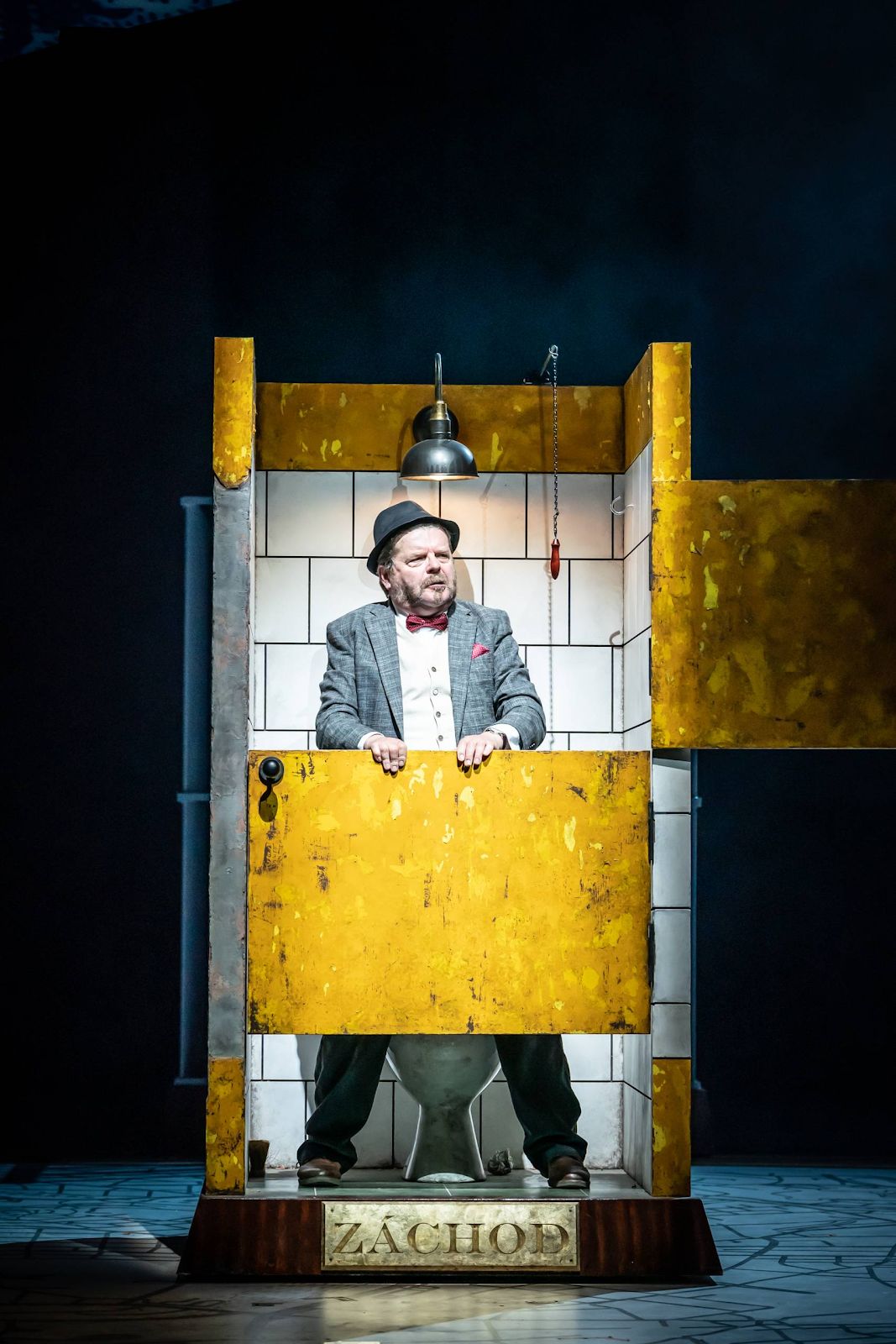
Whether one cares for the (literal) toilet (brush) humour of the interlude between the visits, will be a matter of taste. Monty Python is not my thing, but if it is yours, you will almost certainly love Pountney’s more outrageous excurses. Sometimes, though, I wondered where the heart was, especially during the Moon-trip. Is there not something more positive to say about artistic creation too? The answer, I suppose, would be that it lies in the score (and, indeed, in the artistic endeavour of performance and reception itself. It arguably suggested itself onstage at the end, when the innkeeper Würfl collected his drunken patron, laughed at his tall tales, but also walked him away in camaraderie. Perhaps that was enough. Again, that will probably be as much a matter of taste or inclination as anything else.


Peter Hoare’s Brouček captured well the contradictions not only of the character, but of our response(s) to him. This was a typically intelligent performance, which held the stage, amused, and touched without sentimentality. Fflur Wyn’s Málinka and other roles were lively, characterful, and rooted in, yet far from hidebound by, the text. Such is the magic of theatre, and such might be said of any number of the cast, including Mark Le Brocq’s handful of roles, Andrew Shore’s, and Clive Bayley’s, as well as Anne-Marie Owens's Kedruta. This was very much a company effort, which did Grange Park Opera proud, enthralling an audience that could all too readily have registered mere bemusement at the work’s oddity.


Domsik (Clive Bayley)


George Jackson’s traversal of the score elicited my unqualified admiration, as did the playing of the BBC Concert Orchestra. Incisive and expansive, earthy and soaring, above all attuned to those fabled speech rhythms and their unpredictable, magical combination into form and structure, this was as fine a Janáček performance as I have heard for some time, all the more so for its revelation of relatively unfamiliar territory. Time and time, presentiments of the Vixen’s world shone through, anchoring these ‘excursions’ in a common humanity and inspiring us to go forth and create it. The score emerged possessed of the musical, scherzando brilliance of the more or less contemporary Gianni Schicchi, if perhaps less single-minded, at any rate without the latter work’s dramaturgical precision, considered as a whole. We might say Janáček’s musical dramaturgy is more adventurous, though much depends what one means. Whatever our thoughts on that, this was a musical banquet beautifully and, at the last, movingly served.


Tuesday, 13 March 2012

Judith Weir, Miss Fortune, Royal Opera, 12 March 2012 (British premiere)

A member of Soul Mavericks
Images: Royal Opera/Bill Cooper
Royal Opera House

Tina (Miss Fortune) – Emma Bell
Lord Fortune – Alan Ewing
Lady Fortune – Kathryn Harries
Fate – Andrew Watts
Hassan – Noah Stewart
Donna – Anne-Marie Owens
Simon – Jacques Imbrailo

Chen Shi-Zheng (director)
Tom Pye (set designs)
Han Feng (costumes)
Leigh Sachwitz (video)
Ran Arthur Braun (movement)

Soul Mavericks (breakdancers)
Royal Opera Chorus (chorus master: Renato Balsadonna)
Orchestra of the Royal Opera House
Paul Daniel (conductor)


Let me try first to ‘accentuate the positive’ (as the libretto might have it). Judith Weir’s Miss Fortune, in a co-production with the Bregenz Festival, where last year it received its world premiere (as Achterbahn), is arrestingly staged by Chen Shi-Zheng. Tom Pye’s colourful designs capture the eye throughout, whether in the initial relative abstraction of the opening scene or the sight – though is it really necessary? – of having a kebab van lowered from the stage. (Could it not just have been wheeled on, at what would surely have been less expense?) The garment factory looks like a factory, and its workers look like factory fodder. Han Feng’s costumes for the most part do the trick, the sharp suit allotted to rich boy Simon for instance presenting an immediate contrast with those around him. Video (Leigh Sachwitz) is put to good use, swift falls in share prices immediately apparent.

Simon (Jacques Imbrailo), Fate (Andrew Watts),
and Tina (Emma Bell)
The Royal Opera fields an impressive cast. Emma Bell could not really be said to inhabit the role of Tina, for there is no character really to inhabit, but she sang with spirit, handling the occasional piece of coloratura with aplomb. Alan Ewing and Kathryn Harries did likewise in the caricatured roles of her parents. Noah Stewart made an impressive house debut as Hassan, the sincerity of his delivery nicely counterpointed by Jacques Imbrailo’s beautifully sung Simon. Andrew Watts did what he could with the sketchily observed role of Fate, and Anne-Marie Owens attended nicely enough to her job as ‘laundromat’ owner, Donna. They all sang well, and Imbrailo in the second act came as close as anyone could reasonably be asked to stealing the show. The breakdancers of Soul Mavericks do a splendid job in their own terms, though whether their inclusion was anything other than a desperate bid to make a dull, inconsequential work more diverting remains at best an open question.

For the plot, let alone its mode of expression, really does not amount to anything much at all. Tina’s parents, Lord and Lady Fortune lose their money in a financial crisis, so Tina decides to make her way in ‘the world, the real world’. Working in a factory (destroyed) and left in charge of a kebab van (ditto), she finds herself at the mercy of Fate, before her luck changes. Fate gives her a lottery ticket. She is on the verge of winning, but, one number out – thirty-eight instead of thirty-nine, or is it the other way around? – she does not. Cue general disappointment. However, Tina is able to call upon Fate to repeat the last few seconds and she wins after all. Simon, however, has already told her it does not matter; he wants him to join her in any case. She therefore tosses her winning ticket into the crowd and leaves with him: it is better, you see, to take a chance oneself than to await a deus ex machina. Nothing, alas, is developed. We gain no insight into any of the characters; instead, we are left with the wisdom of the fortune cookie. This may have its basis in a Sicilian folk-tale (Sfortuna), but in its ‘contemporary’ retelling, Weir’s opera would appear to have lost any of its teeth.

Hassan (Noah Stewart)

Apparently stuck between vaguely neo-Romantic style and not-quite-minimalism, the score offers little to interest, even as orchestral music, let alone as word setting. (Though, as I mention below, the worst of Tippett sometimes sprang to mind, he always had an ear for setting the English language.) The passages when Weir sounds more minimalistic sometimes seem to offer a little more – and believe me, I am surprised to find myself longing for anything more akin to minimalism! – but they never quite seem to cohere into something more than sound-track. At times, I thought Paul Daniel could have offered more in the way of rhythmic precision, but without having seen the score, it is difficult to know for sure. Doubtless it is not the point that almost all of the harmony could have been offered by an unadventurous composer from a century ago. But when precious little goes ‘beyond’ Walton or Shostakovich, for instance, and the only hint of something a little more ‘advanced’ would seem to be the most occasional hint of second-hand Berg and the use of a few drums, then there is perhaps something of a problem. More seriously, though, and despite the use of different sound worlds and indeed different generative material, I found it impossible to discern anything of a particular compositional ‘voice’, let alone for any of the music to lodge itself in my memory. The score certainly does nothing to engage one’s sympathy with either the characters or the apparent ‘moral’.


Simon and Tina

 It is, though, Weir’s own libretto that presents the greatest problem. One could hardly imagine that anyone with the slightest ear for language, let alone verse, let alone verse to be set to music, would not have realised that, at the very least, radical revision was required. If the plot plumbs no depths, the language combines to equal degree banality of expression and concept. There were times when I was put momentarily in mind of Tippett’s late libretti, albeit without the weird eccentricity. Lord Fortune’s ‘You make your own destiny, no pain, no gain’ gives a taste: far from the worst, but typical, and without a hint of satire. References to the need to rid oneself of ‘negative energy’ are bad enough – I should like to say that I thought the phrase was used ironically, but I am not so sure – but a new low is hit by Simon’s entrance into Donna’s ‘laundromat’ to tell her that she had produced the most beautifully laundered shirt. The psychobabble was not even interesting or amusing – at least Tippett would try to explore potentially interesting ideas – but merely dull. For the most part, the language, though not alas the drama, resemble a poorly-scripted soap opera. ‘In the end, we’re all dead,’ we are informed at some point. Quite.

Miss Fortune will be broadcast on BBC Radio 3 on 19 May at 6 p.m.