Showing posts with label The Excursions of Mr Brouček. Show all posts

Friday, 9 May 2025

The Excursions of Mr Brouček, LSO/Rattle, 6 May 2025


Barbican Hall

Mr Brouček – Peter Hoare
Mazal/Blankytný – Aleš Briscein
Málinka/Etherea/Kunka – Lucy Crowe
Sacristan/Svatopluk/Lunobor/Domšík – Gyula Orendt
Würfl/Čaraskvouci/Councillor – Lukáš Zeman
Čišničeck/Child prodigy/Student – Doubravka Novotná
Kedruta – Hanna Hipp
Básník/Oblačný/Vacek- Arttu Kataja
Artist/Dohuslav/Vojta – Stephan Rügamer
Skladatel/Harfoboj/Miroslav – Linard Vrielink

Tenebrae (chorus director: Nigel Short)
London Symphony Orchestra
Simon Rattle (conductor)


Images: Mark Allan


Simon Rattle’s survey of the Janáček operas has proved a tale of two cities: Berlin (first the Philharmonic and latterly the Staatsoper) and London (the LSO). The latter has been mostly in concert, although it shared Peter Sellars’s concert staging with the Berlin Philharmonic. Now, on the back of Robert Carsen’s Berlin staging, originally seen at the Janáček Festival Brno, the LSO’s series reaches The Excursions of Mr Brouček to the Moon and to the 15th Century. 

Of those I have attended, this unquestionably marked the highpoint: one of those performances it is difficult immediately to imagine being bettered. At the heart of that was the magnificent playing of the LSO. Janáček had not previously played a large part in its repertoire, though I remember an interesting, also highly criticised Glagolitic Mass from Colin Davis. It hardly could, one might say, for a symphony rather than an opera orchestra, which incidentally reminds us of a long-term consequence of Davis and Clive Gillinson’s tenures, nurtured by their successors: regular performances of opera in concert, supplemented by occasional appearances in festival pits. Intimacy of acquaintance with Janáček’s writing, its melodic, rhythmic, harmonic, and timbral qualities, inextricably bound to the Czech language, told—as, I think, it did with Rattle, who has long championed this music and who no longer has anything to prove. Precision, heft, the way the orchestra ‘spoke’: this and so much more made for an ideal partnership, rendered all the more impressive by a uniformly impressive cast and chorus (the ever versatile Tenebrae choir, trained and sometimes conducted here by Nigel Short). 


From the opening of the first part, dance rhythms and orchestral colours, xylophone immediately recalled from Jenůfa, created a dramatic stage before our ears, so much so that it is difficult to imagine anyone truly regretting the lack of staging. Time of day, temperature (literal and metaphorical), place, and much more were palpable, indeed unavoidable. As dawn approached at the end of the first part, one felt it emotionally, overwhelmingly so, as well as temporally. For a tenderness embedded in the composer’s deep humanity was always apparent, in a reading that saw no reason to exaggerate the bizarre, zany elements, as perhaps did David Pountney in a memorable 2022 staging for Grange Park Opera. There is room for all, but this went deeper, also underscoring the extraordinary, innovative brilliance of the composer as a contemporary of Strauss, Schoenberg, and yes, Puccini. There was absurdity, yes, but in that absurdity lay deepest sincerity, and the second part, darker and more soulful from the off, proved more moving still. Soundworlds related yet distinct offered both contrast and connection between the opera’s two parts. 

Peter Hoare, who had also sung the title at Grange Park, proved if anything a still more captivating Mr Brouček, alive to his provincial, bourgeois absurdity, not without affection, yet quite without what would have been deadly sentimentality. Like his fellow cast, this was a portrayal that sprang from the page, deeply rooted in words, music, and their alchemy, without being bound by them. Lucy Crowe gave as fine a performance as I have ever heard from her, alternating various roles as Málinka, Etherea, and Kunka, bringing something special to each of them, refulgent of tone, yet acerbic where called for, and hinting without didacticism at what might unite them. Much the same might be said in principle of all those taking on multiple roles, world-class casting offered by the likes of Gyula Orendt, Linard Vrielink, and Aleš Briscein. Truth be told, there was not a weak link in the cast; more to the point, the drama lay in connection, collaboration, and of course conflict. We were fortunate, I think, to see and hear a cast that had mostly performed together onstage in Berlin. 


Dare we hope, then, for all of Janáček’s operas to feature in subsequent instalments? However tempting, we should probably retain perspective and simply enjoy them one at a time. Sometimes I worry that, in ever-straitening times, opera with full forces, be it staged or unstaged, might come to seem an ‘unaffordable’ luxury. Smaller versions, cleverly adapted, whether will slightly reduced orchestrations or full-scale reductions, can form a crucial part of our operatic ecology, but that must never be at the expense of the ‘real thing’. One can hardly hope for a better reminder of such ‘reality’ than the magical surreality of these Excursions.


Tuesday, 21 June 2022

The Excursions of Mr Brouček, Grange Park Opera, 18 June 2022


The Theatre in the Woods

Mr Brouček – Peter Hoare
Málinka, Etherea, Kunka – Fflur Wyn
Mazal, Bounzincek, Petrik, Svatopluk – Mark Le Brocq
Würfl, Paycek, Councillor – Andrew Shore
Sacristan, Dudcek, Domšík – Clive Bayley
Kedruta – Anne-Marie Owens
Spotcek, Vojta, Raincek, Mirosla – Adrian Thompson
Postdatedcek – Jonathan Kennedy
Child Prodigy – Pasquale Orchard
Spotcek – Robin Horgan
Farty – Benjie del Rosario
Taborite I – Toki Hamano
Arty, Taborite I – Marcus Swietlicki
Dancers – Lauren Bridle, Bridget Lappin, Arianne Morgan, Luke Murphy, Jay Yule

David Pountney (director)
Leslie Travers (designs)
Marie-Jean Lecca (costumes)
Tim Mitchell (lighting)
Lynne Hockney (choreography)

BBC Concert Orchestra
George Jackson (conductor)
 

Bounzincek (Mark Le Brocq) and an artist on the moon
Images: Marc Brenner

Hats off to Grange Park Opera for unquestionably the best of the four ‘country house’ operas I have seen so far this season. First, and perhaps most important, with respect to the work itself: Janáček’s The Excursions of Mr Brouček. I suppose it might be theoretically possible to reach a state in which Janáček’s music was heard too often, though it might not. (Imagine saying such a thing of Bach or Mozart.) If it is, though, we are nowhere near that yet. Yet the Janáček operas we see staged are mostly, perhaps understandably, restricted to three: Jenůfa, Katya Kabanova, and The Cunning Little Vixen. We must go beyond The Makropulos Case and even From the House of the Dead to reach Mr Brouček. Doubtless some in the Grange Park Opera audience had seen it in the theatre before, but I had not, and was immensely grateful to have the opportunity to do so, let alone for it to be performed so well. 

Mr Brouček will doubtless always be a problematical work, in a way that the aforementioned popular (relatively speaking) trio will not. Its two-part structure will probably always require effort to bring together—if, indeed, such is the dramaturgical aim. But art is certainly not always about perfection, or approaches to it. Sometimes, it is about quite the opposite. The first part’s satire against pretentious avant-gardism, or perhaps better derrière-gardism, hits home more readily for a modern, or at least non-Czech, audience than the second, more preoccupied with Czech national mythology—although a little grounding helps us on our way. Nationalism, after all, remains sadly too universal. But the other part of the satire is against the antihero himself: the philistine who has little idea what he is doing in Prague, let alone on the Moon or in the fifteenth century. To that, we can and should all relate. No one likes a landlord, after all, especially one who boasts of having no mortgage, only a three-storey house. You can begin to see why the opera will never touch as Katya does. That is not its purpose.


Málinka (Fflur Wyn)

David Pountney’s production pulls out all the stops for a frankly zany trip from Prague to the moon, clarified and extended by Marie-Jean Lecca’s imaginative costuming. Leslie Travers’s brilliant set for the former captures an almost childlike delight in city models, as well as the, or at least an, idea of Prague. The empty pretentiousness of the moon artists—Pountney has fun, using his own, free English version of the text, creating names such as Spotcek, Raincek, and Postdatedcek—engenders an intoxication of its own. It is fun to watch, which guards us against too ready identification with Brouček. ‘We must each fight our inner Brouček,’ Janáček insisted. A similar, yet different mix of magical constructivism informs the still more bewildering—for many—and darker trip to the Prague of the Hussite rebellion.


Mr Brouček (Peter Hoare)

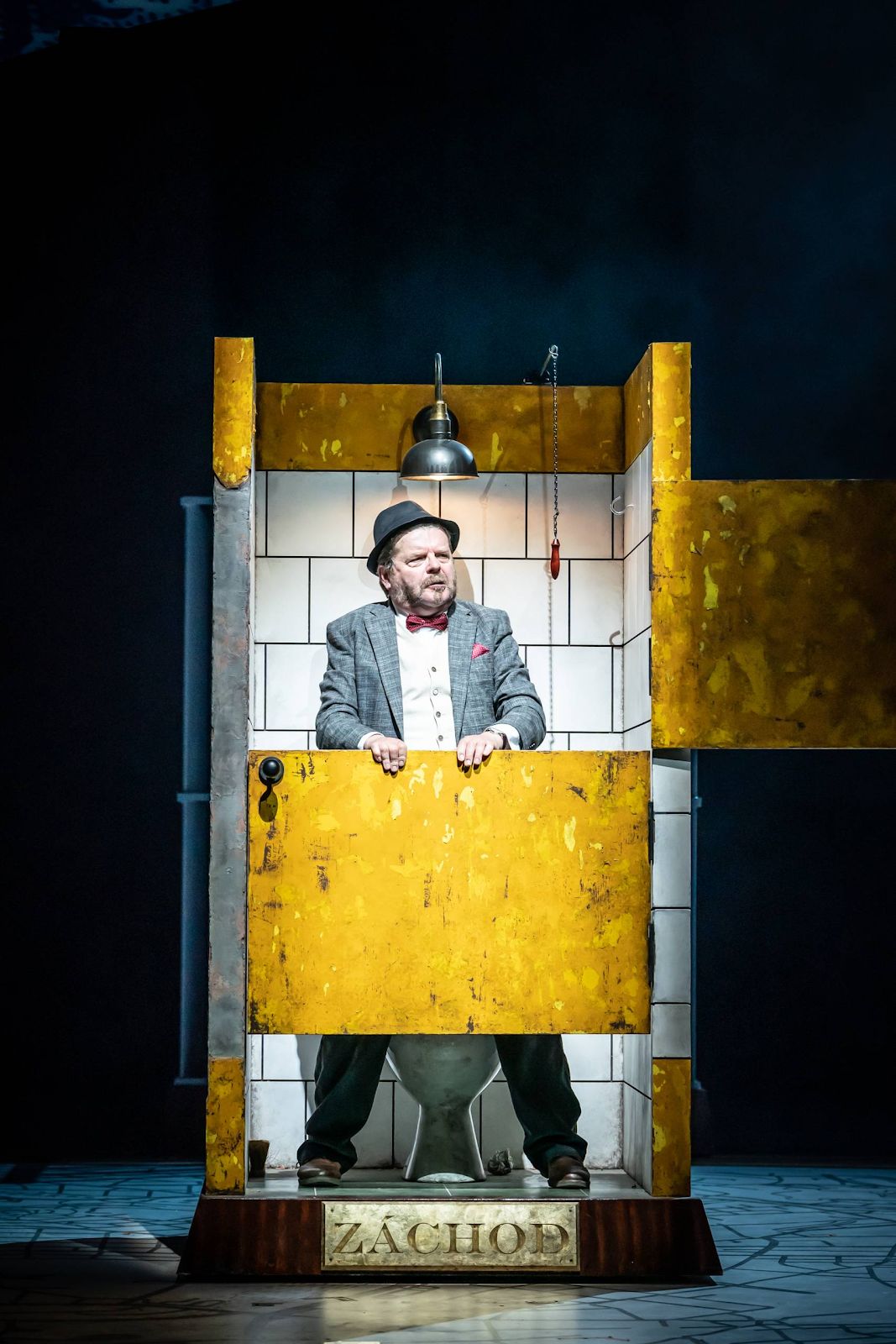
Whether one cares for the (literal) toilet (brush) humour of the interlude between the visits, will be a matter of taste. Monty Python is not my thing, but if it is yours, you will almost certainly love Pountney’s more outrageous excurses. Sometimes, though, I wondered where the heart was, especially during the Moon-trip. Is there not something more positive to say about artistic creation too? The answer, I suppose, would be that it lies in the score (and, indeed, in the artistic endeavour of performance and reception itself. It arguably suggested itself onstage at the end, when the innkeeper Würfl collected his drunken patron, laughed at his tall tales, but also walked him away in camaraderie. Perhaps that was enough. Again, that will probably be as much a matter of taste or inclination as anything else.


Peter Hoare’s Brouček captured well the contradictions not only of the character, but of our response(s) to him. This was a typically intelligent performance, which held the stage, amused, and touched without sentimentality. Fflur Wyn’s Málinka and other roles were lively, characterful, and rooted in, yet far from hidebound by, the text. Such is the magic of theatre, and such might be said of any number of the cast, including Mark Le Brocq’s handful of roles, Andrew Shore’s, and Clive Bayley’s, as well as Anne-Marie Owens's Kedruta. This was very much a company effort, which did Grange Park Opera proud, enthralling an audience that could all too readily have registered mere bemusement at the work’s oddity.


Domsik (Clive Bayley)


George Jackson’s traversal of the score elicited my unqualified admiration, as did the playing of the BBC Concert Orchestra. Incisive and expansive, earthy and soaring, above all attuned to those fabled speech rhythms and their unpredictable, magical combination into form and structure, this was as fine a Janáček performance as I have heard for some time, all the more so for its revelation of relatively unfamiliar territory. Time and time, presentiments of the Vixen’s world shone through, anchoring these ‘excursions’ in a common humanity and inspiring us to go forth and create it. The score emerged possessed of the musical, scherzando brilliance of the more or less contemporary Gianni Schicchi, if perhaps less single-minded, at any rate without the latter work’s dramaturgical precision, considered as a whole. We might say Janáček’s musical dramaturgy is more adventurous, though much depends what one means. Whatever our thoughts on that, this was a musical banquet beautifully and, at the last, movingly served.