Showing posts with label Clive Bayley. Show all posts

Friday, 11 July 2025

Festival d'Aix-en-Provence (2) - Don Giovanni, 8 July 2025


Grand Théâtre de Provence


Images: Festival d'Aix-en-Provence 2025 © Monika Rittershaus


Don Giovanni – Andrè Schuen
Leporello – Krzysztof Bączyk
Donna Anna – Golda Schultz
Donna Elvira – Magdalena Kožená
Don Ottavio – Amitai Pati
Commendatore – Clive Bayley
Zerlina – Madison Nonoa
Masetto – Paweł Horodyski

Director – Robert Icke
Set designs – Hildegard Bechtler
Costumes – Annemarie Woods
Lighting – James Farncombe
Choreography – Ann Yee
Video – Tal Yarden
Sound – Mathis Nitschke
Dramaturgy – Klaus Bertisch

Estonian Philharmonic Chamber Choir (choirmaster: Aarne Talvik)
Bavarian Radio Symphony Orchestra
Simon Rattle (conductor)


If I remember correctly, that splendidly grumpy old man Johannes Brahms averred that he would much rather stay at home and read the score than suffer yet another Don Giovanni disappointment in the opera house. Often, one sympathises—and more generally with Mozart, especially nowadays. It is, notoriously, a director’s graveyard; it has for a while also seemed to be a conductor’s graveyard too. In both cases, the Commendatore regularly calls time on all manner of easy perversities that too often masquerade in place of understanding, hard work, and genuine imagination and invention. I was nonetheless keen to see this new Aix production, the festival’s eighth and my first there. That was above all to see what Robert Icke, an almost universally admired figure of British spoken theatre – this season alone, I saw Oedipus and Manhunt (which Icke wrote as well as directed) – might accomplish in his first foray into opera. 

Having entered the theatre and quickly skimmed a page or two of the programme, I felt my heart sink when I read some of Simon Rattle’s words in the programme, regardless of the good sense many others made. ‘The “Mozart” [!] I grew up with as a child – the style of interpretation I once admired – has, for most of us, become unlistenable. We’ve all evolved without realising it.’ Perhaps, then, this would be a classic instance of one element working and one distracting, with the stage performances themselves as yet undetermined. For once, alas, my inner Brahms proved wrong. There was much to admire and to consider on all fronts. Not only was this to be a serious piece of theatre; it was, certain, despite inevitable reservations, to be the best Mozart and indeed to my taste probably the best performance of music before Wagner I had heard from Rattle. This, I think, was testament not only to his thoughtful, keen-eared approach, dismissal of Furtwängler, Böhm, Klemperer, Giulini, Davis, et al. (and their admirers) notwithstanding, but also to willingness to learn from his still relatively new orchestra, the Bavarian Radio Symphony, and to theirs from him. 


Interviewed in 2015, Icke declared his responsibility ‘always’ to be ‘to the impulse of the original play, to clear away the accumulated dust of its performance history. So much of great drama was profoundly troubling when it was first done. They rioted at Ibsen’s A Doll’s House, for goodness’ sake. Audiences shouldn’t be allowed to feel nothing.’ A ‘period’ approach similar to Rattle’s (at least in theory, if not in practice)? Hardly, as anyone familiar with his work would attest. That is, in part, the problem: such notions mean such different things to people in different contexts that misunderstanding – doubtless including mine concerning Rattle’s words – is rife. Enough, anyway, of this preamble. It may have been better to plunge straight into the action as Mozart does, if arguably to withdraw a little thereafter. I wanted, though, to try to give an impression or at least a self-assessment of my own accumulated dust, if only to help explain my own admiration – some anticipated, some less so – for what I saw and heard. 

Icke opens with the Commendatore, in a sense master of ceremonies, initiating his own private performance—on record, like so many of us, one might even say in neo-Brahmsian fashion. The sounds of an old, crackly performance will be heard again for Giovanni’s Tafelmusik as we approach the denouement and the Commendatore’s return. (In reality, he has never been away, conceptually or physically, as stage appearances make clear.) For there is here a strong relationship, probably identity, between the two. Does Giovanni’s murder of his nemesis thereby suggest the master of his own fate is indeed his own nemesis? Is the action that unfolds, whether from the standpoint of an old man sipping wine to a gramophone record of his youth or from hospital bed and a fatally wounded young man, drip-attached, staggering with increasing difficulty across the stage (n the second act), the Commendatore/Giovanni narrating his own story? How reliable a narrator might he be? And how reliable might live and recorded video images be? The work, even? These are not necessarily questions to be answered definitively, though nor are they trivially raised then neglected. This is – at least was for me – a call to active participation from the spectator and listener. That may be why some evidently did not care for it. 

The concept takes its leave, I think, from Leporello’s line, ‘Chi è morto, voi, o il vecchio?’ To ask his master who is dead, him or the old man, is generally taken not only to be (theatre of the) absurd – clearly it is – but as merely silly. (Thank goodness this was not a Don Giovanni played ‘for laughs’, a dramaturgical misunderstanding of the highest or rather the lowest order. The ever-irksome Glyndebourne guffaw was at least avoided.) If we lose the intrinsic master-servant dialectic, highly eroticised by Giovanni’s clothes- and partner-swapping libertinism, we gain an intriguing consideration of what relationship there might be between Giovanni and the Commendatore and what their secret(s) might be. Occasional sharing of lines between characters, not only them, speaks and sings of other connections, born of theatrical experience – they work to the extent one might not even notice – and possibility. It is a standpoint; no one would claim it to be the only standpoint, but it is a fruitful one. 


For we rarely ask who the Commendatore is. We arguably do not even ask who Giovanni is, though we think we do. His kinetic energy deludes, seduces us—as well as those onstage. There are neither masquerade nor masqueraders here, which is surely part of the point. Instead, the old man – or is it the young man – has summoned characters from the medical staff. Donna Elvira, the young man’s fellow inhabitant of the chameleon-realm between seria and buffo, di mezzo caraterre, is notably precisely who she says she is, her words generally disregarded: his wife. In the final reckoning, she returns to his bedside. Perhaps he is not dead after all, then: not in a banal, realistic way so much, but rather to reckon with the circularity of an abuse that is born of and returns to the family, a little girl who sees it all the counterpart, perhaps more than that, to Donna Anna. As survivors do – are we all, ‘in a very real sense’, survivors? – she teaches other women, onstage and on film. She should not have to, of course, but what choice does she and do they have? 

The idea of standing between life and death – in limbo perhaps or hell, even heaven – can be considered and expressed in many ways. Giovanni’s initial, disconcerting beatific gaze suggests one way, perhaps not taken—or is it? At any rate, the idea is one arguably explored in the work or at least one it might encourage us to explore. Claus Guth’s Salzburg production was admired by many, though it struck me as in many ways problematical—not least since it took the cowardly, decidedly non-Giovanni path of omitting the scena ultima. When I think about it again, though, it certainly occupied itself with this notion. Here, the heartbeat that punctuates the action – filmic yet theatrical, auditory yet visual – brings it home arrestingly, in more than once. 


Use of surtitles to convey concept rather than the text is by now a common dramaturgical device. Here, I admit I felt unease: was too much being skated over? Might not the conflict have been better brought out into the open? Did the ‘new’ words for the scena ultima threaten ironically to turn what we saw into too much of a conventional morality play? Perhaps that was the point; if so, it seemed a pity, also a little too much ‘leading’ for what we ought to have been able to grasp without. At least, though, I was led to ask the question, and it may have been my misunderstanding or simply a case of my preference/preconception not according with a valid alternative. 

Rattle’s musical dramaturgy surprised me: not only from what he had said, but from what I had been told. A friend who had attended an earlier performance informed me of swift tempi. Once past a shockingly fast alla breve, even by current standards, what I heard was anything but. Who knows? Maybe I too am an ‘authenticist’ without having known it. The point was not of course speed or even tempi as such, but rather a variegated approach, giving each number its due whilst attempting to situate it within a greater whole. I did not find everything entirely convincing; when does one ever? More often than not I did, though. I also found a welcome collaborative approach not only to the production but to the cast, without ever falling into the messy trap of having them all do their own thing. This work needs a musical as well as a stage director—and it received one: one, moreover, who was as alert as any I have heard, perhaps even more so, to the array of timbral possibilities, some historically derived, some less so. The Munich wind in particular must have thanked their lucky stars. 

The whole orchestra was on outstanding form, truly able to ‘speak’ dramatically: a quality Rattle associates with Nikolaus Harnoncourt and which I do with Mozart’s position between Gluck and Mozart. Again, maybe we are not so far apart after all; maybe we are ready at long last to put such ‘debates’ behind us. There were times when tension sagged a little, Rattle perhaps savouring, even loving, the score more than is ideal, however understandable. As ever, the familiar conflation of Prague and Vienna versions did not help. (For once, given aspects of the production, inclusion of the Leporello-Zerlina duet might have been an advantage.) But none of my reservations was grievous and I learned much from what I heard too. 


Andrè Schuen proved an outstanding Giovanni: properly adaptive to every situation, his very core shifting as necessary; suave and strong; yet troubled and tortured. Clive Bayley’s Commendatore, unusually and necessarily more acted than sung, imparted equal conviction in the concept. If (the mature) Donna Anna seemed somewhat sidelined by that concept, Golda Schultz’s vocal palette and sparkle left nothing to be desired. Krzysztof Bączyk was likewise faced with a production in which Leporello seemed less central than otherwise, but his performance remained estimable, a proper foil to his master’s (in either incarnation). Magdalena Kožená fully captured the world of a different Elvira, words and music harnessed with insight. Madison Nono and Paweł Horodyski presented a spirited, finely sung Zerlina and Masetto with an apt taste for light sadomasochism that was not confined to them. Amitai Pati seemed at times a little out of sorts vocally as Don Ottavio, but everyone is entitled to a (relative) off-night, especially in such cruelly exposed music. All the cast, small chorus included, contributed to the realisation of the greater whole: Icke’s, Rattle’s, and the broad intersection of the two.


Tuesday, 21 June 2022

The Excursions of Mr Brouček, Grange Park Opera, 18 June 2022


The Theatre in the Woods

Mr Brouček – Peter Hoare
Málinka, Etherea, Kunka – Fflur Wyn
Mazal, Bounzincek, Petrik, Svatopluk – Mark Le Brocq
Würfl, Paycek, Councillor – Andrew Shore
Sacristan, Dudcek, Domšík – Clive Bayley
Kedruta – Anne-Marie Owens
Spotcek, Vojta, Raincek, Mirosla – Adrian Thompson
Postdatedcek – Jonathan Kennedy
Child Prodigy – Pasquale Orchard
Spotcek – Robin Horgan
Farty – Benjie del Rosario
Taborite I – Toki Hamano
Arty, Taborite I – Marcus Swietlicki
Dancers – Lauren Bridle, Bridget Lappin, Arianne Morgan, Luke Murphy, Jay Yule

David Pountney (director)
Leslie Travers (designs)
Marie-Jean Lecca (costumes)
Tim Mitchell (lighting)
Lynne Hockney (choreography)

BBC Concert Orchestra
George Jackson (conductor)
 

Bounzincek (Mark Le Brocq) and an artist on the moon
Images: Marc Brenner

Hats off to Grange Park Opera for unquestionably the best of the four ‘country house’ operas I have seen so far this season. First, and perhaps most important, with respect to the work itself: Janáček’s The Excursions of Mr Brouček. I suppose it might be theoretically possible to reach a state in which Janáček’s music was heard too often, though it might not. (Imagine saying such a thing of Bach or Mozart.) If it is, though, we are nowhere near that yet. Yet the Janáček operas we see staged are mostly, perhaps understandably, restricted to three: Jenůfa, Katya Kabanova, and The Cunning Little Vixen. We must go beyond The Makropulos Case and even From the House of the Dead to reach Mr Brouček. Doubtless some in the Grange Park Opera audience had seen it in the theatre before, but I had not, and was immensely grateful to have the opportunity to do so, let alone for it to be performed so well. 

Mr Brouček will doubtless always be a problematical work, in a way that the aforementioned popular (relatively speaking) trio will not. Its two-part structure will probably always require effort to bring together—if, indeed, such is the dramaturgical aim. But art is certainly not always about perfection, or approaches to it. Sometimes, it is about quite the opposite. The first part’s satire against pretentious avant-gardism, or perhaps better derrière-gardism, hits home more readily for a modern, or at least non-Czech, audience than the second, more preoccupied with Czech national mythology—although a little grounding helps us on our way. Nationalism, after all, remains sadly too universal. But the other part of the satire is against the antihero himself: the philistine who has little idea what he is doing in Prague, let alone on the Moon or in the fifteenth century. To that, we can and should all relate. No one likes a landlord, after all, especially one who boasts of having no mortgage, only a three-storey house. You can begin to see why the opera will never touch as Katya does. That is not its purpose.


Málinka (Fflur Wyn)

David Pountney’s production pulls out all the stops for a frankly zany trip from Prague to the moon, clarified and extended by Marie-Jean Lecca’s imaginative costuming. Leslie Travers’s brilliant set for the former captures an almost childlike delight in city models, as well as the, or at least an, idea of Prague. The empty pretentiousness of the moon artists—Pountney has fun, using his own, free English version of the text, creating names such as Spotcek, Raincek, and Postdatedcek—engenders an intoxication of its own. It is fun to watch, which guards us against too ready identification with Brouček. ‘We must each fight our inner Brouček,’ Janáček insisted. A similar, yet different mix of magical constructivism informs the still more bewildering—for many—and darker trip to the Prague of the Hussite rebellion.


Mr Brouček (Peter Hoare)

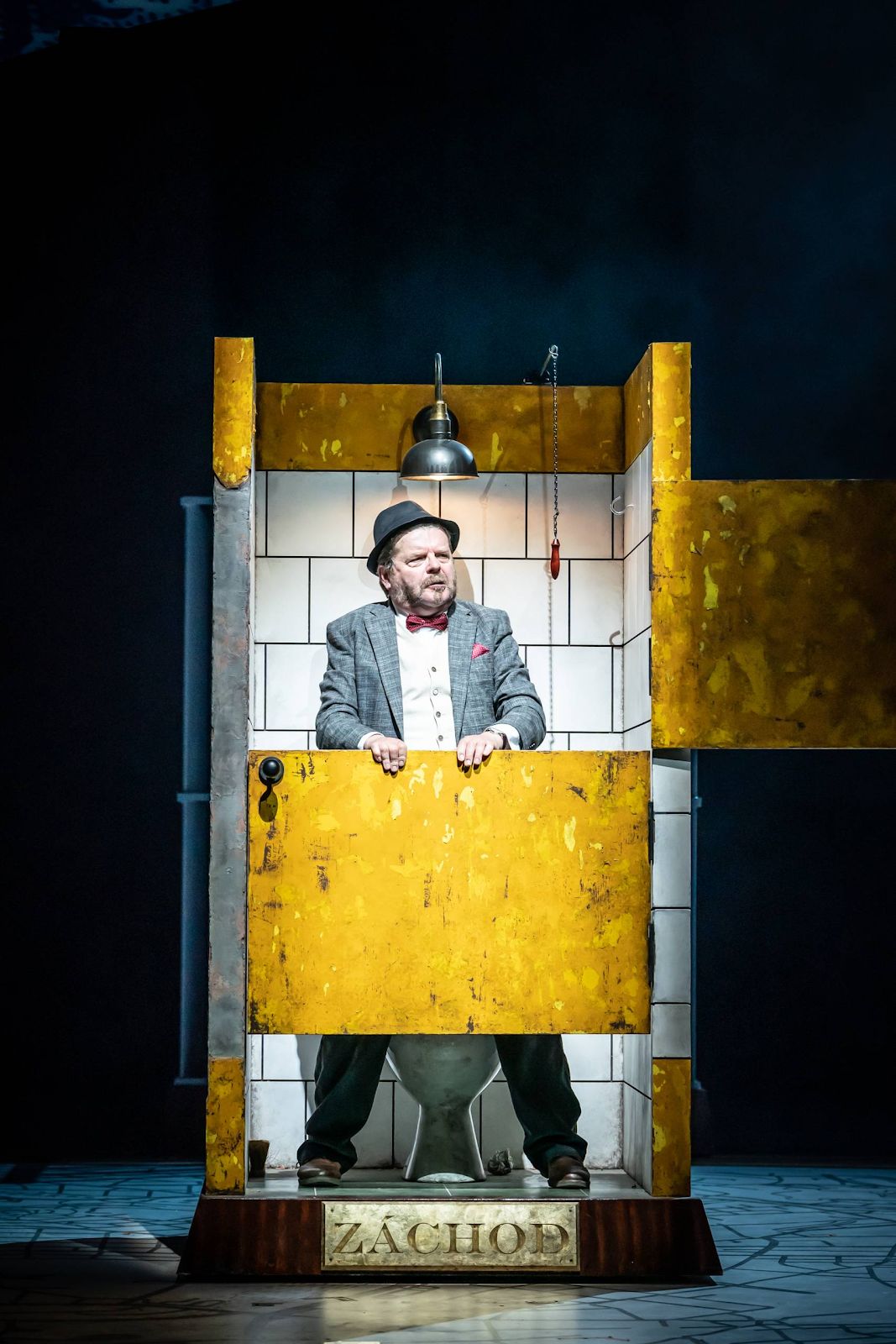
Whether one cares for the (literal) toilet (brush) humour of the interlude between the visits, will be a matter of taste. Monty Python is not my thing, but if it is yours, you will almost certainly love Pountney’s more outrageous excurses. Sometimes, though, I wondered where the heart was, especially during the Moon-trip. Is there not something more positive to say about artistic creation too? The answer, I suppose, would be that it lies in the score (and, indeed, in the artistic endeavour of performance and reception itself. It arguably suggested itself onstage at the end, when the innkeeper Würfl collected his drunken patron, laughed at his tall tales, but also walked him away in camaraderie. Perhaps that was enough. Again, that will probably be as much a matter of taste or inclination as anything else.


Peter Hoare’s Brouček captured well the contradictions not only of the character, but of our response(s) to him. This was a typically intelligent performance, which held the stage, amused, and touched without sentimentality. Fflur Wyn’s Málinka and other roles were lively, characterful, and rooted in, yet far from hidebound by, the text. Such is the magic of theatre, and such might be said of any number of the cast, including Mark Le Brocq’s handful of roles, Andrew Shore’s, and Clive Bayley’s, as well as Anne-Marie Owens's Kedruta. This was very much a company effort, which did Grange Park Opera proud, enthralling an audience that could all too readily have registered mere bemusement at the work’s oddity.


Domsik (Clive Bayley)


George Jackson’s traversal of the score elicited my unqualified admiration, as did the playing of the BBC Concert Orchestra. Incisive and expansive, earthy and soaring, above all attuned to those fabled speech rhythms and their unpredictable, magical combination into form and structure, this was as fine a Janáček performance as I have heard for some time, all the more so for its revelation of relatively unfamiliar territory. Time and time, presentiments of the Vixen’s world shone through, anchoring these ‘excursions’ in a common humanity and inspiring us to go forth and create it. The score emerged possessed of the musical, scherzando brilliance of the more or less contemporary Gianni Schicchi, if perhaps less single-minded, at any rate without the latter work’s dramaturgical precision, considered as a whole. We might say Janáček’s musical dramaturgy is more adventurous, though much depends what one means. Whatever our thoughts on that, this was a musical banquet beautifully and, at the last, movingly served.


Sunday, 10 February 2019

Katya Kabanova, Royal Opera, 9 February 2019


Royal Opera House
  
Tichon (Andrew Staples) and Katya (Amanda Majewski)
Images: Clive Barda/ROH


Katěrina Kabanova – Amanda Majeski
Marfa Ignatěvna Kabanicha – Susan Bickley
Varvara – Emily Edmonds
Boris Grigorjevič – Pavel Černoch
Váňa Kudrjáš – Andrew Tortise
Tichon Ivanyč Kabanov – Andrew Staples
Savël Prokofjevič Dikoj – Clive Bayley
Kuligin – Dominic Sedgwick
Glaša – Sarah Pring
Fekluša – Dervla Ramsay
Woman – Amy Catt
Passer-by – Luke Price

Richard Jones (director)
Antony McDonald (designs)
Lucy Carter (lighting)
Sarah Fahie (movement)

Royal Opera Chorus (chorus master: William Spaulding)
Orchestra of the Royal Opera House
Edward Gardner (conductor)


Janáček is surely the perfect, or at least a perfect, composer with whom to introduce someone to opera. Starting with From the House of the Dead or The Adventures of Mr Brouček might be a little odd, if hardly disastrous. However, Jenůfa, The Makropulos Case, The Cunning Little Vixen, and Katya Kabanova all boast compelling, readily comprehensible stories, strong characters (especially female ones), and textbook demonstrations of what might be accomplished by musical drama, even in something that might superficially seem close to a sung play (in itself no bad thing for a beginner). Last but not least, they are not a second too long, showing unerring mastery concerning what need be depicted, even lingered over, and what may be assumed or suggested, without the slightest chance of having anyone wonder ‘when will this be over?’ Loving them, one might wish that they were longer, but one also knows that they should not be. For devotees of late-nineteenth-century literature, Jenůfa and Katya would seem the most obvious choices. (Not that Wozzeck would do any harm: it gripped this sometime schoolboy for life…!) Setting, narrative, and character stand in well-nigh perfect relation to one another: familiar, yet fresh.

Kabanicha (Susan Bickley) and Katya

Why, then, have London houses seemed so reluctant recently to stage these operas? Xenophobic audiences, bizarrely lacking in curiosity? Most likely, alas; we live, after all, in the age of ‘Brexit’. Whatever the reason, we have all the more reason to cheer the Royal Opera’s commitment, following years of silence, to staging a number of Janácek’s works. Last year’s From the House of the Dead, in a striking, duly provocative staging by Krzysztof Warlikowski, was unquestionably a highlight of the London musical year. (If, later in the year, Munich’s offering from Frank Castorf went further, all the better for us. How fortunate we were to have both.) Richard Jones’s new Katya is not at that level: a ‘safer’ choice, no doubt; nor is it so well conducted. Nevertheless, a cast as strong dramatically as vocally brought out the best in work and production alike.

Varvara (Emily Edmonds)


Without really getting in the way, Jones’s staging is mildly puzzling: a mix of good ideas, oddly undeveloped ideas, and all-purpose Richard Jones, almost as if it were an early sketch rather than a finished production. We begin and end with a portrait of a girl, Katya presumably, and there is something intriguingly doll-like to her appearance onstage, even to some of her gestures. Three men from the community – beyond that, it is barely a community – leer through the windows at her. It is sketchy, though: neither subtle nor thought through. The 1970s Eastern bloc setting is fine, if hardly original, but not much is done with it. Nor is it clear why abstraction is occasionally the order of the day: budget limitations seem more plausible as an explanation than dramatic motivation. Auditorium strobe lighting for the storm that opens the third act is an odd touch: neither in keeping with what has preceded and what will follow it, nor productively in contrast. A degree of stylisation on stage works much better, cinematic ‘still’ moments suggestive of contrasting chaos and a moment of fateful decision. That particular aspect of the setting, too, is excellent – a wonderfully ‘real’ bus shelter, which again has much to offer in metaphorical suggestion. More along such Brechtian lines might work well; all too soon, however, it is gone.

Boris (Pavel Černoch) and Katya

Sadly, Katya’s talk – song – of sin is left to fend for itself. It still moves, of course, but would have done so far more in a production that deigned to notice it. For, despite the ‘updating’ – the slightly retro term seems apt here – socio-cultural context is barely present, at least as anything more than backdrop. It is perfectly possible, I am sure, to present a Katya Kabanova with something to replace the theology, just as it would be with Don Giovanni. Whether it is a good idea remains an open question, for here, as so often with Mozart’s deeply Catholic opera, the issue is simply ignored – or, worse, is not even noticed. Likewise, Kabanicha’s terrible words of thanks at the close could hardly fail to register; they could – should – nonetheless readily register far more strongly, set in social and theological context; or, alternatively, in its provocatively avowed absence. As Schoenberg once noted, it is only the middle road that fails to lead to Rome.


That such crucial moments did register was the cast’s achievement (as well as Janáček’s!) Amanda Majeski’s Katya was a towering performance: fearful, compassionate, human, with as impressive and moving an emotional as a dynamic range. Pavel Černoch fully lived up to the expectations I had from his Munich Makropulos Case (as Albert Gregor), his romantic ardour as genuine as his courage was but flickering, a properly compromised portrayal. Andrew Staples drew out the still more compromised, indeed downright cowardly nature of his not-even-rival, Tichon. Susan Bickley rescued her Kabanicha from mere caricature, hinting at a constraining force of social propriety that might – just might – explain or at least contextualise a little of her monstrous, constructively murderous behaviour. Clive Bayley’s Dikoj offered a quality cameo as Dikoj. If only the sado-masochism in his relationship with Bickley’s Kabanicha hinted at here had been taken further by Jones, there might have been illumination such as that gleaned from Christoph Marthaler’s production for Paris. Emily Edmonds and Andrew Tortise gave lively performances as Varvara and Váňa respectively, the latter’s second-act song winning in its diegetic naïveté.


Edward Gardner’s conducting had its moments. They tended, though, to be moments – at least until the third act, undeniably possessed of great narrative thrust. The intricate, complex relationship between continuity and discontinuity in Janáček’s score is not at all easy to bring off. Mark Wigglesworth did so magnificently at ENO nine years ago. Here, whatever its warmth, there was something soft-focused to too much of the Orchestra of the Royal Opera House’s playing. Rhythmic bite was not quite what it might have been, nor were underlying harmonic motion and tension. If the achievement of that final act could have been read back into the first two, something more taut and stark in its tragedy could well have resulted. In a way, then, it complemented Jones’s staging. Vocally, however, this was the real thing.


Monday, 3 October 2016

Don Giovanni, English National Opera, 30 September 2016


Leporello (Clive Bayley) and Don Giovanni (Christopher Purves)
Images: (c) Robert Workman


Coliseum
 
(sung in English)
 
Don Giovanni – Christopher Purves
Commendatore – James Creswell
Donna Anna – Caitlin Lynch
Don Ottavio – Allan Clayton
Donna Elvira – Christine Rice
Leporello – Clive Bayley
Masetto – Nicholas Crawley
Zerlina – Mary Bevan

Chorus of the English National Opera (chorus master: James Henshaw)
Orchestra of the English National Opera
Mark Wigglesworth (conductor).
 
Richard Jones (director)
Paul Steinberg (set designs)
Nicky Gillibrand (costumes)
Mimi Jordan Sherin (lighting)
Sarah Fahie (movement)
 
A perfect staging of Don Giovanni is too much to hope for, especially when the ‘traditional’ conflation of Prague and Vienna versions is employed. Perfection is reserved for Mozart, of course, although Da Ponte does not do badly at all here. But the opera in any case does not have the absolute dramatic perfection of the other two Mozart Da Ponte operas; its greatness, like that of Wagner’s operas, lies partly in the impossibility of the challenge it sets. Even Don Giovanni himself, after all, fails to live up to the expectations voiced in the Catalogue Aria; or at least he usually does.

Don Ottavio (Allan Clayton) and Donna Elvira (Christine Rice)

 
That said, so many stagings fail so dismally, that it is a great pleasure to welcome one that (mostly) convinces as a piece of intelligent theatre, if one that might well have been seen twenty years or so ago. Like most productions – not, I hasten to add, the still eminently watchable Salzburg Herbert Graf production, for Furtwängler – it fails to reckon with the work’s religion and theology. Sin goes unconsidered. Nevertheless, Richard Jones shows a commendable willingness to consider many of the ideas and (potential) problems, and to weld them into a far from inconsiderable narrative – and challenge, both to us and to the work (‘itself’ and reception). What Jones’s staging and the designs of Paul Steinberg and Nicky Gillibrand lack in apocalyptic grandeur and high stakes, they gain in connection to the tawdry here and now (or perhaps ‘here and then’: we are a few decades in the past). If Giovanni cannot be an aspirant Faust – the nineteenth-century and indeed Straussian hero – perhaps he can be, if not quite Everyman, then a familiar manipulator and exploiter. The visual æsthetic is familiar House of Jones, although less clichéd than some of its wares, but the Personenregie is tight.

 
I worried to begin with about the lack of specificity, even coherence. During the Overture, a series of women – and one Leporello look-alike, or at least dress-alike – pass by, cannot refuse the seedy veteran (a nice touch!) seducer, and gain their ten seconds of fame with him behind a hotel/brothel door. For the first scene, a sado-masochistic (lightly so: this is certainly not Calixto Bieito, or, less successfully, for the Deutsche Oper, Berlin, Roland Schwab) scene announces itself, the Commendatore a hypocrite, Donna Anna, playing on ETA Hoffmann’s ghost, opening up her own deceptive narrative; how much she is deceiving herself, her father, Don Giovanni, her fiancé, us, is unclear, and productively so. So far, so good, but is it not a bit odd for so much of the rest of the action to take place in the same setting? It seems too specific, too limiting, or, on the other hand, not nearly liminal enough. (The brilliant Munich staging by Stephan Kimmig, perhaps the best I have seen, certainly the equal of Bieito, is the place to go for the latter.) Such a concern, however, was largely banished by the strength of character and narrative drive drawn out – an old-fashioned virtue this, and as necessary a virtue as ever – by Jones.   

Donna Anna (Caitlin Lynch), Commendatore (James Creswell), Don Ottavio (Allan Clayton)


What saves – and I suppose that is, irredeemably, as it were, a theological concept – the production from mere modern-ish conventionality, is the long game that Jones plays, revealing his hand only at the end of the Stone Guest scene, and only granting us full understanding in the final, endlessly alienating scene itself. (If you do not want to know his surprise, please look away now, and move on to the next paragraph.) Eschewing atheistic heroism of the old school, and avoiding Hell, or perhaps perpetuating it – insert Sartre quotation here, if so inclined – the old rake, at the last, accepts his servant’s offer to take his place with the Commendatore. That has been cunningly prepared by what at first seems an irrelevant Jones cliché: Leporello’s creepy, verging-upon-yet-not-quite-attaining-outlandish orange wig. The aforementioned Leporello look/dress-alike, part of the chorus, as the work progresses, helps keep it in mind, or at least in visual memory. In lieu of a change of clothes in the second act – yes, we lose the distinction of social order here, which is something, but not necessarily everything – a change of wig does the trick. And it will again, and again. Not only does Giovanni, his grim work far from done, take Leporello’s place in the final sextet, he picks out the Leporello-alike from the chorus as his new servant, and the events witnessed in the Overture start up once again.

Donna Anna and Don Giovanni


Musically, we were on strong ground. Mark Wigglesworth, following an Overture that came a little too close to Rossini – however fast, or not, Mozart should never sound inflexible – offered a reading which, whilst rarely close to the Romantic grandeur of Furtwängler or Barenboim, impressed on its lighter terms. Tempi were varied, and that is the important thing, and there was always life to be heard, to be felt, in the music. The playing of the ENO Orchestra – and the singing of the cruelly victimised Chorus – was always excellent. If there were more light than shade, the scales were not tipped unduly, and the production offered a goodly amount of the latter. Wigglesworth, who really should be reinstated as Music Director yesterday, paced the work with a mastery born not only of lengthy acquaintance, but of intimate understanding. Kate Golla’s harpsichord continuo – no modish, and historically ‘incorrect’, fortepiano here – proved just as alert to the needs of the drama and, more generally, of the words (even when less than happily and/or accurately translated).
 
Christopher Purves’s assumption of the title role was, crucially, very much in line with what seemed to be Jones’s view of work and character alike. He had seen it all, and would see it all again. Initially, he might seem like an ordinary bloke, but when it mattered, not least in the serenading of ‘Deh, vieni alla finestra’, he was transformed – and transformed the situation. There were a few passages when Purves sounded a little tired, but even those could, with a little good will, be readily assimilated into the concept. Clive Bayley’s Leporello was, likewise, quite different from what has become the norm, but was equally convincing on its own terms. Allan Clayton offered an object lesson in the art of the lyric tenor, his Don Ottavio blessed with as honeyed a tone as one could wish for. Caitlin Lynch’s Donna Anna was more variable, not always on top of her coloratura, and less than convincing dramatically. Christine Rice’s Donna Elvira, on the other hand, proved brilliantly unstable – in a dramatic rather than a vocal sense. The production seemed curiously uninterested in Mary Bevan’s Zerlina, but there was some fine singing to be heard, in tandem with Nicholas Crawley’s truly excellent, darkly attractive Masetto, so much more than a stock buffo character. James Creswell’s still darker Commendatore was as finely sung as we have come to expect from this artist.

Masetto (Nicholas Crawley) and Zerlina (Mary Bevan)

I only have one real complaint. As with the Royal Opera’s recent new Così fan tutte, the greatest impediment to a successful evening proved to be bad behaviour from a selfish section of the audience. Where do these people come from, laughing hysterically at someone walking onstage, applauding all over the place, chattering, consulting their telephones throughout? (They seemed to find the use of a telephone onstage too hilarious for words: a double whammy, I suppose, which needless to say necessitated use of their own.) I am not sure that a single number went uninterrupted, in one way or another, by the man seated next to me, who remained quite impervious to even the hardest of stares. Such disrespect shown to the performers, to the rest of the audience, to the work itself, is unforgivable. A performance of Don Giovanni is a privilege for all concerned; one is, or should be, a participant, not a sociopathic ‘customer’. Nevertheless, the evening for the most part rose above such distractions: no mean achievement at all.

Saturday, 17 October 2015

Die Entführung aus dem Serail, Glyndebourne Tour, 15 October 2015


Glyndebourne Opera House

Belmonte – Ben Bliss
Osmin – Clive Bayley
Pedrillo – James Kryshak
Pasha Selim – Franck Saurel
Konstanze – Ana Maria Labin
Blonde – Rebecca Nelsen

Sir David McVicar (director)
Ian Rutherford (revival director)
Vicki Mortimer (designs)
Andrew George, Colm Seery (choreography)
Paule Constable, David Mannion (lighting)

The Glyndebourne Chorus (chorus master: Jeremy Bines)
Glyndebourne Tour Orchestra
Christoph Altstaedt (conductor)
 

Strong musical values were in evidence at Glyndebourne’s ready-to-tour Entführung aus dem Serail. A generally young cast sang – and acted – well, giving rise to the not unfamiliar thought from this company that these are names we shall see and hear again. I found Ben Bliss’s Belmonte a little stiff to start with, but he seemed more in his stage element as time went on, revealing a lyric tenor of considerable beauty and sensitivity, both verbal and musical (a false opposition, I know). His third-act duet with Ana Maria Labin’s Konstanze was quite ravishing of tone. Labin’s performance was excellent throughout, Mozart’s coloratura holding no fears for her, but just as important, put to musical and dramatic use. Cleanness and keenness of delivery were as one.

 
The same could be said of their servants, Pedrillo and Blonde. Blondes rarely disappoint; that, however, is no reason not to acknowledge the spirited performance of Rebecca Nelsen, both in vocal and stage terms. I certainly should not wish to get on the wrong side of her. James Kryshak offered a splendidly eager, puppyish performance as Pedrillo. Again, vocal beauty and dramatic purpose were not to be rent asunder. The pair showed excellent chemistry too.

 
Clive Bayley trod Osmin’s line between comedy and a touch of pathos with consummate skill, although the production (more on which soon) did not necessarily help in that respect. Franck Saurel seemed a good actor to me, especially during the rare moments at which he toned things down; however, this Bassa Selim spent far too much of his time shouting and screaming tones of near-hysteria. He may have been following orders, since there was sensitivity to be seen and heard, especially at the end. A pity, though.

 
The Glyndebourne Tour Orchestra under Christoph Altstaedt offered warm, stylish playing: far rarer nowadays than it should be in Mozart. There were no ‘period’ grotesqueries, although a few more strings would not have gone amiss. (Karl Böhm’s Staatskapelle Dresden will surely always remain the model here.) Still, Altstaedt’s tempi and balances were well considered – well considered enough for one barely to notice them. Mozart’s all-encompassing Shakespearean dramatic sympathies were much in evidence, then, to the ears.

 
If you sensed a ‘but’ coming, you were, I am afraid, right to do so. David McVicar’s production, here revived by Ian Rutherford, proves a considerable disappointment. Rarely does it get in the way of the musical performance – to be fair, something not necessarily to be taken for granted – yet, by the same token, it seems to have little or nothing to say. I should be tempted to say McVicar was still languishing in his Zeffirelli period, save for the fact that it now seems too long to be a mere period. Whatever has happened to him is a great pity, since he used to be capable of interesting, theatrically alert productions, his ENO Turn of the Screw a case in point. Now it is ‘light entertainment’, at least for some, to the near-exclusion of anything else, the Royal Opera Trojans a particular low point. Here there is a vague updating to the time of composition, perhaps to underline the Pasha’s status as an Enlightened Despot, but ultimately to precious little effect. One has the distinct impression that it might just have been because the director liked eighteenth-century costumes better than those from a somewhat earlier period.

 
At any rate, we seem to be firmly in the realm of ‘costume drama’, as opposed to putting the history to dramatic work. Orientalism, as in that Trojans production, is reproduced, even heightened, rather than interrogated. If this is not a gift of a work in which to do just that, then I really do not know what is. What should we think of the ruler’s self-revelation as better than his Western charges? And how is it compromised by the fact that he is, by origin, a Christian himself, a ‘renegade’? What of the Janissary music; is it merely ‘pretty’, local colour? If so, does that not in itself raise questions? And what of all those darkly erotic, sado-masochistic suggestions arising from torture and the eagerness with which it is suggested?

 
Nothing, so far as I could discern, on any of those questions or many others. I could only long for what I imagine Calixto Bieito must have made of the work in Berlin. Instead, we have an extravagant barrage of extra actors, children included, and some jarring ‘low humour’. The Mozart family’s correspondence had a celebrated scatological element, but I am not sure that that translates into Osmin belching and farting. One need not go so far as, and would clearly be unwise to imitate, Stefan Herheim’s brilliant Salzburg production – the most recent I had seen, as long ago as 2006, prior to this – in completely reimagining the work as a profound meditation on sexual politics. If the Orientalism is going to remain, though, something needs saying about it – and to it.


Friday, 21 June 2013

Gloriana, Royal Opera, 20 June 2013


Royal Opera House, Covent Garden

Elizabeth I – Susan Bullock
Robert Devereux, Earl of Essex – Toby Spence
Frances Devereux, Countess of Essex – Patricia Bardon
Charles Blount, Lord Mountjoy – Mark Stone
Penelope, Lady Rich – Kate Royal
Sir Robert Cecil – Jeremy Carpenter
Sir Walter Raleigh – Clive Bayley
Henry Cuffe – Benjamin Bevan
Lady-in-Waiting – Nadine Livingston
Blind Ballad Singer – Brindley Sherratt
Recorder of Norwich – Jeremy White
Housewife – Carol Rowlands
Spirit of the Masque – Andrew Tortise
Master of Ceremonies – David Butt Philip
City Crier – Michel de Souza
Concord – Giulia Pazzaglia
Time – Lake Laoutaris-Smith

Richard Jones (director)
Ultz (designs)
Mimi Jordan Sherin (lighting)
Lucy Burge (choreography)

Royal Opera Chorus (chorus master: Renato Balsadonna)
Orchestra of the Royal Opera House
Paul Daniel (conductor)

 
The Royal Opera offered a strong performance and production, for the most part as excellent as we have any right to expect, of what remains, alas, a very weak opera. Aldeburgh fundamentalists, a highly vocal sect that is yet diminishing with age, will maintain that Gloriana’s dreadful initial reception was to be attributed to a philistine audience of coronation dignitaries and the merely prejudiced. (Richard Jarman, General Director of the Britten-Pears Foundation, writes in the programme of a composer ‘whose musical conservatism was attacked by the avant garde in his lifetime but whose reputation has outlived his critics.’ Well, he would, wouldn’t he?) The way some speak of the debacle, one would think that a a masterpiece of the order of Birtwistle’s Mask of Orpheus had been slighted. It is certainly difficult to begrudge the opportunity to find out for ourselves, in what is the first time since the brief 1954 revival that the Royal Opera has staged the work, but the flip side of that opportunity proves to be realisation that many of the criticisms levelled at the work in 1953 were justified after all.    

 
Though not really a criticism of the work as such, it is extraordinary to think that anyone could have thought this an appropriate subject for dedication and tribute to a new queen: it would surely have been far better left to stand on its own feet, appearing a few years later, after the composer had had more time to work on it. La clemenza di Tito, far and away the greatest of all coronation operas, may have been written in breakneck time, even by Mozart’s standards, but, wonderful conductor of Mozart though Britten was, he certainly lacked Mozart’s combination of greatness and incredible facility. The opera is certainly not helped by William Plomer’s dreadful libretto, laden down by unconvincing archaisms and cringeworthy rhymes of which ‘duty’ and ‘beauty’ is far from the worst offender; nor is it assisted by all too formulaic scene-by-scene alternation between ‘public’ and ‘private’ realms, which encourages a dramaturgy that barely advances, if indeed it does at all, beyond Verdi. (Half-hearted applause greeted the end of each scene, whilst Richard Jones’s metatheatrical production, about which more below, did its heroic to make the scene-changes of interest.) Schiller or Boris Godunov this conflict decidedly is not. Apart from Elizabeth I herself, and perhaps the Earl of Essex, characters, such as they are, tend to be products of plot situations rather than vice versa.

 
Yet even the manifold dramatic weaknesses do not excuse the weakness of so much of the score itself. Even the mild syncopations of the opening chorus sound shop-soiled: as if drawn from a Britten manual of how to add a little ‘modernity’ without frightening away the horses. Large sections of the orchestral writing seem little more than padding. At their best, there is a kinship in vocal lines to Purcell; much of the time, however, they veer between the merely nondescript and the inappropriately Italianate (as in nineteenth-century Italianate, certainly nothing contemporary). And if Norwich might not always be accepted as a heaving metropolis, does it really deserve the tedium of the ‘masque’? (I could not help but think of those dreadful shows the present Queen and Duke of Edinburgh must sit through when on an official visit, doubtless longing to be taken as quickly as possible to Balmoral or Newmarket.) Dramaturgically, there are signs of hope there: at least Britten is doing something different. Rarely, however, does his formulaic music rise to the occasion; it is actually more interesting when it alludes most strongly to Tudor styles, though the ‘real thing’ would be more interesting still. Matters were not helped by having the first and second acts run together without an interval; it made for a very long time, scene changes included, sitting through pretty insubstantial stuff.

 
That said, there could be no gainsaying the commitment of the Royal Opera’s forces to presentation of the work. If there were times when Paul Daniel might have sped things up a bit, one did not need to know that he had conducted the score before, for Opera North, to hear that he was fully in command of it. Likewise, the Orchestra of the Royal Opera House and the Royal Opera Chorus, as ever excellently prepared by Renato Balsadonna, responded with enthusiasm and sensitivity that lay almost beyond the call of duty, regal or otherwise. Casting was of great strength, the only real problem being Susan Bullock’s vocal fallibility in the title role; without too much effort, though, one could accept that as reflecting the fallibility of an ageing monarch. Otherwise, Toby Spence proved as fine an advocate as the Earl of Essex could ever expect: ardent, sensitive, headstrong as required. Mark Stone offered a finely-sung, equally finely-acted, darker-hued foil as Lord Mountjoy. It was an especial joy to hear Patricia Bardon’s true contralto, plaintive and full of tone, as the Countess of Essex, with Kate Royal’s Penelope equally well sung, if less clear of diction. (The weird outburst in the final scene, quite unmotivated by what little character development has previously been offered, is certainly not her fault.) Smaller roles such as Sir Walter Raleigh (Clive Bayley), Sir Robert Cecil (Jeremy Carpenter), and Carol Rowlands's splendidly shrewish London Housewife offered ample opportunity for care with words and music, however undeserving. Likewise, Brindley Sherratt made the most of the tediously repetitive part for the Blind Ballad-Singer; again, comparisons with a superficially similar role in Boris Godunov are unfortunate, to say the least.

 
Richard Jones pursued his task as director with palpable relish. The production offers a metatheatrical view of staging a 1953 celebration, framed by a small procession of dignitaries. The idea might have been pushed further; as it stood, it did not really do a great deal other than remind us when the work was written. Perhaps that might have been more than the work could have taken, though Christopher Alden’s superb Midsummer Night’s Dream for ENO suggests bravery in staging may be the way forward for Britten’s slighter operas. Designs by Ultz – just ‘Ultz’, presumably like ‘Jesus’, or ‘Voltaire’, his ‘mystery’ enhanced by the lack of a programme photograph – were handsome, colourful, even witty. If we must have the 1950s on stage all the time, this was a model of how to accomplish the task. Lucy Burge’s choreography and the work of various actors and dancers were equally estimable. I could have done without the cumbersome business of each scene being introduced by a gang of children holding up letters to spell, ‘Nonesuch Palace’, ‘The City’, and so on, but apparently some members of the audience found that side-splittingly hilarious.  

 
It is meet and right that opera houses should grant the possibility to reassess works and indeed composers, lest unfair historical verdicts go uncontested. The production earlier this season of Meyerbeer’s Robert le Diable is a case in point. Yet I suspect that the uninformed vitriol poured upon a flawed yet intriguing grand opéra will be matched this time around by calls of ‘disgracefully neglected masterpiece’. We should all like to find another operatic masterpiece, but wishing does not make it so; for that, we should do better to turn our attention to the future, not least to the new work Covent Garden has commissioned from George Benjamin and Martin Crimp. Works as different as The Minotaur and Written on Skin, masterpieces both, suggest ways forward; yet it does us no harm occasionally to reflect that creation of masterpieces may not only alleviate but also be facilitated by the possibility of failure elsewhere.