Showing posts with label Mark Le Brocq. Show all posts

Wednesday, 18 February 2026

Aufstieg und Fall der Stadt Mahagonny, ENO, 16 February 2026


Coliseum


Images: Tristram Kenton


Announcer – The Company
Leokadja Begbick – Rosie Aldridge
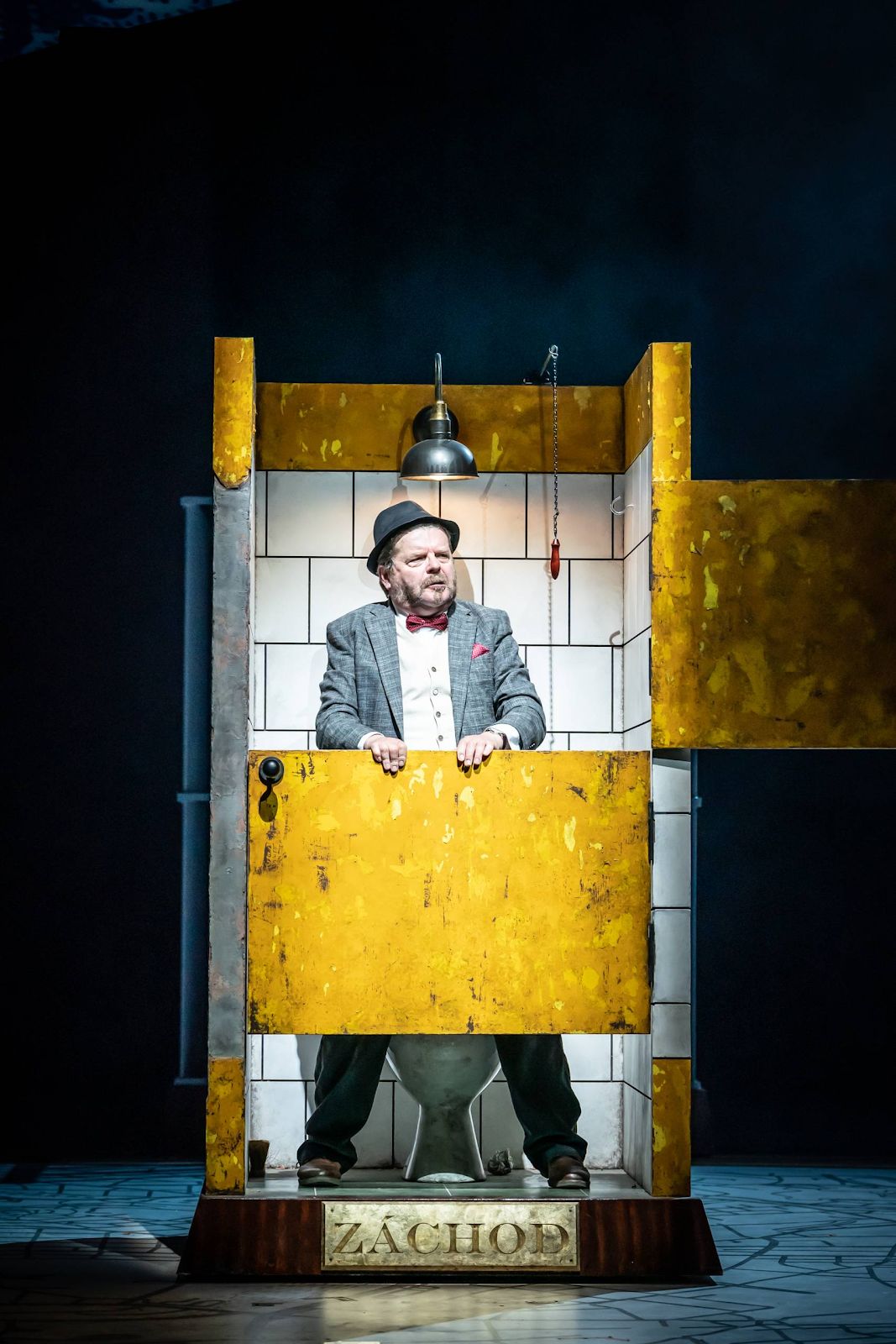
Fatty the Bookkeeper – Mark Le Brocq
Trinity Moses – Kenneth Kellogg
Jenny Smith – Danielle de Niese
Jimmy MacIntyre – Simon O‘Neill
Jack O’Brien – Elgan Llŷr Thomas
Bank-Account Billy – Alex Otterburn
Alaska Wolf Joe – David Shipley
Jenny’s Girls – Joanna Appleby, Deborah Davison, Sophie Goldrick, Ella Kirkpatrick, Claire Mitcher, Susanna Tudor-Thomas
Jenny’s Boy, A Cloud – Damon Gould
Jenny’s Boy, A Typhoon – Adam Taylor
Toby Higgins – Zwakele Tshabalala

Director – Jamie Manton
Designs – Milla Clarke
Lighting – D.M. Wood
Choreography – Lizzi Gee, Spencer Darlaston-Jones
Sound design – Jake Moore
Intimacy and fight coordinator – Haruka Kuroda

Chorus and Additional Chorus of the English National Opera (director: Matthew Quinn) 
Orchestra of the English National Opera
André de Ridder (conductor)


In Berlin’s Dorotheenstädtischer Friedhof, one of my favourite cemeteries, Hegel lies buried—as, very close, do Bertolt Brecht and Helene Weigel, as do many others. Brecht’s Chausseestrasse house and the room in which he worked overlooked that cemetery; the Marxist Brecht expressly chose it out of increasing fascination with Marx’s single most important intellectual forerunner, GWF Hegel. One summer, I lived ten minutes’ walk away and visited regularly. Karl Marx, of course, lies in another celebrated cemetery, in another great world city: Highgate in London, further from anywhere in London I have lived, yet not so far in the greater scheme of things. This tale of ‘my’ two cities, of two cemeteries, of three dead men and more – ‘Nothing you can do will help a dead man’ – shaped my experience of this new ENO production of The Rise and Fall of the City of Mahagonny, not least since I had seen Mahagonny only two months previously, in Berlin, in Barrie Kosky’s Komische Oper staging. 

In capitalist society as in its artistic production, then as now, the grit lies in contradiction. What Hegel the divined as ontology, Marx situated in particular social and economic conditions. We are not obliged to choose; both indeed may be true or at least contain truth. In any case, following in both Hegel and Marx’s wake, Brecht and Kurt Weill’s Mahagonny offers an illuminating instantiation of some of these contradictions: not only in subject matter but in aesthetics and its implications for performance and reception. Some art fails because it simply is not very good, or at least is not well presented. The contradictions here, though, are of a different nature, not to be smoothed over, concealed, or reconciled, but to be such stuff as dreams are smashed on—as indeed is patently the case wherever we look in our present social and political predicaments. No wonder, then, that this new ENO production, the last, I believe, before the company’s move to Manchester, is replete with more general resonance than those personal, albeit connected elements with which I began. 


The contradiction between advertisement and reality is key to the Mahagonny and the Mahagonny we visit with Jamie Manton and his team, yet so is the form of production we can all see – and hear – if only we open our eyes and ears. In the ‘real’ world, ideology mystifies, obscures, yet never quite conceals; here, contradiction is perhaps more glaring, but that is the (Brechtian) point. It all goes back to a lorry, a box of theatrical tricks. (In what I think is pure coincidence, it put me a little in mind of the van in Frank Castorf’s Bayreuth Ring, though vehicular function may hold something in common.) Great claims are made for the city the unholy trio – less a trinity than in Kosky’s staging with c.1930 religious symbols – have built. Perceived desire and demand play their part, whether for whiskey or women—and, in a welcome update, men too. Sex workers rather than prostitutes, Jenny’s girls and boys are available to all, though the outcome does not change. Any declaration of love is not necessarily entirely hollow, but its truth is fleeting and contradicted by the destructive self-interest of all (save, perhaps, the founding mother and fathers). Even the whiskey is diluted by grim recycling that suggests what comes out one end will go back in the other. 

But it is not all grime and grimness: there would be no contradiction then. There is Weill, of course, on whom more soon, but there is also a lively sense of fun, of entertainment: not necessarily unmediated, but what is? There are plenty of witty moments to occasion a wry smile or more, whilst the framing – the Coliseum’s staging and technical equipment a container for, in turn, the container – reminds us this is theatre. Announcements are made by alternating members of the company, part Brechtian remnant with loudspeaker, part Handmaid’s Tale entertainment imitation. (Before the interval, that is; after, they are more clearly themselves, unmasked.) And whilst the production in general shies away from specific contemporary reference – we can hardly fail to make it – the trial as gameshow surely gives the Trumpian game away. Resourceful designs impart a sense both of using what was to hand and also of what one might see, or have seen, at the Berliner Ensemble. In the contradiction between expectation and reality, a weathervane (we have plenty of them in our world) tapdancing hurricane points the way to just destruction of the city, only suddenly to change direction in a triumph of the knowingly underwhelming that prefigures God’s forlorn, defeated attempt to visit justice on this world at the end, drawn out Weill’s Bachian chorales bleakly yet thrillingly subverting Christian passion. Likewise, a cloud dances in counterpoint to Weill’s delicious parody of overwrought, out-of-tune Romantic salon music, edging out Jimmy’s act in more ways than one. 


For the tension and indeed contradiction between Brecht and Weill will, should always lie at the heart of this work and its performance. Can, should music do what Brecht seems to imply it should? Where does that leave the songs, the tunes, the band? André de Ridder, music director designate, drew out biting and seductive playing from the ENO Orchestra. One could sympathise with Jimmy on his last night, traduced and betrayed, as for once strings soared, but not too much—and then it was over. Structurally, closed forms – how they do (and do not) add up to more – were clear and did far more than reproduce those of the libretto. It can be all too easy hearing Weill in the twenty-first century to succumb to nostalgia for a ‘Weimar’ that never was. Here, edge was maintained without entirely denying us pleasure; banjo and Hawaiian guitar could be heard amidst ominous, bass-led hemming in. If only Jeremy Sams’s translation could have decided what it wanted to be and stuck with it, much would have bitten still more savagely. Much was good, but there were too many instances that simply jarred, and the crucial Biblical element to Brecht’s writing was too often lost. 


One less productive contradiction, at least for me, lay between operatic voices and miking. The Coliseum has never offered an ideal acoustic for opera, but here balances were too often awry. The chorus suffered more than most, words sometimes more or less inaudible. Rosie Aldridge and Danielle de Niese offered nicely contrasting and complementing female leads, equally at home in more operatic moments and something closer to the street, both fine singing actors. Simon O’Neill proved a tireless Jimmy, ably supported by his friends, Alex Otterburn, Elgan Llŷr Thomas, and David Shipley. Alongside Kenneth Kellogg and Mark Le Brocq, all offered individual performances founded on the text and on a recognition that the text has contradictions of its own, not least between words and music. Ultimately, I found there was in all respects no need to choose: Berlin and London offered different experiences, in contrast, complement, and yes, contradiction. In some ways, the latter, perhaps ironically, seemed the more Brechtian in its reluctance – refusal would be too strong – to concede to opera, even in Weill’s idiosyncratic conception. It was, in any way, a properly barbed, defiant way for ENO to bid us au revoir. 


Tuesday, 21 June 2022

The Excursions of Mr Brouček, Grange Park Opera, 18 June 2022


The Theatre in the Woods

Mr Brouček – Peter Hoare
Málinka, Etherea, Kunka – Fflur Wyn
Mazal, Bounzincek, Petrik, Svatopluk – Mark Le Brocq
Würfl, Paycek, Councillor – Andrew Shore
Sacristan, Dudcek, Domšík – Clive Bayley
Kedruta – Anne-Marie Owens
Spotcek, Vojta, Raincek, Mirosla – Adrian Thompson
Postdatedcek – Jonathan Kennedy
Child Prodigy – Pasquale Orchard
Spotcek – Robin Horgan
Farty – Benjie del Rosario
Taborite I – Toki Hamano
Arty, Taborite I – Marcus Swietlicki
Dancers – Lauren Bridle, Bridget Lappin, Arianne Morgan, Luke Murphy, Jay Yule

David Pountney (director)
Leslie Travers (designs)
Marie-Jean Lecca (costumes)
Tim Mitchell (lighting)
Lynne Hockney (choreography)

BBC Concert Orchestra
George Jackson (conductor)
 

Bounzincek (Mark Le Brocq) and an artist on the moon
Images: Marc Brenner

Hats off to Grange Park Opera for unquestionably the best of the four ‘country house’ operas I have seen so far this season. First, and perhaps most important, with respect to the work itself: Janáček’s The Excursions of Mr Brouček. I suppose it might be theoretically possible to reach a state in which Janáček’s music was heard too often, though it might not. (Imagine saying such a thing of Bach or Mozart.) If it is, though, we are nowhere near that yet. Yet the Janáček operas we see staged are mostly, perhaps understandably, restricted to three: Jenůfa, Katya Kabanova, and The Cunning Little Vixen. We must go beyond The Makropulos Case and even From the House of the Dead to reach Mr Brouček. Doubtless some in the Grange Park Opera audience had seen it in the theatre before, but I had not, and was immensely grateful to have the opportunity to do so, let alone for it to be performed so well. 

Mr Brouček will doubtless always be a problematical work, in a way that the aforementioned popular (relatively speaking) trio will not. Its two-part structure will probably always require effort to bring together—if, indeed, such is the dramaturgical aim. But art is certainly not always about perfection, or approaches to it. Sometimes, it is about quite the opposite. The first part’s satire against pretentious avant-gardism, or perhaps better derrière-gardism, hits home more readily for a modern, or at least non-Czech, audience than the second, more preoccupied with Czech national mythology—although a little grounding helps us on our way. Nationalism, after all, remains sadly too universal. But the other part of the satire is against the antihero himself: the philistine who has little idea what he is doing in Prague, let alone on the Moon or in the fifteenth century. To that, we can and should all relate. No one likes a landlord, after all, especially one who boasts of having no mortgage, only a three-storey house. You can begin to see why the opera will never touch as Katya does. That is not its purpose.


Málinka (Fflur Wyn)

David Pountney’s production pulls out all the stops for a frankly zany trip from Prague to the moon, clarified and extended by Marie-Jean Lecca’s imaginative costuming. Leslie Travers’s brilliant set for the former captures an almost childlike delight in city models, as well as the, or at least an, idea of Prague. The empty pretentiousness of the moon artists—Pountney has fun, using his own, free English version of the text, creating names such as Spotcek, Raincek, and Postdatedcek—engenders an intoxication of its own. It is fun to watch, which guards us against too ready identification with Brouček. ‘We must each fight our inner Brouček,’ Janáček insisted. A similar, yet different mix of magical constructivism informs the still more bewildering—for many—and darker trip to the Prague of the Hussite rebellion.


Mr Brouček (Peter Hoare)

Whether one cares for the (literal) toilet (brush) humour of the interlude between the visits, will be a matter of taste. Monty Python is not my thing, but if it is yours, you will almost certainly love Pountney’s more outrageous excurses. Sometimes, though, I wondered where the heart was, especially during the Moon-trip. Is there not something more positive to say about artistic creation too? The answer, I suppose, would be that it lies in the score (and, indeed, in the artistic endeavour of performance and reception itself. It arguably suggested itself onstage at the end, when the innkeeper Würfl collected his drunken patron, laughed at his tall tales, but also walked him away in camaraderie. Perhaps that was enough. Again, that will probably be as much a matter of taste or inclination as anything else.


Peter Hoare’s Brouček captured well the contradictions not only of the character, but of our response(s) to him. This was a typically intelligent performance, which held the stage, amused, and touched without sentimentality. Fflur Wyn’s Málinka and other roles were lively, characterful, and rooted in, yet far from hidebound by, the text. Such is the magic of theatre, and such might be said of any number of the cast, including Mark Le Brocq’s handful of roles, Andrew Shore’s, and Clive Bayley’s, as well as Anne-Marie Owens's Kedruta. This was very much a company effort, which did Grange Park Opera proud, enthralling an audience that could all too readily have registered mere bemusement at the work’s oddity.


Domsik (Clive Bayley)


George Jackson’s traversal of the score elicited my unqualified admiration, as did the playing of the BBC Concert Orchestra. Incisive and expansive, earthy and soaring, above all attuned to those fabled speech rhythms and their unpredictable, magical combination into form and structure, this was as fine a Janáček performance as I have heard for some time, all the more so for its revelation of relatively unfamiliar territory. Time and time, presentiments of the Vixen’s world shone through, anchoring these ‘excursions’ in a common humanity and inspiring us to go forth and create it. The score emerged possessed of the musical, scherzando brilliance of the more or less contemporary Gianni Schicchi, if perhaps less single-minded, at any rate without the latter work’s dramaturgical precision, considered as a whole. We might say Janáček’s musical dramaturgy is more adventurous, though much depends what one means. Whatever our thoughts on that, this was a musical banquet beautifully and, at the last, movingly served.


Wednesday, 22 March 2017

Doktor Faust, Semperoper Dresden, 19 March 2017


Semperoper
Images: Jochen Quast
Faust (Lester Lynch) in front of an image of Helen of Troy


Doktor Faust – Lester Lynch
Wagner – Michael Eder
Mephistopheles, Night Watchman – Mark Le Brocq
Duke of Parma, Megäros – Michael König
Duchess of Parma – Manuela Uhl
Master of Ceremonies, Gravis – Magnus Piontek
Soldier (Girl’s Brother), Natural Scientist – Sebastian Wartig
Lieutenant, Beelzebuth – Jürgen Müller
Students from Krakow – Eric Stokloßa, Bernhard Hansky, Allen Boxer
Theologian, Levis – Tilmann Rönnebeck
Asmodus, Jurist – Stephan Klemm
Students from Wittenberg – Gerald Hupach, Khanyiso Gwenxane, Alexandros Stavrakakis, Aaron Pegram, Benjamin Glaubitz
Tenor Solo – Aaron Pegram
Shy Person – Friedrich Darge
Women’s Voices – Roxana Incontrera, Angela Liebold, Ewa Zeuner
Dancers – Juliane Bauer, Marianne Heubaum, Nicole Meier, Björn Helget, Dennis Dietrich, Dominik Strobl
 

Keith Warner (director)
Anja Kühnhold (assistant director)
Tilo Steffens (set designs)
Manuel Kolip (video)
Julia Müer (costumes)
John Bishop (lighting)
Karl Alfred Schreiner (choreography)

Juliane Schunke (dramaturgy)
Sächsischer Staatsopernchor Dresden (chorus master: Jörn Hinnerk Andresen)
Säschsische Staatskapelle Dresden
Tomáš Netopil (conductor)

 
Wagner (Michael Eder) and Faust

One of the greatest twentieth-century operas, scandalously neglected, by a great twentieth-century composer at least as scandalously neglected as any other. We knew that already, of course, or many of us did, but no one could have been in any doubt after this excellent Dresden performance. Whatever minor cavils I might have – mostly concerning the edition used – they will not seriously detract from that. Doktor Faust received its premiere here at the Semperoper in 1925; this premiere of a new production by Keith Warner, conducted by Tomáš Netopil, proved a worthy successor.


Warner is a serious, thoughtful director: just the thing, one would have thought, for Busoni in general and Doktor Faust in particular, and so it turns out to be. Busoni insisted on a distinction – did not almost all interesting composers of his time? – between his own musical drama, its epic quality perhaps looking forward to that of Brecht and Weill (Busoni’s pupil), and Wagnerian music drama, which he considered incapable of greater intensification. That is clear enough, although on certain occasions, I found myself intrigued by aspects of the performance that brought Busoni closer to Wagner than one might have expected. In his Sketch for a New Aesthetic of Music, Busoni had declared that ‘the greater part of modern theatre music suffers from the mistake of seeking to repeat the scenes passing on the stage’. Its ‘proper mission’, rather, was to interpret ‘the soul-states of the persons represented’, which might actually stand in opposition to the action. Warner respects the particular qualities of Busoni’s work, not least that distinction between the role of words and music (much, perhaps ironically, as many directors would now also do with Wagner) and, quite rightly, has staging interpret them and mediate between thereby. The assembled company thereby offers a rebuke to Schoenberg’s frankly silly (wilful?) misunderstanding, quite some time later, of what Busoni had said:


I remember how Busoni was the first to claim that music in opera must not express what is expressed by the action. The opera is principally the product of four factors: the text, the music, the stage, and the singer. If one of these constituents is allowed to disregard what the others do, why should they not also enjoy the same privilege? For instance, the singer? Could not Monastasos ask Sarastro to dance a ‘pas de deux’ with Pamina? Or could not Lohengrin immediately after his arrival sell the swan to a butcher and start auctioning his gondola?


Not that such reading against the grain would necessarily be a bad thing, if done intelligently; far from it. However, it is not in play here.

Faust, the Duchess of Parma (Manuela Uhl), and the chorus
 

What is in play is a staging that successfully navigates the interplay between such opposing and/or complementary features of Busoni’s work, to which we might add (again, not unlike Wagner, if with different means) tragedy and comedy, temporal and eternal, continuing and formally delineated, and not least, the ideal and the ‘merely existing’. As lain out in the (here unspoken) Prologue, the opera’s distinctly non-Goethian origins – like Wagner, Goethe is a figure from whom one might well decide to keep one’s distance here – in earlier puppet theatre remind us that there is more than one route to selling one’s soul and indeed to enlightenment. We have been led to think for ourselves, though, before the formal beginning of the performance, when we see a group of students (dancers, as we later discover, offering intelligently choreographed commentary and dramatic incitement) perusing their books, what they are reading or thinking (presumably) projected onto the curtain. And so, when the curtain rises during the ‘Symphonia’, we see hints at earlier historical attempts at solving the eternal riddles of existence, parading ancient philosophers and Christ (I think) amongst them, the twin roots of our (and Faust’s) Western tradition. He, not unreasonably, seems very much weighed down by it all at his desk, the bargain he strikes in some sense a response to a depression that is perhaps both personal and collective.

Mephistopheles (Mark Le Brocq), Faust, and the chorus
 

The fateful journey through which Mephistopheles takes our hero has elements again both of history and eternity. Indeed, even before the appearance of the final spirit, Faust has opened the book, Clavis astartis magica, to find a modern laptop. What might just seem a time-travelling gimmick, however, has a real dramatic point, increasingly so as the evening progresses. We place our faith in new methods of communication, new route to enlightenment, but do we thereby lose our diminish our critical faculties? Of course Faust would choose the sixth spirit, the one who travels as quickly as the thoughts of man (wonderfully double-edged!), just as we sit here writing and reading online. But what trickery is there in the Mephistophelian magic that enables the brutal murder of the girl’s (Gretchen’s) brother, the glittering seduction of the Duchess of Parma, and most glaringly here, the apparition of Helen of Troy? The action has taken us forward, through the age of Einstein to that of Warhol (amongst others featured). In the Wittenberg tavern, transposed to a transatlantic flower-power joint, Mephistopheles provides Faust with the requisite hallucinatory drug to smoke. The apparition then is real, in the quotidian sense, but is it real in the Hegelian, philosophical sense? Perhaps, then, as with Wagner again, the scene is very well set for the (relative, at least) victory of Schopenhauer in the final scene, Busoni at least as explicit here as his great predecessor in the crucial importance of the philosophy of the Will. Too much metaphysics, or not enough? The production is open enough to have us wonder.

Mephistopheles
 

I wondered, though, in that vein, whether we might have been better off with Philipp Jarnach’s edition, as premiered in Dresden all those years earlier, rather than the more recent version by Antony Beaumont. Beaumont’s version, incorporating material not used by Jarnach, is undoubtedly fascinating and closer to Busoni’s intentions. There remains, however, a nagging doubt, and I say this without wishing to posit a philistine distinction between ‘scholar’ and ‘composer’, that Jarnach’s punchier solution actually, in its relative infidelity (or, if you prefer, insufficiency), offers the better theatre. We should lose a good deal of the explicitly Schopenhauerian conclusion, yet the admittedly melodramatic final bars do their work so brilliantly that I missed them greatly. ‘Sollte diese Mann verunglückt sein?’ when spoken, offers an ending that is both teasingly ironic and recognisably tragic. Whether one wants that is, I suppose, largely a matter of taste. I had never heard the Beaumont ending in the theatre, and do not begrudge it. Might there, perhaps, though, be in the future some possibility of combining the best features of both? This is not, after all, Don Giovanni (about which more soon, also from Dresden).


The arguments are finely balanced, I accept. Ultimately, it was far more important that Netopil and the Staatskapelle Dresden offered so expert an account of the score. The orchestra’s strengths were just as strongly in evidence as if they had been playing a repertoire work by Wagner or Strauss: perhaps a little darker of hue than they would have been in the latter, again suggesting a greater, despite-himself, kinship between Wagner and Busoni than many of us might have expected, but also harking back to the great (despite the cuts) recording by Rafael Kubelík with the Bavarian Radio Symphony Orchestra. (Kent Nagano in Lyons offers an account textually preferable and, on that account absolutely necessary, yet by dramatic comparison, a little more bloodless.) There was heft and there was light; there was mahogany and there was gold; and so on and so forth. Everything was well-paced, with excellent momentum. If there were a few occasions on which I thought the demonic sardonicism might have been played up a little more (notably the Flea Song), emphasising the closed nature of the form as well as its integration, then that stands at least on the verge of nitpicking.

The end
 

Lester Lynch gave a fine portrayal of the title role, which went from strength to strength. It is by any standards a big part, and there were a few moments before the interval (during the Parma scene) when he sounded a little tired, if only relatively speaking, but as his anguish, weighed down by his conscience (personal and collective, as mentioned earlier?) came to the fore, there was no faulting the intelligent and ultimately deeply moving quality of his response. Mark Le Brocq’s Mephistopheles was very much in the mould of Kim Begley (for Nagano), a Loge on steroids, with a weird, unearthly tendency to camp that chilled rather than merely amused. I was a little surprised at some of the strange German heard from Manuela Uhl as the Duchess of Parma, but hers is a thankless role, and she generally did what she could with it. Aside from Michael Eder’s somewhat underpowered Wagner (no, not that Wagner), the rest of the cast was thoroughly impressive, not least collaboratively, proving much more than the sum of its parts. So too was the chorus, not just vocally, although it was little short of outstanding in that respect, but in stage business too. Warner, Netopil, and the assembled company presented us, then, with a true company achievement: just what opera should be. Whatever Schoenberg might have said…