Showing posts with label Andrew Shore. Show all posts

Tuesday, 21 June 2022

The Excursions of Mr Brouček, Grange Park Opera, 18 June 2022


The Theatre in the Woods

Mr Brouček – Peter Hoare
Málinka, Etherea, Kunka – Fflur Wyn
Mazal, Bounzincek, Petrik, Svatopluk – Mark Le Brocq
Würfl, Paycek, Councillor – Andrew Shore
Sacristan, Dudcek, Domšík – Clive Bayley
Kedruta – Anne-Marie Owens
Spotcek, Vojta, Raincek, Mirosla – Adrian Thompson
Postdatedcek – Jonathan Kennedy
Child Prodigy – Pasquale Orchard
Spotcek – Robin Horgan
Farty – Benjie del Rosario
Taborite I – Toki Hamano
Arty, Taborite I – Marcus Swietlicki
Dancers – Lauren Bridle, Bridget Lappin, Arianne Morgan, Luke Murphy, Jay Yule

David Pountney (director)
Leslie Travers (designs)
Marie-Jean Lecca (costumes)
Tim Mitchell (lighting)
Lynne Hockney (choreography)

BBC Concert Orchestra
George Jackson (conductor)
 

Bounzincek (Mark Le Brocq) and an artist on the moon
Images: Marc Brenner

Hats off to Grange Park Opera for unquestionably the best of the four ‘country house’ operas I have seen so far this season. First, and perhaps most important, with respect to the work itself: Janáček’s The Excursions of Mr Brouček. I suppose it might be theoretically possible to reach a state in which Janáček’s music was heard too often, though it might not. (Imagine saying such a thing of Bach or Mozart.) If it is, though, we are nowhere near that yet. Yet the Janáček operas we see staged are mostly, perhaps understandably, restricted to three: Jenůfa, Katya Kabanova, and The Cunning Little Vixen. We must go beyond The Makropulos Case and even From the House of the Dead to reach Mr Brouček. Doubtless some in the Grange Park Opera audience had seen it in the theatre before, but I had not, and was immensely grateful to have the opportunity to do so, let alone for it to be performed so well. 

Mr Brouček will doubtless always be a problematical work, in a way that the aforementioned popular (relatively speaking) trio will not. Its two-part structure will probably always require effort to bring together—if, indeed, such is the dramaturgical aim. But art is certainly not always about perfection, or approaches to it. Sometimes, it is about quite the opposite. The first part’s satire against pretentious avant-gardism, or perhaps better derrière-gardism, hits home more readily for a modern, or at least non-Czech, audience than the second, more preoccupied with Czech national mythology—although a little grounding helps us on our way. Nationalism, after all, remains sadly too universal. But the other part of the satire is against the antihero himself: the philistine who has little idea what he is doing in Prague, let alone on the Moon or in the fifteenth century. To that, we can and should all relate. No one likes a landlord, after all, especially one who boasts of having no mortgage, only a three-storey house. You can begin to see why the opera will never touch as Katya does. That is not its purpose.


Málinka (Fflur Wyn)

David Pountney’s production pulls out all the stops for a frankly zany trip from Prague to the moon, clarified and extended by Marie-Jean Lecca’s imaginative costuming. Leslie Travers’s brilliant set for the former captures an almost childlike delight in city models, as well as the, or at least an, idea of Prague. The empty pretentiousness of the moon artists—Pountney has fun, using his own, free English version of the text, creating names such as Spotcek, Raincek, and Postdatedcek—engenders an intoxication of its own. It is fun to watch, which guards us against too ready identification with Brouček. ‘We must each fight our inner Brouček,’ Janáček insisted. A similar, yet different mix of magical constructivism informs the still more bewildering—for many—and darker trip to the Prague of the Hussite rebellion.


Mr Brouček (Peter Hoare)
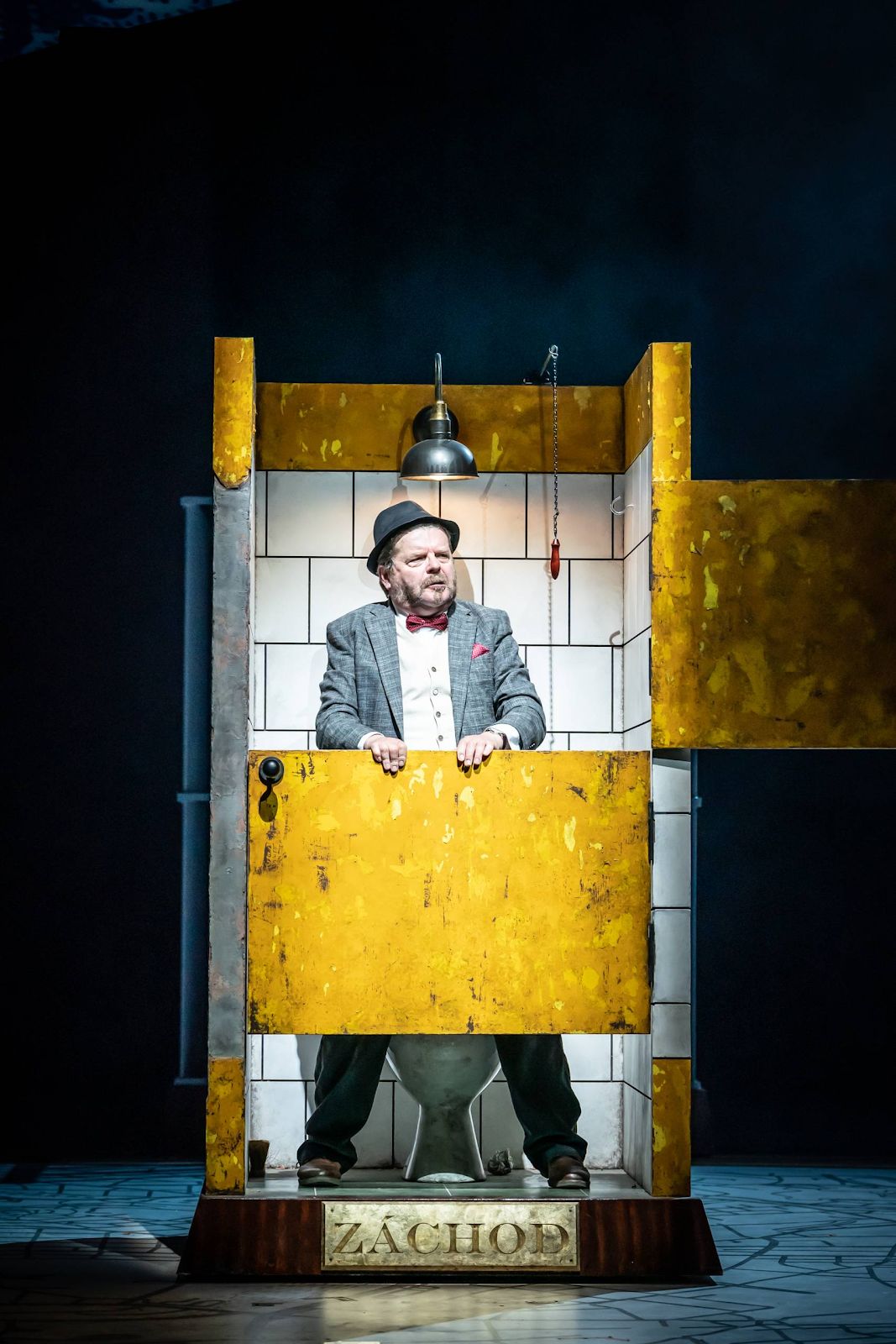
Whether one cares for the (literal) toilet (brush) humour of the interlude between the visits, will be a matter of taste. Monty Python is not my thing, but if it is yours, you will almost certainly love Pountney’s more outrageous excurses. Sometimes, though, I wondered where the heart was, especially during the Moon-trip. Is there not something more positive to say about artistic creation too? The answer, I suppose, would be that it lies in the score (and, indeed, in the artistic endeavour of performance and reception itself. It arguably suggested itself onstage at the end, when the innkeeper Würfl collected his drunken patron, laughed at his tall tales, but also walked him away in camaraderie. Perhaps that was enough. Again, that will probably be as much a matter of taste or inclination as anything else.


Peter Hoare’s Brouček captured well the contradictions not only of the character, but of our response(s) to him. This was a typically intelligent performance, which held the stage, amused, and touched without sentimentality. Fflur Wyn’s Málinka and other roles were lively, characterful, and rooted in, yet far from hidebound by, the text. Such is the magic of theatre, and such might be said of any number of the cast, including Mark Le Brocq’s handful of roles, Andrew Shore’s, and Clive Bayley’s, as well as Anne-Marie Owens's Kedruta. This was very much a company effort, which did Grange Park Opera proud, enthralling an audience that could all too readily have registered mere bemusement at the work’s oddity.


Domsik (Clive Bayley)


George Jackson’s traversal of the score elicited my unqualified admiration, as did the playing of the BBC Concert Orchestra. Incisive and expansive, earthy and soaring, above all attuned to those fabled speech rhythms and their unpredictable, magical combination into form and structure, this was as fine a Janáček performance as I have heard for some time, all the more so for its revelation of relatively unfamiliar territory. Time and time, presentiments of the Vixen’s world shone through, anchoring these ‘excursions’ in a common humanity and inspiring us to go forth and create it. The score emerged possessed of the musical, scherzando brilliance of the more or less contemporary Gianni Schicchi, if perhaps less single-minded, at any rate without the latter work’s dramaturgical precision, considered as a whole. We might say Janáček’s musical dramaturgy is more adventurous, though much depends what one means. Whatever our thoughts on that, this was a musical banquet beautifully and, at the last, movingly served.


Wednesday, 13 June 2018

Capriccio, Garsington Opera, 9 June 2018


Garsington Opera House, Wormsley

Images: Johan Persson
Andrew Shore (La Roche), William Dazeeley (Count), Hanna Hipp (Clairon),
Miah Persson (Countess), Benjamin Bevan (Major-Domo)


Flamand – Sam Furness
Olivier – Gavan Ring
La Roche – Andrew Shore
Countess Madeleine – Miah Persson
Count – William Dazeley
Clairon – Hanna Hipp
Major-Domo – Benjamin Bevan
Italian Soprano – Nika Gorič
Italian Tenor – Caspar Singh
Servants – Richard Bignall, Dominic Bowe, Robert Forrest, Andrew Hamilton, Emanuel Heitz, Jack Lawrence-Jones, David Lynn, Kieran Rayner
Monsieur Taupe – Graham Clark
Young Dabicer – Lowri Shone

Tim Albery (director)
Tobias Hoheisel (designs)
Malcolm Rippeth (lighting)
Laïla Diallo (choreography)

Garsington Opera Orchestra
Douglas Boyd (conductor)

Who among the younger generation can really imagine a great city like Munich in total darkness, or theatre-goers picking their way through the blacked-out street with the aid of small torches giving off a dim blue light through a narrow slit? All this for the experience of the Capriccio première. They risked being caught in a heavy air raid, yet their yearning to hear Strauss’s music, their desire to be part of a festive occasion and to experience a world of beauty beyond the dangers of war led them to overcome all these material problems... Afterwards it was difficult to relinquish the liberating and uniting atmosphere created by the artistic quality of the new work. But outside the blackened city waited, and one’s way homewards was fraught with potential danger.

With those words, the director Rudolf Hartmann recalled the 1942 Munich premiere of Richard Strauss’s final opera, Capriccio. They are not without sugary romanticism, which tells its own contemporary as well as subsequent story, yet by the same token, would surely touch all but the stoniest of hearts. (Of the many, there are alas far too many – especially when it comes to Germany.) Since first reading them, I have found it difficult to put them and their implications – some, to borrow from Nietzsche, beyond good and evil – out of mind when listening to and thinking about Capriccio.

The Servants (Robert Forrest, Jack Lawrence-Jones, Andrew Hamilton, Richard Bignall, Dominic Bowe, David Lynn, Kieran Rayner, Emanuel Heitz)

Perhaps, then, it is merely my problem that Tim Albery’s new production seems strangely uninterested in what for me has become very much part of the work. That despite a strange claim quoted in the programme: ‘I’ve worked with Tobias Hoheisel, a London-based German designer, who has a real sensibility for Strauss’s world and language. We talked a lot about the political context of the opera and decided that we should not set it in the ruins of a collapsing Europe. We set it in the time in which it was composed, when so many people were forced into exile.’ I am far from saying that a performance of any work should always concern itself with origins, the conditions of its first performance, or indeed any one time or place. Albery’s distinction, though, makes little sense, for Capriccio was composed during the Second World War: Europe was – again – collapsing. It was not 1945, but nor was it 1935, let alone 1925. One might accuse Strauss of evasion – although, by this stage, what on earth was he supposed to do? – but there seems to me here a degree of evasion here too.

Sam Furness (Flamand), Gavan Ring (Olivier), Andrew Shore (La Roche)

What we are left with is a typical rococo palace with more modern touches: costumes and artwork. The action and conversation – are they the same thing, somewhat different, even in some respects opposed? should we not at least ask? – proceed straightforwardly. Everything is well directed on stage, but there is little edge: which only the ignorant and/or hostile could claim of the work itself.  This might seem facile, but the very setting of the work in France has – and had – resonances. To have, moreover, the Countess comparing the musical merits of Rameau vis-à-vis Couperin is more telling than many might think: Brahms might have edited Couperin, but one will struggle to find his name or his music in Third Reich performances and musicology. Indeed, many composers, let alone others, would not necessarily have been well acquainted with the music of eighteenth-century France. Strauss certainly was – and showed through his composition that he was: sometimes through direct quotation, for instance the ‘Air italien’ from Les Indes galantes, when the composer is mentioned, at other times through allusion. Likewise for Gluck – what are we to make here of a ‘German’ composer acting as a ‘French’ one? – and much else.
 
William Dazeley (Count),Miah Persson (Countess), Sam Furness (Flamand)
The apolitical, especially at times such as this, may actually be read as highly political, whatever Strauss’s – or anyone else’s – straightforward intention. Perhaps the beauty of the costumes, the Countess (Miah Persson) truly resembling a star from the Golden Age of Hollywood, the servants’ livery truly impeccable, hints at something more; perhaps it does not. That ambiguity is welcome, but might we not have had a little more? One need not have Baldur von Schirach on stage to listen to the opening sextet – although why not? – to hint at something more troubling. (The sextet had its private premiere at Schirach’s villa, the Vienna Gauleiter having helped Strauss secure his Viennese Belvedere home. In return, moreover, for the composer playing his part in furthering Viennese musical life, Schirach, the only defendant other than Albert Speer to speak against Hitler at Nuremberg, had offered protection for Strauss’s Jewish daughter-in-law, Alice, and his grandsons.) A challenging work, ever more so the more one gets to know it and think about it, deserves perhaps rather more challenge than this. Otherwise, the updating might as well not have happened; it does not seem in any way to shape, to comment, or even to frame the drama. More fundamentally, though, I missed the achievement of Christian von Götz’s Cologne staging, which I saw at the 2007 Edinburgh Festival. There, not only was one forced to confront the work’s political difficulties; one emerged, at least I did, with ever-greater admiration for it. (Indeed, it was the aftermath of that experience that set me on the road to writing a chapter on Capriccio in my book After Wagner.)

Miah Persson (Countess)

If Albery’s production comes across as something for those as unconcerned with such matters as many have erroneously claimed Strauss to be – non-, even anti-metropolitan opera – there were many musical rewards to enjoy. That was true above all for Persson. Her musical line, subtly inflected brought into greater relief than anything on stage the central question of ‘Word oder Ton?’ This was in every respect, certainly verbal, yet not only so, a superior performance to that heard in concert from Renée Fleming a few years ago. (Why are Covent Garden and still more ENO so hostile to staging Strauss, or at least so reluctant to do so?) The vocal bloom of her final scene was well prepared, prefigured perhaps more subtly still than the theme on which Douglas Boyd had proved perhaps just a too insistent in his orchestral highlighting. That said, if sometimes apparently viewing Strauss’s motivic technique a little too much as concerned with reminiscence, and not quite enough as ‘the binding together of a music drama through a dense web of motivic connections from within’ (Carl Dahlhaus on Wagner), Boyd handled and communicated the ebb and flow well: no easy task. It was doubtless no coincidence, given his background as an oboist, that the woodwind of the excellent Garsington Orchestra were afforded especial opportunity to shine. If a few more strings would at times have been appreciated, there were no real grounds for complaint here either; the section certainly came into its own at climaxes.

Hanna Hipp (Clairon)


Otherwise, there was a fine sense of vocal ensemble, Andrew Shore’s typically characterful La Roche, Hanna Hipp’s rich-toned Clairon, and Graham Clark’s properly scene-stealing Monsieur Taupe (even without Götz’s yellow star, the escape carriage having been missed) for me the pick of the bunch. If Albery’s staging perhaps serves La Roche’s caricatured aesthetics better than his broader role as impresario and indeed spokesman for broader theatrical values – Max Reinhardt his obvious (Jewish) inspiration – the opera is such that a thinking audience member cannot help but reflect upon such matters. Capriccio is a good deal less fragile, as well as a great deal more political, than it might seem and than it might have been ‘intended’ to be.


Sunday, 22 February 2015

Die Meistersinger von Nürnberg, English National Opera, 21 February 2015


Coliseum

(sung in English, as The Mastersingers of Nuremberg)

Walther – Gwyn Hughes Jones
Eva – Rachel Nicholls
Magdalene – Madeleine Shaw
David – Nicky Spence
Hans Sachs – Iain Paterson
Sixtus Beckmesser – Andrew Shore
Veit Pogner – James Creswell
Fritz Kothner – David Stout
Kunz Vogelgesang – Peter van Hulle
Konrad Nachtigall – Quentin Hayes
Ulrich Eisslinger – Timothy Robinson
Hermann Ortel – Nicholas Folwell
Balthasar Zorn – Richard Roberts
Augustin Moser – Stephen Rooke
Hans Folz – Roderick Earle
Hans Schwarz – Jonathan Lemalu
Night Watchman – Nicholas Crawley

Richard Jones (director)
Paul Steinberg (set designs)
Buki Schiff (costumes)
Mimi Jordan Sherrin (lighting)
Lucy Burge (choreography)

Chorus of the English National Opera (chorus master: Martin Fitzpatrick)
Orchestra of the English National Opera
Edward Gardner (conductor)
 

Although the English National Opera has been decidedly sparing with its Wagner for quite some time now, its recent track record, leaving aside a disastrous Ring, has perhaps been better than that at Covent Garden. Above all, I am thinking of Nikolaus Lehnhoff’s production of Parsifal, sadly revived but once, with estimable conducting from ENO’s soon-to-be Music Director, Mark Wigglesworth, and a fine cast (bar an unfortunate Kundry). The contrast with the Royal Opera’s recent Parsifal – a production that appeared to offer a bizarre tribute to Jimmy Savile, a Music Director quite out of his depth, and a tenor whose replacement with a pneumatic drill would have been more or less universally welcomed – was telling. Here, a Meistersinger production originally seen in Cardiff again proved preferable to Covent Garden’s most recent offering (an especially sad state of affairs at the sometime house of Bernard Haitink). If we quietly leave to one side the most extravagant claims heard over the past fortnight – surely more a consequence of sympathy with and support for ENO in the face of financial and managerial difficulties than of properly critical reception – this proved something to be cherished, something of which ENO could justly be proud: a good, and in many respects very good, company performance.


Edward Gardner’s conducting certainly marked an advance upon his 2012 Flying Dutchman. One would hardly expect someone conducting The Mastersingers for the first time to give a performance at the level of a Haitink or a Thielemann, let alone the greatest conductors of the past; nor did he. Yet, once we were past a fitful first-act Prelude – I began to wonder whether we were in for a Harnoncourt-lite assault upon Wagner! – Gardner’s reading permitted the score to flow as it should. (I shudder in horror when I recall Antonio Pappano’s hackwork – a generous description – at Covent Garden.) If there was rarely the orchestral weight, the grounding in the bass, that Wagner’s work ideally requires, relative lightness of touch was perhaps no bad thing for lighter voices than one would generally encounter. Moreover, Gardner seemed surer as time went on: not an unusual thing in this score, for even so fine a Wagnerian such as Daniele Gatti gave a similar impression a year-and-a-half ago in Salzburg, coming ‘into focus’ more strongly as the work progressed. Moreover, orchestral playing, considered simply in itself, was excellent throughout; a larger body of strings would have been welcome, but one cannot have everything. The ENO Chorus, clearly well trained by Martin Fitzpatrick, offered sterling service in the best sense: weighty where required, yet anything but undifferentiated. Orchestra and chorus alike have prospered under Gardner’s leadership; they are treasures the company and country at large have the strongest of obligations to protect.


What of Richard Jones’s production? Clearly, to anyone familiar with the work of Stefan Herheim, or, from an earlier generation, say, Harry Kupfer and Götz Friedrich, there has again been an excess of extravagant praise. The production rarely gets in the way: certainly a cause for celebration. Yet, by the same token, it has nothing in particular to add to our understanding, however diverting the ‘spot the German artist on the stage curtain’ might be. (I could not help but smile at the mischievous inclusion of Frank Castorf.) A predictably post-modern mix of nineteenth- and sixteenth(?)-century costume could have been used to say something interesting about Wagner’s donning earlier, anachronistic garb (that is, Bach rather than something ‘authentic’). It would need to have been more sharply defined and directed, though; here, it remains on the level of the mildly confusing, or at least incoherent. One has a sense of community, but it is difficult to discern much in the way of the darker side of the work – without which, the light makes less impression, just as its ‘secondary’ diatonicism remains predicated, both immediately and more reflectively, upon the chromaticism of Tristan. I can see why Jones might have opted – at least that is what I think he was doing – to present Hans Sachs as suffering from bipolar disorder, doing an irritatingly silly dance at one point, prior to slumping into depression. Had that been a personal illustration of the Schopenhauerian Wahn afflicting the world more generally, it would have worked a great deal better, though, than an all-too-simple explanation for Sachs’s mood-swings. The translation, similarly mistaking the personal for the metaphysical, certainly did not help: ‘Mad! Mad! Everyone’s mad!’ for ‘Wahn! Wahn! Überall Wahn!’ If that were misleading, though, far worse was the bizarre reference to ‘ancient Rome’ instead of the Holy Roman Empire in Sachs’s final peroration, rendering his warnings meaningless and merely absurd. There is enough uninformed misunderstanding of this scene as it is, largely born, it seems, by Anglophone audiences being unable or unwilling to read what Wagner actually wrote; further confusion such as that is anything but helpful.


Jones certainly did score, though, in his adroit direction of the cast on stage, although much of that credit should certainly go directly to members of that cast. Andrew Shore’s Beckmesser was an unalloyed joy, treading the difficult line between comedy and dignity as surely as anyone was is likely to see today. His diction was beyond reproach, seamless integration of Wort und Ton almost having one forget the problems of translation. James Creswell’s rich bass similarly impressed, having one wish that Pogner’s role might be considerably expanded. David Stout’s Kothner elicited a not dissimilar reaction from this listener. Iain Paterson’s voice is less ideally suited to his role, that of Sachs, but there was no doubting his commitment to role and performance, the thoughtfulness of which offered many compensations. The other Masters and Nicholas Crawley’s sumptuously-clad Night Watchmen were an impressive bunch too. I wondered whether, to begin with, Gwyn Hughes Jones’s Walther was a little too Italianate in style; that is doubtless more a matter of taste than anything else, though, and either the performance or my ears adjusted – or both. He certainly went from strength to strength in the second and third acts, experiencing no difficulties whatsoever in making himself heard above the rest of the ensemble, without any recourse to barking. Nicky Spence’s characterful David – it would, admittedly, be an odd David who was not characterful! – struggled a little with his higher notes in the first act, but, like the cast as a whole, offered a portrayal considerably more than the sum of its parts. I was less keen on Rachel Nicholls’s somewhat harsh-toned Eva, having the distinct impression that her voice was being forced, perhaps on account of the size of the theatre. (But then, Wagner tends to be performed in larger theatres.) Madeleine Shaw’s Magdalene was straightforwardly a joy to hear, as impressive in its way as the assumptions of Shore and Creswell. Again, it was difficult not to wish for more.


So, despite certain reservations, this was a Meistersinger to be reckoned with. On a number of occasions, especially during the third act, work and performance brought a lump to my throat, even once a tear to my eye. That, surely, is the acid test – and it was readily passed.

Friday, 31 October 2014

La bohème, English National Opera, 29 October 2014


(sung in English)
 
Coliseum
 
Marcello – George van Bergen
Rodolfo – David Butt Philip
Colline – Barnaby Rea
Schaunard – George Humphreys
Benoît, Alcindoro – Andrew Shore
Mimì – Angel Blue
Parpignol – Philip Daggett
Musetta – Jennifer Holloway
Policeman – Paul Sheehan
Foreman – Andrew Tinkler

Jonathan Miller (director)
Natascha Metherell (revival director)
Isabella Bywater (designs)
Jean Kalman, Kevin Sleep (lighting)

Chorus of the English National Opera
Orchestra of the English National Opera (chorus master: Genevieve Ellis)
Gianluca Marcianò (conductor)
 

Jonathan Miller’s production of La bohème for ENO, shared with Cincinnati Opera, sits uneasily, at least as revived by Natascha Metherell, between comedy and tragedy. Perhaps, you might say, that is as it should be; there is certainly an element of taste in such matters. However, it seems to me that a highly creditable desire to explore the darker elements – and they are hardly difficult to find! – in Puccini’s opera is somewhat undone by moments closer to farce. The greyness of an imagined Paris inspired by Cartier-Bresson works very well, Isabella Bywater’s designs in themselves a great visual strength, waiting to be relieved by brief, or at least relatively brief, moments of colour. Café Momus makes a particular impression in that respect. However, I could not help but wonder whether some of the things – entrances, concealment, and so on – one sees going on around the sets would be better left unseen. Elements of ‘surprise’ – yes, many of us know the opera all too well, but that is a different matter – are lost, without the ‘workings’ adding anything genuinely new. Still, it is a relief not to have anything too sugary; the last thing Puccini of all composers needs is sentimentalising. Doubtless I have been spoilt by seeing Stefan Herheim’s urgently compelling version on DVD: the only staging of this work that has really revealed anything at all to me. Recommended to Puccini-lovers and –sceptics alike, indeed to anyone who believes that opera can and should be something more than a tired museum piece.
 

A few more serious drawbacks prevented the evening from having had the impact it might have done. Amanda Holden’s translation started off poorly and, if anything, got worse. It managed both to be vaguely ‘after’ the libretto and dreadfully anti-musical. Italian suffers worse than most languages by translation into English, but the task can be accomplished much better than this. This was a version only for those who might think there is something ‘edgy’ about people randomly singing the word ‘bastards’. But then, perhaps a selfish – or hard-of-hearing? – audience happy to applaud throughout, and indeed before the orchestra had stopped playing at the ends of acts was genuinely enthralled or even shocked by such banalities. Moreover, Gianluca Marcianò’s charmless conducting helped nothing or no one. The first act in particular seemed devoid of life. I struggled in vain to hear anything throughout the evening that would vindicate Puccini’s symphonic ambition. Instead, phrases followed one after another, quite unconnected. The ENO Orchestra, on generally excellent form, both pointed and luscious where permitted, deserved far better.
 

So too did the cast: probably the principal reason to catch this revival. There was a good sense of ensemble between the singers, which will doubtless only increase as the run progresses. Individually, there is much to admire too. David Butt Philip really presented Rodolfo as a credible character, not a mere opportunity to sing. The conflicts within his soul, cowardice and self-absorption vying with a genuine if ‘poetic’ aspiration towards something nobler, came across with considerable subtlety. Angel Blue seemed slightly stilted to start with, but quickly grew into the role of Mimì. Her vocal allure is by now reasonably well known; it did not disappoint. However, a little more attention at times to words and their implications would have deepened the impression. If George von Bergen was somewhat stiff as Marcello, the other students impressed; Barnaby Rea’s Colline and the Schaunard of George Humphreys helped to create a proper sense of milieu and preoccupation from which Rodolfo could emerge. Jennifer Holloway’s Musetta very much looked the part, but the top of her range proved uncomfortably strident, even squally. Andrew Shore, however, proved luxury casting as Benoît and Alcindoro, vivid portrayals them both.


Tuesday, 1 October 2013

Die Fledermaus, English National Opera, 30 September 2013


Coliseum

(sung in English)

Gabriel von Eisenstein – Tom Randle
Rosalinde – Julia Sporsén
Frank – Andrew Shore
Prince Orlofsky – Jennifer Holloway
Alfred – Edgaras Montvidas
Dr Falke – Richard Burkhard
Dr Blind – Simon Butteriss
Adele – Rhian Lois
Ida – Lydia Marchione
Frosch – Jan Pohl

Christopher Alden (director)
Allen Moyer (set designs)
Constance Hoffman (costumes)
Paul Palazzo (lighting)

Chorus of the English National Opera (chorus master: Martin Fitzpatrick)
Orchestra of the English National Opera
Eun Sun Kim (conductor)
 
 
Champagne is constantly evoked in the libretto of Die Fledermaus, an all-too-ready explanation for the events that have taken place or are to follow. As Prince Orlofsky sings, ‘Champagner, König aller Weine! Hoch die sprudelnde Majestät und ihre Untertanen!’ or, as Frank ruefully comments, ‘Der verdammte Champagner!’ We could have done with a few more bubbles here, especially following the interval.

 
The ultimate question, then, is: what is it that falls a little flat? It is not always easy to put one’s finger on it; by the same token, there are a good few things to admire, so it is perhaps better to put off that question a little longer. As implied above, the first act is on the whole rather fun and indeed much of the rest of the production makes one think. (That is a red rag to the bull of a certain self-satisfied variety of opera-goer, let alone operetta-goer, but who cares?) Christopher Alden’s staging quite rightly does not take the easy road; if one is going to plead the cause for the defence, especially in a case such as this, then one needs to dig beneath the surface. The Overture presents both the gigantic version of Eisenstein’s pocket watch, which will haunt the staging throughout, and figures of bats themselves, before we see the bat. (Incidentally, should ENO not call the operetta, The Bat, rather than employing a German title?) As the performance progresses, we realise that the surrealistic occurrences may not be just that; Rosalinde’s marital bed, one of many handsome designs by Allen Moyer, conjures up fantasies that prefigure Freud, but they are the stuff of the drama itself, not something superimposed. Indeed, the blurring of boundaries between what is ‘dreamed’ and what is ‘real’ is one of the strongest features of Alden’s production. It takes us forward so that, in his words, ‘the ponderous nineteenth-century Victorian bedroom of Act I cracks open to let the fresh air of Act II’s 1920s-ish celebration of loosening up, freedom, and creativity.’  Except, and I suspect this may be where I part company from many others, the problem is not that the production goes too far; I am not sure that it goes far enough. One does not really feel what Alden describes. If there were an ‘orgy’, as I had heard it described prior to the performance, then somehow my friend and I managed to miss it. A little more abandon would not have gone amiss. ‘The reactionary crackdown on subversive degeneracy in Act III’s prison’ likewise does not really come off. Indeed, it seems tacked on, the Nazi thuggishness of Frosch an all-too-easy card to play, a card which, moreover, seems uncertain as to whether it be intended parodically. The alarming overacting of Jan Pohl in the role would seem out of place on just about any stage, or indeed in a 1970s situation comedy; but here, when more subtle expectations have originally been set up, it seems all the more striking a misjudgement, presumably on Alden’s part.

 
I confess to initial scepticism about the idea of Johann Strauss in English, but if translation must be done, then Daniel Dooner and Stephen Lawless did a fine job indeed, a striking contrast with the previous ENO effort for Fidelio (David Pountney). Whilst all was going well, there was genuine wit to be savoured – and the later problems certainly did not lie with this accomplished translation. Eun Sun Kim’s conducting of the score proved varied. It began in mercilessly hard-driven fashion, but calmed down, and if sometimes it felt more observed than felt from within, there were passages in which the rhythmic lilt was winningly conveyed. For that, of course, the orchestra itself deserves credit too. Yet one could never quite kid oneself that this was the ‘real thing’, a slippery concept, and in repertoire such as this, dangerously amenable to all manner of unpleasant, völkisch interpretations. Perhaps, however, and this goes for the contribution of the cast as well, performances will sound more at ease with themselves as the run continues.

 
There was much to enjoy from the cast, Tom Randle predictably subtle, no mere caricature, as Eisenstein, and Julia Sporsén an attractively-voiced Rosalinde. Andrew Shore displayed considerable comic as well as musical gifts as Frank. Jennifer Holloway offered vocal depth as Orlofsky, though many of her words were quite incomprehensible, partly no doubt a result of the thick, allegedly ‘Russian’ accent she was obliged to adopt. I continue to find the idea that ‘regional’ or ‘foreign’ accents are intrinsically hilarious at best questionable, but it seems to have become a staple of such events, doubtless as a substitute for genuine comedy. Likewise, if Edgaras Montvidas’s Alfred and Rhian Lois’s Adele tilted too much towards such caricature – probably not their fault at all, certainly jarring with the more interesting aspects of this conflicted production – they offered considerable vocal rewards, as did Lydia Marchione as Ida. Richard Burkhard’s Falke had some problematic moments vocally; Simon Butteriss offered a Dr Blind as camp as (presumably) requested by the director. Choral singing was generally of a high standard. It was, though, that elusive sense of ‘company’ that was perhaps most lacking. Again, that may rectify itself in subsequent performances.

 
I wonder, though, whether the principal problem lies with the work itself. Of course, one does not expect it to be Parsifal or Saint François d’Assise; even so, it remains rather thin stuff: better than Lehár, no doubt, though otherwise, Offenbach’s wit, style, and satire seem preferable in just about every respect, and perhaps transfer better to a modern, international house. Granted, this is a very difficult genre to get ‘right’; Elisabeth Schwarzkopf claimed to find it trickier than opera. Is it really worth the trouble, though? Perhaps it is better off left to the ‘traditional’ likes of the Volksoper, though Alden et al. certainly merit thanks for trying something more provocative. Given ENO’s puzzling neglect of Richard Strauss – surely a work such as Intermezzo ought to be right up its street – it would probably be better advised to transfer its allegiance to him for the next few Strauss outings. Once a decade or two seems about right for Johann.

Saturday, 15 June 2013

Death in Venice, English National Opera, 14 June 2013


The Coliseum

Gustav von Aschenbach – John Graham-Hall
Traveller, Elderly fop, Old gondolier, Hotel manager, Hotel barber, Leader of the players, Voice of Dionysus – Andrew Shore
Voice of Apollo – Tim Mead
Polish Mother – Lauda Caldow
Tadzio – Sam Zaldivar
Tadzio’s sisters – Mia Anglian Mather, Zhuliana Shehu
Governess – Joyce Henderson
Jaschiu – Marcio Teixeira
Hotel porter – Peter van Hulle
Strawberry-seller, Strolling player – Anna Dennis
Strolling player – Adrian Dwyer
Guide – Charles Johnston
English clerk – Marcus Farnsworth
Glass-maker – Richard Edgar-Wilson
Lace-seller – Constance Novis
Beggar woman – Madeleine Shaw
Restaurant waiter – Jonathan McGovern
Lido boatman. Gondolier, Priest in St Mark’s – Paul Napier-Burrows
Hotel waiter – David Newman
Newspaper-seller – Lyn Cook
Gondoliers – Philip Daggett, Anton Rich
Ship’s steward – Gary Coward
Hotel guests from many countries – Allan Adams, Deborah Davison, Natalie Herman, Suzanne Joyce, Graeme Lauren, Lydia Marchione, Claire Mitcher, Ronald Nairne, Emily Rowley Jones, Paul Sheehan, Andrew Tinkler, Susanna Tudor-Thomas

Deborah Warner (director)
Tom Pye (set designs)
Chloe Obolensky (costumes)
Jean Kalman (lighting)
Kim Brandstrup (choreography)
Finn Ross (video)

Paul Brough (chorus master)
Orchestra of the English National Opera
Edward Gardner (conductor)

 
ENO is on fine form at the moment. Its recent Wozzeck deservedly received well-nigh universal acclaim. If Death in Venice did not have anything like the same dramatic impact, then that is more to be ascribed to the work than to the performances, which were generally excellent. In certain quarters, it is heresy to question Britten’s standing; for those with a greater sense of discrimination, it is patently obvious that his output is highly variable. The overrating of Peter Grimes offers an especially extreme example: a great story, with some memorable music, interspersed with some that is really rather dull. The Turn of the Screw stands head and shoulders above the rest of Britten’s operas, not least since it suffers less from the formal problems that so often beset his work. ENO, however, has served Britten very well, Christopher Alden’s riveting production, for instance, having elevated the slight, often tedious Midsummer Night’s Dream far above the intrinsic qualities of the work. Death in Venice is a better work than that, but it is not without tedium; an idea, at least as converted into this opera, which might have been better suited to a short one-act work, is drawn out far too long, seeming to take about as long as it would to read Thomas Mann’s novella. And if Britten’s display of his workings helps impart unity, that display, whether in terms of sonorities – the all too ready resort to gamelan echoes – or twelve-note process often sounds too obvious. It is difficult not to conclude that the opera would have benefited from wholesale revision, perhaps from a good editor.   

 
Edward Gardner necessarily conducted the score as if he believed in every note of it; there is every reason to think that he did. If there were a few occasions when greater tightness might have been achieved, that is a minor criticism of a performance as dramatic as orchestral writing that is sometimes more thin than spare would permit. The ENO Orchestra was an estimable collaborator without, fully playing as if this were a repertory work inside the composer’s idiom. If the percussionists inevitably deserve special mention, that is no reflection upon the standard of performance elsewhere in the pit, from which sinewy woodwind lines and dark brass punctuation emerged with equal conviction.

 
John Graham-Hall’s voice is not especially beautiful; nor does it need to be. Whatever claims one might make for Peter Pears’s artistry, that would be an eccentric place to start, and Gustav von Aschenbach is a Pears role par excellence. Graham-Hall offered something far more telling: elusive yet unmistakeable dramatic truth. One felt that this was Aschenbach’s story; one both saw it through his eyes and saw him through the eyes of the story, if that makes any sense. It is a strenuous role indeed, but Graham-Hall used its very difficulty to great effect. Beauty, after all, is to be espied from afar, as it was here, not only in the guise of Sam Zaldivar’s gracefully nonchalant assumption of Tadzio, not only even in the æsthetic contemplation and temptation of the Games of Apollo, but in the society as a whole of which Aschenbach both is and is not a part. Tim Mead’s beautifully sung – and acted – Apollo seemingly tilted the dramatic scales further, though of course it would be the Voice of Dionysus that would eventually, tragically capture him. (That tragedy is perhaps one of the weaker aspects of the opera, pushing it too far in the direction of melodrama; but again, that is not the performers’ fault.) Andrew Shore managed a serious of roles with equal facility, as convincing as the oleaginous Hotel Manager as the ludicrous Leader of the Players (his heightened absurdity perhaps a consequence of Aschenbach’s condition?) A plethora of small roles – is the cast not excessive, especially for an opera concentrating so heavily upon a single protagonist? – emerged with similar qualities of observance.

 
Deborah Warner’s production is perhaps the best I have seen from her. The action takes place when and where it ‘should’, but unlike, for instance her dull Eugene Onegin, that provides a frame for imaginative performance. The first, dark scene in Munich, Tom Pye’s excellent set weighed down by the writer’s words, gives way to a plausible journey to illusory, indeed deadly light. For Jean Kalman’s lighting – the initial view from the hotel a fine coup de théâtre – stands as central as Chloe Obolensky’s beautifully-designed period costumes to the often spellbinding success of the staging. Graham-Hall of course deserves the lion share of the credit for the dramatic truth of his descent, but Warner’s direction of him onstage, for instance in the tentativeness of his approaches to Tadzio, must also have played an important role. Kim Brandstrup’s choreography highlights the boys’ natural athleticism, highly successful in conveying its crucial non-reflective quality. Reflection, after all, is Aschenbach’s lot.  

Wednesday, 27 February 2013

Il barbiere di Siviglia, English National Opera, 25 February 2013


(sung in English as The Barber of Seville)

The Coliseum

Fiorello – Alexander Robin Baker
Count Almaviva – Andrew Kennedy
Figaro – Benedict Nelson
Rosina – Lucy Crowe
Doctor Bartolo – Andrew Shore
Don Basilio – David Soar
Berta – Katherine Broderick
Ambrogio – Geraint Hylton
An Official – Roger Begley
A Notary – Allan Adams

Jonathan Miller (director)
Peter Relton (revival director)
Tanya McCallin (designs)

Chorus of the English National Opera (chorus master: Genevieve Ellis)
Orchestra of the English National Opera
Jaime Martin (conductor)

 
ENO’s advertising emphasises the ‘25th anniversary year’ of Jonathan Miller’s staging of The Barber of Seville. It holds the stage well enough without offering any especial insight – at least by now. The programme book mentioned commedia dell’arte: Tanya McCallin’s designs are of that world, certainly, even if there does not seem to be a great deal in Miller’s production that goes beyond the general ‘look’ of that tradition. Unlike many endlessly revived productions, this, then, is not in itself particularly tired, and one can readily imagine it offering the opportunity for new casts to come in and assume their roles without a great deal of stage rehearsal. By the same token, when compared with, for instance, John Copley’s considerably more venerable Royal Opera La bohème, which I happened to see earlier in the month, the staging does not especially sparkle, enlighten, or indeed charm either. It would do no harm to have a little Regietheater cast Rossini’s way. Either that, or assemble a cast whose sparkle would lift the work above the merely quotidian.

 
I say ‘the work’, but this performance, unfortunately, put me in mind of Carl Dahlhaus’s ‘twin musical cultures’ of the nineteenth century: too clear a distinction, no doubt, but nevertheless heuristically useful. On the one hand, one has the culture of the musical work, as understood in an emphatic sense, that of Beethoven and his successors; on the other, one has ‘a Rossini score ... a mere recipe for performance, and it is the performance which forms the crucial aesthetic arbiter as the realisation of a draft rather than an exegesis of a text’. The problem was that this performance, taken as a whole, simply did not sparkle as Rossini must. One therefore became of the score as a decidedly inferior, indeed well-nigh interminable work. Repetitions grated and a good part of the audience was espied, furtively or less furtively, glancing at wristwatches. If Rossini’s ‘musical thought hinged on the performance as an event,’ then this was an unhinged performance – and not, alas, in the expressionistic sense.

 
Jaime Martin’s conducting started well enough. There was throughout a welcome clarity in the score; this was not, at least, Rossini attempting and failing to be Mozart or Beethoven. Give or take the odd orchestral slip, there might have been much to enjoy in the contribution of the ENO Orchestra, considered in itself.  However, impetus was soon lost, and any ‘purely musical’ tension soon sagged. Whether the first act were actually as long as it felt, I am not sure, but many during the interval opined that it seemed as though it was never going to end. If Rossini’s repetitions as opposed to development serve a dramatic purpose, one can readily forget them; here they were apparent in unfortunately lonely fashion. I could not help but mentally contrast the extraordinary use to which Beethoven, for instance in the Waldstein Sonata, puts simple tonic and dominant harmony, to the tedium induced on this occasion. For some reason, the fortepiano was employed as a continuo instrument: a strange fashion, which has enslaved musicians who would never think of using it in solo repertoire. Performance, then, failed to elevate the ‘work’. At least the English translation, by Amanda and Anthony Holden was a cut above the average.

 
The greater fault in any case lay elsewhere, above all in Andrew Kennedy’s Almaviva. His casting seemed simply inexplicable. Almost entirely lacking in coloratura, let alone Florez-like facility therewith, he resorted to mere crooning, a state of affairs worsened by the application at seemingly random intervals of unnervingly thick vibrato. His stage presence was of a part with his vocal performance. Benedict Nelson’s Figaro started off in reasonably convincing fashion, but by the end was somewhat hoarse and throughout lacked the pinpoint precision that might have lifted the performance. By contrast, Lucy Crowe was an excellent Rosina. Her coloratura was impeccable, her gracious stage presence no less so. Andrew Shore reminded us of his skills as a comic actor in the role of Doctor Bartolo, and Katherine Broderick also took the opportunity to shine as Berta. Sadly, the increasingly lacklustre conducting and the embarrassing performance of Kennedy conspired to negate those positive aspects of the performance, rendering one tired with the ‘work’, however it were considered.

Tuesday, 18 September 2012

Julietta, English National Opera, 17 September 2012


(sung in English)

Coliseum

Julietta – Julia Sporsén
Michel – Peter Hoare
Clerk in the Bureau of Dreams – Jeffrey Lloyd-Roberts
Man in a Helmet/Seller of Memories/Convict – Andrew Shore
Man at Window/Waiter/Beggar – Henry Waddington
Little Arab/First Gentleman/Bell Boy – Emilie Renard
Old Arab/Grandfather/Old Sailor – Gwynne Howell
Birdseller/Fortune Teller/Old Woman – Susan Bickley
Fishmonger/ Grandmother – Valerie Reid
Young Sailor – Anthony Gregory
Second Gentleman – Clare Presland
Third Gentleman – Samantha Price

Richard Jones (director)
Antony McDonald (designs)
Ricardo Pardo (associate set designs)
Matthew Richardson (lighting)
Philippe Giraudeau (choreography)

Chorus of the English National Opera (chorus master: Martin Fitzpatrick)
Orchestra of the English National Opera
Edward Gardner (conductor)
 
Images: Richard Hubert Smith
The Chorus


Julietta (or Snář, ‘The Dream-Book’) was based by Bohuslav Martinů on Georges Neveux’s play Juliette, ou La clé des songes. An initial French setting was discarded in favour of Czech, though this being ENO, the opera was of course performed in English, David Pountney providing a translation, which on several occasions quite mystifyingly confused singular and plural pronouns. (Julietta has been performed before at the Coliseum, the first English production having been given by the New Opera Company in association with ENO, conducted by Charles Mackerras.)  Michel, a Parisian bookseller, is searching for Julietta, her voice having attracted him since his previous visit three years before to the coastal town in which the action takes place. It quickly becomes clear to him and us that none of the townsfolk has a memory extending beyond a few minutes; Michel’s ability to remember sets him above them. A contrast is constructed between Julietta’s world of fantasy – she wants to hear of a past that never happened, in which she and Michel were lovers – and Michel’s world of reality. Having shot her upon her flight from a forest meeting, Michel is advised at the ‘Central Office of Dreams’ (!) that he has been dreaming and resolves to escape. However, hearing Julietta’s voice, he follows what seems to have been the route of other dreamers he has met at the office and return to her.  The opening setting returns, in contrast to the end of Neveux’s play – and the original French version – in which Michel remained uncertain as to whether to return to the world of dreams.
 
Michel (Peter Hoare)
 

That, I am afraid, makes the opera sound considerably more interesting than it is. Surrealism dates, of course, and tends to lend itself best to something snappier: a song, perhaps, or even a song-cycle, something more filmic, or a visual artwork (if ‘snappy’ may be stretched that far). This three-act opera dragged, the composer’s attempts at soaring lyricism remaining stubbornly earthbound. That is doubtless partly a matter of the subject matter: it is difficult to care about such ‘characters’ and their wearying silliness. However, whatever Martinů’s devotees may protest, I think it is also a matter of  the composer’s music itself. There is a great deal of his music I have not heard, an important proviso, yet everything I have has seemed similarly anonymous, its manifold derivations failing to cohere into a greater whole. What sounds most interesting, or rather least uninteresting, here are the passages that sound a little like (very) watered-down Janáček. Attempts to signal (relative) modernity by parading hand-me-downs from Stravinsky and Prokofiev fall flat. There is certainly compositional craft in the orchestration, and interest in the considerable use to which the piano is put, but so what, if there is nothing to say? To complain about an artwork being derivative is doubtless indicative of a post-Romantic world-view; well, so much the better for (post-)Romanticism.
 

Michel and Julietta (Julia Sporsén)
The music seemed well performed. If there were times when I could imagine Edward Gardner having exerted a tighter grip on proceedings, his direction was alert enough, though the orchestra sounded a little tired during the third act. Julia Sporsén proved as radiant as one could have any right to expect as Julietta, even if it were difficult not to wish that she were singing Janáček or something else more worthwhile. Peter Hoare did his best with what must be the tiring role of Michel, imparting as much credibility as the work would permit. The rest of the cast all performed creditably, often more than that. Susan Bickley offering luxury casting in the small roles of birdseller, fortune teller, and old woman, Andrew Shore likewise in three small roles, perhaps most notably the seller of memories who tries to convince Julietta and Michel that they holidayed together in Spain. I was especially impressed by Anthony Gregory’s lyrical tenor as the Young Sailor, who asks Michel for Julietta’s shawl – here, it seemed, more of a scarf: whether staging or translation erred, I cannot say – so as to compete with his elder colleague. Again, I hope I shall hear him more gainfully employed elsewhere.
 

The work in its general surrealist plotline might have been written to play to Richard Jones’s strengths. The designs (Antony McDonald and Ricardo Pardo) were arresting, deriving from imaginative use of a giant accordion, whose music we hear at the opening. Yet in the absence of anything to care about, we were left, hardly surprisingly, with a series of stylish images. First seen in Paris ten years ago, Jones’s production has now made it to London. Let us hope that he and a talented cast will next be offered something more substantial to which to apply themselves. There is a host of works that languish unperformed or under-performed; Martinů has had his chance.