Showing posts with label George Jackson. Show all posts

Tuesday, 21 June 2022

The Excursions of Mr Brouček, Grange Park Opera, 18 June 2022


The Theatre in the Woods

Mr Brouček – Peter Hoare
Málinka, Etherea, Kunka – Fflur Wyn
Mazal, Bounzincek, Petrik, Svatopluk – Mark Le Brocq
Würfl, Paycek, Councillor – Andrew Shore
Sacristan, Dudcek, Domšík – Clive Bayley
Kedruta – Anne-Marie Owens
Spotcek, Vojta, Raincek, Mirosla – Adrian Thompson
Postdatedcek – Jonathan Kennedy
Child Prodigy – Pasquale Orchard
Spotcek – Robin Horgan
Farty – Benjie del Rosario
Taborite I – Toki Hamano
Arty, Taborite I – Marcus Swietlicki
Dancers – Lauren Bridle, Bridget Lappin, Arianne Morgan, Luke Murphy, Jay Yule

David Pountney (director)
Leslie Travers (designs)
Marie-Jean Lecca (costumes)
Tim Mitchell (lighting)
Lynne Hockney (choreography)

BBC Concert Orchestra
George Jackson (conductor)
 

Bounzincek (Mark Le Brocq) and an artist on the moon
Images: Marc Brenner

Hats off to Grange Park Opera for unquestionably the best of the four ‘country house’ operas I have seen so far this season. First, and perhaps most important, with respect to the work itself: Janáček’s The Excursions of Mr Brouček. I suppose it might be theoretically possible to reach a state in which Janáček’s music was heard too often, though it might not. (Imagine saying such a thing of Bach or Mozart.) If it is, though, we are nowhere near that yet. Yet the Janáček operas we see staged are mostly, perhaps understandably, restricted to three: Jenůfa, Katya Kabanova, and The Cunning Little Vixen. We must go beyond The Makropulos Case and even From the House of the Dead to reach Mr Brouček. Doubtless some in the Grange Park Opera audience had seen it in the theatre before, but I had not, and was immensely grateful to have the opportunity to do so, let alone for it to be performed so well. 

Mr Brouček will doubtless always be a problematical work, in a way that the aforementioned popular (relatively speaking) trio will not. Its two-part structure will probably always require effort to bring together—if, indeed, such is the dramaturgical aim. But art is certainly not always about perfection, or approaches to it. Sometimes, it is about quite the opposite. The first part’s satire against pretentious avant-gardism, or perhaps better derrière-gardism, hits home more readily for a modern, or at least non-Czech, audience than the second, more preoccupied with Czech national mythology—although a little grounding helps us on our way. Nationalism, after all, remains sadly too universal. But the other part of the satire is against the antihero himself: the philistine who has little idea what he is doing in Prague, let alone on the Moon or in the fifteenth century. To that, we can and should all relate. No one likes a landlord, after all, especially one who boasts of having no mortgage, only a three-storey house. You can begin to see why the opera will never touch as Katya does. That is not its purpose.


Málinka (Fflur Wyn)

David Pountney’s production pulls out all the stops for a frankly zany trip from Prague to the moon, clarified and extended by Marie-Jean Lecca’s imaginative costuming. Leslie Travers’s brilliant set for the former captures an almost childlike delight in city models, as well as the, or at least an, idea of Prague. The empty pretentiousness of the moon artists—Pountney has fun, using his own, free English version of the text, creating names such as Spotcek, Raincek, and Postdatedcek—engenders an intoxication of its own. It is fun to watch, which guards us against too ready identification with Brouček. ‘We must each fight our inner Brouček,’ Janáček insisted. A similar, yet different mix of magical constructivism informs the still more bewildering—for many—and darker trip to the Prague of the Hussite rebellion.


Mr Brouček (Peter Hoare)
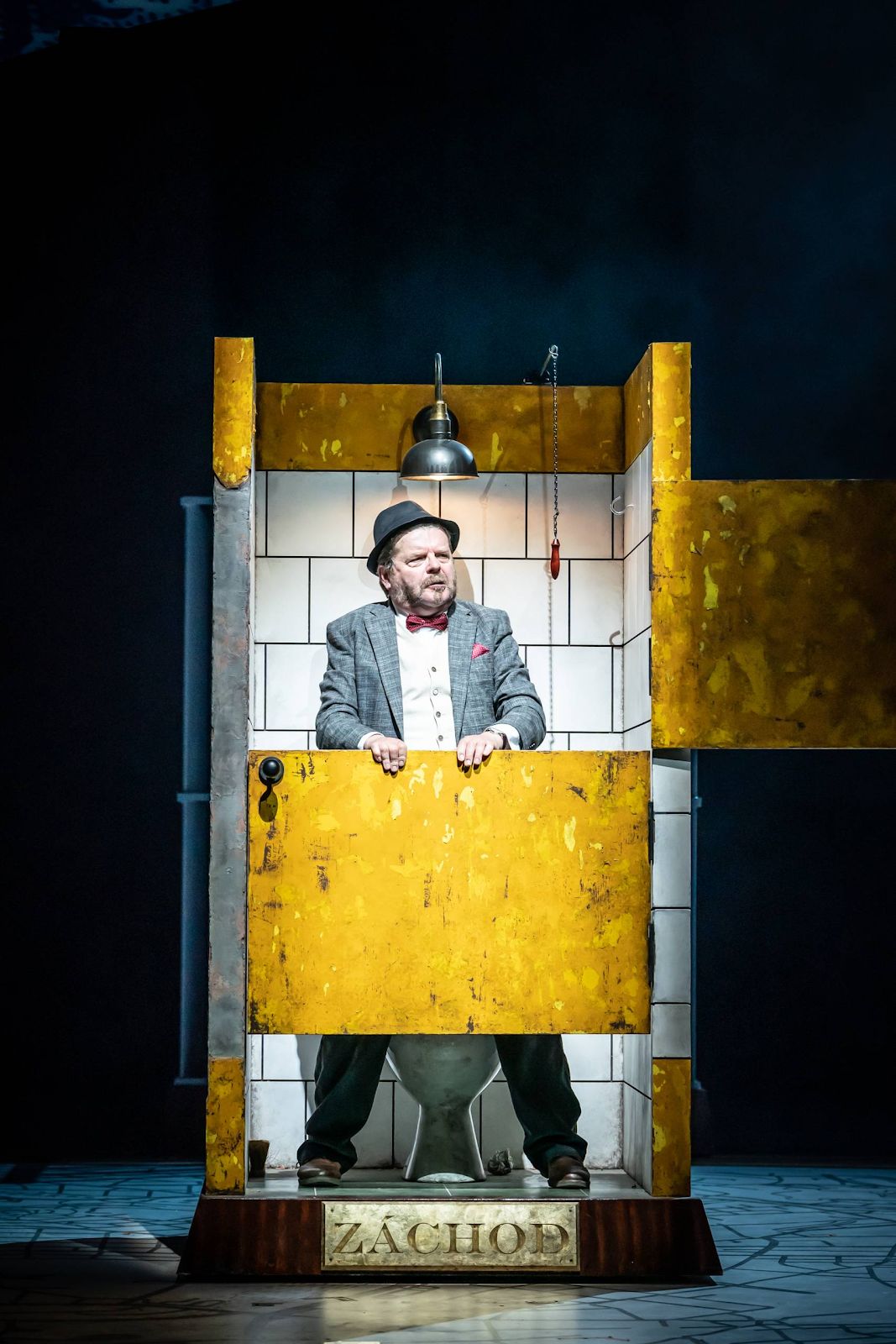
Whether one cares for the (literal) toilet (brush) humour of the interlude between the visits, will be a matter of taste. Monty Python is not my thing, but if it is yours, you will almost certainly love Pountney’s more outrageous excurses. Sometimes, though, I wondered where the heart was, especially during the Moon-trip. Is there not something more positive to say about artistic creation too? The answer, I suppose, would be that it lies in the score (and, indeed, in the artistic endeavour of performance and reception itself. It arguably suggested itself onstage at the end, when the innkeeper Würfl collected his drunken patron, laughed at his tall tales, but also walked him away in camaraderie. Perhaps that was enough. Again, that will probably be as much a matter of taste or inclination as anything else.


Peter Hoare’s Brouček captured well the contradictions not only of the character, but of our response(s) to him. This was a typically intelligent performance, which held the stage, amused, and touched without sentimentality. Fflur Wyn’s Málinka and other roles were lively, characterful, and rooted in, yet far from hidebound by, the text. Such is the magic of theatre, and such might be said of any number of the cast, including Mark Le Brocq’s handful of roles, Andrew Shore’s, and Clive Bayley’s, as well as Anne-Marie Owens's Kedruta. This was very much a company effort, which did Grange Park Opera proud, enthralling an audience that could all too readily have registered mere bemusement at the work’s oddity.


Domsik (Clive Bayley)


George Jackson’s traversal of the score elicited my unqualified admiration, as did the playing of the BBC Concert Orchestra. Incisive and expansive, earthy and soaring, above all attuned to those fabled speech rhythms and their unpredictable, magical combination into form and structure, this was as fine a Janáček performance as I have heard for some time, all the more so for its revelation of relatively unfamiliar territory. Time and time, presentiments of the Vixen’s world shone through, anchoring these ‘excursions’ in a common humanity and inspiring us to go forth and create it. The score emerged possessed of the musical, scherzando brilliance of the more or less contemporary Gianni Schicchi, if perhaps less single-minded, at any rate without the latter work’s dramaturgical precision, considered as a whole. We might say Janáček’s musical dramaturgy is more adventurous, though much depends what one means. Whatever our thoughts on that, this was a musical banquet beautifully and, at the last, movingly served.


Tuesday, 15 June 2021

Le nozze di Figaro, Opera Holland Park 15 June 2021


Holland Park

Count Almaviva – Julien Van Mellaerts
Countess Almaviva – Nardus Williams
Susanna – Elizabeth Karani
Figaro – Ross Ramgobin
Cherubino – Samantha Price
Marcellina – Victoria Simmonds
Bartolo – James Cleverton
Basilio, Don Curzio – Daniel Norman
Barbarina – Claire Lees
Antonio – Henry Grant Kerswell
First Bridesmaid – Naomi Kilby
Second Bridesmaid – Susie Buckle

Oliver Platt (director)
takis (designs), applied on the set for La traviata by Cordelia Chisholm
Rory Beaton (lighting)
Caitlin Fretwell Walsh (movement)

Opera Holland Park Chorus (chorus master: Richard Harker)
City of London Sinfonia
George Jackson (conductor)


What a welcome return to Holland Park this proved to be. Glorious weather helped, of course—quite a change from an earlier visit to Glyndebourne with altogether necessary overcoat and umbrella—but the achievement of Opera Holland Park first of all in putting on a season at all, let alone with its customary artistic success, deserves the highest praise.


One might think one could hardly go wrong with The Marriage of Figaro, though all too many recent productions have proved otherwise. In reality, it requires, like all Mozart, excellence in every respect. There is nowhere to hide, least of all in musical terms. The City of London Sinfonia was on good form, conducted by George Jackson, who fell prey to none of the traps readily walked entered by many of his peers. Instead, what we heard was an imaginative, wisely comprehending performance of Mozart’s score. Everyone will have his own ideas concerning tempi. In most cases, there will be various solutions. The trick is to make them work: largely, if anything but simply, a matter of ensuring a steady underlying tempo, which can certainly be varied, whilst at the same time hearing and conveying the act and ultimately the entire opera as a whole. There were, quite naturally, occasions when I initially wondered whether an initial tempo, at odds with how I might hear in my head, would work. There were none, however, when I was not swiftly convinced by Jackson’s choice: even Susanna’s emergence from the wardrobe, which showed a due sentiment of wonder can sound faster than I had believed.


A keen ear for orchestral detail, sometimes interpretative such as a cartoonish descending cello line, more often straight from the score, was in evidence throughout. Crucially, Jackson and his players conveyed an underlying melancholy, sometimes something darker still, as necessary counterpart to high spirits. There was room to breathe and to reflect: not so much a matter of speed, or even tempo, as of understanding and communicating the relationship between words, melody, harmony, and, this being opera, gesture. This was definitely Mozart’s comedy, not Rossini’s. The score was necessarily given in a reduced orchestration by Jonathan Lyness, which, lack of double wind notwithstanding, often tricked one into thinking one was simply hearing a small orchestra. Wind came naturally to the fore, balance not always as expected, but there was really no ground for complaint—and every ground for gratitude that this was happening at all, let alone so well.


Whilst there is no reason to be ageist about this, Figaro responds well to a cast of young singers—always, of course, provided they are capable of navigating its treacherous waters. This cast certainly was; it worked very well in ensemble too. The central quartet—Julien Van Mellaerts as the Count and Nardus Williams as the Countess; Elizabeth Karani as Susanna and Ross Ramgobin as Figaro—and others besides provided that necessary sense of reacquainting us with characters many fancy we know so well yet also of bringing something distinctive, of anchoring their portrayals in this particular Figaro, rather than some generic conception. All impressed in their various ways. Van Mellaerts, in combination with Jackson, had me sit up and take notice of quite what seria depth Mozart achieves in the Count’s third-act recitativo accompagnato and aria, ‘Hai gia vinta la causa … Vedrò mentr'io sospiro’. Detail and style matter here—not necessarily prescriptively, but generalisation will not do—as of course do their relationship to the whole. Williams brought great musical virtues to a finely balanced portrayal of dignity and sense of fun: this was Rosina, as well as ‘the Countess’. Karani and Ramgobin judged their standing at the centre of every intrigue extremely well: a musical just as much as a stage matter. Handling of recitative was just as impressive as their arias, which grew out of the former as musico-dramatic necessity.


Cherubino is a gift of a trouser role, yet no less tricky for that. Samantha Price had its measure, capturing not only its effervescence but a hint of the sadness—at least for those of us no longer quite so youthful—that lies with its distance. Victoria Simmonds and James Cleverton ensured that Marcellina and Bartolo, even shorn of their fourth-act arias, were more than stock buffo characters. As ever, the angel as well as the devil lies in the detail. A wily Daniel Norman as Basilio, and a bluff Antonio in Henry Grant Kerswell added to the fun; as did last, but far from least, Claire Lees’s beautifully sung, intelligently acted Barbarina. A small chorus, well directed and supplemented as is customary by the Holland Park peacocks, helped bind the action together in stage as well as musical fashion.


Oliver Platt, whose work I have admired in not one but two productions of Così fan tutte (Holland Park and the Guildhall), pulled off the difficult task of directing a Figaro for a time of social distancing. For the most part, one forgot—at least I did—that the characters were not interacting quite as normal. So much can be done, and was, with implication and choreography (for which plaudits to Caitlin Fretwell Walsh’s movement direction). Then there were moments, frozen as if for reflection, in which a sense of distance opened up: opening up being the operative word, since they were open to interpretation rather than dogmatically defined. The same might be said of a stylised, punkish look at costumes (takis) that were not quite what we might initially have thought. When we saw the servants, they were not really servants at all, let alone serfs. Crucially, they wore wigs. Who were they? People playing at being servants?


Moreover, whilst it would be difficult to claim this as an overtly political Figaro, it would be equally difficult not to draw political conclusions from the sense of judgement being passed on the Count and indeed the metatheatrical way the characters—perhaps partly out of character—turned on him and ultimately left him in isolation at the end of the second act. Judge not, that ye be not judged, takes on different meaning in a drama involving manorial justice—whatever the temporal context(s).


For opera is always constructed, never more so than now. Charlotte Chisholm’s resourceful work on a set necessarily conceived for two operas, this and La traviata, once again had one pretty much forget the restrictions under which we still labour—until a moment recalled the fact to us, at which one lauded the achievement. The action flowed with plenty of incident, yet nothing that jarred. Where there was anachronism, as for instance in the third-act ballet—what a history there is to that, as Lorenzo Da Ponte’s Memoirs so memorably recount—it was quite deliberately so. Distance intervened, momentarily, on and off stage; and then all came back together, audience included. That, surely, is what opera needs right now: solidarity and action in knowledge of the crisis that engulfs us.

Saturday, 7 May 2016

Trinity Laban SO/Jackson - Elgar, 6 May 2016


Great Hall, Blackheath Halls

Elgar - Symphony no.1 in A-flat major, op.55

Trinity Laban Symphony Orchestra with members of Welsh National Opera Orchestra
George Jackson (conductor)


Members of the WNO Orchestra have been joining young players at the Royal Welsh College of Drama, Birmingham Conservatoire, and Trinity Laban Conservatoire of Music and Dance, for ‘side-by-side’ mentoring, rehearsals, and performances. In a welcome note to the programme, Trinity Laban’s Head of Orchestral Studies explained: ‘Not only then, are the students encouraged and trained to play to the highest professional level, but they also experience the focus and discipline required to prepare a performance in limited rehearsal time – again a crucial discipline for the aspiring professional orchestral musician.’ The results, under Trinity Laban’s Sir Charles Mackerras Fellow in Conducting, George Jackson, were impressive indeed. Impressive and moving.
 

The excellent Blackheath acoustic helped to bring out both the warmth and immediacy in the orchestral playing. If the lamps were going out all over Europe at the opening of the first movement, there was strength too. The transition to the second group and the character of its material were smoothly, dramatically handled. Disintegrative tendencies – particularly in the brass earlier on, but later also in some beautifully dissolving string lines – were present but not exaggerated. Jackson imparted a strong sense of line throughout; there was no doubt that he knew where the music was heading, nor of his ability to communicate that to his players and to the audience. The timpanist’s underpinning of the dramatic trajectory often proved especially telling.
 

The scherzo was just as alert dramatically – drama, an idea to which I kept returning – as it was rhythmically. (There is no real distinction, of course.) Darkness was of a kind familiar from Elgar’s own no-nonsense approach to the score. The trio, tonally distant, sounded outwardly different, at least to begin with, but underlying unease remained, indeed mounted. The slow movement was in that respect not dissimilar, albeit with the ordering, as it were, reversed. There was a songful quality to this Adagio: certainly not on the slow side, but nor was it ever harried. Occasional passages of thinner string sound were to be heard, but such a cavil – almost my only one – should not be taken too seriously, for there were many more passages of noble passion.


The Lento opening to the finale was unmistakeable in its sense of darkness, even malevolence, such as at least to match what had gone before. ‘What had gone before’ was of course to be heard in thematic reminiscence, arguably more than mere ‘reminiscence’. Elgar’s practice here inevitably brought to mind some of his greatest symphonic predecessors, not least Beethoven in the Ninth Symphony, albeit with the crucial caveat of there being no vocal entry, with all that that entails (or does not). There is much more to the movement than that, of course, but there was a heavy load to be borne. Elgar offers no fixed boundary here between past and present; nor did the performance, whose flexibility, even protean quality, greatly enhanced its capacity to move. The final peroration, if one can call it that, was as equivocal as many of its Mahlerian counterparts.