Showing posts with label Dvořák. Show all posts

Wednesday, 5 February 2025

Aimard/Philharmonia/Honeck - Weber, Beethoven, and Dvořák, 2 February 2025


Royal Festival Hall

Weber: Overture: Der Freischütz
Beethoven: Piano Concerto no.3 in C minor, op.37
Dvořák: Symphony no.9 in E minor, ‘From the New World’, op.95

Pierre-Laurent Aimard (piano)
Philharmonia Orchestra
Manfred Honeck (conductor)

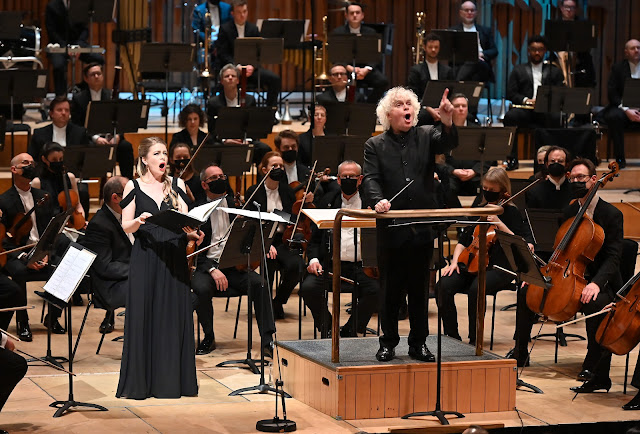
Manfred Honeck’s unfussy musicianship has long offered an antidote to crass media veneration of mediocre ‘star’ performers. Much the same might be said of Pierre-Laurent Aimard, who, although certainly celebrated, could not stand further removed from the likes of… [I had better stop there]. The Philharmonia, on better form than I have heard it for some time, clearly relished the opportunity to perform with both in this Sunday afternoon concert at the Royal Festival Hall, which also went to show there is life yet in the ‘classic’ overture-concerto-symphony programme, whose popularity may have been attained with good reason. 

Weber’s Freischütz Overture announced a reassuringly large orchestra, sounding very much as ‘of old’. Taken in gorgeously relaxed fashion, the introduction unfolded rather than being harried. Not that it lacked the tension and release of incipient drama, whether in dark, threatening intimations of the Wolf’s Glen or elsewhere, later glorying in the gentlest of lyricism and well-nigh Brucknerian power of silence. 

A smaller Philharmonia, strings thinned by several desks, reassembled for Beethoven’s Third Piano Concerto, Aimard at the keyboard. As Donald Tovey observed, the opening movement’s difficulty lies first in the ‘sheer symphonic exposition’ offered by the orchestra; ‘it rouses no expectation of the entry of a solo instrument, and … leaves nothing essential for the pianoforte to add when its time comes.’ Save to the most strenuous musical minds, doubtless counter-productively strenuous, Beethoven saves the day, although a fuller learning of Mozartian lessons, such as we see in very different ways in the Fourth and Fifth Concertos, would have avoided the problem in the first place. Why mention this? Because, perhaps through estimable fidelity to the work in all respects, Honeck and Aimard brought that difficulty to the fore, before settling down to a fine performance. Honeck’s ‘first exposition’ was motivically coherent and imparted a strong sense of goal-orientation; but it was only after the piano’s second attempt, as it were, announcing a true partnership between soloist, conductor, and orchestra, that all fell quite into place, the basic tempo slightly broadening in a reading of mutual responsiveness. Aimard’s way with the piano was, as one might have expected, not to be pigeonholed. Neither old-fashioned, nor ‘period’, doubtless modernist in its way, though without shouting about it, it gave a sense of having considered the music anew, without stinting on spontaneity of the moment. The first movement close provided a case in point, suspense and climax working so well because fully prepared from all. 

That disinclination to be categorised was certainly to be heard, if so inclined, in the slow movement too. Shaped rather than moulded, it was always heading somewhere, yet with plenty of space to enjoy what arose during the journey. Possessed of an ultimately long line, yet with much variegation within, it spoke of a Beethoven once again – is he not always? – in transition, in a noble, deeply felt utterance from piano and orchestra alike. Taken attacca, the finale sounded as a necessary response. Occasional slight gear changes might have been better avoided or integrated, but the crucial thing was a feeling of life, of drama. No ‘designer Beethoven’ here. Fortunately, this was not a performance in keeping with a bizarre programme note attributed to Andrew Mellor, reading at best as if the work of ‘artificial intelligence’ (sic): ‘That realisation [of deafness] had a cataclysmic effect on Beethoven as a person and shot entirely new sentiments and concepts into his music, starting with this piece. … Beethoven got wise to that new reality in this piece.’ It is difficult to know where to start with that, so let us instead end by saying performers and audience, let alone Beethoven, deserved far better. In all other respects, they received just that—other programme notes, by Joanna Wyld and Douglas Shadle, included. 

Dvořák’s ‘New World’ Symphony came up similarly fresh, even if I left not quite convinced that elements were strongly integrated enough to avoid accusations – more justly levelled at work than performance – of the episodic. As might be expected, I felt that above all in the finale, though I should not wish to exaggerate. Otherwise, there was much to enjoy from the large orchestral forces reassembled. The first movement’s introduction proved tender and wistful, speaking of both darkness and light; in essence, it told, as surely it must, of many things. Indeed, that movement as a whole proved full of drama, flexible without meandering, musicians at the top of their game both in solo and tutti work. Antiphonal violins had one ask why anyone would ever have considered placing them together. 

Warm, dignified, excellent playing from all, not only but certainly including Henry Clay’s cor anglais, characterised the slow movement: much implied, no overstatement. Horns, as in the Weber, were simply to die for. String playing would have gladdened any of the great conductors from the past who had led this work, whether with the Philharmonia or other orchestras. The scherzo was urgent, perhaps at times a touch hard-driven, yet certainly giving a proper sense of release and relaxing without meandering. Transition to the trio was intriguingly disorienting, suggesting a more ‘modern’ Dvořák than many of us might be used to, material almost dream-like prior to sharpening of focus. The finale was likewise urgent, though not breathless. Tender strings, characterful woodwind, and implacable brass more or less suspended those nagging formal doubts.


Sunday, 8 September 2024

Musikfest Berlin (4) - Prohaska/MCO/Manacorda - Ives, Kloke, Mahler, and Dvořák, 5 September 2024


Philharmonie

Ives, arr. Eberhard Kloke: Seven Songs from the collection ‘114 Songs’ (world premiere)
Kloke: The Answered Question, op.131 (world premiere)
Mahler, arr. Kloke: Seven Early Songs
Dvořák: Symphony no.9 in E minor, op.95, B.178, ‘From the New World’

Anna Prohaska (soprano)
Mahler Chamber Orchestra
Antonello Manacorda (conductor)


Images copyright: Berliner Festspiele / Fabian Schellhorn

Musikfest Berlin’s focus on the Ives sesquicentenary continued with two commissions from Eberhard Kloke, one an arrangement of seven Ives songs for soprano and chamber orchestra, the other ‘an alternative experimental arrangement’ of Ives’s The Unanswered Question, ‘in which a differently posed question from Ives’s work is answered anew’. Kloke’s compositional activity, long focused on existing music by other composers – as conductor and composer alike, he considers himself above all an ‘interpreter’ – here also took in his arrangements of seven early songs by Mahler, dedicated, like those of Ives, to Anna Prohaska. 

In all three cases, ‘originals’ drifted in and out of consciousness: sometimes straightforwardly present, sometimes changed (whether by arrangement or otherwise), sometimes as underlay, and sometimes as a starting-point for other music by either composer. Ives’s own mysterious piano opening to ‘Thoreau’ prefaced, as in the original song, the spoken voice, ultimately leading to our first hearing of the Mahler Chamber Orchestra’s wind, directed by Antonello Manacorda, melodrama turning into song. Here, as elsewhere, Kloke’s orchestration proved sympathetic for voice and original material, musical and verbal. ‘Élegie’ offered a taste of Ives in French, both composers seemingly responding in kind, Kloke’s use of cello pizzicato almost more harp-like than the also present harp. His chamber writing permitted Prohaska to scale down her voice in singing of great subtlety that could also soar to climax—and did. Sharper-edged sonorities and harmonies in ‘His Exaltation’; a keen sense of the waters in ‘Grantchester’; and a jaunty, unmistakeably Americanism – accent to match, spoken and sung, with and without microphone – in ‘Charlie Rutlage’ were among other highlights, leading us to the closing question, already familiar from the encore to a song recital a few nights earlier: ‘Is life anything like that?’ 

Other questions, actually posed and might-have-beens, emerged in The Answered Question, partly submerged by a barrage of audience coughs. The MCO’s performance drew one in to listen, as did the spatial arrangement: two trumpets above, winds below, a further group (flute, oboe, clarinet, piano) at the back of the latter, as if in limbo. Questioning was questioned, as indeed was that questioning of question, in what came across as a post-transcendentalist refusal to accept easy answers, and accompanying unease as a result. Manacorda’s balancing and reconciliation of the instrumental parts proceeded with an ease belying the difficulty of his task, patient direction amply rewarded.  

For the Sieben frühe Lieder, title echoing Berg and perhaps Berio too, cowbells appeared: a temptation doubtless too difficult to resist. Here, Kloke offered quotation, allusion (thematic and timbral), and perhaps also illusion from Mahler’s Wunderhorn symphonies, already closely related to his song output, to produce a work I should guess extended to about twice the length of the songs alone. As the work progressed, memory, accurate and faulty, increasingly played a role of its own. A ‘Bruder Martin’ introduction to ‘Nicht wiedersehen!’ albeit with celesta and harp alongside double bass (first solo then duo) set the scene, the klezmer music of the First Symphony’s third movement joining later, surfacing in a way not dissimilar to that of the Mahler material in Berio’s Sinfonia. Saxophone was but one of the other instruments to be heard, all beautifully, expertly played by the musicians of the MCO; just as welcome, Prohaska treated the songs throughout as songs, not as would-be arias. The posthorn solo from the Third Symphony unsettled ‘Es ritten drei Reiter’. A purely vocal, folksong-like opening to ‘Ich ging mit Lust durch einen grünen Wald’, elicited a sly instrumental response again evoking the First Symphony. Sleighbells from the Fourth framed ‘Das Mägdlein trat aus dem Fischerhaus’. The idea of resurrection, capitalised and otherwise, helped shape ‘Selbstgefühl’. It made for an unexpected, fascinating journey, and a surprisingly apt bridge between Ives and Dvořák.


Hearing the ‘New World’ Symphony from a chamber orchestra is different; it would be idle to pretend otherwise. In a well-conceived performance such as this, hard-driven at times but with undeniable drama, losses were surprisingly few. There was, moreover, unquestionable advantage in the Abbado-like sense of an orchestra of soloists coming together. Contrasts, as in the first movement introduction, were in some ways greater; nothing was prettified; and there was no doubting the symphonic integrity of the whole, whether as work or performance, a welcome change from an incoherent Mahler Sixth two nights earlier. Manacorda’s single-minded determination made for a concise, not un-Beethovenian experience, the first movement seemingly over almost before it had begun. In the slow movement, that solo and others were magically taken: as if heard for the first time, nothing taken for granted. (An extended cadenza for mobile telephone was less welcome.) Songful, soulful, yet never sentimental, the music spoke more of Bohemian words than an imagined ‘America’, and was all the better for it. Bubbly and boisterous, the scherzo teemed with life and not a little fury. I was less sure about the solo-string transition to the trio, though whether it was a strangeness too far is more a matter of taste than anything else. It had me listen, though. The finale sometimes had me miss a greater complement of strings, but the better course of action was to value what one did hear here, vehement, direct, and gripping. There was heart-rending exhilaration to the second group too, born of the material rather than imposed upon it. The struggle, once more, was unquestionably symphonic.


Tuesday, 6 February 2024

Rusalka, Staatsoper Unter den Linden, 4 February 2024


Rusalka – Christiane Karg
Prince – Pavel Černoch
Foreign Princess – Anna Samuil
Vodník – Mika Kares
Ježibaba – Anna Kissjudit
Gamekeeper – Adam Kutny
Kitchen Boy – Clara Nadeshdin
Nymphs – Regina Koncz, Rebecka Wallroth, Ekaterina Chayka-Rubinstein
Huntsman – Taehan Kim

Director – Kornél Mundruczó
Designs – Monika Pormale
Lighting – Felice Ross
Video – Rūdolfs Baltiņš
Choreography - Candaş Baş
Dramaturgy – Kata Wéber, Christoph Lang

Staatsopernchor Berlin (chorus director: Gerhard Polifka)
Staatskapelle Berlin
Robin Ticciati (conductor)


Images:  Gianmarco Bresadola
Rusalka (Christiane Karg)

Director Kornél Mundruczó comes like a breath of fresh air to unsettle our conceptions of Dvořák’s penultimate and, by some way, greatest opera and thus to do precisely what the material demands; or rather, it comes as something bitterly stale, menacing, even poisonous to accomplish what fresh air on its own might not be able. It is certainly refreshing, though it should not be, to have a production that takes class seriously as a form of social distinction, a social barrier, though ultimately it will go beyond that, re-engaging with the opera in all its strange tragedy and tragic strangeness. By grounding itself in the here and now, but also a here and now our society largely wishes to ignore, it challenges, but it challenges further and with brilliant theatricality by the course subsequently taken. 

Rusalka – not strictly her ‘name’, but it is all we have, and ‘the rusalka’ or even ‘the sprite’ would seem unduly pedantic – lives in a shared, ground-floor Berlin apartment, a WG or Wohngemeinschaft, her flatmates the other three nymphs and Vodník (if you prefer, the Watergoblin). She does not fit in with, or has grown distant from, her female flatmates at least; they are so much more laid back, fun-loving, quite happy in their less-than-ideal home of disrepair. Theirs is a working class, it seems, the bourgeoisie simply cannot stomach, however much it might claim to act in its name. But nor, any more, can Rusalka, at least since she has seen signs of the life – above all, the Prince – upstairs. In his modern penthouse with balcony and views across the city including, yet far from restricted to the Fernsehturm and the Rotes Rathaus, he and his appallingly grotesque group of friends, the Foreign Princess (his ex-) included, have ‘made it’. They know each other inside and out, as it were; they probably even vote Green. 

Rusalka, Prince (Pavel Černoch), Gamekeeper (Adam Kutny),
Kitchen Boy (Clara Nadeshdin), and Ensemble

One can see why she would like to escape to that other world, embodied in an attractive, trendily dressed mysterious (to her, though not to us) stranger. For one thing, other than the drugs that may or may not be Ježibaba’s stock-in-trade (what is that fascinatingly beyond-good-and-evil or just-plain-evil neighbour doing?) she is hardly spoilt for choice in alternative paths. Needless to say, an actually existing working-class young woman is the most shocking sight of all to the Prince’s friends and they work immediately to exclude her, the Foreign Princess going all out to rekindle those embers until the culpably weak yet more sympathetic Prince succumbs. No wonder the two sides cannot communicate, at least not until it is too late. For it is important to recognise that Rusalka fits in on neither side of this social divide. She only discovers – and this is entirely faithful to the work – where she might have done far too late. There is, again as in the work, a sort of tragic communion in that the Prince realises too late; he can only do what is right (for him, as much as ethically) by surrendering his life, which, movingly he does. 

In a programme interview, Mundruczó says he kept thinking of Kafka when working on the opera: doubtless a surprising reference for some of us, the Prague connection, albeit intergenerational, notwithstanding. But that may be to fall for outdated ‘national’ histories of music. Why not, after all? It certainly comes into his own in the third act here, where the action transfers less to a house than a cellar of horrors. Having returned to Ježibaba, been scorned and perhaps even poisoned, Rusalka leaves behind the world of social realism in which we imagined we should remain until the end and morphs into an impossible creature, part human, part goodness knows what, although it is perhaps not coincidental that its black suggests the colour of refuse and its disposal. One can and perhaps should read that in social and environmental ways; after all, what could be more of a social issue, what could hit the working class harder, than the destruction of the planet? But the aesthetic is actually quite different; one can read it for ‘meaning’ in that way, but the vision seems to lie beyond that: something spellbinding, from which one wishes to avert one’s eyes in horror at the agony Rusalka is experiencing, yet cannot. It is more filmic than theatrically Gothic, I think, but that choice seems a deliberate decision, again, judging from the interview, to attempt to reach younger audiences with different frames of reference. Whatever one might think of that – I am not sure I am the target audience here – for me it works. It truly unsettles and actually leads us to reconsider clashes between ‘natural’ and ‘human’, or ‘natural’ and ‘supernatural’ worlds very much as the work does—yet which can become lost if the setting is too folk-like. A sort of deformed, already-dead tree-in-plastic has grown, suffocating and perhaps literally trashing all that approach it.


Rusalka, Prince, Third Nymph (Ekaterina Chayka-Rubinstein)

Fairy tales, told properly, are dark, even sick, not through a sort of tired, bourgeois exhibitionism – that might be better left upstairs in the deceased Prince’s apartment – but because they tell of dreams, fantasies, delights, and horrors. They are not of the sanitised, commercial world of Disney, but come from a place of sex, violence, and more. The mirror they hold up is truthful because it is distorted, not despite that distortion. This production recognises such twisted truths and turns them into a drama at least implicit in Dvořák’s –and Jaroslav Kvapil’s – work and world. It may predate Freud and Kafka, but it is not without connections and even presentiments. I have nothing at all against a production presenting a single-minded view of a work, incorporating more current concerns, and so on. The work, whatever it may be, will survive. But a particular point of interest here is that the director does not impose a framework, even a related conceptual framework, on the work, but rather presents such a related framework as a way in to experience or re-experience the very strangeness of the work ‘itself’. 

For Dvořák progresses in this score too; even in so late a work as this, written after (!) Pelléas et Mélisande, he does not rest on his laurels. If those laurels are too folk-like for some early on – their loss, but there is no accounting for taste – then they surely will not be by the third act. For me, conductor Robin Ticciati and the superlative Staatskapelle Berlin came truly into their own in this act, opening up a range of post-Wagnerian language and emotion, not just or even principally emotion, extending beyond what I have heard from Ticciati previously (save, perhaps, at Glyndebourne for the dramaturgically unfortunate Ethel Smyth opera, The Wreckers). Not that there was anything wrong with what he did earlier. I initially found it a bit hard-driven, but came to realise that this was probably as much a reading developed in tandem with the production as a conception ‘in itself’ of the score. Lack of what might be thought of as sentimentality – not necessarily so, but that is arguably another matter – was the point. It was not cold, but nor was it a kitsch (or readable as such) tale of forest life. 


Rusalka, Ježibaba (Anna Kissjudit)


The same might be said of performances from an excellent cast, only more so, for there was some singing of ravishing warmth—but not only of that. Making her role debut, Christiane Karg not only traced the journey(s) proposed by composer, librettist, conductor, director, and more; she was instrumental in creating them. Occasionally during the first act, I wondered whether she might be a little under-powered, and perhaps there were a few first-night nerves there, but this was more, I think, a matter of wise marshalling of resources and dramatic trajectory. In many ways, I liked the way the Song to the Moon did not become a stand-alone aria and indeed related strongly to the music surrounding it, but I can well imagine some not having done so. Whatever one’s position on that – mostly a matter of personal preference – this Rusalka grew in stature through shocking experience, a tragic heroine to remember for the denouement. 

There was tremendous acting on her part too. Pavel Černoch’s Prince was similarly, if differently, involving. Despite it all, and partly on account of twin vocal intelligence and beauty, one could not help but like him, and again shared his ultimate tragedy at the close. Mika Kares’s Vodník also grew as his character – and the truth that character told – increasingly gained our sympathy. Anna Samuil offered glamour and refulgence – just the thing – for the Foreign Princess. Anna Kissjudit’s already horrible Ježibaba became all the more splendidly, horrifyingly so on her return, just as the production demanded, without sacrifice to more ‘traditional’ vocal values. Smaller roles and choral parts were all well taken, all contributing to a greater musicodramatic whole. 

As for the audience member who not only booed the end of the first act, but through his failure to stop – I am trying to be polite – seemed determine to prevent the second from beginning, what part of that whole troubled him so much? And why?

Monday, 16 October 2023

BPO/Hrůša - Dvořák, 13 October 2023


Philharmonie

Dvořák: Stabat Mater, op.58

Corinne Winters (soprano)
Marvic Monreal (mezzo-soprano)
David Butt Philip (tenor)
Matthew Rose (bass)

Rundfunkchor Berlin (chorus director: Gijs Leenaars)
Berlin Philharmonic Orchestra
Jakub Hrůša (conductor)

 
© Bettina Stöß / Berliner Philharmoniker

Dvořák’s Stabat Mater is clearly a favourite work for Jakub Hrůša. Six years ago he conducted it in this same hall, Berlin’s Philharmonie, with the Berlin Radio Symphony Orchestra; in 2023, it was the turn of the Berlin Philharmonic. Hrůša has called the piece a ‘wonderful gift’; he, a fine team of soloists, chorus, and orchestra in turn offered a wonderful gift to the audience with this performance. If the work, like many others, is not without unevenness, much of it has the composer firing on all cylinders. At a time when, even by current standards, our world is overwhelmed with grief, it will surely have spoken clearly and directly to many. It certainly did so to me. 

A first movement of quite extraordinary power did so from the outset. Hrůša and the orchestra offered a translucent introduction, elemental without Brucknerising, chromatic descending sequences grief-laden without sentimentality, leading somehow almost magically towards the entry of the chorus, which both emerged from and intensified such feelings, as clear of line as it was full of tone. I cannot imagine the climaxes have ever sounded more shattering. David Butt Philip’s tenor entry similarly grew out of an extended what had gone before. If somewhat operatic, that is the nature of the piece; it became more so with impassioned singing from the full quartet. Hrůša’s formal command was unerring, a crucial matter in a work of this scale. The vocal quartet that followed was naturally more intimate in scale, though no less heartfelt. Splendidly declamatory singing from Corinne Winters had her come into her own, with Matthew Rose an excellent foil, Fasolt-like in sincerity, though building later to quite a fury. 

 ‘Eja mater, fons amoris’ quite properly offered moments where the mood lightened, not least through sheer delightfulness of orchestral playing, though the chorus’s repeated cries of ‘Fac’ were anything but light. There was some much needed choral and woodwind balm in ‘Fac, ut ardeat cor meum’, where it was lovely to hear the organ in softer passages too. But even that came in the shadow of imposing, implacable brass. Harmoniemusik in the following chorus, ‘Tui nati vulnerati’, set the scene for as close as we were come to gambolling lyricism, in Bohemian Brahms fashion, with shades of the darker, mahogany Brahms to come in the opening of the ‘Fac me vere tecum flere’. Butt Philip’s imploring reading and the choral singing shone equally. 

A venerable mainstay of musical crucifixion iconography, sharpened notes made their point in both chorus and orchestra in ‘Virgo virginum praeclara’. One certainly did not need to know or see; piercing could be heard and felt. Likewise in the throbbing pizzicato playing from lower strings, contrasting in almost sadomasochistic fashion with ravishing bowed violins and woodwind, of the duet ‘Fac, ut portem Christi mortem’. Butt Philip and Winters blended and contrasted well as required. In the penultimate number, the only truly solo (without chorus) movement, mezzo-soprano Marvic Monreal offered characterful contrast, especially in her lower range. 

The final movement’s uneasy calm from soloists and orchestra paved the way for some truly radiant choral singing when reprising the opening material. Its ‘Amen’ still seems to me a little unsatisfactory as a conclusion to a setting of this poem; Dvořák’s more typically personal style sits a little awkwardly with its import. Ironically, if Rossini in his Stabat Mater at times adopted a jaunty, well-nigh postmodern dissociation from the poem, his writing here seems to me more congruent. There was no gainsaying the performance’s all-round excellence, though, and there are many worse things than being oneself—whether for Dvořák, Rossini, Schubert, or anyone else.


Wednesday, 1 March 2023

Rusalka, Royal Opera, 27 February 2023


Royal Opera House

Rusalka – Asmik Grigorian
Prince – David Butt Philip
Vodník – Rafał Siwek
Ježibaba – Sarah Connolly
Duchess – Emma Bell
Kuchtík – Hongni Wu
Hajný – Ross Ramgobin
Wood Spirits – Vuvu Mpofu, Gabrielė Kupšytė, Anne Marie Stanley
Lovec – Josef Jeongmeen Ahn

Ann Yee and Natalie Abrahami (directors)
Chloe Lamford (set designs)
Annemarie Woods (costumes)
Paule Constable (lighting)
Ann Yee (choreography)

Royal Opera Chorus (chorus director: William Spaulding)
Orchestra of the Royal Opera House
Semyon Bychkov (conductor)


Images: Camilla Greenwell

A strange evening: I very much enjoyed this new Rusalka, though found myself slightly haunted by the suspicion I did so more than I should have done. Musically magnificent yet theatrically inert: opera should intrinsically be more than that, yet I suppose we should be grateful that it can still partly satisfy, even when one crucial component misfires. 

The production is oddly listed as having been ‘created by Natalie Abrahami and Ann Yee’ but with ‘Ann Yee and Natalie Abrahami’ as directors. Equitable, perhaps, but does such re-listing really merit a line in the programme? (Does it really merit three lines in a review, one might also ask, I suppose.) I mention it only as a minor instance of something more irritating. Equity, sustainability, so much else: these are of course causes toward which we should all be working, a great deal faster and harder than we are now. They do not, however, in themselves make a production; they are certainly no substitute for one either. For here, whilst one could read an interesting programme note, promising much, by Jessica Duchen on ‘A Sustainable Rusalka for the Royal Opera House’, the results were actually neither sustainable – for that, ‘wed have to have started the control systems much earlier’ (Abrahami) – nor, contra what we read, saying anything much about sustainability or wider ecological issues. Instead, there was a strange boast, admittedly fulfilled, of having ‘worked with our creative team to create the illusion of water, using paint effects and lighting, and a set that can hold this without having to turn over actual water’. Fine, if hardly unprecedented. Is that not more often the case than not with water? How many productions will theatregoers already have seen that did just that?

Ultimately, the directors (or ‘creators’) feel the story is ‘not about nature’s conflict with humanity, but rather humanity’s need to connect and meld with nature’. It is a point of view: not one that makes a great deal of sense to me, either intrinsically or in the case of Rusalka, but worth a hearing or viewing. What, then, do we have? A sort of non-directed cartoon with words and music attached. Singers generally have to fend (creditably) for themselves. A mossy fairytale without irony or magic turns mildly trashy in the second act, presumably out of a desire to be ‘contemporary’. It looks as though a few items from Claire’s Accessories have been magnified on stage to frame the ‘party’. Inflatable toy animals are presumably intended to imply distance from Nature’s real animals, yet since no one seems to know what is going on, they just look silly. We return more or less to a slightly broken version of the setting for the first act. Alleged intentions go unrealised, as if our ‘creators’ have failed to appreciate that stating you will do, let alone explore, something is not the same as doing or exploring it. As a framework for the story, it works reasonably. Paule Constable’s lighting pretty much steals the visual show, saying so much more than Yee’s tedious, seemingly tone-deaf choreography.

And save, mercifully, for the musical performances: singers, orchestra, and conductor. My two other big house Rusalki over the past decade or so have been Paris in 2019, not so long before the end of the world, and Covent Garden’s first (!) staged performance in 2012. An excellent Komische Oper staging in Berlin was a slightly different animal, built as it was around a thriving company, as opposed to an ‘international’ cast; it offered by some way the most interesting, penetrating production (Barrie Kosky). Paris had Camilla Nylund, Klaus Florian Vogt, Karita Mattila, Thomas Johannes Mayer, and Michelle DeYoung, Covent Garden 2012 also had Camilla Nylund, working with Bryan Hymel, Petra Lang, Alan Held, and Agnes Zwierko. At this level, comparisons are often more a matter of taste than anything else, but I should unhesitatingly plump for David Butt Philip’s Prince from Covent Garden 2023 and consider its cast every inch the equal of its illustrious predecessors. 


One of my first thoughts was that surely we must be due a Lohengrin from Butt Philip soon; lo and behold, on later reading the programme biographies, one (Deutsche Oper Berlin) is forthcoming. Beautifully, unerringly musically phrased, his Prince conveyed a vulnerability and complexity of character considerably beyond either of the aforementioned performances. This was a considered character development, conveyed through words and music. Asmik Grigorian’s Rusalka likewise had it all: effortlessly scaling the vocal peaks, drawing in through hushed intimacy, and offering almost everything in between. Her stage presence likewise was second to none. Sarah Connolly’s Ježibaba and Emma Bell’s Duchess – I am not sure why the usual ‘Foreign Princess’ was not used here, but no matter – represented luxury casting. The former’s expressive range, controlled in technique yet with dramatic spontaneity (or the impression of such), could hardly have been bettered. The latter’s star quality shone through: both in itself and as something akin to metacommentary on the role. Rafał Siwek’s dark-toned Vodník was just the thing too, in voice and presence. Lively and warmly sympathetic performances from Hongni Wu (Kuchtík) and Ross Ramgobin (Hajný) were also highly worthy of note.

 Excellent conducting from Susanna Mälkki (Paris) and Yannick Nézet-Seguin (Covent Garden, 2012) notwithstanding, Semyon Bychkov was for me in a different league. His was world-class conducting, the Orchestra of the Royal Opera House sounding the equal of its very starriest peers. One might expect operatic symphonism from Bychkov, but the extent to which the entire work sounded as if heard in a single, variegated breath nonetheless astonished. A symphony in three movements emerged, its first two acts strongly contrasted. The first was doubtless ‘objectively’ on the slow side, but emerged as an exquisitely conceived, quasi-Wagnerian tapestry in absolute commanded of our musical attention. The second entered more Italianate waters, enlivened by a welcome dash or two of Tchaikovsky, and the third effected due synthesis, culminating in a climax that can surely have never sounded closer to the pantheistic ecstasy of Janáček. Not, of course, that this was not first and foremost Dvořák, but it was a generous, cultivated and culturally broad performance that denied national, let alone nationalistic, clichés. 

Mention should also go to the language coaches, Lada Valesova and Lucie Spickova. I do not speak or understand Czech, save for odd words and phrases I have picked up. But I could have had a stab at transcribing some of it here, such were the clarity of diction and, insofar as I could tell, evident meaning with which words in their alchemic union with music were treated. All in all, then, a splendid evening—yet despite, rather than on account of, the inconsequential production.

Thursday, 24 November 2022

Andsnes - Vustin, Janáček, Silvestrov, Beethoven, and Dvořak, 21 November 2022


Wigmore Hall

Aleksandr Vustin: Lamento
Janáček: Piano Sonata 1.X.1905, ‘From the Street’
Valentin Silvestrov: Bagatelle, op.1 no.3
Beethoven: Piano Sonata no.31 in A-flat major, op.110
Dvořák: Poetic Tone Pictures, op.85

Leif Ove Andsnes (piano)

Leif Ove Andsnes’s performances are always very well worth hearing; this programme, mixing the familiar and unfamiliar was no exception. The first half offered short pieces by Russian and Ukrainian composers, either side of Janáček’s tribute to František Pavlík, a worker killed demonstrating for a Czech university in Brno, followed by Beethoven’s penultimate sonata: however one considers it, and however clichéd this may sound, a sublime song from and to the human spirit and what it might yet achieve. 

Aleksandr Vustin, invited by Andsnes in 2019 to his Rosendal Chamber Festival, in what was only Vustin’s second journey outside Russia, died the following year, an early victim of the coronavirus pandemic. His Lamento, itself inspired by the funeral of a friend and its sounds, is tonal, yet moves in often surprising ways. Opening two-part left-hand writing soon has a right-hand melody soar above—a recollection, I learned later, of a bird that began to sing at the funeral and would not stop. It made for an interesting prelude to Janáček’s Sonata 1.X.1905, ‘From the Street’, its first movement in Andsnes’s performance both precise and suggestive: like work and composer, one might say. Proudly turbulent in its post-Romanticism, passages of its music seemed almost to acquire proto-filmic character, perhaps in slow motion, in remembrance. The composer’s profound national pride sang forth still more directly in the second movement, the stubbornness of his writing, not least in sheer persistence of figures, transmuted once more into a declaration of spirit, made with a fine sense of musical drama.

One of Valentin Silvestrov’s Bagatelles offered cool contrast, behaving (at least I fancied) not entirely unlike Vustin’s piece. The quiet dignity of Andsnes’s performance again made for an interesting prelude to a sonata, this time Beethoven’s in A-flat major, op.110. Its first movement sang with a simplicity both fragile and strong. Welcome, one might say, to late Beethoven. Fractures were often only implied; this was not the most modernist of accounts, nor was there any reason it should be. Yet implied they were. The turn to the minor was communicated with ineffable sadness, yet never mawkishness. Again, this was Beethoven. The scherzo’s gruff humour did not attempt to conceal the difficulties of the trio. The overriding impression was of shocking concision. Mournful dignity characterised Beethoven’s ‘Klagender Gesang’ in the finale, the fugue first offering release and intensification, its voicing to die for: beautiful, no doubt, yet above all truthful. Contrast and complement of material registered and developed throughout, the inverted fugue enabling yet in no sense guaranteeing ultimate triumph. There was, rightly, no easy path.

The second half was given to Dvořák’s Poetic Tone Pictures, op.85: new, I confess to me, and quite a discovery. Andsnes had explored them during lockdown, welcoming the discovery of ‘life-affirming music of the greatest invention and imagination’. Dvořák can occasionally pale alongside Janáček, but not here. This work emerged as a Schumannesque collection, played with affection, characterisation, and acute understanding. Indeed, the scene-setting of its first piece, ‘Night journey’ immediately brought Schumann to mind: not that it sounded ‘like’ Schumann, but in terms of the role it played in introduction, and its vein of fantasy. Andsnes’s communication of the charm and Romantic snares of this night was finely judged indeed. A wonderful procession of characters, scenes, sketches in a strong sense ensued: not unlike a good novel, or perhaps better, a collection of short stories. ‘At the old castle’ haunted. A vigorous ‘Furiant’ put Andsnes’s fingers duly through their paces. Dances of all kinds, goblins and all, invited us in—not always without danger. Exuberance and introspection informed one another across more elevated canvases and earthier songs. Andsnes’s cantabile in the ‘Serenade’ was just the thing, as was his Lisztian grandiloquence in ‘At a hero’s grave’. Fascinating—and nourishing.

Tuesday, 11 January 2022

LSO/Rattle - Anderson, Mahler, Rott, Webern, and Dvořák, 9 January 2022


Barbican Hall

Julian Anderson: Suite from Exiles
Mahler: ‘Blumine’ movement for Symphony no.1 in D major
Hans Rott: Symphony in E major: Scherzo
Webern: Six Orchestral Pieces, op.6
Dvořák: Symphony no.7 in D minor, op.70

Siobhan Stagg (soprano)
London Symphony Chorus (chorus director: Simon Halsey)
London Symphony Orchestra
Simon Rattle (conductor)


Images: Mark Allan


Two or three weeks ago, it did not seem especially likely this concert would happen. It did—and very well it went too. To hear as large an orchestra as that fielded by the LSO here under Simon Rattle remains unusual during our current troubles. We now perhaps ascribe greater worth to every artistic and social occasion, all too well aware of general precarity. I certainly relished the sheer richness of orchestral sound, the unquestionable commitment from all on stage and (London Symphony Chorus) up in the balcony, and something close to a full house for an appreciative audience.

It seems that Julian Anderson’s Exiles has, one way or another, been a victim of the dread virus. Two of its five movements were given by the LSO and Rattle in September; here they were joined by ‘La République des Lettres’ for soprano and a cappella chorus, then impossible to perform. When the final two will come is unclear, yet on the basis of this ‘Suite’ and its reception, they will be eagerly awaited by many. The new movement—to the world, that is; all were new to me—pays tribute to the American diplomat Varian Fry who assisted many under threat from Nazism into exile. Here, several of them are named, from Bohislav Martinů via Darius and Madeleine Milhaud and Betsy Jolas to the Hungarian animal photographer Ylla (Camilla Koffler). That was the work of half the chorus, initially syllabic, though not in a ‘difficult’, Nono- or Lachenmann-like way. The other sang from Psalm 46: ‘God is our hope and strength: a very present help in trouble…’. Dialogue between soprano Siobhan Stagg and choir added to the responsorial sense. If the writing were largely homophonic, there was a splendid, again psalm-like freedom to its metre, Rattle finely shaping an heroic performance from all.

First we had heard ‘le 3 mai’, Anderson’s setting of an e-mail from the Moroccan-French composer Ahmed Essyad to other composers from 3 May 2020, telling of his coronavirus isolation and nonetheless greeting them: ‘internal’ exile. The soprano I head first, followed by orchestral sounds that to me evoked a sense of electronic communication—latterly both bane and saviour of our lives. Anderson’s orchestration here and later proved typically ‘French’ in sonority, bells perhaps evoking an inheritance from Messiaen as well as Debussy and Ravel. The darker turn taken upon ‘Je vous embrasse tous,’ leading to climax at the end of the same line of the text, ‘sans covid’, repeated, would doubtless have moved irrespective of the words set; however, we heard it with them, and could hardly fail to think ‘if only’. The sign off ‘Ahmed’ returned us to the exile of electronic communication. 

‘Tsyion’, heard last, sets for chorus words from Psalm 137, the Jews in Babylonian exile, by those famous waters, and from Horatiu Rădalescu on that archetypal exile Ulysses, whilst the soprano sang other words above, from Rădalescu on ‘Exile’ itself. Stagg’s exultant melismata again provoked memories of Messiaen, but Anderson’s music throughout offered a compelling harmonic language and, more broadly, combination of that with melody, rhythm, and timbre never to be reduced to mere ‘influence’ or parallels. Solo horn at one point seemed to encapsulate the wistfulness of exile; there was more to it than that, though. Anderson’s fantastical imagination suggested to me opportunity and, at the close, through a mass of solo violins, a secularised chorus of birds. There is hope out there, as Essyad realised in contemplating a mountain he could not yet visit.

Next up was the discarded ‘Blumine’ movement from Mahler’s First Symphony. There could be no doubting the composer via sentiment or language, nor the specific identity of the Mahler of that symphony, though in many ways it sounded, quite rightly, earlier still: late Romantic rather than modernist, even ‘late early Romantic, Mendelssohn as well as Wagner apparent, Mahler taking his leave from the world of Das klagende Lied. Rattle had Mahler’s song sung with simplicity, never audibly moulded as has seemed the case with much of his more recent Mahler. There was darkness, but only moments of darkness in a fine, unexaggerated performance. And what it was to hear both the excellent solo trumpet and a full LSO at the movement’s climax. This was truly affecting music-making, all the way to a magical final harp chord.


The scherzo from the E major symphony of Mahler’s friend Hans Rott received here an outstanding, spacious, altogether generous performance, whetting the appetite for what one must hope will one day be a performance of the whole work. One need not be starry-eyed about it, as some are, to recognise its music, anticipations of Mahler and all (any ass can see that…) as intrinsically worthy of listening. The LSO’s sound hovered, like Rott’s music, somewhere between Bruckner and Mahler, with a little Berlioz at times too, not least in its trippiness. A sort of deranged jollity with disquieting echoes fascinates; and if sureness of direction is not altogether Rott’s thing, his music’s sheer originality offered something quite compelling both as work and performance. 

With Webern’s op.6 Orchestral Pieces we are in different territory: one of the supreme masterpieces of twentieth-century orchestral music. Rattle and the LSO offered them as the repertoire pieces they demand to be: without apology and through intimate knowledge and understanding. Free choice might not lead one naturally to the 1928 revision, but its smaller forces doubtless enabled the work to be performed at all. Heard after that first half of Anderson, Mahler, and Rott, the first movement’s lyricism emerged all the lovelier and more longing. Rattle ensured here and throughout a balance that invited comparison with conductors such as Abbado and Boulez. In this narrative, crucially, every note counted for a multitude in so much other music. The second movement’s response sounded as inevitable as I can recall, in a vision less haunted than propelled by anger, fear, violence, and yes, wonder. Longing was intensified in the third piece, here sounding intriguingly close to Berg. The German Sehnsucht came to mind. Ominous tread and progress through the funeral march fourth encapsulated a Mahlerian world in itself. Music lay between the notes as well as in them, in a requiem of defiant hope whose roaring climax duly shattered. Heard in aftershock, the fifth seemed to say, stealing from the future of Webern’s teacher Schoenberg’s Piano Concerto, that life must go on. It witnessed yet sparkled. And what expressive depth we heard in the closing ‘Langsam’ movement, each chord speaking as if it were a page or two at least of Mahler.


It is doubtless too easy to speak of performing Dvořák via Webern, but it was difficult, at least at times, not to hear it that way. An aural lens of motivic concision and well-nigh Schubertian melodic profusion did no harm at all to its opening ‘Allegro maestoso’. I was fascinated to hear the LSO strings sound more ‘old German’, akin to Daniel Barenboim’s Staatskapelle Berlin, than I ever heard the Berlin Philharmonic under Rattle. It worked, in any case, as the LSO really dug into Dvořák’s score. A purposeful yet flexible account of this first movement was far from deaf to the beauties and meaning of detail, yet integrated them rather than having them stand out. Here, again, music lay between as well as in the notes. The slow movement was taken slowly, surely more than the ‘poco’ of the composer’s ‘Adagio’ marking; a somewhat Tchaikovskian performance nevertheless worked well on its own terms. Rattle loved it doubtless, but not, I think, too much. There were rhetorical underlinings, yet they worked to shape a musical drama. The scherzo flowed via, rather than despite, its engineered tensions, metrical and more. Its trio was, I felt, moulded a little too much. Likewise the finale: impassioned, yes, but not always clear where it was going. That said, Rattle’s conception of something akin to an enigmatic tone poem in its own right had much to be said for it. His remains a questing musical imagination, as seen in programming and heard in performance.


Tuesday, 10 August 2021

BBC Proms (3) - BBC NOW/Bancroft - Thomas, Ives, and Dvořák, 8 August 2021

Royal Albert Hall

Augusta Read Thomas: Dance Foldings (world premiere)
Ives: Orchestral Set no.1: Three Places in New England
Dvořák: Symphony no.9 in E minor, op.95, ‘From the New World’


BBC National Orchestra of Wales
Ryan Bancroft (conductor)


A
n excellent American-themed concert from the BBC National Orchestra of Wales and its Californian Principal Conductor, Ryan Bancroft. It began, as is right, with a new work: Augusta Read Thomas’s Dance Foldings. For the 150th anniversary of the Royal Albert Hall, founded to promote the arts and sciences alike, the BBC has commissioned four new works to reflect the arts and sciences in our world. Dance Foldings is the first, Thomas taking as the starting point for her material ‘the metaphors, pairings, counterpoints, foldings, forms and images inspired by the biological “ballet” of proteins as they are being assembled and folded in or bodies’. As she observes, the animations one can view online of proteins folding can resemble assembly lines or ballets, both types strongly suggesting ‘musical possibilities’. The sense of ballet music, even without dancers, was strong from the opening: hard-edged, sharply rhythmic, ‘alive-from-the-inside’. The orchestra, including piano, suggested a post-Agon world, perhaps even some commonality with Henze, though it was Stravinsky who more frequently came to mind. There were rhythmic, melodic cells, but there was also, increasingly, mirroring, chain-like progression, and transformation, leading us through a musical maze that suggested something both spontaneous and yet, once done, set in stone (or, perhaps, an amino acid chain). Urgent, unquestionably forward-looking, and highly colourful, t were a work and performance both raucous and controlled, as if evoking a life-force more scientific than often one encounters in the concert hall.


Charles Ives’s First Orchestral Set, Three Places in New England, followed, an all too rare opportunity to hear Ives’s orchestral music in the concert hall. I would not say the misty opening of ‘“The St Gaudens” in Boston Common’ sounded more ‘modern’, but rather differently modern, its known/found melodies notwithstanding. In highly atmospheric, expertly shaped performance, it sounded like music of the clouds and/or music emerging from the clouds. Ligeti was not far beyond—or should that be behind? At any rate, Ives’s pioneering spirit was unquestionably, poetically present. ‘Putnam’s Camp’ was admirably clear, the riot of tunes heard against each other and gaining from that experience without losing their own identity. There was a fine sense of what I thought of as the programmatically spatial: this was music in some sense ‘about’ space, temporal space included, irrespective of the space in which it was performed, or at least not confined by that latter space. Still more mysterious at its heart, the movement seemed to explore the age-old dramatic dichotomy of private and public, as well as old and new, in ways that never ceased to surprise and to enliven. Enigmatic, liminal, ‘The Housatonic at Stockbridge’ proved in its breadth as complex as its predecessor—so long as one listened. There was something ineffably human at its base or its far-away, aurally glimpsed hymn-book source, but there were no easy questions, let alone answers.

The New World Symphony opened similarly broadly, as if in keeping with social distancing on stage, yet with no lack of tension. Bancroft’s principal tempo for the ‘Allegro molto’ was, if anything, on the swift side, but not unreasonably so. He was flexible too, permitting keen woodwind plenty of opportunity to sing. There were some strikingly Wagnerian moments to this first movement: harmonically, but also in the way the cellos ‘spoke’. Grave brass and soft strings prepared the way for that melody in the ‘Largo’. It moved, without being harried; in short, again it sang. As did much else: not in one voice, but in many, more than the sum of their parts, not entirely unlike Ives’s music. Bancroft shaped the movement unobtrusively, comprehendingly, another nice touch being the nod to Mendelssohnian processional (the second movement of the Italian Symphony, as in the First Night’s Sibelius Second). Indeed, there was a strong sense of narrative: not necessarily programmatic, but not necessarily not either. A properly urgent scherzo, to which harmony was as crucial as rhythm (or melody) gave way, through somewhat disorienting transition, to a polished, lyrical, rhythmic trio. As for the finale, this may sound facile—perhaps it is—but it combined and culminated. Lyricism was just as crucial here as elsewhere. What a tremendous symphony this is, in quite a different league from any other by Dvořak; and so it sounded here.


Thursday, 1 July 2021

Waterloo Festival (5) – Isserlis, Haywood, Bruch, Strauss, Dvořák, and Le Beau, 24 June 2021

St John’s, Waterloo

Bruch: Kol Nidrei, op.47
Strauss: Cello Sonata in F major, op.6 (London premiere of first version)
Dvořák, arr. Isserlis: Four Romantic Pieces, op.75
Luise Adolpha Le Beau: Cello Sonata in D major, op.17

Steven Isserlis (cello)
Sam Haywood (piano)


Image: Matthew Johnson


All good things must come to an end, or at least from time to time a pause. Let us hope that this, the last in the Spotlight Chamber Concert series, now also part of the Waterloo Festival, is only au revoir. Anthony Friend’s achievement in attracting such an array of musicians, to give such excellent performances at the darkest of times, merits our deepest gratitude; it certainly has mine. This long-delayed concert from Steven Isserlis, now with pianist Sam Haywood, made for a splendid finale—at least for now.


First up was Max Bruch’s Kol Nidrei, treated to a performance of High Romantic expressivity, balanced with great dignity, Haywood’s sensitivity as accompanist crucial here. Bruch’s piece is very different, of course, from Schoenberg’s Kol nidre for speaker, chorus, and orchestra. Schoenberg wrote to Paul Dessau that ‘one of my principal tasks’ had been to ‘vitriolize away the cello-sentimentality of the Bruchs etc., lending this decree the dignity of a law, of an “edict”.’ Whatever one thinks of that, one probably knows what he meant. Dignity takes many forms, however, as does sentimentality. It would have taken a harder heart than mine not to admire and enjoy so committed and freely romantic a performance. The way the music subsided just as dusk outside began to fall offered magic in itself.


Strauss and Schoenberg had a fraught relationship over the years. Schoenberg could not possibly, however, have known the first, 1881 version of Strauss’s Cello Sonata, since it only became available last year, Strauss’s music having passed out of copyright. (The same fate or opportunity awaits Schoenberg’s music next year.) Isserlis and Haywood gave the London premiere with a conviction that suggested a repertoire piece—which, even when one considers the first movement, in which relatively little changed, is perhaps something of an exaggeration for Strauss’s revision, let alone this. Both musicians were clearly inside the music, the pianist in particular, unsurprisingly, given quite a work-out. Strauss’s talent, at only seventeen years old, at writing for any instrument was heard both in his cello writing and in its combination with piano. There is little, even no, sign of the ‘real’ Richard Strauss, but it is an enjoyable, incredibly competent piece. The first movement was shaped as if it were Brahms, underlining an astonishing, Mendelssohn-like security of harmony and form. Its successor, an Andante entirely absent from the more familiar version of the work, received a rapt reading that did not obscure but rather enhanced its essential simplicity. The third movement, again replaced in its entirety in the second version, was likewise imbued with all the freshness of discovery and all the apparent familiarity of repertory. Mendelssohn again came to mind. It sang beautifully, if not remotely like the Strauss of maturity. There were some splendidly deadpan surprises too.


Dvořák, arranged by Isserlis, was next. One might never have guessed the Four Romantic Pieces were not originally written for cello and piano such was the success of arrangement and performance, clarifying textures that might conceivably have proved awkward. A delectable, songful performance of the first had genuine simplicity, albeit one that concealed much craft beneath the surface. The second was given in passionate contrast, founded on fine command of detail and articulation, leading aptly enough to a third that seemed to combine many of the virtues of both. Melancholy nobility, moving me considerably, proved the hallmark of the fourth.


Finally, a curiosity: the D major Sonata of Luise Adolpha Le Beau, written, albeit three years earlier and emerging victorious, for the same competition Strauss’s failed to win. The first movement’s opening proved, like Strauss’s, highly accomplished and, in performance, rich in tone. Where it travelled thereafter seemed more arbitrary. It nonetheless benefited from great care and evident belief. This big-hearted performance more or less melted my sceptical heart. A sad, yet warm and dignified slow movement, and pleasant enough finale likewise benefited from committed performance. I could not help but think the latter went on a bit, but did not mind in the slightest. The encore, Cécile Chaminade’s Sommeil d’un enfant was very much what one would expect: pleasant and well-crafted in its salon way.

Wednesday, 26 June 2019

Vadim Repin and friends: Brahms and Dvořák, 23 June 2019


Mozart-Saal, Konzerthaus, Vienna

Brahms: Piano Quintet in F minor, op.34
Dvořák: Piano Quintet in A major, op.34


Some might have expected a clash of solo egos with an instrumental line-up such as this. Not a bit of it: the billing ‘Vadim Repin and friends’ seemed very much borne out by what we saw and heard in this Vienna Konzerthaus performance of piano quintets by Brahms and Dvořák.


There are doubtless many ways to sound Brahmsian; we should not be prescriptive. This, from the outset of Brahms’s F minor Quintet, was undoubtedly one of them. Overall line and its ebb and flow were likewise immediately impressive: more often said than done, perhaps particularly in the first two movements. Similarly balance: what, one might have asked, is often held to be the problem? What struck me particularly about the opening ‘Allegro non troppo’ was both the sense of proximity to and distance from the sound and conversational quality of a Classical chamber ensemble, and the character of themes when announced: the latter something for which, perhaps not entirely coincidentally, Schoenberg consistently lauded Mozart, many of whose techniques he also claimed to have learned more consciously via Brahms. ‘I found, Schoenberg once told a pupil, ‘that if he [Mozart] has a scene in which there are several characters or moods, then he would construct a theme in the beginning of this scene which contains at once as many elements as necessary to contain the later coming moods.’ Such was what we heard here. Another distance relished was that of the development from home – until, that is, we were (tonally) home for a recapitulation that proved a true second development.


The opening piano quartet music to the second movement (minus Nikita Boriso-Glebsy’s second violin) left us in no doubt concerning this music’s complexity. Somehow Boriso-Glebsy’s first entry, however brief, seemed to ground music that had threatened already to veer off towards Schoenberg. Perhaps that was a conscious straining towards full ensemble; it certainly felt like that. Not that that precluded further complexity, far from it. The Scherzo was taken swiftly indeed – and it worked. Transformation from ghostly to vehement is key to this music. That was very much how it sounded here. Rhythm was rightly grounded in harmony, as opposed to being some thing-in-itself; it was all the stronger for that. There was, quite rightly, no attempt to beautify the Trio, which made the Scherzo’s reprise all the more different. The finale’s opening, reminiscent of late Beethoven in its rarity, fragility, and humanity, offered fertile ground for a veritable explosion of material. Not that its profusion was arbitrary; again it put me in mind of Schoenberg on Mozart.


Dvořak’s A major Piano Quintet opens very differently. Mellow, duetting lyricism between Alexandre Kniazev on cello Denis Kozhukhin on piano was nonetheless emphatically, unanimously brought to an end by the whole ensemble, setting up a polarity that would run through the performance as a whole. I was especially struck by the limpidity of Kozhukhin’s playing and golden yet variegated playing from Maxim Rysanov on viola; but truth be told, every musician’s playing was outstanding. Perhaps the overall tone was richer than in Brahms: a reflection, I suspect, of the greater, or more overt, lyricism on display. Affinities also made themselves apparent, but the expansiveness on offer seemed to owe little to Brahms and more than a little to Schubert. There was a great deal of art concealing art to the ‘Dumka’ (Andante con moto) that followed, properly grounded in harmony as the force through which this music could truly sing. It was Schubert who again came to mind in the high spirits of the Scherzo/Furiant, poles apart from its Brahmsian counterpart. Kozhukhin’s way of reminding us of that material throughout the Trio proved wonderfully compelling. And there was no doubt that the Finale was indeed a finale, relished and communicated as such. It lent a fine sense of coherence to a work that can sometimes seem to meander. A fitting conclusion to a fine concert.

Monday, 4 February 2019

Rusalka, Opéra national de Paris, 29 January 2019


Opéra Bastille


Prince (Klaus Florian Vogt), Foreign Princess (Karita Mattila), Rusalka (Camilla Nylund)
Images: Guergana Damianova /Opéra national de Paris

Prince – Klaus Florian Vogt
Foreign Princess – Karita Mattila
Rusalka – Camilla Nylund
Vodník – Thomas Johannes Mayer
Ježibaba – Michelle DeYoung
Huntsman’s Voice – Danylo Matviienko
Kitchen Boy – Jeanne Ireland
Nymphs – Andreea Soare, Emanuela Pascu, Élodie Méchain
Gamekeeper – Tomasz Kumiega

Robert Carsen (director, lighting)
Michael Levine (designs)
Peter van Praet (lighting)
Philippe Giraudeau (choreography)

Chorus of the Opéra national de Paris (chorus master: Alessandro di Stefano)
Orchestra of the Opéra national de Paris
Susanna Mälkki (conductor)


And so, the third and final opera from my long weekend in Paris: Dvořák’s Rusalka. Whilst the first two, Il primo omicidio (an oratorio, albeit staged) and Les Troyens, garnered their principal interest from their respective productions and, in the latter case, singing too, Rusalka, once over a problematical first act, offered largely musical riches and little enlightenment from the director. To be fair, Robert Carsen’s production is old, dating from 2002. Age, however, does not really seem to be the problem. It does not look tired; indeed, it looks ‘stylish’, ‘beautiful’, etc., fresh too, so that it might have been premiered today; it just does not seem to have anything particular to say.

Rusalka

It is not exactly ‘traditional’, although it is difficult to imagine ‘traditionalists’ minding it, their ideology and practice often proving not quite so consonant as they imagine. Indeed, so long as ‘pretty’ or ‘beautiful’ designs are present, they are unlikely to notice a Konzept one way or another. Credit where credit is due: Michael Levine’s designs and the lighting from Praet and Carsen himself are splendidly realised. If you like large, ultra-minimalist hotel bedrooms, furnished in exquisite silk and satin – or fabric that resembles them from afar – you may be happy. (I should happily stay in one, but that is a different matter.) There is a coup de theatre, a literally blinding flash of fire, at the moment of fateful transformation; it promises a great deal, yet alas, that is that. What instead we have is an oh-so-elegant paddling pool as the setting for the first act; in the second, the bed that has been suspended in the air find itself in that hotel room, reflected in a mirror image. Ježibaba install herself in that bed, newly suspended in mid-air for the third, with the return of water perhaps – if we are to be charitable – also suggesting a visual dissolution of themes; that scene is followed by a return to the hotel room, after which presumably the Prince and Rusalka will die – or perhaps not. Is that a directorial twist, a feminist criticism? Perhaps, although it does not seem to be presented as such. It seems more a matter of simply not listening to either words or music, without actively attempting to criticise them.  


There are likewise mild, ‘stylish’ confusions in the second act. What to make of that mirror image (until someone neglected to replicate a gesture, presumably by accident rather than on purpose)? I assume it was intended as a play on the bifurcation of human and spirit world, yet the placing of different characters, the Foreign Princess and Rusalka dressed identically, seems merely arbitrary in that respect. Is the lack of sense the point? It could be might be; again it does not seem to be. Much of this could readily contribute to something more interesting; it is a genuine pity that it does not, remaining more at the level of opera as a ‘luxury product’ that barely registers as drama. If, for instance, at ENO, you favoured Carsen’s similarly ‘beautiful’ Midsummmer Night’s Dream, with a not dissimilar bed centre-stage, to Christopher Alden’s gripping piece of theatre with the same work, this will certainly be for you. By contrast, Barrie Kosky’s brilliant production for Berlin’s Komische Oper truly penetrates to the dramatic heart, in more than one way, of the work.

Nymphs (Andreea Soare, Emanuela Pascu, Élodie Méchain), Rusalka

As a framework for fine musical and indeed stage performances, the production nevertheless worked well. Susanna Mälkki started fitfully, rendering the first act somewhat puzzling. However, in the second and third acts, she came increasingly into her own, drawing a variety of tone and phrasing, not to mention formal dynamism, seemingly unimagined by Philippe Jordan the previous night in Les Troyens. For her, the third act was undoubtedly the climax, motivic development truly working itself out horizontally and vertically in ways that Brahms and Schoenberg would surely have admired.

Foreign Princess and Prince

Mälkki’s two compatriots onstage proved outstanding throughout, Camilla Nylund offering an unfailingly differentiated performance equally attentive to the needs of words and music. Nothing was taken for granted; everything sounded – and looked – fresh. Karita Mattila announced undefinable, unmistakeable star quality as soon as she strode on stage as the Foreign Princess. One was left in little doubt whose musical wiles would win out, at least in the here and now. It was interesting to hear voices one ‘knew’ from Wagner, moreover, in this music, not at all inappropriately. Michelle DeYoung proved a formidable Ježibaba in every way. Thomas Johannes Mayer and Klaus Florian Vogt are known quantities. The former impressed once again, rather as a Wanderer on location; whether one ‘likes’ the latter is largely a matter of taste, though I shall admit to feeling that that once ethereal – if highly controversial – Lohengrin voice wears somewhat thin nowadays. All other parts were taken with great musical and dramatic skill, the three nymphs, Andreea Soare, Emanuela Pascu, Élodie Méchain, worthy of especial mention.