Showing posts with label Callum Thorpe. Show all posts

Thursday, 2 August 2018

Munich Opera Festival (3) - From the House of the Dead, 30 July 2018


Nationaltheater

Images: Wilfried Hösl

Alexandr Petrovič Gorjančikov – Peter Mikuláš
Aljeja – Evgeniya Sotnikova
Luka Kuzmič (Filka Morozov) – Aleš Briscein
Skuratov – Charles Workman
Šiškov – Bo Skovhus
Big Prisoner, Prisoner with the Eagle – Manuel Günther
Little Prisoner, Bitter Prisoner – Tim Kuypers
Governor – Christian Rieger
Old Prisoner – Ulrich Reß
Čekunov – Johannes Kammler
Drunk Prisoner – Galeano Salas
Cook – Boris Prýgl
Smith – Alexander Milev
Pope – Peter Lobert
Prostitute – Niamh O’Sullivan
Don Juan (Brahmin) – Callum Thorpe
Kedrill, Young Prisoner – Matthew Grills
Šapkin, Happy Prisoner – Kevin Conners
Čerevin, Voice from the Kirghizian Steppes – Dean Power
Guard – Long Long


Frank Castorf (director)
Aleksandar Denić (set designs)
Adriana Braga Peretski (costumes)
Rainer Casper (lighting)
Andreas Deinert (video, live camera)
Stefanie Katja Nirschl (live camera)
Jens Crull (video, live editing)
Miron Hakenbeck (dramaturgy)
Martha Münder (revival director)


Bavarian State Opera Chorus (chorus master: Sören Eckhoff)
Bavarian State Orchestra
Simone Young (conductor)


Frank Castorf might have been born to direct From the House of the Dead. In this, his third opera project – or better, his third opera project in the opera house, for his Volksbühne Meistersinger must surely be reckoned with, even by those of us who did not see it – many of his hallmarks and those of his team are present, yet without the slightest hint of staleness, of anything other than being reborn for and in the work. And how the work suits such an approach; in many respects, the deconstruction has already been done. Probably Janáček’s greatest opera, indeed his greatest work of all, it is no accident that it is the one Pierre Boulez chose to conduct, towards the end of his life. Alas I never heard that live, although in 2014, I would see Patrice Chéreau’s production in Berlin. That was, of course, a fine piece of theatre, as indeed was Krzysztof Warlikowski’s Covent Garden staging, seen earlier this year. Castorf, however, revelling in its fragmentary nature – for it is in many respects his own – triumphantly, I should say dialectically, offers the strongest sense of a whole I have seen or could imagine. By taking it as it is, Castorf’s team and a magnificent cast, aided greatly by Bavarian State Opera forces under Simone Young in the finest performance I have heard from her, alert both to the needs of the minute and of the greater architecture, present and represent the opera as it is and might be. Quite without sentimentality, they write and rewrite, igniting and reigniting that Dostoevskian redemptive spark that is both present and absent throughout, depending when and where one looks and listens, how and with what one pieces together one’s own narrative, musical and dramatic.

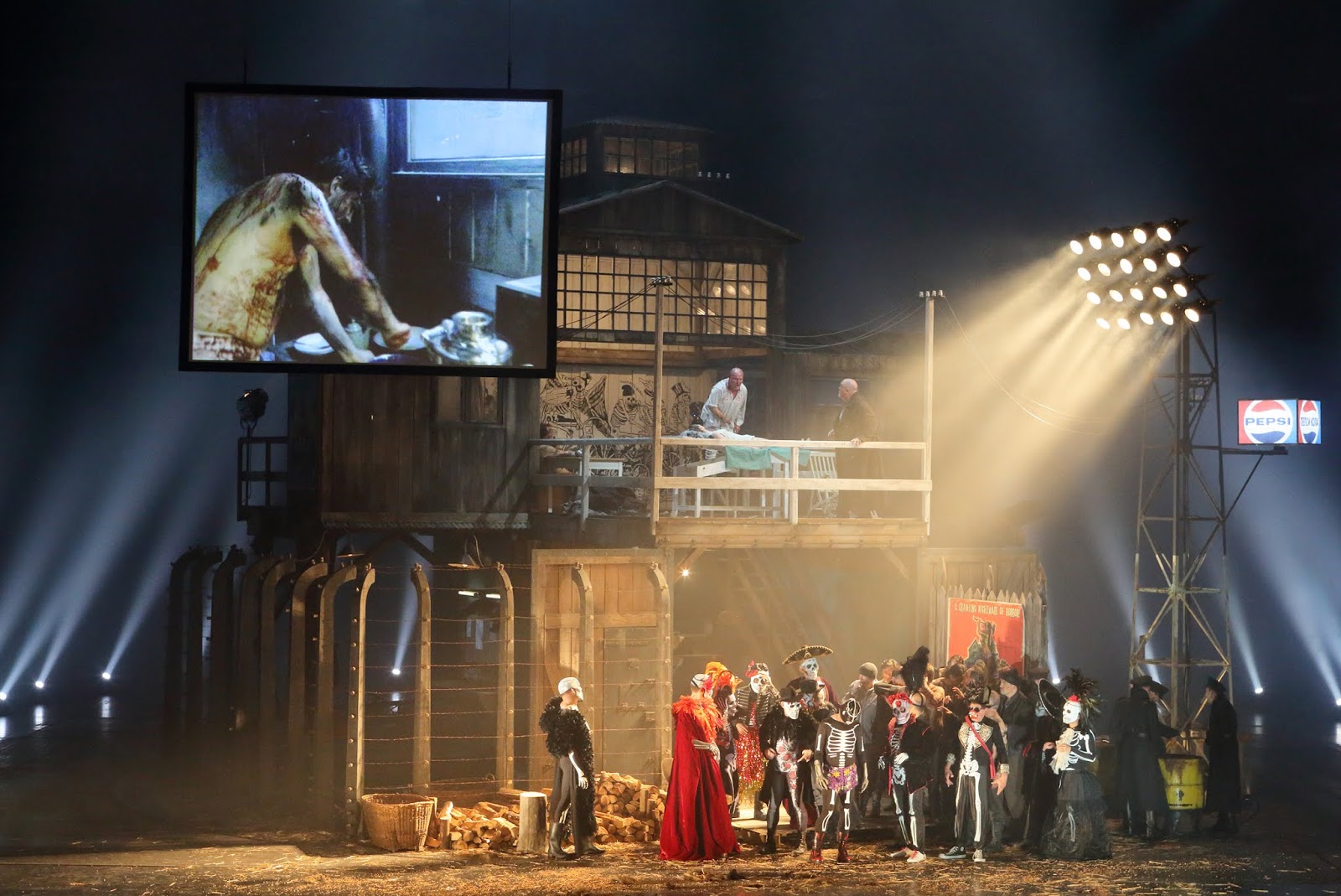
We are in Russia – no doubt of that. It is Russia at a dark time – again no doubt of that. (When, however, was that not the case, save for a few years under Lenin, and even then…?) But is it a ‘real’ Russia? And what indeed could so impossibly naïve a formulation mean? Live camerawork performs all manner of tasks, questioning our ability to comprehend, to view, to narrate, whilst making it all the more necessary that we try to do so. There is little doubt concerning the realism – until, that is, a true Carnival of the Dead comes amongst the prisoners and the prison. Magic realism? Perhaps, but if so, it is the blackest of magic to follow, perhaps even to sublate, the blackest of comedy and (non-)redemption. Whereas, in his Siegfried and Gotterdammerung, Castorf took us to an alternative historical path for the GDR, an alternative that turned out not to be so very alternative at all, (Al)Exander Platz still a commercial, post-socialist wasteland, Wall Street still failing to burn, here we seem perhaps to have joined the USSR for an alternative 1930s.


Bitter Prisoner (Tim Kuypers), Prisoner with
the Eagle (Manuel Gunther),
Aljeja (Evgeniya Sotnikova)
Or have we? Trotskyist hints abound: the rabbit hutch (many thanks to my friend Sam Goodyear for having pointed out the connection), Mexico too (‘Partido liberal’, we read on one of many historical and/or imaginary signs), a film advertisement (in Spanish), starring Alain Delon. (Hang on, if we are in 1972…?) Even a carnival bird Aljeja, splendidly sung by Evgeniya Sotnikova, seems both to suggest and to disavow that possibility. Or are we, was I, confusing him/her – here most definitely ‘her’ – with the Prisoner with the Eagle, or his eagle? What might that mean here, whether the confusion or the eagle? Russia or the USSR, however, it certainly remains, even down to the affinity – which seems to have been overstated by some – with Aleksandar Denić’s Walküre set (Azerbaijan, 1942). What does a sign for Pepsi Cola in English and Russian tell us? And what, at the end, does the English poster invitation to travel to the USSR as a holiday destination mean, not least in such appalling circumstances? Stop trying to ascribe meaning to everything: is that not what, as an imprisoned intellectual, one is compelled to do? Are we to see the future and will it to work, or perhaps indict it? Is it just a joke, as suggested by the presence of a Ring crocodile? Who knows? We shall never make the journey, just like so many of those prisoners, yet unlike, perhaps, Gorjančikov, who thinks he has something written in his head. Like Dostoevsky, like Trotsky, like Castorf, like our writer, Alexandr Petrovič Gorjančikov, we write and rewrite. So too does the action all around, on stage, on film, seen and unseen; so too, of course, does the orchestra.


Šiškov (Bo Skovhus), Statisterie and Chorus
It is complicated, yes; how can a fragmentary drama with so many ‘characters’ or at least people not be? But it is also visceral, direct. Violence we see, we feel, whether we like it or not, be it in the Guard’s sadistic flagellation (a truly nasty Long Long, almost a match for the still nastier Governor of Christian Rieger) or in the metal of the steppes’ orchestra. Opera too, even in this most inhospitable of circumstances, is reborn. If the Wanderer seemed to have been an inspiration for our noble prisoner’s initial journey to this camp, Peter Mikuláš capturing both intelligence and a certain camouflaged nobility, then it is the Wotan of the second-act Walküre monologue who comes to mind in that of Šiškov. That is partly a matter of Bo Skovhus’s searing portrayal, quite the most powerful performance I have seen and heard from him in a long time. But everyone involved has played a role in putting these pieces together, in constructing something from these musico-dramatic shards. ‘A mother gave birth even to Filka,’ after all – and we know it, because, like Šiškov, he sings, not least in this devilish incarnation from Aleš Briscein. So too, earlier, do Don Juan (an outstanding Callum Thorpe) and his pseudo-Leporello (another excellent performance, this time from Matthew Grills), in a play-within-a-play. That, thanks to Castorf’s lengthy experience with and rejuvenation of post-dramatic commentary, seems more of a play-in-itself than I can recall – until, once again, it does not.

 
Šiškov, Cerevin (Dean Power)


For, like Don Giovanni, this is redemptive within and without, or seems to be: as I said, it takes life and drama as they are. A (post-)religious consciousness is at work here. It also, perhaps, suggests what they might be, or at least what one day, when the revolution comes again, the revolution to which we cling no matter what, we might hope it to be. The noble prisoner leaves, though, so most likely not. He has used, learned from his experience; so, we imagine, have we. The carnival of (Russian) death continues. There is a chink of something uncertain. In the blackest of comedies, we might even think it light. Humanity even – though are we not all now post-human(ist) as well as post-dramatic? Who knows, who cares? This human comedy and tragedy of which we are part rolls on, just as it did for those Calderón-like figures of a reimagined Salzburg World Theatre in the celebrated post-war Furtwängler Don Giovanni. The final scene alienates – like Mozart’s. And yet, like that too, it moves (us). We have experienced something, even if we have not a hope in our living hell of learning what it may have been. We have, like this Gorjančikov, written a work of sorts in our head. No one will read it or even remember it, perhaps it would be impossible for anyone to make sense of its difficult, even nonsensical fragments; yet that spark of creativity, of art, of that which Marx just as much as Schiller considered made us human, has flickered. At least we think it did. Perhaps. Or at least we thought it did. Once. Perhaps. We return, like Gorjančikov, like Trotsky, to watch the post/non-human (non-)drama for the rabbits in their hutch, caged like us and yet (to the sentimental?) more free. Perhaps.

Aljeja and rabbits in their hutch


Sunday, 14 August 2016

Proms at … Sam Wanamaker Playhouse, Arcangelo/Cohen, 13 August 2016


Sam Wanamaker Playhouse

Purcell – The History of Timon of Athens, The Man-Hater: excerpts
Blow – Venus and Adonis: excerpts
Purcell – The Fairy Queen: excerpts
Locke – The Tempest: excerpts
Purcell (attrib.) – The Tempest: excerpts

Katherine Watson (soprano)
Samuel Boden (tenor)
Callum Thorpe (bass)

Alessandro Talevi (movement director)
Arcangelo
Jonathan Cohen (director, harpsichord, organ)


This highly enjoyable Prom, part of 2016’s ‘Proms at…’ mini-series, took as its guiding concept the reopening of London’s theatres following the Restoration, focusing in particular upon musical and dramatic responses to Shakespeare. Purcell, rightly, loomed large, with John Blow and Matthew Locke joining him. Receiving their Proms premieres were the excerpts from Timon of Athens and those from Locke’s The Tempest.

 
The Timon of Athens excerpts opened with a Curtain Tune of decidedly ‘world’-‘jazz’ inflection. I have nothing against such an approach at all, but it seemed a bit of an easy option here, as if offering a touch of – highly predictable – ‘swing’ and some ‘colourful’ percussion was all that was required. We seemed on surer ground with ‘I spy Celia’. Our tenor and bass, Samuel Boden and Callum Thorpe, dressed in matching white T-shirts and jeans offered strutting performances: ‘I am redder, then I please her’. Boden’s ‘I see she flies me’ showed off again his splendid, light but not too light tenor, the coloratura negotiated with nonchalant ease. There was languorous contrast in Dryden’s lines, ‘Were she but kind whom I adore/I might live longer, but not love her more.’

 
What we still believe to be the first English opera, Venus and Adonis followed, again, as in all cases this afternoon, in excerpted form. Two recorders and harpsichord gave us the Act I ‘Tune for flutes’, in nicely unhurried fashion, again a welcome contrast with what had gone before. Further music from the first act – a sequence opening ‘Venus! … Adonis!’ and the music surrounded by the Hunters’ Music – followed. Thorpe’s chocolatey bass seemed ideally suited to the role of Adonis, whilst his Venus, Katherine Watson, proved equally stylish, ‘English’, but in a good way. The Hunters’ Music again revived the ‘popular’ element, this time with tambourine; much to its benefit, it was varied, more intense, the second time around. (Yes, I know I am being a bit of a puritan; please forgive me.)

 
Music from The Fairy Queen followed, excerpts selected from Acts I, III, and V. The opening Prelude (First Music) was fast and furious – for better or for worse. The following Hornpipe was well judged, with a winning swing, colourful too. The Act V Prelude showed an air of unease, followed by the Second Music-Rondeau, which proved graceful of lilt. ‘If Love’s a Sweet Passion’ benefited from a lovely oboe solo, sounding almost like a soft-spoken trumpet at times, at others thoroughly pastoral. Dances from that same, third act followed: for the Fairies, a Hornpipe, and for the Haymakers, the ‘Dialogue between Coridon and Mopsa’ just before that final dance. Done up in lipstick, newly clad in a pashmina, Boden played the countertenor-ish maiden, blessed with beautiful deportment too. Alessandro Talevi had certainly prepared the participants well for a highly erotic conclusion. The Chaconne: Dance for a Chinese man and woman rounded off the first half.

 
Opening the second were two pieces from Matthew Locke’s incidental music to The Tempest, a 1674 production much loved by Nell Gwynne. The music – Curtain Tune and Dance of the Fantastick Spirits – was interesting to hear, but paled somewhat next to that of Purcell (even ‘Purcell, attrib.’). Purcell’s 1695 music, if indeed it is by Purcell, followed. Thorpe’s rendition of ‘Arise, ye subterranean winds’ was commanding, duly declamatory. Watson’s ‘Full fathom five’, later joined by her tenor and bass colleagues, proved a charming item to follow. Her ‘Dry those eyes’ offered a vocal line both clear and melancholic, with fine playing too from the members of Arcangelo. Finally, ‘Neptune’s Masque’ provided opportunities, well taken, for all to shine. Neptune’s lengthy air again received a commanding yet subtle performance from Thorpe. Aeolus, summoned by the god, appeared in black leather jacket and shades all over the theatre. His ‘Your awful voice’ was as agile both vocally and in stagecraft. There was some able fiddling too. The closing chorus had more than a hint of ‘authentic’ Purcellian melancholy, whoever the actual composer may have been.


Wednesday, 14 January 2015

L'Orfeo, Royal Opera, 13 January 2015


Roundhouse

Orfeo – Gyula Orendt
Euridice – Mary Bevan
Silvia (Messenger) – Susan Bickley
First Pastor – Anthony Gregory
Second Pastor (Apollo) – Alexander Sprague
Third Pastor – Christopher Lowrey
Charon – James Platt
Pluto – Callum Thorpe
Proserpina – Rachel Kelly
Nymph – Susanna Hurrell

Michael Boyd (director)
Tom Piper (designs)
Jean Kalman (lighting)
Sound Intermedia (sound design)
Liz Ranken (movement)
Lina Johansson (circus director)
 
Vocal Ensemble from Guildhall School of Music and Drama
Dancers from East London Dance
Orchestra of Early Opera Company
Christopher Moulds (conductor)
 

I am all in favour of our London opera companies moving outside of their West End homes – perhaps preferably a little further afield than Camden, but even that change of scenery can act as a liberating agent. For that, the Royal Opera is fully deserving of praise, and it certainly feels ‘different’ taking the Tube to Chalk Farm and arriving at the Round House, venue for a good number of Pierre Boulez’s BBC Symphony Orchestra concerts, given when he similarly wished to break free of some of the stultifying conventions of bourgeois concert life and to seek new, more receptive audiences. It is a lovely touch to have children from local schools compose and perform fanfares – audibly related to Monteverdi’s celebrated opening Toccata – in the bar beforehand. As with Boulez’s innovation, one cannot but praise the broadening of repertoire too, Monteverdi, one of the very greatest of all opera composers, being conspicuous only by his absence from Covent Garden’s endeavours.
 

However, in this case, it is not entirely clear what remains of the Royal Opera, beyond its name as an umbrella organisation and presumably some degree of financial support. To bring in a ‘period’ orchestra at the same time as relocating gave the impression of Monteverdi being compartmentalised, surrendered to those whom Boulez so aptly summed up as ‘specialists in nullity’; moreover, what does it say about the worth the company attributes to its own, very fine orchestra, perfectly capable of performing repertoire from Monteverdi to Birtwistle? The world is full of ‘period’ performances of ‘early music’; is it really too much to ask that someone, somewhere might actually show the courage to stand up to ‘authenticke’ fatwas and use rich, modern forces? Or perhaps, even, to use one of the several ‘reimagined’ versions of Monteverdi’s score for our own or other times? Berio’s would perhaps have been the most obvious in this case, but there are many others; indeed, the task would have made a wonderful commission for an imaginative young (or old) composer.


The situation seems odder still in the light of a staging that is certainly not attempting some form of historical recreation. Nothing wrong with that, at all, of course; indeed, the idea is as silly onstage as in the pit – or here, onstage again, given that there was no pit. The post-modernism, in the worst sense, of mainstream ‘authenticity’, however is shown up for what it was, given the incoherence of approach. As Boulez once again put it with respect to the kindred movement of twentieth-century neo-Classicism, ‘People gather up all manner of bits and pieces and say, “O.K., I’ll put a Corinthian column on a metal base and it will look post-modern.” Obviously, this is all quite superficial.’
 

Alas, a greater problem with Michael Boyd’s staging lies in its incoherence even on its own terms. Rarely have I been so unclear as to what an opera staging was seeking to achieve. A host of theatrical clichés listlessly compete to amount to considerably less than the sum of their parts. We have a play within a play, vaguely nodding both to the work’s courtly origins (a royal couple, later revealed to be Pluto and Proserpina, seated above, under a crest) and some sort of modern-ish fascism-lite (hints of a prison, which soon vanish, security forces (?) all in black, and so on). The ‘look’ comes across as a mixture of student production and 1990s RSC, whilst the addition – I hesitate to say ‘incorporation’ – of dancers, a laudable community initiative in itself, is less than fully integrated, giving the impression of a school talent show. The choreography itself is embarrassing enough to make one think of David McVicar’s West End-musical assault on The Trojans. Piling more art forms upon each other – a ‘circus director’ is credited, though I am not quite sure for what – seems a grave misunderstanding of the Gesamtkunstwerk, itself a concept unduly emphasised by those who have most likely never read Wagner in the first place. Above all, given the overall incoherence, there is little sense of who these people actually are, let alone, most crucially, of how they relate to one another. Had I not known the opera, I suspect I should have found myself utterly at a loss, instead of only partly so.
 

Related to that is the most baffling aspect of all: what seems to be a Christianising concept, signalled not only by the transformation of shepherds into robed priests with crucifixes (‘pastors’, a play on words or at least upon origins only likely to register, let alone to be appreciated, for those with a cast list and who have checked it) and the English translation furnished by Don Paterson. Orfeo – why not ‘Orpheus’, if we are in English? – is presented in Christ-like imagery to start with, prefiguring his death; but it is far from clear that death is in itself a Christian concept, and little is done to explain why or even how we should plausibly consider the action in this sense. The final act in particular now takes upon itself an oddly Christian, or perhaps better, anti-Christian tinge, with words such as 'grace' in context accorded unsettlingly prominent emphasis. Quite apart from the question of why the work is being performed in translation – there are surtitles, which should surely be enough – the appearance of concepts such as ‘grace’ sit as awkwardly as the Christian elements in Britten’s Rape of Lucretia. Orfeo is not Parsifal, nor did it become so on this occasion. Given the choice, I should unhesitatingly stick with Alessandro Striggio – not, I hasten to add, on account of a nasty bout of Werktreue, but because transformations, should they be attempted, need to be considerably more coherent than these. I am not sure what the cuts are supposed to achieve, either; Orfeo is certainly not a lengthy work.
 

There was, however, much to admire in the singing; indeed, it was as a showcase for (mostly) younger voices that this performance really found its raison d’être. The undoubted star of the show – something would have gone wrong, had this been otherwise! – was Gyula Orendt, as Orfeo. A member of the Berlin State Opera, the Hungarian-Romanian baritone offered as powerfully-acted a performance on stage as I have seen for a long time. His facial expressions: tearful, hopeful, joyous, and, towards the close, benumbed, drew one in to his character as happens all too rarely on the operatic stage. (That may, of course, be partly a matter of the relative intimacy of the venue, at least for those of us fortunate enough to have been in the Stalls.) Although his vocal performance was not entirely flawless – he was not the only cast member to experience occasional difficulty with the hemiolas – to say more would be to nit-pick in the face of so committedly dramatic a performance. Mary Bevan offered a lovely Euridice, words and music as one – insofar as they could be in translation. Susan Bickley made the most of the Messenger’s pivotal appearances: one saw as well as heard the import of her news. Callum Thorpe and Rachel Kelly were equally impressive as the ‘royal’ (?) couple, Pluto and Proserpina. My only regret was that they did not have more to sing, but their acting was to be enjoyed more or less throughout. All members of the cast, though, impressed. Their ensemble, together with the splendid postgraduate singers from the Guildhall, offered a true instance of what opera should be: more, rather than less, than the sum of its part. (Mostly) subtle amplification dealt pretty well with the problematical acoustics, although certain oddities were unavoidable in a non-static staging.
 

Christopher Moulds might, however, have presented a more bracing account. Rhythms too often were on the soggy side; Ivor Bolton, in Munich last summer, had offered much more in the way of dance and, indeed, more general dramatic contrast. (He also had the benefit of an excellent production, one which it would be well worth the Royal Opera, ENO, or someone else considering bringing to London.) The continuo group proved far more impressive than the rest of the orchestra, its brass and, less but still too frequently, its strings sometimes excruciatingly out of tune. I can scarcely imagine the reaction, were such flawed playing to be served up by the Orchestra of the Royal Opera House; quite why audiences and critics are willing to put up with this in the name of ‘period performance’ remains an utter mystery to me. But then, so does the ideology as a whole; whatever it might be, it is certainly not ‘historically informed’.


Saturday, 6 October 2012

Christ lag in Todesbanden/Der Kaiser von Atlantis, English Touring Opera, 5 October 2012

Linbury Studio Theatre
 
Bach – Christ lag in Todesbanden, BWV 4 (arr. Iain Farrington)
Ullmann – Der Kaiser von Atlantis

Emperor Überall – Richard Mosley-Evans
Death – Robert Winslade Anderson
Loudspeaker – Callum Thorpe
Maiden – Paula Sides
Harlequin – Jeffrey Stewart
Drummer – Katie Bray
Soldier – Rupert Charlesworth

James Conway (director)
Neil Irish (designs)
Guy Hoare (lighting)

Aurora Orchestra
Peter Selwyn (conductor)
 

Not for the first time, the heroic efforts of English Touring Opera have put to shame the larger, wealthier opera companies. Whereas ENO has elected to garner minor headlines by launching a silly campaign to encourage audience members to wear jeans and trainers, and from the 2012 productions I have seen on the main stage at Covent Garden, but one, Rusalka, has proved artistically first-rate, not only is ETO offering an autumn season composed of three twentieth-century operas – Albert Herring, The Emperor of Atlantis, and The Lighthouse – in the present production, it has risen impressively to the challenge.  


To preface Viktor Ullmann’s opera with Bach’s Christ lag in Todesbanden was a brilliant idea. (There was also a pre-performance rendition of a newly commissioned song-cycle by Helen Chadwick, Towards an Unkown Port, which I was unable to attend.) Bach’s cantata was arranged for the same chamber forces as the Ullmann, Iain Farrington’s arrangement showing both sensitivity to the score and an imagination that at times seemed to pay occasional homage to the Bach arrangements of Webern and Berio. (Was that a touch of flutter-tonguing I heard early on?) Harlequin and Death observe the performance, presented chillingly by four soloists – Katie Bray, Rupert Charlesworth, Paula Sides, and Callum Thorpe – with suitcases ready for the journey ahead. Though sung in German, Harlequin offers a rough and ready flash card translation, which at times he uses to incite Death, waiting with his scythe. This may be an Easter Day cantata, based of course upon Luther’s chorale, itself based upon eleventh-century plainsong, but it is hardly Bach at his most jubilant. Christ lies in bonds of death and though we progress towards a final ‘Alleluia’ – this from 1724, Bach’s first version for the final stanza having been lost – via, amongst other wondrous writing, it is sin, the wait for judgement and, above all, especially in a contest such as this, the stretto contest between life and death, that linger longest and most profoundly in the mind. Each of the soloists was excellent, as indeed was the Aurora Orchestra, the plangent beauty of Charlesworth’s tenor perhaps particularly worthy of praise.
 

Der Kaiser von Atlantis, or  to give it its full title, Der Kaiser von Atlantis, oder Die Tod-Verweigerung (‘The Emperor of Atlantis, or Death’s Denial’), followed on immediately. How does one listen ‘objectively’ even upon hearing the subtitle, given that one knows this was a Theresienstadt opera? One does not, of course, and it would be unreasonable to expect anyone to do so.  A Schoenberg pupil, on his teacher’s recommendation, Ullmann was made a founder member of the committee for the Society of Private Musical Performances. Having been taken to Theresientadt in 1942, he wrote this opera with librettist Peter Kien the following year, though it only went so far as dress rehearsal, before being realised for the thinly disguised satire that it was. Ullmann, Kien, and many of their colleagues would be transported to Auschwitz in October 1944, to be murdered there.
 

Yet Ullmann’s opera is not of mere historical interest; he was an established composer for quite some time before the Second World War, and it shows. ‘Eclectic’ would perhaps give the wrong impression of the score, since it does not dart around willy-nilly; however, it certainly draws upon elements of tonal Schoenbergian writing and more popular idioms, often bringing Weill to mind. Death’s withdrawal of his labour disturbs the Emperor Überall – here, in spite of the opera being sung in English, the name was wisely not translated, adding definite national resonance – in his campaign of total war. (Yes, that very phrase is uttered.) The non-death of the soldier and girl in the third scene echoes, questions, subverts the struggle between life and death in the Bach cantata. Eventually, the Emperor accedes to Death’s demand that he be the first to die in return for the freedom for others to die again. It is perhaps only in this fourth scene that the music lingers a little too long, but even that arguably has its dramatic point, given the Emperor’s reluctance to die. The final ‘rejoicing’ is set to a lightly modernist elaboration of, irony of ironies, Ein’ feste Burg ist unser Gott.   


Once again, the orchestra, expertly directed by Peter Selwyn, was on excellent form. James Conway’s direction was typically impressive throughout, each character well prepared for his or her actions within this almost surreally terrifying setting, the sets of Neil Irish and Guy Hoare’s lighting playing their part here too. One had a sense if not of the conditions of Theresienstadt – how could one? – then of how modest means can create something far and beyond what one might expect, of the defiance and, clichéd though it may sound, hope that artistic solidarity may confer in the darkest of circumstances. Especially noteworthy amongst the cast were, once again, Charlesworth as the Soldier, also Callum Thorpe’s intelligently presented Loudspeaker, informing the Emperor of the war’s progress, and Paula Sides’s attractively voiced Maiden. Richard Mosley-Evans wavered somewhat as the Emperor, but the whole performance remained far more than the sum of its parts.
 

The production will also be seen in Cambridge, Exeter, Tunbridge Wells, Harrogate, Aldeburgh, Malvern, and Buxton. Click here for further details from the ETO website.