Showing posts with label From the House of the Dead. Show all posts

Thursday, 2 August 2018

Munich Opera Festival (3) - From the House of the Dead, 30 July 2018


Nationaltheater

Images: Wilfried Hösl

Alexandr Petrovič Gorjančikov – Peter Mikuláš
Aljeja – Evgeniya Sotnikova
Luka Kuzmič (Filka Morozov) – Aleš Briscein
Skuratov – Charles Workman
Šiškov – Bo Skovhus
Big Prisoner, Prisoner with the Eagle – Manuel Günther
Little Prisoner, Bitter Prisoner – Tim Kuypers
Governor – Christian Rieger
Old Prisoner – Ulrich Reß
Čekunov – Johannes Kammler
Drunk Prisoner – Galeano Salas
Cook – Boris Prýgl
Smith – Alexander Milev
Pope – Peter Lobert
Prostitute – Niamh O’Sullivan
Don Juan (Brahmin) – Callum Thorpe
Kedrill, Young Prisoner – Matthew Grills
Šapkin, Happy Prisoner – Kevin Conners
Čerevin, Voice from the Kirghizian Steppes – Dean Power
Guard – Long Long


Frank Castorf (director)
Aleksandar Denić (set designs)
Adriana Braga Peretski (costumes)
Rainer Casper (lighting)
Andreas Deinert (video, live camera)
Stefanie Katja Nirschl (live camera)
Jens Crull (video, live editing)
Miron Hakenbeck (dramaturgy)
Martha Münder (revival director)


Bavarian State Opera Chorus (chorus master: Sören Eckhoff)
Bavarian State Orchestra
Simone Young (conductor)


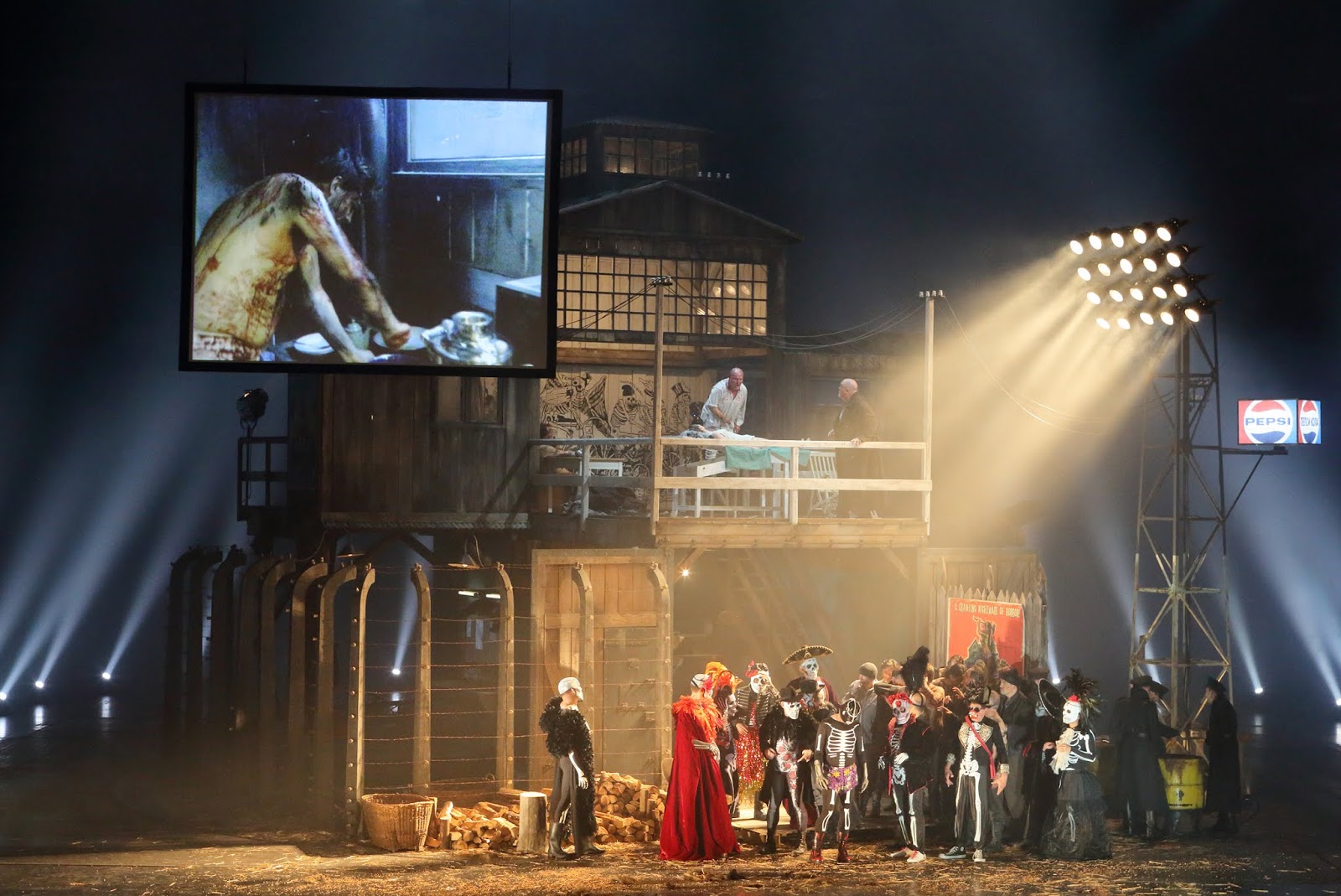
Frank Castorf might have been born to direct From the House of the Dead. In this, his third opera project – or better, his third opera project in the opera house, for his Volksbühne Meistersinger must surely be reckoned with, even by those of us who did not see it – many of his hallmarks and those of his team are present, yet without the slightest hint of staleness, of anything other than being reborn for and in the work. And how the work suits such an approach; in many respects, the deconstruction has already been done. Probably Janáček’s greatest opera, indeed his greatest work of all, it is no accident that it is the one Pierre Boulez chose to conduct, towards the end of his life. Alas I never heard that live, although in 2014, I would see Patrice Chéreau’s production in Berlin. That was, of course, a fine piece of theatre, as indeed was Krzysztof Warlikowski’s Covent Garden staging, seen earlier this year. Castorf, however, revelling in its fragmentary nature – for it is in many respects his own – triumphantly, I should say dialectically, offers the strongest sense of a whole I have seen or could imagine. By taking it as it is, Castorf’s team and a magnificent cast, aided greatly by Bavarian State Opera forces under Simone Young in the finest performance I have heard from her, alert both to the needs of the minute and of the greater architecture, present and represent the opera as it is and might be. Quite without sentimentality, they write and rewrite, igniting and reigniting that Dostoevskian redemptive spark that is both present and absent throughout, depending when and where one looks and listens, how and with what one pieces together one’s own narrative, musical and dramatic.

We are in Russia – no doubt of that. It is Russia at a dark time – again no doubt of that. (When, however, was that not the case, save for a few years under Lenin, and even then…?) But is it a ‘real’ Russia? And what indeed could so impossibly naïve a formulation mean? Live camerawork performs all manner of tasks, questioning our ability to comprehend, to view, to narrate, whilst making it all the more necessary that we try to do so. There is little doubt concerning the realism – until, that is, a true Carnival of the Dead comes amongst the prisoners and the prison. Magic realism? Perhaps, but if so, it is the blackest of magic to follow, perhaps even to sublate, the blackest of comedy and (non-)redemption. Whereas, in his Siegfried and Gotterdammerung, Castorf took us to an alternative historical path for the GDR, an alternative that turned out not to be so very alternative at all, (Al)Exander Platz still a commercial, post-socialist wasteland, Wall Street still failing to burn, here we seem perhaps to have joined the USSR for an alternative 1930s.


Bitter Prisoner (Tim Kuypers), Prisoner with
the Eagle (Manuel Gunther),
Aljeja (Evgeniya Sotnikova)
Or have we? Trotskyist hints abound: the rabbit hutch (many thanks to my friend Sam Goodyear for having pointed out the connection), Mexico too (‘Partido liberal’, we read on one of many historical and/or imaginary signs), a film advertisement (in Spanish), starring Alain Delon. (Hang on, if we are in 1972…?) Even a carnival bird Aljeja, splendidly sung by Evgeniya Sotnikova, seems both to suggest and to disavow that possibility. Or are we, was I, confusing him/her – here most definitely ‘her’ – with the Prisoner with the Eagle, or his eagle? What might that mean here, whether the confusion or the eagle? Russia or the USSR, however, it certainly remains, even down to the affinity – which seems to have been overstated by some – with Aleksandar Denić’s Walküre set (Azerbaijan, 1942). What does a sign for Pepsi Cola in English and Russian tell us? And what, at the end, does the English poster invitation to travel to the USSR as a holiday destination mean, not least in such appalling circumstances? Stop trying to ascribe meaning to everything: is that not what, as an imprisoned intellectual, one is compelled to do? Are we to see the future and will it to work, or perhaps indict it? Is it just a joke, as suggested by the presence of a Ring crocodile? Who knows? We shall never make the journey, just like so many of those prisoners, yet unlike, perhaps, Gorjančikov, who thinks he has something written in his head. Like Dostoevsky, like Trotsky, like Castorf, like our writer, Alexandr Petrovič Gorjančikov, we write and rewrite. So too does the action all around, on stage, on film, seen and unseen; so too, of course, does the orchestra.


Šiškov (Bo Skovhus), Statisterie and Chorus
It is complicated, yes; how can a fragmentary drama with so many ‘characters’ or at least people not be? But it is also visceral, direct. Violence we see, we feel, whether we like it or not, be it in the Guard’s sadistic flagellation (a truly nasty Long Long, almost a match for the still nastier Governor of Christian Rieger) or in the metal of the steppes’ orchestra. Opera too, even in this most inhospitable of circumstances, is reborn. If the Wanderer seemed to have been an inspiration for our noble prisoner’s initial journey to this camp, Peter Mikuláš capturing both intelligence and a certain camouflaged nobility, then it is the Wotan of the second-act Walküre monologue who comes to mind in that of Šiškov. That is partly a matter of Bo Skovhus’s searing portrayal, quite the most powerful performance I have seen and heard from him in a long time. But everyone involved has played a role in putting these pieces together, in constructing something from these musico-dramatic shards. ‘A mother gave birth even to Filka,’ after all – and we know it, because, like Šiškov, he sings, not least in this devilish incarnation from Aleš Briscein. So too, earlier, do Don Juan (an outstanding Callum Thorpe) and his pseudo-Leporello (another excellent performance, this time from Matthew Grills), in a play-within-a-play. That, thanks to Castorf’s lengthy experience with and rejuvenation of post-dramatic commentary, seems more of a play-in-itself than I can recall – until, once again, it does not.

 
Šiškov, Cerevin (Dean Power)


For, like Don Giovanni, this is redemptive within and without, or seems to be: as I said, it takes life and drama as they are. A (post-)religious consciousness is at work here. It also, perhaps, suggests what they might be, or at least what one day, when the revolution comes again, the revolution to which we cling no matter what, we might hope it to be. The noble prisoner leaves, though, so most likely not. He has used, learned from his experience; so, we imagine, have we. The carnival of (Russian) death continues. There is a chink of something uncertain. In the blackest of comedies, we might even think it light. Humanity even – though are we not all now post-human(ist) as well as post-dramatic? Who knows, who cares? This human comedy and tragedy of which we are part rolls on, just as it did for those Calderón-like figures of a reimagined Salzburg World Theatre in the celebrated post-war Furtwängler Don Giovanni. The final scene alienates – like Mozart’s. And yet, like that too, it moves (us). We have experienced something, even if we have not a hope in our living hell of learning what it may have been. We have, like this Gorjančikov, written a work of sorts in our head. No one will read it or even remember it, perhaps it would be impossible for anyone to make sense of its difficult, even nonsensical fragments; yet that spark of creativity, of art, of that which Marx just as much as Schiller considered made us human, has flickered. At least we think it did. Perhaps. Or at least we thought it did. Once. Perhaps. We return, like Gorjančikov, like Trotsky, to watch the post/non-human (non-)drama for the rabbits in their hutch, caged like us and yet (to the sentimental?) more free. Perhaps.

Aljeja and rabbits in their hutch


Sunday, 11 March 2018

From the House of the Dead, Royal Opera, 10 March 2018


Royal Opera House

Luka Kuzmič – Štefan Margita
Nikita, Big Prisoner – Nicky Spence
Čekunov, Small Prisoner, Cook – Grant Doyle
Prison Governor – Alexander Vassiliev
Alexandr Petrovič Gorjančikov – Willard White
Guard – Andrew O’Connor
Antonič (Elderly Prisoner) – Graham Clark
Skuratov – Ladislav Elgr
Aljeja – Pascal Charbonneau
Šiškov (Pope) – Johan Reuter
Drunk Prisoner – Jeffrey Lloyd-Roberts
Šapkin – Peter Hoare
Prisoner (Don Juan, Brahmin) – Aleš Jenis
Prisoner (Kedrill) – John Graham-Hall
Young Prisoner – Florian Hoffmann
Prostitute – Allison Cook
Voice – Konu Kim
Čerevin – Alexander Kravets
 

Krzysztof Warlikowski (director)
Małgorzata Sczczęśniak (designs)
Felice Ross (lighting)
Denis Guéguin (video)
Claude Bardouil (movement)
Christian Longchamp (dramaturgy)


Royal Opera Chorus (chorus director: William Spaulding)
Orchestra of the Royal Opera House
Mark Wigglesworth (conductor)


Astonishingly, this new production of From the House of the Dead is not only the Royal Opera’s first, but also Krzysztof Warlikowski’s house debut. Better late than never, I suppose, and past omissions are hardly the fault of the current regime. Another important first is presented in a first full outing for this critical edition of the work, including Janáček’s proper libretto, including dialect, Russian, and even, apparently, a little Ukrainian, as part of his own translation from Dostoyevsky. Such things matter, of course, although how many of us in a (presumably) largely Anglophone audience can, hand on heart, claim to notice them all? Some will, and I am grateful to my friend and colleague, Geoffrey Chew, who certainly will do, for having alerted me in the first place to the use of the new edition.
 

Ultimately, though, opera lives in performance. The conductor, Mark Wigglesworth observes in a programme note, there is ‘a curious tension in today’s operatic culture between the musical priority of the performers, which typically tries to be one of complete fidelity to the composer’s instructions, and a dramatic expectation that pieces are simply springboards for a director’s limitless imagination.’ Such a tension may prove productive, as here, yet it also requires deconstruction of its own, as indeed Wigglesworth proceeds to acknowledge. It is often in those cracks that one perceives chinks of light, or to quote Janáček himself, ‘the spark of God … “A mother gave birth even to him!”,’ perhaps ultimately thus even of redemption. In this outstanding performance and production, one of the finest things I have seen at Covent Garden for a while, the interaction between freedom and determinism, such as one might readily associate more with, say, Schoenberg, in Moses und Aron, comes to influence and be influenced by work, dramatic ‘content’, performance, and the oracular mystery of ‘opera’ that arises from the dialectical relationship between them.
 

It has been worth the wait for Warlikowski. Patrice Chéreau, in his justly lauded production, originally conducted by Pierre Boulez, but which I saw in Berlin under Simon Rattle, presented the work relatively straightforwardly, perhaps even in the very best sense ‘traditionally’. Warlikowski, however, offers a post-Foucauldian queering of the work, engaging in more explicitly conceptual fashion with power, ‘justice’, and ‘punishment’ in an age of activist and intellectual intersectionality. Kimberlé Crenshaw, who coined the term, has always insisted that intersectionality was fundamentally concerned with power rather than mere identity; the line is not always absolute, of course, and identity will often prove a response to power relations, but we do well to remember that, especially when ‘centrist dad’ types – who, predictably seem to have hated the staging – as much as unrepentant reactionaries will rail against ‘identity politics’ and indeed against the very idea of intersectionality as well as the word. ‘Citizens of nowhere’, one might say, against ‘very fine people’; or is that our white privilege attempting to trump, as it were, deeper, more serious, still more violent problems and battles within society with our own? It is not either-or; that is part of the point, or should be. The coercive apparatus that sets us against one another, within and without formal incarceration returns us to Foucault, whom we see on film at the beginning, not only to have his ideas confirmed, but also to challenge them. As with Janáček and Dostoyevsky, we need them and yet have also moved on. In the agony of that alienation lies our drama too.
 

And so, alongside Foucault, we also see - and perhaps more to the point, watch - actors and singers – what, if anything is the difference? – at sport and not. Prisoners are no more the same than non-prisoners. Are we merely looking, or are we engaging in surveillance? At least indirectly we all are, and if our gaze is directed to the stage, we also know, even if we deny, that we are watching each other too. Anyone driven to distraction by the call ‘see it, say it, sorted’ on railway carriages over the past few months, will know how little it might take to have been incited by the ‘duty’ to bring to ‘justice’ so as to be facing such ‘justice’ itself, which as Foucault pointed out, was and always had been spectacularly unsuccessful in its alleged project of ‘rehabilitation’. In the contemporary American prison in which the action unfolds, the intense physicality and to us, most likely a largely white, bourgeois audience, the ‘danger’ of such, especially when as here non-white and/or non-binary faces crop up,  replicate or, perhaps better, recreate hierarchies outside of the system.
 

That places the arrival of Gorjančikov in an interesting light. To a certain extent he is ‘one of us’. We can probably imagine ourselves more as political prisoners than as some of the ‘others’, more as items on, say, Amber Rudd’s lists of foreigners than as murderers or drug dealers. We are offered a way in, but also a way to differentiate ourselves, as we do both inside and outside, to reaffirm our respectability, perhaps even to sympathise with or at least to acknowledge as ‘necessary’ the brutality we see on show from the prison officers – and hear in the chains of Janáček’s score. Are we ultimately ‘do-gooders’, or just armchair reformers, if indeed we care at all? Might we even extend that critique to the performance and to the work itself and to that redemptive claim, the ‘spark of God’, in which we so desperately wish to believe?
 

Other hierarchies recreate themselves, although not necessarily identically. In a world of often (although let us not assume too much a priori) toxic masculinity – Šiškov, after all, killed his wife, upon realising that she still loved Filka/Luka – where is the space for women? Their near-absence on stage is one of the many things that makes this work so singular in Janáček’s œuvre; the harshness of the score is not only a harshness of the tundra. Here Warlikowski doubles down, doubtless controversially, not only allotting the trouser role of Aljeja to a tenor, but revealing, or rather concealing, the Prostitute – still sung by a Woman – as a drag queen, heightening elements of the ‘show’ which, after all, lie at the heart of the play within a play here. Such, after all, may be one of the ways of dealing with prison life. Or is it, instead, a reassertion of male privilege, a banishment of women? It does not take long before our thoughts touch upon the repression of trans women, men too, not least again on account of their absence too. Is this all intentional? I have no idea, although I suspect that some at least of it is. The production, however, offers the space for such reflection; indeed, I should argue that it demands it.
 

All that would be diminished, or unachievable, were it not for a fine, committed ensemble cast – there is no room, thank God, for ‘stars’ here – working with so impressive a chorus, orchestra, and conductor. I find it difficult to believe that the opera has ever been better conducted than by Wigglesworth, who inspired the Orchestra of the Royal Opera House to the very top of its form. The sound world was just right, less golden, more steely than the Staatskapelle Berlin under Rattle. Yet it seemed to grow out of an emphasis upon specifics, upon details, upon those gnawing rhythmic and melodic cells. This was not an abstract ‘approach’ foisted upon the work, quite the contrary. Certainly one heard, or fancied one heard, the intimacy of connection between language(s) and music. That held even when the language we heard was not at its sharpest (not necessarily, I think, a matter of nationality). I am really not in any position to comment further and shall leave that to Czech speakers; I think, unsurprisingly, that I detected some variation, but would always have had to resort to the titles in any case. The richness of what even post-humanists tend to fall back on calling ‘humanity’ is on show here, yet so is its commonality, not least in resistance to oppression. Singling out particular artists seems more than usually beside the point, but Štefan Margita, Nicky Spence, Ladislav Elgr, Pascal Charbonneau, and delightfully, Graham Clark all made very strong impressions, as did Allison Cook as the Prostitute.
 

Here, though, more than ever, one remembered, saw and heard dramatised that oft-cited section of a 1927 report from the Czech newspaper, Lidové noviny. Dostoevsky’s novel had appealed to Janáček, and so it does to us, because ‘“in each of these criminals there is a spark of God”. The new opera has no main hero. Thus its novelty lies in its collectivism.’ Is that not a collectivism we need as much as ever, perhaps still more so?


Tuesday, 16 December 2014

From the House of the Dead, Berlin Staatsoper, 13 December 2014

Schillertheater
 
Images: Monika Rittershaus (from the original, 2011 staging)
 
Alexandr Petrovič Gorjančikov – Tom Fox
Aljeja – Eric Stoklossa
Luka Kuzmič (or Filka Morozov) – Štefan Margita
Skuratov – Ladislav Elgr
Siškov, Guard – Pavlo Hunka
Prison Governor – Jiří Sulženko
Big Prisoner – Peter Straka
Small Prisoner – Vladimír Chmelo
Elderly Prisoner – Heinz Zednik
Cook, Blacksmith – Maximilian Krummen
Priest – Arttu Kataja
Cekunov – Ján Galla
Drunk Prisoner – Stephen Chambers
Sapkin – Peter Hoare
Kedril – Marian Pavlovič
Don Juan, The Brahmin – Ales Jenis
Young Prisoner – Olivier Dumait
Prostitute – Eva Vogel
Cerevin, Guard – Stephan Rügamer
 
Patrice Chéreau (director)
Peter McClintock (revival director)
Richard Peduzzi (set designs)
Caroline de Vivaise (costumes)
Bertrand Couderc (lighting, video)
 
Chorus of the Berlin State Opera (chorus master: Martin Wright)
Staatskapelle Berlin
Sir Simon Rattle (conductor)
 
Let me find something to complain about. The typing of such a review is a nightmare: all those diacriticals, especially for someone who knows not a word of Czech. That would be it, really. Two of my abiding musical regrets are not having seen the production of Moses und Aron, conducted by Pierre Boulez at my very first Salzburg Festival (I opted for The Marriage of Figaro instead) and not having seen this production of From the House of the Dead (Z mrtvého Domu) when it was first staged, again conducted by Boulez. Neither of those omissions can be put right, of course, but at least I have managed to see my first and – again, alas – doubtless last opera production by Patrice Chéreau in the theatre. (That is, unless I somehow manage to travel to New York to see his valedictory offering, Elektra.)
 
Perhaps the ultimate joy – should that not be an utterly misplaced word with respect to this opera – of this production is to see something that is so well thought out, so well executed, so clearly what it intends to be and what an operatic staging should be, that one experiences almost anew the greatness of genre and work, in themselves and also in performance. Any element of ‘opera house routine’ is banished, likewise any idiotic directorial clichés and incoherences. (The contrast with Christof Loy’s self-regarding assault on Tristan earlier this month could hardly be greater.) Chéreau trusts the work, and it therefore trusts him, permitting re-creative freedom as opposed to mere licence. Realism is both apparent and yet called into question or extended, according to taste. By that, I mean that the prisoners are clearly prisoners, as we should expect to see them; the prison is clearly a prison as we should expect to see it, the behaviour and interaction of the prisoners is so clearly plausible that we might actually be there, and yet there is no delimitation. This could be anywhere, and even the period is unclear – without a hint of post-modernist incongruity. There is plenty of action to watch, more doubtless than one can take in from a single viewing, and yet none of it is gratuitous, none of it distracts. We witness the faithful creation and development of a world we can imagine, rightly or wrongly, as if that matters, Janáček himself creating when sketching and developing his opera from Dostoevsky. Richard Peduzzi’s fine set designs are likewise sufficiently realistic and sufficiently abstract, so much part of the action that one cannot conceive of ‘production’ and ‘designs’ separately. (My mind inevitably went back to the triumph of the Centenary Ring, one of the few DVD opera stagings I am happy to watch again and again.)
 
The coup de theatre, for Chéreau is nothing if not a man of the theatre, comes at the end of the first act, in which a collapse both physical, intellectual, and metaphysical arises, rubbish falling from above – but is there even an Above in a sense Dostoevsky would have understood? – to create pointless ‘work’ for the prisoners thereafter. Is there a hint that this debris might relate to the learning of books, and to the horror of their destruction in authoritarian societies?  I felt so, but perhaps that was just my own reading; either way, Chéreau’s staging and its exemplary revival under Peter McClintock allow us the openness of our own interpretations, again up to a point and without the reactionary chaos of ‘anything goes’. From the House of the Dead has been criticised as having little in the way of plot, even little in the way of ‘opera’. It is surely the composer’s most radical work – which is saying something. Chéreau’s production enables the musical performance to examine and to project its dramatic dialectic between individual character and collectivity, and to show not only its radicalism but also the deep humanity which ultimately places it decisively in the tradition of his earlier works.
 
That relationship between individual and choral collective was powerfully, indeed unforgettably, achieved by the artists themselves on stage. It is, more than usual, not only invidious but more or less impossible to single out members of the cast in such a work and performance. However, the men to whom Janáček more or less briefly grants prominence might usefully be mentioned. Tom Fox’s Alexandr Petrovič seemed just as the composer might have thought of him: noble, ‘different’, compassionate.    The role of Aljeja, the young Tatar, was taken by the tenor, Eric Stoklossa, rather than the more usual mezzo. Stoklossa nevertheless conveyed the character’s youth and vulnerability, without a hint of sacrifice to the integrity of musical delivery. The brutality of the third-act monologue and the horror of its outcome were conveyed powerfully, again with just the right balance between the specific and the universal, by Štefan Margita’s Filka and Pavlo Hunka’s Šiškov. Laidslav Elgr’s Skuratov offered a subtle development of character the work’s detractors would have one believe never present, again perfectly in keeping with Chéreau’s overall vision. Ales Jinis made a strong impression indeed as the prisoner taking the roles of Don Juan and the Brahmin in the second-act plays, his charisma hinting at a homoeroticism which may or may not be ‘there’ in work and setting (irrespective of intention?) The presentation of those two plays was exemplary throughout, all concerned pulling off the trick of convincing portrayal of amateur dramatics with knowledge of the darker forces at work. In that sense, the resentful violence of Vladimír Chmelo Small Prisoner and the frail wisdom of Heinz Zednik’s Elderly Prisoner framed the action and its parameters tellingly.


Sir Simon Rattle showed himself at his curtain call deeply appreciative of the playing of the Staatskapelle Berlin. Rightly so, for theirs was playing at a level one might have expected them to reserve for Daniel Barenboim. Initially I wondered whether the sound were a little too ‘Romantic’, almost Brahmsian (ironically, given Rattle’s own rather odd way with  Brahms). But I rightly doubted my doubts and was quite won over; for one thing, this ‘old German’ sound is arguably very close to what Janáček himself would have heard and had in mind. One heard Wagner, Strauss, Debussy, even perhaps the Second Viennese School; and yes, one heard Janáček. Rhythms were tight and musically generative, but this was a different, less overtly modernistic composer than one sometimes hears. There is room for several Janáčeks, of course, or rather several manifestations, each shedding light upon the other. Indeed, we may then hear the intimate relationship between ‘late Romanticism’ – itself a deeply problematical concept, which often obscures as much as it enlightens – and ‘modernism’, ‘German’ and ‘Czech’. The final march chilled as it told of a compassion Janáček manages to imply as dialectically responsive to its Fatal inhumanity.
 

Last but certainly not least, indeed arguably foremost, was the contribution of the chorus. Its delivery of words and music, its portrayal of individual and collective, its situation as background and foreground, its clear commitment to work and performance: all of these and more were exemplary throughout. Janáček’s conception of this strange, visionary work emerged in disconcerting triumph. The ultimate test was passed: however difficult the message, I wanted to see it again immediately.