Showing posts with label Matthew Rose. Show all posts

Monday, 16 October 2023

BPO/Hrůša - Dvořák, 13 October 2023


Philharmonie

Dvořák: Stabat Mater, op.58

Corinne Winters (soprano)
Marvic Monreal (mezzo-soprano)
David Butt Philip (tenor)
Matthew Rose (bass)

Rundfunkchor Berlin (chorus director: Gijs Leenaars)
Berlin Philharmonic Orchestra
Jakub Hrůša (conductor)

 
© Bettina Stöß / Berliner Philharmoniker

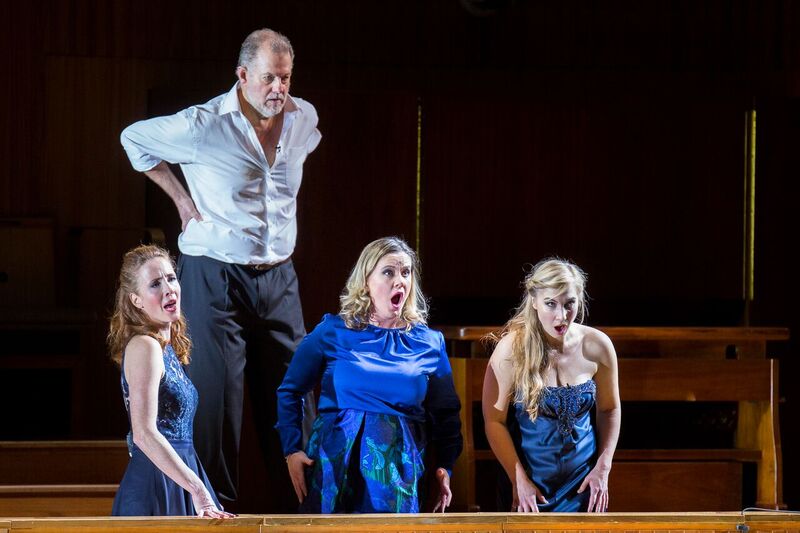
Dvořák’s Stabat Mater is clearly a favourite work for Jakub Hrůša. Six years ago he conducted it in this same hall, Berlin’s Philharmonie, with the Berlin Radio Symphony Orchestra; in 2023, it was the turn of the Berlin Philharmonic. Hrůša has called the piece a ‘wonderful gift’; he, a fine team of soloists, chorus, and orchestra in turn offered a wonderful gift to the audience with this performance. If the work, like many others, is not without unevenness, much of it has the composer firing on all cylinders. At a time when, even by current standards, our world is overwhelmed with grief, it will surely have spoken clearly and directly to many. It certainly did so to me. 

A first movement of quite extraordinary power did so from the outset. Hrůša and the orchestra offered a translucent introduction, elemental without Brucknerising, chromatic descending sequences grief-laden without sentimentality, leading somehow almost magically towards the entry of the chorus, which both emerged from and intensified such feelings, as clear of line as it was full of tone. I cannot imagine the climaxes have ever sounded more shattering. David Butt Philip’s tenor entry similarly grew out of an extended what had gone before. If somewhat operatic, that is the nature of the piece; it became more so with impassioned singing from the full quartet. Hrůša’s formal command was unerring, a crucial matter in a work of this scale. The vocal quartet that followed was naturally more intimate in scale, though no less heartfelt. Splendidly declamatory singing from Corinne Winters had her come into her own, with Matthew Rose an excellent foil, Fasolt-like in sincerity, though building later to quite a fury. 

 ‘Eja mater, fons amoris’ quite properly offered moments where the mood lightened, not least through sheer delightfulness of orchestral playing, though the chorus’s repeated cries of ‘Fac’ were anything but light. There was some much needed choral and woodwind balm in ‘Fac, ut ardeat cor meum’, where it was lovely to hear the organ in softer passages too. But even that came in the shadow of imposing, implacable brass. Harmoniemusik in the following chorus, ‘Tui nati vulnerati’, set the scene for as close as we were come to gambolling lyricism, in Bohemian Brahms fashion, with shades of the darker, mahogany Brahms to come in the opening of the ‘Fac me vere tecum flere’. Butt Philip’s imploring reading and the choral singing shone equally. 

A venerable mainstay of musical crucifixion iconography, sharpened notes made their point in both chorus and orchestra in ‘Virgo virginum praeclara’. One certainly did not need to know or see; piercing could be heard and felt. Likewise in the throbbing pizzicato playing from lower strings, contrasting in almost sadomasochistic fashion with ravishing bowed violins and woodwind, of the duet ‘Fac, ut portem Christi mortem’. Butt Philip and Winters blended and contrasted well as required. In the penultimate number, the only truly solo (without chorus) movement, mezzo-soprano Marvic Monreal offered characterful contrast, especially in her lower range. 

The final movement’s uneasy calm from soloists and orchestra paved the way for some truly radiant choral singing when reprising the opening material. Its ‘Amen’ still seems to me a little unsatisfactory as a conclusion to a setting of this poem; Dvořák’s more typically personal style sits a little awkwardly with its import. Ironically, if Rossini in his Stabat Mater at times adopted a jaunty, well-nigh postmodern dissociation from the poem, his writing here seems to me more congruent. There was no gainsaying the performance’s all-round excellence, though, and there are many worse things than being oneself—whether for Dvořák, Rossini, Schubert, or anyone else.


Sunday, 21 November 2021

Die Walküre, English National Opera, 19 November 2021


Coliseum

Siegmund – Nicky Spence
Sieglinde – Emma Bell
Hunding – Brindley Sherratt
Wotan – Matthew Rose
Brünnhilde – Rachel Nicholls
Fricka – Susan Bickley, Claire Barnett-Jones
Gerhilde – Nadine Benjamin
Ortlinde – Mari Wyn Williams
Waltraute – Kamilla Dunstan
Schwertleite – Fleur Barron
Helmwige – Jennifer Davis
Siegrune – Idunna Münch
Rossweisse – Claire Barnett-Jones
Grimgerde – Katie Stevenson

Richard Jones (director)
Stewart Laing (designs)
Adam Silverman (lighting)
Sarah Fahie (movement)
Akhila Krishnan (video)

Orchestra of the English National Opera
Martyn Brabbins (conductor)

Images: (C) Tristram Kenton
Siegmund (Nicky Spence) and Sieglinde (Emma Bell)

I wanted so much to like this more than I did. It is not quite ENO’s return to the Coliseum after you-know-what, but in many ways it felt like it. (A Philip Glass revival and a new production of Gilbert and Sullivan will have had their devotees, but they are not my potion of forgetfulness.) Anneliese Miskimmon, ENO’s Artistic Director, could not have been more welcoming in her brief address from the stage before the performance. And what could be a greater declaration of intent for a new era than a new Ring? Perhaps a Schoenberg or, still more so, a Stockhausen series? But even then, the Ring retains for many the status of non plus ultra. Its all-encompassing nature continues to surpass all competitors; no artwork has more to tell us, so it seems, at any juncture in our dubious human development.

No Ring is therefore going to be perfect; even the most exalted performance, let alone staging, will have imperfections. It would be too easy to judge perfection a lesser thing; it is not, necessarily, but it is a different thing—one which Mozart (often) has covered. Yet if a Ring in performance will always fall short, it should not fall so short as Richard Jones’s half-hearted attempt at a production, which detracted all too much from a mixed musical performance laying claim to not inconsiderable virtues. Perhaps more would have been gleaned had we seen Das Rheingold first. Starting with the second instalment is not without precedent, but I remain unconvinced that it is a good idea. Berlin’s Deutsche Oper has had to present Stefan Herheim’s new Ring as and when it can, but that is a different case, planned performances having to be cancelled, given without an audience, and so on. (How I long to see what Herheim has done!) Yet it is difficult to imagine that much light being shed on a Walküre (sorry, Valkyrie, as ENO obstinately continues to refer it) seemingly without a concept or indeed much of an idea at all. Presumably, money was tight, for what we see is not so much minimalism as people wandering a little lost around a stage that sometimes has scenery and sometimes does not. As in Jones’s recent, wretched La clemenza di Tito for the Royal Opera, there was a vague look: in this case, noir-ish ‘Scandinavia’, though it would be difficult to say anything more precise than that. ENO’s publicity suggests the idea that this is a family saga: well, sort of, I suppose, but only if that is taken to be the crucible for something greater. Use of video to show Alberich (‘Nibelung’ tattooed on his forehead), Grimhilde, and Hagen when referred to in Wotan’s narration—nothing more, just show them—seemed both patronising and pointless, though perhaps in a greater context it contributes to the banal theme of family feud. The appearance of Hunding’s clan on stage might have contributed further, but ultimately undirected (like so much else), they proved little more than a distraction, the lack of much to distract from notwithstanding.


Alberich (Jamie Campbell), Brünnhilde (Rachel Nicholls), Wotan (Matthew Rose)

Maybe the strange claim (Christopher Wintle) that opened one of the programme notes offered a clue to the lack of any exterior, let alone political element: ‘Most of us can agree that The Valkyrie is “about” incest.’ I do not know precisely to whom ‘us’ refers; certainly not to me, anyway. Wagner’s drama is no more ‘“about” incest’ than The Flying Dutchman is ‘about’ sailing. The point of Siegmund and Sieglinde’s love is that it breaks the violent, cruel bonds of marriage, family, and custom (which Wagner specifically identified with Fricka); that it leads Siegmund to reject immortality, and thus to put Brünnhilde on her way to doing likewise, to attaining the superior status of ‘purely human’; and precisely that it does not matter whether the Volsung twins are brother and sister, not that it does. Here, occasional straining towards a familial idea, for instance Hunding’s physical brutality to Sieglinde, seemed little more than striving after effect, given a lack of embedding in anything more than an IKEA catalogue. The production team sported more interesting clothes than those given to the cast; maybe they should have swapped.


Grimgerde (Katie Stevenson), Rossweisse (Claire Barnett-Jones),
and Siegrune (Idunnu Münch)


Or maybe they should have given them to the curious animals that pranced around the stage, Wotan’s ravens (I think) included: more Sesame Street than creatures of the forest. Whether the concept were malevolent or ironic, neither possibility was achieved. For some reason, a lone tap dancer did her stuff during the Ride of the Valkyries, whilst actors in horse costumes struggled around on tip toe. Why on earth Grane, understandably fidgeting, was made to balance in this way through the entirety of the final scene—and not only then—I have no idea; but then I have little idea about anything else either. Inability to set the stage ablaze at the close was attributed to a late intervention from Westminster City Council. Alas, Wotan’s protracted fumbling to attach to Brünnhilde a harness that would awkwardly suspend her above the stage, without the slightest sign of flames that had intermittently flickered earlier, seemed all too apt a metaphor. Quite what the Met, where Jones’s third (!) attempt at the Ring is heading, will make of it is anyone’s guess. It is certainly devoid enough of intellectual content to satisfy Friends of Otto Schenk. But the ‘look’, for that is all it is, and lack of discernible stage action will surely trouble many. 

Martyn Brabbins’s conducting was sane, measured, and doubtless sensitive—perhaps too sensitive—to the needs of his singers. Brabbins clearly appreciates the need to think in the broadest terms about Wagner’s structures, yet often seemed to confuse that with maintaining a slow speed throughout, occasionally changing gear when that could not conceivably be maintained any longer. A few understandable fluffs—every performance has them—notwithstanding, the ENO Orchestra played beautifully, if often in strangely subdued fashion, especially in the first act (!) I do not know how long it lasted in actual minutes, but it felt like the longest I had ever heard. By contrast, the third act often seemed rushed, if hardly short. This was clearly a work in progress, but there may be considerably more hope for improvement here than in the staging.


Brünnhilde

Had it not been for an initial announcement, no one would have known Nicky Spence was suffering from a cold. Siegmund is clearly a role for which he is ready—and for which he has well prepared. There are strength, vulnerability, and many other of the qualities we need, even in so unpromising a setting as this. It was difficult to discern much in the way of chemistry with Emma Bell’s Sieglinde; nor did this seem to be ironic or deconstructive detachment. However, considered on its own terms, her performance also impressed, indicative of a woman bruised yet determined to command her own destiny. Dart-playing Rachel Nicholls, lumbered with a strange skater-girl look, trod a fine, shifting line between Brünnhilde's youthful impetuosity and the glimmers of something more moving, more human—which is to say she understood what was at stake, even if Jones did not. Matthew Rose, lumbered with, well, being a lumberjack-turned-television-detective, offered a typically detailed and thoughtful performance as Wotan, though the third act did not show him at his strongest. These things vary from night to night. Brindley Sherratt's focus as Hunding varied too, though at its best it offered something darkly psychopathic. One of the strongest, most committed and sustained performances came from the team of Susan Bickley (finely observed, on stage) and Claire Barnett-Jones (also finely observed and with gleaming tone, from a box above) as Fricka. This, again, was a performance that truly used words, music, and gesture to suggest drama beyond Jones’s imagination.


So too did John Deathridge’s new singing translation. It was in many respects remarkably faithful not only to what Wagner said but, crucially, to what he did not, employing suggestion and ambiguity in the right places. It had an intriguing line too in something akin to Stabreim. Word order and stress played their part, as did various other considerations one might find—with profit—in reading Wagner’s own Opera and Drama. This did not, like many of ENO’s translations, attempt to draw attention to itself, still less to elicit inappropriate laughter; rather it participated in the dramatic effort in a way the singers and orchestra, if hardly the director, did. The sort of people who drone on about ‘the Coli’ and alleged halcyon days of Reginald Goodall will doubtless bemoan the lack of Andrew Porter, but their parochial concerns need not be ours.


Fricka (Susan Bickley) and Wotan

‘Mark well my poem,’ wrote Wagner to Liszt in 1853, enclosing a copy of the Ring in verse; ‘it contains the beginning of the world and its end.’ One might argue that beginning(s) and end happen elsewhere in the Ring; but were this the generic television ‘show’ from which Jones & Co. appeared to have taken non-inspiration, it seems doubtful, even in the unlikely event of a decision to renew for another ‘season’, that many viewers would have been remaining. To achieve not only an Annunciation of Death, but an entire Walküre, in which nothing whatsoever seemed to be at stake, was a peculiar, perverse and strangely pointless achievement. Either Jones needs to rethink—the prefix ‘re-’ may be too kind—or ENO should act decisively with courage and substitute another production or concert performances. With Wagner, in Wagner, much is or should be at stake.


Thursday, 20 June 2019

Boris Godunov, Royal Opera, 19 June 2019


Royal Opera House

Images: (C) ROH 2019/Clive Barda


Boris Godunov – Bryn Terfel
Andrey Schchelkalov – Boris Pinkhasovich
Nikitch – Jeremy White
Mityukha – Adrian Clarke
Prince Vasily Ivanovich Shuisky – Roger Honeywell
Pimen – Matthew Rose
Grigory Otrepiev – David Butt Philip
Hostess of the Inn – Anne Marie Gibbons
Varlaam – John Tomlinson
Missail – Harry Nicoll
Frontier Guard – Alan Ewing
Xenia – Haegee Lee
Xenia’s Nurse – Fiona Kimm
Fyodor – Joshua Abrams
Boyar – Christopher Lemmings
Holy Fool – Sam Furness

Richard Jones (director)
Miriam Buethner (set designs)
Nicky Gillibrand (costumes)
Mimi Jordan Sherin (lighting)
Ben Wright, Danielle Urbas (movement)
Gerard Jones (associate director)

Trinity Boys’ Choir
Royal Opera Chorus and Extra Chorus (chorus master: William Spaulding)
Orchestra of the Royal Opera House
Marc Albrecht (conductor)


Dmitri (David Butt Philip ) and Pimen (Matthew Rose)

Maybe there is something to be said after all for the 1869 version of Boris Godunov. There is obviously a huge amount to be said for what we see and hear, the problem lying in comparisons with later versions. However, unlike 2016, when Richard Jones’s production had its first outing, I actually felt – as opposed to being able to come up with an argument in my head – what particular virtues it might have. It no longer came across as the ‘sketch’ of which I wrote three years ago, so long as one were able to keep 1872, or indeed aspects of Rimsky-Korsakov, out of one’s mind. That I was, more or less, speaks perhaps of still more distinguished performances than last time around – and not only of greater receptivity on my part during Britain’s own, unending Time of Troubles.

Shuisky (Roger Honeywell) and Boris (Bryn Terfel)


That began, I think, at the top – or rather in the pit. Last time around, Antonio Pappano had offered one of his better performances at Covent Garden. Marc Albrecht, however, proved surer, more focused, more grimly fatal, aided by an Orchestra of the Royal Opera House on fine, impressively dark form. Just what this version in particular needs then: almost enough to have one shrug at losing the Polish act, if not quite the clock. The chorus, almost as much the opera’s foundation as the orchestra, was on good form too: the sound of Mother Russia and her tribulations resounding from and through multiple pasts: that of the historical Boris Godunov, nineteenth-century reinventions, and our own. The rawness of its cries certainly brought out that quality in Mussorgsky’s ‘original’ text. One could doubtless pick holes, were one so inclined; I admit my lack of competence to judge the Russian. Neither this chorus nor any non-Slavic one will ever quite attain that ‘Russian’ sound many have in their heads from recordings, some from performances too. But so what? This is an opera for the world; if your sole objection is that it does not sound as you ‘feel’ it should, based upon what you have heard before, then perhaps the fault may lie with you. Nationalism may help to ground nineteenth-century opera; it should have no place in twenty-first-century performance and reception.

Holy Fool (Sam Furness) and children's choir

The same goes for the stage performances too, most highly distinguished on their own terms. Bryn Terfel’s portrayal of Boris seemed to me to have developed considerably from last time, though it had had much to offer then too. In some ways, his facial expressions, his haunted demeanour, their combination with vocal delivery seemed to have drawn closer to a great, non-Russian predecessor in the role, John Tomlinson (seen at Covent Garden under Semyon Bychkov in 2003). Not that this was anything other than Terfel’s own portrayal, of course. As Varlaam, Tomlinson himself proved in finer vocal fettle than I had heard for some time, his as fully committed a performance as we have come to expect over the years. It was, perhaps, Matthew Rose as Pimen who offered the finest vocal performance of all, the monk and chronicler – apparently innocent, but who knows? – brought vividly to life with surpassing vocal radiance. David Butt Philip’s Grigory benefited from a typical detailed, intelligent performance, with Roger Honeywell a properly wheedling Shuisky. This was a Boris with no weak links, cast from depth, other impressive performances coming from Jette Parker Young Artist, Haegee Lee and treble, Joshua Abrams, as the doomed ruler’s children. Sam Furness's Fool rightly held sway in his scene - and perhaps swayed the tsar too.

Boyars, Pimen, and Boris

Jones’s production has much to be said for it, especially when compared to more recent stagings I have seen from him (Katya Kabanova and La Damnation de Faust, for instance). The ritual re-enactment above of Dmitri’s assassination not only chills, but imparts unity and immediacy. That we see the re-enactment re-enacted, or threatened to be, below too heightens the sense of never-ending sorrow, of political and cultural impossibility. The red hair that marks out erstwhile and present Tsarevichi, as well as pretender Grigory, is but the most visible strand that seemingly marks out the fate of all. Lightly nineteenth-century dress reminds us, like Pimen’s chronicle, here literally writ large, that this is a contested history, in which generation after generation, not least those of Pushkin and Mussorgsky, will continue to rewrite to their own purposes. There is no peace in Russia, no peace in the world at large. It is not, perhaps, a production that has a great deal to say in and of itself, but it amply permits us to continue on our sorry path, both as chroniclers and readers.

Murder of Tsarevich Dmitri

With that, it is goodbye to the Royal Opera House for me for a little while. Next month, I shall leave the country again for a while. Will the ‘will of the people’ to which Boris attributes the Tsarevich’s death continue to prevail? As much and as little as ever. Who will be tsar when I return? A Godunov, a Shuisky, a Romanov? May God have mercy on the souls of the crowd, if not those whose Kremlin machinations have done this to us.


Wednesday, 19 December 2018

BBC SO/Gardner - Berlioz, L'Enfance du Christ, 17 December 2018


Barbican Hall

Karen Cargill (mezzo-soprano)
Robert Murray (tenor)
Etienne Dupuis (baritone)
Matthew Rose (bass)

Members of the BBC Singers
BBC Symphony Chorus (chorus master: Neil Ferris)
BBC Symphony Orchestra
Edward Gardner (conductor)


L’Enfance du Christ is not an Advent work, but since most of this country’s musical institutions shut down over Christmas, Advent is probably the only chance we shall have to hear it – and even then, only on occasion. But then Messiah is a Lenten work, and yet… There was certainly much for which to be grateful in this BBC SO performance. An initial tendency, heard for instance in the first scene’s Marche nocturne, for Edward Gardner to drive Berlioz’s music too hard, was mercifully not maintained. Indeed, as time went on, Gardner’s tempi relaxed more, greatly to the music’s benefit. The BBC Symphony Chorus’s singing, at the outset a little woolly, sharpened up too. If orchestral colours tended to be stronger on individuality then on blend, that was only a tendency, with plenty of exceptions, not least the opening woodwind recitative, in which the orchestra, Robert Murray, a fine Narrator, drew us in, his entry and that of the strings having the drama gather pace nicely and without exaggeration.


There is something enduringly and endearingly strange to any ‘sacred’ or perhaps better ‘religious’ work by Berlioz. Just as much as with the Requiem, it is perfectly clear, without his needing to say so, that he does not believe a word of it. If that stands very much in a grand, public, ceremonial tradition ultimately as empty as Robespierre’s Cult of the Supreme Being, this becomes an illustrated children’s story that is yet not for children. The vividness of the writing and, one hopes, the performance too has characters, scenes, even locations stand out from the pages, but the lack of belief – not hostile, just ‘as it is’ – remains. That presents its own very particular challenges to the performers, challenges to which they rose very well. Herod’s Aria, for instance, sung darkly and clearly by Matthew Rose, ‘accompanied’ by due orchestral darkness too, might have been sung by a Shakespearean king; it was difficult not to think of parallels in the writer Berlioz loved above all others. In the ensuing scene with the soothsayers, the clarinet first commenting on, then seemingly confirming, the king’s dream, much must be accomplished by instrumental means alone, the ‘stage directions’ acting ‘as if’ there were a stage, written explications to musical ‘illustrations’. Such was certainly the case with the ‘cabalistic’ movements of the soothsayers as they moved to conjure the dark spirits to be ‘appeased’. A dark, Theresa May-like tyrannical resolve was inculcated, heedless of the consequences: infanticide meant infanticide. Just after the Strong and Stable One had flounced out of Parliament ‘in real life’, so too did Herod walk offstage: ‘Malgré les crie, malgré les pleurs de tant de mères éperdues, des rivières de sang vont être répandues, je serai sourd à ces douleurs.’


Pastoral innocence was just what we needed as balm to such malevolence, and so we heard – even saw – it at the Bethlehem stable. Karen Cargill’s beautifully floated lines as Mary remained alert to Berlioz’s idiosyncracies. Joined by Etienne Dupuis, whose suave, stylish, yet heartfelt singing proved very much one of the evening’s highlights, this Holy Family gave us something we might or might not believe in, but which could certainly enchant. Berlioz’s tone-painting did likewise, although it had me think his strictures against Haydn in The Creation not without double standards. Joined by offstage members of the BBC Singers as angels, singing very much in a choral tradition of French semi-archaism, this was a scene not just of contemplation but of readiness to depart. It prepared us as well as the Holy Family well for the short second part: ‘La fuite en Egypte’, its Overture having me wonder again – as I had during Herod’s music – whether Mussorgsky knew the music and unconsciously had it in mind when at work on Boris Godunov. The Russian composer certainly cherished Berlioz’s treatise on orchestration. Sometimes a correspondence is just a correspondence; at any rate, parallels, such as they be, may be worth consideration. The celebrated ‘Shepherds’ Farewell’ flowed nicely, integrated rather than a ‘set piece’. Murray’s narration reminded us how stylish and meaningful his French singing could be; sweet toned too, it was really rather wonderful.


The third part, entitled ‘L’Arrivée à Saïs’, is indeed an arrival in more than a strictly narrative sense. The Holy Family, following malevolent calls, as May would have it, to GO HOME – ‘Arrière, vils Hébreux,’ shout the Roman and Egyptian Tories de leurs jours – nevertheless find shelter with fellow ‘migrants’: an Ishmaelite and his family. And yet – something that came across gently yet strongly in performance – this is not the end of the story. Anticipatory narration, clearly, vividly delivered by Murray and the BBC SO alike, is never quite fulfilled, events and sentiments in the Ishmaelite house – Berlioz’s fugal chorus especially relished – a challenge to us, to the readers of his picture-book to respond or, like many self-styled ‘Christians’, to cross to the other side of the road, with or without ‘citizens of the world’ abuse. Berlioz’s closing chorus, euphonious to a degree, sounded a gentle warning: ‘O mon cœur, emplis-toi du grave et pur amour qui seul peut nous ouvrir le céleste séjour.’ Will any of us heed it?


Monday, 29 January 2018

Das Rheingold, LPO/Jurowski, 27 January 2018


Royal Festival Hall

Images: Simon Jay Price


Woglinde – Sofia Fomina
Wellgunde – Rowan Hellier
Flosshilde – Lucie Špičkova
Freia – Lyubov Petrova
Fricka – Michelle DeYoung
Erda – Anna Larsson
Froh – Allan Clayton
Loge – Vsevolod Grivnov
Wotan – Matthias Goerne
Donner – Stephen Gadd
Fasolt – Matthew Rose
Fafner – Brindley Sherratt
Mime – Andrew Thompson
Alberich – Robert Hayward

Malcolm Rippeth (lighting)
Katie Thackeray (deputy stage manager)
Ted Huffman (consultant)

London Philharmonic Orchestra
Vladimir Jurowski (conductor)


It is, of course, quite an achievement in itself for a symphony orchestra to perform Das Rheingold or indeed any of the Ring dramas. It does not happen very often, not nearly so often as it should; for given Wagner’s crucial musico-historical position, this is music that should stand at the very centre of their repertoires – just as Beethoven should at the centre of opera orchestras’. One can envy the practice of many German orchestras, which play for both opera house and symphony hall, but envy does not necessarily take us very far. (Actually, as Alberich will show us, it does, but perhaps not in the best direction.) In a closer-to-ideal world, admitted Vladimir Jurowski in the programme, there would have been a theatrical production, but the Ring ‘would be the end of Glyndebourne as a venue – it would simply fall apart if we tried to squeeze the orchestra into the pit!’ Why an achievement to perform it, though? Because Wagner’s dramas offer a standing rebuke to neoliberalism. It is not that there is any lack of ‘demand’; look how performances, especially in Wagner-starved Britain, will often sell out within a few minutes. But however great the demand, they will not ‘pay for themselves’. They are a communal undertaking, explicitly intended and functioning as heirs, political, social, religious, and dramatic – the distinctions make no sense – to the Attic tragedy of Aeschylus and Sophocles. (For more on that, please click here.)


Moreover, for the London Philharmonic Orchestra to give such an outstanding orchestral performance, in what must be the first time many of its players will have performed the score, is again cause for thanks and rejoicing. The LPO strings could hardly have proved more protean, the variegation of their tone a challenge to many an opera orchestra, that variegation surely born in part of Jurowski’s strenuous demands. Detail was present and vivid to what sometimes seemed a well-nigh incredible decree. For instance, the brass spluttering as Alberich floundered in the Rhine, for instance, looked forward suggestively to Strauss’s critics in Ein Heldenleben. If the anvils did not sound as they might in one’s head, when do they ever? That was no fault of the excellent nine players on three sides of the stage. The Prelude sounded – and, given the pipes behind the stage – unusually organ-like: not just the timbres, but also the insistence on the E-flat pedal, quite beyond any I can recall previously having heard. Such was the revealing side of Jurowski’s tight leash and rhythmic (harmonic rhythm included) exactitude, Bruckner coming strongly to mind.

Fasolt (Matthew Rose), Freia (Lyubov Petrova), and Fafner (Brindley Sherratt)

And yet, as so often, Jurowski himself proved too unyielding, almost Toscanini-like, if on a lower voltage. His again was quite an achievement, given that this was the first time he had conducted the score. There is no reason to think that subsequent performances will not reap rewards. By the same token, however, it would be idle to think that this compared to a Daniel Barenboim or a Bernard Haitink, although it certainly knocked spots off the incoherent incompetence Wagner generally suffers under Haitink’s successor at Covent Garden. To Londoners who hear little or nothing else, this would rightly be a cause for rejoicing. Moreover, the sometimes almost caricatured formalism of Jurowski’s approach – I wondered at times whether he had been reading Alfred Lorenz! – was not without its rewards. Was structure, however, too clarified, even simplified? For every revealing instance of opposition between different varieties of thematic material – Fricka’s disruptive, recitative-like ‘Wotan, Gemahl’, for instance, amidst Wotan’s orchestral dreaming of Valhalla – there were at least two passages that were distinctly subdued, almost as if concerned that the orchestra would threaten audibility of the singers. (It never did, by the way.) It was wonderful to hear so much harp detail as the gods crossed the rainbow bridge, and there is certainly good, Feuerbachian dramatic reason to emphasis the unreal beauty of the fortress and the path thereto. It need not, though, and surely should not come at the expense of its sacerdotal power. Novelistic, almost domesticated narrative sometimes threatened, in a dialectical turn, the integrity of musico-dramatic form. Yes, this is epic, yet it is anything but undisciplined. Das Rheingold, however, is a very difficult work to bring off: in some ways more so than the subsequent Ring dramas. Even Barenboim has sometimes erred a little too much towards Neue Sachlichkeit here. That there was a good deal to engage with critically, however, the foregoing merely illustrative, suggests that Jurowski’s Wagner is and will continue to be something to take seriously.

Alberich (Robert Hayward) and the Rhinemaidens (Sofia Fomina, Rowan Hellier, Lucie Špicková)


Vocally, as will almost always be the case, the bag was mixed. I could not resist the sense that, to a certain extent, at least Matthias Goerne’s Wotan was a little too much reliant on stock emotionally stunted sociopathy. Only towards the end, after the arrival of Anna Larsson’s typically excellent Erda, did he seem more truly ruminative. That is a crucial moment, of course, in his road towards Schopenhauerian conversion, but Wotan is never merely a figure of force. ‘Nicht durch Gewalt!’ is, after all, his injunction to Donner.  Robert Hayward’s Alberich went awry a few too many times; at his best, however, he proved darkly impressive. The giant pair of Matthew Rose and Brindley Sherratt also duly impressed as Fasolt and Fafner, the lovelorn brother genuinely moving, the sheer malevolence of Fafner at and after his death chilling indeed. Vsevolod Grivnov and Adrian Thompson offered detailed, dramatically alert ‘character tenor’ portrayals of Loge and Mime respectively, Allan Clayton’s light, bright-toned Froh a proper contrast. Michelle DeYoung’s Fricka, often imperious, was sometimes a little on the wobbly side, but there was little harm done in that respect, nor in the not dissimilar case of Lyubov Petrova’s cleanly sung Freia. Above all, there was a fine, almost Mozartian sense of conversation in passages of much dramatic to-and-fro. If only there had been a little more conventional drama. There nevertheless remained much to admire – and far from only because it happened at all.

Loge (Vsevolod Grivnov)

Sunday, 18 December 2016

Der Rosenkavalier, Royal Opera, 17 December 2016


Royal Opera House


Images: © ROH. By Catherine Ashmore

Die Feldmarschallin, Fürstin Werdenberg – Renée Fleming
Der Baron Ochs auf Lerchenau – Matthew Rose
Octavian – Alice Coote
Herr von Faninal – Jochen Schmeckenbecker
Sophie – Sophie Bevan
Jungfer Marianne Leitmetzerin, Noble Widow – Miranda Keys
Valzacchi – Wolfgang Ablinger-Sperrhacke
Annina – Helene Schneidermann
Police Inspector – Scott Conner
The Marschallin’s Major-domo – Samuel Sakker
Faninal’s Major-domo – Thomas Atkins
Italian Singer – Giorgio Berrugi
Milliner – Kiera Lyness
Innkeeper – Alasdair Elliott
Notary – Jeremy White
Animal Seller – Luke Price
Doctor – Andrew H. Sinclair
Boots – Jonathan Fisher
Noble Orphans – Katy Batho, Deborah Peake-Jones, Andrea Hazell
Marschallin’s Lackeys/Waiters – Andrew H. Sinclair, Lee Hickenbottom, Dominic Barrand, Bryan Secombe
Mohammed – James Wintergrove
Leopold – Atli Gunnarsson
Hairdresser – Robert Curtis
Baron Ochs’s Retinue – Thomas Barnard, Dominic Barrand, Nigel Cliffe, Jonathan Fisher, Paul Parfitt, Bryan Secombe
Musicians – Andrew Macnair, Andrew O’Connor, Luke Price, Alexander Wall
Coachmen – Thomas Barnard, Nigel Cliffe, Jonathan Coad, Christopher Lackner
Dancers, Actors, Child Singers

Robert Carsen (director)
Paul Steinberg (set designs)
Brigitte Reiffenstuel (costumes)
Robert Carsen and Peter van Praet (lighting)
Philippe Giraudeau (choreography)


Royal Opera Chorus (chorus master: William Spaulding)
Orchestra of the Royal Opera House
Andris Nelsons (conductor)


If Der Rosenkavalier subtly counsels us against nostalgia, walking us through our own constructionism and that of others, layering further experience and memory, real, imagined, or more likely, somewhere in between, this new Royal Opera production unwittingly offered something of a countervailing argument. As we are now so wearily aware, the United Kingdom’s cultural inferiority and isolation are likely only to increase over the coming months, nay years, of Maying. Very few will care; of them, many will decamp to what was once quaintly known as ‘the Continent’; others will not unreasonably seek a degree of refuge in other, actually better times. Only the truly ignorant, of culture and of history, would hold out any hope for this miserable island’s prospects, having ‘taken back control’. Likewise, for all the gloss we saw, far less often heard, on stage, only those ignorant of operatic life ‘abroad’, and indeed in earlier years here in London, would fail to feel, at best, regret.  


Trailed unofficially as Renée Fleming’s farewell to the Covent Garden stage, the production suggested that it was not before time. Fleming has never been much of an actress, although she retains an undeniable presence. (Big, expensive costumes doubtless help, especially in the third act, but it is not just that.) There were, to be fair, moments in which she danced along to the (somewhat fitful) waltzes in the first act, but otherwise, there was little beyond generalised and sometimes downright inappropriate facial gestures. Her inability not only to project but even to sustain her lines, hardly helped by perversely dragging tempi from Andris Nelsons whenever she set foot on stage, made for a sad experience indeed, however much the fans may have oohed and aahed at her wardrobe.


The Marschallin (Renée Fleming), Sophie (Sophie Bevan)


Nelsons was at least as much at fault. He has conducted the opera before, but it often did not sound like it, the performance suggestive of a superior run-through, even sight-reading. Having opened in strangely aggressive fashion, he ground the first act to a halt. Once the Marschallin’s retinue had been dispersed, the remainder felt like an act, and a tedious one at that, to itself. Whether he were responding to Fleming, or somehow trying to highlight her aurally, I do not know; it certainly did not work. Too often, phrases were simply left hanging, even disintegrating. If the second act and earlier sections of the third – infernal cuts notwithstanding – marked a great improvement, listlessness was again the order of the day, as we drew ever so gradually to a close. Time was – yes, I know stopping the clocks will not help us – when the Orchestra of the Royal Opera House could sound not unlike one of its great ‘Continental’ cousins. Perhaps it still can, under, say, Semyon Bychkov. However, it is now well-nigh impossible to ignore the long musical decline of the house since the departure of Bernard Haitink. There were a good few moments of glorious sheen, but there was a good deal of scrappiness too. Viennese idiom, such as it was, too often sounded forced. Go to Dresden, to Berlin, to Munich, even, on a good day, to Vienna, go indeed to many a smaller German theatre, to hear what this score and others can sound like. And listen to a conductor such as Christian Thielemann, almost always at his best in Strauss, to hear how infinite flexibility can, indeed must, be married to a sense of the whole; or listen to the great conductors of the past, to Karajan, to Krauss, to Kempe, to the Kleibers, perhaps even, if feeling truly adventurous, progressing to a conductor whose name did not begin with ‘K’.


What of the rest of the cast? Alice Coote’s Octavian was a bit of a loose cannon (with apologies to the extravagant World War One recreations chez Faninal). At her best, she offered a spirited, rich-toned performance; at other times, there was a distinct lack of focus. Whether the relative lack of refinement dramatically were Coote’s or director, Robert Carsen’s idea, it was not, I am afraid, a good one. Matthew Rose’s Ochs was much better: less the boorish oaf, more the slightly, but only slightly, past-his-sell-by-date country cousin, who could still summon up a soupçon of charm when he made the effort. Sophie Bevan’s Sophie was very much in line with (welcome) contemporary fashion: her own woman, with agency, no mere annoyance. Her vocal performance was not bettered and rarely approached by others on stage. All, however, should be thanked for their excellent diction; Hofmannsthal’s words could always be clearly discerned. (That goes for Fleming too.)

Ochs (Matthew Rose)
 

Jochen Schmeckenbecher’s Faninal seemed oddly subdued, at least vocally; I wondered whether he would have been happier in a smaller house. It was a pity to hear coarseness creeping into Giorgio Berrugi’s rendition of the Italian Singer’s aria, but the many, many ‘smaller’ roles were generally well taken, Perhaps the most noteworthy for me were Helene Schneidermann’s cleverly scheming Annina, Alasdair Elliott’s outrageous Innkeeper as transvestite Master/Mistress of Ceremonies, and Scott Conner’s calm, confident Police Commissioner. (One might well understand why the Marschallin departed with him rather than with Faninal, although I am not sure that it made a great deal of dramatic sense here.)


Carsen’s production is a frustration, and not only because it runs dangerously close to his earlier staging, for the Salzburg Festival, although divergences often intrigue; such layering of reception is surely not inappropriate for such a work. However, the first and second acts seem – not in a knowing way – to rely too much on former glories, coming across as attempts to make a former, sharper production look different. (Did those I heard loudly praising Carsen know his earlier production? I have my doubts.) Designs from Paul Steinberg and Brigitte Reiffenstuel, however impressive in themselves, are made to do too much of the work. The note of ambiguity concerning where, or rather when, we are during the second act, is, however, an excellent touch. Are we gearing up for war, uniforms and indeed the aforementioned weaponry ever-present? Or, are we to understand from the field medical assistance afforded Ochs, that we are now in its midst? The trench movements of Ochs’s retinue (on leave?) certainly suggest so. Alternatively, might this be an imagined future from the Marschallin’s comfortable 1911?


The third act sets its impressive seal on such ruminations, or at least the first half of it does. Initially, it too seems as though it might follow earlier Carsen too closely, but wisely, no attempt is made to replicate the extraordinary Salzburg visual spectacle of multiple brothel rooms (nor, indeed, the horse). We seem to have moved, or imagined ourselves, into the 1920s, to a world in which sexual ‘decadence’ and ‘depravity’ (for those of a ‘Brexit’ disposition, in any case) run riot, whilst still recognisably, increasingly so, a projection from where we began (and indeed may still 'be'). Octavian’s, or rather Mariandel’s, forwardness, is perhaps the most intriguing development. Where she ‘should’ be a (relatively) innocent victim, here this ‘virgin’ promises to take Ochs to places he may never have dreamed of, or at least would rather not have done. The already fascinating sexual politics of the opera take another twist, such as would surely have shocked the straitlaced Benjamin Britten, who apparently disapproved of its ‘lesbianism’ (!)


Alas, the rest of the act, whether knowingly or otherwise, simply offers relative withdrawal, as it were. A large stage and a large bed are its focus, Octavian and Sophie rather unnecessarily beginning to further their acquaintance. The parallel created with the opening scene need surely not be presented with quite such heavy-handedness.At the very close, it seems as though we shall truly return to Salzburg, where a gunshot frighteningly heralded the coming of war. (That production stayed where it was, rather than peering into the future, as Carsen does here.) The reappearance of cannons, seemingly pointed at a drunken Mohammed, suggest something similar, but instead they misfire (perhaps an all too telling metaphor), soldiers falling bathetically to the ground themselves, and the liveried servant continues along its way. I think I can discern a point being made here, but it is not made very clearly.

Mohammed (James Wintergrove)
 

Another baffling aspect relates to, what seems to be a kleindeutsch rather than an Austrian setting. (The message of the paintings we see, visual art so often a Carsen device, is ambiguous.) I am afraid I found myself baffled by visual references to the ‘other’ Kaiserreich and its successor republic. The antics of the tavern seem very much of Weimar. Even the Grecian frieze of the Faninal mansion looks more Berlin than Vienna. (To my, perhaps vulgar eyes, it does not look so very nouveau riche, more akin to a Wilhelmine museum room.) Is a point being made about Strauss’s native Bavaria, perhaps even Strauss himself, having made the ‘wrong’ choice? If so, it remains obscure. There is, all considered, simply too much that is either too obscure or too obvious, suggestive, rightly or wrongly, of an unwelcome degree of directorial haste.


In many respects, then, this proved a missed opportunity, laced with tantalising hints of how much better things might have been – might still be, if only they/we were to get our act together. It could have been far worse; perhaps it might improve during the run; and yet… It was, one might say, a ‘soft Brexit’ Rosenkavalier, albeit with hints of our Poundland Fürstin Resi’s ‘red, white, and blue’ variety. Note to directors: do not, under any circumstances, accept my Konzept. It will neither end nor even start well.