Showing posts with label Die Walküre. Show all posts

Tuesday, 7 July 2026

Munich Opera Festival (4) - Die Walküre, 1 July 2026


Nationaltheater


Images: Monika Rittershaus


Siegmund – Joachim Bäckström
Hunding – Ain Anger
Wotan – Nicholas Brownlee
Sieglinde – Irene Roberts
Brünnhilde – Miina-Lisa Värelä
Fricka – Ekaterina Gubanova
Helmwige – Dorothea Herbert
Gerhilde – Julie Adams
Ortlinde – Elaine Gvritshvili
Waltraute – Claudia Mahnke
Siegrune – Niina Keitel
Rossweiße – Christina Rock
Grimgerde – Natalie Lewis
Schwertleite – Noa Beinart
Loge – Charith Pidikiti

Director – Tobias Kratzer
Assistant director – Matthias Piro
Designs – Rainer Sellmaier
Lighting – Michael Bauer
Video – Manuel Braun, Jonas Dahl, Janic Bebi
Dramaturgy – Bettina Bartz, Olaf Roth

Bayerische Staatsorchester
Vladimir Jurowski (conductor)


As a student in Berlin, Ludwig Feuerbach attended lectures from, among others, GWF Hegel and Friedrich Schleiermacher: far from an unusual combination, but prophetic for his subsequent development as the pre-eminent Young Hegelian philosopher of love-communism. Although he lectured at Erlangen, Feuerbach failed to obtain a university position, an ambition rendered impossible following revelation of his authorship of the atheistic Thoughts on Death and Immortality published anonymously in 1830, a year in which revolutions once again began to sweep Europe. His writings, including those Thoughts, The Essence of Christianity, and Principles of the Philosophy of the Future, inspired many radicals in the next wave of revolutions (1848-51), although Feuerbach remaining personally aloof from revolutionary activity. One of those, of course, was Richard Wagner, who, shortly after publication of Feuerbach’s Thoughts, had gained his first experience, direct and reported, of revolution, inspired by events in Paris, Leipzig, and even the previously quiescent Dresden. The seventeen-year old Saxon would recall in his autobiography Mein Leben ‘the world of history’ having come to life: ‘Saxony was not spared: in Dresden it even came to street-fighting’. He began to attend Leipzig University lectures on philosophy and aesthetics, and henceforth considered himself a ‘fervent partisan of the revolution’. Wagner would go on read at least all three of the Feuerbach books named above and, in contrast to one of his great intellectual mentors, stood anything but aloof from revolutionary political activity—be it in practice, during the 1849 Dresden uprising, or in the fruits of his post-revolutionary exile in Zurich. Among those were The Artwork of the Future, dedicated to Feuerbach, its very title a homage, and of course Die Walküre, perhaps his single most Feuerbachian drama—in that the positive, as well as negative, side of a religion purer than yet related to Christianity, founded on love, features most strongly in the love of Siegmund and Sieglinde, and Brünnhilde’s conversion to their creed, crucially at the ‘price’, in reality an elevation, of losing her own immortality. 

With this Walküre, newly premiered, Tobias Kratzer’s Munich Ring reaches its second instalment. I was unable to see Das Rheingold; but on the evidence of this, as well as much of his other work – his near-universally loved Bayreuth Tannhäuser, various Deutsche Oper productions, and more – I hope to put that right before long. Even considered on its own, Kratzer’s Walküre has numerous distinctions, but perhaps its most distinctive feature, at least until the third act, is a more overt Feuerbachian element than any other I can recall. I suspect it would seem so all the more in light of the Rheingold, but that must remain a matter of speculation by now. What it certainly does is put the gods, even here, centre-stage, not only as ‘the gods’, characters in this drama, but emphatically as gods—and emphatically not, as Ernst Bloch put it, ‘called gods without being gods’.


The curtain rises on a rural, possibly suburban chalet; by deduction, it may be somewhere outside Munich, though it need not be. This, of course, is Hunding’s house, at the end of the driveway a quasi-Marian shrine, albeit to Fricka. That is, Kratzer follows Wagner absolutely in presenting a dramatic critique of religion, mostly yet not only Christianity, albeit shrouded, as it were, in the guise of Germanic paganism. (Wagner is doing other things with reference to the Eddas and sagas too, but he is certainly doing that, in unambiguously post-Feuerbach fashion.) It is here, under Fricka as well as Hunding, also under a larger, indoor ecclesiastical shrine, not unlike a tabernacle or reliquary, perhaps denoting the rule of Valhalla/religion/Christianity more generally, that Siegmund takes refuge. Sieglinde is clearly a member of this religion too, since she genuflects before the shrine even when Hunding has gone—and, initially shamefully, later with abandon, celebrates her wholesale abandon(ment) only after covering it. When, in the second act, Wotan comes to earth, like the gods of old (though also, if we believe the New Testament, ours too), he is distressed not only by Fricka’s demolition of the new religion he has ultimately inspired, but by the destruction of the shrine within: his old religion, one might say. Just as Wagner’s god is torn, so is he, visibly as well as audibly so.


That Hunding, whose cause Fricka takes, should be a devotee of her understanding of this religion – sect, perhaps – will surprise no one, but it is clear, not assumed. She even recognises herself in it; I am tempted to add, in Biblical style, ‘and it was good’, save that obviously it was not for humanity. We even see a ram, albeit a dead one; hers is a chariot, if only metaphorically, of death—as in Wagner. When death occurs, moreover, it is unquestionably violent; we are no more spared than its more direct victims. When Wotan, in anger, bids Hunding kneel before Fricka, Wagner’s goddess of ‘custom’ (as he explained in a letter to August Röckel), the bourgeois property- and motor-owner does just that: not something I have seen before. She and other gods – I assume, Froh, Donner, and Freia – whom we have already seen, in a drawing projected at some point during Wotan’s monologue, observe events on the battlefield. Dressed in designer Rainer Sellmaier’s mediaeval, even Burgundian-Nibelungenlied garb, they offer strong connection to the mediaevalism of work, Wagner’s selection and adoption of sources, and to the hostile, Young Hegelian critique of church and state such as had been mystically united in states such as the Prussia of Frederick William IV.


Another such example, if less fanatically so, was the Saxony in which Kapellmeister Wagner threatened to burn it all down—and took delight in seeing just that in his opera house: ‘8 May (Monday) Morning once again by roundabout route via barricades to Town Hall. At S. Anne Barricade guard shouts “Well, Mr Conductor, joy’s beautiful divine spark’s made a blaze.” (3rd perf. 9th Symphony at previous Palm Sunday concert; Opera House now burnt down. Strange feeling of comfort.)’ Another important point, I suspect, from Wotan’s monologue: in his proto-Parsifalian wandering, he passes a church. Out of it ran two hooded figures, disaffected youth, it would seem. Something within me wondered whether one might be Alberich, in the one Ring drama in which he ‘should’ not appear onstage. I think it was, for during the Ride of the Valkyries, a hooded figure with child, surely Hagen, watches. We shall see. To be reminded, at any rate, of Wagner’s contemporary and fellow Feuerbach enthusiast (for a while), Marx, and his more or less contemporaneous observation, in explicit Young Hegelian critique of Hegel, that ‘the relationship of industry [Alberich] and, in particular, the world of wealth to the political world [the gods] is one of the principal problems of modern times,’ was salutary—and I should be surprised to learn that it had merely been my interpretative fancy. 

So far, so excellent—all accomplished in fine Personenregie and response thereto. This is no mere concept; it is an absorbing drama. That of the third act is hardly less so in the latter respect, although it seems strangely distant from what has gone before. Perhaps more will be revealed in Siegfried or Götterdämmerung, but once past a video ‘Ride’ that took in much of Munich, Brünnhilde at the helm of Apocalypse Now helicopter, an original ‘Bavarian host’ of the Siegestor, thus returning to source as it were. Naturally, the local audience loved it, and why not, numerous aspects of the city eliciting gasps of recognition and, less laudably, actual applause. Surely one can appreciate a coup de théâtre or de cinéma without Pavlovian response. That nonetheless we should end up in the Nationaltheater may have particular warrant, given it was here that, against Wagner’s wishes, Ludwig II had it all begin. Perhaps Kratzer anticipated the applause or such reaction, and turned it against the audience avant la lettre. We can read it that way anyway. And perhaps subsequent events will play out more fully in that respect—and not too closely to Stefan Herheim’s metatheatrical Deutsche Oper Ring. But it seemed a slight pity. There is still much to admire in the emergency repair work – and religious rebirth? – offered by Valkyrie body-snatchers to heroes, as well as in the passionate direction and portrayal of Wotan and Brünnhilde thereafter. That the demi-god Loge appears as bidden, with flame, at the close, ties all neatly together. Yet I could not help but think – this is really my sole cavil – a more apt setting might have been found, unless the point be that the opera house is now our dubious temple. If so, I shall happily recant; again, we shall see.


In one sense, though, even that helped point, in the unlikely event anyone should have needed pointing, to the truest heroes of all: the orchestra that first performed this work. Wherever you may have heard it, in Berlin, Bayreuth, Dresden, Vienna, or elsewhere, it is unlikely to have been played better than this. Strings were dark yet incisive, ‘old German’ in a way Furtwängler might have recognised, ‘dramatic’ in a way Boulez might have done. The rest of the playing was equally outstanding, the Ride far more than showpiece, but rather quite rightly a symphonic movement taking its place in Wagner’s dramatic whole. Vladimir Jurowski’s conducting had its moments in better and worse senses. To begin with, too often one could hear as well as see him conduct. Wagner became a miniaturist in a sense too close to Nietzsche’s jibe. It was all too effortful, though to Jurowski’s credit, he never tried to get this great orchestra to sound like anything other than itself. The third act was more at ease with itself, with far fewer odd impositions upon it; it flowed in a way closer to the Rhine (or Isar) and thus the orchestra’s mysterious, Delphic oracle sounded more unbidden—save, in the eternal riddle, for who might have created its own gods.


Speaking of heroes, Joachim Bäckström made for a fine Siegmund, his chemistry with Irene Roberts’s increasingly ecstatic Sieglinde – what a foretelling of Siegfried she offered! – thrilling and, at times, disturbing to watch. For Kratzer did not follow Wagner in his understanding of incest. These twins, even the religious Sieglinde, were positively excited by the prospect of incest, as opposed to loving each other and its revelation not mattering. Again, film revealed some of the backstory, adding to rather than merely mirroring what we learned from narration—at least after the first, slightly disappointing instalment. Nicholas Brownlee’s Wotan we had thus seen and known already, his fireside sadness, seen by the siblings’ mothers, projected into a wise, multivalent portrayal of the ‘sum of present-day intelligence’ (Wagner on the character, immediately prior to starting work on the score of this opera).  

Ekaterina Gubanova’s imperious, haughty, godlike Fricka was all one might hope for, in general and in context. Ain Anger’s self-assured Hunding was no mere thug, though he was certainly given to violence; here was a man who knew his beliefs and his patriarchal rights, and was willing to fight for them. Miina-Lisa Värelä’s Brünnhilde’s journey to the brink of losing immortality absorbed us through excellent, Wagnerian command of words, music, and gesture. Other Valkyries offered singing and acting of the highest order. For not the least of the work’s and performance’s virtues was a celebration of Wagner’s Feuerbachian conception of the ‘purely human’ and its socialist expansion into a vision, political, social, religious and more, that only in cooperation might we begin to achieve our potential as a species.


Thursday, 22 May 2025

Die Walküre, Royal Opera, 17 May 2025


Royal Opera House

Siegmund – Stanislas de Barbeyrac
Sieglinde – Natalya Romaniw
Hunding – Soloman Howard
Wotan – Christopher Maltman
Brünnhilde – Elisabeth Strid
Fricka – Marina Prudenskaya
Gerhilde – Lee Bisset
Helmwige – Mauda Hundeling
Waltraute – Claire Barnett-Jones
Schwetleite – Rhonda Browne
Ortlinde – Katie Lowe
Siegrune – Catherine Carby
Grimgerde – Monika-Evelin Liiv
Rossweisse – Alison Kettlewell
Erda – Clare Almond
Actors – Illona Linthwaite, Lucy Brenchley, Clea Godsill, Maria Leon, Virginia Poli, Nadia Sadiq, Jay Yule

Director – Barrie Kosky
Set designs – Rufus Didwiszus
Costumes – Victoria Behr
Lighting – Alessandro Carletti

Orchestra of the Royal Opera House
Antonio Pappano (conductor)

The Royal Opera’s new Walküre proved very good in every respect, often excellent, offering some degree of solace for having come close to taking out a bank loan to buy a ticket. Our ultra-neoliberal, genocidal government will no more fund the arts than its kindred, ever-so-slightly-less genocidal, ever-so-slightly-more-separatist predecessor. As the last remnants of humanity crash down livestreamed before us, an historic half a million-plus citizens protesting but a stone’s throw away to stop the genocide in Gaza, Wagner’s message could hardly be more urgent. Will anyone listen? Doubtless. Will any of the people who need to listen do so? Almost certainly not, as signalled by the unpleasant experience of passing a key architect of Brexit Britain’s malaise, Michael Gove, on the stairs. What do these people think the Ring is about? It is a question as old as the work itself, but then the same question could be asked – doubtless was – in the theatres of Athens. A politically committed artist such as Wagner could not have been less concerned with l’art pour l’art: that was at best the world of actually existing opera houses and their ‘absolute music’. Such is never all we have, though sometimes it may feel like it. As once again, Wagner and his performers sought to ‘make clear to the men of the revolution the meaning of that [non-]revolution,’ it was possible, whatever the catastrophes outside and perhaps even on account of them, once again to be moved and challenged by Wagner’s drama in the theatre. 

I missed Das Rheingold, though if the final Götterdämmerung has not by then subsumed us all, I hope to catch up when the whole Ring is staged. Barrie Kosky’s outward-looking Kammperspiel of a Walküre seemed nevertheless to stand perfectly well on its own merits. Hallmarks not only of Kosky’s direction, indeed not only of the cast onstage, but also of Antonio Pappano’s direction of a splendidly responsive Orchestra of the Royal Opera House were listening and collaboration: qualities in shorter supply than ever as fascism deepens its grip with every day—over Starmer’s ‘island of strangers’. Trump’s politics-as-gameshow, and almost anywhere else one can think of in the benighted ‘West’ (and not only there). 

I have not been a fan of Pappano’s Wagner in the past; here, both his conducting and that orchestral response sounded transformed. (In retrospect, there may have been something of an augury in the unusually Wagnerian Turandot I heard him conduct in 2023, but the Ring is a challenge of quite another order.) Now it seemed to spring directly from the words – perhaps a little too much, rather than asserting itself as an equal partner – but, if one wanted an Opera and Drama Wagner, at least according to many readings, here it was. There was none of the orchestral scrappiness, none of the merely following (‘supporting’) singers that had bedevilled earlier Ring performances I had heard. (I skipped the last outing of Keith Warner’s Ring, or rather could not afford to go.) No Wagner performance, not even Barenboim’s or Furtwängler’s, will cover every base; this is music, as it is drama, that encompasses and suggests more than any one performance can. On its own terms, it convinced, and there was no doubting the strong relationship built with the production.   

Kosky’s production is in many ways straightforward, its overriding concept of the despoliation of Nature (chapter four of my book on the Ring) clear and fatally apparent. A tree and all that has been felled from it, presumably beginning with Wotan’s spear (in the work’s prehistory as recounted to us by the Norns in the Prologue to Götterdämmerung), offer the roots and present of the tragic calamity that has befallen this world. Designs, especially set and lighting, contribute powerfully, a black-grey-white colour scheme occasionally bloodied in red, for instance that on Siegmund as Wotan chillingly watches him expire. Perhaps at some level he cares; perhaps not. Ambiguity renders it all the more chilling. There is perhaps a touch of the actor-politician Zelensky to him: a fascinating figure, with whom the Nietzsche of The Case of Wagner would have had a field day. Continuation and re-emergence of that red, flowing from the tree and seeping into the scene with the Valkyries and their carts of heroes (also tree-like, Nature’s wholeness still just about intact), made its point unmistakeably. So did Wotan’s brutal violence: no Rheingold ‘Nicht durch Gewalt’ here, should we take it seriously. Even Fricka’s glamourous arrival in a vintage car, which could readily have seemed an expensive distraction, took its place against this backdrop, connected to it in clear musicodramatic terms, as did Beckettian emergence of characters, Endgame-like, from holes in the savaged tree in the final scenes of the second act. For all the fuss about Erda, her appearance seemed in many ways of lesser importance, though the painterly provision of her spring fruits at the end of the first act was a nice touch. The tree doubled as Brünnhilde’s rock; in lesser hands, that might have confused, yet here seemed perfectly in order, aided by interventionist surtitling. 

Binding together musical performance and stage direction was of course the cast, which worked together very well indeed—almost as if this were a repertory spoken theatre with singing, in which company members worked together day in, day out. This made for moments of extraordinarily powerful emotional impact: Sieglinde’s ‘Lenz’ jubilation; Brünnhilde’s quandary following Wotan’s monologue, spotlit simply in front of the curtain; her embrace of Sieglinde following her decision to defy Wotan; and above all, Brünnhilde’s sobbing on her separation for the rock. Natalya Romaniw and Elisabeth Strid offered powerful portrayals of our two heroines, if we may call them that, founded, like the performance as a whole, in a word-driven approach that proposed rather than detracted from musical possibilities. Stanislas de Barbeyrac’s subtle Siegmund grasped at vocal steel when required, a fine match for Soloman Howard’s Hunding-as-policeman, as rounded a portrayal as any I can recall, perhaps more so, with unforgettable physical presence. Christopher Maltman’s Wotan occasionally lacked heft, but more than often than not impressed, in another highly text-driven performance. Marina Prudenskaya seems always to offer a class act, and certainly did here as a proud Fricka, marshalling instrumental reason just as her consort has always done. Individual direction (and performance) of the other Valkyries was put to excellent dramatic ends, one daring to tarry, so as to confront Wotan with the heinousness of his deeds, only to be brutally dismissed. 

I look forward to Siegfried. 

Wednesday, 15 May 2024

Die Walküre, Deutsche Oper, 12 May 2024


Images: Bernd Uhlig (from 2020 premiere, with a different cast)


Siegmund – Daniel Frank
Sieglinde – Elisabeth Teige
Hunding – Tobias Kehrer
Wotan –Derek Welton
Fricka – Annika Schlicht
Brünnhilde – Ricarda Merbeth
Siegrune – Arianna Manganello
Roßweiße – Karis Tucker
Gerhilde – Felicia Moore
Ortlinde – Maria Motolygina
Waltraute – Elissa Pfaender
Helmwige – Flurina Stuckl
Schwertleite – Alexandra Ionis
Grimgerde – Nicole Piccolomini
Schwertleite – Lauren Decker
Hundingling – Eric Naumann

Director – Stefan Herheim
Revival director – Silke Sense
Set designs – Stefan Herheim, Silke Bauer
Costumes – Uta Heiseke
Video – William Duke, Dan Trenchard
Lighting – Ulrich Niepel
Dramaturgy – Alexander Meier-Dörzenbach, Jörg Königsdorf

Orchestra of the Deutsche Oper 
Nicholas Carter (conductor)

What if the Volsung twins did not engage our sympathies so fully as they usually do? What if their actions were less positive than we tend to think? Sometimes, recently, those questions have been posed implicitly by what still seems to me a strange desire positively to reassess the Fricka of Die Walküre. Not that Wagner is the only point of reference here, but the Ring’s creator was very clear on this, both in the work ‘itself’ and in other writing. A letter to Theodor Uhlig (12 November 1851, so before he had started work on the music) speaks of Wotan’s ‘struggle with his own inclination and with custom (Fricka)’ and indeed Fricka herself refers to ‘the guiding rope of custom, rent asunder,’ which she would ‘bind anew’. Latterly, some seem to have decided to take the part of Fricka’s family-values morality. Like every character – this is part of Wagner’s greatness – Fricka is given her due, and should be in performance. A caricature, whilst tempting, will get us nowhere. What I took from the first act of Stefan Herheim’s Walküre – thus before her reappearance – was something slightly different: a willingness, refreshing if unsettling, to challenge the dominant narrative concerning Siegmund and Sieglinde, a challenge to which Fricka would assent, albeit for different reasons. Sieglinde has still been deeply wronged, of course: the evening begins with her, traumatised, unable to make the central stage piano sound. Only after several fruitless attempts does the orchestra launch its storm. It is a questionable pursuit in ‘real life’, of course, to cast doubt on how trauma may manifest itself; perhaps the same should be the case here. That said, many of Siegmund and Sieglinde’s acts seem designed to dissipate sympathy, from her insistence on kissing him far too ‘early’ and in front of the mute Hundingling (her child with Hunding, I presume), to her murder of him who, starved of affection from his father seems only to wish to find a new family with his mother and her new lover. That Siegmund too rejoices in that act underlines the predicament. His holding Hunding earlier at knife point also reverses roles somewhat. Ultimately, the strength both of acting and Personenregie (seen also, for instance, in the individual treatment of the Valkyries) made a case for reassessment. So too, arguably, did the doubt –preconceptions properly challenged – I continued to feel. The framing is powerful and provocative; that is what matters most.


Likewise or at least related, in the third act, the true horror of what Wotan proposes for Brünnhilde, too readily sentimentalised, comes across more clearly than I can previously recall. Portrayal of male violence, especially sexual violence, against women onstage is a controversial issue now, and rightly so. Nevertheless, Herheim’s portrayal of Valkyries raped by a host of the undead – immortality and mortality a crucial theme for Wagner’s deeply Feuerbachian drama – underlines what the god intends for his ‘favourite daughter’, too often lost in final reconciliation. Hundingling, notably, has taken his place along them; what else, after all, could he have learned from his earthly sojourn? This scene seemed to alter the dramatic, perhaps even the temporal, proportions of the third act. The latter probably were objectively different too, conductor Nicholas Carter working in tandem with the production. Throwing the dramatic weight forward had the first two scenes seem considerably more substantial, the third a logical, still deeply moving outcome to its predecessors. The emotional torrent of Wagner’s – and the once more outstanding Orchestra of the Deutsche Oper’s – strings still registered keenly, yet a shadow rightly hung over what we heard and felt.


All around, refugee suitcases formed the set, reminding us of the external world encountered in Das Rheingold. A war zone is suggested, aptly for all that unfolds, the second as much as the external acts. These people’s reappearance and different reactions to what they saw reminded us we should not take ‘their’ reactions for granted, ‘othering’ them as an undifferentiated mass. These, like the characters of the Ring many are playing, are individual human beings, not some other species known as ‘migrants’. Wagner was a refugee too and expressed pride in having been so; so is Siegmund, always ‘geächtet’, as he puts it. And so too, we should remember, is Sieglinde, returning to her Medea-like act. We always feel sympathy for Medea, so should we not for this Sieglinde too? If not, why not? From where, we might ask, are they refugees? The world around us has all too many possibilities, as does history. So too does reception history: might we not understand them also as heirs to the ‘men and women moved to the very depths of their being’ at the end of previous Ring productions. Celebrated predecessors such as Chéreau and Kupfer spring particularly to mind. For reception, always a Herheim speciality, continues to be so. The brilliant coup de théâtre of turning on the house lights when Wotan wills ‘das Ende’ may be old hat: Brecht, 1924, as a friend commented. But is that not the point here, that theatre and reception history more broadly contribute to what we see and hear, both when it conforms and when it does not? One could not want for alluring yet dangerous contrast in fire from lighting and video here either.

Carter’s direction continued to impress. If I found the opening Prelude hard-driven, then I often do; it could reasonably be replied that this is, after all, a storm. This conductor’s chemistry with the orchestra was not the least of this performance’s virtues; nor was careful shaping, without sounding unduly moulded, of paragraphs and scenes to form not only a satisfying musical whole, but one that interacts tellingly, excitingly with the action onstage. There are so many potential approaches to this music that it is perhaps impossible, even for a Furtwängler, to keep them all in the air. If, though, I sometimes missed the dramatic and dialectical despair conjured from the second act – that extraordinarily difficult yet crucial sequence – by the likes of Bernard Haitink or Daniel Barenboim, the sheer malevolence of the darker music associated not only with Hunding, but also with Wotan, was rendered strikingly immanent. It is a wonder, given the repeated telephone calls taken by someone in the far left of the stalls, that the Annunciation of Death managed to move at all, but it did. (It certainly had me devising my own such annunciation for whomever the culprit may have been.)


Herheim’s different conceptual approach to Siegmund and Sieglinde doubtless had consequences for perception of their performances. So too did relatively unappealing – especially so in Siegmund’s case – scenic presentation. That said, whilst Daniel Frank sang the role well enough, it did not seem to me the most keenly dramatic of performances, however considered. Elisabeth Teige engaged attention and sympathy more powerfully as time went on as his sister-bride. Tobias Kehrer’s Hunding seemed to me revisionist in an ultimately more convincing fashion, imparting deeper understanding of how and why even this most unsympathetic of characters might have turned out the way he did, without neglecting that he had. Derek Welton’s Wotan came across as perhaps more tightly, certainly more darkly, focused than that of Iain Paterson in Das Rheingold; that is perhaps in part a matter of material, but surely also pays tribute to the intelligence and musicality of this fine artist. At times, profoundly, disconcertingly other-worldly, the god could also readily turn human, all too human. Annika Schlicht’s Fricka was again not only beautifully sung, but verbally scrupulous, as here she must be all the more. From a fine complement of Valkyries, Ricarda Merbeth captured an excellent balance of waywardness – how could anyone delude himself she could for long be kept in check? – and growing compassion.

If, initially, I felt if not underwhelmed, then less overwhelmed than by the fizzing theatricality of Herheim’s Rheingold, this Walküre grew on me and has continued to do so. Music drama is, after all, not only theatre, as an increasingly Schopenhauerian Wagner would have been first to argue. At the close, Mime-as-Wagner returns, to deliver at the ‘right’ musical moment Siegfried from Sieglinde, collecting the shattered pieces of Notung too. Both Mime and Wagner soon had their doubts as to what sort of monster they had created. That here they have done so from, as it were, the very spirit of music, the ever-present piano, will surely prove significant. Soon we shall discover for ourselves.


Friday, 7 April 2023

Berlin Festtage (2) - Die Walküre, 5 April 2023


Staatsoper Unter den Linden

Siegmund – Robert Watson
Sieglinde – Vida Miknevičiūté
Hunding – Mika Kares
Wotan – Michael Volle
Brünnhilde – Anja Kampe
Fricka – Claudia Mahnke
Gerhilde – Clara Nadeshdin
Helmwige – Christiane Kohl
Waltraute – Michael Doron
Schwetleite – Alexandra Ionis
Ortlinde – Anett Frisch
Siegrune – Natalia Skrycka
Grimgerde – Anna Lapkovskaja
Rossweisse – Kristina Stanek

Dmitri Tcherniakov (director, designs)
Elena Zaytseva (costumes)
Gleb Filshtinsky (lighting)
Alexey Polubpoyarinov (video)
Tatiana Werestchagina, Christoph Lang (dramaturgy)  

Staatskapelle Berlin
Thomas Guggeis (conductor)


Images: Monika Rittershaus
Brünnhilde (Anja Kampe)

A prisoner has escaped in transit. Unpredictable and aggressive, as the video report informs us during the Act I Prelude, he is sought by police to return him to his institution. Someone knows what he is doing, though, and has maybe even had a hand in his escape: Wotan watching Hunding’s hut/apartment through a one-way window. If the glint and polish of the Research Institute’s wood panelling have previously suggested something with roots in the German Democratic Republic, yet a little too nouveau simply to be that, here we come a little closer to source (though it may still, of course, be a similarity rather than a straightforward portrayal). 

Take the U-Bahn further east from Unter den Linden, to Lichtenberg’s Magdalenenstrasse, and you will alight on a platform whose walls display twenty murals by Wolfgang Frankenstein and Hartmut Hornung, depicting the history of the German workers’ movement from 1848 to the founding of the GDR. Exit the station, and you will soon find your way to Normannenstraße 22, whose ‘Haus 1’ contains the offices of Erich Mielke, head of the Stasi. The wood panelling uncannily resembles the distinctive design of those offices, whose conference room contains the only artwork – as opposed to a documentary depiction – I can think of celebrating the construction of the Berlin Wall, another piece by Frankenstein, an emigrant from the West. This may or may not have been Tcherniakov’s intention in his own designs. I still suspect, partly on the basis of other productions, that the look of both sets and costumes may represent to him something more post-Soviet and avowedly psychiatric-therapeutic, not of course that the continuation of such activities post-1989 has been unknown, whether in Russia, whose NKVD was the avowed inspiration for the Stasi, or elsewhere. Yet it surely has resonances here in Berlin, in a production concerned with scientific or pseudo-scientific experimental psychology, observation, and discipline. 

The way the gods pass in and out of an apparently human dwelling, or site for observation, has obvious parallels, whilst remaining true to exploration of what form the gods might take in the world of heroes and humans. Hunding, a police officer, doubtless thinks himself well provided for—and in many ways is. It comes, however, at a price, as does everything, and Wotan-Mielke’s price will ultimately be death. (Mielke admitted that extra-judicial execution was an ultimate tool at his disposal.) Police Valkyries, learning their trade from their father, certainly entertain doubts, Brünnhilde’s of course the longest-lasting, yet all but her fall in ultimately. What else could they do? Siegmund faces a similar fate, more brutal, at the hand of other Wotan underlings; he puts up a fight, yet diagnosed psychologically disturbed, the end is always in sight. All the while on another floor of the research centre, though only occasionally visible to us, the Norns continue their work of classification, of filing, of recording.


Wotan (Michael Volle) and Brünnhilde

There are oddities, or at least details for which I cannot account. There remains a problem with objects that do not appear even in substitute form: not necessarily their lack of appearance, though that may present a problem in itself, but at least a lack of clarity as to why they are absent. I can speculate as to why Wotan brings a hooded Sieglinde back with him, so that she witnesses what becomes of Brünnhilde. There is no escape, after all, and this may be part of her treatment; she is clearly, unsurprisingly, traumatised by it all. I am nevertheless not sure, ultimately, what it added. More puzzling was Wotan’s clearly seeing Brünnhilde, and she him, on storming in to the panelled Valkyrie lecture theatre, only for him to ask ‘Wo ist Brünnhild?’ It did not seem to be ironic and, if it were, the end of that irony remained obscure. 

Scenically, much of that act was somewhat on the uneventful side, although to be fair, it often is. There is, though, a discernible transformation to be tracked in Brünnhilde, culminating intriguingly in what seems to be a reversion to childhood as she uses her crayons to create her own fire on the chairs. And I could forgive a great deal for the awe-inspiring denouement, in which Wotan’s world recedes into the background, a chasm opening up between them, stage machinery revealed and distance attained. What that will signify for the drama to come remains to be seen, but it is full of promise as well as having provided a moment of aesthetic wonder in itself.


Siegmund (Robert Watson), Hunding (Mika Kares), Sieglinde (Vida Miknevičiūté)

Thomas Guggeis’s work with the Staatskapelle Berlin (and singers) continues to be excellent. The orchestra was largely kept on a tight leash, making the most of highly emotional outpourings (not entirely unlike Boulez in this opera). Yet listen more closely and it bubbled away throughout, as much a witch’s cauldron as Wagner’s Greek chorus. I was struck more than once by the dark malignity of much of the sound, both drawing out the best from this particular orchestra and commenting on and contributing to Wagner and Tcherniakov alike. This may not be Daniel Barenboim’s Ring; it remains his orchestra.


Michael Volle’s command of his role as Wotan proved exceptional throughout. In marriage of close attention to text (which, one still finds oneself continually having to point out, includes words and music) to utterly convincing external manifestation of character, he must have few if any equals today. His is certainly a modern Wotan, not only in keenness of response to strong direction, but also in strong rooting in Lied performance. The saga-like epiphanies of a Hans Hotter or even a John Tomlinson may not be for our age, which is not to say that equivalent interpretative depth is lacking; it certainly is not. But we think of Wotan differently, as we shall think of him differently in another decade or two. For now, Volle reigns pretty much supreme, a privilege to see and hear.


The Valkyries

A further revelation was Vida Miknevičiūté’s Sieglinde, an outstanding singing actress, in which the accent on singing and acting was equally powerful, both enhancing the other. Her farewell in the third act was so earth-shattering that it threatened to overshadow, yet did not, what was to come, whilst her stupefied vulnerability at the end of the previous act engendered feelings both of sympathy and of critical, almost Brechtian, distance. Robert Watson’s Siegmund was largely well sung and similarly sympathetic; one rooted for his attempt to escape, even as one knew it bound to fail. Mika Kares, Fasolt in Das Rheingold, offered us a similarly considered portrayal of Sergeant Hunding. Claudia Mahnke was able to bring her Fricka more strongly into the foreground than had been permitted (perhaps by the production) in the previous instalment. She led us through the twists and turns of her dialectical argument, devastatingly victorious over Wotan—without suggesting the strange understanding voiced by some recently that somehow Fricka is in the right. Hers is the language of an old world—and here there is no doubt that that old world needs transforming, which does not of course guarantee that transformation taking place.

Anja Kampe’s Brünnhilde will surely be key to the success or otherwise of that attempt. On this basis, we can conclude that she will give it her best shot, however high the stakes, and that her performance will enable considerable feeling of affinity. Her Valkyrie sisters offered a fine ensemble of soloists too. What next? More will be revealed; yet tragedy seems to be colouring and forming the musical as well as the scenic air.

Wednesday, 3 August 2022

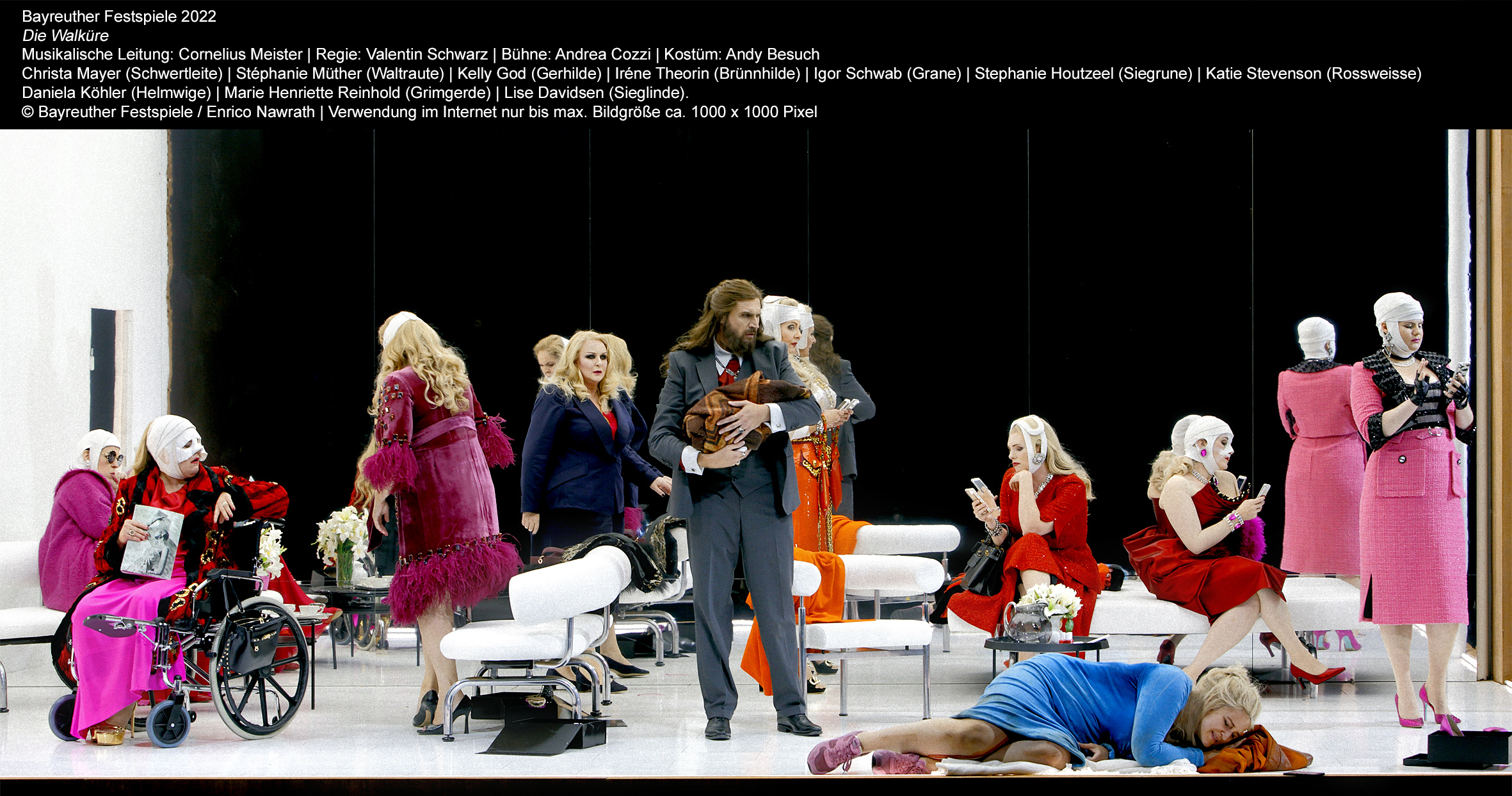
Bayreuth Festival (2): Die Walküre, 1 August 2022


Festspielhaus


Siegmund – Klaus Florian Vogt
Hunding – Georg Zeppenfeld
Wotan – Tomasz Konieczny, Michael Kupfer-Radecky
Sieglinde – Lise Davidsen
Brünnhilde – Iréne Theorin
Fricka, Schwertleite – Christa Mayer
Gerhilde – Kelly God
Ortlinde – Brit-Tone Müllertz
Waltraute – Stéphanie Müther
Helmwige – Daniela Köhler
Siegrune – Stephanie Houtzeel
Grimgerde – Marie Henriette Reinhold
Rossweiße – Katie Stevenson
Grane – Igor Schwab

Valentin Schwarz (director)
Andrea Cozzi (designs)
Andy Besuch (costumes)
Konrad Kuhn (dramaturgy)
Reinhard Traub (lighting)

Bayreuth Festival Orchestra
Cornelius Meister (conductor)

The boos are getting louder: not, I think, for the musicians, but for the production of Valentin Schwarz, who has yet to appear for a curtain-call. That need be no bad thing artistically, though the practice itself is fascistic; should a bourgeois audience feel satisfied with what it has consumed, it will be a disturbing outcome for art. Here, though, the open mind I am endeavouring to keep concerning Schwarz’s production is struggling a little. As a distinguished Wagner scholar said to me when I met him afterwards, ‘It is getting worse.’ On the basis of what I saw in Die Walküre, I had little choice but to agree.

Short of the framing of the action as a saga of twins, which here seems more assumed to continue from Das Rheingold than illustrated, there is little at all to point to other than strange departures from Wagner’s drama, which taken separately or together fail to amount to anything very much. Siegmund and Sieglinde are, I think, taken back by their self-discovery to their childhood, joined by ‘symbolic’ star-children. (Either that, or they fantasise about the children they will have, but I think it is the former.) There is nothing wrong with that; it makes sense. But for it to have taken place in Wotan’s godly quarters seems peculiar—imagine Fricka’s thoughts on that—as well as quite at odds with what they have just sung, without obvious reason.

 It is later implied that Sieglinde, heavily pregnant throughout the first two acts, is carrying Wotan’s baby. At least I think that is why he ‘comforts’ her, whilst Siegmund and Hunding seek one another, pulling down her tights and apparently attempting to deliver the child. If not, it is a straightforward case of sexual assault, although I suppose it must have been anyway earlier. My guess would be that this is intended to enhance the parallelism between Wotan and Alberich, that both will be found to have produced children, Siegfried and Hagen, through rape. But where that leaves Siegmund, goodness knows: St Joseph with a twist, it would seem. Where, though, does that leave Hunding? He must surely have noticed. It is difficult not to conclude that Wagner’s plot would have been better left as it was.

In between, Freia’s funeral, or at least her lying in rest, had taken place. There were some germs of decent, if ultimately rather incidental ideas, here. Assuming we are still to take her as goddess of love, her death would have obvious implications (although its timing is arguably strange, given that Siegmund and Sieglinde have just met). In a Mafia-film-style mise-en-scène, a few people come to pay their respects, whilst Wotan and Fricka have their decisive confrontation. (Brünnhilde spends some of that scene in what appears to be a greenhouse. I don’t know either.) Hunding petitions the gods in person, an interesting touch. That Fricka returns at the end of the third act, after Wotan has put Brünnhilde to sleep (and made, you guessed it, his incestuous urges all too clear), suggests that she is confident in her triumph. She even wheels on a drinks trolley and offers Wotan a celebratory glass. He declines, though, so in the absence of a spear—just nothing at all, throughout—Fricka clinks together the glasses to make the requisite noise.


I am afraid I have no idea at all what happens in the Ride of the Valkyries. It veered all over the place—at least the BBC light entertainment place—from Dr Who to The Benny Hill Show to Casualty, with an apparently accidental turn for Diana Dors’s gender-reversal ‘The Worm that Turned’ series for The Two Ronnies. Sometimes the Valkyries were in charge, sometimes Wotan’s guards. There was a great deal of mobile telephone use. Perhaps it is time to call for a moratorium on those devices onstage, unless the director has a clear idea what they are for. As things stand, they seem to have become the new suitcases.

Lack of objects when called for and introduction of obscure alternatives does little to help. I have already mentioned the lack of a spear or any substitute.   Just as the role of Das Rheingold’s dark-haired boy is more unclear than ambiguous, so is that of the strange pyramid-in-a-box, earlier seen and quasi-worshipped upon the gods’ entry into Valhalla as if a grail-refugee from a production of Parsifal. It now reappears as a repository for a pistol. Sometimes a pistol is a Notung equivalent, sometimes not; sometimes there are several. None of it makes any sense, really, and try as I might to try to piece together some sort of explanation, I am really on the verge of giving up.

As for Grane’s reincarnation as Brünnhilde’s male, suited personal assistant, it makes even less sense when there have been a few apparently arbitrary visual references to actual horses elsewhere. Finally, there is a strong impression that the strongest acting is brought by the singers themselves to their roles. Personenregie is intermittent at best and sometimes disappears altogether in longer exchanges between characters. I suppose some of these things, minus the lack of Personenregie, might add up to something in retrospect, but I do not feel especially hopeful.

Musically, things are better, often much better. Cornelius Meister continues to impress greatly with his command of structure and detail, conveying and expressing a Wagner melos from the pit that drives and, in many respects, is the action. The sound he drew from the Bayreuth Festival Orchestra—and, I assume, to an extent, the sound its players wished to conjure too—was in some ways distant from that we might recall from old Bayreuth recordings, closer to those of other opera orchestras. Choices seem well justified to me, though, and there is no point merely trying to imitate Karl Böhm—or anyone else, for that matter. There is considerable emotional and conceptual range as the cauldron of Wagner’s Greek Chorus bubbles: quite a difference, alas, from what we see onstage.

Not, however, from what we hear onstage. Lise Davidsen’s Sieglinde was at least the equal of any I have heard. No one seems to have a bad word to say about this extraordinary soprano, and so far there seems no reason for anyone to do so. Her final peroration here, ‘O hehrstes Wunder!...’ was as vocally magnificent, riding the orchestral wave almost like no other, as it was clearly heartfelt, the culmination of a dramatic journey that now must end. Klaus Florian Vogt’s tenor will always divide opinion. Much of that is simply down to taste. Whether one liked his performance or not—and there is no getting away from the fact that its sound is very different from the baritonal Siegmunds we have come to expect—his was certainly a committed and, I think, highly likeable performance. Georg Zeppenfeld’s Hunding offered a masterclass in the role, everything present and correct, both considered and alert to the moment.

Tomasz Konieczny and Michael Kupfer-Radecky shared the role of Wotan, the former having become unable to continue during the second interval. Both gave strong performances, deeply rooted in Wagner’s text; if the ear took a little while to adjust to new sound and delivery, that was a tiny price to pay for so crucial, short-notice a substitution. Christa Mayer’s Fricka was once again first-class, fuller-throated than often one hears, and all the better for it. Iréne Theorin impressed as head Valkyrie, youthfully impetuous and headstrong, yet clearly transformed by what she had witnessed. The rest of her team was cast from depth, including a return for Mayer as Schwertleite. Had this been a concert performance, I suspect it would have moved more than it did in the theatre. This Ring, however, will continue in Wagner’s own theatre.


Sunday, 21 November 2021

Die Walküre, English National Opera, 19 November 2021


Coliseum

Siegmund – Nicky Spence
Sieglinde – Emma Bell
Hunding – Brindley Sherratt
Wotan – Matthew Rose
Brünnhilde – Rachel Nicholls
Fricka – Susan Bickley, Claire Barnett-Jones
Gerhilde – Nadine Benjamin
Ortlinde – Mari Wyn Williams
Waltraute – Kamilla Dunstan
Schwertleite – Fleur Barron
Helmwige – Jennifer Davis
Siegrune – Idunna Münch
Rossweisse – Claire Barnett-Jones
Grimgerde – Katie Stevenson

Richard Jones (director)
Stewart Laing (designs)
Adam Silverman (lighting)
Sarah Fahie (movement)
Akhila Krishnan (video)

Orchestra of the English National Opera
Martyn Brabbins (conductor)

Images: (C) Tristram Kenton
Siegmund (Nicky Spence) and Sieglinde (Emma Bell)

I wanted so much to like this more than I did. It is not quite ENO’s return to the Coliseum after you-know-what, but in many ways it felt like it. (A Philip Glass revival and a new production of Gilbert and Sullivan will have had their devotees, but they are not my potion of forgetfulness.) Anneliese Miskimmon, ENO’s Artistic Director, could not have been more welcoming in her brief address from the stage before the performance. And what could be a greater declaration of intent for a new era than a new Ring? Perhaps a Schoenberg or, still more so, a Stockhausen series? But even then, the Ring retains for many the status of non plus ultra. Its all-encompassing nature continues to surpass all competitors; no artwork has more to tell us, so it seems, at any juncture in our dubious human development.

No Ring is therefore going to be perfect; even the most exalted performance, let alone staging, will have imperfections. It would be too easy to judge perfection a lesser thing; it is not, necessarily, but it is a different thing—one which Mozart (often) has covered. Yet if a Ring in performance will always fall short, it should not fall so short as Richard Jones’s half-hearted attempt at a production, which detracted all too much from a mixed musical performance laying claim to not inconsiderable virtues. Perhaps more would have been gleaned had we seen Das Rheingold first. Starting with the second instalment is not without precedent, but I remain unconvinced that it is a good idea. Berlin’s Deutsche Oper has had to present Stefan Herheim’s new Ring as and when it can, but that is a different case, planned performances having to be cancelled, given without an audience, and so on. (How I long to see what Herheim has done!) Yet it is difficult to imagine that much light being shed on a Walküre (sorry, Valkyrie, as ENO obstinately continues to refer it) seemingly without a concept or indeed much of an idea at all. Presumably, money was tight, for what we see is not so much minimalism as people wandering a little lost around a stage that sometimes has scenery and sometimes does not. As in Jones’s recent, wretched La clemenza di Tito for the Royal Opera, there was a vague look: in this case, noir-ish ‘Scandinavia’, though it would be difficult to say anything more precise than that. ENO’s publicity suggests the idea that this is a family saga: well, sort of, I suppose, but only if that is taken to be the crucible for something greater. Use of video to show Alberich (‘Nibelung’ tattooed on his forehead), Grimhilde, and Hagen when referred to in Wotan’s narration—nothing more, just show them—seemed both patronising and pointless, though perhaps in a greater context it contributes to the banal theme of family feud. The appearance of Hunding’s clan on stage might have contributed further, but ultimately undirected (like so much else), they proved little more than a distraction, the lack of much to distract from notwithstanding.


Alberich (Jamie Campbell), Brünnhilde (Rachel Nicholls), Wotan (Matthew Rose)

Maybe the strange claim (Christopher Wintle) that opened one of the programme notes offered a clue to the lack of any exterior, let alone political element: ‘Most of us can agree that The Valkyrie is “about” incest.’ I do not know precisely to whom ‘us’ refers; certainly not to me, anyway. Wagner’s drama is no more ‘“about” incest’ than The Flying Dutchman is ‘about’ sailing. The point of Siegmund and Sieglinde’s love is that it breaks the violent, cruel bonds of marriage, family, and custom (which Wagner specifically identified with Fricka); that it leads Siegmund to reject immortality, and thus to put Brünnhilde on her way to doing likewise, to attaining the superior status of ‘purely human’; and precisely that it does not matter whether the Volsung twins are brother and sister, not that it does. Here, occasional straining towards a familial idea, for instance Hunding’s physical brutality to Sieglinde, seemed little more than striving after effect, given a lack of embedding in anything more than an IKEA catalogue. The production team sported more interesting clothes than those given to the cast; maybe they should have swapped.


Grimgerde (Katie Stevenson), Rossweisse (Claire Barnett-Jones),
and Siegrune (Idunnu Münch)


Or maybe they should have given them to the curious animals that pranced around the stage, Wotan’s ravens (I think) included: more Sesame Street than creatures of the forest. Whether the concept were malevolent or ironic, neither possibility was achieved. For some reason, a lone tap dancer did her stuff during the Ride of the Valkyries, whilst actors in horse costumes struggled around on tip toe. Why on earth Grane, understandably fidgeting, was made to balance in this way through the entirety of the final scene—and not only then—I have no idea; but then I have little idea about anything else either. Inability to set the stage ablaze at the close was attributed to a late intervention from Westminster City Council. Alas, Wotan’s protracted fumbling to attach to Brünnhilde a harness that would awkwardly suspend her above the stage, without the slightest sign of flames that had intermittently flickered earlier, seemed all too apt a metaphor. Quite what the Met, where Jones’s third (!) attempt at the Ring is heading, will make of it is anyone’s guess. It is certainly devoid enough of intellectual content to satisfy Friends of Otto Schenk. But the ‘look’, for that is all it is, and lack of discernible stage action will surely trouble many. 

Martyn Brabbins’s conducting was sane, measured, and doubtless sensitive—perhaps too sensitive—to the needs of his singers. Brabbins clearly appreciates the need to think in the broadest terms about Wagner’s structures, yet often seemed to confuse that with maintaining a slow speed throughout, occasionally changing gear when that could not conceivably be maintained any longer. A few understandable fluffs—every performance has them—notwithstanding, the ENO Orchestra played beautifully, if often in strangely subdued fashion, especially in the first act (!) I do not know how long it lasted in actual minutes, but it felt like the longest I had ever heard. By contrast, the third act often seemed rushed, if hardly short. This was clearly a work in progress, but there may be considerably more hope for improvement here than in the staging.


Brünnhilde

Had it not been for an initial announcement, no one would have known Nicky Spence was suffering from a cold. Siegmund is clearly a role for which he is ready—and for which he has well prepared. There are strength, vulnerability, and many other of the qualities we need, even in so unpromising a setting as this. It was difficult to discern much in the way of chemistry with Emma Bell’s Sieglinde; nor did this seem to be ironic or deconstructive detachment. However, considered on its own terms, her performance also impressed, indicative of a woman bruised yet determined to command her own destiny. Dart-playing Rachel Nicholls, lumbered with a strange skater-girl look, trod a fine, shifting line between Brünnhilde's youthful impetuosity and the glimmers of something more moving, more human—which is to say she understood what was at stake, even if Jones did not. Matthew Rose, lumbered with, well, being a lumberjack-turned-television-detective, offered a typically detailed and thoughtful performance as Wotan, though the third act did not show him at his strongest. These things vary from night to night. Brindley Sherratt's focus as Hunding varied too, though at its best it offered something darkly psychopathic. One of the strongest, most committed and sustained performances came from the team of Susan Bickley (finely observed, on stage) and Claire Barnett-Jones (also finely observed and with gleaming tone, from a box above) as Fricka. This, again, was a performance that truly used words, music, and gesture to suggest drama beyond Jones’s imagination.


So too did John Deathridge’s new singing translation. It was in many respects remarkably faithful not only to what Wagner said but, crucially, to what he did not, employing suggestion and ambiguity in the right places. It had an intriguing line too in something akin to Stabreim. Word order and stress played their part, as did various other considerations one might find—with profit—in reading Wagner’s own Opera and Drama. This did not, like many of ENO’s translations, attempt to draw attention to itself, still less to elicit inappropriate laughter; rather it participated in the dramatic effort in a way the singers and orchestra, if hardly the director, did. The sort of people who drone on about ‘the Coli’ and alleged halcyon days of Reginald Goodall will doubtless bemoan the lack of Andrew Porter, but their parochial concerns need not be ours.


Fricka (Susan Bickley) and Wotan

‘Mark well my poem,’ wrote Wagner to Liszt in 1853, enclosing a copy of the Ring in verse; ‘it contains the beginning of the world and its end.’ One might argue that beginning(s) and end happen elsewhere in the Ring; but were this the generic television ‘show’ from which Jones & Co. appeared to have taken non-inspiration, it seems doubtful, even in the unlikely event of a decision to renew for another ‘season’, that many viewers would have been remaining. To achieve not only an Annunciation of Death, but an entire Walküre, in which nothing whatsoever seemed to be at stake, was a peculiar, perverse and strangely pointless achievement. Either Jones needs to rethink—the prefix ‘re-’ may be too kind—or ENO should act decisively with courage and substitute another production or concert performances. With Wagner, in Wagner, much is or should be at stake.


Tuesday, 6 July 2021

Die Walküre, London Opera Company, 3 July 2021


St John’s, Waterloo

Siegmund – Brian Smith Walters
Sieglinde – Gweneth-Ann Rand
Hunding – Simon Wilding
Wotan – Simon Thorpe
Brünnhilde – Cara McHardy
Fricka, Waltraute – Harriet Williams
Gerhilde – Jacqueline Varsey
Ortlinde – Philippa Boyle
Schwertleite – Rhonda Browne
Helmwige – Natasha Jouhl
Siegrune – Carolyn Dobbin
Grimgerde – Katharine Taylor-Jones
Rossweisse – Angharad Lyddon

Rosemary Taylor (clarinets)
Jo Harris (trumpet)
William Brown (trombone, bass trumpet)
James Bower (percussion)
Peter Selwyn (piano, music director)


Wagner’s dramas, one might think, would be among the last things to return to our cultural lives. In a way, they doubtless will. For obvious reasons, a full-scale staging of Die Meistersinger would be a tall order right now, though Bayreuth proposes a few performances this summer of Barrie Kosky’s staging (widely lauded, though certainly not by me). Covent Garden has reopened its doors with Mozart: La clemenza di Tito and, now, Don Giovanni (review forthcoming), though friends in Berlin are currently enjoying Stefan Herheim’s new Rheingold at the Deutsche Oper. (How I wish I were still there!) In London, however, such possibilities seem still quite distant. The London Opera Company’s Tristan und Isolde, performed last October with piano trio in place of orchestra, was a rare beacon of light. Now, the company returns with its second instalment of Wagner—or anything else—Die Walküre, marked as a concert performance but with a degree of acting and a few small props.


Brian Smith Walters and Gweneth-Ann Rand offered pretty much everything one could hope for in the Volsung lovers. The former’s Heldentenor thrilled vocally as any Siegmund must; there was, though, much more to him than that. Like the rest of the cast, he took advantage of the lack of full staging to show just how much character narrative can develop through words and music. From outlawry and dejection to apparent victory, only to be snatched away from him by the chief of the gods himself (ever unknown to him as his father), this was a story that demanded to be told. Rand’s dignity told in sheer stage presence—even without a ‘proper’ stage—and again through words and music. She engaged us, had us feel for her, but was no mere victim; this was a Sieglinde with agency too. The titular Valkyrie herself was familiar from Tristan. Then as Isolde, now as Brünnhilde, Cara McHardy led us not merely to follow, but to share her journey from the warrior maiden’s first, thrilling ‘Hojotoho’ to a tender, closer-to-human farewell with Simon Thorpe’s Wotan. Thorpe’s performance seemed drawn from the sagas, delivered as myth that did not preclude but rather encompassed humanity. That quality was certainly present in Harriet Williams’s uncommonly sympathetic Fricka. She not only made her case—its chilling logic is, on one level at least, readily apparent—but had us understand why. Simon Wilding’s jet-black Hunding proved the perfect foil to Volsung Lenz, another considered and highly dramatic portrayal. Brünnhilde’s Valkyrie sisters impressed equally in solo and ensemble performance, aided by a lucid instrumental ride from Peter Selwyn and company.


My principal reservation nonetheless concerned the arrangement itself: not, of course, the act of arranging, but the choices made. Tristan’s piano trio with conductor (the excellent Michael Thrift) worked considerably better for me. There will always be pros and cons, and the presence of bass clarinet in particular certainly had its Wagnerian moments. The choice of clarinet/bass clarinet, trumpet, bass trumpet/trombone, percussion (mostly timpani), and piano nonetheless seemed odd. It may not have been a choice; performing forces often are not. A few times, players and singers fell out of sync, likewise instrumental ensemble itself: doubtless to be expected, though perhaps a few times more than one might have hoped. Still, I should not carp. The openings of the second and, as mentioned, third acts in particular thrilled, ensemble seemingly reinvigorated. In Wagner-starved London, few will have been disappointed. Let us see what the London Opera Company, currently seeking sponsorship, comes up with for Siegfried next year.


St John’s, Waterloo will now close until next year for restoration, the first major work to Francis Octavius Bedford’s Greek Revival building since 1951, when it was rebuilt as the official church of the Festival of Britain. That festival helped bring hope and light back to London after the privations of war and rationing. St John’s has helped many of us over the past year, not least as home to the Waterloo Festival, with its actualised theme of ‘respair’, the return of hope after a period of despair. I look forward to its reopening and, in the meantime, the continuation of its crucial ministry to neighbourhood, city, and beyond.