Showing posts with label Brindley Sherratt. Show all posts

Saturday, 20 May 2023

Wozzeck, Royal Opera, 19 May 2023


Royal Opera House

Wozzeck – Christian Gerhaher
Marie – Anja Kampe
Captain – Peter Hoare
Doctor – Brindley Sherratt
Margret – Rosie Aldridge
Drum Major – Clay Hilley
Andres – Sam Furness
First Apprentice – Barnaby Rea
Second Apprentice – Alex Otterburn
The Fool – John Findon
Soldier – Lee Hickenbottom
Tenor Solo – Andrew Macnair
Marie’s Son – Jonah Elijah McGovern

Deborah Warner (director)
Hyemi Shin (set designs)
Nicky Gillibrand (costumes)
Adam Silverman (lighting)
Kim Brandstrup (choreography)

Royal Opera Chorus (chorus master: William Spaulding)
Orchestra of the Royal Opera House
Antonio Pappano (conductor)


Images: Tristram Kenton
Andres  (Sam Furness), Wozzeck (Christian Gerhaher)


Thirty years ago, in Sheffield, a teenage schoolboy saw his first opera in the theatre. It was Wozzeck, directed by Deborah Warner for Opera North. Quite an opera with which to begin, you might say, and indeed in many ways it was, yet why would you wish to begin with something that was not ‘quite an opera’? He knew a little more, though not much, opera not having been part of his childhood or more general homelife, nor indeed of his schooling. Plus ça change… By that time, he had just begun to explore the operas of Mozart, those you might expect: Figaro, Don Giovanni, and The Magic Flute. He had also, slightly clueless, speculatively bought a reduced, ‘historic’ recording of Tristan und Isolde from WH Smith and had watched a video, kindly lent by his music teacher, of Die Meistersinger. That, however, was it. He had not yet knowingly listened to music of the Second Viennese School, though that also was suddenly about to change. It is no exaggeration to say that those hundred minutes in the Lyceum Theatre changed his life. 

From 1993 to 2023: an avid (if, born perhaps of that initial experience, selective) opera-goer travelled across another English city for the first night of a new production of Wozzeck, also directed by Deborah Warner, now for the Royal Opera. Full circle? Not really; nothing ever is. Our protagonist has, for better or worse, had numerous experiences, music, dramatic, emotional, and intellectual, since; he is certainly no longer a boy. Yet Wozzeck, which for him ever since has had at least as strong a claim as any to be the single greatest opera of the twentieth century, exerts, if anything, a still greater fascination and admiration, certainly a greater love, than it did then, born of three decades of living with it. How, then, would Warner II fare in circumstances both old and new?
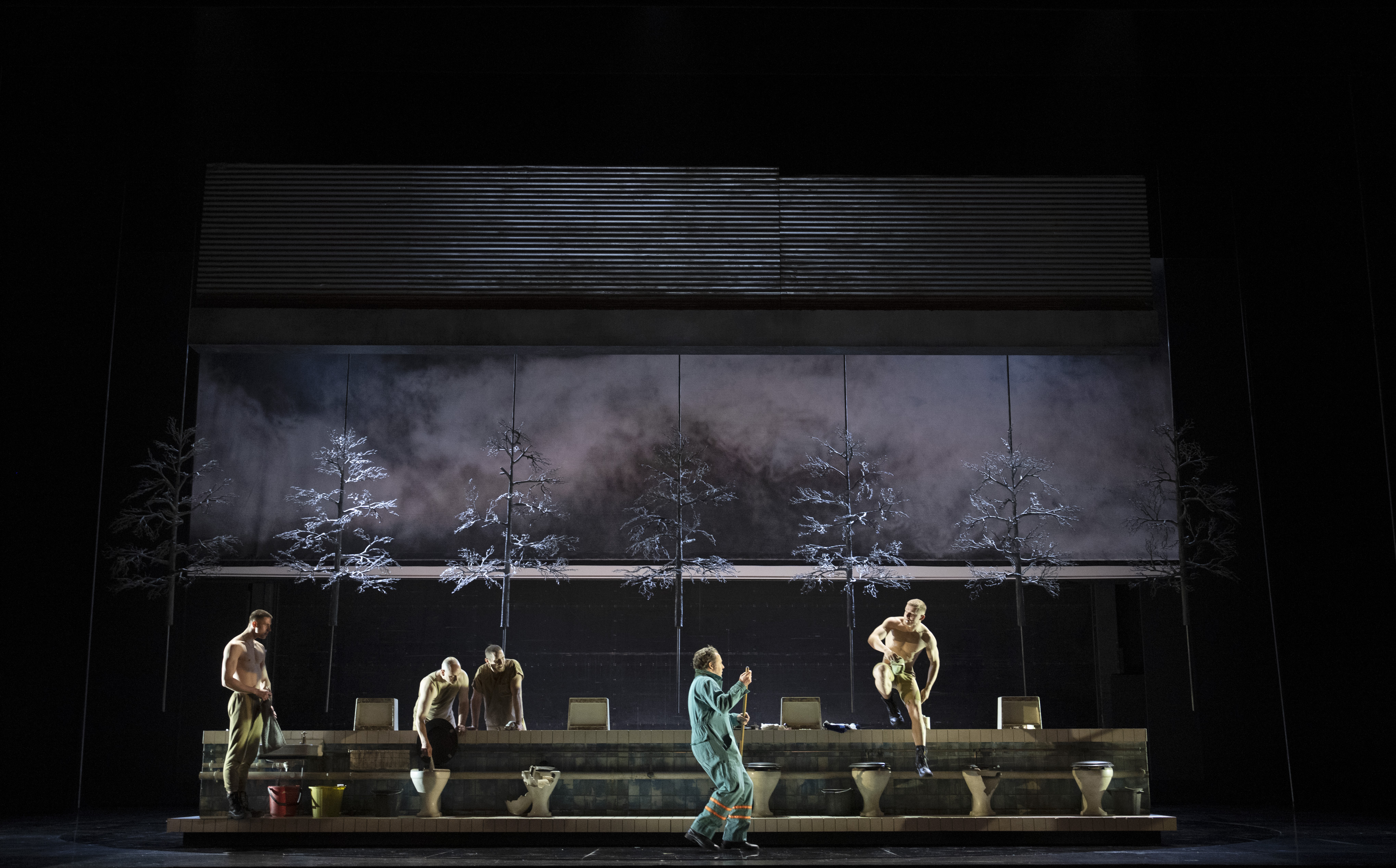


Truth be told, if you spend your time in Wozzeck thinking about a previous production or performance, something has gone wrong (either with you, what is onstage, or both). I did not. In any case, comparisons either with Warner’s first staging or with when I had previously heard Antonio Pappano conduct the work (twenty-one years ago for Keith Warner’s then-new production, in Pappano’s first season at Covent Garden) would largely be meaningless, given the vagaries of memory and my lack of a written record. Deborah Warner in 2023 does not seem to me especially to take a view or standpoint, at least not exclusively. This is not a Wozzeck that (over-)emphasises the brutality of military life and war, or expressionist experimentalism, or any one thing, though many such things are present. The action is already taking place as we take our seats, soldiers (an excellent troupe/troop of actors) relieving themselves in various ways, cleaning up, doing very much what soldiers do in barracks. That establishes an expectation of realism which is not entirely fulfilled, but rather is supplemented, so that as the action develops, as different standpoints are afforded by the work (and probably its creator), we have opportunity to take them too. Everything takes place more or less where one might expect, but there are always refreshing touches of set design, costume, lighting, or detailed Personenregie – let alone the musical performances – to enable us to take a fresh look and listen. The drama unfolds, with great immediacy, yet always it feels that this is ultimately Wozzeck rather than ‘Deborah Warner’s Wozzeck’, whether that feeling, even that possibility, be a fond illusion or otherwise. Different settings for different scenes – no fewer than fifteen of them – present themselves without fussiness or fetishisation: this is a light, enabling, generous realism that can shade almost imperceptibly into other, complementary aesthetics as required. Credit is surely due both to the design team and to the Royal Opera House’s technicians and actors, who accomplished this feat with such apparent ease. Rehearsal surely paid off.


Slightly stylised trees, Cross-like, hint at Wozzeck’s fate, albeit without redemption, but also at a natural world beyond that neither knows nor cares, yet in some sense frames tragedies that lie in stark contrast, being entirely the creation of man. There remains a Romantic desire to escape this miserable world, even if only to Berg’s family estate (Berghof) in Carinthia. Like so much else, though, it is not possible. The blood-red moon and the black, unfathomable lake dominate our vision and consciousness as natural and human boundaries. And finally, in that ultimate, heartbreaking scene of horror: the child turns to the wall in front of which the other children have just been playing, to see painted on it the news they have so cruelly, carelessly delivered. His mother is dead. He turns around and walks off, alone. The drama stops, silence cruelly denied by some idiot’s premature applause—but even that could not quite break the punch to the solar plexus. 

Much of that is, of course, a musical punch. Pappano really seems to be at his best right now. Shortly after thinking his Turandot perhaps the best I had heard from him, I found this Wozzeck at least close to equal, and in ways that surprised me. Without wishing to play that game of illusory comparisons, however tempting, I found this an infinitely more engaging experience than in 2002. Often quite extraordinary orchestral precision, for which one must of course above all credit the orchestra itself, laid bare the framework of closed forms in themselves, their multifarious musical procedures objects of an almost yet not quite Neue Sachlichkeit fascination, but also showed them to be the engines of a dramatic progression that, however Wagnerian it may often sound, is at least as much an alternative to Wagner’s method. There were wrenching, late-Romantic passages, of course, precisely where one would need and expect them, but this was also a musical drama that prefigured Hindemith, Weill, perhaps even Berg’s own teacher, Schoenberg. This was not always a Wozzeck that rose from the bass line, though sometimes it did, but it hinted more than usual at Berg’s later writing, whilst also suggesting an earlier, almost Mendelssohnian Romanticism. Like Warner’s production, it afforded different standpoints, without sounding merely sectional. 

I have been fortunate to see some extremely fine Wozzecks in those years since my first encounter (Andrew Shore on that first encounter included). Christian Gerhaher’s thoughtful, collegial approach, placing himself and his character at the dramatic hub, gaining meaning as much from interaction with colleagues as from his considered yet apparently spontaneous way with the text, has nothing to fear from any of them. His performance, worlds away, as is proper, from the beauties of his celebrated Wolfram, was yet equally well judged. Indeed, I wonder whether it heralds a new chapter in his career. For now, though, it will more than do in and of itself.


Wozzeck, Marie (Anja Kampe)

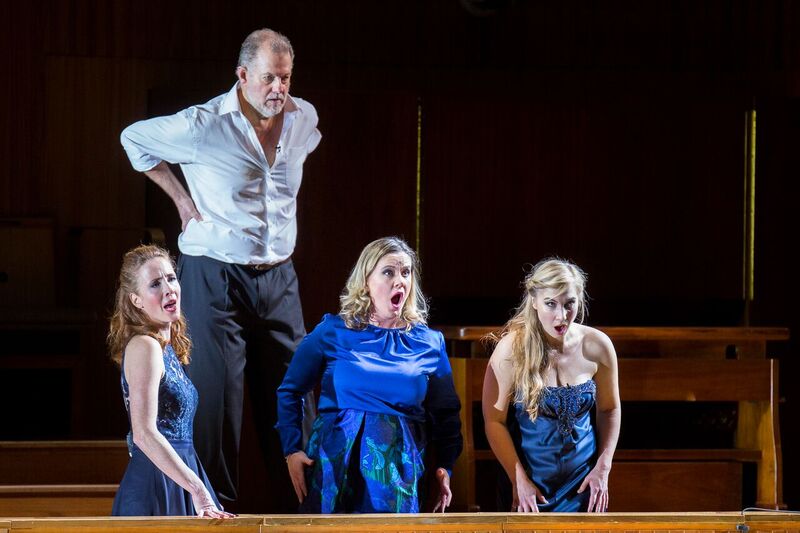
There was splendid chemistry with his Marie, Anja Kampe. I was about to say ‘we tend…’, but should really only speak for myself: I tend often somewhat to overlook the tragedy of Marie’s death, so overwhelmed am I by that of Wozzeck. Here I felt greater parity, doubtless a matter of Warner’s Personenregie but also of Kampe’s portrayal. (It is more or less impossible for an outsider to distinguish between the two.) This important corrective was brought into further relief by Anna Picard’s excellent programme note on ‘Maria and her World’, whose closing words seem very much to refer to what we saw and heard: ‘She is no Kundry. Neither is she a Judith or the hysterical Woman in Marie Pappenheim and Arnold Schoenberg’s monodrama, Erwartung. Her murder is not dressed up as a form of release for Wozzeck or a point of debate. It is simply a domestic tragedy of a very ordinary, and ever modern, kind.’ Which also brings us back to Gerhaher’s Wozzeck, for his very haplessness – what art lay in that – also contributed to that very non-release, felt (at least by me) more emphatically than I can recall.


Captain (Peter Hoare), Wozzeck

All in the cast contributed to the greater dramatic (and musical) whole, so much as to suggest unusually fruitful close collaboration between all concerned. Sam Furness’s Andres surprised me, not least because I often find myself wondering where the role went, thinking it smaller than I had expected. Not here: this was a character sympathetic to Wozzeck who yet had his own story to tell. Likewise Rosie Aldridge’s spirited Margret, whose spot in the second tavern scene almost had time stand still as the world disintegrated around her. Peter Hoare’s Captain and Brindley Sherratt’s Doctor made a sharply etched pair: guilty, yet not guilty, like all in the world we saw. Well, perhaps not quite all, for it is difficult to find any grounds to absolve the Drum Major, here given an appropriately nasty, bullying, yet finely sung performance by Clay Hilley. William Spaulding's Royal Opera Chorus was on outstanding form too. 

What, then, should a Wozzeck accomplish? There can be no definitive answer, no more than for any artwork in performance. Different productions, different performances, different audiences will all render such categorical statements in vain. If I have learned one thing over the past thirty years, it will be that. That said, if one does not emerge from a performance convinced that it is one of the greatest of all operas – ranking beyond that is a mere parlour game – it will have been in vain. My first experience was not; nor, emphatically was this: a searing and strangely refreshing Wozzeck, which I hope and intend to revisit soon.


Sunday, 21 November 2021

Die Walküre, English National Opera, 19 November 2021


Coliseum

Siegmund – Nicky Spence
Sieglinde – Emma Bell
Hunding – Brindley Sherratt
Wotan – Matthew Rose
Brünnhilde – Rachel Nicholls
Fricka – Susan Bickley, Claire Barnett-Jones
Gerhilde – Nadine Benjamin
Ortlinde – Mari Wyn Williams
Waltraute – Kamilla Dunstan
Schwertleite – Fleur Barron
Helmwige – Jennifer Davis
Siegrune – Idunna Münch
Rossweisse – Claire Barnett-Jones
Grimgerde – Katie Stevenson

Richard Jones (director)
Stewart Laing (designs)
Adam Silverman (lighting)
Sarah Fahie (movement)
Akhila Krishnan (video)

Orchestra of the English National Opera
Martyn Brabbins (conductor)

Images: (C) Tristram Kenton
Siegmund (Nicky Spence) and Sieglinde (Emma Bell)

I wanted so much to like this more than I did. It is not quite ENO’s return to the Coliseum after you-know-what, but in many ways it felt like it. (A Philip Glass revival and a new production of Gilbert and Sullivan will have had their devotees, but they are not my potion of forgetfulness.) Anneliese Miskimmon, ENO’s Artistic Director, could not have been more welcoming in her brief address from the stage before the performance. And what could be a greater declaration of intent for a new era than a new Ring? Perhaps a Schoenberg or, still more so, a Stockhausen series? But even then, the Ring retains for many the status of non plus ultra. Its all-encompassing nature continues to surpass all competitors; no artwork has more to tell us, so it seems, at any juncture in our dubious human development.

No Ring is therefore going to be perfect; even the most exalted performance, let alone staging, will have imperfections. It would be too easy to judge perfection a lesser thing; it is not, necessarily, but it is a different thing—one which Mozart (often) has covered. Yet if a Ring in performance will always fall short, it should not fall so short as Richard Jones’s half-hearted attempt at a production, which detracted all too much from a mixed musical performance laying claim to not inconsiderable virtues. Perhaps more would have been gleaned had we seen Das Rheingold first. Starting with the second instalment is not without precedent, but I remain unconvinced that it is a good idea. Berlin’s Deutsche Oper has had to present Stefan Herheim’s new Ring as and when it can, but that is a different case, planned performances having to be cancelled, given without an audience, and so on. (How I long to see what Herheim has done!) Yet it is difficult to imagine that much light being shed on a Walküre (sorry, Valkyrie, as ENO obstinately continues to refer it) seemingly without a concept or indeed much of an idea at all. Presumably, money was tight, for what we see is not so much minimalism as people wandering a little lost around a stage that sometimes has scenery and sometimes does not. As in Jones’s recent, wretched La clemenza di Tito for the Royal Opera, there was a vague look: in this case, noir-ish ‘Scandinavia’, though it would be difficult to say anything more precise than that. ENO’s publicity suggests the idea that this is a family saga: well, sort of, I suppose, but only if that is taken to be the crucible for something greater. Use of video to show Alberich (‘Nibelung’ tattooed on his forehead), Grimhilde, and Hagen when referred to in Wotan’s narration—nothing more, just show them—seemed both patronising and pointless, though perhaps in a greater context it contributes to the banal theme of family feud. The appearance of Hunding’s clan on stage might have contributed further, but ultimately undirected (like so much else), they proved little more than a distraction, the lack of much to distract from notwithstanding.


Alberich (Jamie Campbell), Brünnhilde (Rachel Nicholls), Wotan (Matthew Rose)

Maybe the strange claim (Christopher Wintle) that opened one of the programme notes offered a clue to the lack of any exterior, let alone political element: ‘Most of us can agree that The Valkyrie is “about” incest.’ I do not know precisely to whom ‘us’ refers; certainly not to me, anyway. Wagner’s drama is no more ‘“about” incest’ than The Flying Dutchman is ‘about’ sailing. The point of Siegmund and Sieglinde’s love is that it breaks the violent, cruel bonds of marriage, family, and custom (which Wagner specifically identified with Fricka); that it leads Siegmund to reject immortality, and thus to put Brünnhilde on her way to doing likewise, to attaining the superior status of ‘purely human’; and precisely that it does not matter whether the Volsung twins are brother and sister, not that it does. Here, occasional straining towards a familial idea, for instance Hunding’s physical brutality to Sieglinde, seemed little more than striving after effect, given a lack of embedding in anything more than an IKEA catalogue. The production team sported more interesting clothes than those given to the cast; maybe they should have swapped.


Grimgerde (Katie Stevenson), Rossweisse (Claire Barnett-Jones),
and Siegrune (Idunnu Münch)


Or maybe they should have given them to the curious animals that pranced around the stage, Wotan’s ravens (I think) included: more Sesame Street than creatures of the forest. Whether the concept were malevolent or ironic, neither possibility was achieved. For some reason, a lone tap dancer did her stuff during the Ride of the Valkyries, whilst actors in horse costumes struggled around on tip toe. Why on earth Grane, understandably fidgeting, was made to balance in this way through the entirety of the final scene—and not only then—I have no idea; but then I have little idea about anything else either. Inability to set the stage ablaze at the close was attributed to a late intervention from Westminster City Council. Alas, Wotan’s protracted fumbling to attach to Brünnhilde a harness that would awkwardly suspend her above the stage, without the slightest sign of flames that had intermittently flickered earlier, seemed all too apt a metaphor. Quite what the Met, where Jones’s third (!) attempt at the Ring is heading, will make of it is anyone’s guess. It is certainly devoid enough of intellectual content to satisfy Friends of Otto Schenk. But the ‘look’, for that is all it is, and lack of discernible stage action will surely trouble many. 

Martyn Brabbins’s conducting was sane, measured, and doubtless sensitive—perhaps too sensitive—to the needs of his singers. Brabbins clearly appreciates the need to think in the broadest terms about Wagner’s structures, yet often seemed to confuse that with maintaining a slow speed throughout, occasionally changing gear when that could not conceivably be maintained any longer. A few understandable fluffs—every performance has them—notwithstanding, the ENO Orchestra played beautifully, if often in strangely subdued fashion, especially in the first act (!) I do not know how long it lasted in actual minutes, but it felt like the longest I had ever heard. By contrast, the third act often seemed rushed, if hardly short. This was clearly a work in progress, but there may be considerably more hope for improvement here than in the staging.


Brünnhilde

Had it not been for an initial announcement, no one would have known Nicky Spence was suffering from a cold. Siegmund is clearly a role for which he is ready—and for which he has well prepared. There are strength, vulnerability, and many other of the qualities we need, even in so unpromising a setting as this. It was difficult to discern much in the way of chemistry with Emma Bell’s Sieglinde; nor did this seem to be ironic or deconstructive detachment. However, considered on its own terms, her performance also impressed, indicative of a woman bruised yet determined to command her own destiny. Dart-playing Rachel Nicholls, lumbered with a strange skater-girl look, trod a fine, shifting line between Brünnhilde's youthful impetuosity and the glimmers of something more moving, more human—which is to say she understood what was at stake, even if Jones did not. Matthew Rose, lumbered with, well, being a lumberjack-turned-television-detective, offered a typically detailed and thoughtful performance as Wotan, though the third act did not show him at his strongest. These things vary from night to night. Brindley Sherratt's focus as Hunding varied too, though at its best it offered something darkly psychopathic. One of the strongest, most committed and sustained performances came from the team of Susan Bickley (finely observed, on stage) and Claire Barnett-Jones (also finely observed and with gleaming tone, from a box above) as Fricka. This, again, was a performance that truly used words, music, and gesture to suggest drama beyond Jones’s imagination.


So too did John Deathridge’s new singing translation. It was in many respects remarkably faithful not only to what Wagner said but, crucially, to what he did not, employing suggestion and ambiguity in the right places. It had an intriguing line too in something akin to Stabreim. Word order and stress played their part, as did various other considerations one might find—with profit—in reading Wagner’s own Opera and Drama. This did not, like many of ENO’s translations, attempt to draw attention to itself, still less to elicit inappropriate laughter; rather it participated in the dramatic effort in a way the singers and orchestra, if hardly the director, did. The sort of people who drone on about ‘the Coli’ and alleged halcyon days of Reginald Goodall will doubtless bemoan the lack of Andrew Porter, but their parochial concerns need not be ours.


Fricka (Susan Bickley) and Wotan

‘Mark well my poem,’ wrote Wagner to Liszt in 1853, enclosing a copy of the Ring in verse; ‘it contains the beginning of the world and its end.’ One might argue that beginning(s) and end happen elsewhere in the Ring; but were this the generic television ‘show’ from which Jones & Co. appeared to have taken non-inspiration, it seems doubtful, even in the unlikely event of a decision to renew for another ‘season’, that many viewers would have been remaining. To achieve not only an Annunciation of Death, but an entire Walküre, in which nothing whatsoever seemed to be at stake, was a peculiar, perverse and strangely pointless achievement. Either Jones needs to rethink—the prefix ‘re-’ may be too kind—or ENO should act decisively with courage and substitute another production or concert performances. With Wagner, in Wagner, much is or should be at stake.


Saturday, 16 March 2019

Die Zauberflöte, English National Opera, 14 March 2019


Coliseum

Images: © Donald Cooper

Tamino – Rupert Charlesworth
Three Ladies – Susanna Hurrell, Samantha Price, Katie Stevenson
Papageno – Thomas Oliemans
Queen of the Night – Julia Bauer
Monostatos – Daniel Norman
Pamina – Lucy Crowe
Three Spirits – Guillermo Fernandez-Aguaya Martin, Richard Wolfson, Nao Fukui
Speaker – Jonathan Lemalu
Sarastro – Brindley Sherratt
First Priest, First Armoured Man – David Webb
Second Priest, Second Armoured Man – David Ireland
Papagena – Rowan Pierce

Simon McBurney (director)
Josie Daxter (associate director, movement)
Michael Levine (set designs)
Nicky Gillibrand (costumes)
Jean Kalman, Mike Gunning (lighting)
Finn Ross (video)
Gareth Fry, Matthieu Maurice (sound design)

English National Opera Chorus (chorus master: James Henshaw)
Orchestra of the English National Opera
Ben Gernon (conductor)

Tamino (Rupert Charlesworth) and Pamina (Lucy Crowe)

When Simon McBurney’s Magic Flute was first staged by ENO, it needed, I think it fair to say, some further work. That it seemed to have received at the time of its first revival, although there was certainly room for more. (Is there not always?) Here, upon its second revival, I could not help but think that there had been something of a reversion, or at least that a general aggressive silliness to the audience made it feel so. Is it really quite so side-splittingly hilarious for someone to write ‘The Magic Flute’ on a board, or for someone to take a photograph? (Worse still, is it really necessary to applaud within a number? A conductor should at least stamp upon such practices, rather than indulge them by pausing.) The most obviously ‘Complicité’ elements of the action, or better its framing, are still handled very well: in general lightly worn, the metatheatricality of sound effects, paper birds, and other ‘workings’ has meaning, wit, and if not quite poignancy, at least permits thoughts of that order. 


A balance is, of course, very difficult to strike in a work with so many competing demands. tendencies, sources, strands of reception; some might argue that it is better not even to try, instead concentrating on one or two. Perhaps. Something more all-embracing is, I think, required or at least desirable. This production certainly attempts that – and sometimes succeeds. It is certainly preferable to its predecessor (Nicholas Hytner), which did not even seem to try. What I missed on this occasion was a greater integration between different strands. A wartime setting seems hinted at, perhaps more than that. (Or is it just a fondness for combat fatigues?) Likewise a somewhat sinister bureaucracy for Sarastro’s brotherhood. (‘Of course’, you might reply, not without reason.) Alas, the logic, the mystery, the magic that might bind these to the rest of what is going on, do not seem to be there; either that, or – perfectly possible, this – I missed them. Inclusion of the Queen of the Night at the close is now such a cliché that it barely registers: nothing wrong with it in itself, but why? Again, it seems unmotivated. The work’s cosmos is unusually varied – not least because, written for a non-court-theatre, and as a Singspiel, it offered librettist and composer far greater freedom than they would ever have been granted for an opera seria or indeed an opera buffa. Making sense of that cosmos and its communicating through words, gesture, and music are key to a success in performance only intermittently realised here.


Papageno (Thomas Oliemans) and
Papagena (Rowan Pierce)


Stephen Jeffreys’s translation sometimes departs considerably from Schikaneder, yet offers welcome relief from the preening self-regard of usual suspects. The translation ‘Queen of Night’ – reproduced in the programme – is a bit odd: not incorrect, yet a departure from universal usage to ends unclear. More seriously, why are the Armoured Men (Geharnischter) listed in the programme as ‘Armed Men’, not at all the same thing? Do such things matter? Yes, especially for a company that prides itself on presenting works in English – and, for once, presented a good case for doing so, the cast’s diction proving uncommonly fine.


For the evening’s true rewards were to be found in the singing – and stage performances more generally. Rupert Charlesworth proved an excellent Tamino, beauty of vocal line allied to unmistakeable sincerity of purpose. It would have been a strange audience member indeed who did not root for him and Lucy Crowe’s equally touching, finely sung Pamina. Julia Bauer’s Queen of (the) Night came as close as many, closer than most, to fulfilling Mozart’s absurd demands. Thomas Oliemans’s Papageno proved a worthy successor to Schikaneder himself, alert to the role’s competing demands without ever alerting us to their difficulty. Brindley Sherratt’s considered – never too considered – Sarastro, Daniel Norman’s lively Monastatos, a fine trio of Ladies and pair of Priests/Armoured Men attested to a casting in depth that has not always been in evidence in recent years at the Coliseum, but which proved very welcome indeed.

Three Ladies (Susanna Hurrell, Samantha Price, Katie Stevenson) and Tamino

Ben Gernon’s conducting had much to be said for it: a few rushed passages notwithstanding, generally sane and varied tempi; command and coordination of the orchestra in the pit and the singers on stage; and undoubted knowledge of the score. What it lacked, at least for me, was any sense of magic, of awe. Partly, that seemed owed to a determination to keep the orchestra down, strings in particular. So much magic and meaning are to be found not on stage, in the pit, that much, alas, was lost. Moreover, as with the production, a sense of greater structure, of the construction of a musico-dramatic world, often proved elusive. How does it make sense for Papageno and the Queen of the Night to feature in the same work, indeed to interact meaningfully? How, moreover, does it make sense for a neo-Bachian chorale prelude and the Papageno-Papagena duet not only to coexist, but to form part of a coherent, meaningfully dramatic whole? The answer may be magical as much as logical; it may not be reducible to words. Karl Böhm and Colin Davis knew how to accomplish this. So have directors such as Achim Freyer and David McVicar, both surely close to their best here. This is where the order’s ultimate wisdom lies, its secrets vouchsafed to and by a band of initiates whom we should treasure. We continue, it seems, to search for an interpretative Tamino and Pamina to join them.


Monday, 29 January 2018

Das Rheingold, LPO/Jurowski, 27 January 2018


Royal Festival Hall

Images: Simon Jay Price


Woglinde – Sofia Fomina
Wellgunde – Rowan Hellier
Flosshilde – Lucie Špičkova
Freia – Lyubov Petrova
Fricka – Michelle DeYoung
Erda – Anna Larsson
Froh – Allan Clayton
Loge – Vsevolod Grivnov
Wotan – Matthias Goerne
Donner – Stephen Gadd
Fasolt – Matthew Rose
Fafner – Brindley Sherratt
Mime – Andrew Thompson
Alberich – Robert Hayward

Malcolm Rippeth (lighting)
Katie Thackeray (deputy stage manager)
Ted Huffman (consultant)

London Philharmonic Orchestra
Vladimir Jurowski (conductor)


It is, of course, quite an achievement in itself for a symphony orchestra to perform Das Rheingold or indeed any of the Ring dramas. It does not happen very often, not nearly so often as it should; for given Wagner’s crucial musico-historical position, this is music that should stand at the very centre of their repertoires – just as Beethoven should at the centre of opera orchestras’. One can envy the practice of many German orchestras, which play for both opera house and symphony hall, but envy does not necessarily take us very far. (Actually, as Alberich will show us, it does, but perhaps not in the best direction.) In a closer-to-ideal world, admitted Vladimir Jurowski in the programme, there would have been a theatrical production, but the Ring ‘would be the end of Glyndebourne as a venue – it would simply fall apart if we tried to squeeze the orchestra into the pit!’ Why an achievement to perform it, though? Because Wagner’s dramas offer a standing rebuke to neoliberalism. It is not that there is any lack of ‘demand’; look how performances, especially in Wagner-starved Britain, will often sell out within a few minutes. But however great the demand, they will not ‘pay for themselves’. They are a communal undertaking, explicitly intended and functioning as heirs, political, social, religious, and dramatic – the distinctions make no sense – to the Attic tragedy of Aeschylus and Sophocles. (For more on that, please click here.)


Moreover, for the London Philharmonic Orchestra to give such an outstanding orchestral performance, in what must be the first time many of its players will have performed the score, is again cause for thanks and rejoicing. The LPO strings could hardly have proved more protean, the variegation of their tone a challenge to many an opera orchestra, that variegation surely born in part of Jurowski’s strenuous demands. Detail was present and vivid to what sometimes seemed a well-nigh incredible decree. For instance, the brass spluttering as Alberich floundered in the Rhine, for instance, looked forward suggestively to Strauss’s critics in Ein Heldenleben. If the anvils did not sound as they might in one’s head, when do they ever? That was no fault of the excellent nine players on three sides of the stage. The Prelude sounded – and, given the pipes behind the stage – unusually organ-like: not just the timbres, but also the insistence on the E-flat pedal, quite beyond any I can recall previously having heard. Such was the revealing side of Jurowski’s tight leash and rhythmic (harmonic rhythm included) exactitude, Bruckner coming strongly to mind.

Fasolt (Matthew Rose), Freia (Lyubov Petrova), and Fafner (Brindley Sherratt)

And yet, as so often, Jurowski himself proved too unyielding, almost Toscanini-like, if on a lower voltage. His again was quite an achievement, given that this was the first time he had conducted the score. There is no reason to think that subsequent performances will not reap rewards. By the same token, however, it would be idle to think that this compared to a Daniel Barenboim or a Bernard Haitink, although it certainly knocked spots off the incoherent incompetence Wagner generally suffers under Haitink’s successor at Covent Garden. To Londoners who hear little or nothing else, this would rightly be a cause for rejoicing. Moreover, the sometimes almost caricatured formalism of Jurowski’s approach – I wondered at times whether he had been reading Alfred Lorenz! – was not without its rewards. Was structure, however, too clarified, even simplified? For every revealing instance of opposition between different varieties of thematic material – Fricka’s disruptive, recitative-like ‘Wotan, Gemahl’, for instance, amidst Wotan’s orchestral dreaming of Valhalla – there were at least two passages that were distinctly subdued, almost as if concerned that the orchestra would threaten audibility of the singers. (It never did, by the way.) It was wonderful to hear so much harp detail as the gods crossed the rainbow bridge, and there is certainly good, Feuerbachian dramatic reason to emphasis the unreal beauty of the fortress and the path thereto. It need not, though, and surely should not come at the expense of its sacerdotal power. Novelistic, almost domesticated narrative sometimes threatened, in a dialectical turn, the integrity of musico-dramatic form. Yes, this is epic, yet it is anything but undisciplined. Das Rheingold, however, is a very difficult work to bring off: in some ways more so than the subsequent Ring dramas. Even Barenboim has sometimes erred a little too much towards Neue Sachlichkeit here. That there was a good deal to engage with critically, however, the foregoing merely illustrative, suggests that Jurowski’s Wagner is and will continue to be something to take seriously.

Alberich (Robert Hayward) and the Rhinemaidens (Sofia Fomina, Rowan Hellier, Lucie Špicková)


Vocally, as will almost always be the case, the bag was mixed. I could not resist the sense that, to a certain extent, at least Matthias Goerne’s Wotan was a little too much reliant on stock emotionally stunted sociopathy. Only towards the end, after the arrival of Anna Larsson’s typically excellent Erda, did he seem more truly ruminative. That is a crucial moment, of course, in his road towards Schopenhauerian conversion, but Wotan is never merely a figure of force. ‘Nicht durch Gewalt!’ is, after all, his injunction to Donner.  Robert Hayward’s Alberich went awry a few too many times; at his best, however, he proved darkly impressive. The giant pair of Matthew Rose and Brindley Sherratt also duly impressed as Fasolt and Fafner, the lovelorn brother genuinely moving, the sheer malevolence of Fafner at and after his death chilling indeed. Vsevolod Grivnov and Adrian Thompson offered detailed, dramatically alert ‘character tenor’ portrayals of Loge and Mime respectively, Allan Clayton’s light, bright-toned Froh a proper contrast. Michelle DeYoung’s Fricka, often imperious, was sometimes a little on the wobbly side, but there was little harm done in that respect, nor in the not dissimilar case of Lyubov Petrova’s cleanly sung Freia. Above all, there was a fine, almost Mozartian sense of conversation in passages of much dramatic to-and-fro. If only there had been a little more conventional drama. There nevertheless remained much to admire – and far from only because it happened at all.

Loge (Vsevolod Grivnov)

Sunday, 10 August 2014

Prom 28 - D'Orazio/BBC SO/Oramo: Beethoven, Brett Dean, and Stravinsky, 7 August 2014


Royal Albert Hall

Beethoven – Egmont, op.84: Overture
Brett Dean – Electric Preludes
Stravinsky – Oedipus Rex
 
Francesco D’Orazio (electric violin)

Oedipus – Allan Clayton
Jocasta – Hilary Summers
Creon – Juha Uusitalo
Tiresias – Brindley Sherratt
Messenger – Duncan Rock
Shepherd – Samuel Boden
Speaker – Rory Kinnear

BBC Singers, BBC Symphony Chorus (chorus master: Stephen Jackson)
BBC Symphony Orchestra
Sakari Oramo (conductor)


I admit that I came to this concert mostly with the second half in mind. It was a more than pleasant surprise, then, also to find a good deal more to enjoy before the interval than I had expected. It is not, of course, that I do not think the world of the Egmont Overture, but I have increasingly become weary of the state of present-day orchestral Beethoven performance. (Oddly, the problems bedevilling symphonic Beethoven seem less apparent or at least far less widespread in solo and chamber music.) Sakari Oramo’s account with the BBC Symphony Orchestra, then, came as a breath of fresh air. The introduction was full of suspense and foreboding, unfolding at a tempo that simply sounded ‘right’ (which is not, of course, to say that another could not). Already there was a proper sense of the mystery of Beethovenian development. The transition to the main Allegro was well handled, and throughout there was a good sense of formal dynamism. Characterful woodwind and forthright brass (admittedly, not always ideally precise) added a great deal. The ‘Victory Symphony’ at the end – I know that it is not actually entitled as such here – was perhaps a touch harried, but if a shortcoming, it was one that was readily forgiven. This was a real Beethoven performance.
 

Brett Dean’s Electric Preludes, for electric violin and orchestral strings, received its first Proms performance, Francesco D’Orazio joining the orchestra. In six ‘character pieces’, some of them continuous, Dean’s work explores, in his words, ‘the intersection between high instrumental virtuosity of a “classical” nature on the one hand and sound-worlds that are only possible with electronics on the other, all commented upon by an essentially “unplugged” string chamber orchestra’. As a summary, that seemed to me to tally very well with what I heard. The first movement, ‘Abandoned Playground’ is scurrying, at times almost filmic in quality and ‘atmosphere’, though perhaps a little repetitive. Despite its inspiration by indigenous painting from around Papunya, in Australia’s Northern Territory, the second movement sounded – at least, impressionistically, to me – more ‘abstract’, though perhaps matters would be different if one knew the art.  The short ‘Peripetea’ that follows, fast and highly rhythmical, had a sense, both as work and performance, of providing what it says, a dramatic turning-point. A slow movement, ‘The Beyond of Mirrors’, seemed more fully to emphasise electronic sounds, and yet at the same time to engage in ‘traditional’ violin and string fantasy. So too, in another mood, did the following ‘Perpetuum mobile’, which put me in mind almost of electric Prokofiev (the finale to the Second Violin Concerto). Its lengthy cadenza seemed perhaps to outstay its welcome, but there could be no gainsaying, here or elsewhere, D’Orazio’s command of technique, idiom, and expression. Likewise, the BBC SO sounded reinvigorated under its new Principal Conductor. The final ‘Berceuse’ traces an unhurried path from a dark, almost growling opening to quiet ecstasy – or so it sounded here in what seemed to me an excellent performance.
 

There followed an equally excellent performance of Oedipus Rex, in which the singularity of this ‘opera-oratorio’ announced itself as only it can, whether through form, language, or that oppressive atmosphere engendered by the pervasive minor third and its implications. The orchestra and Oramo continued to be on fine form, now joined by soloists, men’s voices from both the BBC Singers and the BBC Symphony Chorus, and Rory Kinnear, a splendid narrator throughout, declamatory without a hint of the excessive ‘ac-tor-li-ness’ which often comes into play here. Stravinsky’s opening chorus was splendidly attacked by chorus and orchestra alike, truly plunging us into the drama. Motor rhythms and ostinato made one all the more aware than usual of Poulenc’s blatant plagiarism in Dialogues des Carmélites (not that Stravinsky, given his record, need have disapproved). The aggression of neo-Classicism was as apparent in Oedipus’s ensuing claim of deliverance as in, say, the Octet; there is nothing placid about this æsthetic. I especially liked the clearly questioning choral ‘Quid fakiendum, Oedipus, ut liberemur?’ There soon followed what for me was the only real blot on the performance, the dry, wooden solo from Juha Uusitalo’s Creon, not helped by a pronounced vocal wobble. An intriguing, quasi-liturgical sense of versicle and response between ensuing chorus and Oedipus (‘Solve, solve, solve!’ ‘Pollikeor divinabo!’ etc.) swiftly compensated. Brindley Sherratt’s Tiresias sounded ‘old’ in character but without detriment to his fine musical delivery, precise and clear of tone, declamatory yet most definitely ‘sung’. The oddness of Stravinsky’s tenor writing constantly forced itself upon one’s attention, at least as much here as in, say, The Flood, but Allan Clayton coped – indeed, more than coped – very well.
 

The second act brings the extraordinary entrance of Jocasta. I mean it as no disrespect to the rest of the cast when I say that Hilary Summers truly stole the show with her unmistakeable contralto, somehow wonderfully archaic in a Mediterranean sense. Stylistically, she sounded just right, ‘operatic’ in Stravinsky’s utterly personal way (all the more so, the more ‘impersonal’ he might try to be). Oramo’s urgent yet spacious pacing seemed well-nigh ideal here, whilst choral imprecations of Fate hammered home their ritualistic point. Jocasta being joined by Oedipus, we heard what registered wonderfully as both parody and instantiation of the operatic duet. Indeed, it was a strength of the performance as a whole that issues of genre seemed, in unforced fashion, to come so strongly to the fore. Duncan Rock’s arrival as Messenger had one wishing he might have sung Creon too: his was a thoughtful, expressive performance, as was that of Samuel Boden as Shepherd, whose sappy tenor dealt so well with the vocal awkwardness of Stravinsky’s writing as almost to vanquish it. (It should not be entirely vanquished, of course, since it is a crucial part of the work and its ‘expressive’ – to use a loaded word in any Stravinskian context – power.) The weird jauntiness of the chorus, ‘Mulier in vestibulo’ led inexorably, as in performance it must, to the stone death of ‘Tibi valedico, Oedipus, tibi valedico’. Oramo and his forces had much to be proud of in this concert.

Friday, 21 June 2013

Gloriana, Royal Opera, 20 June 2013


Royal Opera House, Covent Garden

Elizabeth I – Susan Bullock
Robert Devereux, Earl of Essex – Toby Spence
Frances Devereux, Countess of Essex – Patricia Bardon
Charles Blount, Lord Mountjoy – Mark Stone
Penelope, Lady Rich – Kate Royal
Sir Robert Cecil – Jeremy Carpenter
Sir Walter Raleigh – Clive Bayley
Henry Cuffe – Benjamin Bevan
Lady-in-Waiting – Nadine Livingston
Blind Ballad Singer – Brindley Sherratt
Recorder of Norwich – Jeremy White
Housewife – Carol Rowlands
Spirit of the Masque – Andrew Tortise
Master of Ceremonies – David Butt Philip
City Crier – Michel de Souza
Concord – Giulia Pazzaglia
Time – Lake Laoutaris-Smith

Richard Jones (director)
Ultz (designs)
Mimi Jordan Sherin (lighting)
Lucy Burge (choreography)

Royal Opera Chorus (chorus master: Renato Balsadonna)
Orchestra of the Royal Opera House
Paul Daniel (conductor)

 
The Royal Opera offered a strong performance and production, for the most part as excellent as we have any right to expect, of what remains, alas, a very weak opera. Aldeburgh fundamentalists, a highly vocal sect that is yet diminishing with age, will maintain that Gloriana’s dreadful initial reception was to be attributed to a philistine audience of coronation dignitaries and the merely prejudiced. (Richard Jarman, General Director of the Britten-Pears Foundation, writes in the programme of a composer ‘whose musical conservatism was attacked by the avant garde in his lifetime but whose reputation has outlived his critics.’ Well, he would, wouldn’t he?) The way some speak of the debacle, one would think that a a masterpiece of the order of Birtwistle’s Mask of Orpheus had been slighted. It is certainly difficult to begrudge the opportunity to find out for ourselves, in what is the first time since the brief 1954 revival that the Royal Opera has staged the work, but the flip side of that opportunity proves to be realisation that many of the criticisms levelled at the work in 1953 were justified after all.    

 
Though not really a criticism of the work as such, it is extraordinary to think that anyone could have thought this an appropriate subject for dedication and tribute to a new queen: it would surely have been far better left to stand on its own feet, appearing a few years later, after the composer had had more time to work on it. La clemenza di Tito, far and away the greatest of all coronation operas, may have been written in breakneck time, even by Mozart’s standards, but, wonderful conductor of Mozart though Britten was, he certainly lacked Mozart’s combination of greatness and incredible facility. The opera is certainly not helped by William Plomer’s dreadful libretto, laden down by unconvincing archaisms and cringeworthy rhymes of which ‘duty’ and ‘beauty’ is far from the worst offender; nor is it assisted by all too formulaic scene-by-scene alternation between ‘public’ and ‘private’ realms, which encourages a dramaturgy that barely advances, if indeed it does at all, beyond Verdi. (Half-hearted applause greeted the end of each scene, whilst Richard Jones’s metatheatrical production, about which more below, did its heroic to make the scene-changes of interest.) Schiller or Boris Godunov this conflict decidedly is not. Apart from Elizabeth I herself, and perhaps the Earl of Essex, characters, such as they are, tend to be products of plot situations rather than vice versa.

 
Yet even the manifold dramatic weaknesses do not excuse the weakness of so much of the score itself. Even the mild syncopations of the opening chorus sound shop-soiled: as if drawn from a Britten manual of how to add a little ‘modernity’ without frightening away the horses. Large sections of the orchestral writing seem little more than padding. At their best, there is a kinship in vocal lines to Purcell; much of the time, however, they veer between the merely nondescript and the inappropriately Italianate (as in nineteenth-century Italianate, certainly nothing contemporary). And if Norwich might not always be accepted as a heaving metropolis, does it really deserve the tedium of the ‘masque’? (I could not help but think of those dreadful shows the present Queen and Duke of Edinburgh must sit through when on an official visit, doubtless longing to be taken as quickly as possible to Balmoral or Newmarket.) Dramaturgically, there are signs of hope there: at least Britten is doing something different. Rarely, however, does his formulaic music rise to the occasion; it is actually more interesting when it alludes most strongly to Tudor styles, though the ‘real thing’ would be more interesting still. Matters were not helped by having the first and second acts run together without an interval; it made for a very long time, scene changes included, sitting through pretty insubstantial stuff.

 
That said, there could be no gainsaying the commitment of the Royal Opera’s forces to presentation of the work. If there were times when Paul Daniel might have sped things up a bit, one did not need to know that he had conducted the score before, for Opera North, to hear that he was fully in command of it. Likewise, the Orchestra of the Royal Opera House and the Royal Opera Chorus, as ever excellently prepared by Renato Balsadonna, responded with enthusiasm and sensitivity that lay almost beyond the call of duty, regal or otherwise. Casting was of great strength, the only real problem being Susan Bullock’s vocal fallibility in the title role; without too much effort, though, one could accept that as reflecting the fallibility of an ageing monarch. Otherwise, Toby Spence proved as fine an advocate as the Earl of Essex could ever expect: ardent, sensitive, headstrong as required. Mark Stone offered a finely-sung, equally finely-acted, darker-hued foil as Lord Mountjoy. It was an especial joy to hear Patricia Bardon’s true contralto, plaintive and full of tone, as the Countess of Essex, with Kate Royal’s Penelope equally well sung, if less clear of diction. (The weird outburst in the final scene, quite unmotivated by what little character development has previously been offered, is certainly not her fault.) Smaller roles such as Sir Walter Raleigh (Clive Bayley), Sir Robert Cecil (Jeremy Carpenter), and Carol Rowlands's splendidly shrewish London Housewife offered ample opportunity for care with words and music, however undeserving. Likewise, Brindley Sherratt made the most of the tediously repetitive part for the Blind Ballad-Singer; again, comparisons with a superficially similar role in Boris Godunov are unfortunate, to say the least.

 
Richard Jones pursued his task as director with palpable relish. The production offers a metatheatrical view of staging a 1953 celebration, framed by a small procession of dignitaries. The idea might have been pushed further; as it stood, it did not really do a great deal other than remind us when the work was written. Perhaps that might have been more than the work could have taken, though Christopher Alden’s superb Midsummer Night’s Dream for ENO suggests bravery in staging may be the way forward for Britten’s slighter operas. Designs by Ultz – just ‘Ultz’, presumably like ‘Jesus’, or ‘Voltaire’, his ‘mystery’ enhanced by the lack of a programme photograph – were handsome, colourful, even witty. If we must have the 1950s on stage all the time, this was a model of how to accomplish the task. Lucy Burge’s choreography and the work of various actors and dancers were equally estimable. I could have done without the cumbersome business of each scene being introduced by a gang of children holding up letters to spell, ‘Nonesuch Palace’, ‘The City’, and so on, but apparently some members of the audience found that side-splittingly hilarious.  

 
It is meet and right that opera houses should grant the possibility to reassess works and indeed composers, lest unfair historical verdicts go uncontested. The production earlier this season of Meyerbeer’s Robert le Diable is a case in point. Yet I suspect that the uninformed vitriol poured upon a flawed yet intriguing grand opéra will be matched this time around by calls of ‘disgracefully neglected masterpiece’. We should all like to find another operatic masterpiece, but wishing does not make it so; for that, we should do better to turn our attention to the future, not least to the new work Covent Garden has commissioned from George Benjamin and Martin Crimp. Works as different as The Minotaur and Written on Skin, masterpieces both, suggest ways forward; yet it does us no harm occasionally to reflect that creation of masterpieces may not only alleviate but also be facilitated by the possibility of failure elsewhere.