Siegfried – Torsten Kerl
Mime – Wolfgang Ablinger-Sperrhacke
The Wanderer – Juha Uusitalo
Alberich – Peter Sidhom
Fafner – Stephen Milling
Erda – Qiu Lin Zhang
Woodbird – Elena Tsallagova
Brünnhilde – Katarina Dalayman
Günter Krämer (director)
Jürgen Backmann (set designs)
Falk Bauer (costumes)
Diego Leetz (lighting)
Otto Pichler (choreography)
Orchestra of the Opéra national de Paris
Philippe Jordan (conductor)
 |
| Mime (Wolfgang Ablinger-Sperrhacke) and Siegfried (Torsten Kerl) (Image: Elisa Haberer) |
What to do for a Siegfried, or indeed for a Siegfried? Our age stands, not without reason, suspicious of charismatic heroes. Nietzsche would doubtless have pointed to our décadence and likened our descent to that from Homerian epic and the dramas of Æschylus and Sophocles, to the dramas of Euripides he so despised. After Freud, we tend to prefer the neo-Euripidean psychology of anti-heroes – not that psychology is absent in Wagner; after Hitler, we tend to prefer the venal sham of so-called representative democracy to those who would overthrow it, out of fear, a quality quite unknown to Siegfried, that we might arrive at something even worse. Either way, we remain ensnared by what Adorno and Horkheimer so tellingly termed the dialectic of enlightenment, which they traced as far back even as Homer’s Odysseus. Yet Siegfried remains. We struggle to find anyone who can sing the role, let alone to believe in him, at least in the drama that bears his name, the betrayals and tragedy of Götterdämmerung perhaps speaking more easily to us. Siegfried remains too, the ‘scherzo’ of the Ring, an aptly Beethovenian description – Wagner rarely sounds more Beethovenian than at the end of the first act – yet a challenge to an age that rarely seems able to deal with Beethoven, at least the symphonic Beethoven, either. We can only marvel at Furtwängler, quite unable, it would seem, to match him, rarely even to approach him. Yet it is not so straightforward even as that, for the tale of the boy without fear becomes intertwined with that of Wotan’s final renunciation. Of the four Ring dramas, Siegfried makes least sense by itself; it can only be understood as the third part of the cycle. Performers and directors need not only to balance the two, but to bring them into fruitful conflict.
If it would be an exaggeration to say that Günter Krämer straightforwardly sets his Siegfried in the 1960s, there are certainly elements of that era to the setting, which makes chronological sense in terms of the Speer-like designs for Valhalla at its height in Die Walküre. Mime appears to live in a relatively swish, if undeniably bad-taste, apartment. The plant growing there looks as though it might explain a good deal, including the bear’s exit through a lift: were both Siegfried and Mime hallucinating? The time-setting makes a good fit with Wagner’s conception too, given that hopes for revolution were still in the air: a Junge Siegfried twinned with les événements is far from absurd, especially in Paris, though it is a moot point whether Peter Wapnewski’s ‘rebel without a consciousness’ (Richard Wagner in seinen Helden (Munich, 1978), p.169) should have lost it through smoking marijuana rather than never having possessed it in the first place. Designs for this act are garish, verging upon psychedelic.
However, a crucial aspect of Mime’s portrayal edges us into the 1970s. Perhaps it would be hoping too much for subtlety in this respect, since it might therefore have gone unnoticed, but Mime appears, through Krämer’s direction, Falk Bauer’s costumes, and Wolfgang Ablinger-Sperrhacke’s acting on stage, to be an outrageously caricatured homosexual, hand gestures, dancing and all, with definite tendencies towards transvestism at least. (Is that yet another dig at Wagner and his pink silk, I wonder?) Given that (s)he appears as something of a cross between John Inman and Mollie Sugden, I could not help but wonder whether Krämer were a devotee of Are You Being Served? Indeed I half expected Miss Johannes Brahms to enter stage left à la Baba the Turk. The concept takes us away from endless debates, whatever one thinks about them, concerning anti-Semitism, and retains the character’s outsider status, and actually seems to be permissible on stage, in a way that a ‘Jewish’ caricature of Mime, were one so inclined, would not be. It also opens up a new angle upon the echt-heterosexual Siegfried’s instinctive aversion towards a parent who claims to be both mother and father, though is actually neither, and who certainly has no offspring of his own. Whilst preparing to forge, Siegfried – immediately, one assumes, bien dans sa peau – mockingly mimics Mime’s gestures; clearly the outcast’s place is in the kitchen. Whether we consider it all a bit of fun, veering dangerously close to homophobia, or even, implausibly, making a serious point concerning gay adoption, is probably more a matter of taste, or at least sensitivity, than anything else. It occurred to me that someone with post-modernist inclination towards hyphens and parentheses might have entitled the first act ‘Mime: (A) His/her-(s)tory’; it is certainly one way to address the paucity of women in the drama. Perhaps a thesis has been launched. At any rate, a possible way of representing Siegfried’s upbringing somewhat overshadows, indeed becomes, the plot.
The Wanderer arrives as a tramp: fair enough. In an interesting touch, he sheds his vagrant’s clothes to become a more recognisable chief of the gods as his wager, whose brutality is often glossed over, with Mime progresses. Brutality, in terms of the aftermath of war, is certainly present in Neidhöhle too. The staging of the second act Prelude is especially interesting. Nude soldiers – although, thanks to Diego Leetz’s thickly atmospheric green lighting, it is quite some time before one knows whether they are nude – carry the Nibelung hoard in dragon formation. (One sees what one hears in the music: an all too rare occurrence in stage direction.) The hoard is composed of crates, which, one eventually makes out, have ‘Rheingold’ inscribed upon them. At the end of the Prelude, the soldiers open the crates, to reveal the weaponry with which the hoard will be defended. Rentier capital – Fafner’s Proudhonian ‘What I lie on, I own’ – constitutes power as lethal as Donner’s hammer or indeed the machine guns we see. Fafner, when he actually appears, is carried aloft, replete with crown: there is something tellingly phantasmagorical to this portrayal, almost Wizard of Oz-like. And that, of course, is at least part of the key to the Tarnhelm’s magic.
If that hits home with considerable dramatic punch, other elements of the production, especially later on, convince less. The Woodbird’s representation on stage as another wartime refugee will not please everyone, and it is a decidedly peculiar conception of an unsullied Voice of Nature. Whatever one thinks of that, it seems needlessly confused to have her played by an actress, whilst Elena Tsallagova sings the role – on this occasion, not without uncertainly – offstage. The office environment of the Wotan-Erda scene does no particular harm, but makes no particular point either: it seems somewhat clichéd. However, there is tightening of tension thereafter. The confrontation between Wotan and Siegfried for once genuinely seems a real struggle. Wagner’s emphasis might have changed from his original conception, but this is still the moment when the sword of revolution shatters the spear of state. For all our – and in many respects, the production’s – reluctance to deal with revolutionary heroism, this deed of an Hegelian world-historical hero registers with surprising force. The backdrop to the final scene both confuses and illuminates. By returning us to the Walküre and Rheingold Speer set, some form of continuity is registered, likewise the changing fortunes of ‘GERMANIA’, now down to only its first three letters. One has to accept that this is just a backdrop rather than Valhalla itself, for the sake of any sense of place.
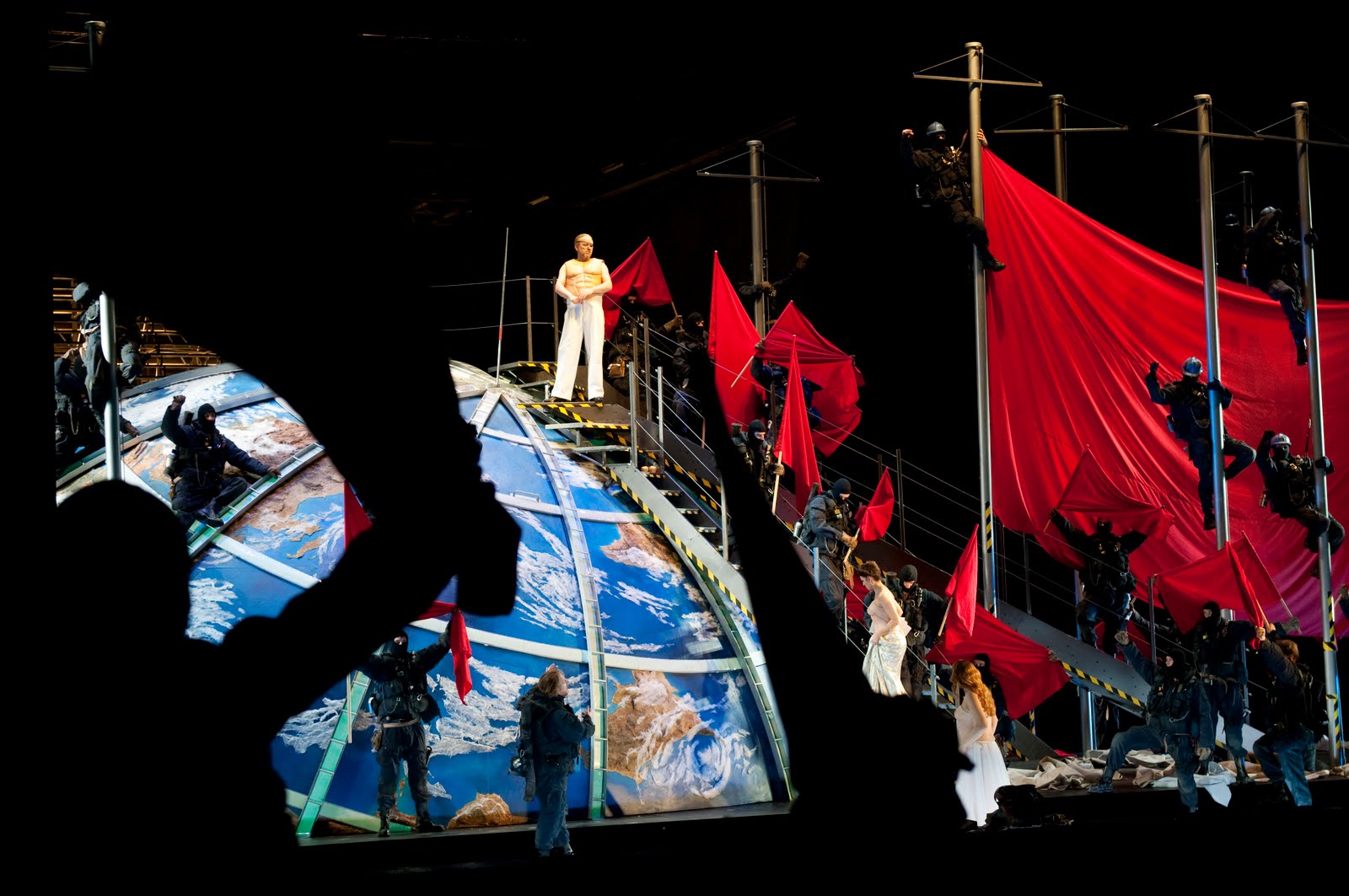
What possesses genuine dramatic power is the idea of having Valhalla’s heroes, old-fashioned in (almost) genuine Teutonic helmets and so forth, on stage above what ought to be Brünnhilde’s rock, ready and yet unable to defend or perhaps even to attain her, unlike Siegfried, the apparent harbinger of a new age – or should that be a New Age? Wotan, or rather, as I discovered at the curtain call, his body double, staggers up the steps, yet has to be assisted by his heroes, and even then it remains a struggle. So the balance or dialectic between the two principal plot strands, if not perfect, is reinstated. Moreover, the spatial separation between Brünnhilde and her old life is rendered glaringly apparent: she is now ‘purely human’, or, as we shall doubtless discover, ‘human, all too human’. Balanced against that signal achievement, I did not find much sense of annihilation, whether political or metaphysical, at the end. Perhaps the words are held to accomplish that by themselves, and perhaps they should, though my experience is that, somewhat bafflingly, audiences often seem oblivious to what precisely Siegfried and Brünnhilde have actually been singing.
In the pit, Philippe Jordan seemed to have the ‘scherzo’ element well in hand. Masculine drive, delineating the trajectory of Siegfried’s behaviour, was counterbalanced by a welcome ‘French’ – perhaps ‘feminine’ – range of colour in the orchestra. Adorno would surely have applauded the sense of phantasmagoria, which yet did not seem, as sometimes it did during the Berlin Philharmonic’s Aix-en-Provence performances, to be present merely for its own sake. For the most part, the orchestra was on fine form, the ‘Forest Murmurs’ magical indeed. Moreover, I do not think I have heard more impressively resounding kettledrums in this work than here: not a trivial point in recounting the tale of Fafner. It seemed, however, that the early third-act slackening of tension onstage was mirrored in the pit too. The structure of this act is especially difficult to hold together: I have heard far worse, but there were moments of meandering.
Ablinger-Sperrhacke’s vocal performance was as impressive as his stage portrayal: the first act really was Mime’s story. His wheedling second-act deceptions were just as impressive, likewise the ‘evil stock-jobbers’ satire’ (Hans Mayer, ‘The “Ring” as a bourgeois parable. Wieland Wagner’s new conception and its realisation in Bayreuth,’ in Programmhefte der Bayreuther Festspiele, booklet for Götterdämmerung, 1966, p.33) confrontation with Peter Sidhom’s verbally attentive Alberich. Juha Uusitalo handled well the changing demands of role and production: both Wanderer and the emerging-returning Wotan were finely characterised and well delivered. Stephen Milling’s Fafner, however, threatened to overshadow all and sundry; his was an excellent performance in every way. The deep beauty of Qiu Lin Zhang’s voice and the dignity of her stage presence made for a notable Erda, though there were moments of less than perfect intonation. It is a cruel thing to leave Brünnhilde’s entry so late and then to expect her to do what she must. Katarina Dalayman’s delivery was not perfect but nevertheless offered moments of scintillation that augur well for Götterdämmerung. What of the hero himself? Torsten Kerl emerged with considerable credit. His resources, quite understandably, were sapped somewhat during the third act, but he recovered for a powerful final duet. Kerl was surprisingly vigorous throughout: his vocal reserves would appear to have grown considerably. What, then, to do for a Siegfried or a Siegfried? One could do much worse than start here.