Showing posts with label Günter Krämer. Show all posts

Sunday, 14 January 2024

Die Zauberflöte, Deutsche Oper, 11 January 2024


Sarastro – Tobias Kehrer
Tamino – Kieran Carrel
Speaker – Padraic Rowan
First Priest – Kyle Miller
Second Priest – Jörg Schörner
Queen of the Night – Hye-Young Moon
Pamina – Elena Tsallagova
First Lady – Flurina Stucki
Second Lady – Arianna Manganello
Third Lady – Davia Bouley
Papagena – Meechot Marrero
Papageno – Philipp Jekal
Monostatos – Burkhard Ulrich
First Armoured Man – Patrick Cook
Second Armoured Man – Youngkwang Oh
Three Boys – Soloists from the Children’s Choir of the Deutsche Oper

Director – Günter Krämer
Revival director – Gerlinde Pelkowski
Designs – Andreas Reinhardt

Chorus of the Deutsche Oper Berlin (chorus director: Thomas Richter) 
Orchestra of the Deutsche Oper Berlin
Giulio Cilona (conductor)


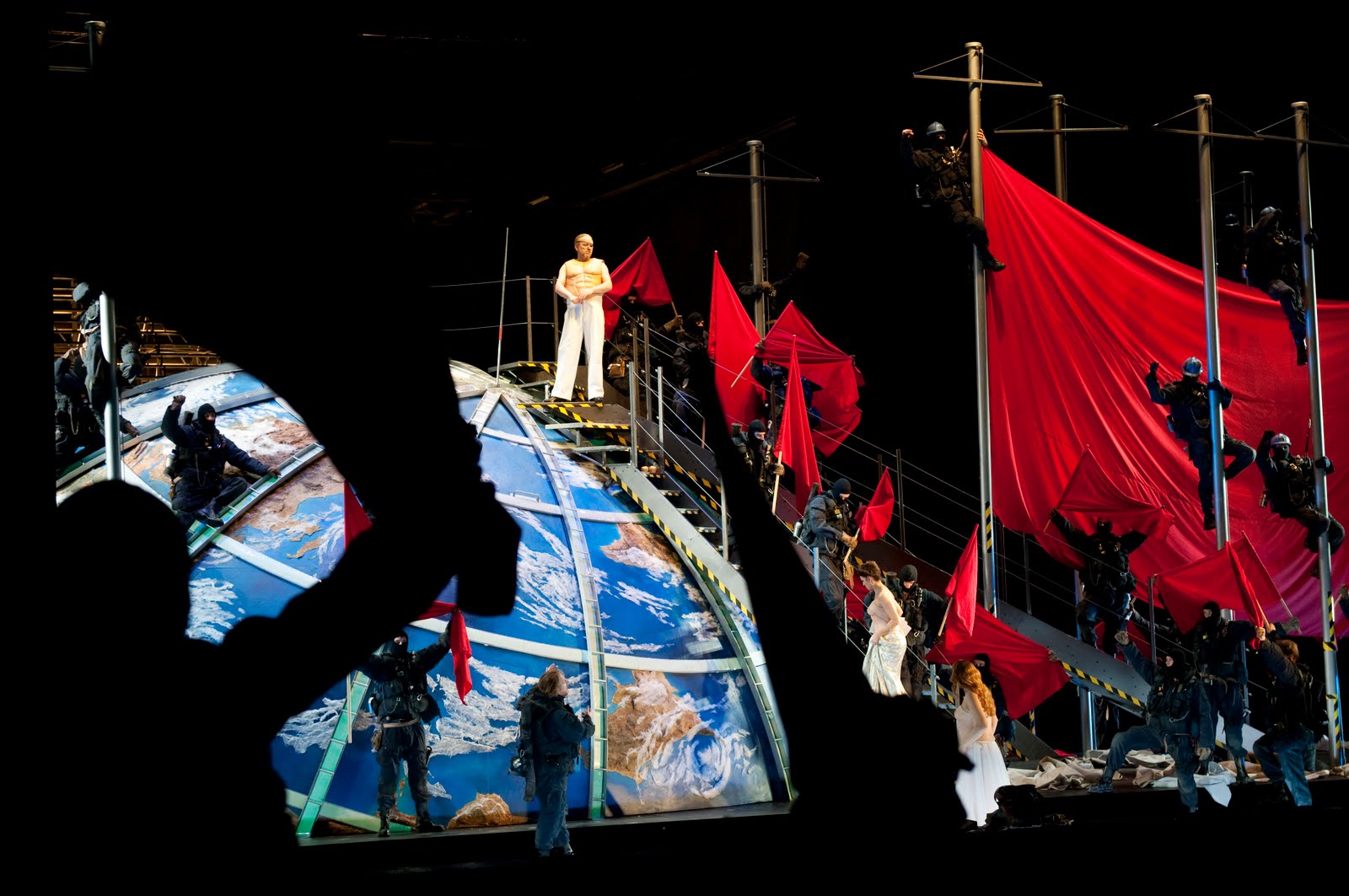
DIE ZAUBERFLÖTE von Wolfgang Amadeus Mozart, Deutsche Oper Berlin, copyright: Bettina Stöß
Images from 2008, with different cast

Premiered on 24 September 1991, six days short of 200 years from the work’s first performance, Günther Krämer’s Magic Flute has done sterling service for the Deutsche Oper. The company would have had more than a year’s worth, if it performed this single work daily without a break, the performance total having reached 379. The work is no stranger to longstanding productions: Achim Freyer’s truly magical staging (I saw it twice in Salzburg) did the rounds for a good few years; David McVicar’s Covent Garden production has been seen regularly, though not so regularly as that, for more than two decades now. Closer to home, August Everding’s tedious offering for the Berlin Staatsoper has been around since 1994 and clocked up 300 in 2021, though it has now been joined in repertoire by a more innovative staging from Yuval Sharon. I have no idea what holds the record; it would not surprise me if there had been something at some point in Vienna, or indeed at another German theatre, small or large, in repertoire for a few more decades, though that is pure speculation. Krämer must surely, though, be a contender in a work whose particular German circumstances seem to conspire towards endless revival: popular here, there, and everywhere ever since 1791; written in the vernacular; rightly or wrongly (to my mind, at least questionably), considered by many to be suitable for children; thereby presenting something approaching box-office certainty for something that is not La bohème, Carmen, or La traviata.

It was the first time I had seen it, so I cannot claim any of the attachment some veterans will doubtless feel for it. It did its job well enough, I thought, though by now it will surely lie at some remove from either the director’s ‘intention’ or what it might have been today. It does not look tired in the way some productions, desperately needing to put out of their (and our) misery do; Andreas Reinhardt’s designs, clear, colourful, and not without mystery, continue to fulfil their brief. It is difficult at this remove to discern a particular standpoint, let alone concept; perhaps there never was one, though I suspect there may have been elements of that once. In particular, I suspect a degree of social criticism would once have come across stronger, not least with respect to the treatment of Pamina and thus women more broadly. Her uncertainty and something approaching momentary horror in the closing scene, realising an apparent lack of agency and, just perhaps, resolving to restore that in the future were intriguing. Concerning racial politics, I wonder whether the portrayal of Monastatos and other slaves in what appeared to be native American garb once made a point that has now been lost (at least for me). It was deeply uncomfortable to view in 2024, and not in an obviously productive way. I wonder whether something might yet be done about that by a future revival director, should there be one, whilst bearing in mind the lack of rehearsal such revivals are likely to be allocated.


Ultimately more detrimental to the dramatic flow were the cuts in dialogue. There is no need to be a purist about that: very few productions use Schikaneder complete, and not only for reasons of sex and gender. But the precise nature of the cuts sometimes made motivation and even straightforward action unclear. Many will have known what to fill in, but many in such an audience also will not. No one need be bored in a largely German-speaking audience by a little more pertinent spoken content. 

The other major problem was Giulio Cilona’s conducting. We all, of course, have different conceptions of the work and how it should ‘go’. Not everyone responds as I do to Klemperer, Böhm, or Furtwängler; nor do I expect everyone to do so. In any case, the question is largely irrelevant since none of them is with us, and no one conducts Mozart quite like any of them any more. (Having heard Colin Davis several times in this and other Mozart operas, I have surely had my share of good fortune for a while, perhaps even for a lifetime.) Disconnection between pit and stage can happen to anyone, though preferably less frequently than here, even on what was probably minimal rehearsal. But the lack of sense that anything might matter, taking too much at an all-purpose allegro and indifferent mezzo piano, ‘Ach, ich fühl’s’ a merciful exception, led to a desultory orchestral performance all round. I initially assumed the string section must have been very small. However, though I could not see the rest of the section, I could see four double basses, so it could not have been that small. The angel of death appeared to be on strike for what should be the terrifying scene with the Two Armoured Men. So did Bach—and even Mozart. An old production needs all the more to be brought to life by comprehending, sympathetic conducting. Such was not the case here.


There was, fortunately, nothing to disappoint in the vocal performances—again bearing in mind the realities of an ultimate repertoire piece in a repertoire house. Kieran Carrel’s Tamino was well sung, personable, very much in recognisable character. Likewise our Papageno, Philipp Jekal’s performance bringing together with skill lightly worn a number of different theatrical and emotional worlds. Tobias Kehrer’s Sarastro made the most of his low notes in particular, alert to deeper meaning without sacrificing essential or at least apparent ‘simplicity’. Hye-Young Moon’s Queen of the Night implored and sought vengeance with impressive accuracy and sparkle. Burkhard Ulrich’s Monastatos was properly sung, no mere caricature: particularly important given the character’s problematical portrayal. Performances from the Three Ladies and Three Boys all deserve favourable mention. For me, though, the stand-out vocal performance was Elena Tsallagova's as Pamina: clean of line, happy of musical and dramatic blend, and with true emotional depth that saw no need to draw attention to itself. Though I cannot help but feel it might be time to draw the final curtain on Krämer’s production, a few more performances such as Tsallagova’s might help delay the inevitable.


Tuesday, 21 June 2011

Götterdämmerung, Opéra national de Paris, 18 June 2011

Opéra Bastille

Siegfried – Torsten Kerl
Gunther – Iain Paterson
Alberich – Peter Sidhom
Hagen – Hans-Peter König
Brünnhilde – Katarina Dalayman
Gutrune, Third Norn – Christiane Libor
Waltraute – Sophie Koch
First Norn, Flosshilde – Nicole Piccolomini
Woglinde – Caroline Stein
Wellgunde, Second Norn – Daniela Sindram

Günter Krämer (director)
Jürgen Bäckmann (set designes)
Falk Bauer (costumes)
Diego Leetz (lighting)
Otto Pichler (choreography)
Stephan Bischoff (video)

Chorus of the Opéra national de Paris (chorus master: Patrick Marie Aubert)
Orchestra of the Opéra national de Paris
Philippe Jordan (conductor)


And so, the Paris Ring comes to an end, though complete cycles are scheduled for 2013. Alas, though Wagner wrote to Liszt in 1853, ‘Mark well my new poem — it contains the beginning of the world and its destruction!’, this world, often highly promising, came to an end not with a bang but a whimper, and not in the sense intended by TS Eliot. Günter Krämer’s production, which I have previously admired, if not without reservations appeared to have run out of steam, as if to give succour to those followers of George Bernard Shaw who regard the Ring’s culmination as its fatal weakness. How anyone reading the score or poem, let alone both together, could possibly think such a thing, I do not know, but it is a point of view, albeit seemingly presented more by default than design on this occasion. Remaining with Eliot, one might charitably think the scenario a ‘heap of broken images,’ though there is no sign of the sun beating here. The erstwhile Speer-like GERMANIA is now reduced to the shell of a stadium: Nuremberg-like, I suppose, though there seems something of a confusion, admittedly commonly-held, between stadium and Kongresshalle. That, alas, more or less seems to be it. There are other touches, some irritating, some not, but I struggled to discern much of an idea, let alone something that would properly unite Götterdämmerung with the rest of the cycle. Falk Bauer’s costumes continue to do good service, here in an all-purpose relatively contemporary fashion, but none the worse for that.


It falls to me, then, with little pleasure, to delineate those ‘other touches’. Hagen is wheelchair-bound: the cliché did no harm and indeed gave physical presence to his ‘degeneracy’, though it is an image as insensitive toward the disabled as Mime’s camp extravaganza to homosexuals. What really lies behind this confinement, however, is a greater role allotted to Alberich. During the Prologue, Hagen is wheeled around by an unidentified hooded figure: I thought it might be Hagen’s father or mother, though it might merely have been an extra. That figure is present for much of the first act, eventually revealing his identity. So Hagen is doing Alberich’s bidding in a far more straightforward way than usual: a pity, since Wagner renders the ‘Schläfst du, Hagen, mein Sohn’ confrontation so rich in its ambiguity – Boulez describes it with atypical hyperbole as ‘amazing’ – but never mind. Things really fall apart, however, when it comes to the third act. Alberich, not Hagen, stabs Siegfried, but it is not clear what is gained by this. Hagen is merely wheeled off by Gutrune, whereas it is Alberich who returns onstage to deliver the final line, ‘Zurück vom Ring!’ Alberich is then speared in turn by the Rhinemaindens, and lies dead on stage as the curtain falls. (Siegfried is still there too.) The question ‘what happens to Alberich?’ is resolved, but instead one might ask, ‘what happens to Hagen?’ Is there any point in the exchange? So bold a rewriting ought at least to have provoked; here it seems merely haphazard, part of a final couple of scenes which might have arisen had one asked someone unacquainted with the Ring to guess ‘what happens next?’ There are no ‘watchers’, so crucial to the remnant of society and the possibility of a future, either. Whereas Krämer has tended previously to avoid video, now it is all over the place, first for water and fire and then for a bewildering portrayal of a Valhalla-like hero – or is it several heroes? – ascending something akin to a virtual Jacob’s Ladder during Siegfried’s Funeral March. Is heaven being reinstated, or is it merely a Feuerbachian critique of immortality that is obliquely being reiterated? The problem is: one is granted no reason to know and, frankly – sadly – little reason to care. The final video game shoot-out following Brünnhilde’s farewell was simply an embarrassment.

Haphazardness is the impression, moreover, one gains from the non-appearance of Siegfried and Gutrune at the end of the second act. They are there in the music and clearly should be on the stage: one might argue that musical presence renders visualisation unnecessary, yet I could not help but wonder whether Krämer, in his arbitrary haste to disregard Wagner’s stage directions in favour of pretty much anything, had even studied the score. Blood brotherhood is for some reason accomplished as if Siegfried were an unsuccessful vampire: again, the idea seems to have emerged from nowhere and to lead nowhere. A final case of undue confusion, which I can hardly avoid mentioning, comes at the end of the first act. There are difficulties, of course, in staging the Siegfried-Gunther-Tarnhelm matter, but having Siegfried come along with Gunther, first hiding behind Gunther – one wanted to call out, pantomime-style to Brünnhilde, ‘He’s behind him!’ – and then under the table, merely popping out to grab the ring – now, ‘He’s behind you!’ – only serves to make matters worse and to add to a general sense of tiredness. Whatever the Tarnhelm, actually visible on stage, was supposed to accomplish, it did not, but nor did a critique of its powers seem intended. A weird interpolation beforehand had been some dirndl-clad men dancing during Siegfried’s Rhine Journey. It was good to see the Rhinemaidens during that scene, however, affording a sense of place all too often absent elsewhere.

It was a visual mess, then, but Philippe Jordan might conceivably have salvaged something. Alas, the prologue and first act proved equally undisciplined in terms of conducting, despite generally impressive playing from the orchestra. Slowness without direction was the order of the day, a sluggish transition from the Gibichung Hall to Brünnhilde’s rock seemingly interminable. Yes, there is a sense of world-weariness to this drama, but forward impetus should be difficult rather than impossible. (Again, unless one conceives the work as a failure and wishes to expose it as such.) Having said ‘not with a bang but a whimper, and not in the sense intended by Eliot,’ then, there was something of Guy Fawkes’s torture rack to be endured. It has sometimes been alleged that the combined prologue and first act are simply too long, but never does it feel that way in a great, or even good, performance. For instance, Bernard Haitink’s long-distance hearing at Covent Garden almost made Wagner’s great span fly by. The Waltraute scene probably came off best, moving between extremes of speed, yet with a proper sense of the whole, rather as if it were a cantata, which in a way it is. It undoubtedly benefited from wholly committed performances on the part of Sophie Koch and Katarina Dalayman. The second and third acts were paced much better, but it was arguably too late to regain confidence by then. Perhaps Jordan was simply having an off day: his readings of the earlier dramas had certainly had their moments.

Vocally, there were two undeniable stars, who just about persuaded one not to relinquish the will to live. Hans-Peter König’s Hagen was, one strange moment of wild tuning aside, impressive indeed: black, forthright, clear of text. Dalayman continued to impress as Brünnhilde, powerful of voice, but equally attentive to the role’s subtler demands. Her Erwartung-style account of the final scene in the second act was a true wonder to experience: reminiscent of Gwyneth Jones, but in tune. Iain Paterson’s assumption of Gunther grew in stature. It is a difficult role at the best of times: to portray weakness without sounding vocally weak is no mean task. Paterson was thoughtful, conflicted, and careful with his words. Torsten Kerl simply does not possess the strength of voice to sound as a true Heldentenor, but he did what he could in a similarly thoughtful reading; it was undoubtedly a pity, however, that in any encounter with Brünnhilde, let alone Hagen, this Siegfried was so utterly overpowered. Unfortunately given the greater role allotted by the production, Peter Sidhom’s Alberich lacked presence, though all the notes and words were there. Strangely, Christiane Libor’s Gutrune came into her own in her final scene; she had previously seemed merely anonymous, without the slightest hint of the corrupting allure for which Wagner’s potion is not entirely a substitute. The end when it came, then, was welcome for all the wrong reasons – and not only because a 6 p.m. start ensured that the performance would conclude ten minutes short of midnight.


Gutrune (Christian Libor), Gunther (Iain Paterson), and Hagen (Hans Peter König)
(Elisa Haberer/Opéra national de Paris)

Alberich (Peter Sidhom)
(Charles Duprat/Opéra national de Paris)

Brünnhilde (Katarina Dalayman) and Waltraute (Sophie Koch)
(Elisa Haberer/Opéra national de Paris)
Hagen, Siegfried (Torsten Kerl), Brünnhilde, and the Chorus
(Elisa Haberer/Opéra national de Paris)

Siegfried, Gunther, Brünnhilde, and the Chorus
(Elisa Haberer/Opéra national de Paris)

Gunther, Hagen, Gutrune, Siegfried, Brünnhilde, Chorus
(Charles Duprat/Opéra national de Paris)


Siegfried's Death (Funeral March)
(Elisa Haberer/Opéra national de Paris)


Thursday, 31 March 2011

Siegfried, Opéra national de Paris, 30 March 2011

Opéra Bastille

Siegfried – Torsten Kerl
Mime – Wolfgang Ablinger-Sperrhacke
The Wanderer – Juha Uusitalo
Alberich – Peter Sidhom
Fafner – Stephen Milling
Erda – Qiu Lin Zhang
Woodbird – Elena Tsallagova
Brünnhilde – Katarina Dalayman

Günter Krämer (director)
Jürgen Backmann (set designs)
Falk Bauer (costumes)
Diego Leetz (lighting)
Otto Pichler (choreography)

Orchestra of the Opéra national de Paris
Philippe Jordan (conductor)


Mime (Wolfgang Ablinger-Sperrhacke) and Siegfried (Torsten Kerl)
 (Image: Elisa Haberer)

What to do for a Siegfried, or indeed for a Siegfried? Our age stands, not without reason, suspicious of charismatic heroes. Nietzsche would doubtless have pointed to our décadence and likened our descent to that from Homerian epic and the dramas of Æschylus and Sophocles, to the dramas of Euripides he so despised. After Freud, we tend to prefer the neo-Euripidean psychology of anti-heroes – not that psychology is absent in Wagner; after Hitler, we tend to prefer the venal sham of so-called representative democracy to those who would overthrow it, out of fear, a quality quite unknown to Siegfried, that we might arrive at something even worse. Either way, we remain ensnared by what Adorno and Horkheimer so tellingly termed the dialectic of enlightenment, which they traced as far back even as Homer’s Odysseus. Yet Siegfried remains. We struggle to find anyone who can sing the role, let alone to believe in him, at least in the drama that bears his name, the betrayals and tragedy of Götterdämmerung perhaps speaking more easily to us. Siegfried remains too, the ‘scherzo’ of the Ring, an aptly Beethovenian description – Wagner rarely sounds more Beethovenian than at the end of the first act – yet a challenge to an age that rarely seems able to deal with Beethoven, at least the symphonic Beethoven, either. We can only marvel at Furtwängler, quite unable, it would seem, to match him, rarely even to approach him. Yet it is not so straightforward even as that, for the tale of the boy without fear becomes intertwined with that of Wotan’s final renunciation. Of the four Ring dramas, Siegfried makes least sense by itself; it can only be understood as the third part of the cycle. Performers and directors need not only to balance the two, but to bring them into fruitful conflict.

If it would be an exaggeration to say that Günter Krämer straightforwardly sets his Siegfried in the 1960s, there are certainly elements of that era to the setting, which makes chronological sense in terms of the Speer-like designs for Valhalla at its height in Die Walküre. Mime appears to live in a relatively swish, if undeniably bad-taste, apartment. The plant growing there looks as though it might explain a good deal, including the bear’s exit through a lift: were both Siegfried and Mime hallucinating? The time-setting makes a good fit with Wagner’s conception too, given that hopes for revolution were still in the air: a Junge Siegfried twinned with les événements is far from absurd, especially in Paris, though it is a moot point whether Peter Wapnewski’s ‘rebel without a consciousness’ (Richard Wagner in seinen Helden (Munich, 1978), p.169) should have lost it through smoking marijuana rather than never having possessed it in the first place. Designs for this act are garish, verging upon psychedelic.

However, a crucial aspect of Mime’s portrayal edges us into the 1970s. Perhaps it would be hoping too much for subtlety in this respect, since it might therefore have gone unnoticed, but Mime appears, through Krämer’s direction, Falk Bauer’s costumes, and Wolfgang Ablinger-Sperrhacke’s acting on stage, to be an outrageously caricatured homosexual, hand gestures, dancing and all, with definite tendencies towards transvestism at least. (Is that yet another dig at Wagner and his pink silk, I wonder?) Given that (s)he appears as something of a cross between John Inman and Mollie Sugden, I could not help but wonder whether Krämer were a devotee of Are You Being Served? Indeed I half expected Miss Johannes Brahms to enter stage left à la Baba the Turk. The concept takes us away from endless debates, whatever one thinks about them, concerning anti-Semitism, and retains the character’s outsider status, and actually seems to be permissible on stage, in a way that a ‘Jewish’ caricature of Mime, were one so inclined, would not be. It also opens up a new angle upon the echt-heterosexual Siegfried’s instinctive aversion towards a parent who claims to be both mother and father, though is actually neither, and who certainly has no offspring of his own. Whilst preparing to forge, Siegfried – immediately, one assumes, bien dans sa peau – mockingly mimics Mime’s gestures; clearly the outcast’s place is in the kitchen. Whether we consider it all a bit of fun, veering dangerously close to homophobia, or even, implausibly, making a serious point concerning gay adoption, is probably more a matter of taste, or at least sensitivity, than anything else. It occurred to me that someone with post-modernist inclination towards hyphens and parentheses might have entitled the first act ‘Mime: (A) His/her-(s)tory’; it is certainly one way to address the paucity of women in the drama. Perhaps a thesis has been launched. At any rate, a possible way of representing Siegfried’s upbringing somewhat overshadows, indeed becomes, the plot.

The Wanderer arrives as a tramp: fair enough. In an interesting touch, he sheds his vagrant’s clothes to become a more recognisable chief of the gods as his wager, whose brutality is often glossed over, with Mime progresses. Brutality, in terms of the aftermath of war, is certainly present in Neidhöhle too. The staging of the second act Prelude is especially interesting. Nude soldiers – although, thanks to Diego Leetz’s thickly atmospheric green lighting, it is quite some time before one knows whether they are nude – carry the Nibelung hoard in dragon formation. (One sees what one hears in the music: an all too rare occurrence in stage direction.) The hoard is composed of crates, which, one eventually makes out, have ‘Rheingold’ inscribed upon them. At the end of the Prelude, the soldiers open the crates, to reveal the weaponry with which the hoard will be defended. Rentier capital – Fafner’s Proudhonian ‘What I lie on, I own’ – constitutes power as lethal as Donner’s hammer or indeed the machine guns we see. Fafner, when he actually appears, is carried aloft, replete with crown: there is something tellingly phantasmagorical to this portrayal, almost Wizard of Oz-like. And that, of course, is at least part of the key to the Tarnhelm’s magic.

If that hits home with considerable dramatic punch, other elements of the production, especially later on, convince less. The Woodbird’s representation on stage as another wartime refugee will not please everyone, and it is a decidedly peculiar conception of an unsullied Voice of Nature. Whatever one thinks of that, it seems needlessly confused to have her played by an actress, whilst Elena Tsallagova sings the role – on this occasion, not without uncertainly – offstage. The office environment of the Wotan-Erda scene does no particular harm, but makes no particular point either: it seems somewhat clichéd. However, there is tightening of tension thereafter. The confrontation between Wotan and Siegfried for once genuinely seems a real struggle. Wagner’s emphasis might have changed from his original conception, but this is still the moment when the sword of revolution shatters the spear of state. For all our – and in many respects, the production’s – reluctance to deal with revolutionary heroism, this deed of an Hegelian world-historical hero registers with surprising force. The backdrop to the final scene both confuses and illuminates. By returning us to the Walküre and Rheingold Speer set, some form of continuity is registered, likewise the changing fortunes of ‘GERMANIA’, now down to only its first three letters. One has to accept that this is just a backdrop rather than Valhalla itself, for the sake of any sense of place.

What possesses genuine dramatic power is the idea of having Valhalla’s heroes, old-fashioned in (almost) genuine Teutonic helmets and so forth, on stage above what ought to be Brünnhilde’s rock, ready and yet unable to defend or perhaps even to attain her, unlike Siegfried, the apparent harbinger of a new age – or should that be a New Age? Wotan, or rather, as I discovered at the curtain call, his body double, staggers up the steps, yet has to be assisted by his heroes, and even then it remains a struggle. So the balance or dialectic between the two principal plot strands, if not perfect, is reinstated. Moreover, the spatial separation between Brünnhilde and her old life is rendered glaringly apparent: she is now ‘purely human’, or, as we shall doubtless discover, ‘human, all too human’. Balanced against that signal achievement, I did not find much sense of annihilation, whether political or metaphysical, at the end. Perhaps the words are held to accomplish that by themselves, and perhaps they should, though my experience is that, somewhat bafflingly, audiences often seem oblivious to what precisely Siegfried and Brünnhilde have actually been singing.

In the pit, Philippe Jordan seemed to have the ‘scherzo’ element well in hand. Masculine drive, delineating the trajectory of Siegfried’s behaviour, was counterbalanced by a welcome ‘French’ – perhaps ‘feminine’ – range of colour in the orchestra. Adorno would surely have applauded the sense of phantasmagoria, which yet did not seem, as sometimes it did during the Berlin Philharmonic’s Aix-en-Provence performances, to be present merely for its own sake. For the most part, the orchestra was on fine form, the ‘Forest Murmurs’ magical indeed. Moreover, I do not think I have heard more impressively resounding kettledrums in this work than here: not a trivial point in recounting the tale of Fafner. It seemed, however, that the early third-act slackening of tension onstage was mirrored in the pit too. The structure of this act is especially difficult to hold together: I have heard far worse, but there were moments of meandering.

Ablinger-Sperrhacke’s vocal performance was as impressive as his stage portrayal: the first act really was Mime’s story. His wheedling second-act deceptions were just as impressive, likewise the ‘evil stock-jobbers’ satire’ (Hans Mayer, ‘The “Ring” as a bourgeois parable. Wieland Wagner’s new conception and its realisation in Bayreuth,’ in Programmhefte der Bayreuther Festspiele, booklet for Götterdämmerung, 1966, p.33) confrontation with Peter Sidhom’s verbally attentive Alberich. Juha Uusitalo handled well the changing demands of role and production: both Wanderer and the emerging-returning Wotan were finely characterised and well delivered. Stephen Milling’s Fafner, however, threatened to overshadow all and sundry; his was an excellent performance in every way. The deep beauty of Qiu Lin Zhang’s voice and the dignity of her stage presence made for a notable Erda, though there were moments of less than perfect intonation. It is a cruel thing to leave Brünnhilde’s entry so late and then to expect her to do what she must. Katarina Dalayman’s delivery was not perfect but nevertheless offered moments of scintillation that augur well for Götterdämmerung. What of the hero himself? Torsten Kerl emerged with considerable credit. His resources, quite understandably, were sapped somewhat during the third act, but he recovered for a powerful final duet. Kerl was surprisingly vigorous throughout: his vocal reserves would appear to have grown considerably. What, then, to do for a Siegfried or a Siegfried? One could do much worse than start here.

Saturday, 3 July 2010

Die Walküre, Opéra National de Paris, 29 June 2010


Image: Opéra national de Paris/ Charles Duprat

Siegmund – Robert Dean Smith
Sieglinde – Ricarda Merbeth
Hunding – Günther Groissböck
Wotan – Thomas Johannes Mayer
Brünnhilde – Katarina Dalayman
Fricka – Yvonne Naef
Gerhilde – Marjorie Owens
Ortlinde – Gertrud Wittinger
Waltraute – Silvia Hablowetz
Schwertleite – Wiebke Lehmkuhl
Helmwige – Barbara Morihien
Siegrune – Helene Ranada
Grimgerde – Nicole Piccolomini
Rossweisse – Atala Schöck

Günter Krämer (director)
Jürgen Bäckmann (designs)
Falk Bauer (costumes)
Diego Leetz (lighting)
Otto Pichler (choreography)

Orchestra of the Opéra national de Paris
Philippe Jordan (conductor)


I surprised myself by concluding that the first instalment of the Paris Ring had been ‘all told, … the best Rheingold I have attended since Haitink’s tenure at the Royal Opera’. Die Walküre is arguably a tougher proposition still than the cycle’s Vorabend, but that earlier promise was essentially maintained. Günter Krämer’s production remained sure-footed and often imaginative; the contribution from Wagner’s Greek chorus, the Orchestra of the Opéra national de Paris, was truly excellent; Philippe Jordan’s conducting grew in stature as the evening progressed; and, if the singing was rarely at a level to challenge the great interpretations we have all heard – or fancy we have – then it was at least creditable, Katarina Dalayman’s Brünnhilde proving much more than that.

The synthetic nature of Krämer’s Rheingold continues into his Walküre. Ideas might well be traced back to other productions, but that is not to say that either the particular mode of expression or the particular synthesis too closely resembles any other. No Wagner scholar would claim that he did not rely upon, that he was not inspired by, the work of his predecessors. Nor, I am sure, would any Wagner performer be so arrogant, though I have a nasty suspicion that Sir Roger Norrington, he of the Tristan-Prelude waltz, might draw close. Why should we expect stage direction to be entirely different? And should it be so, is that not more likely to be the product of default than design? What we have here are ideas that generally have a firm basis in the work, not in a quasi-archaeological obsession with Wagner’s intentions, narrowly construed, but nevertheless in meaningful dialogue with what he wrote. There is plenty of directorial leeway in deciding what to emphasise, what to develop, without necessity to transplant something entirely ‘new’ onto Wagner’s drama.

The first act is a case in point. Krämer elects to convey a greater sense than the composer prescribes of Hunding’s society. This highly militarised milieu reminds us that the brutal Hunding represents a remarkably contemporary – for Wagner and for us – bourgeois hierarchy of instrumentalisation. Hunding appears to be a middle-ranking figure in whatever civil war is raging; Siegmund hails of course from an insurrectionary wild race, fro whom nothing (at least nothing that Fricka, voice of custom would understand) is sacred. Thugs billeted upon Sieglinde, Hunding’s mere chattel, are Krämer’s invention; the violence they exude conveys Wagner’s dramatic purpose. Another social aspect emphasised, again in contradistinction to Volsung anarchistic outlawry, is that of the Valkyries. A choice is thereby set up for Brünnhilde to make. Wotan’s maidens serve a military role, in this case not only returning heroes to Valhalla but cleaning up their bodies and enrobing them. Theirs is probably the most convincingly integrated Ride I have seen: no danger here of something to be tacked on, endured, until we can return to the proper business of Wotan and Brünnhilde. Valkyries and soldiers form part of an uncomprehending society that watches the extraordinary turn of events at the end of the second act, when for Brünnhilde the first intimations of the power of love lead her to disobey Wotan’s command. Loge’s fire, when it comes, will burn brightly indeed. Yet, like the Young Hegelian Bruno Bauer’s ‘I demonstrate that religion is a hell composed of hatred for humanity and that God is the bailiff of this hell,’ the intention will be to unmask, leaving us with a view of the society left behind. Bauer, who at one point harboured plans with Karl Marx to found a Hegelian journal entitled The Archives of Atheism, knew Mikhail Bakunin well – and we know with whom Bakunin would fight upon the barricades of Dresden.

The sickness of the (painted) tree in the first act stands consonant with that of the ‘bad’ nineteenth century: a sort of sub-Pre-Raphaelite post-Romanticism. First we do not see it, then Sieglinde reveals it. Then we – or at least I – think: is that not just too poor a substitute for Wagner’s ash? But there is something more to come, revelation from behind the painting of the sword that mysterious visitor had deposited. The real forest, when viewed properly during the second act, evokes Caspar David Friedrich, but at a slight remove, as if that artist’s day has already passed, which in a way of course it has, whilst retaining a presence. Reality, and especially history become more layered than one might have thought, in a fashion akin to Wagner’s motivic method.

GERMANIA now stands tall, but Krämer and his team cleverly undercut, like Wagner, Valhalla’s grandiosity. They do it with mirrors – which both extend the scope of Jürgen Bäckmann’s set and highlight the trickery involved. Gothic letters, seen in the production picture, may be seen in black on stage and white in reflection: magically, as it were, the ‘right way around’. This, presumably, is what the gods see, or delude themselves they see. Likewise the upholders of self-righteous, hypocritical bourgeois morality: they represent a properly Feuerbachian inversion of religious practice. If Feuerbach’s Essence of Christianity looms large, so does his earlier Thoughts on Death and Immortality. Where Feuerbach had praised antiquity for its lack of belief in and unawareness of the doctrine of immortality of the soul, it is now necessary to strike against that belief, as Siegmund does. Interestingly, Wotan himself takes Siegmund to his final resting place during the third act, honouring perhaps ‘das Ende’, for which the god has wished, and to which the Volsung might have pointed the way. Freia’s golden apples are littered around Valhalla, to remind us of the casual abandon with which the denizens of light have adopted their false immortal cause. Ubiquitous yet already insufficient, they equate very well to the terms of the drama so far. One might even claim that they not only support the words but compensate for a surprising absence from the music. Still, Wagner had so many balls in the air that dropping the odd apple is neither here nor there.

Erda returns at the end, reprising her slow walk across the stage. Brünnhilde elects to sleep beneath rather than upon the table Wotan has prepared for her and Siegmund. It is not yet clear what this might mean, since there is more to come, but the handling of Walküre makes me eager to find out.

Philippe Jordan’s first act opened impressively, not least on account of the tremendous bite from the opera orchestra’s strings. This was a true storm, also a musical one, a mini-exposition if you like. Tension was not always maintained, however, especially during the final scene, some of which meandered. Yet the structure of the second and third acts was far more clearly in place: a sterner task to effect, one might have thought, yet accomplished with great success. No one in the theatre seems likely to match my experience of Bernard Haitink’s direction of the potentially sectional second act, Wotan’s monologue and all, yet shape and momentum were skilfully imparted. Wagner’s endless melody was sung – and meaningfully so.

Robert Dean Smith is unlikely to win prizes for charisma, but he was for the most part a dependable enough Siegmund, even if ‘dependable’ is hardly sufficient in this role. His second cry of ‘Wälse’ seemed, surprisingly, to last for an eternity, far longer than I can otherwise recall. Jon Vickers might have brought it off, but here we ended up with an audibly strained hero for a good part of what ensued. Ricarda Merbeth portrayed a feistier, less pure Sieglinde than is often encountered. Her odd facial expressions took a bit of getting used to, but the confidence of her vocal assumption grew, culminating in a refulgent, genuinely moving ‘O hehrstes Wunder!...’ Günther Groissböck and Yvonne Naef, imperiously resplendent in Falk Bauer’s gown (pictured), made much of the words of Hunding and Fricka, and showed that they could act too. Thomas Johannes Mayer, substituting for the advertised Falk Struckmann, was a more than creditable replacement as Wotan, gaining in stature as the drama progressed. He too showed especial attentiveness towards the words, veritably hissing his contempt at Hunding, but proving equally capable of lyricism when required. Katarina Dalayman’s Brünnhilde was the star turn, however: tireless and yet a soul in transition – arguably in emergence. The demands of words, music, and stage action combined here to present a Valkyrie unlikely to be equalled by present-day exponents.

What a pity, then, that one was fortunate to hear a single bar of the second act without an onslaught of heavy coughing, the outer acts bearable only by comparison. Once again, I was reminded of Pierre Boulez’s strictures concerning opera houses; once again I doubted whether they really are the right place to stage Wagner’s music dramas. Not for nothing has the later composer-conductor voiced admiration for his predecessor’s loathing of a system in which ‘opera houses are … like cafés where … you can hear waiters calling out their orders: ‘One Carmen! And one Walküre! And one Rigoletto!’ A Jockey Club disruption might at least have proffered entertainment as well as enragement value. If the Opéra National de Paris and the Bastille amphitheatre are doing Wagner proud, they remain hamstrung by a pernicious section of their audience. It is not difficult to imagine how Wagner would once again have railed at the city of his misère.

Monday, 29 March 2010

Das Rheingold, Opéra national de Paris, 25 March 2010

Images: Opéra national de Paris/Charles Duprat

Wotan – Falk Struckmann
Donner – Samuel Youn
Froh – Marcel Reijans
Loge – Kim Begley
Alberich – Peter Sidhom
Mime – Wolfgang Ablinger-Sperrhacke
Fasolt – Iain Paterson
Fafner – Günther Groissböck
Fricka – Sophie Koch
Freia - Ann Petersen
Erda – Qiu Lin Zhang
Woglinde – Caroline Stein
Wellgunde – Daniela Sindram
Flosshilde – Nicole Piccolomini

Günter Krämer (director)
Jürgen Bäckmann (designs)
Falk Bauer (costumes)
Diego Leetz (lighting)
Otto Pichler (choreography)

Orchestra of the Opéra national de Paris
Philippe Jordan (conductor)

The beginning of a new Ring will always be an event but is perhaps even more so in Paris. The Paris Opéra itself has not presented a complete cycle since 1957, reaching only as far as Die Walküre under Solti in 1976 – and even then, the company was still exclusively ensconced at the Palais Garnier, as opposed to its present day split between the old theatre and François Mitterand’s Opéra Bastille. There have been more recent performances of the tetralogy, however, at the Théâtre des Champs-Elysées and the Châtelet. The city so important to understanding Wagner, the city for which he notoriously prescribed a ‘fire cure’ and which punished him more than handsomely with the Tannhäuser debacle, has never been short of Wagnerians and has equally never been short of opponents. There is, of course, nothing more Parisian than an artistic ‘controversy’ (consider the Querelle des bouffons) or ‘case’: was Nietzsche more décadent than he knew? Perhaps surprisingly, that arch-controversialist Gérard Mortier never, during his reign at the Bastille rose to this ultimate challenge pour épater les bourgeois, but the new directorate of Nicolas Jöel and Philippe Jordan, the latter already a Wagner conductor of considerable experience, has. Das Rheingold and Die Walküre are presented this season; Siegfried and Götterdämmerung are scheduled for next.


I had felt somewhat nonplussed by earlier work I had seen from director Günter Krämer. At the 2002 Salzburg Festival, I was grateful enough for the chance to hear Strauss’s ‘cheerful mythology’, Die Liebe der Danae, still more so from the Staatskapelle Dresden and Fabio Luisi, but the production seemed to do little other than to present each act at a different stage of the work’s history: the 1944 dress rehearsal, the ‘true’ premiere of 1952, and the revival fifty years hence. Tristan, which I saw in Vienna in 2008, I found still less revealing: unobjectionable, but nothing more. By contrast, this Rheingold is really rather good: red in tooth and claw, as befits the least ambiguously socialist of all Wagner’s stage works. The staging is recognisably post-Chéreau – what could it mean to attempt to be pre-Chéreau? – and certainly shares ideas with other productions, but I see no harm in that. It generally works as a synthesis, and some of the greatest artists and thinkers have had abilities at least as much synthetic as ‘original’: for instance, Marx, who looms large here. (The programme misleads in straightforwardly describing Wagner (p.86) as ‘lecteur de Marx’. He may well have been; indeed, I should wager that he was. However, short of new documentary evidence coming to light, we cannot say for certain.) And Wagner as a thinker was certainly synthetic in tendency, if not always in achievement, nowhere more interesting than in the contradictions this might present.

Though we have seen the Rhinemaidens as ladies of the night before, the direction on stage makes this credible theatrically as well as a good idea. (I am trying not to shudder excessively at memories of the embarrassing pole-dancing experiment from Phyllida Lloyd for the English National Opera.) Alberich is a dwarf too, for those who treasure stage directions – and he certainly should be a misfit in a trivial world where one is judged solely on appearances. Krämer recognises that there is no golden age for Wagner: the composer, often even in this work a Schopenhauerian avant la lettre, presents an almost Hobbesian initial state of nature and a Fall that is anything but a felix culpa. That the post-lapsarian world is still worse than its predecessor does not detract from the latter’s amorality. Diego Leetz’s lighting works well in suggesting a Rhine of sorts. This first scene, then, seems to me a model of what Warren Darcy has called a ‘tragedy in miniature’.

I was disappointed at the abruptness of the scene shift that followed: at odds with one of the supreme examples of Wagner’s ‘most delicate and profound’ art of transition, that of Alberich’s ring into Wotan’s Valhalla. We see the site for the latter, though not of course the completed version, too early. What is being built is, with perhaps unduly heavy-handed reference to the Third Reich, GERMANIA, whose capital – in more than one sense – construction, grandiose as the drama’s conclusion, we witness as the evening progresses. Portrayal of the gods is imaginative. Their idealistic physique – muscles for the men, breasts for the women – is clearly constructed, in that they wear these, and one is intended to see that they are not ‘natural’. This certainly fits with Feuerbach’s conception, so important to Wagner, of religion alienating human qualities onto a projected godhead and thereby impoverishing life on earth. The appendages are lost when Freia and her golden apples are captured, and put back on upon her return to the fold. It is not quite clear to me, however, why Wotan does not suffer this fate. Loge, as so often, steals the show. Initially more than a little camp, the outsider, brilliantly portrayed by Kim Begley, soon throws caution to the wind as a fully-fledged drag artiste.

Nibelheim comes across well, especially its centrepiece golden globe hoard and the equally striking pendulum-like cutting mechanism that swings throughout. The wonder and tawdriness of the magic trick are presented in Alberich’s Tarnhelm transformations: we know that he is hiding behind the ball; yet we see and hear that others believe something else. Moreover, we witness the brute power wielded over the Nibelungs, since these are cowering characters on stage. Wotan’s wresting of the ring from the dwarf, one of the truly terrible moments in the cycle, most certainly is here: the violent, bloody loss of the finger realistic and prescient as Alberich’s curse itself. Then there are the giants. Initially they appear with socialist propaganda followed – this a coup de théâtre – by a threatening band of angry proletarians, who burst into the audience, dispensing red sheets, inscribed with Fasolt’s fundamental denunciation of Wotan: ‘Was du bist, bist du nur durch Verträge.’ (‘What you are, you are through contracts alone.) Not a bad agitprop slogan, and in a nice touch, Fricka peruses what seems to be a fuller prospectus of the workers’ programme. The subsequent portrayal of Fafner chills. A construction union boss, we see in the fourth scene that he is more inhuman than the gods, savagely wielding and employing his whip when duly strengthened by possession of the ring. (I could not help but think of the leaders of UNITE, drawing salaries not so very far off the executives they excoriate.) Also memorable, with attendant change of pace, is Erda’s scene, in which, clad as a Victorian matriarch, she slowly traverses the stage as she delivers her warning: simple but effective. She watches beforehand, which perhaps serves no particular purpose but, by the same token, does no especial harm.

Begley was perhaps the star performer, sardonic and with a perfect sense of timing, but the cast in general impressed. Peter Sidhom does not possess the largest of voices for Alberich, but he cleverly used what he has. Iain Paterson and Günther Groissböck clearly differentiated between Fafner and Fasolt, the vocal and scenic realisation properly increasing as the drama progressed. Qiu Lin Zhang suffered from bad intonation at her entry as Erda, but recovered with nobility. Falk Struckmann was variable as Wotan, always attentive to the words but sometimes a little underwhelming vocally, apparently pushing him to be a bit too much of an ‘actor’ on stage. Sophie Koch had something of the sphinx’s enigmatic quality to the god’s attractively sung and played consort: more interesting than something too overtly shrew-like. Marcel Reijans displayed an attractive lyric tenor as Froh. The Rhinemaidens were of somewhat uneven quality, at least in vocal terms.

Underpinning this all, however, was the first-rate orchestral contribution. The orchestra of the Opéra national de Paris sounded surprisingly – welcomely – ‘German’ in tone, doubtless in partial consequence of Philippe Jordan’s experience in German houses, not least the Berlin Staatsoper. The blend was impressive, sometimes reminiscent of Karajan’s favoured Wagner sound. This rendered the novelty – in historical terms – of Wagner’s brass writing telling, but subtly so. The only real disappointment was the feebleness of the anvils. For Jordan’s command of the work’s vast structure one could certainly forgive that. He certainly has the measure of the work’s ebb and flow, of the orchestra’s role as Greek chorus; I have heard him do nothing finer. Indeed, all told, this was the best Rheingold I have attended since Haitink’s tenure at the Royal Opera. Die Walküre is eagerly anticipated.

Wednesday, 2 April 2008

Tristan und Isolde, Vienna State Opera, 1 April 2008

Vienna State Opera

Tristan – John Treleaven
König Marke – Stephen Milling
Isolde – Evelyn Herlitzius
Kurwenal – Boaz Daniel
Melot – Clemens Unterreiner
Brangäne – Daniela Denschlag
Hirt – Michael Roider
Stimme des Seemanns – Gegely Németi
Steuermann – Marcus Pelz

Chorus and Orchestra of the Vienna State Opera
Thomas Lang (chorus master)
Leif Segerstam (conductor)

Günter Krämer (producer)
Gisbert Jäkel (designs)
Falk Bauer (costumes)

Wagner famously wrote to Mathilde Wesendonk of his fears whilst composing the music for Tristan und Isolde: ‘I fear the opera will be banned – unless the whole thing is parodied in a bad performance –: only mediocre performances can save me! Perfectly good ones will be bound to drive people mad, – I cannot imagine it otherwise.’ On those rare occasions when ‘perfectly good’ performances arise, one knows precisely what he means: the work is truly unbearable. The problem, however, is, that it appears that nothing other than a ‘perfectly good’ performance will do. Even a performance with great merits, let alone a truly ‘mediocre’ one or a ‘parody’, leaves one feeling that it has not really done the job at all. Such, at least, has been my experience on a number of occasions, and was again this evening.

The orchestra was excellent. Indeed, the Vienna strings struck me as absolutely perfect for the work: certainly the best I have ever heard. Those hunting horns, that bass clarinet, the shepherd’s English horn: for all of these and more, I should have nothing but praise. There were many times that I found myself wishing to hear a purely orchestral rendition: inappropriate, of course, but not so wholly inappropriate as in any other of the Wagner music dramas, given that, even more than usual, the drama lies in the orchestra. Leif Segerstam’s direction was for the most part unimpressive. There were moments when he indulged the gorgeousness of the orchestra a little too much, but one could easily forgive that. Yet something very odd happened during Tristan’s monologue, which really derailed the performance. My problem is that I am not entirely sure what it was. It sounded either as if Segerstam had lost his way, or – which I cannot quite believe – the music had been cut. I say ‘cannot quite believe’, not because the work is never cut – although the Act Two love duet would be the more usual place for butchery – but because, if it were, I could not register when and where it had happened. However, the end of the monologue at least sounded foreshortened, and somehow managed to seem a terrible anti-climax (at least in retrospect, for one might actually have missed it there and then). Somewhere along the line, my attention started wandering, which I can honestly say it has never done before in a live performance of Tristan, whatever its faults. After that, I am afraid, I simply – and very sadly – found myself wishing that it were all over.

Casting Tristan is, of course, impossible. Perhaps Ben Heppner can sing the title role; I have not heard him. But I doubt that anyone else can today. There are no rivals to Windgassen or Suthaus, let alone Vickers or Melchior. I feared the worst with John Treleaven, following his Royal Opera Siegfried. Perhaps lowering expectations helped, but I think that he was somewhat better, even if his stage presence was risibly unconvincing. He looked throughout like a newly-redundant middle-manager, upset and just occasionally crazed at the prospect of eking out his remaining years on the dole. Nobility and unbearable possession did not come in to it. Nor did beauty of tone, or at times sung tone – although this was less frequent than it had been in the Ring. He exhibited stamina, as he had at Covent Garden, but sadly that is not enough. Dramatic sense would have been furthered if Evelyn Herlitzius's Isolde had chanced her arm by eloping with Clemens Unterreiner's vocally- and physically-attractive Melot instead. Herlitzius at least looked credible. She approached the part – or at least this was how it seemed – as a singing actress, rather in the line of Waltraud Meier, albeit without Meier’s extraordinary charisma, or indeed without the refulgence of tone of which Meier is still capable, whatever her detractors might claim. Some of her portrayal worked better than other parts. Much of the worst was over in the first half of the first act, when it had sometimes seemed as though she had little voice at all. She clearly did, and used it to great effect in much of the second act. Yet the guiding principle of her portrayal – was it of her direction? – appeared to be that Isolde was deranged. I suppose she is, in a sense, but this is something far more powerful, far more complex, than the traditional operatic heroine’s ‘madness’. Especially earlier on, one might have been forgiven for thinking that this was Donizetti with music. As so often, the Kurwenal and Brangäne were better, although Daniela Denschlag appeared – somewhat oddly – to tire later on. Boaz Daniel was certainly a fine Kurwenal; his loyalty was heard as well as seen. Moreover, his lines were shaped in a musical fashion from which the Tristan and Isolde could have learned much. Stephen Milling did not disappoint as Marke, but then I am not sure that I have ever heard anyone disappoint in this gift of a role. I did not find him especially memorable, but could find no fault with his tone, nor his command of line.

The production did no particular harm, although I am not sure that it did any particular good either. There was some powerful use of lighting, in a straightforwardly representational fashion, to suggest day and night. (The colours of Herbert Wernicke’s Covent Garden production achieved something far more difficult: meaningful abstraction.) I thought having Tristan and Isolde kiss as the curtain came down on Act I a mistake. It seemed merely tawdry, and not only on account of the unconvincing acting. The sets worked well enough, without drawing undue attention, which is as it should be. And there was one extremely compelling image, a video image of waves during the first scene of Act Two. Uncannily synchronised with the surging of the orchestra – impeccably projected by Segerstam – this was powerful indeed. I could not really say why, but it worked, which is all that mattered. The costumes were nondescript nineteenth-century, making one wonder why Falk Bauer had even been engaged.

There was, however, one other important element to the performance. Even if one had been in the presence of Furtwängler and Flagstad, I think it would have been difficult to maintain concentration in the face of the audience. In this of all works, absolute concentration, indeed possession, is vital. Lose it and one might as well go home. Mobile telephones rang twice. On the first time, the culprit would not even turn off the nauseating wrong-key rendition of the first subject from Mozart’s great G minor symphony. Coughing one can put up with, irritating though it might be; there are, after all, occasions on which many people simply cannot help it. There is no excuse whatsoever, for conducting 'conversations', for want of a better word. One member of an American ‘tour group’ behind congratulated another member, ‘admiring’ him for having ‘put up’ with ‘so long in the theatre’, just as the shepherd’s pipe song began. Nor is there any excuse for falling asleep, let alone for snoring, as the unpleasant Austrian in an ill-fitting suit seated next to me did: not just once, but on several occasions. When awake, he insisted upon ‘conducting’, although whatever he was doing bore no relation to the score, nor to what was being heard. Given that he had been asleep for much of the performance, I wondered at his boorish shouts of ‘Bravo’ – to John Treleaven, of all people. There were many more examples, but I shall stop there. It was doubtless all the more shocking for being Vienna, not Verona. What I truly do not understand, however, is why such people have elected to attend a performance of Tristan. Only the St Matthew Passion would seem less suited. Are they attending by mistake, expecting something akin to La Traviata? Do they really not care that they ruin whatever might be left to salvage for everyone else? This is, perforce, a communal experience. I was driven mad for all the wrong reasons.