Showing posts with label Karen Cargill. Show all posts

Sunday, 25 September 2022

LPO/Gardner - Schoenberg, Gurrelieder, 24 September 2022


Royal Festival Hall

Waldemar – David Butt Philip
Tove – Lise Lindstrom
Wood-dove – Karen Cargill
Klaus-Narr – Robert Murray
Peasant – James Creswell
Speaker – Alex Jennings

London Philharmonic Choir (chorus director: Neville Creed)
London Symphony Chorus (chorus director: Simon Halsey)
London Philharmonic Orchestra
Edward Gardner (conductor)


Image: London Philharmonic Orchestra


The pandemic is not over. But I remember thinking, when some sort of minimal concert life was intermittently starting up again—socially distanced concerts at St Martin-in-the-Fields with a maximum audience of thirty, the first and second series of Spotlight Chamber Concerts at St John’s Waterloo, and so on—what resumption of a full range of musical life would entail for me. I chose three examples, which have remained in my mind ever since: a large-scale work by Richard Strauss, a full staging of Die Meistersinger, and a performance of Gurrelieder. Strauss came a little while ago, in a performance of the Alpine Symphony—though I await a Frau ohne Schatten. Meistersinger is yet to come. On this Wagner-and-Strauss-starved island, we should probably not hold our collective breath. Nevertheless, even if accompanied by precious little other Schoenberg, Gurrelieder has returned.

It was, if truth be told, a somewhat mixed performance we heard from Edward Gardner and the LPO: well sung and played, Gardner’s conducting more variable yet growing in stature, with one major, well-nigh catastrophic miscalculation for the closing melodrama. The Royal Festival Hall is far from ideal for this work, yet Esa-Pekka Salonen’s Philharmonia performances in 2009 and 2018 had seemed far more at home. Contrast was glaring in the opening bars. Both Salonen and Gardner achieved great clarity; whatever the Festival Hall’s shortcomings, it probably helped in that respect. Gardner and the LPO, however, sounded oddly mechanical, as opposed to pointillistic; the strange impression was of oddly balanced strings and flutes out of sync, even when they were not. And even once the music had settled, Gardner imparted an oddly regimented quality to it, moving bar-to-bar rather than via paragraph. There were, though, some inviting, dangerous, Tristan-esque sounds from the LPO that prepared the way splendidly for David Butt Philip’s first entry.

Butt Philip showed himself, without exaggeration, to be one of the finest Waldemars I have heard. His way with words and shaping of vocal lines were beyond reproach. As the first part progressed, his emotional range widened to encompass, as does the work, the impetuous, the angry, and also greater dynamic range. The ardent lyricism as he told of Waldemar’s pride, likened unto that of Christ seated once more next to His father, was an object lesson in dramatic delivery that yet retained a Lieder-singer’s attention to detail. Lindstrom offered a womanly Tove with Nordic steel: no false purity, and again a performance that took its leave from the verse. The LPO generally sounded gorgeous. Earlier on, Gardner might have lingered to advantage. Greater flexibility did come, though, whether in the coital stillness of Tove’s response or the ghostly, again Tristan-like brass of ‘unsel’ger Geschlechter’ foretold, developing via frightening double basses into something more ominous. Waldemar’s words ‘Unsere Zeit ist um’ offered ecstatic contradiction, already tinged with irony concerning fate and the future. Yet the sweetness of the interlude introducing Tove’s last words consoled, as it should. Could Lindstrom’s delivery here have been more lyrical? Probably. Her care for verbal expression nonetheless offered compensation enough, and the climax on ‘Kuß’, her final word, sent shivers down the spine, with credit due to all concerned: soloist, conductor, and orchestra.

The Wood-dove’s song was, quite simply, outstanding. Karen Cargill’s deep, rich tone furthered an interpretation once more unquestionably rooted in the text. Rising out of the orchestra, this was a forest messenger one knew one could trust, however much one wanted her words not to be true. Gardner here captured to a tee the crucial role of rhythm, not least in relation to harmony. It made for a gripping conclusion to the first part, the strange decision to break for an interval all the more regrettable.

That said, the brief Part Two plunged us, orchestrally and vocally, straight back into the action. Butt Philip showed anger, increasingly blasphemous, without hectoring. Crucially, he continued to sing, never shouting, and in highly variegated fashion too. Gardner communicated well the fulfilment of those early ghostly sounds in the opening of Part Three, Butt Philip and the LPO audibly responding by taking us on a journey to new, more bracingly modernist sounds, though the direction of travel rightly remained unclear, a veritable Götterdämmerung Hallowe’en from male chorus and James Creswell’s Peasant alike highly impressive. Robert Murray’s Klaus-Narr was nicely animated, communicating like Cargill’s Wood-dove with evident sincerity and truthfulness. Again, this was music that was sung, here in Straussian fashion, albeit more grateful for the tenor. Meistersinger-ish tendencies in the orchestra were welcome and revealing, preparing the way for that extraordinary experience in the prelude to the Speaker’s appearance of material transformed before our ears, almost against our (even Schoenberg’s?) will. History’s demand, the material’s, or the drama’s? Why choose?   

And then, talk about spoiling the ship for a ha’p’orth of tar. The Speaker entered, perversely miked, and in English translation. One can perform Gurrelieder in English, I suppose, but then it should surely be the whole thing. The ‘effect’ was alienating in quite the wrong way, exacerbated by laboured, ac-tor-ly delivery on the part of Alex Jennings. The idea, it seems, was Gardner’s own; someone should have dissuaded him. For however sardonic, at times even vicious, the LPO sounded, this was a conceptual miscalculation that torpedoed the performance as a whole. How I longed for the inimitable Barbara Sukowa, icing on the cake for both of Salonen’s performances (as well as Claudio Abbado’s Vienna recording). Even the strange, choral climax, sincere in its way yet knowing that such tonal sounds can no longer truly convince, failed through no fault of the chorus to salvage matters. A great pity indeed.


Wednesday, 19 December 2018

BBC SO/Gardner - Berlioz, L'Enfance du Christ, 17 December 2018


Barbican Hall

Karen Cargill (mezzo-soprano)
Robert Murray (tenor)
Etienne Dupuis (baritone)
Matthew Rose (bass)

Members of the BBC Singers
BBC Symphony Chorus (chorus master: Neil Ferris)
BBC Symphony Orchestra
Edward Gardner (conductor)


L’Enfance du Christ is not an Advent work, but since most of this country’s musical institutions shut down over Christmas, Advent is probably the only chance we shall have to hear it – and even then, only on occasion. But then Messiah is a Lenten work, and yet… There was certainly much for which to be grateful in this BBC SO performance. An initial tendency, heard for instance in the first scene’s Marche nocturne, for Edward Gardner to drive Berlioz’s music too hard, was mercifully not maintained. Indeed, as time went on, Gardner’s tempi relaxed more, greatly to the music’s benefit. The BBC Symphony Chorus’s singing, at the outset a little woolly, sharpened up too. If orchestral colours tended to be stronger on individuality then on blend, that was only a tendency, with plenty of exceptions, not least the opening woodwind recitative, in which the orchestra, Robert Murray, a fine Narrator, drew us in, his entry and that of the strings having the drama gather pace nicely and without exaggeration.


There is something enduringly and endearingly strange to any ‘sacred’ or perhaps better ‘religious’ work by Berlioz. Just as much as with the Requiem, it is perfectly clear, without his needing to say so, that he does not believe a word of it. If that stands very much in a grand, public, ceremonial tradition ultimately as empty as Robespierre’s Cult of the Supreme Being, this becomes an illustrated children’s story that is yet not for children. The vividness of the writing and, one hopes, the performance too has characters, scenes, even locations stand out from the pages, but the lack of belief – not hostile, just ‘as it is’ – remains. That presents its own very particular challenges to the performers, challenges to which they rose very well. Herod’s Aria, for instance, sung darkly and clearly by Matthew Rose, ‘accompanied’ by due orchestral darkness too, might have been sung by a Shakespearean king; it was difficult not to think of parallels in the writer Berlioz loved above all others. In the ensuing scene with the soothsayers, the clarinet first commenting on, then seemingly confirming, the king’s dream, much must be accomplished by instrumental means alone, the ‘stage directions’ acting ‘as if’ there were a stage, written explications to musical ‘illustrations’. Such was certainly the case with the ‘cabalistic’ movements of the soothsayers as they moved to conjure the dark spirits to be ‘appeased’. A dark, Theresa May-like tyrannical resolve was inculcated, heedless of the consequences: infanticide meant infanticide. Just after the Strong and Stable One had flounced out of Parliament ‘in real life’, so too did Herod walk offstage: ‘Malgré les crie, malgré les pleurs de tant de mères éperdues, des rivières de sang vont être répandues, je serai sourd à ces douleurs.’


Pastoral innocence was just what we needed as balm to such malevolence, and so we heard – even saw – it at the Bethlehem stable. Karen Cargill’s beautifully floated lines as Mary remained alert to Berlioz’s idiosyncracies. Joined by Etienne Dupuis, whose suave, stylish, yet heartfelt singing proved very much one of the evening’s highlights, this Holy Family gave us something we might or might not believe in, but which could certainly enchant. Berlioz’s tone-painting did likewise, although it had me think his strictures against Haydn in The Creation not without double standards. Joined by offstage members of the BBC Singers as angels, singing very much in a choral tradition of French semi-archaism, this was a scene not just of contemplation but of readiness to depart. It prepared us as well as the Holy Family well for the short second part: ‘La fuite en Egypte’, its Overture having me wonder again – as I had during Herod’s music – whether Mussorgsky knew the music and unconsciously had it in mind when at work on Boris Godunov. The Russian composer certainly cherished Berlioz’s treatise on orchestration. Sometimes a correspondence is just a correspondence; at any rate, parallels, such as they be, may be worth consideration. The celebrated ‘Shepherds’ Farewell’ flowed nicely, integrated rather than a ‘set piece’. Murray’s narration reminded us how stylish and meaningful his French singing could be; sweet toned too, it was really rather wonderful.


The third part, entitled ‘L’Arrivée à Saïs’, is indeed an arrival in more than a strictly narrative sense. The Holy Family, following malevolent calls, as May would have it, to GO HOME – ‘Arrière, vils Hébreux,’ shout the Roman and Egyptian Tories de leurs jours – nevertheless find shelter with fellow ‘migrants’: an Ishmaelite and his family. And yet – something that came across gently yet strongly in performance – this is not the end of the story. Anticipatory narration, clearly, vividly delivered by Murray and the BBC SO alike, is never quite fulfilled, events and sentiments in the Ishmaelite house – Berlioz’s fugal chorus especially relished – a challenge to us, to the readers of his picture-book to respond or, like many self-styled ‘Christians’, to cross to the other side of the road, with or without ‘citizens of the world’ abuse. Berlioz’s closing chorus, euphonious to a degree, sounded a gentle warning: ‘O mon cœur, emplis-toi du grave et pur amour qui seul peut nous ouvrir le céleste séjour.’ Will any of us heed it?


Monday, 2 July 2018

Pelléas et Mélisande, Glyndebourne, 30 June 2018


Glyndebourne Opera House
  
Mélisande (Christiana Gansch), Pelléas (John Chest), Golaud (Christopher Purves)
Images: Richard Hubert Smith

Golaud – Christopher Purves
Mélisande – Christina Gansch
Geneviève – Karen Cargill
Arkel – Brindley Sherratt/Richard Wiegold
Pelléas – John Chest
Yniold – Chloé Briot
Doctor – Michael Mofidian
Shepherd – Michael Wallace

Stefan Herheim (director, lighting)
Philipp Fürhofer (designs)
Tony Simpson (lighting)
Alexander Meier-Dörzenbach (dramaturgy)

Glyndebourne Chorus (chorus master: Nicholas Jenkins)
London Philharmonic Orchestra
Robin Ticciati (conductor)

Mélisande and Golaud

What might have been? Such was a thought that came to my mind more than once during this, the premiere of Glyndebourne’s new Pelléas et Mélisande. What might have been if Stefan Herheim had not changed his Konzept so late in the day? (I had actually forgotten about that until reminded during the interval, yet had already begun to wonder whether the production had been, especially for him, unusually rushed.) What might have been, had this magnificent statement of intent – one of the greatest opera directors alive – from Sebastian F. Schwarz’s intendancy not been followed by manœuvring to ensure that something more ‘English’ would thereafter prove the order of the day? What might have been, had this Pelléas been conducted by someone with a little more feeling for and understanding of Debussy’s score – it would not have been difficult – than Robin Ticciati? What, ultimately, might have been, were operatic culture in this country not so philistine and class-ridden? The good news – our lives are at present as full of good news as those we see in Pelléas – is that leaving the European Union will only serve to make everything far, far worse. C’est au tour de pauvres petites.

Mélisande and Pelléas

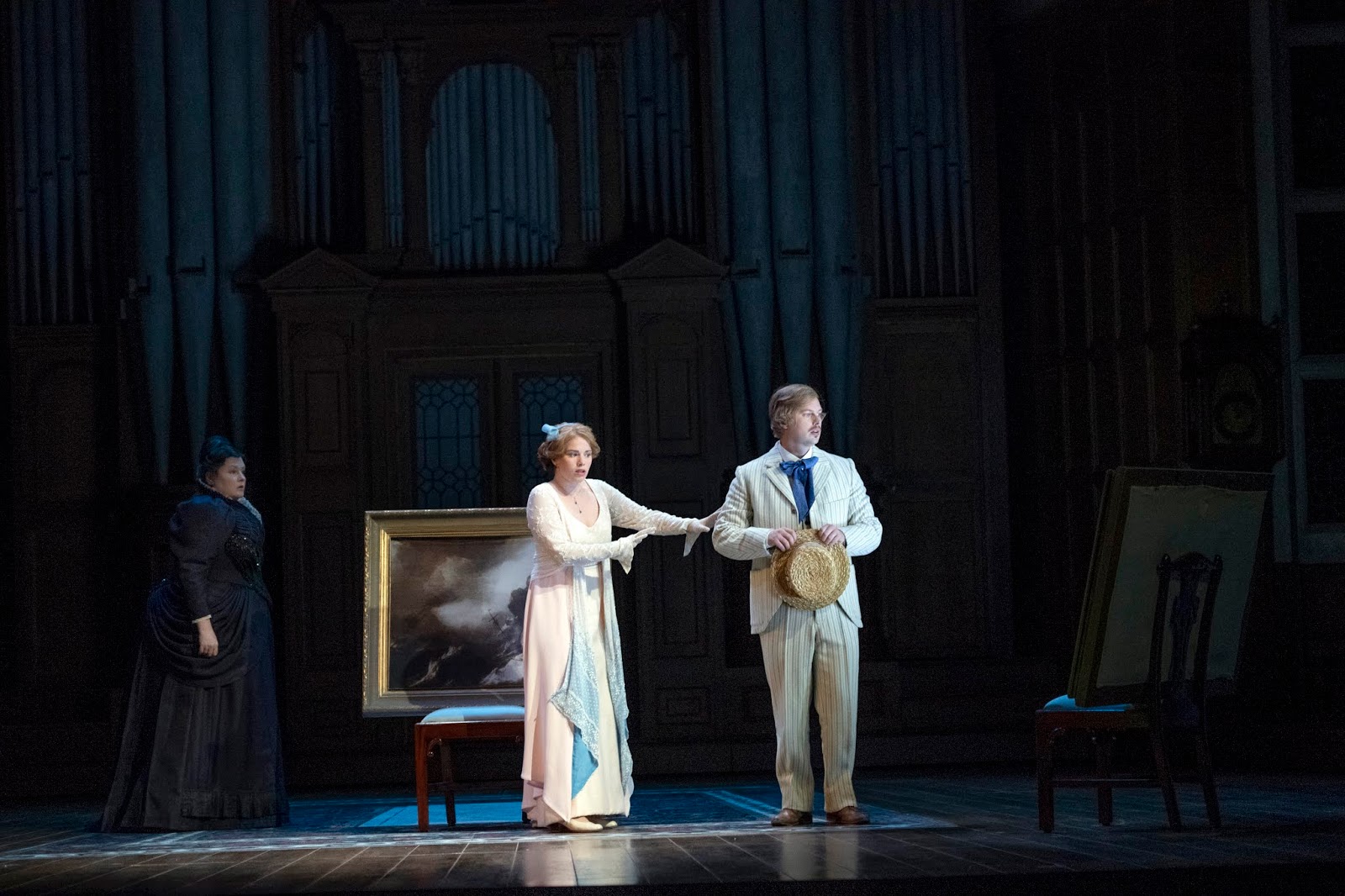
I was thinking, though – which is considerably better than not. Even if I could not help but wonder what Pelléas set on a spaceship would have been like – on the face of it, it sounds a brilliant idea – Glyndebourne’s Organ Room, from time to time a salle modulable yet never escapable, turned the action and responsibility squarely upon us, the audience. (If only the worst-behaved had noticed. Some laughed at the end. Laughed! It was not difficult to think of them as Faragistes.) It is specific, yes, but not exclusivist. Indeed, with its heavy wood-panelling in Philipp Fürhofer’s outstanding set design, it might almost be the Victorianised combination room of an Oxford or Cambridge college or even something from the Hanseatic world of Buddenbrooks. Ancestry and tradition weigh down on it, though, as seen on the severe wall portraits. It is about us, then, but also about how we have become who we are.


Geneviève (Karen Cargill), Mélisande, and Pelléas

‘Us’ in this sense means taking on aestheticism, asking ourselves as well as selfish fellow audience members what we think we are doing and why. These are people engaged in fruitless, fatal pursuits – but in this case they are also aesthetic pursuits. They try to paint new pictures and cannot. Why not? On account of tradition, or account of an aestheticism that has them retreat from lives, even try to turn their lives into art? It need not be either/or; it almost certainly is not. We see through their attempts at art, though: literally, for the paintings, if they exist at all, are beyond the fourth wall. Is not Mélisande, after all, a blank canvas? Men certainly tend to wish her so – as with Lulu. It is just a hobby, though, is it not? Something for rich people to do to while away their time, perhaps like building an opera house so that ‘your’ – the possessive is important – wife might sing in it. Pelléas might seem different; he is, here, an artist, a younger Debussyan dandy rather than the elderly huntsman trying to be something he is not and certainly was not. (Are Golaud and Pelléas to be identified with the composer? Perhaps, perhaps not. If you do not want ambiguity, this is not the opera for you.) But is he? Is he really? Or does he just wear summer clothes in a darkened room? Perhaps his aestheticised life is still more dishonest; perhaps ours are too. Perhaps, peut-être. ‘Je pars peut-être demain.’


We do that to children too, especially those of us who claim to be shocked by the very suggestion. Germaine Greer has fallen off the rails spectacularly in recent years, but her insight that we are all paedophiles still holds; indeed it holds more strongly than ever, if less so for those of us unburdened by ‘family’. And so, when Yniold – yes, I too had been mumbling that I should have preferred to hear a treble – is unmasked as a woman all along, with locks aspiring to those of Mélisande, we are obliged to ask ourselves questions. The violence we see, feel aestheticised and sublimated all around us suddenly becomes, as the interval comes, something we can no longer ignore. Those blows that never quite led anywhere come to seem something more than ‘boring’.


By the same token, however, should they perhaps not have become something a little sooner? When does representing boredom become merely boring? I am not sure that Herheim, usually a master at treading of multiple lines, does not trip, even fall, in this case. An object lesson in that respect was Christiane Pohle’s revelatory post-Beckett staging for the Bavarian State Opera. Meaninglessness was the thing there, not ennui as such; the production was all the better for it. I cannot help but wonder whether the negative reaction it received was laced with misogyny – and/or perhaps a journalistic lack of understanding of ‘modern’ theatre. It was, at any rate, difficult not to ask such a question in a work that focuses on abusive behaviour and yet here, at least, attempts to avoid addressing that behaviour.

Golaud and Mélisande

Later on, when it becomes more explicit, when we see that Pelléas and Mélisande literally stage their own death – is it actually a real death at all, or just an act – everything falls into place. Mélisande has already – in fact she did so straight away – ease(le)d out Geneviève. The family, closing ranks, would clearly avenge itself, so perhaps playing at Tristan and Isolde is all that it is left. It has not been an easy road; nor, surely, should it have been. However, just a little relief from the claustrophobia might actually render it more powerful. As things stand, there remains more than a little suspicion that earlier tedium is a handy, even suggestive excuse, yet perhaps nevertheless an excuse in part. Bloodied clowns certainly make their point; this sick Liebestod from the Theatre of the Absurd has still not left my imagination. Yniold, now herself, visits the Organ Room as a guest, an opera-goer. It makes the point, yes, but might it not be better left unmade?


Tradition is, after all, sometimes necessary, or at least helpful – as the Roman Catholic Church would rightly tell us. It often provides an important counterweight to literalism, to fundamentalism. Collective wisdom enables development; each one of us need not re-invent the wheel. (Aesthetes breathe a collective sigh of relief.) As Pierre Boulez pointed out in challenging – though not, as some have claimed, denying – tradition, ‘a strong personality will inevitably transform it [tradition].’ That still leaves the problem, of course, of what to do about personalities that are not ‘strong’ or do not wish to be. ‘Ne me touchez-pas! Ne me-touchez-pas!’ Is the conclusion here bleak or weak? Is it too easy to say that it is what we want it to be? Doubtless. Is it what we will make of it? By definition it more or less has to be, but is that simply to evade the question? And is that wrong? Debussy, after all, is the unsurpassed master of musical ambiguity.


Tradition, or at least learning, would certainly have benefited the conducting, at best featureless, at worst frankly jejune, we heard from Ticciati. Debussy’s genius shone through, although more the debt to Wagner than what distinguished him from the old Klingsor. That, however, was surely the doing of the London Philharmonic, drawing when it could on its vast reserves of operatic and symphonic experience. Alas, such uninspired musical direction  bleeding titbits of Wagner for people who dislike Wagner  did not help the singers either. Christopher Purves was presented as an older Golaud and sang as such: nothing wrong with it. His anger was wonderfully sublimated until it was not. It would have gained greater musical context, though, as would the rest of the cast’s, had there been – well, greater musico-dramatic context. Christina Gansch and John Chest likewise offered good vocal performances as the doomed lovers, but something seemed to be missing. (Should something be missing? Perhaps. Again, however, it is a fine line.) Richard Wiegold was an undoubted hero of the evening, singing from a box whilst an indisposed Brindley Sherratt acted out the role of Arkel below. Karen Cargill offered rich-toned benevolence – I think – as Geneviève; as so often in this role, one wished there were more to hear.  There was much to admire from Chloé Briot, Michael Mofidian, and Michael Wallace, although it was difficult not to think that all concerned might have benefited from greater certainty and clarity elsewhere.


Was it worth it, then, to have annoyed the right people, bluff English purveyors of ‘common sense’? Of course. They will not like Pelléas anyway; if they think they do, it is because they have not remotely understood it and think of it as vaguely ‘beautiful’. Is it enough to have annoyed them? Of course not. Does this represent Herheim’s best work? No. Does the production stand in need of revision? Very much so. Does it also need a conductor with a little more idea what might be going on and what might be at stake? Still more so. And yet, I have been thinking about it ever since, and show no sign of stopping. In the meantime, hasten to see Barrie Kosky’s Berlin production and, should it ever be revived, Pohle’s Munich staging. There are always, as we æsthetes/æstheticists will tell you, great recordings too. Desormière or Karajan? Boulez or Abbado? Why choose? With Boulez, you can even see Peter Stein before he lost it. ‘What,’ you might ask, ‘is “it”,’? Such is surely part of what Herheim’s production is about – perhaps, peut-être, still more so than he intended.


Saturday, 11 June 2016

Tristan und Isolde, English National Opera, 9 June 2016


Isolde (Heidi Melton), Brangaene  (Karen Cargill), Tristan (Stuart Skelton), Kurwenal  (Craig Colclough)
 
 
Coliseum

Tristan – Stuart Skelton
Isolde – Heidi Melton
King Marke – Matthew Rose
Kurwenal – Craig Colclough
Melot – Stephen Rooke
Brangäne – Karen Cargill
Shepherd – Peter van Hulle
Steersman – Paul Sheehan
Young Sailor – David Webb

Daniel Kramer (director)
Anish Kapoor (set designs)
Christina Cunningham (costumes)
Paul Anderson (lighting)
Frieder Weiss (video)

Chorus of the English National Opera (chorus master: Stephen Harris)
Orchestra of the English National Opera
Edward Gardner (conductor)


My first Tristan, indeed my first Wagner, in the theatre was ENO’s previous staging of the work, twenty years ago, in 1996. The experience, as it should, as it must, although this is alas far from a given, quite overwhelmed me. Whether it would now is beside the point: I have no way of knowing and could not, would not go without a considerable number of Tristan- and Wagner-experiences in between. ENO’s new Tristan has its faults, but it also has far from negligible virtues. If the acid test might be said to be whether it reminds one that Tristan is, will surely always be, the greatest musical drama of all – with, that is, the possible exception of the St Matthew Passion, depending on how one considers Bach’s supreme masterpiece – then ENO succeeded not so very far off triumphantly. Given the strength of the company’s enemies within and without, that success deserves trumpeting loudly.


There are certainly some very good things in Daniel Kramer’s production. I use that somewhat limp phrase deliberately, for the overriding impression, or at least an overriding impression, is that it would benefit from revision, from a strong hand that would enable greater coherence and ruthless elimination of the irrelevant. (The latter is perhaps the worst foe of all in Tristan: remember Christof Loy? If not, do keep it that way.) In retrospect, it is the first act that stands out as seemingly from another production. Give or take the division of the stage into Isolde’s world and Tristan’s, strongly reminiscent of Herbert Wernicke’s excellent Covent Garden production, absurdly dispensed with in order to prepare the way for Loy, it seems really to be a straightforward, almost ‘traditional’ staging. I have no problem with that; it lets the work speak, and there is much to be said for that. Whatever one does with Tristan, one is ill-advised indeed to do something to it. Its status as an almost entirely metaphysical drama renders it curiously, almost uniquely, impervious, to such Konzept­-driven treatment. (Or at least it has done so in my experience: it is foolish and indeed absurd to rule things out ‘in principle’.)  Alas, Kramer has a bizarre mini-concept, or whatever we want to call it, concerning Kurwenal. Of any character in opera, I find it difficult to think of a less camp specimen. Undoing or undercutting conventional views of masculinity might be an interesting project here, but simply turning him into a camp monstrosity, dressed, like Brangäne, as if he were a refugee from a highly stylised presentation of Alice in Wonderland, is bizarre and, frankly, extremely irritating. He spends a good deal of time and energy spraying perfume, or air-freshener, or something at Tristan before the latter’s confrontation with Isolde. To what end? I am afraid I have no idea. Something, I think, to be eliminated from the revival I hope will come. The very peculia costumes (in themselves well designed by Christina Cunningham, but again, to what end?) would benefit from rethinking en masse.


In the second and third acts, Anish Kapoor’s striking designs do a great deal – perhaps a little too much? – of the work. The lack of specificity is no bad thing. Tristan is certainly not about Cornwall. (Imagine a Tory-UKIP production, in which the whole problem never arises, because Cornwall’s borders are ‘secure’ and our ‘migrants’ are never able to disembark thanks to Theresa May’s ‘tough’ stance on immigration. Or rather, do not.) The love duet takes place in something not so very far removed from what Wagner stipulates; the landscape supplies its own, neo-Romantic (quasi-lunar?) magic and ‘beauty’, without becoming ‘the thing’, which is surely as it should be. The death-wish, that sickest Romanticism-cum-Schopenhauerism, which pervades the whole work is intelligently brought out in Kramer’s vision of neurotic self-harm. It certainly convinces far better than the unbearable dullness – it might work as Konzept, but in the theatre, with this most particular, resistant of works? – of Christoph Marthaler’s Bayreuth production. If the hospital beds and physical restraining of the final scene are perhaps a little too overt, I did not find them unforgivably so. For English audiences, notoriously resistant to modern musico-dramatic theatre, there is sometimes something to be said for spelling things out (although preferably not in this particular work). Again, the costumes are weird: here almost Dr Who-like. Again, rethinking for a revival, so as to bring out more strongly what matters? We can but hope.

 
Brangaene, Isolde, Tristan, and King Marke (Matthew Rose)
 

The central ideas of the third act are strong too, Kapoor’s designs and Frieder Weiss’s video providing an æsthetically inviting setting and a necessary visual confrontation with the sapping away of Tristan’s life force respectively. One would hardly be able to avoid, in the case of the latter, Tristan’s loss of blood; the way in which it both horrifies and yet remains a thing of compelling beauty is surely quite in the spirit of the work. It complements the score without overshadowing it, very much what is required. Paul Anderson’s lighting, excellent throughout the evening, offers just the right mixture of subtlety and night-day contrast. The neo-Beckettian direction Kramer offers seems far more appropriate than the strange distractions of the first act. If the attempt at transfiguration does not entirely succeed, that is at least in part Wagner’s fault. He almost gets away with it, but the rupture with tonality, with reality, with pretty much anything and everything should have been so extreme during Tristan’s monologue that Isolde’s Verklärung both enraptures and misses the point. I have yet to see a production that took quite such an Adornian line, although Peter Konwitschny arguably comes close at times, whilst also veering in completely the opposite direction; here, in a broadly traditional sense, Kramer characterises the act pretty well as a whole.  

 
Tristan, his blood draining away

Edward Gardner led a largely successful, often highly ‘theatrical’ account of the score. Its metaphysical basis might have suffered somewhat, but does it not always when Furtwängler, or at least Carlos Kleiber, cannot make it? On its own terms, whilst sometimes considerably driven (echoes perhaps of Böhm, if not quite with his symphonic, post-Beethovenian grounding?), there was considerable give and take, a sense of melos much stronger than his Meistersinger, and a well-judged balance between the requirements of the moment and those of the greater line. If the orchestra sounded at times a little thin, especially in string sound, during the first act, it played for the most part magnificently. Even earlier on, there was to the playing a productive, ever-surprising physicality, a true sense of bow touching string and sparking off something one cannot, should not put into words. The offstage (in-theatre) brass at the end of the first act was a mistake: far too loud, far too much a distracting ‘effect’, but such things are worth trying, at the very least. Some outstanding woodwind playing was greatly valued, not least, of course, the expert English horn solo in the third act (Helen Vigurs).

Tristan and Kurwenal
 

Stuart Skelton’s performance in the title role showed just how much this generous artist has to give in Wagner (and not just in Wagner). He made everything he could out of the words, out of the notes, and out of the mysterious alchemy Wagner here achieves between them. If he seemed a little tired onstage, although not vocally, later on during the third act, that may readily be forgiven; indeed, it offers its own dramatic justification. I have said this before, and fear that I shall have to say it again: it is frankly beyond belief that Covent Garden offers Skelton nothing, especially when one considers the Wagner tenors it has continued to inflict upon us. Heidi Melton was strongest during the first act. Again, she made much of the words, although some of her vowels were decidedly peculiar; however, some of her singing later on was distressing in quite the wrong way. She seemed miscast, unduly stretched by the role. Karen Cargill, on the other hand, made for a lovely Brangäne indeed, despite the bizarre nature of her treatment by the production. This was someone in whom one would readily confide, beauty of tone part of the dramatic assumption rather than a thing-in-itself. I wondered whether we might have been better off with her as Isolde. Craig Colclough suffered more from the production than anyone else, but his Kurwenal managed vocally to rise far above such limitations. His third-act Beckettian best-friend portrayal, true nobility of tone again very much part and parcel of what we saw and felt dramatically, was one of the most moving aspects of the entire performance. Likewise Matthew Rose’s dignified – if oddly, coldly treated by Kramer – King Marke. It is, I think, a more difficult thing to sing this part, arguably any of these parts, in English than in German. Rose, like the rest of the cast, but perhaps more so still, made one of the best cases in practice for performance in the vernacular I can recall hearing. Here, for once, was that vaunted dramatic immediacy, with the outstanding diction it requires. The smaller roles were all taken very well indeed, David Webb’s Sailor song setting the scene with considerable distinction. All in all, this is a Tristan that deserves to be seen, still more to be heard.


Sunday, 27 September 2015

BBC SO/Oramo - Mahler, Symphony no.3, 24 September 2015


Barbican Hall

Karen Cargill (mezzo-soprano)
Trinity Boys Choir (chorus master: David Swinson)
BBC Symphony Chorus (chorus master: Stephen Jackson)
BBC Symphony Orchestra
Sakari Oramo (conductor)
 

No orchestra benefits from the dreadful acoustic of the Royal Albert Hall; given the frequency of its Proms performances, no orchestra therefore suffers so much from that acoustic as the BBC Symphony Orchestra. In a work of the scale of Mahler’s Third Symphony, the Barbican might seem to offer the opposite problem. There were times when the hall did feel a little on the small side, the acoustic becoming unduly congested, but for the most part, this performance from the BBC SO and Sakari Oramo convinced, both on its own terms and those of the hall.

 
There was certainly a good sense even at the very opening of the first movement of how Mahler prolongs, twists, transforms phrases to afford motivic and other development over its great span. (One can perhaps overemphasise the length of the work: great by symphonic standards, true, but hardly by those of Wagner, to whom Mahler perhaps owes most of all.) The dryness of the acoustic permitted us to hear a good deal of instrumental detail, not least the notes in downward glissandi, and in general militated against a soft-centred, generic ‘late Romanticism’ which tends to sentimentalise Mahler and assimilate him to quite the wrong sort of imagined Vienna. I could, for instance, imagine the sound having elicited an admiring nod from Boulez. Echoes of the Second Symphony and presentiments of what was to come (‘O Mensch!’ in particular) were readily apparent. What to make of them? Perhaps that was for us to decide. For the performance of the marching music was well judged in its ambiguity. ‘false optimism’ would be too pat; there was something here perhaps beyond conventional meaning, or at least verbal meaning. Later, of course, the material took a considerably darker turn and properly chilled, its roots in imagined village revelries and urban militarism notwithstanding. ‘Politics in a new key?’ Perhaps. Aspirant musical cinematography, its metaphysical underpinning, and provoked reflections did not, however, work against structure; one could certainly perceive the wood for the trees. That structure was rather infused with formal dynamism as well as local colour and flavour.

 
I had a few doubts concerning the second and third movements, which did not, I think, entirely avoid a sense of lingering a little too long, of sprawl. Otherwise, however, there was some beautiful moments – and not just those of wondrous hush. The second movement was unusually acerbic: no unduly cloying sweetness here, which is not, of course, to say no sweetness. There was more than a hint of the Totentanz. Perhaps detail slightly overwhelmed the whole, especially towards the end, but when compared to the mauling Simon Rattle and the Berlin Philharmonic gave this symphony a few years ago, this was a model of cohesion. The third movement opened as bracing in its – an inevitable metaphor, now – mountain air as Webern’s music. However, countervailing and/or differing forces ensured the multi-dimensionality of the drama – and of our response.

 
Karen Cargill brought the appealing nature and character of her voice to sound as one with the nature and character of the music in the fourth movement: not just colour, depth, and vibrato, but her use of the words, with respect to meaning and also to their musical quality. Orchestral stillness surrounded them and yet, as Galileo might have said, the music moved – in more sense than one. The fifth movement was appropriately child-like, although certainly not childish. Mahler’s alienated soul rarely permits the unmediated, however much it might long for it. . The Trinity boys offered not only very impressive diction but also a splendidly ‘Continental’ sound: more St John’s than King’s. Cargill was able here to show a more urgent side to her Lieder-singing, hers a dignified and illuminating performance.

 
Dignity was also the watchword of the final Adagio, especially its opening. The acoustic was not ideal for climaxes but did not too seriously detract either. Oramo offered a warm, rich account, the BBC strings and later other instruments giving a wonderful impression of chamber music writ large, almost as if this were the String Quartet Mahler never wrote. The music was chaste and yet suffused with longing, simple yet complex, private yet public: yes, one could certainly think of this and feel it as ‘what love tells me’. This truly sounded, and I can think of few greater compliments, as if it were Mahler’s voice speaking. But might not the audience have allowed us even a second or two of space for reflection before applause?


Saturday, 24 March 2012

BBC SO/Davis - Wood and Tippett, 23 March 2012

Barbican Hall

Hugh Wood – Violin Concerto no.2, op.50 (London premiere)
Tippett – A Child of Our Time

Anthony Marwood (violin)
Nicole Cabell (soprano)
Karen Cargill (mezzo-soprano)
John Mark Ainsley (tenor)
Matthew Rose (bass)

BBC Symphony Chorus (chorus-master: Stephen Jackson)
BBC Symphony Orchestra
Sir Andrew Davis (conductor)


The Barbican’s English oratorio series now reaches the twentieth century, with Tippett’s A Child of Our Time, though it will step back to The Dream of Gerontius next month. At a little more than an hour long, Tippett’s 1939-41 oratorio might have been thought to make for short measure by itself, though I for one should much prefer to leave wanting more rather than to regret the inclusion of padding. In any case, the companion piece was certainly not padding on this occasion; we were treated to the London premiere of Hugh Wood’s delightful second violin concerto, written between 2002 and 2004, and reviewed in 2008 (premiered by Alexandra Wood, the Milton Keynes City Orchestra, and Sian Edwards in 2009). Cast in the ‘traditional’ three movements, ‘marked ‘Allegro appassionata e energico’, ‘Larghetto, calmo,’ and ‘Vivacissimo’, this proved to be a concerto worthy of any soloist’s – and orchestra’s – attention, and received committed performances from all concerned. Sir Andrew Davis is an old Wood hand, having recorded the composer’s Symphony and Scenes from Comus for NMC. His direction of the BBC Symphony Orchestra, also featured on that recording, seemed authoritative, rhythms tight and colours boldly portrayed. Likewise the contribution of Anthony Marwood impressed. His is not a ‘big’ violin tone, or at least it was not on this occasion, but his shaping of Wood’s lines and his irreproachable intonation – there are a lot of tricky yet always idiomatic double-stopping passages here – served the composer well. What struck me most forcefully about the work were the powerful echoes of Berg: to have as a kinsman, if not a model, the composer of the greatest of all twentieth-century violin concertos is not necessarily a bad thing. I assume that the harmonic relationship between the two works must be deliberate. Certainly the way Wood’s themes construct themselves – at least quasi-serially, by the sound of it – has strong parallels in the work of his august predecessor. Even the solo violin theme which enters in the second bar (a rising figure of semiquavers, G-B-E-flat-F-sharp-B-flat-D-F-A, which then continues to soar above the orchestra in lyrical crotchet triplets) seems to harness the spirit if not the letter of Berg’s example. The transformative technique to which the themes are subjected, and through which they are developed, may ultimately have its roots in Liszt, even Beethoven, but it sounds very much Wood’s own. I wondered also whether , especially in the rondo-like finale, there was something of a homage to Prokofiev, though this may have been nothing more than unwitting correspondence; whatever the truth of that, the woodblocks and other lively, rhythmic untuned percussion gave a hint of the Russian composer’s second concerto. (Wood in his programme note pointed to a ‘Spanish’ tinge, ‘prompted by Alexandra Wood’s playing of Sarasate).

A Child of Our Time had the second half to itself. Davis and the BBC SO again have a good track-record in the composer’s music, if not quite so extensive as the conductor’s namesake, Sir Colin. Marking both the increasingly traumatic turn of events in the 1930s – in particular, Kristallnacht and the 1938 assassination of a Nazi diplomat by a Jewish boy, composition beginning the day after war was declared – and the composer’s undertaking of Jungian analysis, this oratorio attempts to address the political by virtue of a turn to the psychoanalytical. That ultimately remains for me a problematical turn, though there can be no doubting the composer’s sincerity. Is it really enough in the Part Two scena – there are three parts, echoing Handel’s Messiah – for the Narrator’s ‘He shoots the official’ to be responded to with the mezzo’s ‘But he shoots only his dark brother’? It might well be the case that the fate of the boy whose tale is told obliquely can provide no answers, but do political atrocities really permit of a solution in which all we need to do is to master our dark unconscious?

At any rate, the oratorio received a fine performance. Its opening orchestral bars evoked a melancholy as ‘English’, if distinctively so, as the music of many of Tippett’s countrymen, up to and including Birtwistle, yet with its own harmonic and melodic inspiration. Are there in the music and the storytelling hints of Weill too, or does that merely reflect common influences? The BBC SO’s contribution impressed greatly, whether in the instrumental interludes – Tippett’s inspiration here Beethoven’s Missa Solemnis – or the more grandly orchestral passages, the opening to the Third Part rhythmically tight and implacable, not least thanks to Davis’s direction. The first interlude, with its trio of two solo flutes and solo viola against a softly singing cello section was powerfully matched by the third part ‘Preludium’, almost neo-Baroque, in which two flutes and solo oboe prepared us for the final peroration, chaste yet without Stravinskian coldness. Choral singing was excellent throughout, the BBC Symphony Chorus as ever well trained by Stephen Jackson, yet with an emotional as well as a musical weight necessary to convey Tippett’s pain and transformation. Strength in anger – ‘A Spiritual of Anger’ – was powerfully conveyed in ‘Go down Moses’, though the intonation of Matthew Rose’s bass contributions was not always spot on. Nicole Cabell and the chorus provided what is perhaps the most magical moment. An exquisitely floated and shaded – with fulsome, though never excessive vibrato – soprano solo, ‘How can I cherish my man in such days…?’ persisted whilst the chorus movingly ‘stole in’ beneath, with the spiritual ‘Steal away’. The use of five spirituals, clearly echoing Bach’s Passion chorales, seems to me not without its problems; simplification of harmonic language at times sounds a little abrupt. Yet again, compositional sincerity tends to win out over such doubts. Karen Cargill, whilst definitely a mezzo, brought a welcome hint of the traditional oratorio contralto too to numbers such as ‘Man has measured the heavens with a telescope’. I was less sure about John Mark Ainsley’s contributions, sometimes both lachrymose and underpowered, struggling to be heard above the orchestra. (It should however be noted that he was a late replacement for an indisposed Toby Spence.) This may be a problematic work, then, but it received for the most part powerful, enlightened advocacy.

Thursday, 5 August 2010

Prom 24: BBC SSO/Runnicles - Mahler, Symphony no.3, 4 August 2010

Royal Albert Hall

Mahler – Symphony no.3

Karen Cargill (mezzo-soprano)
Edinburgh Festival Chorus (chorus master: Christopher Bell)
Royal Scottish National Orchestra Junior Chorus
BBC Scottish Symphony Orchestra
Donald Runnicles (conductor)

And still they come: the pace will only increase over the next year or so. Still, I can hardly criticise the frequency of Mahler performances when I make such an effort to attend a good number myself. What I think unwise is the number of inessential performances, those without anything to say. (We all know a good few of those: no names just at the moment…) Would Donald Runnicles and his Scottish forces fall into this category? It seemed unlikely.

And so, the first movement burst on to the scene with nothing of the inessential to it. urgent, with sonorous, Wagnerian brass and mysterious bass drum, one sensed Mahler’s music emerge from the depths. The BBC Scottish Symphony Orchestra’s cellos provided a near-ideal attack and depth of tone, whilst trumpets sounded properly militaristic. The feeling of primæval stirring was aided by trombones, moving with the import of tectonic plates. Something was coming into focus: not arbitrary, but as yet unnamed. And from this, uncertain, fantastical march music emerged, Janus-faced: looking back to the Romantics and forward to the Second Viennese School. No wonder Schoenberg reacted so deliriously to the first Viennese performance in 1904, extolling the revelation of ‘a human being, a drama, truth, the most ruthless truth!’ Runnicles ensured that the Third Symphony’s place in Mahler’s great symphonic progression was assured, echoes of its predecessor’s death and resurrection quite rightly belying the ‘fun’ of the march, without entirely negating it. The conductor’s sense of purpose did not prevent, but rather enabled, those strange metaphysical moments of stillness that penetrate to the very heart of Mahler’s music: fine work here and elsewhere from guest leader Marcia Crayford. And whilst the BBC SSO’s woodwind sometimes sounded a little feeble, there was no gainsaying the deathly marionettes revealed by its clarinets: wonderfully sardonic, suggesting an Alpine band on acid. The development section closed with a sophisticated primitivism that looked forward to the Rite of Spring: an unexpected and intriguing suggestion. Thereafter, the recapitulation quite rightly recapitulated, but its material, equally rightly, sounded anew, with presentiments of the Nietzschean stillness of the fourth movement (a mobile telephone interruption notwithstanding). Joy, far from unalloyed, triumphed in the final march and dash – but predicated, as it should be, upon the journey that had preceded it. Applause at the movement’s end was bad enough but applause for the entry of soloist, Karen Cargill, a little while afterwards was surely a philistinism too far even for this audience.

A warm, lilting second movement allowed the strings to bloom. (How different this was from the poor showing of the BBC Symphony Orchestra under lacklustre Jiři Bělohlávek for the opening night’s Mahler Eighth!) Crucially, Runnicles imparted surefooted harmonic direction – and winning but never exaggerated rubato. The opening light swing of the third movement was equally delightful, though Runnicles did not undersell the accompanying grotesqueries. Some of the subsequent material would have benefited from greater flexibility, though: it sounded almost as if these were bars to play through in order to reach the following movement. The posthorn entry, however, was duly heart-stopping: again, that stillness within a sure dramatic narrative. Wunderhorn echoes were beautifully clear – and meaningful. There were a few instances of orchestral untidiness but nothing too crucial.

Amidst the coughing and a person in the arena not only receiving but taking (!) a telephone call, somehow the mystery of Zarathustra won through for the ‘O Mensch!…’ movement. Cargill’s diction was superb – and there was marvellous depth to her voice too. We were spared the modish glissando interpretation of Mahler’s hinaufziehen marking, but the oboe sounded just a little plain, lacking in mystery. However, Crayford’s violin solo was marvellous: almost a final echo of a Bachian obbligato. There was spirited singing in the fifth movement; again diction was very fine. Runnicles poised the music nicely between dream and nightmare, with snarling yet still fairy-tale-like brass contributing greatly. However, there was one serious drawback: the use of mostly girls’ voices, with a few boys thrown in. Not that they did anything wrong, but there is a world of difference in sound between boys and girls – and this movement needs echoes of Tölz or Vienna, or better still the real thing. There was a sad impression of having spoiled the ship for a ha’porth of tar.

Finally, the great slow movement. It opened beautifully, with pregnant suggestion of opening out to come. Runnicles certainly did not linger; indeed, the music sounded unusually impassioned, even angry, at times. There was, moreover, often a sense of it being a little too moulded at times. Whereas three years ago at the Proms, I had admired the extraordinary level of the performers’ musicianship in the performance from Claudio Abbado and the Lucerne Festival Orchestra, yet had sometimes missed a stronger sense of conductor’s vision, here too many bar lines, beats even, were too clearly audible. It is an extraordinary difficult thing to get the balance right: Pierre Boulez certainly did in Berlin in 2007, and I have heard Bernard Haitink do so too, but Runnicles seemed to be trying too hard, especially at climaxes. There was true nobility to be heard, though; I should not wish to carp unduly. There were, however, other factors that detracted: one, a high-heeled walk-out from three women a few rows in front, in this of all music; another, a few too many slips from the brass, less consistent than at their first-movement best. This was not, then, quite the crowning glory for which one would wish, but if one were left once again staggered at Mahler’s achievement, a great deal that was right had been done.