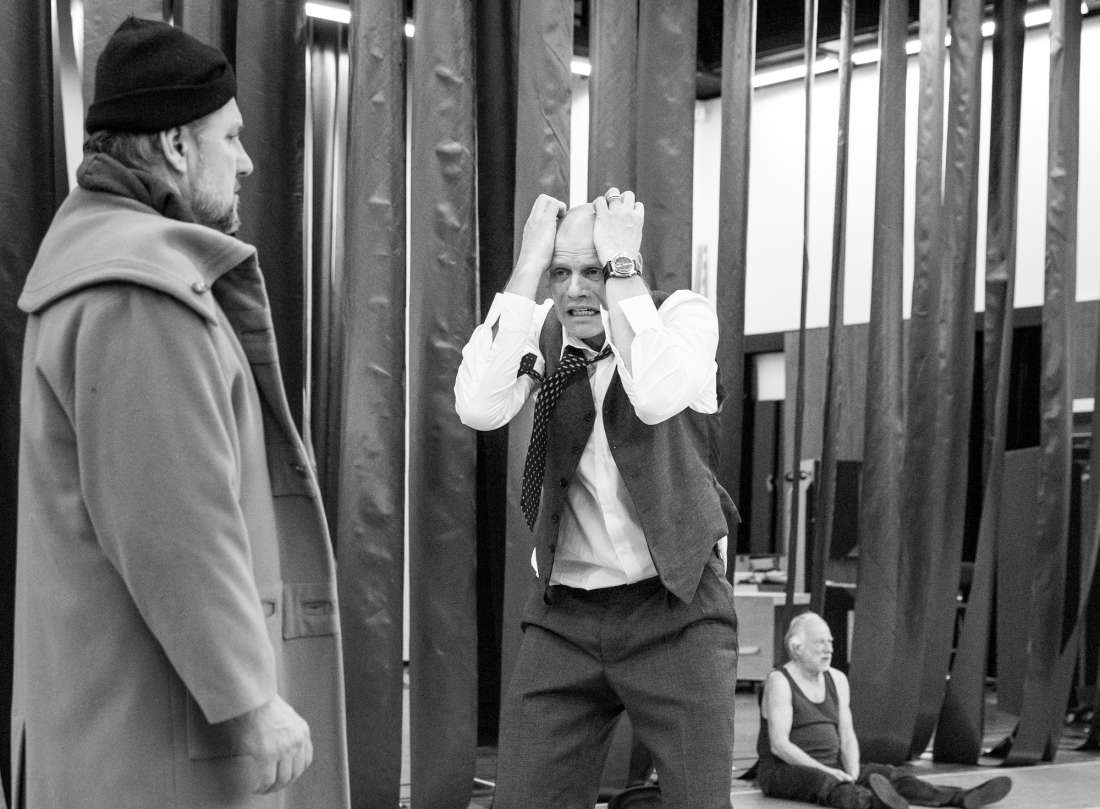
Showing posts with label Andreas Conrad. Show all posts

Wednesday, 30 August 2017

Bayreuth Festival (4) - Siegfried, 26 August 2017


Festspielhaus


Siegfried – Stefan Vinke
Mime – Andreas Conrad
Wanderer – Thomas Johannes Mayer
Alberich – Albert Dohmen
Fafner – Karl-Heinz Lehner
Erda – Nadine Weissmann
Brünnhilde – Catherine Foster
Woodbird – Ana Durlovski

Frank Castorf (director)
Aleksandar Denić (set designs)
Adriana Braga Peretski (costumes)
Rainer Kasper (lighting)
Andreas Deinert, Jens Crull (video) 

Bayreuth Festival Orchestra
Marek Janowski (conductor)


Siegfried is now for me the highpoint in Frank Castorf’s Ring. It is surely the most difficult of all four parts to bring off, but Castorf’s – and his performers’ – grasp of the work’s epic quality may well be unsurpassed. One would at least have to go back – from productions I know – to Harry Kupfer, perhaps even to Patrice Chéreau. In Wagner’s drama, as in Castorf’s staging, so many of the Ring’s strands come together here – and how!


A crucial idea to the drama, to its realisation, and indeed to the epic tradition in which it so triumphantly yet challengingly stands is liminality. At a basic, or perhaps better immediate, level, the revolving stage does its work here. Forest or station? Both are quintessential liminal zones. The German Romantic forest has a long history, of course, extending back long before German Romanticism. Think of the invention of ‘Hermann’, a Teutonisation of Arminius: ‘Assuredly he was the deliverer of Germany,’ wrote the admiring Tacitus in his Annals. Arminius ‘had defied Rome, not in her early rise, as other kings and generals, but in the height of her empire’s glory.’ And for Romans, Germans such as Wagner, born in Leipzig in 1813, could substitute the French. Caspar David Friedrich contributed two paintings to an exhibition held in Dresden in March 1814 to celebrate the liberation of Germany from the French yoke, one depicting the imaginary grave of Arminius/Hermann. Wagner too rejoiced in the memory of those events in the Teutoburger Wald, even when he told Cosima in rather gloomy terms: ‘So far, we have been great in defence, dispelling alien elements which we could not assimilate; the Teutoburger Wald was a rejection of the Roman influence, the Reformation also a rejection, our great literature a rejection of the influence of the French; the only positive thing so far has been our music — Beethoven.’ The implication was, of course, that now things might change, although by then the strong, Schopenhauerian element in his world-view was already suggesting they might not. And so, enter the resigned Wanderer, more a hero than the rebel without a consciousness, Siegfried, born in that forest, and ignorant of anything beyond it, might ever prove in reality.


Castorf may be understood both to play on that characterisation and to question it. How, after all, could one not, concerned where – indeed knowing where – such Romanticism, even nationalism, might lead, or perhaps better, be understood by some to have led. And so, the fabled alternative Mount Rushmore presents a world in which socialism might appear to have won the day: Marx (great) – Lenin (good) – and then we on the Left do not quite know where to look when it comes to Stalin and Mao. Could we not have Adorno instead? The negative dialectic says no. Aleksandar Denić’s set design for the other side, Bayreuth (Al)exanderplatz station – S-Bahn, U-Bahn, post office, station restaurant, fountain, clock – is too real to be real. It is an astonishing sculpture and again an astonishingly apt liminal foil to the forest. What is more full of transience, more full of possibility, more full of the potential for foiling possibility, than a station? East Berlin seems to be going pretty well, or does it? Or is it East Berlin at all? It is what it is, just as those celebrated crocodiles are what they are. That does not stop us continually asking how, why, what, though. Like Mime, however, do we ask the questions whose answers we really need? Political leaders come and go above on the screens: is that Siegfried; is it Wotan; is it Mime? Or are they just faces of no one in particular, on to whom we (literally) project what we expect, what we want, what we have been led to believe? It is a question as much, perhaps for Honecker as for Merkel, for Lenin as for Stalin. And when actual projections of characters’ faces appear on Mount Rushmore again, what are we to make of them? Does it ‘mean’ anything that we see, or think we see, Siegfried’s face not on revolutionary Lenin or Mao but on ‘establishment’ Stalin, and Wotan (his eye damaged, yet playfully winking) on Stalin’s? Why do we insist on meaning at all? Have we not learned? Is Beckettian gloom perhaps all there is?


Maybe, yet there are other possibilities here we might grasp. Whether they are better or worse is for us to decide; perhaps Schopenhaurian renunciation would be better after all, but there is no short-circuiting of the question. Our supposed revolutionary hero, Siegfried, is a brutal figure by any standards. His Kalashnikov, heard to terrifyingly loud effect, should give us all pause for thought. Do we think of late Soviet, Brezhnev-era imperialism perhaps (Afghanistan?) or of our own, more fashionable heroes? We still all believe in Castro and Guevara, do we not? Meanwhile, oil continues to do its work; it always has, in West and in East. Patric Seibert, initially Siegfried’s chained bear, is literally covered in it. Alberich is still at large, watching and mocking – like the Wanderer and also like Mime. We draw connections between them; or perhaps we do not. It is up to us. And all the while, those awe-inspiring landscapes and cityscapes, with their wealth of associations, form our thinking, whether we like it or no.


Erda initially does not. But she must put on a show. The misogyny here of a newly revivified Wanderer – I am genuinely unsure as to whether the production participates in it, which is perhaps as it is uneasily should be – truly shocks. As soon as the tables turn – for Wagner, as soon as Wotan finally rejects Fate, but what does that mean here? – Wotan can treat the earth goddess as despicably as any other woman. There is no redemption for him here in the halting of a wheel’s turning; perhaps instead he transmutes it into post-Russian roulette. Desperate to have a piece of him, Erda debases herself in the now celebrated insistence on fellating the god. His response is to run after Siegfried and to leave her to pay the bill. She has even turned herself into one of his ‘favourite’ blondes, but to no avail. Nadine Weismann, giving a towering dramatic portrayal, quite unafraid to sound hurt, damaged, and cowed, cuts a movingly pathetic figure under the restaurant table at her last.


Will things go better for her daughter? Probably not. We fear the worst when she dons her wedding dress, sure that Siegfried will betray her. Our old friend, the Brazilian carnival Woodbird is still around, after all. But in an inversion of what we have seen in previous years, Siegfried returns to her and they embrace. Is Castorf reconciling himself somewhat with Wagner, with Romanticism? I admit that I felt a little disappointed – how much more powerful I found it for Brünnhilde to be left on her own, whilst Siegfried fucked the Woodbird. But perhaps that is the point. Perhaps we now stand at the point at which we need to deconstruct the ‘Castorf Ring’, which, like Wagner’s, we know too well. At any rate, Catherine Foster proved herself in glorious voice, movingly eloquent as events around her coincided with, commentated on her – or did not. She has unquestionably gone from strength to strength.


Stefan Vinke, in the title role, proved tireless, if not necessarily ingratiating. But then, how ingratiating should a Siegfried be? When one hears so many singers who are simply incapable of getting through the evening, one cannot but be grateful for one who can, and who continues to be heard. He was certainly unafraid to repel us dramatically; no fairy-tale Romanticism here. Andreas Conrad’s Mime was very much a plausible opponent, heightening the dramatic stakes. This was a tenor, as well as a character, who demanded to be heard – and was. Thomas Johannes Mayer was perhaps on occasion a little verbally bluff as the Wanderer, but acted the role to a tee. His callous dismissal of Erda, mentioned above, chilled more, I think, than any of his predecessors’. Other singers all impressed in their different ways, very much part of the company.


And if Marek Janowski’s conducting of the score was not so alive to its epic quality as, say, that of Daniel Barenboim, or to the great conductors of the past, there was, at its best, a quicksilver dramatic quality to be heard and, yes, to be experienced that had been lacking in swathes of Die Walküre. Was the scene between Alberich and Mime simply too fast, almost glib? Perhaps, but it is not difficult to come up with a reading, in this context, to justify such a portrayal of what Hans Mayer brilliantly dubbed an ‘evil stockjobbers’ satire’. If Karl-Heinz Lehner’s darkly dangerous, still alluring Fafner represented, to quote Mayer once again, ‘the world of shameless wealth, the concentration of capital as a sign of the rise of the middle classes … under which Wagner had to suffer so much,’ then there is again something to be said for a lack of majesty to his prowling around the station. So long, that is, as it retained musico-dramatic coherence, which it did; Janowski certainly knew where the score was going, even when he seemed a little impatient with it. Perhaps, then, that will prove the most intriguing dialectical legacy of all from Castorf’s Siegfried: seemingly having held the work to sometimes extreme account, it vouchsafed the possibility, even the plausibility, of new musical readings too.


Thursday, 25 August 2016

Bayreuth Festival (4) - Siegfried, 23 August 2016


Bayreuth Festspielhaus
Siegfried – Stefan Vinke
Mime – Andreas Conrad
Wanderer – John Lundgren
Alberich – Albert Dohmen
Fafner – Karl-Heinz Lehner
Erda – Nadine Weissmann
Brünnhilde – Catherine Foster
Woodbird – Ana Durlovski


Frank Castorf (director)
Aleksandar Denić (set designs)
Adriana Braga Peretski (costumes)
Rainer Kasper (lighting)
Andreas Deinert, Jens Crull (video)


Bayreuth Festival Orchestra
Marek Janowski (conductor)


Mea culpa. I am by now convinced that this Ring has been far more strongly presented than it was when I saw it in 2014. (I have kept to my resolution not yet to re-read my earlier reviews, but shall do so once my visit to the festival is over.) Everything is tighter; revisions to the productions have been entirely to their benefit; the cast is much stronger, vocally and otherwise; the director seems less hostile to, although not necessarily less critical of, Wagner; and so on. And yet, the difference in my response cannot, I think, be explained away entirely in such terms; even if it can, I should rather err on the side of generosity. I am happy, then, to say that I owe Frank Castorf an apology.


Viewed overall, it was this Siegfried’s epic scope, quite in keeping not only with Wagner’s vision but with so many other dramatic works too, that struck me most of all. The word ‘journey’ has so been so debased by the lucrative language of ‘self-help’ – in some cases, in more than one literal sense – that it is perhaps too late to use it non-ironically; indeed, after Castorf, it is perhaps too late to view the Ring without some degree, at least, of irony. But the tale of the boy who learns what fear receives as probing and, in many respects, as sympathetic a treatment as I have seen for quite some time. There is no doubt of the distance both he and we have travelled by the close – and there is genuine (neo-Feuerbachian?) hope to be experienced, especially at the ends of the second and third acts. It is not hope that is unalloyed; nor should it be. (Listen to the words in the nihilistic ecstasy of Siegfried and Brünnhilde’s duet, if you doubt me; listen also to the disturbing contrapuntal virtuosity of Wagner’s music there, both attempting, so it seems, to conceal and yet to celebrate the terrifying, pyromaniacal marriage of Bakunin and Schopenhauer.) But it celebrates, as did Marek Janowski, in what proved unquestionably his strongest performance so far, the very particular character of what, for once, truly emerged as, according to the cliché, the ‘scherzo’ of the Ring: less of a cliché, if one considers, post-Beethoven, what that might actually mean, both for Wagner and for us. If the Wagnerian hero would be a Hegelian, world-historical figure, responding to contemporary necessity; so must our (anti)hero be. For, as Feuerbach pointed out, ‘God did not become man for his own sake’; nor do we produce the Ring solely for Wagner’s.


Aleksandar Denić’s sets remain a thing of wonder – and wonder is surely an epic quality in itself. The sublimity – gone right, or gone wrong? both and neither? – of the alternative Mount Rushmore backdrop reminds us that much is at stake. Irony need not be ornamental: ask Heine. As Marx, Lenin, Stalin, and Mao look down on us, as we look up to (or down on?) them, as occasionally their faces metamorphose into those of others, unreliable narration kicks in once again: do we know the newcomers, both here and on video, or not? Is this actually, then, an alternative historical path? Can we, as Wotan still wishes, at least some of the time, avert Götterdämmerung – or, perhaps worse still, a return to the non-golden-age of the Golden Motel. What is intervention? Is it desirable, or even possible? As with the shocking golden concealment of Freia – and it was, for me, impossible not to hark back to that moment – the machine-gun brutality of Siegfried’s murder of Mime truly terrifies, truly casts its shadow. As the riddles, the narrations, play themselves out, Wagner plays along; or rather leads us – and the production. Does it mean anything, then, when Wotan rejects Fate (Erda)? Or has that idea been (rightly or wrongly) jettisoned? There are no easy answers, or indeed perhaps any answers at all, just as in the Ring.


But Wotan rejects Erda not in that location, of course; he rejects her on the other side of the revolving set, the extraordinary recreation – well, knowingly unfaithful creation – of Alexanderplatz, first seen, if I remember correctly, which is not necessarily the case, as a playground for Fafner and his floozies. It is at least as much a thing of beauty as the other side of the dialectical wall (or even Wall). And, crucially, like that other side, yet also unlike it, it is, as stations and their surroundings tend to be, a place of liminality. Whether or no we may salvage the idea and the experience of a ‘journey’, we seem fated, Wanderer-like, to remain in transit. We find meaning and meaninglessness in Everyman Patric Seibert’s activities, whether as house-animal-cum-servant chez Mime, the Nibelheim van pressed back into service, or as waitor-cum-post-office-manager in the mysteriously empty – in more than one sense – proceedings in East (is there even a West?) Berlin.


I did not regret the loss of the more excessive spaghetti-founded activities in the first scene of the third act. I most certainly did appreciate Erda’s varied reprise of her Rheingold actions. Having worried, with her assistant on film, about which wig to wear during the Prelude, she disappears and changes it for her final exorcism and/or intensification of Wotan’s Rheingold possession, consensual or otherwise, of her – which, amongst other things, may well, through the creation of Brünnhilde, have enabled the rest of the action to unfold. What had previously seemed to me – rightly or wrongly, in the context of the 2014 production – arbitrary, even plain silly, now seemed charged with meaning. Returning to the scene, unquestionably ‘up for it’, Erda asks us difficult questions about what we should do, faced with a god, or a God. Just as our politicians will fellate the nearest banker without a moment’s thought, so does she get to work – and so does Wotan contemptuously slip his banknotes where one might expect. Her final finger-gesture to our hapless waiter as he returns for his payment is a splendid gesture: again rich in both potential meaning and meaninglessness. Ditto the now ‘traditional’ addition to the now five-strong crocodile community. What, two years ago, to me seemed a mere scenic backdrop – or, at least some of the time, did so – is now crucial to the drama.


Janowski’s conducting, as I mentioned above, came much more into its own. Perhaps that personal impression of mine is owed, at least in part, to a long-term strategy on the conductor’s part. Many conductors, after all, present Das Rheingold in buttoned-up, almost frigid fashion. Nevertheless, there is, I think, more to it than that. The greater sense of ebb and flow, of harmonic ‘depth’ – yes, I know it is a nineteenth-century, Germanic, ideological construction, but is no less useful for that – was palpable and, more to the point, dramatically productive. Balances were much less problematical too. If wind instruments often, although not always, came to the fore, there is nothing wrong with that. There is arguable Beethovenian warrant for it; and we want to hear, of course, as much as is possible. The Bayreuth Festival Orchestra now, for the first time, seemed very much to be the same orchestra – if not necessarily quite so consistently – as that I had heard for Thielemann’s Tristan. Pacing, whether longer- or shorter-term could not really be faulted; it may not always have been how I imagine it in my head, but that is neither here nor there.


The cast was excellent too – and here, I think, we may come to the core of why I found this Siegfried so much more convincing than I had before. Lance Ryan’s Siegfried, however adept on stage, had been excruciating vocally; Stefan Vinke gave the most convincing vocal performance I have heard from him in quite some time, clearly benefiting from not having to force his voice to fill an absurdly large theatre. He entered into the stage proceedings with equal commitment too. As with the previous night’s Tristan, ‘untiring’ should not be understood here as a euphemism; pent-up energy spilled carelessly onto the ground, as it must in the case of this rebel without a consciousness. Catherine Foster gave a splendid performance – much more at home in the production, and in the role, than I found her last time – as Brünnhilde. Her problem is not to be untiring but, so late in the evening, to be immediately fresh, dramatically immediate; the problem proved not to be such, simply an opportunity very well taken. One truly felt her transition from immortal to human, its joy as well as its fears.


John Lundgren’s Wotan/Wanderer exceeded even its Walküre promise. His performance, born very much of the detail of Wagner’s poem, equally alert to the implications of its musico-dramatic flowering, was one for the sagas – mediæval and contemporary. Albert Dohmen’s highly intelligent portrayal of Alberich was spot on: as quicksilver in momentary response as it was determined by what had gone before. His verbal acuity was shared, responded to, by Andreas Conrad’s Mime: a brother-in-arms indeed. Karl-Heinz Lehner’s Fafner was just as sinister and, intriguingly, just as darkly, dangerously attractive as what we had seen and heard his Rheingold incarnation. What we lost in rentier sloth, we gained in other respects. Nadine Weissmann retained and developed that wonderful sense of musico-dramatic ‘presence’ from the earlier drama. And Ana Durlovski’s carnivalesque Woodbird came across – rightly, in the spirit of the production – as more woman than voice of Nature. I may be nearing the moment of a mea maxima culpa.

Sunday, 21 August 2016

Bayreuth Festival (1) - Das Rheingold, 20 August 2016


Bayreuth Festspielhaus


Wotan – Iain Paterson
Donner – Markus Eiche
Froh – Tansel Akzeyebek
Loge – Roberto Saccà
Fricka – Sarah Connolly
Freia – Caroline Wenborne
Erda – Nadine Weissmann
Alberich – Albert Dohmen
Mime – Andreas Conrad
Fasolt – Günther Groissböck
Fafner – Karl-Heinz Lehner
Woglinde – Alexandra Steiner
Wellgunde – Stephanie Houtzeel
Flosshilde – Wiebke Lehmkuhl

Frank Castorf (director)
Aleksandar Denić (set designs)
Adriana Braga Peretski (costumes)
Rainer Kasper (lighting)
Andreas Deinert, Jens Crull (video)


Bayreuth Festival Orchestra
Marek Janowski (conductor)


And so, two years after my first viewing, I am returning to Frank Castorf’s Ring. I shall not re-read my first reviews until afterwards: not because I entertain some absurd fantasy about coming to the production anew, for my present experience will clearly be coloured by prior experience; yet, by the same token, I see no especial reason to have the former over-determined by the latter. One’s memory can play tricks, of course, and what I perceive as difference may or may not so; I may be misremembering, or indeed may simply not have noticed certain aspects before; I may also be viewing them in different contexts, the world – mostly to its disadvantage – having ‘moved on’ considerably since 2014. That, after all, is part of the message – at least part of the message I have taken – from the video work in this production. No one, perhaps, is so unreliable a narrator as the person convinced of the absolute truth of his or her recollections. Even if ‘correct’, that correctness is of limited use: few things are so pernicious as anti-historical elevation of the momentary to the permanent; one has only to think of the runes inscribed on Wotan’s spear, or, more generally, the bourgeois universalism of the Declaration of the Rights of Man. Any Hegelian and/or Marxist – perhaps more to the point, any historian or philosopher of history – could tell you that. However, for anyone wishing to read my previous reviews, they may be found here: Rheingold, Walküre, Siegfried, Götterdämmerung.


Back, then, to the Golden Motel: the trashy Texan (Route 66) location for the action. On first glance, like much mass culture, it might seem to be all about sex. Like the first scene of Das Rheingold, one might say, for what Wagner called Alberich’s liebesgelüste (‘erotic urge’ he was at that time disdaining traditional capital letters for nouns). In both work and production, though, things are far more complicated than they might seem. How might we characterise that liebesgelüste? It may – as I have argued elsewhere – be understood partly, at least when considered from the standpoint of the history of ideas, as an important precedent for Nieztsche’s will to power. But Wagner is not Nietzsche – even if Nietzsche is far closer to Wagner than he ever, even earlier on, wishes to admit. For the question is social too: Alberich’s proto-Nietzschean ressentiment is born of his lowly place in Wotan’s society. That is the psychological – and, in some senses, socio-political – impulse for the challenge of capital to the established political order; or at least it was in Wagner’s time. The relationship between Valhalla and Nibelheim is not entirely different in the age of neo-liberalism, but nor is it the same.


The ressentiment is also æsthetic, of course: Wagner once remarked that he had every sympathy for Alberich’s turn against the Rhinemaidens. Hedonists reject and scorn the dwarf because he is ugly. Yet the relationship between the social and the æsthetic – and this is just one relationship amongst many in this complex world – also needs to be considered. (Rhine)gold is here crucial: as itself; as the oil that powers so much of what we see, petrol pumps in the forecourt; as the shiny stuff of hegemonic trash culture (think Donald Trump, on whom, more soon); as the agent of the motel’s ‘rainbow’ rebranding in the fourth act; even, perhaps, as something hallucinogenic, narcotic, when Donner’s mysterious ‘clearing’ of the air leaves the pleasure-seekers in the bar – something now, as the rainbow flag and tight-fitting costumes for all genders and orientations – in a state of trance-like animation. But the complexity of the web of power relations, not only between characters, but between forms of power, is really the thing.


Returning – or perhaps better, again trying to return – to the beginning, then, the hedonism of swimming pool, beach ball, sun loungers, of a supposed ‘golden age’ is lain bare, again both in work and production. It is a construction; it always was; it creates more gold for some, takes away that gold from others. Wagner makes it perfectly clear that the world into which Alberich intrudes is no idyll, no ‘natural’ state of affairs; so does Castorf. The Rhinemaidens, just like the gods and goddesses who come after them – in the hierarchy, do they come before or after? Intriguingly, it is the Rhinemaidens who take occupation of the gods’ room once they have vacated it to deal with the giants. Will they relive what has gone on between those crumpled sheets, or will they – hollow laugh! – put things right? There are, of course, many more options than that. It is, rightly, unclear, or at least complicated – are already social beings. They are clad, and they behave, in ways that many would consider attractive, others would consider exploitative and/or exploited, others ‘whorish’, and so on. They have agency, yes, but only up to a point – like the rest of us. ‘Men make their own history,’ as Marx, writing at the same time as Wagner, and under many similar influences, tells us, ‘but they do not make it as they please; they do not make it under self-selected circumstances, but under circumstances existing already, given and transmitted from the past. The tradition of all dead generations weighs like a nightmare on the brains of the living.’ So too, of course, does the weight of those with greater power – and so too does the source of that power itself.


What might seem initially arbitrary, and did so (at least to me) more, although not entirely, two years ago, now speaks of complexity: when Wotan and Mime initially bring Alberich and Mime onto the scene in Nibelheim, we are asked to consider who is ensnaring whom, and, when we think we have an answer, that answer is immediately called into question. Welcome to (late) capitalism. Similarly, the Trump-like – how prescient! – depiction of Wotan, as we initially see him, a pleasure-seeking playboy who has, we might guess, inherited power, whilst claiming to have earned it, a vulgarian who yet exercises brute force, whilst allegedly (at least to Donner) renouncing it, two constructed ‘blondes’ – what a custom that is, to refer to women simply by hair-colour! – not only on his arm, but in his bed: that poses still more questions than it might ever answer.


The video work to which I referred adds another crucial dimension. Often we see in close-up what we would see on stage, were we closer. Sometimes we see what we could not otherwise see, that action taking place in a space not otherwise at the moment visible. Sometimes we suspect that what we are seeing is different; at certain points, we know that it is. And there are stills too; where did they come from? Did those events, those scenes ever happen at all? We learn a great deal – and truly acclaim the magnificent acting of the cast (and their detailed direction). We appreciate the complexity of the action. But we are also, like the characters in Hans Neuenfels’s Lohengrin, like the viewers of the ‘reality television’ that seems to be being made before our eyes, being directed. There are interests, powerful interests, at stake here. And just as Trump-Wotan does not make history as he pleases, however much he might insist otherwise, nor do we, as spectators-cum-participants. Patric Seibert’s Everyman offers us almost conventionally dramatic opportunity to empathise – but, as soon as we do, the situation is again rendered more complex. Post-dramatic theatre actually seems to encompass that which it has negated; but is the dialectic Hegelian or Adornian? Brecht, it seems, has more Aktualität, even in opera, than we might have given him credit for.


That detailed direction is really worth saying a little more about. (I am afraid there is much I shall have to miss out, for there is far too much to say.) Whether it is the Rhinemaidens taking occupation of and apparently driving the flashy car on stage, the heartrending – pretty much stage-direction-literal – covering of Freia with gold, the truly shocking, yet utterly to the point, penetration of Erda by Wotan in the shower cubicle as giants and gods settle their accounts, or, to take a very different example, the extraordinary acting by facial expression of Sarah Connolly’s Fricka (on camera): there is so much to see, to think about. It is more coherent than one might initially suspect, irrespective, I suspect, of intention; and when it is not, the incoherence now seems far more a matter of policy, of criticism, than it did last time (to me).


Few, if any, Rheingold productions have for me so convincingly, completely combined vocal and acting skills. In that, this is an utterly Wagnerian, or neo-Wagnerian essay. The Rheingold Wotan is always a tricky one, often rendered comprehensible, or more so, by what comes afterwards, yet needing nevertheless to make a strong impression of his own in the here and now. Iain Paterson would always have had a good many balls in the air; in this production, he had a good few more. They were kept in motion with great conviction; it will be very interesting to see how things turn out. Connolly’s Fricka, as previously mentioned, was a tour de force of vocal acting; her disquiet, yet her need at some point to reconcile herself with what was going on, whatever her distaste (her character’s distaste, that is) for the sub-Dallas antics around her, were powerful, provocative, partly on account of their lack of exaggeration.  Tansel Akzeyebek’s Froh was beautifully sung, equally well acted. Markus Eiche’s Donner came into his more conventional own with the storm; his portrayal of the crazed, clearly dangerous playboy earlier on, was – even if one were to dislike the directorial concept – equally impressive. Caroline Wenborne’s Freia elicited as much as sympathy as the post-Brechtian framework permitted; again, her marriage of singing and acting – on stage and on camera – was worthy of the highest praise. Roberto Saccà offered a sardonic Loge, careful with his words, yet free with them at the same time. Nadine Weissman’s deep-toned Erda – what an entrance, in that joyously vulgar white fur coat! – proved as much a vocal pleasure as her character’s greater role was a provocative dramatic development.


Albert Dohmen, as Alberich, grew in stature – quite rightly – as the performance progressed. The earth-shattering moment of his curse was strikingly well prepared: as much verbally as musically. Andreas Conrad did a great deal with the relatively few lines that Mime has: his evocation of old Nibelheim struck an excellent balance between genuine sentiment and alienated narration (reliable or otherwise). The giants’ journey, not the least striking part of the production, was marked as powerfully in vocal-dramatic terms by Karl-Heinz Lehner and Günther Groissböck as it was in their costume upgrade: local thugs to (relatively) expensive-suited Mafiosi. Both performances were sexually charged (which takes us back to that liebesgelüste starting-point), and highly differentiated, especially as time went on. One would certainly not have blamed Freia at all had she opted for Groissböck’s Fasolt, whether on grounds of physical allure or acuity of response to Wagner’s alchemic blend of words and music. Alexandra Steiner, Stephanie Houtzeel, and Wiebke Lehmkuhl offered both excellent blend and, where necessary, commendable differentiation of character as the Rhinemaidens; their acting skills were, again, outstanding.


In this, in some ways, perhaps the most radical of all Wagner’s scores, the orchestra has a very particular role, or roles. It offers exposition, commentary, wonder, dialectical development, emotional and conceptual depth: all that and much more. Marek Janowski’s conducting often seemed – at least by comparison with the multivalent drama elsewhere – to be a little too concerned to keep the score on a tight leash. It was fast-paced, which is fair enough, but there is more to be revealed when the work relaxes too. Some balances were also peculiar; the conductor appeared to have a bizarre fascination with the composer’s clarinet lines, sometimes to the exclusion of everything else. It was fascinating to hear the work almost as if from a clarinettist’s standpoint, but again a little odd, and one-sided. Perhaps it was an acoustical quirk. Against those reservations, of which I do not wish to make too much, Janowski clearly knew what he wanted and how to achieve it. His neo-Mendelssohnian persuasion has a degree of historical warrant, and there was no denying the ability of the Bayreuth Festival Orchestra’s ability in that respect. In Wagner, however, at least for me, there is never one single answer; one looks forward as well as back. Certain intimations of Schoenberg (Pierrot, and not only on account of the clarinet!) were most welcome. More standpoints, reconciled by the slippery conception of the Wagnerian melos, might have been brought to our attention in certain other performances, but this had coherence of its own.


Wednesday, 1 June 2016

Lear, Opéra national de Paris, 29 May 2016


Palais Garnier

King Lear – Bo Skovhus
King of France – Gidon Saks
Duke of Albany – Andreas Scheibner
Duke of Cornwall – Michael Colvin
Earl of Kent – Kor-Jan Dusseljee
Earl of Gloucester – Lauri Vasar
Edgar – Andrew Watts
Edmund – Andreas Conrad
Goneril – Ricarda Merbeth
Regan – Erika Sunnegårdh
Cordelia – Annette Dasch
Fool – Ernst Alish
Servant – Nicolas Marie
Knight – Lucas Prisor

Calixto Bieito (director)
Rebecca Ringst (set designs)
Ingto Krügler (costumes)
Bettina Auer (dramaturgy)
Sarah Derendinger (video)
Franck Evin (lighting)

Chorus of the Opéra national de Paris (chorus master: Alessandro di Stefano)
Orchestra of the Opéra national de Paris
Fabio Luisi (conductor) 
 
Rehearsal photograph: © Élena Bauer / OnP


This year has seen musical Shakespeare commemorations aplenty, although I cannot help but wonder whether some miss the point. Although there are many wonderful musical settings of Shakespeare, his verse is often so musical in quality that it requires nothing additional. Successful Shakespeare operas are thus less surprisingly few than one might initially suspect. Britten’s A Midsummer Night’s Dream has its devotees, many of them fervent; I should rather stick with the play and Mendelssohn’s incidental music. Falstaff: well, it is difficult to care much one way or the other about The Merry Wives of Windsor, even if Nicolai’s version is (slightly) preferable. Lear, however, has at least one other excellent operatic version, very different in conception: Alexander Goehr’s Promised End. Aribert Reimann’s opera is more conventionally operatic, perhaps, than Goehr’s post-Brechtian response, although such a claim is highly relative and this is no work, thank God, for canary-fanciers. We are lucky to have both – and equally lucky never to have that threatened late Verdi opera. (I have never heard Aulis Sallinen’s 2000 opera.) At any rate, the Paris Opéra’s contribution, whether intended as such or no, is most welcome in principle, still more welcome in practice.


Claus H. Henneberg wrote a number of libretti, from Reimann’s 1971 Melusine to works by Peter Eötvös and Matthias Pintscher. (How I should love an opportunity to see the latter’s Thomas Chatterton!) This, first performed at the Munich Opera Festival in 1978, was written with Dietrich Fischer-Dieskau very much in mind for the title role, and that seems to have helped the initial dissemination of the work, both in the theatre and on its first recording. For a number of stagings followed, including San Francisco, Paris (making Calixto Bieito’s staging the Opéra national de Paris’s second), East Berlin (the Komische Oper), Vienna, Amsterdam, and eventually in 1989, London (ENO). Opera of this period has not generally been well served well by our opera houses, although many continental houses – and not just German ones, as this Paris production and its predecessor attest – tend to do better than their English counterparts; nor has it been in much Anglophone writing. In the meantime, however, you are recommended to seek out a performance and/or a recording where you can.
 

This Paris production and performance will do nicely in that respect. Reimann’s post-expressionist score – not unlike what you might expect from so fine a pianist in Lieder of the Second Viennese School – and Henneberg’s libretto do nothing especially ‘to’ the play, although it is of course not remotely set in its entirety. Given the musical language, violence comes much to the fore, without forsaking claims upon our human sympathies. Indeed, as one would expect, the latter become progressively engaged as the second of the two acts progresses. Dramatic parallelisms and distinctions, for instance between Lear (baritone) and Gloucester (bass-baritone), Cordelia and Edgar, are surely, if sometimes rather obviously, handled in words and music. The series with which the latter pair are associated come strongly into the foreground, much as they might have done with Berg, although there is far less of the ‘Romantic’ to this score. As with a good deal of serialist opera, one has a sense of the workings of the serial machinery and its implications, even if one could not quite put it into words, and would have to consult the score properly to analyse it. (When, after all, would one not? Surely the same is true of Mozart or Wagner.)


Although I felt that Fabio Luisi sometimes led the excellent Orchestra de l’Opéra national de Paris with a little too much restraint, and that something more full-blooded would have turned the dramatic screws with a more evident sense of theatre and ultimately of musico-dramatic generation, audibility of such procedures and our consequent ability to relate them, indeed to fuse them, with stage action were nevertheless most welcome. Not that screams from the orchestra – seemingly, insofar as I could tell, never having seen the score, executed with pinpoint precision – or stereo dialogue between percussionists in boxes either side of the pit had nothing of the visceral to them, far from it. The score can rarely, if ever, have been played with such clarity and, at times, both depth and brightness of string tone as by this fine orchestra, still woefully underrated by many who should know better. My mind was cast back to their magnificent Moses und Aron at the opening of this season.
 

The cast was excellent too. Bo Skovhus gave a highly distinguished, dramatically detailed performance of the title role. His initial pride and its disintegration into a complex web of emotions, inadequacies, and ultimately greater humanity were accomplished in what I presume would have been a more physical performance than that adopted by Fischer-Dieskau (or indeed, really possible to the role’s creator at the time). Skovhus was, I am sure, just as committed as his great predecessor would have been. The dryness I have sometimes observed more recently in his voice seemed as resolutely banished as Cordelia, without danger of its parallel return.
 

Lauri Vasar’s Gloucester was handsomely sung, in a portrayal of considerable emotional depth. Facial, vocal, and verbal expression seemed very much of a piece, as indeed they did in general on stage, testament surely to Bieito’s work as director as well as to individual artistry. Indeed, it is surely testament to both that it is difficult to disentangle the two, and I shall not really attempt to try. Bieito certainly does not seem out to shock, but rather to draw from characters, production, and performances the elements of musical drama. Modern dress is employed, if one cares about that sort of thing in itself, but the designs more broadly are stark, permitting one to allow oneself to imagine any manner of ‘setting’ or none: so more or less what all but the most hidebound reactionary would expect in Shakespearean tragedy. I am not sure that anyone would claim this as a ‘history play’, but perhaps someone silly will claim it as a ‘history opera’; frankly, who cares?
 

What Goneril and Regan have in common and what, increasingly, sets them apart is fascinatingly explored, Ricarda Merbeth’s Goneril the power-dressing big sister, initially less interested in the sexual, it would seem, but ultimately more successful – perhaps because her actions have not previously been so overtly erotic? – in its exploitation. The depravity of Regan’s actions, by contrast, from the initial sexual approach to her father (one almost wants to have her convicted of elder abuse) to her sleazy demise (a touch of necrophilia before expiring, perhaps, however understated?) tell their own story. Erika Sunnegårdh’s performance again melded the ‘musical’ and the ‘dramatic’ into a single, dynamic whole. If Annette Dasch’s Cordelia made less of a strong impression, that was more a function of the work; when she returned, hers was an undoubtedly sympathetic contrast, if ultimately never one that could emerge victorious. Andreas Schiebner’s Albany was intriguingly ambiguous: here, one felt, was a truly conflicted character, no doubt weak yet still a victim of circumstances. Andreas Conrad’s Edmund followed the seeming fate, even nature, of his own personal circumstances, with similarly powerful command of musico-dramatic theatre. His legitimate half-brother, Edgar, received a memorable performance, especially but not only in vocal terms, from Andrew Watts, switching as he must between tenor and countertenor. Here, again, was a desperately needed hint of sympathy, if also a reminder of hopelessness. There was no sense, however, of whether he might become king; our eyes and ears were focused upon tragedy.


Now I should like to see Bieito direct King Lear ‘itself’ or not quite ‘itself’. Shakespeare stands no more in need of Werktreue than any composer of opera, indeed if anything, less so. The Barbican has staged some of his Shakespeare; alas, I was unable to go, but hope that it will not prove the last opportunity in London. Otherwise, to Paris, to Barcelona, or to wherever else might oblige…


Thursday, 21 April 2011

Salome, Komische Oper, 15 April 2011

Komische Oper, Berlin

Salome – Morenike Fadayomi
Herodias – Christiane Oertel
Page to Herodias – Karolina Gumos
Herod – Andreas Conrad
Narraboth – Thomas Ebenstein
Jokanaan – Egils Silins
First Nazarene – Jan Martinik
Second Nazarene – Raphael Bütow
First Soldier – Hans-Peter Scheidegger
Second Soldier – Adam Cioffari
First Jew – Christoph Schröter
Second Jew – Peter Renz
Third Jew – Matthias Siddhartha Otto
Fourth Jew – Thomas Ebenstein
Fifth Jew – Marko Spehar
A Cappadocian – Ipca Ramanovic
A Slave – Sven Goiny

Thilo Reinhardt (director)
Paul Zoller (set designs)
Katharina Gault (costumes)
Ingo Gerlach (dramaturgy)
Franck Evin (lighting)

Orchestra of the Komische Oper, Berlin
Alexander Vedernikov (conductor)

Confusion reigned in the ‘Dance of the Seven Veils’, the idea apparently being to substitute Herod’s weird and wonderful fantasies, though can anyone actually think of quite so many things during that time? John the Baptist and, I think, Jesus competed for attention, perhaps leaders of rival cults. Was one a false prophet or both? Who was who? And with whom would Salome throw in her lot? The cars and phalluses were too silly to be offensive, though one could imagine some finding it all blasphemous. A veiled woman suggested something more daring, but she did nothing more than stand there; clearly Christian sensibilities are fairer game than certain others. So far, so fantastical; perhaps it was revealing to some. However, confusion reigned throughout Thilo Reinhardt’s production, suggesting that the former chaos might have been more by default than a product of intention. Salome was reduced to cartoon status, replete with captions, and not only in terms of Paul Zoller’s garish designs. There seemed on one level to be plenty of ideas, or at least thoughts, but they never cohered into any particular idea, let alone Konzept; nor even did there appear to be any effort made to make them cohere.

Reading the beginning of the synopsis, one senses a definite idea: ‘An emergency meeting in Herod’s palace. The future of the fundamentalist prisoner Jochanaan (John), “The Baptist”, doesn’t just involve the circle at Herod’s palace, consisting of Romans, Jews and the followers of the new Nazarene religion, but also the populace of the multiracial state.’ Whatever one thinks of that, and one-sided though it might be, it is not inherently absurd. However, it was difficult to detect much of such a view in the production, not least on account of a great deal of irrelevant flailing around. There appeared to be a point being made – fragility of political and/or religious conviction? – by Jews and Nazarenes changing allegiance, but the upshot was greater confusion. It seemed, whether this were actually the case or no, as though the singers had mostly been left to their own devices. Salome at times seemed to have become some sort of freedom fighter, sporting a revolutionary beret and rifle, yet that aspect came and went. Strauss’s – or Wilde’s – æstheticism did not seem to register – and that is surely what lies at the heart of this work. Camp it up by all means, if you must, but it all seems a bit pointless without a heightened, most likely suffocatingly excessive, sense of the æsthetic. Salome is no more interested in politics than Strauss is, perhaps even less so: she certainly has no interest in the offer of half of Herod’s kingdom. That is not necessarily a bar to a political Salome, but one needs more of a sense of what is at stake.

Morenike Fadayomi’s performance in the title role was spirited. It sometimes veered more towards the acted than the perfectly sung, but she had stage presence and used it. Egils Silins was an impressive Jokanaan, not merely blustering, a more credible object of Salome’s lust than often one finds. Andreas Conrad’s relished the inevitable high – or is it low? – camp of the role, whilst Christiane Oertel made a suitably nasty (and horribly dressed) Herodias. Quite why she acted as Jokanaan’s executioner, though, was unclear. Thomas Ebenstein, whom I have admired in previous performances at the Komische Oper, was a sweet toned, imploring Narraboth, though his musicianship was undermined by the initial boorish stage acts Reinhardt’s direction imposed upon him. For sadly, if the director had taken relatively little notice of the words, the music seemed to have passed him by entirely. Alexander Vedernikov’s conducting had its moments, especially when dance rhythms came to the fore, though it lacked as yet a longer sense of line. (This is, it must be said, a difficult score indeed, and not everyone, alas, possesses Karajan’s surety of command.) Nevertheless, the contrast between Strauss’s astonishing craftsmanship and the stage direction was glaring.

Sunday, 1 March 2009

Philharmonia/Salonen - Gurrelieder, 28 February 2009

Royal Festival Hall

Waldemar – Stig Andersen
Klauss-Narr – Andreas Conrad
Tove – Soile Isokoski
Wood-dove – Monica Groop
Peasant – Ralf Lukas
Speaker – Barbara Sukowa

City of Birmingham Symphony Chorus (chorus master: Simon Halsey)
Philharmonia Voices
Philharmonia Orchestra
Esa-Pekka Salonen (conductor)

This was a wonderful opening to the Philharmonia’s series: ‘City of Dreams: Vienna 1900-1935’. A performance of Gurrelieder could hardly fail to be an occasion but the performance was excellent in pretty much every respect. I was reminded me quite how much I love this extraordinary work. It certainly evinces its composer’s unswerving integrity, even if the Wagner references in the choral writing can draw a little close for comfort. It is the most heartfelt of farewells to the nineteenth century yet it also looks forward, especially in the Speaker’s melodrama, to so much of what is to come. Indeed, the work’s progress, marked by its increasingly ‘modern’ orchestration – Schoenberg broke off that work between 1903 and 1910 – enables us to experience an ongoing critique of its earlier self, without any cost to our appreciation of the sheer gorgeousness of Part I.

Esa-Pekka Salonen’s performance with the Philharmonia captured perfectly the ever-shifting balance between late Romanticism and early modernism, without ever so much as hinting at the temptation to become duly astringent. We have all, I am sure, heard passionless, anti-septic performances of music from the Second Viennese School, which might have put us off for life. The point is not that Schoenberg’s modernist music becomes less ‘emotionally’ intense, quite the contrary; the sheer concentration of such intensity is what some listeners still find difficult to cope with. Rather to my surprise, the opening was a little shaky, the woodwind – especially flute – figures not sounding fully integrated and exhibiting a certain rhythmic insecurity. Yet there was barely another weakness to the performance. The Philharmonia was on good form as I can ever recall, perhaps even better. Certainly the warmth and silkiness of its strings would have put many Continental orchestras to shame, whilst the orchestral blend was, following that initial uncertainty, almost faultless. To marshal such huge forces is an achievement in itself but Salonen’s true achievement was to go beyond such ‘traffic control’ to engage musically with the work. After the bitter disappointment of Monday’s Flying Dutchman, in which the conductor had proved unable or unwilling to maintain any musical line, this was an object lesson in how to do so. Tempo variations were all successfully integrated into a varying, supremely flexible pulse. Orchestral detail, for instance the beautiful harp figurations, was highlighted, but never too much. And, in the balance, or rather dialectic, between symphonic cohesion and motivic definition, Salonen proved himself as true a Wagnerian as a Schoenbergian. I do not think I have ever heard, in the Wood-dove’s lament, the ’cellos’ evocation of the monk’s sounding of the Angelus so beautiful and so closely integrated into the dove’s narrative. Yet it never stood out as ‘mere’ pictorialism; it contributed to the ‘purely’ musical development rather than detracted from it. What Willi Reich called ‘the work’s infinitely subtle motivic cohesion’ was superlatively served on this occasion. Now I want to hear Salonen in Wagner.

The singing was throughout of a very high standard. Stig Andersen and Soile Isokoski proved sure interpreters of their parts. One might at times have thought them just a little ‘safe’, but it is no mean achievement to have presented so musical and coherent a reading. Isokoski’s experience in Lieder-singing shone through; thought had clearly gone into every word and its relationship to the music. Andersen’s slightly elderly-sounding Heldentenor sounded quite appropriate to Waldemar; unlike so many of his ilk, he can sing the part and never resorted to barking. I do not think I have encountered a better Wood-dove than Monica Groop, her lament as plangently moving as it is possible to imagine and her storytelling impeccable. Ralf Lukas was an admirable Peasant, whilst Andreas Conrad was a truly Mime-like Klaus-Narr, bringing home the similarity to an extent I do not recall previously having appreciated. Barbara Sukowa was at least as excellent a Speaker as she was on Claudio Abbado’s superlative Vienna recording. Her text was so internalised that she could deliver it with a freedom, always intimately connected to the music, which apparently transcended any impression of rehearsal. It was a great pity, though, that the use of microphones was not only so clearly audible, but so crass that she sounded as if she were almost in an entirely different acoustic. Perhaps it is necessary, or advisable, to use microphones here, although I doubt it; if so, however, it really needs to be handled better. The choral singing was equally excellent, the Wild Hunt duly terrifying and ghostly – shades of the Dutchman, mediated very heavily by Götterdämmerung – whilst the sheer honest exultance of Schoenberg’s final hymn to the sun was captured ecstatically.

It was a good idea to provide surtitles, rather than have everyone spending half the time at following the programme – often a line or two behind. However, the translation left more than a little to be desired, not so much in terms of accuracy as with respect to strange infelicities of style, unsure whether it was aiming at archaism or efficient modern rendering. The appearance of ‘Gurre-on-Sea’ was unfortunate, to say the least, evoking images of Clacton rather than Teutonic mystery. And the audience was sadly on typical form when it came to shuffling and coughing. Sometimes the latter is unavoidable, I know, but surely the woman sitting next to me could have waited a little longer than the end of the second bar. The shifting impressionistic textures of the Prelude suffered particularly in this regard. Yet such irritations remained minor in the face of so movingly assured a performance. If the rest of the series lives up to the expectations now engendered, London and various other European cities are in for a rare treat. Next stop: Verklärte Nacht and Zemlinsky’s Lyric Symphony.