Showing posts with label Fabio Luisi. Show all posts

Tuesday, 10 October 2023

Kissin/BPO/Luisi - Martines, Mozart, and Schmidt, 6 October 2023


Philharmonie

Marianna Martines: Sinfonia in C major
Mozart: Piano Concerto no.23 in A major, KV 488
Franz Schmidt: Symphony no.2 in E-flat major

Evgeny Kissin (piano)
Berlin Philharmonic Orchestra
Fabio Luisi (conductor)


Image: Martin Walz / Berliner Philharmoniker

This concert from Evgeny Kissin, the Berlin Philharmonic, and Fabio Luisi brought together three very different works from composers working in present-day Austria. (Mozart, of course, came from Salzburg, which only became part of Austria some years after his death, but he had been living and working in Vienna for some time.) Mozart’s A major Piano Concerto, KV 488, is an imperishable masterpiece, even amongst his piano concertos. Haydn pupil Marianna Martines’s C major Sinfonia proved pleasant, even interesting, to hear, if hardly something to which many would frequently return. As for Franz Schmidt’s Second Symphony, I know it has its devotees, and I was keen to give it a second chance, having heard it a few years ago at the Proms, but on this basis I cannot understand what they hear in it. 

Martines’s piece is a Sinfonia in the old-fashioned sense; in three very short movements, it could readily have been a three-part opera overture. Written for strings, two flutes, two oboes, two horns, and timpani, with continuo provided by harpsichordist Arno Schneider, it lay, as one might expect, on the cusp of what we have come to know, not necessarily helpfully, as the Baroque and Rococo, form lying somewhere between the two, melodic and harmonic language closer to the latter.  The first movement, ‘Allegro con spirito’, is put together from very simple material: scales, arpeggios, and so on. The composer shows keen facility, including that for (slight) modulatory surprise, but there are no more fundamental surprises here. Luisi here and elsewhere kept the Berlin Philharmonic on a tight leash, perhaps a little too tight at times, but such is the way nowadays of most conductors with eighteenth-century music. The second movement, ‘Andante ma non troppo’, is more lyrical, again as one would expect. It unfolded largely according to a predictable harmonic plan, save for one moment which sounded more puzzling than adventurous. The third movement, in triple time, comes close to a minuet, though I am not sure I should quite call it that. It is strangely lacking in harmonic motion, though a contrasting central section (a trio, I suppose) brought some tonal variation. No masterpiece, then, but a welcome opportunity to expand our knowledge of Italianate musical culture in Vienna in the early 1770s. 

Luisi retained a smallish string section for the Mozart, but it sounded warmer and fuller. There is, of course, a slightly larger wind section too, oboes exchanged for clarinets, with two bassoons joining the band, albeit without timpani. The orchestra sounded considerably larger, though, reflecting less constraint. Conductor and pianist opted for a steady tempo: welcome in many ways, yet sometimes tending a little to the foursquare. Kissin proved admirable in his clarity, if at times somewhat deliberate. A little more ‘flowing like oil’ would have done no harm. The development section seemed to suit him better, perhaps a consequence of a more (post-)Beethovenian mindset. Luisi largely seemed content to follow; I could not help but wonder what difference the presence of Kissin’s former collaborator, that supreme Mozartian Sir Colin Davis, might have made. 

Again, the slow movement evinced a welcome disinclination to rush, but also at times a certain ponderousness and lack of lyricism. Climactic high notes, which should breathe the air of the opera house, were too often stabbed at. Lightness of touch and gravity of sentiment can readily go together; indeed, in this movement, they surely must. The Berlin wind, as elsewhere, were well-nigh perfect. In the finale, Kissin better combined steadiness with forward motion; it is all too easy to take this music too fast at the beginning and find oneself compelled to skate over its latter course. Not so here. He might have been more yielding at times, but that is not his way. What did it lack? Ultimately, that sense of magic in every bar that the greatest performances bring to Mozart.

Schmidt’s symphony naturally brought a considerably larger orchestra to the stage. I had no reservations concerning the performance; the Berlin Philharmonic clearly relished its task, playing as if this were a repertory piece, and Luisi conducted it as such, with evident belief, leading a fine balance throughout the work’s three lengthy movements of detail and grand sweep. I only wish it were belief in which I could have shared. The first movement was probably the most convincing, with just enough occasional approaches to more adventurous composers (say, Elgar and Strauss) to hold one’s attention. Yet it could never quite take flight; or rather, when it seemed to do so, it was never entirely clear why. However gorgeous the orchestra sounded – and it truly did – the composer sounded in need of some intensive study of Brahms. 

The second movement, a theme and ten variations, was again well paced and phrased. The theme’s Harmoniemusik again sounded a little like early Strauss, albeit without the memorability or the daring. Variations passed pleasantly enough between strings and woodwind, at one point suggesting watered-down Reger, at another something closer to Mendelssohn (though without his lightness of touch). The fourth brought something a little sterner, the sixth a hint of yearning, the eighth something broader, and so on. It was competent, yet hardly inspired. By the time we reached the final variation, the composer seemed to have run out of steam; and yet… it continued for quite some time. At the end, someone shouted ‘Bravo!’ and others applauded. Maybe they thought or hoped the symphony was over.   

The final movement’s opening counterpoint is well put together, yet again it remained stubbornly unmemorable. If you are going to write in such reactionary fashion, at least write a tune. It sounded like the introduction to a Bach transcription that never materialised. Nor, if I am honest, did anything else much. This was note-spinning at length. If that length had been acquired from Bruckner, how to use it to good effect had not. The end, of course, simply had to include a chorale in augmentation. In the future, I shall stick with Schmidt’s Fourth Symphony, which has its moments, not least in its Adagio, more finely wrought than anything here.

Wednesday, 1 June 2016

Lear, Opéra national de Paris, 29 May 2016


Palais Garnier

King Lear – Bo Skovhus
King of France – Gidon Saks
Duke of Albany – Andreas Scheibner
Duke of Cornwall – Michael Colvin
Earl of Kent – Kor-Jan Dusseljee
Earl of Gloucester – Lauri Vasar
Edgar – Andrew Watts
Edmund – Andreas Conrad
Goneril – Ricarda Merbeth
Regan – Erika Sunnegårdh
Cordelia – Annette Dasch
Fool – Ernst Alish
Servant – Nicolas Marie
Knight – Lucas Prisor

Calixto Bieito (director)
Rebecca Ringst (set designs)
Ingto Krügler (costumes)
Bettina Auer (dramaturgy)
Sarah Derendinger (video)
Franck Evin (lighting)

Chorus of the Opéra national de Paris (chorus master: Alessandro di Stefano)
Orchestra of the Opéra national de Paris
Fabio Luisi (conductor) 
 
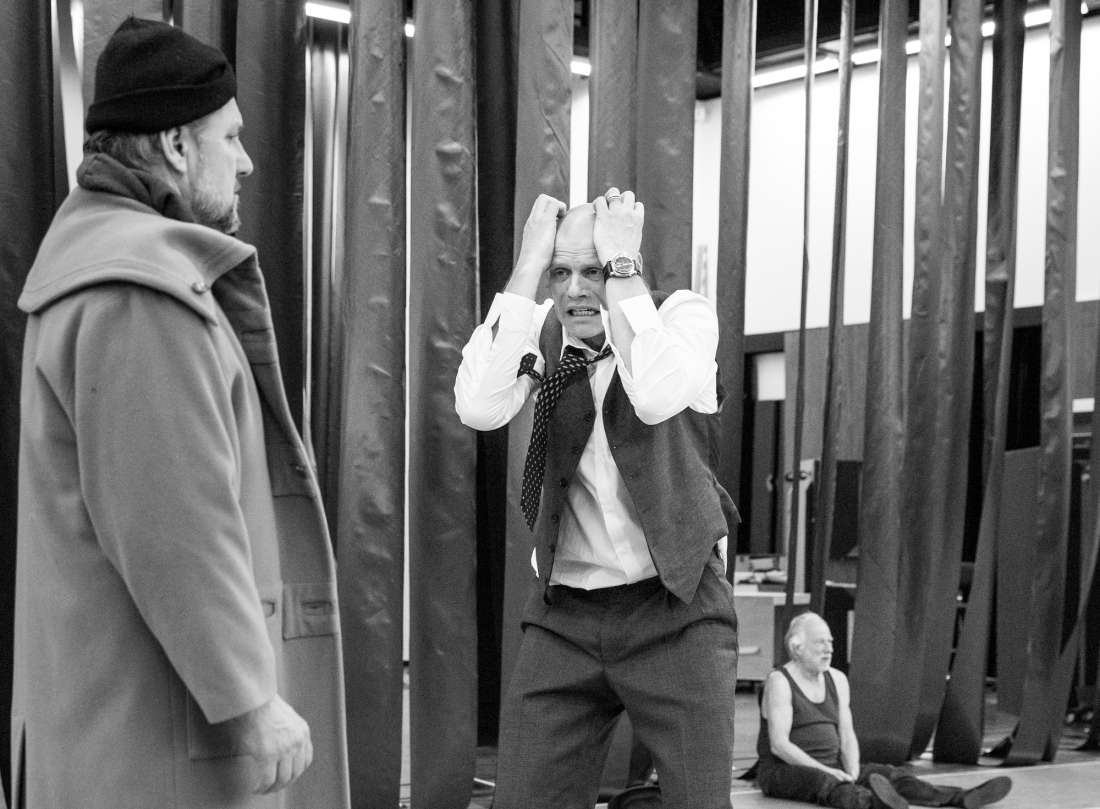
Rehearsal photograph: © Élena Bauer / OnP


This year has seen musical Shakespeare commemorations aplenty, although I cannot help but wonder whether some miss the point. Although there are many wonderful musical settings of Shakespeare, his verse is often so musical in quality that it requires nothing additional. Successful Shakespeare operas are thus less surprisingly few than one might initially suspect. Britten’s A Midsummer Night’s Dream has its devotees, many of them fervent; I should rather stick with the play and Mendelssohn’s incidental music. Falstaff: well, it is difficult to care much one way or the other about The Merry Wives of Windsor, even if Nicolai’s version is (slightly) preferable. Lear, however, has at least one other excellent operatic version, very different in conception: Alexander Goehr’s Promised End. Aribert Reimann’s opera is more conventionally operatic, perhaps, than Goehr’s post-Brechtian response, although such a claim is highly relative and this is no work, thank God, for canary-fanciers. We are lucky to have both – and equally lucky never to have that threatened late Verdi opera. (I have never heard Aulis Sallinen’s 2000 opera.) At any rate, the Paris Opéra’s contribution, whether intended as such or no, is most welcome in principle, still more welcome in practice.


Claus H. Henneberg wrote a number of libretti, from Reimann’s 1971 Melusine to works by Peter Eötvös and Matthias Pintscher. (How I should love an opportunity to see the latter’s Thomas Chatterton!) This, first performed at the Munich Opera Festival in 1978, was written with Dietrich Fischer-Dieskau very much in mind for the title role, and that seems to have helped the initial dissemination of the work, both in the theatre and on its first recording. For a number of stagings followed, including San Francisco, Paris (making Calixto Bieito’s staging the Opéra national de Paris’s second), East Berlin (the Komische Oper), Vienna, Amsterdam, and eventually in 1989, London (ENO). Opera of this period has not generally been well served well by our opera houses, although many continental houses – and not just German ones, as this Paris production and its predecessor attest – tend to do better than their English counterparts; nor has it been in much Anglophone writing. In the meantime, however, you are recommended to seek out a performance and/or a recording where you can.
 

This Paris production and performance will do nicely in that respect. Reimann’s post-expressionist score – not unlike what you might expect from so fine a pianist in Lieder of the Second Viennese School – and Henneberg’s libretto do nothing especially ‘to’ the play, although it is of course not remotely set in its entirety. Given the musical language, violence comes much to the fore, without forsaking claims upon our human sympathies. Indeed, as one would expect, the latter become progressively engaged as the second of the two acts progresses. Dramatic parallelisms and distinctions, for instance between Lear (baritone) and Gloucester (bass-baritone), Cordelia and Edgar, are surely, if sometimes rather obviously, handled in words and music. The series with which the latter pair are associated come strongly into the foreground, much as they might have done with Berg, although there is far less of the ‘Romantic’ to this score. As with a good deal of serialist opera, one has a sense of the workings of the serial machinery and its implications, even if one could not quite put it into words, and would have to consult the score properly to analyse it. (When, after all, would one not? Surely the same is true of Mozart or Wagner.)


Although I felt that Fabio Luisi sometimes led the excellent Orchestra de l’Opéra national de Paris with a little too much restraint, and that something more full-blooded would have turned the dramatic screws with a more evident sense of theatre and ultimately of musico-dramatic generation, audibility of such procedures and our consequent ability to relate them, indeed to fuse them, with stage action were nevertheless most welcome. Not that screams from the orchestra – seemingly, insofar as I could tell, never having seen the score, executed with pinpoint precision – or stereo dialogue between percussionists in boxes either side of the pit had nothing of the visceral to them, far from it. The score can rarely, if ever, have been played with such clarity and, at times, both depth and brightness of string tone as by this fine orchestra, still woefully underrated by many who should know better. My mind was cast back to their magnificent Moses und Aron at the opening of this season.
 

The cast was excellent too. Bo Skovhus gave a highly distinguished, dramatically detailed performance of the title role. His initial pride and its disintegration into a complex web of emotions, inadequacies, and ultimately greater humanity were accomplished in what I presume would have been a more physical performance than that adopted by Fischer-Dieskau (or indeed, really possible to the role’s creator at the time). Skovhus was, I am sure, just as committed as his great predecessor would have been. The dryness I have sometimes observed more recently in his voice seemed as resolutely banished as Cordelia, without danger of its parallel return.
 

Lauri Vasar’s Gloucester was handsomely sung, in a portrayal of considerable emotional depth. Facial, vocal, and verbal expression seemed very much of a piece, as indeed they did in general on stage, testament surely to Bieito’s work as director as well as to individual artistry. Indeed, it is surely testament to both that it is difficult to disentangle the two, and I shall not really attempt to try. Bieito certainly does not seem out to shock, but rather to draw from characters, production, and performances the elements of musical drama. Modern dress is employed, if one cares about that sort of thing in itself, but the designs more broadly are stark, permitting one to allow oneself to imagine any manner of ‘setting’ or none: so more or less what all but the most hidebound reactionary would expect in Shakespearean tragedy. I am not sure that anyone would claim this as a ‘history play’, but perhaps someone silly will claim it as a ‘history opera’; frankly, who cares?
 

What Goneril and Regan have in common and what, increasingly, sets them apart is fascinatingly explored, Ricarda Merbeth’s Goneril the power-dressing big sister, initially less interested in the sexual, it would seem, but ultimately more successful – perhaps because her actions have not previously been so overtly erotic? – in its exploitation. The depravity of Regan’s actions, by contrast, from the initial sexual approach to her father (one almost wants to have her convicted of elder abuse) to her sleazy demise (a touch of necrophilia before expiring, perhaps, however understated?) tell their own story. Erika Sunnegårdh’s performance again melded the ‘musical’ and the ‘dramatic’ into a single, dynamic whole. If Annette Dasch’s Cordelia made less of a strong impression, that was more a function of the work; when she returned, hers was an undoubtedly sympathetic contrast, if ultimately never one that could emerge victorious. Andreas Schiebner’s Albany was intriguingly ambiguous: here, one felt, was a truly conflicted character, no doubt weak yet still a victim of circumstances. Andreas Conrad’s Edmund followed the seeming fate, even nature, of his own personal circumstances, with similarly powerful command of musico-dramatic theatre. His legitimate half-brother, Edgar, received a memorable performance, especially but not only in vocal terms, from Andrew Watts, switching as he must between tenor and countertenor. Here, again, was a desperately needed hint of sympathy, if also a reminder of hopelessness. There was no sense, however, of whether he might become king; our eyes and ears were focused upon tragedy.


Now I should like to see Bieito direct King Lear ‘itself’ or not quite ‘itself’. Shakespeare stands no more in need of Werktreue than any composer of opera, indeed if anything, less so. The Barbican has staged some of his Shakespeare; alas, I was unable to go, but hope that it will not prove the last opportunity in London. Otherwise, to Paris, to Barcelona, or to wherever else might oblige…


Sunday, 4 October 2015

Wozzeck, Zurich Opera, 2 October 2015


Captain (Wolfgang-Ablinger Speerhacke) and Wozzeck (Leigh Melrose)
Images: Belinda Lawley
 
 
Royal Festival Hall
 
Wozzeck – Leigh Melrose
Drum Major – Brandon Jovanovich
Marie – Gun-Brit Barkmin
Andres – Mauro Peter
Captain – Wolfgang Ablinger-Sperrhacke
Doctor – Lars Woldt
Margret – Irène Friedli
Apprentices – Pavel Daniluk, Cheyne Davidson
The Fool – Martin Zysset
Soldier – Tae-Jin Park
Marie’s Son – Laura Missuray

Zurich Opera Chorus
Philharmonia Zurich
Fabio Luisi (conductor)
  

The greatest opera of the twentieth century? Without a shadow of a doubt, which is strange, given a century overflowing with operatic masterpieces. I have never been to a performance of Wozzeck that has not left me reeling, even when miserably conducted by Antonio Pappano; this visit from the Zurich Opera, giving its new production in concert, was no exception. It was, despite the indisposition of the anticipated Christian Gerhaher as Wozzeck, at least as strongly cast as any I have heard, and benefited not only from excellent playing from the Philharmonia Zurich but, of course, its presence on stage rather than in the pit.
 

One reservation, which I shall get out of the way first: the conducting of Fabio Luisi. Luisi’s career is a mystery to me. I heard him once, as a short-notice stand-in for Christoph von Dohnányi, give a truly excellent performance of Schubert’s ‘Great’ C major Symphony; such success has never in my experience been repeated. (Perhaps it was Dohnányi’s performance the orchestra was really giving?) Otherwise, it has been workmanlike performances without exception. I suppose it takes some degree of skill to have the audience in no doubt where every bar line falls, but Luisi’s bar-to-bar approach and seeming inability to go beyond a purely literalist communication of the notes on the page are really not enough for Wozzeck, not enough indeed for any score.
 

That the orchestra’s playing was of such a consistently high standard throughout, from cultivated chamber-like playing to shattering climax (d-Moll!) offered considerable compensation, not least because in such a concert setting, one appreciated Berg’s closed forms and their astonishing musical invention all the more. That Wozzeck is, amongst so many other things, as great a musical masterpiece as Pierrot lunaire has never, in my ‘live’ experience as opposed to studying the score and recordings at home, been quite so utterly apparent. Indeed, I could not help but wonder whether Stravinsky might just as readily have chosen Berg’s score as the ‘solar plexus of twentieth-century music’. Nevertheless, it remained a pity not to have a more imaginative, probing conductor, who could have turned the musico-dramatic screws, or even shown some appreciation of what and where they were.
 

The loss of Gerhaher turned out to be no loss at all. Indeed, although I was certainly curious to hear what a voice of such beauty would have made of the role, I cannot believe that the dramatic achievement of Leigh Melrose’s portrayal could possibly have been superseded. Melrose’s Wozzeck in English remains unforgettable, like much else from ENO’s brilliant Carrie Cracknell production. Here, he showed that, in the original language, his match of verbal and musical acuity with first-class acting – yes, although this was a ‘concert’ performance, much of what we saw as well as heard was in character – could, if anything, penetrate still deeper. Much nonsense has been spoken, probably more often written, about Fischer-Dieskau’s allegedly too ‘intellectual’ assumption of the role. One needs a mind to be able to understand and to communicate the darkest, most profound reaches of Berg’s – and of Wozzeck’s. This Wozzeck was as thoughtful and as sensitive as he was downtrodden and, ultimately, angered. Melrose’s appearance in Francesconi’s Quartett at the Linbury Theatre also remains lodged in the memory; quite why Covent Garden does not offer him a role on the main stage is a mystery to me.
 

Wozzeck’s final confrontation with Marie was not the least of the moments when tears involuntarily came to my eyes. (Inevitably, the final scene was the most gut-wrenching of all.) Gun-Brit Barkmin offered an equally fine portrayal of her role. Her Chrysothemis in Semyon Bychkov’s Proms Elektra last year gave British audiences an inviting taste of her artistry. This all-enveloping performance, from siren (anticipations, not least in the Louise Brooks ‘look’, of Lulu?) to terrified, guilt-wracked victim, unabashed sensuality and genuine maternal protectiveness in complex coexistence and conflict, lived both in the moment and in Berg’s astonishing depth of character development.


The cabaret-duo of Wolfgang Ablinger-Speerhacke’s Captain and Lars Woldt’s Doctor, high camp never at the expense of solid musical values, was at least as fine as any I have seen. They really should have their own ‘spin-off’ work. Brandon Jovanovich offered a Drum Major as repellent and yet as alluring in his masculinity as any I can recall too; the sheer power of his vocal delivery had all quake before him. Every member of the cast contributed to a greater whole; here, the advantages of having rehearsed and performed on stage prior to performance were abundantly clear. Last but not least, I must mention the astonishing heft and clarity of the choral performance, again doubtless benefiting from not being dispersed around the stage. Echoes of Weber, turned horribly sour, can rarely have been so disturbingly apparent.


Sunday, 12 February 2012

Götterdämmerung, Met Opera Live, 11 February 2012

Metropolitan Opera, New York: HD Live, viewed at BFI IMAX

Brünnhilde – Deborah Voigt
Gutrune – Wendy Bryn Harmer
Waltraute – Waltraud Meier
Siegfried – Jay Hunter Morris
Gunther – Iain Paterson
Alberich – Eric Owens
Hagen – Hans-Peter König
First Norn – Maria Radner
Second Norn – Elizabeth Bishop
Third Norn – Heidi Melton
Woglinde – Erin Morley
Wellgunde – Jennifer Johnson Cano
Flosshilde – Tamara Mumford

Robert Lepage (director)
Neilson Vignola (associate director)
Carl Fillion (set designs)
François St-Aubin (costumes)
Etienne Boucher (lighting)
Lionel Arnould (video image artist)

Patricia Racette (‘Live in HD’ host)
Metropolitan Opera Chorus
Metropolitan Opera Orchestra
Fabio Luisi (conductor)


Oh dear, oh dear, oh dear. With the caveat that this is the only instalment of Robert Lepage’s Met Ring that I have seen, it really is as bad as everyone has said it is. In the face of uniformly negative reviews – I am sure there will be exceptions, but they have not come to my notice – Götterdämmerung proved to be one of the most vacuous productions of anything I have ever seen. Even the Otto Schenk production that this replaced seems in retrospect a monument to Wagner’s ‘emotionalisation of the intellect’ (the desired mode for reception of his yet-to-be-composed tetralogy, according to Opera and Drama). Well, not quite, but here, I am afraid, there is simply nothing. There has been a peculiar recent trend of presenting ideas-free or at least ideas-lite Ring cycles: witness Stéphane Braunschweig in Aix and Guy Cassiers in Berlin (and Milan). However one could fail to entertain any thoughts, however misplaced, about the Ring is a conundrum too far for me, but Lepage seems to have hit rock bottom. So far as I can discern, his only concern is the ‘machine’, about which we have all heard far too much already. A preposterously expensive mechanism for scene changes and video projections – disturbingly similar to Ex Machina’s ‘Cirque du Soleil’ – is not a substitute, or rather it is but not should be, for dramatic direction. A production that took technology as its starting-point could have a great deal to say. How about, say, starting with Victorian phantasmagoria in Nibelheim and making our way forward? (Memories of Patrice Chéreau’s hydroelectric dam necessarily return.) But here we simply have duller costumes than in Schenk, and video projections of a few natural phenomena. What is the drama about? What is at stake? The nihilism of Götterdämmerung, or at least that dramatised therein - Chéreau rightly characterised the world of the Gibichung court as ageing, pointing to the increasing desperation of its rituals, which seek some sort of moral code in a post-religious society that knows no morality, indeed finds it impossible to ‘know’ – is quite a different matter from presenting nothing at all. The mock-up horse seems so designed to appease ‘traditionalists’ that it would surely have been more honest to go the whole hog, if you will forgive the mixing of equine and porcine, and present a real animal on stage. It all looks at best like an expensive version of a school Viking play. Poor Waltraud Meier really pulls the short straw with Waltraute’s silly helmet.

Enough! If even the lobotomised would require a further lobotomy to find anything in the production, was there anything at least worth hearing? The score, after all, is not without interest. Fabio Luisi’s conducting was better than we tend to hear at Covent Garden; there was little of the stopping and starting that must be endured here post-Haitink. But if corners were for the most part safely navigated, the reading nevertheless struggled to rise above the efficient. How depressing it is to write that! In a brief interval conversation with Patricia Racette – may I never hear her inane questioning again! – Luisi claimed that he wished to rid the work of heavy German tradition. He accomplished that after a fashion, I suppose, but it might have been worth him considering whence that disparaged tradition arose. This was not a chamber reading – there is, up to a point, a place for such – but a dull one, quite uninvolving throughout. Again, I should remind you that we are talking about Götterdämmerung here. Choral singing, I am delighted to report, was excellent. The Metropolitan Opera Chorus was clearly well-trained, and sang with admirable heft, as well as clarity.

Meier’s Waltraute was, unsurprisingly, a highlight. Somehow she managed to wring some drama from the situation: she did so as only she can, with her extraordinary intensifying synthesis of word and gesture. Iain Paterson was an excellent Gunther, conflicted and insecure, and Wendy Bryn Harmer offered an excellent, complementary Gutrune, often quite beautiful of tone. Hans-Peter König’s Hagen was interesting. There were times when I thought him too benevolent, but his portrayal won me around: a nasty turn thereafter suggested that it might actually have been an act, Hagen’s act. We were left guessing. Sad to say, I missed Eric Owens’s Alberich: confusion – entirely my own fault – concerning the interval timings meant that I missed the very opening of the second act, surely one of the most extraordinary scenes in this extraordinary drama. Owens certainly received a rapturous curtain call. As for Deborah Voigt’s Brünnhilde, I have heard worse, but the view that her weight loss entailed a great deal of vocal loss seemed pretty close to confirmation here. There was a dignity to her portrayal that promised more than it delivered, but if hardly memorable, there was no disgrace here either. Jay Hunter Morris should probably be applauded for managing, more or less, to sing the well-nigh impossible role of Siegfried – we all have horror stories to recount in that respect – but there were times when he sounded strained, even in a recorded balance that offered undue emphasis to the singers. Moreover, this was a role for the most part presented as opposed to lived. The production of course did not help, but Meier and Paterson in particular showed what might nevertheless be done by intelligent singing-actors. Intelligence, alas, was not something with which Lepage and company credited their audience.

It was unfortunate that much of the final scene of the first act was vitiated by some problem with transmission. First an unpleasant noise replaced the music, then silence. Whether this were the fault of the broadcast or the cinema, I do not know. Strange computer announcements appeared on screen from time to time, too, and there were problems with the subtitles (quite apart from the often questionable translation). I shall not bore readers with too many of my thoughts concerning opera in the cinema – I have come rather late in the day to it, this being my first time – but this was, for whatever reasons, a far less involving experience than I had anticipated, and it would be good to hear a balance that sounded a little closer to what one might hear in the opera house. Wagner's great Chorus, the orchestra, suffered especially.

(See also the review by Classical Iconoclast, including links to reviews of previous instalments.)

Thursday, 11 March 2010

Jansen/Rysanov/Philharmonia/Luisi - Mozart and Schubert, 9 March 2010

Royal Festival Hall

Mozart – Sinfonia concertante in E-flat major for violin and viola, KV 364
Schubert – Symphony no.9 in C major, ‘Great’, D 944

Janine Jansen (violin)
Maxim Rysanov (viola)
Philharmonia Orchestra
Fabio Luisi (conductor)

I did not enter the Royal Festival Hall with especially high hopes, feeling disappointed that Christoph von Dohnányi had fallen ill. His last-minute replacement, Fabio Luisi, had recently been lauded in certain quarters for his Strauss and Bruckner. I had rather admired his conducting of Die Liebe der Danae a few years ago in Salzburg, also, as it happens, replacing Dohnányi, yet more recently, I had been somewhat nonplussed by an Edinburgh concert with the Staatskapelle Dresden. Luisi must have been having an off-day – or perhaps I was – since his conducting of Mozart and Schubert proved excellent, and I think it is fair to say that nowhere am I less easy to please than in Classical repertoire…

There were two other stars for the Mozart Sinfonia concertante, of course – well, three, since the brightest-shining of all is the composer of this imperishable masterpiece. It speaks extremely well of Luisi and his two soloists, Maxim Rysanov and Janine Jansen, that their musicianship ultimately returned the spotlight to Mozart himself. Everything sounded right: tempi, blend, sonority, character. That is not to say that there is one ‘correct’ way, but rather that the performance did its job in convincing one of its rightness for as long as it lasted – and a little while after. For the music does not play itself; it needs to be performed. The Philharmonia strings were of a decent size (10.8.6.4.3), the orchestra providing clarity, warmth, and a weight that did not preclude lightness of touch where necessary, for instance in beautiful, unanimous pizzicato and truly ravishing woodwind passages. It is grossly unfair even to mention it, but the only thing I missed was that true Viennese sweetness now so indelibly associated – and justly so – with this music: think, for instance of one of Karl Böhm’s recordings. In the first movement, the tempo, as elsewhere, seemed just right: unhurried, but by the same token never dragging. The great opening tutti crescendo was flawlessly handled, in a way that would surely have impressed Mozart and the fine (considerably larger) Paris orchestra for which he wrote. In a concerto, however, one awaits of course the entry of the soloist(s), and from the outset, Janine Jansen and Maxim Rysanov impressed, not only attentive to each other, but with an obvious rapport; indeed, the frisson seemed almost sexual, by which I do not mean to imply anything beyond the performance, but performing with another musician always involved shared intimacy, at least if it is done properly. There was a clear contrast between violin and viola, but equally a fine blend. If anything, Rysanov’s part impressed all the more, if only because one is less accustomed to hearing a solo violist: I certainly was led to wish that Mozart had written a viola concerto, not least since he clearly adored the instrument.

The slow movement flowed, in the proper rather than the modern ‘fast’ sense, yet retained its dignity. Jansen’s opening violin solo sounded veiled, as if it were muted, yet it was not; Rysanov’s response was rich – in every sense – in melancholy, exquisitely voiced and shaped. When the major mode came, Mozart smiled through tears as only he can. Luisi’s role was crucial, in that he ensured an unbroken line from beginning to end, not in the sense of a lack of phrasing or articulation, but in the long-distance hearing (Furtwängler’s Fernhören) that makes of this movement a single aria. The ineffable sadness of the cadenza proved the emotional climax, its chromatic intensity almost unbearable; nothing could have been more distant than mere solo display. A truly Mozartian quicksilver change of mood was brought about by the Puckish finale. Fun can be beautiful – and beauty can even be fun; such is Mozart’s lesson, as taught to us here. Interplay between all musicians was once again exemplary. A fine performance indeed!

For Schubert’s ‘Great’ C major symphony, Luisi opted for a full, Romantic orchestra (strings: 16.14.12.10.8). Thank goodness for that! He had no truck with the modern trend towards an absurdly fast introduction to the first movement. Instead, Schubert, quite rightly, looked forward to Bruckner, without foregoing the composer’s particular grace and charm. Cellos were suave, brass full of foreboding, and the oboe solo (Gordon Hunt) simply enchanting. The transition to the exposition was thrilling and arrival was decisive, underpinned by martial rhythm. I felt a certain regret – both times, since the exposition repeat was taken – that Luisi did not yield for the second subject, but this was part of his intriguingly, and ultimately convincingly, urgent account. The lightness of the opening to the development, woodwind in particular, suggested Mendelssohn, but the Philharmonia brass soon supplied military muscle, the scene set for battle, as kettledrum clouds underscored. Before we knew it, the recapitulation was upon us, but had battle been enjoined or deferred? Schubert’s goal-orientation is generally more ambivalent than that of Beethoven, and so it was here. Ambiguity continued into the coda, which sounded grand but unsettling: an apt summation of the symphony as a whole. In a sense, one might think of Furtwängler, but with very different means. The slow movement was taken relatively swiftly, but never sounded remotely trivial. Subtle rubato was employed where necessary, but onward, even martial drive won out. Cellos and double basses were especially important here in underpinning the rhythmic menace, whilst woodwind entwined gorgeously above: again, an unsettling combination. Consolation was to be heard, but would not quite endure. The climax was shattering, almost Brucknerian; I was truly shocked. After that, the sadness of cellos and oboe shone through, aided by Luisi’s astute relaxation of tempo. Resumption of the initial tempo could not remove the shadow cast; the urgency pertaining to the last terrified. The scherzo continued in a similar vein: urgent and graceful; it stomped, but with charm. There were odd bars in which ensemble and control lapsed slightly, only really noticeable in the face of such excellence elsewhere. The scale and oh-so-Austrian quality of the trio registered, but I felt that such might have been emphasised a little more, the music occasionally edging towards the neutral.

What to do for a finale? Ever since the Eroica, at least, this has been a great problem for the symphonist. Luisi drew Beethovenian parallels but equally emphasised Schubert’s own path. Command of line was all-important here and the conductor did not disappoint. Where Bruckner in the Seventh Symphony so signally failed, Schubert was permitted to succeed, resolving tensions without avoiding them. A motivic insistence clearly born of Beethoven sounded, but Schubert was never made to sound ‘like’ him. The one thing I missed here was the last ounce, and I only mean an ounce, of orchestral weight, so as truly to overwhelm prior to resolution, but the low unison blows nevertheless struck a Brucknerian terror into one’s heart. A stylish and intriguing touch, which somehow avoided mannerism, was the subtle diminuendo upon the final chord. The time for easy victory, if ever it had existed, was long gone in this understanding of Schubert.

It is a pity, then, that the audience seemed lacklustre in its response. For me, this was an extraordinarily memorable concert. Dresden may have lost Luisi, but I hope that London will hear more of him.

Friday, 29 August 2008

Edinburgh International Festival: Grimaud/Staatskapelle Dresden/Luisi, 28 August 2008

Usher Hall

Weber – Overture: Oberon
Beethoven – Piano Concerto no.4 in G major, op.58
Strauss – Ein Heldenleben
Bernhard Lang – Monadology II (British premiere)

Hélène Grimaud (piano)
Staatskapelle Dresden
Fabio Luisi (conductor)

This was a considerably different concert from that advertised. First, the programme was changed, so that Hélène Grimaud performed Beethoven’s Fourth Piano Concerto rather than Schumann's. Then disaster struck the night before, the orchestral players arriving in Edinburgh but not their instruments, with the result that the first of their two concerts was cancelled. It was therefore decided to give the British premiere of Bernhard Lang’s Monadology II in addition to the new programme.

It is almost always a joy to hear the Staatskapelle Dresden, and this occasion was no exception. Faced with the proverbial gun to my head, I should finally opt for the Vienna Philharmonic Orchestra as the world’s greatest, but I have no doubt that I should put Dresden second, however nonsensical such rankings ultimately may be. No one quite possesses the sweetness of the Vienna strings, yet there is something darker, more traditionally German about the Staatskapelle Dresden, a direct line to the extraordinary tradition that has had it directed by composers such as Schütz, Weber, Wagner, and Strauss, not to mention a host of great principal conductors. That is true authenticity. I was therefore especially eager to hear Weber’s Oberon overture, as truly German Romantic a curtain-raiser as one could imagine, in spite of its composition for Covent Garden. The slow introduction was good, though not perfect; a number of minor slips made me wonder whether the prior uncertainties surrounding the concert were extracting their toll. But the main section began with a bang – and the real sound of a great orchestra. Silvery violins, a ravishing clarinet solo, a beautifully rounded sound on the kettledrums: these were some of the delights to savour, although there was also a distinctly sour tone from the oboes at one point. Perhaps the most splendid memory was that of the full complement of horns, at their fullest tone, without a trace of harshness or braying. The overture was well directed by Fabio Luisi, although without the last ounce – or perhaps even a few ounces – of individuality.

Doubts concerning Luisi resurfaced during the Beethoven concerto, although he was presented with a headstrong pianist, very much more the soloist than the chamber musician, when of course she should have been both. Interplay and even mutual sympathy were often lacking; it made me wonder quite why the programme had been changed in the first place. The orchestra sounded wonderful, never more so than in the truly ravishing pizzicato passage following the first movement cadenza, but it could have been more purposively directed. The second movement was something of an exception, with truly characterful strings proving implacable Furies to Grimaud’s pathetic – in the best sense – Orpheus and a greater sense of partnership all round. The beautifully hushed strings at the end took on a memorable, veiled sound, vibrato withdrawn momentarily for a musical reason rather than out of authenticist dogma. A winning lilt was imparted to the finale, although Grimaud once again soon became too much the star soloist. It was rare indeed for her so much as to glance at the conductor or the orchestra. There were many good things in this performance, yet I felt that it could readily have been much better.

Ein Heldenleben benefited from a splendidly vigorous opening, although once again there were quite a few slips only a little way in. The very odd cracked note apart, the Dresden horns were once again to die for, as indeed was the orchestra as a whole, especially when Strauss called for great washes of orchestral sound. Leader Kai Vogler proved a fine soloist indeed. Split violins, here as elsewhere, paid dividends, although elsewhere the account could sometimes be found wanting in terms of clarity. Bombast won out over irony, for it sounded as though the conductor was simply taking Strauss at face value. Moreover, Luisi appeared to value volume over other, more signal virtues, mistaking it for dramatic tension. His direction was once again weaker than the orchestral performance itself and here with graver consequences. Ein Heldenleben needs a great orchestra, of course, but just as important is absolute security in structural terms, lest the score begin to sprawl, to meander even. Here this happened far too often, resulting in an unduly episodic reading. And then there was an unwelcome surprise in terms of an alternative ending. Apparently Luisi and the Staatskapelle have recorded the work with this violin-focused winding down. It is not unpleasant in itself, but is not a patch upon the familiar Also sprach Zarathustra reference. Still, I suppose it might appeal either to Zarathustra-haters, although I should have thought that they would also be Heldenleben-haters in any case, or to those approaching Strauss’s symphonic poem without a sense of irony.

Then, as a bonus, came the Lang premiere. At least, I had thought it would have been a bonus. The piece sounded very interesting from the composer’s own programme note, which explained its concept of ‘musical-cellular processing’, as derived from Leibniz’s monadology. (Festival director Jonathan Mills’s stumbling over the title during his concert introduction suggested a certain unfamiliarity with Leibniz’s philosophy.) Yet the sole impression I gained from the performance was one of tedium. An opening woodwind reference to Strauss’s Don Quixote – the piece is subtitled ‘A new Don Quixote’ – never really led anywhere, and much of the music merely sounded like a textured accompaniment to something that never materialised. The introduction of a wind machine merely sounded incongruous, for there was on the whole little sense of orchestral colour. Rhythmically the piece was monotonous too. Perhaps I missed the point, but I could not help but notice an apparent lack of enthusiasm on the orchestra’s part. Whilst I cannot but applaud attempts to build upon the orchestra’s great tradition – it is hardly celebrated as a champion of the contemporary – I am not sure that this was an ideal opportunity to do so. I was, however, greatly relieved to read that this was a shorter version – of about twenty minutes, I should guess – of an original, fifty-minute-long score.