Showing posts with label Calixto Bieito. Show all posts

Sunday, 12 February 2023

Carmen, English National Opera, 9 February 2023


Coliseum

Carmen – Ginger Costa-Jackson
Don José – Sean Panikkar
Micaëla – Carrie-Ann Williams
Escamillo – Nmon Ford
Zuniga – Keel Watson
Moralès – Christopher Nairne
Frasquita – Ellie Laugharne
Mercédès – Niamh O’Sullivan
Dancaïro – Matthew Durkan
Remendado – Innocent Masuku
Lillas Pastia – Dean Street
Mercédès’s daughter – Fatima Hammad

Children’s Chorus and Additional Chorus
Chorus (chorus director: Mark Biggins) and Orchestra of the English National Opera
Kerem Hasan (conductor)


Images: Adiam Yemane


Whatever happened to Calixto Bieito’s Carmen? I have seen it twice previously at ENO, in 2012 and 2015, and enjoyed it greatly. It has been revived since in London, but it dates back to the 1999 Festival Castell de Peralada and has been seen at a number of houses, Barcelona, San Francisco, and Oslo included. Maybe it has just had its day; with occasional, intriguing exceptions, few things date so quickly as stage productions. I think it is probably more than that, though. By the time of its third ENO revival, the link with Bieito seems tenuous, as if those involved would rather be at work on a new production, a production of their own. We are left with sets and costumes that have often lost their freshness, in seems to be quite a different overall approach, sitting uneasily, even incoherently, with Bieito’s radicalism: a softer radicalism, admittedly, than in many of his stagings, yet radicalism nonetheless. Sadly, many of the objects of Bieito’s critique have either more or less disappeared or found themselves (unwittingly?) transformed into objects of appreciation. 

One looks in vain for any real sense, beyond the uniforms, that this might be the dying days of Franco’s Spain – and uniforms, especially in a drama involving army officers, are hardly restricted to that time and place. The violence is more generalised, less clearly motivated. These are, it seems, simply a bunch of nasty people, Don José included. It is a point of view, I suppose, yet not to my mind an especially illuminating one. Perhaps more seriously, the idea of ‘Spain’ as a perpetual, arguably degenerating recreation, dating back to this opera and beyond seems to have been replaced by a taking at face value, if not quite celebration, of the tackiness and tourist vulgarity at which Bieito took aim. This Carmen now often seems less designed for the Opéra Comique, more to be straining at the commercial West End – without ever quite being able to fill the vast space of the Coliseum as would surely be necessary if taking, however misguidedly, that route. That said, the ballet of the fourth act retains much of its force and bite. 

A vicious toxic masculinity remains, even on occasion continues to shock: Don José striking Micaëla and verbally abusing her as she departs, for instance, that first scene surely echoed at the close when he brutally slits Carmen’s throat. But surely there is more to Carmen, indeed more to Don José, than that. One need not necessarily go down DmitriTcherniakov’s route, decentring Carmen and transforming the opera into Don José’s therapy session, fascinating, provocative, and rewarding though that was. A degree greater sympathy, or at least searching, for all the characters would not have gone amiss here.


More consistently strong performances might have helped. One principal towered above the others, Sean Panikkar’s Don José. The range of his performance, vocally and dramatically, came close to an object lesson, even within parameters that have become unsympathetic. He acted as an energising presence for others too. Rarely, moreover, have I heard such clear diction in this theatre’s cavernous spaces. If that brought the shortcomings of an oddly unsettled English translation more strongly to the fore, that is firmly the fault of that translation. (And really, Carmen in English is ultimately not a very good idea.) Ginger Costa-Jackson’s Carmen grew in stature as the evening progressed, at her strongest (wonderfully acted here) when later showing fear and vulnerability, strangely patchy earlier on. 

A lively, charismatic stage portrayal from Nmon Ford’s Escamillo was not always matched vocally in the lower range, but there was no doubting the commitment of the performance. Carrie-Ann Williams’s late-substitution Micaëla had its moments, more in the third act than the first, but never quite settled. There were, truth be told, several rather mixed performances, and one, the Zuniga, in which the singer seemed lacking, whether on the night or more fundamentally, in the necessary vocal equipment. Fortunately, Christopher Nairne’s Moralès (another late substitution), as well as Ellie Laugharne and Niamh O’Sullivan Frasquita and Mercédès, offered highly convincing, individual performances in their smaller roles.

The ENO Orchestra, meanwhile, was on excellent form, offering precision, warmth and sheen in near-equal (where appropriate) measure. Conductor Kerem Hasan’s tempi were well chosen and communicated, with plenty of drive and tenderness as the score required. The chorus and additional chorus did good work in all that was asked of them. I just wish the parts, many of them good, had added up to a more satisfying theatrical experience, as had been the case previously, whilst noting that mine seems to have been a minority view.

Wednesday, 3 October 2018

Moses und Aron, Semperoper Dresden, 29 September 2018


Moses – John Tomlinson
Aron – Lance Ryan
Young Maiden – Tahnee Niboro
Sick Woman – Christa Mayer
Young Man/Naked Youth – Simeon Esper
Another Man, Ephraimite – Matthias Henneberg
Priest – Magnis Piontek
Youth – Beomjin Kim
Six Solo Voices – Katerina von Bennigsen, Stepanka Pucalkova, Michal Doron, Aaron Pegram, Jiři Rajniš, Tillmann Rönnebeck
Solo Soprano – Kira Tabatschnik
Naked Virgins – Tania Lorenzo, Tahnee Niboro, Grace Durham, Constance Heller
Elders – Woo Ran Lim, Andreas Heinze, Norbert Klesse

Calixto Bieito (director)
Rebecca Ringst (set designs)
Ingo Krügler (costumes)
Michael Bauer (lighting)
Sarah Derendinger (video)
Johann Casimir Eule (dramaturgy)

Vocalconsort Berlin, Dresden Symphony Chorus, Dresden State Opera Chorus, Extra Chorus and Children’s Chorus (chorus master: Jörn Hinnerk Andersen)
Sächsische Staatskapelle Dresden
Alan Gilbert (conductor)

Images: Ludwig Olah

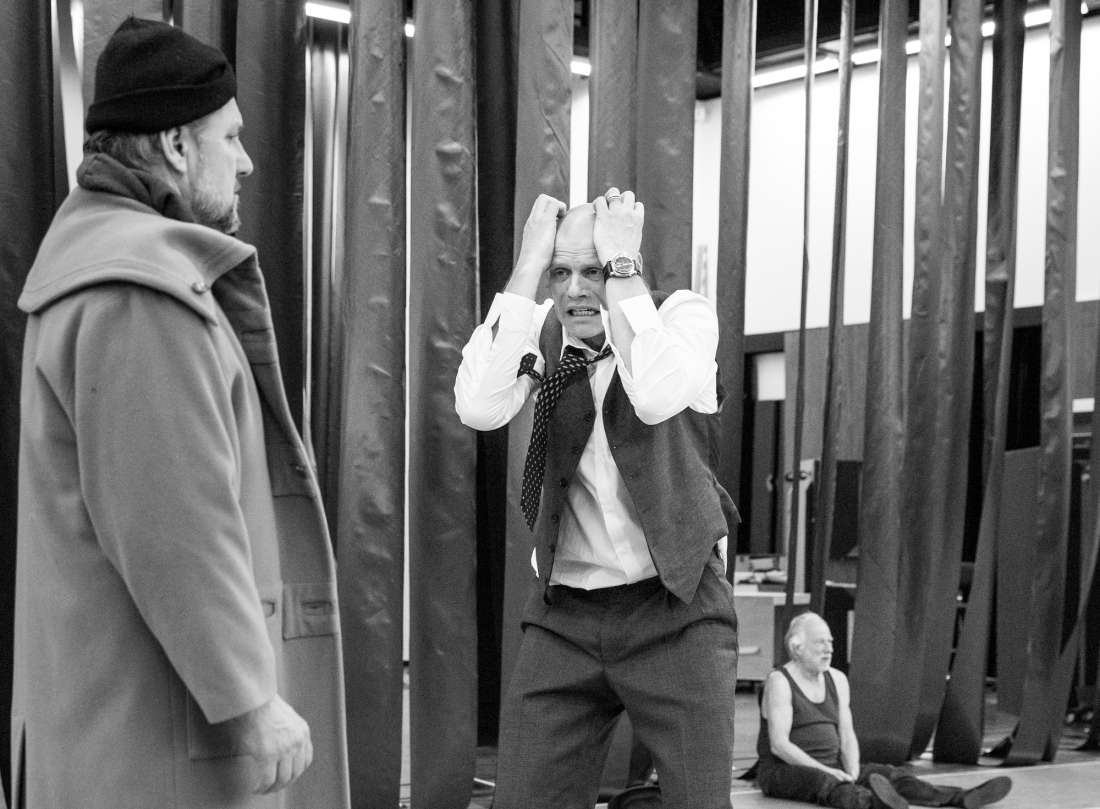
There is no more emphatic modernist masterpiece than Schoenberg’s Moses und Aron. It stays so true to its mission that it cannot, irrespective of ‘the composer’s intention’, be completed, the very quintessence of the modernist fragment, of the ‘difficult’ work about ‘difficulty’. Its concern with the hubris of the representation leads it to a series of antinomies unflinchingly confronted, quite without evasion. Yes and no, perhaps more yes than no – and yet, perhaps even in work as well as in performance, with an undeniable element of the two. The balance may be skewed, just as it is between Moses and Aron, between truth and communication, but it is never one or the other; such would not be bad dialectics, but rather no dialectics whatsoever, and what could be less Schoenbergian than that? One can rejoice in the antinomies in the impossibilities; one can take them further. Alternatively, one can try to make something complete out of them. One will probably do both. Here, however, in an extraordinary new production from Calixto Bieito and the Semperoper Dresden, we perhaps come closer than ever to the next dialectical stage by both honouring the two-act fragment – performed, without an interval, almost as if a single, unbroken span – and, as Bieito insists both in speech and, more important, in the art and craft of stagework, by rendering it an apparently ‘complete’ artwork.


Bieito has at heart – he is assuredly a director with a great heart – always been one not only to present but also to necessitate a message of humanism. Just like Schoenberg, one might say, and these are unquestionably a composer and work for whom he has the greatest, most productive respect. He plays Moses pretty straight, but then he has never been much of one for deconstruction. (For that route, take Peter Konwitschny’s staging, which I saw in Hamburg in 2004.) The first act, then, plays itself out much as it tends generally to do, but with such attention to the detail and meaning thereof concerning the interaction between Moses, Aron, and the chorus, the Children of Israel, that even those of us who imagine we know the work reasonably well discover much that is new, not only visually, but verbally, musically too. Likewise, perhaps still more so, with the relationships between individual, group within the chorus, and the chorus as a whole (when indeed it exists as such). Here, as throughout, we see a deeply musical staging – just as, I think, we hear a deeply dramatic and indeed scenic performance. With Bieito, one never doubts that one is seeing what one should be seeing, the craft of his blocking as impressive as the enabling generosity of his vision. These people, all of them, are human beings, not symbols, whatever the complexity of their dramatic roles. Aron’s visible crises of confidence – the man behind the communicative mask – intrigue and perhaps help explain part of his later desperation to please. That and, of course, the fact that his life and the lives of others might be in danger otherwise. He is a politician, to be sure, but we are led to understand the psychology, not just the deeds, of this politician.


Which brings us properly to the second act proper. What is idolatry to us, today? That is a question any conceivable production of this work will have to ask. ‘BE GOD’ announce the video images – images, be it noted – running at the back and sides of the stage, the arena or agon for the unfolding wilderness drama. (We certainly behold, metaphysically as much as physically, a wilderness, Die Israeliten in der Wüste, as CPE Bach’s oratorio has it. JS Bach and, to a lesser extent, Handel are the most obvious eighteenth-century progenitors here, yet there is always room for more at this party, even when attended by so colossal a chorus as here.) It grows in size and then becomes ‘BE GOD YOURSELF’. Again, all the while, different, flawed human beings play their roles individually and en masse. Not unlike notes, although music is never lazily to be considered a ‘language’, the letters become objects of aesthetic contemplation – Kant? – and soon, tellingly, suggest chains rather than deliverance. What is freedom without determinism? What is an orgy without sado-masochism? The participants excitedly don 3-D-style glasses. Will they see, understand better? Who knows? They think they will; they feel that they do.


This is a Blutopfer, of course: a blood sacrifice. Words having become images, images become other images. As human bestiality – we do not need camels to traipse onstage, for the beast is within us all – manifests itself in blood and violence, video turns to hardcore pornography. We see no full bodies, although occasionally we see faces to lure us in: faces that may or may not be attached to the hairless, barely human sexual organs and emotionless, purely mechanical acts performed, ‘performance’ being both the operative word and not. (For where, ultimately, is the form allegedly derived, created?) These are bodies or parts of bodies, not people. This is matter, not spirit. This is certainly not ‘love’; ‘sex’ seems too neutral a word. You can – you do – fill in the verbal, conceptual gaps. And then you ask yourself questions about those antinomies you have just delineated. Are they as much to make you feel better, as much a reassertion of your moral and cultural superiority, as anything approximating to truth content? Schoenberg, whisper it, can be wrong or at least limited in his vision too. Aron, part mastermind, part victim, emerges more than ever as a Pilate-like figure. He has helped provide, perhaps even create – is that not God’s task? – the materials. But are not his images, conjured up from a plastic bag of tricks, a diversion both from the truth, whatever that might be, as well as from what is actually going on before his eyes and ears? He has modelled an idol, but the Children of Israel have made themselves, not that idol, let alone Moses’ unrepresentable, unimaginable, ever-apophatic Idea of ‘One’, their own god(s). The manipulated collective - manipulated by what, by whom? - has fashioned a cybernetic idol. Moses, interestingly, seems less central than is generally the case. His tragic diagnosis of what he thinks has happened, more in sorrow perhaps than in anger, is, as much recent scholarship has acknowledged, quite deliberately wide of the mark itself. So it seems, in a related if not quite identical sense, here.


Such would go for nothing were it not for the many outstanding musical and dramatic performances. Alan Gilbert, leading the Staatskapelle Dresden, gave far and away the finest performance I have heard from him; I suppose you either conduct Moses und Aron or you do not. It was a performance as colourful as the op.16 Five Orchestral Pieces, as ‘dramatic’ as Wagner, as comprehending and communicative of the work’s ebb and flow as an excellent account of Beethoven, and as imbued with the spirit of the dance as Der Rosenkavalier. After all, many of us have often thought of Richard Strauss as Aron to Schoenberg’s Moses. This great orchestra could hardly boast of a greater Strauss pedigree: what a list of premieres, from Feuersnot to Daphne! Nor, of course, should one forget that this was the orchestra of none other than Kapellmeister Wagner. It certainly sounded like it here, but with a kaleidoscopic array of timbre that looked forward far into the twentieth century. As for the assembled choruses, again one might say that one either sings Moses or one does not, but that would be to take for granted a well-nigh incredible achievement. These musicians conveyed and lived the drama through words, notes, modes of sung or speech delivery, and of course stage action. Their contributions proved, quite rightly, still more crucial than those of John Tomlinson and Lance Ryan. If the former proved, at times, a little on the generalised side and the latter, ironically, more able with word and stage deed than with tone – twelve-note bel canto this was not – one could readily adapt such shortcomings into the greater narrative and its frame. Anyone feeling disappointed would have missed the point absurdly in the face of something so very much greater than the sum of its parts. Bieito’s – and, I think, Gilbert’s – uncompromisingly operatic view of the ‘complete’ work would win converts from all of those with eyes to see and ears to listen. ‘What third act?’ one might have asked, had the question so much as occurred.


And yet, in the afterlife of its experience, in the way we continue to think about what we have seen and heard long after that final orchestral tragic unison, the work opened up once again. In that, and not only in that, its serialism won out. In 1975, Dresden played host to the first East German performance of Moses und Aron, directed by none other than Harry Kupfer; in Bieito and his assembled forces, Kupfer has found a more than worthy successor. For ultimately – at least for now – the work has emerged more strongly than ever not only as a contest of ideas at its grandest but as an uncontested musical masterpiece. It is fashionable in certain quarters to denigrate the very idea. Schoenberg, thank God or at least Moses, never had truck with fashion, nor will he.


Wednesday, 1 June 2016

Lear, Opéra national de Paris, 29 May 2016


Palais Garnier

King Lear – Bo Skovhus
King of France – Gidon Saks
Duke of Albany – Andreas Scheibner
Duke of Cornwall – Michael Colvin
Earl of Kent – Kor-Jan Dusseljee
Earl of Gloucester – Lauri Vasar
Edgar – Andrew Watts
Edmund – Andreas Conrad
Goneril – Ricarda Merbeth
Regan – Erika Sunnegårdh
Cordelia – Annette Dasch
Fool – Ernst Alish
Servant – Nicolas Marie
Knight – Lucas Prisor

Calixto Bieito (director)
Rebecca Ringst (set designs)
Ingto Krügler (costumes)
Bettina Auer (dramaturgy)
Sarah Derendinger (video)
Franck Evin (lighting)

Chorus of the Opéra national de Paris (chorus master: Alessandro di Stefano)
Orchestra of the Opéra national de Paris
Fabio Luisi (conductor) 
 
Rehearsal photograph: © Élena Bauer / OnP


This year has seen musical Shakespeare commemorations aplenty, although I cannot help but wonder whether some miss the point. Although there are many wonderful musical settings of Shakespeare, his verse is often so musical in quality that it requires nothing additional. Successful Shakespeare operas are thus less surprisingly few than one might initially suspect. Britten’s A Midsummer Night’s Dream has its devotees, many of them fervent; I should rather stick with the play and Mendelssohn’s incidental music. Falstaff: well, it is difficult to care much one way or the other about The Merry Wives of Windsor, even if Nicolai’s version is (slightly) preferable. Lear, however, has at least one other excellent operatic version, very different in conception: Alexander Goehr’s Promised End. Aribert Reimann’s opera is more conventionally operatic, perhaps, than Goehr’s post-Brechtian response, although such a claim is highly relative and this is no work, thank God, for canary-fanciers. We are lucky to have both – and equally lucky never to have that threatened late Verdi opera. (I have never heard Aulis Sallinen’s 2000 opera.) At any rate, the Paris Opéra’s contribution, whether intended as such or no, is most welcome in principle, still more welcome in practice.


Claus H. Henneberg wrote a number of libretti, from Reimann’s 1971 Melusine to works by Peter Eötvös and Matthias Pintscher. (How I should love an opportunity to see the latter’s Thomas Chatterton!) This, first performed at the Munich Opera Festival in 1978, was written with Dietrich Fischer-Dieskau very much in mind for the title role, and that seems to have helped the initial dissemination of the work, both in the theatre and on its first recording. For a number of stagings followed, including San Francisco, Paris (making Calixto Bieito’s staging the Opéra national de Paris’s second), East Berlin (the Komische Oper), Vienna, Amsterdam, and eventually in 1989, London (ENO). Opera of this period has not generally been well served well by our opera houses, although many continental houses – and not just German ones, as this Paris production and its predecessor attest – tend to do better than their English counterparts; nor has it been in much Anglophone writing. In the meantime, however, you are recommended to seek out a performance and/or a recording where you can.
 

This Paris production and performance will do nicely in that respect. Reimann’s post-expressionist score – not unlike what you might expect from so fine a pianist in Lieder of the Second Viennese School – and Henneberg’s libretto do nothing especially ‘to’ the play, although it is of course not remotely set in its entirety. Given the musical language, violence comes much to the fore, without forsaking claims upon our human sympathies. Indeed, as one would expect, the latter become progressively engaged as the second of the two acts progresses. Dramatic parallelisms and distinctions, for instance between Lear (baritone) and Gloucester (bass-baritone), Cordelia and Edgar, are surely, if sometimes rather obviously, handled in words and music. The series with which the latter pair are associated come strongly into the foreground, much as they might have done with Berg, although there is far less of the ‘Romantic’ to this score. As with a good deal of serialist opera, one has a sense of the workings of the serial machinery and its implications, even if one could not quite put it into words, and would have to consult the score properly to analyse it. (When, after all, would one not? Surely the same is true of Mozart or Wagner.)


Although I felt that Fabio Luisi sometimes led the excellent Orchestra de l’Opéra national de Paris with a little too much restraint, and that something more full-blooded would have turned the dramatic screws with a more evident sense of theatre and ultimately of musico-dramatic generation, audibility of such procedures and our consequent ability to relate them, indeed to fuse them, with stage action were nevertheless most welcome. Not that screams from the orchestra – seemingly, insofar as I could tell, never having seen the score, executed with pinpoint precision – or stereo dialogue between percussionists in boxes either side of the pit had nothing of the visceral to them, far from it. The score can rarely, if ever, have been played with such clarity and, at times, both depth and brightness of string tone as by this fine orchestra, still woefully underrated by many who should know better. My mind was cast back to their magnificent Moses und Aron at the opening of this season.
 

The cast was excellent too. Bo Skovhus gave a highly distinguished, dramatically detailed performance of the title role. His initial pride and its disintegration into a complex web of emotions, inadequacies, and ultimately greater humanity were accomplished in what I presume would have been a more physical performance than that adopted by Fischer-Dieskau (or indeed, really possible to the role’s creator at the time). Skovhus was, I am sure, just as committed as his great predecessor would have been. The dryness I have sometimes observed more recently in his voice seemed as resolutely banished as Cordelia, without danger of its parallel return.
 

Lauri Vasar’s Gloucester was handsomely sung, in a portrayal of considerable emotional depth. Facial, vocal, and verbal expression seemed very much of a piece, as indeed they did in general on stage, testament surely to Bieito’s work as director as well as to individual artistry. Indeed, it is surely testament to both that it is difficult to disentangle the two, and I shall not really attempt to try. Bieito certainly does not seem out to shock, but rather to draw from characters, production, and performances the elements of musical drama. Modern dress is employed, if one cares about that sort of thing in itself, but the designs more broadly are stark, permitting one to allow oneself to imagine any manner of ‘setting’ or none: so more or less what all but the most hidebound reactionary would expect in Shakespearean tragedy. I am not sure that anyone would claim this as a ‘history play’, but perhaps someone silly will claim it as a ‘history opera’; frankly, who cares?
 

What Goneril and Regan have in common and what, increasingly, sets them apart is fascinatingly explored, Ricarda Merbeth’s Goneril the power-dressing big sister, initially less interested in the sexual, it would seem, but ultimately more successful – perhaps because her actions have not previously been so overtly erotic? – in its exploitation. The depravity of Regan’s actions, by contrast, from the initial sexual approach to her father (one almost wants to have her convicted of elder abuse) to her sleazy demise (a touch of necrophilia before expiring, perhaps, however understated?) tell their own story. Erika Sunnegårdh’s performance again melded the ‘musical’ and the ‘dramatic’ into a single, dynamic whole. If Annette Dasch’s Cordelia made less of a strong impression, that was more a function of the work; when she returned, hers was an undoubtedly sympathetic contrast, if ultimately never one that could emerge victorious. Andreas Schiebner’s Albany was intriguingly ambiguous: here, one felt, was a truly conflicted character, no doubt weak yet still a victim of circumstances. Andreas Conrad’s Edmund followed the seeming fate, even nature, of his own personal circumstances, with similarly powerful command of musico-dramatic theatre. His legitimate half-brother, Edgar, received a memorable performance, especially but not only in vocal terms, from Andrew Watts, switching as he must between tenor and countertenor. Here, again, was a desperately needed hint of sympathy, if also a reminder of hopelessness. There was no sense, however, of whether he might become king; our eyes and ears were focused upon tragedy.


Now I should like to see Bieito direct King Lear ‘itself’ or not quite ‘itself’. Shakespeare stands no more in need of Werktreue than any composer of opera, indeed if anything, less so. The Barbican has staged some of his Shakespeare; alas, I was unable to go, but hope that it will not prove the last opportunity in London. Otherwise, to Paris, to Barcelona, or to wherever else might oblige…


Sunday, 24 May 2015

Carmen, English National Opera, 20 May 2015


Coliseum

(sung in English)

Carmen – Justina Gringyte
Don José – Eric Cutler
Escamillo – Leigh Melrose
Micaëla – Eleanor Dennis
Zuniga – Graeme Danby
Moralès – George Humphreys
Frasquita – Rhian Lois
Mercédès – Claire Presland
Dancairo – Geoffrey Dolton
Remendado – Alan Rhys-Jenkins
Lillas Pastia – Toussaint Meghie
Girl – Sophia Elton

Calixto Bieito (director)
Joan Antonio Recchi (revival director)
Alfons Flores (set designs)
Mercè Paloma (costumes)
Bruno Poet (lighting)

Orchestra of the English National Opera
Chorus of the English National Opera (chorus master: Martin Fitzpatrick)
Sir Richard Armstrong (conductor)
 

When I saw this production open in 2012, I opened by writing, ‘A triumph for ENO! I suspected that Carmen would prove eminently suited to Calixto Bieito’s talents, and so it proved. Shorn of any ‘picturesque’ pandering – remember Francesco Zambello and her donkey? – what we saw here is perfectly attuned to Bizet’s resolutely unsentimental score.’ And so it still very much seems, under the able revival direction of Bieito’s then assistant, Joan Anton Rechi. The updating to the tawdry end of the vicious Franco regime continues to resonate; violence is in the air and more than in the air. At any point, it can and will claim its victims, many of whom we see on display here. We too live in a militarised society, although one that remains slightly more bashful about proclaiming itself to be such; we can draw parallels without their in any sense being forced upon us. We certainly know poverty, racism, misogyny, and the other forces we see depicted on stage; we also know, increasingly well, child abuse – and the figure of the small girl, both loved and abandoned by her mother, looks to an uncertain future most likely to be cyclical, or worse.


But above all, Bieito’s mastery of his craft as director and storyteller comes through. Characters who can sometimes seem romanticised, caricatured, even one-dimensional are more complex than we generally see. Carmen stands out less than is often the case; her vulnerability is as much social as personal, and all the more credible for that placing. Likewise Micaëla’s greater capacity for agency, her deviousness – no mere ‘angel’ on this occasion – make her a far more interesting character. Has she even invented the story about Don José’s mother? She certainly expresses triumph upon prizing him away from Carmen, harking back to the first scene in which she cannot prevent herself from kissing him – and clearly feels no shame in having done so. ‘Franco or his successors?’ I asked last time. ‘Is there that much of a difference, especially under the present regime?’ We may make substitutions across history, across the world, whilst at the same time remaining plausible specificity, indeed ruthless realism.


Ryan Wigglesworth conducted an excellent account last time; I am not sure that Sir Richard Armstrong was not finer still. Each act had its own colour, its own pace, but the ineluctable calling of Fate drove, in the best sense, the action forward. The ENO Orchestra was on top form, its woodwind solos full of character, fresh and subtle as a fine manzanilla. The strings dazzled in as impressive an orchestral performance as I have heard in the Coliseum all year. Likewise, the chorus, of which the director asks a great deal, was its typical excellent self. These were individuals but they were also a threatening and threatened mass.


Justina Gringyte was somewhat more aloof than Ruxandra Donose, but equally convincing as a character. Hauteur, relatively speaking, worked well here, and she could certainly turn on the charm when required. Her lines were clean, and her slightly accented English equally clear. Don José is a difficult role; in the beginning, Eric Cutler seemed a little too generalised, too lacking in charisma. However, he seemed, especially in the context of a strong company, to grow into the role. Leigh Melrose’s reprise of Escamillo offered an uncommonly subtle reading, in which the relationship between vulnerability and machismo – ever a ‘Spanish’ theme, even for a Frenchman such as Bizet – was intriguingly explored. Eleanor Dennis’s revisionist Micäela did not lack for sweetness of tone, especially during her third-act aria. Rhian Lois and Clare Presland offered vividly characterised readings of Frasquita and Mercédès. Special mention should be offered to Sophia Elton as that frightened, yet strong, little girl.


Those who have yet to see Bieito’s Carmen should hasten to the Coliseum; those who have done so before will need no encouragement from me. Let us hope, as I concluded in 2012, for more Bieito from ENO – and, indeed, for the Royal Opera to enlist his services too. The former enfant terrible is now widely recognised as one of the most thoughtful, provocative opera directors at work today; we need to see more of him in London. More from Armstrong would be no bad thing too. 
 

Wednesday, 8 April 2015

Gianni Schicchi and Bluebeard's Castle, Komische Oper, 5 April 2015


Komische Oper, Berlin

Gianni Schicchi – Günter Papendell
Lauretta – Kim-Lillian Strebel
Zita – Christiane Oertel
Rinuccio – Tansel Akzeybek
Gherardo – Christoph Späth
Nella – Mirka Wagner
Gherardino – Kosma Foik
Betto di Signa – Stefan Sevenich
Simone – Jens Larsen
Marco – Nikola Ivanov
Ciesca – Anna Werle
Maestro Spinellocio - Bruno Balmelli
Amantio di Nicolao – Philipp Meinhöfer
Pinellino – Ezra Jung
Guccio – Tim Dietrich
Buoso Donati – Bernd Guthmann 

Bluebeard – Gidon Saks
Judit – Ausrine Stundyte

Calixto Bieito (director)
Rebecca Ringst (set designs)
Ingo Krügler (costumes)
Pavel B Jiracek (dramaturgy)
Franck Evin, Rosalia Amato (lighting)

Orchestra of the Komische Oper, Berlin
Henrik Nánási (conductor)


Images: Monika Rittershaus
 

Easter Sunday in one of the most strongly atheist cities in Europe: it must be time for Calixto Bieito’s double-bill of Gianni Schicchi and Bluebeard’s Castle. And whilst it was difficult to find much prospect of resurrection, let alone Resurrection, what an enthralling evening it turned out to be. Both works were premiered in 1918, but beyond that, have little in common, contrast being more the order of the day. But the production, especially its designs, and those too-oft-unsung heroes of the opera house, the stagehands, did a magnificent job in bringing them together – if only ultimately to keep them apart. Performed without an interval, there is only a very short break. Little, apparently, has changed. The curtain rises to reveal the room in which Gianni Schicchi, the Florentine ‘trickster’ has comedically triumphed, following the death of Buoso Donati. Bluebeard and Judit seem initially to have triumphed, only for all to turn inexorably to tragedy.


The first opera fully inhabits an updated spirit of commedia dell’arte, ‘Europe’s oldest tradition of comedy,’ as Bieito comments in a programme booklet discussion. It is difficult to imagine any sense in which the work is fundamentally ‘about’ fourteenth-century Florence; its import is certainly more universal here. There is riotous earthiness, much as one expect from both director and company. So there is in the tradition in which it partakes. And whatever Puccini may have been, he was no prude. A gloriously bad-taste view of modern Italy – Bieito cites the ’60s and ’70s Spanish and Italian films, loved by his father, of Alberto Sordi, Vittorio Gassman, and Alfredo Landa – reigns, but as a frame rather than unwanted determinant, for the equally bad-taste antics of the squabbling relatives. As ever with this director, whatever one thinks of his ideas, there is no doubting the mastery of his craft; everything is clearly as it should be, and indeed there is probably too much to take in on a single viewing, just as there would be in ‘real life’. The filmic – or indeed ‘stagey’ – falling still of the characters in ‘O mio babbino caro’ shows it not as the fly in the ointment I once took it to be, but as a wry send-up of the sentimentality of a tradition that ensnared Puccini at least as much as it inspired him. The notary’s stamping of each clause of the will upon the back of his assistant, and the latter’s outrageous expressions of pain and anal pleasure is but one vignette; Rinuccio’s enjoyment of Lauretta (later clearly tempted by the aforesaid assistant) outside the window before they climb back in is another. You will either love or hate it, but cannot doubt the brilliance of the accomplishment. I found it more enthralling than any other staging I have seen.


At first, one thinks that there will merely be clever re-use of Rebecca Ringst’s set, dark, brooding emptiness substituted for Italian religious tat and ‘valuables’. But the conception is better than that. As the tragedy deepens, as Fate does its terrible work, walls move and new scenes present themselves, the mechanics dealt with superlatively. We do not see what lies behind each door; such would only lead to the gravest disappointment. In that sense, and despite my regret that I had long thought the work stood in little need of staging, this remains theatre of the imagination. Certainly ours, and maybe theirs. Yet we see a good deal of the castle, itself surely an important ‘character’ in its own right, although quite rightly, secondary to the antagonists. The castle is a setting, but also an intensification, of the searing struggle we witness, one of the most compelling psycho-dramas I have ever seen. Sado-masochistic, soaked in blood, a deadly serious game: I am not sure that any description can come close. Suffice it to say that Bieito penetrates to the very heart of what is going on in this extraordinary work, screwing up the tension like none – at least in my experience – before him and never letting go. One small example: the way they hide and exchange clothes, seeking to learn something, yet only adding to the sanguinary descent into madness and beyond. Nothing is added, but somehow the drama is set free.


That would be nothing, of course, without singers able to inhabit the roles as overwhelmingly as we saw and heard. Gidon Saks’s Bluebeard was not especially impressive in purely vocal terms; in a concert performance, one would have thought him underpowered, although his diction was beyond approach. Yet he somehow managed to project above the orchestra, perhaps at least in part by virtue of his stage presence. One felt the terror he felt as much as that he projected; one knew, almost before the text, whether verbal or musical, told us, that he had nobler intentions, yet was incapable of fulfilling them. As for Ausrine’s Judit, no praise could be too high. Hers was a complete portrayal, as distinguished vocally as on stage. She took the role to places I had no idea it could go: this was a woman driven by mysterious forces to do something she knew would end in tragedy, yet had no choice but to do. She exulted, she cowered; above all, she assumed the role – Bartók’s, Bieito’s, and hers – in every sense.


Gianni Schicchi is, of course, far more of a ‘company’ opera, and so it was here. There were powerful performances from the young lovers, an enthusiastic, puppyish Rinuccino, Tansel Akzeybek, and an adult-girlish Lauretta from Kim-Lillian Strebel. Günter Papendell proved wily and victorious in the title role. Everyone else contributed in his or her own way, the zany sum being still more than the sum of its numerous parts. Throughout, Henrick Nánási ensured an excellent contribution from the orchestra. Puccini’s scherzo’s followed by Bartók’s tragedy might sound ironically Mahlerian in the abstract, but it sounded very much of the two composers in the theatre. It was not, however, a performance which stood apart from what we saw on the stage; I heard it simply as part of the drama. That was not least the virtues of this unmissable double-bill (performed, I should note, in the original Italian and Hungarian).


Sunday, 6 July 2014

On booing, in the wake of the Royal Opera's Maria Stuarda


I can claim neither a stake nor a particular interest in the Royal Opera’s new staging of Donizetti’s Maria Stuarda; I cannot stand Donizetti’s music, still less what seem to me his feeble attempts at musical drama. Nevertheless, the production and, more precisely, some reactions to it, seem to have caused a bit of a stir. It is far from the first time that a first night audience’s experience has been ruined by the booing of a vocal minority. Rusalka, which received a production that was hardly ‘difficult’, yet which nevertheless asked that an audience bother to think, to participate, was treated similarly a little while ago at the same venue; so, more recently, was Calixto Bieito’s excellent production of Fidelio for ENO. There are many other examples.  Nevertheless, such behaviour and discussion of such behaviour have occasioned a few thoughts.


First, and perhaps foremost, is a matter of gender. Have you ever heard a female boo-er? Doubtless there are a few here or there, but I cannot recall a single one. This seems very much to be behaviour associated not with all men, but predominantly, perhaps almost exclusively, with some of them.  I first encountered it, cruelly directed at a particular singer (who was hopeless, but nevertheless…) at the Bayreuth Festival, on the occasion of my first visit there in 2000. It seems more generally to be levelled, however, at directors and the production team more generally, though the behaviour of certain sections of the audience at La Scala, for instance, tells another story again. (A culture that treats opera as if it were football may well turn out to deserve neither. It certainly does not deserve Parsifal or Wozzeck.) Are the unabashedly reactionary loggionisti all male? I do not know, never having attended the opera in Milan, but I should be surprised if there were many women amongst them. Note, moreover, that whilst there may be criticism, sometimes savage, of the worst of ‘traditional’ stagings, it never seems to take the form of booing; it always seems to emanate from petit bourgeois outrage at something beyond the unimaginative ken of self-appointed ‘traditionalists’.


What does booing entail? A bestial response to something of which, presumably, the perpetrator disapproves, a response, moreover, which seems intended to garner attention, to threaten the scapegoated victim in the public arena of the theatrical here-and-now, and violently to drown out the applause and even the non-applause of others. Some have claimed that booing is merely the other side of the coin to applause. Now, admittedly, it can sometimes be irritating to encounter enthusiastic applause for something one has thought mediocre or worse, but one can always refrain from joining in. Is that not a better approach than seeking, in at least quasi-fascistic fashion, to drown out the enthusiasm, however well- or ill-founded, of others? We are not dealing with a game show, in which the contestant with the greatest balance of cheering against booing wins a cash prize; or at least we should not be dealing with that. Given that the generally accepted way of thanking performers for their efforts would be to applaud, is not withdrawal of applause quite enough to indicate displeasure and disapproval? What can someone have done that is so truly appalling that it necessitates assumption of the persona of a rowdy farmyard (male) animal?


‘We have paid for our tickets; we are entitled to do whatever we want,’ shout the ‘me-first’ boo-ers. Do you have no consideration for others and for how they might feel about your threatening, coercive behaviour?  There is a problem here, of course, in that part of the alleged justification for such behaviour is that of a commercial transaction. All the more reason, ultimately, to rid art of such alien concerns. Wagner’s vision of a festival theatre, free in every sense to all, is what we should be aiming for. Wildly utopian? Why? We offer free admission to our great museums and galleries. Why should music and theatre be different? The sums are miniscule when contrasted with what we spend on bombing to death fellow human beings in Iraq, on nuclear weapons, or on bailing out the banks. Ridding performances of those who consider their wealth offers them entitlement would be a victory in every sense. In the meantime, however, kindly offer some common courtesy towards other audience members. And yes, that also involves refraining from applause or other noise during an act, from coughing, chattering, allowing your mobile telephone to ring, etc., etc. Should you claim otherwise, then you really would seem to have no conception of art and of why it might matter, let alone of how one might behave decently towards other human beings. You are no more entitled to force your pathetic, caricatured attempts at ‘masculinity’ upon others in this arena than you are in any other.


For booing is not ‘refreshing’, ‘liberating’, ‘valid’, or any other such nonsense; it is a form of violence which should have no role in civil society. There are now more opportunities than ever before for every member of the audience and for interested parties beyond to contribute to appreciation, discussion, criticism, even downright demolition. Social media buzz after every performance. You can even set up your own blog; I am anything but a technological mastermind, and I managed to do so. Sometimes we may be guilty of excessive brutality in such arenas; it is a danger of which we should be mindful. That is really quite different, however, from the fascistic – let us lose the earlier ‘quasi’ – behaviour increasingly turning theatres into bear-pits.

Thursday, 26 September 2013

Fidelio, English National Opera, 25 September 2013


Coliseum

Florestan – Stuart Skelton
Leonore – Emma Bell
Rocco – James Creswell
Marzelline – Sarah Tynan
Jaquino – Adrian Dwyer
Don Pizarro – Philip Horst
Don Fernando – Roland Wood
First Prisoner – Anton Rich
Second Prisoner – Ronald Nairne

Calixto Bieito (director)
Rebecca Ringst (set designs)
Tim Mitchell (lighting)
Ingo Krügler (costumes)

Chorus and Additional Chorus of the English National Opera (chorus master: Aidan Oliver)
Orchestra of the English National Opera
Edward Gardner (conductor)

 
More than two centuries on, Fidelio may well remain the most misunderstood opera of all. Irrelevant and downright stupid criticisms continue to be made of it, those voicing them apparently blind to what one would have thought the blindingly obvious truth that it not only represents, but instantiates the bourgeois idea of freedom at its most inspiring, apparently deaf to the symphonism of this most symphonic of operas, that idea of freedom explicitly expressed through the structural dialectics of Beethoven’s score. What a relief, then, for ENO’s new Fidelio, a co-production with the Bavarian State Opera, where it has already been seen, to be staged both as an expression and a deconstruction of that idea. Such problem as there were lay with Edward Gardner’s Harnoncourt-lite conducting, but Calixto Bieito’s imaginative, probing production offered one of those rare evenings in which a staging could more or less redeem a disappointing conductor. For that, of course, an often excellent cast should also share the credit.

 
Recent performances of Fidelio have tended to make a point of messing around with the work: re-ordering, new dialogue, and so forth. I have never quite understood why; the libretto is no literary masterpiece, but that is hardly the point, for it serves Beethoven’s purpose. Bieito – I assume this to be his doing – also makes changes; this was probably the first occasion on which I found the choices worth making, not as a blueprint for other performances, but simply as a valid performing choice in this particular context. Alarm bells would normally ring were a performance to open with the third Leonore Overture; even Daniel Barenboim, in a magnificent Proms concert performance, failed to convince that such was a wise move, the overture tending to overshadow, almost to render the opera unnecessary. Yet, following a blinding light and our first reading from Borges, the appearance of the pitiless, intermittently neon-lit labyrinth, a fine piece of design by Rebecca Ringst, not only sets up our expectations – the hopelessness of blind alleys and imprisonment for all concerned – but, in tandem with the overture in which Beethoven essentially presents a symphonic poem, both heightens and deconstructs those expectations. As an audience, also imprisoned in our different ways, we will the prisoners to escape, we begin to ask ourselves how we too might escape, and, perhaps most importantly of all, we already begin to appreciate that this will be a far tougher battle than Beethoven might ever have conceived. That the drama has in a sense been played out before a note has been sung and we have progressed not an inch is, or ought to provoke sober reflection. (The ridiculous booing form small sections of the audience, doubtless fresh, as a Twitter friend suggested, from the UKIP party conference, suggested, sadly if all too predictably, as another Twitter friend commented, that those most in need of the production’s message would never trouble themselves to heed it. At least, however, we can take a small degree of comfort from their discomfort.)

 
As ever, with Bieito, the craft of stage direction is exemplary; what we see is what he intends us to see. (Yes, this ought to be a given, yet all too often it is anything but.) I could not help but wonder whether survival of dialogue, not necessary all of it, might have aided understanding of who the characters were, but of course, as stated previously, the characters, such as they are, are really not the point in this of all operas. Borges and, on one occasion, Cormac McCarthy (as I learned from the programme) do sterling work instead: allowing us to think for ourselves, to make correspondences, rather than necessarily have our vision restricted to Guantánamo Bay, or wherever it might be (perfectly valid though that realistic approach may be). It is a pity that David Pountney’s translation veers all over the place: sometimes offering attention-seeking rhymes, sometimes curiously Victorian formulations, sometimes more present-day demotic. Yet even though it sounds in serious need of editorial attention, or better still rejection in favour of the German Beethoven set, there are phrases that stick with one, phrases that interact with the staging, to have us think. ‘Crimes against humanity’, a sadly everyday phrase in many respects: how could a London audience not think of a war criminal still very much amongst us such as Tony Blair? Bieito’s relative abstraction – unusual for him, and highly telling – permits the space for reflection, whilst listening to the progress of Beethoven’s drama.

 
It is that sureness of musical touch that perhaps permits ‘liberties’, which, when recounted in the abstract, might for some sound too much. Leonore III already used, we hear – this a real coup de théâtre in visual and musical terms – at the once ‘traditional’ juncture, music from, or perhaps beckoning us to, heaven, a Heiliger Dankgesang whose numinous qualities, for which, many thanks to the excellent Heath Quartet, suspended in cages from the ceiling, transcend the drama, question it, and are in turn questioned by it. Bieito undercuts all-too-easy expectations by introducing a sense of distancing already between Leonore and Florestan. And the caged musicians: are they a Stockhausen-like flight of fancy? Are they angels of Beethovenian mercy? Are they too imprisoned, sheltered from ‘reality’, whatever that might be? Are they, as the minority audience reaction would suggest, fated to be ignored, whatever the truth – so Beethovenian a word – of what they might attempt to express? We must think for ourselves, and tragically, an administered world, to borrow Adorno’s formulation, wishes to block them out, as sure as its gaolers wish us to think of opera as nothing more than entertainment.

 
Entirely unprepared as I was for that challenge to the musical work, provocative in the best sense, it made as full as conceivable an impact upon me. Likewise Bieito’s trump card in the final scene. Don Fernando makes his appearance as a stereotypical eighteenth-century ‘operatic’ character in a box above the stage. His increasingly bizarre and unpredictable behaviour, not to mention outrageous feyness, have us realise, both there and when he comes down to the stage, that rescue is not all that it is cracked up to be. Indeed, though we are told that it has happened – many of the prisoners are handed placards, personally signed, to signal their alleged liberation – we wonder whether that is just a trick, perhaps an ‘operatic’ trick. There is no doubting Beethoven’s sincerity, his greatness; that endures. But we also know that the administered world endures. The labyrinth does not retreat; it is simply, as New Labour would have had it, ‘rebranded’. Political action, whether individual or en masse, is both absolutely necessary and quite hopeless. Fate, or rather the forces of late-capitalist production, will find another way to trick us, in the manner of Don Fernando; his apparently ‘arbitrary’ shooting of Florestan, not slain but wounded, a truly shocking moment. And the return of blinding light has us appreciate anew the perils both of the cyclical and of all-too-easy identification of forces such as ‘light’ with progress.

 
The contrast between Beethovenian optimism, the sheer goodness of the score, and its staged deconstruction would of course have been greater still, had it not been for Gardner’s listless conducting. Often simply too fast – the main body of the overture but a single, albeit extreme example – the problem went beyond that; like Harnoncourt, the conductor seemed to have little or no ear for harmonic rhythm. Numbers did not extend beyond themselves; nor did that seem in itself a deconstructive strategy, more a matter of reductive domestification by default. To a certain extent, a grander canvas revealed itself during the second act, but structural concerns still went for very little. There is no one ‘correct’ way to conduct Fidelio: consider the success of such entirely different approaches as those of Furtwängler and Klemperer, or latterly, Barenboim and Colin Davis; but that does not mean that anything goes. We had, as I said, to rely upon the staging to accomplish double the work; almost miraculously, it accomplished something not so very short of that.

 
The singers’ accomplishment was also not to be disregarded. Stuart Skelton offered the finest Florestan I have heard since Jonas Kaufmann: powerful yet vulnerable, clearly committed to the ideas of both Beethoven and Bieito. If only he had not been harried by Gardner’s seeming desire to catch an earlier train home. Emma Bell was an impressive Leonore, her ‘Abscheulicher’ almost beyond reproach, though certain coloratura later on was skated over. More importantly, though, her identification not only with the role but with that all-important idea of freedom, shone through. Sarah Tynan proved an uncommonly excellent Marzelline, cleanly sung, vivacious, and equally committed in dramatic terms. Though Jaquino is a smaller role, Adrian Dwyer offered similar virtues when called upon. James Creswell was a likeable yet properly tortured Rocco. The only vocal disappointment was Philip Horst’s often lightweight Pizarro.  Choral singing was of a high standard throughout: a credit both to the singers and to Aidan Oliver as chorus master.

 
Anyone, then, who cares about opera as drama, who believes that it is something more than expensive entertainment, needs to see – and to hear – Bieito’s Fidelio. Reactions will differ, but those willing to be challenged will find themselves properly inspired and unsettled.